← Design Matters with Debbie Millman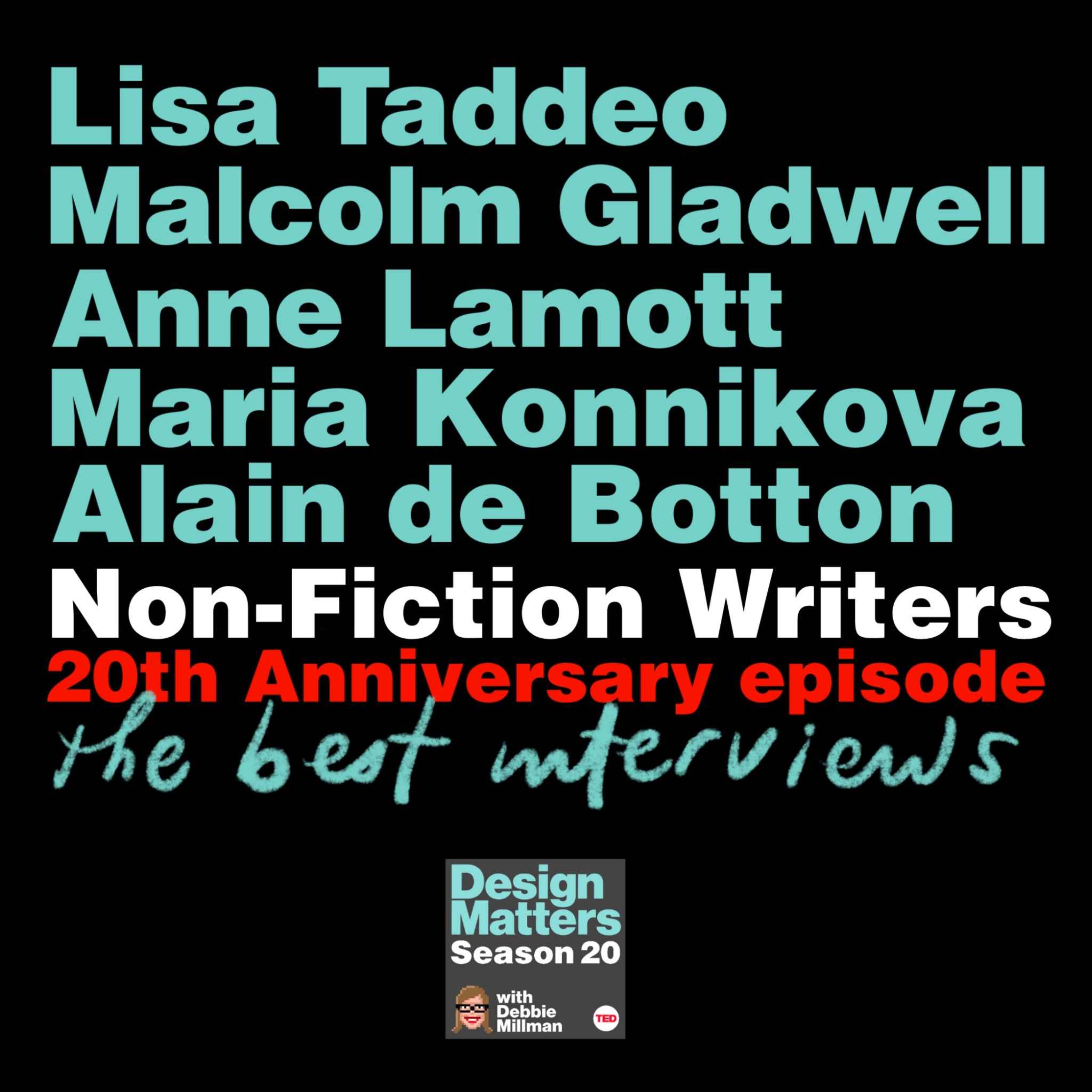
Design Matters with Debbie Millman
20th Anniversary celebration with non-fiction writers Lisa Taddeo, Malcolm Gladwell, Anne Lamott, Maria Konnikova, and Alain de Botton
00:49:37
Loading summary
Transcript133 lines
- [00:01]
Alain de Botton
What makes sex exciting is really the sense of someone allowing you into their life.
- [00:08]
Lisa Taddeo
She remembered every second, but she also wanted it recorded in the world.
- [00:16]
Debbie Millman
From the TED Audio Collective, this is.
- [00:18]
Malcolm Gladwell
Design Matters with Debbie Millman. On Design Matters, Debbie talks with some.
- [00:25]
Debbie Millman
Of the most creative people in the.
- [00:26]
Malcolm Gladwell
World about what they do, how they got to be who they are, and what they're thinking about and working on. In this episode, in celebration of Design Matters 20th anniversary, we'll hear from some of the terrific nonfiction writers that Debbie has interviewed over the years. When we're making high stakes decisions about strangers, we might be better off not meeting them.
- [00:46]
Maria Konnikova
And socially, that societies with higher levels of trust end up doing better economically.
- [00:52]
Anne Lamott
Families Hard Hard.
- [01:01]
Debbie Millman
Botox Cosmetic Adobotulinum Toxinae FDA Approved for over 20 years so talk to your specialist to see if Botox Cosmetic is right for you.
- [01:11]
Alain de Botton
For full prescribing information including boxed warning, visit botoxcosmetic.com or call 877-351-0300.
- [01:20]
Debbie Millman
Remember to ask for Botox Cosmetic by name. To see for yourself and learn more, visit botoxcosmetic.com that's botoxcosmetic.com hi listeners, it's your host, Debbie Melman. Thank you for listening to this episode. To hear more episodes like this one, you can follow Design Matters on Amazon Music or just ask Alexa play Design Matters on Amazon Music. Now onto my conversation. Over the 20 years I've been hosting Design Matters, I've interviewed a lot of writers, novelists, poets, playwrights and more. I've also interviewed a good number of non fiction writers. These are writers who dive deep into a subject and bring us back their findings in polished, beautiful prose. My first guest is Alain de Botton. The Swiss born British author has written irresistibly compelling books about everything from status anxiety to the consolations of philosophy. De Botton also writes fiction. When I interviewed him in 2016, he had just published his novel the Course of Love. This gave me an opportunity to talk to him about love and about how he developed into a writer with so much range. He studied history at Cambridge University and went on to get a master's degree in philosophy at King's College in London and then began a PhD program in philosophy at Harvard, which you eventually discontinued. What were you imagining at that time you wanted to be look like many.
- [02:59]
Alain de Botton
Young people with a kind of cultural and aesthetic interest. I imagined that academia was going to be nirvana because these guys were going to pay you to do the stuff that it was lovely to do anyway. Reading books writing, etc. And then I quickly realized that really there was a mass deception going on and that academia had collectively got together to try and make this supposedly lovely thing as unpleasant as possible, simply because they had a massive problem of over subscription. So the only way to deal with over subscription is to make you jump through so many hoops and make those hoops so unpleasant that only the most determined survive. Look, ultimately I felt that the sort of things I was interested in, though they made use of the humanities, weren't actually things that needed to be interpreted in an academic way, that the academic strictures, the footnoting, etc. Took away from the force of what I was trying to say. They didn't help it.
- [03:57]
Debbie Millman
And so was there an intention, a very specific intention, to become a writer?
- [04:02]
Alain de Botton
I was really confused because of course, when you say you want to be a writer, people automatically go, well, that means you're a novelist. And then there are these few, you know, sub genres of nonfiction, but they have much lesser status and the field is often occupied by so called professionals. So I didn't really know how I would fit in. And I tell you, the career of one person in particular was absolutely decisive to me, and that's the French theorist, essayist and writer Roland Barthes, who liberated me. And I remember that as a young man I would have all his books on my shelf and I would sometimes look at them just to gain inspiration, just like a religious person might look at an icon to fill themselves up. And so he really gave me courage, not so much for what he wrote, but the forms, the inventiveness. He was a man who might write a beautiful essay on photography, and then he might move to an essay about Japan and then a book about Balzac, et cetera. And I thought, this is the sort of life that I would like to live. And so, as I say, I can't underestimate the role that Holland Barthes had at a certain point in my career in giving me courage.
- [05:04]
Debbie Millman
In your book, How Proust Can Change youe Life, you ask this question in the chapter how to Be Happy in Love. How long can the average human expect to be fully appreciated? And the answer? Often as little as one quarter of an hour. So we metabolize love. We metabolize everything.
- [05:24]
Alain de Botton
That's right. I mean, one of Proust's concerns, and this is what makes him such a fascinating artist and quintessential artist, is that he's aware of how much we fail to appreciate the beauty and interest of things that are too often around Us. And he understands art as a mechanism that can restore beauty and interest to things that have been unfairly neglected. And that's how he reads the history of art. So when he reads the Impressionists, for example, he understands that these are people who, who looked at ordinary scenes, wind blowing through a tree or a bunch of asparagus on a sideboard, and they were able to reawaken us. And he very, in a very humane and fascinating way, his argument is we shouldn't go and appreciate simply the works of art at the Louvre or the Musee d'. Orsay. What we should do is learn art's general lesson, which is its power to reanimate our relationship with the world.
- [06:20]
Debbie Millman
You often speak of the importance of understanding one's own psychology. Are there questions that you ask yourself that help guide you to better understand your own psychology with regards to love and work? Do you go to analysis? Do you examine that for yourself?
- [06:37]
Alain de Botton
I've been to analysis for many years and think it's a tremendous discipline because what it does is to give you a tool with which to understand yourself, because another person's interest and curiosity makes you more interesting to yourself. I mean, the very fact that you're asking me these questions, for example, now, is forcing me, leading me to go into my own mind. Normally, one hovers on the outside of consciousness. When there's somebody asking questions and listening carefully, you travel inside. And that is what therapy can help you to do. But it's not the only thing. I mean, there are versions of therapy that one does on one's own, including having a hot bath or going on a country walk, or simply lying in bed with a pen and paper and downloading the contents of one's mind. All these are forms of mental self investigation.
- [07:24]
Debbie Millman
Ella, you pose a question. Why do we kiss people? Why do we kiss people? My question to you, why do we kiss people?
- [07:32]
Alain de Botton
This is a question that really goes to the heart of what is sex about? And at one level, sex is, you know, looked at from 30,000ft, a highly peculiar thing. There's so much interest in touching bits of somebody else's body and why let alone rub lips and hold hands and what's going on here? And the way I read it is I think that what makes sex exciting is really the sense of someone allowing you into their life. And the backdrop to sex is loneliness, a feeling of our unacceptability and our sort of alienation from others. You can analyze almost any so called sexy situation through that lens. You know, why is it interesting to be kissed or to kiss. It's because normally people's mouths are such an area of taboo. They're so central through space through which we speak and eat and breathe, and yet to be inside somebody else's mouth is just. Well, it sounds revolting.
- [08:32]
Debbie Millman
We don't really like dentists very much, do we?
- [08:33]
Alain de Botton
We don't like dentists. It's intensely private. And to give somebody permission to be there, it's a way of saying, I accept you in my life. And that isn't just psychologically interesting, that then becomes erotic. But I think the psychological excitement is what comes first. Eroticism is really the physical manifestation of psychological excitement. You know, oral sex, for example. Again, what's going on there? Why would that be particularly exciting? It's exciting because it's permission. It's like the so called dirty, shameful, private side is being accepted and witnessed by another person. And this is a vital corrective to haunting feeling of loneliness which pursues all of us all the time.
- [09:15]
Debbie Millman
But it's interesting that the behavior or the act of sex, in many cases in relationships, helps cement that relationship and create an intimacy and a exclusivity. And that has very little to do with procreation, especially if you're not in a heteronormative relationship.
- [09:39]
Alain de Botton
That's right. And of course, sometimes it leads people to impatience and to a feeling of why does this act need to be so sacred? Why can't we just share it with lots of people?
- [09:49]
Debbie Millman
Well, that's the center of polyamory now as well.
- [09:51]
Alain de Botton
And our age is impatient and is looking for answers. And before there was polyamory, there was free love. And you know, there's always been a wing, a side of human nature that goes, well, essentially it's in rebellion against possessiveness and jealousy. I almost think that it's like trying to argue with the waves. I mean, they will be stronger than you and you know, you go out there and try. But I think we have to accept jealousy as a demented force that is within us and we can't reason with it. But you know, there is a real difference between playing tennis with someone and having oral sex with someone. It may not look it and it's. It's in a way seems a bit arbitrary, but let's not get too reasonable about it. There is a difference.
- [10:31]
Debbie Millman
There's also a big difference with who we bring to that room where we are having our oral sex. Because it seems in both on love and the course of love, and certainly my own experiences of love, the person you bring to that early Relationship is not the person that you are. And you write, every fall into love involves the triumph of hope over self knowledge. We fall in love hoping we won't find in another what we know is in ourselves all the cowardice, weakness, laziness, dishonesty, compromise and stupidity. We throw a cordon of love around the chosen one and decide that everything within it will somehow be free of our faults. And then you go on to say, what is so frightening is the extent to which we may idealize others when we have such trouble tolerating ourselves.
- [11:24]
Alain de Botton
That was me at 22. Where do we go from there? And I think this is my latest thought on this, is that I think that there are relationships with which force you to be fully acquainted with the most damaged and difficult sides of another person. And those are what one you call a marriage or a long term relationship or a real commitment, especially when there are children. You then cannot escape it. You can't edit yourself in front of another person. The constraints of it. You're sharing the bathroom, you're sharing the bedroom, you're with each other all the time, there is nowhere to go. And one way to interpret that is to say, well then you're seeing the real person. And so in a way that's great, but I also want to hold onto the idea that sometimes we should be allowed to edit ourselves and that there could be relationships where two people decide that they don't necessarily want to expose one another to the full extent of their disturbances, that they may want to say, let's call it a day, you know, we've, we spent three days together. Let's see, I'll next see you in five days. I just need a little time. And rather than this being an abandonment of love or an abandonment of intimacy, it could be seen as a desire to protect your partner from your more damaged and damaging sides.
- [12:45]
Debbie Millman
The endlessly fascinating Alain de Botan. In 2016, I also interviewed Maria Konnikova, who writes about science and psychology. When we spoke, she had just published her book the Confidence why We Fall for It Every time. This subject gave me an opportunity to make an embarrassing confession. You've been asked many, many times in many, many interviews if you've ever been conned and your response is you don't know. Yep, you might have been such a good conn that you don't know that you've ever or never been conned.
- [13:19]
Maria Konnikova
Absolutely. And I think that's true of most people.
- [13:21]
Debbie Millman
I've been conned. The first year I came to New York City, I'm A native New Yorker, but I had never lived in Manhattan until I graduated college. And it was the winter after I'd graduated. So it was January, 1984. I'd been in New York about three or four months. I was so broke that I had to decide what I was going to use. The money that I had for paying rent, paying for my student loan, or eating. And I was in a really bad place. I had $400 to my. That's all I had. I was coming from an interview. I was desperate to find a job. It was winter. I was wearing a big puffy coat and heels, but I had walked on those pumps so much that the heels were worn down. And rather than the rubber tips, they were steel tips. And so it was very, very hard for me to walk on what was really icy sidewalk. I got pushed over by someone. Two women came to my rescue and made some disparaging remark about the person that sort of pushed me by accident, but maybe not. And then walked away and didn't even stop to help me. They both stopped to help me. I didn't know that they knew each other. And the con began. It was an all afternoon con wherein one of the women then showed me a wallet that was filled with money. And she had found it and didn't know what to do about finding this wallet. Classic, classic. The magic wallet. Somehow with a magic wallet. So, you know, you know, it's a classic con. And I got conned into somehow giving them my $400 to somehow get some of the money that was in their wallet. And I was supposed to go meet somebody that they knew and went to the office where I was supposed to meet this person who was then going to give me some of the money. And of course, I walk into this office and I'm like, is so and so there? And they're like, who? And I knew. And then I didn't realize because I'd had this envelope that felt like there was money in it that was in exchange for the money that I had because of the serial numbers and God only knows what the actual thing was that I believed with all of my heart and all of my soul. And I thought, well, at least I still have the money in the envelope. And then I opened the envelope and it was newspaper. It was newspaper. I lost everything. Oh, no. And I didn't have to tell anybody because I was so ashamed, of course. How could I have been conned?
- [15:59]
Maria Konnikova
Well, that's one of the reasons I wrote the book. I want to take away the shame and I want People to feel empowered, not to feel like marks, but to feel like victims. Because think of the difference in the terminology. Mark is very impersonal. You are just, you know, you've got a bullseye on your head, and you're just another thing that's in my way. Victim gives you, I think, the power to say, yeah, this happened to me, and it wasn't because I was greedy or stupid or anything like that. It could have easily been you, because we look at you, you are remarkably smart, accomplished. You know, you are.
- [16:36]
Debbie Millman
It's all interpretation, right? Maria? Anybody listening to this podcast?
- [16:43]
Anne Lamott
Like, what a moron.
- [16:45]
Debbie Millman
She fell for the wallet con when she was 21.
- [16:48]
Maria Konnikova
But it happens. I mean, I write about a woman who went on to become a senior editor at Scientific American, got a PhD in sociology, who fell for three card Monty on her first day at Manhattan. That was scary.
- [17:00]
Debbie Millman
Yes. And then the wonderful art dealer who was conned by the forgeries. This quote in the book actually gave me some sense of redemption. I want to read it because it's so beautifully written and such a wonderful. The real confidence game feeds on the desire for magic, exploiting our endless taste for an existence that is more extraordinary and somehow more meaningful. But when we're falling for a con, we aren't actively seeking deception, or at least we don't think we are. As long as the desire for magic, for a reality that is somehow greater than our everyday existence, remains, the confidence game will thrive. And I know that's what I wanted. I just wanted a better possible future. But it was, I think, motivated by greed because I wanted more money than I had, and I wanted it to come in an easier way than I'd been able to fathom.
- [17:59]
Maria Konnikova
Well, yes and no. I mean, as you analyze it now, you can say, well, it was greed, but in the moment, I don't think it was greed.
- [18:05]
Debbie Millman
Hope, yeah.
- [18:07]
Maria Konnikova
You trusted things gambling, you trusted these women. They always phrase it in ways that's perfectly legitimate and that the only thing that you're doing by turning over your money is it's a show of confidence, of trust in them. So you're being a good person and. No, but that's actually. That's how it works psychologically. And if. If someone is truly greedy, I think it would be very, very difficult to get them to part with $400.
- [18:32]
Debbie Millman
You described the confidence game, the con, as an exercise in soft skills, trust, sympathy, and persuasion. And you state that the true con artist doesn't force us to do anything. He makes us complicit in Our own undoing. He doesn't steal. We give. He doesn't have to threaten us. We supply the story ourselves. We believe because we want to, not because anyone made us. And so we offer up whatever they want. Money, reputation, trust, fame, legitimacy, support. And we don't realize what is happening until it is too late. Our need to believe, to embrace things that explain our world, is as pervasive as it is strong. Given the right cues, we're willing to go along with just about anything and put our confidence in just about anyone. Maria, why do we do this? Why do humans do this?
- [19:31]
Maria Konnikova
This sounds so depressing when you read it like that.
- [19:35]
Debbie Millman
I actually think it sounds awesome.
- [19:38]
Maria Konnikova
Well, I think that we do it for a few different reasons. One that I was actually really, at first, very surprised to find is that we're wired to trust. That's our default state.
- [19:48]
Debbie Millman
Isn't that interesting?
- [19:49]
Maria Konnikova
It was really interesting. And after I did the research and explained it, it's intuitive. You understand why it's the case because for society to move forward, we need to forge bonds with one another. We need to trust one another. That's how you build commun. How you can protect each other. I mean, we sleep. You know, we spend so much of our time sleeping. Someone needs to protect us. You know, you need to trust that that person's not going to kill you. And you see all of this research that shows that trust goes along with intelligence, health, happiness, better life outcomes, and socially, that societies with higher levels of trust end up doing better economically. And that makes a lot of sense once you think about it. But it also means that when someone's out to deceive us, we're much less likely to question it. So I think that's one part of it. And the other part of it is it's not just that we want to believe. And I think that's true. We all have this positivity bias about ourselves and about the world, that we are slightly better than average or a lot better than average at everything. One of my favorite studies in the book, It's Just One or two Sentences, was about a group of researchers who went to a hospital and interviewed people who had just gotten into car accidents. And over two thirds of them had caused the accident. And they asked them the how good a driver are you? And almost everyone said, I'm far above average. And these were people who just caused an accident. There was no difference whether or not they'd caused it or been the victims of it. And that just. That illustrates how strong that bias is. And so when we think if something's too good to be true, it probably is, we only apply it to other people. When it comes to ourselves, nothing's too good for us.
- [21:31]
Debbie Millman
You write at length about the dark triad of confidence games and how a con artist's brain is actually different than that of a normal person, so to speak. Can you elaborate on the dark triad?
- [21:43]
Maria Konnikova
Absolutely. So the first. The first element of it, which is what makes the brain a little bit different, is psychopathy. And not all, by the way. It's a Venn diagram. So not all con artists are psychopaths. I think that they. They have some of the dark tribe, but not necessarily all three. And psychopathy is a lack of empathy. You're not experiencing emotions the way that other people do, so you don't feel guilt, you don't feel remorse. You know, the women who took your $400 don't think anything of it.
- [22:11]
Debbie Millman
So they don't start feeling bad for anything to you.
- [22:14]
Lisa Taddeo
Not at all.
- [22:15]
Debbie Millman
That's harmful.
- [22:15]
Maria Konnikova
Yes. By the way, those women were probably not psychopaths, because women are almost never psychopaths.
- [22:21]
Debbie Millman
But they might have been desperate for their own money.
- [22:23]
Maria Konnikova
Absolutely. But that illustrates the point. It allows you to take advantage of people because you really feel absolutely no remorse whatsoever about doing so. And the second part of it is narcissism, which isn't just what we think of as narcissism, which is my mind, overblown ego. It's also a sense of entitlement. So I say, you know what? That $400, it rightly belongs to me. I'm not stealing it from you. I'm just going to take it because I deserve it more. It's going to be better in my hands. And so I write about some imposters who steal PhDs, who steal medical credentials, who steal all sorts of credentials.
- [23:01]
Debbie Millman
He's a teacher that went around pretending he was a Physics PhD. School after school, after school. It's unbelievable.
- [23:08]
Maria Konnikova
And people gave him tenure. I want tenure.
- [23:12]
Debbie Millman
And he seems to have the pick of the litter between you two and Colorado.
- [23:16]
Maria Konnikova
And it's incredible, but his thought process is, I'm smarter than the people with the PhDs. Why not just take one? Why do I need to work for it?
- [23:24]
Debbie Millman
And when he finally got caught, he was, well, the system allowed this to happen.
- [23:28]
Maria Konnikova
Exactly.
- [23:29]
Anne Lamott
Exactly.
- [23:29]
Debbie Millman
I didn't do anything wrong.
- [23:30]
Maria Konnikova
It was the system. It wasn't me. And you know what? He's right. He did do something wrong, but he's right that the system allowed it to happen, and then the final part of it is Machiavellianism, and those are your soft skills that you and I were talking about, the soft skills of persuasion. Can I manipulate you and get you to do what I want you to do, but without your realizing that I'm manipulating you so that you think that you're doing what you want to do? No one wants to be manipulated. No one likes being manipulated. If I sense that you're manipulating me, I'm going to bristle. I'm gonna be actually really upset. I'm not gonna do what you want. But if I think that I'm doing it myself, well, then I'm very happy to do it. I'm so smart. I had this brilliant idea, you know, why don't I give you $400? And that's what they're so brilliant at. I think most, if not all, con artists are Machiavellians, because you almost have to be. That's how you get others to put their confidence in you.
- [24:26]
Debbie Millman
Maria Konnikova, who went on to write a book about poker and became a professional poker player. Anne Lamott writes both fiction and nonfiction. In her nonfiction, she is often autobiographical, and she takes on some hard topics. Addiction, single motherhood, faith, and depression. I spoke with her in 2018, shortly after the publication of her book Almost Everything Notes on Hope. So, Anne, in 2015, on the eve of your 61st birthday, you decided you would write down every single thing, which was A list of 14 points published on Facebook. It went viral, it was shared 100,000 times, received more than 11,000 comments, and eventually led to a TED Talk on the subject. And I'm wondering if you would be up for reading a few of the points on the list.
- [25:21]
Anne Lamott
Yeah, I really made. I made a list because I wanted to share with my little grandson, who was 6 at the time, and my niece what I thought might really help them as they're coming up, because there's just so little truth out there. And so I'm just gonna read these three, and you can see the truth in these three points.
- [25:39]
Debbie Millman
Wonderful.
- [25:40]
Anne Lamott
1. Life is a precious, unfathomably beautiful gift, and it is filled with heartbreaking sweetness and beauty, floods and babies and acne and Mozart all swirled together. 2. Almost everything will work again if you unplug it for a few minutes, including you. 3. There is almost nothing outside of you that will help in any kind of lasting way, unless you are waiting for an organ you can't buy, achieve, or date it. This is the most horrible truth. I'll read a little bit of the fourth. Well, I'll just read the first sentence of the next three. Everyone is screwed up, broken, clingy, and scared. Even the people who seem to have it more or less together. They are much more like you than you would believe. So try not to compare your insights to their outsides families. Hard, hard, hard, no matter how cherished and astonishing they may also be. And last grace. Grace is spiritual. WD40, its water wings. The mystery of grace is that God loves Dick Cheney and me exactly as much as he or she loves your grandchild. Go figure. The movement of grace is what changes us, heals us in our world. To summon grace, say help, and then buckle up. Grace won't look like Casper the Friendly Ghost, but the phone will ring or the mail will come. And then, against all odds, you will get your sense of humor about yourself back. Laughter really is carbonated holiness, even if you are sick of me saying it.
- [27:13]
Debbie Millman
Anne, this is one of your great gifts to the world. It really is. I am. I can't even begin to tell you how many times I've listened to this talk of these points. This book has been described now as the book we need from Anne Lamont. And in the prelude to Notes on Hope, you write, there is the absolute hopelessness we face, that everyone we love will die, even our newborn granddaughter, even as we trust and know that love will give rise to growth, miracles and resurrection. Love and goodness and the world's beauty and humanity are the reasons we have hope. Yet no matter how much we recycle, believe in our priuses, and abide by our local laws, we see that our beauty is being destroyed, crushed by greed and cruel stupidity. And we also see love and tender hearts carry the day. Fear against all odds leads to community, to bravery and right action, and these give us hope. Are you feeling any optimism in these times, or how can you feel optimism in these times?
- [28:16]
Anne Lamott
I always feel optimism, and I also am absolutely stunned and horrified by the Trump administration. There, I said it. I wasn't going to name names, but I'm horrified. I'm angry. I march, I send money off to organizations that I hope will bring it all down. And I feel just like everybody does about it. And I also remember, as a radical act, how much is really beautiful and touching and precious and. And I go outside and I make myself look up. And the first line of the book is that I'm stockpiling antibiotics for the apocalypse. Yeah. Even as I'm waiting for the paper whites to bloom in the kitchen. And the second chapter is that all Truth is paradox. And these are terrible, terrible times. And they're also the best times. I fell in love at the ripe old age of I'm getting married and I'll be 65 three days earlier than my marri and he's a year younger in three months and a year so that he'll be 63 and I'll be 65. And I have an unbelievably fabulous grandchild who lives with us half time. And the medicine that has come up has saved more people than I can. We have had literally miracles upon miracles at our church because of chemotherapy and vaccines. I love vaccines. I love Cipro. I want to say I love. I just got a shingles vaccine. I will, I will be so happy for the rest of my life, every day that I don't get shingles. And so. And I'm loved. I mean, the people that love me are just great people. I can either believe what I secretly think about myself on down days or I can believe what my how my friends see me, which is as a magical, brilliant, tenderhearted person. It's a bit of a choice to have hope.
- [30:19]
Debbie Millman
Well, you've said. This is how you describe finally coming into yourself. Mess, failure, mistakes, disappointment and extensive reading, limbo, indecision, setbacks, addiction, public embarrassment, and endless conversations with your best women friends. The loss of people without whom you could not live, the loss of pets that left you reeling, dizzying betrayals, but much greater loyalty. And overall, choosing as your motto William Blake's line that we are here to learn, to endure the beams of love. I think that's just perfection.
- [30:55]
Maria Konnikova
Perfection.
- [30:57]
Debbie Millman
Since you talked about Neil, one quote of yours that I read that was absolutely hilarious was that you were thinking of registering with Walgreens or Jack's Drugs in San Anselmo, which has a great selection of orthotics and durable medical equipment. I mean, you're only 65. Where you're gonna be only 65, that's not so bad.
- [31:20]
Anne Lamott
Yeah, I know, but we don't really need anything. We don't need more plates, you know, we don't need silverware or cloth. Cipro.
- [31:27]
Debbie Millman
Cipro. Give Anneal. Cipro.
- [31:29]
Anne Lamott
Cipro. And a cane.
- [31:31]
Debbie Millman
Yeah. The legendary and luminous anne Lamott in 2018. Malcolm Gladwell is the celebrated author of many best selling books including the Tipping Point and Blink, among other things. He is the great explainer of complex ideas from the disciplines of psychology and the social sciences. Malcolm has been incredibly generous to me and has been a regular guest on the show since season two. This conversation is from 2019, not long after he published Talking to Strangers. What we should know about the People We Don't Know. I want to talk to you about some of the case studies in your book. You talk about how in Pre World War II Germany, British leaders met with Hitler and they believed him when he stated that he had no desire for war. And you detail how some people were deceived by Hitler and some were not. And the puzzle you outline is that the group who were deceived are the ones you'd expect not to be, while those who saw the truth are the very people you think would be deceived. And you go on to declare the this could all be a coincidence. Of course they were determined to see Hitler the way they wanted to see him, regardless of the evidence of their eyes and ears. Except that the same puzzling pattern crops up everywhere. Can you elaborate on what that puzzling pattern is?
- [33:01]
Malcolm Gladwell
Yeah. So there at that point in the book, I'm trying to account for the fact that face to face encounters with strangers seem to yield far less value than we would imagine. In fact, they very often seem to yield negative value. That is to say, we appear to be worse off in our estimations, in the accuracy of our estimations of others after meeting them than if we never meet them at all. So in the case of Hitler, the people who completely misunderstood Hitler were the ones who met him. And, and virtually everyone who saw Hitler for really who he was in the years before World War II were people who never met Hitler. So that's a little bit of a puzzle. Right, because we structure our society on the assumption that it's crucial to meet someone, a stranger, face to face if we ought to make sense of the stranger. Every single company that makes a hire of consequence does so after a face to face job interview. Right. But the evidence, I then go into the evidence using judges making bail decisions of defendants pointing out that all of the evidence would suggest that when judges meet defendants face to face, they actually do a worse job of understanding whether they should be given bail or not than if they had never met them face to face and only looked at their criminal record. That's pretty sobering, and it's a kind of radical thought to think that, you know what, when we're making high stakes decisions about strangers, we might be better off not meeting them.
- [34:32]
Debbie Millman
I mean, that's, I think, also why Freud wanted his patients to sit on a sofa facing away from him. So there wouldn't be that constant assessment analysis of how you're reacting to what I'M saying and what you think about what I'm saying, which we obviously always get wrong anyway. And just the notion of being able to tap into the unconscious was easier if you weren't constant reflecting on the machinations of the physical interaction.
- [35:00]
Malcolm Gladwell
Yeah.
- [35:01]
Debbie Millman
What can the television show Friends teach us about strangers and communication?
- [35:05]
Malcolm Gladwell
Oh, that was the Friends chapter of my book. Is the only light chapter in the book. Although it quickly gets into a murder case.
- [35:12]
Debbie Millman
I was going to say it's kind of terrifying.
- [35:15]
Malcolm Gladwell
But that chapter was an attempt to explain a paradox, which is Friends. If you ever ask someone to explain the plot of an episode of Friends, it is insanely difficult. Takes, like, forever. They need a flowchart. It's like so much happens, right? And yet at the same time, no one. No one has ever said at the end of an episode of Friends. Oh, my God. So much of that went over my head. I gotta watch it again.
- [35:43]
Maria Konnikova
It's not like Game of Thrones.
- [35:46]
Malcolm Gladwell
You always get it.
- [35:47]
Maria Konnikova
It.
- [35:47]
Malcolm Gladwell
Even though it's complicated. Why? So what I did is I took an episode and I gave it to a psychologist who studies facial expressions and had her go through and code the facial expressions. There's a whole language for describing people's facial expressions.
- [36:01]
Debbie Millman
That was a very complicated part of the book.
- [36:03]
Malcolm Gladwell
Yeah.
- [36:04]
Debbie Millman
A3U.
- [36:05]
Maria Konnikova
Yeah.
- [36:06]
Debbie Millman
It was really scary.
- [36:07]
Malcolm Gladwell
Every muscle of your face has a number. And so you can. I can look at your face and I can score it. Do a notation of all the muscles you're using right now.
- [36:15]
Debbie Millman
Now.
- [36:15]
Malcolm Gladwell
And what I was interested in figuring out is when someone experiences an emotion on Friends, is it expressed reliably and accurately on their face? And the answer is absolutely. Every time when Joey is perplexed, Joey's face looks perplexed. When Ross is angry, his brow furrows, his eyes narrow and his lips are stretched and his mouth grows hard, you know? Or when Phoebe is surprised, her jaw drops, her eyes go wide and her eyebrows go up. Right? They do this perfectly. So that's why you can follow along even though it's complicated. Because they are giving you this real time emotional guide to the plot. Right. In fact, you can turn the sound off on Friends and still follow it because everything is done so insanely transparent that they'll give you two cracks at every emotional state. Right. The way it's acted out and the way it's expressed on their face. That is not the way things are in real life. I may be experiencing a very complicated emotion right now, but there is no reason to believe it's expressed on My face.
- [37:27]
Debbie Millman
Do you think that the success of Jennifer Aniston and all of the rest of the stars had something to do with their talent, or do you think it was the direction?
- [37:40]
Malcolm Gladwell
Well, I think that in a sitcom, in a primetime sitcom like Friends, you are required to act in a transparent way. In other words, the form asks for a kind of literalness in the way actors present themselves. If you're doing a weird German indie film, the same rules do not apply. You know, there's a great deal of ambiguity there in the way people express themselves. But there is a. You know, the rules of engagement for Ross and Phoebe and Monica and whatever in Friends are that if the scene calls for you to be happy, you have got a smile and your face has got to light up. You can't. You can't do some ambiguous thing.
- [38:22]
Debbie Millman
Do you think that that could work? This kind of test could work with Grey's Anatomy or with Seinfeld or. Yeah.
- [38:30]
Malcolm Gladwell
Mainstream television is an art form that calls for this kind of transparency. Because we watch. Have watched so much of that, we have come to the false belief that we can read people by looking at their faces. And that causes a huge amount of problem when we're dealing with strangers because we think that we can look into their hearts by reading their faces, and we can't because they're not Joey.
- [38:58]
Debbie Millman
Right.
- [38:58]
Malcolm Gladwell
It's not that way.
- [39:00]
Debbie Millman
You explore this notion of what you call matched versus mismatched people. Can you talk a little bit about what that means?
- [39:07]
Malcolm Gladwell
Yeah. So this is Levine's idea. He digs in further and he says, okay, so what this default to truth means is we're gonna have a lot of trouble spotting liars. And sure enough, we do. Right? But then he goes even further. He says, in fact, it's more interesting than that. He says there are some people we get right? And he calls those people matched people. And matched people are people who are like the characters in Friends, who, when they're happy, their face lights up and when they're sad, they have perfect frown. And when they're lying, they get red in the face and stammer and look away and get all nervous and jiggle their feet and they're like. It's just obvious, right? But he said there's another category of people he calls mismatched. And these are people who do not have a reliable correspondence between their body language and their internal emotional states. And those people, we always get wrong.
- [39:58]
Debbie Millman
Now, do you think that those people are acting or are they just operating with different motivations or unconscious motivations? In terms of how they, how they're perceived.
- [40:09]
Malcolm Gladwell
In some cases it may be people acting. I think in most cases it's just the way they're built. You know, I think many of us are mismatched in certain circumstances. You know, we all have different ways of expressing emotion. And one of the things that happens in a friendship is that you come to understand all the ways in which your friend is idiosyncratic. Right. Friendship is the, is the never ending process of revising our understanding of someone we are close to. Right. You're constantly updating your database on this person who you're friends with. Right. Each time you notice some anomalous event, you're like, oh, when my friend Steven is unhappy, he doesn't show it in the same way. I'm used to it. Maybe he stammers or maybe he, you know, there's all kinds of. That's what friendship is.
- [41:02]
Debbie Millman
That's what love is too. When Roxanne doesn't include an exclamation point and okay, I don't assume she's mad at me anymore.
- [41:07]
Malcolm Gladwell
Anymore. Yes, that's right. You updated your Roxanne database. Yes, yes. But we don't have a database on strangers.
- [41:14]
Debbie Millman
Right.
- [41:15]
Malcolm Gladwell
And so we're left with this extraordinarily complex and noisy source of information on them. And so that's why it's so incredibly problematic to draw high stakes conclusions from strangers because we just don't know enough about their idiosyncrasies.
- [41:32]
Debbie Millman
Malcolm Gladwell we started this episode with Alain de Botton talking about love. And we're going back to that interesting topic with journalist and author Lisa Taddeo. In 2019, I spoke to her about three women. Her book about the sex lives of three very different American women. One of the other commonalities that I felt among the three women was their pervasive sadness. They all have a very deep sense of almost defeat. Would you say that that's correct?
- [42:07]
Lisa Taddeo
No, I mean Lena's incredibly, Lena had, Lena was going after this man full throttle. She had a terrible couple of weeks during it when she was nearly suicidal. The rest of the time, and I still talk to all three of them the rest of the time, Lena's quite happy. She gets a little things happen that make her sad. But at that point in her life, and that's the thing, the reason that you, these three were willing to talk as much as they were is because there's pain. You know, you want to talk about that when you're totally happy. You don't really need to talk about it.
- [42:42]
Debbie Millman
And I don't think people are that interested in reading about happy people.
- [42:45]
Lisa Taddeo
That's the thing. People are like, why don't you have happy marriages? I'm like, because. Well, first of all, I think Sloane's is an incredibly happy marriage. There's confusion, as there is in any relationship. But the thing I always say is that her husband tells her every day that she's his fantasy. That's a huge thing. You're my fantasy above all.
- [43:05]
Debbie Millman
Yes.
- [43:06]
Lisa Taddeo
He wants to. You know what she said to me was, hey, you know what? So, yeah, he likes to watch me have sex with other people, but he does a lot for me. And, like, so what? You know, and it makes her feel weird. But if she at any point said, I don't want to do this anymore, he wouldn't leave her or get angry because part of her likes it, too.
- [43:25]
Debbie Millman
I have been all of a sudden, in the same way that maybe 24 months ago, we started reading and hearing all about polyamory. Now, I don't know if it's because of your book, but all of a sudden, I'm reading all about this whole Cook holding thing, which is when a man likes to watch his wife have sex with other men. Why is. I mean, from a psychological perspective, do you understand that need?
- [43:50]
Lisa Taddeo
I think, yeah, psychologically, I do. I understand it because I've talked to a few of them. I was very interested in going into depth with that. I had a couple like that. Esther Perel talks a lot about with women, the idea that once you are. Once you feel safe, you start to feel a little bit bored sexually. And that's true for men, too, but for women, it's very true, is what she's found and what I found, too. It's like you go after safety your whole life, and then you get it, and you're like, what can I do? So with men, it's. I think it's more. Some men are incredibly, incredibly jealous. And other men, they use that jealousy to fuel their sexuality in a way. So I think that seeing that happen is a way of one. I think it's like, okay, look, let's say our relationship is. At one point, it's immutable that it's going to. One person's gonna cheat on the other, which I'm not saying that's true, but that's a feeling that a lot of them said they have. Then at least let me just open it up now. Let me watch the very thing that I fear.
- [45:00]
Debbie Millman
Did you find in all of Your research and all of the subjects. Any woman that wanted to watch her husband having sex with others?
- [45:09]
Lisa Taddeo
Oh, yeah. Yeah, definitely. There was a lot of that. In fact, in a lot of my readings, it's been interesting because I've had a lot of women who are older come up to me and say, this is what I've done with my husband. I've wanted to watch him have sex. There's been a lot of women who have said, why don't you talk to me? I'm like, I looked for you. I looked for a lot of people. So, yes, I did. I actually found more. Like I said, after the book came out, people felt more comfortable talking about it.
- [45:37]
Debbie Millman
Did anything surprise you about women's desires?
- [45:40]
Lisa Taddeo
Yes, I was surprised. And perhaps it's because, I mean, saying I'm prudish seems not true, because I like. But I am a little bit prudish. Not judgmentally prudish, just like, oh, wow. Oh, I didn't. Oh, that's interesting. That kind of like. And I found a lot of people to be a lot more adventurous than I thought that they would be by just kind of looking at them. There's a lot more sex going on at all times. Like, there's like. I was just. I was shocked at women specifically that I thought were kind of, you know, stay at home, hanging out. There was a mom that was in. That was one of my. A friend of a friend, and she. She was just making out with other guys who weren't her husband. And I would never have thought that about her. She would go to, like, bars with her friends or even just a restaurant and, like, make out with a bartender. And I was like, really? You know, and I'm not gonna say her name, but, like, Jennifer. Oh, my gosh. And it was so. So I saw a lot of that.
- [46:38]
Debbie Millman
A lot of the book is rather steamy. Tell us how you regard writing about sex, especially if you feel like you're a bit more of a prude.
- [46:47]
Lisa Taddeo
Well, I'm not prudish in terms of writing or reading about it. I like to. What I wanted to do with writing about sex because there's a lot of, you know, bad sex. Writing bums me out. And what I wanted to read and write was to have something that was in between profane and clinical. So I didn't want to use the word that starts with a C. I don't know what the sort of.
- [47:12]
Debbie Millman
You can say whatever you'd like.
- [47:13]
Lisa Taddeo
Didn't want to use the word cock. And I didn't want to Use the word member, you know, I didn't unless the women specifically said them. But in terms of my writing about it, I just. I just didn't want to use it. And I wanted to describe as much as possible the sex from a kind of positional angle, from a kind of, like, the movement of bodies, and less the. When I read, like, hardcore, like, and then this just like porn, when it's hardcore pornography, like, it's a little bit this and like, softcore porn. At least in my. For me, it's like, oh, there's a story and it's softer. I don't necessarily need to see the National Geographic of it, but when I spoke to Lena, Lena's section is the most graphic. And the reason that it is is because she was the most who just, like, everything would tell me, thrust for thrust, what was going on immediately afterwards. And there's one section that I just copied and pasted from Facebook, which is where she'd written to me on, because I couldn't do it better than that. And she was so aware, not only of the bodily stuff and remembering every second the way that you do when you're in passionate thrall to somebody. She remembered every second, but she also wanted it recorded in the world. Not in a book, you know, necessarily, but she just wanted to have it said out loud. So she was finding herself in those moments after being raped, after not being touched for a decade. And so. So because she was finding herself in these moments, I felt like each moment was important. And I think that writing about sex specifically is the same way that I would write about anything specifically. If I'm writing about the way that you make kombucha, I would be very specific about it because it's interesting to me, the specificity. So the same thing is true of sex. Why not write about sex specifically? Most of us do it. That's the thing about this country. We have this puritanical hangover. And it's fine. Like, I get it. I grew up puritanical. But in terms of writing about it, and maybe it's because my parents have passed away, I'm like, well, whatever. I want to do it like this. I want to be true to what happened.
- [49:20]
Debbie Millman
Lisa Taddeo from 2019. You can hear the full interviews and nearly 700 other interviews with a vast range of writers and the most creative people in the world on our website, designmattersmedia.org or wherever you get your podcasts. It's hard for me to believe, but, yes, this is the 20th year we've been podcasting Design Matters and I'd like to thank everyone for listening. And remember, we can talk about making a difference. We could make a difference, or we can do both. I'm Debbie Melman and I look forward to talking with you again soon.
- [49:58]
Malcolm Gladwell
Design Matters is produced by the TED Audio Collective by Curtis Fox Productions. The interviews are usually recorded at the Masters in Branding Program at the School of Visual Arts in New York City, the first and longest running branding program in the world. The editor in chief of Design Matters Media is Emily Weiland.
- [50:22]
Debbie Millman
Botox Cosmetic Outobotulinum Toxinae FDA Approved for over 20 years. Talk to your specialist to see if Botox Cosmetic is right for you.
- [50:32]
Alain de Botton
For full prescribing information, including boxed warning, visit botoxcosmetic.com or call 877-351-0300.
- [50:41]
Debbie Millman
Remember to ask for Botox Cosmetic by name. To see for yourself and learn more, visit botoxcosmetic.com that's botoxcosmetic.com now you can.
- [50:53]
Malcolm Gladwell
Fly anywhere in the world and pay discount prices on your airline ticket. Book a flight today to London, Paris, Madrid or anywhere else you want to.
- [51:03]
Debbie Millman
Go and pay a lot less guaranteed.
- [51:06]
Malcolm Gladwell
Call The International Travel Department right now at Low Cost Airlines, 8002-1551-4180-0215-5141. That's 800-21551.