← Design Matters with Debbie Millman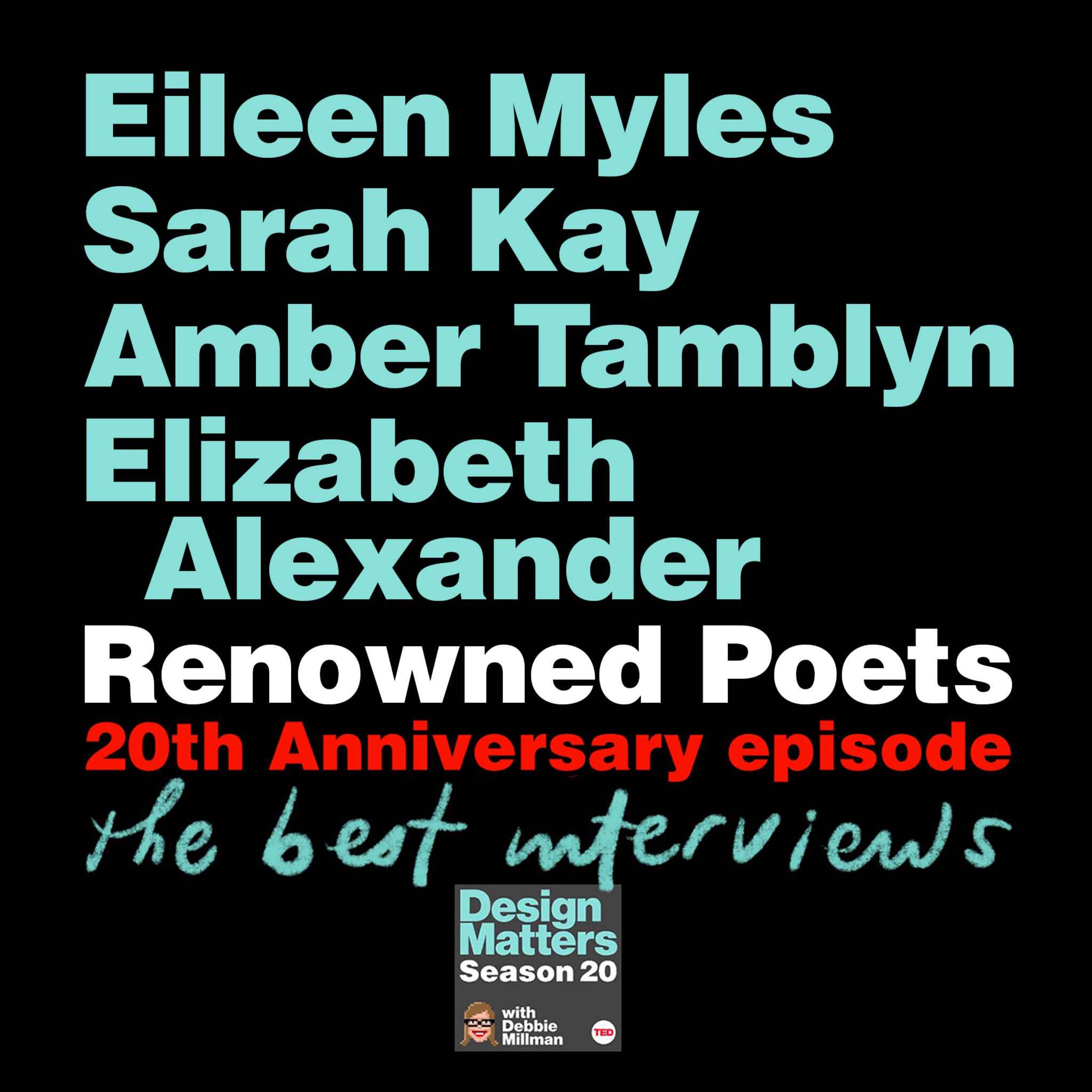
Design Matters with Debbie Millman
20th Anniversary celebration with renowned poets Eileen Myles, Elizabeth Alexander, Sarah Kay, and Amber Tamblyn
00:55:27
Loading summary
Transcript192 lines
- [00:01]
Elizabeth Alexander
Sometimes I almost remember it like I wrote it, rather than as it happened.
- [00:06]
Eileen Miles
In the DNA of Everything you write is everything else you're ever gonna write.
- [00:13]
Narrator
From the TED Audio Collective, this is.
- [00:15]
Debbie Millman
Design Matters with Debbie Millman.
- [00:20]
Narrator
On Design Matters, Debbie talks with some.
- [00:22]
Debbie Millman
Of the most creative people in the.
- [00:23]
Narrator
World about what they do, how they got to be who they are, and what they're thinking about and working on. On this episode, in celebration of the twentiet anniversary of Design Matters, we'll hear from some of the poets that Debbie.
- [00:36]
Eileen Miles
Has interviewed over the years.
- [00:38]
Amber Tamblyn
There was an entire part of myself that was dying.
- [00:40]
Sarah Kay
It felt like the whole room was communicating. There is room for you.
- [00:54]
Debbie Millman
This episode is supported by Harvard Business School Executive Education. Their programs create powerful connections for leaders around the world, strengthening both organizations and individual by deepening existing relationships and fostering new ones. Participants leave with lifelong friends, new potential business partners, and a powerful globe spanning network of fellow change makers. Learn more at HBS ME Learn. That's HBS ME Learn.
- [01:23]
Narrator
This podcast is brought to you by Wise, the app for international people using money around the Globe. With the WISE account, you can send, spend and receive in over 40 currencies with no markups and no hidden fees. Whether you're sending pounds across the pond, spending rials in Rio, or getting paid in dollars for your side gig, you'll get the mid market exchange rate on every transaction, plus most transfers arrive in less than 20 seconds. Join 15 million customers internationally. Be Smart, Get Wise Download the Wise app today or visit wise.com Ts and Cs apply foreign.
- [02:00]
Debbie Millman
This episode is sponsored by Gilt, your partner in taxes. If you're a business owner, you probably know that tax season shouldn't be just a once a year scramble. Yet for so many of us, that's exactly what it feels like. A flurry of forms, emails and missed opportunities. G is a modern tax planning and strategy solution for you and your business that takes a smarter approach, pairing real CPAs with AI to help you align your tax strategy to how your business grows. With gelt, your dedicated CPA team reviews your strategy every quarter so you can optimize things like entity elections, retirement contributions and hidden credits or deductions before it's too late. It's proactive, transparent and built for growing businesses, from creative studios and design agencies to consultants and independent practitioners. Make taxes part of the business plan and schedule a call@joingt.com today to learn how your taxes can become a lever for growth. When I interview designers, painters, photographers, movie makers, illustrators and other Visual artists. I talk to them about their lives, their creative processes, and their work. But because it's an audio podcast, listeners can't see what we're talking about. When I interview musicians, some have agreed to perform a song or two in our little podcast booth, which is an extraordinary gift. But not every musician I speak with is a singer songwriter who can show up in person with a guitar. But when I interview poets, I always get them to read some of their work, and poets are wonderful readers of their poems. On this episode celebrating the 20th anniversary year of Design Matters, I'd like to play excerpts from some of the poets I've had the pleasure of talking with and listening to. Eileen Miles has been publishing poetry for 50 years and is a literary institution in New York City's East Village. They're also a novelist, an art journalist, and a writer of opera libretti. If you look up the words hip or cool in my imaginary illustrated dictionary, you will find a headshot of Eileen Miles. I spoke with them in 2017. You moved to New York City in 1974 to be a poet, and you said that all of your life, people have asked you what you do, and you say that you're a poet, and they just kind of look at you like you've said you're a stripper still.
- [04:38]
Eileen Miles
No, they look at you like you said you were a mime. It would be cool if they looked at you if they thought you were a stripper. They just thought, why? I mean, I'm just like, what does that person do? I mean, even earlier today, I had a conversation with somebody, and there was somebody taking pictures, and then he was like, well, what do you do all day? And I just thought, that's so strange. Well, what do you do all day? You know, part of what's interesting about being a poet is that nobody knows, you know, that it's sort of like what people don't get is that it's almost like you're like a professional human.
- [05:10]
Amber Tamblyn
In what way?
- [05:11]
Debbie Millman
What do you mean?
- [05:12]
Eileen Miles
You know, in the same way that there are, like, epic poems, right? And there would be a hero, but really the hero of the epic poem was the poet, the one who wrote the story, you know, who gave mind to the saga, kind of. And I think that you're still that person, you know, except that the saga is kind of a day. It's kind of a postmodern day, and you're sort of in it, kind of telling the story of it, you know, and it doesn't have to be a linear story, but you're just kind of saying, what's. I'm making a mime gesture. You're kind of saying, what's. Here you are. Yeah. Yeah. And I think that's like a very ordinary but, like, very necessary and sort of completely surreal and phenomenal job. And yet, I think that is the job of the poet.
- [05:54]
Debbie Millman
You've written about how you walked into the Veselka Cafe in October of 1975 and met the late New York poet Paul Violi, who invited you to a workshop at St Mark's Church, and you went and wrote this about the experience. Suddenly, the rest of my history came out of that accidental moment. I met Allen Ginsberg, and I thought, I must be in the right. Every situation spawns another one. And those were the ones that I had, the lives I had. What do you think your life would have been like if you hadn't met Paul?
- [06:28]
Eileen Miles
I mean, I so much wrote my novel Inferno to say what it was like to be a female coming into New York as a poet in the 70s, you know, because every dude had some book you should read. I mean, to quote the art critic Peter Schjeldahl, he said. I think he was talking about art in the 80s, and he said there was no top of the heap. There were just a lot of little heaps on the top. And that's how the poetry world sort of always was and was then. So it was just like. It was a question of what other pile I could have wound up in. But Paul was my guide into all the, you know, like, quote, other schools of poetry at the time. And I. We didn't consider other. It was like Black Mountain. It was beat. It was New York School. It was everything that was sort of not the mainstream American canon of literature, you know, so that was the right place. And hopefully I would have found it some other way, but Paul was the guide.
- [07:17]
Debbie Millman
You have said that you feel funny about being in the New York School, and you prefer. I believe you said, the folk. Folk Poet School.
- [07:27]
Eileen Miles
Right. I mean, I just. I think I'm just sort of wanting to be a little more. Maybe even more vernacular. I mean, even the New York School is kind of precious. And, like, we're about art, you know, And I want that to be less true.
- [07:40]
Debbie Millman
In an interview in the Paris Review, you stated, I've made myself homeless. I've cut myself off from anything I knew prior to living in New York. I did this to myself, so I know exactly how it happened. Do you think this was a necessary component to you becoming the writer you Are now.
- [07:59]
Eileen Miles
Yeah, yeah. I mean, I think that we're always translating.
- [08:03]
Debbie Millman
Right.
- [08:03]
Eileen Miles
You know, and I think again, I think any of us who come from another class on any level can't stay home and do, you know, or make you have to take what you have someplace else. I mean, I've even in the poetry world, I've done that with, I mean, basically importing male avant garde styles into kind of a queer or a lesbian so that I feel like I've operated a lot like a translator of styles and realities or even bringing a lesbian reality into the poetry world. I think between me and Jill Soloway, we've brought more lesbian content into the mainstream than there's been in a while.
- [08:39]
Debbie Millman
Jill Salloway, of course, the creator of the television show Transparent.
- [08:45]
Eileen Miles
Right.
- [08:45]
Debbie Millman
Let's talk for a few minutes about Allen Ginsberg. You've written quite a bit about his epic poem Howl and have stated that these are some of your favorite. Who lit cigarettes in boxcars? Boxcars, boxcars racketing through snow toward lonesome farms in grandfather night. What is it about those lines that move you so much?
- [09:05]
Eileen Miles
Well, it's really the boxcars. Boxcars, boxcars. You know, I love the way you say that.
- [09:09]
Debbie Millman
Box cars.
- [09:10]
Elizabeth Alexander
Awesome.
- [09:11]
Eileen Miles
Why thank you. I mean, it's just the metonymy of poetry. And I think he was. I mean, he was a poet very influenced by film, by tv, by the media. And he used the kind of ancient incantatory way of poetry. And of course it just, it does. The movement of the train across America, plus it carries. The part that people don't talk about, I think with Howell, as far as I know, is they don't talk about its relationship to the Holocaust. You know, those boxcars are carrying lots of Jews to the camps. I can't imagine being a Jew in America in the 50s and not thinking about that.
- [09:47]
Debbie Millman
You stated that Ginsburg was the first poet to send out press releases and that he knew all about marketing and media.
- [09:53]
Elizabeth Alexander
Uh huh.
- [09:55]
Debbie Millman
Influence you in any way?
- [09:56]
Eileen Miles
Yeah, absolutely. Because I think he believed that if you have an important message, you've gotta get it out. Walt Whitman believed that too. Patti Smith believed. I mean, that's part of what I loved and felt and saw about Patti. That trembling thing where, you know, like, I'm full of this thing and I've got to get it out.
- [10:11]
Debbie Millman
You know, you published your first book of poetry on a mimeograph machine in 1978. Where did you make it? How did you distribute it? Where is it now? Where can we find it?
- [10:23]
Eileen Miles
Probably let's see. I wonder. Some college libraries have it. I don't know which one. You know, they all have special collections. And I'm probably. I'm kind of in the archival moment, so I probably will be sending all of my crap to some college library soon. But it was the mimeo machine at St. Mark's Church, a poet named Jim Brody, who was like, you know, second, third generation, New York school, had a press, I think it was called Jim Brody Books. You know, he was like, why don't you have a book? And I don't know why you should have a book. And he ran, and there was supposed to be 200 copies, but somehow we ran out of paper at 160. And then he just kind of handed them to me. And then I just, you know, mailed them out and had a book party and did everything he knew to do at that time.
- [11:04]
Debbie Millman
Did you design the COVID No.
- [11:07]
Eileen Miles
And I was really. I mean, my first couple of books were designed by other people, and I was very unhappy with the results. And I've been like a pit bull ever since. About that.
- [11:15]
Debbie Millman
I saw you did the lettering on both of your new releases, your re releases. Yes, but we'll talk about that in a little while. You gave your first reading at CBGB's on the Bowery in. What was that like, what did you read?
- [11:29]
Eileen Miles
You know, I can't. I mean, I can sort of remember, ish. What poems I read. You know, it was whatever the. Whatever little pile of poems I regarded as my poems at that time. And, you know, and it was just this thing. It was like the language of poetry. It's like, there are open mics, and then if they're. If you're any good, they were like, would you like to do a feature? You know, and then you get to read 10 minutes or a half hour or whatever. The thing is, I just remember this very intense spotlight and sitting alone on stage and feeling like there was nothing outside of that light and being so scared. And then afterwards feeling like that was one of the greatest feelings in the world.
- [12:05]
Debbie Millman
What do you think of your early work? Do you look back on it and feel nostalgic, Proud, horrified?
- [12:12]
Eileen Miles
Nostalgic and proud, not ever horrified. I feel like I know what I meant. And I knew, like, I'll read a poem now or a little piece from Chelsea Girls and I'll just notice how there's a whole novel in that short piece. Like, I mean, I think it's in the DNA of everything you write, is everything else you're ever gonna Write?
- [12:29]
Debbie Millman
Really?
- [12:29]
Eileen Miles
I think so.
- [12:30]
Debbie Millman
I always have a hard time looking back on things that I've done, and maybe it's because they're just not finished.
- [12:35]
Eileen Miles
Yeah, you don't know. I mean, I think when you're younger, you don't know what editing means, right?
- [12:38]
Debbie Millman
That's true. You know, in 1994, you published your first collection of short stories, Chelsea Girls, and last year HarperCollins reprinted it. Paris Review described Chelsea Girls as a nonfiction novel or fictional. Nonfiction. You've described it as a series of short autobiographical films. Is the book fully autobiographical?
- [13:02]
Eileen Miles
Well, I don't know what fully means. You know what I mean? I think. I mean, I just feel like once you put pen to paper or start typing in whatever format, on some level, you're lying. You know what I mean? I think.
- [13:13]
Debbie Millman
In what way?
- [13:14]
Eileen Miles
Well, I just think that it isn't the thing, it's a symbol of the thing, you know, the way language is simply symbolic. So you're reducing and expanding and distorting and translating right away. The act of writing as a translation and even a form of blindness, you know?
- [13:28]
Debbie Millman
Would you consider reading one of your poems from I Must Be Living Twice?
- [13:32]
Eileen Miles
Yes, I would consider that. Rampant Muse. Is that.
- [13:36]
Debbie Millman
Yes.
- [13:36]
Eileen Miles
Okay, cool.
- [13:37]
Debbie Millman
I love that poem.
- [13:38]
Eileen Miles
It's like a little bit about Robert Creeley. Do you know that?
- [13:41]
Debbie Millman
I did not know that.
- [13:42]
Eileen Miles
He's got a very famous book of poems called For Love. And it's really good.
- [13:46]
Narrator
It's really great.
- [13:47]
Eileen Miles
And so there was a little bit of and we're friends, or we were friends also. Somebody someplace around that time said, da, da, da, da, da. Unless you're a rampant lesbian. And I said, and I am.
- [14:01]
Debbie Millman
How do you become a rampant lesbian?
- [14:03]
Eileen Miles
I know, I know. I was like, of course I'm a rampant. What are the kind of. And so my rampant muse for her Tuesday night Reading for love on my bed or writing for love poem is wishing. When I stopped weeding 1000 times I've read and wrote for love. Wear my sneakers, drink my bourbon be 28 in spite of me in mirrors. Christ, I look fucking old. What does the evening mean? I could fall for lamp light, radio song the oval shaped frame of which he was particularly fond for love I would dream when my schemes fall through man, could that little girl dance for love I will read it 10,000 times for my tomboy cousin Jean Marie for radio song for love I would not pity me my 28 sneakers, bourbon the unseen future of my communications in the lamplight her, she holds me here so rampantly in her evening beauty.
- [14:57]
Debbie Millman
That was Eileen Miles in 2017, reading the poem For My Rampant Muse, for her from the book I Must Be Living New and Selected Poems. Elizabeth Alexander is a celebrated poet as well as an essayist, memoirist, playwright, philanthropist, and academic. In 2009, she read a poem she wrote for President Barack Obama at his first inauguration. I spoke with her in 2017. Now, I understand you also studied ballet.
- [15:31]
Elizabeth Alexander
I did. So we must speak now of Adele, my mother, Adele Logan Alexander, who insisted that I take ballet. And every time I wanted to quit, she had this amazing way, which I have not been able to master with my children, who squandered all their talents to, you know, kind of keep me going to whatever the thing was that she thought that I should be doing. And there was a moment where it clicked in. And I'm so glad that she did, because once I got good enough to be able to really dance, you know, you repeat and you repeat and you repeat and you practice and you do the same things over and over and over again, but eventually you can put it together and make something beautiful and understand it as an expressive art.
- [16:16]
Debbie Millman
Sort of like life.
- [16:17]
Elizabeth Alexander
Sort of like life, exactly. So it was my serious thing, ballet and then modern dance that I did outside of school. It was what I loved very, very. And I was very good at it. But being very good at it did not mean being good enough at it to do it. So to see that you can devote yourself so thoroughly to something and love something so thoroughly. But what does it mean to really be an artist? It's serious business. So just cause it's fun and just cause you go six days a week, that is both separate from the true talent factor and also the X factor that makes you insanely want to keep doing it above all other things.
- [16:58]
Debbie Millman
Do you think that discipline that you were able to cultivate as a ballet dancer is something that has impacted how you approach your writing?
- [17:06]
Elizabeth Alexander
It has impacted how I approach every single thing I do. Finding a discipline. Discipline is. Discipline is discipline. And understanding that, you know, you don't get the immediate payback necessarily. And also that just because you've, you know, got a little flair with a certain shape of poem or turn of phrase or effect, you have to resist defaulting to that. You have to become well rounded in your discipline. You know, you can be a kicker and not a good jumper, but you've got to learn to be a better jumper.
- [17:43]
Debbie Millman
You were educated at Sidwell Friends School, the same school that Barack Obama's daughters are now attending in Washington, D.C. did it surprise you that Sasha Obama missed her father's farewell speech because she was studying for a test?
- [17:56]
Elizabeth Alexander
Well, I mean, let me tell you, you know, that is a very serious family. And if you look at. I mean, if we really think for a minute about what it means to come with grace and integrity as young girls through those eight years and to parent with grace and integrity under those circumstances, it is really something to behold.
- [18:24]
Debbie Millman
In your 2005 book of poetry, American Sublime, you wrote a poem titled Tina Green, and I'm wondering if you could read that for us.
- [18:34]
Elizabeth Alexander
I would be happy to read it.
- [18:35]
Debbie Millman
If you can tell us a little bit about the poem. I was wondering if it was autobiographical.
- [18:41]
Elizabeth Alexander
Yes. Well, it is. So. And you know, of course, when a poem is autobiographical, I think sometimes I get a little, you know, hackles, because I want to say, like. And it's crafted, too, and there are always moments of poetic license. And sometimes I almost remember it like I wrote it rather than as it happened, which is sort of an interesting thing.
- [19:02]
Debbie Millman
The memory is so fluid.
- [19:04]
Elizabeth Alexander
Yeah. And I believe poems more than any. I believe anything, actually, really. Or once I've made something, I believe it more than what happened because it's fixed. Perhaps. Maybe. But I was at a different school at the time. The story behind here, the speaker attended the Georgetown Day School. That was my happy school. That was a very kind of free, wonderful hippie school. It was a beautiful place. And this is a story about the only black teacher I had. So it's called Tina Green. Small story, hair story, Afro American story. Only black girl in my class story. Pre adolescent story. Black teacher story. Take your hair out. They beg on the playground. The cool girls, the straight and shiny hair girls, the girls who can run. Take your hair out. They say it is Washington hot. We are running. I do. And it swells. Snatches up at the nape, levitates woolly universe, nodding fleece zeppelin. Run so I do into school to the only black teacher I'll have until college. The only black teacher I've had to that point. The only black teacher to teach at that school full of white people who tell the truth. I love the teacher I love, whose name I love, whose hair I love. Takes me in the teacher's bathroom and wordlessly fixes my hair perfectly. Wordlessly fixes my hair into three tight plaits. Stunning. Thank you.
- [20:43]
Debbie Millman
The emotion in that poem is so universal and yet so personal. How do you create that kind of connectivity between the personal and the universal?
- [20:59]
Elizabeth Alexander
You know, in general, I mean. My quick answer. Is that art that speaks to any of us always comes from a very particular place, and then we find ourselves in it in some kind of way. You know, this is fifth grade when we're 10 years old, we do and don't experience ourselves as people with races in raced bodies, to use the theoretical language. You know, I always knew I was a black person, but I did not think about it 24 hours a day. I don't think any of us thinks of our race 24 hours a day. You know, Zora Neale Hurston, famously and beautifully said. I feel most black when I am thrown against a stark white B background. So sometimes understanding us as people with races is a relative thing. So I think that everybody, not just people of color, have in them a lot of really interesting, perhaps unplumbed experiences of understanding yourself in an identity and in a racial identity.
- [21:57]
Debbie Millman
You went to Boston University to get your master's degree at the urging of Adele Alexander, your mother.
- [22:03]
Elizabeth Alexander
Yes.
- [22:04]
Debbie Millman
Can you tell us why?
- [22:05]
Elizabeth Alexander
So I was working as a journalist beforehand. I was a newspaper gal. Washington Post. Yep. Both before the summer before I graduated from college and then the year afterwards. And it was a very, very interesting job. It was fast paced. People were smart, interesting. I liked being sent out into my own city to explore. I liked being sent to corners and people who I wouldn't have found on my own and having a reason to ask them about their lives. But I was that. I really did want to do a different kind of writing. I learned how to master the form of what a news story looks like and how to have, you know, paragraphs towards the end that could be lopped off. But I wanted to surrender to that alchemical process that happens when you make something and don't just record something. And I could feel myself, literally, it was like a shoreline. I could feel myself, like wanting to step over into embellishment, into something else. And I knew that that was not sustainable. And I feared I would make a mistake and I wouldn't know I'd made a mistake. I mean, again, this is like believing the things that I write more than how they happened. So I was talking about this, that and the other. And it was my mother who. And it's fitting that we should speak of it now because the great poet Derek Walcott has just passed away. And he was my teacher and my mentor. My mother said, I saw that. Whose work you love teaches at Boston University. Why don't you just apply to that program? And I had sworn when I graduated from college that I was done with school. I wasn't gonna go to school anymore. Done. And, you know, she. Knowing me very well, she said, oh, you won't get in. She's a wicked gauntlet. I know. You know, just. If you don't get in, then, you know, you can just stay at that job. Fine. So I applied and I applied. I had short stories, which I'd written in college. I applied to the fiction program, but I went to study with Walcott, and that changed everything.
- [24:11]
Debbie Millman
You went to Yale University for your undergraduate degree. And I understand that you studied with John Hershey in your senior year, who you've credited with helping you find your fictive voice. But when you got to Boston University, I understand that Derek Walcott looked at your diary and saw your potential as a poet. How did he see your diary?
- [24:35]
Elizabeth Alexander
Because I showed it to him.
- [24:37]
Debbie Millman
It's pretty brave.
- [24:38]
Elizabeth Alexander
Well, I mean, again, you know, I. I was admitted. They had tracks, so I was admitted into the fiction track. But I knew that this great poet whose work I read not in school, but just on my own, was why I was there. So I went to his office, and all I knew, I couldn't show him stories. And I had. It was a diary. And in it I had what I called at the time. It's a phrase that Garrett Hongo uses, word clouds. They were just, you know, word stuff. And it was what I had to show. I had to show him something. And so he had a legal pad, and he thumbed through, and he said, okay, well, here's this. And then he wrote it out with line breaks. And he said, see, you're writing poems, but you don't know how to break lines. But that's what makes it a poem. He was very kind when he said that. And then he said, okay, go. Go write some poems and don't come back until you have some to show me.
- [25:35]
Debbie Millman
You said that he gave you a huge gift. He took that cluster of words and he lineated it.
- [25:40]
Elizabeth Alexander
Yes.
- [25:41]
Debbie Millman
How do you think he saw that?
- [25:43]
Elizabeth Alexander
You know, one of the things that he used to say was, the poem will find its shape, the line will find itself. So he would say, just start writing, and you will see what the natural shape of this poem is. Which was very mystifying to me when I first heard it. But I find it to be always absolutely true. You know, that you. And that doesn't mean you can't play around. You think it's a long, lined poem, you try it that way, but maybe you nip it back. But you start to catch a rhythm, and you start to sort of Say, okay, this is the amount. And then you say, all right, let me write in this next line. Let me follow that amount.
- [26:21]
Eileen Miles
Hmm.
- [26:21]
Elizabeth Alexander
Okay, let's see. What about that?
- [26:24]
Debbie Millman
So is it a negotiation?
- [26:26]
Elizabeth Alexander
It's a calibration. I mean, that process sometimes takes a very long time, but then you've got sort of a mass, and then you can put your hands in the club.
- [26:35]
Debbie Millman
I'd like to ask you to read a poem from this period. It is from your first book of poems, the Venus Hottentot, published in 1990, and the poem is called Boston. Can you tell us a little bit about it before you share it with us?
- [26:49]
Elizabeth Alexander
So that was an. It was a one year master's program. And Boston and Cambridge changed a lot. This was 1985. It was still coming out of the period in its history where it had such racial strife around busing. It was not a very warm, well desegregated town. There were the remnants of that. And it was also a place where I had a hard time finding my community. So Boston year, my first week in Cambridge, a car full of white boys tried to run me off the road and spit through the window open to ask directions. I was always asking directions and always driving to an Armenian market in Watertown to buy figs and string cheese, apricots, dark spices and olives from barrels, tubes of pastes with unreadable Arabic labels. I ate stuffed grape leaves and watched my lips swell in the mirror. The floors of my apartment would never come clean. Whenever I saw other colored people in bookshops or museums or cafeterias, I'd gasp, gasp, smile shyly. But they disappear before I spoke. What would I have said to them? Come with me. Take me home. Are you my mother? No. I sat alone in countless Chinese restaurants, eating almond cookies, sipping tea with spoons and spoons of sugar, popcorn and coffee. Was dinner when I fainted from migraine in the grocery store, a Portuguese man above me mouth, no breakfast. He gave me orange juice and chocolate bars. The color red sprang into relief, singing Wagner's Valkyrie. Entire tribes gyrated and drummed in my head. I learned the samba from a Brazilian man, so tiny, so festooned with glitter, I was certain that he slept inside a filigreed Faberge egg. No one at the door, no salesmen, Mormons, meter readers, exterminators, no Harriet Tubman, no one red notes sounding in a gray trolley town.
- [29:06]
Debbie Millman
Thank you.
- [29:07]
Elizabeth Alexander
Sometimes when I read that, I feel like I should say, but then it got better.
- [29:11]
Debbie Millman
Well, let's talk about that then.
- [29:13]
Eileen Miles
Yes, you did you know?
- [29:14]
Elizabeth Alexander
But it was a very monastic year.
- [29:18]
Debbie Millman
Elizabeth Alexander in 2017 this episode is sponsored by Gelt, your partner in taxes. If you're a business owner, you probably know that tax season shouldn't be just a once a year scramble. Yet for so many of us, that's exactly what it feels like. A flurry of forms, emails and missed opportunities. Galt is a modern tax planning and strategy solution for you and your business that takes a smarter approach, pairing real CPAs with AI to help you align your tax strategy to how your business grows. With Gilt, your dedicated CPA team reviews your strategy every quarter so you can optimize things like entity elections, retirement contributions and hidden credits or deductions before it's too late. It's proactive, transparent and built for growing businesses from creative studios and design agencies to consultants and independent practitioners. Make taxes part of the business plan and schedule a call at joint join Gilt.com today to learn how your taxes can become a lever for growth.
- [30:29]
Narrator
Before we had AT&T business Wireless coverage, our delivery GPS wasn't the most reliable. Once our driver had to do a 14 point turn to get back on route. A 14 point turn. An influencer even livestream the whole thing. Not good for business. Now with at least AT&T business Wireless routes are updating on the fly and deliveries are on time. And the influencer did get us 53 new followers though. AT&T business Wireless Connecting changes everything. You're a pro at running your life. At committing to your workout, at showing up every day. At Bombas, we're pros too. Pros at making socks. Our sport assortment has specialized socks for whatever sport you're committed to. Running, height, golf, Pilates, and so much more. Made with sweat, wicking yarns, blister fighting details and targeted arch support. Bombas Sport is pro level socks from the Pros of Socks. For another pro, you go to bombas.com audio and use code audio for 20% off your first purchase. That's bombus.com and use code audio.
- [31:32]
Debbie Millman
Hey.
- [31:32]
Narrator
Everyone, it's Russell and Christine. So I just found this mobile game everyone's talking about. Royal Match. Gorgeous graphics and super fun puzzles.
- [31:41]
Amber Tamblyn
Bro, you're late. I'm already at level 700.
- [31:44]
Debbie Millman
I play it every day on the.
- [31:45]
Amber Tamblyn
Subway because it doesn't need wi fi.
- [31:47]
Narrator
Wait, what? I've got to catch up.
- [31:49]
Debbie Millman
Oh, and they just added new minigames. They make it even more fun and challenging.
- [31:53]
Narrator
Alright, show's over.
- [31:54]
Amber Tamblyn
I'm gonna go play download Royal Match on the App Store or Google Play today.
- [32:03]
Debbie Millman
Sarah Kay is a writer and poet who is also well known for her spoken word poetry. When I spoke with Sarah in 2018, I invited her to read a poem to open the episode.
- [32:15]
Sarah Kay
The universe has already written the poem you were planning on writing. And this is why you can do nothing but point at the flock of starlings whose bodies rise and fall in inherited choreography, swarming the sky in a sweeping curtain that for one blistering moment forms the unmistakable shape of a giant bird flapping against the sky. It is why your mouth forms an O that is not a gasp, but rather the beginning of. Oh, of course. As in of course. The heart of a blue whale is as large as a house with chambers tall enough to fit a person standing. Of course, a fig is only possible when a lady wasp lays her eggs inside a flower, dies and decomposes the fruit, evidence of her transformation. Sometimes the poem is so bright your silly language will not stick to it. Sometimes the poem is so true nobody will believe you. I am a bird made of birds. My blue heart, a house you can stand up inside of. I am dying here inside this flower. It is okay. It is what I was put here to do. Take this fruit. It is what I have to offer. It may not be first or ever best, but it is the only way to be sure I lived it all.
- [34:02]
Debbie Millman
Sarah, we just had you read a poem as our cold open of the show today. Tell us a little bit about what you read.
- [34:10]
Sarah Kay
So I have a friend named Kava Akbar who is also my co author of a column that three of us write for the Paris Review online. And one time Kava posted this photo that he had found on the Internet, which was that scientists had dissected the heart of a blue whale and hung it from the ceiling. And when they did that, it's how they figured out that the heart of a blue whale is so big that each chamber of the heart is big enough for a human to stand up inside of. And when Kava shared this photo, he shared it with the caption. This is just a reminder that the universe has already written the poem you were planning on writing. And at the time I was like, oh no, I'm out here trying to be original. I'm trying to invent new stuff. What do you mean the universe has already thought of everything. This is terrible. And it really, really got under my skin. But then not too long after that, I saw this video that was making the rounds online that maybe you saw where there are these birds called starlings that fly in big Formations called murmurations. And it's like a cloud of birds, and they usually move in amorphous shapes. But someone had happened to catch a video of these birds, and all at the same time, the birds moved and formed the shape of a starling in the sky.
- [35:28]
Elizabeth Alexander
Oh, wow.
- [35:29]
Debbie Millman
I did not see that.
- [35:29]
Sarah Kay
When I saw this video, the first thought I had was, the universe has already written the poem you were planning on writing. And for some reason in that moment, it no longer upset me. And instead I thought, well, maybe it's not my job to invent something new with each poem. Maybe it just means that it's my turn to hold something to the light for a moment and consider it for whatever time I have.
- [35:57]
Debbie Millman
Do you think that it is still possible, though, to create original art?
- [36:04]
Sarah Kay
I don't know. And I also think that maybe thinking about it too much prevents me from making any art at all. So, not to say I don't care, but I try not to worry about it too much.
- [36:17]
Debbie Millman
I mean, I think it's so interesting that the notes that we use to make music, or the letters that we use to make words and then sentences and then paragraphs and stories and poems, or the ingredients that we use to make food, they're all pretty fixed at this point. You know, not too many people are inventing a new ingredient. We're all creating the same things from the same things. And yet there are unique voices. And I do believe that you are one of them.
- [36:47]
Sarah Kay
Well, thanks.
- [36:48]
Debbie Millman
I read that when you were, I think, a freshman in high school, you described yourself as a live wire of nervous hormones and underdeveloped and over excitable. Did you experience all of those emotions again? Exactly. I love that quote of yours. So one afternoon after school, you went over to a friend's house and watched the documentary Slam Nation. You said this about watching slam poetry. For the first time, I felt my two secret loves, poetry and theater, had come together, had a baby, a baby I needed to get to know. So why were these loves secret?
- [37:27]
Sarah Kay
That's a great question. It's different now for sure, but I think the world that I was a 13 year old in was one in which we didn't have YouTube for starters. And I had never seen anybody that looked anything like me on a stage before or really on tv. And so the idea of being a performer or an actress or anything that involved being in the spotlight did not appear to be possible or an option. And I don't even think I could articulate that. I know I couldn't articulate that. Then. But I do think that that had something to do with. And so to risk saying out loud that that was a dream or a possibility seemed just absolutely absurd. And I would have been laughed out of the building. I'm sure that was mainly in my head, but it certainly felt that way. And I also didn't know that poetry could be performed until that moment. And poems at the time were things I wrote in secret in a notebook that nobody ever saw. So that's why both theater and poetry felt like secret loves.
- [38:58]
Debbie Millman
You were writing these poems on your own in your journals and then out of the blue you received a letter informing you that someone had registered you for the New York City Teen Poetry Slam. To this day, I believe you have no idea who signed you up.
- [39:14]
Sarah Kay
Correct.
- [39:15]
Debbie Millman
What did you think?
- [39:18]
Sarah Kay
I didn't think much other than I love poems. It sounds like there will be other kids there who also love poems. Oh, I remember vaguely that documentary I saw a little clip of. I remember this is a thing, so I guess I could try it one time. I think something that doesn't always get included in, in the narrative of this is that I grew up very close to ground zero and September 11th happened when I was 13. And in the time period following, all of the adults around me were very busy trying to keep the world from falling apart.
- [40:00]
Debbie Millman
Your mom had broken her leg, my.
- [40:01]
Sarah Kay
Ankle broken her ankle. My just everyone, teachers, parents, everyone was really.
- [40:06]
Debbie Millman
Your brother didn't speak for months.
- [40:08]
Elizabeth Alexander
Yeah.
- [40:08]
Sarah Kay
So there was a lot happening. And as a result I. I didn't want to burden anyone with whatever my 13 year old thoughts and feelings and worries were. And to be 13 and try to wrap your head around terrorism was really hard for me. And so the only way that I understood it at the time was that someone had tried to communicate. There is no room for you here. Which I understand is a very oversimplified way of reckoning an act of terrorism. But that's what made sense to a 13 year old. And my parents were thrilled that there was something that I was vaguely curious about and wanted to go try because it meant a little bit of joy in what was otherwise kind of a dark time. And then the reason I think that it captured me so tremendously was that it was the first time, time as a 14 year old girl that I felt like a room full of people were listening to me and saw me. And I was allowed to talk about these fears and flaws and joys and doubts in a way that I hadn't before. And in some ways it felt like the Whole room was communicating. There is room for you here, and I don't think I've ever forgotten that. And I think over and over again, anytime I'm in a room where people have come to listen to me speak, I never take for granted what a gift that is and what it means that people communicate to me that there is room for me here.
- [41:49]
Debbie Millman
I believe that there was a woman that was in the audience that you described as 8ft tall having a very specific reaction that really encouraged you. Can you share that story? Yeah.
- [42:00]
Sarah Kay
I mean, the first time that I ever got on stage, I shared a poem and I came off and it was the first time I'd really performed like that in front of anyone. And I was so nervous. And everyone else in the room was older and cooler, but there was one girl who came and found me and tapped me on the shoulder, and when I turned around, she said, hey. I really felt that. And to know that something that I had made had had an effect on another person, let alone someone so much older and cooler, was like a lightning bolt.
- [42:34]
Debbie Millman
You mentioned that you grew up in Lower Manhattan near the World Trade center, and you were 13, living in New York City on 9 11, where you experienced the tragedy. You've written about it quite beautifully. You've written quite a heartbreaking and beautiful essay. And you've also written. Written some really extraordinary poetry about some of the terrorism that we've experienced more recently. And there's a poem titled the Places We Are not, which I'm wondering if you might be able to read today.
- [43:07]
Sarah Kay
Sure. A man plows his truck through the crowd celebrating on the nice boardwalk where my once love once insisted that we could make it all the way through a triple layer chocolate mousse until we were both so full we could not even bear to lick our spoons. I text a friend, where are you? Which is code for please tell me these new deaths are not yours. This time if I scroll up, I will see the same text I sent her back when Paris was exploding a few moments or weeks ago. Farther up, the same text she sent me when I was in lockdown in Jakarta as the man across town pulled the pin from his grenade. Not yours. This Time is a song that plays so often I cannot help but know the words. Are you okay? Is the hook. Are you okay? Is code for we are not okay, but please remind me you are breathing. Back home, the black men and women I love look into mirrors and wonder if they are lost teeth in the mouth of an impatient God. Are you okay? I text impotent Please remind me you are breathing. I am scared is not a good enough reason to not get out of bed. The world is falling apart Is not a good enough one either. I ask my mother if growing older means one wound piled upon another until we are just a collection of hurt, but she insists no. Sometimes someone gets married or has a baby. Someone teach me a new song. Please bring me a spoon and a mouth to lean across the table for this time, this time I am a jaw of loose teeth I am a collection of string I am a snow globe of worry I am a Rolodex of fear Year they are placing body bags over children on the sidewalk where I once pushed a bowl away laughing. I cannot possibly have any more love. I am already full Sarah K In.
- [45:52]
Debbie Millman
2018Amber Tamblyn is an award winning television, film and theater actor. She's also a novelist and a poet. I spoke with her in front of a live audience in New York city in early 2020 in celebration of the 15th anniversary of design Matters. You're known for many iconic roles beyond Emily Quatermain on General Hospital. You were Joan Girardi on Joan of Arcadia, Martha M. Masters on House named for one of your actual friends, Martha Masters, Jenny Harper on Two and a Half Men, and Tibby Rollins in the Sisterhood of the Traveling Pants films. How do you feel about those roles now?
- [46:37]
Amber Tamblyn
I have a, I have many feelings. I, I have so many feels. I've spent, I think, so much of my now adult life exercising the pain, having an exorcism of the pain of those experiences of growing up in the business. But I also have a deep sense of love and pride for those characters and, you know, things that you would not expect. You could bring off the page.
- [47:07]
Debbie Millman
You could.
- [47:08]
Amber Tamblyn
And I feel that I did, I guess in a certain way, especially with things like Sisterhood of the Traveling Pants. Who knew that that would be so deep and so filled with emotion and turn out to be such a wonderful, wonderful experience. And I came away from that with some of the closest friendships of my life with my cast members, America Ferreira, Blake Lively and Alexis Bleda. Well, but it does really feel like a different life in a certain way. It feels very separate than where I've been in the last maybe eight years, eight to 10 years almost. And for the most part I, I haven't really thought much about acting or the things that, you know, it, the way in which it brought joy to my life during those years. But I think because I've had so much distance from, from it, I have A new appreciation for it in a way that I didn't before. I'm about to shoot a show for FX and it'll be my first time doing something that I. I'm like, very, very excited about, is a very exciting role. And so I have been thinking about it a lot lately, but I haven't. I just haven't thought about any acting, any of the stuff that I've done in a long time. It's interesting that you're bringing it up because it's been at the forefront of my thought lately because of.
- [48:21]
Debbie Millman
Well, I have a bunch more questions about it. But I do want to ask you if it's true that you told Jon Cryer to go fuck himself in your audition for Two and a Half Men, which was in front of Chuck Lorre.
- [48:32]
Amber Tamblyn
Oh, 100%.
- [48:33]
Debbie Millman
So what, what brought that out?
- [48:34]
Amber Tamblyn
I think I also told Chuck Lorre to go fuck himself.
- [48:38]
Debbie Millman
Fair.
- [48:38]
Amber Tamblyn
Well, it was the care. It was the character was this. She was sort of supposed to replace the half man idea. She was Charlie Harper, Harper's daughter, who was basically just a woman version of him. Just a alcoholic, foul mouth womanizer. And so I also was like, I actually don't really care if I do Two and a Half Men. This is not like an audition that's gonna break me. And so I was rude to all of the men in the room and got hard.
- [49:08]
Debbie Millman
And I also like that.
- [49:09]
Amber Tamblyn
Don't they sometimes they. Those types of men do. I mean, as I said, I know narcissistic white men very well. Although both of them are lovely and John Crier is especially wonderful. I think I had also signed in on the audition sheet a fake name, which is kind of like a really messed up thing to do, especially if you're going up first in the morning. I think I signed in as Jennifer Lawrence because then everyone who comes after you is looking and they're like, oh, Jennifer Lawrence auditioned for this. Okay, I gotta up my game.
- [49:41]
Elizabeth Alexander
So you have a little bit of.
- [49:41]
Debbie Millman
A sadomasochist streak in you.
- [49:43]
Amber Tamblyn
I guess so. Debbie's getting real tonight. Someone give me a drink.
- [49:49]
Debbie Millman
I think we can make that happen. You've said that show business is voyeuristic and that if you're an actress, you're playing that which the voyeur looks at for a living. People look at you to escape their realities, to invent their own new realities. How do you. How did you manage to keep your own identity? And how have you been able to avoid the often treacherous pitfalls that other child actors have Succumbed to.
- [50:15]
Amber Tamblyn
So funny, because we were just talking about this. I think it's twofold for me, obviously. I think having parents who were a strong support system in my life, it was a real privilege to have that kind of upbringing and family. And I think also poetry. Poetry really saved me in a way. Poetry was a third parent. Poetry was a guardian. It was a way for me to reflect on those experiences and be able to put on the page the feelings that I had, whether it was anger or frustration or feeling invisible or feeling objectified, all of those things. Poetry was a real way for me to let those things out early on, from a young age. And so I've been writing. Most people. Well, I'd say maybe less so now, but there was a time. There was a time at which most people were really shocked that I was a poet. Even though I had been publishing, you know, the Simon and Schuster book that I wrote, Free Stallion, was poems written age 11 to 21. I had been writing as long as I had been acting. These were two co. Coinciding forms of art and expression that I'd done from a very young age. And they very much informed each other. And one was like a salve to the other in a certain way.
- [51:40]
Debbie Millman
Well, you said that poetry was one of the few areas in your life where you felt like you had full control. Why did it make you feel like you had control?
- [51:48]
Amber Tamblyn
Well, as an actress, you are creating something that's only really half yours, if that. You are putting yourself on the line emotionally, often physically, psychologically, for something you have no control over. You are interpreting the words of someone else that they've written. You are. You are creating the world that a show creator has written and has created, that they have envisioned. You are moving in the way that a director is telling you to move. So much of that is. Is about an interpretation of someone else's art, of all of the people's art around you, which is a great joy. And the people who do it really well are masters at it. You know, it's. It is using that empathic tool to tell a really deep and. And important story. If you're.
- [52:39]
Sarah Kay
If.
- [52:40]
Amber Tamblyn
If that is something that you're very good at, but at the same time, after the acting experience, and this is something that I think so many people don't understand about our business, is that. That you probably have only ever seen like 30% of the stuff that I have done, if that. And that's any actor. That's Meryl Streep. That's the most famous actor and the Least known actor. Because once you've acted, there's so many other levels that that piece of work has to go through in order to succeed. To see the light of day, it has to be edited very well, and you have to hope that the editor and director are on the same page and that the director directed it with. Well, then you have to hope. Even if you have a good film, you have to hope that it goes into a festival. And then even if it gets into a festival, you have to hope it gets bought. And then if it gets bought, you have to hope they put the right marketing behind it. And then if they do that, you still have to hope that people go to theaters and see it. Same thing could be said about television. You know, you create something all the way through. If you're doing a pilot, it may never see the light of day, or it might go on and, you know, air for five episodes and disappear. So it's a strange industry because you pour your heart and soul and physical self into things that often no one ever sees or no one knows about. So in that way, I really felt like writing. For me, at least if I failed by it, I was failing by 100% of my own self expression, as opposed to 50% of an expression that was part of me that still might fail anyway, if that makes sense.
- [54:16]
Elizabeth Alexander
Yeah.
- [54:17]
Debbie Millman
There seems to be a lot of judgment when an actor tries something other than acting, whether it be writing, music, politics, even activism. Did it feel it was harder to be taken seriously as a poet because of your celebrity?
- [54:31]
Amber Tamblyn
Oh, absolutely. I think there was. I think I got discouraged early about ever sort of submitting my work or doing anything with it other than just writing and performing. I would do book tours. I would. I would frequent a place called Beyond Baroque in Los Angeles where. Where I would read a lot. And I think around the time I was writing Dark Sparkler, which really, really was a kind of exorcism for me. It was a. I was deep in the middle of a real existential crisis, trying to figure out what I wanted to be outside of this idea of going into other people's rooms and auditioning and interpreting their work and knowing I had so much more to offer.
- [55:12]
Debbie Millman
When the existential crisis stem from.
- [55:14]
Amber Tamblyn
Well, it stemmed from the fact that I had only ever really played other people for a living my whole life, since I was 11. You know, people always ask me, like, how. How old were you when you knew you wanted to act? And that sentence, that idea is something that I have come up against and talked about in therapy. For so many years to think about. How does a child have a choice? What choice does the child have a child have in choosing that life? It's not really a child's choice. That's the choice of adults. And then the child spends their time trying to please adults by performing. And so then your life becomes performative. You are a walking, talking, living performance. It's complicated. And so. So Dark Sparkler was sort of this reckoning for myself, coming to terms with myself with. Also. How do you. How do you talk about this pain, how do you talk about this invisibility while still knowing you are the most privileged person in any given room for the money you make, the job you have, the industry you're in that people would love to be a part of?
- [56:26]
Narrator
And.
- [56:27]
Debbie Millman
And how.
- [56:27]
Amber Tamblyn
I was trying to find a way to talk about my experience and my need for a certain kind of death. I mean, really, I was seeking death. Not literal death, but a metaphorical death. I was ending. I was ceasing and I was. I was seeking and ceasing, if that makes sense, and ending to the person that I was when I was younger. That person that really didn't have any control over her life while she was creating these incredible characters that bring people so much joy, and I often had so much fun shooting them. There was an entire part of myself that was dying. Dying that was. That was not being given an opportunity to thrive and to become more. And that book was a direct, I think, moment for me to. To let those things be talked about on a page and to be able to see them and see my own experiences, not only writing about these actresses that had literally died, but then writing these meta poems in the back about. About, you know, my experience writing about dead actresses. And it was actually Roxane Gay who published the first poem I. It was like my first published poem ever. She published this poem about Britney Murphy. And I remember submitting it to Pank. A friend had said, you gotta submit. You know, it's a great editor there now. And I was like, no one's ever gonna publish my work. I'm an actress. I can't. I'll just. I'll take myself seriously. And that's fine line. And I think she wrote me back in, like two hours or something. It was very exciting. And it was a moment for me to feel like, oh, I'm. I'm can be taken seriously in the art form that I've done, as long as I've acted. It was a big moment.
- [58:09]
Debbie Millman
Do you want to read that poem for us sure.
- [58:13]
Amber Tamblyn
Brittany Murphy her body dies like a spider's in the shower the blooming flower seeds a cemetery A pill lodges in the inner pocket of her flesh coat her breasts were the gifts of ghosts Dark tarps of success. Her mouth dribbles over onto the bathroom floor. Pollock blood. The body is lifted from the red carpet, put in a black bag, taken to the mother's screams for identification. The country says good things about the body body they print the best photos, the least bones, the most peach candles are lit in the glint of every glam, every magazine stand. Does the southern belle curtsy in her post box office bomb honor? The autopsy finds an easy answer. They say good things about the body. How bold her eyes were were bigger than Hepburns the way she could turn into her camera close up like life.
- [59:23]
Debbie Millman
Depended on her amber Tamblyn in 2020. You can hear my full interviews and hundreds of other interviews with some of the world's most creative people on our website designmatters, media.com or wherever you get your podcasts. We'll be back next week with one last special episode culled from the many years I've been doing Design Matters. Yes, this is the 20th year we've been podcasting Design Matters, and I'd like to thank you for listening. And remember, we can talk about making a difference. We can make a difference. Or we can do both. I'm Debbie Melman and I look forward to talking with you again soon.
- [60:07]
Narrator
Design Matters is produced by the TED.
- [60:09]
Eileen Miles
Audio Collective by Curtis Fox Productions. The interviews are usually recorded at the.
- [60:14]
Debbie Millman
Masters and Branding Program at the School.
- [60:16]
Eileen Miles
Of Visual Arts in New York City, the first and longest running branding program in the world. The editor in chief of Design Matters Media is Emily Weiland.
- [60:30]
Debbie Millman
This episode is sponsored by Gilt, your partner in taxation. If you're a business owner, you probably know that tax season shouldn't be just a once a year scramble. Yet for so many of us, that's exactly what it feels like. A flurry of forums, emails and missed opportunities. G is a modern tax planning and strategy solution for you and your business that takes a smarter approach, pairing real CPAs with AI to help you align your tax strategy to how your business grows. With Gilt, your dedicated CPA team reviews your strategy every quarter so you can optimize things like entity elections, retirement contributions, and hidden credits or deductions before it's too late. It's proactive, transparent and built for growing businesses, from creative studios and design agencies to consultants and independent practitioners. Make taxes part of the business plan and schedule a call call@joingt.com today to learn how your taxes can become a lever for growth.
- [61:36]
Sarah Kay
The old adage goes it isn't what you say, it's how you say it.
- [61:40]
Amber Tamblyn
Because to truly make an impact, you.
- [61:42]
Sarah Kay
Need to set an example.
- [61:44]
Debbie Millman
You need to take the lead.
- [61:45]
Amber Tamblyn
You need to adapt to whatever comes your way. And when you're that driven, you drive an equally determined vehicle, the Range Rover Sport Sport. Blending power, poise and performance, it was designed to make an impact with a dynamic drive, refined comfort and innovations like.
- [62:01]
Debbie Millman
Cabin air purification and active noise cancellation. The Range Rover Sport is built to be as uncompromising as you.
- [62:08]
Sarah Kay
Explore Range Rover sport@range rover.com USSport shipping.
- [62:14]
Amber Tamblyn
Billing, admin, payroll, marketing. You're managing all the things, so why waste time sending important documents the old fashioned mail and ship when you want how you want with stamps.com print postage on demand 247 and schedule pickups from your office or home. Save up to 90% with automated rate shopping. That's why over 1 million small businesses trust stamps.com go to stamps.com and use code podcast to try stamps.com risk free for 60 days.
- [62:43]
Sarah Kay
Hey, it's Olivia from Ollie. I gotta tell you, I saw when.
- [62:47]
Debbie Millman
You asked AI about probiotics. No judgment, but I think Ollie can help. Probiotics are the good bacteria that support your digestive and immune system. Just two gummies a day to bring balance to your gut. So save the AI for drafting that reply to your ex.
- [63:03]
Sarah Kay
That's gonna take guts.
- [63:04]
Debbie Millman
Go to o l-y.com to learn more. These statements have not been evaluated by the Food and Drug Administration.
- [63:09]
Amber Tamblyn
This product is not intended to diagnose.
- [63:11]
Debbie Millman
Treat, cure or prevent any disease.
- [63:12]
Narrator
Ollie hey, it's Adam Grant from Ted's podcast Work Life, and this episode is brought to you by Service. Now. AI is only as powerful as the platform it's built into. That's why it's no surprise that more than 85% of the Fortune 500 companies use the ServiceNow AI platform. While other platforms duct tape tools together, ServiceNow seamlessly unifies people, data workflows and AI connecting every corner of your business. And with AI agents working together autonomously, anyone in any department can focus on the work that matters Most. Learn how ServiceNow puts AI to work for people@servicenow.com.