Loading summary
Transcript95 lines
- [00:01]
Olafur Eliasson
The glacier. If the weather was good, the glacier would be spectacular. Like it was fantastic.
- [00:06]
S. Devlin
And she was filming herself in front of the concert all night long.
- [00:14]
Debbie Millman
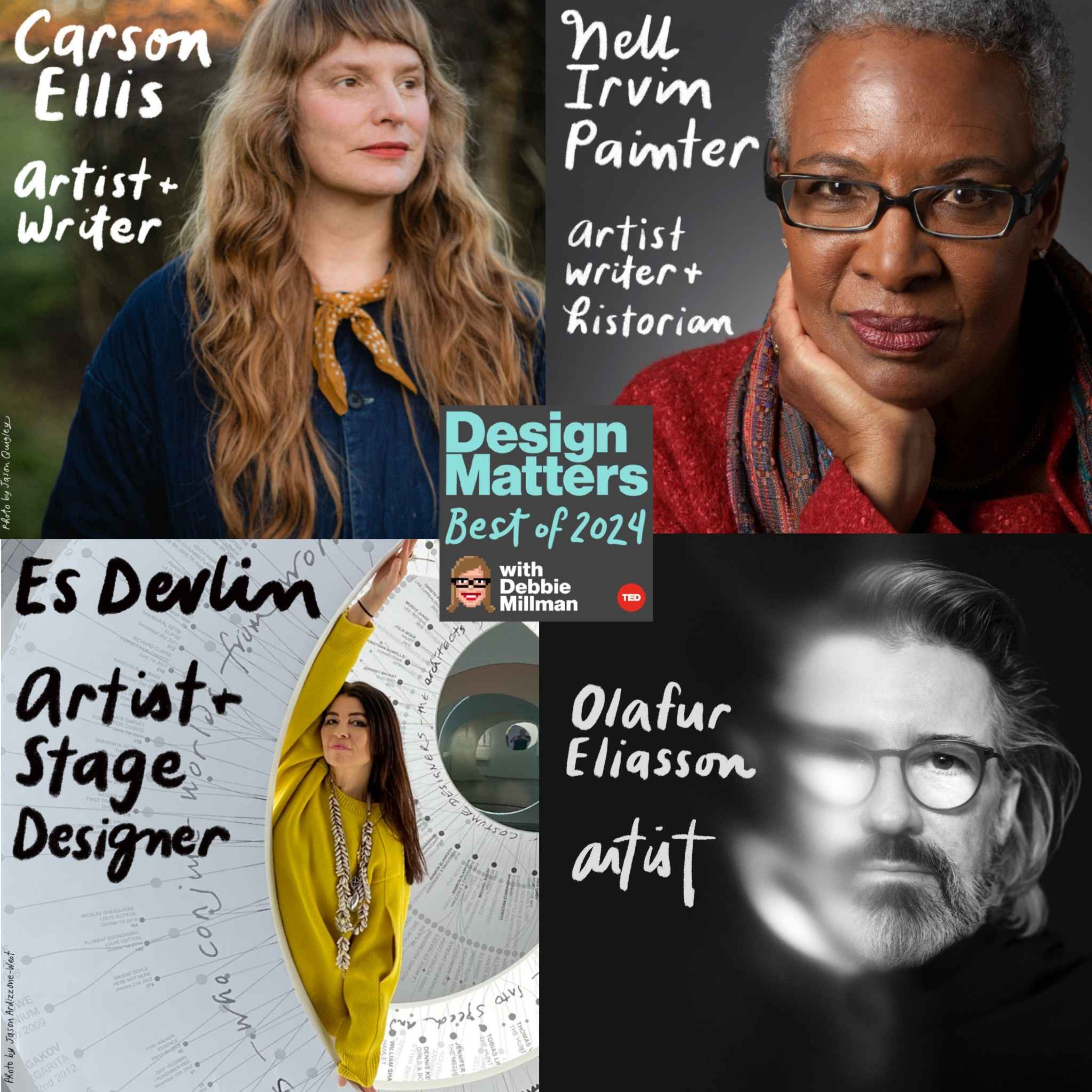
From the TED Audio Collective, this is Design Matters with Debbie Millman. On Design Matters, Debbie talks with designers and other creative people about what they do, how they got to be who they are, and what they're thinking about and working on to mark the end of 2020. On this episode, we're going to hear excerpts from interviews Debbie did with visual artists in the past year.
- [00:38]
Nell Irvin Painter
My bonafides, which came from academia, counted for nothing.
- [00:44]
Carson Ellis
I was moved when I read it. I read it and I thought it was very funny how boring it was.
- [00:54]
Whole Foods Market Ad
You can save every day by shopping at Whole Foods Market. Seriously, don't just go for their big sales. Walk the store and see the savings for yourself. In the meat department, look for yellow low price signs on Whole Foods Market. No antibiotics ever. Chicken breast and ground beef. Quality, flavorful meats priced just right. Perfect for big dinners with plenty left over for tomorrow's lunches. There are so many ways to save at Whole Foods Market now. You know.
- [01:22]
B2B Marketing Student
My dad works in B2B marketing. He came by my school for Career Day and said he was a big roas man. Then he told everyone how much he loved calculating his return on ad spend. My friends still laugh at me to this day.
- [01:36]
LinkedIn Ad
Not everyone gets B2B, but with LinkedIn you'll be able to reach people who do. Get a hundred dollar credit on your next ad campaign. Go to LinkedIn.com results to claim your credit. That's LinkedIn.com results. Terms and conditions apply. LinkedIn the place to be To Be.
- [01:52]
Carson Ellis
Bombas makes the most comfortable socks, underwear and T shirts. Bombas are so absurdly comfortable you may.
- [01:58]
LinkedIn Ad
Throw out all your other clothes.
- [01:59]
Interviewer
Sorry, do we legally have to say that?
- [02:02]
LinkedIn Ad
No, this is just how I talk.
- [02:03]
Carson Ellis
And I really love my Bombas. They do feel that good. And they do good too. One item purchased equals one item donated.
- [02:09]
LinkedIn Ad
To feel good and do good, go to bombas.com acast and use code acast.
- [02:14]
Carson Ellis
For 20% off your first purchase. That's B O M B-A-Com acast and.
- [02:19]
LinkedIn Ad
Use code acAst at checkout.
- [02:25]
Debbie Millman
If you had to add up what kinds of creative people have most appeared on Design Matters, designers would come first, especially since Debbie interviewed designers almost exclusively in the early days of this podcast. But a close second would probably be artists. So many designers also have an art practice, or their work simply bridges the divide between design and art. On this episode we're going to hear excerpts from interviews that Debbie did with four very different artists. S. Devlin is a set designer who often works on a grand scale. She's done concert sets for Beyonce and Lady Gaga, for opera festivals, the Olympics and even for the Super Bowl. One of her latest projects was creating digital sculptures for U2 and the inaugural performance at the Sphere, the giant immersive entertainment arena just outside of Las Vegas.
- [03:18]
Interviewer
In an article that I read about your involvement with the Sphere, you talked about the iPhone occation of the experience of being at the Sphere and seeing the unbelievable explosion of art and graphics where you're fully immersed in this environment. It is really transformational. It does feel like either a religious experience or a drug induced experience. It's really unlike anything that has come before it. I'm wondering how you feel about the throngs of people videotaping while they're watching and experiencing.
- [04:03]
S. Devlin
I wanna break that into two parts really, because when I said it's like the iPhone ification of concert design, I sort of meant that when Jony I've designed the iPhone in a way he'd sort of reached the Nepal's ultra of design of that object because it was this infinity pool, this beautiful black thing. And in a way, you know, no one's really gone any further with it because it was like, okay, we arrived. This is what this object needs to be for now until it's in our body. This is as edgeless as it can be, as infinity edged as it can be before it actually migrates under the skin probably. And we had talked with Willie Williams, U2's creative director, 10 years ago when we were first working with U2. We talked about the possibility and the desire that we had for sound and vision to coexist in one piece of technology at a concert. Because it irritated us that there were two departments. People up ladders and genies putting truss up to hang giant great big speakers in front of necessarily other people up other ladders putting up big screens. And we longed for a video screen that was permeable to sound. And we actually commissioned a lot of research on this with our colleagues who made a lot of new video technology. But they couldn't solve it for all the frequencies for an outdoor concert. It wasn't possible. And that's where I think the Sphere has iPhone iFied concert design. It has just simply in an iPhone y way combined the thing you need to do at a concert, which is to hear, and the thing you want to do at a concert, which is to see and it's done a sort of synesthesic, synesthetic move where the speakers and I can't remember how many thousands of them there are, but many are behind the screen and the screen is permeable to sound. And that's brand new. So that's one piece to give you the other answer about how I feel about the fact that certainly on the opening night I went back again just before the closing and it was somewhat different then. But certainly on the opening night it really was like being in a film studio in that everybody is holding their phone because this was new, everyone had to film it and listen. That's fine. Making a film, everybody. Becoming a filmmaker is rather beautiful in its way, but it does preclude dancing. And if there's one thing I think will be put on most of our gravestones, certainly mine. If I died tomorrow is. Had a cool life but didn't dance enough. So I think who among us?
- [06:39]
Interviewer
Who among us?
- [06:40]
S. Devlin
So, so, so I do think being a filmmaker is cool. I don't even mind being a self portrait filmmaker. Although I was at the weekend concert, Abel Tesveh, the weekend in London at the Olympic Stadium. It was beautiful night, really beautiful. And the lady in front of me had her camera pointing to me all night. I was like, that's weird. And then I realized what it wasn't. It was pointed at herself and she was filming herself in front of the concert all night long. And you could say that's a heroic and majestic act of sustained self portraiture in the school of Durer and all the other great self portraits that have been made. That's, you know, an important act.
- [07:19]
Interviewer
So that's a generous way of putting it.
- [07:25]
S. Devlin
I have found life far more interesting. When I tried to always find an alternative to judging. I thought if I can apply my curiosity rather than my judging bone, life just becomes a bit more interesting.
- [07:39]
Interviewer
The sphere is 360ft tall. It has 580,000 square feet of fully programmable LED exterior and it's a curved 160,000 square foot screen inside. How did you approach making this level of artwork for you two and for the Sphere?
- [08:07]
S. Devlin
Well, first thing, obviously to say that this was very much not something I did at all alone. The project was led by the band and by their very long standing creative director, Willie Williams, who has a wonderful team called Treatment, who are beautiful craft as a video, but that band very broad in their seeking when they come to make a show. And they gathered together a kind of board, creative board that we had been working together, actually 10 years since the Innocence and Experience tour. So it's that same group. And we spent three days together and just brainstormed ideas. And I think the first thing we knew was there was a concern that this giant object, what would be the reception of it? Should the world have it? Is it a good thing to even be part of? Really, everyone was questioning that. And I think we wanted to declare our awareness of its materiality, that we weren't going to just treat it as a portal to something. We were going to start at the beginning by saying, hey, we know the minerality of this thing. We know what it took to build it. We know the resources that have gone into it, financial, mineral, human, planetary. We know that there's a commitment to solar power eventually, but that hasn't happened yet. So when you go in, the concretization of it was sort of very purposeful. And actually I went back the other day and someone I was with said, oh, how are you going to get rid of all the concrete panels to reveal the led? And, oh, the other person looked up and said, oh, I didn't know it had a hole in the roof. And I said, oh, yeah, you know, the rain sometimes comes in. So it's quite believable. When you walk in this concrete interior, I say, when you walk in, that show's now finished. But when you walked in. And then, very purposeful, the splitting apart, it's a gesture that's really important to me. That line of light I saw, obviously important to many other people, including Tadew Ando and all sorts of people, not just me. So splitting the concrete apart to then reveal the video, and then ultimately a gesture that Jim Dolan and Bono had been clear on since the very beginning of their conversations was that they wanted to deconstruct the sphere and reveal what you would see if the sphere weren't there. So this reveal of Las Vegas, built with such precision by industrial light and magic, deconstructs itself. And the way that they researched that, they unbuilt every building in Las Vegas in the order in which they were built until you just got back to the planet, the place on the planet where we are, that space in the desert, none of the lights, just that. And then we went back ultimately to the species which also call that place home. And I think we were clear that we wanted to consecrate the building like a cathedral, to make a sort of offering and say, let's dedicate and consecrate this building to the species that call this place home. That don't have any say in whether or not we use the resources to build a giant dome. So that's what that final Nevada arc gesture was about.
- [11:22]
Interviewer
There were two things that I was really struck by regarding this sphere. One is how much it takes its shape and form from a planetarium and how you lose sense of there being any boundaries when you're in it. You know, it just feels as if you're in this infinite space, literally and figuratively. The other thing I was thinking about was how almost impossible it feels to make a film of this show. You know, so many shows turn into films. You know, Hamilton is even a film. And so I was wondering if there was any consideration of that when making this.
- [12:07]
S. Devlin
I think it's such an interesting thought. I think we were really focusing on making the show, to be honest, in the medium that it is. But I think there is a version where you could play the show as it is and intercut it with footage of the singers. Because if you think about it, if you're watching the show from the four hundreds right at the back, which is where, frankly, you get the best sense of the architectural form of the place, then your awareness of the people on the stage, you know, they take up a very small percentage of your range of vision there. So if you were playing recorded sound as well, rather than live sound, I think you'd have also a lot of different controls over those speakers. I think that system can do a whole load of things that we didn't do with it yet because we were working with live sound. So I personally think there'll be a whole nother level you can take it to when you're working with recorded sound. And you would just place footage of the performance within that film. I think it'd be pretty spectacular and hopefully make it far more accessible to a lot of people to come and see that work, you know, even when the band aren't there. I think it's going to be pretty.
- [13:17]
Debbie Millman
Exciting, actually, for that S. Devlin. Olafur Eliasson is an artist who also works on a grand scale. His sculptures, installations and experiments with light and water have been drawing huge audiences for several decades. As she often does with guests, Debbie asked liaison about his childhood.
- [13:37]
Interviewer
You talked about a powerful memory in your childhood. In the late 1970s, there was a rationing of electricity in the town where your grandparents lived. And I read that at a certain hour in the evening, all the lights would go off and you'd all move to the windows and watch how the colors of the twilight sky would take on A new quality. Why do you think that memory is so resonant in you?
- [14:04]
Olafur Eliasson
I think it was the social aspect that sort of stamped it into the back of my mind. In 72 and 73, the oil was rationalized because it was the oil crisis. But I remember my grandparents, they had a small house on top of a sort of a hilt called Holstead in this small suburban town to Reykjavik called Hapnerfjorder. And the house was facing the windows, facing north. So in Hapnerfeld, when you face north, you're looking up to the part of Iceland, the other arm, so to speak, called Sniper's Nest. On the end of Snae Nest, there's something called Snifersjerkul or the glacier of Snifeld. Snifel means snow mountain. So on a clear day, we could stand in the window of the living room of my grandparents and we would look across the ocean to that other peninsula called Snaife Shukul. And we could see in the summer, the sun would set in north. The sun would go down and it would just go under the horizon and come up again. I mean, if you're at the North Pole, the sun doesn't go down at all, as we know, right? So the glacier would be lit from behind. Sometimes this is such a spectacular phenomenon. You have this chunk of ice, like about 1 km high and 3 or 4 km wide. This glacial chunk, right of course now is like almost gone. It's much, much smaller. So at a certain time of day, I believe just after dinner, in order to save money, because Iceland had not yet fully harvested its geothermal power that it has today, so it was relying on oil. So Iceland was just in the process of getting up onto its feet. So oil actually was an important thing to make everything run in Iceland still in the 70s. So there was a bell, a huge bell in the city. And it was like an alarm bell. And it was always fascinating to stand up in the window, look over the city, small city of Hapnerfjorder. The bell would sound and all the lights would go out. Like all the street lights, all the house lights, everything, instantly. Yeah, it's fascinating, right? And then my grandma would come with a candle and let's all sit by the window, she said, because it's the only place there's a bit of light. So sitting by the window with the family and doing what we were doing, right, Reading and just sitting and talking or something. I like rolling around on the floor if we wanted to. That was very special because the light Outside was really blue, very intensely sort of twilight blue. The glacier, if the weather was good, the glacier would be spectacular. Like it was fantastic. And then there was this one candle, this burning little piece of fire, right? So you had the ice and you had the fire and you had this blue color and you had the warm color in everybody's faces, in the skin. It's like a little bit of a campfire. So it's a little bit like you had this sort of red and warmth coming together. And I did not really have much of rituals, routines. I didn't have a childhood where everything was ceremonialized. You know, I always envied the people who had a very clear patterns of Christmas and this ceremony and that ceremony. Because there's something very beautiful in the repetition of things. There's something really unique about falling into the rhythm of life, the respiratory rhythm of how to live. I had a bit of this and that. My mother got married, then divorced and married again. You know, it's like my father then went, was here and there, and then he died. This was one of the times where there was a routine. You just knew at, what was it, 8 o'clock there would be this bell and we'd all run to the candle. And when you're five years old, it was so nice to know what was about to happen. And that's an interesting thing to think about. These sort of expectations and then the happening and then memories, right? How you anticipate. And then you have the moment of presence and then you have the kind of warmth of a memory that you carry with you into life.
- [18:04]
Interviewer
Olafur, you had your first art show, your first solo art show of drawings when you were 15 years old. What kind of work were you showing in that exhibit?
- [18:16]
Olafur Eliasson
Yeah, there was. Where I lived on the countryside in Denmark with my mother, there was a small artist group and artist associations of all kinds of artists. It's more like kind of a. A gathering. And they had shows in, in libraries, on shopping malls or, you know, here and there. And I was the youngest member there. The first time I ever kissed one was one of the kids of one of the other artists in that group. Isn't that funny? But in a, in a shopping mall at night, on the opening, where I just drifted into the mall somewhere with, with this one wonderful young woman. You know, looking back at it today, what it was, it was nice because it was nothing in particular. It was just me having fun. So what must have been the case is that there was not a lot of pressure to perform because I think I can remember roughly there was a cat, and there was a. There's a puffin. You know, the Icelandic puffin, right? And stuff like that. And it wasn't really the best drawings of a cat or puffin or something like that, but it was okay to just be like that. And then, because one of the people in this artist group had a little gallery where they normally showed ceramics. And then I had a show there. And that was kind of funny because I was not so old. I was. I was just turning 15. Well, I was just turning 14 or whatever, you know, so. So. And. And. And. And I was like, oh, I have a show. My God, if I. I'm gonna. $40, $30, $60 for the drawings, right? So I was like, oh, my God, if I said everything, I have, like, $300. It was going to be so wild. But what I think now, looking back, it was not. Like, my mother looked over my shoulder and said, this drawing is not good enough. Do it again. Tiger mom is here. So. So what was beautiful is that I had a good time, and I said, oh, my God, this is great. I love having an exhibition. And I did. I did. I think I did. I don't really remember. I think I did sell a few of them, probably to my family members or something. But, you know, these drawings, they must be around, or maybe not now.
- [20:15]
Interviewer
Despite having your first solo exhibition at such a young age, I actually read that your first passion was breakdancing, and you even won a Scandinavian championship as part of a trio you named the Harlem Gun Crew.
- [20:33]
Olafur Eliasson
Yeah, it's funny, right? It's not.
- [20:35]
Carson Ellis
I saw a couple of.
- [20:36]
Olafur Eliasson
Maybe it's not funny, actually.
- [20:37]
Interviewer
No. I saw some wonderful videos of you.
- [20:39]
Olafur Eliasson
Breakdancing on YouTube, actually, around the same time of the show. So I. I went to Copenhagen to see my granddad. I was 14. And in the window. And this is now. This is now 81. Can you imagine? 81? I'm in Copenhagen on the pedestrian show, and there's a clothing store. And in the window of this clothing store, there's like, three or four human mannequins. I'm looking at them, and I say, my God, they. They're real people. But they're standing very still. And suddenly they moved like robots. Like their hands, you know, like the hands. And they. Then one of them, out of nowhere, just made a wave from one hand through the elbow, shoulder, over to the other arm and to the other hand. And I was shocked. And I realized my life in that moment had changed. I'm not being overly Dramatic. So I went home and from that moment on I started moving around my house as a robot or as a kind of some kind of moving. See now there was nothing called Internet. There was barely something called video. Like a VHS didn't exist. There was something called Betamax, I think, or what. So I had no idea until a little later I actually met one of the people in Copenhagen and said, what were you doing? Because he was standing on the street. Where is this one? Yeah, I was in high school in America. He said there it was quite normal to me do it. But what are you doing? Yeah, it's called Electric Boogie or break dance. And, and, and I said, my God, it's amazing. So I was then 15 and you know, I hit puberty. Like finally, it's like the last one in the class to puberty. And then I said, I said, okay, I need to acknowledge that I have a body. And how better to acknowledge embodiment by disembodying and becoming a robot. So I felt very comfortable in being present and being unpresent at the same time, as you could say. And of course as things went on and music videos then came and then the Rocksteady crew and then there was suddenly a whole handful of. And then suddenly there was like rap music and there was like. So I just completely by coincidence happened to be on the front end of that movement also when it took place in America.
- [22:59]
Debbie Millman
That was Olafur Eliasa.
- [23:04]
Whole Foods Market Ad
You can save every day by shopping at Whole Foods Market. Seriously. Don't just go for their big sales. Walk the store and see the savings for yourself in the meat department. Look for yellow low priced signs on Whole Foods Market. No antibiotics ever. Chicken breast and ground beef. Quality flavorful meats priced just right. Perfect for big dinners with plenty left over for tomorrow's lunches. There are so many ways to save at Whole Foods Market. Now you know.
- [23:32]
Interviewer
This is a mini meditation guided by Bombus.
- [23:35]
Carson Ellis
Repeat after me. I'm comfy. Comfy.
- [23:38]
LinkedIn Ad
I'm cozy, cozy.
- [23:40]
Carson Ellis
I have zero blisters on my toes.
- [23:42]
S. Devlin
Blisters.
- [23:42]
Carson Ellis
And that's cuz I wear Bombus the softest socks, underwear and T shirts that give back. One purchased equals one donated. Now go to bombas.comacast and use code acast for 20% off your first purchase. That's b-bas.com acast and use code acast at checkout.
- [24:01]
B2B Marketing Student
My dad works in B2B marketing. He came by my school for career day and said he was a big roas man. Then he told everyone how much he Loved calculating his return on ad spend. My friends still laugh at me to this day.
- [24:16]
LinkedIn Ad
Not everyone gets B2B, but with LinkedIn you'll be able to reach people who do. Get $100 credit on your next ad campaign. Go to LinkedIn.com results to claim your credit. That's LinkedIn.com results. Terms and conditions apply. LinkedIn the place to be, to Be.
- [24:34]
Debbie Millman
Nell Irvin Painter is a celebrated historian and academic who took up art later in life. Painter says her interest in art grew out of the biography she wrote of Sojourner Truth.
- [24:46]
Interviewer
You decided, despite already having a PhD from Harvard University, you wanted to go back to school to get another bachelor's degree.
- [24:54]
Nell Irvin Painter
That's right.
- [24:54]
Interviewer
But this time in fine art. What inspired that decision?
- [25:00]
Nell Irvin Painter
Two things. Sojourner Truth and that stay in the art history library had really reawakened my attraction to images and to imagery. And the other thing was I just wanted to do it and I could. My husband takes care of me. I didn't have to worry about I had the money. And art school was, as you know, absurdly expensive.
- [25:30]
Interviewer
Yes.
- [25:30]
Nell Irvin Painter
And the degree you come out with is not going to pay your rent. So luckily I didn't have to worry about my rent. And I wanted the degrees, plural, because I wanted to be professional. I wanted to be professional in the way I was professional as a historian. That has not been totally smooth. But with I just keep talking, you see where I got to in ways that I could put the two together. It took me 10 years to put my historical self together with my visual artist self. It was very bumpy. And even now I cannot go from concentrating on writing to concentrating on drawing without a kind of week or so of just changing gears.
- [26:27]
Interviewer
You got your BFA from Mason Gross School of the Arts at Rutgers University, and though you originally didn't know if you wanted to go to graduate school, you ultimately realized that you did. And you've written that this was because you wanted to work harder than the kids did. You wanted to be more intense than the kids were, and you thought graduate school would do that for you. Did it?
- [26:50]
Nell Irvin Painter
Yeah, it did. It did. It was the hardest thing I've ever done. I tell people getting a PhD from Harvard in history was a piece of cake in comparison.
- [27:01]
Interviewer
Why is that now? How is that possible?
- [27:04]
Nell Irvin Painter
Well, I guess the easiest way is to say that as a historian, I knew what the values and the standards were in art. I did it. So some of the art that I looked at when I was an undergraduate just looked like piles of stuff to Me, I didn't understand how you use visual archives as opposed to how you use historical archives. And I was too tight and too focused on what I call discursive meaning. When I started to. What I came to later on in graduate school was a real loosening up, and that was something I really had to do.
- [27:56]
Interviewer
You went to the Rhode Island School of Design, or risd.
- [28:00]
Nell Irvin Painter
Yeah.
- [28:00]
Interviewer
What did the students make of an African American woman in her 60s alongside them in class?
- [28:07]
Nell Irvin Painter
I think kind of nothing. That is not true of everyone. I mean, we were very small. We were 12. But a couple of them felt old because they were like 31, 32. But I was just this old lady, and my bona fides, which came from academia, counted for nothing. And the thing that really summed it up, at the end of the school year, we were going to have. We were going to take our picture. So everybody assembled at the given time, and nothing happened. And nothing happened and people weren't there. And so finally I, you know, I'm always on time, but I finally said, look, I have to take care of this thing in my studio. Call me when you're ready to take the picture. And as soon as I left, they took the picture.
- [29:07]
Interviewer
You know, despite all the accolades you got as an, as an historian, you often got what you referred to as stinging criticisms that were one long tearing down in addition to this other utterly disrespective behavior. One professor even told you that you would never be an artist. Yeah, I'm assuming that that was a white CIS heterosex. In any case. Why. Why did he say that to you and how did you respond and how did you recover from that?
- [29:44]
Nell Irvin Painter
Yeah, his name was Henry. He was printmaking teacher. And this was my first semester at risd, and I was feeling my way, you know, I was not an experienced printmaker by any means, but I tried hard. And he called me dogged. And it wasn't like, oh, you are dogged. You are very hard working. No, it was, you are dogged. So I called him out on it because I knew teaching, and if you're a good teacher, you don't say things like that too. So I said, henry, that's bullshit. He said, you may sell your work, you may have collectors, you may be in museums, you may have a gallery, but you will never be an art artist. And that stung. And I would say, yeah, what saved me was I had friends at Yale. They put me back together again.
- [30:47]
Interviewer
You did a fellowship there, did you?
- [30:49]
Nell Irvin Painter
After I graduated from. Yes, Dean.
- [30:51]
Interviewer
Yeah, you did a lot of research after that experience and discovered how many people have either been told that they'll never be an artist or have known somebody who was told that they would never be an artist?
- [31:03]
Carson Ellis
Yes.
- [31:04]
Interviewer
Whether it's a fine artist or a poet or a playwright or any field in the arts. And you talk about this in relation to what you refer to as the talent mystique, the great man mystique, and the genius mystique. And I'm wondering if you can talk a little bit about that.
- [31:18]
Nell Irvin Painter
I can talk about that actually more easily through publishing, because the publishing world right now, people are tearing their hair. Oh, terrible. You know, all this consolidation. And in the good old days, an editor could foster a writer even though the writer was not selling out, and just wait until that writer flourished. And now there's just, oh, it's so terrible. The marketing. Oh, but at the same time, the early reviews came through. I got two really good, strong early reviews from Kirkus and from Publishers Weekly. And another list maker said, These are the 45 best books by women of color this spring. And I thought, 45, wow, that's fantastic. So I wonder if my 45 best books by women of color is related to the good old days gone by. When the good old days gone by were white male writers in the 20th century, there was a tiny sliver of publications by white women. There was almost nothing well known by black women. The breakthrough is with Toni Morrison. And that is like in the 1980s.
- [32:59]
Interviewer
Yeah.
- [33:00]
Nell Irvin Painter
When I am with other black women writers and they talk about what made the difference from them, they talk about when they were girls and they read Toni Morrison. When I was a girl, there was no Toni Morrison.
- [33:14]
Debbie Millman
Nell Irvin, painter Carson Ellis is an author and illustrator. Her best selling books for children include Home and Do Istak. Her latest, One Week in January, is for adults, and it illustrates a diary she kept in her 20s.
- [33:30]
Interviewer
The book relays the story of one week of your life in 2001, the monumental week you first moved to Portland, Oregon. And that week you decided to keep a journal documenting every single thing you did each day. Everything you ate, every book you read, every time you checked your email. Why that week at that time? And why so much detail?
- [33:55]
Carson Ellis
I don't remember why that week. And I didn't remember anything about this journal when I found it. I just found it in a box of, like, ephemera a few years ago and I couldn't remember why it even existed. I hadn't seen it in 20 years or something. I was like, why would I have kept not only this journal for one week, but a journal that is. Was so, so meticulous. Such a. A detailed, meticulous chronicle of everything I did. But then I. I spoke to my friend about it who is in the book a lot, my really old friend Emily. And I asked her if she remembered anything about it, and she was like, I do. You kept that journal because you were worried that you were losing your memory and it was some kind of memory exercise because you always were feeling like you were too forgetful and you were somehow trying to boost your memory by writing down everything that you did. So I think every morning when I woke up, I wrote down every single thing that I could remember from the day before. And it was the week I moved to Portland. And I think. I don't know why. I don't know if there's significance to that. I'm not sure if that was intentional. I'm not sure if it was something that was sort of helping me get my bearings in a new city. My sense is that at the time I was 25 years old and I had just a million like half formed art ideas in my head. And this was just one of them, you know, like a bunch of just ways of being creative that I was sort of exploring and trying to find some purpose for in my creative practice.
- [35:29]
Interviewer
You know, you said that the text doesn't read so much like a journal, that you feel that it reads more like a stoic catalog and that you don't reveal much emotionally. And I have to say, Carson, I don't agree at all. That to me, doesn't even feel like we're talking about the same book.
- [35:48]
Nell Irvin Painter
Interesting. Interesting.
- [35:49]
Interviewer
It feels so. There's so much emotion in it. And what's so interesting about it is that there's a lot of emotion because of the things that you don't say that give a sense of there being deep emotionality in it.
- [36:03]
Carson Ellis
Yeah, I mean, I think my favorite books are books where we're not hearing from a narrative voice what the characters are going through. We're witnessing it and we're discerning it from context and dialogue and stuff. And so I guess in that way this book is similar where I don't really ever say how I'm feeling, but because you see everything I'm doing and are privy to so many of my conversations, you can see that I am broke. I'm probably in love with my best friend who I'm hanging out with all the time, but he's dating all of.
- [36:37]
Interviewer
My friends and sleeping with in the Same bed, but nothing is happening.
- [36:40]
Carson Ellis
Yeah, we're sleeping in the same bed, but we're, quote, unquote, just friends. Like, there's so much sort of like, longing and unfulfilled stuff in it that it is. I agree with you. I do think there's a lot of feeling in it. But I think I really go out of my way to not actually express anything, which does seem counter to a diary, because I feel like other diaries I have kept, I've kept them because I was in some kind of moment of emotional tumult, and I wanted to be like, dear Diary, you know, I'm. I'm so unhappy because of this reason and this. And there's none of that in this book.
- [37:17]
Interviewer
Well, it's certainly very unselfconscious. But that's also what I love about it. You kind of know that this young woman is in love with this man, and he's bringing her pizza every night because she's so broke she doesn't have money for dinner. And I don't know. There's so much unsaid beauty in it. What made you decide, once you found it again, that you wanted to make it into a book and make all of these, I think, 20 or 30 illustrations, paintings for the book.
- [37:52]
Carson Ellis
I was moved when I read it. I read it, and I thought it was very funny how boring it was. It's just sort of like I woke up and I put on this song, and then I ate this bagel, and then I checked my email and no one had written me, and then I took a shower. It's like just page after page of that. And I realize I'm not really selling it, but I think there is something to that. For one thing, it's such a time capsule, both of my life, which was so different then because I was broke and I wasn't a working artist, and I was also kind of transient and in, like, constant transition when I was 25 years old, but also because we were in the middle of this radical cultural shift into a digital age. So it was like my email was novel, the Internet was novel, and I had no sense of how profound this shift was or the magnitude of it, or the fact that it was irreversible and that we were all, like, moving headlong into a era of digital everything that we would live in, whether we wanted to or not. So there was something kind of moving about that. And I do pine for a time before my iPhone and my social media. And so it was very, very sweet and moving to be taken back to that period and also to that period in my own life. And then also I. I feel like, because it is. I do think of it as a pretty stoic account of that week. And so it felt like it was. It just felt like a thing that would serve from illustration. Like I was like, oh, the other side of the story is all the sort of like emotional poignancy and resonance of that week. And maybe that could be something that would be in the art if it's not in the text. Or maybe those two things would kind of communicate with each other to tell a more interesting story or something. I guess as an illustrator, I think I'm always trying to find places where art helps text be more interesting or sophisticated or tell a story that is a little deeper because you've combined it with some visual element. And this occurred to me as a good candidate for that.
- [40:06]
Interviewer
Yeah, I mean, what I find so remarkable is that the paintings are so vivid. They really do help sort of expand the text in a lot of ways. And because it is so matter of fact, you never really tell your reader how they should feel. It almost feels very objective in a lot of ways. There's nothing purpley about it, it's all very clear. And then you see these beautiful paintings that seem to perfectly articulate the memory. And so I think there's such a nice sort of duality to that. Without sounding really sort of eye rollingly ridiculous. There's such a nice kind of play between the very sort of ethereal, very beautiful memories as paintings or paintings as memories, and then this very matter of fact way of going about your life.
- [41:01]
Carson Ellis
Thanks, Debbie. I was sort of hoping for that and I was hoping that the two things would feel like these separate voices sort of working together to tell a story. You know, like the voice of the 48 year old painter and the voice of the 25 year old writer who are the same person, but kind of not really. You know, so much time has passed.
- [41:21]
Interviewer
Do you see this 25 year old version of yourself as part of who you are, as integrated into who you are? How do you feel about these two women, one at 25, one at 48, that share the same soul?
- [41:36]
Carson Ellis
They feel like they're the same person, but they also feel really, really different. It did feel certainly more like, you know, I'm like collaborating with an author than it felt like I was writing and illustrating my own book.
- [41:50]
Interviewer
Carson, before we finish the show, I'm wondering if you could read a little bit from one week in January, new paintings for an old diary.
- [41:59]
Carson Ellis
I Would love to. I'm going to read the end.
- [42:02]
Interviewer
Oh, good.
- [42:03]
Carson Ellis
Which is Friday. It's one week and so this is the last day and I'm going to start. About halfway through the day, Colin called Emmy and asked her if she wanted to come to the track with us. She did, so we picked her up and went to Portland Meadows to bet on horses. It was rainy and we drove down to MLK instead of i5 and got sort of lost. Colin was being a real brat to everything that Emmy and I asked. He would say no, and when I patted him on the shoulder, he said, don't touch me. I said, you're never coming to the track with me again, are you? He said, no. I said, that's mean. He said, good. And I said in my head, I hate Colin Malloy. We got to the track in time for the third race and I told Colin that I was so mad and went to get a hot dog, a program and a beer. I placed my first bet, $2 across on the number six and went to the paddock to look at my horse. Then I saw Colin and was still angry, so he half heartedly apologized and we made up. The only good bet either of us made was the same bet. Three bucks across on a long shot and we both won $24. Emmy made one bet on a horse named the Cisco Kid in the fifth race and lost. I was wearing Emmy's grandma's rings, my red dress and red high heels for luck. Our luck was never very good though, and we left after the sixth race. We dropped Emmy at home and came back to the warehouse where I fell asleep on Colin and Stiv's couch for about an hour. Nathan woke up at 10 to 10 and the three of us walked downtown to see Marjorie, Lucia and Heidi in a dance performance at an. I kept slipping and falling all the way there because of my lucky shoes. When we got there, it had just ended. We all felt dumb for missing it. I walked around and looked at the art, which was bad except for a painting of a rooster on a pane of glass. Heidi then drove Colin, Nathan and me to a bar called fifteen where we got so drunk. Colin drank screwdrivers, Nathan drank beer and I drank scotch. I started talking to a boy named Donald and Colin pretended to be my jealous boyfriend. Then I slipped and fell on a ramp going down to the bathroom because of drunkenness and again the lucky red shoes. I broke two glasses, one with scotch and the other with water and two men rushed over to help me and brush me off. I was Sad because my scotch was now on my dress. But one of the men offered to buy me another, so I didn't care. Then Marjorie came and introduced me to a guy named Shantos in Elvis sunglasses who is some sort of promoter or something. We talked about me making some posters for him and exchanged numbers and the owner of the bought me another scotch because I had fallen down and broken mine. I went back to talk to Donald, but he told me he was looking for his one true love and tucked my hair behind my ear. So I left and sat down with Lucia, Jebediah, Colin, Marjorie, Nathan and some of Jebediah's friends. Nathan was sad because the hot girl that he hadn't worked up the courage to talk to had left. Colin and I started singing Pogue songs as loud as we could and slamming our fists on the table. The bouncer came by and told us to shut up, but we didn't. Another guy collecting glasses said to us, snidely, is that really necessary? But still we sang. I vowed never to return. Then we got up to go home and Nathan tried to solicit a ride from Marjorie, who was in the midst of a conversation and I said we ought to walk anyway because we were so drunk. A couple of blocks from home we spotted some scaffolding on the roof of a building with 30 foot ladders tied to either side. Nathan somehow got on the fire escape and busted the chain that was securing the lowest part of the ladder and keeping it from touching the ground. It was one of those see saw type ladders. It was raining now and I ran to get Nathan's bag and slipped and fell on my ass. We climbed the fire escape to the roof and Nathan got out his video camera. Colin and I each climbed a ladder on either side of the scaffolding. I was still wearing high heels and climbed so carefully. When we got to the top, we were dozens of feet up with about 30ft between us. After some time, Colin put a cigarette in his mouth and yelled to me, do you have a light? I yelled back, yes, come down and we'll have a cigarette. So we climbed down and ran around on the roof, going up some more ladders and looking into a creepy brick room. Nathan had filmed the whole thing, so we went home to watch it. When we got back on the ground, we started running and I yelled, wait, you guys. And fell on my ass once more. I had left my red candle that I stole from the bar on the ground next to the building, but I couldn't find it and decided to come back for it. The next day we walked home in the rain and went straight up to Nathan's. First we watched the rap video that we made in San Francisco for Vava Amonia, which was so funny. Then we watched the video of the roof, which was beautiful and eerie with only the noise of cars on the highway and some yelling in the background. We shared the last two cigarettes and the last two beers between the three of us. Nathan rewound the tape and we watched the whole thing again with outtakes from Vava Vonia, scenes of Colin and Nathan driving out to San Francisco and some video shot at the Shanghai. Colin went to sleep and Nathan and I talked about lost love. Now I'm sad, I said. Now I'm really sad, said Nathan. I kissed him goodnight on the cheek and went to bed.
- [47:27]
Debbie Millman
Carson Ellis her book is One Week in New Paintings for an Old Diary. You can hear the full interviews with all four of these artists on designmattersmedia.com or wherever you get your podcasts. Design Matters is produced for the TED Audio Collective by Curtis Fox Productions. The interviews are usually recorded at the Masters in Branding program at the School of Visual Arts in New York City, the first and longest running branding program in the world. The editor in chief of Design Matters Media is Emily Weiland.
- [48:04]
B2B Marketing Student
My dad works in B2B marketing. He came by my school for Career Day and said he was a big roas man. Then he told everyone how much he loved calculating his return on ad spend. My friends still laugh at me to this day.
- [48:19]
LinkedIn Ad
Not everyone gets B2B, but with LinkedIn you'll be able to reach people who do get $100 credit on your next ad campaign. Go to LinkedIn.com results to claim your credit. That's LinkedIn.com results. Terms and conditions apply. LinkedIn the place to be to be.