Loading summary
Transcript93 lines
- [00:01]
Stella Bugbee
My main goal was to create a space where the people working on that project could say whatever they wanted to say in the tone they wanted to say it in.
- [00:13]
Ryan Reynolds
And then they said, bob wants a cover. I said, bob wants a cover. We have, like dogs on the COVID Or.
- [00:25]
Debbie Millman
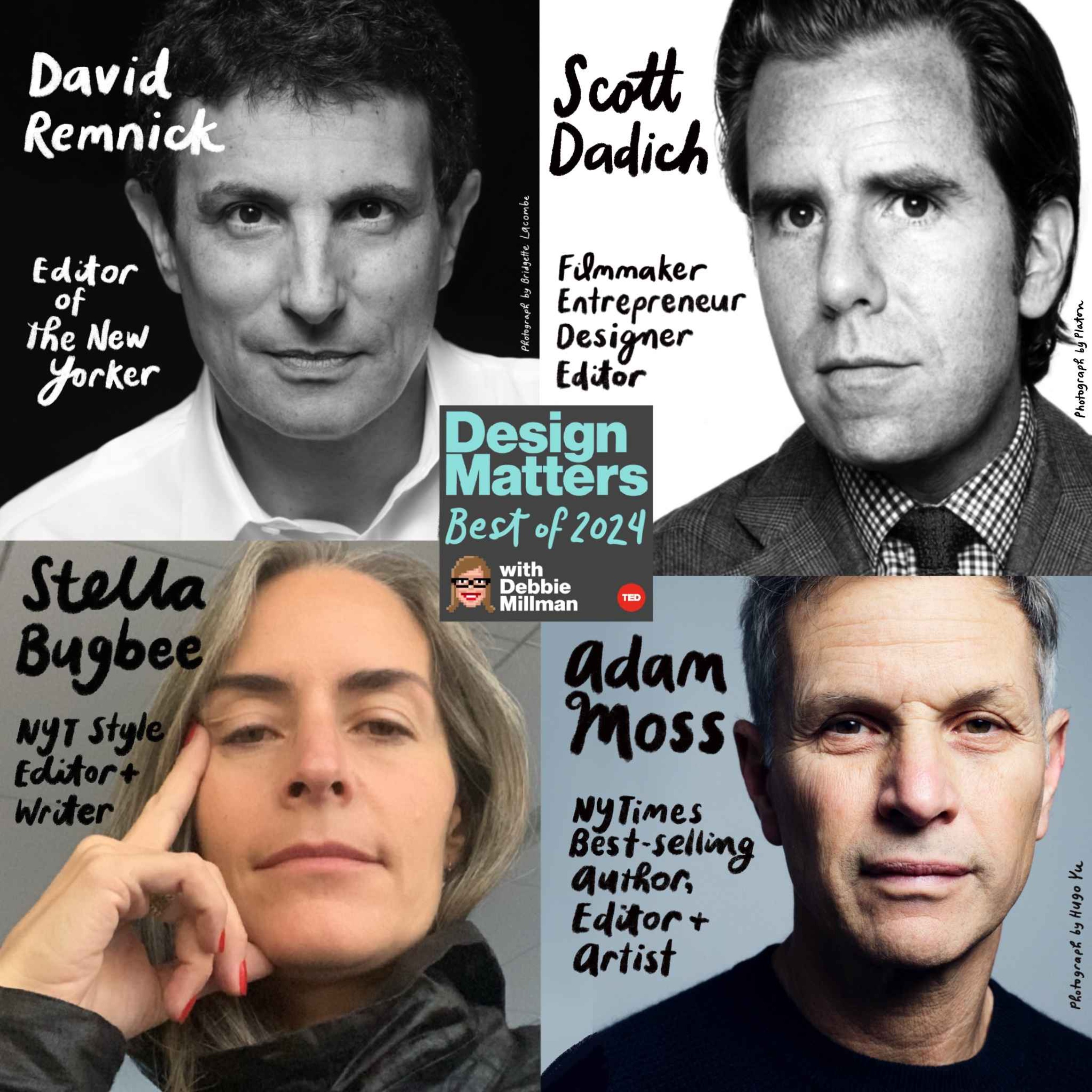
From the TED Audio Collective. This is Design Matters with Debbie Millman. On Design Matters, Debbie talks with designers and other creative people about what they do, how they got to be who they are, and what they're thinking about and working on. To mark the end of 2024. On this episode, we're going to hear excerpts from interviews Debbie did with magazine editors in the past year or so.
- [00:48]
Adam Moss
I had no experience. I mean, like zero experience.
- [00:51]
Scott Dadich
We bucked no digital signatures. We checked into that hotel and we waited.
- [01:00]
Sarah Gibson Tuttle
Hi. Who here loves when their nails are perfectly done? Me. I'm Sarah Gibson Tuttle and I started Olive in June because, let's be real, we all deserve to have gorgeous nails. But who wants to spend a fortune or half their day at the salon? And that's why I created the Mani system. So you can have that salon perfect manicure right at home. And guess what? The best part, each mani only costs $2. Yep, you. You heard me. $2. No more. 30, 40, $50. Salon trips that eat up your day. Now you can paint your nails whenever you want, wherever you want. And trust me, you're going to be obsessed with your nails. And everyone is going to ask you, where did you get your nails done? And here's a little something extra. Head over to oliveandjune.com and get 20% off your first mani system with code perfectmanny20@oliveandjune.com perfectmanny20. That's code perfectmanny20 for 20% off@oliveandjeune.com perfectmanny 20. You're all set for a nail glow up. Let's get those nails looking fabulous, shall we?
- [01:59]
Adam Moss
Ryan Reynolds here from Mint Mobile. With the price of just about everything going up during inflation, we thought we'd bring our prices down. So to help us, we brought in a reverse auctioneer, which is apparently a.
- [02:10]
Scott Dadich
Thing Mint Mobile unlimited premium wireless.
- [02:13]
Ryan Reynolds
30. 30. Get 30. Get 20. 20.
- [02:15]
David Remnick
20.
- [02:15]
Ryan Reynolds
Better get 20. 20. Better get 15.
- [02:17]
Scott Dadich
15.
- [02:17]
Emily Weiland
15. 15.
- [02:18]
Ryan Reynolds
Just 15 bucks a month.
- [02:19]
Emily Weiland
Sold.
- [02:20]
Adam Moss
Give it a try@mintmobile.com Sold.
- [02:23]
David Remnick
$45 upfront payment, equivalent to $15 per month.
- [02:25]
Ryan Reynolds
New customers on first three month plan.
- [02:26]
David Remnick
Only taxes and fees, extra speed slow or above 40 gigabytes in detail. It took a lifetime to find the person you want to marry. Finding the perfect engagement ring is a lot easier. @bluenile.com you can find or design the ring you've always dreamed of with help from Blue Nile's jewelry experts who are on hand 247 to answer questions and the ease and convenience of shopping online. For a limited time, get $50 off your purchase of $500 or more with code LISTEN@Bluenile.com that's $50 off with code LISTEN@BUenile.com Proving Trust is more important than ever, especially when it comes to your security program. Vanta helps centralize program requirements and automate evidence collection for frameworks like SoC2, ISO 27001, HIPAA and more. So you save time and money and build customer trust. And with Vanta, you get continuous visibility into the state of your controls. Join more than 8,000 global companies like Atlassian Flow Health and Quora who trust Vanta to manage risk and prove security in real time. Now that's a new way to GRC. Learn more at vanta.com tedaudio that's vanta.com tedaudio.
- [03:44]
Debbie Millman
For many years now, Debbie has been interviewing designers, artists, writers, filmmakers, musicians, people in pretty much every creative field. In the past year or so, it just so happens that she interviewed some of the best magazine editors in the business. In this episode, we're going to hear excerpts from those interviews. First up, Stella Bugby, the styles editor at the New York Times since 2021. Before that, Stella Bugbee was the editor of New York Magazine's website the Cut.
- [04:14]
Emily Weiland
You started working at the New York magazine's the Cut as a consultant in 2011, first to help relaunch New York Magazine's digital vertical. You ended up agreeing to join as the editorial director the next year. And in the 10 years you were there, you essentially reconstructed what was originally a Fashion Week blog and created a full fledged magazine brand in its own right. What gave you the sense that you could do that aside from just always wanting to be in charge?
- [04:47]
Stella Bugbee
Well, so New York Magazine has actually a precedent for a project like this.
- [04:52]
Emily Weiland
And that is Ms. Ms. Ms. Magazine.
- [04:54]
Stella Bugbee
And Adam Moss, who was the editor at New York Mag, I think that he thought there was space to push this, whatever he was calling, we were calling it a women's vertical or whatever, into a vital Internet publication. I stress the Internet part of it because I think there was this permissiveness to give somebody maybe untested a chance. And that was the writers, that was the editors, that was the photo team. Like it wasn't a Whole bunch of experts coming in who'd already done a bunch of stuff. It was a bunch of young people and we didn't necessarily know exactly what the rules were. So that was good. I'm not sure that I had the confidence necessarily to come in and do that, but there was a lot of interest in pushing things. And Adam was very experimental. And I had worked with David Haskell, who is now the editor in chief of the magazine on Topic, which was his project that you mentioned earlier. And then when we worked on topic, I remember thinking like, I just actually want to be picking the topics. It was Rob Giampiccio and me and David. And while I was of course interested in the design, I was so much more interested in thinking about assigning stories for a specific topic or picking the topic and then thinking about how to represent that. And so David, he knew that that's sort of where my interest lay. Plus I'd been working in fashion then for a year at that point, before that. And it just was a strange job and I had a strange resume and it enabled me to pull upon everything I'd done up to that point. It let me pull the branding and the, you know, art direction and the editorial ideas and put them all in one place, which lucky, so lucky to be able to, you know, to use all these weird experiences that didn't necessarily add up to anything until that moment. So it wasn't necessarily that I had the confidence, just I had a really strange group of skills that applied in this particular instance. And then I ran at it head on.
- [07:03]
Emily Weiland
I found this quote, something that Adam Moss said about you when he hired you. The very unusual thing about Stella is that she has this big, important editorial job and has never been an editor before. He went on to state that he would have been unlikely to appoint a design director to run the cut had he not already gotten to know you. When you consulted and he state, what we saw then was that Stella was a natural editor with a crystal clear vision, an incredible sense of story and great news judgment. Stella, what I love so much about this is that you succeeded by creating a magazine and a brand that you've described at various times as a smart, funny, clear eyed look at fashion, beauty and issues that matter most to women. That also blends a literary feeling with a punk feminist sen. Like, what could be better than that? How were you able to sell that and figure that out in such a figure it out and then sell it in such a clear eyed way? I mean, that's what he said in a clear Eyed way.
- [08:12]
Stella Bugbee
My main goal was to create a space where the people working on that project could say whatever they wanted to say in the tone they wanted to say it in. So it was always very much about the community. I used to make this arm motion where I put my arm kind of in a circle and I said, I'm just keeping the space open so that we can do what we want and say what we want and that we're not being forced into a silo by some advertising category. I think that's really. If you look at most magazines, they were created for the purpose of advertising categories.
- [08:53]
Emily Weiland
And you created this for a certain sensibility. It feels like an attitude almost.
- [08:59]
Stella Bugbee
Yeah. Psychographic, I say, but, you know, it's. I firmly believe that there were people who wanted to talk about serious things and silly things at the same time in the same place, and that was fine. And I defended that urge more than anything. And you know, it changed dramatically year over year over year. And so it wasn't just that I had that vision from the beginning. It was sort of like a. Well, I got that done. What else can we do and how else can we grow and who else can we bring on and what other voices can we put forth and what other challenges and ideas? And while that was all happening, the magazine was also, you know, feeding me incredible pieces. And I was working with the people who worked making the print magazine all the time and the editors on that. And I had an incredible partner in Lauren Kern who's now at Apple News. And she was like sort of my editorial partner on the magazine on the print side. And you know, once that came about when she joined, I think that we all saw the real potential for it to be something very impactful. And again, we just all ran at it. You know, it was. For me, I didn't want to squander that opportunity ever. At any moment I thought, what if no one ever gives me this opportunity again? I have to run at this, you know, and I wanted to give everybody else that sense that we gotta run at this because we don't know that this is a guarantee that we'll always have a place to say and think and be ourselves. Even with the precedent of Ms. Having come out of that publication, which is really powerful and I was operating a lot on other publications backs, you know, like I think you mentioned Mirabella, the actual Mirabella.
- [10:45]
Emily Weiland
Right. Grace's magazine.
- [10:46]
Stella Bugbee
After Incredible Magazine, Sassy like these are. There was a precedent for some of what we were doing.
- [10:50]
Emily Weiland
Remember New York Women, New York, New York Woman New York Women.
- [10:52]
Stella Bugbee
New York, New York Woman. Yeah. And in fact, I met with the editor of New York Woman early on in my time at the Cut because Pam Wasserstein knew her. We went out for lunch, and it was important to me to note that we were part of a pretty healthy legacy, actually, and we were just doing it on the Internet for a new audience and building an audience in that space. But a lot of people have tried to do what we were trying to do. And in fact, I have the very first issue of Mirabella, and I got it when we were relaunching the cut in 2018, just as a kind of reference. And I couldn't believe how contemporary it was and how it felt like it could literally be running now.
- [11:32]
Debbie Millman
Stella Bugby, she mentioned her editor at New York magazine, Adam Moss. Debbie interviewed Adam Moss in May of this year, and they talked about how he reshaped New York Magazine and then about the family of magazine websites created under his editorial direction.
- [11:50]
Emily Weiland
You left the Times in the early aughts, but not after more accolades, awards, an increase in readership, a whole different way of really assessing the magazine. And you went on to New York Magazine as editor, and you were brought in again to remake it by then owner Bruce Wasserstein. And I read that you approached it as a kind of restoration project as opposed to a reimagination, and you wanted to bring back some of the values of the original co founders, Clay Felker and Milton Glaser, while still pointing it to the future. What were the values you deemed most important to restore?
- [12:31]
Adam Moss
Well, one of them was both Clay and Milton had a perspective that what the magazine was really about was not New York City, but a New York City way of looking at the world. And that there was a filter that could be applied to Washington, could be applied to Hollywood, could be applied overseas, to London, other places that it was really a magazine of the Cosmopolitan world. New York magazine inspired a lot of city magazines, but it actually never was a city magazine. And the owners of the magazine before Bruce took it over very much remade it themselves in the mold of the magazines that were imitators of New York. So I was trying to go back to that original idea, which I thought was bigger and more interesting and more adventurous, and to remake the magazine in 2004 to feel like it was a magazine of 2004, but it had the values that animated its founding.
- [13:34]
Emily Weiland
Adam, we could do a whole series, a whole series on design matters about the relaunch of New York Magazine, but I do want to get to your glorious new book. Suffice it to say that since the redesign and relaunch in 2004, New York magazine has won more national magazine Awards than any other publication, including the award for general editing excellence in 2006, 7, 2010-2011-2014-2016, as well as the Society of Publication Designers Award for 2013 Magazine of the Year. Most recently, the magazine won a George Polk Award in magazine reporting for the Bill Cosby rape investigation. And it's also been awarded several Pulitzer.
- [14:18]
Adam Moss
Prizes, many after I left. I just should say. Okay, but. Yes, yes, yes, yes, yes, yes, yes, yes, yes. Thank you.
- [14:26]
Emily Weiland
Congratulations.
- [14:27]
Adam Moss
Thank you.
- [14:27]
Emily Weiland
You not only reimagined the print magazine, you also embraced the magazine killer called the Internet.
- [14:34]
Adam Moss
Yeah.
- [14:35]
Emily Weiland
And new digital only brands, five of which, Vulture, the Cut Intelligencer, the Strategist, and Grub street, are now considered heavyweights in sort of modern online editorial. And New York Magazine is now as much of a digital company as it is a print company.
- [14:51]
Adam Moss
Absolutely. Yeah.
- [14:53]
Emily Weiland
When so many editors couldn't or wouldn't adapt their publications to the digital world, what gave you the sense that this was gonna be the game changer it ended up becoming?
- [15:03]
Adam Moss
It wasn't that I thought it was a game changer. It was that I thought that it was interesting. And I had come from the New York Times just recently, which had. They were making a few mistakes, but basically they were getting it right about how to create a digital newspaper. And I found that very exciting. And there were several experiments, even at the very early newyorktimes.com that I did with the magazine, that were exciting to me. I wanted to bring that spirit. I just wasn't scared of it. And also, the owners of New York Magazine were not scared of the Internet for reasons that really. I've told this story too many times, and it's boring. But they were making money on their own digital site for arcane reasons, but they were. So that that became a business imperative, too. And it really. I just keep saying this because. Not because I'm an economist, but you need the right conditions on the ground to do anything creative, really. And in all these instances, the right conditions, the right economic conditions enabled the creative things that we were able to do, but I was just crazy interested in it. And each experiment we did, trying to build out a sort of satellite, not a satellite, but a constellation really, of digital magazines, was interesting to me and interesting to my colleagues, and it spurred us on to do more and more and more. We started with this thing called Grub street, and then. Which is about food. And then we realized, well, okay, if these things were vertical, as opposed to horizontal, which is to say about one subject, that could be wonderful. And maybe the Voice should be the same voice as the print magazine, but kind of sped up for digital purposes and gave a lot of license to the early writers who helped create the Voice. Grub street became Intelligencer, which eventually became Vulture on culture and entertainment. And Intelligencer went through several iterations, but eventually became a news site. And then the Cut, which was a kind of women's magazine, but a very different kind of women's magazine than it had ever been made before. And, you know, lo and behold, we had this fleet of magazines that were built for the Internet and had the DNA of New York in them. And that proved to really work.
- [17:29]
Emily Weiland
In 2019, after 15 years of non stop growth and innovation, you decided to leave New York magazine. At that point, you had also somewhat secretly taken up painting. Did your new fine arts pursuit influence your departure?
- [17:47]
Adam Moss
No, I don't think so. I had always loved the visual parts of magazine making. And I have a house in Cape Cod that used to be an art school. Just by coincidence, and there is just a feeling of being there that, you know, you can kind of see the, you know, ladies with their bonnets painting on plein air on the dune. And I found that interesting. And then one summer, I just decided to try to do a painting a day without any. I had no experience, I mean, like zero experience doing this. And I just started to experiment. Started painting at 3 and ended at 5. Whatever it was, it was. And that was crazy fun to me. And then when I got back to New York, someone made a gift of giving me an art teacher. And that was the first time I got a teacher. But I was still working in New York at the time. No, I left New York because I felt that I could only edit the magazine for myself and that I was no longer the reader. I had seen the ways in which an editor who didn't have themselves as a compass could screw up a magazine and how it could become contagious. I just didn't want to do that. So I had to get out of the way. So I left without any sense of what I'd want to do, except, as you've mentioned before, to try to do something with less ambition. It was more like, okay, see what happens, without any true sense. But I did enjoy painting enough that I thought, well, maybe I should paint full time. And, you know, I had a problem, which is that I actually was kind of good at the Beginning my first six months, I would say painting, I was a much more successful painter than I ever was. Again, why? Because I was looser, because I was naive. I didn't know better, really. It's really. I can't believe how thematically consistent this all is. And then as soon as I did know more, as soon as I took more classes and that kind of thing, my work started to just stiffen up and fall off a cliff. So that was deeply, deeply upsetting to me. And though I enjoyed it, it scared me.
- [20:03]
Emily Weiland
Why?
- [20:04]
Adam Moss
Because. Because I really wanted it. And I didn't know how to get there, and I didn't have any roadmap whatsoever to get there. I mean, I, you know, I could acquire skills, but I was already, I think, aware that skills training wasn't the problem. I mean, I did lack skills, but you can always get skills. I really felt that there was a way of thinking as an artist and a degree of courage and risk taking that I did not have in solo activity. I'd had it in a group because the group is safe and the group eggs you on. And making something together in a group is really still the greatest thing in the world to me. But here I was, alone and not making enough progress. So that's really when I realized that I kind of just wanted to talk to people who were successful at making art. By art, I mean any kind of art. Novels and poems and visual art. And. And then I was afraid that they wouldn't be truthful with me. They wouldn't know how to be truthful with me. Because so much of the process of making art is secretive and people are afraid of jinxing the muse. So they develop a kind of set spiel. And that's how they talk about their art and it's about the project and all that stuff. But that's not what I wanted to know. I really wanted to know how something is made and what goes through a person's mind when they're making it, and what goes through a person's emotional makeup. What kind of person is successful at this? So that's when I devised this idea of concentrating on a single work from each of these people and asking them to trace the evolution in as many different layers as they could. Both, like, practically what they did, but also very much their kind of emotional journey and then also part as a goad to help them remember truthfully. And also just because I love this stuff, to accompany it with a gallery of the artifacts of the making of the thing, the notes and the sketches and the doodles that were their tools making the work. Then I kind of looked at all that and I kind of had a book or I had a structure of a book or I knew what the book was.
- [22:24]
Debbie Millman
Adam Moss's book is called the Work of How Something Comes From Nothing.
- [22:31]
David Remnick
Support for this show comes from Lumen. Still curious about what is Lumen? Well, it is the world's first handheld metabolic coach. You know how growing up people might have said like, oh, you must have a fast metabolism, you must have a slow metabolism. It's really not about fast or slow, it's about efficiency. Lumen helps you measure your metabolism through your breath. It's paired with an app that lets you know if you're burning fat or carbs and then gives you tailored guidance to help improve your nutrition and workouts and sleep and even managing stress. I love to check in on how my metabolism is functioning on my lumen in the mornings, but you can do it any time of the day. All you have to do is breathe into your lumen and you'll know what's going on with your metabolism. Then Lumen will give you a personalized nutrition plan for that day based on your measurements and it will occur just its recommendations to keep your metabolism healthy through hormonal shifts. So if you want to stay on track with your health this holiday season, go to Lumen Me Design to get 15% off your lumen. That's L U M E N me Design for 15% off your purchase. Lumen makes a great gift too. Thank you Lumen for sponsoring this episode. Proving trust is more important than ever, especially when it comes to your security program. Vanta helps centralize program requirements and automate evidence collection for frameworks like SoC2, ISO 27001, HIPAA, and more. So you save time and money and build customer trust. And with Vanta, you get continuous visibility into the state of your controls. Join more than 8,000 global companies like Atlassian Flow Health and Quora who trust Vanta to manage risk and prove security in real time. Now that's a new way to GRC. Learn more@vanta.com tedaudio that's vanta.com tedaudio okay, web designers, let's talk about the C word. Creative Burnout. You're working on a site for a really big client, but between resourcing, feedback, tight budgets, and even tighter deadlines, it doesn't make the cut. Wix Studio helps close that gap so you can deliver your vision with less friction. Built for agencies and enterprises, you get total creative control over every last pixel with no code, animations, AI powered tools, reusable design assets, advanced intuitive layout tools and a figma to WIX Studio integration. You can design the way you want to and deliver when you need to. And if you're worried about the learning curve eating into time you don't have, don't be. Wix Studio is intuitive by design so your entire team can hit the ground running for your next project. Check out wix studio.com that's wix studio.com.
- [25:24]
Adam Moss
Ryan Reynolds here from Mint Mobile. With the price of just about everything going up during inflation, we thought we'd bring our prices down. So to help us we brought in a reverse auctioneer, which is apparently a.
- [25:35]
Scott Dadich
Thing Mint Mobile unlimited premium wireless 3030.
- [25:39]
Ryan Reynolds
Better get 30, better get 2020, 20 better get 2020.
- [25:41]
Emily Weiland
I bet to get 15 15, 15, 15 15.
- [25:43]
Ryan Reynolds
Just 15 bucks a month.
- [25:44]
Emily Weiland
Sold.
- [25:45]
Adam Moss
Give it a try@mintmobile.com Switch $45 upfront.
- [25:49]
David Remnick
Payment equivalent to $15 per month New customers on first three month plan only Taxes and fees extra speed slow are above 40 gigabytes.
- [25:54]
Ryan Reynolds
Detailed.
- [25:57]
Debbie Millman
David Rimnick has been the editor of the New Yorker magazine since 1998. Debbie spoke with him in March in front of a live audience at the On Air Festival in Brooklyn.
- [26:08]
Emily Weiland
It took three years, but the magazine has actually been profitable since 2001.
- [26:15]
Ryan Reynolds
Look, I will say this, our business changed a lot. The old style of all magazines was subscriptions were very cheap so that it would get in a lot of hands and so advertisers would reach as many people as possible of a certain kind of audience, depending on what the magazine was or newspaper or television network or whatever it might be. The nature of advertising has changed and is completely and utterly dominated by Google and Facebook. And I don't know what the real numbers are, but something like 75% of the ad market is to that and the rest is scraps. And the result has been, in addition to other factors like Craigslist and so on, has been the decimation of mid level newspapers. I mean there's really only a few exceptions to this. And magazines. And it's tragic. It's tragic. Not that every publication that's been lost or diminished is perfect, but the changed landscape is deeply, deeply, deeply worrying for all kinds of reasons that we can talk about. The only other alternative that I know of at the moment is subscriptions. The same thing that television's discovered and luckily enough, fairly early. We changed our emphasis and we basically said to you readers of the New Yorker, without saying it That I can't give this away anymore. You have to pay more than a cup of coffee a week to have this extraordinary thing in your hands or on your phone or however you choose to read it. And the New Yorker, in fact, gives you a great deal more per day per week than when Mr. Shawn was editing it. But the subscription model, now that we've had a lot of success with it for a while now, the subscription model is facing challenges, too, because you all had this discovery. You've all woken up and go, wait a minute, I have Netflix. I have Paramount Plus. And then there are even apps now to get rid of or shave down.
- [28:16]
Emily Weiland
Your subscription, which was, you know, the original cable system.
- [28:20]
Ryan Reynolds
Exactly. So, you know, we're in a time of real flux. And editors spend a lot more time thinking about business than they probably, if they're being honest with themselves, would like to. They want to be thinking about writing and graphic design and all kinds of things. But if you don't have your eye on business, and this goes with public radio or look at what's happening in the podcast business. Right. You know, we have the New Yorker Radio Hour with my colleague David Krass now. We have a terrific time doing this. We're thinking about how to make. Develop it, make it better all the time. But we also have to pay attention to economics. Otherwise, you know, you wake up and something terrible has happened. And I'm determined, you know, we're going to celebrate 100th anniversary next year, the New Yorker. I don't want that to be an occasion for us to show off at a museum of ourselves. There'll be some of that, to be sure. But I want people in this room and their children to be reading the New Yorker. That is a lot better than the one that we have now in the future. So I think about that kind of thing all the time.
- [29:24]
Emily Weiland
The last thing I want to talk to you about is music. In your latest book, holding the Profiles and Popular Music, you state that there's no one who has meant more to you than Bob Dylan. In 2004, you were hoping to get an exclusive excerpt of his recently published memoir in the New Yorker. You had almost had it in the bag.
- [29:45]
Ryan Reynolds
Yeah, I got screwed with my pants on.
- [29:48]
Emily Weiland
Dylan wanted the COVID Dylan wanted the COVID of the New Yorker.
- [29:52]
Ryan Reynolds
Let's just say that Bob Dylan has remained unmoved by and unimpressed by my hero worship. It doesn't keep him up nights, apparently. I'm not alone. So what happened was I had heard that he was writing a memoir and that it was good and that it wasn't like Tarantula, which is a kind of, I don't know, surrealist experiment. And I was summoned. I said, well, send the manuscript to the publisher. You said, I can't send the manuscript. It would be like sending the Dead Sea Scrolls to my apartment. So I went to his. To the Dylan office. I won't even tell you where it is. But you have to press a button that says, like, I don't know, Ab Cube carpets. It's like a. It's like a CIA thing. And you go up there and it's just Dylan everything. Dylan tote bags and Dylan albums and Dylan this and Dylan that. And if I'd gone when I was 16, my head would have exploded into a thousand pieces. And they sit me in a little room with a bare table and a manuscript and a glass of water. And I sat there and read the book straight through Chronicles, Volume 1. And it was terrific. And I said to the publisher and the Dylan guy, nice people. I'm in. Don't call Rolling Stone. That's not your audience anymore. I don't know. Whatever bullshit I told them I was trying to get it for the New Yorker. I'm a competitive person. And we made an agreement, and we made a handshake agreement, okay? And it still pisses me off. I know many years ago, John Kerry was running for president. Half the people here weren't born yet. And it really pisses me off, this thing. And it got to the summer, and they call and they said, okay, we're about to publish it. And I said, great. Seven thousand words. The New York bit in the beginning. We're all set. And we'll try to figure out what to do about fact checking and copy editing. And Bob doesn't necessarily have to be completely involved and so on and so forth. Whatever. Whatever shit I was slinging. I was. I thought. I just thought, everything's gonna be great. And then they said, bob wants a cover. I said, bob wants a cover. We have, like, dogs on the COVID or bowl of fruit or a joke or a Barry Blitz making fun of whatever. We don't have. We don't do that. We don't have photographs on the COVID And I thought I'd change their mind. And there was a pause and they said, bob wants a cover. And it was like talking to your parents at your worst moment. Bob wants a cover. I said, I can't do it. I said, I'm sure we can find some way to work this out. Bob wants a cover. And that was it. And they went to Newsweek, and by that time, Bob kind of looked like Vincent Price, you know, with a little mustache and a cowboy hat. And I thought, they're never gonna put Bob Dylan on the COVID in the middle of a presidential race. They put him on the COVID and they ran this excerpt. And apparently Bob Dylan survived the experience of not being published in the New Yorker. And then another thing happened. I saw that he had these paintings. He's a painter. He also makes whiskey and iron gates. A man of parts.
- [33:15]
Emily Weiland
He's a range. He's got range.
- [33:17]
Ryan Reynolds
He's got range. And these paintings, some of them are. Some of them are kind of good. And there was one, a painting of Katz's Delicatessen, right. The pastrami capital of the world. And it's pretty good. And it's a good New Yorker cover. It's a New York scene. I make an arrangement, we're all set to go. Two weeks out, I get a phone call. Bob doesn't want to do it. So I feel our relationship, yeah. Is not on an equal level somehow.
- [33:54]
Debbie Millman
David Remnick. Scott Dadich is a designer, a filmmaker, and a magazine editor. He went from creating the tablet edition of Wired magazine to becoming the magazine's editor in chief for several years.
- [34:07]
Emily Weiland
Some of your biggest accomplishments at Wired were the collaborations you forged with guest editors and your exclusive interviews in somehow you were able to get an exclusive sit down interview with Edward Snowden in Moscow and you wrote this about the experience. Just a few people on earth know where I was and why in Moscow to sit down with Edward Snowden. It was a secret that required great efforts to keep. I told co workers and friends that I was traveling to Paris for some work, but the harder part was covering my digital tracks. Snowden himself had shown how illusory our assumption of privacy really is. A lesson we took to heart that meant avoiding smartphones, encrypting files, holding secret meetings. Scott, how did you get that interview in the first place?
- [35:05]
Scott Dadich
That was a process that took probably the better part of eight or nine months. My very dear friend Platon, long time collaborator, dating back to my earliest days at Texas Monthly. And I had talked about this as a. As a get, this is a. This is a thing. And we thought in first terms of the visual, and we thought in first terms of the COVID very much in a George Lois kind of condition, like, we need to make an iconic cover. And this is a moment. An individual who would deserve such a treatment. Then came the very real practicalities of what he had or had not done. And the arguments in the newsroom about our obligation to cover his actions, whether we agreed with them or not, whether we could reach him or not. But it was my responsibility as the editor of Wired to reach out and to find a channel appropriate to find him. We were looking at news reports and wire clippings and the access that the Guardian was getting and what we're seeing on channels like social media and Twitter. So we had some indications, but ultimately got a connection that Platon and I had raised to an individual who knew his lawyer. And so we've got a communication over to him and we waited and we checked in and we waited and we checked in. And I don't remember the exact date, but we'd got a communication back that if I were to be in Moscow on such and such a date, at such such a time, at such and such a hotel, maybe conditions would be right for a meeting.
- [36:48]
Emily Weiland
And you and a photographer went, I believe, yes.
- [36:50]
Scott Dadich
So Platon, the photographer, we packed up some cases and his assistant and our photo editor, we all met in Moscow. And the secrecy and the sort of skullduggery of it seems over the top, or maybe to some seemed over the top at the time, but I did have to communicate to a couple of my colleagues at Conde Nast, and I also sought the advice of several of the other editors in chief that I had trusted very deeply and have very strong relationships given my previous work with them. So I just sought some advice. And it turns out that a couple of them, and one of them in particular, had been over in Russia and had been hacked and had his smartphone compromised and banking details and all the sort of things that you can imagine would be really terrifying to encounter. So there was a very real cautionary tale about why the secrecy was going to be required. Whether it was from people chasing Snowden or other actors or government officials, we just didn't know. And there was a lot to be careful about.
- [37:57]
Emily Weiland
Did you know for sure he was going to show up, or was it. Were you just hoping he'd show up?
- [38:03]
Scott Dadich
We really didn't. And we were hoping, and I did. I, I, I. We stopped in Paris and I met Platon at Charles de Gaulle and at the gate. And I had sent my iPhone back to in a FedEx packet back to Amy in San Francisco. And so I was phoneless until we got to the Moscow airport. Platon and I bought burner phones, and no one knew those numbers. No one knew how to reach us. We were there. We did not bring computers. We were not online. We left no digital signatures. We checked into that hotel and we waited. We sat and we waited and sure enough the phone rang and it was Ed himself. And this voice on the phone at the pre appointed time called out and said, I understand you're in room so and so and I'll be there in about an hour. And sure enough, there was a knock at the door about an hour later, like the longest hour of my life, waiting to see if that was going to happen. And he ended up showing up.
- [39:05]
Emily Weiland
Scott, as an interviewer, I need to ask this question. It might not be as interesting to my listeners as it will be to me, but I can't resist. How did you prepare for that interview?
- [39:16]
Scott Dadich
Well, obviously we had just read everything we could get our hands on, stayed as current as we could on news events, on government positions and what the Obama administration was doing. Obviously we had an incredible amount of opinion and reporting background from our colleagues in the newsroom. So you feel pretty well prepared. I was there not only to meet with him, oversee the photo shoot, and then facilitate the interview for Jim Bamford, our incredible journalist who's going to write the profile. So Jim was also there and meeting with him the next day, but Platon and I ended up having the very first interaction with him in that hotel room, which lasted about four hours that afternoon.
- [40:02]
Debbie Millman
Scott Davich. You can hear the full interviews with all four of these editors on designmattersmedia.com or wherever you get your podcasts. Design Matters is produced for the TED Audio Collective by Curtis Fox Productions. The interviews are usually recorded at the Masters in Branding program at the School of Visual Arts in New York City, the first and longest running branding program in the world. The editor in chief of Design Matters Media is Emily Weiland.
- [40:38]
David Remnick
Only Boost Mobile will give you a free year of service when you buy a new 5G phone.
- [40:41]
Ryan Reynolds
Oh, like a BOGO.
- [40:42]
David Remnick
A BOGO.
- [40:43]
Adam Moss
Buy one, get one BOGO.
- [40:45]
David Remnick
Well, technically it's buy one phone, get one year.
- [40:48]
Adam Moss
So BOP goy ah bopgoy get the Boost Mobile Bop goy Deal bop goy with Boost Mobile.
- [40:56]
Emily Weiland
Bob goy, bob goy bop goy.
- [40:59]
Scott Dadich
This is the best idea we've ever had.
- [41:01]
Adam Moss
When you purchase an eligible device, you get $25 off every month for 12 months, with credits totaling one year of free service. Tax is extra for the device and service plan online only.
- [41:08]
Ryan Reynolds
Let's talk about something that's not always top of mind, but still really important. Life insurance. Why? Because it offers financial protection for your loved ones and can help them pay for things like a mortgage, credit card debt. It can even help fund an education. And guess what? Life insurance is probably a lot more affordable than you think. In fact, most people think life insurance is three times more expensive than it is. So with State Farm Life Insurance, you can protect your loved ones without breaking the bank. Not sure where to start? State farm has over 19,000 local agents that can help you choose an option to fit your needs and budget. Get started today and contact a State Farm agent or go to statefarm.com over.
- [41:52]
Emily Weiland
The last 75 years, over 10,000 chemicals have been introduced to our food supply, yet the EU only allows 300 food additives. But at Thrive Market, we bring our members the highest quality brands and restrict more than 1,000 ingredients found at conventional grocery stores. Making the switch is easy with our Healthy Swaps scanner, which finds better versions of all your favorite pantry, snacking and home essentials without the added junk dyes and fillers. Plus, it's all delivered straight to your door. So if you're looking to shop at a grocery store that actually cares about your health, go to thrivemarket.com podcast and you'll get 30% off your first order and a free gift.
- [42:42]
Scott Dadich
SA.