Loading summary
Transcript128 lines
- [00:01]
Debbie Millman
TED Audio Collective.
- [00:08]
Progressive Insurance Ad
This episode is brought to you by Progressive Insurance. Fiscally responsible financial geniuses, Monetary magicians. These are the things people say about drivers who switch their car insurance to Progressive and save hundreds. Visit progressive.com to see if you can save Progressive Casualty Insurance Company and affiliates. Potential savings will vary. Not available in all states or situations.
- [00:32]
Debbie Millman
Spark Something Uncommon this Holiday with just the right gift from Uncommon Goods. The busy holiday season is upon us and Uncommon Goods makes it less stressful with incredible hand picked gifts for everyone on your list. All in one spot. Gifts that spark joy, wonder, delight and that it's exactly what I wanted feeling. Some of my favorite items that I've discovered on their site include a grilled personal pizza maker, some fabulous garden accessories, and my favorite a pair of wine glasses personalized with a Maya Angelou quote. When you shop at Uncommon Goods, you're supporting artists and small independent businesses. And with every purchase you make at Uncommon Goods, they give back $1 to a nonprofit partner of your choice. To get 15% off your next gift, go to UncommonGoods.com DesignMatters that's UncommonGoods.com DesignMatterS for 15% off. Don't miss out on this limited time offer Uncommon Goods We're all out of the Ordinary.
- [01:47]
TED Audio Collective
This archival episode of Design Matters originally dropped in January of 2023.
- [01:53]
Alexandra Horowitz
One of the things that is key is central to the feeling of understanding and intimacy and connection with somebody is that you can look at each other in the face, look in each other's eyes. Dogs will do this with us. Dogs look us in the faces.
- [02:13]
TED Audio Collective
From the TED Audio Collective, this is Design Matters with Debbie Millman. For 18 years, Debbie Millman has been talking with designers and other creative people about what they do, how they got to be who they are, and what they're thinking about and working on. On this episode, Alexandra Horowitz tells us about her study of dogs and why we humans have trouble understanding them.
- [02:37]
Alexandra Horowitz
It's very hard for humans to imagine that animals are thinking if they're not thinking in words or pictures.
- [02:48]
Debbie Millman
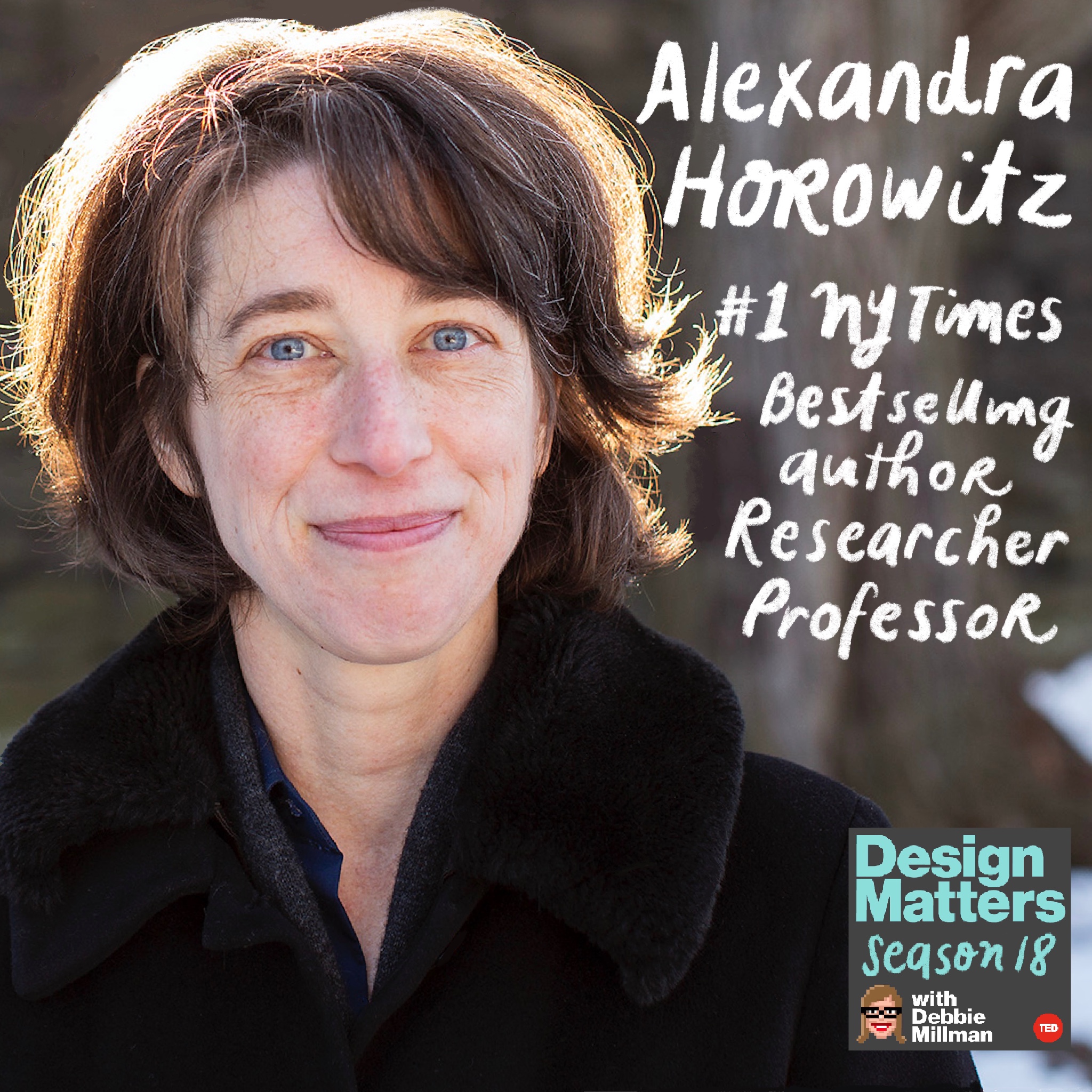
We feed them, we go on long walks with them, we groom them and rub their bellies. We even share our beds with. But do we really know who they are? Yes, they're dogs. But do we know what's going on between those two floppy ears? Alexandra Horowitz knows a lot more than most people. She is a professor at Barnard College, where she teaches creative nonfiction, writing, and audio storytelling. A senior research fellow, she also runs the Dog Cognition Lab at Barnard. She's also written some of the world's best books about dog cognition. Her latest is the Year of the How Dogs Become Themselves. She's here to talk about the relationship between humans and our canine friends and a bit about herself as well. Alexandra Horowitz, welcome to Design Matters.
- [03:45]
Alexandra Horowitz
It's a complete pleasure to be here. Thanks, Debbie.
- [03:48]
Debbie Millman
Alexandra, you were born in Philadelphia. Your family moved to Golden, Colorado, when you were a child. And I read that year your dad was the son you circled, and you were influenced both by his work ethic as a litigator and his humor. How were you influenced by his humor?
- [04:06]
Alexandra Horowitz
I think he saw levity in everything. He took himself seriously, and at the same time, he didn't take himself too seriously. I mean, he was born of this kind of east coast generation of lawyers and doctors who really felt like they were making a change in this world. And at the same time, he was very ready to find the silliness in a situation and the playfulness in the situation. And that's definitely imbued my work and made it possible for me to do what I do.
- [04:40]
Debbie Millman
As you were growing up, I understand, you not only liked to watch your dog and your cat, you liked to observe the ants in your yard and counted the prairie dogs in the field on your way to school. What motivated this early interest in animals and insects?
- [04:56]
Alexandra Horowitz
That's some deep dive research. You've been into my background there, Debbie. Yeah, I don't know exactly what motivated it. When you're growing up in Colorado. I felt very exposed to part of the natural world. We lived in a community which was, I guess, suburban by some definition, but also the community itself was enforced as a kind of natural community. People didn't have lawns particularly. In fact, I think they were forbidden. And the mountains were kind of our backdrop, and there were elk wandering through the foothills. And you just felt like that was part of your life, and so you observed it. Naturally. It was just the scene that was going by outside your window. And it was only later, when I wound up moving to cities, that it felt like that was quite unusual. But I retain that interest in, you know, looking closely, especially at animal communities.
- [05:56]
Debbie Millman
I know at that time, veterinary work didn't interest you. At that point in your life, what were you thinking you might do professionally?
- [06:04]
Alexandra Horowitz
I wasn't really on a pre professional track. I think my father was an attorney and my mother had been trained as a lawyer as well. And I thought, well, you know, that's something that I could do with a kind of analytic acumen, which I prided myself as a young Alexandra as having. It didn't pan out. I didn't, I think, have any special interest in law, though I applied to law schools. I wound up doing philosophy in college. And I. I also thought that that was a potential avenue. But I wasn't an academic philosopher at heart. Right. I wasn't that driven by these arguments and conversations. You know, my dad. One of the things my dad gave to me as a child was the freedom to not know what I was going to be. He really had confidence in both me and my brother that we would just wind up doing something that was appropriate for us and he would support whatever kind of thing that was. You know, he was, as I say, he was a lawyer. He grew up around people with certain kind of very traditional professional roles. So for him it was maybe a leap to say, but he did, you know, you should be an artist, you know, you should go out and be an artist. And I thought, well, you know, I don't have any particular artistic talent. But I appreciated that. For him, what that meant was you don't have to do, follow a traditional path and will be there rooting for you whatever you do. So I didn't know. I just sort of went headstrong toward the things that interested me.
- [07:43]
Debbie Millman
You did study philosophy at the University of Pennsylvania. Why philosophy?
- [07:49]
Alexandra Horowitz
I had the fortune to have a philosophy class in high school. A teacher named Sean Smith taught philosophy. He was, in fact, now that I reflect back on it, a master's student in philosophy himself. He was finishing a degree in Edinburgh and teaching at this Colorado school. And I loved it. I just loved the thought processes involved in setting out an argument and following in its path and the way the words kind of tumbled out of philosophers mouths and the things they got to think about. So I pursued that as a degree. My mother had been a philosophy major as well, so it probably was, you know, a little bit my birthright to be thinking deep philosophical thoughts as a. As a young thing. And I actually really fell in love with analytic philosophy and the philosophy of J.L. austin, which actually led later to kind of another career of mine. But again, it wasn't with any thinking. Hmm, this is going to pan out into a profession, a specific profession, more just. This is a way of thinking that I want to encourage in myself. Right. The ability to make an argument and follow it through to a conclusion.
- [09:08]
Debbie Millman
After you graduated, you worked at the Merriam Webster Dictionary. What was your job there?
- [09:15]
Alexandra Horowitz
I was a lexicographer, which is briefly a definer of words, which seems insane in retrospect. You know, I was just out of college. I was a kind of dabbler in dictionaries. I was the type of person who liked to sit down, open up a dictionary and read several pages for fun. And somehow this led me to the notion that maybe a dictionary company would want to hire me as a philosophy major from Penn with no experience, particularly in linguistics or lexicography. And they did. So I wound up being one of the maybe 20 definers on the 11th edition of the Collegiate Dictionary of Merriam Webster's Collegiate Dictionary, which came out in 91. And it was kind of a fabulous gig. You just are defining new words, making sure the old meanings are still consistent with how we're using words. For somebody who's at all interested in language, you know, I was the type of person who would collect big words or like fun, fancy words and write them down and have like little boxes of three by five cards of these things. This was like a dream come true. You're just surrounded by big, fancy words and also really quotidian, ordinary words that are really tricky to define and therefore become intricate and fun. So, yeah, I did that for the length of that edition of the dictionary.
- [10:42]
Debbie Millman
I thought it was a wonderful overlap to share with you that at that particular moment in time I worked at the graphic design firm that designed that particular edition of the dictionary.
- [10:58]
Alexandra Horowitz
Wow.
- [10:58]
Debbie Millman
Yeah. Frankfort, Gibbs Walkind. So I spent a lot of time looking at page proofs of that dictionary.
- [11:05]
Alexandra Horowitz
Oh, that's wonderful. That's wonderful.
- [11:07]
Debbie Millman
Well, it was well designed and I should say, yes, Johann Wipper designed most of that. And I know he did the COVID and he and I went on to work for many, many years at Hot 97, the hip hop radio station. But I understand that's also where you met your husband, who I think the first question he asked you was what the etymology was of the word pumpernickel after hearing you mention your dog's name, which was Pumpernickel.
- [11:34]
Alexandra Horowitz
That's right.
- [11:35]
Debbie Millman
That's true.
- [11:36]
Alexandra Horowitz
Yeah. This is a kind of sordid but real tale. Well, I didn't meet him at Merriam, although he now works at Merriam Webster. So it's all come back round to Miriam. I was in New York and he was working as a mover, as a furniture mover. And I was helping my parents move furniture from one apartment to another. And supervising this move, I barely had any furniture of my own at the time. I just finished graduate school and he came in the door and my dog Pumpernickel was barking and I said, pumpernickel you don't need to bark. And his response, the mover's response at the door was, do you know the etymology of pumpernickel? And I said, well, I mean, I do. She's my dog. We had a little disagreement about the etymology because pumpernickel was this German bread which is notoriously difficult to digest. And so pumpernickel comes from the words for flatulent goblin. But he thought that the more apt etymology was farting devil. So we had a little disagreement about the etymology of pumpernickel. And the rest is history, as they say.
- [12:45]
Debbie Millman
Yes, you should have known instantly you were a soulmate.
- [12:50]
Alexandra Horowitz
I love that. It was extremely unlikely.
- [12:54]
Debbie Millman
You then moved to New York and worked as a fact checker for the New Yorker. Now, the New Yorker is one of the most notoriously difficult places to find a job, and fact checking is one of the most difficult jobs there is. They are held to a very high standard. What was that experience like?
- [13:12]
Alexandra Horowitz
Also a great experience. One of the things we did at Merriam Webster in the moments when we were not defining words was we were collecting words, basically meaning we would read prolifically and mark words that seemed to be used in such a way that it made their meaning quite visible, quite transparent, or mark new words or what seemed to be new uses of words. And one of the things that would. That multiple people would read and mark, as we said, was the New Yorker. And so I became a New Yorker reader. You know, I'd been a person who grew up just looking at the drawings as a kid. And one could forever just look at the drawings in the New Yorker, of course. And yet I started reading and loved the magazine, as everybody around me did, and just cold called them, right? Just wrote to them and said, I any job at the magazine I will take. And it just so happened. I mean, I really don't understand how some of these things happen sometimes, but I feel like one leans into one's interest and it works, right? I mean, I guess I'm forgetting the times when I've leaned into an interest and it didn't work or I tried to do something and people, you know, or the very many employment letters I wrote which didn't respond where Merriam Webster did. So it seems inevitable in retrospect. But here too, I just wrote to them and they were interviewing for fact checker positions. It was right when Tina Brown had taken over editorial helm of the magazine and her interest in the magazine was in more topical articles. And of course, the New Yorker had been famously non topical, right? Like you could do a three part, 50,000 word series on Boggs, but there wasn't really anything on what had happened last week. But when you do a topical magazine, you really need to be able to change directions. Quick new news comes out, you have a writer write something and the checker has to check it quickly. Or a whole team of checkers. So they were doubling their checking department, which had been pretty small, I think about eight people. And so I actually was hired freelance at first and then eventually got a staff position. And it was also terrific because a great camaraderie. My peers were so sharp and funny and it was a great, exciting place to be. And it also was a really interesting place for me because, you know, as somebody who had this little bit of philosophy background, I was very interested in the nature of a fact. Right. The nature of truth and what counted as confirming the fact. Verifying truth. Right. And that's always been a motif for me, actually. You know, the fact that I was able to define words in the dictionary. Sure, there were other editors who looked at those words. But it was interesting to me to be put in the position from being just a user of words to a definer of words. And here, maybe I wasn't writing these facts, but I was confirming the truthiness of the fact. Right. And so those turns were very interesting for me. And that was one of the, I think, the things I take away from being a fact checker. There was a somewhat of the slippery nature of facts and what it means to confirm a fact and what knowledge is.
- [16:23]
Debbie Millman
Yeah, I mean, you sort of the last word on words, which is so philosophically interesting to me.
- [16:31]
Alexandra Horowitz
Yeah, right, right. So besides being just a very cool job, it had this sort of conceptual interest.
- [16:39]
Debbie Millman
While you were there, you worked on fact checking several pieces by the legendary neurologist Oliver Sacks, who wrote books including the man who Mistook His Wife for a Hat and the book Awakenings, which became a very popular movie. What was it like working with Oliver?
- [16:57]
Alexandra Horowitz
I was never the main checker on his pieces. I was a sort of ancillary checker. And of course, his pieces were full, full, full of facts of all sorts. Facts about individual people, about neurological conditions, about philosophical histories. And he was a really generous writer. You know, he was interested in working collaboratively with his checkers to find the truth there. Right. Versus being antagonistic with the checker, as sometimes writers could be. Right. They didn't want to have somebody else looking over their shoulder and saying, well, you know, there's another way of looking at this or this other person says this thing. But he was fabulous. And he was quite an inspiration as a writer for me, as well as somebody who had taken his scientific career and made a writerly career out of it. So that wound up being important in my life.
- [17:53]
Debbie Millman
Did working with him at all influence your decision to go back to school to get a PhD in cognitive science?
- [17:59]
Alexandra Horowitz
Completely. It completely influenced, right? The cognitive science was a kind of budding field at the time, which combined, you know, the types of things one would ask questions about in philosophy. Where is mind? Like, what is a individual? Are we. Do we have free will with neuroscience and psychology and anthropology and computer science, all these other people who are asking similar questions in their own methodological ways. And so it was this multifaceted field. It wasn't something that Oliver had done, but his approach was his own kind of version of cognitive science, right? He was taking the William James and connecting it to the Raymond Cajal neurological experiments and then writing about it in his own sort of novelistic way using, like, very strong narrative voice. So I felt like it was of a kind with Oliver Sacks work. And, yeah, that's why I went back to graduate school. That's the first time I started thinking, kind of professionally, frankly, that, oh, I would like to be a scientist who dabbles in these topics in some way.
- [19:08]
Debbie Millman
You got your PhD from the University of California, San Diego, and you described the PhD in cognitive science in the following way. It's basically an interdisciplinary degree. Philosophers ask, what is the mind? Neuroscientists are interested in examining the brain. Psychologists want to look at behavior. So those fields, plus computer science with an interest in artificial intelligence and anthropology, converge in this one interdisciplinary field which wants to use different methods and approaches to tackle the questions of mind. And, Alexandra, to me, this sounds like the most interesting PhD on the planet. Really?
- [19:51]
Alexandra Horowitz
Truly, it really, really is fabulous. I think that so much creativity comes from interdisciplinarity, right? You have to be skilled and trained at the thing you're doing, but also you need the perspective from outside of your field, it seems to me, to really make movement in your own field. So cognitive science had that kind of baked in.
- [20:13]
Debbie Millman
Initially, you trained as an ethologist, which is the science of animal behavior. And you joined two research groups observing highly social creatures, the white rhinoceros at the Wild Animal park in Escondido, and the bonobos, which are pygmy chimpanzees at the San Diego Zoo, where you learn the science of careful observations, data gathering, and statistical analysis. What are Some of the things you learned about these species, both of these.
- [20:42]
Alexandra Horowitz
Projects were ongoing projects of faculty members. And in the latter case, and in the former case, researchers at the zoo who wanted to basically do basic research on the animal species. So even though we're familiar with rhinoceri and bonobos and all the other animals who are common to see at a zoo, for instance, we don't know everything about their lives. Right. We might not know all about their social habits. We might not know how they forage or how they identify themselves, how they identify each other. And so each project had its own interest. The rhinoceros project was interested in. Well, the white rhinoceros is a fantastic species. You know, we. I didn't know much about them at all, just except for that they were an African species. There were fewer, many fewer of them than there used to be. They're not endangered, I think, anymore. They are matrilineal, so they live in groups of women. And the males, who are usually smaller than the females, only approach when they've received kind of advanced word that a female is ready to mate. Otherwise he'll just get beat up. Yeah, they're just. They're really not interested in his company at all. They don't hang out with the males at all, but they'll endure his company if they're interested in mating. And the way they leave this communication that they're interested in mating is through their dung, actually. And they leave these kind of huge heaps of dung that's. They're like, you know, bulletin boards with all the information about all the rhinoceros, it has, all the health and mating, reproductive status, etc. They're basically leaving a message. Once they leave, the male can go and sniff and see if he can pursue one of the females. So we're basically looking at how does their behavior relate to their endocrinology and that people would go in and gather samples and check their hormone levels, and then we would try to sync it with their behavior. So it was the first time that I'd really looked at behavior of an animal over a long period closely, where you start to think about them as individuals who have their own life histories. And you also think about the fact that their individual life history, while having interesting analogs to a human life history, you know, is full of its own complexities, some of which I might not be aware of. For instance, I didn't use my sense of smell to do much in my life, particularly certainly not to find out information about other people, except for maybe accidentally and even Then really inadvertently so, it made me kind of aware of the types of things that would later drive my research, like the looking closely, looking over a long period of time, the importance of sort of individual animals and the perceptual world of non human animals, which is in so many ways much more expansive than ours.
- [23:49]
Debbie Millman
You also spent many hours at the local dog parks and beaches with your famous dog Pumpernickel, where you began to see the interplay between him and other dogs in entirely new ways. And you wrote this about the experience. And I found it so moving and so vivid that I'd really like to share it verbatim with our listeners. It's about a paragraph, if you don't mind.
- [24:14]
Alexandra Horowitz
Sure, sure.
- [24:15]
Debbie Millman
Where I once saw and smiled at play between pumpernickel and the local bull terrier, I now saw a complex dance requiring mutual cooperation, split second communications and assessment of each other's abilities and desires. The slightest turn of a head or the point of a nose now seemed directed, meaningful. I saw dogs whose owners did not understand a single thing their dogs were doing. I saw dogs too clever for their playma. I saw people misreading canine requests as confusion and delight as aggression. I began bringing a video camera with us and taping our outings at the parks. At home, I watched the tapes of dogs playing with dogs, of people ball and frisbee tossing to their dogs, tapes of chasing, fighting, petting, running, barking with new sensitivity to the possible richness of social interactions in an entirely non linguistic world. All of these once ordinary activities, activities now seemed to me to be an untapped font of information. When I began watching the videos in extremely slow motion playback, I saw behaviors I'd never seen in years of living with dogs. Examined closely, simple play frolicking between two dogs became a dizzying series of synchronous behaviors. Active role swapping, variations on communicative displays, flexible adaptation to others attention and rapid movement between highly diverse. What I was seeing were snapshots of the minds of the dogs, visible in the ways they communicated with each other and tried to communicate with the people around them, and two in the way they interpreted other dogs and people's actions. I never saw Pumpernickel or any dog the same way again. It's like one of those Proustian moments for me. I just love that whole vivid experience. I saw it so deeply and with. And it felt like in that experience your whole life changed.
- [26:25]
Alexandra Horowitz
It really did. It's the thing that's right in front of you that you've never seen and in fact, that way of looking has infected me in other directions as well. But just with jogs, just with this one subject, it's profound to see that something you thought you knew had all this dimensionality, which was invisible and which in fact makes it run, makes it work, and is essential to its existence. So, you know, thank you for highlighting that. It was profound for me, and it changed the course of it, created my professional career as well.
- [27:03]
Debbie Millman
How did the experiences with Pumpernickel translate into even considering this line of research? Before your work, there really wasn't a cognitive science of dogs.
- [27:13]
Alexandra Horowitz
Yeah. I was sensitive to and interested in dogs. You know, I was a dog lover. I was like all the people who were dog lovers. Identical. Right. I just was interested in and fascinated by dogs. Had the same types of generalized questions that I. A lot of people, direct toward me now. You know, what is my dog thinking? What does my dog know about me? I had those questions, but I just didn't think of them as scientific questions that were answerable potentially.
- [27:41]
Debbie Millman
Oh, Alexandra. I had those questions too, but hired a dog whisperer just to give you a difference in sort of life path.
- [27:49]
Alexandra Horowitz
That's right. That's a different avenue. So I think that that was meaningful to me, not just with her. Right. But in sort of in every direction.
- [28:02]
Debbie Millman
Why do we love dogs so much?
- [28:04]
Alexandra Horowitz
Their responsiveness to us, I think, is central to it. They are not unique as domesticated animals, not unique as animals who are tameable or friendly or have the cognitive capacities they do. But they are really unusual in their responsiveness to us, their interest in us, their agreeableness with us, and their seeming ability to read us so well. And frankly, we like that a lot. That's a kind of responsiveness that, you know, I think I look for in other human beings, this kind of sensitivity that dogs seem to come with automatically. Right. I think that's the center of it.
- [28:50]
Debbie Millman
I think having now had dogs for most of my adult life, I've seen how, for me and for others, they sort of are able to crack hardened hearts open in a way that sometimes people. Other people can't. And I don't know if it's because of the trust or the unconditional sense of love that they provide us. But I'm sure you've witnessed that over and over again.
- [29:17]
Alexandra Horowitz
Yeah. And when you say unconditional, I think that's such an interesting observation. Right. That you yell at a dog, get angry at a dog, accidentally step on a dog, and you turn around and they're completely ready to start over again. And that's maybe sometimes not to their benefit, but they are delighted every time you return home. And who is like that? Who in our lives is like that? And I think another element of this, you know, being able to crack someone's veneer, for instance, is I've been thinking about it a lot because I worked in words for such a long time. Is there wordlessness? You know, a lot of people like to voice what their dogs are saying, and that that's a sort of way of animating that quiet member of this conversation that you always feel like you're having with your dog. But really, I think it would be alarming if they said anything out loud. Out loud. There's something about just listening, which they.
- [30:19]
Debbie Millman
Seem to do, that's so interesting. I had never really thought of it that way. When I first met the woman who's now my wife, she knew that I was both a dog and a cat person. At one point, I had two dogs and two ca. Now I have two cats. At the time, I had just had two cats and told her that I'd always had dogs. And she said that she was definitely not a dog person. And relate a story how she was bitten when she was five years old and ever since then had been deathly afraid of dogs. And over our years together, she saw how I responded when seeing dogs on the street or with other friends, dogs. And ultimately thought about getting a dog, which we subsequently have done. And this person who considered herself not a dog person in quotes, is now buying clothes for Max. Takes him everywhere, talks to him, drives with him. I would say that they are by far best friends. And as someone who is as verbose as she is as a writer, I find it really interesting that that wordlessness might also be rather comforting to her. I hadn't thought about that. I think that's so interesting, just letting.
- [31:29]
Alexandra Horowitz
Your own words hang into space without a judgment.
- [31:33]
Debbie Millman
Yeah, yeah.
- [31:34]
Alexandra Horowitz
While still having that feeling of a relationship of somebody who understands you at some level. Right?
- [31:39]
Debbie Millman
Absolutely. Oh, yeah. They're soulmates. I mean, I had a dog that was a soulmate for 17 years. And I adore Max. I adore Max. But they are soul connected in a way that I was with Duff and, you know, just thrilled that she could have that experience.
- [31:56]
Alexandra Horowitz
Well, I'm glad, because those early dog bite folks, it can be so traumatic, and most people don't recover from that. Right.
- [32:05]
Debbie Millman
Yeah. Well, that's why we got Max as a puppy. And I'm gonna talk to you about that in a bit. But in the meantime, I wanna go back to your history a little bit. Well, really your moment. Now even. You are a leader of a sea change taking place in science's attitude towards studying dogs. And the transformation isn't complete, but the landscape of dog remarkably different than it was when you first started 20 years ago. And you've said that the scientists doing this work have seen what you've seen, that the dog is a perfect entry into the study of non human animals. Why is the dog the perfect entry into this study?
- [32:46]
Alexandra Horowitz
For the reason that I got interested in studying dogs, which is that they are ubiquitous, available, and actually cognitively far more skilled than we'd given them credit for. There was another researcher, Brian Hare, who was a grad student when I was a grad student and who is now a leader in canine cognition, who was doing research with chimpanzees where they were asking if chimps could follow a human pointing one direction or another, that human cue of a point which, which all babies learn to follow very early in their life. We don't come following a point, but we learn it pretty quickly and it's really essential. It seems like a simple gesture, but what it is is an understanding that someone else's gesture is referential, is leading to something else apart from themselves, that someone is showing you something. So understanding that is key. And chimpanzees are not great at following pointing. And that was surprising to researchers because there are our closest non human relatives. And it was a type of thing that made people say, oh, there's this huge cognitive gap between humans and non humans. And I was always dubious of this, and Brian was as well. And he tried the pointing trick with his dog in the garage and his dog was perfectly able to follow his point. And many dogs, most dogs are quite good at following a point, just like humans and just like almost no other animals, frankly. So dogs turn out to have some of these cognitive skills that we value because there are cognitive skills, they're the things that make us human. And as a species we're terribly interested and have been since the ancient philosophers in what makes humans human. Right, what distinguishes us from non humans. So dogs wind up being interesting cognitively and then they're also widely available, you know, these other animals whose the research projects I joined to sort of learn how to be an animal observer as a graduate student, they were with animals who were in zoos or wild animal parks. Other people study Jane Goodall, like, right, find the animals in the wild. And both of those are very effortful. In the case of Studying animals in the wild takes many years just to identify animals and get them to acclimate to you. And also in some cases artificial. You know, studying an animal in a tiny little enclosure. Even the best zoo is extremely unnatural environments, so you're probably not getting a lot of natural animal behavior here. With dogs we have an animal who is right in front of you. Like widely available people will come with their dogs to my lab, you know, and participate in studies and then go home with their dogs. I don't have to keep dogs in a lab, feed them, have them in an artificial environment, or find them out in the world. Right. They come to us so they wind up being terrific subjects. And also, you know, at the end you can play with them and give them a pat on the head and interact with them in a way you can't with other non human animals.
- [35:55]
Debbie Millman
Neanderthals didn't live with dogs, but Homo sapiens have been in close proximity with dogs for thousands, maybe even hundreds of thousands of years. How did this relationship with canines first come to be?
- [36:11]
Alexandra Horowitz
That is still being worked out. There is a lot of argument about how domestication started. We know that it happened multiple times in different parts of the world. One of the theories that I've always liked, but we don't have complete confirmation for, is really that some wolves started to self domesticate in a way. In other words, they became less fearful of humans, more willing to approach, for instance, a village where people would throw out their trash and then that would be the bones that they couldn't eat from their kill, for instance, and then that would be another source potentially of food for the wolves. And that eventually those people might have started taking in some of the young pups of those somewhat tamer self tamed wolves. And that over time found use for those wolves as guards, for instance, as giving them information about when a predator was about, or even as food in a lean time. And then started selecting, therefore breeding and thereby domesticating those wolves into what we see as dogs today. That's one possible story, but honestly we can't know. And there is still a lot of interesting scientific discussion about what it might be.
- [37:32]
Progressive Insurance Ad
Support for this podcast comes from Odoo. Imagine relying on a dozen different software programs to run your business, none of which are connected, and each one more expensive and more complicated than the last. It can be pretty stressful. Now imagine Odoo. Odoo has all the programs you'll ever need and they're all connected on one platform. Doesn't Odoo sound amazing? Let Odoo, Harmonize your business with simple, efficient software that can handle everything for a fraction of the price. Sign up today@odoo.com that's o d o o dot com.
- [38:09]
Debbie Millman
There are now between 700 million and 1 billion dogs in the world. Of those dogs, about 470 million are kept as pets. And you stated that through the artificial selection of domestication, dogs have evolved to be sensitive to the things that make up our cognition, including attention to others. How does that influence how we feel about each other?
- [38:37]
Alexandra Horowitz
For instance, dogs look us in the faces. Right. One of the things that is key is central to the feeling of understanding and intimacy and connection with somebody is that you can look at each other in the face, look in each other's eyes. Right. Intimacy is in a held eye gaze. Dogs will do this with us. Now, this doesn't seem like a big behavior, like a profound behavior, but it's quite unusual. Eye gaze is usually a threat between animals. So a wolf. I recommend not holding a long eye gaze with any wolves. If a wolf stares at another wolf, it's considered a threat. It's a kind of demand to back down, and one of them will. Otherwise, they're in a fight. Dogs somehow have suppressed that urge to feel like eye gaze is potentially threatening in that way and instead have started to use eye gaze the way we use it as part of forming a connection, a part of forming an understanding, and also then as information gathering. Just as they follow a point, they can follow your gaze to what you're looking at and find hidden food, find where you're going, look at your gaze to see which direction you're going next. Those little simple behaviors like that one have led the dog to feel like a co conspirator with us and able to interact with us and use us to get information.
- [40:09]
Debbie Millman
It's so interesting. I was thinking about how, when used aggressively, a stare can between humans also provoke a fight with somebody saying something like, you know, what are you looking at? Kind of a thing.
- [40:23]
Alexandra Horowitz
Right.
- [40:25]
Debbie Millman
How'd you like that little New Yorker in me come out? But it can also be used as a flirting device. So it's interesting that we also can use more primitive notations with our eyes.
- [40:41]
Alexandra Horowitz
Yeah. And I think that a stare could be too long with the dog as well. Right.
- [40:45]
Debbie Millman
Sometimes I just stare deeply into Max's eyes and he just stops. He just looks away, goes off and plays with the toy. Your work has been influenced by Jakob Van Uchskull, and Uxkull believed that anyone interested in understanding the Life of an animal must begin by considering what he called their umwelt, their subjective self world. Can you talk a little bit more about the umwelten and how that has impacted how you think about animals?
- [41:14]
Alexandra Horowitz
Sure. Van Uchskl's idea, which he proposed early in the 20th century using this word umwelt, which it's my understanding in German just means world or environment, was quite novel. His idea was that one needed to consider the sort of subjective world, the self world of each individual and also of each species to really appreciate their experience. I must have come to Van Uxgel via some philosophers when I was in graduate school and not thought about it much until I was writing my first book, Inside of a Dog and dived into that material again and realized that what he was doing was this beautiful combination of subjective and scientific approach to other animals. It was trying to understand the animal through not just knowing what their sensory abilities were and their cognitive abilities were the types of things that cognitive scientists would do, but also through trying to appreciate their perspective, the things that were meaningful to them, what they were trying to perceive with those sensory abilities and what they were trying to understand or who they were trying to interact with with those cognitive abilities. And so that approach of imagining the umvelt of another animal became really central to my thinking about dogs from that point forward. And in fact still drives, I'd say, my all of my research questions. My real ultimate aim is to understand what it's like to be a dog. And that means to me to be able to imagine what it's like in their world from their perspective and point of view.
- [42:55]
Debbie Millman
You've stated that research hasn't confirmed that dogs are self aware, but it also hasn't confirmed that they aren't either. And you've said that in one study you did. Watching slow motion video of dogs in social play led you to the conclusion that dogs act as though they are thinking about the minds of other dogs. And I just found that mind blowing, no pun intended. Can you talk a little bit more about those findings?
- [43:23]
Alexandra Horowitz
Yeah. This was my very first research study with dogs and I was interested in what kind of behaviors we could see in play. You know, play is very essential for human development, for human social development, and especially in thinking about others. Social play often involves pretend. I'm pretending to be my dad and I have to imagine in that role, what does he want to do? What kind of thing would he do? Right. And it's through exercises and games like that that we start to appreciate. Not everybody knows what we Know that other people have their own beliefs and knowledge different from our own. And we go from being like the Piagetian ego to being someone who appreciates that others have minds. And you have to think about others perspectives. And that leads to our social community today. Whether non humans could do that wasn't obvious. But I thought maybe in play you would see it. Because social play is this fast paced kind of rambunctious interaction where they're using a lot of behaviors that in other contexts might be aggressive behaviors or mating behaviors or somewhat violent biting and tackling. And so the whole thing can only work if each of them is gauging whether the other participant sort of understands the game and is still in the game. And so I was looking at these behaviors that the dogs did called play signals, which basically frames the whole play. It's like something like a play bow which most people live with dogs are familiar with, right? Where the dog puts their front legs down and the rump up high and wags their tail. And it's an invitation to play essentially. But it's also saying something like everything that happens after this is play. So if I do that and you play bow back and then I bite you, you don't think, hey, you don't get defensive and bite me back. Except for as a play by, you realize it's all in play. We're now participating in a game. So it's like this meta communication that changes the nature of all of the things I say after that. And I realized that dogs were using these play signals really intentionally. They were using them with attention to whether the other dog was able to receive the signal. For instance, like it's no good doing the signal if you've got your back turned. It's no good doing the signal if you're facing the other way. You're engaged with somebody else you're talking to, you're interacting with a person. I have to get your attention, make sure it's at me and then do the signal. And that's what dogs did. And what I loved about that was that that is the type of thinking about other minds that we do naturally all the time. Right. If I want to talk to you, Debbie, like I wait till you're not talking to somebody else and then I start talking and then I pause to see if you've understood that I'm talking to you. If I can't get your attention by waiting, I tap you on the shoulder or I call out or something like that. And this type of use of attention in communication is Very natural to us. But it's also indicative that we're appreciating that other people have their own minds and they're engaged in their own things, and that if we want to communicate, we have to engage them in their attention first. So dogs were doing precisely the same thing.
- [46:43]
Debbie Millman
You've written about how language marks the difference between human memory and dog memory. And I recently interviewed Temple Grandin, who has done a lot of work in animal cognition, and she's posited that animals might think in pictures. And I was wondering what your thoughts might be on the ways in which dogs can think.
- [47:03]
Alexandra Horowitz
I think that's perfectly possible. Right. I think it's interesting because it's very hard for humans to imagine that animals are thinking if they're not thinking in words or pictures. Right. But I certainly want to imagine as well that they're thinking in smells. What would that mean for us? It's very hard for us to think about that.
- [47:25]
Debbie Millman
Right?
- [47:25]
Alexandra Horowitz
Because again, we bring. We kind of verbalize or we image it.
- [47:29]
Debbie Millman
Right.
- [47:29]
Alexandra Horowitz
But the fact that they know that something's happened, they're anticipating what's going to happen next, that something is happening for them at that moment. To me, that's not a question. Thinking is happening. So then the question is, well, what was the nature of that? It's probably the nature of their perception generally. And most non humans are actually pretty olfactory. Not just dogs, but lots of non humans. So maybe it's also thinking in smells and sounds.
- [47:56]
Debbie Millman
Well, a nose of a beagle, for example, has 300 million receptor sites compared with a human being's nose, which has only 6 million. So dogs smell fundamentally differently than humans. And from what I understand, I've learned through reading your books, that a dog's sniff is actually different than ours as well as their exhale. So much so that their exhale actually enhances their sense of smell. How does that actually work?
- [48:29]
Alexandra Horowitz
You know, there I. Who knew that one could have a better or worse sniff, right? But it turns out our sniffs are pretty bad. Their whole anatomy is set up to enable olfactory information to get to the brain. And that includes, right, all those receptor sites where odors connect to the cell, and it causes the cell to fire and it sends a signal to the brain. But it's also just anatomy. It's the muscles of the nostrils that allow them to sniff up to seven times a second. Something that for us would be basically hyperventilation. But an analogy would be in the 60 frames per second that our eyes are able to see. Right. And our brains make into fluid motion. Since this is their picture of the world. Right. They don't want to be constantly releasing the picture every time they exhale. The way we get rid of a smell is we exhale through our nostrils. Right. If you are in the New York City in the summer and it smells like garbage, you might just exhale through your nose. And that literally displaces the odor molecules from the back of your nose so that you, at that moment, aren't smelling the smell of garbage. But dogs don't want to. That's their scene of the world. Right. So they instead have these side slits, and that's how they exhale. And then that does kind of create a little vortex. People who study airflow have shown that helps hurry in the next snout full of air. So everything about them is designed to allow them to see the world through smell.
- [49:59]
Debbie Millman
They can also tell time through smell. I've learned through your work. I'm wondering if you can share how they do that.
- [50:06]
Alexandra Horowitz
Well, this is my positing based on something on the nature of smell. So an interesting thing about vision is that light travels so quickly that when we open our eyes, the world just appears. And that seems straightforward to us. But if you look at any other medium, you see that that's not at all straightforward. That's not how other media work at all. Right. If you're in sound, sound travels through air. And similarly, odors need to travel on the breeze. Odors that you smell in your nose are something called volatile organic compounds. That just means molecules that are light enough to go up your nose. So they have to be in the air to be smelled. Well, they get in the air on the breeze, and there isn't a constant breeze. It's not like opening your eyes and seeing the room. Airflow determines how you're going to smell something. And similarly, odors will decay over time. That determines what you smell. So there's been this little bit of research on tracking dogs. These researchers asked if they could tell which way a missing person had gone. And the dog was able to tell, just through sniffing five footsteps, which way the person had gone. And that is because they could differentiate the odor concentration from the first to the fifth footstep.
- [51:27]
Debbie Millman
Wow.
- [51:28]
Alexandra Horowitz
There was less odor in the first footstep and more in the fifth. Another way of thinking about that is the first footstep was older. It actually told the story of something in the past, the more distant past than the fifth footstep. The fifth footstep is newer, so I very much see Odors as inherently carrying time information in them. When a dog leaves their house and they stick their nose on the ground and smell whatever is on the sidewalk or the patch of grass, they're basically collecting information about whoever has passed by. Nobody is there at that moment, but whatever dog or person or food or bird has been by, there's some olfactory evidence of their presence. Similarly, if they stick their nose up into the breeze, they might catch the odor of someone who's about to come around the corner, whose olfactory information is being carried ahead of them. So dogs, in that one moment, to us, for us, which is just one visual moment, are experiencing a little bit of the past and a little bit of the future.
- [52:41]
Debbie Millman
That's incredible. Alexandra, what is a dog's sense of time and absence? I'm always worried then when I leave a dog alone in the past, when I left Scruffy and Duff by themselves, or now when I leave Max by himself, he might think that we're never coming back. Do they remember that I've left or we've left before and always come back? Is there any sort of repetitive cognition that they can sort of hang their hats on, so to speak?
- [53:11]
Alexandra Horowitz
Yeah, I think one of the most agreeable things about dogs living with us is that they're really creatures of habit. So if we establish patterns, habitual patterns with them, they learn those really rapidly. And this is exactly how, for instance, your dog knows if you get up at the same time of day to feed them or go for a walk. Right. They are sensitive to our behavior and they learn our habits by the same regard. If you left for work every day, were gone for six hours and came back, they get sensitive to that period of time and know approximately when you're going to return. Now, some people think, well, that's not the case. You know, I just go to my basement and I come back up and my dog is so delighted to see me. But there was actually, actually research that looked at the intensity of the greeting that dogs give to their people when somebody's been gone a half an hour or an hour or several hours, and it's more intense the longer you've been gone. Right. They're sensitive to that feeling of the time that you've been missing. But they all also are very adaptable and will endure the same time again and again and again without over anxiety that this time you're gone for good.
- [54:24]
Debbie Millman
In addition to all of your teaching and research, you also write books. Your first book, Inside of a what Dogs See, Smell, and Know, came out in 2009, became a New York Times number one bestseller. Spent 64 weeks on the bestseller list. I read an interview wherein someone asked you how you became a writer, and you stated, I wrote a book and people started calling me a writer. But you were such a beautiful writer. You have such a way with language. How did you get to be such a good writer?
- [54:59]
Alexandra Horowitz
Thank you. I mean, I think whatever writing skill I have is how every writer has her skill, which is through reading, through an interest in language. Right. Through an enjoyment of the playfulness of language. And here there's an evocation of my dad again, and his enjoyment in the sometimes silliness of language and how one can be playful even with a serious topic. So I was just, like so many others, a profligate reader. And then whatever I create is simply a result of that plus time.
- [55:36]
Debbie Millman
Your most recent book, the Year of the How Dogs Become Themselves, is part memoir, part book of science. The book is about your quest to understand the science of early dog development by studying the behavior of your own brand new puppy. And sort of reminded me you mentioned Jean Piaget. Yeah. And this was psychologist before. And he used his own children as subjects in formulating his theories about developmental psychology. Was that intentional in getting your outcome to figure it out?
- [56:09]
Alexandra Horowitz
Yes, exactly. I couldn't bear any dogs myself, but I thought I could. I could do one better. I could just adopt a dog and subject them to the same type of scrutiny that really I subject all my subjects to, but not my child and live with them at the same time.
- [56:26]
Debbie Millman
Your new puppy entered your world in the spring of 2020, and your family at the time included what you've described as three reasonable humans. You, your husband and your son, two elderly dogs, and one contented cat in a home that replete with animal fur. The pandemic was just taking hold. What made you decide to get a puppy at that particular moment?
- [56:50]
Alexandra Horowitz
This was an accident. I was interested in following litters of dogs who had been fostered by shelters and individuals associated with those shelters, and then following all of the puppies during their early development. And I was looking for multiple litters to follow. I happened to be following one litter in upstate New York of 11 puppies when suddenly it was March 13th. Our world shut down on itself. And I realized, oh, I'm probably not going to be let into people's homes to watch their litters of puppies develop. I. I bet not only is this the last litter I'm going to watch for a while, but this is the litter from which we should Get a puppy. So I hadn't been thinking that there would be a puppy in this litter. You know, I wanted to collect a lot of information from a lot of exposures, but circumstances dictated it.
- [57:52]
Debbie Millman
Talk about how you chose your particular dog from that litter and why you named the dog Quiddity, which literally means the essence of something, why that name.
- [58:06]
Alexandra Horowitz
And in fact, also was a title of A philosopher's book, W.V.O. quine, he called Equidities. So there was a philosophy connection, but that was unintentional. You know, once I realized we were going to adopt a puppy in this litter, I had a kind of panic, which was that as a scientist, even one who doesn't proclaim to be a scientist of early dog development per se, I thought, well, I should be able to predict. I should be able to know which the perfect puppy is for our family, right? Not the perfect puppy. They're all perfect. But which one would suit our funny little family unit best? And I really couldn't tell. You know, all of them had these becoming characteristics. They were all becoming themselves. Their personalities were starting to diverge. Their behavior was starting to be individuated. And I couldn't tell, happily, the foster who was taking care of all these, heroically taking care of all these puppies, and the mother had met all the people who wanted to adopt puppies and kind of pre assigned several puppies to each one as possible choices. And in our group, she assigned one female to us. And I was sort of interested in a little bit of female energy in our otherwise male environment of both dogs and my husband and son being male. So we chose the female, but it was a little bit out of my control. And I think that's just as well, actually. What we could control was her name. And I'm very keen on naming. I think naming a dog is a great part of entering them into your family. Right. I've done a little study on names where of the several thousand people who contributed to this study, many of them would contribute part of each member of the family to the dog's name. And I think that's just wonderful because it's part of, like, including them right away, right? Conspiratorially, kind of like you're part of us already. And so our way of doing that was we just all chose names of the three humans in our family. We eliminated them in various rounds. And then my son kind of chose the final name, which was Quid. I don't know if he knew what Quid meant exactly. If he'd read it somewhere. He, I GUESS he was 10 at the time, but it sounded just like delightful enough. And then with its lengthening as Quiddity as the essence of a thing, it seems like this puppy being the essence of dog was going to really represent her for us.
- [60:45]
Debbie Millman
I was surprised to read that Quidd's mother, who had been extremely doting since birth to all of her pups, began to find them irritating as they got older. You know, through reading the book, I began to understand that pups become much better at learning skills from other dogs or even humans. Pretty much any dog other than their moms. After a certain age and even free ranging, dogs tend to drift away from their mothers.
- [61:16]
Alexandra Horowitz
Yeah.
- [61:17]
Debbie Millman
And puppies form much longer lasting bonds with their siblings. Is this an advantage from an evolutionary point because of how many puppies get separated from their mothers?
- [61:29]
Alexandra Horowitz
Yeah. A number of interesting things have happened in the transition from wolves to dogs. You know, in wolf packs, often the young wolves will stay with the pack. Wolf packs are really just family packs, multigenerational family packs. Maybe a male will go off and forge his own way, or a female will go off and forge her way with the, with another male. But with dogs, just think about it, they have to be flexible enough to live with another family. And not just another family, but a human family, a family that's not of their species. And the way that dogs have changed in order to accommodate this is kind of twofold. One, dogs can give birth twice a year, so they go into heat approximately every six months. If that's the case, then you have to imagine that your previous litter had better be pretty well on their way before that next litter comes along. So kind of biology might start the process here and then secondarily, while that mother dog is taking care of her litter. It's a completely full time job. I mean, this particular dog, Maze, had 11 puppies. They are born unable to do a thing right. They can't see, they can't smell, they can barely move. They could just about lift their head and suckle. They can't maintain their own body temperature. They can't excrete for themselves. Their mom has to prompt their excretions and then clean up after them. So it's a full time responsibility with these 11 puppies for several weeks of feeding, warming and cleaning them. And it's appropriate that as they start to get bigger, more capable, a few weeks in, they can eat food other than milk, that she starts to similarly distance herself from them and make things a little more challenging instead of lying down to Let them nurse standing up and making them kind of reach for her belly if they want to nurse, for instance. And then as they get more rambunctious, scolding them a little bit and telling them, you just can't jump on me and bite me all the time, which is the type of thing a parent should do and tell their young ones. And so that's when they start turning to their siblings more and learning more from their siblings. That actually does equip them pretty well to moving on to a different family, a different world. Hopefully in there too, there's an exposure to people, right? And not in every free ranging population will there be. But ideally, in any population of dogs that's being bred or raised from a shelter, there will be humans in there from the very early weeks until they're adopted out. So that dogs just know how to interact with them.
- [64:06]
Debbie Millman
How traumatic is it to separate a dog from their mother and siblings?
- [64:12]
Alexandra Horowitz
I don't think it's hugely traumatic. I mean, I think at its essence, the mom is ready to be done with the pups, is no longer looking to sleep with them, is no longer counting them. Sure, they go toward each other, but I don't think that they're heavily bonded siblings too. Similarly, they're attached, but not permanently bonded. What I think can be traumatic is that they're going from like this pile of dogs who they live on and around and follow everywhere and who follow them to often these very isolated situations in human families. You know, I think I thought about it a lot with this puppy. You never saw the dog. Dogs not on top of each other when they were sleeping and eating, climbing over each other in full body contact. But one of the first things that we tend to do In America, in 21st century America with dogs, is put them in a crate by themselves. And that's very isolating. And I think that's challenging. I think that itself is challenging. But if instead they get to be proximate to the other warm bodies in the house, it seems to me that the transition is actually often very smooth.
- [65:25]
Debbie Millman
You brought Quidd home when she was about 10 weeks old and charted her growth from quote, wee grub to boisterous sprite, from her birth to her first birthday. And very surprisingly, you found that you didn't quite take to Quid right away. I was so surprised by this. Why?
- [65:46]
Alexandra Horowitz
This is something that I hadn't anticipated and I actually struggled with whether to put it in the book. And the book wound up being more of a memoir than I thought it would be because I included some of this reaction that I had. I just assumed, because I loved visiting the puppies and I love puppies, and I'm interested in dogs generally. Right. I never meet dogs who I don't like. Right. Frankly, that never happens, that I would adore this dog. But instead, I was very conscious. And with the way I was scrutinizing her behavior hour by hour, day by day, of the ways that she was disrupting our family. Right. And all the relationships in the family between the dogs, the dogs with the cat, us with the dogs, us with the cat. They were all disrupted by this little chaotic force.
- [66:40]
Debbie Millman
Yes.
- [66:41]
Alexandra Horowitz
I've been there.
- [66:43]
Debbie Millman
Roxanne and I had our biggest fight the weekend we got the dog.
- [66:47]
Alexandra Horowitz
Absolutely. It's three days later that everybody says, I think I've made a great mistake. And for me, it lasted longer, I think, because I was less willing to kind of suspend disbelief. And I think I didn't give her the benefit of the doubt. Right. I was very. I was almost too attentive. I think this is one place that maybe my kind of scientific gaze, where I was looking at and assessing and analyzing everything led me to have more difficulty falling in love with her than, for instance, my husband and son, who were immediately smitten and had no trouble. And at the same time, also Finnegan, who was our older dog, who has been like. Who's one of these heart dogs, you know, who I had a terrific relationship with. He's in all of my. Every one of my books. And who was at the time 12 and a half, started to suffer from a degenerative disease. And he was moving much less well. And. And I could see his vitality dim even as hers shone so brightly. And it felt unfair. It felt like an unfair trade to me. And it was hard for me to release that and just take in the kind of joyousness of her presence.
- [68:04]
Debbie Millman
Purely quit is two and a half now. How has she changed, and what is your relationship like with her now?
- [68:12]
Alexandra Horowitz
Oh, well, I love her now. You know, now she's terrific. She's a complete delight, really. She's her own dog. She's not the dog I would have anticipated. She's not the dog I would have chosen. She has energies that are inexplicable to me. Could chase a ball until she's exhausted. And I don't understand that. I don't appreciate it, but I.
- [68:37]
Debbie Millman
She's not a cerebral dog.
- [68:39]
Alexandra Horowitz
She's not. She's not a thinker. I think it became easier for me, actually, to see her for herself after our older dogs passed, which they sadly did about a year ago.
- [68:52]
Debbie Millman
I know. I'm so sorry.
- [68:53]
Alexandra Horowitz
Thank you. I wrote an obituary for Finnegan in.
- [68:58]
Debbie Millman
The New York Times, which is absolutely stunning.
- [69:00]
Alexandra Horowitz
Stunning, which I think there should be more of, frankly, because that's a real relationship with a real individual who. Whose death needs marking. And yet, for the same reason, I was able to see her a little bit better and her grief, actually. Right. And her feeling of loss of these siblings. She was quite close to both of them, even though they. I think that she kind of vexed them as well. After they died, I became closer with Quidd.
- [69:29]
Debbie Millman
You write about how dogs are not born understanding the Byzantine rules of human social interaction and the rules of our houses and what we consider appropriate behavior. They don't understand the pronouns we put on items. This is my bed. This is your bed. They don't have a clue about the identities we give to objects. That's a shoe, not a chew toy. One of my favorite moments in the Year of the puppy is actually near the end when you offer a list titled what you need to be prepared for your puppy. And I'd like to share that list with our listeners now, if you don't mind.
- [70:08]
Alexandra Horowitz
Sure, sure.
- [70:09]
Debbie Millman
Here's Alexandra Horowitz's complete list titled what you need to be prepared for your puppy. Expect that your puppy will not be who you think, nor act as you hope. And that is the complete list. Tell us why that is the list list.
- [70:32]
Alexandra Horowitz
I mean, I. I'm playing with the fact that there are a lot of books which say, oh, here's the list of sort of items you need to buy or things you need to do to train your dog, and then the whole thing is set, set and done. Then you've got the, you know, good dog for life. And I think that that while an attempt to at least superficially prepare people for the upheaval that is adding an individual quadruped wolf descendant to your life, it also is woefully inadequate. Really. And the thing that's really happening is that you're adding an individual person to your life who has their own beliefs and feelings and knowledge and awareness and is very young, often. Right. And doesn't know very much. And the best thing you can do is be patient with them, give them a little benefit of the doubt, and let them learn about your world. Help them learn about your world as you learn about them. That's where the relationship that you want is going to come from. Not in, you know, getting the equipment and doing the simple training. It starts with being open to a new individual.
- [71:41]
Debbie Millman
When I first, first, first got my dogs as an adult woman on my own, I didn't know anything about what I was doing. My first dog, Scruffy, was. I decided to get him when I was going through depression and thought it might help and bought, I don't know, hundreds of books on dog training and how to be a good dog mom. And then over the years, have been given a lot of dog books and have always been interested in sort of the inner lives of dogs. And I do have to say that there's absolutely no comparison to the books that you write and every other book I've ever read on how to understand dogs. And I only wish that I had gotten the Year of the Puppy before we got Max. It would have helped a great deal. I just have a few more questions for you, and then I'll let you go. Last week, the state of New York banned pet stores from selling dogs, cats and rabbits. And the ban, which takes effect in December of 2024, is meant to prevent the sale of animals raised by commercial breeders accused of keeping them in inhumane conditions. And I agree with Martha Nussbaum, who says that animals have intrinsic dignity. Aside from this ban, how can we help dogs have more dignified existences?
- [72:57]
Alexandra Horowitz
That's such a great question. I think the answer is in letting them be themselves a little bit more, leaning into their dogness. And I think one of the difficult things about having a dog in contemporary society is that a lot is asked of them, which is kind of fundamentally antagonistic with who they are, right. They're asked to stay by themselves for long periods of time, doing nothing, sort of waiting. They're asked to be still when they're young and little, when they can't still their bodies yet, they're asked not to use their mouths. When they use their mouths like we use our hands, right? They're asked not to sniff things when that's their way of seeing the world. I think appreciating that the thing we enjoy about living with dogs is their otherness, is the things that are different about them, rather than just trying to make them into little mini humans. I think that respects their dignity. And that would be the way, if I were king of the world and I could make us change how we deal with dogs, it would be allowing them to roll in that thing now and then and play with other dogs, splash in the puddles, sniff as long as they want to sniff, follow their impulses somewhat more and celebrate them for who they are not just try to make them somebody they're not.
- [74:19]
Debbie Millman
Alexandra, my last question for you is this. Can dogs smile?
- [74:25]
Alexandra Horowitz
Yes, they're smiling much of the time. It's just not with their mouth. They're smiling with their, their tail and body and ears and face. Right. They certainly have muscles in their face which are expressions of a smile. But they, like the dolphin, sometimes look like they're smiling because of their lips. We're very convinced by that. But it's more a full body smile, which is, I think, even more pleasurable.
- [74:54]
Debbie Millman
Alexandra Horowitz, thank you so much for doing so much work in the world that matters. And thank you for joining me today on Design Matters.
- [75:03]
Alexandra Horowitz
A complete pleasure, Debbie, thanks.
- [75:06]
Debbie Millman
Alexandra Horowitz's latest book is the Year of the Puppy How Dogs Become Themselves. You can find out more about Alexandra Horowitz and her other marvelous books@alexandrahorowitz.com you can listen to her podcast called Off Leash, which is wonderful wherever you love podcasts. And you can also see more about the dog cognition lab at barnard@dogcognition.weebly.com this is the 18th year we've been podcasting Design Matters, and I'd like to thank you for listening. And remember, we can talk about making a difference. We can make a difference, or we can do both. I'm Debbie Melman and I look forward to talking with you again soon.
- [75:49]
TED Audio Collective
Design Matters is produced for the TED Audio Collective by Curtis Fox Productions. The interviews are usually recorded at the Masters in Branding program at the School of Visual Arts in New York City, the first and longest running branding program in the world. The editor in chief of Design Matters Media is Emily Wilent.