Loading summary
Transcript154 lines
- [00:01]
Debbie Millman
This episode of Design Matters originally dropped in March of 2024.
- [00:06]
Carrie Brownstein
I also like to be a voice for those of us who are discontent. For those of us who are still clawing and fighting and wrestling and thrashing about. Those are my people.
- [00:24]
Debbie Millman
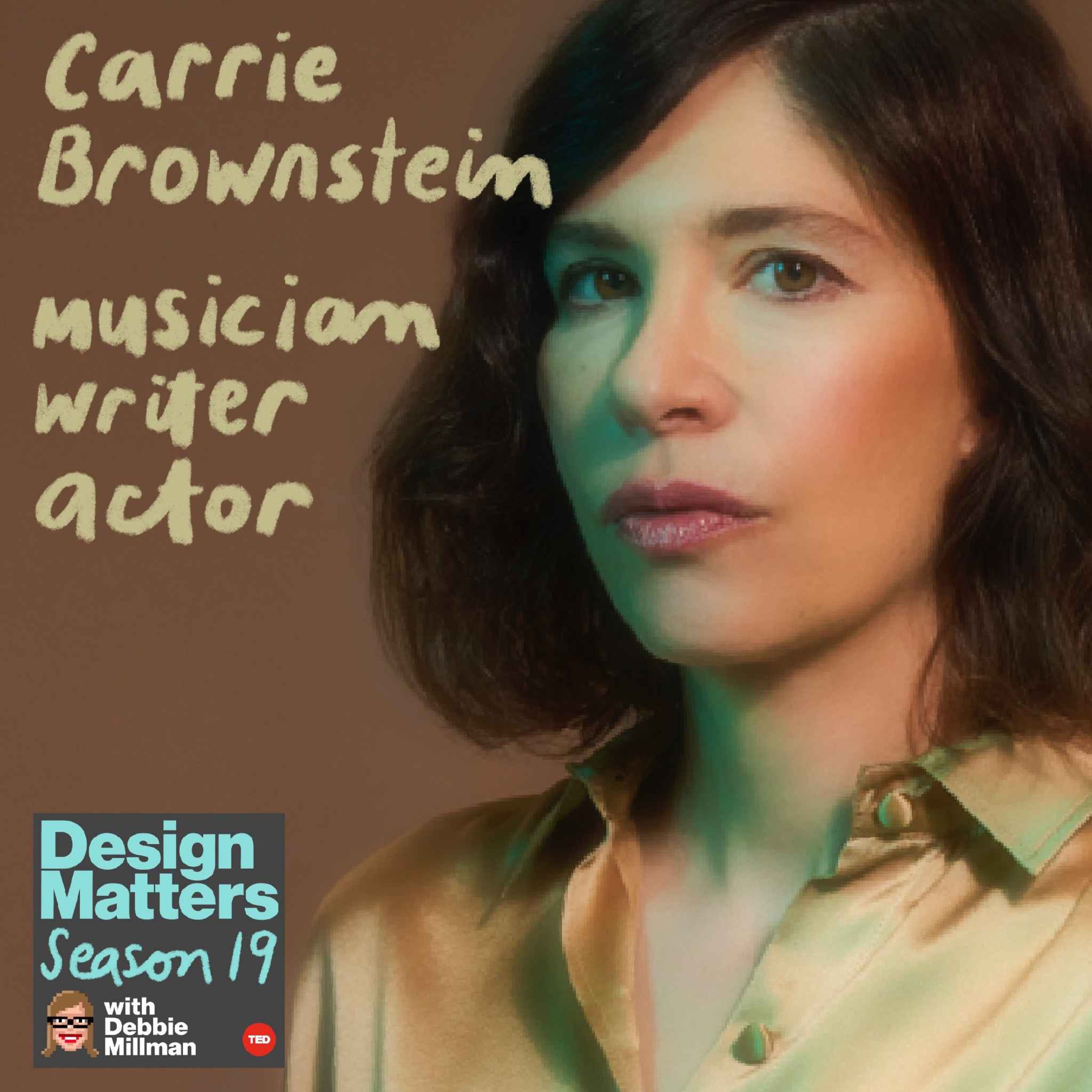
From the TED Audio Collective. This is Design Matters with Debbie Millman. For 19 years, Debbie Millman has been talking with designers and other creative people about what they do, how they got to be who they are, and what they're thinking about and working on. On this episode, Carrie Brownstein talks about her career as a punk musician and her other career as a writer and comedian.
- [00:48]
Carrie Brownstein
I want life to feel urgent. I want art to feel urgent.
- [01:02]
Mint Mobile Ad
Support for this show comes from Mint Mobile if saving more and spending less is one of your goals for 2025, why are you still paying insane amounts of money every month for wireless? That's a question that I used to ask myself, but I don't now because I switched to Mint Mobile. It's the easiest way to save. I couldn't believe how easy it was to save and I can't believe how much I was overpaying for my mobile service. You can maximize your savings with Mint Mobile with plans starting at $15 a month when you purchase a three month plan. I actually got this plan for my daughter who now has a mobile plan. She has a $15 a month three month plan and we have loved it. The coverage has been great. It's supremely reliable so you can say bye bye to your overpriced wireless plan's jaw dropping monthly bills and unexpected overages. Ditch overpriced wireless with Mint Mobile's limited time deal and get three months of premium wireless for 15 bucks a month. To get this new customer offer and your new three month premium wireless plan for just 15 bucks a month, go to mintmobile.com design that's mintmobile.com design cut your wireless bill to 15 bucks a month at mintmobile.com design $45 upfront payment required, equivalent to $15 a month. New customers on first three month plan only speeds slower above 40 gigabytes on unlimited plan. Additional taxes, fees and restrictions apply. See Mint Mobile for details.
- [02:26]
Bombas Ad
Bombas makes the most comfortable socks, underwear and T shirts.
- [02:30]
Warning. Bombas are so absurdly comfortable you may throw out all your other clothes.
- [02:34]
Sorry, do we legally have to say that?
- [02:36]
No, this is just how I talk. And I really love my Bombas.
- [02:39]
They do feel that good. And they do good too. One item purchased equals one item donated.
- [02:44]
To feel good and do good, go to bombas.com acast and use use code acast for 20% off your first purchase. That's B O M B A S.com acast and use code ACAST at checkout.
- [02:56]
Progressive Insurance Ad
This episode is brought to you by Progressive Insurance. Do you ever think about switching insurance companies to see if you could save some cash? Progressive makes it easy to see if you could save when you bundle your home and auto policies. Try it@progressive.com Progressive Casualty Insurance Company and affiliates. Potential savings will vary. Not available in all states.
- [03:16]
Whole Foods Market Ad
Start the new year with great everyday prices at Whole Foods Market. Supercharge your routine with low prices on no antibiotics ever. Favorites like boneless skinless chicken breasts and ground beef, plus a rainbow of organic produce including green beans, blueberries, cherry tomatoes and more. No sale needed to save. Just look for the yellow low price signs or the 365 by Whole Foods Market logo. Shop Whole Foods Market in store and online if it weren't all true, Carrie Brownstein's career would seem like fantasy fiction. She's a celebrated musician first and foremost, but she's also a comedian, a writer, a director and an actor. In today's interview, we're going to talk about the band she co founded, Slater Kinney, which has been called one of the greatest bands of all time. They've just released their 11th album, Little Rope. But I'm also going to ask her about the now classic television series Portlandia, which she co wrote and starred in alongside Fred Armisen. Along the way, we're going to talk about her memoir, Hunger Makes Me a Modern Girl, and everything in between. Carrie Brownstein, welcome to Design Matters.
- [04:31]
Carrie Brownstein
Thanks for having me.
- [04:33]
Whole Foods Market Ad
Carrie, I understand that you've described your look as akin to Mick Jagger in sweatpants.
- [04:43]
Carrie Brownstein
Really?
- [04:44]
Whole Foods Market Ad
Yes.
- [04:47]
Carrie Brownstein
I don't remember saying that. But you know what's weird? I've seen Mick Jagger in sweatpants. My only time ever meeting Mick Jagger, he was in sweatpants. So maybe I somehow conflated those two things and when I saw him, maybe I thought that's what I look like. I actually think of myself as a little business casual. No. No matter if that's appropriate or not. Like I'm business casual in my everyday life, but sometimes I'm also business casual on stage with my band. And I think this is when I should have not been dressing business casual. Like I look like. I go from stage to like being a flight attendant on Delta, like right after the show.
- [05:31]
Whole Foods Market Ad
What made you sort of attracted to the business casual look?
- [05:38]
Carrie Brownstein
You know, I think early on when I was playing with Slater Kinney I grew up in the suburbs, and I think my idea of dressing up was to just look a little like, okay, you just put a blazer on or you put a button up, shirt on. And so in my mind, I thought, well, I'm going on stage. Probably should wear a loafer. It's not. It's not how rock stars dress or should. Any particular favorite designers in the current era? I really like Stella McCartney. I like Rachel Comey, I like Parenza Schooler, but that's not what I also, let's just admit, I have a lot of J. Crew, too, so.
- [06:22]
Whole Foods Market Ad
Well, you know, Jenna Lyons Day was quite nice, her time there.
- [06:27]
Carrie Brownstein
She was nice. Yeah. And I'm actually, Yeah, I. Right now I'm wearing a J. Crew sweater and Everlane cord, so. Pretty basic. Pretty basic over here.
- [06:41]
Whole Foods Market Ad
You said that you grew up in mostly the suburbs. It was the suburbs of Seattle, mostly in Redmond, Washington. And you wrote in your memoir that Seattle was your beacon and your muse, but it was never really yours. And I'm wondering if you can explain that a little bit.
- [06:59]
Carrie Brownstein
I think, because I was outside of the city and I never really came of age there. That's. You know, I had some formative experiences there, but I was always on the periphery. And when I finally found my voice and tried on the boldness and the brazenness that comes along with electric guitar and forming a band, I was in Olympia, Washington, where I went to college. So Seattle was something I sort of looked up to. I imagined that I would end up there eventually, and I never did. So it always just feels like the thing I thought I would be and something I thought I would be a part of and then never was. I feel sort of adjacent to it.
- [07:49]
Whole Foods Market Ad
In elementary school, you've described yourself as confident and popular. You were an early round draft pick for teams in gym class. I never was. You won the spelling bee. You attended every crucial water park birthday party and sleepover. You were active in music, sports, school plays, and was elected vice president. Would you say that at that time you were a bit of an overachiever?
- [08:17]
Carrie Brownstein
What a tool. God. What. That's the kind of kid I would just loathe now and be like, I was a little bit of an overachiever. I mean, when you list it all like that, that's not how I felt. But I think I was confident. I think I had at the time. And this is sort of right before I lost all of that confidence. But, yeah, I was a little bit of an overachiever, I guess. I mean, if I'm just listening to that list and feel exhausted by it. Then, yes, I was.
- [08:52]
Whole Foods Market Ad
But you had quite a range. I mean, you were sort of smart by winning this spelling bee. So that was one aspect of you. But you also were active in sports.
- [09:04]
Carrie Brownstein
I was an all.
- [09:05]
Whole Foods Market Ad
You were also.
- [09:06]
Carrie Brownstein
Yeah, I was an all rounder.
- [09:07]
Whole Foods Market Ad
Yeah.
- [09:07]
Carrie Brownstein
All rounder, yeah. You could also call me a child dilettante too.
- [09:13]
Whole Foods Market Ad
Oh, in what way?
- [09:15]
Carrie Brownstein
No, I, I think I, I just. Yeah, I, I think I connect. Even now I connect with people via activity. I'm introverted and I like activity based hangouts. My father was, you know, I ended up mostly being raised by my dad, but even when my mom was still around, we were kind of in the way that. And this is very essentialist, but in the way men like to hang out with each other through activities. That's kind of how my sister and I were sort of ushered into our social. We sort of were mimicking our dad's way of interacting. So it was my way of being around people because, you know, sort of one on one interactions were trickier for me and sometimes still are just because I get nervous and shy.
- [10:09]
Whole Foods Market Ad
Your dad took you to your first concert when you were in the fifth grade. Tell us about who you saw.
- [10:16]
Carrie Brownstein
Yes, well, in 1985, Madonna was touring for her seminal album, Like a Virgin. So she was on the Virgin tour and she actually started that tour in Seattle. She played three nights at the Moore Theater, which is a. Actually it might be the Paramount, so someone can fact check that. Anyway, a really small theater, 2000 capacity. Beastie Boys were opening and I went. They were booed off stage, by the way. People hated the stage.
- [10:45]
Whole Foods Market Ad
Yeah, I read that in your memoir, Laughing Out Loud.
- [10:48]
Carrie Brownstein
Yeah, people just thought, what a bunch of brats up there. And I went to the first night and it was incredible. I mean, there were costume change after costume change and all the hits, and it was exhilarating.
- [11:03]
Whole Foods Market Ad
And I believe you dressed up as Madonna at that time.
- [11:06]
Carrie Brownstein
I mean, my very like young version of that. My, my parents were, they weren't strict, but you can do a lace glove like Madonna, but you're certainly not going to have a bra. I probably wasn't even wearing a bra. What was. What would we be showing? So it was a very chaste. It was a virginal, it was a truly virginal version.
- [11:30]
Whole Foods Market Ad
I believe that it was seeing that show that first ignited the feeling that you would much rather be the object of desire than dole out from the sidelines. Did you have a sense of what that feeling Meant in regard to who you wanted to be or become.
- [11:47]
Carrie Brownstein
I think it was actually a slightly later show, it was George Michael's Faith tour. Because I remember at that show my friend turned to me and, you know, she basically said that she wanted to just like make out with George Michael. Like she was just.
- [12:05]
Whole Foods Market Ad
It was slightly more. It was dirtier than that in the book.
- [12:09]
Carrie Brownstein
It was dirtier than that. What she wanted to do to George Michael. Michael, yes. Was unholy. But I just, I mean, I was sort of surprised, taken aback, because the way I was watching George Michael was thinking, I don't want to do something to him. I don't want to be like a side piece or accessory. I want to be that. I want to be the person that's on stage that is making people feel excited. And like I want to have people projecting their fantasies and imaginations onto me. And so that was the moment where I thought, oh, I'm very. I'm in a different place than my friend. The way that I'm experiencing this is not sort of witnessing like I'm. I want to participate in this, you know, not just as a fan. And so I think that really sowed the seed for me wanting to perform.
- [13:02]
Whole Foods Market Ad
Though your first music lessons were on the piano. You gravitated to the guitar. And when you were 15 years old, you bought your first guitar, a Canadian made Solid State amp with a cherry red epiphone copy of a Stratocaster. It was the first big money purchase you made with your own money. How did you make that money?
- [13:23]
Carrie Brownstein
I worked at the Crossroads movie theater in Redmond. I worked Saturdays and Sundays. And yeah, I just saved up my money, by the way. Big money. It was like a $300 guitar. So that was a lot of ton of money for me at the time. But, um, but as. As far as guitars go, you know, that's. That's not like a big ticket item. But it was a huge amount of money for me and I just saved up. Yeah, I. I started working that year actually at the movie theater. And my weekends were pretty boring because I just went to the theater at 11 and I left at 7 and didn't do much after. But it was a good lesson. I think my, I think my parents rightly so, you know, they were like, well, you've gone through these phases. You sort of have these pursuits that you get really excited about. You did tennis for a while. We got you lessons. You know, they just were like, if you're really going to do this, maybe you'll stick with it if you know you have more invested in it. And they were right.
- [14:20]
Whole Foods Market Ad
You took guitar lessons from Jeremy Enoch A music and part of the band Sunny Day Real Estate. And Jeremy and the band are often cited as pioneers in second wave emojis. He taught you chords by way of playing the Last Day of Our acquaintance by Sinead O'Connor, wherein you'd play along to the two chord song, which I couldn't believe that it was two chords while Jeremy sang. And then he'd get bored and play REM's the One I Love or U2's New Year's Day. And you felt that even with just a few chords, everything was in your grasp. And at that point, did you think you wanted to be like, were you sure at that point I'm going to be a musician?
- [15:06]
Carrie Brownstein
I wanted to be a musician in the moment. I was really raised to think that I have to go off to university, probably get a graduate degree. Music seemed like a hobby and certainly a way of harnessing my emotions as a teenager, you know, making myself heard and giving myself a voice when I just felt like I didn't have the words or just sort of lacked coherency. So I was excited to have that tool at my disposal and to have a way of expressing myself that involved volume, you know, and sort of was naturally angsty, you know, the putting the guitar through a distortion pedal or turning the gain up on the amp, you know, it seemed to match this rage and discomfort that I was feeling or just confusion, the confusion of adolescence. But I didn't really think, okay, well, this is what is going to sustain me for the next 30, 40 years. I just thought, this is great that I have this now. I can form a band and be around people and be part of this community. Wasn't thinking too much beyond that.
- [16:26]
Whole Foods Market Ad
While all of this was happening, your home life was becoming more and more unstable. Your mother had an eating disorder. And you've written that her illness permeated the landscape of your psyche and you developed a kind of general anxiety and sense of unease. And this manifested in nightmares where you would wake up scared of a fire or that all of your hair was falling out. Did your parents understand what was happening to you at that point?
- [16:55]
Carrie Brownstein
I don't think so. Giving them the benefit of the doubt, which I definitely do. They had a lot going on. You know, my mom was dealing with her own illness, physical and mental, and my father was trying to keep her feeling safe. Of course he was worried about her. And then basically take on the role of like, sole Parent while my mom was hospitalized for a few months. So yeah, I think they didn't. They were concerned about my sister and I, but I don't really think they had the wherewithal or the bandwidth to do much more than sort of make sure we were fed and off to school and getting our homework done. Yeah, they had a lot going on.
- [17:45]
Whole Foods Market Ad
You were 14 when your mom left your family to seek a cure for her eating disorder. And you wrote in your memoir that in doing so she left another form of sickness and longing behind. Did anyone explain to you what was happening? How did you experience her leaving?
- [18:03]
Carrie Brownstein
I mean, it was explained as, I guess that they were splitting up. But what we really didn't understand was that she was forging a path that in her mind necessitated, you know, leaving behind her role as at least a day to day mom. You know, the quotidian tasks of motherhood and nurturing that, that was kind of going on the back burner. We didn't really realize that until she was gone. And there wasn't any sort of structure for custody except that we were just with my dad. You know, there was no arrangement like, well, you'll. You have to see your mom or she wants you guys around on these days. It was just, that's it. And I. So I think it sort of took a second for us to realize we'd been left. For me, I was a little bit older than my sister, so I was able to kind of use that irascibility that's, you know, starts to take hold when you're, you know, 14. You can kind of be defiant and, you know, reject like, I'm gonna leave you first, kind of, you know, you have a little bit more of that, that gumption. But yeah, the truth was that we'd been kind of left behind.
- [19:23]
Whole Foods Market Ad
When did you come back and what was it like when she came back?
- [19:27]
Carrie Brownstein
I mean, she would pop in and out every once in a while. She was not too far away. But yeah, there just was no sort of formal routine for us seeing her. So it was sporadic and really, really confusing.
- [19:43]
Whole Foods Market Ad
All through this time you were still playing music. And in your junior year of high school, you formed a band with a few other people called Born Naked. What kind of music were you playing?
- [19:54]
Carrie Brownstein
Oh, we were playing rudimentary punk music for sure. Yeah, you know, three chord punk songs. Our singer, Lex Bratty vocalist. It was fun. It sounded like the punk music coming out of Olympia would sound like. It was definitely minimalist and more about intent than the actual product.
- [20:20]
Whole Foods Market Ad
I think at 16, you wrote a song called you'd Annoy me. And you've stated that you sometimes feel that you've been writing that same song ever since. And I'm wondering if you can talk about why or how and what maybe some of the lyrics were. I couldn't find it.
- [20:37]
Carrie Brownstein
The first line, I think is, the way you look really annoys me. The way you talk really bores me. That's the opening two lines there. I think that it feels like a perennial theme in that my friends call me Carrie David after Larry David. I just. I have this kind of constant dissatisfaction, glasses half full.
- [21:04]
Whole Foods Market Ad
It.
- [21:05]
Carrie Brownstein
I have to be kind of poked and prodded into optimism, I think. And of course, now I have a little more self awareness to realize if someone else is annoying me, it's probably a projection. In what ways am I annoying myself? In what ways am I not measuring up? So, yes, you know, self awareness sets in and. But I think that can be my default mode. And the older I get, I try to rest myself of that and take a deeper look at why I'm feeling dissatisfied or disdainful or grumpy.
- [21:40]
Whole Foods Market Ad
And how do you feel like you've been writing that same song ever since?
- [21:45]
Carrie Brownstein
Well, I can hear iterations of that song. Not musically. Musically, I've progressed. But in a lot of the especially early Slater Kinney songs, there's a brattiness. There's, you know, get out of my way, leave me alone, I need to be by myself. This sort of lone wolf theme that keeps cropping up. But hopefully, I think maybe in the last couple years there's less you annoy me songs, maybe more I annoy myself songs.
- [22:22]
Whole Foods Market Ad
At that time, Nirvana's Smell Like Teen Spirit came out. And for you and your friends, Nirvana was a local band, and I think you saw them play in your high school gymnasium. Is that true?
- [22:34]
Carrie Brownstein
College. So I. The first college.
- [22:37]
Whole Foods Market Ad
Amazing.
- [22:37]
Carrie Brownstein
Yeah. The first college I went to was a state school in Bellingham, Washington, which is a small town really close to the Canadian border in Washington.
- [22:47]
Whole Foods Market Ad
Beautiful, beautiful town.
- [22:48]
Carrie Brownstein
It is. Beautiful, beautiful place. Yeah. Very verdant. Anyway, Mudhoney, who was another Seattle grunge band on Sub Pub Records at the time, were playing. So very exciting. Oh, Mud Honey's coming to our college. And so I got tickets and I went in and there was a surprise opener. And that opener was Nirvana, who had just released Nevermind earlier that year. And I think, you know, they were really good friends with Manhatty and said, hey, we'd like to come and do a secret show. So, yeah, that's a pretty special university show to watch. And they played all. All the hits. I mean, Smells Like Teen Spirit, that album was probably already, you know, platinum at that time.
- [23:32]
Whole Foods Market Ad
Shortly thereafter, you started to become aware of the music scene in Olympia. You heard bands like Bikini Kill and Rap Mobile and Heavens to Betsy. And you've said that for the first time, you heard your story being explained and sung to you, that you were being seen and recognized. And I'm wondering how that music did that to you. What did it speak to you? What was it saying to you?
- [23:57]
Carrie Brownstein
I think it took a certain female experience and centered it and was fearless and unapologetic and unsparing in the specificity and the detail and just not sidelining those stories. It spoke to pain and longing and specific narratives that I could really relate to and had anger and fury and was unafraid to express that in music. And I just thought, oh, this is really the first time. I mean, I've been listening to punk and Indian alternative music, at least by then, for a couple years, and certainly had related to it. But all of a sudden there was a blueprint. And I think I could see myself on the landscape for the first time. And people need that, right? People, anyone needs to sort of be able to see themselves in order to do it and to make it and have an example. It gives you faith and gives you the ability to try. So it's helpful to have people come before you, for sure.
- [25:24]
Whole Foods Market Ad
You also wrote that it was crucial to finally recognize yourself in the world. What were you beginning to see?
- [25:33]
Carrie Brownstein
I felt like I just didn't have a voice or a means of expressing myself. And punk music, and particularly the music coming out of Olympia, it just became this container, this world that I could set myself in. And I think what I was seeing was someone who was worthwhile, someone who could find the words, especially if the way of conveying them was through music, you know, that there was a way out. I think that's what I recognized was a way out from who I was, which is someone who was very insecure and diffident and lonely, I think. So I recognized community. I recognized collaboration and these fellow travelers. And I dove into it, and they're also just queerness, you know, I just recognized all these facets of myself that were very nascent and not even that clear to me yet. But my world just opened up.
- [26:45]
Whole Foods Market Ad
You left Western Washington University in Bellingham and transferred down to Evergreen College in Olympia in order to be closer to that music scene. I understand, though, that you first met Corinne Tucker the lead singer of Heavens to Betsy in Bellingham. What was that first meeting like?
- [27:04]
Carrie Brownstein
So Corin played in a band called Heavens to Betsy, which was a two piece, very deconstructed, unconventional music, which a lot of the Olympia scene was. And they were playing a show at this space called the Show Off Gallery. It was them Mechanormal. It was a very avant garde two piece from Vancouver and Bikini Hill, who were probably the most well known riot grrrl band of that era and very well known band today. But Bikini Hill canceled, so it was just these two other bands. And, you know, I went in and watched Corn sing. I'd seen Heaven's Betsy before, before I'd gone to college and I went up to her afterwards and, you know, told her I was a fan. And I said, I think I'm going to drop out of Western and transfer to the Evergreen State College, which is in Olympia. And she basically said, yeah, you should. And I mean, I sort of took that as like permission, you know, from this person I've never even talked to before. And she said, well, why don't you give me your address? I can send you my fanzine or keep, keep in touch. And I think I knew I was getting out of Western because she had basically ordained it. And I wrote down my dad's address and this notebook for her. And she remembers me as being very, she said, very nerdy, shy. And I think I was. But yeah, so I dropped out like two weeks later. And my dad was not happy. He just thought, that's it, you've ruined your life. But I did apply to Evergreen and transfer, so I finished college.
- [28:45]
Whole Foods Market Ad
You described Curran's guitar this way. It was handmade by her and her father. And you described it as a crude piece of machinery painted matte black and looked like a home appliance that had been melted down a fire. She also played with the tiniest of amps, an orange Roland cube with one speaker, no pedals and no tuner. And you've written that the ugly parts were edged in disgrace and disgust. It bordered right on ugly the whole time. But you've written this in a way that makes it feel very beautiful and something you really liked. And I'm wondering if you can talk to that a little bit.
- [29:29]
Carrie Brownstein
I think feeling like the music that Corin was making, this grotesque grumbling sounds coming out of her guitar and the way her voice could sort of pin you to the wall, it was scrawling and screeching. It had moments of, I think, gracefulness to it as well, it just felt truthful. Honestly, I just thought this is just real. Like not everything is pretty and beautiful. And female singers don't just have to sort of be folk singers that are, you know, a salve for people's hurt. Like, another way to process hurt is to meet it, to scream back at it. And I loved that sort of beautiful ugliness of that music. I think at the time I sort of felt like a distorted version of a person and the music really matched that. It was kind of being splintered apart. And in the moments where it came together, you just thought, aha. Okay, I can be both. I can acknowledge the parts of me that are broken, but also stand up too.
- [31:00]
Mint Mobile Ad
Support for this podcast comes from Odoo. Imagine relying on a dozen different software programs to run your business, none of which are connected, and each one more expensive and more complicated than the last. It can be pretty stressful. Now imagine Odoo. Odoo has all the programs you'll ever need, and they're all connected on one platform. Doesn't Odoo sound amazing? Let Odoo harmonize your business with simple, efficient software that can handle everything for a fraction of the price. Sign up today@odoo.com that's o d o o.com support for this show comes from Mint Mobile. If saving more and spending less is one of your goals for 2025, why are you still paying insane amounts of money every month for wireless? That's a question that I used to ask myself but I don't now because I switched to Mint Mobile. It's the easiest way to save. I couldn't believe how easy it was to save and I can't believe how much I was overpaying for my mobile service. You can maximize your savings with Mint Mobile with plans starting at $15 a month when you purchase a three month plan. I actually got this plan for my daughter who now has a mobile plan. She has a $15 a month three month plan and we have loved it. The coverage has been great. It's supremely reliable. So you can say bye bye to your overpriced wireless plans, jaw dropping monthly bills and unexpected overages. Ditch overpriced wireless with Mint Mobile's limited time deal and get three months of premium wireless for 15 bucks a month. To get this new customer offer and your new three month premium wireless plan for just 15 bucks a month, go to mintmobile.com design that's mintmobile.com design. Cut your wireless bill to 15 bucks a month at mintmobile.com design 45 dollars upfront payment required equivalent to 15 dollars a month new customers on first three month plan only speeds slower above 40 gigabytes on unlimited plan. Additional taxes, fees and restrictions apply. See Mint Mobile for details.
- [33:04]
Bombas Ad
January Gym chaos is real, but your fitness goals don't have to suffer for it. Skip the crowded gyms and embrace a better way to get fit in 2025. Bring an uninterrupted low impact full body workout into the comfort of your home with the Hydro Rower. Designed by Rowers and led by Olympians, hydrow offers the largest library of immersive rowing workouts filmed in stunning outdoor locations. Kick off the new year with a full body workout all from the comfort of your home with Hydrow. Head over to hydrow.com and use code TED to save up to $475 off your Hydro Pro Ro. That's H Y--R-O-W.com code TED to save up to $675. Hydro.com code TED Bombas makes the most comfortable socks, underwear and T shirts.
- [33:54]
Warning. Bombas are so absurdly comfortable you may throw out all your other clothes.
- [33:57]
Sorry, do we legally have to say that?
- [34:00]
No, this is just how I talk. And I really love my Bombas.
- [34:02]
They do feel that good. And they do good too. One item purchased equals one item donated.
- [34:07]
To feel good and do good, go to bombas.com acast and use code Acast for 20% off your first purchase. That's B O M B-A-Com acast and use code acast at checkout.
- [34:23]
Whole Foods Market Ad
You started your own punk band, Excuse 17 in 1993 with Becca Albee and Curtis James and recorded two full length albums, a single and you contributed to the Free to Fight compilation album and you also started to tour the US as the opening act for Heavens to Betsy. What was it like to first start performing live?
- [34:50]
Carrie Brownstein
It was fun and it was really scary. I mean, when you say performing live, let's One thing to remember is these were not traditional venues. So it's not like I suddenly was on a big stage in a beautiful theater. I was in basements, some kind of ramshackle jerry rigged club or venue or space that had just opened up. So everything was a little bit derelict. So it was good that we started there because there was nothing real polished about us as a band or you know, my sort of performance on stage. But it was really exciting, you know, being in those small decrepit spaces that didn't live up to any fire code. It was wonderful and Wondrous. And what I really remember about it was getting to see the US for the first time. You know, I, I just had grown up in the Pacific Northwest. I, at this point I never been to Europe. I'd only ever been to Vancouver, Canada. So what I remember was just that camaraderie and meeting like minded people in all these cities and just feeling less isolated. You know, this is pre Internet. It was just the only way you could reach people was, was to go there. You know, in terms of actually meeting them and getting to know them, you know, you could have epistolary relationships, but in terms of the face to face, like you had to go to their town. So it, it really was eye opening in that way and performing. Yeah, I sort of got like my sea legs a little bit as a performer. I think the other thing people forget pre Internet is it's a mystery what happened. Like you rehearse in a space but you don't necessarily understand. You get to even a club or you know, some kind of fly by night venue or they still have a pa, you know, they still have monitors if you're lucky. There's a sound person. You know, these, these are new things. These are not. You don't watch a YouTube video. I didn't go to like a, you know, school of rock where you learn what all these things are. So the tour was like a full, it was just demystifying all these things that I really didn't understand. When you get on stage, you, you need a monitor mix. That's what you hear. The audience is hearing something through the PA speakers. But I was like, oh, what is that? And what do I tell? How do I explain myself? So it was a real lesson in learning how to communicate and take these chances. But it was, it was really scary that first tour.
- [37:34]
Whole Foods Market Ad
In your memoir you write about how you were anxious to pour your guts out. And many of your songs with excuse 17 are sonic and lyrical, purging like a caged animal who upon release, heads straight to the recording studio. And I'm wondering, given how you've mentioned that you were introverted and shy, where did this stage Persona come from? And what did it feel like to have that Persona on stage given your introversion?
- [38:03]
Carrie Brownstein
I don't think it fully came to be in excuse 17, but there were shades of it. Again, punk is a great place to practice loudness. You know, it is. You are turned up in terms of your amps and often you don't have, you don't have a great monitor mix. So you better Be singing loud or literally screaming. And so in screaming, which I did a lot of in excuse 17, I just found, literally found my voice literally was more in touch with my anger. And performance wise, though I've seen video of myself back then, I'm not moving around very much, you know, I still feel kind of stuck in place. I had this little leg move I did. Not like Chuck Berry, but you know, like a little bit like of a Buddy Holly, I guess. Sort of like my foot sort of moving back and forth. That was like as bold as I got back then. But the music, it's bigger than you and I started. That's, I think is the first thing that really gives you license because you're like, oh, this music can hold me. Like, I have felt so unheld and just free floating in life for a long time. And now I have like this sonic vessel that allows me like a sturdiness and ballast. And then once you accept that, once you realize that you can start taking steps forward. And I think I did. So excuse 17 was sort of the early iterations of that, but I. I didn't really have like a full stage Persona yet, you know, which I still don't quite have. But I definitely. It's very rudimentary compared to what came later.
- [39:58]
Whole Foods Market Ad
You don't think you have a stage presence now?
- [40:00]
Carrie Brownstein
Oh, no. Presence, yes. But I wouldn't say like I have like a Persona like where I sort of get on stage and like fully transform. I think there's always something of me that comes through. But I definitely have a stage presence. Yes. And I can. I move around on stage in a way that I never would in real life. I can't as I don't quite know where that comes from, except to say that again, the music as a place that I understood as is just having me just. It has me. It's not going to let me go. And this is a world that I've built like this with my cohorts and collaborators and with the audience is a steadiness that I've built.
- [40:42]
Whole Foods Market Ad
Yeah. I would describe your stage presence almost like punk ballet. There's something very balletic about it. How did you learn how to windmill to do the windmill?
- [40:53]
Carrie Brownstein
I don't know how I learned to do it. I don't think I practiced it, but I realized I was able to do it. It's interesting that you say balletic because I am coordinated, but I wouldn't say I'm the most graceful person. But on stage I'm able to sort of mimic a gracefulness that I think I don't really in my day to day life. But things like the Windmill, it's interesting. On stage, I just possess a fluidity that I just don't have anywhere else. And so something like the Windmill, which I probably just auditioned one time on stage without knowing whether, you know, I mean, even Pete Townsend, I think, actually like, pierced his hand like a whammy bar, you know, it's. It's not the safest move, but luckily, yeah, I came back around and was able to like strum the strings and I just thought, oh, okay, I guess I can do that. So, yeah, it wasn't. It wasn't me auditioning that, like in. In my room or something. I just did it on stage. But the stage just gives license for those kinds of things, including failure and error and a lot of things that could go wrong. But I think I like that I'm willing to take those risks on stage, risks I would not take in real life.
- [42:06]
Whole Foods Market Ad
Now, Slater Kinney started as a side project with Corinne, and you named the band after one of your practice venues. When did you decide this was it? You're both leaving your other bands and starting your own band together?
- [42:22]
Carrie Brownstein
Probably around 1995. It's a weird story because. So we were in a very insular but vital artistic music community in Olympia. There were a lot of bands. We were gleaning a lot of influence and inspiration from our friends, but it was also sort of suffocating in its smallness. So we actually went to Australia and sort of took ourselves to the other side of the world. And it just allowed us to see ourselves in a different way, to just dare to imagine ourselves existing outside of Olympia, bigger than Olympia, like, just, let's reinvent. And I think it was during that time that we decided we probably wouldn't continue with our other bands. And that was tough. That was like, you know, it's been a long time now. And Corin and I have spoken recently about. Yeah, that was not. That wasn't easy. I think our other bands felt a little betrayed by that. Like, oh, you guys are just going to form this thing. And then it ended up being bigger than those other bands. And I think obviously that's difficult too. But we just. We had this chemistry, Corin and I, that was undeniable. And we were creating something very singular together. And I think we didn't want to let that go.
- [43:50]
Whole Foods Market Ad
You said that when you started playing with her, it felt like you'd met your musical match.
- [43:55]
Carrie Brownstein
Yeah, for sure. I mean, we just are really Intuitive. Together we can sort of finish each other's musical sentences. And I think because we are both self taught, the way that our guitars interlocked and the way our vocals would play off each other, it just felt very different than anything else we'd done to this day. There's certain ways that I play that I can only play with Corin and that always makes it more unique than something I'm doing with another collaborator. I really value that.
- [44:36]
Whole Foods Market Ad
As the band grew in popularity and stature. Critical response. You began to grapple with issues that you said you'd face for years. The requirement that you were going to have to defend or analyze decisions like why you were an all female band or why didn't you have a bass player? And you realized that those questions and talking about that experience had become part of the experience itself. Was that something that you resented or just figured it was part of the equation?
- [45:09]
Carrie Brownstein
That's a good question. I did resent it. Sometimes what it is is it's an energy suck. We just wanted to talk about the music. Like why do we have to. You know, I would just think, have you ever asked a band of men, why are you an all male band? I know you've never asked that question. And I just thought, oh, all the time saving that those guys get to do. Like they just. They don't have to waste a single moment thinking about these other things and having to speak for everyone. You know, just not sort of being able to be seen as like an individual or a specific entity. That was frustrating. I don't know if I was resentful, but I was. It was frustrating because we didn't want to have to do that. We didn't want to have to spend our time doing that.
- [46:00]
Whole Foods Market Ad
Years ago I interviewed David Lee Roth and I kind of wish now that I'd asked him. So why were you in an all male band?
- [46:08]
Carrie Brownstein
I wish you had. I wish.
- [46:10]
Whole Foods Market Ad
Me too. As you moved into the late aughts and early 2000s, the band continued to grow in fame and stature. But you stated that to court, fame, money and press felt dirty and sweaty. It implied that you wanted to be accepted and loved by the mainstream, the same people who had rejected, taunted and diminished you in high school. And it sounds. You wrote that. It sounds silly now, but at the time these categories seem finite, immutable and significant. Has your relationship to fame changed over the years?
- [46:44]
Carrie Brownstein
I mean, I think it's still something that I don't really value as a category. I try to examine things more from a place of feeling Gratitude, like, oh, I'm grateful for access to certain things. I'm grateful for certain privileges that come with success. But in terms of what I value and who I want to be around, it has very little to do with fame or celebrity. I find it, yeah. A strange thing to sort of worship or put too much of a premium on. I just want to be around kind, smart, interesting people in all walks of life. From all walks of life. Yeah. I have a lot of hobbies that purposely sort of bring me around people who I would never meet through film, music, or television.
- [47:43]
Whole Foods Market Ad
What kind of hobbies?
- [47:45]
Carrie Brownstein
Dog agility. And it's interesting with dog agility because we all think of, like, oh, what's a diverse group of people? What's an interesting intersection of people? Well, you actually have to step out. You like. Dog agility is very interesting. I mean, it is people I just like, oh, I would never meet you. Like, you know, this is not academia. This is not the arts. Like, it's wonderful. I love it. Also now I do a lot of pickleball, and I'm hanging out with. Hanging out with a lot of older people and younger people. Anyway, I just love these kinds of hobbies or pursuits that get me outside of a social group that I would normally be around and make genuine friends there and have sort of a common interest that we form our friendship around. I love it. It's. It's one of my favorite things.
- [48:42]
Whole Foods Market Ad
In 2005, Slater Kinney, or 2006. I'm sorry, Slater Kinney took a hiatus. It had been about 12 years and seven albums together. You took an indefinite hiatus. And speaking of dogs, you dove headfirst during the hiatus into volunteer work at the Oregon Humane Society. And you won the Oregon Humane Society Volunteer of the year award in 2006.
- [49:13]
Carrie Brownstein
I did, yes. I also worked at the time as a trainer at a private facility and got a job at the Humane Society as well. I was not just a volunteer. I also worked in their training department, and I was the assistant in a reactive rover class. And then in the other. At the private facility, I was an assistant in just more like basic obedience. So I was all in with that. My social life was all like. My best friend that year was a woman named Jean, who was probably 70 years old. We hung out all the time. We went on dog walks together. Like, I stayed at her house on the coast and became friends with her son. Like, just. Yeah, I really dove into that world, and that was pretty much my main social group for at least a year.
- [50:09]
Whole Foods Market Ad
My first dogs, which I got back in 2000 after going through a particularly depressive experience. I think I credit them with opening my heart.
- [50:20]
Carrie Brownstein
Yeah.
- [50:21]
Whole Foods Market Ad
My wife was never a dog person, but she knew when we met that I'd had a history with dogs, and both of my dogs had. Who were very close to each other. They were like soulmates. Had passed away at 17 and 18, six months before we met. And so she knew that I had this giant hole in my heart for dogs. And despite not being a dog person, she. She got me a dog three years ago.
- [50:47]
Carrie Brownstein
That's sweet.
- [50:47]
Whole Foods Market Ad
And now she is a dog person. She is even more of a dog person than I am. So I do think that dogs can save and change our lives in the most profound ways.
- [51:01]
Carrie Brownstein
Absolutely.
- [51:01]
Whole Foods Market Ad
Did that job at that time help you get over some of the loss of Slater Kinney and the sadness that you were feeling about the band going on hiatus?
- [51:10]
Carrie Brownstein
Absolutely. For one, it just was a way of understanding. Like, just broadening my comprehension about life and loss and, you know, giving me a task to do. And I think dogs or animals in general, like, their needs are very clear, and they're simple, and you realize that humans aren't that much different. Most of us want to be loved and protected, and, you know, it's just. You start to see all these through lines, and it really is so clarifying, I think, and it also just teaches you patience. One of my volunteer jobs at the Humane Society was just cleaning out the cages, and you see, like, obviously the literal, like, feces of these dogs, but you just sort of see, like, this is just a temporary thing for most of them. You know, they're just living in this cage. There's just so much humanity in here, and there's just, like, all. My only job is to just make sure for this moment that this dog has an okay life as I. You know, we are stewarding them into the. The next phase. And I just thought, well, that's how it should be with everyone. Like, whenever I have an interaction with someone, if it's finite, I don't know if I'll ever see them again. Like, it. It should be as pure as I. What I'm doing with these dogs. Like, I never. I don't know what state someone else is in. Like, my job is just to be kind and open and leave them feeling either the same or better than when we started this conversation. Like, it just. Yeah, I think that clarity of purpose really helped me just have perspective on the band and also just appreciate what we had done. Not just mourn, you know, the hiatus but appreciate, like, the journey we've been on.
- [53:09]
Whole Foods Market Ad
One thing that I've come to realize about dogs, that I try to consider what it would be like as a person to be this way, is just how unselfconscious they are.
- [53:21]
Carrie Brownstein
I know.
- [53:22]
Whole Foods Market Ad
I mean, Max, my dog, doesn't really like when anybody's looking at him. When he poops, that's probably it. Everything else, he's just completely okay as is. And I love that about him.
- [53:34]
Carrie Brownstein
I love that, too. Sorry, my dog is barking. There's probably some of them. Hold on. I do need to at least bring Banjo in here. Hold on.
- [53:41]
Whole Foods Market Ad
Okay, absolutely.
- [53:42]
Carrie Brownstein
Banjo, buddy, come here.
- [53:47]
Whole Foods Market Ad
In 2005, you began working with Saturday Night Live alum Fred Armisen on a series of comedy sketches for the Internet titled Thunder Ant. What first inspired you two to do that together?
- [54:02]
Carrie Brownstein
Yeah, so Fred and I met through music because he is a drummer, and we'd been in the same circles for a while. And he had just started on SNL, but was still, like, in the cast, but not, like one of the main stars of the show. And he reached out, he said he wanted to collaborate, and I assumed he wanted to do music. And he said, well, actually, I think it was the year John Kerry was running for president.
- [54:30]
Whole Foods Market Ad
Yeah.
- [54:31]
Carrie Brownstein
So it would have been 2004. And he said, I have to make this video for their campaign. And he's like, my idea is that you're a host of, like, a cable access show and you're running it out of your basement and all. Place Saddam Hussein as, like. He's like, I kind of. When I see pictures of him, he's like, he looks like one of those aging rockers. Like, he's got this beard now, and he just looks like a Paul Weller. And so I was like, okay. And so I played Cindy Overton and had the first interview with Saddam Hussein, who he did. He played with a British accent and had a guitar the whole time. I don't know if Fred ever turned that into the Kerry campaign, I can't imagine that they would have used it. I mean, they're not going to use put Saddam Hussein in viral video ad. Anyway, that encouraged us to keep making videos. And. Yeah, so we would just get together every once in a while. The next thing we made, actually, was the feminist bookstore, which became a recurring sketch on Portlandia.
- [55:37]
Whole Foods Market Ad
And one of my favorite.
- [55:39]
Carrie Brownstein
Yeah. So we just. We really enjoyed it. We would just. Fred would fly out to Portland, although I think we did one in New York, too, where he was living, and we would just make These videos and put them up online and send them to our friends. And it was, yeah, really fun. And we kind of developed a language, and, you know, we built our own chemistry. And we just like, oh, we have this sensibility now. Like, you know, these are ideas. Like, these aren't just disparate sketches. Like, we're creating a world here. So then we took it out as a pitch for a show.
- [56:11]
Whole Foods Market Ad
And you pitched it to Lorne Michaels. He approved it. In 2011, Portlandia debuted on the IFC network, and it was an immediate success. We. I know that when you were in high school, you were, I believe, the star of one of your high school plays, but did you feel surprised by the sort of naturalness at which you could enter into this new world of acting and comedy?
- [56:36]
Carrie Brownstein
Yes, and I was absolutely surprised. I had terrible imposter syndrome. I felt like I'd snuck in through some kind of side or back door. What's also amazing is that if this had been created in any other way, I think that someone would have said, like, I mean, Fred was working with Kristen Wiig and, you know, Amy Poehler and Maya Rudolph, you know, these heavyweights. Heavy, brilliant, brilliant comedic actors. And somehow Lorne. And this is why he's genius, and he just has that acumen. He just thought, no, this is. You guys are friends. Not that Fred isn't friends with those other people, but you guys have this specific way of being together that if we just sub out Carrie for someone else, it will change the nature of the show. So I felt very lucky, but I also felt like I had a lot to prove. And I remember when we were shooting the pilot, Fred and I had done every scene together, and then all of a sudden, we were getting. We were doing a shot. It was the put a bird on it sketch, and it was just me and our director, Jonathan Kreisel, yelled, action. And I just thought, oh, my God, like, it's just me. What am I going to do here? I was really nervous. I really credit Stacey Silverman, who is a wonderful writer. She had written for Colbert, and now she writes for a ton of comedy shows. She just had a lot of faith in me, especially as a writer. And I think becoming more confident as a writer in terms of writing these sketches helped me become more confident as a performer. And Fred was really helpful, too. But, yeah, I was terrified.
- [58:16]
Whole Foods Market Ad
Your beloved feminist bookstore sketch, which you've just referenced, Women first stars your characters, Toni and Candace. This was one of the first of a range of characters that you and Fred played together, where you were cross dressing with Fred, appearing as a woman. Later, you appeared as a man, most notably as Andy, the men's rights activist, or Lance, husband to Fred, playing your wife. Nina. You are so great as Andy. I wouldn't have even known it was you, truly.
- [58:47]
Carrie Brownstein
Yeah, I just, just that kind of gender expression, it's just really. It's very freeing. And it's. It also grants you, I think, a little bit of an understanding, too. I was like, oh, yeah, this. Okay, this is. This is a different headspace to get into for a little while. I loved it. I missed that.
- [59:08]
Whole Foods Market Ad
Portlandia ran for eight seasons. The show received 22 Emmy nominations, won three, and in 2011, won the prestigious Peabody Award for its good natured lampooning of hipster culture, which hits the mark whether or not you're in on the joke. In 2015, Jerry Seinfeld stated that Portlandia was one of the best comedies of all time. And that very same year, Stereogum chief editor Tom Brahan stated that Slater Kinney was one of the greatest rock bands of the past two decades. Did you believe any of it?
- [59:45]
Carrie Brownstein
I feel like that stuff is so arbitrary and subjective. And of course, it's a lovely thing to hear, but you can't really hang your hat on that. I just, I. You know, you have to take it with a grain of salt because if you put a lot of, like, faith in that or give that kind of stuff too much power, you also have to give the negative feedback a lot of power, too. And I think, you know, my role is to hopefully tune both those extremes out as much as I can. Even though it's. It's flattering. It's so arbitrary.
- [60:22]
Whole Foods Market Ad
2015 was a big year. The band re emerged with the launch of the album no Cities to Love. And your most recent album, Little Rope, was launched earlier this year. While you were making it, Corinne was notified by the American Embassy in Italy that your mother and stepfather had been killed in a car accident while they were there on holiday. And I'm so sorry, Carrie. I'm so sorry that this happened.
- [60:52]
Carrie Brownstein
Thanks, I appreciate that. I do. I will just clarify that. Corrin just got a call that they were trying to get ahold of me, so she didn't actually have to deliver that news. Yeah, it was hard to read.
- [61:02]
Whole Foods Market Ad
I'm sorry, I didn't get that quite right.
- [61:03]
Carrie Brownstein
Oh, no, that's totally fine. That's totally fine.
- [61:06]
Whole Foods Market Ad
Most of the songs for Little Rope were already written by the time of the accident. Can you talk a little bit about how grief mitigated into the work, perhaps in ways you didn't expect.
- [61:19]
Carrie Brownstein
Yeah, that time was so awful and disorienting. And this is. It's been good to contextualize all this because music, for me, was something that had existed for so long, and I knew how to write songs. I didn't know how to grieve my mom. And so I sort of was able to transfer just some of that confusion into a choreography that I knew, which was songwriting and playing, even. It was even more simplistic than that, more reductive. I just literally played guitar. I hadn't played that much guitar since I was in high school. I mean, obviously, I've played guitar for many years now, but I don't usually just sit around for eight hours a day. And I just needed somewhere to put my hands to place myself in time and space and literally in a room. So I would just. It was so comforting to put my hands on the neck of the guitar and feel my fingers move along the frets. And it helped ground me. And it became a ritual and just started to give shape to days that felt very foggy and misshapen. And the other thing was, I think when you lose someone, you lose the ability to do anything for them, and you sort of miss that ability to reach them, to connect with them. So I transferred a lot of that caretaking and nurturing and tending to onto the album because I. I couldn't tend to my mom. I think more than the song sort of being about grief, the Sorrow just informed the way we approached the record, the way I approached it. And just the stakes felt very, very high. Just didn't want to put anything out into the world that wasn't fully formed, wasn't intentional, didn't have life to it.
- [63:41]
Whole Foods Market Ad
Yeah, I. I read a review, and I thought this was a really, really apt line. The songs feel despondent and treacherous at times, but at others, they're hopeful and gleaming. I think it's a really complicated, really beautiful album. What do you think Little Rope tells your audience about who the band is now?
- [64:02]
Carrie Brownstein
I think it tells them that we're a band willing to reckon with the present, that we're not steeped or trapped in our own history except to bring it along with us. We're not stuck there. We're not, you know, sort of tricked or intoxicated by nostalgia or sentimentality, but we're willing to carry the weight of our history and our failures and our frailty along with us and transform it into something that exemplifies strength and that we have a willingness to keep going and persevere and to connect. That just. That desire to connect and commune with an audience is ever present and ongoing. And that, you know, we're uninterested in no longer telling our story. That we have, I guess, enough confidence and willingness to keep the chapters going, you know, keep the narrative going. So I think it just expresses a willingness and also a celebration at the same time. You know, not something that's like a burden, but something that's a real joy.
- [65:24]
Whole Foods Market Ad
I have one last question for you. In your memoir, which was published several years ago, you wrote that much of your intention with songs is to voice a continual dissatisfaction, or at least to claw your way out of it. And I'm wondering if that's still the case.
- [65:43]
Carrie Brownstein
I think in some ways it is, but I don't feel just wholly dissatisfied. That's just. It's too cynical to be steeped in dissatisfaction. And it also. There's something whiny about that. I'm like, oh, come on. Like dissatisfaction? What does that mean? Like, that's. That's sort of of your own making a little bit.
- [66:07]
Whole Foods Market Ad
Well, it's a tough world out there. Especially now.
- [66:09]
Carrie Brownstein
It's a tough world. But I. But I. You know, like, it's tougher for other people, I guess. That's how I feel, you know, and. Sure, like, existentially, you know, if you're lucky, it's. It's just existential. And if you're less likely, you know, thus fortunate, those can be very real threats, you know, corporeal threats. So, yes, I mean, I'm not saying that I can't be dissatisfied, but I guess what I'll say is that I try to at least question what I'm dissatisfied about. But I also like to be a voice for those of us who are discontent, for those of us who are still clawing and fighting and wrestling and thrashing about. Those are my people. Like, those are my people who just are restless by nature. And that restlessness can be born of many things, and I love that. I want life to feel urgent. I want art to feel urgent. I want people to lay every. You know, leave everything on the stage, leave everything on the page, leave everything on the screen. Just, you know, like, just put it out there. And so I don't know if it's dissatisfaction, but it's definitely a restlessness and a desire to keep wanting and, you know, to not settle, to just not look out and think this is okay. So I will continue writing for myself and for other people who think this is not okay.
- [67:51]
Whole Foods Market Ad
Thank you Carrie Brownstein for making so much work that matters. And thank you for joining me today on Design Matters.
- [67:59]
Carrie Brownstein
Thank you Debbie. That was a wonderful interview.
- [68:01]
Whole Foods Market Ad
Thank you Carrie Brownstone memoir is titled Hunger Makes Me a Modern Girl. Her latest album with Slater Kinney is titled Little Rope. You can find out more about the band on their website, slater kinney.com this is the 19th year we've been podcasting Design Matters and I'd like to thank you for listening. And remember, we can talk about making a difference. We could make a difference or we can do both. I'm Debbie Melman and I look forward to talking with you again soon.
- [68:34]
Debbie Millman
Design Matters is produced for the TED Audio Collective by Curtis Fox Productions. The interviews are usually recorded at the Masters in Branding program at the School of Visual Arts in New York City, the first and longest running branding program in the world. The editor in Chief of Design Matters Media is Emily Weiland.
- [68:59]
Carrie Brownstein
My dad works in B2B marketing.
- [69:01]
Whole Foods Market Ad
He came by my school for Career.
- [69:03]
Carrie Brownstein
Day and said he was a big roas man. Then he told everyone how much he loved calculating his return on ad spend.
- [69:11]
Whole Foods Market Ad
My friends still laugh at me to this day.
- [69:13]
Progressive Insurance Ad
Not everyone gets B2B, but with LinkedIn you'll be able to reach people who do. Get $100 credit on your next ad campaign. Go to LinkedIn.com results to claim your credit. That's LinkedIn.com results. Terms and conditions apply. LinkedIn the place to Be to Be this episode is brought to you by Progressive Insurance. Do you ever think about switching insurance companies to see if you could save some cash? Progressive makes it easy to see if you could save when you bundle your home and auto policies. Try it@progressive.com Progressive Casualty Insurance Company and affiliates. Potential savings will vary. Not available in all states.
- [69:48]
Bombas Ad
Over the last 75 years, over 10,000 chemicals have been introduced to our food supply, yet the EU only allows 300 food additives. But at Thrive Market, we bring our members the highest quality brands and restrict more than 1,000 ingredients found at conventional grocery stores. Making the switch is easy with our Healthy Swaps scanner, which finds better versions of all your favorite pantry, snacking and home essentials without the added junk dyes and fillers. Plus, it's all delivered straight to your door. So if you're looking to shop at a grocery store that actually cares about your health, go to thrivemarket.com podcast and you'll get 30% off your first order and a free gift.
- [70:29]
Warby Parker Ad
If you wear glasses, you know how hard it is to find the perfect pair, but step into a Warby Parker store and you'll see it doesn't have to be. Not only will you find a great selection of frames, you'll also meet helpful advisors and friendly optometrists. Yep, many Warby Parker locations also offer eye exams. So the next time you need glasses, sunglasses, contact lenses, or a new prescription, you know where to look. To find a Warby Parker store near you or to book an eye exam, head over to warbyparker.com retail.