Loading summary
Transcript154 lines
- [00:01]
Debbie Millman
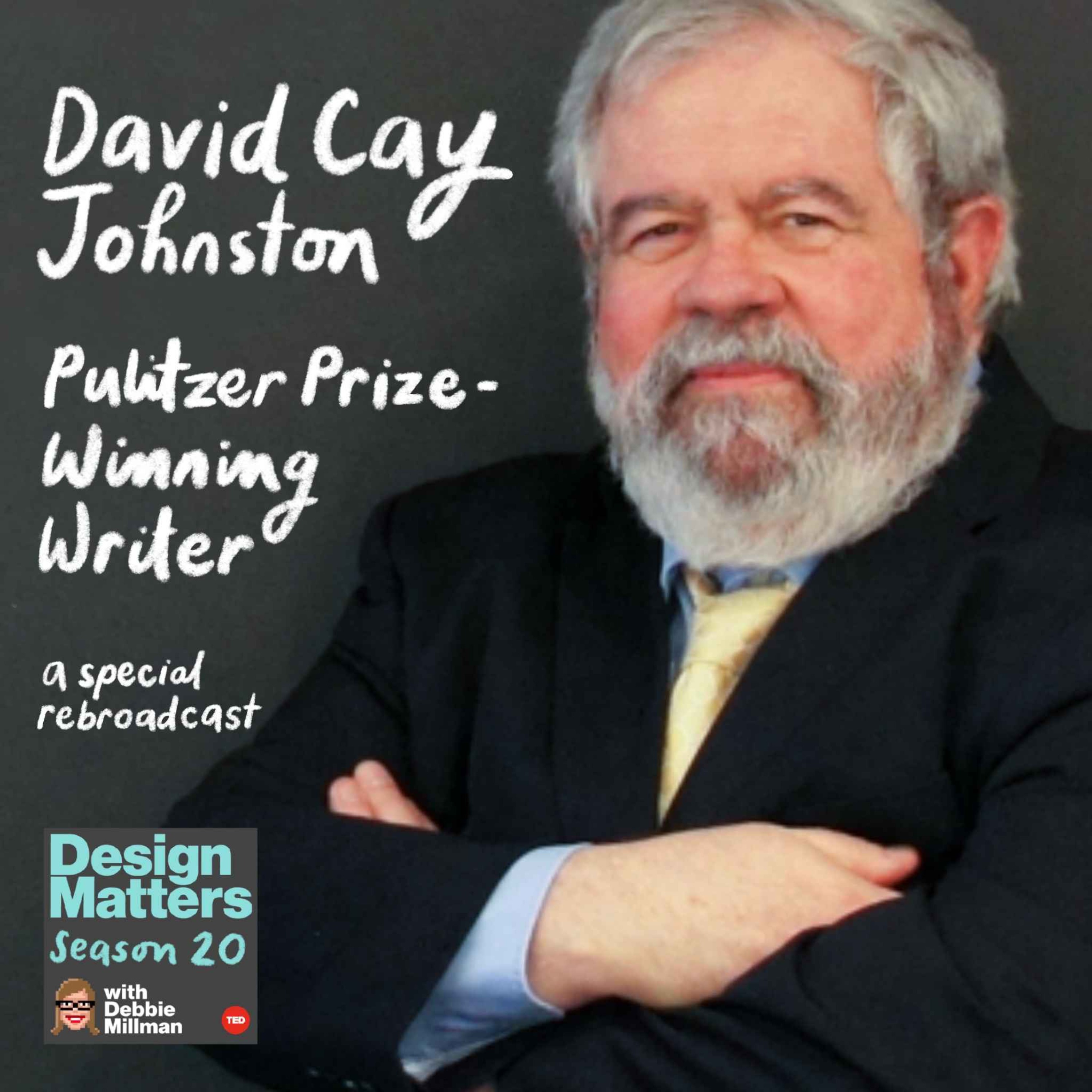
This archival episode with David Cay Johnston originally came out in 2018. Donald Trump was in his first term, but the issues Debbie and David talk about are just as relevant today. He's the person they still believe is going to save them.
- [00:16]
David Cay Johnston
Why? Why, David?
- [00:17]
Debbie Millman
Because they're just not connected to politics and they bought Donald's con. And it's very hard for people who've been conned to admit they were taken. You have to say I was dumb. I got taken to yourself from the Tet Audio Collective. This is Design Matters with Debbie Millman. For 14 years now, Debbie Millman has been talking with designers and other creative types about what they do, how they got to be who they are, and what they're thinking about. On this podcast, Debbie Millman talks with David K. Johnston about the fun of investigative journalism. The great thing about being a journalist, if you treat it seriously, is you're a perpetual graduate student. And the only difference is the public reads your papers.
- [01:09]
David Cay Johnston
This episode is sponsored by Lumen. Your metabolism is like your body's engine. It powers everything you do from how you move to how you feel. And when it's running smoothly, you feel the difference. More energy, better sleep, improved recovery. Lumen is the world's first handheld metabolic coach that helps you understand what your body is burning fats or carbs just by breathing into it each morning. Then the app gives you daily nutrition guidance personalized to your body's needs. This summer, stay in sync with your metabolism and feel your best, whether you're active, resting or anything in between. The warmer months are coming. Spring back into your health and fitness. Go to Lumen Me ted to get 10% off your lumen. That's L U M E N me Ted for 10% off your purchase. Thank you Lumen, for sponsoring this episode.
- [02:00]
James and Fouhad
Hello guys, I'm James. And I'm Fouhad. And we're Shits and Geeks Podcast and this episode is brought to you by Boost Mobile, offering reliable nationwide coverage backed by a 30 day money back guarantee. Love your service or get your money back. No questions asked, bruv. You know how it goes. Obviously I'm on one provider, you're on another provider. Sometimes I have good signal, you have bad signal, you have bad signal, I have good signal and I get stressed and I think, shall I change? Is it worth changing? Is it going to make it better? I don't know. I've been with my provider for a long time. Same. It's anxiety inducing and I don't want the hassle. Well, guys and girls, here's the twist. Boost Mobile gives you the same nationwide coverage and network speeds that you're already used to for way less money. That's right, Boost Mobile gives you unlimited plans starting at just $25 a month. No price hikes, no contracts, no multi line faff. Just solid coverage and proper value. And if you're sitting there thinking, bruv, this sounds too good to be true, don't worry, you've got a 30 day money back guarantee. Try it risk free and if you don't love it, you get your service fees back. There are plenty of benefits when you switch to Boost Mobile. Together with their roaming partners, boost mobile covers 99% of the US population 5G speeds not available in all areas. So whether you're scrolling streaming or just lost in a group chat, you're covered. Bottom line, Boost Mobile gives you the freedom to save money without sacrificing coverage. And no one's locking you into anything. Visit your nearest Boost Mobile store or find them online@boostmobile.com that's boostmobile.com, reliable service, proper coverage, and no stress does it.
- [03:29]
Debbie Millman
Ever feel like you're a marketing professional.
- [03:31]
James and Fouhad
Just speaking into the void?
- [03:34]
Debbie Millman
Well, with LinkedIn ads, you can know.
- [03:36]
James and Fouhad
You'Re reaching the right decision makers.
- [03:38]
Debbie Millman
You can even target buyers by job.
- [03:40]
James and Fouhad
Title, industry, company seniority, skills.
- [03:44]
Debbie Millman
Wait, did I say job title yet?
- [03:46]
James and Fouhad
Get started today and see how you.
- [03:47]
Debbie Millman
Can avoid the void and reach the.
- [03:49]
James and Fouhad
Right buyers with LinkedIn ads.
- [03:51]
Debbie Millman
We'll even give you a $100 credit.
- [03:52]
James and Fouhad
On your next campaign.
- [03:54]
Debbie Millman
Get started at LinkedIn.com results terms and conditions apply out here.
- [03:59]
David Cay Johnston
It's not only the amazing views, but the way time stretches out a little longer and how the breeze hits just right at the summit. With AllTrails, you can discover nature's best with over 450,000 trails around the world. Download the free app David K. Johnston is a muckraker. His investigative journalism has upended the careers of government officials, businessmen and politicians. He won a Pulitzer Prize in 2003 for beat reporting that showed how corporations were twisting tax laws to their advantage. Since the 2016 presidential election, there's been more muck to rake than ever, and Johnston has been busy. Last year, he wrote the Making of Donald Trump, which the New York Times called a searing indictment. His latest book about what the Trump administration has been up to in its first year is called it's even Worse than you Think what the Trump Administration is Doing to America. David K. Johnston In a time when journalism is under attack in this country, a very warm welcome Today on Design Matters.
- [05:14]
Debbie Millman
Well, thank you for having me, Debbie.
- [05:16]
David Cay Johnston
David, I understand your mother was the only child of a very wealthy businessman as well as a disowned heiress. How on earth did she get disowned?
- [05:28]
Debbie Millman
My agent wants me to write a screenplay about this. My mother testified against her father in the spring of 1941. So before Pearl harbor, when America was still relatively innocent, he was tried for alienation of affection by his mistress's husband. Now, if you went into your to a lawyer today and said, I want to sue this woman, alienating my husband, you'd be laughed out of the law office. But back then, there was a trial. My grandfather lost. He had to pay $10,000, which is a lot of money in 1941. And the Star witness against him, who had the records of the hotel rooms and the trips was my mother.
- [06:06]
David Cay Johnston
Oh, my goodness. How did she find all that information or get all that information?
- [06:09]
Debbie Millman
Well, she worked for him in the business.
- [06:10]
David Cay Johnston
Quite a scandalous background.
- [06:12]
Debbie Millman
Oh, yeah. The trial was covered by newspapers from far away in some of the big cities. One of them, the headline was Sin in the North Woods.
- [06:23]
David Cay Johnston
Sounds like a romance novel. You've described your dad as a man from New Orleans with a third grade education who read a book every day. And I understand he once had dinner with President Franklin Delano Roosevelt. How did that come about?
- [06:39]
Debbie Millman
My father was the president of Young Democrats of Arizona in 1932, and he was on the DS with FDR. My father left New Orleans when he was 19 years old because he couldn't stand the racism. It drove him crazy his whole life. When I was a boy, my brother and I. If he was home at dinner time because he was a chef. And even though he was disabled, like most disabled war veterans, he continued to work. He. He would make us stand in front of the news, put his hands on the back of our necks, and we would see Bull Connor attacking people or whatever, and we would sit down and my father would go into a rage and he would say, there but for the grace of God go you. You could have been born poor and black in the south, and you will not allow this. Wow.
- [07:21]
David Cay Johnston
So I understand that fury that he had really helped fuel your outrage against inequality and racism as well. That's where it really began.
- [07:32]
Debbie Millman
Yes. But I also am someone who believes very strong. We want to have a society that ennobles the human spirit. That, I believe, is the real purpose of our Constitution. That if we govern ourselves and we do it wisely, we will see how far human beings as A society, because we're social animals, can advance. And we need to constantly be aware that those people who have positions of power and privilege, not all of them, but enough of them, that it matters. Try to twist the rules, try to oppress other people, try to take care of themselves at the expense of other people. And I've spent a lot of my career doing this. The 13 years I was at the New York Times as the tax reporter, I documented every chance I got, which was four, five, six, ten stories a year. How inequality was on the rise. A lot of people attacked what I was writing back then and showing how government policy was the real big driver. Certainly the driver we can do something about in the fact that the bottom 90% of Americans incomes were going nowhere. In fact, in 2012, the bottom 90% of Americans had smaller incomes than in 1967, the year I graduated from high school.
- [08:47]
David Cay Johnston
How is that possible?
- [08:49]
Debbie Millman
Because government policies, and we don't tend to cover what government does so much. In journalism, we cover politics, not policies. Have pushed down wages in a variety of ways. In 1973, about 37% of private sector workers belonged to unions. But about 80% of workers benefited from that because many employers didn't want unions, mostly because of the work rules, not because of the pay. Were willing to pay premium wages and treat workers better to keep unions out. That's a social good. We've decimated unions. It's now about 6% of private sector workers. We created changes in our society that led to almost all mothers of small children going to work. Now, I'm certainly not arguing women should stay home. My wife's a CEO. But you shouldn't have to go to work. We ought to have a society where you can spend time with your children. We'll be better off if we do that. Some European countries require you to take a year off work each time you have a child and subsidize you on the theory that this is an investment in the future of your. We obviously reject that idea here. So fundamentally, this issue of power is what's interested me my whole life. And that's led me to study, well, how do these systems work? How do corporations work? And it eventually led me to study the law of the ancient world, which I taught at Syracuse University's College of Law, though I'm not a lawyer and it's graduate of business school for eight years. Because it was a way to understand why is the law the way it is today? We'll go back and look at the root and learn the principle and Theory. If you learn the principle and theory of anything, whether it's design or taxes or military strategy, you'll understand things much more deeply than if you just know the mechanics.
- [10:45]
David Cay Johnston
But your journalism career, David, started rather serendipitously. You won a speech contest when you were in school.
- [10:52]
Debbie Millman
I won a lot of them. Probably 40 or 50 of them.
- [10:55]
David Cay Johnston
You won a lot of speech contests. The local paper who was shooting your picture asked you to write a column, offered you 20 cents an inch. The paper liked it. And shortly thereafter, they had you covering the school board and the city council. You were making minimum wage. So can you tell us what happened when you were 18 and a reporter for the San Jose Mercury approached you and gave you some advice?
- [11:23]
Debbie Millman
Well, back then in Santa Cruz, California, there were five or six reporters every Tuesday at the Board of Supervisors. I had just finished Knight High, School, was a father was married, and the local San Jose Mercury reporter, whom I'd known since I was 10 years old or 11 years old, was on vacation. And this guy slides up next to me in the church pews where we sat down as the Board of Supervisors met those bench seats and asked me a couple of questions, and I answered them. And he took me to the Catalyst that Ken Kesey wrote about to have a cup of coffee. I literally didn't have a dime in my pocket.
- [12:02]
David Cay Johnston
I think you also had a hole in your shoe.
- [12:03]
Debbie Millman
I had a hole in my shoe. And he started asking me about things. And the next day or the day after, he told me that I had a job interview at the San Jose Mercury. And I said, excuse me, Jack. I'm 18 years old. I just finished high school. They're not going to talk to me. He said, I don't care how old you are, you can do this. So I went over to the San Jose Mercury. The man I was to see had gone to dinner early. The two editors I met with just made fun of me for an hour. They brought over a graduate student who was a copy boy and used him to, you know. So what are you doing, Jonesy? Well, I'm getting a graduate degree. And why are you doing that? Well, I hope you'll be a reporter here. Okay, Jonesy, go get me a cup of coffee. He'd walk away. You think we're gonna hire you?
- [12:47]
David Cay Johnston
That sounds like torture.
- [12:48]
Debbie Millman
Yeah, well, it was an hour I endured. And when I went back to Santa Cruz, Jack Frazier said, boy, they were really impressed with you. And I said, really? And he said, yeah. And he said, just go back every three weeks until they Hire you. And nine months later, being so young, it hadn't occurred to me that it was vacation time again. And the Santa Cruz guy would go on vacation. The managing editor said to me, suppose I hired you. What are you going to do in 10? And I looked at him, pointed at him and said, I'm gonna sit in that chair and I'm gonna run this joint nice. And he hired me, and I was on the front page in a matter of weeks.
- [13:23]
David Cay Johnston
But now, prior to that, your only experience in newspapers, I believe, was your seven newspaper routes as a delivery boy, four in the morning and three in the afternoon. Is that correct?
- [13:33]
Debbie Millman
Well, no, no. I worked for two weekly newspapers, the one that you mentioned earlier, and another weekly newspaper, and I split my time between them. But it was such minimal experience. When I turned up at the San Jose Mercury, Peninsula bureau. Robert Lindsay, who became a famous New York Times reporter, West coast bureau chief, did the Falcon and the Snowman and the subsequent movie. One of the greatest reporters of all time. You know, Bob told me just recently that when I came, they were all like, what have they done here? This guy has no real reporting experience. He's a teenager. And he said, you know, it took us a couple of weeks, and we went, hey, this guy's writing sophisticated stories.
- [14:08]
David Cay Johnston
So they put you on the front page?
- [14:09]
Debbie Millman
Yes. And so things went very well.
- [14:12]
David Cay Johnston
I read that you originally pursued journalism because you didn't want to be poor. If the San Jose Mercury hadn't hired you, do you think you'd have ended up an LAPD cop? I believe that was your first aspiration.
- [14:24]
Debbie Millman
Yeah, I would have become a CACI officer at the lapd, and my goal would have been to be homicide detective.
- [14:30]
David Cay Johnston
Still have any of that aspiration in you?
- [14:33]
Debbie Millman
Well, I did. You know, I spent three years of my life exposing the LAPD when I was at the LA Times. I was the first reporter to do this, way before anybody else.
- [14:41]
David Cay Johnston
And didn't they spy on you when you were on a date?
- [14:43]
Debbie Millman
Once I went on a blind date with the woman I've been married to today for, let's see, 35 years, eight months, two weeks and four days.
- [14:53]
David Cay Johnston
Who's counting?
- [14:54]
Debbie Millman
Not long enough. And luckily, she didn't run away either. When she found out, when I told her right up front, I have six kids. Or when I told her that the LAPD had spied on us and you.
- [15:04]
David Cay Johnston
Have eight kids now, I believe that's right.
- [15:06]
Debbie Millman
So the coverage of the lapd, which they were regarded as the world's most honest, efficient, effective police department, I spent three years showing that they weren't honest, they weren't effective. Daryl Gates got worldwide news coverage for claiming there was a huge crime surge in la. And I showed that it was the theft of Blaupunked radios from German cars. And if you just remove that from the data, crime was down. I proved that he assigned officers to sleep with women to get political information, that an LAPD undercover officer started the May Day 1981 riot in LA, used videotape to prove that and a lot of other stuff until the LA Times shut me down.
- [15:45]
David Cay Johnston
How did they do that?
- [15:46]
Debbie Millman
They just sent me to the women's section to write features. Really? Yes. So I wrote what I called investigative features. And one of the things I did there was I hunted down personally. A very vicious killer confronted him. This was a case of a young man who was tried four times for a particularly repugnant murder. And the judge in the case, who was a very pro prosecution judge, but black, and this was a black on white killing, threw out the conviction and it was reinstated by the court of appeals. And when he came up for sentencing, the judge who knew I was working on this story said, Mr. Cooks, this. The court believes you are innocent, but I am required by the court of appeals to sentence you and I hereby sentence you to 15 years to life in prison. I got him a fifth trial. The real killer was called as a witness. The sheriff's department in LA produced evidence that nobody had seen that clearly exonerated the kid and he was acquitted. The real killer, of course, went scot free because five times the eyewitness had gotten up on the stand and said, that's the guy who did it.
- [16:53]
David Cay Johnston
There's justice for you.
- [16:54]
Debbie Millman
Yeah. Well, the LA Times never got that story on the front page. They buried it in the back of the paper.
- [16:59]
David Cay Johnston
Why?
- [17:00]
Debbie Millman
I was on the outs for having disturbed too much trouble. I had. Shortly before I left the paper, the editor of the paper, who was generally a very good guy and ran a great newspaper, I don't want to put this out of context. LA Times had fantastic journalism all over the world, had a huge staff, paid people well, they just didn't want to do investigations of the local establishment, called me in his office and he said, I don't think you appreciate that there isn't a single important person in California who hasn't sat in that chair pointing at me and complained about you. And I said, well, Bill, did they ever say I don't have my facts right? And he said, you're not getting the message. And I said, probably not.
- [17:35]
David Cay Johnston
Now, how did you know to follow these stories? How did you know, for example, that it was the radios that were increasing the crime rates and not actual violent crime?
- [17:45]
Debbie Millman
Well, I didn't know it was the radios. What I knew was that the lapd, this is before computers, kept all their crime reports on big ledger sheets, big green books. And so all I had to do was go over there and sit down and analyze the data. And that's what started my career. When I first covered the Santa Cruz County Board of Supervisors and the trustees didn't know I was a high school student, they gave out a press release one day. Next year, property taxes on the average home in Santa Cruz valued at $34,211 will go up by $43.02. Utterly meaningless information which appeared in the local daily the next day, unless you own a house valued at exactly $34,211. I just turned the thing over with long division, did the math, and it's roughly what I'm about to say, and that is, I said next year, property taxes will go up by $1.32 for every thousand dollars of value in your house. And people notice this. And pretty soon, the NBC radio station, San Francisco's morning drive time guy, is reading a story of mine on the air and saying, why don't we get things like this in the San Francisco Chronicle? Why isn't this something called the county news? Down in Santa Cruz, most journalists very accurately report the official version of events and the official criticisms of the official version of events. And I very quickly realized that the story was the unofficial version of events.
- [19:08]
David Cay Johnston
How do you know that the unofficial story of the events are true?
- [19:13]
Debbie Millman
Because you have to check and cross check. And, you know, this fake news stuff that Donald says. Donald has been a huge perpetrator of fake news his whole life, planting stories. He planted stories and got national coverage that Madonna and the actress Kim Basinger and Carla Bruni, later first lady of France, were his lovers. He hadn't met two of them, and the third one had called him a lunatic. Which one? Carla Bruni called him a lunatic. And he just makes stuff up and he plants false stories all over the place. So he's very familiar with fake news. What I realized early on is you just had to prove what you had. You had to have verifiable facts nobody could question. One of the lessons I learned over time is, you know, if you. You write a story about the cops and something they did that's heroic, you can have a whole Bunch of factual errors. They don't care. You write a story about a crooked cop and you get a comma. This literally happened to me. You get a comma, somebody can challenge, they will try and get you fired for it. And so you got to have, you know, some fortitude about it. And you've got to be very careful and very thorough. And it includes editors not messing your stuff up. I've had some things happen in my career I'm not exactly happy about where editors changed things. They didn't understand or they didn't know, or they thought they were making the story better, but they didn't know the facts. And so they weren't malicious. It's just this is not a simple and easy thing to do.
- [20:38]
David Cay Johnston
When asked about what advice you would give to young journalists, you stated this only study enough journalism to understand the basics of how to report and how to organize your writing. Focus your education on hard ideas that will equip you with tools, statistics, chemistry, physics, literature, or history. But focus on how to deeply understand how things work. Study philosophy. Don't waste your time in a whole bunch of stupid journalism courses.
- [21:10]
Debbie Millman
Still believe that?
- [21:11]
David Cay Johnston
Yeah.
- [21:11]
Debbie Millman
And I taught journalism for eight years at the University of Spoiled Children. I'm sorry, the University of Southern California.
- [21:19]
David Cay Johnston
And so what were you teaching that would be meaningful if you're recommending that they shouldn't be taking. Or unless maybe your class wasn't one of the stupid ones.
- [21:27]
Debbie Millman
Well, I was just teaching introductory news writing and news reporting. I just came back from a world lecture tour. 57,000 air miles. So that's more than twice around the planet. Went to five continents. And what I was telling investigative reporters and young ones, especially in all these places, is if it's important enough to write about, somebody already wrote it down. There's a record, you know, right now there is a plane somewhere flying. It could be a little plane or a jetliner that will crash because of a mechanical failure that's already underway. You can't write about it until after it happens. Don't pursue things that will take five years because you're giving up the opportunity to do lots of other stories that you can do more quickly. But if you don't understand things deeply, there will be big stories right in front of you. The very best stories are right in front of your eyes. And I urge them to all read Edgar Allan Poe's short story the Purloined Letter, where these Belgian detectives go in and they're searching everywhere for this letter, and they're taking things off the Shelves, and the letter's right there in front of them on the table, on the desk. Never occurs to them it would be hidden in plain sight. But you have to know how things work. When I got a fellowship to the University of Chicago in 1973, I took a course from a famous education professor, Paul Peterson, who was visiting from Harvard. It was about decision making. He called on me in the second or third class, and I got up and said, indicated I'd read the work, made it clear. And then I said to him, I don't understand this professor, to be honest with you. I mean, I. I read it, I can regurgitate it, but I really don't know what's going on here. And can you help me with the mechanics of this? And he says, well, Mr. Johnston, I could certainly help you with the mechanics of this. And then what would you know? You would know the mechanics of this particular transaction, which is of absolutely no significance whatsoever. Perhaps you could spend your time learning principle and theory, and then the mechanics will be obvious to you. I was 24 years old. I had five children and had been a reporter now for seven years. And I suddenly thought, oh, my goodness, nobody ever said that to me. Oh, of course. And I spent most of the rest of my time in Chicago because I was living alone, going to the library in the evening, going into the shelves, just pulling things off the shelves, climbing into these big chairs they had I called elephant chairs, and just reading till I fell asleep and the sun came up on my eyes in the morning and said, that's what you have to do. So if you're going to write about police, well, where do we get police? They don't exist in the ethers. Where did that idea come from? If you're going to write regulation, where did that come from? Where did these things begin? And what's the underlying principle? In theory, that's what I teach all around the world to young journalists.
- [24:11]
David Cay Johnston
You have been an investigative reporter for over 50 years. So I want to talk a little bit about some of the highlights of a career that prompted the Washington Monthly to cite you as one of America's most important journalists before we talk about your brand new book. So first, your innovative coverage of tax issues in the New York Times prompted tax policy changes by both Presidents Clinton and George W. Bush that Congress valued at more than $250 billion.
- [24:43]
Debbie Millman
How did you just. In the first 10 years, how did you do that? Well, George W. Bush's case, he would not show anybody his tax plan like Donald Trump until he took office. About five days after he took office, Senator Miller from Georgia introduced the bill. I read the bill, ran to my editor's office and said, oh my God, there's a super rich people can live tax free forever in this law because they repealed the gift tax. He said, what difference does that make? I said, if you get rid of the gift tax, you take your Bill Gates size fortune, you give it to Aunt Martha, all she has to do is live a year and a day for technical reasons, and in her will she gives it back to you, and you now get the stock that was valued at a penny a share, valued at whatever the price is, $50 a share, and you owe no taxes if you sell it. And he goes, wow. He said, well, there's a problem. And I said, what's the problem? He says, well, you can't say that. And I said, what do you mean I can't say that? I can prove this. He said, no, you got to quote somebody. They're not going to want this. You're not going to get on the front page. So I knew the lawyer who probably had figured this out. Lo and behold, he had. And we quoted him and ran on the front page. And the next day, that day, Ari Fleischer, the White House spokesman, was asked about this. And Ari started off saying, because we knew each other from when he worked in Congress, he said, well, anything David writes about taxes, we're going to treat with deep respect. That certainly isn't our intention. We're not aware of what the meaning of this is, for sure, but we will look into it. And then, very quietly, three months later, they dropped that provision from the bill.
- [26:17]
David Cay Johnston
How did you learn, as much as you know about taxes and tax law?
- [26:24]
Debbie Millman
Well, I spent a great deal of time reading books, you know, learning these things, reading statutes, learning how to read them, spending time with top tax people. The great thing about being a journalist, if you treat it seriously, you can have a fun life in journalism. But if you treat it very seriously is you're a perpetual graduate student and the only difference is the public reads your papers.
- [26:48]
David Cay Johnston
You won the 2001 Pulitzer Prize for beat reporting for your penetrating and enterprising reporting that exposed loopholes and inequities in the US Tax code, which was instrumental in bringing about reforms. You described how corporations were paying less in taxes even as individuals were paying more. What kind of changes did you provoke?
- [27:11]
Debbie Millman
Well, it prevented some proposed policies from going into place, first and foremost, and then secondly, it prompted the government to start seriously acting on these tax shelters. They were aware of them, there was some action being taken. I got lots of prominent tax people to say on the record, this is corrupt, this is wrong, it's dishonest. And it really pressured the federal government to crack down. And it also changed the public's understanding fundamentally. What I wanted to do was get the public to, instead of saying, oh, tax, I don't want to think about that. To have just a fundamental understanding of the principles, the ancient principles that go into tax. And if you just get those, then you can look at the tax debate and have sort of a better understanding. I also showed, in 2002, I wrote a story pointing out that Enron had, we said 800 and some offshore subsidiaries. It turned out they had double listed some. So in the end it turned out there were seven, a little under 700 and that Enron was taking profits earned in the US siphoning them out of the US and converting profits into interest free loans from the federal government. Think about that. Imagine the taxes taken out of your next paycheck. If the government said you can keep that money and invest it, it has just loaned you your taxes at zero interest. And if you could do that every year for 30 or 40 years, invest that money, then pay the government the taxes with no adjustment for inflation or anything else, you'd be really rich.
- [28:45]
David Cay Johnston
Who comes up with these kinds of ideas?
- [28:48]
Debbie Millman
Lawyers and accountants who get paid huge fees by rich people so they don't have to pay taxes. America has two tax systems, separate and unequal. One is for most Americans, wage earners, people with labor income. And the other is for very wealthy people, wage earners we don't trust. You don't get your paycheck until the taxes are withheld first. But if you own your own business like Donald Trump, you tell the government what you say were your profits. And unless they audit you, and we do very few audits, the government accepts what you said. That's nutty. We should.
- [29:22]
David Cay Johnston
So the government doesn't trust the wage earner, they trust the business owner.
- [29:26]
Debbie Millman
Right.
- [29:26]
David Cay Johnston
And the business owner is generally the one that's doing the fancy accounting.
- [29:30]
Debbie Millman
That's right. And in many cases just flat out cheating. I mean, Donald Trump. As I reported in my last book, the Making of Donald Trump, there were two civil tax trials for him for tax fraud and in both cases he lost. He had no evidence to support what he did, none. And furthermore, there was clear evidence of criminal tax fraud. When the tax return at issue was shown to Donald Trump's tax lawyer and accountant who'd worked for him for years. The only copy anybody had was the photocopy. Apparently a photocopy was submitted to the city. This is the city of New York. And Jack Mitnick testified. That's my signature. But neither I nor my firm prepared that tax return. That's about as good of evidence of criminal tax fraud as you were ever going to get.
- [30:15]
David Cay Johnston
And why wasn't he punished for it?
- [30:17]
Debbie Millman
Because the vast majority of criminals never are prosecuted.
- [30:22]
James and Fouhad
Hello guys. I'm James. And I'm Fouhad. And we're Shits and Geeks Podcast and this episode is brought to you by Boost Mobile. Offering reliable nationwide coverage backed by a 30 day money back guarantee. Love your service or get your money back, no questions asked, brav. You know how it goes. Obviously I'm on one provider, you're on another provider. Sometimes I have good signal, you have bad signal, you have bad signal, I have good signal and I get stressed and I think, shall I change? Is it worth changing? Is it going to make it better? I don't know. I've been with my provider for a long time. Same. It's anxiety inducing and I don't want the hassle. Well, guys and girls, here's the twist. Boost Mobile gives you the same nationwide coverage and network speeds that you're already used to for way less money. That's right, Boost Mobile gives you unlimited plans starting at just $25 a month. No price hikes, no contracts, no multi line faf. Just solid coverage and proper value. And if you're sitting there thinking, bruv, this sounds too good to be true, don't worry, you've got a 30 day money back guarantee. Try it risk free. And if you don't love it, you get your service fees back. There are plenty of benefits when you switch to Boost Mobile. Together with their roaming partners, boost mobile covers 99% of the US population. 5G speeds not available in all areas. So whether you're scrolling streaming or just lost in a group chat, you're covered. Bottom line, Boost Mobile gives you the freedom to save money without sacrificing coverage. And no one's locking you into anything. Visit your nearest Boost Mobile store or find them online@boostmobile.com that's boostmobile.com Reliable service, proper coverage and no stress.
- [31:50]
David Cay Johnston
Hey guys, it's Hannah from Giggly Squad. You know, I love beauty and that's why I go to Sephora. It's not just shopping, it's like a glam experience. The beauty advisors actually get beauty. Unlike those big box and they give me all the advice I need. And I love going with the products you can only find at Sephora, like my new favorite Kayali fragrance, my perfect shade of Haus Labs foundation, and finally restocked my Lineage lip mask. All with the help of real experts.
- [32:16]
James and Fouhad
Oh, and if you haven't tried day.
- [32:18]
David Cay Johnston
Shampoo, go try it. It's a game changer. Sephora isn't just a store, it's the beauty destination.
- [32:24]
Debbie Millman
Go.
- [32:24]
James and Fouhad
You'll thank me later avoiding your unfinished home projects because you're not sure where to start. Thumbtack knows home so you don't have to don't know the difference between matte paint, finish and satin.
- [32:34]
Debbie Millman
What that clunking sound from your dryer.
- [32:36]
James and Fouhad
Is with Thumbtack, you don't have to be a home pro. You just have to hire one. You can hire top rated pros, see price estimates and read reviews all on the app download today.
- [32:46]
David Cay Johnston
What makes a great pair of glasses? At Warby Parker, it's all the invisible extras without the extra cost. Their designer quality frames start at $95 including prescription lenses plus scratch resistant, smudge resistant and anti reflective coatings and UV protection and free adjustments for life. To find your next pair of glasses, sunglasses or contact lenses, or to find the Warby Parker store nearest you, head over to warbyparker.com that's warbyparker.com you first met Donald Trump in 1988 when you were the Atlantic City bureau chief for the Philadelphia Inquirer and he was trying to break into the casino business. And during one of the first meetings I read that you deliberately said something wrong about the casino game craps in order to see how he might respond. So can you tell us that story?
- [33:41]
Debbie Millman
Well, when I arrived in Atlantic City, I met Donald Rydoff. And I immediately said, boy, this is our P.T. barnum. Come see the Fiji Mermaid and the incredible Two Headed Woman. Now everybody knew back then P.T. barnum was selling hoaxes. He didn't hurt anybody. But Donald's like him in selling stuff to you. And right after that, knowing he was the most important story in Atlantic City, I started preparing to learn about him. Well, his competitors immediately said to me, donald doesn't know anything about the casino business. And I'm like, come on, the man owns two casinos. That's not possible. I went to the government regulators. They had a polite phrase. Donald is not an operator. Then I went to Donald's own guys who would, you know, as soon as they realized they could trust me, it was like, donald doesn't know anything about this business. All he knows how to do is take money out of the business. So with the connivance of a couple of his guys, I came up with these four questions. One was about craps. And in my first long sit down interview with him, I just dropped into what I was a question, these falsehoods. Donald immediately incorporated the falsehoods into his answer. And that's when I realized that he was no different than the ads you see on tv. Where are California Psychics? Is your boyfriend really loyal to you? Well, we'll tell you at California Psychics and what they really do is listen to clues from you about what you want to hear. And that's what Donald did. I mean, he's masterful at this. He's really good at this stuff. Of getting you to suspend your skepticism and buy his sales story. How well he does what all con artists do. He figures out what it is you want so that he can pick your pocket or get you to vote for him. In the most recent example, and the world's full of people like that. And luckily for me, because I had covered the LA Police department for three years, I had covered Daryl Gates, the police chief there was who in many ways was like Donald. He wasn't money motivated, but he was power mad. He would make things up. He, you know, when I broke the story about him assigning officers to sleep with women, you know, it's like, what's wrong with this? I mean, I'm the monster, not him for this sort of stuff. Same thing with Donald. So he sort of helped prepare me for that. And Donald was used to just saying things and getting implanted in the newspaper. The famous New York Post headline, best Sex Ever. Years later, Marla Maples appears on Designing Women and she's playing herself. And she turns at the end of the episode and looks into the camera and says, I never said that. Which apparently Stormy Daniels in her recent interview would confirm. So Donald was not used to journalists, not just buying his nonsense. The only reporter before me who had done this was Wayne Barrett, to whom my new book is dedicated. Wayne Barrett was a reporter at the Village Voice, a lefty paper, and yet he had the most fantastic law enforcement sources. FBI agents, cops, parole people who all totally trusted him because of the solidness of his work. And Donald was on the warpath against the two of us and a guy at the Wall Street Journal whom he tricked into doing something that basically ended his career. It was inconsequential. Shouldn't have happened to him. Donald tried to trap me. Well, Donald kept trying to, you know, he kept offering me things. He'd offered Wayne Barrett a free apartment in Trump Tower if he'd go away. So he was by then smart enough not to know to offer me something like that, but, you know, did I want to go on his jet this or that? So one day when I had lunch with him, my middle son, who was a teenage boy, came, and Donald had to get up and leave. And while he was gone, Andrew walked up to him. There's a picture of the two of them together. It's on my Facebook page. And the next day, a couple of copies of the picture, one of them framed, arrives at my home by messenger. And Donald's written on it, you know, Andy, you have a great dad, Donald Trump. And I immediately realized he would use this. He would go and say, well, I blackmailed him if he didn't take this picture with my son and write what I told him to write, I would write negative stories about him. So I told the editors of the Philadelphia Inquirer about this. We agreed that we would pay for the picture. We went to the casino, and we offered, you know, and it was a higher price than everybody said it was worth. Not much. I think we. Everybody said 150 bucks. So we wrote 1 75. They wouldn't take the check. They mailed it back to us. So I found a charity Donald claimed to have been connected to, and I sent $150, $175 contribution in his name and expense accounted. But I took away from Donald the opportunity to do that, and I never allowed him to do anything more than. And, you know, the only things I'll take from people are a cup of coffee, a glass of water, a cookie if it comes with the coffee. These are gratuitous. These are just, you know, simple courtesies. Everybody who's ever made themselves vulnerable to Donald in any way has come to rue it.
- [38:23]
David Cay Johnston
He called you at your home last year to yell at you about the questions you submitted to the White House while working on an article at the.
- [38:30]
Debbie Millman
White House to him. That's the campaign.
- [38:32]
David Cay Johnston
Oh, during the campaign.
- [38:33]
Debbie Millman
This was in 2016.
- [38:34]
David Cay Johnston
Okay, so he called to yell at you.
- [38:35]
Debbie Millman
Yeah, yeah. Many times. He's done that. Many times.
- [38:39]
David Cay Johnston
What does he say? How does he.
- [38:42]
Debbie Millman
It was a standard Donald Trump telephone call of this kind, because I've had many. He's called me at home many times. It's, hail, fellow, well met. What do you want to know? When he knows what you want to know? And then he turns to menacing. And in this case, and then he Hangs up on you. And in this case, it was so, hey, David, we haven't talked in a while. And I said, yeah, Well, I said, you know, I'm glad you called me back. Let's go through these questions because I want to make sure you get your full sight of this told. And he says, what do you want to know about? You know, pick one. So I picked one of them. And he goes, listen, if you don't write it the way I like it, I'm going to sue you. He's been threatening to sue me since.
- [39:20]
David Cay Johnston
1989, and he has yet never to sue it.
- [39:22]
Debbie Millman
Never. No. And he's never going to. I mean, I wish he would. I would have the right to question him under oath. There's a challenge to Donald Trump. If Donald Trump had the guts to sit down with me in front of a television camera where he can't walk away for one hour, I promise you, at the end of that hour, every American would understand who he is. The portrait of Dorian Gray would come right onto his face. Anyway, I said, donald, you're a public figure in America. That means that he would have to prove that I knew what I wrote was a lie and I did it anyway. There's no chance anybody's ever going to prove that. And I said, so, Donald, you're a public figure. He says, I know I'm a public figure. I'm going to sue you anyway. Click. Now, Donald had gone to the editors of the Inquirer and the New York Times to try and get me fired with no success of any kind. I know that he went to various news organizations and made through intermediaries all sorts of threats. That's one of the reasons that during the campaign, nobody reported on the robust public record about his deep entanglement and favors for this international drug trafficker. Where Donald wrote a letter, there's. I mean, none of this is in dispute. The facts and, you know, his question would be, why would, as a casino owner, where you could lose your casino license, would you be doing favors for a major drug trafficker and doing business with him? The obvious question to ask is, well, were you two in business together? Because if they were, everything he did makes perfect sense. But nobody reported this. So when Americans voted, they had no idea who Donald Trump was. He wasn't scrubbing described. I can tell you the names from not off memory, but I could find for you quickly the names of Barack Obama's childhood playmates in Indonesia from kindergarten, the boys he smoked marijuana with in Hawaii and high school, and some of the women he dated when he went to Columbia University. None of that kind of stuff was done with Donald Trump. And it's because his campaign was so bizarre and unlikely. I mean, what I've compared it to is, you know, we all rubbernet, we all stopped. What is that accident on the other side of the freeway? Well, Donald Trump is that traffic wreck with dancing girls, fireworks and a marching band. And people were like, wow, what's he going to do next? And literally when Trump went off the air, Fox and CBS said people click the dial away. So they covered this because it was good for business. That doesn't explain the newspapers failing utterly failing to what's called scrub.
- [41:48]
David Cay Johnston
Well, Tony Schwartz, the ghostwriter of Trump's the Art of the Deal, said that Trump would be a very unhappy man if no one paid attention to him.
- [41:56]
Debbie Millman
Well, Donald, by the way, is an unhappy man. I mean, Donald Trump is a man who, you don't see him laugh. He can't take a joke about himself. I've always felt kind of sorry for him. I mean, he's a 71 year old man trapped in the year of puberty when he was 13 emotionally. And there's no joy and contentment in his life. Donald is desperately in need of public adoration. He has said he is superior to the rest of us. His sons have said that Trumps believe they're genetically superior. They believe in what they call the horse race breeding theory of genetics. You notice his doctor just said, well, you know, he overweight and whatnot, but his genetics are really superior.
- [42:37]
David Cay Johnston
Talk about the anonymous, mysterious arrival of the pages of Trump's tax returns that arrived at your house last year. First of all, why you, if you.
- [42:47]
Debbie Millman
Believe as I do, that Donald Trump had this sent or sent by somebody, this return makes perfect sense.
- [42:54]
David Cay Johnston
So you think that it was sent to you by.
- [42:57]
Debbie Millman
It came in the US Mail. I've given the news organizations the COVID letter so they can see it and it says client copy. So it didn't come from, you know, a government file somewhere. And Donald has a long history of leaking material on himself. When the New York Post in the summer of 2016 published the what I call sleazy porn pictures of Melania, they certainly are not art. I invite you to go to the New York Post and look at them. This is not high art. I don't have any problem with nudity at all, but this was just porn. Donald's spokesman had no complaint. And that tells me is Donald leaked the pictures or he told someone to go ahead and put the Pictures out there. So when I got the return, I was literally shooting a picture with my cell phone of Mar A Lago from across the waterway. My phone buzzed, and my daughter said, urgent. You know, you got to look at your email. And I think to myself, two things. Is this real? And does anybody else have it? And what that return showed was an enormous income, almost $3 million a week, and a tax bill of $36 million, which is about 23% of his income. However, it included most of the tax being from a backup tax system called the AMT. Take away the AMT and his tax rate was less than 3.5%. That's an important number because the poorest half of Americans who file tax returns, their tax rate that year was more than 3.5%, just a little above their average income was $300 a week. Donald's income was almost 3 million a week. So he wanted to be taxed less lightly. He called for eliminating the amt. So his policy was, I want to be taxed more lightly than the poorest half of Americans.
- [44:50]
David Cay Johnston
And the AMT is alternative minimum tax. Is that correct?
- [44:52]
Debbie Millman
The alternative minimum tax. Right. And the particular portion that applied to him is called the refundable amt. So, so essentially, in the next year or the next two or three years, he would get back 85% of the taxes that he paid. But Donald, I don't think anybody would know that. When I called the White House or emailed the White House, Sean Spicer, I immediately focused on the amt. And if Donald's reaction to that, where he went ballistic, tells me that he thought he was going to get me to write a story about, hey, you made a lot of money and you paid a lot of taxes. And he didn't know how well I knew taxes, that I would point this out. That's a little surprising given that I tried to give once Donald tax advice and he couldn't follow it because he doesn't know anything about anything, but especially not taxes, even though he claims to be the world's greatest expert on taxes.
- [45:41]
David Cay Johnston
What made you decide to give the story to Rachel Maddow?
- [45:44]
Debbie Millman
Well, I didn't. That's not what happened. We published it@dcreport.org and then I became what's known in the trade as the guest. You want to get the interview with somebody. And my friends and I who do DCReport were basically volunteers as a few people.
- [46:01]
David Cay Johnston
Yeah. You don't take a salary for that.
- [46:02]
Debbie Millman
No, I put money into it, and we discussed where to take it. And we agreed that if I went to the Times, it would all be caught up in the Times editing process and take days and somebody would break the story that we had to go to tv. I wanted to go to Lawrence o', Donnell because he does know taxes, or to cnn. And Rachel was certainly a possibility. And unanimously, the guys in my team said, you got to go to Rachel. She has the audience and whatnot. And then Rachel was criticized for her 17 minute opening monologue. Watch her every night. She does a 17 minute monologue every night. And then there were these people who said, there's nothing there. All I can tell you is any journalist who said, there's nothing there, they don't know what they're writing about. And there are lots of journalists who, who accurately quote people, but have no idea what they're writing about. And these journalists didn't call me. Journalists from Germany and Japan and Spain and all over the world called me. American journalists. Did not.
- [47:00]
David Cay Johnston
Why?
- [47:01]
Debbie Millman
Well, this also happened when I did the Making of Donald Trump. When I get interviewed, and I've done a dozen interviews this week with foreign journalists, you know, they've actually read the book. They ask smart questions generally, not always, but generally American journalists. The question is like, well, I didn't have any time to read your book, but I understand, you know, you don't like Trump. It's just, it's appalling, the standards that we've allowed to sink. And it's because the money's gone. I mean, there was a time when, you know, at the LA Times, national correspondents flew first class. You know, you'd be lucky today to get a coach ticket at a discount to go somewhere.
- [47:34]
David Cay Johnston
Well, let's talk a little bit more about. It's even worse than you think. It is the other side of the story told in your previous book, the Making of Donald Trump and the Michael Wolf book, Fire and Fury. It is instead exploring who Trump is and what his allies say about him. And the new book explains what the administration is doing to damage the government, our income, health and safety. But I want to talk about Trump's work ethic, because you write In Trump's first 202 days in office, he spent 65 days at Mar A Lago, his New Jersey golf course, or Trump Tower. That's almost one day in three.
- [48:14]
Debbie Millman
And that's continued, by the way, one in three.
- [48:16]
David Cay Johnston
So the taxpayers are footing the bill for this. Why isn't there more outrage about this in Congress or in the Senate?
- [48:23]
Debbie Millman
Well, Donald has never been a guy you'd call a hard worker. And we now know he puts in essentially a five hour day minus lunch and spends hours and hours watching on television to see what people are saying about the people who I championed in my books, the bottom 90%, who have real grievances. He's the person they still believe is going to save them.
- [48:46]
David Cay Johnston
Why? Why, David?
- [48:47]
Debbie Millman
Because they don't understand that putting Goldman Sachs people in charge and passing a tax bill that's basically a shopping list for Goldman Sachs clients and removing job safety inspections and things are not in their interest because they don't follow politics closely. They're not dumb. Sit down in a blue collar bar and watch a messed up play in baseball or football and listen to the analysis of people and my goodness, these people know how to analyze this stuff. They're just not connected to politics. And they bought Donald's con. And it's very hard for people who've been conned to admit they were taken. You have to say I was dumb. I got taken. To yourself, not to the rest of the world.
- [49:27]
David Cay Johnston
Yeah, so much shame in that.
- [49:28]
Debbie Millman
And I mean, we have people in prisons, people I've written about who just went on to do horrible things because they wouldn't admit that they got taken. And then there is this core of people which I suspect is based on the social research, between a quarter and a third of Americans who hate the civil rights movement. And you know, they don't want to sit next to a Latino on the plane, they don't want an Asian in the cockpit. And God forbid they don't want to report to a black woman boss. And Donald's their champion, he's their hero. And I've been surprised at some of the people who've come up to me, including wealthy, educated people who come up to me and they say, well, whatever, you're right, you know that Donald's right. And I go, well, right about what? And they go, you know about. And I go, no, you know those people.
- [50:12]
David Cay Johnston
So he's exposed the underbelly of this country.
- [50:15]
Debbie Millman
He's exposed that a lot of people just can't come to terms with the civil rights movement. They do not believe we are all created equal. And remember the day that Richard Nixon resigned and I covered his resignation, 29% of Americans still supported Nixon. Donald Trump will never resign. He is not a patriot like Richard Nixon. I mean, much as I don't like Richard Nixon's policies and all the things he did wrong, at the end of the day, the man did the right thing for the country. He resigned. Donald Trump is about Donald. He's not about America. If he is removed from office and not tried and convicted criminally and sent to prison, he will tour the country for the rest of his life fomenting violence and revolution and attacking the government. And the way you know that is, what did he do during the campaign? He pointed out people in the crowd and said, beat that person up. I'll pay your legal bills. And he didn't do it just once. He did it again and again and again in various different ways.
- [51:11]
David Cay Johnston
You state that there is a single factor that defines Donald Trump's presidency, making it unlike the 44 administrations before, be they great, middling, or corrupt. And this is one of your lines. Be they great, middling, or corrupt, the president's past all shared a trait missing in the Trump presidency. What is that factor?
- [51:32]
Debbie Millman
It is an effort to somehow make America better, to leave behind a legacy that things are better. Arthur, Chester Arthur, totally corrupt New York politician who became president by accident. He was vice president, called in his crooked cronies and said, you're never to darken the door of the White House again. I'm the president now. And he gave us the Pendleton Civil Service act, among other things. Donald Trump's presidency is about Donald's ego. It's the glorification of Donald. And as Tony Schwartz says, you know, he needs people to be adoring to him.
- [52:03]
David Cay Johnston
You have talked about how this fake news movement that we are now contending with is actually not that new.
- [52:11]
Debbie Millman
Right.
- [52:12]
David Cay Johnston
You've talked about how for the last 40 years, there's been an honest effort to discredit honest journalism in this country and promote dishonest journalism.
- [52:20]
Debbie Millman
Well, a serious effort to attack honest journalism. I don't know if I called it an honest effort.
- [52:25]
David Cay Johnston
Okay, A serious effort, yeah. Why? Why is this happening?
- [52:30]
Debbie Millman
Well, you know, journalists aren't in the business of being liked. We're in the business of telling you things that are uncomfortable. Powerful people don't like things. When I revealed how Jack Welch's retirement was package worked and did the economics of it, it wasn't even a long or prominently played story. It was so devastating to him that he immediately wrote a piece in the Wall Street Journal saying, I'm relinquishing all of this. And some people, he said, you know, don't respect contracts. I just described his contract. I don't think he was respecting it, but the shareholders should know what he was getting because it was totally at odds with his public statements and it was hidden from them. And so I don't do this to be loved, you know, I mean, there are people who will tell you I'm the guy that I kept saved from life in prison, will tell you what a great guy I am. But there are plenty of people who will tell you that they hate me with a passion.
- [53:20]
David Cay Johnston
And that doesn't bother you?
- [53:21]
Debbie Millman
No. No, you do what's right. You do what you believe is right and what in my business you can prove is true. If you can't prove it, you can't print it.
- [53:30]
David Cay Johnston
Do you envision a time when Washington will ever be truly accountable to the people again?
- [53:36]
Debbie Millman
Yes, if we get rid of the current campaign finance system. I've interviewed over a hundred congressmen and senators. They all hate the groveling and the begging for money. They know it's inherently corrupting, but they're all risk averse, as economists would say. They won't change it. You know, we're going to, over time, human beings progress. But as Monty Python said, you know, there was the Dark Ages. We can slip back into very bad things. And if American citizens are vigilant, if they start paying attention to their government being as involved in politics as they are in the last scrimmage in the football game, we'll have a better Congress.
- [54:12]
David Cay Johnston
Do you feel optimistic about the future?
- [54:15]
Debbie Millman
You can't be the father of eight children in modern America and not be a total optimist in the long haul. I think that we will do very well. I think we will become more prosperous, but we will not be as well off as we could be because, for example, Trump has abandoned the Pacific and China has filled the flag, the vacuum and is orienting the Pacific countries away from us into China.
- [54:36]
David Cay Johnston
You speak at length about this in the books.
- [54:38]
Debbie Millman
Yes. Japan has made a huge trade deal with the European Union that Trump was, you know, off doing. Oh, please glorify me in Poland at the time. And so we're going to pay some long term economic prices for these things. The question I think we face is, is Donald Trump an anomaly, a mistake that we're going to recognize and we're going to correct? And that correction means we're going to remove a lot of people from Congress who are supporting him in November, or is he the beginning of a trend? And will people without Donald's deficits in terms of making things up and his personality disorders come forward and move us into becoming a fascist country in which you are going to lose your individual liberties and Donald Trump clearly has no regard for your liberties. These we're going to find out real fast. We've got two elections coming up, 18 and 20, and I'll be glad to tell you on the day after election day, either one of those two elections, depending how it goes, but certainly by the end of the second, whether we're going to have a brighter future or a very dark future and cease to be a beacon of liberty around the world. And for all of our flaws, and we got plenty of them, whether we're going to continue the progress to ennoble the humans spirit, to see what human beings can accomplish if we free them up and provide them with the liberty to make the best of themselves that they can.
- [56:02]
David Cay Johnston
David, I'd like to close the show with a quote from your book, the Making of Donald Trump. You wrote, whatever your views, become deeply informed. The founders believed that knowledge and reason must be the cornerstones of our representative democracy if we are to govern ourselves. So spend time learning and then do your duty as a citizen. Vote.
- [56:26]
Debbie Millman
And at the end of the day, the only thing that matters is who turns out to vote.
- [56:31]
David Cay Johnston
David K. Johnston, thank you for these wise words and thank you for joining me today on Design Matters.
- [56:37]
Debbie Millman
Thank you, Debbie.
- [56:38]
David Cay Johnston
David's latest book is It's Even worse than you Think what the Trump Administration is doing to America. You can read more written by david@dcreport.org this is the 14th year I've been doing Design Matters and I'd like to thank you for listening. And remember, we can talk about making a difference. We can make a difference or we can do both. I'm Debbie Melman and I look forward to talking with you again soon.
- [57:05]
Debbie Millman
Design Matters is produced by the TED Audio Collective by Curtis Fox Productions. The interviews are usually recorded at the Masters in Branding program at the School of Visual Arts in New York City, the first and longest running branding program in the world. The editor in chief of Design Matters Media is Emily Weiland.
- [57:30]
James and Fouhad
Hello guys, I'm James. And I'm Fuhad and we're Shoots and Geeks Podcast and this episode is brought to you by Boost Mobile, offering reliable nationwide coverage backed by a 30 day money back guarantee. Love your service or get your money back. No questions asked.
- [57:43]
Debbie Millman
Brav.
- [57:44]
James and Fouhad
You know how it goes. Obviously I'm on one provider, you're in another provider. Sometimes I have good signal, you have bad signal, you have bad signal, I have good signal and I get stressed and I think, shall I change? Is it worth changing? Is it going to make it better? I don't know. I've been with my provider for a long time. Same it's anxiety inducing and I Don't want the hassle. Well guys and girls, here's the twist. Boost Mobile gives you the same nationwide coverage and network speeds that you're already used to for way less money. That's right, Boost Mobile gives you unlimited plans starting at just $25 a month. No price hikes, no contracts, no multi line faf. Just solid coverage and proper value. And if you're sitting there thinking Bruh, this sounds too good to be true, don't worry, you've got a 30 day money back guarantee. Try it risk free and if you don't love it, you get your service fees back. There are plenty of benefits when you switch to Boost Mobile. Together with their roaming partners, boost mobile covers 99% of the US population 5G speeds not available in all areas. So whether you're scrolling, streaming or just lost in a group chat, you're covered. Bottom line, Boost Mobile gives you the freedom to save money without sacrificing coverage. And no one's locking you into anything. Visit your nearest Boost Mobile store or find them online@boostmobile.com that's boostmobile.com Reliable service, proper coverage, and no stress. Quince believes that quality products shouldn't be a luxury. Whether It's a breathable 100% European linen shirt or effortless stretch cotton pants, all of their high end top quality pieces are about half the cost of similar brands. Yes, really. By working directly with top artisans and cutting out the middlemen, Quints gives you luxury pieces without the markup. Get the high end goods you deserve@quinte.com upgrade for free shipping and 365 day returns.
- [59:26]
David Cay Johnston
Hey, it's Maya and Sim from the Girls that Invest podcast. If you are an IT or security pro, you know managing devices, identities and applications can feel overwhelming and honestly risky. That's where Trelica by1Password comes in. It helps conquer SaaS, sprawl and shadow it by discovering every app your team uses, managed or not. With pre built app profiles, you can assess risk, manage access, and even optimize your software spend. Plus, it simplifies onboarding, offboarding and compliance, all while cutting costs costs by eliminating unused licenses. Take the first step to better security for your team. Learn more at 1Password.com Special Offer Aging is a natural process, as we all know, and I for one don't mind embracing it. But I will tell you one part of aging that I don't care for. It's the symptoms that stem from changing hormones, especially as you get older to perimenopause and menopause. That's why we want to tell you about Happy Mammoth's Hormone Harmony. Happy Mammoth, the company that created Hormone Harmony, is dedicated to making women's lives easier. And that means using only science backed ingredients that have been proven to work for women. They make no compromise when it comes to quality and it shows. For a limited time you can get 15% off on your entire first order@happy mammoth.com just use the code happyme at checkout.