Loading summary
Transcript191 lines
- [00:01]
Debbie Millman
This episode of Design Matters originally dropped in April of 2024.
- [00:06]
David Remnick
Part of what shaped me is when I was a young reporter, the world was a very promising it's always filled with misery. We are half conscious crazy people doing the best we can and the worst we can all the time. But there was this moment of promise in the Middle east, in Eastern Europe, in Central Europe, in South America. Democratic promise. I'm not saying heaven on earth, but promise.
- [00:37]
Debbie Millman
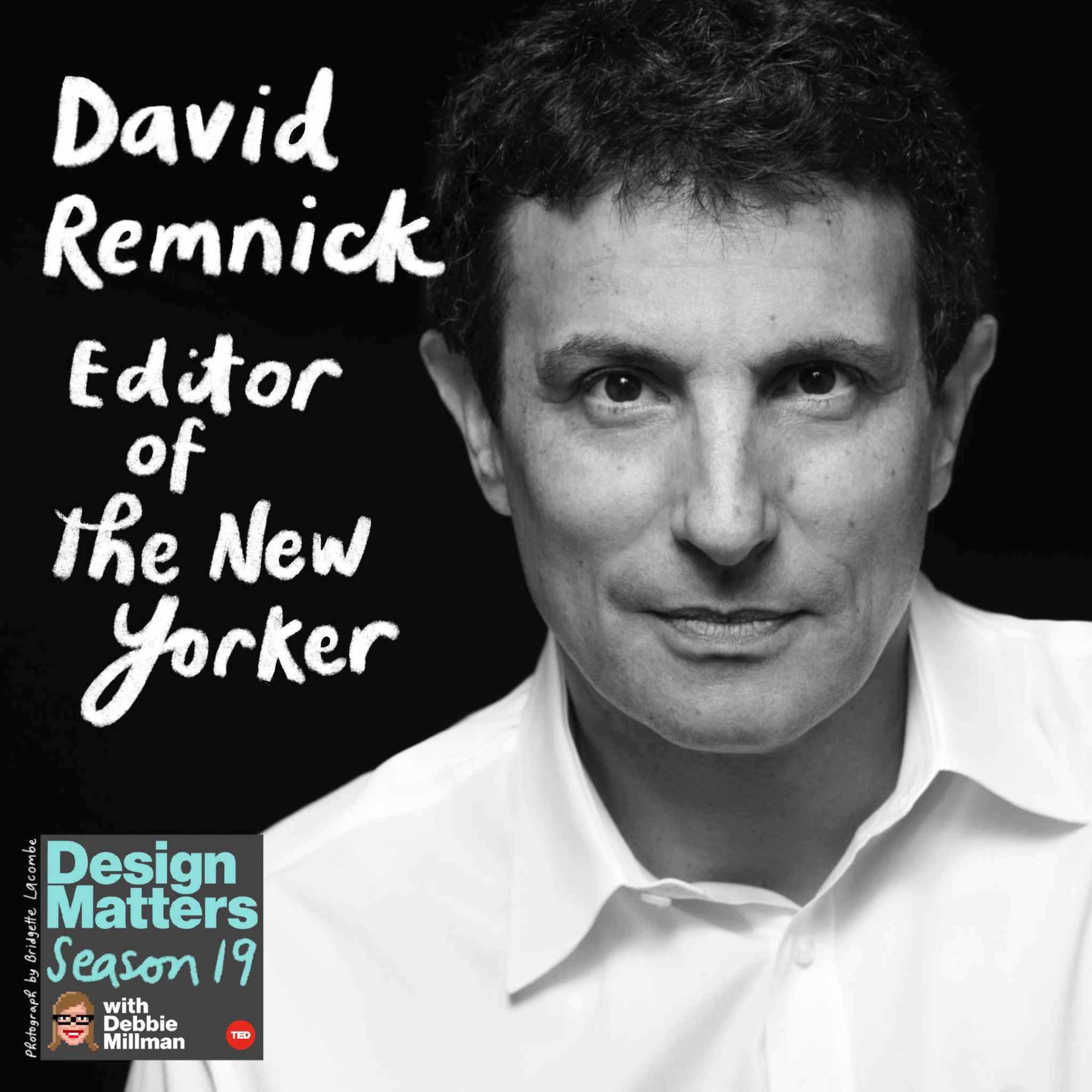
From the TED Audio Collective this is Design Matters with Debbie Millman. For 19 years, Debbie Millman has been talking with designers and other creative people about what they do, how they got to be who they are, and what they're thinking about and working on. On this episode, David Remnick, the editor of the New Yorker. Magaz talks about his life and career and tests the limits of his memory.
- [01:02]
David Remnick
Look, the story I'm about to tell you may be completely false.
- [01:13]
Vanta Advertisement
Trust isn't just earned, it's demanded. Whether you're a startup founder navigating your first audit or a seasoned security professional scaling your GRC program, proving your commitment to security has never been more critical or more complex. That's where Vanta comes in. Businesses use Vanta to establish trust by automating compliance needs across over 35 frameworks like SoC2 and ISO 27001, centralized security workflows, complete questionnaires up to five times faster, and proactively manage vendor risk. Vanta not only saves you time, it can also save you money. A new IDC white paper found that Vanta customers achieve $535,000 per year in benefits, and the platform pays for itself in just 33 months. Join over 9000 global companies like Atlassian, Quora and Factory, who use Vanta to manage risk and prove security in real time. For a limited time, get $1,000 off vanta@vanta.com tedaudio that's v a n t a dot com tedaudio for $1,000 off.
- [02:13]
AT&T Advertisement
And now a next level moment from AT and T Business. Say you've sent out a gigantic shipment of pillows and they need to be there in time for International Sleep Day. You've got at and T5G, so you're fully confident, but the vendor isn't responding and International Sleep Day is tomorrow. Luckily, AT&T5G lets you deal with any issues with ease, so the pillows will get delivered and everyone can sleep soundly, especially you. AT&T5G requires a compatible plan and device coverage not available everywhere. Learn more@att.com 5G Network Are you still quoting 30 year old movies? Have you said cool beans in the past 90 days? Do you still think Discover isn't widely accepted? If this sounds like you, you're stuck in the past. Discover is accepted at 99% of places that take credit cards nationwide, and every time you make a purchase with your card, you automatically earn cash back. Welcome to the now it pays to Discover. Learn more@discover.com creditcard Based on the February.
- [03:11]
Peloton Advertisement
2024 Nielsen report, everyone has a reason to change. Growing old, heartbreak, a fresh start. Whatever it may be, Peloton is here to get you through life's biggest moments with workouts you can do on your time and motivation that keeps you coming back. Peloton's tread and All Access membership help you track progress in classes from runs to Pilates, making you stronger and your fitness goals a reality. Find your push, find your power peloton visit1peloton.com.
- [03:46]
Debbie Millman
Debbie's interview with David Remnick took place in front of a live audience at the on air Fest on March 1, 2024 in Brooklyn.
- [03:57]
Interview Segment
David, I understand that you are planning to title the last book you ever write, Basically Fine.
- [04:08]
David Remnick
No, I think I'm going to title it home by 10.
- [04:11]
Interview Segment
Well, tell us the story of Basically Fine.
- [04:13]
David Remnick
I have no idea what basically oh.
- [04:16]
Interview Segment
It was when you interviewed Kenzaburo Ore and you sent the article to.
- [04:22]
David Remnick
Oh my God. How do you remember these things? I'm going to confess to you and this is going to be a problem for you. If I wasn't married to the woman I'm married to, I would not remember any of my life. The nature.
- [04:36]
Interview Segment
Fortunately I know your wife.
- [04:37]
David Remnick
Yes, and anything before my wife, I have no idea. So we'll, we'll struggle here for the next some minutes. But I'm not kidding around. KenzoBoro OA, like a lot of stories for journalists is somebody that Kenzoboro Oway won the Nobel Prize Japanese author I think just died very recently and I was assigned to write a profile of Kenzabo Oa when I was a writer for the New Yorker and Tina Brown was the editor and I really struggled with this piece and his English was about as it's better than my Japanese, but it was not great and I came home and I did not have what I like best in this world other than my friends and family and peace and love and understanding which is a full notebook. Yeah, a half filled notebook is hell on earth. And yet I wrote the piece anyway because that's what one does. And I went into my editor Jeff Frank's office. And I saw the note from Tina Brown and it said, jeff, I guess Remnick's piece is basically fine. And let me just say, in the annals of editor reaction, basically fine sucks.
- [05:54]
Interview Segment
You might not remember.
- [05:55]
David Remnick
Really bad. I tried to put it out of my mind, but you thankfully now have reinserted it.
- [06:02]
Interview Segment
Just to prepare you. That might be happening a few more times.
- [06:06]
David Remnick
Yeah, yeah.
- [06:08]
Interview Segment
You were born in New Jersey.
- [06:09]
David Remnick
I was in what you deepest, darkest.
- [06:11]
Interview Segment
No, no. I'm going to be bringing up a lot of things that you've said before. I need you to know right now that you can trust me, that the sources are good. You've described your upbringing as an east coast version of what is seen in the film American Graffiti. Marching bands, football teams, and very middle class, in a blue collar, Springsteenian sort of way.
- [06:34]
David Remnick
That's right. No ocean.
- [06:36]
Interview Segment
You went to kindergarten in a yeshiva. That doesn't feel particularly Springsteenian.
- [06:42]
David Remnick
Well, from where I come from, it is. My parents sent me to a religious school for a year because I was large and impatient and I missed the cutoff date. Do they still have cutoff dates for kids? So I missed the cutoff date. So I was a little on the old side to be waiting yet another year. So they sent me to a yeshiva in Patterson, New Jersey, and it was called Yavneh. And I had my mouth washed out with soap by Mrs. Wool. Why she should rot in hell. I think I.
- [07:17]
Interview Segment
And it was, by the way, not.
- [07:20]
David Remnick
Just any soap, you know, that kind of lava soap, which is combination soap and a stone. Yeah, it was that. I think I said a bad word of some kind, you know, like tuchus that would get you to skip a grade. Now got my mouth washed out with soap.
- [07:40]
Interview Segment
You were a newspaper junkie as a child and began reading the Village Voice at your neighborhood 7 11.
- [07:47]
David Remnick
I did.
- [07:48]
Interview Segment
I didn't even know 711 sold the Village Voice.
- [07:50]
David Remnick
Well, I didn't. I didn't strictly speaking buy it either. I would sit on the floor of the 711 and read it cover to cover. And that's what I thought I'd do with my life, I thought, even as I got older. I think the Village Voice really had kind of two big moments when it was first invented. It was invented as a product of the 60s, obviously. In fact, it's a new book about the Village Voice is said to be very, very good. I haven't read it yet.
- [08:16]
Interview Segment
It's covered on today's New Yorker website.
- [08:20]
David Remnick
I don't read it. I hear the New York. Yeah, I Hear the New Yorker website is excellent and the magazine is said to be good, too.
- [08:28]
Interview Segment
It's pretty good.
- [08:30]
David Remnick
Funny cartoons and whatnot. Yeah. No photographs on the COVID though. Yeah.
- [08:34]
Interview Segment
Caption content.
- [08:35]
David Remnick
Yeah, they have that, too. I should subscribe.
- [08:41]
Interview Segment
I'm really actually hoping you're gonna give me some tips on subscribing.
- [08:44]
David Remnick
Oh, I've got a lot of tips.
- [08:46]
Interview Segment
No, no, no, no. On how to get to the top three in the caption contest. That's a bucket list item for me.
- [08:52]
David Remnick
Okay, can I just digress from the Village Voice for a second? Occasionally I'm invited to, like, a fancy thing, and not very often, and once in a while I'll go because curiosity killed the cat. So I went to this thing and I was introduced to then Mayor Michael Bloomberg. And he says, hello. Hello. I was very polite, you know, well brought up in New Jersey and whatnot. And he said, you know, I've tried to win the cartoon caption contest dozens and dozens of times, and I've never won. Now, prior to this conversation, I had had what my dearly departed mother would call a big drink. And so. And. And so I said, wait a minute. You're the mayor of New York, you are the richest person in New York, and you want to win the fucking Create caption contest, too? And he just didn't find this funny at all. And he said, yes, yes, but we.
- [09:56]
Interview Segment
Take it very seriously.
- [09:58]
David Remnick
I think he take himself very seriously. So anyway, I worship the Village Voice because it was, you know, the New York Times is the weather, and it's the. You know, it was the establishment word and all that. And the Voice was this other thing and filled with writers who wrote about themselves and they were at different spots in politics. And there was feminism. What was that? There was all this stuff about race, although there were no very few black writers. A God knows. A condition not limited to just the Village Voice at that time. And it was. It just, you know, even in North Jersey, you feel. You don't feel like you're sitting here in Williamsburg or Manhattan or whatever. It feels a million miles away. And so to listen to WBAI or WNEW FM for music or the Caribbean station or this and the other thing. Radio is a big part of this imagining another life.
- [10:56]
Interview Segment
Well, you were a child insomniac. And you've described yourself as an adolescent, no sleeper, all night listener and eyes wide open, ceiling staring dreamer.
- [11:07]
David Remnick
Yeah, that wasn't cocaine at work. It was just. It was just. It was just a sense of wanting to be elsewhere and knowing that There was this world across the river. Now, a person with a real imagination, someone like John Updike, or name your favorite writer, Roxane Gay, would have. Yeah. Would it certainly have had the imagination to know that Hillsdale, New Jersey had its own emotional depths and interest, as Updike made of his Pennsylvania. But I did not. I did not. New York City was. Was where I wanted to be from the time I began going with my parents to visit my grandparents in Brooklyn and great grandmother in Coney Island. And in Trump Houses, by the way.
- [11:58]
Interview Segment
Wow. So are you still an insomniac?
- [12:02]
David Remnick
Pardon me?
- [12:02]
Interview Segment
Are you still an insomniac?
- [12:04]
David Remnick
Oh, no. I sleep like a rock. Cause I live here. Mission accomplished.
- [12:11]
Interview Segment
You started writing for your high school newspaper. I did the Smoke Signal when you were 13. And from what I understand, none of your classmates were interested in contributing to the paper.
- [12:23]
David Remnick
No.
- [12:23]
Interview Segment
So you wrote and edited the entire paper by yourself. Is it true you made up different bylines so it wouldn't seem as if you were writing it on your own?
- [12:35]
David Remnick
I still do. Are you a fan of Rachel Aviv? Mm, that's me. She's good, isn't she? She's really good.
- [12:46]
Interview Segment
She's my favorite.
- [12:47]
David Remnick
Yeah. Patrick Raden. Keefe. Me too. Me too.
- [12:52]
Interview Segment
Now, you put this together yourself via old school layout and paste up techniques on your kitchen table.
- [12:59]
David Remnick
Yeah.
- [12:59]
Interview Segment
How was it printed? Was it mimeographed?
- [13:04]
David Remnick
Well, let me tell you how paper was. You printed it out and you cut it and used scissors and glue. It was a big. Mitzi. It was a big deal. And it was a terrible. First of all, beginning with the title was called the Smoke Signal because we were the Pascack Valley Indians. They aren't anymore. I think they're like the warriors or something. And the Smoke Signal became the. I don't know what else. But that came the signal.
- [13:35]
Interview Segment
Right.
- [13:36]
David Remnick
30 years later, not the signal. That would be the CIA newspaper. And I didn't do it completely by myself, but nobody was really terribly interested in this. That could have been the first signal that the newspaper business was in trouble.
- [13:51]
Interview Segment
You also got a job for what you've described as, quote, writing stupid little articles for one of the community giveaway papers featuring information about school board meetings. But you also described it, and I love this, as the most romantic thing ever.
- [14:10]
David Remnick
Well, I left my house and I asked people impertinent questions and they answered them. You know the words. I think reporters discover this very early on, or anybody that has a medium that they can put between themselves and the world. A canvas, a Notebook. It's a form of permission. It's a form of permission. And to have that permission at a, you know, preposterously young age and to have, you know, what seemed like ancient important people like 40 year old school board members answer your questions, it was very suggestive of something exhilarating.
- [14:50]
Interview Segment
You also started to play guitar around that time and I believe your first instrument was something you called a Gesunda guitar.
- [15:01]
David Remnick
A Gesunda guitar would mean a bigger, healthy guitar. No, I had a crap guitar. But remember what was the guitar? The guitar was like a notebook. The guitar was a way to be a part of this thing that was happening that you wanted to be a part of. I wouldn't have picked up a flute. Well, unless you wanted to be Jethro Tull. I was going to say Ian Anderson, but I just desperately wanted to. Look, I grew up in a very, in all seriousness, what struck me as a very dull, conventional, hemmed in environment with a mother who was quite ill, who had very serious Ms. And how she managed, I to this day, I don't know. And a father who soon would be quite ill and not be able to work, you know, when he hit about, you know, in his 50s and it was, there was a certain kind of desire to be another, to enter the big world, however deceptive that might be. That certainly was the animating spirit of everything I did. You know, I, I learned about that other world through various mediums. One of them was very early bumping into the obvious music, most particularly Bob Dylan. And then you'd listen to that and then that would throw you to reading Allen Ginsberg or, or, or, or. And it happens to a lot of people, I'm sure a lot of people in this room at, at a certain age something sparks you, whether you read or listen or you have a friend that leads you in some way and so that all these things were very important to me.
- [16:52]
Interview Segment
How did your parents illnesses impact your ambition?
- [16:59]
David Remnick
Well, it suggested that at a very peculiar age early on, and I know I'm not alone in this and I'm far from, you know, in, in the global sense or even in the metropolitan sense, the most disadvantaged. But it suggested that the future would require me to help them. I was the older of two kids and my father struggled on for, for a while but you know, he was a dentist and he very, very small dental practice and at a certain point when he was, I don't know, I think he lied about it for years because he had a tremor in his hand, his wife is sick he has two kids to support. He's screwed right in the conventional making a living sense. And I think he lied about it for a while. But patients, I think you all know as dental patients. We all have an identity as dental patients. That a dentist who comes at you with a shaking hand is not a good prospect for future business. It's like a bad Buster Keaton movie. And so he, you know, by the time I came back from Moscow in my late 20s or 30s, whatever I was, they were all in debt. And, you know, things collapsed again. I'm not weeping about this, except I think back at them, and they were much younger than me, and they were probably terrified. But in my, you know, egomaniacal teenage imagination, I knew that I had to make a living.
- [18:29]
Interview Segment
How did that impact the choices that you were making about what couldn't be a novelist?
- [18:33]
David Remnick
I couldn't say, you know what, my parents are going to stake me a little bit, and I'm going to move into a tiny apartment and with roommate, and I'm going to be. I'm going to be the next pick. Your favorite novelist. That. That was not. I needed a job.
- [18:48]
Interview Segment
What gave you the sense that journalism would be a more secure option?
- [18:55]
David Remnick
Let's just let that sit.
- [18:56]
Interview Segment
I love that people laugh at my jokes, but that wasn't really a joke.
- [19:00]
David Remnick
But. Well, first of all, the journalism business, even though I didn't know it at the time, was fat and happy in those days. Right. I'm sensing that there are some people here in the audience who are in a state of. When they think about the journalism business or the podcasting business. What's the word we now use constantly? Precarity, which I think became a word three years ago. I'm not sure before.
- [19:26]
Interview Segment
Along with unprecedented.
- [19:27]
David Remnick
Exactly. And. And, you know, as somebody who now is ostensibly in charge of a lot of people, I think I'm thinking about this all the time. In other words, I'm 65 years old. Right. But I'm working with a lot of people who are 27 and 34, and they want to have an exciting, interesting, engaged life. That's why they got into journalism and didn't go work for Goldman Sachs. It wasn't for the doe. I mean, they deserve to make a living, but the whole business model has exploded. But back to your question. You know, I was so lucky that right out of college, having had internships at Newsday and the Washington Post, I stuck around at the Washington Post. I mean, there ain't many Washington Posts left anymore. A lot of my friends went to the Miami Herald, which was this terrific, flawed, but terrific place to learn and to write and maybe spend your whole career. There's, there's barely a Miami Herald.
- [20:25]
Interview Segment
Do you feel that choosing journalism over becoming a novelist or a poet? I know you also wrote poetry was a compromise that would have really filled.
- [20:33]
David Remnick
The coffers for my parents. Yeah. The collected elegies.
- [20:37]
Interview Segment
Family on that income.
- [20:38]
David Remnick
Yeah.
- [20:38]
Interview Segment
Do you feel like it was a compromise?
- [20:40]
David Remnick
I did at the time. The self proclaiming of oneself as a novelist. Just, first of all, there was no fiction around. It's not as if I had written anything. You know, I always hear all the time people who say, I've always wanted to write, I want to write. And I would never answer this way because there's a certain cruelty in it. But then write if you're going to do that. You will find a way. You have to find a way. And there are all kinds of writer biographies about how people found a way. Graham Greene was a night copy editor in a newspaper, I presume, not making a hell of a lot of money, but enough to eat and house himself. And he got up early and he pushed himself and he wrote novels and got started, and he was good at it. And there is no law that at any given moment there are going to be. The world is going to treat you the way you want to be treated. It's, it's, it's, that's the fact. I needed a job.
- [21:39]
Interview Segment
You went to Princeton University, which you said getting in was a miracle.
- [21:44]
David Remnick
I, I, to this day I don't understand it. If I had, if I presented the SAT scores that I did have, now there's no way. And the high school I went to, nobody went to these places. And, and again, I just don't, I don't get it. There must have been some mistake.
- [22:04]
Interview Segment
You study.
- [22:04]
David Remnick
I'm not kidding around.
- [22:05]
Interview Segment
I know.
- [22:06]
David Remnick
I really don't, I don't, I don't get it. I mean, it was a top. There were other people at the top of the class and they never reached.
- [22:11]
Interview Segment
Out to you and asked you to come back?
- [22:13]
David Remnick
Oh, that's a stupid, nervous interview with a tie. And I, you know, I don't know.
- [22:17]
Interview Segment
You studied Russian and French, majored in Comparative Literature. Your parents thought that majoring in Comparative Literature was weird.
- [22:28]
David Remnick
My father asked me, what are you comparing?
- [22:30]
Interview Segment
Comparing?
- [22:33]
David Remnick
Good question, smart guy. I was comparing it to dentistry, as it happens. And Tolstoy won. I, you know, concerning how I made my life later in the Russia biz, a bit. Here were the grades that I got in Russian C plus and D. Yeah. And then I got out of the Russian business. What happened was I had had some in high school. The only interesting course that my high school offered was Russian. I. I think some really. I don't know, with this wonderful man named Frank Falk. I don't know what he. How he washed up at this high school, but he was teaching Russian. I thought, wow, cool. Okay. And I took it for four years. And when I got out after four years, I could say, those boys are crossing these bridges or something. That was it. So I thought, third year at least, right. And I took the test. They sometimes give you the aptitude test. And Veronika Dolinko said to me, she's the teacher. She said, david, I think you should start from beginning. I said, well, surely second year then. And she said, it is your funeral. And so it was. And so it was. But I kind of started all over again years later.
- [23:56]
Interview Segment
I actually minored in Russian literature in English translation.
- [24:00]
David Remnick
There you go.
- [24:01]
Interview Segment
Just to avoid that whole scenario.
- [24:03]
David Remnick
That's fine.
- [24:04]
Interview Segment
While at Princeton, you joined the University Press Club. In 1979, you co founded the student newspaper, the Nassau Weekly.
- [24:12]
David Remnick
Still exists.
- [24:13]
Interview Segment
I know, it's incredible.
- [24:15]
David Remnick
It is amazing.
- [24:16]
Interview Segment
You also became a stringer for the New Brunswick Home News, the Asbury Park Press, and interned at the Washington Post and Long Island Newsday. Overachiever much?
- [24:32]
David Remnick
Yeah, I guess. I mean, I have one quality that I will. I will fest to. I have what my grandparents would call zits. Flesh. I put in front of a task. I will complete it. I mean, if I have to write a long piece in three days, I won't move from the chair. It might not be all that good, but I will complete it.
- [25:00]
Interview Segment
How are you able to write that fast?
- [25:04]
David Remnick
I don't know. It's like, again, I will fess up to that. The quality somebody else will have to fess up to. I don't know. It's like asking, how does a seal know how to balance a ball on his or her nose? It's just that that thing that I learned how to do. I think part of it is that I didn't learn how to be a reporter by blogging at home. Which is another generational thing. And I've nothing against that. Different qualities come out of it, but I had this kind of traditionalist training of covering police at night and having to do things very quickly. And I was a sports reporter for two years at the Washington Post. And you would have to cover ball games at night and write an account of the game in 20 minutes. So you build muscles. Why does a dancer jump higher than we do? Because they spend all day long training. They just do training.
- [26:06]
Interview Segment
Early on, you interned at the Washington Post and then stayed there after graduation until they told you to go away for a year.
- [26:14]
David Remnick
Yeah, and I taught. I taught in Japan, knowing no Japanese, at a Catholic university. So they had this Jewish kid from Jersey at a Jesuit school in Tokyo. And the day I landed, the three priests greeted me, and they said that I may not date any students. So. And of course, I'm a really good boy. And I said, okay. And so I had a rather monastic Japanese existence, and I read, like, a book or two a day. I couldn't speak any language, and I think they wanted me to stay for two years, and I stayed six months, and I traveled around all over the. All over Southeast Asia, you know, on $5 a day and all the hashish you could pocket, and came back and started a job at the Washington Post. For real?
- [26:59]
Interview Segment
Well, actually, you made a stop in Paris.
- [27:01]
David Remnick
I did.
- [27:02]
Interview Segment
Clad in a Leon Russell t shirt and $9 Converse sneakers.
- [27:07]
David Remnick
Yeah, those were good.
- [27:08]
Interview Segment
You made money singing Bob Dylan songs.
- [27:10]
David Remnick
In this earlier time. But, yes, I was a busker. So next time you're on the subway and somebody. What? I don't know. What are the most common songs you hear on the subway being sung to? You give the person a little dough because they. They need it. But I had a great time. It was really fun.
- [27:30]
Interview Segment
And you made enough money to survive doing the bus.
- [27:32]
David Remnick
If you stay in a hotel for $4 a night, it doesn't take long to make that much money.
- [27:36]
Interview Segment
You returned after your year away, where you worked at the Washington Post for the next 10 years. You worked with the legendary Ben Bradlee. He was the editor of the Post during that time. And you said that you. And.
- [27:49]
David Remnick
And legendary podcaster Malcolm Gladwell as well.
- [27:52]
Interview Segment
Yes, I. I'm gonna mention that a little bit. You said that you and most of your young colleagues saw Bradley the way one might see a great orca in a fish tank.
- [28:03]
David Remnick
Right. So they had. They had glass. It was the. It was the beginning of the glass office period. And he was in his post Watergate period, so he was already a celebrity. And he was incredibly handsome in an old WASP sort of way.
- [28:20]
Interview Segment
Jason Robart.
- [28:21]
David Remnick
Oh, my. He. Jason Robards didn't come close to looking as good as Ben Bradlee and All the President's Men. I'm sorry. He got the voice. You know, the great voice and the whole thing. And cursing in fluent French. He had it all going on. But he was also in this kind of late mannerist period. His accomplishments, the big accomplishments, were a little behind him. He was kind of coasting a little bit, I'd say he was enjoying it. He was enjoying life. But I was terrified of this guy, and I had almost no contact with him. And even when half the hierarchy of the Washington Post came to Moscow, when I was there to interview Mikhail Gorbachev, Bradley just stayed home. He wanted no part of it. I think the jet lag was too much.
- [29:06]
Interview Segment
What was the biggest thing you learned from him?
- [29:10]
David Remnick
Fearlessness in an editor is essential if we can be serious for a moment. And I've been at this for a while now, and the New Yorker is many things. I hope. I hope it's funny. I hope it has literary depth. But one thing it has to do is put pressure on power. It has to ask hard questions. It has to not pander to its audience in any way. It has to do hard work. And that's not always. That's, you know, you don't always sleep well. And we have a lot of safeguards beyond the talent and the efforts of the writers. We also have an extraordinary checking department of really devoted people going over every. Not just spellings and when so and so was born, but really beating the hell out of these pieces to make sure they're right. But they also have to be fair. And we live in a world that is unbelievably confusing and difficult and contentious and polarized and mysterious. And it's a high order to get things right. And Bradley is among those journalists who knew that, like in life, you wake up every day and you make one mistake after another, and you have to proceed fearlessly. Otherwise you're just. You're just not going to have any value to the reader of the greater world.
- [30:47]
Vanta Advertisement
Trust isn't just earned, it's demanded. Whether you're a startup founder navigating your first audit or a seasoned security professional scaling your GRC program, proving your commitment to security has never been more critical or more complex. That's where Vanta comes in. Businesses use Vanta to establish trust by automating compliance needs across over 35 frameworks like SoC2 and ISO 27001. Centralized security workflows, complete questionnaires up to five times faster, and proactively manage vendor risk. Vanta not only saves you time, it can also save you Money. A new IDC white paper found that Vanta customers achieve $535,000 per year in benefits and the platform pays for itself in just three months. Join over 9,000 global companies like Atlassian, Quora and Factory who use Vanta to manage risk and prove security in real time. For a limited time, get $1,000 off vanta@vanta.com tedaudio that's V A N T A dot com tedaudio for $1,000 off.
- [31:48]
Olive & June Advertisement
Hi. Who here loves when their nails are perfectly done? Me. I'm Sarah Gibson Tuttle and I started Olive in June because, let's be real, we all deserve to have gorgeous nails. But who wants to spend a fortune or half their day at the salon? And that's why I created the Mani system. So you can have that salon perfect manicure right at home. And guess what? The best part? Each mani only costs $2. Yup, you heard me. $2. No more. 30, 40, $50. Salon trips that eat up your day. Now you can paint your nails whenever you want, wherever you want. And trust me, you're going to be obsessed with your nails and everyone is going to ask you, where did you get your nails done? And here's a little something extra. Head over to oliveandjune.com and get 20% off your first mani system with code perfectmanny20@olivenjune.com perfectmanny20 that's code perfectmanny20 for 20% off at o june.com perfectmanny20. You're all set for a nail glow up. Let's get those nails looking fabulous, shall we?
- [32:48]
Peloton Advertisement
If you work in quality control at a candy factory, you know strict safety regulations come with the job. It's why you partner with Grainger. Grainger helps you find the high quality and compliant products your business needs to inspect, detect and help correct issues. And the sweetest part is everyone gets a product that's as safe to eat as it is delicious. Call 1-800-GRAINGER Click grainger.com or just stop by Grainger for the ones who get it done.
- [33:18]
AT&T Advertisement
Does it ever feel like you're a marketing professional just speaking into the void? Well, with LinkedIn ads, you can know you're reaching the right decision makers. You can even target buyers by job title industry company seniority skills. Wait, did I say job title yet? Get started today and see how you can avoid the void and reach the right buyers with LinkedIn ads. We'll even give you a $100 credit on your next campaign. Get started at LinkedIn.com results. Terms and conditions apply.
- [33:50]
Interview Segment
Given the state of politics in the US Right now and the potential futures that may unfold how worried, again. Again, how worried are you about the validity of the news being questioned?
- [34:09]
David Remnick
I think it should be questioned. Well, in terms of what, us being questioned? No.
- [34:14]
Interview Segment
Yeah. Us being questioned as, you know, fake news, the whole way in which the news has been in many ways seen as false lies, untruths.
- [34:29]
David Remnick
I think there's one thing that we need to, at this late date, recognize, concede and deal with is that it's not so much that Donald Trump is a. Because we're. That's what you're talking about. Not only, but part of it, that Donald Trump is not just an autocrat and a demagogue, he's also a very talented demagogue and very. I'm not sure how talented an autocrat he is, but certainly a talented demagogue that other people trying the same stunts. We've seen them in American history and they haven't been as successful. Our history is filled with demagogues and would be autocrats and worse, racists, misogynists and so on. But his ability to lock in to a certain base psychology and comedy and sense of arousal at a visceral level is astonishingly effective. Maybe not in this room, I'm assuming not in this room, I'm hoping, and I'm assuming fairly unanimously. But in the greater world, it is an astonishing thing that you have a president United States. You can object to whatever particular issue you might have, whether it's the Middle east or economics or immigrant, whatever it is, but to compare one to the other and know that they are in a tie is, I think that's another thing that's very, very hard for our writers and our readers to make sense of and understand is how this could possibly be. How it is that we live in the same country that elected Barack Obama in 2008 and 2012, and in fact, many, many of the same voters then voted to elect Donald Trump president. That is an astonishingly complicated piece of business to understand. And I think that we, we do our best and fail all the time and then have to wake up and try again.
- [36:42]
Interview Segment
You were in Russia during the Gorbachev Yeltsin years. You returned to the US in 1992. You wrote your first book, Lenin's the Last Days of the Soviet Empire. It received both the Pulitzer Prize for nonfiction and the George Polk Award. After writing over 150 major stories on everything from the Soviet dissident Anatoly Sharansky to the Indianapolis 500, you left the post to become a staff writer at the New Yorker. And you were hired by then editor Tina Brown. This was not your first attempt to work there. Can you tell us about the queer letter you sent editor William Shawn when you were still in college?
- [37:22]
David Remnick
Yeah, this was really kind of ballsy. So, William Shawn, the New Yorker was a very, from the outside at least, a very insular, special institution. And I should say that one advantage of being a dentist, son, is that dentists have waiting rooms. And waiting rooms at least then, were filled with magazines. And on Saturdays after my father closed up shop, I'd go in and read all the magazines. One magazine that I was not especially interested in was the New Yorker. It seemed, not for me. It seemed sort of not of the 70s. I was interested in Rolling Stone, which now seems like, you know.
- [38:05]
Interview Segment
No, that was a bible.
- [38:07]
David Remnick
The invention of the insight of Rolling Stone was that it discovered that the counterculture was the culture. That's a profound insight. Think of everything else, what you will or yanwen or whatever, but that was an insight. It was a business. But it was exciting, certainly to a 16 year old imagination sitting in New Jersey. So I wasn't interested in the New Yorker. And then I got to college. I had this teacher, a writing teacher named John McPhee, who, by the way, wrote about stuff that didn't innately excite me. Geology. And then I got into it and it was magnificent. It was like discovering Renaissance painting or something. It's just, oh my, how did I miss this all my life? But I also. He was a writer, as a teacher, he wasn't a scholar of literature. He was an actual practicing writer. This was enormously influential to me and exciting. That's what I wanted to do. So the New Yorker became more enticing and I wrote a query letter to William Shawn, who was a kind of gnomic genius, odd, distant figure. It was like writing a letter to Buddha. And you expected about the same result. Dear Buddha, Dear Buddha and I. Dear Mr. Shawn, I'd like to write a profile of this guy, Tom Page, who was a squash champion, who grew up in Dayton, Ohio. First family of Dayton, Ohio. Weirdly rich, but had a squash court in his backyard. And when he broke his right arm, his strong arm, he played with his left arm and he beat everybody anyway. And he took an enormous amount of drugs. And it turned out he was also quite disturbed and died very young. But he seemed like an ex, you know, the kind of profile of a deeply eccentric, interesting person. I got back the following letter. Dear Mr. Remnick, Mr. Wind covers racket sports for us. I love the Mr. Wind part. Like I, I, I, I love the racket. The is Mr. Wind. And when it said, sincerely yours, William Shawn, and that I don't have this letter kills me to this day. Mr. Wind turned out to be Herbert Warren Wind, who wrote very, very, very, very long pieces about golf tournaments. And the structure of the piece would be, we came to the first hole, Go on. And there would be many columns. And then which brought us to the second hole, which was a dogleg left of 343 yards, par four. People ask me, why are the pieces in the New Yorker so long? And I say, you should have seen it back when, I mean, we used to do four part series on literally on grains. And of course there were four part series that were brilliant, you know, Janet Malcolm or whatever McPhee. But there's a sociology to this too. So why are Dostoevsky and Dickens novels so long? They're so long because in the 19th century, literary magazines were middle class entertainment and Crime and Punishment being published in the Bell in Kokel or Dickens being published in Blackstones. This was entertainment for the kind of sending middle class audience that was going to read a novel. And they were entertaining and they were episodic and they were, and they were realist and they went on. There's a sociology to the, to the art question. William. Sean's one of his biggest challenges as an editor, and all editors have peculiar challenges to the time. One of his biggest challenges is I need to have enough editorial matter to go next to the gazillion ads I am publishing. I don't have that problem. I have a different kind of business.
- [42:07]
Interview Segment
Well, when you took over in 1998, the magazine had lost an estimated $170 million since the Newhouse family had bought it in 1985. This was not the only precarious time in its history. I believe you are in possession of a letter from co founder Raul Fleischman to a colleague stating that they needed to shut the magazine down In May of 1925, just three months after the debut issue.
- [42:40]
David Remnick
That was before the word precarity was around, but there it was.
- [42:44]
Interview Segment
It took three years, but the magazine has actually been profitable since 2001.
- [42:50]
David Remnick
It's. I, look, I will say this. Our business changed a lot. The old style of all magazines was you subscriptions were very cheap so that it would get in a lot of hands and so advertisers would reach as many people as possible of a certain kind of audience, depending on what the magazine was or newspaper or television network or whatever it might be. The nature of advertising has changed and is completely and utterly dominated by Google and Facebook. And I don't know what the real numbers are, but something like 75% of the ad market is to that and the rest is scraps. And the result has been, in addition to other factors like Craigslist and so on, has been the decimation of mid level newspapers. I mean, there's really only a few exceptions to this. And magazines. And it's tragic. It's tragic. Not that every publication that's been lost or diminished is perfect, but the changed landscape is deeply, deeply, deeply worrying for all kinds of reasons that we can talk about. The only other alternative that I know of at the moment is subscriptions. The same thing that television's discovered and luckily enough, fairly early. We changed our emphasis and we basically said to you readers of the New Yorker, without saying it, that I can't give this away anymore. You have to pay more than a cup of coffee a week to have this extraordinary thing in your hands or on your phone or however you choose to read it. And the New Yorker in fact, gives you a great deal more per day, per week than when Mr. Shawn was editing it. But the subscription model, now that we've had a lot of success with it for a while now, the subscription model is facing challenges too, because you've all had this discovery. You've all woken up and go, wait a minute, I have Netflix, I have Paramount plus. And then there are even apps now to get rid of or shave down your.
- [44:54]
Interview Segment
Which was, you know, the original cable system.
- [44:56]
David Remnick
Exactly. So, you know, we're in a time of real flux. And editors spend a lot more time thinking about business than they probably, if they're being honest with themselves, would like to. They want to be thinking about writing and graphic design and all kinds of things. But if you don't have your eye on business and this goes with public radio or look at what's happening in the podcast business. Right. You know, we have the New Yorker Radio Hour, my colleague David Krass. Now we have a terrific time doing this. We're thinking about how to develop it, make it better all the time. But we also have to pay attention to economics. Otherwise you wake up and something terrible has happened. And I'm determined, you know, we're going to celebrate 100th anniversary next year, the New Yorker. I don't want that to be an occasion for us to show off in a museum of ourselves. There'll be some of that, to be sure, but I want people in this room and their children to be reading the New Yorker. That is a lot better than the one that we have now in the future. So I think about that kind of thing all the time.
- [46:00]
Interview Segment
When you first made the announcement of your expansion into podcasts, you stated, while I readily admit to the gall of it, we come to this project with a deep respect for the history and creative range of the medium. Why did you feel it was galling to expand into the podcast?
- [46:18]
David Remnick
Because, you know, it's like, you know, I'm not saying we're Michael Jordan, but, you know, when Michael Jordan left the Chicago Bulls to go play baseball, that was kind of. One could argue it was both galling and a little stupid. And like, why are you doing that? I think it's actually kind of interesting as my son's. As my son, I once said, you know, maybe I'll write a novel. He said, stay in your lane. Stay in your lane. I don't believe in necessarily staying in your lane, but there is that instinct toward, okay, you know how to do this. You know how to make hamburgers. Make hamburgers. And sometimes places that expand and suddenly start serving, you know, something else, fail. I. I just think it's enormous fun. And I. And I also think it reaches other people.
- [47:05]
Interview Segment
Is there an underlying principle or philosophy that is guiding the continued expansion into podcasts?
- [47:11]
David Remnick
That'll be good. And they have to make their own way. The. The latest one will be two. Two things have started of late. There's a culture podcast with Alex Schwartz and Vincent Cunningham and Nomi Fry, which is extremely fun and funny and smart. And we purchased a podcast that you probably know called in the Dark. And in the Dark was being run out of, I think, Minnesota Public Radio for a while, and, you know, they stayed in Minnesota. And this is a reporting and narrative podcast. More. More like in the mode of serial, say. And it's really hard to do. And they work a long time on their reporting. They're working on their third season, and they've been around for some years. These are serious reporters, and they were. I felt that they were kindred souls, and so did the head of Conde Nast. So we don't see them a hell of a lot. And there's an editor at the New Yorker named Willing Davidson who works with them, and Chris Bannon who does heads podcasts and audio in general. A Conde Nast is in deep contact with them, but they're really ambitious. They're shooting for the moon. They also had a kind of mini season that took a New Yorker piece by Heidi Blake called The Runaway Princesses. And I thought it was, I thought it was terrific. So I have, Look, I just listen to a lot of audio. It's always meant a lot to me, podcasts and radio. And I just thought it was an experiment worth, worth trying. We've had failed experiments too, in video. We did a, we did a thing with Amazon that I think, if we're being honest with, I saw a noble failure. It wasn't embarrassing, but it wasn't, it didn't take off, it didn't, it didn't garner the attention and didn't quite, it didn't quite work.
- [49:01]
Interview Segment
How long do you give something before you make that decision?
- [49:04]
David Remnick
Well, sometimes economics will dictate that. Economics might tell you, quite frankly, audio is less expensive to do, although in the dark because it's is so intensively reported, you know, like cereal, like any number of other things that's more expensive to do.
- [49:23]
Interview Segment
In a recent episode of the New Yorker Radio Hour, you interviewed a meme mixologist. Yeah, and I'd never heard that job title before.
- [49:32]
David Remnick
God knows I hadn't either.
- [49:33]
Interview Segment
Can you, can you share what that actually is for the audience?
- [49:35]
David Remnick
No, I have. No, no, I, I, I really. Have you ever had the feeling, and maybe you're having it right now, that you were interviewing something and the producers said, you know, we're going to interview a meme mixologist, and you say, okay, that's fine. And you get through the interview as if in a haze, and at the end you say, I really don't know what that is. Yeah, I think that's fair enough.
- [49:57]
Interview Segment
But no, I'm not experiencing that. Thankfully. The last thing I want to talk to you about is music. In your latest book, holding the Note Profiles and Popular Music, you state that there's no one who has meant more to you than Bob Dylan. The Passion.
- [50:12]
David Remnick
I don't think I'm alone in that. Yeah.
- [50:15]
Interview Segment
Anybody here?
- [50:16]
David Remnick
Okay, well. Older crowd.
- [50:17]
Interview Segment
Perhaps this passion was first ignited in 1966 when you first heard the song I want you.
- [50:28]
David Remnick
Yeah, it was a weird experience. Again, I don't remember much. Look, this what I'm about, the story I'm about to tell you may be completely false in the sense that it was a novelist named Harold Brodke and he wrote a novel called the Runaway Soul. The novel opens with his own birth, and Harold claimed that he really remembered it. And it was important to him, this kind of self mythologizing at some level, because there's no earthly way that he remembered his birth. I do think I. This is true. But so I want to be honest.
- [51:10]
Interview Segment
Memory of a memory.
- [51:11]
David Remnick
But because I'm. Exactly. Because I'm a journalist. I just. When I read memoirs, I read them in this spirit. All of them, including Bob Dylan's memoir, by the way.
- [51:21]
Interview Segment
We'll get to that in a minute.
- [51:22]
David Remnick
Yeah. When I was seven, something like that, my mother got sick. She had the first serious attack of multiple sclerosis. And my father and my brother at that time must have been four. My father was not able to go to the hospital. I guess I was past the limit and my father took me to the hospital. And it was very scary. Seeing your mother in a hospital bed, seeing your parents doing anything other than be in the kitchen is scary. The primal scene. Let's not even think about that. Yeah, but sick is really that I. That I really do remember. And as I recall, I heard this week played the radio. My father liked music too, and he had good taste, you know, R B, jazz, classical. And someone was on the radio singing with a voice like, this was not Paul Revere and the Raiders. This was not your average pop music. This was not Chad and Jeremy. This was the Guilty Undertaker, Size of Lonesome, Morgan Grinder Kreis. And what the fuck was he singing about? And I was 7 years old and it was thrilling. And I was not yet at the age where I was allowed to buy albums. And there was a store called EJ Corvettes, a department store, not a high level one, that was out on, I don't know, Route 17 or Route 4 somewhere in Jersey.
- [52:54]
Interview Segment
Corvette with a K. There you go.
- [52:56]
David Remnick
And I bought this album because kids, kids can't decide that Beatles album or that. So I bought something called best of 66, always hedging my bets. And it was okay. And then there was that song and I didn't know. And then I. And it was $1.99, I think the album. So I bought other Bob Dylan albums going backwards. So that would have been the time of Blonde on Blonde and then Highway 61 revisited and going backwards and backwards. Until then he was nothing but an acoustic guitar and a harmonica. And that was a revelatory thing. At a very young, I knew what the Beatles were. Even in the minivan taking us to Yeshiva. Kids wore Beatles wigs with a yarmulke on top. It's a great look. It's a great look. But this was something completely mysterious. And to this day, I mean, I think the last time I saw Bob Dylan was four months ago with one of my children who's, you know, now 32. And. And they've all. Well, certainly Alex and Noah have gone with me any number of times. I don't know whether they're indulging me or not. I can never quite tell.
- [54:16]
Interview Segment
In 2004, you were hoping to get an exclusive excerpt of his recently published memoir in the New Yorker. You had almost had it in the bag.
- [54:25]
David Remnick
Yeah, I got screwed with my pants on.
- [54:29]
Interview Segment
Dylan wanted the COVID Dylan wanted the COVID of the New Yorker.
- [54:33]
David Remnick
Just say that Bob Dylan has remained unmoved by and unimpressed by my hero worship. It doesn't keep him up nights, apparently. I'm not alone. So what happened was I had heard that he was writing a memoir and that it was good and that it wasn't like Tarantula, which is a kind of, I don't know, surrealist experiment. And I was summoned. I said, well, send the manuscript to the publisher. He said, I can't send the manuscript. It would be like sending the Dead Sea Scrolls to my apartment. So I went to his. To the Dylan office. I won't even tell you where it is, but you have to press a button that says, like, I don't know, Ab Cube carpets. It's like a. It's like a CIA thing. And you go up there and it's just Dylan everything. Dylan tote bags and Dylan albums and Dylan this and Dylan that. And if. If I had gone when I was 16, my head would have exploded into a thousand pieces. And they sit me in a little room with a bare table and a manuscript and a glass of water. And I sat there and read the book straight through Chronicles, Volume 1. And it was terrific. And I said to the publisher and the Dylan guy, nice people. I'm in. Don't call Rolling Stone. That's not your audience anymore. I don't know what. Whatever bullshit I told them. I. I was trying to get it for the New Yorker. I'm a competitive person. And they. And we made an agreement, and we made a handshake agreement, okay. And it still pisses me off. I know it's many years ago. It looks like John Kerry was running for president. Half the people here weren't born yet. And it really pisses me off, this thing. And it got to the summer, and they call and they said, okay, we're about to publish it. And I said, great. Seven thousand words. The New York bit in the beginning. We're all set, and we'll try to figure out what to do about fact checking and copy editing. And Bob doesn't necessarily have to be completely involved. And so on and so forth. Whatever. Whatever shit I was slinging. I was. I thought. I just thought, everything's gonna be great. And then they said, bob wants a cover. I said, bob wants a cover. We have, like, dogs on the COVID or bowl of fruit or a joke or a Barry Blitz making fun of whatever. We don't have. We don't do that. We don't have photographs in the COVID And I thought I'd change their mind. And there was a pause, and they said, bob wants a cover. And it was like talking to your parents at your worst moment. Bob wants a cover. I said, I can't do it. I'd say, I'm sure we can find some way to work this out. Bob wants a. And that was it. And they went to Newsweek. And by that time, Bob kind of looked like Vincent Price, you know, with a little mustache and a cowboy hat. And I thought, they're never gonna put Bob Dylan on the COVID in the middle of a presidential race. They put him on the COVID and they ran this excerpt. And apparently, Bob Dylan survived the experience of not being published in the New Yorker. And then another thing happened. I saw that he had these paintings. He's a painter. He also makes whiskey and iron gates. Man of a man of parts.
- [57:56]
Interview Segment
He's a range. He's got range.
- [57:57]
David Remnick
He's got range. And these paintings, some of them are. Some of them are kind of good. And there was one, a painting of Katz's Delicatessen. Right. The pastrami capital of the world. And it's pretty good. And it's a good New Yorker cover. It's the New York scene. I make an arrangement. We're all set to go. Two weeks out, I get a phone call. Bob doesn't want to do it. So I feel our relationship.
- [58:29]
Interview Segment
Yeah.
- [58:30]
David Remnick
Is not on an equal level. Somehow you think. Yeah.
- [58:37]
Interview Segment
Malcolm Gladwell is here today to receive the 2024 Audio Vanguard Award. And you work together at the Washington Post.
- [58:44]
David Remnick
Did I come in second? I'm just asking.
- [58:47]
Interview Segment
Maybe next year. You work together at the Washington Post. And he said this about you at the Washington Post. There was one day when David Remnick had three stories on the front page, which I don't think has ever been repeated. He was in a league by himself. So the idea that he would have a second act where he would outperform his first act is kind of unbelievable.
- [59:15]
David Remnick
Have I ever mentioned publicly how much I love Malcolm Gladwell? Look, that happened, the front page thing, because I was blessed. I was sent to Moscow at a time where American Interest in what was going on was singular. And the news and the interest in the very topics of what was going on every day were so fascinating and thankfully so fascinating to our readers at the Washington Post that I think it was the journalistic equivalent of holding out a bucket and in a rainstorm. And it just filled up with stories. I could. I could go to my mailbox in the morning, my mailbox, and come up with a story just by reading my mail.
- [60:00]
Interview Segment
Well, you could. I don't know, any idiot could.
- [60:03]
David Remnick
And I. No, no, no, I mean it. At that time, every single day, in a newspaper, in a literary journal, something was being published that would. Had never happened before. They're publishing Anna Akhmatovo or Solzhenitsyn or Nabokov or Orwell or. Oh my God, there's the first report we've ever seen on the war in Afghanistan. I mean, we forget now that things are so dreadful in Russia, and not only Russia, how dreadful they are. How incredibly promising it was to be alive in Moscow in 1989 or 1990 there and by the way, in the world. You know, part of what shaped me is when I was a young reporter, the world was a very promising. It was. It's always filled with misery. We are half conscious crazy people doing the best we can and the worst we can all the time. But there was this. There was this moment of promise in the Middle east, in Eastern Europe, in Central Europe, in South America. Democratic promise. I'm not saying heaven on earth, but promise. And for all kinds of reasons that we could spend many, many hours discussing. So much of this was squandered that it's very hard not to view current times through that prison for somebody of my vintage. And I don't want to die like that. I don't want to go to my rest thinking that this country has given up on its democratic promise, no matter how flawed we are, even at our best, or all these other parts of the world. It wasn't just the fact that I was 32 years old. And that's. You're innately. Although I don't know that that's the case now with people who are 32 years old. But there was some sense that the world could turn a corner for the better. Not perfect by any stretch of the imagination, but the idea that history could go backward so profoundly is instructive about the precarity of human arrangements and behavior and foolishness and. And that's why I'm in this business, not just because it's so immensely fun and satisfying, but because I hope it helps somehow lead the other way.
- [62:45]
Interview Segment
Well, what I can say is that with you at the helm of the New Yorker, it gives all of us.
- [62:53]
David Remnick
Hope that that's, that's immensely generous. Thank you so much. Thanks for having me.
- [62:56]
Interview Segment
David Remnick thank you so much.
- [63:00]
Debbie Millman
Design Matters is produced for the Plant Audio Collective by Curtis Fox Productions. The interviews are usually recorded at the Masters in Branding program at the School of Visual Arts in New York City, the first and longest running branding program in the world. The editor in chief of Design Matters Media is Emily Wyett.
- [63:24]
Maybelline Advertisement
Ever wonder what your lashes are destined for? The cards have spoken. Maybelline New York Mascara does it all. Whether you crave fully free Fan lashes with Lash Sensational Big Bold Volume from the Colossal A Dramatic Lift with Falsies Lash Lift or Natural Looking Volume from Great Lash, your perfect Lash future awaits. Manifest your best mascara today. Shop Maybelline New York and discover your Lash destiny. Shop now at Walmart.
- [63:50]
David Remnick
What makes a great pair of glasses?
- [63:52]
Peloton Advertisement
At Warby Parker it's all the invisible.
- [63:54]
David Remnick
Extras without the extra cost.
- [63:56]
Interview Segment
Their designer quality frames start at $95 including prescription lenses plus scratch resistant, smudge resistant and anti reflective coatings and UV protection and free adjustments for life. To find your next pair of glasses.
- [64:11]
David Remnick
Sunglasses or contact lenses, or to find.
- [64:13]
Interview Segment
The Warby Parker store nearest you, head over to warbyparker.com that's warbyparker.com this is.
- [64:20]
Uber Eats Advertisement
Paige, the co host of Giggly Squad. I use Uber Eats for everything and I feel like people forget that you can truly order anything, especially living in New York City. It's why I love it. You can get Chinese food at any time of night, but it's not just for food. I order from CVS all the time. I'm always ordering from the grocery store. If a friend stops over I have to order champagne. I also have this thing that whenever I travel, if I'm ever in a hotel room, I never feel like I'm missing something because I'll just Uber Eats it. The amount of times I've had to Uber eats hair items like hairspray, deodorant, you name it, I've ordered it. On Uber Eats you can get grocery alcohol everyday essentials in addition to restaurants and food you love. So in other words, get almost anything with Uber Eats. Order now for alcohol you must be legal drinking age. Please enjoy responsibly. Product availability varies by region. See app for details.
- [65:20]
Maybelline Advertisement
Imagine a toilet so striking it inspired a couture dress. That's right kohlersvale Smart Toilet in Honed Black actually inspired fashion designer Laura Kim to create a stunning black chiffon dress that debuted on the Runway at New York Fashion Week. The Vail Smart Toilet, with its curved design, deep, rich textural color, touchscreen controls, and customizable cleansing features, can transform your routine into something extraordinary. That's the power of design. Design changes everything. Vail Smart Toilet in Honed Black only from Kohler Discover the Vail Smart Toilet and go behind the scenes of Kohler's partnership with creative director Laura Kim. At Kohler.