Loading summary
Transcript96 lines
- [00:01]
Elise Hu
Hi TED Podcast listeners. It's Elise Hu here from TED Talks Daily. Thanks for making our podcast part of your routine. We really appreciate it and we want to make your favorite TED podcasts even better. We put together a quick survey and we'd love to hear from you. It only takes a few minutes, but it helps us shape our shows and get to know you, our listeners, way better. Head to the episode description to find the link. Thank you again for listening and for taking the time to help our shows.
- [00:31]
Debbie Millman
This episode of Design Matters originally came out in October of 2024.
- [00:36]
Olafur Eliasson
I need to be less defensive. I need to release my honesty. I need to come through with my story.
- [00:52]
Debbie Millman
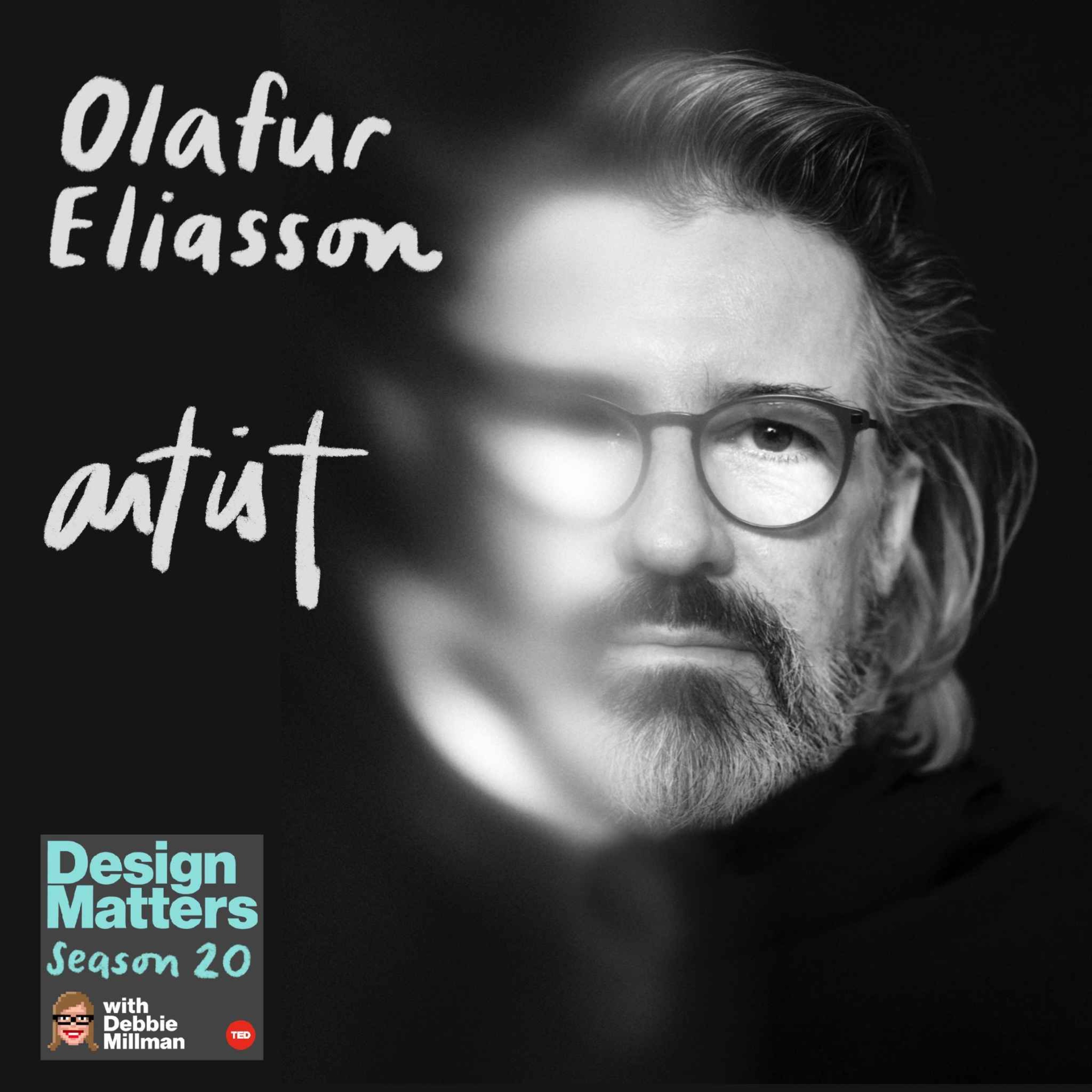
From the TAD Audio Collective, this is Design Matters with Debbie Millman. On Design Matters, Debbie talks with designers and other creative people about what they do, how they got to be who they are, and what they're thinking about and working on. On this episode, Olafur Eliasson talks about creating art that affects viewers by including them.
- [01:15]
Olafur Eliasson
People are actually worth trusting when it comes to looking at art. Foreign.
- [01:27]
Alloy Women's Health
Struggling with hot flashes, brain fog or midlife weight gain? You're not alone. But why wait years for relief? Nearly half of women suffer for as much as three years before seeking help for menopause symptoms, often because they don't know where to turn. Alloy Women's Health offers science backed physician guided treatment plans for your hormonal symptoms as well as skin, hair and sexual wellness treatments. And Alloy now offers access to competitively priced GLP1 prescription medication to help manage midlife weight gain. Joint the 95% of women who tried aloi and saw relief in the first two weeks. Visit myalloid.com alloy20 today and use code alloy20 to get $20 off your first order. Start feeling like yourself again.
- [02:07]
Maybelline New York
Ever wonder what your lashes are destined for? The cards have spoken. Maybelline New York Mascara does it all, whether you crave fully fan lashes with lash Sensational big bold volume from the Colossal a dramatic lift with falsies lash lift or natural looking volume from Great Lash, your Perfect Lash Future Awai Manifest your best mascara today. Shop Maybelline, NY and discover your lash destiny Shop now at Walmart.
- [02:33]
Olafur Eliasson
Race the runners Race the sails. Race the sails. Captain, an unidentified ship is approaching. Over. Roger, wait.
- [02:41]
LinkedIn
Is that an enterprise sales solution?
- [02:44]
Olafur Eliasson
Reach sales professionals, not professional sailors. With LinkedIn ads, you can target the right people by industry, job title and more. We'll even give you a $100 credit.
- [02:55]
Debbie Millman
On your next campaign.
- [02:56]
Olafur Eliasson
Get started today at Linked.
- [03:00]
Terms and Conditions
Terms and conditions apply.
- [03:05]
Debbie Millman
Hi, this is Debbie Millman from Design Matters. Work today moves fast, but Monday.com is here to help with their work management product. It's built for more than just marketing teams. It connects entire organizations to bridge the gap between strategy and execution. Plus, with built in AI capabilities, your team can work smarter, not harder. Maximize your marketing impact with the first work product you and your team will love to use. Visit us@Monday.com to learn more. Deep down, every visual artist suspects that they can't compete with nature. The scale, the shapes, the forms, the patterns, the light, the colors, the designs found pretty much everywhere in the natural world are so perfect. And it might just be an act of hubris for an artist to even try to compete. Yet Olafur Liasson seems to have found a way to harness some of this natural beauty in his own extraordinary art. His sculptures, his installations, experiments with light and water have been drawing huge audiences for several decades. In 2003, his weather project in London created the illusion of of a meteorological event with a giant sun filling turbine hall at the Tate Museum. In the middle of the last decade, he installed giant blocks of melting ice from the Greenland ice sheet in European cities where climate change conferences were taking place. In Switzerland in 2021, he created an indoor outdoor pond of unearthly beauty. Olafur Eliasson continually provokes his audiences to think about the natural world and our place in it in novel ways. Nowhere is that more apparent. In his most recent work as the newly appointed guest curator for Wetransfer, Olafur has created lifeworld, a public site specific reflective video installation on billboards in London, New York, Seoul and Berlin. We're going to talk about that and much more on today's show. Olafur Eliasson, welcome to Design Matters.
- [05:18]
Olafur Eliasson
Thank you so much. Thanks for having me.
- [05:20]
Debbie Millman
Olafra, I understand you have a number of unique collections. They include vintage light bulbs and antique owls. What is it about those particular objects that intrigues you so much?
- [05:33]
Olafur Eliasson
Owls? Yeah. They're not antique in that sense. They are. What do you call that when you have a stuffed animal? Taxidermy. Taxidermy.
- [05:43]
Debbie Millman
Very interesting.
- [05:44]
Olafur Eliasson
Yeah. So I collect. I have a few collections. I collect meteorites and compasses primarily, and then old bulbs, you know, incandescent bulbs. So I have like an old people's home for bulbs that are out of use, but they still work in the kitchen in my studio. Toy animals collect that too.
- [06:03]
Debbie Millman
Olafur, you were born in Copenhagen, where your parents emigrated from Iceland in search of work. Your dad became a cook and your mother was a seamstress. Is it true that your mom was from an Icelandic fishing village that could be traced back to the 11th century.
- [06:19]
Olafur Eliasson
You know, in Iceland you have this sort of the book of Icelanders. And the population of Iceland is so small that everyone is pretty much related to everyone, so to speak. So I have an Icelandic partner, a woman called Eda, and she and I met a little more than a year ago. She actually checked on an app whether we were too closely related to actually date. So it's not just my family or my mother's family. Everyone in Iceland can trace their family back to 16th, 15th, 14th, 13th century, all the way back to before people settled in Iceland, into Norway, actually, depending a bit. So, yes, I have my family tree. It goes back to the Renaissance. You know, I know for a fact that I have a woman from Napoli. She was a nun, 16th century, so she evidently wasn't a nun her whole life. And I have a North African, what is now probably Algeria, that was a sailor, maybe a pirate of sorts. And he got stuck in Iceland. And so I have him in my family. So I. I do span a bit. I'm not just Icelandic. I would. I cover a bit of Mediterranean genetic pool as well.
- [07:32]
Debbie Millman
I've been to Iceland several times. One of my observations is that it seems to be a very happy people. People there feel very content to be in Iceland.
- [07:45]
Olafur Eliasson
I think people in Scandinavia normally score high on the sort of the happy charts. I think the social infrastructure and the safety nets, should you fall through, is very strong. Health, education, social mobility. You know, you can be of family with no education, you will. You're likely to have social mobility in terms of getting a higher education. Unlike, I believe, America. One could say there's a lesser chance for you to. To. To somehow deviate from your family pattern with regards to education and so on. So in that sense, it's a happy country. And of course, the fact that Iceland is such a small island, there's 300,000 people, 350,000 people. That means that they have to look abroad, they have to see. To collaborate with the world outside. So they're very in negotiating, very good in conversations. And I would say they're good in diplomacy as well. And I think that has also taught them that you get quite far by being in a good mood or being happy. So the question is whether then people deep down also happy. Iceland was a Danish colony up until the second World War. Iceland was not as evolved as Denmark. Denmark itself didn't really manage Iceland to the same place. Progressive evolution. So there was a number of things that led to a. Should I say a kind of lack of self esteem in Iceland because it was only once the American with the Cold war came with the silver dollar, buying the hearing, the fish of Iceland and suddenly Iceland, oh my God, you can have fridges and American cars and you know, there was the American base in Keflik and everyone in Iceland could see the American TV. I grew up when I was 4 or 5, laying on my grandparents carpeted floor in a suburb of Hapner Fjord looking at, you know, the Fantastic Four, the Silver Surfer at 4 o' clock in the morning when the sun was already shining in the summer. And I remember watching the American TV and the news from America for the soldiers, right? And of course the news were only good news because the American soldiers are not supposed to get bad news from America. So. So I thought, oh my God, America is like amazing. There's like, everything is perfect in America. So as to the happy country, I am sure they're quite happy because it's a fantastic country. I love it very much. Just like I love the rest of Scandinavia, to be honest. But, but it also is these kind of very well functioning democracies, they all suffer from one danger and that is they start to take themselves for granted. And that is the thing with democracy, right? Once you start to take it for granted, it is actually very wobbly because you start to think, nah, I don't really have to vote, it doesn't really matter. Do I have to do anything? I don't have to, it's I'm taken care of. And then there is this assumption that the country or the system is taking care of you and you sort of miss the point that you are to be taking care of the democracy in order to be happy. Yeah. So there is a bit of this disillusional, delusional kind of self picture, self reference.
- [10:50]
Debbie Millman
I want to talk a little bit about your upbringing. You were I think about 4 years old when your parents separated and your dad left Copenhagen and went back to Iceland. How did you with that distance at such a young age?
- [11:05]
Olafur Eliasson
Yeah, my parents, they divorced when I was even younger than four. My father stayed in Denmark first for some years. My father was an artist and just finished his education as a cook. Back there it was called a cook and not a chef. And my mother was a seamstress and was trying to finish her education as a tailor. They were both around 20 when they got me, so they were very young and. And my father kept sending me pencils and papers. I did not see him so often, but I did see him at least a month, once a month, every second month or so for a weekend. And what I did, based on my father's advice, I would just. Instead of trying to draw something that looked like something, and bear in mind I was only four or five or six or something, I would just sort of do some crazy noodles, some random sort of noodles, and then I would fill out the gaps, you know, just like kind of with a black pen. I would sort of circle many, many circles, and then I would fill out all the gaps. And my father said, try to find a cat. Try to look for a house and a cat. And then I somehow used my imagination and said, oh, there's a cat that look, there's the eye. Eye, nose, and I'll just add a few ears here. So in a certain way, my father aspired to a creative type of imagination, the imaginative. My mother, unlike my father, she was very disciplined. She actually made sure that I got to school. She was a seamstress. She made sure that I was dressed. But we didn't have any particular money, so I was wearing relatively fashionable clothes, like box trousers with shoulder straps. And there I was getting increasingly good at drawing and looking somewhat okay, being very shy, impossible at football, and socially a little bit more focused on trying to impress with my drawings, just like I tried to impress my father with my drawings. When I finally saw him, I said, look what I did. And I'd filled out the paper to the edge to make sure that he couldn't say, oh, look, there's a white spot there. You didn't paint that. And now, of course, later in life, I realized, oh, my God. My God. I was working hard to make my father like me. I wonder if I thought it was my fault that they got divorced or whatever one. You know how it is when you.
- [13:12]
Debbie Millman
Go, well, kids always think that I did.
- [13:14]
Olafur Eliasson
Yeah, so. So. So, in a sense, it was not easy. It was also not so bad, as it turned out. Okay. And my mother in particular has, you know, devoted her life to provide a safety upbringing for me. And I had the luxury of having a father who had a lot of very inspiring thoughts and ideas. And he would hike in Icelandic landscapes with a staffuli and a painting. And he would literally, like in the good old days, stand in the nature and paint a waterfall. You. But in a really abstract way, like full of people falling down instead of water falling down. And I would be like this small chap. I was. I would be sort of running around him and climb up the mountainside and roll a rock down the mountainside and see if I could hit a leg of the tripod of the. Of the staphili of his, or make a little dam for the water so I could make a kind of a, you know, the floodgates or dam crossing down and a sort of tsunami coming down my father's way in that sense. I did have a lot of time on my own where I was actually given the opportunity to be in nature. And this is where my relationship with Icelandic nature actually started. I would say.
- [14:22]
Debbie Millman
I read that by the time you were nine years old, you could draw all the bones in a hand, and by the time you were 14, you could draw every bone in the body with remarkable photorealistic accuracy.
- [14:35]
Olafur Eliasson
Yeah, so my mother noticed. My God, my son, you're good at drawing. Let's put you to drawing school. Where my father was like, well, he doesn't need to go to drawing school. He doesn't need to learn to draw. You just be abstract. Look at Rausenberg. So my father showed me Rausenberg. He showed me the pop artist. And my father was a huge fan of Jasper Johns. He explained to me that Rothko actually is about something. It's not really sure what, but it's something. And look at this goat with a tire around it. That was a Rosenberg goat with paint in the fur and a tie. And I said, why on earth? Because in Iceland you had a lot of sheeps everywhere. So I was like, why does the sheep have a car tie around it? I was 5 years old and my father said, don't you see? This is nature versus culture fighting. The culture is the human. So in a sense, my mother taught me in a drawing school. I took private lessons and credit to her for doing that, because the drawing teacher, he was tough. So I can say that looking back, that I grew up with a great support and love and compassion from my parents to follow my dreams.
- [15:38]
Debbie Millman
It seemed that even at a young age you were starting to think more conceptually. I understand that at one point you set up a studio on a boat, suspended a pen above a sheet of paper so that the rocking of the waves would produce drawings.
- [15:54]
Olafur Eliasson
Yeah, it was me and my father. My father had to work as a fisherman. He was a cook on a fishing boat. And, you know, being a cook on a fishing boat in Iceland means that you are basically emptying out the oceans for fish. Right? Because there's like 60 people or 30 people working on a one month long journey with this kind of incredible industrial freezing machine that fishes and freezes. So my father would cook for these 30 people in shifts. And the little bit of time he had in between, he would make art. He had a tiny little studio on the boat. So I, who didn't see my father very often, I at that point was in art school. But on the ocean I would talk to him and we would rather play chess. And he would not have the chessboard. I would have the chessboard. And he would say E7 to E8. Or like, that's having it in his mind. He was very good at that. Or we would talk about art. And we also talked about how could we make something together when we're never together. So we came up with this idea of putting a steel ball on a piece of paper inside of a frame. And the frame was actually like a. A tray for food. And then he would put ink on the ball. And then later we realized a tennis ball was better, or found different types of balls. Or we hung a pen in a string, because at that time he would sail north of Russia in the polar sea. There was a horrible oce absolutely wild. And the boat would be rocking really intensely. So we made these spectacular drawings with either balls or pins, where the rocking of the boat would be drawn over maybe a week onto a paper. So it was like the ocean drawing itself onto a paper. It was like turning the boat into a pencil, basically. So we had good fun with that. And soon after that, actually my father got very sick and died. So it has a strong sort of memory for me, because I'm now looking back today, of course, I'm very happy I had some relationship with him while he was still on the ocean.
- [17:45]
Debbie Millman
You talked about a powerful memory in your childhood. In the late 1970s, there was a rationing of electricity in the town where your grandparents lived. And I read that at a certain hour in the evening all the lights would go off and you'd all move to the windows and watch how the colors of the twilight sky would take on a new quality. Why do you think that memory is so resonant in you?
- [18:12]
Olafur Eliasson
I think it was the social aspect that sort of stamped it into the back of my mind. In 72 and 73, the oil was rationalized because it was the oil crisis. But I remember my grandparents. They had a small house on top of a sort of a hilt called Holstead in this small suburban town to Reykjavik called Hapdnofjorde. And the house was facing, the windows facing north. So in Hapnerfeld, when you face north, you're looking up to the part of Iceland the other Arm, so to speak, called Snaefellsnes. At the end of Snaefel's nest, there's something called Sneifersjerkul or the glacier of Sneifeld. Snifeld means snow mountain. So on a clear day, we could stand in the window of the living room of my grandparents and we would look across the ocean to that other peninsula called Schneiffe Shukul, and we could see the. In the summer, the sun would set in north. The sun would go down and it would just go under the horizon and come up again. I mean, if you're at the North Pole, the sun doesn't go down at all, as we know, right? So the glacier would be lit from behind. Sometimes this is such a spectacular phenomenon. You have this chunk of ice, like about 1 km high and 3 or 4 km wide. This glacial chunk, right, of course, now is like, almost gone. It's much, much smaller. So at a certain time of day, I believe just after dinner in order to save money, because Iceland had not yet fully harvested its geothermal power that it has today. So it was relying on oil. So Iceland was just in the process of getting up onto its feet. So oil actually was an important thing to make everything run in Iceland still in the 70s. So there was a bell, a huge bell in the city, and it was like an alarm bell. And it was always fascinating to stand up in the window, look over the city, small city of Hapnerfjorder. The bell would sound and all the lights would go out. Like all the street lights, all the house, like everything instantly, yeah, it's a fascinating, right? And then my grandma would come with a candle and let's all sit by the window, she said, because it's the only place there's a bit of light. So sitting by the window with the family and doing what we were doing, right, Reading and just sitting and talking and so on, or like rolling around on the floor if we wanted to. That was very special because the light outside was really blue, very intensely sort of twilight blue. The glacier, if the weather was good, the glacier would be spectacular. Like, it was fantastic. And then there was this one candle, this burning little piece of fire, right? So you had the ice and you had the fire, and you had this blue color and you had the warm color in everybody's faces, in the skin. It's like a little bit of a campfire. So it's a little bit like you had this sort of red and warmth coming together. And I did not really have much of rituals Routines. I didn't have a childhood where everything was ceremonialized. You know, I always envied the people who had a very clear pattern of Christmas and this ceremony and that ceremony, because there's something very beautiful in the repetition of things. There's something really unique about falling into the rhythm of life, the respiratory rhythm of how to live. I had a bit of this and that. My mother got married, then divorced and married again. And, you know, it's like my father then was here and there, and then he died. This was one of the times where there was a routine. You just knew at. What was it, 8 o' clock, there would be this bell and we'd all run to the candle. And when you're five years old, it was so nice to know what was about to happen. And that's an interesting thing to think about. These sort of expectations and then the happening and then memories and how you anticipate. Then you have the moment of presence. Then you have the kind of warmth of a memory that you carry with you into life.
- [22:12]
Debbie Millman
Oliver, you had your first art show, your first solo art show of drawings when you were 15 years old. What kind of work were you showing in that exhibit?
- [22:24]
Olafur Eliasson
Yeah, there was. Where I lived on the countryside in Denmark with my mother, there was a small artist group and artist associations of all kinds of artists. It's more like kind of a. A gathering. And they had shows in libraries or in shopping malls or, you know, here and there. And I was the youngest member there. The first time I ever kissed one was one of the kids of one of the other artists in that group. Isn't that funny? But in a shopping mall at night, an opening where I just drifted into the mall somewhere with this one wonderful young woman. You know, looking back at it today, what it was, it was nice because it was nothing in particular. This is me having fun. So what must have been the case is that there was not a lot of pressure to perform, because I think I can remember roughly there was a cat and there was a puffin, the Icelandic puffin. Right. And stuff like that. And it wasn't really the best drawings of a cat or puffin or something like that, but it was okay to just be like that. And then, because one of the people in this artist group had a little gallery where they normally showed ceramics. And then I had a show there. And that was kind of funny because I was not so old. I was. I was just turning 15. Well, I was just turning 14 or whatever, you know, so, so, and, and, and, and I was like Oh, I have a show. My God, if I. I'm going to $40, $30, $60 for the drawings, right? So I was like, oh, my God, if I said everything, I have, like, $300, it was going to be so wild. But what I think now, looking back, it was not like my mother looked over my shoulder and said, this drawing is not good enough. Do it again. Tiger mom is here. So what was beautiful is that I had a good time. And I said, oh, my God, this is great. I love having an exhibition. And I think I did. I don't really remember. I think I did sell a few of them, probably to my family members or something. But, you know, these drawings, they must be around, or maybe not now.
- [24:22]
Debbie Millman
Despite having your first solo exhibition at such a young age, I actually read that your first passion was breakdancing, and you even won a Scandinavian championship as part of a trio you named the Harlem Gun Crew.
- [24:40]
Olafur Eliasson
Yeah, it's funny, right? It's not.
- [24:43]
Debbie Millman
I saw a couple of.
- [24:44]
Olafur Eliasson
Maybe it's not funny, actually.
- [24:45]
Debbie Millman
No. I saw some wonderful videos of you breakdancing on YouTube.
- [24:49]
Olafur Eliasson
This is actually around the same time of this show. So I went to Copenhagen to see my granddad. I was 14. And in the window. And this is now. This is now 81. Can you imagine? 81. I'm in Copenhagen on the pedestrian shown, and there's a clothing store. And in the window of this clothing store, there's like three or four human mannequins. I'm looking at them. I say, my God, they. They're real people, but they're standing very still. And suddenly they moved like robots. Like their hands, you know, like the hands and they. And then one of them, out of nowhere, just made a wave from one hand through the elbow, shoulder, over to the other arm and to the other hand. And I was shocked. And I realized my life in that moment had changed. I'm not being overly dramatic. So I went home. And from that moment on, I started moving around my house as a robot or as a kind of. Some kind of moving. See, now, there was nothing called Internet. There was barely something called video. Like a VHS didn't exist. There was something called Betamax, I think, or what. So I had no idea until a little later, I actually met one of the people in Copenhagen. I said, what were you doing? Because he was standing on the street. Where is this one? Yeah, I was in high school in America. He said there it was quite normal to do it, but what are you doing? Yeah, it's called Electric Boogie or Break Dance. And I said, my God, it's amazing. So I was then 15 and I hit puberty finally. It's like the last one in the class, puberty. And then I said. I said, okay, I need to acknowledge that I have a body. And how better to acknowledge embodiment by disembodying and becoming a robot. So I felt very comfortable in being present and being unpresent at the same time, as you could say. And of course, as things went on and music videos then came, and then the rock steady grew and then there was suddenly a whole handful of. And then suddenly there was like rap music and there was like. So I just completely by coincidence happened to be on the front end of that movement also when it took place in America. So now one important anecdote is that. And I'm sorry for being so granular. My father grew up close to the American base in Iceland. Keflavik, right? He grew up in Hapnerfjord, which we talked about. And he worked in the kitchen. That's why he became a cook. Later he was in the canteen of the American base. In the canteen they had a jukebox. That jukebox. Of course, the kitchen personnel had the key to that because every week there would be new records from America. And the new records they would put in and then the old records from the week before they would take out. Then the kitchen staff would take the records for themselves and take them home. But my father, he was like, this wasn't proper. So he only got, let's say, jazz music. And he got like black music. Because a lot of the army personnel were black people. And so there was a lot of black music. So I actually had the records from my father when I grew up with Coltrane and Mike Davis and Herbie Hancock. And so when everybody was listening to abba, I was listening to Miles Davis. So I somehow realized, who's Curtis Blow, who's Johnny Guitar Watson? And who is African Bambata? Who's the soul sonic force? George Clinton. My God. So when I was 15, I loved, you know, what is it called? The Space Dog by George Clinton. It's like the best song in my life. So hip hop totally hit me because I completely got it. So I very quickly became obsessed with Breakdance and I met a few like minded people. And one and a half or two years later it became mainstream fashion. Then of course, we became the champion because I was like doing it for a while already. But trust me, it was nothing compared to. I mean, first of all, we were not as good as people were in other places in America, of course. But it is only about four months ago or five months ago that I made a music video for the great artist Peggy Goo. And she asked me to make a music video because she had seen me dance. This is like not so long time ago. And she said the only thing I have to promise is that you're dancing in the meteor. And I was very happy. So I made a music video and it's on YouTube if you search my name. And Peggy Goo, I made a music video where I'm dancing electric boogie in the age of 50 something. And it's still the same old school moves. And she said to me afterwards, that's really great because my. My inspiration sort of retro vibe. And I said so do you think I'm that retro? Yeah, it's very retro looking. She said, so it's very funny. So that bit of dancing, I stopped again when I was 18 and I got more serious about art. But that embodiment, that realization of space and time took what I learned from nature as a child. The idea of process, the idea of, you know, temporality, the change of things over time, the seasonals. The thing I learned as a dancer, as a street dancer, street performer, I learned that I could, if I would do slow motion, maybe even levitating, sort of moon walking, slow motion, everything else relatively to that would speed up. So I could, with my body holding the attention span of, of the ones looking at me, I could control the speed of the space. See now that became important for my art later on.
- [30:35]
Debbie Millman
When did you feel that you first became an artist and how did that realization make you feel?
- [30:42]
Olafur Eliasson
I think I chose to be an artist when I was four because then I could make my father like me. Right. And that's not the right reason, I know that, but that's actually.
- [30:50]
Debbie Millman
Did it work?
- [30:51]
Olafur Eliasson
Yeah, yeah. But you know, we developed a huge interest together and it worked in that way very well. But I don't want to have to earn my parents love, I just want to have it. And I did. So I'm not God forbid he can hear what I'm saying. But wasn't that funny? God forbid. So the thing is, when I went to art school, I was 18, I had done a lot of breakdancing on the street. I loved street dancing. But when I went to art school, I thought I was kind of stepping out of society, liberating myself of the burden of structuralism, like the structure of the world. I thought it was a kind of mildly escapistic Thing, you know, it's like kind of liberating to go, ah, thank God I'm going to go into art school. I'm not going to be another cogwheel in the machinery of the modern economy. But little did I know that, you know, of course, become an artist is actually stepping closer to the world. It's actually like taking a magnifying glass or a microscope binocular and get even more close or even more involved, which was liberating as well in a certain way. So going to art school was a sort of crucial moment for me because I sort of stopped dancing from one day to the next. I learned a lot in dancing, also about being competitive. I was not necessarily the most sociable person because I was very interested in getting a great education, getting out of here and move on. I was like, not going to be an art student for the rest of my life. So one or two years into art school, I already went to New York right away. I said, okay, this is enough. I just have no patience for learning. I went to New York twice, actually. And it's funny, I'll be completely honest. I was very, very, very naive. And I remember the first time I got here was like 90. And we were living in a cheap hotel just on 42nd street, off Times, because early in the morning, and I was like, you know, jet lagged, coming from Europe. And I only had about, I think $180 for nine days. And then there was this kind of four or five people standing on Times Square and with a little box with three cups on it.
- [33:03]
Debbie Millman
Oh, no.
- [33:03]
Olafur Eliasson
And I was like, what the. What is that? And I. I like. I like stuff like that. Street and street performers. I was like, that's sweet. And then there was this girl, she put $20. She was so dumb, she put $20 on the wrong cup. And she said. I was like, my God, why everybody. I know where it is. You're silly. I know where it is. So put some money, they said. And then I only had that 100 bill, so I put only a 20. I said. They said, no, no, you put 100. I said, anyway, I knew what the thing was, right? And then he lifted. I lifted it myself. Then that wasn't there. Fucking hell. And then I lost $100. That was my first time. I have been in New York for like six hours or something. It's a walking jet. Times Square. So isn't it funny now that I'm doing actually all the screens on Times Square?
- [33:47]
Debbie Millman
Yes.
- [33:48]
Olafur Eliasson
You always wonder who the fuck makes them make money. These sort of crooks on the street. Right. With this trick, Well, I lost $100. I can openly and honestly say that. And I had never seen it before. And how can you be so naive? Now, of course, I know that you have to live on the moon to never have seen this before, but live in a bubble like I did. So nevertheless, now I'm back on Times Square with my project, right. With the life world on all the screens around. So I'm sort of, this is me kind of revenging that $100 that I lost back then. But anyway, you can get along in New York for a little money or you could back then.
- [34:24]
Debbie Millman
Oh, you only had $80 left.
- [34:26]
Olafur Eliasson
Yeah, yeah. But that was about $10 a day for free. Right.
- [34:29]
Debbie Millman
I was actually thinking about that $10.
- [34:30]
Olafur Eliasson
A day book, Toast, bread and cornichons.
- [34:33]
Debbie Millman
I just interviewed the magician David Kwong, and he came out with a book called 25 Magic Tricks to Fool youl Parents. And that trick, in case you're interested.
- [34:46]
Olafur Eliasson
In understanding the machines traumatized.
- [34:52]
Debbie Millman
This is.
- [34:52]
Paige Desorba
Paige Desorba from Giggly Squad. Opill is a game changer for sexual reproductive health through the first over the counter daily birth control pill available in the U.S. finally, the days of needing a prescription to get birth control are over. Opill is FDA approved, no prescription needed, full prescription strength, estrogen free, and available online and at most major retailers. So when there's no prescription, no appointment, there's no hassle, no more waiting at the doctor's office to get a prescription. Opill will be easily accessed over the counter, in store or online and will be ready for when you need it. Opill is available online and that most major retailers use code giggly for 25% off your first month of opill@opill.com the.
- [35:38]
James and Fuhad
Old adage goes it isn't what you say, it's how you say it. Because to truly make an impact, you need to set an example. You need to take the lead. You need to adapt to whatever comes your way. And when you're that driven, you drive an equally determined vehicle. The Range Rover Sport. Blending power, poise and performance, it was designed to make an impact. With a dynamic drive, refined comfort, and innovations like cabin air purification and active noise cancellation, the Range Rover Sport is built to be as uncompromising as you. Explore. Range Rover sport@rangerover.com ussport Summer might scream.
- [36:16]
Alloy Women's Health
But there's way more to pour with First Leaf. Go beyond the usual. First Leaf brings fresh reds, sparkling whites and crisp blends that are perfect for warm days to get started. Just take First Leaf's quick quiz and they'll match wines to your taste and deliver them to your door. No wine I'll stress. No second guessing. Find your new warm weather favorite at Try First Leaf and.comSummertime and get your first six bottles for just 44.95.
- [36:40]
Paige Desorba
Try FirstLeaf.comSummertime hey, it's Paige from Giggly Squad. Real talk. If there's one store that I absolutely love walking around, it's Sephora. It's my total guilty pleasure. They have amazing brands that other people don't have, and I find something great every time I walk in, and there's literally one down the street from me, so I do that a lot. It's so fun to shop in the store and online, and the products are just too good. No regrets, ever. For example, one of my favorite beauty brands is makeup by Mario, who just launched his new lip gloss that I absolutely love. So the next time you're in the market for great beauty, shop all the hottest products and brands only at Sephora.
- [37:24]
Debbie Millman
In addition to studying art, you also became really intrigued by gestalt features, psychology, phenomenology. At that time, did learning about these disciplines influence the kind of art that you were making or would ultimately make?
- [37:40]
Olafur Eliasson
Well, because I had this relationship with nature that I had, and I don't want to overemphasize it, but it was something that was significant for me, and I had this relationship with dance. I had a very strong sense of, what does experience mean? And, you know, why did I, when I looked at a certain painting, not experience anything? And why would that not be a problem? And of course, I realized if I made an effort, I could experience something. But this idea of the relativity of experiencing being actually in my own hands, that I could, if I looked harder, I could see more. It just struck me, my God, if I actually had a closer look, I could see structures. I could see interest. I can see intentionality. I could see, you know, power structures. I could see economical structures if I just looked close enough and if I specialized my way of seeing. So gestalt psychology was one of the ways where I started to somehow decipher or break down what does seeing the world actually mean? What does taking in the world actually mean? And, of course, phenomenology was a thing that was very much focused on that. And I gradually realized that the experience of the world was more important to me than the world, for the time being at least. So I went into gestalt psychology, perception theory, or perception psychology into media Theory, a little bit like understanding why is this ad so convincing that I actually feel like buying those shoes. So I studied that. But all in all, everything was about, what is the space between me and the world. And I thought, why don't I just make that the artwork? So I said to myself, I'm just going to call what I do a machine that creates a phenomena. So I made a rainbow machine. It's like a hose with some holes in it and just connect it to the tap and have a drain in the floor. And then I bought a light. A lamp didn't really make a rainbow. So I went to the theater and borrowed a theater projector and then it made a rainbow. So it's like, fantastic. I've done a work of art. But. But the nice thing about the rainbow is, of course it's not there when you don't look. Because the drop and the light and your eye has to have 45 degrees, or is it 47? I don't know. There is a certain angle of the sun and then it creates the rainbow. But if you're not looking at it, then there is no angle anymore. Then there is. You could argue this and that, of course. I get that. But the point was, suddenly the person looking actually became constitutional. Without the person, there would be no rainbow. And funny enough, if there was another person standing over, like, 2 meters away from me, that person would see another rainbow because it's a different angle to the light. So suddenly I had something that I felt comfortable with, namely that there was a very high degree of relativity in reality. Reality is relative to how you actually see it or where you are seeing it from. What does me seeing in first mean? And so on. And this opened up for the dematerialization of the objecthood in art, for my part, where I started to take away the focus on the solid, the non negotiable, the idea that something can be purchased even because, you know, a rainbow, the experience of a rainbow, you can't really buy that. You can buy the machine and then everybody else. You can become a rainbow producer of experiences. But in that sense, I was very much inspired also at the time by the Leidens. This is now late 80s, early 90s, 91, 1, 2, 3. I went back to art school after being in New York. It was so hard. I had so much debt. Had to go home and pay my credit card off. And I started studying this sort of Robert Irwin, James Tyrell, John McCracken, the. The. The light and space people, Maria Nortman and I. I was very Interested. They were all into psychology also. They're very interesting all. And into Buddhism and into all kinds of contemplative stuff. So I. I studied that as bit. A bit as well. But also structuralism, the way that the world gradually became accessible through deconstructing it. That meant that you could be aware of your seeing at the same time as seeing. You could say, that would be like seeing yourself seeing. You could start to deconstruct the vision you're having while having it. So I said, okay, I'm just going to do a marsh. You know, the smelling, the humidity, the sound change in the gallery when you put a moss wall. So is it the moss wall or is it the way the sound and smell and everything changed? The humidity in the room changed. It's everything. Everything is the artwork. The world is not necessarily what it appears to be by the first glance. And to hand over the responsibility to what is the it, then to the viewer meant that you have a lot of confidence in the viewer. That means that you grant the person looking at the artwork a lot of space, a lot of. Well, love, you could say you grant the person the confidence in that the person is good enough. Just like my parents didn't make me draw the bloody cat perfectly. They just granted me, this is good enough as fun. That's nice. It's generous. It's hospitable in its own way.
- [43:06]
Debbie Millman
Well, there's also a bit of good parenting in that.
- [43:08]
Olafur Eliasson
Yeah. Well, also a lack of resources. You could say, you know how we are with our parents. We're always a little grumpy when it comes to. Oh, yeah.
- [43:15]
Debbie Millman
Oh, yeah.
- [43:17]
Olafur Eliasson
So what I'm trying to get at is that idea that people are actually worth trusting when it comes to looking at art, because they're not stupid. And now if you looked at the way museology was going, the way, you know, you had in museums, you had interpretations. Tson vs Chronology and Display ideology. You had, you know, the, the Pompidou, the Tate and. And mom and you. They were sort of competing in display ideology in different ways. There was theory on that. Do you. Do you put a label? Do you have an explanation? Do you have a headset with an explanation? All these things, right? That's a part of the experience. Of course, you cannot just say, oh, here's the painting. That's the label, has nothing to do with the painting. What. What about the space between the two paintings? That takes like four seconds to go from this painting to that painting. What does it mean to go from Morris Le is Strip Stripes into Ed Reinhardt. What's the gap between the two? That's the deeper reasoning behind the weather project. Because I said, why don't we just declare this a public space? At the time, I was very much into the urban planner Jan Gil, who did the famous book Life Between Buildings. He romanticized a little bit, one could say, the history of the Italian piazza and how the policeman met the priest, met the school kids met the teenager met the old people in the. During the day, you know, there was the hurly burly of life. It was the living of the city. What was unique was we pay taxes and we have for that something in return called the public space. And what is public about it is because we own it together. And this is where we have the capacity to sort of negotiate our sense of reality. So now, if you call it public space, but it actually is a privatized space, and it's just presenting itself as a public space, but it actually is a consumer space. It's a big shopping mall full of advertisements, then there is a conflict in the degree to which you are allowed to design your own life space, living what the central public is and what the space actually does, because it actually is more manipulative. It's power structures and economical structures. It's a capitalist structures and so on. This was now a very fast and huge jump, generalizing a lot. But this is where I said to the Tate, then at the time, the Weather Project 2003, I want to make the Tate into a public square. It's a public space. It already was free of charge to get in. And I thought it was so interesting that you were kind of not in the museum yet, but you were also not completely on the street. You were in that weird buffer. Why don't we just lean towards the city instead of leaning towards the. Instead of making it a primer for the museum, make it a primer for the city going out again. These ideas of holding space for my own inner potential, holding that space for myself, and that inner space that allows for that, that actually was very much my interest at the time.
- [46:23]
Debbie Millman
There's so many projects I want to talk to you about, but I do want to make sure we spend enough time talking about your current project. The only thing that this conversation was reminding me a little about was the project that you did. I believe it was the same year that the weather project came. It was in the Venice Biennale when people went into a room, you had installed a drum and people pressed it and were startled several seconds later by an intense Flash of light that then produced them.
- [46:51]
Olafur Eliasson
An after image.
- [46:53]
Debbie Millman
Yeah, an after image of Utopia.
- [46:55]
Olafur Eliasson
Yeah, it was two years after, actually. Yeah. So it's basically like a bucket on the wall with a little red dot. And you know, we are all children if there is a red dot next to a bucket with a screen on it. Of course, everyone, everyone presses the. But that's why humans, that's why I have some hope, right? And then it. It flashes in strong, bright light. Utopia right into your face. And. And of course it's like, you know, being taken a photo of something just flashed right into your face. But if you look then onto the next artwork in the complementary color, I mean, in gray letters, it would read Utopia on top of the next few things you look. So it's just funny, you look at this work that says Utopia. Utopia. And I guess the point I was maybe in the context of this conversation, particularly heavy about is that I do believe that we, who goes to see a museum or an artwork or a situation or a theater or into a gallery or something, that we are producers of our own realities. I don't think we are without pressure from our surroundings. Of course we are victimized in all kinds of ways and all of that, but still, as to what is actually looking at culture, what does it mean to read a book, to look at a work of art? You look at a painting or look at a work of art and you go like, wow, I know that feeling. That sky, those stars. That is exactly how I actually, I have a feeling. No, I have yet not articulated something like a feeling in me that had I to articulate it, I would do it like this. It is as if this Starry Night by Williams, it is giving language to something I wanted to say for so long.
- [48:53]
Debbie Millman
An after effect.
- [48:54]
Olafur Eliasson
It is so interesting. It's as if I am speaking. It's as if the painting or the drawing of this situation, this book, it is as if it's listening to me. So I put the book down, I go home from the museum and I say, my God, I feel listened to, I feel seen, met, heard. I feel acknowledged. I contributed to this museum. I didn't go to consume art. I came to produce art. I am worth something. I am of some value. I'm gonna vote. Do you know what I mean? So if I'm good enough, then I'm gonna co produce my own reality. But for that to happen, you have to. You have to first grant people to own that and not say to them, if you press there, then it says Utopia. And then you have to look over here. Then you see an after image. And that means that you are now seeing your own projection. But fundamentally, I think people are smart enough to. To make the link between, oh my God, I'm not a consumer, I'm a producer of my own life. And that's a great feeling, to feel acknowledged. For that to feel seen, well, then I must be doing something right. And that's where culture, I mean, unlike this, is now again a generalization. Unlike capitalism, this is where culture has a function in society. It actually acknowledges people's existence and the value of their contribution to society.
- [50:24]
Debbie Millman
Let's talk about Life World. You were recently appointed We Transfer's 2024 guest curator. You're following in the footsteps of previous curators, including Marina Abramovich, Solange Knowles, Russell Tovey. And you have just debuted Life World, this magnificent public, site specific, reflective video installation which is on billboards that are currently living in Lond, Seoul and Berlin. When this airs, it will also be living in Times Square in New York City. It also lives online in the global digital space of Wetransfer. Describe Life World for us.
- [51:07]
Olafur Eliasson
Yeah, it's a good question. I was invited by this organization called Sirca. It's a fantastic group of very committed people who believe in art and that in it as of itself is like, so inspiring. And the opportunity is to work in a space that is normally dominated by these giant screens. And of course, now these screens are bigger and brighter than ever before. It's interesting. Before I went to art school, I saw that one small billboard on Times Square by, was it Jenny Holzer saying, protect me from what I was.
- [51:45]
Debbie Millman
Yes, yes.
- [51:46]
Olafur Eliasson
And I looked at it and. And I said, my God, that's a moment for me. That's a moment like, yes, exactly. How genius to put that there on Times Square. I hadn't been on Times Square, and then, then two or three years later, I go to Times Square and then I lose my hundred dollars. So. So protect me from what I want. And so now, in a way, I've been protecting myself. I've become defensive.
- [52:16]
Debbie Millman
Why?
- [52:17]
Olafur Eliasson
Because I am protecting myself constantly from the interest of all kinds of, should I say, triggers. I'm triggered by things, you know, I'm triggered by. I don't want to deal with pain. I don't want to deal with things that are difficult. I don't want to talk about things that are inconvenient or difficult. I don't want to just want to not deal with stuff. I'm just tired. You could say, right So I have become very good at protecting myself. So I just want to acknowledge the importance for that work of art, of Jenny's. Protect me from what I want. Now I'm in a situation where I say, unprotect me from what I want. I need to be less defensive. I need to release my honesty. I need to come through with my story. Of course, in a way, that is what she's saying. Of course. Also, protect me and unprotect me means that in order to somehow sustain myself, I have said, no, no, not this, not this, not this. I become very defensive, right? I am avoidant of pain. See, now, this might be painful mind, you know, dealing with difficult stuff. That might be trauma, right? It might be talking too much about my, you know, my childhood and so on and so forth. I think we did pretty well today. That has taken a bit of practice to actually say so much that I did. But, you know, 10, 20 years ago, that would have been difficult. It's like kind of. It's not exactly painful, but it's not exactly convenient. It was like. Because it was not all easy. It was not all easy with my childhood like this, but it's not so bad also. And. And now I can talk like this because I worked on it, right? Like we all do probably. So. So here I am opening up. Here I. I am in the process of relaxing my avoidance of pain. I'm in the process of being present and compassionate to you and to the world. Present in a way which allows me to be with other people's pain without becoming in pain or without getting. Experiencing the pain. I've been very interested in how now my interest in psychology has evolved and my relationship with space, my relationship with other people, with culture, with art and, you know, some great artworks, they bring us into situations which is inconvenient. Oh, that is it. That is pushing the buttons, right? That book is touching the. This is. This is painful. And I think I have come to become better at being present to those types of situations, those types of pains without freaking out, without being triggered or without. Without not, you know, now I notice I'm getting triggered. I go, oh, I'm getting triggered. That's interesting. What's happening? So I studied for some time now, within the context of art, what is called ifs internal family systems, which is very much about your awareness of your awareness. There's a lot of overlap with what I've been talking about earlier. To what extent are you actually capable of having a conversation with a part of you that is having this Experience and say, wow, that's interesting. This painting triggers that part in me. That part. I haven't seen that part for a long time. What's going on here? Hello there, high part. So and so. Right. So if you're into internal family system, which is now a well established therapy, but also almost like a philosophy, you could say that I think allows to a lot of evaluations of a lot of situations. On top of that, I've been very interested in nonviolent communication in terms of how do you speak without what you are saying is always introducing a force that is on the expense of something else. It doesn't have to be always on behalf or something, but how do you actually honor the fact that there is a space between you and the other person and it is not for you to dominate that space to the extent of marginalizing, alienating the other person? How do you actually honor the need for the two of you to actually come together and be together without having then again to agree about everything? So these are things that I think are today interesting for me with regards to when looking at the space on Times Square and when I say unprotect myself, I expose myself to the world. I take down my defensiveness, and then I see what happens. Because of course, I am opening up for a degree of sensitivity. I am opening up for. Maybe I'm not hypersensitive, but I'm opening up for vulnerability. This is where I want to get at. So for me, this project is about. I believe that a great public space honors or hold vulnerability in its foreground. Vulnerability. Because I can stand here in the space and I can see there is a person in need. Need. Hi there. You need something? Can I help you? Can we possibly work together on sorting something out? I also need something, by the way, we are together. This is our space. We both paid for it, or we paid for something like that, right? So is there actually space here to meet each other in a vulnerable space? Of course. I see. Think what I said earlier about culture. This is what culture does normally. This is what a theater can do. This brings us together around our own vulnerability and it allows us to deal with it in a certain way. So now, of course, I first looked at Times Square and of course, I've been there. You know, I lost $100. I said, I know Times Square. And it's impressive, right? It's impressive. It is so intense and complex and what goes on on these screens, it is shaping our reality. It is literally shaping our reality. And of course, the advertisements on there Is only high profit margin things. This is too expensive. It's way too expensive, right. So what you have there is stuff with big bucks, big money, right? Things where the profit high. So that is cosmetics because they're very cheap to make and they sell for very high prices. So there is. You can afford doing these advertisements or the kind of the very aggressive type of TV series on the big networks. And there's big money in that. And then you see that and then there's a few other things. So it is not all kinds of advertisements. Let's take all the screens and what I did, I filmed all the screens and the buildings and the street with the people from I think four different angles. The kind of the main angles from north, south, east, west. Basically I just filmed it 10 minutes of each out of focus. But more out of focus on the screens, less out of focus on the pictures. Then I took that film back to my editing board and then I added. Added time blur the ads. Because otherwise you can just see the. The ads.
- [59:55]
Debbie Millman
It's like a spatial blur, right?
- [59:57]
Olafur Eliasson
Yeah, there's. I added depth blur. I said, oh, now you know, just. If you need a blur, just download a blur. It's like so funny. Of course I thought there was only out of focus. No, so. So what it is, there's a blur where I can show what was two seconds ago and what is in two seconds and I can fade in. Fade in. So there's a time blur, There's a depth blur. I could also add a blur so that things further away are more blurry. As if it's a flat fog, like a foggy room. The furthest away is like out of focus completely in the close by. It's like almost not in autofocus. So the people and the cars were the only things. I only blurred a little bit, by the way. So we send it first to test it to the company. Right. And then send it back. Send it back to. Oh, there's something wrong. It's out of focus. It's like almost too good to be a real joke, but it's actually true. So anyway, so the idea I hope to achieve is that people look up and they go like, like, wait a minute. That's a film of what I am looking at. When you look at the screens, you just see what you already see. But of course it's recorded a month and a half ago. There is almost a sense of a live feed. It is not a live feed. And but there's this kind of. My God, this is here. This is the world that I'm looking at and it's completely blurred. It looks amazing when it's blurred. It's like so fantastic. We did now, there was the opening, Piccadilly Circus, about two and a half weeks or three weeks ago. And when it started, it got completely silent on the square.
- [61:31]
Debbie Millman
Yeah, I've seen video. I can't wait for it to go up. November 1st in Times Square. Life World will be synchronized every night from 11:57pm to 12:00am on nearly 100 digital displays from 41st street to 49th street in New York City. And you've stated that you think that we may tend to underestimate people's potential for making up narratives themselves about what they think is right and wrong. But in this sort of slurry, blurry, hurly burly space, you have to find out for yourself, what do you want to do. You have to lean into this intuition to somehow find out, what do I actually think about this? What is it that I'm seeing? Why is it blurred? What am I unable to see? Olafur, do you think that this means relinquishing some sort of control over the viewing?
- [62:28]
Olafur Eliasson
Sometimes my experience is people go like, oh my God, it's like I'm being put to work again. Can't I just tell me what I'm looking at?
- [62:38]
Debbie Millman
That's sad, though.
- [62:39]
Olafur Eliasson
I want very quickly. If it is, then compelling. People go, oh, wait, hang on a minute. That's. Oh, wow, that's a funny color. I worked with what is called a micro phenomenology interviewer who's sort of out of a more psychological perspective. Her name is Katrina Hyman, a German scientist who interviews people going into like maybe three seconds of what they experienced. And then she interviews for two hours about what happened. So I've been very interested in. At what point in a situation does people sort of open up? There is always this challenge of pacing. You know, your attention is very interlocked with pace. When you drive a car car, you have a tunnel vision, which is, I believe it's 60 degrees, right? If you go on a bicycle, you're a bit wider because you're going slower. If you're pedestrian, you're 100, I think 30 or 40 degree. You're like much wider. You keep track. You can see so much because you're walking so slow. You. It's too dangerous to have 140 on a car. You would miss something for sure. Right? So slowing down already opens up for the unforeseen. The same Kathmann in my exhibition In Basel, where I took off the facade and took a pawn from the outside to the inside. She interviewed a young 21 year old person coming to the exhibition. And on the way in the bus, this person had a quarrel with the bus driver. The person was not of Swiss ethnicity and there was a sort of racist component to this. So the person was kind of already coming into the exhibition with some friends, wasn't really very sure they were going to be open. It was like not exactly what they needed, a bloody art exhibition right now. Because the person was not happy, right? So she talked to the person and asked, well, so that was your state of mind. This is how you then arrive, then you get in. Let's focus on four seconds here. Then they went into talking about that. It turns out the person had sat down, looked at the water, being grumpy, didn't want to talk to the others, looked into the waters, and in the sort of sliminess of the green color in the water, there was the dog that that person had lost not so long time ago.
- [65:09]
Debbie Millman
Oh, my God.
- [65:10]
Olafur Eliasson
And it just sat there. And you could. You can kind of see it's not. It's not so complicated that the person misses his dog because he's not happy. So the person sat there and in that space, there was enough slowness for the dog to come back in the memory and embrace the sadness. Maybe there had not been room for that sadness. So I was very happy with the fact that imagine, here's this exhibition. There's a mad artist takes off the facade with the water like that. In the many, many different kinds of experiences goes on. One of the experiences is the person misses his dog. By looking into the artwork. This might sound a little anecdotal, but I'm totally serious. This is what I'm talking about. There is room for you to be you in every possible way. And if it's your lost dog and because you had an unfriendly bus driver who's not exactly, you know, hospitable to your way of seeing things. I can completely see why a space like this can also be a valve for you to express your unmet emotional need. And that, I think, is one of the things that I mean by when we slow down, when we have the courage to slow down. Because it does take a little bit of courage. Because everything else, of course, proportionately gets fast. I might not make it there. Whatever people are running for, I'm gonna run too, right? So in that sense of slowing down, in that sense of kind of, I suddenly see a new opening, and that is that I need to look for my dog. I need my dog. Where is my dog? Right? And this is what I mean. Public space or cultural space, but this is what we want our society to be capable of, to host unmet emotional needs. In a way, it doesn't mean that they are going to be met immediately. You understand, that's not the thing what gives it the space, but at least there's room for expressing your unmet emotional need, right? And maybe that's a step closer to then eventually feeling that it might be met.
- [67:26]
Debbie Millman
It's such a gift that you've created this work for our city, especially at this particular time in our trajectory here. Oliver Eliason I want to thank you so much for making so much work that matters, for making New York City so much more creative over the decades. You've done work here and thank you for joining me today on DesignConsulting.
- [67:49]
Olafur Eliasson
Master Kind. Thank you so much. It's my honor to be here. Thank you so much dear.
- [67:53]
Debbie Millman
Thank you. To see more about Life World, you can go to WeTransfer.com and to read more about Olafur's practice and his body of work, you can go to ole4eliasson.net and if you find yourself in New Zealand at the beginning of the year, you can go to the Auckland Art Gallery to view a retrospective highlighting over 30 years of Oleifer's installations, sculptures, photographs and more that explore themes of human perception, experimentation and environmental awareness. I'd like to thank you for listening. And remember, we can talk about making a difference. We can make a difference, or we can do both. I'm Debbie Melman and I look forward to talking with you again soon.
- [68:37]
Design Matters is produced for the TED Audio Collective by Curtis Fox Productions. The interviews are usually recorded at the Masters in Branding program at the School of Visual Arts in New York City, the first and longest running branding program in the world. The editor in chief of Design Matters Media is Emily Wyland.
- [69:04]
Terms and Conditions
It's James and Fuhad from Shits and Geeks podcast, and we're here to talk about Boost Mobile, the newest 5G network in the country. With compelling deals for new lines, Boost Mobile makes it easy to switch Today, Boost Mobile's new network delivers customers the speed and service they'd expect from the Big three, plus groundbreaking benefits you'd only get from a true challenger in the industry. These include letting people try the network risk free for 30 days and offering a 25 per month unlimited plan that's guaranteed to never go up in price. They have blazing fast 5G and plans for all the latest devices. Visit your nearest Boost mobile store and find us online@boostmobile.com if you're anything like.
- [69:44]
Paige Desorba
Us, you love attention. And my favorite way to get all eyes on me is with Next Level Shiny, glossy hair which is why we're.
- [69:52]
Olafur Eliasson
So excited to tell y' all about the new Lamellar Gloss Collection from the.
- [69:56]
Paige Desorba
Girlies at Tresemma and Gigglers. We've got you too, because Tresemme partnered with us to bring you 1-800-gloss, a special bonus episode of Giggly Squad, where Hannah and I give advice on all things hair and giving gloss. Check out the episode and grab the Lamellar Gloss Collection today because I'm officially declaring this spring gloss season Imagine a.
- [70:16]
Maybelline New York
Toilet so striking it inspired a couture dress. That's right, Kohler's Veil Smart Toilet in Honed Black actually inspired fashion designer Laura Kim to create a stunning black chiffon design dress that debuted on the Runway at New York Fashion Week. The Veil Smart Toilet, with its curved design, deep, rich textural color, touchscreen controls, and customizable cleansing features, can transform your routine into something extraordinary. That's the power of design. Design changes everything. Vail Smart Toilet in Honed Black only from Kohler Discover the Vail Smart Toilet and go behind the scenes of Kohler's partnership with creative director Laura Kim at.
- [70:55]
LinkedIn
Kohler.com Here's a wake up call. Right now, your liver is filtering everything from fast food to fancy drinks. But there's a game changer that 3.5 million people are talking about. It's called LiverMD. 80% of LiverMD users saw significant improvements in their liver test results, plus better energy digestion and less bloating. Backed by clinical research and trusted by health professionals, physician formulated LiverMD takes liver care to the next level level with seven clinically studied ingredients at their clinically effective dosages. For real, powerful results, from happy hours to heavy meals and everyday environmental toxins, your liver's keeping score. Time to flip the script with LiverMD. Feel the difference in 90 days or it's free. Visit onemd.org and use code TEDTalks to save 15% on your first order.