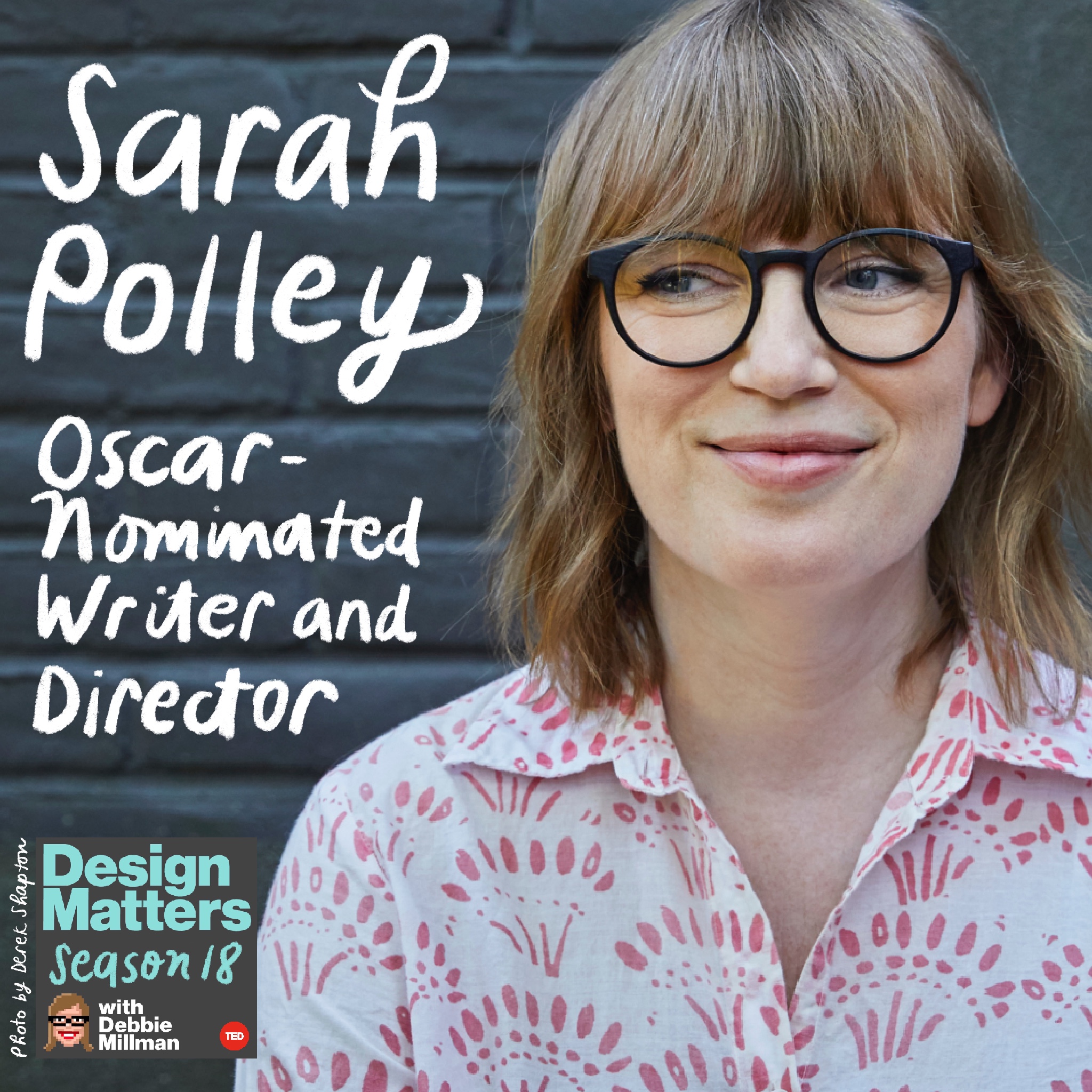
Loading summary
Transcript116 lines
- [00:01]
Debbie Millman
TED Audio Collective.
- [00:08]
Progressive Insurance Ad
This episode is brought to you by Progressive Insurance. Do you ever find yourself playing the budgeting game? Well, with the name your price tool from Progressive, you can find options that fit your budget and potentially lower your bills. Try it@progressive.com Progressive Casualty Insurance Company and affiliates Price and coverage match limited by state law. Not available in all states.
- [00:29]
Sarah Polley
Spark something Uncommon this Holiday with just the right gift from Uncommon Goods. The busy holiday season is upon us and Uncommon Goods makes it less stressful with incredible handpicked gifts for everyone on your list. All in one spot. Gifts that spark joy, wonder, delight and that it's exactly what I wanted feeling. Some of my favorite items that I've discovered on their site include a grilled personal pizza maker, some fabulous garden accessories, and my favorite, a pair of wine glasses personalized with a Maya Angelou quote. When you shop at Uncommon Goods, you're supporting artists and small independent businesses. And with every purchase you make at Uncommon Goods, they give back $1 to a nonprofit partner of your choice. To get 15% off your next gift, go to UncommonGoods.com DesignMatters that's UncommonGoods.com DesignMatterS for 15% off. Don't miss out on this limited time offer. Uncommon Goods we're all out of the Ordinary.
- [01:44]
TED Audio Collective
This archival episode of Design Matters originally dropped in February of 2023.
- [01:50]
Debbie Millman
You know, I really have issues in general in movies with the concept of villains. I think it's a really harmful concept. I don't think we should have them. I think we can have people do terrible, awful things, but I think if we don't seek to understand some part of their humanity, we're just doing all of us a great DennisService.
- [02:08]
TED Audio Collective
From the TED Audio collective, this is Design Matters with Debbie Millman. For 18 years, Debbie Millman has been talking with designers and other creative people about what they do, how they got to be who they are, and what they're thinking about and working on. On this episode, Sarah Pauley talks about her family and her career and about her most recent film.
- [02:31]
Debbie Millman
I found the debate so alive and electric and the premise so hopefully.
- [02:42]
Sarah Polley
One of the contenders for Best Picture and Best Adapted Screenplay at the Oscars this year is Sarah Pauli's latest movie, Women Talking. The movie is intense, closely observed, hopeful and disturbing, and a must watch for anyone interested in complexly beautiful stories. This is Sarah Polly's fourth feature film as a director, and it's now clear that she is in the midst of an extraordinary new chapter of her career, which has also included acting in over 40 films, stage work, producing, writing and directing television, and the writing of an extraordinary memoir. Hopefully we'll be able to get to talk about much of that today. Sarah, Polly, welcome to Design Matters.
- [03:33]
Debbie Millman
Thank you so much for having me.
- [03:36]
Sarah Polley
Sarah, with all of the accomplishments and success that you've had and some of which that I've just listed, is it true that your real ambition is to win at Wimbledon?
- [03:49]
Debbie Millman
I think it was when I was 10 for about five minutes. And someone interviewed me during that five minutes. And what's great is I'd never actually played a tennis game. I'd only like smashed a ball against the garage door. But yeah, I did state in an interview when I was 10 that I wanted to win Wimbledon. I'm the least athletic person you'll ever meet in your life.
- [04:08]
Sarah Polley
I thought that was really charming. And you know, it's so interesting how no matter what we accomplish or no matter what, what we are able to achieve, there's always something else that we have set our sights on. At least that's what I found with so many creative people. Both of your parents were in show business before you were born. Your mom was well known for playing Gloria Beecham on 44 episodes of the television series Street Legal. By the time you were five years old, you had a part as a penniless child in the movie One Magic Christmas. Do you remember wanting to be an actress at such a young, or was it something that your parents encouraged you to do?
- [04:50]
Debbie Millman
It's a really good question and one I've thought a lot about. At one point I was working on a documentary about child actors that I never went through with. And what was really interesting in that research was that I could find almost no child actor who didn't claim it was their idea and that they pushed their way into it and their parents knew better, but they just had this indomitable will that their parents couldn't, you know, contend with. And everyone told that story, including Shirley Temple, who started at 3 and who clearly had a really overbearing stage parent. So that was my story for many, many years. I'm not sure about that story anymore. I will say I don't think my parents were the archetypal terrible stage parents. They weren't ogreish for sure. But I do think, you know, my mom was a casting director and an actor and I think all of my siblings at some point went up for audition. So I have to imagine it was instig by my mom. And I think early on I liked it. And then I Think that sort of quickly changed around 8 or 9.
- [05:53]
Sarah Polley
How does one go about even getting a part in a film at 5 years old? Like, how do you have the sort of presence to audition?
- [06:03]
Debbie Millman
I mean, I think that child actors generally come from the pool of sort of overly precocious children, which is a kind of a dangerous thing because usually with precociousness comes a delay in other, more important. So you become very good at pleasing a room of adults and impressing a room of adults. And I think so much energy goes into that when you're a precocious child that less development and work goes into actually figuring out who you are and what your actual instincts and intuitions are.
- [06:34]
Sarah Polley
You've stated that you grew up trying to fit yourself into characters other people had written. This included Beverly Cleary's iconic character Ramona Quimby on television, Alice from Alice in Wonderland, on stage. You played Sally Salt in Terry Gilliam's movie the Adventures of Baron Munchausen, and became famous starring as Sarah Stanley, the heroine of the television show Road to Avonlea, which was based on the classic beloved books by L.M. montgomery. How do you learn how to embody other characters so thoroughly before you've even sort of figured out who you are?
- [07:20]
Debbie Millman
Yeah, I mean, I think it's complicated and maybe a little bit perilous. I mean, I think playing Ramona was a great thing for me at, you know, 7 and 8, because it was this character who was so alive and honest and not always palatable. She knew who she was. She was incredibly outspoken. She was really assertive. She was so completely herself. She kind of suffered sometimes for her inability to conform, but that was what was wonderful about her. So that was. And so was Sally Salt in that sense, in terms of embodying that character. But, you know, when your identity is still forming, you are very informed by this game of imagination that goes on for months and months in which primarily older men are telling you you're doing a good job or not doing a good job based on being the thing they've constructed for you. It's a really problematic way to grow up, I think, especially as a young woman. So I found that tricky and became more tricky as I became a teenager and sort of into early 20s, just in terms of parsing out what is my identity versus, you know, what am I constructing to please others.
- [08:32]
Sarah Polley
In several of your roles, Sally Salt and Baron Munchausen in particular, you exposed to really, really rough working conditions for a little girl. So much so that you once had to be ambulance to a Hospital. How do you make sense of that now, looking back on it? I know that you've written open letters to Terry Gilliam. I know that you've spoken to your father about how you felt about being put in the line of danger, so to speak. How do you feel about that, looking back on it now and what you went through?
- [09:03]
Debbie Millman
I mean, I guess it's important to sort of preface what I'm gonna say by saying, you know, I think that it's terrible I was put in those positions. And I think that children shouldn't be in unsafe working environments and perhaps shouldn't be in adult working environments, period. I will say that after this years, I've developed a greater appreciation for how difficult it is to stand up to 100 people and stop production. Especially if you're a parent that comes from a background where, you know, where you don't have access to this kind of world. You know, like my parents weren't wealthy. They. My mom was an actor and, you know, at the end of her life, sort of had this small part on a TV show, but really was an aspiring actor and a casting director on Canadian productions. But not in this big, heady world of movie stars and a big budget production. And I do think for most parents it would be very difficult to stand up and shut down a production because you were uncomfortable with something that was happening to your child. I mean, ideally, me as a parent, I would think, you know, hopefully that would come easily, but I think that's actually under playing what a kind of emergency room mentality develops on a film set. And I have seen over and over large groups of adults, many of whom are very good, decent, conscientious people, become complicit in situations that were unsafe or unhealthy for kids or other vulnerable people. I've seen it so many times that I'm reluctant to sort of sit back and judge those people as individuals for not having the courage to stand up. I think I blame more a sort of system that allows it to happen. I think that the people who do have authority, producers, directors, have to take a lot of responsibility and be accountable for conditions that arise on a set. Because I think, you know, I did have crew members over the years in various unsafe working environments I was in as a kid, risk their jobs or lose their jobs in order to protect me. But that was the cost. It was very real. So I think over the years I'm far less angry at the individuals and far more focused on the structures and what are the rules and what are the Protections in place for kids. And, you know, why don't we have a third party child psychologist, for instance, that's not employed by anybody involved in the production or the parents, but is maybe employed by the union to be there to independently have agency to say, this is not okay. This isn't safe. Like, why don't we figure out how to make this better? I mean, I think kids shouldn't work more than a small amount of every year if they're going to work at all. I highly discourage parents from putting their kids into professional environments. But I do think kids will always be in films and television. So what can we do to make it much, much safer and to create roles for people who are there solely to have agency to disrupt a production if it's not going well for a child?
- [11:57]
Sarah Polley
You've written about how you had a mother who made you feel like life and the world were really exciting, but two days after your 11th birthday, she passed away from cancer, yet you still kept working, getting bigger and bigger roles. How did you manage through this?
- [12:18]
Debbie Millman
I mean, it's interesting. I've been thinking about it a lot lately because my oldest is turning 11 tomorrow. And so, you know, suddenly this moment where, you know, the age I was and two days after my birthday that she died, sort of looking at what 11 means is really interesting. Like, it's not quite what I remembered it. And my kid is both more kind of responsible and competent than I remember being, and also vulnerable in a way that I don't remember myself, but I'm sure I was. I think the one thing I've noticed from my own kids is they're sort of built to adapt and they're built to be resilient and to move on to the next thing. And I think that the things that happen to you as a kid really wait until you're an adult to come crashing down on you in so many ways. Because I think we are just sort of built to be moving and changing and growing, and that kind of gets folded into the experience. And I think it. It wasn't really till much later that I recognized how truly difficult it was.
- [13:18]
Sarah Polley
After your mother died, you and your dad were left on your own. By that time, all of your siblings had already moved out. You were the youngest. You've written how your dad, who prided himself on not being a father, effectively fell apart and retreated into a solipsistic funk. So I have two questions about that. It's such a major thing to have read. First, why did he pride himself on not being a Sort of father, you.
- [13:47]
Debbie Millman
Know, he had this kind of untraditional world of way of seeing the world and that permeated everything. So to him it was a point of pride that he wasn't taking on a traditional role of a father. He instead was a friend that he didn't have authority over me. He would never tell me what to do. There were no rules, there were no bedtimes, there was nothing I was not allowed to do. And so that was sort of his thing was I'm not your dad, I'm your friend. Which you know, on the one hand was wonderful. And you know, I shared books with him and long conversations late at night and had this really interesting kind of non judgmental relationship with him or from him. But at the same time there was nobody to catch me either. There was, you know, nobody was going to notice if I didn't come home. So it was a feeling of profound insecurity and lack of safety coupled with this kind of wonderful gift of having a father who really thought I was great. And I think the older I get, the more I realize what a gift that was that to have a parent who truly values your brain and is excited by your mind and thinks you're a really wonderful person. Just at his core, I think he really loved me. And I think as I get older I'm more and more aware of what a gift that was. Now, would I have preferred to have some structure and some safety and some boundaries and some sense of being safe as a kid? Of course. Would I trade that feeling of insecurity for a feeling of security with a parent who didn't make me feel like I was really great when I was a kid. I'm really not sure at this point. Ideally you have both, but yeah, so it was a very complex relationship and certainly, yeah, there's a lot to unpack there.
- [15:35]
Sarah Polley
How bad was his solip cystic funk? Were you actually taking care of him?
- [15:39]
Debbie Millman
To a certain extent, yeah. I mean, I know I would get up and go to work at, you know, 4 or 5am in the morning, often in the dark. And I would have slept in the clothes I was gonna wear the next day. Cause that seemed to make more sense to me than having to get dressed in the morning. I know that no one had done laundry in years in that house.
- [15:57]
Sarah Polley
You went from bed to bed, right? Your siblings, beds with clean sheets till they were dirty and.
- [16:03]
Debbie Millman
Exactly, yeah. And the sort of mess and the mice and the maggots just kind of piled up. I mean that it was really pretty squalid and, you know, I would come home and he'd be. Have watched TV all day and smoking and burning holes in the armrest of the recliner. It was pretty bad. And I think he was genuinely depressed, and I think he may have been autistic and had never been diagnosed and actually did have struggles with kind of communicating or connecting to his own emotional life and communicating that to others. He was very, very isolated. My mother was his entry point and his connection socially and to the world. He was a man of that generation where every physical thing had been taken care of him since the day he was born, all by his mother, and then right into, you know, into his marriage. And so I just think he kind of came apart and didn't even know he had come apart and didn't have the resources to look for help. So I kind of look back on him with a very big degree of, you know, sadness and compassion at this point. And I think it was very painful for him when I moved out because really, there was no one there to take care of me. I didn't want to live. We lived way out in the country, and I wanted to live closer to my school, my friends. And I think he. In his mind, he kind of got abandoned, which, of course, is really complicated and not quite accurate. When I was, you know, 14 and leaving, and he wasn't taking care of me, but. But in his reality, that was the truth and I think must have been extremely painful for him. I stayed close to him until he died, but, yeah, I mean, I kind of look back and go, I so wish he'd had more support in order to kind of come into himself.
- [17:45]
Sarah Polley
You've written that at 11 years old, there was some part of you that felt you were responsible for your mom's death. Why is that?
- [17:56]
Debbie Millman
I think that's what kids do when things go wrong, or a lot of kids. I think you. You try to figure out the way you're responsible for things or could have altered them. So I think that that took me decades to come to as a sense that somehow this had been my fault. I think that when she was sick, there was a lot of denial about how sick she was, both from her and a lot of people around her. I think that my intuition was that there was something really serious going on. So I would talk about my mom having cancer and dying, even though that's not language that was being used in my house. So I think what happened was that when she died, my sense was I had made up that she was dying. And by making up this lie that she was dying had somehow willed it to happen. And I do think there are incredible mental gymnastics that kids can play again. Watching my own kids in order to sort of twist themselves into being responsible for things they're not responsible for. And there's no one. You know, the thing as a kid too is there's often no one there to check your work. Right. Like unless you're an incredibly commutative kid, you go through 20 stages of a problem and no one's there to sort of correct the 10 strange logical leaps you've made on the way somewhere.
- [19:11]
Sarah Polley
You mentioned leaving home when you were 14, you decided you were grown up enough to go, your dad let you, by 15, you dropped out of high school, you were living with your 19 year old boyfriend. No one called Child, Child Services?
- [19:28]
Debbie Millman
No. It's interesting and it's funny because a lot of people knew it was happening and I think probably if I was to put myself in the position of one of the adults who knew this was happening, I would have sort of looked at it and gone strangely, I think I was in the best case scenario for me at that point. So the 19 year old boyfriend that I had at the time was like a high school dropout. And on paper this is not a good situation for a 15 year old girl, you know, ended up being an incredible caretaker of me and, you know, we still remain very close friends. And when I had this major spinal surgery when I was 15 years old, he was Florence Nightingale. I mean, he cooked for me and he took care of me in a way that almost nobody else I think, could have certainly a better job, I think that my dad would have done at that time. So I think that the adults that did know what was going on didn't intervene because they could see. Even though this was clearly problematic and not perfect, it was probably the best case scenario for me at that moment.
- [20:28]
Sarah Polley
You mentioned surgery. You had been diagnosed with scoliosis four years earlier during a routine insurance medical exam for Road to Avonlea. For our listeners, can you describe exactly what is scoliosis?
- [20:44]
Debbie Millman
Yeah, so it's a curvature of the spine and it's often diagnosed around adolescence and I think majority in girls, although it happens to boys too. And eyes. I had a very severe curvature of my spine, so my spine was in an S shape and it caused one shoulder blade to jut way out and my whole body was pretty lopsided and I was sort of hunched over to one side so that the tips of my fingers touched the side of one of my knees. And I think by the time they operated, it was over. I think it was like 65, 66 degree curve in my upper spine.
- [21:20]
Sarah Polley
Were you in pain?
- [21:22]
Debbie Millman
I was pretty uncomfortable. I would get back spasms. I had to wear a fiberglass brace 16 hours a day. It was really constricting. I don't remember being in a ton of physical pain, but I would say a lot of discomfort.
- [21:36]
Sarah Polley
Because you had that brace on pretty much the entire shoot of Avonlea.
- [21:42]
Debbie Millman
Yeah, they had to sort of design my costumes, but it was very limiting in terms of how I could move. And, you know, as an adolescent girl, it's like, it's already. There's nothing more embarrassing than your body changing and growing in puberty, and then you have this added thing on top of it to be embarrassed about. It's not an easy thing to wear a brace with scoliosis, as any kid who went through that will tell you. But the brace ultimately didn't work, and I had to have the surgery anyway, because once I moved out, I kind of just ditched the brace and there was no one there to stop me. So. Yeah.
- [22:12]
Sarah Polley
The motivation to finally get surgery on your spine is one of the most poignant chapters in your memoir, and I'm wondering if you can talk about that specific decision at that particular time to have the surgery.
- [22:29]
Debbie Millman
Yeah. So I was in a production of Alice through the Looking Glass at the Stratford Festival, and I was 15 years old, and I started to have incredible stage fright. I mean, the kind of stage fright that started around noon. And I would be in a state of panicky sweats for seven hours. I would be in the rehearsal room in the basement of the theater hours before every show, sobbing uncontrollably in terror that I was going to forget a line on stage, that I would humiliate myself on stage. I kept this terror as a complete secret. I didn't confide in a single person, including the many wonderful adults that were around me. The actors in that company were great and would have been incredibly supportive, but I was so ashamed of the fear that I couldn't speak it. And so it kind of grew like a monster. And I had been avoiding seeing an orthopedic surgeon for years since, you know, I had moved out. I had stopped wearing my brace. I knew that my spine was growing completely out of control into this curve. I had a sense I might need surgery, and I had just avoided that because the thing I'd been most terrified of in the world was having this scoliosis surgery. But at some point, the Terror of being on stage, which became a kind of madness. I mean, I actually started to think I was through the Looking glass as Alice and everything was backwards, and I had to run to stay in place. And the whole sort of horrifying narrative of that journey of Alice's through the Looking Glass kind of mapped itself onto this breakdown I was having, and I think unprocessed grief about my mother dying.
- [24:13]
Sarah Polley
I mean, your world was upside down, really.
- [24:15]
Debbie Millman
Yeah, yeah, no, exactly. There were just sort of too many resonances. It was like the whole thing was a metaphor for the. For the life I was living. And this idea of growing bigger and smaller and not knowing whether you were big or small. And there were so many things that were echoes and sort of haunting for me. And so in my kind of addled brain, I kind of realized the only way out of the terror of being on stage is this bigger fear, which is to have the surgery. And if I can tell people that I have to drop out of this play because I'm in agony because of my back, which I wasn't. I was uncomfortable, but I wasn't in agony, then I can get out of this play without having to tell anyone, I'm afraid. So I ended up going to this orthopedic surgeon, and thank God I got this most beautiful doctor who kind of figured out really quickly that, you know, first of all that I did need the surgery, that I genuinely did need the surgery. Secondly, that my claims of agonizing pain were actually referring to something else, which was this crippling anxiety about having to go on stage and that I needed his help in getting out. And without making me say it, yeah, he just sort of said to me, you know, I once had a patient who really needed to stop playing baseball, and he wasn't in that much pain, but he really needed to stop playing baseball. And so he got a note for me so he could stop playing baseball. So would you need a note like that for me? And I said, yeah, I do, because the surgery wasn't urgent. He said, well, I'm going to book you in in a couple of months, and I'm going to give you this note. And he gave me this note, basically saying I had to drop out of the play because of my spine and how much pain I was in, and I got out of the play, and it really saved my life. Like, I really don't know at 15, how out of control I was, but I expect that my life was in danger, like, in terms of what I would have done to get myself out of that play. And I think he saw that and really saved me the trouble of having to tell that story. It was really an amazing moment for me of him stepping in like that.
- [26:19]
Sarah Polley
Yeah. I also wanna point out that it only became utterly unbearable when the show was extended. You know when you got that news, you needed to take action. Cause you were like counting down till the end of the run. It was like 10 shows away. And then it got extended and.
- [26:37]
Debbie Millman
That's right. I was I think 10 shows away from finally being done after 60 shows. That's right. And then they said, we're this extension, we're taking the show to Toronto. And I think that's when I just realized I couldn't possibly add on more to my tally.
- [26:52]
Sarah Polley
During the Gulf War.
- [26:53]
Debbie Millman
Let's.
- [26:54]
Sarah Polley
Yeah. Time to new subject. During the Gulf War, that Happy Time, you wore a peace sign to an American awards ceremony. And at the time Disney had picked up the rights to row to Avonlea for US distribution. And they asked you to change the shirt and you refused. Did that affect future relationship or at the time the relationship they had with Disney?
- [27:19]
Debbie Millman
I mean, I don't know because it's so hard to track it. I know that it was some awards ceremony in Washington, there were a bunch of senators at my table and it was my mom's old big ban the bomb sign, like her peace sign from the 70s or something. And I remember them saying, maybe you should take that off. And then I remember getting a call later from an executive at Disney saying, you know, we're not a political company. You need to like not make political statements. And I was like, well, as a matter of fact, you are quite a political company, sir. You've been quite political. So I don't know, my memory is that I was brought in for a lot of auditions for Disney movies before that point and none afterwards. But I don't necessarily trust my 12 or 13 year old militant activist brain to remember things accurately at that age. But that was my memory. I mean, I remember going around saying, I've been blacklisted by Disney. Which I think was a stretch. But I do know that I did have a confrontational conversation with them about it afterwards.
- [28:14]
Sarah Polley
Well, you then did really become a genuine political activist. You handed out leaflets for the Ontario New Democratic Party. You organized a protest against the provincial Progressive Conservative government. You lost two back teeth in a fight with the police, supported the Ontario Coalition Against Poverty, spoke out against income inequality, and in 1994 even considered studying political science and philosophy at the university at Oxford. At that Point. Did you see your fame as a distraction from what was really important in the world?
- [28:49]
Debbie Millman
I definitely did, yeah. I knew that I wanted to do something political. I thought that had to do with grassroots organizing. That was absolutely my whole life between the ages of, I guess, 16 and 18, and then ongoing after that, although I was acting a little bit again by then. But, yeah, I couldn't for the life of me see a life in film or in the arts. I really wanted to be on the ground. I think, you know, it was getting to see firsthand what regressive policies could do to people's lives. So they hacked away at welfare, they hacked away at healthcare, they hacked away at education. And so I really saw the province I lived in change dramatically in a short space of time. So it felt urgent. And I just think, especially at that time in my life, I just couldn't imagine how you could sleep at night if you weren't doing everything you could to fight this. And so I ended up having this really amazing community of activists that kind of took me in and became my family. And I had an amazing political education, really amazing grassroots direct action organizers, and also a couple of very activist mpps in our provincial parliament who sort of took me on and mentored me. So I dropped out of school and every day I would go to the library and read what I'd been instructed to read, and I'd go and have these amazing conversations with politicians and activists. And I just felt like I was getting the most sort of electric conversation education, but also kind of with boots on the ground.
- [30:18]
Sarah Polley
How did you get your two back teeth knocked out? Who did you have a fight with?
- [30:23]
Debbie Millman
This story, I think, has been exaggerated over the years and probably mostly my fault, mostly my fault as a teenager in my telling of it. So I did get teeth knocked out, that is true in a sort of riot situation. So there was lines of riot cops in front of us. We had broken over the barriers. We got surrounded by police on horseback on one side, and we were up against this phalanx of riot cops in front of us. And then in the sort of melee, I got one tooth, I think was knocked out, was knocked out at the time, and the second one was loosened and came out on the weekend. But here's the thing that I laughed out of that story. They were baby teeth and they were already loose. So I totally feel like I lied, like, even though it's sort of true, exacerbate those teeth were coming out anyway.
- [31:13]
Sarah Polley
But you were already a teenager. What kind of teeth were they? How could they?
- [31:16]
Debbie Millman
No, I. I was late. I was late. Like, I lost my last baby tooth when I was like 19 years old or something. Ridiculous.
- [31:24]
Sarah Polley
Well, I don't know. Being hit enough to knock a tooth out despite, you know, it. It's. It. It sounds pretty, Pretty gruesome.
- [31:33]
Debbie Millman
It was better the way I used to tell it, where I just got like smashed in the face and teeth went flying and blood was everywhere. I miss that story. I miss having no self awareness.
- [31:42]
Sarah Polley
Well, I mean, this is something I want to talk to you about. When we start to talk about the films that you've directed. Sort of this nature of storytelling and truth and memory and perspective. I mean, it's all so subjective, and I think that's what makes it so interesting. But by the time you were 20, you were cast as the lead role in Cameron Crowe's film Almost Famous. At the time, folks were already booking you for the COVID of Vanity Fair. It was clearly a superstar making role. You decided to pull out of the movie. You had the part. You were already on set. You decided to pull out and said that the decision was pure survival.
- [32:30]
Debbie Millman
Yeah.
- [32:31]
Sarah Polley
In what way?
- [32:33]
Debbie Millman
So I think first and foremost, I had a really strong sense that I would not survive being famous generally, that being famous on that level was such a threat to my life as I knew it, and also my identity as I knew it. I think that people who survive that type of fame and still maintain some sense of themselves or some kind of integrity or have their relationship still intact are made up some pretty resilient stuff. I just knew that it wasn't the life I wanted. The idea of a whole bunch of people that I didn't know knowing who I was just sounded kind of like a horror show to me. I think also because my early experiences with fame had not been positive, it wasn't something that I had illusions about. I think also, you know, I was a political activist at that time, so the idea that, you know, that character during the Vietnam War was following around a rock band. I was like, what is she doing? Like, I literally just couldn't connect, if any lane, I was like, girl, get a grip.
- [33:34]
Sarah Polley
She'd be on the street.
- [33:36]
Debbie Millman
Go get it on the street. What are you doing? So I think that I just also had trouble with that and even just being in costume fittings for that role and sort of realizing, oh, we're trying to make this iconic figure for people to be attracted to and for women to want to emulate in some way. And there was something about it that I started to feel Deeply uncomfortable with. And it was a really interesting thing that happened about a. You know, the time the film came out. I remember having this costume fitting where they put that fur coat on me that she wears in the film, actually. And it was sort of like this idea of, how do we make her kind of sexualized? And I remember putting on this pair of, like, pants that I really loved. And they really showed off my hips, which I was really excited about because I was. I'd been a really scrawny kid, and I had these awesome hips that I was really proud of. And I remember the costume designer saying, no, those don't work. And then we kept doing some other stuff, and then I said, can I try those pants on again? And her saying, no, you look dumpy. They make you look dumpy. And I realized that my having hips was a problem in Hollywood. And I just remember in that moment going, oh, if I stay here, I'm going to get an eating disorder, like, right away. And I'm going to start to, like, hate the things I love about my body, which is the fact that it's starting to look kind of womanly and curvy. And it just felt like the beginning of, you know, something really destructive. And I remember trying on that fur coat, and there's this idea of, like, making this character really sexy. And then I remember when the film came out, Naomi Klein phoned me, who was a friend at the time, and she was at a Radiohead concert, and she said, oh, my God. She was like, you're right. I'm seeing a lineup out the door right now of groupies wearing that same fur coat. Wow. And this character had become this kind of, like, iconic thing that these young women had been emulating it. I just was. That was my fear, I think, in playing that part, was that there's something about this that I don't want to be part of making this a model for people, like, I don't think, you know. And again, it's a bit earnest. It's a bit overly earnest, really, when I look back on it. And I'm. Who knows if I'd make the same decision today, But I know that those are my reasons for it. And I do think that I was right, that a better life was waiting for me than being really famous. And, in fact, not doing that film led to me making my very first short film in the sudden time that I had to myself and finding my voice as a writer and director, and that was sort of somehow realizing where I was supposed to land.
- [36:06]
Sarah Polley
You went on to write this about the decision to leave the film. I think those moments where you decide not to do something in the face of nobody understanding that decision are the moments that form you, that carve you out. It will always be a part of who I am, how I did that. Yet you also write that after the decision, before starting to work on your own films, you went into a pretty serious depression. How did you manage in and out of that?
- [36:39]
Debbie Millman
You know, I think it was a hard thing to let that many people down. I let a lot of people down when I dropped out of that role. I mean, that was the role that everybody wanted and people had worked very hard to get me considered for. And I certainly really disappointed Cameron Crowe and, you know, everyone involved in that production, including the producer, Lisa Stewart, who remains a very good friend of mine. And so I think that that ended up being a really sad feeling. And also there's a sense of directionless when this thing that you're supposed to want, you find out you don't. And so if you don't want that, what do you want? I did go into a depression. And somewhere in that depression I came up with this idea for a short film. And I'd never thought of writing and directing films before. I'd wanted to be a writer, but not of films. And I started to make it with some friends and with some old crew members I knew. And through the process of that collaboration, just the intensity and joy of that collaboration, I think I really found the path that I wanted to be on.
- [37:42]
Progressive Insurance Ad
Support for this podcast comes from Odoo. Imagine relying on a dozen different software programs to run your business, none of which are connected, and each one more expensive and more complicated than the last. It can be pretty stressful. Now imagine Odoo. Odoo has all the programs you'll ever need and they're all connected on one platform. Doesn't Odoo sound amazing? Let Odoo harmonize your business with simple, efficient software that can handle everything for a fraction of the price. Sign up today@odoo.com that's o d o o dot com.
- [38:19]
Sarah Polley
You shot your first shorts and then went back to school. You graduated from the Canadian Film Center's directing program and within two years won a Genie award for your short I Shout Love. How did your career as an actress impact your approach to directing?
- [38:37]
Debbie Millman
I think at first it worked against me. I think at first, you know, my experience as an actor actually made me incredib self conscious with actors. So I'd be over talking everything I'd be constantly funneling the direction I was giving through what my own ears would be and if it would throw me off or not. And I was really overthinking it. And, in fact, I strangely think it took me some distancing from myself, from my own experience as an actor, to be able to gain confidence as a director. But I. What I do think I really learned from it that was helpful was, you know, I grew up listening to film crews complaining plane. And I knew what made them really unhappy. I knew what frustrated them. I knew where they felt unacknowledged, unseen, and dismissed. I knew how it felt when people worked hours that were too long, when communication was poor. And so that became a really big driving force for me was to try to create an environment where the working conditions themselves were healthy, which I just feel like isn't enough of a conversation on film sets. Like, the idea that we actually are responsible for creating a working environment, that's healthy.
- [39:46]
Sarah Polley
Eyeshadow Love is about a couple about to break up, and Tessa, the female lead, convinces her boyfriend Bobby to spend one last night together to make a video reenacting the happy moments in their relationship. And this motif of subjective perspective is embedded in your first two featured directorial efforts, Away from her, which out in 2006, and the 2011 film Take this Waltz, both of which garnered awards and accolades. Both films show how feelings of love and longing morph over time. And I realized that the use of time is really embedded in all your films. And I'm wondering, first of all, I'm wondering if you would agree, like, time is almost a character in and of itself as people change and then reckon with those changes almost after the change has occurred.
- [40:47]
Debbie Millman
Thank you. It's also so fun to get to talk about Eyeshadow Love, because no one has seen that movie. Yeah, it's interesting you say that, because what I'm reminded of when you're talking about it is I always end up having this conversation with Luc Montpellier, who's my director of photography on most of my films, about the sun being a character and the movement of the sun being a character. And how do we show that? Because it becomes so important what happens in the course of a day, either in a relationship or in the case of women talking, in the case of this community's conversation. Yeah. And also this idea of different perspectives and looking back at things and people being so sure of their versions of things, especially in relationships, but really everywhere of this idea that we're sort of clinging to a narrative, we are rigid with it. We're immovable with it. We're holding on tight with white knuckles. And it's in direct conflict with somebody else's or everybody else's narrative. And what do we do with that and how do we make sense of it?
- [41:48]
Sarah Polley
Both Julie Christie and Michelle Williams, the female leads in both movies away from her and Take this Waltz, have a complex inner life that in many ways is in direct opposition to how they live outwardly. Do you feel that that's the case with most people? I get the sense that there's an aspect of that in most of your lead characters.
- [42:17]
Debbie Millman
I do think I'm deeply interested in that. I'm deeply interested in how incongruous somebody's life is with the life they're living. And it's been really interesting because on this press tour for women talking, I'm meeting so many people and I'm finding the question I keep asking everyone I meet, whether they're, you know, on the team for a studio or working on another film that's, you know, also on the trail, I always want to know, like, what would you be doing if you weren't doing this? Or what was, what did you want to do that you didn't do? And if you could trade your life right now for anything, what would it be? And there's almost an implosion. When you ask the question of a lot of people, you know, a lot of people have an answer to that question that's both really revealing and often very painful. And you realize, like, most people are not living the life not just that they want to, in terms of being able to get where they want, but are not making decisions on a day to day basis in a way that they feel is true to them.
- [43:20]
Sarah Polley
Right?
- [43:20]
Debbie Millman
Whatever their circumstances are and whatever their limitations are, there's a sense in which, which there is this gap between who we want to be and who we know ourselves to be, or who we know ourselves to be and who we're behaving as. And I just think that's so interesting. I mean, certainly I feel that all the time. And I think, you know, you feel that a lot as a parent. There's always this sort of deep chasm between who you thought you'd be as a parent and who you actually are on a day to day basis. But I think I'm really interested in that space between the life you're living and who you feel you either should be or who you deeply are.
- [43:59]
Sarah Polley
I mean, you did make that decision when you decided to drop out of Almost Famous, which Is sort of an interesting metaphor, just as a title. And then. And then started to direct. I mean, it seems like you did take that stance for yourself, which is one of the most difficult things to do as somebody that teaches a lot of young people, young undergrads, early grads, that they're making the decisions that ultimately impact who they become. Taking that first step, having that courage to live a life that you dream of, is something that most people are deeply afraid of doing.
- [44:46]
Debbie Millman
Yeah. I mean, I think I was so lucky to have any agency at all. When I look back, you know, and I look at so many of the people I knew and friends at the time had no agency at all to change anything if they. If they had wanted to. But, yeah, I do think that those choices that can be unpopular at the time can so deeply inform the rest of our life, I think, in a positive way. And I had it again recently because, yes, I've been writing and directing films, and I love doing it. I think that when I was a child and really consistently throughout my life, what I most wanted to do was write a book. And I hadn't done it, and I'd kind of resigned myself to the fact that my life didn't have space for it. And I think when I turned. Might have been when I turned 40, when I just sort of went, you know, like, so this is just the deal you've made with yourself. You always want to do this thing and you're just not going to do it because there isn't space for it, there isn't time for it. And, well, what if you just decided there was. What if you just did that? And so I think for me, getting to write that book was. Was kind of the biggest thing I've ever done for my younger self and my current self. But just that idea of honoring what it is you would have done if left to your own devices, because I think. Or if you were lucky enough to get to do what you wanted to do if left to your own devices. Because I think although I love making films, it is an extension of the life I had as a child and being a child actor, which wasn't necessarily something that I ran headlong into or chosen. And so the idea of kind of rewinding and going, okay, well, if I had had some choice, I probably wouldn't have gone into film at all. I mean, I think my gut is I would have gone to university, hopefully, and maybe studied politics and literature and I think written books, I would hope. And so to get to go and do that was just felt like really life altering in some essential way.
- [46:33]
Sarah Polley
Well, while we're on the topic of the book, I was going to ask you about this a little bit later in our conversation, but talk about the title. Talk about the title of your book.
- [46:42]
Debbie Millman
Yeah, my book is called Run towards the Danger. And that's a quote from the amazing Dr. Michael Collins @ the University of Pittsburgh Medical center, and he runs a concussion clinic there. And I had a concussion that lasted on and off for three and a half years. I had a giant fire extinguisher fall off a wall onto my head at a community center after I was swimming one day and. And I was in a sort of state of brain fog and headaches and confusion, inability to multitask, certainly not looking good for ever being able to make a film again, having really intense troubles with night light and noise. And it went on, on and off for about three and a half years. And then finally I went to the UPMC Concussion Clinic and I saw Michael Collins. And so much of the advice and up until the point of seeing him had been. And whether it be lie down in a dark room or take naps or listen to your body, you know, some people would say take a walk and do things. But as soon as you feel your symptoms come on, rest, and then don't go back to it till you feel better. His advice was diametrically opposed to this. So his advice was, and I want to be clear before this advice, you know, he also gave me a very specific regimen of both physical exercise and vestibular exercise. And I can't ignore that, because this advice, I think without those. That scaffolding is irresponsible. But with that scaffolding, his advice was, if you remember nothing else from this meeting today, remember this. Run towards the danger. So anything that triggers your symptoms, you need to do more of. Anything that's uncomfortable for you, anything that causes pain, whether it be light or noise or crowded environments or parties or grocery shopping. All of the screen time, all of the things that provokes those symptoms, you've been avoiding them, and it means your brain has become much weaker at handling them. So you actually have to train that back to health by doing all of the things that make you most uncomfortable. So this mantra of run towards the danger became the centerpiece of my recovery, where I had to just run headlong into the things that I've avoided for years in order to protect myself. And the only way I could get better was by doing more of them. So, of course, this was a huge paradigm shift for me in my life and ended up sort of permeating every aspect of it in a really beautiful, life changing way. And I was completely better in six weeks.
- [49:11]
Sarah Polley
It's really incredible. The full title of your book is Run towards the Confrontations with a Body of Memory, which is just such a stunning title. And it includes pieces on your childhood career, obviously the devastating concussion injury and the painstaking recovery. Your own sexual assault by a journalist years earlier and the aftermath. One of the things that I often talk to my students about is the notion of confidence. And they're all very sure that they'll do something that they really want to do when they find the confidence. I've come to realize that that confidence is really just the successful repetition of any endeavor. So the more you do something, the more likely it is you'll get better at it and then develop confidence. You can't just go and get confidence off the shelf. And it seems like running towards the danger is sort of putting yourself in a position to begin to confront the things that you maybe feel are dangerous but ultimately help define who you are.
- [50:26]
Debbie Millman
Yeah. And this notion that you do something alongside your anxiety, like, you don't wait for it to pass. You don't wait for the confidence to come. You don't wait to stop being anxious. You kind of do it at the same time as feeling the anxiety. And I think we have this sort of conversation around anxiety right now. I feel culturally that has to do with overcoming it so that we can do something or solving it so that we can. Can move forward or listening to our body and honoring our anxiety. And I actually kind of feel like. No, no, no. Like it may be your companion. It doesn't mean you don't keep going. You know, you don't wait for it to leave. It may never leave, but I think you're right. Like, I. I do think that. I think Callie Curry said this once, the. The writer of Thelma and Louise, where she said to a bunch of young writers and directors, the only difference between the people you respect and you is they're doing it anyway. Like they're terrified and have all the same doubts. They're just doing it anyway.
- [51:20]
Sarah Polley
Yeah. You talk about that in actually the essay about yout Stage Fright when you were younger and how you were so interested in how Barbra Streisand had been able to manage, how it took her 30 years to get over the stage fright to begin performing again because she forgot the words to a song that she was performing live in Central park when she was, you Know, practically a teenager. And then how she managed to move through that, I don't know that you ever get over things like that. You just have to live with them and act as if it's okay to do it anyway.
- [51:54]
Debbie Millman
Yeah. And it's interesting how these things come and go, because I found recently I've had to be on stage so much in the last six months of traveling with women, talking and make speeches and be on stage. Like, I feel like sometimes four and five times a week. And I'm just suddenly not afraid of being on stage anymore. I mean, this has plagued me my whole life, and suddenly it's just gone. I literally just sit there and wait for it. Almost like I'm lonely for it, for the anxiety to come before I go on stage. I'm waiting for my buddy Terror, and he just doesn't show up anymore. And it's. It's just that I just think I've done it so much that it exhausted me. And so it's funny because, you know, so much of the advice around anxiety is to sort of move away from the triggers. And that must be appropriate in some situations when things are really acute or where there's some kind of ptsd. In my case, I find not moving away from those triggers, but actually doing more of the thing that I'm finding difficult has been key. And it came directly from that concussion recovery of let's find more triggers like let's make a game of this and let's do it.
- [53:00]
Sarah Polley
In Take this Waltz, Michelle Williams has. The character that Michelle Williams plays so beautifully, has quirks that she only shows her husband. She likes baby talk. They also have a really unique way of articulating their love for each other with sort of these profoundly violent almost insults. And it's heartbreaking when she tries to reenact this way of communicating with the man she leaves her husband for. And I'm wondering if you think that we all sort of show up as the same person over and over again in our relationship.
- [53:39]
Debbie Millman
I think yes and no. I have a friend who always says, we find someone who will take us, and then we reveal ourselves, which I love, because I do think at the beginning of the relationship, I think what people fall in love with isn't just the other person, but the promise of being someone else than someone better ourselves. And then I think so much of when people feel they've fallen out of love has to do with. With the. You know, often, not always, is to do with this sort of sinking realization that you are still yourself, that you haven't been fundamentally altered. So it's also falling in love with an image of yourself. I think that is true, but I also do think that for me, anyway, you know, there have been relationships in which I have felt the support to grow and evolve and be the best version of myself. And I would say specifically the relationship I'm in now, which I had not been in for very long when I made Take this Waltz. So I think that it's not like I think all relationships are created equal and it's just us, no matter where we go. I do think there's, you know, people give us the space and the room to grow and some others don't. But I do think it is a crushing moment when you realize that the parts that you don't like about yourself have followed you into a relationship you thought was going to solve that.
- [55:04]
Sarah Polley
Michelle Williams character feels very dependent on who she's in love with. And at the end, it's a little bit ambiguous. She goes back to reenact a happy moment with the man she left her husband with by herself and goes on an amusement park ride that was particularly magical. And you play the same song. The song by the Buggles video killed the radio star. And it's a little bit ambiguous. I wasn't sure if she was finally content being on her own or if she was just longing for the past. And given my opportunity to ask you about it firsthand, I figured I couldn't pass up the opportunity for this. Spoiler.
- [55:50]
Debbie Millman
Sure. I mean, it's funny because I saw this debate online about this moment recently between people who thought one thing and someone else who thought she was just really happy in her new relationship, and this person was sort of being taken down by these other people. And when I. So I rewatched it because I was trying to remember what I intended. And I think that there's everything in that moment. So she's writing the Scrambler, and I think what we see across her face is sadness and emptiness and a sense of being alone and resignation to that and. And joy at discovering that she can live with that and an ability to suddenly be present in the moment of this beautiful experience while knowing it's not going to solve anything for very long. And I think in my mind, in that moment, what she's really experiencing is the reality of impermanence. You know, I think the whole film for me was really inspired by Buddhist philosophy and people like Pama Chodron, who talk so much about, you know, there being a gap in life and this idea of emptiness and so I liked the idea of we see a character at the beginning of a film, and there's a feeling of emptiness. And so she completely rearranges her entire life and starts a new life in order to fill that emptiness and ends up where she began, with emptiness, because it is part of the reality of life. So in my mind at the end, and there is a profound sadness that she hasn't been able to solve that emptiness, but also a communion with it, an acceptance of it, and moments of passing delight, which I think is what she realizes she can hope for in this life.
- [57:30]
Sarah Polley
I love that views of shared reality are reflected again in your remarkable 2012 documentary stories we Tell, where you challenge the idea that any one narrative can accurately portray and reflect reality. And this came with your sort of shocking news that your family wasn't quite what you thought it was. And I was wondering if you can talk a little bit about the plot of the film of this documentary.
- [58:03]
Debbie Millman
Sure. So I found out when I was 27 years old that the man who raised me, my dad, who I've been talking about, was not my biological father, and that my had had an affair with a man named Harry Galkin in Montreal in 1978. And they had conceived me. And I was raised as part of my family, with my siblings not knowing this. There had always been rumors that I was the child of some actor in some play maybe, but it was really. It was kind of a joke. It never was really serious. I mean, what was interesting was that after this happened, there was this revelation, and my dad found out, my siblings found out. I would start to hear people tell the story to others. And the stories that we were telling bore very little relation to each other, even down to the details of how I found out my biological father was my biological father. Like everything had been shifted or changed or details were missing or added. In many ways, I felt, in order to help fit into the context of the narrative that that particular person in our family had about our family. So I became really interested in the idea of capturing all of the competing and conflicting and sometimes complementary narratives about the same event in a family and this idea of a story told not by one voice, but by a chorus of voices. So I was just interested in looking at all the different ways we fictionalize and shift and change the details of our narratives, not willfully and not intentionally, but out of some sense that there is a narrative we are somewhat attached to. There's a story, there's a meaning we're attached to that everything must kind of slot into. And the way we do this unconsciously, it just got its kind of talons into me. And I got so excited about the idea of capturing my dad's version, capturing Harry's version, capturing all of my siblings version, and having them tell the story in these conflicting ways.
- [60:02]
Sarah Polley
What did making that movie help you understand about the nature of truth and memory, whether it be unreal, others versions, or your own?
- [60:11]
Debbie Millman
I mean, it's a good question. I think I became less dogmatic about truth and more interested in what people need emotionally to survive. People were telling the stories that had meaning to them, and sometimes they weren't right, but it didn't make it not okay from my point of view, for them to live alongside that story that they were telling. It was a lot of, I think, staying out of the way. I think one of the things that I loved about the process was I had to sit with each of my family members and really listen. And, you know, when you're making a documentary, a really great tip I got from another documentary filmmaker was, you know, when someone finishes answering a question, don't jump in with your next question because it's entirely possible they'll want to fill that space. And in that space, what they might give you is far more potent and unintentional than what their constructed answer might be. And how often do we do that with our family? If they tell a version of events we don't agree with, right, we jump in, we correct, we argue, or we say, actually, I remember it this way, but actually have to listen and to hear people go to the end of a story and leave those silences and let it be their version and not impose my own. You learn a tremendous amount that you've missed about how people think and feel and who they really are. And I think there's so much about our families where they have remained strangers to us in a way that so many others wouldn't, because we're imposing layers and layers of years and years of small interactions that build into one kind of monolithic narrative that we then ride like a bull, you know, like around that relationship. And so to sort of have this very delicate space of listening and finding out where you've just been entirely wrong is really interesting. I actually had a really interesting experience with a family member recently, which, you know, for me, like, shone a light on this whole experience where I talked to a family member recently about something that was happening to me that was kind of exciting. And then I was sort of inviting them to come stay at my cottage and they were Sort of giving me responses that I'm used to over the years of, aha. And in my mind, I knew exactly what was going on in this person's head. What was going on in this person's head was, you know, why do I have to hear about this great thing that's happening to you? Like, I don't care. And, you know, yeah, yeah, sure, I'd love to come to the cottage. This person was never going to come to the cottage. And they were sort of humoring me, and I could just feel the cynicism and the judgment dripping. It's someone I actually have a very good relationship with, but I know that there's parts of me that irritate them. And. And these were present in the conversation. And then the most astonishing thing happened. They hung up the phone, but they didn't hang up. And I was just about to hang up, and I realized they hadn't hung up. And I suddenly heard them call out to someone else in their household and say, I just talked to Sarah. And I thought, oh, God, like, I'm going to hear all the criticism that I've always known is there, but they've never set out loud, like, this isn't an openly critical person. And what they did was they conveyed to this person how excited they were for me about this thing that had happened to me and how excited they were to come that summer to my cottage. And it was so palpable, the joy in their voice and the pride and the excitement about seeing me. And I realized that I had for my entire life been reading a narrative into this person's tone of voice and gesture year that did not exist. And it was so horrifying. I'm not somebody who's constantly, like, reading in negative things to the people I know, but this was just something I knew from probably 800,000 misunderstandings built up over decades, I had created a narrative that wasn't true. And the only way I would have ever known that would be to have been able to hear this thing I wasn't supposed to hear after a phone call they hadn't hung up on properly. And so for me, that's actually sort of, in many ways what stories we tell is about. But it was an amazing moment for me to realize I'm still doing it. I'm still mapping and projecting stories about relationships onto people that aren't real. And we all do that every day in ways we don't get to have the big reveal that we were wrong.
- [64:33]
Sarah Polley
Yeah. How did the realization about who fathered you Biologically impact how you felt about your mother and your father.
- [64:49]
Debbie Millman
I mean, I think at first I felt tremendously guilty for finding it out. And it actually took a close friend of mine, after months of just feeling terribly guilty for finding this out, to say, do you understand that by finding out this information, you didn't cause anything to, like, you didn't actually make this happen? You're not responsible for your mother affair. This. This isn't something that you did or that you're responsible for that is in any way bad. And I didn't know that. I thought by finding the. Really the information out that I had somehow hurt my father. I didn't tell my dad for a long time. I actually didn't tell him until a journalist threatened to print the story who had heard it from somebody else. And so that. That was actually the impetus for telling my dad in the first place. I think with my mom, I mean, oh, my God. My mom was one of that generation of women who was expected to do all of the housework, all of the cooking and cleaning, all of the childcare, and provide half of the income to the family. So she worked crazy hours in a profession that was incredibly dismissive and horrible to women. She had absolutely no support at home. We didn't have help in anything. So she's sort of running around vacuuming and cleaning and dusting and trying to get meals on the table and doing all the grocery shopping because my dad also didn't drive. She's waiting hand on foot on kids and a husband. And I just think any joy that that woman got in her life, I feel no judgment for. So if she went away and did a play for a couple of months in Montreal and got to kind of feel herself and have joy and not have to be responsible for everybody in the world for five seconds, I find that really, really hard to judge. I'm a big fan of monogamy in my own life. I live a very different life than my mother did, with a lot more freedom and agency and support and like an equal partner in everything. So I just think it's like I can't find it in my heart to judge her on any kind of moral grounds, that she had a beautiful affair and kept that for herself. I think that many people would have just snapped and not been able to care for their kids with that kind of pressure. And if this was what helped her get through, good for her. And she lived a short life. My oldest brother always says that. He always says, you know, she only lived till she was 53. And I'm so glad she had some fun while she was here.
- [67:20]
Sarah Polley
Your voice is mostly in the background of stories we tell. And in many ways it feels like your father Michael's film as he does most of the narration. Can you talk about that decision?
- [67:30]
Debbie Millman
Yeah, sure. So I really fell in love with my dad's voice in this film. And I think in part because. Because when I first, you know, the revelations first came out, people were saying, you know, you should make a film. It's so interesting. And I thought, it's not, though. I mean, I've seen the movie before of someone finding their biological father, and it's very interesting in my life. But that to me, isn't a cinematic experience or particularly original. But what was interesting was my dad's response, which was one of absolutely no judgment towards my mom. In a way, all of his failings as a father suddenly disappeared. And he suddenly was this person who was incredibly concerned with taking care of people. He was deeply upset that my mother had felt that she had had to keep this secret and carried that with her until the end of her life and that she couldn't have relied on him to sort of understand and be okay with it. He was worried about me taking on any kind of guilt about it. He was excited for me to get to know my biological family. He was just extremely magnanimous and did a lot of self reflection about ways in which he had not supported her or been an equal partner. And it was just an extraordinary thing to see him do. So that became interesting to me. And then the difference between his version and Harry's version and my siblings versions became deeply interesting to me. And the way we were clearly kind of fabricating or making things up about the story to suit whatever overall narrative we had about our lives was really interesting. So I became much more interested in other people's voices than my own. My version of that story actually isn't in the film, and who knows if I'll ever even tell. It's very different from all the versions that are in the movie. And what was interesting is I think that suited everybody just fine because, you know, then I wrote my book, which is really just my version, which was a lot trickier, I think, for people, because suddenly it wasn't, okay, I'm giving this narrative to everybody except myself. It's like, this is my story. And that's a lot harder for people to stomach, I think.
- [69:27]
Sarah Polley
Yeah. What was so interesting to me, I saw the movie before I read Run towards the Danger and the Michael in the movie and the Michael in Run towards the Danger almost felt like two different people. I was also astounded by his sort of magnanimous response to your mother's relationship with Harry and your subsequent birth. I mean, he was very willing to take on the responsibility of that need and her because of his own lack of participation in the marriage at times. But the Michael in Run towards the Danger was far more complex and tricky to like.
- [70:15]
Debbie Millman
And I think we all probably are that way, right? I think probably all of us could have a story written about us in which we do seem magnanimous and almost heroic, and we could have a story written about us that would make us seem monstrous. Or maybe I don't think my dad seems monstrous, but, you know, that focused on our failings. And I think we are many things. And my dad was certainly many things. He was this incredibly tolerant, philosophical, unjudgmental, progressive, beautiful person, like a brilliant writer, able to take responsibility for his part in what happened in his marriage that led to this affair. And he was also someone who was deeply negligent of a child and, you know, crossed a lot of boundaries he shouldn't have and let me down. And so, you know, I think at various points, he let me down terribly, and he really did come through in this moment. So because the film is about that moment, I let him shine as brightly as he did in that moment. I don't think I would have written the more difficult stories about my dad when he was alive. I can't imagine wanting him to be exposed in that way before his death. You know, it doesn't affect him now, and it does affect me deeply to be able to tell the truth of my life and to not have to be protecting him anymore, I think is really important for me. But I also, weirdly, don't think he'd argue with any of it. I mean, one of his only big criticism of stories we tell was, you know, you've made me look like a saint and I'm not. You know, we all know I really let you down in so many. And this is a fiction. I was like, well, the movie is sort of about many versions, and this is one version of you. And it is true, actually, that you are this great in this moment. But I don't know how much he would argue with the portrait painted in Run towards the Danger. I think that I would be more concerned about telling that story when he was alive because I don't think he would be prepared for other people's reactions.
- [72:13]
Sarah Polley
To it at the end of the film. Michael narrates the following. And I'm gonna read this verbatim because I like it so, so much. And there is a fly buzzing around me as I write. It will buzz around looking for food, and one sustained it may seek a mate. It will never know why. It's just simply been sentenced to follow the demands of millions of ancestors. For that fly, the word why does not exist. I will go on. I will go on. I felt that to be one of the most beautiful yet heartbreaking parts of the film. And I'm wondering, do you have the same response that. I mean, can you talk about what that meant to you? That little snippet?
- [72:59]
Debbie Millman
Yeah. I mean, I think my dad was someone who really was comfortable with the kind of chaos and absurdity of life and the not knowing and. And the meaningless. For him, I think life was kind of meaningless. And yet that didn't bother him. You know, it was part of its beauty is that we're just here for a minute. And I think he was also someone who just delighted in small things like a beautiful cup of tea and a book. And he didn't need a lot to be happy. And so, you know, a lot of the film, he's looking at this fly and imagining its thoughts and something like that would give my dad pleasure for weeks, you know, like he was able to just kind of hone in on something philosophically and live there and need very little else. And he was a beautiful person to spend time with for that reason, you know, it was a beautiful brain to get to be inside. And it's funny because for all of the problems with him as a parent, as a kid, he was one of the people I most liked spending time with as an adult. I think so much for his capacity to just get lost in the joy of a thought or a concept and his excitement about being lost in his mind.
- [74:18]
Sarah Polley
Your latest directorial effort, the film Women Talking, is out now. It's nominated for two Academy Awards, one for best Adapted Screenplay for the screenplay that you wrote, and one for Best Picture of the Year. It's up against films like Avatar and Elves, Elvis and Top Gun. Congratulations on this remarkable showing. The film is based on the novel of the same name by Marion Toews, and it's about a group of Mennonite women in Bolivia who are trying to figure out what to do after discovering that men in their community have been using a cow tranquilizer to knock them out and rape them. The victims include a four year old baby, as well as women of all ages, including women that are Elderly. What attracted you to this story?
- [75:18]
Debbie Millman
So I think that I was so drawn to this idea of this conversation that this group of women have, this group of women in this community who are basically elected to. To decide whether they are going to stay and fight or if they're going to leave or if they're going to stay and forgive the men and do nothing. And these women come together, many of whom don't agree with each other on this fundamental question, and they have to sit together and come to some kind of consensus. And it was this incredible act of radical democracy, of what democracy should actually look like if we're forced to contend with each other and each other's very uncomfortable positions and beliefs and have to find a way forward. I found the debate so alive and electric and the premise so hopeful. Having to figure out what is the way forward. Not just reckoning with the harms that have happened, which is something they also have to do and find language for, but also what's next. And there's a pivotal moment where only Rooney Mara's character says, you know, perhaps it would be useful to think not only what it is we want to destroy, but also what we want to build. And I think that in this conversation about not just gender based violence, but systemic injustice and looking at inequity and this idea of looking forward and looking for what's next just felt to me like water in the desert.
- [76:48]
Sarah Polley
I understand that the visual language of the film was inspired by the first serious piece of art that you bought over 20 years ago by the Canadian photographer Larry Towell. Can you talk about how it influenced the film?
- [77:02]
Debbie Millman
Yeah. So I was obsessed with this series of photographs for so long. And it's a book you can get called the Mennonites by Larry Towell. They're these incredible, very respectful, compassionate, beautiful photographs of Mennonites living in very conservative, traditional colonies. And I've had a lot of interactions with Mennonite colonies over the years in a certain area of Ontario that I. That I went to a lot. So I have Mennonite friends. It's a faith and a culture that I've always been deeply interested in, especially the focus on the collective and the lack of individualism and the lack of materialism. And there's just been a lot that I think I've learned from those communities. And so these photographs were really important to me. And so a lot of the imagery in the film was inspired by Larry's photos. And there's a general tone of respect that I really wanted to emulate too. We're telling a really horrific story about something that did happen in a Mennonite colony, at least the background events did in Bolivia in the early 2000s. And because we were telling such a difficult story, it was really important for me to focus on also the beautiful aspects of this culture. And to have that be part of the package as well.
- [78:21]
Sarah Polley
In your film, the characters articulate the broad range of responses to trauma, anger, resignation, collapse, silence, and explore how some victims of abuse judge others for having different responses than their own or for falling apart in the ways that they feel, feel they haven't been allowed to for themselves. And this is something that my wife also explores in her book not that Bad Essays on Rape Culture. And it breaks my heart that women not only judge the trauma response of others, but also the trauma response of themselves, as if there's some sort of prescribed way to grieve or to suffer. And I thought that the way in which you portrayed the various responses to be very empathetic.
- [79:12]
Debbie Millman
Thank you. And, of course, Roxanne's work has been a huge influence on me and certainly was very present in my mind as I was making this film. What I loved about Miriam's book and what I tried to sort of translate to the screen was this idea that there's not one valid response. That there's this myriad of responses to this violence that range from anger to sadness to paralysis to equanimity to fury, to, you know, a sense of just desperately wanting to maintain the status quo, of not wanting to confront, of wanting to confront, and that all of these would be understood equally. So one of the things that was most important to me in my process was taking the time to write a draft from each character's point of view as though they were the only important character in the room. And I did that twice just to make sure that I am really feeling this story through their eyes. So whether it's a character that I feel connected to or not, by the end of that process, I had to understand and empathize with every moment of what they said and did through only their eyes. One of the things I love about, for instance, Sidney Lumet's movies is, I think what you can sense with his movies is that he just loves all his characters. So even if their behavior is, you know, really hard to understand or maybe even offensive, he has clearly taken the time to not judge them and to understand them. And so that, for me, I mean, I've never heard him talk about that, but that's what I get from his films. And so that sort of became endemic for me, this idea that I'm going to love all of these characters equally. I'm gonna love what they do, I'm gonna love what they say, even if it's not productive, even if it's destructive. I'm gonna understand it through their point of view, not mine own. Because I do think, you know, this idea of the perfect victim has been so damaging to so many of us who've gone through this. Both exactly in terms of, you know, other people's judgments of us, but also our judgments of ourselves and how self critical we can be about not responding the way we think we should have.
- [81:17]
Sarah Polley
Yeah, I mean, think back when you were a little girl, you know, thinking you were responsible for your mother's death. Of course we think we're responsible for, for anything bad that might happen to us because sort of, that's sort of the way we're raised now. I wanna talk to you about Frances McDormand's character because you do want to love her. I mean, just what you said about writing the film from even her perspective and this little bit of a spoiler alert here, so cover your ears if you haven't seen the film. Frances McDormand chooses not to go with the rest of the women. Why?
- [81:51]
Debbie Millman
Yeah, and it's interesting. So we changed this actually from even how we shot it. So originally her character, who is on the site of Stay and do nothing and forgive the men, they end up. She and her family end up not being in the halo for the conversation because they think it's against God to even have the conversation. And the way the film used towards the end was her character is actually running to a buggy to go to the city to alert the men and salon. Claire Foy's character, who's actually had to use the cow tranquil again, plug your ears if you haven't seen the film, but has to tranquilize her son in order to take him with them, which is actually breaking a lot of rules that they've set out for themselves in terms of being pacifists about this. Also in this original version, they had used the cow tranquilizer on Frances McDormand's character, stopped her from going to the city to tell the men. And so her sort of agency was taken away in that moment. And what we changed it to is we didn't have Claire go on this kind of spree. It was just very specifically to bring her son with her. And it was very late in the editing process. We were almost finished the movie. And we suddenly realized we had this shot of Frances watching the Hay Loft from way earlier in the movie. And we just got really interested in the idea of what does it look like to actually sit on her face as though she's watching the wagons go off and the buggies go off and she's not part of it. And what I loved about what that did is I think that it did make you feel more for her in that moment. So it wasn't just this enemy they'd had to defeat to go off. And. You know, I really have issues in general in movies with the concept of villains. I think it's a really harmful concept. I don't think we should have. I think we can have people do terrible, awful things, but I think if we don't seek to understand some part of their humanity, we're just doing all of us a great disservice. And I think what we had done is we've made her too much of a villain. And I think in choosing that moment of her looking off and just trying to read her face as she sees her whole community leave without her, as she tries to maintain this kind of religious order in her mind, that is going to be so harmful to. I think it got us one step closer to empathizing with her in some way. And I think because that side is not that well represented in the film, the stay and do nothing people aren't that well represented because they've actually lost the vote before the film even starts. It was really important to have the best actors possible to play those parts. People we could love in an instant or at least wonder about in an instant because we weren't gonna get to spend much time with.
- [84:30]
Sarah Polley
Yeah. I mean, Frances McDormand's face in that shot is. It actually reminds me a little bit of the amount of emotion conveyed in living in that space that Michelle Williams has at the end of Take this Waltz. It's just so much of the sort of human dilemma right there. Like, that's what we contend with as we live.
- [84:55]
Debbie Millman
Yeah. Yeah.
- [84:56]
Sarah Polley
One of the things that I found really interesting was how you stated that you were more interested in exploring the culpability of systems that allow violence against women to happen than in judging individual men. And I thought that Ona's sort of decision to bring her son was a really hopeful sign that there could be a different way of behaving and there could be a different way of thinking about entitlement and agency. And I kind of loved that she went to that effort to bring him along.
- [85:37]
Debbie Millman
I am a tremendously hopeful person, and I have not always been. And I would say that's something that's really developed in the last few years. And part of that has been the unwritten and most useful articles and essays of the MeToo movement that will never be written, I don't think, were the private conversations that a lot of men were having with themselves, some of which I got to hear. So I got this kind of amazing window through a couple of people I knew into what it felt like to sort of reframe things, have language for things, realize things that it felt like coming on to someone was actually the way you were doing it had actually felt like harassment and oppressive, realizing that something had crossed a line with something that you had interpreted a different way. I think that there were people who had a lot of sleepless nights thinking about what they had done, not because they were scared of being caught, but because they realized they had created harm. And we'll never get to read those essays, sadly. So I don't think anyone's going to be brave enough to write them. But I think they happen. I think they happen more than we know. And I did see a transformation in a few people. I mean, not everybody, and God knows a lot of people just ended up running scared and being terrified they were going to get caught and did everything to protect themselves. So it's not all like roses. But I do think that we are capable of looking at ourselves and of some kind of accountability. And I do think that it's possible to learn different roles for ourselves and have different expectations for others in terms of what the expectations are in terms of gender. I just think that we're capable of great change. I've seen it enough in my life that I believe it. And I'm not coming from a place of being totally naive either. I mean, I've obviously experienced great harm as well, but I just feel, like, incredibly hopeful based on what I've seen in my life, that there is a chance for transformation and change, at least.
- [87:41]
Sarah Polley
Women Talking is a remarkable film. And I know a lot of people that are gonna be rooting for you on Oscar night. So our fingers and toes are crossed. I have one last question for you, and it's about politics. I read that you sometimes consider dedicating more time to politics, and for some reason, age 57 is planted in your brain as the. You'll make a more concerted move in that direction, and I'm wondering if you.
- [88:08]
Debbie Millman
Still feel that way. So 57 is the time, is the age I'll be when My youngest is 18, which I think because I have friends who are in politics who have little kids. And it just looks so hard. And I think it's so important for people with young kids to be in politics. And so I don't want to sort of knock that. I think it's amazing. I just know that I don't think I would have the energy for it. I do think about it a lot. I don't know. I think I used to think maybe I was interested in some kind of elected role, not leadership, but maybe some kind of role as an MPP in Ontario. I think now I'm not certain how well I would do with the willful misrepresentation of things that I said or the actual malice that comes at you on a daily basis. Just the tiny whispers, you know, I've experienced of that. You know, I really get through the day and through my life dependent on my very steadfast belief that people are intrinsically good no matter what their behavior tells us, that deep down, we're really good. And I think many moments in a politician's life, I think, would challenge that so intensely that it might really be hard on me psychically. So I'm not sure if it would be such a public role, but I do feel like over the course of my life generally and before 57, I would like to be dedicating a substantial amount of time to things I believe in. And here it would be the fight to preserve universal public healthcare and a massive reinvestment in education and in public schools and homelessness, which is increasingly an issue here.
- [89:47]
Sarah Polley
Sarah Polly, thank you so much for making so much work that matters. And thank you so much for joining me today on Design Matters.
- [89:57]
Debbie Millman
Thank you so much. This podcast means so much to me and I listen to it so regularly. And I'm astonished that I'm here and getting to talk to you. So thank you so much for having me.
- [90:08]
Sarah Polley
Thank you. I am astonished as well, and so grateful. Sarah Polly's most recent film is Women Talking. It is nominated for two Academy Awards. Good luck with both. We are all so hoping you win.
- [90:20]
Debbie Millman
Thank you.
- [90:21]
Sarah Polley
This is the 18th year we've been podcasting Design Matters, and I'd like to thank you for listening. And remember, we can talk about making a difference. We can make a difference, or we can do both. I'm Debbie Melman. I look forward to talking with you again soon.
- [90:36]
TED Audio Collective
Design Matters is produced for the TED Audio Collective by Curtis Fox Productions. The interviews are usually recorded at the Masters in branding program at the School of Visual Arts in New York City. The first, first and longest running branding program in the world. The editor in chief of Design Matters Media is Emily Wilet.