Loading summary
Transcript105 lines
- [00:01]
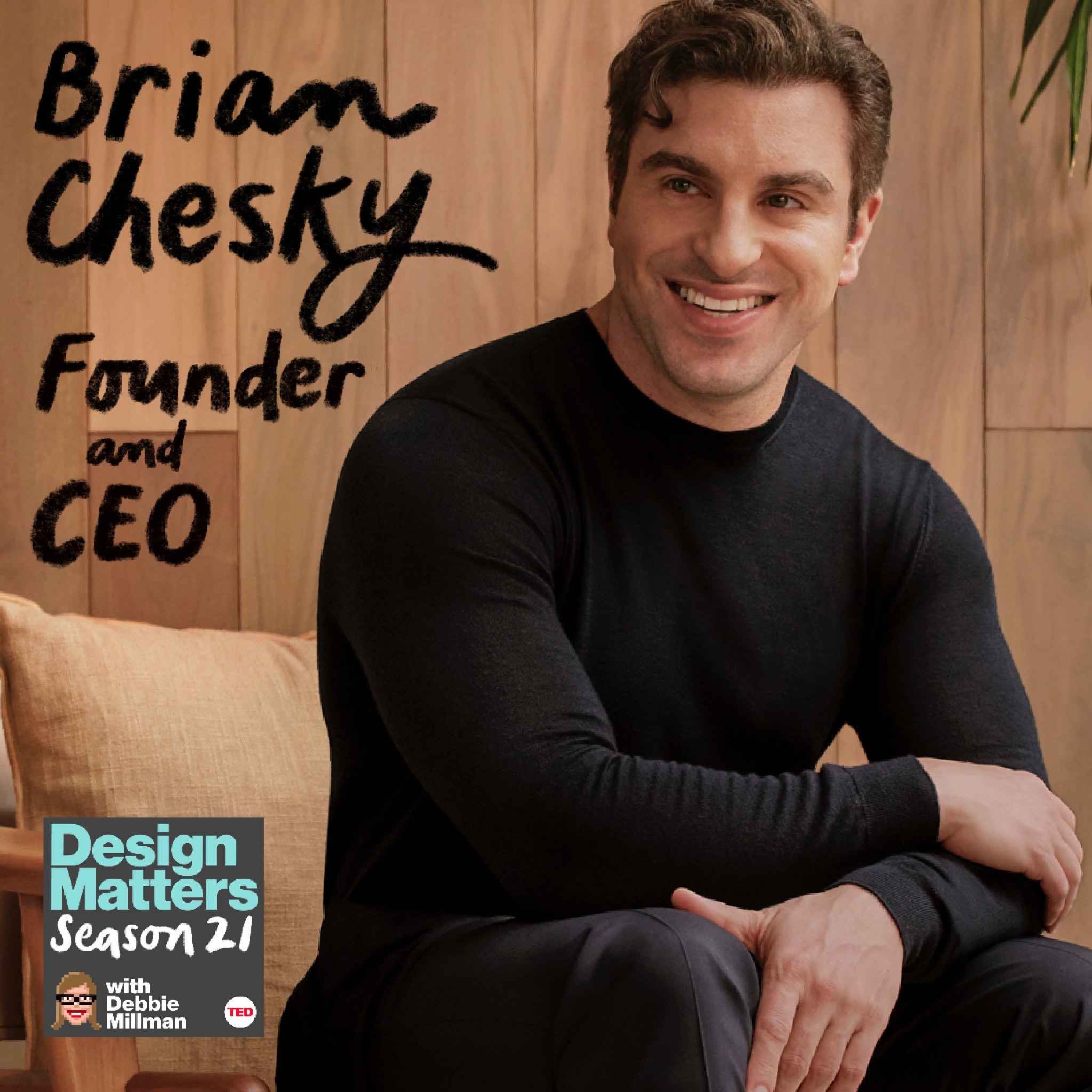
Brian Chesky
Artists aren't just and designers aren't just communicators. We can actually be change agents. We can actually build things. We can create things, we can run things. We can be in charge of things. From the Chad Audio Collective, this is Design Matters with Debbie Millman. On Design Matters, Debbie talks with some of the most creative people in the world about what they do, how they got to be who they are, and what they're thinking about and working on. On this episode, a convers with Airbnb co founder Brian Chesky about art, design, entrepreneurship and change. The world can be our canvas. Our Canvas isn't necessarily 18 by 24 inches. It can be the whole world.
- [00:50]
Debbie Millman
This episode is supported by Harvard Business School Executive Education.
- [00:54]
Brian Chesky
Their programs create powerful connections for leaders.
- [00:56]
Debbie Millman
Around the world, strengthening both organizations and individuals by deepening existing relationships and fostering new ones.
- [01:04]
Brian Chesky
Participants leave with lifelong friends, new potential business partners, and a powerful globe spanning network of fellow change makers.
- [01:11]
Debbie Millman
Learn more at HBS ME Learn. That's HBS ME Learn. This episode is brought to you by Mint Mobile. Now that the holidays are over, you might be feeling the weight of all that spending. The gifts, the gatherings, the everything. But here's one expense you can actually do something about right now. Your wireless bill. Mint Mobile's end of year sale is still going on, but only until the end of January. 50% off unlimited premium Wireless. You can keep your own phone. Bring your phone number and all your contacts you can. It's seamless. This January, quit overspending on Wireless with 50% off unlimited premium Wireless plans start at $15 a month at mintmobile.com design that's mintmobile.com design Limited time offer upfront payment of $45 for three months, $90 for six months or $180 for 12 months. Plan required $15 a month equivalent taxes and fees Extra initial plan term only greater than 50 gigabytes may slow when network is busy Capable device required Availability speed and coverage varies. See mintmobile.com this episode is sponsored by Gilt, your partner in taxes. If you're a business owner, you probably know that tax season shouldn't be just a once a year scramble. Yet for so many of us, that's exactly what it feels like. A flurry of forms, emails and missed opportunities. G is a modern tax planning and strategy solution for you and your business that takes a smarter approach, pairing real CPAs with AI to help you align your tax strategy to how your business grows. With gelt, your dedicated CPA team reviews your strategy every quarter so you can Optimize things like entity elections, retirement contributions, and hidden credits or deductions before it's too late. Tax it's proactive, transparent, and built for growing businesses, from creative studios and design agencies to consultants and independent practitioners. Make taxes part of the business plan. And schedule a call@joingt.com today to learn how your taxes can become a lever for growth. Brian Chesky is someone who has reshaped the world through his imagination. As the co founder and CEO of Airbnb, he helped transform a simple idea, sleeping in a stranger's room on an air mattress, into a global movement grounded in belonging, hospitality, and the hope that people can take care of one another. Trained as an industrial designer at the Rhode Island School of Design, Brian has brought an artist's curiosity to some of the thorniest questions about how we live, how we travel, and how we connect. And in doing so, has changed the possibilities for millions of people around the world. Brian Chesky, welcome to Design Matters.
- [04:36]
Brian Chesky
Well, thank you for having me here.
- [04:38]
Debbie Millman
Brian. Is it true that when you were seven years old, you asked Santa Claus to bring you poorly designed toys so you could redesign them?
- [04:47]
Brian Chesky
Yes, absolutely.
- [04:49]
Debbie Millman
What gave you the sense that that was possible, that Santa would actually do that for you?
- [04:54]
Brian Chesky
Well, I remember just as a kid, I don't know why I would, like, get catalogs of toys or catalogs of sporting goods items or whatever, and I would just, I'd first draw them and trace them, and then I'd redraw them and I'd change them, and I would then want to, like, disassemble things. And so when the time came, I think When I was 5, I got hockey equipment. When I was 6, I think I got, like, a drawing easel. And then by seven, I was like, all right, like, what am I going to design? What am I going to redesign? And I think that was kind of like, where I got it. And I was really fun. Like, I started and even, it was even just things like, like, that were popular. Like, I remember, like, Game Boy and Game Gear came out and video games kids love, like, we're obsessed with those. So I was like, redesigning consoles. Nike Airs or, like, were just coming out. And so I was really getting into footwear and sneaker design. So it was just like, things that were around me and I just kept imagining, like, I don't know. And design kind of came kind of organically because I thought of it as art, like drawing, like copying something and so drawing from observation. And I was drawing products and objects. That was not the only thing I was doing, and then pretty soon I was designing. But I didn't know it was called design back then.
- [06:04]
Debbie Millman
Yeah, I didn't either. I actually thought that most design was just done by printers. I didn't know that it was a discipline.
- [06:10]
Brian Chesky
Yeah. Like, growing up, I don't know if I ever thought of myself as a designer until maybe I went to a school called the Rhode Island School Design. And then it kind of occurred to me, I guess what I do is design. But even then when I applied, I applied as an artist, and I said I went to art school. I didn't say I went to design school. Even it was called the design school. And it was half art, half design, actually mostly two thirds design, probably by student matriculation. So, yeah, it was like something I was, like, so fascinating growing up. I mean, I remember when I was, like, also seven, I went to St. Louis because the first time was an airplane. Our family did a trip to St. Louis. My mom was a social worker, and she had a conference in St. Louis. And my sister, my dad and I went along. And I just had this, like, peculiar thought to, like, want to redesign the city. I just, like, was obsessed with, like, the development of cities and how they were designed and organized. And so only late years later did I realize I was not maybe a typical interest.
- [07:05]
Debbie Millman
You grew up in an upstate New York suburb wedged between Schenectady and the Mohawk River. And as you mentioned, your mom was a social worker. So was your dad.
- [07:16]
Brian Chesky
Yeah.
- [07:16]
Debbie Millman
And much of their time was consumed with finding shelter and care for the community's needy as people. Back then, how did you understand the kind of work they were doing?
- [07:28]
Brian Chesky
They always said that they were there in service to others, to people in need. My mom worked as a social worker in hospitals, first in a, like, kind of general hospital, and then in a women's hospital. Much of my childhood memories were my mom working in a women's hospital. And so, you know, why would a woman need a social worker at a hospital? Well, they were dealing with, like, loss of pregnancy, domestic violence, drug addictions, some combination of being on drugs and having children. It was mostly, like, a lot of challenges and despair and trying to help people through difficult periods. My dad worked for New York state government, and he worked with people that had developmental disabilities. So he chose to work with, you know, developing programs for them. So my mom worked with women that were essentially victims or something, you know, quite tragic had happened to them. Hence they needed a social worker. And my dad worked with people with disabilities. And I remember my dad always, like, rooted for the underdog. Like, if we ever went to a. My dad was obsessed with sports. If we went to a sports game, he would, like. He would always root for the underdog. He hated the Yankees.
- [08:33]
Debbie Millman
Why? Why? I mean, I'm a Mets fan myself, as a.
- [08:36]
Brian Chesky
Maybe because they always won.
- [08:37]
Debbie Millman
Yeah.
- [08:37]
Brian Chesky
And we're from New York, but we were Boston Red Sox fans. And, you know, part of me thought, like, it's. Cause, like, a lot of our family's from Boston, but we were always Boston fans. We were Patriots fans in the 90s and 80s when it was not, like, cool to be Patriots fans and Boston Red Sox fans. Some of it had to do with. I think he always, like, stuck up for the underdog. I think that was the way my parents were wired to help people in need that were overlooked by other people. And so that was kind of just hardwired in me. And it was pretty natural to do, like, toy drives and, like, my member. My dad, like, really encouraged me to do a lot of that stuff.
- [09:10]
Debbie Millman
You mentioned ice hockey. Yeah. I know that that was one of your first big passions. And I read that after getting a set of gear for Christmas, which included pads, skates, stick, and a helmet, you insisted on sleeping. Going to sleep with it all on.
- [09:27]
Brian Chesky
Yes.
- [09:28]
Debbie Millman
Were you afraid that somebody was gonna come in the middle of the night and take it?
- [09:31]
Brian Chesky
Inexplicable. I don't know why I did that. I guess I was just so excited. And I didn't wanna take the equipment off. But if anyone knows anything about hockey equipment, it is extremely hot. It is, like, wearing, like, five bedspreads. And so we get very enthusiastic and obsessive about things, whether it was, like, not just drawing, but, like, try to redesign something not just wearing equipment, but, like, sleeping in it. So I probably just had a pretty obsessive kind of mind for these types of things.
- [09:56]
Debbie Millman
Well, you've described it as an intense imagination.
- [09:59]
Brian Chesky
Yes, I think that's a good way. It may be better than obsession. Yeah.
- [10:01]
Debbie Millman
And believed you could become anything at that time. And you also had a teacher in high school who saw something in you that you felt others didn't, and at that time recommended that you go to art school. What do you think he saw in you?
- [10:17]
Brian Chesky
So my mom, of course, social worker, I remember one time she told me in high school, she said, I chose a job for the love and didn't make a lot of money. She chooses the job that pays you a lot of money. And I remember telling my mom, I think I'm gonna In high school, I think I wanna be an artist. And she goes, oh, my God, you found the one job that's gonna pay you less than a social worker. I transferred high schools, and late in 11th grade, I got this new art teacher, and her name was Ms. Williams. I think she saw, like, a real talent in me, and I just hadn't shown my art a lot to many people. And, you know, growing up where I went up, there was a big emphasis on sports. And, you know, when you're a kid, you want to fit in. And art wasn't a way to fit in. And it wasn't what the cool kids did. The cool kids played sports, and the cool kids were great athletes. And so, like, socially, I wanted to be an athlete, but, like, in my soul, in my heart, I was absolutely interested in art. That's what I actually chose to do in my free time. And it definitely, like, was cool that you could draw, but it was great to get validation because Ms. Williams actually, unbeknownst to me, told my mom, she says, I think he's going to become a famous artist. Of course, I didn't become a famous artist. But just saying that alone, I think addressed her fear that this was going to be unviable path for me and that actually I was good at this. Regardless of how good I was, I was clearly good at it. I was passionate in it. Someone believed in me and that maybe I could actually make money in it. So I think it alleviated some concerns from my parents. It kind of instilled in them this idea that I probably have some talent to do this, probably of a gift. And she really opened my eyes and really encouraged me. And if you tell somebody they're really great at something, you want to reinforce that and become even better, you know? And then I eventually got another teacher, and I entered my artwork in a, like, national competition. There were a series of winners. I was one of the winners. I got my work displayed in the US Capitol and the Rotunda Gallery, and I was, like, 16 or 17 years old at this point. I became very clear, like, this could actually be a pursuit of my life. I remember having this, like, crazy thought, I could just go to design school and art school and cut out all this stuff that I wasn't really interested in and just focus on the subject that I was really good at, really interested in. And then here's the big thought. I can choose to be happy the rest of my life. That was a profound thought, especially at that age. At 16, you can say, I can just decide to Be happy. It's like almost like a decision. You decide to be happy, and the way you decide to be happy is, well, what makes you happy? Just decide to do that and not worry about, can you make money doing that? Like, just have faith. You'll figure that out.
- [12:47]
Debbie Millman
Despite all of that, I understand your dad had some anxiety about you being an artist and worried that if that was the path you ultimately took, you would eventually move back home and live in their basement. And I read that you felt that that was not a totally unreasonable fear. Were you insecure about your cr. Creative abilities at that time or have any concern about being more realistic? Or was it just the sense that I actually can do what I want to do to be happy?
- [13:18]
Brian Chesky
I definitely didn't have any insecurity about my creative abilities at that point because, like, I was always. I was the artist in every school I went to, and I was always known as that person. So I presumed that I was really good, but I didn't know if that had any value to society. I remember thinking, almost like I was born 100 years too late to do what I wanted to do. I would loved Leonardo da Vinci. I loved Van Gogh. I loved Norman Rockwell. It occurred to me that they were from different eras, and if those artists had emerged today, you know, would we value them the same way? And also, the other thing I really noticed is, like, part of the thing I gravitated to and ultimately why I chose design, is I wanted to make things for people like my parents, art that would speak to them. And being here at Art Basel Miami, it's an incredible show. I can also tell you, my parents don't go to the show, and they probably can't name one artist in the show. They can name. My dad can name, like, every musician from the 1950s and 60s, and, like, they can probably name hundreds of musicians. Most of the artists they can name are dad. And so there was, like, something interesting about that, right? And so, basically, I realized I wanted to be able to create something for the masses. And, you know, I think at the time, that was kind of called illustration, if you're a painter and a fine art, like, you know, could be reached by the masses, but it was more difficult. It certainly wasn't reaching people in my hometown where I grew up. And so I think it was, like, a little bit of an anxiety or this nervousness also, possibly a rebellion. Like, part of me was almost like, who cares? My high school yearbook quote was, I'm sure I'll amount to nothing.
- [14:51]
Debbie Millman
No.
- [14:51]
Brian Chesky
Yeah, it was kind of a joke. I mean, I'm not sure I really thought I would amount to a lot. I don't. That time I cared about, like, there was so much pressure on kids growing up, you know, upstate New York in the 80s, and, like, you know, everyone to be something. And it was almost seemed completely ridiculous. Like, just live your life and pursue and decide to be happy, and maybe you'll be successful, and maybe you won't be successful. And so I think at that period of my life, it was almost like I didn't have high expectations, but I was also like, well, who cares? Who cares? I mean, one of the things I told. I went back to high school, to the high school I graduated from, and gave my, like. Gave the, like, a commencement address. And my first piece of advice to them was don't take career advice from your parents. I think there's many things you should listen to your parents about. Like, I think you should listen to your parents probably about relationships, Regardless of whether they have a good relationship or not. They probably have learned a lot. You probably should listen to your parents about how to be a good person, presuming they're a good person, they have a lot of wisdom. There's a lot of things you should probably have a good relationship with your parents, keep in touch with them, but you probably should not take any career advice from their parent. Your parents and I. I used to say this before AI. Now I think it's clear that, like, you. Like, that's a much longer conversation. So this was kind of the environment. I was rebellious, irreverent, not sure I can make money, and partly didn't know if I cared.
- [16:10]
Debbie Millman
You decided to go to the Rhode Island School of Design with your dad's blessing, as long as you promised him you'd get a job with health insurance. It seemed like health insurance was really.
- [16:20]
Brian Chesky
Important to him and my mom, actually. Yeah. And I don't know if it was health insurance or that health insurance is a proxy for it being a real job, because they knew a lot of artists that did not have steady income. Or they're artists slash waiters or artists slash something or something by day, artists by night. And they. Were they really an artist or was. In other words, if you're an artist by night, it's not really your profession or your career. You're not making money off of it. Maybe you can be an artist, you can express yourself. But they just wanted to make sure that I was stable. I could have a family, I could be comfortable so I would have a better life. Than them. That was really important. They felt like they had a better life than their parents. They wanted me to have a better life than them. There's a lot of anxiety, by the way, like if you're good at math, no parent worries about if you're going to basically have a better life than them and have anxiety if you're really good at like, I mean, I bet you maybe you said that you study literature. Maybe some parents get a little bit nervous at literature, but I bet you art school is a, maybe music school, but probably more art school. If you want to pierce anxiety into like working class, middle class parents, tell them that your, your son is going to go to art school. Maybe now there's more success. One of the turning points though that really helped was I ended up getting a scholarship to go to risd. And so number one, that reduced some of the financial burden. Number two, I think that was another testament to okay, well the best artists probably do make money. And so I think the combination of those two things really helped me. But I don't know, I was like irreverent, I was idealistic and I kind of just had this general sense that the world I was growing up in was going to be a different world than the world I was going to be in as an adult. I had no idea the extent to which the world was going to change. Everyone's job is going to change. That I would go into tech or do any of this. But I basically realized like I did not need to live someone else's life. I did not need to live by a formula. I did not need to accept dogma of like how you live your life. And I think anyone listening, of course that's true now because with mass disruption of technology and AI, you can have a lot of anxiety again. And I think that my philosophy reminds me of a Albert Einstein quote. The best way to keep your balance on a bicycle is to keep moving. That you don't need to worry exactly where you're going to go, but you just have to keep moving in the way. Which direction do you follow? A lot of people say follow your passion. I think that's pretty good. Maybe a better way to describe it is follow your curiosity. Because I think the curiosity comes before your passion. You have to be curious to discover things to then become passionate about them. And I was just insatiably curious about things, but it was always through a lens. And that lens was through essentially art designed imagination.
- [18:53]
Debbie Millman
While you were at risd, you majored in industrial design. And once again you had teachers who gave you the sense that you had the ability to design the kind of world you wanted to live in. How did you envision what that world would look like at that time?
- [19:11]
Brian Chesky
This is so funny. I want to first, like, describe the environment of risd, because it was really important. I think the environment of RISD might have been more important than the instruction of risd, the community. So when I grew up, obviously I was born in 1981. I grew up in upstate New York, around Albany, in this small town called Niskayuna. And anyone that came of age in the 80s or 90s, I guess I came of the age in the 90s, but like, mid, late 80s, early 90s, it was a prosperous era, kind of like a peak of, like, mass homogenous kind of youth pop culture. But kind of before the Internet disrupted everything. I think it was really about fitting it. I think it is still today, but I think there's probably more a celebration of individuality. But in the 80s, it was really about fitting in. And so when it's about fitting in, it's about conforming, because you have to conform to something to fit into it. And of course, why is fitting important? Because it's this basic human need to belong. And why does do we need this basic human need to belong? Because belonging provides survival. Because we're tribal people, and if we didn't belong to a tribe, then we would be. We'd perish alone in the woods. And so it's a primordial feeling that you have to belong. And the belonging required conformity. And conformity meant I need to follow this kind of narrow path and I need to like. And so you're kind of taught growing up kind of the world is the way it is and you have to follow the rules. I mean, a lot of school and a lot of growing up and I went to, like. I'm not religious, but I went to, like, religious classes a little bit. And a lot of it was doctrine and like, which is basically like, telling you to think like other people. There was a. You take a test and there's one right answer. Right, like, there's one right answer. And you either got the right answer, there's one right answer and infinite wrong answers. That's interesting, right? There couldn't possibly be infinite right answers. Almost no exam in school, except for maybe creative writing and art, where there's more than one right answer. There's not a lot of creativity in that. The school, like, literally the desk were in this, like, formation. They were literally in rows Kids had to learn exactly alike. I get to risd, and it was completely different because all the outcast, well, not the, the creative kids, maybe the slight misfits, they all came together and suddenly all of us, when you take really creative, really ambitious people, kids that like didn't fit in and now they suddenly fit together with each other. There is something about art school that reminds me of Silicon Valley, which is, it makes you more ambitious. It makes you feel like you can be yourself because you're around other like minded people. And suddenly I'm around people that think they can change things. And RISD instilled this idea, like, and it was about design, drawing from observation to saying, well, how do you see it? How do you see it different than someone else? That there wasn't one right way to draw a bicycle. It was your interpretation and in fact it was celebrated to see it differently. And so I remember a teacher said to me, you're a designer, you can design the world you want to live in. He was basically saying, you can change the world, you can design anything, you can redesign it, you don't need to conform. That was a profoundly different way to think about the world. That was completely antithetical to my upbringing. And I think that a lot of kids and a lot of people, maybe today it's changing because the Internet and like social media and like now emerging technology like AI, like that people have a sense they actually can change things. I think there is an upside of technology in that way. But that was a profound difference for me. And so that was completely profound to be able to know that like I could essentially change the world. And I think it's this great, like Steve Jobs quote. He said, like, everything around you is made by people before you that were no smarter than you and that you can change things. And once you realize that, it will never be the same.
- [23:01]
Debbie Millman
I read about one of your first assignments at risd. One of your art professors asked you to draw a self portrait. And I think he gave you like a week to do it. And then the next week you all came back into the class with your self portrait and the next assignment was to draw 200. What did that teach you about improvisation and creativity?
- [23:25]
Brian Chesky
It was another reinforcement of the way that like, okay, so if you spend like a whole week on a drawing, like you're gonna probably approach it in a kind of maybe conventional way or a certain way and probably the way you've always done it in a way. And you're trying to imagine, you know, you're also imagining you wanted, like, when you're in art school and you're with other artists you like, on the one hand, you want to do something that's individual. You want to have fun doing it. You want to make sure it's true and express yourself. But because there's a crit, there's this sense of evaluation, there is a little bit of a competitiveness with other students, even if you're not that competitive. And there's a sense that you need the teacher's approval because they're gonna go through this crit, and you're gonna get, like, positive or negative feedback. And they were pretty unvarnished in their feedback. And there's critiques. And so you do a drawing, and it's almost to train you to expect to spend many hours. So then you get an assignment that seems impossible. It almost takes your breath away. You're like, how am I going to do that? That's an incredible lesson to learn. And he doesn't tell you how. And so you're like, well, how do I do this? And, you know, there's unending ways to, like, create 200 self portraits. And I think I ended up, you know, xeroxing them and, like, manipulating every xerox. And, like, I don't know if that was a creative solution or not. You know, there was many ways you can, like, you know, so it was really this idea that, once again, you can think differently about a problem and you can make your mark and you can try to do something different. And actually, a lot of creativity comes through trying to solve a problem, a problem that seems impossible. At first. I think it was actually John Maida, who became president of RISD after I left. But he said, art is a question to the problem of the world, and design is the answer. And I always gravitated, probably more to the answers than the questions. And so even that art assignment felt like, in a way, a design challenge as much as an art challenge, because I was trying to solve the problem of how can I do 200 distinct things? To me, that was as much a design problem as an art problem.
- [25:22]
Debbie Millman
You not only were making 200 distinct things and pursuing art and design despite all of your artistic inclinations, you also wanted to pursue some sports, and you became the captain of the hockey team, which you said was one of the hardest marketing challenges in the world. How so?
- [25:42]
Brian Chesky
Because art kids aren't really involved, like, very interested in sports. And it was really funny because the hockey team at RISD was, like, the biggest student club on campus, and we didn't have a lot of clubs. RISD was a very individualistic school. My sister went to Syracuse University. You know, kids paint their faces orange and blue and they all go to the football games and they go to the basketball games and there's sororities and they go to parties together and they do all these things. It's very collegial. Risd, while it's a community, it's kind of individualistic. Oftentimes kids are like in studio on a Friday night, not partying. So there wasn't really a lot of ways for all the students to come together. The hockey games were one of those things, but the kids didn't come together for sports. And I, we had this vision that like, I mean, this goes back to like maybe the way I was wired. I took over the team like late freshman year because the kids running the team had gone away to winter session. I took over a team with two other students, a freshman, and then R.A. we kind of like managed the team. At that moment we realized we had the biggest marketing challenge in the world. How do we get art students to come to a hockey game, to sports gaming? Realized they weren't interested in sports, they were interested in theatrics and being together. And so we kind of made the whole thing like this insane kind of entertainment carnival kind of atmosphere. And we just had fun. It was very irreverent and it kind of spoke to what they were looking to do. By the way, that also taught me a lot about entrepreneurship. I would say that running the hockey team, like running any club where there's no curriculum, there's no teacher, there's no critical, it's completely self directed. You create your own goals. If you choose not to do it, no one's going to ask anything of you. And it's completely unbounded. And you have to have a budget and you have to mobilize people, you have to have a vision, you have to point people in a certain direction. You got to convince people to do things for you. And at risd, it was the ultimate lesson in convincing people. Because I had barely any money, so I had to convince people to do things for me for free, which is really good practice later on because like, even if you pay people, you got to convince them to do things for you versus someone else. And so you're kind as a tech leader now I'm in the job of convincing people like all day long. I learned so many lessons from risd and so I learned about marketing, I learned about like building a team and leadership and A lot of the lessons I learned were outside of the classroom. It was also one of the thing is, the hockey team was one way I learned about entrepreneurship. The other was in 2003 I did a program at MIT. So RISD had this program at MIT. They have a business school called Sloan and they had a product development program inside of Sloan where essentially MIT grads who could get a dual degree in like engineering and an MBA was like at the time it's called like Leaders for Manufacturing. And they were doing this product development program and they were like electrical mechanical engineers. And a whole bunch of them realized like they can't get very far without industrial designers. I had happened to go into industrial design as a field and that was also like we ended up having this product development studio where they told you to redesign something every. We were bit of it in groups. It was like eight MIT people and a designer from risd. And so I was basically in a group and I got a. You had to get an everyday object. You had to redesign it. And the everyday object I got was a sugar canister. And I was like, oh my God. And I felt at the time like I got the worst object to redesign. Like some people got like a sake machine or like a this or a that and I got a sugar canister. But I loved the project because we reimagined it. Starbucks at the time was blowing up and we imagined this like kind of sugar dispenser was this long, beautiful frosted glass tube that could dispense half a teaspoon of sugar, which I think is the size of a sugar packet. But I had to learn how to mobilize a team, figure out how much it manufacture and cost and help drive the team forward. And me and this kid Matt, who was a mechanical engineer, essentially drove the program forward. Those two experiences, the hockey team at mit, were seminal experiences that were pretty much outside the regular RISD curriculum. And I learned so much from them.
- [29:42]
Debbie Millman
You also were a student intern at Conair, the health and beauty appliances company. And I believe you designed something called the Soap Show.
- [29:53]
Brian Chesky
Well, yeah. So basically what happened is at risd, you know, you have to pick a major. Freshman year. It's like crazy. They had 18 majors, so 18 majors of art and design means that you're picking something very narrow. So I go to industrial design and I graduated from risd and risd, the department had. The new department had created a design firm inside risd. It was basically design internship program. And we had like a bunch of clients. I actually worked with two conair and then apc, which was like a surge protector company. But the Conair team was probably the more notable one. This project, by the way, was when I first started working with my co founder, Risdy Jo Ghebia. We were paired together and we basically. They wanted us to redesign, basically, a woman's hair dryer. I think they were looking for that. They were also looking. They want to do, like, a face steamer, and they were just looking for, like, students to give them some forms and shapes. Instead, we decided to try redesign the company and the company strategy and the roadmap. I don't think that was appreciated. They were like, that wasn't the assignment. And they also, I think, felt it slightly undermining, insulting. But we had this great invention called the soap shirt, where you put it on, you wash it off. I remember we pitched it to them and there was a guy named Marty. He was the cmo. And at the end of the pitch, he looks at me, said, you drink too much coffee. And that was about all that he said. So I realized the soap shirt probably wasn't going to production.
- [31:12]
Debbie Millman
You were selected to be the commencement speaker at your graduation at RISD and in preparation while as a student. While you were a student. Yeah. In preparation, you studied every commencement speech you could find. And the night before the address, a lot of research.
- [31:27]
Brian Chesky
Wow, this is incredible. In.
- [31:30]
Debbie Millman
In the night before the address, in an effort to make the experience less intimidating, I read that you stood at the podium and watched as the staff set up 6,000 chairs one by one. Did that help you feel less intimidated? What were you trying to learn in that moment?
- [31:47]
Brian Chesky
Wow, this is incredible. I totally forgot I even did that. But now I remember. I think it goes back to, like, why did I sleep in hockey equipment? Why did I redesign toys, like, when other kids weren't? When I went into something, I went into something all the way. It was almost like becoming a method actor or something. I became the character. And so I didn't just do a commencement address. I studied commencement addresses. And, like, I decided I always wanted to have, like, a first principle point of view. My first principal point of view of commencement addresses is, number one, unless you're like, a world leader or incredibly accomplished, you should probably be funny. Because ultimately, like, commencements are long. They're frankly kind of boring, and people want to laugh. And laughter is a great way to get feedback. If you are powerful and poignant, you don't know your power from point because, like, that's a quiet reaction. Laughter kind of brings energy. And I Thought like, student commencement address should be funny. I also thought that, like, you know, a lot of student addresses are trying to speak from a place of wisdom, but you're just a student. And so they're like, kids are talking about changing the world and what we're going to do in our generation. I always thought that was a little bit off putting. So my commencement address was almost a satire. It was almost like me telling the students about, like, wisdom. I literally remember saying, like, not only am I here to accept this lifetime achievement award, and I kind of played that whole thing up. But the final thing I realized was that most commencement addresses were students speaking to other students. I didn't think that was the wrong audience. I thought the invited speaker should speak to students and that the students should speak to the parents. That was the insight that this was going to be a speech on behalf of the students, to the parents. It was going to be slightly satirical and it's going to be ridiculous and funny and it was going to be experience no one would ever forget. And I was going to go on stage. I had a white tuxedo with black pants and I had them hemmed too high with white socks. I walked out to Billie Jean. They were like, why are we playing walkout music? But they let me do it. I ripped off my robe, I did the moonwalk, and then I proceeded to do this ridiculous speech. So I was like, I had this whole plan and I was like, the night before, I'm like, what am I doing? It reminded me actually of a scene from Rocky. You ever see the movie Rocky?
- [34:08]
Debbie Millman
Of course.
- [34:09]
Brian Chesky
Do you remember the night before the fight? Rocky is nervous and he gets up and he goes down to the the arena the night before and he like says the shorts are the wrong color or whatever. And he's just like, really nervous. That was what was doing for me. I was like kind of feeling the environment. I was a little bit nervous, but I was also like preparing. I was getting ready. I was imagining the energy and I put myself there. And so I think that's what it was.
- [34:34]
Debbie Millman
Any place we can see this commencement speech or reading?
- [34:37]
Brian Chesky
Yeah, absolutely. If you Google Brian Chesky, Fast Company RISD commencement, then it will absolutely be like the first Link. Because like 12, 13 years ago, an author named Austin Carr discovered it and somehow found it put online. It's like a 12 minute speech and it's. I don't know, it's kind of looking back now. I cannot believe I did that. It was like, I guess, yeah, I think it was 6,000 people in the audience, cause all the students and the parents or whatever the audience size was. It was completely crazy that I did that. It was probably the craziest thing I'd done up until that point in my life. That was a moment I realized I wasn't just pretty good at art and design, that I could actually like kind of speak to people and like perform. And most artists aren't performers. That was like a performance. And I realized at that point, like I was meant to be on some kind of stage.
- [35:29]
Debbie Millman
In keeping with your father's fears, after graduation you actually did move back home. Was it hard to find a job at that point?
- [35:38]
Brian Chesky
It was hard to find a job initially because RISD prepared me for life, but it did not prepare me to get a job. And I resented RISD actually after I graduated. And now I have a deep appreciation. But I remember like, for example, in industrial design, we had a pretty good industrial design program, the University of Cincinnati, for example. The kids had amazing portfolios. They were just like, had much more technical backgrounds. They had learned the details of how to do like the isometric drawings in a way that maybe re RISD hadn't been honed. They weren't doing hockey teams, they weren't at mit, they weren't learning this, they weren't learning that. And I felt less prepared after I graduated. And I was like, all right, what do I do now? I don't really have the portfolio to get a job because I was doing all sorts of things that were interested to me. So I went back home and I basically spent not quite a year, but the equivalent of a school year, probably the equivalent of two semesters, jammed in one, like over the course of six months, just basically taking everything I learned and just drawing like 12 hours a day, 16 hours a day, just drawing, drawing, drawing. Industrial design, designing products, designing products, working on my portfolio over the course of that year, I got good enough to get a job years later, by the way, I will say that RISD the right thing because the short term pain of not having the skill after graduation, having to move back to my par was worth it because they actually weirdly prepared me to be a CEO. And like, I don't know if the students at other schools were as prepared.
- [37:12]
Debbie Millman
This episode is sponsored by Gilt, your partner in taxes. If you're a business owner, you probably know that tax season shouldn't be just a once a year scramble. Yet for so many of us, that's exactly what it feels like. A flurry of forms, emails and missed opportunities. Yelt is a modern tax planning and strategy solution for you and your business that takes a smarter approach, pairing real CPAs with AI to help you align your tax strategy to how your business grows with gilt. Your dedicated CPA team reviews your strategy every quarter so you can optimize things like entity elections, retirement contributions and hidden credits or deductions before it's too late. It's proactive, transparent and built for growing businesses, from creative studios and design agencies to consultants and independent practitioners. Make taxes part of the business plan and schedule a call@joingt.com today to learn how your taxes can become a lever for growth. This episode is brought to you by Mint Mobile. Now that the holidays are over, you might be feeling the weight of all that spending. The gifts, the gatherings, the everything. But here's one expense you can actually do something about right now. Your wireless bill. Mint Mobile's end of year sale is still going on, but only until the end of January. 50% off unlimited premium wireless. You can keep your own phone, bring your phone number and all your contacts. It's seamless. This January, quit overspending on Wireless with 50% off unlimited premium wireless plans start at $15 a month at mintmobile.com design. That's mintmobile.com design limited time offer upfront payment of $45 for three months, $90 for six months or $180 for 12 months. Plan required $15 a month equivalent taxes and fees extra initial plan term only greater than 50 gigabytes. May slow when network is busy. Capable device required. Availability, speed and coverage varies. See mintmobile.com.
- [39:42]
Brian Chesky
In a world where January is supposed to be boring, one staple of the holidays refuses to end the great deals at Verizon, the joy just keeps on coming. Right now you can save on four new phones and four lines. Critics agree it's the deal that keeps on giving. Come into Verizon and save on four new phones in four lines on unlimited. Welcome additional terms applied. See verizon.com for details. Think enterprise software is too costly, too complex and takes too long to get up and running? Think again. Workday Go makes simplifying your small or mid sized business simple. HR and finance together on one powerful AI platform right at your fingertips. Workday Go gets you live fast and fits the needs of your business. Find out what Workday Go can do for you. Go With Workday Go.
- [40:44]
Debbie Millman
You ended up getting a job with a small firm in Los Angeles called 3 did. Is that the way? Yeah. Your dad was happy as you did indeed. Get health insurance. Can you Share a bit about the project you worked on called the Pure Flush.
- [40:58]
Brian Chesky
Yeah. Oh God, yeah. So I finally graduated from risd. I have this funny commencement address and I get a job with health insurance in Marina Del Rey in Los Angeles, California. And it was this like model making shop turned industrial design studio that had like I think eight or ten people in it. And basically if Ideo or Frog Design were the big standard firms, they were like the McKinsey of design that got the big clients, our firm got the little clients. And so instead of Procter and Gamble, like contracting us for like a year long project that involved a lot of design research, which at the time seemed way more prestigious, we had small clients, lots of them, small budgets, really tight timelines and you had to just churn out product after product after product. It turned out, by the way, that was incredibly great preparation because a lot of great, like that's how a startup is and big companies spend like years doing research. And I think that actually is, you know, research can be really good for innovation. But like that's also like big company itis. That's like kind of this problem. I think it's deeply problematic. So, so essentially I'm at this design firm, we're designing products and one day my boss comes into work and he says, you're going to be on a reality TV show. I'm like, what? And he apparently was approached by producers of a show called American Inventor. American Inventor was a spin off American Idol. It was basically the same idea as American Idol, but for inventors. That it was like a casting call. And the people with the best ideas for inventions would get $50,000 and they would use that money to hire a design firm to build a prototype of their idea. And the best prototype would get manufactured kind of a little bit like Shark Tank. But you were like even before you had a prototype. But also unlike Shark Tank, they were actually was like true reality TV where they were filming the behind the scenes of the making of it and they were looking for people like drama. And so I ended up getting paired with a magician who had an idea for a toilet seat. By the way, at the time I thought this is like amazing. And looking back, I'm like, oh wow. Like I was designing toilet seats. But you know, I really like gave the project everything. The magician was quite dramatic. Maybe that's why they chose him. There were a lot of tensions between the design firm and the magician. Although I think some of this was like played up for television like, like a SLA part and like slamming it down and almost breaking it. Like, we printed out the toilet seat. But we did everything. We did the packaging, the design, the form. He was insistent on calling the name Flesh Pure, which sounded like a unseemly infomercial. And we wanted to make it, like, something a little bit more elegant. And he said the words flesh and pure had to be in it. And so we compromised on Pure Flush because it sounded slightly better than Flesh Pure. And he. I remember him saying, you flush, but then you apologize at the end with the pure. And that was the way he pitched the name to me. And I just. I was like, okay, just call it Pure Flush. It's at least slightly less bad.
- [44:04]
Debbie Millman
Shortly thereafter, I think you were about 23 years old. You had a pivotal moment, and you described it this way. I remember one day, it was like I woke up. I remember having this vision. I was in a car and I could see the road disappearing in the horizon. I looked in the rear view mirror and it was the same road that was my life. I had a weird feeling of mortality and realized, this is my life. How did that make you feel?
- [44:37]
Brian Chesky
It made me feel like I felt growing up. And I was trying to escape that feeling. I didn't know any entrepreneurs growing up up. I didn't really know a lot of artists and diners growing up. And I went to RISD and I was told that, like, you can design the world you want to live in. And I get a design firm and I'm not really designing the world I want to live in. I'm designing the pure flesh. And I remember I'm like 25 at this time. The cubicle next to me, the guy's like 35. The Cubel next to him is like 45. You almost like every 10 years, you move down one cubicle. And there's nothing wrong with that kind of life. It just wasn't me. The mortality, the sense of mortality is a weird feeling. The feeling like I'm going to do the same thing over and over again. I can see the rest of my life, and I didn't want to see the rest of my life. I wanted to discover the rest of my life. I didn't want it to be kind of preordained for me. And like a lot of people, they would call that security, consistency. A lot of people would gravitate to that. Maybe most people, I don't know. I think a lot of people like the idea of the road less traveled. I don't know if everyone wants to actually do that because the road less traveled is also, you know, you don't know if you're gonna. It's gonna be raining. You don't know if you're gonna, like, find a place to sleep. Like, it can be a little scary and you're going on this whim. So I just realized at that point I need to take a chance and I need to, like, I'm at this design firm, I've learned what I can learn. But I remember like that magician. I'm designing his toilet seat. I'm designing all these products for other people. I remember thinking, what's the difference between me and them? The difference was that they took the chance and I hadn't. That they got. They took that car and they got off. And the road less traveled. And I was staying on a road that looked like it was disappearing into the horizon. And that's when I had this moment in my life that changes my life. You see, I probably had two moments like that in my life. The first moment was when I was 16 and I said, I'm going to decide to be happy the rest of my life. I'm going to take the road less traveled. I'm not going to go to university, I'm not going to Ivy League school. I'm going to go to design school. And I did it. And my life had changed. And nearly 10 years later, I'm 25, turning 26. I find myself in the same place now. Somehow I'm happy, but I'm still kind of taking the road again, more travel. And I decide once again to get off that road. And so I do the thing that shocks my parents again. I decide to go to work and quit my job with health insurance without a plan. My boss is dumbfounded, thought I was going to be there for a while. I'm living in a house in Los Angeles with three friends that I convinced to move across the country to live with me. And now I'm telling them I'm going to leave. Not only leave my job, I'm leaving la. Like, where are you going? I said, I'm gonna go to San Francisco. They said, why are you going to San Francisco? I said, because the gears in the world are turning there. Because that's where, you know, when I said San Francisco, like, I also meant Silicon Valley. The whole vibe. YouTube had just launched. I was obsessed with watching videos on YouTube. And, you know, the videos I watch most on YouTube are Steve Jobs videos. I didn't even know who he was really until you. I knew Johnny. I've was. He was head of industrial designer At Apple at the time when I was at RISD and I looked up to him and he was like my hero or one of my heroes because as industrial designer, he was like the preeminent designer in his field. I didn't really know Steve Jobs was, I don't even think I, I heard his name vaguely. I didn't really know who he was. It wasn't clear that that was a path that like actually you could actually become an entrepreneur. So that was like a completely profoundly different idea for me. And I discovered him on like watching videos of his keynotes on YouTube. YouTube had just sold to Google for like a billion and a half dollars. Facebook had launched, had taken the world by storm. It was very clear that at times in history there are certain places where something is happening that changes the world. If it was the 1400s, you would have wanted to been in Florence for the Renaissance. If it was like the 1920s, you might have wanted to be in Paris or Berlin as an artist. If you were a folk singer, you would have wanted to been in Greenwich Village in the early 60s. And if you were in rock and roll, you wouldn't have been in San Francisco in the late 60s. And it was kind of like that with tech. That was where you wanted to be with tech and tech was where it was happening. And it seemed that other than Apple, Steve Jobs and Jony I've that Silkenbach had not yet discovered design hadn't really infiltrated and it certainly hadn't infiltrated apps yet. Even though this beautiful iPhone had just launched, there were no beautiful designed apps for it. I remember when I was at Joe at risd, there was this whole focus of how do you get design in the boardroom? Get design in the boardroom. And design was becoming important Target helped create a design renaissance. The Volkswagen Bug reissue was like an iconic design. And most importantly, Apple's resurgence was like huge. And Joe and I had this provocative idea. Why should design be in the boardroom when it can run the boardroom? And going back to running our clubs, mit, I realized we can run our own company, we can start a tech company, no matter that we don't know a ton about tech. I mean, Joe and I had created websites growing up, so you knew a little bit about startups. And so Joe had moved to San Francisco and he was for a year trying to convince me, come to San Francisco. Come to San Francisco. Well, one day I decide to do that. So I quit my job, I pack everything in the back of old Honda Civic and I drive up to San Francisco. Now, this is October 2007. I get to San Francisco and Joe tells me the rent is $1,150. Now, I don't have enough money to pay my rent because I wasn't planning necessarily to quit my job. So I'm kind of living, like, paycheck to paycheck, and I have a thousand dollars of bank. And so we have this basic problem. How are we going to pay our rent? It turns out that that weekend, the industrial designer society America idsa, had a design conference coming to San Francisco. We went on the conference website and I don't know, we were just perusing the website and we get to, like, the page about how to get there and where to stay. And they recommended, like, four hotels. And in each of the hotel they recommended, they actually crossed out because they had had an update. Sold out, sold out, sold out, sold out. So it's very clear that, like, the hotels they were recommending were sold out. Designers had no place to say and that we had this really creative idea. We said, well, what if we just turned our house into a bed and breakfast for the conference because they don't have places to stay and we can't pay our rent. So. Actually seems like a really good solution. It'd be fun. We can meet some designers, get paid, pay our rent. So we build a website in three days, and we're going to call it a designer bed and breakfast. But we didn't have any beds. Luckily, Joe had three air beds. So he pulled the airbags out of the closet. We called it Airbed and breakfast dot com. That's where the name Airbnb comes from. I never thought, by the way, I'd tell that story, like, thousands of times, but I did. I have now. And we built the website and we ended up having three people stay with us. I remember at this point, my mom said, so I guess you don't have that job of health insurance now, do you? I said, no, I'm an entrepreneur. And she said, what do you mean, I think you're unemployed. She goes, no, I'm an entrepreneur. And that's when I realized the difference between unemployed entrepreneur starting is mostly in your head. It's a mindset. But something remarkable happened that weekend. We made our rent. But more importantly than making a rent we actually like, it was an amazing experience. It was easy. It was fun. We became friends with these people, especially the first guest, Amal, we've kept in touch with. He's now employee of Airbnb, because, like, we ended up working with Him. And at that point, we realized we're ordinary guys. I bet you there's a lot of other ordinary people like us that want to make some extra money, meet some cool people. And I asked Joy to say, who's the best engineer you know? He said, well, my old mermaid natives. And the three of us got together and we said, what if you can build a website? You can book someone's home the big way. You can book a hotel anywhere around the world. And that's what we set out to do. And obviously it worked out. But I didn't do it because I thought it would work. I did it because I said, I'm going to choose to be happy the rest of my life. That was almost like this guiding principle. And I said, happiness is doing what you love, and I rather do what I love and fail than succeed in being something that wasn't me.
- [52:59]
Debbie Millman
What did your first few bookings teach you about people's willingness to try something new?
- [53:05]
Brian Chesky
After the first weekend, we built a website. And the first booking, I think we built it for south by southwest 2008. We built a platform. We wanted to get, like, hundreds of people to stay, and we only got two bookings. Bookings. And I was one of the two bookings. So it didn't really work right away, and we decided to keep working on it. Now, a lot of people, when something doesn't initially work, they pivot, they lose faith. We could have pivoted, too. Years later, people ask, like, why did you cape at it? And I said, if people could experience what I experienced that first weekend, this would be an idea that would change the world. We just had to convince people to try it and show them that it wasn't weird. What we noticed, eventually, people started booking. Not many. It'd be like one a week, then one a day, then one hour, and then one a minute. And that was kind of exponential. But at point, it would just be a few, few bookings a day. We realized that while most people in the world were not willing to try something new, there were a few that were. I remember when we first came out the idea, I go to one of my mentors in Silicon Valley, and I said, I can't figure out how to get, like, build a service people want. Even my own sister doesn't want to use it. And he goes, well, don't worry. Your sister might not be an early adopter. And I'm like, interesting. She said, I bet you once the early adopters use it, she'll use it. People want to try something first. And, you know, there's early adopters, late adopters, and then there's laggards. And it turns out my sister was an early adopter. She just wasn't the first. But there is somebody that's the first follower and the second follower and the third follower and the fourth follower. And the first person is the most courageous topically. And they're. They seek novelty or they may be desperate or they need, like, who knows, but they're going to try something. When you're building a network effect business like ours that requires social proof that what you really have to do is find those courageous people or those people whom this speaks to, you don't need the entire world to use your product all at once. In fact, that'd be a disaster. You can't help all of them. You just need to get them one at a time and just know that you're building a business one person at a time. But it also taught me that people do inherently trust each other. They don't trust strangers, but if they know just a little bit about the person and if they believe that there's some basic protections, that they can actually trust one another with one of the most intimate possessions at home. Remember, back then, a lot of them were staying in the same home together. And so you had to also trust that, like, you could live together with somebody that you didn't actually know. And so we realized the problem wasn't a home rental problem, it was a trust problem. And if we could design a system of trust that we could actually design a way for millions of people and maybe one day hundreds of millions or billions of people to live together. And that was what we did. In other words, we had such a good experience that week, and we realized this is a way for millions of people to make extra money, meet cool people, have a local experience when they travel, but it's a design problem that they don't do it. We had to essentially design a system of trust to get strangers to live together, a user interface that make it easy to book a home the way you can book a hotel, any in the world. And then we had to do a lot of selling, a lot of marketing, a lot of storytelling to convince people this idea wasn't weird, that it was actually cool to put your home up, cool to stay in homes. If you could do those three things, you could build a business. And we did. We just never imagined how big it would get.
- [56:30]
Debbie Millman
As you were trying to scale, you said that of the 20 investors you emailed, only eight replied. And most told you that it didn't fit their thesis or the market was too small.
- [56:40]
Brian Chesky
No. So all had an excuse.
- [56:42]
Debbie Millman
How did you metabolize that level of skepticism and rejection?
- [56:47]
Brian Chesky
I think I wavered between thinking they didn't get it and, you know, my confidence was shaken a little bit. Make we're like, maybe, maybe this isn't the most marketable idea. In hindsight, it all happened pretty quickly. We had the idea, we built two, three versions of the website, we got introductions to investors, they all said no. And the whole thing played out over like the course of less than a year. But in Silicon Valley time, when you're 25, 26 years old, that seemed like a lifetime because, like, there's a famous story of like, Mark Zuckerberg has this idea for Facebook. He launches it within two weeks, the entire Harvard campus is on it. And then within a year, like, he's funded by venture capitalists. And here we were on the same timeline and we didn't really have a business. And all the investors said no. What do you do when you need investment? And all the people that are likely to invest say no. And like all of them say no. Almost none of them took a meeting to give you an example of why they didn't like the idea. I remember I met with an investor and he said, I like everything about your company but you and your idea. He said it like kind of brutally. But what he meant was, I remember thinking to myself like, I went back to Joe and said, I have good news, he likes everything else, but that's a problem. He said, basically, designers don't start companies as strangers, won't live together. Those were not unreasonable conclusions. How many designers started big companies that were fundable? Almost none, at least in Silicon Valley. I mean, Steve Jobs was kind of a designer, but he wasn't officially designer. People didn't see him as a designer. You know, Steve Jobs thought of more like a mythical figure, like God, not designer. So you couldn't be like him. There weren't a lot of models and that strangers were not staying together. It just also told me how uninformed some investors were. They can't be informed in everything. They thought the market for travel wasn't that big. Some of them. It turns out the market for travel is four times the size of the advertising industry. The advertising industry is the basically the entirety where the majority of Google and Meta's revenue. These are multi trillion dollar companies and they compete for an industry 1/4 the size of travel. So clearly it's a big market. So it taught me to get used to no. And one way you get used to no is you just get a lot of no's. But the way you get used to no is said, like you tell yourself they're going to get it eventually. And so initially, some demoralization. Initially it's like, maybe this isn't the right deal. Initially, like, I don't know if this is going to work. But then you build your confidence again. You get more people booking, you start reading reviews of people staying, and you start realizing, if people could experience what I experienced, this would be an idea that's spread on the world and investors just want to see growth. And if this idea spreads, it will be funded. And so we kept at it, we kept at it, we kept at it, and we kept improving the product. It was like we're in a tunnel and it's darkness, but eventually there'll be light at the end of the tunnel. But you don't know where that light is. You don't know if you're a minute away or an hour away. That was the scary thing is around that time, we were only three months from a breakthrough, but we didn't know if it was three years. We thought it would happen, but we didn't know we were just a few months away.
- [59:48]
Debbie Millman
In the meantime, you're living on your credit cards.
- [59:51]
Brian Chesky
Yes.
- [59:52]
Debbie Millman
You had so many credit cards that were maxed out. You filled binders with them. You described waking up with panic every morning and the cycle of convincing yourself every day that everything made sense. What did living in that level of uncertainty do to you emotionally?
- [60:13]
Brian Chesky
There's lightness and darkness to so many things in life, I think. I don't know if you can have light without darkness. I'll start with the light, and I'll go to the darkness and the light side. It created this sense of resolve, stillness, this sense that, like, every day there was a little bit of anxiety, but the course of the day was figuring out how to get through the next day. And you had to, like. Like a lot of people say, like, I want to start a company, but I don't have an idea. And I tell them, actually starting a company's having like a hundred thousand ideas because you need like 10 ideas a day. And you need to be doing it for like thousands of thousands. And you need maybe 100 ideas a day, little ideas, like, what do I do? Do I do this, do that. They're tiny, tiny, tiny ideas. Not just one idea. And so you just need to get through till tomorrow. And you don't need to know how to get to the top of the mountain. If we're trying to climb mountain, you need to get to nighttime. You just need to make some progress tonight. And just know with enough nights, you'll get there.
- [61:11]
Debbie Millman
One of your philosophies has been do everything by hand until it's painful.
- [61:16]
Brian Chesky
Yes.
- [61:17]
Debbie Millman
Is it still?
- [61:18]
Brian Chesky
I. Sometimes I like to say unfortunately, no, which is a funny way of saying it. Right. I think I have the high class problem now if it's no longer painful. Meaning until a year or two ago, it felt like even after we went public, it felt like I had to work, like, day and night, often seven days a week. And if I stopped working, I always felt like it was like pushing a rock up a hill. And if you stop pushing, it would just fall the way down and then you all the way down. You'd lose everything. And at some point, you get to the top of the hill and you can almost, like, let go. And a thing has its own momentum, and at some point, you can't stop. If you tried, I couldn't stop Airbnb. If I tried before, if I didn't hold it up, it would collapse. That's what it felt like. And that changed a few years ago. The company does not need me to run it day to day. It needs me to point it in the right direction and make sure we get to tomorrow. It doesn't need me for today at all. And I actually don't know most of what we do today. I've gotten out of those details, and I'm able to do that. So at that point, it's not painful. At the same time, I've learned something about myself that I want it to be painful.
- [62:29]
Debbie Millman
Why?
- [62:30]
Brian Chesky
It's not misery, not torture, but the pain of an artist trying to work through a problem or a designer. I like the challenge. I like the struggle. I like the creation. I like the learning. It was never about the outcome. The destination was always about the journey, you know, so to speak. For me, the doing it by hand is the act of designing, is the act of creating. And then once we figure out the product, I work with a team to say, okay, we've created this thing by hand. This is what the perfect experience looks like. Now, how do we industrialize it? I can help think through how to hire the people to industrialize it and some of the processes. And I find the design process kind of interesting, but I'm not really someone that likes to manage the machine. And so that tells me now's the time to find the new thing for me that would probably be around with Airbnb today. Like everyone, most people know everybody has homes, but we're going to a lot of new businesses, experiences, services, even hotels. We have a really unique spin on boutique and independent hotels, which are very Airbnb bed and breakfast. That's the origination BnBs, but then also AI. I'm so excited about the opportunity for AI. It feels like 2008 again when the App Store just came out. Maybe like 1993, 94 with the Internet, but much bigger, actually more profound. And so suddenly I feel like a beginner again.
- [63:55]
Debbie Millman
How do you see AI fitting into your business model?
- [63:59]
Brian Chesky
I think it's going to change our business less than most other tech companies. And the reason why is for now, most of AI is going to change what's on a screen. The way AI is happening in the world right now are two basic places, screens and robotics. That's basically what AI is at the moment. Eventually it's going to be like significantly more penetrated across everything we do, but everything in a screen is going to change. But most of RMB is not on a screen. The homes you stay in aren't going to change much. The experiences you have aren't going to change. The services you can have aren't going to change. So our business is not going to change as much as Instagram's will, or Meta's will, or Google's will, or even Uber's will, because Uber sits in the world of robotics. So I like that our business is so timeless. I remember telling, I think, Warren Buffett about it one time, and he said, like, this idea makes sense to me because it could have existed before the Internet. In fact, this idea could existed before I was born.
- [64:58]
Debbie Millman
Didn't he wish that he had come up with the idea?
- [65:00]
Brian Chesky
He did wish he came up with the idea of very good research in Airbnb. The actual idea is the kind of idea that could exist 100 years ago and it'll probably exist 100 years from now. I think that whether it's Airbnb or not, or where people are using apps and devices or something different, I think the actual things they're doing are timeless. They're going to go on forever, and they've been doing it forever. The thing that we invented was a global system of trust to connect people. But like hospitalities in nearly every culture, like the ancient Greeks, as a this term Xenia, which was X E N I A this, this idea of hosting people in your home. And so I think the first thing I'd say is AI is primarily going to change the digital world. It's going to take a long time to change the physical world and it's most going to change robotics. And robotics is not going to be a major driver of travel for a long time, number one. Number two, it is going to change a lot though on the screen. I think it's going to change the way you find Airbnbs. It's going to change the way you search and discover destinations. I think it's going to allow us to start many more businesses, many, much more quickly. I think in the future you're not going to have a search box, you're going to have a conversation with the application. I don't think chatbots are the interface for the future. I think, you know, this will resonate with, with readers. But the reason why a traditional chatbot like ChatGPT or Gemini will not be the primary applications of the future, or that form factor will not be the only or primary form factor is the same reason why Twitter X is not as popular as Instagram or TikTok. Because one is text based, the other is photo and video based. And I think that large language models are trained on text now. They also train photos and videos. But I think the future of AI is going to be much richer than text. It's going to be visual, it's going to be like multimodal, it's going to be very much interactive. And so what I'm trying to do with Airbnb is design what's the interface after a large language model Chatbot? What is a significantly more visual interface that is generated? The interface, not just the content, is actually generated in real time, but it abides by rules. Hence it's designed, not random. And that's something I'm thinking about. And what if Airbnb could understand you and know you and learn about you better than any other brand in the world? Because at the end of the day, I think what Airbnb is really about is not a home rental website. Like, like that's the way we started. But we're going somewhere else. Where we're going is in the center, the sun of the solar system of Airbnb is not a home. It's the person. And what I really want to build is not a marketplace for short term rentals. I want to build a community of people that are known and trusted, that they know and trust each other. The Airbnb knows them, we care about them. And that in this community, this trusted community, you can travel and live and get anything you need to travel and live anywhere. And that's really what I want to do. I think AI can help us get there, make it much more efficient. But again, I think the most of the things we're going to offer in the real world, and I don't think AI is going to change them that much. I think we're almost a bet on AI because I think AI is going to help our business, because every listing is one of a kind. So AI can, like, essentially do all the hard work of, like, customer Service. When the 10 million homes are all different, it's really, really hard to adjudicate between two people in different countries, have a dispute over a rental or a listing, you get there, it's not exactly right. And AI can really help with a lot of that. At the same time, I think Airbnb is a bet on AI because in a world of AI is a world where people are going to be glued to the screens more and more, and I think they're going to potentially have more time freed up. I mean, the. The optimistic view of AI is that it's going to automate so many things. It's going to free us up, and we're going to have a lot more wealth creation or we'll have time to do something. What are we going to do? We're going to travel, we're going to have experience with real people in the real world. I think the AI is going to change so many jobs. I don't think it's going to change how we make wine. I think that there are certain things people don't want to change, and those things are these traditional ideas in the real world, the way people meet in the physical world. Some of these things are going to.
- [68:55]
Debbie Millman
Stay the same against all odds, given the time that it was in our recent history. December 2020. Shortly after Covid, Airbnb went public with an expected valuation of $47 billion. By the market close, your market cap was over 86 billion. Five years later, it settled in at close to 80. Today, being the CEO of Airbnb includes overseeing a community of over 5 million hosts and 2 billion guests. You've become very wealthy in the process, but you have also signed the giving Pledge and have committed your CEO equity compensation to philanthropy. What moved you toward that level of commitment?
- [69:44]
Brian Chesky
There were a couple things. I remember when we started. I said, this will be huge one day. Thousands of people will do this. I didn't think billions of people would do it. I didn't think we'd make a Ton of money. I didn't think when I was like in my early 30s I'd become a billionaire. I was one of the youngest self made billionaires in the world. It was very weird, it was very surreal. I didn't know what to do with the money for a long time. I didn't even really think it was real. I wasn't even sure it was real because it was paper stock that I couldn't sell. And I'm like, well what if the valuation goes down 99% like during the dot com bubble? Then I'm not really a billionaire, it's just on paper. So I didn't really act like I was one. It didn't really seek sink in. And then at some point it started becoming like obvious this is going to be real. Even the down case scenario, like this is going to be real. I have a lot of money. And I noticed people were signing this thing called the Giving Pledge that Bill Gates really kind of got going Warren Buffett and I wasn't sure if I should sign it or not. It seemed like the right thing to do. It seemed like a really righteous good movement. I remember calling up Bill Gates, he had his argument, but he actually had me talk to Warren Buffett. It who I had known a bit at this point he was like this like grandpa figure to me. And I visited him twice in Omaha, Nebraska. You know, I admired him. And I remember when I visited Warren he had this tiny little house that I think was like worth like $400,000. This is a guy that's worth like a hundred billion dollars or something like that. And he had a tiny little office and we got in his like car, he drove to like a Marriott to eat at the like restaurant where he had like a cheeseburger and like a, a Diet Coke I think or something like that. Literally his lifestyle, if you took away all of his money and gave him like $100,000 like or whatever million dollars and took away like 100 billion, his lifestyle wouldn't have changed. I don't know something about that I admired and I, I made the analogy that like having too much money, consuming too much money, are like those musicians that write about music but then they start living this huge lifestyle and they no longer can write music for their fans because their fans can't relate to them. So I thought to myself like on the one hand having a grandiose lifestyle, there's some things that are kind of fun about it it, but it's got to be a part of you. You can't Possibly spend all that money. And so I talked to Warren Buffett and he said, well, the whole purpose of Giving Pledge is just this idea that you're going to give your wealth back to society, not to your children. I thought to myself, anyway, like, if I'm going to be like multi billionaire, what actual burden it would be to give all that money to children? I mean, some children are up for it and it's great. But Warren Buffett had this great quote. He said, I'm going to give my kids enough money to do anything, but not so much money to do nothing thing. And so I think this idea of like, leaving everything to your children, it's a huge burden on them. No one consumes that kind of amount of money. No one needs that much money for their lifestyle. So I think that, like having billions of dollars, the utility of it is capital allocation, that I believe that I can do really good things to the world. And so I realized the way to do that was want two things. Either invest it in my own companies or give it back to society through philanthropy. And I noticed that philanthropy seemed to have a purpose and it was to do things that neither government nor capitalism was incentivized to do. So, for example, like if there's malnutrition in Africa, as an example, that's not a good business. Because if people are malnourished or they can't get clean drinking water, they're not going to pay you for that solution. So you can't make money. And maybe the US Government, that's not their priority. They have other priorities. So Fantha B. Kind of fills in the cracks. I thought that was really cool. And I have a cool idea that maybe in a perfect society there would be no need for philanthropy. But you fill in the cracks and that, like some people say, well, why don't you just pay higher taxes? And there's that argument too. But if anyone's worked in the government or like, seen the city of San Francisco, for example, that we have one of the biggest operating budgets in the world and we still don't know how to solve a lot of problems, there's very good ways to allocate capital. So that's where I kind of decided to join the Giving Pledge. I didn't know quite what to do with it because it's like, okay, now I want to join the Giving Pledge, but I don't want to give all of my money away now because, like, what if I, like, pledge all my money now? And I realize, like, in 10 years I want to Solve a problem. I already give my money away. Also, Warren Buffett joined the Giving Pledge, but he started giving his money later in life after he let it compound. So I said, I'm going to, like, join the Giving Pledge. I'm going to mostly not give too much money away early. I want the principle to compound. But later in life, I'm going to give away quite a lot of it to causes I'm passionate about and try to help solve problems.
- [74:00]
Debbie Millman
Brian, I have one last question. What do you hope your work will make possible for the next generation of innovators?
- [74:11]
Brian Chesky
You go back to that investor who said, I like everything but you and your idea. Designers don't chart companies and strangers don't trust each other. The first thing I hope is that a generation of designers and creative people realize that they can rise up and they can change the world. They don't just need to work for other people. They don't need to just express ideas. Like, you can create a painting, you can express an idea, hoping that idea influences people's minds and gets people to change. You also can directly change things. You can actually change things, not just put out a message that inspires people to change things. The artists aren't just. And designers aren't just communicators. We can actually be change agents. We actually build things. We can create things, we can run things. We can be in charge of things. That many artists and designers are entrepreneurs. They don't think of themselves as that, but they're sole proprietors. They actually are. And that the world can be our canvas. Our Canvas isn't necessarily 18 by 24 inches. It can be the whole world. I hope that people in Silicon Valley realize you don't necessarily have to be an engineer, that. That the next great company can come from anywhere. It can happen with anyone. That design isn't just how something looks. That's how something fundamentally works. If you believe that, then the world should be run with the help of designers, and design can design anything. And I also hope that people take a more humanistic approach to the world and design. We're not necessarily making things. We're designing experiences for people. And the things we make are just vessels for those experiences. We're not building an app for people to book a house. We're connecting people. And for them to connect, they got to stay in a house and stay in a house when you have an app for them to book. But notice you're working backwards from the outcome you want to create. And in our case, it's connection to people. Cultures and communities all over the world. I hope that people are more bold, are bolder, more ambitious and believe that anything is possible because of the journey we've gone down. And so that's why I tell my story. And I love telling my story because I hope it's relatable. At least the beginnings are relatable. The rocket ship is a little less relatable. But anyone can get on a rocket ship. It may not go as far as ours gone because there's a lot of luck involved and craziness. But you know, I think almost anyone can start a company. Not everyone can grow a big company, but you don't need to. If enough people start things, create things, then you can design the world you want to live in. So that's kind of where I end it. I didn't just talk where I started. That we think we live in a world that others have left for us and we have to live in that world or that we have to protest for a different way or speak out for change. You can also just change it. You can change and design the world you want to live in. And I hope that I'm evidence of that.
- [77:09]
Debbie Millman
Brian Chesky, thank you so much for creating so much work that matters. Thank you so much for joining me today on Design Matters.
- [77:18]
Brian Chesky
Well, thank you very much.
- [77:20]
Debbie Millman
You can talk about making a difference. You can make a difference, or we can do both. I'm Debbie Millman. I look forward to talking with you again soon.
- [77:31]
Brian Chesky
Design Matters is produced for the TED Audio Collective by Curtis Fox Productions. The interviews are usually recorded at the Masters in Branding program at the School of Visual Arts in New York City, the first and longest running branding program in the world. The editor in chief of Design Matters Media is Emily Weiland.
- [77:50]
Debbie Millman
Foreign. This episode is sponsored by Gilt, your partner in taxes. If you're a business owner, you probably know that tax season shouldn't be just a once a year scramble. Yet for so many of us, that's exactly what it feels like. A flurry of forms, emails and missed opportunities. G is a modern tax planning and strategy solution for you and your business that takes a smarter approach, pairing real CPAs with AI to help you align your tax strategy to how your business grows. With Gilt, your dedicated CPA team reviews your strategy every quarter so you can optimize things like entity elections, retirement contributions, and hidden credits or deductions before it's too late. It's proactive, transparent and built for growing businesses, from creative studios and design agencies to consultants and independent practitioners, make taxes part of the business plan. And schedule a call@joingelt.com today to learn how your taxes can become a lever for growth.
- [79:02]
Brian Chesky
In a world where January is supposed to be boring, one staple of the holidays refuses to end the great Deal deals at Verizon. The joy just keeps on coming. Right now, you can save on four new phones and four lines. Critics agree it's the deal that keeps on giving. Come into Verizon and save on four new phones in four lines on unlimited. Welcome. Additional terms apply see verizon.com for details. With no fees or minimums on checking accounts, it's no wonder the Capital One bank guy is so passionate about banking. With capital 1:1, if he were here, he wouldn't just tell you about no fees or minimums. He'd also talk about how most Capital One cafes are open seven days a week to assist with your banking needs. Yep, even on weekends, it's pretty much all he talks about in a good way. What's in your wallet? Terms apply. See capital1.com Bank Capital One NA Member FDIC.
- [80:02]
Debbie Millman
As a small business owner, you.
- [80:03]
Brian Chesky
Don'T really get to clock out early.
- [80:05]
Debbie Millman
Your business is on your mind 24 7. So when it's time to hire, you.
- [80:09]
Brian Chesky
Need a partner that works just as.
- [80:11]
Debbie Millman
Hard as you do. That partner is LinkedIn jobs when you.
- [80:14]
Brian Chesky
Clock out, LinkedIn clocks in. It's super easy to post your job.
- [80:18]
Debbie Millman
For free, share it with your network.
- [80:20]
Brian Chesky
And manage qualified candidates all in one place.
- [80:23]
Debbie Millman
LinkedIn can even help you write your job description and get it in front.
- [80:27]
Brian Chesky
Of the right people.
- [80:28]
Debbie Millman
And promoted jobs get three times more qualified applicants. 72% of small businesses say LinkedIn helps.
- [80:36]
Brian Chesky
Them find higher quality candidates, and you can double your reach just by adding the hashtag hiringframe to your profile photo.
- [80:43]
Debbie Millman
Find out why more than 2.5 million.
- [80:46]
Brian Chesky
Small businesses use LinkedIn for hiring. Post your job for free@LinkedIn.com jobsearch that's.
- [80:54]
Debbie Millman
LinkedIn.com J O B S E A R C H Terms and conditions apply.
- [81:02]
Brian Chesky
Hey, it's Adam Grant from Ted's podcast Work Life, and this episode is brought to you by ServiceNow. AI is only as powerful as the platform it's built into. That's why it's no surprise that more than 85% of the Fortune 500 companies use the ServiceNow AI platform. While other platforms duct tape tools together, ServiceNow seamlessly unifies people, data workflows and AI connecting every corner of your business. And with AI agents working together autonomously, anyone in any department can focus on the work that matters Most. Learn how ServiceNow puts AI to work for people@servicenow.com.