Loading summary
Transcript124 lines
- [00:01]
C. Thi Nguyen
The fact that they say, I love this game, I want to play it. Why? Because I don't know, it's got weird, deep social vibes. I can't say more. Right. That's permissible. And you can modify games from the TED Audio Collective this is Design Matters with Debbie Millman. On Design Matters, Debbie talks with some of the most creative people in the world about what they do, how they got to be who they are, and what they're thinking about working on. On this episode, a conversation with C? Th Nguyen about what games teach us about the real world and about ourselves. Games are designed to make the beauty and the interest emerge in you, the player. With no fees or minimums on checking accounts it's no wonder the Capital One bank guy is so passionate about banking with Capital One. If he were here, he wouldn't just tell you about no fees or minimums. He'd also talk about how most Capital One cafes are open seven days a week to assist with your banking needs. Yep, even on weekends. It's pretty much all he talks about in a good way. What's in your wallet? Terms apply. See capitalone.com bank capital1NA member FDIC okay,
- [01:24]
Debbie Millman
I have to tell you, I was
- [01:25]
C. Thi Nguyen
just looking on ebay, where I go for all kinds of things I love. And there it was. That hologram trading card. One of the rarest. The last one I needed for my set.
- [01:33]
Debbie Millman
Shiny like the designer handbag of my dreams.
- [01:36]
C. Thi Nguyen
One of a kind. Ebay had it and now everyone's asking, ooh, where'd you get your windshield wipers? Ebay has all the parts that fit my car. No more annoying, just beautiful.
- [01:49]
Debbie Millman
Millions of finds, each with a story. EBay Things people love this podcast is
- [01:54]
C. Thi Nguyen
brought to you by Wise, the app for international people using money around the Globe. With the WISE account, you can send, spend and receive in over 40 currencies with no markups and no hidden fees. Whether you're sending pounds across the pond, spending Rials in Rio, or getting paid in dollars for your side gig, you'll get the mid market exchange rate on every transaction. Plus most transfers arrive in less than 20 seconds. Join 15 million customers internationally. Be Smart, Get Wise Download the Wise app today or visit wise.com Ts and Cs apply.
- [02:30]
Debbie Millman
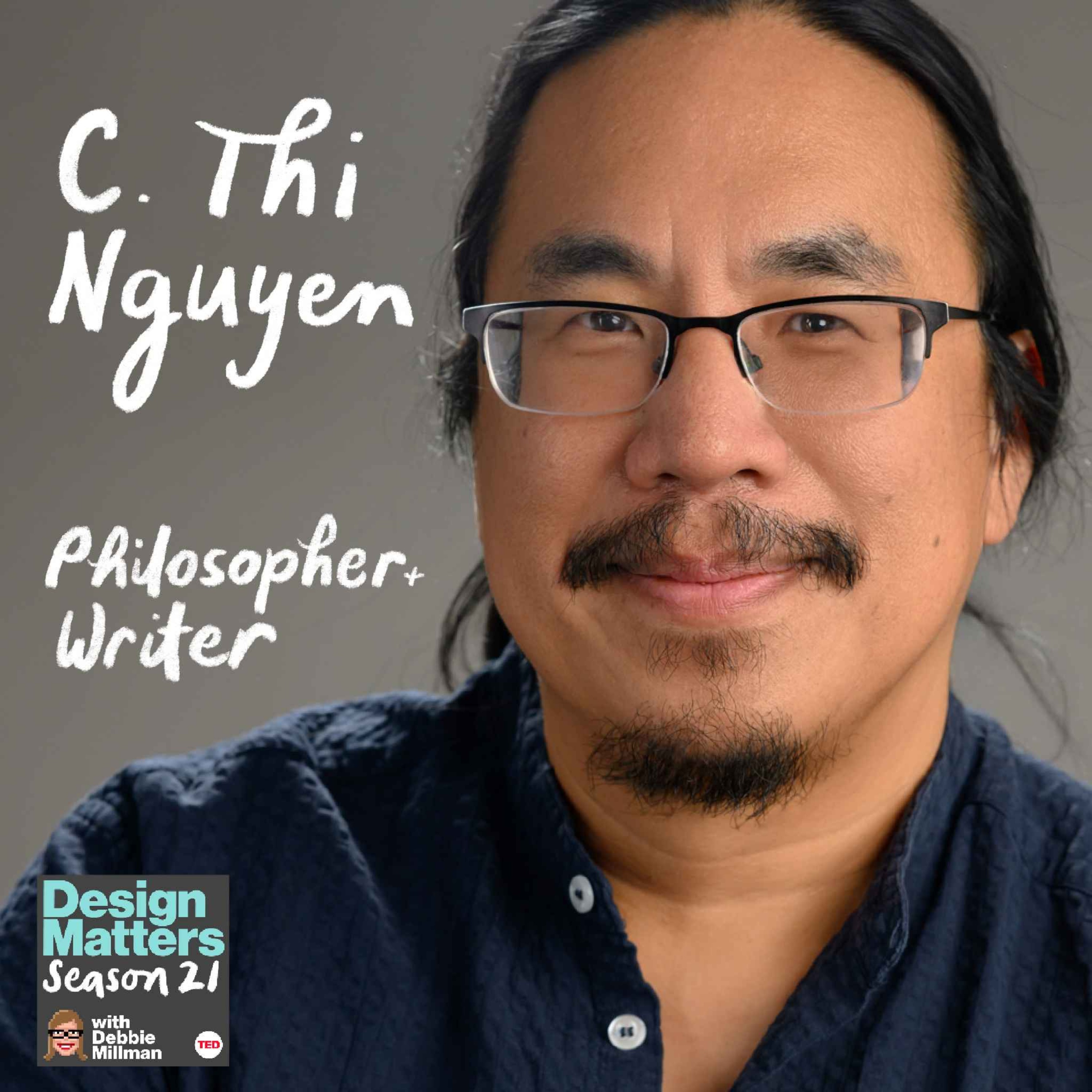
C? Th Nguyen is a philosopher who has spent much of his life examining the invisible architectures that shape human experience, the systems that tell us what matters, what counts, and how to measure whether we are succeeding. T is a professor of philosophy at the University of Utah and the author of Agency As Art, which has won the American Philosophical Association's book prize. His latest book, the how to Stop Playing Someone Else's Game, examines how metrics, from grades to social media to professional rankings, can narrow our understanding of what makes life meaningful. Thi Nguyen, welcome to Design Matters.
- [03:13]
C. Thi Nguyen
Thank you. It's good to be here. Your introduction also, like, stabbed at the heart of my being. Like, you got the soul and everything I'm interested in. Exactly right. You know, I actually didn't understand this for a long time. Like, I had all these weird obsessions. I was writing about in philosophy. I was writing about, like, social media, and I was writing about games, I was writing about trust structures, and I was writing about computing. And I. People would ask me what brought it all together, and I didn't know. And actually, like, there's this thing called midterm review. When you're a young professor, someone else reviews all your work. And this philosopher, Brandon Cook, read everything, and he wrote this letter and he said, you might think that T's interests are zany and all over the place, but what he cares about is how the outside world, how social structures and technological structures change how we value and think. And I was like, oh, my God, suddenly I make sense to myself.
- [04:07]
Debbie Millman
Oh, good. Well, I'm glad. I'm glad. I've spent a lot of time with you over the last couple of weeks, whether or not you realized it. And so I love to look for those threads that knit everything together. However, you do have a somewhat surprising origin story. Is it true you were a teenage movie critic? San Jose Mercury News.
- [04:30]
C. Thi Nguyen
You looked that up? Amazing. Yeah, that was my ye. Yeah. So when I was in high school, the San Jose Mercury News was looking for teenage movie critics, and they held an essay contest, and they got three of us. And I think what they were looking for was, like, it was supposed to be the teenage view. And I think they were looking for, like, kids who would talk about kid action movies. And because they held an essay contest, they got the three most pretentious, artsy, fartsy, like, nothing is good but late Altman weirdos. And I. So I ended up, yeah, writing a bunch of weird movie reviews that I think if we went back to look at them, which I haven't in years, are probably unbearably pretentious. That was. That was my first writing gig.
- [05:20]
Debbie Millman
What. What kind of films were you reviewing at that point? Like, adult movies, kids movies.
- [05:26]
C. Thi Nguyen
I was 16 or 17, but, like, I mean, we would have fights because I, you know, I was an art kid. I Always wanted to, like, review arty. They did let me review, like, Krzysztof Kieslowski's Red, but they also wanted, you know, the teenage reviewer should review, like, Jurassic park, so I would do that too.
- [05:43]
Debbie Millman
But Teenage Mutant Mutant Ninja Turtles, and
- [05:45]
C. Thi Nguyen
I was much less generous back then than I would have been now. I was a much more rigid, fancy art is better kid. I have a more expansive view now.
- [05:55]
Debbie Millman
Your parents came to the US From South Vietnam. What made them decide to settle down in Southern California?
- [06:02]
C. Thi Nguyen
I think when you're a Vietnamese war refugee, the government just sends you someplace and you end up there. I think they were going through a lot of local churches to place immigrants with families. And so there was a family that just volunteered to open their home to a refugee family. And they took in my parents, and it happened to be in San Jose. And by an enormous amount of luck, I mean, okay, there are two ways I can tell my story. One way to tell my story is I'm an immigrant's child. I grew up poor with people that had nothing. And then I fought my way to a fancy college and I fought my way to a professor gig. Here's another way to tell my story. In Vietnam, my dad was a professor of math at the University of Saigon. And then he went and he ended up in San Jose as a math person with a math background in the late 70s. And he figured out about this thing happening called computers. And he retrained and he applied his math background, and he ended up at intel doing coding. So he rode the Silicon Valley boom and surprise of all. Surprise. A math professor's kid is a philosophy professor. What. What wonders there are.
- [07:21]
Debbie Millman
You know, one of the. I think wonderful things about retrospection is how we can decide which narrative means more to us. I love how your dad's job at intel set the stage for so much of what you're doing now. I read that when you were 10 years old, he brought home a massive early computer.
- [07:47]
C. Thi Nguyen
Yeah.
- [07:47]
Debbie Millman
And rather than coding, you used it to play Colossal Cave Adventure.
- [07:52]
C. Thi Nguyen
Yeah.
- [07:53]
Debbie Millman
How did you even discover that game at that time?
- [07:55]
C. Thi Nguyen
T, my first computer was the size of a fridge. It was blue. It was obsoleted at intel. And so intel would sell off old stock to employees. And so my dad got this thing. Massive thing. Floppy disks were a foot wide. And I do think it just came with a bunch of floppies that already had stuff pre installed. And one of them was, what I didn't realize at the time was the first text adventure game like Colossal Caves. And I clumsily dealt with this text parser in a cold garage, which is where we kept it, to play this thing that I was fascinated by.
- [08:36]
Debbie Millman
Please tell me that you still have that computer.
- [08:38]
C. Thi Nguyen
There's no way we. That I. We. That thing is gone decades ago.
- [08:44]
Debbie Millman
Do you remember what you felt the first time you realized that a machine could create an entire inhabitant credible world?
- [08:53]
C. Thi Nguyen
No. I think I am probably the first gen to not be able to remember clearly that experience because it's the way things were. Like the. My growing up, like, I think there wasn't a transition point. Some of the earliest games I can remember were computer and video. So I think I was right at the breaking point where I was one of the first people for whom that was natural. That was just the way games happened.
- [09:23]
Debbie Millman
But that experience ultimately sparked what is now a lifelong devotion to and fascination with games. What was it about gaming that so intrigued you at that point?
- [09:35]
C. Thi Nguyen
Yeah, I don't. I mean, it wasn't just the computer stuff. I grew up playing all kinds of games. I grew up playing card games. I grew up playing. My dad taught me to play chess when I was 12. My sister's boyfriend taught me to play Go, which is the great, you know, Japanese, Chinese, Korean cultural equivalent of chess. And in an alternate life I just would have played that. And I think. I don't know if there's a way to say what united them. Like, actually maybe I should say that when I started writing, I mean, they were such a natural part of my life. I only asked the question you're asking 30 years down the line. When I started writing philosophically about games, they were so natural for me that it wasn't until I had to explain to an outsider's eye why the hell someone would love and spend so much time on such weird views that I was forced to produce a unifying story. Before that, I just knew that I loved games, right? They were awesome. That's what I did in my spare time. Two kinds of games kept me sane in graduate school. One kind of game is during graduate school I discovered with a couple of friends of mine, including my best friend in grad school, the philosopher David E Ry. After school and work, we would find random European board games. This was when we were getting this huge influx of this massive explosion of really incredibly well designed games from Germany and the rest of Europe. And we'd play these things that were so interesting, so elegant, had such interesting design mechanics and made us interact in weird, interesting ways. Like if you grow up in kind of the American game landscape, A lot of the games are very war gamey. And then a lot of the German games coming at the time are about these intricate auctions and market manipulations. It turns out there's a history to this. The history that I understand is after World War II, Germany turned away from kind of chess and other direct war games. And there's also a long tradition of playing family games. I think. I don't even know if. I don't know if it's still true. But when I was looking into it in like the 90s, there was information that the average German family played more board games together than watched tv, which is wild. So there's this huge market and this impulse to discover different kinds of interactions besides direct conflict. So a lot of the German board games were about being in a market or an auction together and subtly manipulating the incentive to try to manipulate other people. And these were just so interesting. So I would do philosophy work and then I would play games with a bunch of people, but especially David Ebry. And then we would sit around and talk late into the night about what made the game good. And at the time, I had no idea this would be part of my professional career. I thought this would be a waste. Nobody in philosophy studied games. That's not a serious topic. And I remember at some point telling somebody I was like, you know, I love art. And I would have loved to have been around as an art critic in the 50s to talk about jazz as it was happening. Wouldn't that have been great? And not really reflecting on the fact that what I was doing at the time was spending all this time playing all these new board games or coming out of this board game revolution in Europe and then going online to BoardGameGeek and trying to write criticism to like express what made this game so interesting. And it took me like again years to be able to tell myself, oh, what I'm trying to do is participate in being like part of the critical reception of this glorious explosion of interesting design of what I think is like the most exciting new art form, which is like designing play and designing interaction by designing rule systems. And yeah, it took me. I was doing it long before I realized what I was doing. I just thought I was like writing little capsule reviews of my geeky little community about this game I played last night that I loved.
- [13:20]
Debbie Millman
There was a tiny little self descriptor in this score that I picked up on and underlined and want to ask you about. You said you were a bit of a smart ass growing up.
- [13:37]
C. Thi Nguyen
That's a lie. Bit is a lie. I was a complete smart ass.
- [13:43]
Debbie Millman
So in what way? How you were smart, how did that
- [13:46]
C. Thi Nguyen
manifest now that you asked the question? I realized that it manifested in a form that just became professionalized as philosophy. Like I was a smart ass because I always was looking for the fast quick response. The quick like, oh, that's not true what you said. Here's a quick counter example. Or like you said this general thing, but what like I would love a fast, clever, funny refutation. And what I've done is entered a profession where that is what you're supposed to do professionally. And so I only don't self describe as a smart ass now because it's been normalized for the job I do.
- [14:19]
Debbie Millman
Your parents wanted you to be a doctor or a lawyer or a programmer and thought you were throwing away your chance at a safe and productive career. Yeah. Even though you were going to Harvard.
- [14:32]
C. Thi Nguyen
I mean the point was I went to Harvard and then afterwards I started pursuing philosophy and the rest of my family were like, what are you doing? I mean, I think in my family there's like, in my gen there's like dozens of computer programmers, three doctors, and then this weirdo that threw away a Harvard education. Even by the time I was an assistant professor of philosophy and had my first job, which is an incredible fight, my mom was still calling me up asking me when I would quit and get a real job and be a programmer.
- [15:04]
Debbie Millman
But a PhD is also a doctor.
- [15:08]
C. Thi Nguyen
Doesn't count.
- [15:10]
Debbie Millman
I, I believe that you intended for philosophy to be a part time backup job for what you considered your real work, which was creative writing and becoming a novelist. So what made you actually choose philosophy?
- [15:23]
C. Thi Nguyen
Wow, you have done your homework. Yes. Yeah, no, I was originally going to be a creative writer and I was interested in philosophy and I started on that and I mean I had this image of like I could teach and that would support and be. And I really did love philosophy, but I thought creative writing was the main thing. I actually have two literary novels and one science fiction novel on my desktop that I wrote during this period. And then at some point, I mean first I realized I wasn't going to do well just because of the way the world is if I split my, like I didn't have the time to do well in both. I had to choose one and I didn't know what to do. And I actually, there's a mentor, Elijah Milgram, a philosopher, who shows up a few places in this book and I gave him a draft of my literary novel and I gave him one of the earliest half written drafts of my first games book. And I was like, I don't know what to do with my life. And he read them and he came back and he said, they're both very good. The literary novel is very well written, but it is very much like many other literary novels written by many people that went to creative writing programs before. And the games book is not like anything I have seen before. And I was like, well, okay, I
- [16:36]
Debbie Millman
actually want to point out that he was rather brutal. He said that your novel, and this is a quote from you, that your novel was well written and artful, but that it was entirely familiar and very much like other nice little literary novels he'd recently read. And you're still good friends.
- [16:56]
C. Thi Nguyen
Yeah, no, I mean, like I said, philosophers are professional smart asses. This is, this is the loving treatment we give each other all the time. Though I will say I spent years in creative writing programs developing, like what I thought was a writerly voice that was myself. And the professional philosophy mostly said, no, like that's not professional. You need to sound like a neutral. And so I learned this other voice. I have quietly referred to it as robot voice in the novels I was writing. I now realized I kind of had to suppress my desire to be like, very geeky and philosophical. And the opportunity to write a public philosophy book was very freeing because that world is a world that really accepts both kind of intellectual interest in complex geeky stuff and narrative. And it let me pursue something that I think I had truly and had never really articulated I wanted to pursue, which was a format in which I could be emotional and narrative and tell stories and give arguments and give social historical analyses and cut between them and try to have them. I realized I had an aesthetic that I'd never gotten to indulge before, which was having a philosophical argument and then telling a story and having the core idea from the argument and the emotional hit of the story hit together at the same moment. And I was permitted to like, chase that and refine that with my amazing editor. And yeah, so it felt very. Until I'd written this new book, I'd always been kind of craving kind of creative outlets because, like, philosophy wasn't quite creative enough. And now since I've been writing this, my craving for other creative outlets is gone. This feels like everything in me that wanted to be a novelist and everything in me that wanted to be a philosopher getting, like to play together for
- [18:39]
Debbie Millman
the first time, despite your parents desire to see you as what I guess they would consider to be A real doctor or your desire at the time to be a novelist? You then enrolled in the graduate program in philosophy at ucla. What made you decide to commit to philosophy at that time time rather than fiction or gaming?
- [19:02]
C. Thi Nguyen
I was still trying to write in the background, like stories, but all the academic disciplines, philosophy had become obviously the one for me. So when I went to college, I thought my interests were either English or evolutionary biology or neuroscience. And I actually was briefly all of those majors and quickly discovered for various reasons again, that they did not fit my personality in various ways. And I kept reading things and different things where I was like, oh, this is so cool. And it would always turn out to be a reading from a philosopher. You get them in neuro a little bit neuroscience. And I was just like, what is this? And I wandered over to the philosophy department. I took a class and I had this wild first class from now I realize I was very lucky to take from a legend in the philosophy of art, Stanley Cavell. And he just like took my mind apart. It was a class about how opera and musicals express the spirit of, like, being unable to express yourself. And it was like a class about all these plot lines in opera, about how a woman who sings then dies of consumption and like trying to understand what the social commentary was and that. And I just was like, this is it, man. This is what I love. And yeah, but while you were in
- [20:17]
Debbie Millman
school, you began living a double life. You worked on your PhD during the day and then began working as a food writer for the Los Angeles Times. Now, is it true that you got that job after drunk posting on Chowhound?
- [20:35]
C. Thi Nguyen
Yes, I love that. Oh my God. Yeah. So the. You found all the best. All stories. The I someone was wrong on the Internet is what happened. So there's this incredible chain in LA called Roscoe's House of Chicken and Waffles, where you do Southern style chicken and waffles. Waffles covered with maple syrup and butter. Chickens, fried chickens covered with gravy. And obviously to me, you eat them together. You wrap it in the soft waffle. And then, then someone on, on Chowhound, the food board I used to hang out on, complained and said, said, these waffles are supposed to be Belgian waffles, but they're not. They're soft instead of crispy. So they failed. And I was incredibly angry. And I. Part of the reason I was angry was because it seemed to me like a kind of thing I particularly couldn't stand, which actually maybe is in the background of my new book. It was like very category based reasoning. Like, this is called the Belgian waffle, therefore it must be crispy. Inflexibly, all Belgian waffles must be crispy. And I thought that is completely, I mean, that is completely wrong for this context. Right? What makes chicken and waffles good is this relationship of soft. And so I was super pissed off. I was only like three blocks from the original house of chicken and waffles. So I was like, I need to write a response post. Then I was like, I need to do more on the ground research first because Roscoe's is open till 4 in the morning. And I was like, okay, I need to take three shots and go to Roscoe's Chicken and Waffles and eat some. And I was eating it and you know, it's like there's this soft chicken and then the sweetness of the maple syrup and the richness of the gravy and then the crispiness. I was like, oh, I know this pattern. This is picking duck. It's the same. Like something softens. Right? Okay, that sounds softens to eat. And then something rich and then fatty and then a crispiness. And so I went home and drunk posted it at three in the morning, this elaborate post about Joseph Campbell and the convergence of food myths and how like different food cultures had the same idea. And then I went to sleep and then when I woke up, the phone was ringing and it was the LA Times food editor wanting to offer me a job because he'd been following my posts. But then that one he said put him over the edge. It was Russ Parsons. Thank you, Russ. And yeah, so.
- [22:55]
Debbie Millman
And you did that for years. You did that for years.
- [22:57]
C. Thi Nguyen
It took me like 11 years to get through grad school, partially because I was food writing for like half the time for like five or six years.
- [23:04]
Debbie Millman
Ultimately, you had to choose between academia and food writing. And you described that decision as painful. What made it so painful for you?
- [23:12]
C. Thi Nguyen
I mean, they're completely different forms of life. And here's a case where I love both of them. Food writing is wandering through the world with your senses alive, noticing things and trying to like describe beauty. Academic philosophy is like this intellectual, abstract, argumentative, incredibly painfully rigorous, fascinating thing. And they were like two different parts of myself. And the decision was tough. Actually, part of the decision was just people. The LA Times being like, newspapers are dying, like, we're firing people. Get out while you can. But I also told myself that if I was going to go into academia, I was going to let myself do Weird Philosophy of Art. And part of it was that. But in the end, food writing for me, and this is very me specific, I think after five years started feeling a little bit repetitive because you have the same kind of relationship. It's always like, here, here's something, describe how good it is, find it. And that's really thrilling. But it's also kind of confining. And the stuff I did afterwards about the philosophy of games was kind of that impulse. I want to describe the live interestingness of games, but. But then especially in the new book, I have the freedom to do it both kind of in the criticy way to talk about it on the ground, and then to step back and be much more philosophical about what the meaning of games is in general. And so, I mean, yeah, I love food writing, but I was hoping to be able to keep writing about weird, beautiful things.
- [24:41]
Debbie Millman
Well, you refer to that as weird aesthetics. And I'm wondering if you can define what weird aesthetics are. Is.
- [24:50]
C. Thi Nguyen
Aesthetics is the broader term. So art is the narrower term. Art is like what humans make to be beautiful and other things like that. And aesthetics is bigger because there's stuff in nature that's also beautiful. So aesthetics is the study of all of that beauty and thrill and horror and comedy in art and in nature. And I think some of it is very well recognized. We are very used to studying the beauty of film and the beauty of sunset and the beauty. And then there are other things that I think are as incredibly important and beautiful and elegant and thrilling that kind of get pushed to the side.
- [25:25]
Debbie Millman
Like what?
- [25:26]
C. Thi Nguyen
So games is one another is like. I've gotten really interested in social food rituals like hot pot, because I think. I think that it's actually quite gamelike. What's going on with social food with like hot pots and fondues, is that part of what it's sculpting is not just the food, but the social interaction. Like the way you bump into each other and negotiate and laugh because you, you don't. Right. I'm super interested in improv. Like, I mean, tabletop role playing in particular is like a collision between games and improv theater. But a lot of this stuff is on the margins of what people would conventionally call art. And I. I've been calling it weird aesthetics just because it seems weird for most people to take it seriously. But I've lately, in the process of writing this new book, talked myself into a new position. I guess the best way to put it is I've started to notice that all the arts that we normally consider high, novels, movies, paintings, are ones where the majority of people sit on their asses and appreciate the very real fine genius of some very distant person. And all the arts where the ability to be creative is distributed over a whole community. Role playing games, fan fiction, cosplay, these are denigrated as low and geeky. And what I've started to think is that a lot of our notion of high art is more generated by what we can easily sell and transfer on an art market. And things that are incredibly beautiful and incredibly live and involve like a community deeply interacting and create. Everyone gets to create for each other. Those are discarded. And when I say weird aesthetics, like, I mean it's. It's that the stuff that I think is as important or even more important that has been like trashed to the side because it's hard to capture, hard to count, hard to stabilize, hard to sell, but it's important, might be more important.
- [27:24]
Debbie Millman
After you received your PhD, you began teaching and you are currently a professor of philosophy at the University of Utah. And that gaming manuscript your mentor told you was startling that you started in grad school became your first book Agency as Art. And I learned a lot from that book. You state that art asks us to see and observe games. Ask us to participate. Would you? I kind of know the answer to. I do know the answer to this, but I want you to elaborate a bit. Would you say that games are a distinct artistic medium?
- [28:03]
C. Thi Nguyen
Yeah, yeah. I mean, what. I should say that in that bit that you quoted. I mean like art in quotation marks, what most people think art normally is. I mean I really do think games are an art form, but I think they're misunderstood because we have a lot of language to talk about. The arts that are fixed and stable, that are kind of where the important part is external and so we can kind of point to the same features. And games are really weird. And I think what's happening with games is that games are designed to make the beauty and the interest emerge in you, the player. A well designed rock climb at the gym gets me to be elegant. It forces me to be elegant. It calls forth an interesting new elegance. Like my favorite puzzle game like Baba Is yous. Like when you play this, the primary thing that's beautiful is actually my mind. Like the way it suddenly moves at the moment it solves the puzzle is beautiful. But also like the game design pulled that out of me. It's kind of second stagey. Right. And I think a lot of the stuff I was that got me angry enough to write this first book was people that wanted to praise games by pointing to their movie like features. And I was also seeing this in game design, right? More and more games would trade away freedom of the player to make them look more like movies with fixed cutscenes, like good cinematography and good dialogue and good script and all the features that were kind of ripped from what we already knew from movies. Now I was trying to explain what games did that was so special. And I think the lightning rod point for me was this moment from Reiner Knitia, who's my favorite German board game designer. And he has a lecture that he gave the Game Developers Conference where he says that the most important tool in his game designer's toolkit is the scoring system because it tells players what to care about. It sets their motivation in the game. And I as a game player was like, that's such a cool expression of what is totally obvious in games. And as a philosopher, I was like, oh my God, this is completely weird. Because most philosophy and most theory about people assumes that our desires are really static. And yet here's this really obvious thing which is that someone can just write down a scoring system and you can just blend into it and completely change what you care about, what you're trying to do. And you can flip on a dime in one night. You can play cooperative. Like we'll often warm up by playing a cooperative game and then we're working together and then we put that one away and then we play a game where we're like trying to kill each other and you just transfer really quickly. So what it ended up saying was game designers tell you what to want and they give you abilities and they give you obstacles and they design all of those in an interaction to give you beautiful action or beautiful thought or like funny action, or like to build interesting socializations or social relationships. They're like sculpting our actions and interactions from one step back. And I think that's really, really crucial. Like in movies, they make something and you're looking at the thing, and the thing that's beautiful is the thing they made and the game designer. I mean, I've actually even kind of thinking that there's actually a lot of similarity between game design and good teaching. Like in good teaching, if I just tell you what to think and you think it. I failed as a philosophy teacher. I need to set the conditions for you to figure it out freely yourself and find the option space to yourself. And game designers are doing something really similar. They're like, they're pushing around rules in order to guide you to a kind of action, but not force you to let you freely find actions such that you're acting and you're finding the action is interesting, fun, beautiful, thrilling, funny. And that's an extraordinarily interesting art form. One weird thought I had at the very beginning of this was I was complaining to people again, drunk. I was at a bar, and I was like, look, they keep saying, you know, games are like movies, but they're sort of like that. But you know what they are? They're really art governments. They're rule sets to guide people's action, not to keep them from killing each other, but for the sake of beauty and interestingness.
- [32:07]
Debbie Millman
You've described games as a kind of library of agencies, and I'm wondering if you can talk about what you mean by that.
- [32:15]
C. Thi Nguyen
Yeah. Each game offers you a different way of looking and thinking about the world. It's a very different angle. It's easiest to see. Sometimes, I think in physical games, like soccer says, don't use your hands, and so you have to discover everything you can do with your feet. I think rock climbing, interestingly, says, don't use tools to climb. You can use tools to keep yourself safe, but to go up, don't use tools. And so instead of using rocks and spikes and ladders and grappling hooks and helicopters, you're suddenly forced to see how much you can get just out of balance and precision. Some games force you. I mean, chess forces you into the mindset and the style of hyper, focusing on geometrical possibilities and geometrical possible interactions. And then other games, like my favorite tabletop roleplaying games I'm playing right now, they give you points for, like, having interesting character flashbacks and screwing up and generating narrative tension in character. And suddenly you're in this position where you're looking around the world, and you're like, oh, my God, what is an opportunity to get myself in trouble for my character motivations? And suddenly you're in, like, the posture of a certain kind of storyteller. And so games are these prepackaged agencies. They're different mindsets and goal sets pushed together. At its best, the world of games is a world where you can dance between these prepackaged mindsets.
- [33:48]
Debbie Millman
You've written that games don't just give us goals. They give us new capacities for action that allow us to temporarily become different versions of ourselves.
- [34:00]
C. Thi Nguyen
Yes.
- [34:01]
Debbie Millman
How does that happen? T.
- [34:04]
C. Thi Nguyen
How. That's a very challenging question term. How does that happen? So the easiest examples are some of the sports examples because they're just removals Right. I think soccer is the easiest example. It's just like, look, how much can you do with your feet. So suddenly you have to attend. It's kind of natural. It's a thing we've always done, but we normally use other capacities. So for my hyper focusing on that capacity, we plunge into it. So Bernard Suits, the philosopher of games, really inspired a lot of my work. One of his interesting thoughts is that games through rules create new possibilities for action. What he means is like there was no such thing as a checkmate without the rules of chess. There's no such thing as like a layup without the rules of basketball. Rules are these weird paradoxes that give us constraints and through those constraints create new possibilities. There's this really, I think standard but simple theory that the fewer constraints the more free you are. That's something that's really false. And you can see it in two ways. The simplest way to think about it is just think of an empty field. You can move in any direction. Now put a room with a door, you can lock in it. In a sense you've removed some freedom of movement, but you've actually done is created a richer possibility. You can be inside or outside. And a lot of political philosophers, this is a thought from Rousseau. What a lot of political philosophy has thought is that rights are new possibilities that you create through restrictions. Right. The restriction don't kill each other creates a new right and a new way of being. You can now safely walk down the street. Rousseau has this idea that like if we were totally free, we could just take stuff from each other all the time. But the rule of not stealing creates the possibility of having property that you can put down and walk away from. And so games, I mean again, this is the thing where games are an elaboration of governments. Games are things that create new possible kinds of actions that we never had before. That new interactions. Some of them are variants on old ones and some of them are just completely bizarre and novel. I mean, if you know the computer game Portal, you're given a gun that can shoot ends of a wormhole that warps space. That's not a thing I do in normal life. And you get new puzzles out of it. The game Bob is yous, the one I talked about before, creates an action space. You're in a physics model and there are words inside the world with you that are the rules of the physics. And when you move those words around, you change the rules of physics. And that's not a thing that is in this world. And someone has Just created a new kind of action. That's fascinating.
- [36:48]
Debbie Millman
You introduced me to the work of Bernard Suits just through reading your work. And one of the things that I came upon through your writing was his idea that playing a game means voluntarily taking on unnecessary obstacles for the sake of struggling against them. And I'm wondering if you think that human beings might actually need obstacles, not just to endure them, but to find meaning.
- [37:23]
C. Thi Nguyen
This is 100% what Suits thinks. I mean, that definition is one of my favorite things in the world. I mean, obviously, since I've sent, like, two books figuring out all the implications of that definition, that games are voluntary obstacles. I think what Suits is saying is that if what you're trying to do in a game is defined in part by the obstacles. Right? This is what he's saying. Like, if you cross the finish line of a marathon and you took a taxi, you didn't cross the finish line.
- [37:48]
Debbie Millman
Right?
- [37:49]
C. Thi Nguyen
What you do is intrinsically connected to that, that constraint. Then the constraints have to matter. And what that means is if the constraints matter, then that means that the way you do things matter. You run a marathon because you want to be running and not sitting in a car. Behind this is Aristotle. Suits is very explicit about it. So the end of the book, the Grasshopper, is this unbelievable argument. The argument is, imagine Utopia, where technology has solved all our practical problems. What would we do with our time? We would play games, or we would be bored out of our minds. So if games are what we play in Utopia, then they must be the meaning of life.
- [38:28]
Debbie Millman
But what about art?
- [38:29]
C. Thi Nguyen
He thinks art is a game. I think art is a game. Okay, I'll give you a fast argument for art being a game. What a game is is something where it's important you do it yourself in a particular way instead of just taking any available shortcut to get to it quickly. Hey, here's a shortcut. Ask AI to make it. The reason you don't do that is because what we actually care about is making it ourself. I mean, if you could automate the whole procedure, have AI make it, and then have AI judge it, then you'd have a lot of art and a lot of judgment about art. What we actually care about is making it ourselves and then appreciating it ourselves and talking to each other and being in that process.
- [39:05]
Debbie Millman
So when we talk about when artists or designers or writers are pushing back against AI Are, what they really pushing back against is cheating?
- [39:16]
C. Thi Nguyen
I think so. And I think what Suits is saying is that the cheat is robbing themselves because what they're mistaking is that the real point is to be doing the thing and they've mistaken the goal for the purpose. Right? So one of the crucial distinctions of the book that I learned from my advisor, Barbara Herman, is that you can distinguish between the goal and the purpose of a game. A goal is what you pursue during the game, and the purpose is why you play it. Right? The goal of charades is to win, but the purpose is to have fun. And if you try to win and fail, you still had fun, you still had a great time. And I think in many games, the mistake of the cheat is to isolate that goal and think that's all that really matters and not to realize that the goal is just there to get you through a particular rich activity. I mean, Suits was an Aristotle scholar. This is what Aristotle said. Aristotle said that human meaning came from are exercising our capacities richly for being engaged in interesting action and interesting thought that it was the doing that was important and not the thing that was done. And sometimes the stuff you made could help you do more things, but the importance in life came from actual doing.
- [40:29]
Debbie Millman
This episode is brought to you by Mint Mobile. I've spent my life studying what we design, but also what designs us, the systems we build and then inhabit. Without question. Wireless pricing is one of those systems we should question. We pay large bills for years, accepting it as inevitable. But there's a better option. With Mint Mobile ready to stop paying more than you have to, new customers can make the switch today and for a limited time, get unlimited premium wireless for just $15 per month. Switch now@mintmobile.com design that's mintmobile.com design. Upfront payment of $45 for three months, $90 for six months, or $180 for 12 months. Plan required, $15 a month. Equivalent taxes and fees. Extra initial plan term only greater than 50gb. May slow when network is busy. Capable device required. Availability, speed and coverage varies. See mintmobile.com
- [41:36]
C. Thi Nguyen
AI is transforming customer service. It's real and it works. And with fin, we've built the number one AI agent for customer service. We're seeing lots of cases where it's solving up to 90% of real queries for real businesses. This includes the real world. Complex stuff like issuing a refund or canceling an order. And we also see it when FIN goes up against competitors. It's top of all the performance benchmarks, top of the G2 leaderboard. And if you're not happy, we'll refund you up to a million dollars, which I think says it all. Check it out for yourself at Fin AI.
- [42:06]
Debbie Millman
This episode is brought to you by Capital One. Capital One's tech team isn't just talking about multi agentic AI. They already deployed one. It's called Chat Concierge and it's simplifying car shopping using self reflection and layered reasoning with live API checks. It doesn't just help buyers find a car they love, it helps schedule a test drive, get pre approved for financing and estimate trade in value. Advanced, intuitive and deployed. That's how they stack. That's technology at Capital One.
- [42:37]
C. Thi Nguyen
Hey, it's Adam Grant from ted's podcast Work Life and this episode is brought to you by ServiceNow. AI is only as powerful as the platform it's built into. That's why it's no surprise that more than 85% of the Fortune 500 companies use the ServiceNow AI platform. While other platforms duct tape tools together, ServiceNow seamlessly unifies people, data workflows and AI connecting every corner of your business. And with AI agents working together autonomously, anyone in any department can focus on the work that matters Most. Learn how ServiceNow puts AI to work for people@servicenow.com.
- [43:17]
Debbie Millman
You deconstruct the various aspects of games of gaming in your new book. I want to talk about that. Your new book is called the how to Stop Playing Someone Else's Game. And it explores how metrics, rankings and incentives can narrow our ambitions and redirect our attention toward goals we may never have consciously chosen. Is it true that you wrote this book because of an email from a student?
- [43:47]
C. Thi Nguyen
Yeah. Yes.
- [43:50]
Debbie Millman
Tell us more. Tell us more.
- [43:52]
C. Thi Nguyen
Yeah, so I was, I was not sure if I wanted to write this book. And I was thinking on a pop book just about games or a pop book just about metrics. Or maybe just being tired of writing. I'd been writing some popular stuff and maybe I just wanted to go back and write geeky, arcane, technical stuff on the weird little details of games. But I gave this talk. It was during Pandemic. It was a zoom talk, and it was a talk where I was just. I didn't really understand the connection, why it was so important to talk about games and metrics in the same place. And so I gave my theory about games and I tried to explain why metrics were not good kind of separately. It went online. And then a few weeks later, I got an email from an undergraduate never met, just someone who saw the thing online. And she wrote me and she said that the talk had pulled her out of five years of Depression because she said she had been a lot like me. Immigrants, kid, Asian American, push to get straight A's, a varsity athlete. But that's not like me. I was not a varsity athlete. And anorexic and in all these sectors, obsessed with upping the score in ways that were making her miserable. And she said she had not realized that she was playing so many bad games, that she didn't want to be playing, that she was stuck in bad games. And hearing me talk about games and metrics made her realize that she had some degree of choice. So she said she reprogrammed her phone screen to remind her constantly. And she sent me a picture, and what it said was, is this the game you really want to be playing? And I mean, I cried. I was like, oh, my God, like, what more impact do you want to have on another human being as a human being? And then I was like, I guess I got to write the book then. And the first chapter of the book is called is this the game you really want to be playing? Because of her and her comment T.
- [45:49]
Debbie Millman
Before we get into the specifics of the book, I want to share with our listeners what I consider to be the most beautiful paragraph in the book. So I just want to make sure you're okay with that. It's not that long.
- [46:01]
C. Thi Nguyen
Yeah, that's fine. I'm excited to see what your pick was. Okay.
- [46:04]
Debbie Millman
What's magical about games, what's different from so many other art forms, is that in games, you act, you analyze the information, you make decisions, you try to enact your will upon the game world. And well designed games make beautiful action more likely. They call it forth. Good games don't tell you what to do exactly. They don't puppet you into beauty. They leave space for your freedom, for you to choose and decide and act and react. But they create the background conditions that make it likely that your own actions will be elegant, fascinating, and thrilling. The beauty is in the process, in what it feels like to be doing the thing. And games help steer you toward finding beauty in your own actions, in finding the answer yourself, figuring out the right move, yourself instinctively reaching out of your own trained skill. How good is that?
- [47:03]
C. Thi Nguyen
Thank you. I'm glad that you're pleased with that.
- [47:06]
Debbie Millman
Yeah, I think it's beautiful. And you go on to stage. Games play around with who you are, what you care about, and the basic shape of your relationship to other people. Games reach into you and give you a new form of agency. And you can, for a while, become completely absorbed in that new agency. And what enables that and crucial part is the clarity, the simplicity and the unambiguity of the scoring system. So how does a scoring system have so much power?
- [47:41]
C. Thi Nguyen
That's the crucial question. I mean, I'm obsessed with the question of why scoring systems are so delightful in games and so draining elsewhere, but they're so similar in their heart. Like, what's similar about the scoring system is the clarity of the expectations, the clarity of the specification of what matters. Scoring systems tell you exactly how to count what matters in normal life. You think, I'm going to try to make my child have a happy childhood? But what counts? Does letting them stay up late count? Does letting them watch this slightly weird, scary horror anime they want to watch count? Or like the direct connection between what you're doing and what you're trying to achieve is so difficult often because it's not just about what will make things happen. It's like if you get a particular result, is that result good or not? Right. It's really hard to judge. So if my child suddenly starts being like, I don't trust my teachers anymore, have I made someone disobedient or have I made someone independent and free willed? It's so hard to tell. And games on the other hand, just say two points for cows, four points for sheep, go. And you know exactly, exactly how well you've done and you know exactly how to compare yourself to everybody else. And it's inarguable. I think that's part of, of the background and that inarguability is achieved in a very specific way. It's achieved by changing the thing that we're counting from something subtle and dynamic and open ended to something that's clear and inarguable. And I think one of the important things is, I think a lot of people want to say, they want to say that the inarguable stuff is the only objective thing. It's the only real thing. And what I want to say is there's so many things that are real and important that are not easy to count. And here is maybe the geekiest way to put what this book is about. This book is about all the mysterious things that are hard to count. And to understand, you have to understand how we count things together. That the process of counting together is a very specific social process and that some things are really easy to count together and some things are really hard to count together. Since you've read both of these books next to each other, let me point out a mistake. In my first book, in my first book I assumed that every game has a scoring system because I was thinking about board games. In between thinking about them, I realized there are so many games that don't have scoring systems, and that's crucial. My favorite example is like, skateboarding. Skateboarding is a game, and you can even have a skateboarding competition where you all go out to skateboard, and sometimes you don't even need to specify the goal. You can just skate and try to skate better, and each person can pursue their own version of better, and each person can come up with their own judgment. And it's okay. Not only that, one person was going for style and the other person was going for speed, and someone else was going for athleticism. It's okay if each of you judges on a different basis. Our judgments aren't forced to converge, and we don't need a single judgment. When skateboarding moves to an official context like ESPNX and the Olympics, in order to make it more readily countable, they change what it's about. Skateboarding becomes less about style and flow and more about height and number of flips, because those are easier to count in public together. So the demand for easy, objective accountability systematically changes the topic towards the kind of things that are easy and quick to recognize and that are verifiable through a mechanical procedure. And I think that's a vast title shift in what we're paying attention to.
- [51:27]
Debbie Millman
You have stated that a game can tell whether you're selfish or part of a larger collective.
- [51:34]
C. Thi Nguyen
Yeah.
- [51:34]
Debbie Millman
How so?
- [51:35]
C. Thi Nguyen
I mean, it can instruct you, right? It can tell you what to do. It can tell you what you care about is the same. It's winning. But games just tell you what count as winning in a particular case. But actually, games tell you what winning means in a really basic way, in that sometimes I open up a game and it's a cooperative game and all the people at the table are trying to win together. And sometimes we open up a game and it says that half of us are achieving victory together. It doesn't matter whether you get the point or I get the point. We're on the same team. They're one point. But we're trying to beat this other team. And sometimes we open up a game and it tells us you're all in it for yourselves. Everybody else is the enemy. The only victory that matters is yours. And the game can just tell you, and we can just. Just do that. And one of the worries I have is that that's safe in games because games are separated. But in the real world, when we're drawn in that way. We have the same fluid capacity, we have the same ability to just be told what to want and to want it on a dime. But in the world, we are not temporarily changing some plastic unimportant points for fun. We're changing how we're pursuing our education or our workplace or our health or creative endeavors. We are vastly redirecting our creative and soul outputs in the direction of what's easily countable by everybody in unison.
- [53:02]
Debbie Millman
Can you talk about the difference between achievement play and striving play?
- [53:07]
C. Thi Nguyen
Yeah. One of the crucial ideas that that I drew from suits I'm trying to think about games is that there are two different kinds of play. So there's achievement play, which is playing in order to win, and striving play, which is taking an interest in winning on temporarily in order to experience the process. So one way to put it is in achievement play you actually care about winning, but in striving play, you just get yourself to care about winning for a little bit it to get absorbed in the struggle. One way to put it is in normal life we take the means for the sake of the ends, but in striving play, you take the ends for the sake of the means. And I think that's crucial. I see exactly why you're asking this here. Because a big difference between metrified life and games and striving play is the points actually don't matter in striving play. You just cared about them temporarily to have the process and you can just throw them away again. I can try to get more points in this German board game than my wife, and she can try to get more than we. And one of us will beat the other and one of us might disrupt the other person's railway network. And one of us won and one of us lost. But since the points aren't attached to anything real, we can just throw them away. We can actually both get what we really wanted, our true purpose, which is an interesting struggle. But that's not true when someone is aiming all out at maxing out their investment portfolio at the expense of everyone else's retirement accounts. It's not true when someone is trying to get the most likes through outrage bait on Twitter. Right. Those are substantially connected to real world resources. And so we are essentially in a terrain that's unlike striving play. And so when you simplify people's activities towards real targets, then you're screwing with the fundamental features of our social world.
- [54:59]
Debbie Millman
Well, this is one of the reasons I was so fascinated by your earlier work. And was so interested in talking to you about the score because quite, I guess, confessionally, my wife describes me as both a sore loser and a sore winner. Because what happens when I start playing a game is that I see the end result as a declaration on who I fundamentally am. So I become either a winner or a loser. Loser, you know, big L. But then if I win, I feel guilty because I am making the other person feel bad. So this is a real big conundrum for me in game playing. It becomes really hard to be around me when playing a game, which is hard for her because she loves board games. She has a whole closet full of board games. And so one of the games I love playing most is Scrabble. It is my number one favorite game to play, but I also don't like to lose. She's also really smart, and I lose a lot. So how do I deal with this?
- [56:17]
C. Thi Nguyen
I think striving play is partially a cultivated psychological skill. I was taught by people that taught me to play games to reflect in ways that were super useful. And a lot of the times the reflection is less, like, was that game interesting? Like, was that a fascinating game? Like, and it's completely different from whether you played well. Like, to have someone be like, well, you, you won, but that was a cheap shot. You didn't play interestingly, or, oh, you know, you lost. But, whoa, did you enjoy that? Was that interesting play? Like, that really, I think, cultivates an attitude of distance, of being able to distance yourself from the victory, and an attitude that asks you to focus on the thing that really, I think, should matter in striving play, which is your experience of the process.
- [57:09]
Debbie Millman
You write at length about a phenomenon you call value capture, and that is one of the central tenets of the book. And you named value capture after regulatory capture, which is a problem in which government regulators go astray. Can you define what value capture means?
- [57:25]
C. Thi Nguyen
So value capture is what happens when your values are rich and subtle or developing in that direction, and then you get put in a social setting next to a simple, typically quantified rendition of those values, and then the simple one takes over. So examples are you go on Twitter to communicate to people and connect, and you get obsessed with likes and follows. You start exercising for health, but you get obsessed with Fitbit or lowering your weight or increasing your total weight or your mileage, or you go to philosophy because you love cool ideas. And then you get obsessed with where your publications are in the status ranking of possible publication venues. And I just want to be super clear about something. Value capture is not the same as bad incentives. So a lot of people study something called perverse incentives, which are incentives that undercut a system. And, and it's really important to understand perverse incentives. But when something is just an incentive, when someone's just offering you incentives and they're not in your soul, you can still trade off between the incentives and what you really care about. You can be like, well, I'll work some for extra money, but I also care about my family, so I'm not going to do all those extra hours. Value capture is when the external incentives or measures transfer into your core values and what you lose is an external standpoint to reflect on that particular metric. Yeah, we've said enough to say. The thing that I find really crucial in interactions with games is that you take on the scoring system and then you reflect from a standpoint, outside the scoring system about whether it was a good game, a fun game, a valuable one, whether it pulled something out of you. And from an unscored standpoint, you ask yourself if that scoring system is good for you or not. A value capture is the case where you don't do that anymore because the metrics have intruded into your core value and so taken over the standpoint from which you might have reflected on the scoring system. The scoring system becomes your value. So where is the place you're going to stand to ask yourself whether that's really actually good for you or not?
- [59:37]
Debbie Millman
This happened to me with Duolingo. So I started Duolingo a little over two years ago and quickly started learning French and was very proud of myself for. For learning French. And then something happened, probably when I got up to the Diamond League because there was nowhere else to achieve upward two, that I started to become obsessed with staying in the Diamond League and suddenly was looking for ways in which to make lots and lots of points as opposed to learn. And it took about six or seven months before I realized, I don't think I'm learning French anymore. So that was a reckoning.
- [60:22]
C. Thi Nguyen
There's so many stories that look like this. And I mean, again, like, I'm not saying don't use gamified apps. Like, one way I put it is that value capture involves outsourcing your values. Another way to put it is that when you buy a gamified app, you're buying like a prefabricated extension to your will. And it does amp you up, it does increase your willpower, but for a fixed target. And that fixed target is never going to fully track what values? Partially because the mechanical measuring systems are blunt and partially because they're made by someone who's not you, who's very distant. Right. And it can't be tailored to your fine experience. And I find that a lot of people's interactions with this are like, when you're completely outside of space, when you're just beginning. When I was just starting rock climbing, when someone's just beginning exercise, something like Fitbit or the rock climbing scoring system really does help because it's in the right direction. And then once you've gotten that as a kickstart, often, like, you start to get a more refined sense of what's important and what's important to you, and that's usually going to veer away from that simplified scoring system. I think a lot of people start a thing and they glom onto the scoring system. That's actually really good because, like, a game, it's a good guide to get into the activity. But, like, the healthy life cycle often looks like using it and then at some point, backing away from it and redesign and being like, this doesn't quite work for me. Let me do this other version. Let me mod it. I mean, the thing I'm describing of, like, starting to do this thing, starting to be on Fitbit, and then being like, this worked for me for a while, but now it's really, like, just kind of annoying, and it's not helping me be healthy. That's not value capture. Because you're saying that the scoring system is not helping you achieve your real goal, which is healthy or.
- [62:01]
Debbie Millman
Yeah. You're gaming your own system.
- [62:03]
C. Thi Nguyen
Yeah, yeah. Say, what do you mean by that?
- [62:05]
Debbie Millman
Well, you're getting the benefit of feeling like you're winning something without actually winning anything.
- [62:12]
C. Thi Nguyen
Yeah.
- [62:13]
Debbie Millman
Playing against yourself and really losing while you're winning.
- [62:17]
C. Thi Nguyen
Yes, yes. Oh, my God, this. Oh, I love that phrase. Do you know that reminds me of. So Natasha Dushiel is a scholar of designed addiction. She studies, like, addictive video games. Addictive video game poker. And there's this thing that she describes that she found out about where video poker. One of the reasons you have these games that let you play, like, ten or a hundred games at once for each poll is that you'll lose most of them and win a few, and then the game can justify giving you tons of fireworks for the one penny you want. And the technical term for this is losses disguised as wins. And I think you've just described something like that to me. It's very similar because many of the cases I'm thinking about are cases where you have become miserable or you've lost the sense of meaning, but you don't notice because the scoring system is so loud that it overrides it. And so your boredom is disguised as a win because there's this little thing that's saying your number is going up, up. So you ignore the fact that you're miserable.
- [63:23]
Debbie Millman
How can people avoid perverse incentives?
- [63:31]
C. Thi Nguyen
Perverse incentives are hard to avoid. So when you're talking about incentives, as in what the external system is doing, unless you're a system designer, and maybe some people here are, maybe some of you are CEOs or VPs or superintendents of schools, then you should think about how you're incentivizing your students or incentivizing your employees. As people who are caught inside the system. We often don't have a power over our incent, over the incentives that are pushed at us. But we do at least have the power to pull back from value capture and leave the incentives as external incentives and not internalize them. We can hold them at arm's length, we can just use them as much as we have to to get the resources in the world, but we can back away from them.
- [64:15]
Debbie Millman
Can you talk a little bit about the difference between imposed metrics and the ones we willingly embrace?
- [64:23]
C. Thi Nguyen
Yeah, willingly embrace here is really tricky.
- [64:26]
Debbie Millman
Yes.
- [64:27]
C. Thi Nguyen
Because I think a lot of the worst cases for me are very willing. When I started thinking about value captor, my first story was like, look, this is bad because it's non voluntary, but a lot of the cases like Duolingo and Fitbit are totally voluntary. And the problem isn't that no one chose. This is why I've been using this outsourcing measure metaphor, because outsourcing is often voluntary. But the problem is the weird fixity of the measure. And so the real problem is, I don't know, something about not being reflectively careful about what you choose. This is why I think it helped me so much to think about this by comparing games and metrics constantly, because I think this is the clearest version of the vision. In the worst case, the world presents you with something and it's an institutional metric. And an institutional metric has certain design features. So a lot of my book draws on the work of Theodore Porter and Lorraine Daston, who are two historians who I think really explain what's going on in institutional metrics. Porter's way of putting it is that metrics are designed to be be comprehensible across contexts. That qualitative justification, justification in written Language is complex and open, end and dynamic, but it requires a lot of shared background context. And so it doesn't travel well and it doesn't aggregate easily. And so to make an institutional metric, we strip away all the nuance, we cut out all the sensitivity and we cut out everything that requires high context and we create a context invariant nugget that can travel easily like letter grades, right? Very little information, very easy to travel. So the thing that Porter really exposes for me is that the thing that makes metrics so powerful and so all consuming, the fact that they're comprehensible by everyone and they can integrate everyone, is precisely made by the process of removing context and sensitivity. It's not an accuracy. That is the design feature and the design bug in one that is the design trade off. So with a metric, if you're value captured by an institutional metric, you have tied your values to something that's constrained by that decontextualization. You're targeting page views, you're targeting publication
- [66:50]
Debbie Millman
rates, you're targeting likes and followers.
- [66:52]
C. Thi Nguyen
Likes and followers. Each of the end of the justification chain is something that is constrained by this decontextual demand. In the game ecosystem, what's interesting is individual scoring systems are still constrained by this kind of hyper clarity, right? Like the specification of every cow counts as one point or the scoring, that's something that anyone can use, that's a decontextualized set of directions. But then your reason for adopting them is not bound by the scoring system. The fact that in the world of games you can move between games and choose games, and that your reason for doing so is not constrained by the demand for instant decontextualization. The fact that they're going to say I love this game, I want to play it. Why? Because, I don't know, it's got weird deep social vibes. I can't say more. Right. That's permissible. And you can modify games like for me, some of the richest heroes are moral. Heroes are indie game designers or people that mod and hack games or house rule them or change them, guided by their own weird, rich illegible purposes. It's not that games guarantee one or and metrics guarantee the other. It is possible for a game to be socially all consuming. It is possible. I mean if you're in a small town and football is the only game in town and everyone has to play it, you don't have that degree of freedom. And it's possible to try to cultivate a more careful attitude toward metrics to invent your own little personal one. But the background social structure really encourages reflection, change, exploration and modification in games because games are disconnected from each other. And the fact that metrics are powerful precisely because they're stable at scale is the thing that, that violently discourages us from tailoring them. Because what makes them powerful is precisely that they've been decontextualized. And then in that decontextualized form, I just have this image of like a butterfly nail, a dead butterfly nailed to the wall. Like they're, they're. The fact that they're rigid and ossified at scale is central to their design function.
- [69:13]
Debbie Millman
If someone listening senses that they've been organizing their life around the wrong score, what would be some of the questions you would consider they ask themselves as a way to begin to pivot?
- [69:26]
C. Thi Nguyen
Right. This is the simplest and dumbest one. But is this interesting? Does this make me happy in the long run? Like, am I better? That's one version. It's also about, is this system doing what really matters? I mean, a lot of the times I think about this as a person under these systems, but a lot of the times I have to think about this as a person with power, moderate power over the systems. I design classrooms with grades, and I suspect a lot of listeners here are designing metrics and performance metrics and KPIs and reviewing systems for employees or people they manage. And in each of these cases, you have to articulate what actually matters and then ask as a question whether the metric captures it without presupposing that the thing that's easily measured automatically is what's important presumptively. So I think asking that question is super important. And often one way to articulate it is just to think to separately ask what really matters. And then when you look at a measure, ask yourself why that measure is. Is where it is. I was looking for a good example of this for my book, and then I realized I'd been staring at the correct example for a year and a half in my life and I hadn't realized it. Which is screen time, right? Like, you know, I've got a six year old and a nine year old and it's really easy to become obsessed with, oh, technology's bad, let's reduce their screen time. And then if you actually look at the kid, screen time sometimes means dumb YouTube shorts that are awful. And sometimes it means he's building interesting architecture in Minecraft and building logic gates for it. And sometimes it means like the dumbest possible clicker game. And sometimes it Means that he's animating his imagination on a stop motion animation program. And I think what we should actually be asking is which of these are creative, which of these are interesting, which of these are challenging, but that would actually require a conversation. And there's no tracker that tracks that. And I think when you look at that, if you actually look at why we talk about screen time, it's because we have a device that measures it automatically. It's completely disattached from anything that actually matters, but it's mechanically simple. And I think when you start seeing the gap between the rationale for why we have a particular measurement system and what actually matters, when you keep looking for that, I mean, I think I've created an attitude of hostility and suspicion towards metrics, although I also recognize that they're sometimes very useful and valuable and you need them. But when you admit that they are simplified litmus tests that are useful in some circumstances for very specific interactions, but profoundly limited, and you make yourself very attentive to their limitations, then it becomes, over time, easy to back away from them.
- [72:18]
Debbie Millman
I have one last question for you. You referenced it before the game Go and you state you share in the score that the game Go is possibly the most beautiful of all games. Why do you feel that way?
- [72:34]
C. Thi Nguyen
Oh, God. I think part of the difficulty is with many games you have to be involved in the intricacies of the game to see the beauty. And that's actually part of the. The. One of the big lessons, like one of the most interesting things I've learned is for all of these things, rock climbing, gardening, you got to spend a huge amount of time in it to see the special revelation. But I can. I'll take a stab. Here's something interesting about Go that's different from chess. Chess is one fight. Go is about 10 different fights that interrelate to each other, but they're separate. And a big mistake you can make in Go is being stuck in one small fight and missing something important happening on the other part of the board. So to play Go well, you have to cultivate in yourself an emotional outlook of constantly asking whether this fight is worthwhile. And you have to constantly be willing to step back from a fight you spend a lot of resources in because it's not as valuable as a move somewhere else. And I think it's also, interestingly, a game that cultivates reflectiveness and stepping back because you, you every move have to ask yourself whether this little fight you're focusing on is actually worth it.
- [73:43]
Debbie Millman
I've spent my entire career thinking about brands as constructs, and your book allowed me to understand how that extends into the way that we organize the rules of our lives. And it has been an absolute privilege to learn in this way and to see the world in an entirely new and I just want to thank you for that. It's been remarkable. I have to say that I rarely come across books that fundamentally change how I think about something, and this has done that.
- [74:20]
C. Thi Nguyen
I am about to cry. This is. I'm in my basement right now. This little. As you probably know, this little patch of books behind me is my carefully constructed zoom window. This is the cold, buggy, disgusting basement that I spent three years alone in writing this book, mostly convinced that no one would ever give a crap. And so to hear you react like that is like, you know, unbelievably gratifying and moving. So thank you.
- [74:47]
Debbie Millman
CT Nguyen, thank you so much for making so much work that matters. And thank you for joining me today on Design Matters.
- [74:55]
C. Thi Nguyen
Thank you so much. It's been amazing.
- [74:57]
Debbie Millman
C Thi Nguyen's latest book is the how to Stop Playing Someone Else Else's Game. You can read more about t@intonionable.net this is the 21st year we've been podcasting Design Matters, and I'd like to thank you for listening. And remember, we can talk about making a difference. We can make a difference, or we can do both. I'm Debbie Millman, and I look forward to talking with you again soon.
- [75:20]
C. Thi Nguyen
Design Matters is produced for the TED Audio Collective by Curtis Fox Productions. The interviews are usually recorded at the Masters in Branding program at the School of Visual Arts in New York City, the first and longest running branding program in the world. The editor in chief of Design Matters Media is Emily Weiland. Hey, it's Adam Grant from ted's podcast Work Life, and this episode is brought to you by ServiceNow AI is only as powerful as the platform it's built into. That's why it's no surprise that more than 85% of the Fortune 500 companies use the ServiceNow AI platform, while other platforms duct tape tools together. ServiceNow seamlessly unifies people, data, workflows, and AI connecting every corner of your business. And with AI agents working together autonomously, anyone in any department can focus on the work that matters Most. Learn how ServiceNow puts AI to work for people@servicenow.com with no fees or minimums on checking accounts. It's no wonder the Capital One bank guy is so passionate about banking with Capital One. If he were here, he wouldn't just tell you about no fees or minimums. He'd also talk about how most Capital One cafes are open seven days a week to assist with your banking needs. Yep, even on weekends, it's pretty much all he talks about in a good way. What's in your wallet? Terms apply. See capitalone.com Bank Capital One NA Member FDIC hi, this is Hannah Berner, co host of Giggly Squad. Let's be honest, we've all done things in our lives that may have just followed the crowd. Like drinking matcha. Even if you think it tastes like grass or pretending skinny jeans were actually comfortable. Have we been doing the same thing
- [77:06]
Debbie Millman
with Zero Sugar Cola?
- [77:08]
C. Thi Nguyen
Last year, people across America took the Pepsi Challenge. No labels, no bias. Judged on taste alone, 66% of participants agreed. Pepsi Zero sugar tastes better than Coke Zero sugar and Pepsi Zero sugar won in every single market. Go out and try Pepsi Zero Sugar today. You deserve taste. You deserve Pepsi.
- [77:28]
Debbie Millman
Wherever life takes you next and whoever you're looking to be, there's a car for that on cars.com with up to 50,000 new vehicles added every day, the possibilities keep growing. Explore over 2 million cars, giving you 2 million ways to find what fits your lifestyle, your goals, and your next move. Whether you're browsing, comparing, or ready to take the next step, Cars.com makes it easy to see what's out there. Find your Next possibility on Cars.com where to next? Hey, it's Paige Desorbo from Giggly Squad. Obviously I love Amazon prime and there's so many different reasons why I am obsessed with it. Not only can you see something on Instagram or TikTok or hear about it
- [78:08]
C. Thi Nguyen
on a podcast and think, wow, I
- [78:09]
Debbie Millman
need to order that. And then you can order it on prime prime immediately. But it also just makes your life better. Because sometimes you forget someone's birthday or a Christmas gift or a Flag Day gift. I don't know any type of gift. And you can literally get it so fast with Prime. Prime just makes your life easier. And it always comes in clutch. Not only is it fast, it's also free delivery. Fast Free delivery. It's on Prime.