Loading summary
Transcript252 lines
- [00:01]
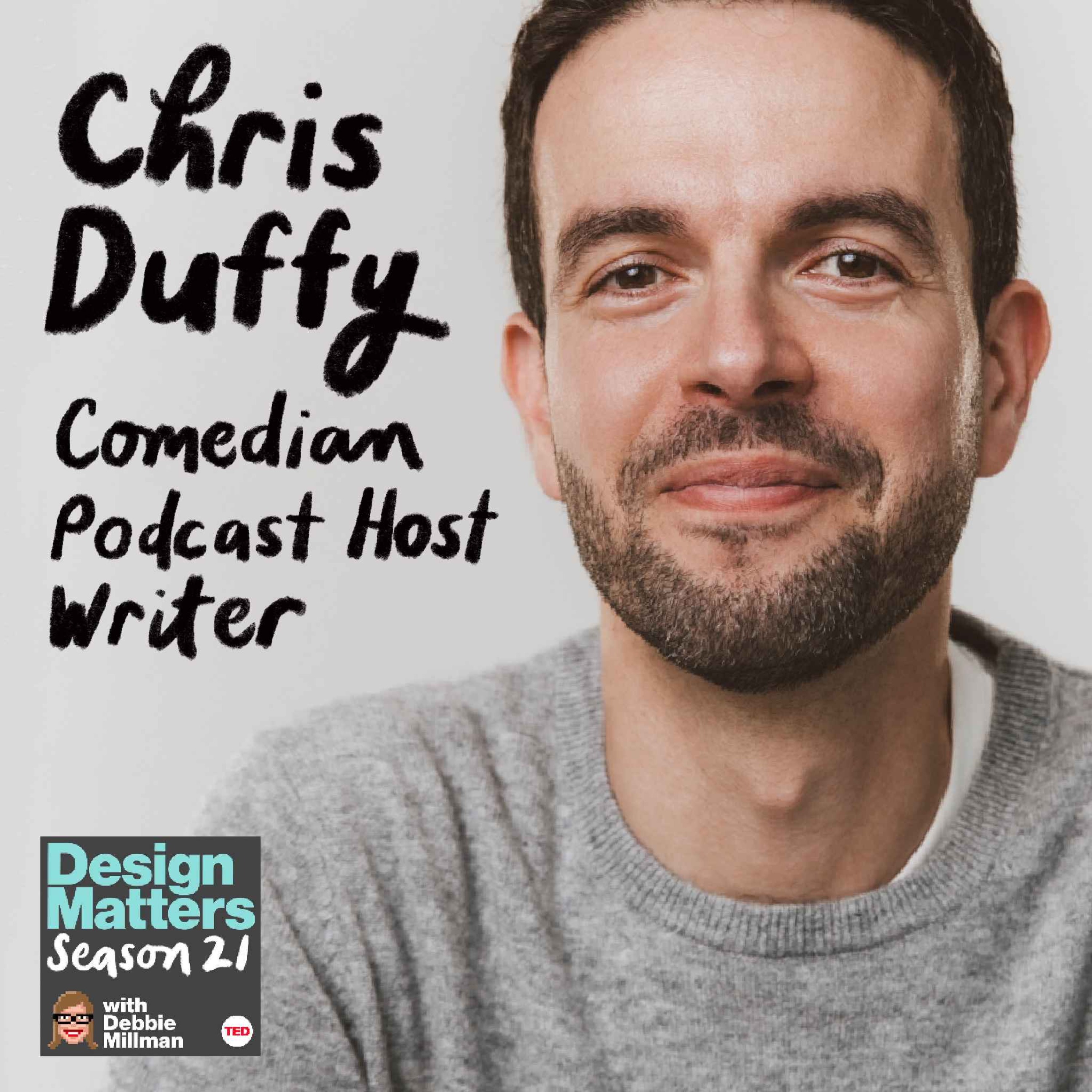
Chris Duffy
I've always been interested in each career move being something that teaches me. So what's something that I would learn? How would it push me? And this was a huge shift for me because it's the first thing that I did where it was in no way Edited for laughs from the TED Audio Collective this is Design Matters with Debbie Melma. On Design Matters, Debbie talks with some of the most creative people in the world about what they do, how they got to be who they are, and what they're thinking about and working on. On this episode, a conversation with Chris Duffy about his career in comedy and about the importance of humor. Anyone can be funny and especially anyone can laugh more.
- [00:49]
Debbie Millman
This episode is supported by Harvard Business School Executive Education. Their programs create powerful connections for leaders around the world, strengthening both organizations and individuals by deepening existing relationships and fostering new ones. Participants leave with lifelong friends, new potential business partners, and a powerful globe spanning network of fellow change makers. Learn more at HBS Me Learn. That's HBS Me Learn.
- [01:18]
Ad/Promo Speaker
This is a Monday.com ad, the same Monday.com helping people worldwide, getting work done faster and better.
- [01:25]
Debbie Millman
The same Monday.com designed for every team and every industry.
- [01:30]
Ad/Promo Speaker
The same Monday with built in AI scaling your work from day one.
- [01:35]
Debbie Millman
The same Monday.com that your team will.
- [01:37]
Ad/Promo Speaker
Actually love using the same Monday.com with.
- [01:41]
Debbie Millman
An easy and intuitive setup.
- [01:43]
Ad/Promo Speaker
Go to Monday.com and try it for free. Yes, the same Monday.com this podcast is.
- [01:49]
Chris Duffy
Brought to you by Wise, the app for international people using money around the globe. With the Wise account, you can send, spend and receive in over 40 currencies with no markups and no hidden fees. Whether you're sending pounds across the pond, spending rials in Rio, or getting paid in dollars for your side gig, you'll get the mid market exchange rate on every transaction, plus most transfers arrive in less than 20 seconds. Join 15 million customers internationally. Be Smart, Get Wise, Download the Wise app today or visit wise.com Ts&C's app.
- [02:25]
Debbie Millman
Chris Duffy has spent his career moving fluidly between teaching, stand up comedy, writing and podcasting, all of which are shaped by curiosity, improvisation and responsibility. Chris is currently the host of the podcast how to Be a Better Human where his conversations center on practical wisdom, vulnerability and growth. His new book, Humor Me How Laughing More can make you present, Connected and Happy is about how to laugh more every day and how to find more humor in the world, which is certainly what we can use more of now. Chris Duffy, welcome to Design Matters.
- [03:06]
Chris Duffy
Thank you so much for having me, Debbie. It's a pleasure to be here.
- [03:09]
Debbie Millman
Chris. I read that one of your earliest memories is when you brought a book of shaggy dog jokes to the hospital to cheer up your great Uncle Norman after he had a heart attack. What gave you the sense back then that humor could be a way for him to heal?
- [03:28]
Chris Duffy
Oh, well, that's true. That I did do that. And it's interesting, the framing of what gave me a sense that humor had the power to heal, because I think a big part of it was humor got the power of giving me attention. Even when he was getting a lot of attention in the hotel, in the hospital room.
- [03:44]
Debbie Millman
Okay, total reframe.
- [03:47]
Chris Duffy
But I was also like six or seven. And I think that I knew that laughing made people feel good. And I loved that feeling of connecting with people. And the fact that I could tell them these now, in retrospect, objectively not funny jokes and they would be delighted was. It felt like this incredible magic trick that I wanted to do. And so when I knew that he was feeling bad, I thought, well, what makes people feel good? Laughing? I can help that. I can help him out with that.
- [04:11]
Debbie Millman
And did it?
- [04:12]
Chris Duffy
I mean, I think he was. I think he enjoyed that I was there and trying. I think he was probably faking the laugh, but it might have distracted him for a moment or two.
- [04:20]
Debbie Millman
You are a fellow native New Yorker and grew up in a tiny fifth floor apartment in Manhattan. Your dad was originally from the Midwest. So how did you all end up in the city?
- [04:31]
Chris Duffy
My dad, yeah, my dad is from Michigan originally, and he's the first person in his family to go to college. Then he got a job working at the Port Authority of New York and New Jersey. And it was kind of especially for what he wanted. It was like this really stable job where you were always going to know you were employed and then you'd get a pension. And so he moved halfway across the country for that. And he ended up meeting my mom and she is from Long island and so was like always wanted to stay in New York. And they got married and then they've literally just lived in two apartments. So they lived in one apartment when I was born. And then when my younger brother was born, on the day he was born, they moved into another apartment and they've been there ever since.
- [05:09]
Debbie Millman
Wow, that is dedication and loyalty.
- [05:14]
Chris Duffy
It's also funny because, like, you know, they moved at a time when New York was not what it is now. It was kind of a lot grittier and a lot cheaper. And so they now live in this kind of fancy neighborhood. Not like the Upper west side was not, you know, a nice neighborhood then. But it's funny because it's like they live in an apartment where the truly the view is of a brick wall like three feet away. And so everyone around them has become like these ultra wealthy people with giant apartments and they're just the fixtures that will never move, that have their little tiny space.
- [05:44]
Debbie Millman
You've written that you also grew up around terrorism as your dad worked in the World Trade center during the 1993 bombing and just barely missed the last train to make it into the twin Towers on 9 11. And you wrote this about the experience. I remember that night in 1993 when dad walked into our apartment, his face jet black, black with soot, his suit covered in ash. Chris, how did those early experiences impact your sense of the city and your place in it?
- [06:21]
Chris Duffy
I think a lot of New Yorkers have this experience and I can only speak to New York, cause that's where I grew up. But maybe other places do too, of when something bad happens or really, you know, when there's a blackout or an emergency, all of a sudden the anonymity drops out and people really are all in it together. You have that sense. And so I really had this feeling of oh, my dad came home and everyone was so concerned and making sure that he was okay, but then was so happy that he was home. And it felt like not millions of anonymous strangers after that. It felt like, hey, when it really comes down to it, we are rooting for each other. And I think I felt that Same way after 911 as well. This kind of. Okay, well when, when push comes to shove, people are here for you.
- [07:03]
Debbie Millman
Was this when you first turned to books as a refuge?
- [07:08]
Chris Duffy
I can remember not knowing how to read and thinking I want to read so badly. So I have always thought of books as a refuge and the highest form of media for me. I mean I've always just loved reading and thought that it was incredible. I think I give a lot of credit to my mom who it wasn't like we could always afford all sorts of luxuries, but she was, her rule was if you ask for a book, we will get the book. And so we would always go to the bookstore and pick something new out. And it was just such a treasure and excitement.
- [07:37]
Debbie Millman
You attended Brown University and from what I found in my research, I believe that you double majored in philosophy and economics. I also saw in another interview that you said that you were an English major. So clarify for me.
- [07:53]
Chris Duffy
Oh, this is incredible. It's Incredible that that is your understanding. I was absolutely, in so many ways not a philosophy and economics major. I did. I majored in English in creative nonfiction writing, which at the time felt like the most, you know, it felt like underwater basket weaving. Like, how are you going to have a career in creative nonfiction writing? And of course, literally everything I've done has been creative nonfiction writing. But I took. The reason it's so funny that it was philosophy and economics in particular is I took one economics class. And at Brown you can take classes, pass, fail. And I took it. Pass, fail. And I just barely passed to the econ class and then a philosophy class. I took like a week of the class. And at the end of the first week, the professor said, if you're happy with your life, if you don't want to examine everything and have everything become a challenging question about morality and meaning, if you like the way your life is right now, you should walk out of this class and not come back. And I left the class and was like, I'm not coming back to that class. That sounds horrible.
- [08:54]
Debbie Millman
So I. Wow.
- [08:55]
Chris Duffy
I dropped the class because I was like, if that's what philosophy is, no thanks.
- [08:58]
Debbie Millman
What a cool professor.
- [08:59]
Chris Duffy
I know he's a cool.
- [09:00]
Debbie Millman
Was it. Did people, like, en masse, leave the room?
- [09:02]
Chris Duffy
No. I think everyone else, how dare you. I will be here. I'm smart enough. And I was like, this sounds bad. What he's offering is real bad. It's Pandora's box. I'm not going to open the box. Everyone else is like, oh, I'll see what's in the box.
- [09:15]
Debbie Millman
Now, you also wrote for the college newspaper, Brown's Daily Herald, which you can still find some of your bylines online. You had it even then at that point. What did you think you wanted to do professionally?
- [09:27]
Chris Duffy
I thought I wanted to be a journalist. I was really sure that journalism was what I wanted to do. The idea of talking to people and getting to have conversations and be interested in all sorts of different topics, that just was so appealing. And it still is so appealing to me. But I graduated in. At the time, it felt like the historic low of journalism where I was applying to jobs at papers and in between, when I would apply and when I would hear back, the paper would go out of business. That happened more than one time that I had sent my clips and resume in. And then I actually talked to someone who was a really award winning journalist, had won. I think he might have even have won a Pulitzer. And I was just asking him for advice and he said, honestly, My advice is that you should not do this as a career. Like my peers are applying for the same entry level jobs that you're applying for. And I think that you would be much better served by doing something else and then writing on the side. And so I took that advice and I said, I've always loved teaching too, and especially if I teach abroad, then I'll have kind of a hook where maybe I can report from somewhere where there aren't as many people reporting, and that could be a way to do both. So that was what I ended up doing.
- [10:34]
Debbie Millman
Well, I don't want to get into your teaching career just yet because I do want to talk about the cryptic ads that you saw pasted up around campus at Brown with headlines like, interested in long form improvisation. You were intrigued. So what happened next?
- [10:52]
Chris Duffy
I auditioned to be in the improv comedy group on campus and I was rejected. And then a person I didn't actually know at the time, who is now one of my closest friends, was starting his own new group. And I didn't really know a lot about improv. Like the idea that there was long form and short form, that was a distinction that didn't mean anything to me. But I really wanted to be in the group of funny people. That was a huge dream of mine always. And so I auditioned and got to be part of this group that became kind of an institution on campus and still exists now. And so we created this thing called Starlinsons, which the reason it was called Starlin Sons, part of the joke was every single time that we did a show, we would come up with a different explanation of why it was called Starlinsons. So it was never the same. And yeah, that group of people that totally. That's incredible that you even found that story out. I'm always in awe of your research when you do it. When I listen to other people and now having it with me, I'm like, how did you even know that? But, yeah, that shaped so much of my creative life is being in Starlin Suns.
- [11:57]
Debbie Millman
Now, I read that while you were in Starla and Sons, you pretended to be a talking dog, Satan on the moon, and an astronaut whose head is a foot. Not things that just in hearing the description, I would necessarily think as funny. But when did you first realize you were funny?
- [12:23]
Chris Duffy
Oh, I think that I knew that I was funny in a way that not just friends would think I was funny when I was in Starlinson. I really do think that. And to this day, I think that some of those performances are like the biggest they're the high point of, like, laughter and really, like, the magic of being in a room. Because the thing is that when you're in a college group, you can get 300 people in a room because it's college and people all want to come support their friends and there's not a lot else to do. And so you have these 300 people packed in a room and you're doing something that you and they are surprised by. And when there's that huge explosion of laughter, I felt like nothing's better than that. But part of the nothing is better than that feeling was going, oh, I am funny. I made that happen.
- [13:10]
Debbie Millman
I took a improv class back in the early 90s in New York City, and I was struck by the sense that comes over you after a time when you're all in it together, where it almost feels like you have a mind meltdown or a hive mind, and it's magic.
- [13:33]
Chris Duffy
That is. I mean, that is the part that I like the most. And I think, especially when you're in a group where you perform with each other a lot and you practice together, part of the fun is knowing, like, okay, if I say this to Debbie, here's how Debbie will likely interpret it, and I can play with you in that way and also play with. I. I think you probably aren't going to get this reference, and it'll be fun to see what you do with that. That is such the most magical part of improv for me. It's possible to have a lot of fun with strangers, but I think when you really know someone well and you know what their moves are and what their comfort is, it's fun to be able to set them up for a perfect joke, but also to tweak them a little bit on stage in a supportive way.
- [14:13]
Debbie Millman
Now we can talk a little bit about your teaching experience. After you graduated college, you moved to Cambridge, Massachusetts, and began teaching fifth graders in an inner city Boston elementary school. Why?
- [14:27]
Chris Duffy
The short answer is, my girlfriend at the time, who's now my wife, had got a job in Boston. And I thought, well, if I'm going to teach, I can teach anywhere, so let me get. Let me apply for every job I could, and this was the one that I got. But the bigger reason of why I wanted to teach fifth graders and why I wanted to teach at all is I had done some volunteering, like, after school programs and just really liked that age group and felt like, similar to the improv, there was this nature of play with elementary school students where you could, you Know, you could go into a character or make believe thing and they would go along with you. And fifth grade was, was nice for me because it was kind of like the end of that. So they were at the most mature where they would still go along with you in playing imagination games or a make believe. And actually like halfway through the year, you, you would feel the switch into like, these are middle schoolers now.
- [15:15]
Debbie Millman
Interesting. I read that you feel as if everyone has the potential to be funny, everyone has the potential to be creative. But something does happen in that fifth grade year that does move you into perhaps more practical thinking.
- [15:32]
Chris Duffy
Yeah.
- [15:32]
Debbie Millman
Were you trying to stave that off and keep them as creative and as engaged in humor as possible?
- [15:38]
Chris Duffy
Definitely. For them and myself, I mean, partly it's, you know, you become what you're surrounded by, and I want to be surrounded by that kind of energy. There are some studies that I've read that say that like fifth grade for many people is kind of the peak of totally uninhibited creativity. And that that's partly because we, we become more social creatures. Right. Like middle school and high school are so much about where do I fit into the group and how do I manage social dynamics. And a lot of that is really painful and awkward, but some of it is just necessary for living in a society. And before that, kids are less aware of those dynamics. And so they're so creative because they, they have no thought of what are other people gonna think of this idea. And that's something that I really want in myself, is as much of that as possible. How do I forget about what other people think? What do I think and what's the most fun?
- [16:26]
Debbie Millman
You were also teaching adults improv comedy at a local theater on the weekends, and you described the experience in this way. This was a group of retired folks, graduate students, and semi successful business people who were paying money to spend their Saturday mornings in an unventilated basement with me. And most of the exercises that we were doing together were to get them to let go of the self critical part of their brain, to release the idea that there was a right answer, to find, and to instead be more comfortable with their honest, creative, idiosyncratic thoughts. Chris, how do you go about doing that?
- [17:02]
Chris Duffy
Okay, this is great. I actually want to do it with you.
- [17:05]
Debbie Millman
Oh my God.
- [17:06]
Chris Duffy
Okay. So my favorite exercise is a really simple one and it's just categories, so it literally is any category. And it, it's important to like know that this is building a muscle. So it's not necessarily like how do you come up with the most hilarious thing? But if I say to you right now, name three kinds of cereal. Just go as fast as you can. What are three kinds of cereal?
- [17:26]
Debbie Millman
Captain Crunch, Frosted Flakes and Rice Krispies.
- [17:30]
Chris Duffy
Great. So three kinds of cereal. You can kind of think three ahead. Your brain is able to assemble three, but when you push it further, when you go to seven. And the rule being you're just gonna say it as fast as possible. So, like, if we said, like, we're gonna say it on the beat, like, so keep going.
- [17:47]
Debbie Millman
Four more.
- [17:47]
Chris Duffy
No, I'll give you a new category, because now you already thought of the series.
- [17:50]
Debbie Millman
I was already like Lucky Charms.
- [17:51]
Chris Duffy
Okay. But, like, the only rule is it doesn't have to make sense. It just has to be as quick as possible.
- [17:57]
Debbie Millman
Seven things.
- [17:58]
Chris Duffy
Seven things. So let's say seven things you might put in your purse. One, two, three, go.
- [18:05]
Debbie Millman
Tissues. Those flosser sticks. Lipstick. Those mints. My wallet, my phone. And a brush.
- [18:15]
Chris Duffy
Okay, great. Seven. So, like, you were giving your honest. At certain point, like, by the time you got to brush, you weren't thinking anymore. You weren't planning. It was just, what is actually in there.
- [18:24]
Debbie Millman
Yeah.
- [18:24]
Chris Duffy
And again, the point is not that, like, brush is the funniest answer, but you get past the what do I think I'm supposed to say? And you just start saying the real things. And the more you give. Wild categories, right? Like, seven things you. You'd never want to hear someone say to you when you're at the beach. Right? Like, the first few will be things that you might expect, but, like, the seventh might be like, you ate my sandwich. You know, it's like you stop. You stop thinking of the planned ones, and you just.
- [18:47]
Debbie Millman
Actually, I wish I had thought about what was in my bag right now, because the seventh thing could have been a banana.
- [18:51]
Chris Duffy
Exactly. Okay, see, that's great. And I think. I think, again, it's like, it's really fun to do exercises like that because it gets people out of the mode that they normally are in, which is what's accurate and what is acceptable, and instead gets you to what's honest and what's authentic. So it may very well be that you would say something that's in your bag, that is not in your bag, but is emotionally true. And that is where a lot of comedy and a lot of creativity comes from, in my opinion.
- [19:17]
Debbie Millman
Yeah, I think that comedy is one of the highest forms of art because you are actually able to get people to think and laugh at the same time. And what is better than that.
- [19:27]
Chris Duffy
Yeah.
- [19:27]
Debbie Millman
Maybe poetry.
- [19:28]
Chris Duffy
Well, when it's done. Yeah, Poetry, I think. Well, I've said this to a few people, which is. Cause it's one of my favorite jokes of all time. But my friend who's a comedian, Mike Kaplan, he has a joke where he says, I say something, and you, the audience, get to decide. If you laugh, it's a joke. If you don't laugh, it's a poem. Oh, and I love that.
- [19:45]
Debbie Millman
I love that because it's kind of true. Well, it's interesting because I also read that you said something about if people laugh, then it's funny. If people don't laugh, you're bad at it.
- [19:57]
Chris Duffy
Yeah.
- [19:57]
Debbie Millman
Like, there's like, when you strike out in a baseball, if you're a great baseball player, you just struck out. But if you strike out on the stage, you're bad at comedy.
- [20:06]
Chris Duffy
Totally. There's such a short feedback loop, which is, you know, if you write a book, if you paint a painting, between, like, doing the work and finding out the reception of the work, there's a really long time. Whereas when you tell a joke, it's seconds between, like, the creation of the thing and the reaction to the thing. And so what's nice about that is you get like this immediate yes or no, but you also then have an immediate chance to pivot. Right. If you. If you've written a 700 page fantasy novel and then it comes out and everyone goes, that makes no sense. It's pretty hard to be like, well, what if the dragons didn't wear hats and instead were angry? Like, you can't just pivot in the moment from your Dragons Wearing Hats novel, but you can pivot in the moment from saying something about, you know, an idea and saying, okay, that doesn't resonate. What if I said it in a different way? But can I say one, one other thing here?
- [20:54]
Debbie Millman
You can say whatever you want, Chris.
- [20:56]
Chris Duffy
It's kind of funny. Like, there's something interesting. And I feel like you will totally get this, which is, I started doing improv comedy and I started doing podcasting at a time when both of those were not cool. They were not like. So there was no social desirability to either of those things. And you, similarly, you were podcasting way before people even understood what a podcast was. And you have been working in design thinking way before. That was like the world of where design meant something, that people were like, I gotta have design on my resume right now. Like, you don't even like the term design thinking because people use it in this way, that's not even how you started thinking about design. I just think that it's kind of interesting to then be on the, like, where we are now, where everybody has a podcast.
- [21:42]
Debbie Millman
Oh, yeah, it's embarrassing. I definitely say you're a podcast host. It's true.
- [21:45]
Chris Duffy
But it's embarrassing in a different way. Right? Like, it used to be embarrassing because people were like, what? That's something on an ipod. Like, what is it that you do? I don't even understand technically how I would access it. And then I think, like, the improv part is also funny because it used to be like, oh, this is like, the nerdiest of comedy nerds. And that was part of the joy of it. And now it's like, I'm taking this improv class because Amy Poler comes. Yeah, that's how you become. That's how you become Amy Poehler. And it's like, no, no, no. This is how you become the guy in the basement teaching the improv class.
- [22:16]
Debbie Millman
Well, speaking of, you continued performing comedy at night while you were te. But this is. I read that you felt that there were maybe 100 people hearing you perform when you were doing this, and you were leaving with some great stories about being a babysitter, but nothing that really mattered. And I read that this period in your life became really emotionally difficult, and you described it as feeling overwhelmed and burnt out. You were also teaching students facing homelessness, illness, trauma. You also said that during this time, you lost your sense of humor and saw laughter as incompatible with responsibility.
- [22:59]
Chris Duffy
Yeah, I think that I had an experience that is not actually all that uncommon for people who really care about making a difference in the world. Like, if you're driven to have some sort of impact, which is. You come out really idealistic. Right. I was like, I'm going to work in this school, and I'm going to change my students lives after they have me. Like, everything will be different. And then what actually happened is you teach and it's really hard, and maybe you're not even connecting with the students at all. And some days the classroom is totally chaotic, and then you have to grade their paper. It just was.
- [23:30]
Debbie Millman
So in fifth grade, you must have to deal with their parents.
- [23:33]
Chris Duffy
Oh, that's the other thing. Right. Like you, I would be trying so hard, and then I would get a phone call, and it would be a parent yelling at me. And it's not even that they were unjustified in yelling at me sometimes, but it just felt like, oh, I'm bad. People don't think that I'm good at this and I'm not actually making a difference. And so the, the thing that I think is the relatable experience for many people is the solution to that was to just try harder. And try harder meant, like, be more serious, cut out the things that give me joy or that, like, give relaxation, to just give every second to doing this and to just try and drive straight at the wall as hard as I can and as. As fast as I can. And it really was not working. Like, it wasn't working in terms of connecting with the kids. It wasn't working in terms of me being able to have the energy to teach and to not burn out. And comedy became this release for me when I actually found it again. But there was this period where it felt like, well, that's silly. Like, you're dealing with real stuff. You shouldn't have any space for this.
- [24:31]
Debbie Millman
I read that you came to the realization that you were no longer going to be a teacher. So you made a very conscious decision and decided to rebuild your sense of humor, to deliberately inject more laughter and comedy into your life and to transform the way you saw the world. Like hashtag goals. Chris, how did you go about doing that?
- [24:54]
Chris Duffy
Well, I want to push back on a tiny bit of that framing, which is I definitely did think, like, I need to consciously make my life have more laughter in it, but it wasn't from the framework of I'm not going to be a teacher. In fact, I still think, like, I will probably go back to teaching at some point. I really. That's a goal for me is to. To find a way to have another chapter of my career where I'm teaching again.
- [25:16]
Debbie Millman
I think you should teach improv. I'd sign up in an instant.
- [25:19]
Chris Duffy
Absolutely. I loved teaching improv. And if you're going to be in the class, man, I'll just teach a one on one. But yeah, I want to teach again. So I think that's a. That's. That's not it. But I did, I did realize, like, hmm, this is not who I am. And not being who I am is impossible to sustain. So I need to find a way to have laughter be a part of my life. And part of it was if I care about education, if I care about people being informed, but I also care about laughter. Maybe there's a way that I can do it that isn't this exact box. And a lot of the things that I've done since I had that revelation have kind of combined those. Those pieces of I want to be teaching people, but I want them to be laughing. I want to entertain with a purpose. Because that is going back to, you know, you said the, the story of like, there's a hundred people in the room. What am I leaving them with? I have always felt, and I think this partly is just because of my parents who both were public servants. This idea that, like, it's not enough if your job is just satisfying, that there has to be some sort of reason for it, a greater good. And I think that's what was, I was hitting the wall with when comedy did start working is, huh? What's the point? If you can get people to pay attention, what are you getting them to pay attention to? And I think there should be an answer to that.
- [26:29]
Debbie Millman
Making the choice to take humor seriously and to cultivate it more does seem to have changed everything at that time in your life.
- [26:39]
Chris Duffy
Totally.
- [26:40]
Debbie Millman
Is that when you decided to take your stand up more seriously?
- [26:43]
Chris Duffy
I think it was when I decided to take all forms of comedy. I've always been kind of agnostic, right, Because I like improv, I like stand up, I like writing funny stories. I'm always of the opinion that rather than being like a purist, a lot of comedians are very purist in their approach. They're like, I'm a stand up, or I only do improv, or I only perform like sketch comedy. And I've always thought, if I can make you laugh in whatever way, that's great. I mean. And part of this again comes back to like thinking of my dad working at the Port Authority, which is when I left teaching, I said to the principal I was working with, I said, if I, you know, I'm doing the math and I think I can pay the bills if I do this for a year, even if I like, work halftime somewhere else. If I leave and it doesn't work out, can I come back? And she said, you know, no promises, but we hire new teachers every year and we really like you, so if you want to come back, it'll probably be okay. So it felt like there was like there was not a huge risk in taking one year to see if it would work. And the response that my dad had to the year is, I can't believe you paid your bills. And that kind of is still how I think of it all.
- [27:49]
Debbie Millman
I was gonna ask you that, how were you able to pay your bills doing stand up comedy? Open mic nights don't pay very much.
- [27:55]
Chris Duffy
No. And it was, it was so. Not that. It was like I got like a very small Contract to help make some like, funny videos for an education nonprofit where we like interviewed kids and made videos they would use in the classroom. I was getting paid a little bit to do stand up. I had started this public radio show which became the main thing that I did. And that was not a public radio show at the time. It was a live show that we recorded. And again, it was like the first wave of podcasts, but it was, we would do it in a small room with like 30 seats and film it and. Or record it. The nice part of coming from having been a teacher in a, in a public school is to get to the same level of pay. It wasn't like I was making a lot of money as a teacher. So I was like, okay, I can get to $30,000 a year if I make this money from comedy. And then the rest of it I can do some other random stuff. So I did all sorts of random non comedy jobs to pass the time.
- [28:44]
Debbie Millman
How does one go about creating standup comedy?
- [28:50]
Chris Duffy
I think that for me it goes back to the reason why I think that this is a teachable skill, which is the first part of standup is actually the most interesting part to me. People really focus on the performing part, which is, you know, you're standing in front of a crowd. How do you deliver it in a way that they understand all that part. But I actually think the most interesting part is how do you notice the thing and come up with the idea and then how do you process that into a way that is something that other people will think is funny? And so that part I think is really anyone can benefit from, which is you walk through the world and you pay attention to things and you notice what strikes you. It's seeds, right? It's not like you find the full grown harvested plant. So you're walking through the world and you go, that's a little odd. Or huh, why is that like that? Or why are these people acting in this way? And you think about it, and what I do and what every professional comedian I know does is you write those little ideas down in a notebook or I have an app on my phone that has tons and tons and tons of, of of ideas like that. And then if you're first starting in comedy, one of the things that they say to do is to take that idea and then put an emotion on it. So like, I hate when or I'm afraid when or I love when or like it's so sexy when if you put one of those types of emotions onto the observation, it instantly becomes charged in a way that is useful for comedy. So that's often how you can, like, frame a thing.
- [30:13]
Debbie Millman
How did you get comfortable with the idea that you were likely going to fail in the pursuit of being funny at standup comedy?
- [30:22]
Chris Duffy
By failing over and over and over and over again.
- [30:25]
Debbie Millman
And how do you manage that? How do you handle that?
- [30:29]
Chris Duffy
Well, I think there's a part of me that is stubborn and thought, like, why did that not go well? It should have gone well. So there's a part of me that said, like, I gotta figure out how to make that go well. I can't let it stop there. But I think the other part, which. It's funny because you would think that this would be more transferable to other failures in my life. But with comedy, I realized really quick that when you bomb, when you go up there and nobody laughs, people don't really remember that. It's actually really rare that two days later people are like, do you remember that guy who told those really unfunny jokes? His name was Chris Duffy. Most of the time they're like, it was a bad show, you know, but, like, it's totally like, people only remember when you are so good. And then they're like, wait, what was that guy's name? That's really the thing that they stand. Otherwise they just go, eh, it's kind of a bust of a night. Didn't really like the comedy show.
- [31:17]
Debbie Millman
What did those first, earliest open mics teach you?
- [31:22]
Chris Duffy
If you're someone who. Well, I don't know. I'm thinking about the listeners. But also, have you ever done an open mic?
- [31:30]
Debbie Millman
I didn't do an open mic for comedy. I did an open mic many, many years ago where people were reading essays or poems, things like that, almost like a slam, but not really. And then after I finished reading, someone came up to me and told me I was being derivative of Karen Findlay and I should be ashamed of myself. And I've never done it.
- [31:53]
Chris Duffy
Oh, my God. That's incredible. That's really incredible. How dare they?
- [31:58]
Debbie Millman
How dare they?
- [31:59]
Chris Duffy
And also, like, being derivative of another writer is. That's how you become a writer.
- [32:02]
Debbie Millman
And Karen Findlay, like, goals.
- [32:06]
Chris Duffy
Yeah. That's great. I'm like, if someone came up to me and they're like, you're derivative of John Mulaney, I'd be like, thank you so much. That's what I was going for. Oh, thanks. That's what I was trying for. Yeah. I mean, the reason I ask you that is because most comedy open mics are Very, very, very few regular people in the audience. It's mostly performing for other comedians who are also trying to get better and are not very successful either. Otherwise why would they be at this open mic? And so the thing that I realized really quick is two parts of that is one, most of those people are not even really listening. They're just thinking in their head about the thing that they're going to say when they go up and trying to practice it. And then the other is that people, the other comedians are less impressed by you having a great joke. I mean, they'll like that, of course, but they're actually most impressed by consistency. Like, oh, you're here every week. That's how you make friends with the other comedians at the open mic. Oh, I've seen you around. Oh, yeah, you're putting in the time. And so when I started to realize that that was what was respected, it made it a lot easier to fail because that wasn't even the metric that people were judging whether they liked you by or not.
- [33:10]
Debbie Millman
Was your meeting other people at these open mics the way you got into writing for television, or was that a separate path?
- [33:16]
Chris Duffy
Yeah, it was a separate path because I've always thought, like, however I make people laugh is great. I was going to open mics, I was doing improv too. And improv and stand up are very separate worlds. But then I had this idea where I thought because of. I was thinking about what would I want people to leave with. And I was living in Cambridge, so I was quite literally commuting, like on a bus that would go past Harvard and then go past mit. And I would think, there's people on this bus who are geniuses. Like, there are people riding this bus who are going to change the world. And I'll never find out what they do or why their work is so important. And that idea stuck with me. And I was thinking, like, I have this platform, even a small platform, and I feel like I'm not. Don't have anything to say with it. And then these people have this really important stuff to say, and no one listens to them who is not in their field already. So I had the idea of, what if we combined those worlds and what if comedians tried to guess what scientists did? And then we interviewed them about their work. And so I started this show that I called, you'd're the Expert. And it was kind of immediately a success. Like, from the start, people, friends came and liked it. And then the second time, they all told their friends. And so the second Time we sold out. And then the third time there was a waiting list. And so we moved from the 30 seat room to the hundred seat room. And then the next time we moved from the hundred seat room to the 200 seat room. And then after several months of selling out, it just became this thing where there was this energy to it. And I started to meet more and more successful comedians because they were on the panel and I was hosting this show that was built for me. Right. It wasn't like me trying to be as good at stand up but not being as good. This was a thing that played exactly to my strengths, which is I was so curious about the scientists and I wanted to hear the funny things that the comedian said. And so my first TV writing job was because Josh Gondelman, who had been on the panel a bunch of times and had a really fun time, he got an email because he was working at last week tonight, and they emailed the staff and said, hey, we're staffing for a new show that is going to be a late night comedy show about science and nature. Do you know anyone who would be good for this? And he said, like, there is literally one person in the country who does this. It's Chris. You should at least interview him. And they took a chance on me and that was my first TV job.
- [35:20]
Debbie Millman
And was that Wyatt Senec's problem?
- [35:22]
Chris Duffy
No, this was a show on National Geographic. Actually that night it was two seasons of a show on National Geographic Explorer. Yeah. Which I think they have fully scrubbed from the Internet. I think you like, quite literally cannot find it online anymore.
- [35:34]
Debbie Millman
But I found references to it.
- [35:36]
Chris Duffy
Yeah, I had a really fun time writing on it, even though the show was not a rating success and the people I worked with were great. So that was what led to Wyatt Cenac's problem areas, which was probably the show that I worked on that people actually saw. But one of the producers there had really liked working with me. And so when that happened, I was.
- [35:55]
Debbie Millman
Able to apply talk about wrong answers only because that is, I think, still ongoing.
- [36:00]
Chris Duffy
I'm actually going to do an episode of it tonight. Oh, wonderful. Yeah. Live show of wrong answers only tonight after this. So I did you're the Expert. This public radio show for about seven years. And then I stopped. Which actually I think is relevant to a lot. Like for at least for why I listen to design matters. People might who are listening may find this interesting too. Is that because I always like to hear people's career paths and how they think about their work. So I did the show that was great for seven years. And then I stopped. Not because I didn't like it, but because I felt like I've kind of learned what I'm going to learn from this. I know how to interview scientists. I know how to run this panel show. And it wasn't making a lot of money, so it wasn't like, oh, I'm going to lose my income stream. But it felt like, okay, I've kind of creatively accomplished what I'm going to accomplish with this. So I stopped doing it. And then during the pandemic, the National Academy of Sciences reached out to me and said, we're trying to do something during lockdown that would be remote, where comedy and science would be combined. Would you be interested in doing that? And it had been a few years since I'd done the last you're the Expert. So I thought, okay, well, this could be an interesting thing. That it had always just been an audio show. Maybe there's some version that's like a streaming game show. That would be fun. So we started working together this experimental program at the National Academy of Sciences called labax, where they just try and do public engagement. And we worked together on this. And then it became this multimedia show called Wrong Answers Only, which has a lot of the spirit of you're the expert, but is instead visual and in front of a live audience. And at first it was in front of a live audience over zoom. And now it's in live audiences in person, and it's three comedians, and they interview a scientist about what they do. And it is so fun to do. It's so fun. It is so funny. And part of the joy is you get these really funny comedians, and they have never made jokes about, like, sea urchins, right? Like an hour of sea urchin jokes. And they're like, this is new for us, too.
- [37:52]
Debbie Millman
I learned a lot about sea urchins in my research.
- [37:56]
Chris Duffy
That's what I love, is then you become like this. And this is partly why I thought I wanted to be a journalist at the very beginning, is because you get to become a weird expert in, like, sea urchins for a week. And then everyone in the room is learning about sea urchins. And for me, the biggest joy is actually that the scientists who are interviewing always leaves going, like, I was a rock star for a night. Like, this was a room full of people totally enraptured by my work. And that is so fun because I actually think that's really what they deserve and so rarely get. You have the vision for your business. You have the plan and you just got handed a huge opportunity. But is your business connectivity reliable enough to make a move? Spectrum Business delivers fast, reliable Internet, phone, TV and mobile services so you're always connected when it matters most. Get connectivity packages built for your business with savings that keep your budget in check. And with fast, reliable Internet and 100% US based customer support, you'll stay connected and ready to bring your vision to life life. Learn more@spectrum.com business restrictions apply. Services not available in all areas do.
- [39:04]
Ad/Promo Speaker
You ever wish you could show your dog just how obsessed you are with them? You actually can by giving them something to obsess over their food. Ollie makes fresh human grade meals tailored to your pup's unique needs and their recipes are made with real meat, fruits and veggies. No fillers, no weird stuff, just the good things your dog deserves. And when your pup eats better, they feel better so they'll have the energy to live their best life right alongside you. Ollie also offers on demand health screenings so you can easily check in with the Ollie Health team and get peace of mind on your dog's well being right now. For a limited time, go to ollie.com healthypup and use code healthypup to get 70% off your first box. Plus free treats for life. The best food for your best friend.
- [39:50]
Debbie Millman
BetterHelp Online Therapy bought this 30 second ad to remind you right now, wherever you are, to unclench your jaw, relax your shoulders, take a deep breath in and out. Feels better, right? That's 15 seconds of self care. Imagine what you could do with more. Visit betterhelp.com random podcast for 10% off your first month of therapy. No pressure, just help. But for now, just relax.
- [40:32]
Ad/Promo Speaker
Hi, this is Hannah Berner, co host of Giggly Squad. Let's be honest, we've all done things in our lives that may have just followed the crowd. Like drinking Matcha, even if you think it tastes like grass. Or pretending skinny jeans were actually comfortable. Have we been doing the same thing with Zero Sugar Cola? Last year, people across America took the Pepsi Challenge. No labels, no bias. We judged on taste alone. 66% of participants agreed. Pepsi Zero sugar tastes better than Coke. Zero sugar and Pepsi Zero sugar won in every single market. Go out and try Pepsi Zero Sugar today. You deserve taste. You deserve Pepsi.
- [41:09]
Debbie Millman
In 2020, you created a one person show titled how to Stay in Love. It was a multimedia show featuring research and interviews with neuroscientists, couples counselors, psychologists and a year's worth of interview footage of real Couples. What motivated that?
- [41:30]
Chris Duffy
You know, it's a really interesting question. No one has ever asked me about this, partly because it was a very experimental thing that was. That I didn't do very many times. I think the honest answer is that I was processing something that was really serious and I was struggling with a lot, which is my wife Molly, just being in a really dark place and her really being in a place of suffering and pain and depression. And I was trying to figure out, like, how do you make things work when it's really hard? And I was trying to process that through comedy and art. And I want to be more generous with my. I was about to say, I kind of regret doing that show, but I don't think I regret it as much as I think I was grasping at straws. And that's kind of what I came about. It's like, what if I turn this into art? And I think it wasn't. Sometimes you need to have metabolized it more to make it into good art. So I think that maybe if I came back to that now or in a few years, I would have a better answer. But I was genuinely trying to say, like, how do you stay in love? How do you keep making this work? And we are still together and we are not in that dark place anymore. But that's kind of what it came out of, was just being like, oh, it's really hard. And I want to help this person who I love. And how do you help someone who you are incapable of helping at the moment?
- [42:48]
Debbie Millman
Do you have an answer to the question of how to stay in love?
- [42:51]
Chris Duffy
I think that the answer is. I'm curious what you think too, because you're someone who's in a long term relationship as well. But I really honestly think that the answer is that you are putting bricks into a wall and that you are not judging each individual brick, but rather thinking like, okay, we have built this huge wall so far, this foundation of this house, and it took a lot of time and to have respect for that. And then to also think, like, some days it's okay, some days you just get another brick on, or you don't even get any bricks on, or some days some of the bricks crumble, but there's still a lot there. So I think for me, it's less about, like, it always being perfect, and more about thinking that the fact that we have both chosen to do this and to put the effort in really matters. And then I think the other one is to be like, if we had a magic wand, both of us would make this work. Like, the struggle is not because you are trying to make this hard or I'm trying to make this hard. The struggle is that there's situations. Yeah, things are hard, and sometimes it's a tough. We had a tough two or three years, but then now it's like that feels so far away, even though it's not so. It's so hard to realize in the moment that it won't always feel like this. And that's true on your individual level as well as on a relationship level. So I think that's maybe my biggest lesson that I've learned.
- [44:11]
Debbie Millman
Well, relationships, intimate relationships, were always my Achilles heel, likely because I didn't come out until I was 50 and prior to that had always been in heterosexual relationships. So, yeah, that's a problem. I think you'll love this answer more than anybody. I think that. I know. I think the secret of our staying in love is having fallen in love through laughter.
- [44:37]
Chris Duffy
I do love that answer.
- [44:38]
Debbie Millman
Roxanne finds me funny. I always tell my students, if you laugh at my jokes, I will give you a better grade. But she genuinely finds me funny. And I'd always had. As I was sort of aging and getting older and thinking about relationships, like, what would be the number one thing that I would want in a relationship? And it was that my partner would find me amusing. And Roxanne finds me amusing. She really does. We laugh all the time. And even when things are hard, even when the world is falling apart, we still find something to cackle over. And that is, I think, what fuels our love.
- [45:16]
Chris Duffy
That is such a beautiful answer. I really do genuinely love that.
- [45:20]
Debbie Millman
Yeah, I thought you might.
- [45:21]
Chris Duffy
Well, the other thing that I think is interesting, too, thinking about those first 50 years of intimate relationships, too, is the honesty piece. Right. Like, you have to be really honest with yourself and with your partner. And I think something that I am kind of constantly stunned by in my relationship, even after 20 years, is that when I think this is the thing that I shouldn't say, or this is an unspeakable type of thing, when I actually do say it, it turns out that it's okay. And I think that, like, you can just be honest with the other person and that that's the root of the successful relationship, it never stops being incredible to me because it just. It's always the. The huge weight that I've assigned to this thing is gone as soon as you say it. Not to me, not to say. It's always easy.
- [46:09]
Debbie Millman
But, yeah, I also think that when you Fight. If you can develop a little bit of scar tissue, that sort of helps the foundation feel more secure.
- [46:16]
Chris Duffy
Totally. And also, you know, one of the funny things about getting married is that people often give you, like, at the ceremony. At the ceremony, afterwards, they give you, like, advice. And. And so much of the advice is terrible. Like, one of the worst pieces of advice I think people always give is never go to bed angry. And I'm like, that's the opposite of what you should do. If you're angry, try going to bed. Try having a snack, and then bring it to the other person.
- [46:39]
Debbie Millman
Walk it off.
- [46:39]
Chris Duffy
Yeah. Like, it's almost always that. It's really not about them. It's like, you're cranky and hungry. Like, go sleep it off.
- [46:45]
Debbie Millman
I never thought about. That's brilliant. That's brilliant. Chris, I have so many other things I want to talk about. I want to talk to you about your book, but before that, I can't not talk to you about your podcast. In 2021, a year after how to Stay in Love, you began to host the original TED podcast, How to Be a Better Human. How did that opportunity come to be.
- [47:07]
Chris Duffy
I had done a standup show in Brooklyn at this little theater called Littlefield, which is a great theater, and someone from TED had seen me do this, like, PowerPoint presentation that was about. I think it was actually about becoming the CEO of LinkedIn, which is.
- [47:23]
Debbie Millman
We were. We were going to talk. Yeah, I want to talk about that for a moment just before we get to the book, but sure.
- [47:27]
Chris Duffy
But. But I did this PowerPoint presentation that was, like, a standup show and a PowerPoint presentation, and they thought it was really funny. And so then they, I guess, had me in their head, and TED was coming up with the way to make this show, how to Be a Better Human. And they wanted it to be hosted by someone who could take some of the air out of the TED brand. Right. Because sometimes it can be very, like, impressive and intimidating. And they wanted someone who could be like, okay, what. What would a regular person do? And. Because a lot of my comedy is like that, and a lot of my comedy was talking to experts and going, you're a physicist. But I have to admit that I don't know what physics is, and I know I was supposed to learn that in high school. So they were like, why don't you audition for this? And I auditioned and did, like, a lengthy round of auditions, and. And then they picked me, and I got to start hosting the show, which has now become a huge pillar of.
- [48:14]
Debbie Millman
My Career, and it's a wonderful show. Your move into hosting a podcast shifted you from performing alone to really facilitating dialogue conversation. What drew you to that format?
- [48:28]
Chris Duffy
Well, I think I've always been interested in each career move being something that teaches me. So what's something that I would learn? How would I, how would it push me? And this was a huge shift for me because it's the only. It was the first thing that I did where it was in no way edited for laughs. Like 0% of how to be a Better Human is about how can you make this a comedy show.
- [48:51]
Debbie Millman
Did the TED folks understand that because of your natural inclinations, the show would lean towards funny?
- [49:01]
Chris Duffy
Yeah, I think they were like, I think they were drawn to the idea that I would make it accessible and that I would kind of be allergic to like the self seriousness. Because you cannot be if you want to be a successful comedian. If you come out and go, like, I'm so smart and I'm so successful, people instantly just hate you. Right. Like you cannot come without it.
- [49:18]
Debbie Millman
It could be in any, any discipline.
- [49:19]
Chris Duffy
Yeah. And so they're like, okay, hopefully you'll take that tact and be willing to laugh at yourself. But for me, I had to really learn to trust the editors and the producers that they weren't going to make me look like little Tony Robbins or something like that, because that's just not who I am. And I was worried like, oh, you're going to make it so that I sound like I'm some sort of motivational speaker. And I'm not a motivational speaker. It messed with my self definition.
- [49:46]
Debbie Millman
In what way?
- [49:46]
Chris Duffy
Because I thought like, well, I'm a comedian first, so everything I do has to be about how many laughs do you get? And this pushed me to be able to say, like, it can be earnest and it can be interesting and that's also okay. You can keep people engaged and not have them think you're like a self serious pretentious hack without them laughing 100% of the time. And that was new to me, honestly, and I was scared of that idea.
- [50:09]
Debbie Millman
Do you have to ever have to hold back from being funny?
- [50:12]
Chris Duffy
Definitely.
- [50:13]
Debbie Millman
Oh, really?
- [50:14]
Chris Duffy
I mean, what I try and do is I try to not hold back from like genuine connection, which often is fun. But certainly there are episodes of the show and there are people where I know, like, I could make this into a bit, but it would kind of cheapen the conversation. Right. So it's like, you know, you can kind of switch onto a character which is a different kind of comedy. But, like, I could come in and be like, Well, I have 15 ideas about how we could transform trash into treasure. Right? Like, people would be like, okay, but this person is actually talking about recycling, and it is important. And it's like, they don't need your pitch of like, what if we wore a trash belt every day made of new trash? Like, that's. That's not a genuine idea. So I try to not do that part, but I try and do the. If I have a genuine reaction, especially if it's self deprecating, I try to put that in, but not the other one.
- [51:01]
Debbie Millman
Before we start talking about your new book, I have two anecdotal stories I want you to share with the audience, please, because I was so charmed with them. The first was when you won your first Webby Award. And I understand your dad was so proud. He shared the news in a DM to a celebrity on Instagram. So I'm wondering if you can share that story with our listeners.
- [51:24]
Chris Duffy
Yeah, so I. So I. We won a Webby for, you know, best advice and how to podcast, which was very exciting.
- [51:30]
Debbie Millman
Absolutely. It's like the Oscars of podcasts.
- [51:33]
Chris Duffy
That's right.
- [51:34]
Debbie Millman
Yeah.
- [51:34]
Chris Duffy
And. And my dad, very, very sweet, earnest man that he is, messaged on, I think Facebook, maybe Instagram, he messaged Drew Barrymore, but through, like, the Drew Barrymore show. And he was like, drew, you know, first of all, he's on a first name basis that's already like, okay, Jerrel, you don't know her dad.
- [51:53]
Debbie Millman
And Drew.
- [51:53]
Chris Duffy
Yeah, yeah, he's like, drew, My son Chris is a comedian. He just won this award. You gotta have him on the show. You two would, like, love each other. Wrote this, like, very, like, earnest thing. And what's so funny about that is that, you know, it's sweet that he did. It's very supportive and I love my dad a lot. But it's also so funny that he was like, hey, you get her. You better get your dates available. Your availability is ready. Because, like, the Drew Barrymore show is going to call you soon. And this is now, like, three years ago, I think, and he still. All the time, like, Drew's going to get back to you at some point. Like, now that the book's out, Drew's. Drew's going to come calling as though they, like, have. As though they filtered his DM into, like, the must respond to at some point where he's like, you know, it hasn't gotten yet, but Drew is going to come a calling. She's going to remember that.
- [52:34]
Debbie Millman
Mark, I want this to happen so badly that that is the main reason I decided to ask you about it on this show.
- [52:41]
Chris Duffy
Oh my God.
- [52:42]
Debbie Millman
We've got to get Drew. Call Chris Duffy. He's Chris's dad.
- [52:46]
Chris Duffy
I would love to be on the show.
- [52:48]
Debbie Millman
Anything more, Drew?
- [52:49]
Chris Duffy
I would love to be on the show. And also I would love to my dad's delusional belief in, in, in his ability to book celebrity guests. I would love for that to be turned into reality. You know, the funny thing is though, my dad, a lot of times we make fun of him because he is very like earnest and believes stuff like this can happen. But then occasionally he makes these incredible things happen like that, where, you know, he's like an earnest Midwesterner who also lives in New York City. So he crosses paths with celebrities and he's so often does not recognize who they are. So he just treats them the way he treats everyone, which is very friendly. And so one time my dad was at like a. He does not go to a fancy gym, but he's retired. So he goes in the middle of the day and he was working out at a gym and this guy is working out and my dad goes, hey, when you're done, can you spot me? And so the guy spots him afterwards. And then my dad comes in the next day and the guy's there again. He goes, hey, will you spot me again? And afterward, after the guy is helping my dad lift his, you know, whatever he's lifting on, on the bench press, someone else comes over and goes, how do you know Matt Damon? And my dad goes, that was Matt Damon. Like he had no idea. So every once in a while my dad is like, hey, you know, we go to the gym together. I do know Matt Damon. I don't know that Matt Damon knows.
- [53:57]
Debbie Millman
Him, but I love your dad. I just need to say shout out to Chris Duffy. To Chris Duffy's dad.
- [54:02]
Chris Duffy
Oh, yeah, shout out to you.
- [54:03]
Debbie Millman
The very first time I became aware of your work was through your experience on LinkedIn when you were the self appointed CEO. So tell us that story. For those that might not be aware of this story, this was my gateway drug into the humor of Chris Duffy.
- [54:23]
Chris Duffy
Yeah, I still think this is the funniest thing that's ever happened to me and that I've been involved in and probably will till the day I die. Because I was a comedian and before that I was a fifth grade teacher. I never had use for LinkedIn as a social network. Like, it's just not how you get a job teaching, it's not how you get a job as a comedian. So I had always heard about it, but it felt like this unfamiliar world. And, and I'm always, I encourage people to, if you have like a weird, unfamiliar world, you should dip your toe in and see what happens. And so I was trying to follow my own advice and I went on LinkedIn and tried to make a profile and instantly I was amazed that you could just say your job is anything. Like, it's incredible to me that you say you work at Nike and they don't email someone at Nike to say, is that true that Chris works here? So I was curious how high up I could take that. And so I thought, well, let's go to the highest level point we can possibly take it. So I made a profile and I said, My job is CEO of LinkedIn. And I made that profile on LinkedIn. And then I clicked save to see if it would allow me to do it. I actually thought it would just say, like, error, you can't say you're the CEO of LinkedIn. But instead, not only did it allow me to, it sent an email to everyone in my contacts list. And so everyone in my contacts list got an email from LinkedIn, not from me, that said, congratulate Chris on the new job. He is now CEO of LinkedIn. And that's like, that's the best possible joke that it came from them. And so people of course were like dying and thought it was so funny. And then incredibly, it did not get flagged internally for more than a year. And then at my year anniversary, my work anniversary, it sent another email saying, congratulate Chris on his one year anniversary as CEO of LinkedIn. And that is when I finally got a message from someone in Twitter.
- [55:59]
Debbie Millman
How did they get tipped off? How did they find out?
- [56:01]
Chris Duffy
I think it started to go a little bit viral. And so they, someone must have said like, hey, this is really funny, you should look at this. And then they said, oh, that's, that shouldn't be allowed. And so I got an email from a woman named Faith who works on LinkedIn's Trust and Security team. And she emailed me and said, hey, we're, we're freezing your account because we are concerned about its accuracy. So I sent her because I was like, I'm not ready to let it go so quick. I sent her a photo of my license front and back and said, just to prove it's accurate, my name is Chris Duffy. And she said, yeah, the problem is not that we didn't think your name was Chris Duffy. The problem is you're saying you're the CEO of LinkedIn. And so I said, faith, you're taking a pretty disrespectful tone for someone who works for me. And then five seconds later, she permanently deleted my account.
- [56:42]
Debbie Millman
That's my favorite part of the story. My favorite part of the story is don't talk to me that way.
- [56:47]
Chris Duffy
Yeah.
- [56:48]
Debbie Millman
So just so you know, there are a whole slew of Chris Duffys on LinkedIn.
- [56:52]
Chris Duffy
Absolutely.
- [56:52]
Debbie Millman
So I think if you change the email you use to sign up, you could go back on.
- [56:57]
Chris Duffy
Yes. Well, here's a, you know, breaking news. I have, I have used a separate new email and I have made a new profile and now I am the owner of Linked L I n C apostrophe D I N N. So now I am the owner of LinkedIn, which is a business networking focus. Yeah, it's a business, business networking focused bed and breakfast. And all of my previous jobs are other puns on LinkedIn. So like Linkin Park, Abraham Lincoln. Those are my previous positions.
- [57:27]
Debbie Millman
Oh my God. Oh, that is so delicious. I did not find those when I was searching for.
- [57:33]
Chris Duffy
It's hard to find. LinkedIn has certainly buried my results now, I think. I'm sorry to all the other Chris Duffy's because you are almost unsearchable on their network as a result of me.
- [57:41]
Debbie Millman
Okay, let's talk about your new book, your brand new book, Humor Me. And I think for anybody listening to the show, you now have ample evidence at how funny this man is and that this is a book you should be reading. It's a book called Humor how laughing more can make you present connected and happy. Chris, why a book and why now?
- [58:04]
Chris Duffy
I have increasingly felt like there is this really weird misconception about what it means to have a sense of humor. The idea is that you are the center of attention, that you're the one who is at the party and everyone's circled around you or you're on a stage. And that, that is the pinnacle of having a sense of humor. And to me, it's not that those people aren't funny, but that is just like a very, it's a very self centered version of humor. And I think that humor done right is so much more generous and it's so much more about laughing with people. Like you said, like being connected to your partner and knowing that you too are seeing each other so deeply and enjoying each other. And so it felt like I really wanted to push for my version of Humor rather than this performative, self centered one. And I also think that we live in a time where people are not willing to laugh at themselves. They're not willing to laugh at the absurdity. They feel like they have to be perfect. And I think the beauty of humor for me is to embrace that the less perfect you are, the better that the more you make mistakes, the more that that is gold and fun and the desirable outcome.
- [59:08]
Debbie Millman
You start the book by stating that this book is not about getting better at comedy. What's the one line sentence? What is this book about?
- [59:16]
Chris Duffy
This book is about laughing more. How do you have more laughter in your life?
- [59:19]
Debbie Millman
You write that the single biggest misconception about a sense of humor is that you're either born with one or you're not. So is it your position that anyone can be funny?
- [59:30]
Chris Duffy
Absolutely. I think anyone can be funny and especially anyone can laugh more. I think so much of laughter is about noticing things and noticing is just a practice, an attention practice that anyone can strengthen by doing it more.
- [59:42]
Debbie Millman
You believe that humor isn't a fixed trait. You describe deciding to reconstruct it deliberately. What surprises you most about approaching humor as a practice rather than a personality?
- [59:57]
Chris Duffy
I think the biggest thing that surprises me about the practice is that it changes your day so dramatically that you can have a really hard day. And if you find a way to laugh really hard during that, so much of the stress and anxiety and residue is washed away. It's not that it changes the fact that there were bad, stressful things that happened, but I think we need that kind of cleansing, cathartic relief of laughter and that it's actually something you can totally make a part of your day rather than having it just be this incredible thing that spontaneously happens once in a while that if you practice it and especially like find what works for you and then do that over and over, it becomes a more common and more frequent part of your day.
- [60:38]
Debbie Millman
You draw a clear distinction between performing comedy and cultivating a sense of humor. When did you realize that these were separate skills and that one could exist without the other?
- [60:50]
Chris Duffy
A lot of times people ask you when you're a comedian, who's the funniest person you've ever met? And my answer was never a professional comedian. I mean, there's so many incredible professional comedians, I'm not trying to put them down. But the funniest people I've ever met are almost all friends that I know from outside comedy who you just, you're around them and you just laugh and there's tears Streaming down your face. And it's not really because they're so saying, like, prepped lines, polished jokes. It's because they're so in the moment with you, and they bring this spirit and energy.
- [61:17]
Debbie Millman
And so it's like their approach to life.
- [61:19]
Chris Duffy
Yeah. Also, like, if you're with someone who laughs really easily and really hard, that's so contagious, and that's so fun. And they're not even saying anything funny. They're just responding. And that is the thing that I want more of in my life and that I want to be more like and that I want people to cultivate is that first, at the heart of.
- [61:36]
Debbie Millman
Building a sense of humor are three key tools you outline in wonderful detail in Humor Me. And they are being present, or noticing that the world is filled with absurdity. Laughing at yourself, or noticing the absurdity and weirdness inside yourself. And then third, taking social risks, being willing to be laughed at. And you call these the three pillars of good humor. And I'm wondering if you can share a little bit about each of the pillars.
- [62:08]
Chris Duffy
Sure. And these are ones that I think you can practice each and every one of these, and that's why I think they're the pillars of building a sense of humor. So the first one is attention, and I think it's probably the one that we understand intuitively the most, which is that you don't laugh at things. You are not struck by things as being delightful. If you're not paying attention, if you're on your phone and you're walking on the street, you will certainly not notice the dog wearing a costume. That just will. You won't even notice that there was a dog. But if you notice the dog wearing a costume, that's something that is a potential thing that could make you laugh, that could make you have a memory. So that first piece is just being attentive to the world around you. And I also think the more that we are willing to pay attention to things, the more that we start to see other versions of that. Right. If I tell you the Dog with a costume story, when you go out on the street, you're so much more attuned now to pay attention to is there a dog? And is the dog wearing something funny? So when you start paying attention to things, you see more of those things. And then the second one is laughing at yourself. There was a study that I came across in doing the research for the book that I've thought about hundreds of times since, which is there was a psychological study, and they were looking at people applying for jobs. And so they had research associates pretend to be job applicants, and then they had regular people rate them as, are you funny or not? Are you funny? Are you capable? And do we like you? Would we hire you? People universally preferred. Of the people who were competent, the person who was good at the job was totally capable, but also had just spilled a cup of coffee on their shirt before they came in for the interview. So the person who was a little bit of a mess but still knew their stuff, everyone said, I like that person more. I think we should hire them more. They're better. And that I think about all the time. Because it's not saying, like, you should pour coffee on your shirt if you are going in for a job interview.
- [63:53]
Debbie Millman
But because I think you should post that on LinkedIn.
- [63:55]
Chris Duffy
Yeah. Yeah. On LinkedIn. The number one reason why I dump a cup of boiling hot coffee on my chest every time I have a job interview, Honestly, I probably should post that on LinkedIn. The reason why I think that's so striking to me is because we have this idea that we should be perfect and that if we are flawless, people will like us more. And instead, the reality is people like us so much more. If we acknowledge our flaws and laugh at them and are willing to laugh at ourselves, that makes us more relatable. That also makes us seem more competent and more confident. So that's the big part of the second pillar for me is like, don't be the person who is flawless. Instead, be the person who spilled coffee on themselves and then is willing to laugh about it.
- [64:34]
Debbie Millman
Why is it so scary to laugh at ourselves?
- [64:36]
Chris Duffy
Because we think that other people want us to be perfect.
- [64:39]
Debbie Millman
Perfect.
- [64:39]
Chris Duffy
But that's not what you want from another person. No. I mean, so much of therapy is, for me at least, is my therapist saying, well, what advice would you give to another person in your situation? Right. Because it's so much easier to see, like, another person. You wouldn't judge them the way you're judging yourself. You would never be as harsh with a friend.
- [64:58]
Debbie Millman
Yeah. You wouldn't speak to other people the way you speak to yourself.
- [65:01]
Chris Duffy
And part of that is, we think, like, if I told you right now, someone can walk in and they're. They seem perfect in every way. They're beautiful, they're rich. They have a great relationship. They have never made a mistake. That is a person who you wouldn't be like, I'm definitely gonna be friends with them. Right. At best, you're intimidated by them, and at worst, you're like, who does this person think they are? I hate them. But we think that that's what other people need from us because we don't see ourselves accurately. So I think that's why we think it's so scary to laugh at ourselves, is because we think we're supposed to hold ourselves to the standard that no one else even wants.
- [65:34]
Debbie Millman
The third pillar is taking social risks, being willing to be left at. You suggest in this pillar to pay attention to doorknobs.
- [65:45]
Chris Duffy
Yeah. This is this idea from Adam Mastroianni, who writes this incredible newsletter called Experimental History. And he is a psychologist, and he has this idea for convert. He studied in his dissertation what makes conversations end? And do people want them to end when they end or not? And the. And one of the ideas that he came up with is that in a great conversation, we have doorknobs, conversational doorknobs, which is someone offers a knob, and the other person turns the knob, and it takes us into a new, unexpected room or a new area of the conversation. And that any good conversation, you will both be accepting and turning the doorknobs and offering the doorknobs. The classic example is if everyone is just willing to accept, then we're in a situation where there's 10 people, and we go, hey, who wants to get dinner tonight? And everyone goes, great, great. I'm up for anything. And everyone goes, okay, well, what should we order? Anything's good with me.
- [66:34]
Debbie Millman
That's actually like an episode of Pluribus.
- [66:36]
Chris Duffy
Exactly. And it's harder when you do that. Right? Like, it's like, well, should we get Thai? Everyone goes, whatever. It's actually easier if someone says, I'm really in the mood for soup. You can say yes or no. But when someone puts something out there, it's actually much easier in the group to do that. So that's offering the doorknob is to say, what's the best soup you've ever had? And then to accept the doorknobs and say, ooh, I had this great soup. Soup that was a chicken lemon soup, that kind of thing. And that's the bare minimum version of it. But thinking about conversations as you want to give and to receive and to not just be doing one or the other.
- [67:07]
Debbie Millman
Have you noticed that your own attention has changed since you began all of this research? The book is so beautifully complex with studies and experiments, and you position it all in really beautiful prose. It's extremely easy to read, but it's all really backed by research.
- [67:30]
Chris Duffy
Oh, thank you. I really appreciate that. That was Important to me.
- [67:32]
Debbie Millman
Has your own attention changed since you began all of the research? What do you notice? What do you name? What do you let pass?
- [67:39]
Chris Duffy
Well, I'll give you the honest answer. I feel like I know the answer. That is, like, the right answer, but I'm giving you the honest answer, which is that I started writing this book, and then while I was like, like three fourths of the way through writing it, my first child was born. And then about five months before the book came out, my second child was born. So there's been this dramatic transformation in my life in terms of my ability to pay attention, to have energy, to get a full night's sleep. And it's also been a really challenging period in my life. And then that's my internal. So it's great. I love having the kids, but it's also like having time for yourself, having energy, having the ability to, you know, go and seek out things and pay attention. They're at a much bigger premium than they used to be for me. And then the other part is the outside world has become so much more devastating. Not that it was ever all peaches and cream outside, but it's definitely become overwhelming in a new way for me. So I think that my attention has. I feel a lot more draws on it, pulls on it. And I also feel there's been a real irony about trying to promote a book and talk about a book about having a sense of humor and laughing every day, because I feel like it has actually gotten harder and harder than it was before when I started writing.
- [68:56]
Debbie Millman
That posits the argument that we need it more than ever.
- [69:00]
Chris Duffy
Yeah. A lot of the practices in the book that I described doing are things that I had let lapse and that when I started to reread the book and get ready, I started to do it again, and they actually made a bigger difference this time. Now, like, to find a way to laugh at the end of every day with my wife, to pay attention to the things that are funny in the world and not just the dark and depressing things. Those have made a really significant difference in my life now in a way that I think before, they were kind of like, oh, yeah, those are things that I do. And now I realize how much I need them and how they actually do make a giant difference.
- [69:29]
Debbie Millman
You don't shy away from the fact that humor can also be weaponized totally. What responsibility do you think people who are good at humor have once they understand its social impact more clearly?
- [69:40]
Chris Duffy
I think you have a huge responsibility. I think if you Think of the, like, classic image of a bully. The image you probably are thinking of is a group of kids all pointing and laughing at one kid. They're laughing because bullies are actually funny. That's something that they're able to do. I'm not saying it's good humor, but they're able to get people to laugh. And so I think that is a real power that we have to be thoughtful of how we use. If you talked to me like, five years ago, I would have said, the thing is professional comedy, there's not fascist comedians. That's not even a thing I would have said, that's impossible. And I think we now know that.
- [70:14]
Debbie Millman
Very possible, in fact, running the country.
- [70:16]
Chris Duffy
Very possible and very successful. So I think increasingly I think of this as it's a really important tool that makes people want to be around you, that makes people feel connected to you, and that makes people pay attention to what you're saying. And you have to make sure that you are using that in the right way. And also when you're laughing at people, to think, like, am I being connected? And am I thinking about, what is the joke here?
- [70:40]
Debbie Millman
Yeah, it's so interesting, especially during the pandemic, when I was watching a lot more TV and was running out of things that I was interested in watching. So rewatching a lot of the things that I thought I loved. Back in the 70s and 80s and 90s, I realized how much of that humor was indeed weaponized. How a lot of humor was about making fun of other people or other races or other classes. And I had to stop watching some of the things that I actually thought that I really had loved.
- [71:10]
Chris Duffy
I've had that experience a lot, too. You know, something that comedians talk about. I read about this in the book, but comedians talk about this as, like, punching up or punching down. So is the joke punching at someone more powerful or is the joke punching at someone less powerful? And so you can make someone laugh by beating up on a person who is less powerful than you, but that's probably not a very good use of your comedy. And if you're punching up and you're punching at the more powerful, that's probably a better use of your comedy. And it's nuanced, right? Because, like, where the power dynamics lie changes depending on what you're talking about and who you are and what the context of the situation is. But something. You know, I'll tell you something that is not in the book, because I learned about it after the book, but I've been thinking About a lot recently in terms of the power of humor in a positive way is I learned a story about Vaclav Havel, who won the Nobel Peace Prize for becoming the leader of Czechoslovakia after communism. And he, before he was a politician, was a playwright. And he wrote this play. When you weren't allowed to say many things in communism, there were rules about what you could say about the party. And he wrote this play that on its face, was a straightforward play, but then when it was performed in a room, people laughed, and they all laughed at the parts that were the jokes about how the. The party wanted people to be perceived but actually weren't. So the thing that was important about that for him is he realized that if everyone else is laughing in the room at this, I'm not the only one who sees it that way. That even though we're not allowed to talk about these things, that actually we all perceive the same ridiculousness and ironic situation in society. And that that made him think, like, oh, I'm not the only one who sees these flaws in society. That that actually was a spark for him. And I've been thinking about that a lot as the power of comedy is to say, like. Like, hey, we actually are on the same page, that this is not normal, that this is ridiculous.
- [72:59]
Debbie Millman
Why do people laugh when they're embarrassed?
- [73:01]
Chris Duffy
Well, like, from just a pure evolutionary standpoint, most of why we laugh is not at something that is in any way funny. It's mostly like a social lubricant. So if you record a conversation and then play it back and listen to the laughs, most of them just come at a pause.
- [73:15]
Debbie Millman
I know somebody that does that. She laughs in every pause. It drives me insane.
- [73:19]
Chris Duffy
Yeah, yeah, yeah. And some. Some people do it a ton, but a lot of it is just to kind of, like, keep us, you know, feeling good and things moving along. So I think we laugh at that. But then the other reason why we laugh at things is because they're some sort of a violation. And often awkwardness, it crosses a boundary. And so we laugh because it's not such a big boundary, but it's an acceptable one. There's a theory about laughter called the benign violation theory. So it's that you laugh because something crosses a line, but it's not crossing the line so far that it's dangerous.
- [73:49]
Debbie Millman
You say humor as a tool for social change involves thinking a lot about drawing lines. In what way?
- [73:56]
Chris Duffy
Well, I think we laugh because something crosses the line, but we also laugh because someone is acknowledging, like, a truth that we haven't thought about consciously before. And so I think a really important way that humor can be a tool for social change is to just help us to imagine the way things could be right. To say, like, here's a great joke. The comedian Kenny DeForest had this joke. He's passed away, unfortunately. But he has this great joke, and I'm paraphrasing it, which is never the best way to tell a joke, but basically, he has a joke about billionaires, where he goes, I don't understand why you need the amount of money that Elon Musk has. Because here's the thing. You have enough money to end hunger in the world. And if you ended hunger and you ended homelessness, and then you wanted a giant yacht, but you don't have the money for it anymore, we'll build you a yacht. We'll do whatever you want. You want to go to space, we'll all chip into the GoFundMe and we'll send you to space. Like, if you do that, everyone will give you whatever it is that you need for the rest of your life. And I think about that joke so often because it imagines this other world and actually, like, points out some really fundamental truths, which is, like, anything that money can get you, everyone in the world loving you could also get you.
- [75:11]
Debbie Millman
Do you think that there's a form of humor that is ethically neutral, or is humor always doing something?
- [75:20]
Chris Duffy
Well, man, I want to say both. I think humor is always doing something, but I also think, like, I love silliness. I love just a pure silliness. And I think that silliness is pretty close to ethically neutral. Right? Like, if you're laughing at Mr. Bean. I don't think that Mr. Bean getting his head stuck in a turkey is like, necessarily taking a real stand on freedom of speech or democracy. But, you know, well, there is some.
- [75:44]
Debbie Millman
Slapstick that does veer into the violence.
- [75:46]
Chris Duffy
That's what I'm saying is like. Even as I say it, I'm like, maybe that's not true. You know, I love. I. I'm not a very mature person. I think a fart is very funny. Fart might be morally neutral, but then I'm like, then you're judging people's digestive systems. I don't know. You know, everything is political to a certain degree, but certainly things are more or less explicitly political.
- [76:06]
Debbie Millman
One of my favorite parts of the book was your understanding of humor in relation to grief and heartbreak and discomfort. And you write about humor helping people metabolize discomfort rather than avoid it that to me was one of the most profound learnings in your book. And I'm wondering if you can share an example of how people can best do that.
- [76:28]
Chris Duffy
I think that one of the biggest ways that humor can help with grief in particular in that metabolizing is in the way that it like, forms a group identity. The reason I say that is if you are someone who has gone through something and you really get it in the same way that I get it, we can laugh about it in a way that someone who hasn't can't possibly make a joke about. Let me just take an example from my own life. My dad worked in the Twin Towers. And so someone makes a 911 joke to me who did not have a family member who was at risk. It's a very different version of a 911 joke. But if someone else is like, that was a terrible day. I was really scared that I was going to lose my parent or I did lose my parent, we can laugh about it. And it makes us both realize like, we're in the same club. And so much of the experience of grief and depression or illness is feeling like, oh, I'm alone. No one else gets this. No one else could possibly understand this. And so when you have that clear moment of, oh, they get it, we are on the same page and we know because we're laughing about it in a way that only people who get it can laugh, you neutralize one of those biggest pieces, which is the isolation. And the other part is, you know, a thing that comedians often talk about is comedy equals tragedy plus time. Something horrible happens and then you have enough time and perspective, you can laugh about it. And I think that's because you can see it from other angles. You can see that it's not just this one bright two dimensional thing. It's also a three dimensional shape. And you can see it from slightly other sides of it.
- [77:54]
Debbie Millman
Yeah, that's, I think, why people now respond to certain jokes after tragedies with them too soon. Because of that, enough time has not passed.
- [78:03]
Chris Duffy
Totally. Yeah. And I think in your own personal life, right, like too soon is a real thing. Right. Like it's much more possible to talk about the worst parts of my life years later than it is weeks later.
- [78:16]
Debbie Millman
Yeah, same. The idea that Joy ultimately declares itself most intensely through our heartbreaks came up over and over again in your interviews and in your research for this book. What did that indicate to you?
- [78:32]
Chris Duffy
Well, I think it really indicates. I mean, I'm actually kind of curious to ask you what that indicates. To you. I want to hear your take, but I'll give you my loose version, which is that humor takes a building of tension, and it builds to the maximum point of tension, and then it pops the balloon and it releases the tension. And so in these heightened moments where things are as bad as they could be, it's actually where you can have the biggest laugh, because it can let go of that tension if things are just kind of of good and neutral. It's hard to have a really big laugh if you're walking outside and it's pouring rain. That is objectively funnier than if it's 70 and sunny. That's worse. But it's also like, there's more emotion in it, and we can laugh about things that are higher emotion. So I think that's one reason why. But that's maybe like the clinical, like, comedy writer assessment. What do you think?
- [79:22]
Debbie Millman
Well, I'm only thinking about things that I sort of learned through reading your book, and I'm trying to think if they're separate from what I might have thought of before. But I think that if joy comes after grief, there is a reckoning that's occurred, a redemption that might have been learned, or something in its place that has occurred to fill that hole. I remember at times when I've been at my most depressed, sort of asking the universe for something good to happen, like, please, I really need this one. Please let something good happen to me. And then when it does happen, there's a certain gratitude or maybe a sense of being heard, being recognized. As you talk a lot about that seeing aspect of understanding between people, that mutuality that occurs that makes things even funnier. You quoted a line from the writer Nora McInerney, who states that grief is so uncomfortable, especially if it's someone else's grief. And I also thought a lot about that in relation to joy, that sometimes seeing somebody else's grief can not only make you feel uncomfortable because you're worried that it might happen to you, but on the flip side of that, it could also make you feel very grateful that it hasn't happened to you. Do you have any advice for getting more comfortable around grief, whether it is ours or someone else's?
- [80:49]
Chris Duffy
Ooh. My advice is that you don't have to solve it.
- [80:54]
Debbie Millman
Yes.
- [80:55]
Chris Duffy
And I think that's not actually the way to get the biggest laugh, of course. But I think you're allowed to feel bad and it's okay. And what people want is to be heard, that to be seen and to be given space is what matters. Right. And so the more that you just let a person tell you how they feel and say, okay, that is. I think that's the biggest thing that you can do. And so often the reason we feel uncomfortable is because it's like, well, how can I fix this? How can I make you not feel pain? How can I make you not feel sadness? And the answer is, you can't. And so then we're uncomfortable because we can't do the job we've assigned ourselves. Listening to you frame this question made me think, too, is there's a very common phrase. Right. What doesn't kill us makes us stronger. And I've always thought that that's objectively wrong. Right. Like, if you break your leg, that leg is not stronger than it was before. Right. Like, that's a weaker leg. You're much more likely to injure the broken leg than you. So. And in so many ways, like, what doesn't kill us does not make us stronger. It leaves us, like, permanently damaged, altered. Yeah. But what it does do is it makes us understand what it's like to be damaged in that way.
- [82:02]
Debbie Millman
Absolutely.
- [82:03]
Chris Duffy
And that's a lot of what we need when we're in grief is someone who gets. Who's gonna say, like, I understand the damage. You're not better. You're different. But I also get that difference. It lets you see that difference.
- [82:15]
Debbie Millman
Yeah. I think that's some of the power in the whole MeToo movement. Just acknowledging that, hey, totally. I'm in that camp as well.
- [82:22]
Chris Duffy
Yeah. And I think, like, so much of the space societally that we responded to the Me Too movement with was about, like, what's the quick fix that we can get rid of this? Right. Instead of, like, how could we actually hear. It was like, great. How can I get you to stop talking as fast as possible? I think that that's kind of like, what policy can we enact that will be. This is not the Me Too movement, obviously. But, like, with Black Lives Matter, one thing that I think of as, like, an incredible ironic moment is that, like, on social media, there was this big thing, and then Gushers, like the candy Gushers posted. Like, we hear you, and we are listening. And we're teaming up with Fruit by the Foot. And it was like, gushers, we actually don't need you and Fruit by the Foot to solve systemic racism. Like, we don't need your voice. We would love if you heard us. But, like, no one was saying, like, if only Gushers and Fruit by the Foot could team up, like, we could solve the history of racism in America like that. That is incredible to me. Also, the fact that they posted, like, more soon and then they never posted.
- [83:23]
Debbie Millman
Again about it is, well, they must have gotten excoriated.
- [83:26]
Chris Duffy
Oh, but I just. I love that. It was like they had something planned and we didn't let them. If we'd let them post one more time, they had it solved.
- [83:33]
Debbie Millman
Oh, my God. When you finished writing your book, Chris, did your view of humor change at all?
- [83:39]
Chris Duffy
Definitely. I think my view of humor has become more nuanced because I think I started this with saying, everyone needs to have a better sense of humor and it's only good. And then the more that I thought about it, some of the things that we've touched on of, like, it can be a force that can be used to exclude people, and it can be something that creates damage and harm. So I think I have a little bit of a nuanced look at it, but I think that the thing that I stay true in is the idea that the more that we can look at the world around us and pay really close attention and the more that we can connect with other people and laugh, that that is something that would, I think, really benefit the world. And I genuinely believe we need more of.
- [84:21]
Debbie Millman
My last question. If you had to distill the deepest thing writing your book taught you not only about comedy or humor, but about being human, what would it be?
- [84:36]
Chris Duffy
The things that we pay attention to and document are what we will remember and what will shape us for Stuffy.
- [84:48]
Debbie Millman
Thank you so much for making so much work that matters. And thank you so much for joining me today on Design Month.
- [84:56]
Chris Duffy
Thank you so much for having me. I cannot express to you how much I am in awe of you and the show, and it's a huge honor to be here.
- [85:04]
Debbie Millman
Thank you. Chris's wonderful new book is titled Humor How Laughing More can make you present, connected and happy. To learn more about Chris, you can go to his wonderful website, Chris Stuffy Comedies. And you could read more of his comedic musings on his newsletter, Bright Spots. And of course, you can listen. You must listen to his podcast, how to be a Better Human. This is the 21st year we've been podcasting Design Matters, and I'd like to thank you for listening. And remember, we can talk about making a difference. We can make a difference, or we can do both. I'm Debbie Millman and I look forward to talking about with you again soon.
- [85:44]
Chris Duffy
Design Matters is produced for the TED Audio Collective by Curtis Fox Productions. The interviews are usually recorded at the Masters in Branding Program at the School of Visual Arts in New York City, the first and longest running branding program in the world. The editor in chief of Design Matters Media is Emily Weiland. The longer you stay alive, the longer you can enjoy Boost Mobile's unlimited plan with a price that never goes up. So here are some tips. Do not parallel park on a cliff if you want to enjoy an unlimited plan with a price that never goes up. Do not mistake a wasp nest for a pinata if you want to enjoy an unlimited plan with a price that never goes up. Do not microwave a hard boiled egg if you want to enjoy an unlimited plan with the price that never goes up. Stay alive and enjoy Unlimited Wireless Protection $25 a month Forever with Boost Mobile, after 30 gigs, customers may experience lower speeds. Customers will pay $25 a month as long as they remain active on the Boost Mobile Unlimited plan. Dreaming of getting the all new iPhone 17 Pro designed to be the most powerful iPhone ever? Then stay in bed and let a Boost Mobile expert deliver and set it up for you. Oh actually they will have to get up and open the door. Oh right. Delivery available for select devices purchased at boostmobile.com, terms apply at Schwab.
- [86:56]
Debbie Millman
How you invest is your choice, not theirs. That's why when it comes to managing your wealth, Schwab gives you more choices. You can invest and trade on your own. Plus get advice and more comprehensive wealth solutions to help meet your unique needs. With award winning service, low costs and transparent advice, you can manage your wealth your way at Schwab. Visit schwab.com to learn more.
- [87:19]
Ad/Promo Speaker
Hi, this is Hannah Berner, co host of Giggly Squad. Let's be honest, we've all done things in our lives that may have just followed the crowd. Like drinking matcha, even if you think it tastes like grass or pretending skinny jeans were actually comfortable. Have we been doing the same thing with Zero Sugar Cola? Last year, people across America took the Pepsi Challenge. No labels, no bias. Judged on taste alone, 66% of participants agreed Pepsi Zero Sugar tastes better than Coke Zero Sugar and Pepsi Zero Sugar won in every single market. Go out and try Pepsi Zero Sugar today. You deserve taste. You deserve Pepsi.
- [87:53]
Chris Duffy
Flowers die in three days. Matching underwear from Meundies. That's a gift that lasts. Meundies creates matching prints for couples and friends. Same adorable designs and different cuts for each of you. All made from their signature ultramodal fabric that feels impossibly soft. With 30 million pairs sold and 90,000 five star reviews, MeUndies matching prints are the perfect gift. Valentine's Day is February 14th, so don't wait. Get exclusive deals up to 50% off at Meundies.com acast code acast. That's Meundies.com acast Code acast.