Loading summary
Transcript196 lines
- [00:01]
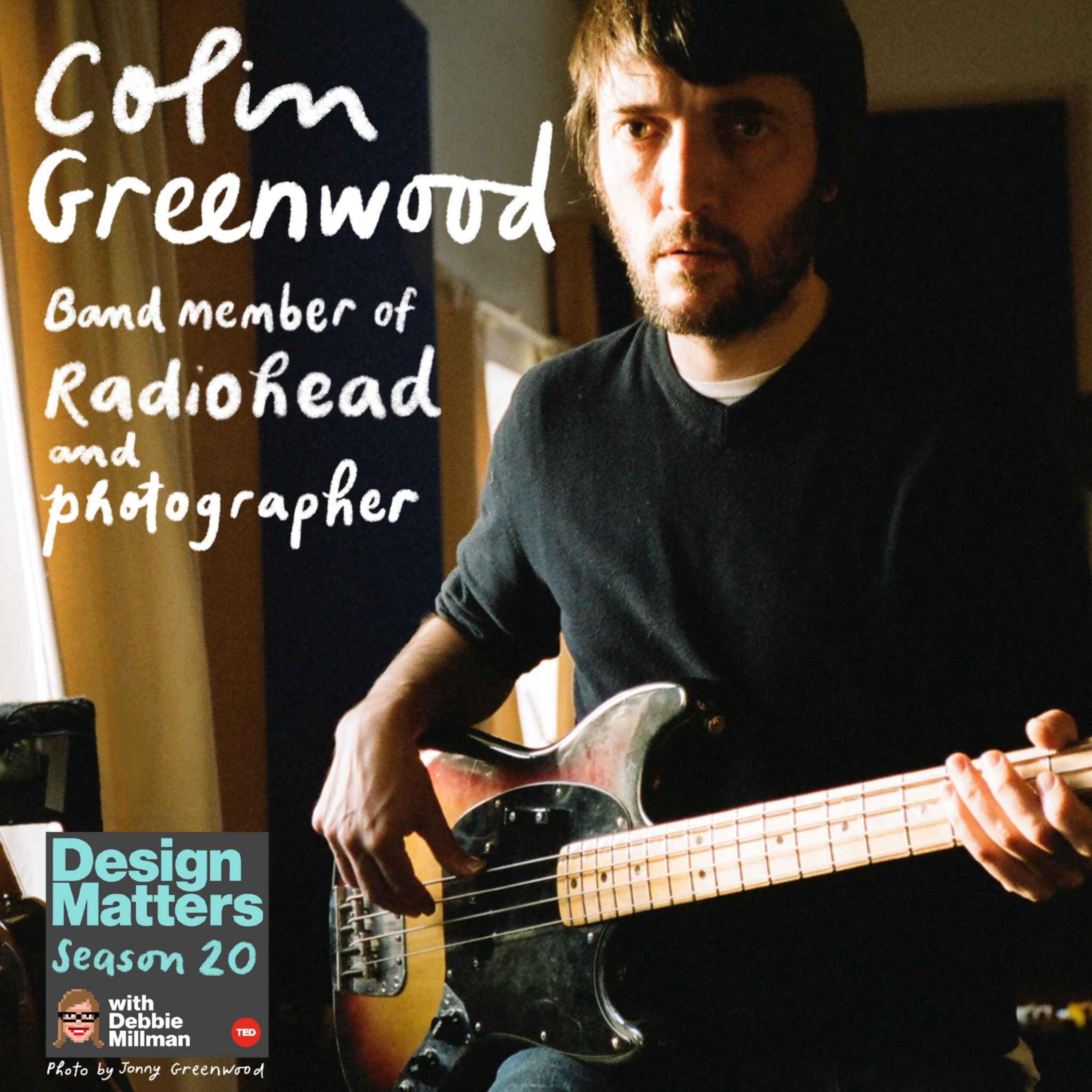
Colin Greenwood
There was one point we were playing, I was playing with Nick Cave and the Bad Seeds and Nick's like playing the piano next to me on stage and he turned around and he said, are you taking photographs? Because I think he must have heard a clicking sound or something. And I was like, no.
- [00:20]
Debbie Millman
From the TED Audio Collective, this is Design Matters with Debbie Millman. On Design Matters, Debbie talks with designers and other creative people about what they do. They got to be who they are and what they're thinking about and working on. On this episode, Debbie talks photography and music with Colin Greenwood, the bass player for Radiohead.
- [00:42]
Colin Greenwood
Our first few records are more bomby bomb and then perhaps our later records are more sort of blippity.
- [00:49]
Ryan Reynolds
Ryan Reynolds here for I guess my hundredth mint commercial. No, no, no, no, no, no. Don't, don't, don't. No. I mean, honestly, when I started this, I thought I only had to do like four of these. I mean, it's unlimited to Premium Wireless for $15 a month. How are there still people paying or three times that much? I'm sorry, I shouldn't be victim blaming here, give it a try@mintmobile.com switch whenever you're ready.
- [01:12]
Advertisement Speaker
$45 upfront payment equivalent to $15 per month. New customers on first 3 month plan only. Taxes and fees. Extra speed slower above 40 GB C Details.
- [01:23]
This episode is brought to you by Progressive Insurance. You chose to hit play on this podcast today. Smart choice. Make another smart choice with Auto Quote Explorer to compare rates from multiple car insurance companies all at once. Try it at Progr, Progressive Casualty Insurance Company and affiliates not available in all states or situations. Prices vary based on how you buy gold.
- [01:44]
Debbie Millman
Let's say that you're in a world famous rock band and you, the bassist, are a shutterbug. For years you've been taking pictures with a small black camera in hotel rooms, in bars, backstage and even on stage. And then the time comes when you release a book of those photos and many unguarded fugitive moments of your band are on display as never before. I'm speaking about how to Disappear. A photographic portrait of Radiohead by Colin Greenwood, the bassist in Radiohead, one of the most important successful and experimental rock and roll bands of the last 40 years. Colin Greenwood joins me today to talk about his career in music and his brand new beautiful book. Colin, welcome to Design Matters.
- [02:39]
Colin Greenwood
Debbie, thank you so much for the invitation and for that wonderful introduction.
- [02:43]
Debbie Millman
Absolutely, My pleasure. Colin, you were born in Oxford, England, but because your father served in the Royal ordinance, your family moved to Germany and then to Didcot, Suffolk, Abingdon and Oakley. I believe you attended five primary schools and even lived in Germany long enough to learn the language. Can you still speak any German?
- [03:09]
Colin Greenwood
I spoke some German and sadly, I did it at secondary school, high school, but I didn't have a very good teacher, and sadly not. But I did do French, A level, so I can order a baguette in Paris. So the thing about what you talked about, all those schools, I guess when you say that, I think you could either become like a raging introvert or you just get very good at making friends all the time. And I think that's a quality that can be part of being a band too. Like Michael Stipe, there's a bunch of people, Mark Eitzel, some people I know like that they were like army brats, as you like to say, you know. So I think there is this interesting correlation. There could be perhaps between people who are like, moved around a lot like that and worked in entertainment.
- [03:54]
Debbie Millman
You grew up in a home with music always in the background. And I understand your parents favorite records were by musicians including Burl Ives, Scott Joplin, Simon and Garfunkel, and even Mozart's horn concerto. That's quite a range.
- [04:12]
Colin Greenwood
Yeah, I guess my parents would have liked the kind of music that was just sort of described as sort of classical music. And more of the pop stuff would have been Simon Garfunkel. And my first. My brother's first record was probably Burl I Junior Choice, which is a collection of American sort of children's little folk song. Big Rock, Candy Mountain. Do you know that? Obviously?
- [04:31]
Debbie Millman
Yes, yes.
- [04:32]
Colin Greenwood
You know, so those are kind of our first records, me and my brother growing up in Germany, because there was no television while we were in Germany, that was in English, so we didn't have any. We didn't have a television. So we just had to entertain ourselves with records and books and writing.
- [04:46]
Debbie Millman
Your parents brought you, your older sister Susan and your younger brother Johnny, musical instruments and encouraged you to play them. And what instruments did they get you all?
- [05:00]
Colin Greenwood
Well, my sister is a bit older, so she kind of. She. Her musical contribution, I suppose, is that she brought music to the house. So we listened to records that she would buy, whether it's like Dylan or Beatles or reggae or whatever on post punk. And then in terms of musical instruments, my brother, I think his first instrument was a recorder. And I had a guitar, and then my brother played a viola and I carried on with the classical guitar. That's kind of what we did really, until radio had kicked off. When we were in our teens.
- [05:34]
Debbie Millman
Now you mentioned your sister and the music that influenced you. What did that include?
- [05:40]
Colin Greenwood
She brought lots of different kinds of records into the house, which is really great, like you know, Scar soul, reggae, quite a Catholic taste. But I would say, you know, record that was big for me, which she probably didn't bring into the house, was Joy Division. I loved that was my favorite when I was about 13. But, you know, lots of different kinds of music, to be fair to her. And we sort of bop around the front room and my mother bought a Sony receiver, you know, one of those sound systems. But yeah, that was, that was made the main musical influences of me and my brother growing up.
- [06:16]
Debbie Millman
Tell us about your Toshiba Radio cassette player.
- [06:20]
Colin Greenwood
It was a single speaker, probably about. What's that about 3 inch size speaker and a little black receiver thing with a cassette. And that was kind of my gateway to my gateway drugs of music. And it was, you know, cassettes, it was Cocteau Twins listening to eps, Everything was on cassette. And yeah, that was the thing that I found music through. And then after that, a little tiny, little JVC stereo receiver. Tiny. I'd call it a beatbox or a boom box, but it was more of a sort of murmur box. It was so small and. But it was just, you know, it was just fabulous. And since then I've spent my life in front of speakers, whether it's like in recording studios or at home.
- [07:03]
Debbie Millman
You attended Abingdon School wherein you had a lot of after school activities options and you took classical guitar lessons with the same teacher as your classmate. Tom York was the teacher, Terrence Gilmore.
- [07:18]
Colin Greenwood
James, he was the director of music at my school and he was actually our neighbor where I lived. He was just a wonder. He is wonderful, inspirational, full of energy. One of these people who's very driven and positive and you know, I was kind of outside of the music system. I felt outside it because I wasn't doing music to study. I was just, you know, exams. I was just doing classical guitar. But you know, he was a fabulous leader and for music at my school and I have very fond memories of him.
- [07:56]
Debbie Millman
He introduced both you and tom to 20th century classical music, avant garde music of the post war era, classic jazz and film scores. And I read that your first experience in a band together was when Tom joined the punk band TNT that you were in. Was that your first band? I read that you were in three different bands before Radiohead.
- [08:21]
Colin Greenwood
I wasn't really in that band. TV dnt and I don't know if they Were they were just like a couple of kids at the school. I think Tom did something with it, but it was all early days and then Palm was in a band and after my school, when he was at college, called the Headless Chickens. They put out a single called I Don't Want to Go Back to Woodstock, I think, which is fun. But when we were at school, it was just basically Radiohead from the ages of about 14, I guess. And we may have jammed with some other people, but that was kind of the thing.
- [08:56]
Debbie Millman
Why were you only able to play and rehearse on Fridays?
- [09:01]
Colin Greenwood
I don't know why. It was probably because that was when the school music school was free to practice or whatever.
- [09:07]
Debbie Millman
So the first band, the first name of the band was On a Friday. After TNT, Tom invited you and Ed O'Brien to start a new band which was named On A Friday. Is it true that your headmaster of your school once sent you a bill charging you for the £60? Why would he do something?
- [09:30]
Colin Greenwood
Well, you know, as I get older, as most people when they get older or perhaps some people, they get more sort of hard in their opinions and stuff. I sort of. My. My recollection of what happened is sort of softened as I've got older and I understand that my Sundays. His house is near, quite near the music school and we were rehearsing on a Sunday, not a Friday.
- [09:50]
Ryan Reynolds
He.
- [09:51]
Colin Greenwood
I think we probably like disturbed his weekend. So he sent us a bill for practicing on a Sunday, but the director of music tore it up and left it on his desk, which I think is brilliant. And the facilities at the school were amazing and I will always be very grateful for that. One of the things they did was this thing I realized now it's called, you know, active listening. Do you know what that is?
- [10:16]
Debbie Millman
Yes, that's a little bit what I have to do with. With the show.
- [10:20]
Colin Greenwood
Yeah, it's like an educational tool that was developed maybe after the war. It was a way of like teaching people about music. The idea of like, you know, you're not just. You just don't let it wash over you. So we had these music lessons which we would like be listening to like a. To meeter version of Masorski Pictures and Exhibition or something like that. Yeah. I realized what we were doing was we were having these lessons in active listening, which is of course what you do a lot when you're making a record.
- [10:47]
Debbie Millman
And it's hard. It's not something that you just sort of tell yourself you're going to do. I'm going to Listen, you know, really hard.
- [10:54]
Colin Greenwood
It's.
- [10:55]
Debbie Millman
It takes a lot of. A lot of training.
- [10:58]
Colin Greenwood
Yeah, well, it takes some energy and I think. But, you know, I think maybe like what Samuel Johnson said about books could apply to this too, is like, you know, if you listen to something and it's kind of boring, that's fine. You can just turn it off, like you would say about a book, you know. But I love listening to things that are satisfying in lots of different ways and don't just sort of modulate mindlessly.
- [11:22]
Debbie Millman
Because Ed already played guitar, you became the bass player.
- [11:26]
Colin Greenwood
Yes.
- [11:27]
Debbie Millman
Did you know how to play the bass at that time or did you pick it up once? You were sort of.
- [11:33]
Colin Greenwood
Yeah, I bought a. My mother, I think, probably got me a bass, a black bass called a Western DX Spectrum. Most important thing about it was it was black. And I played along with my little Toshiba thing. I managed to plug it into the microphone input of the thing to like. Like lots of Otis Redding and, you know, Booker T. Because their bass lines are fairly straightforward. And that was a way for me to learn, really. And then, you know, other stuff after that. So that's how I started.
- [12:05]
Debbie Millman
You said that the decision to play bass allowed you to dodge a bullet.
- [12:09]
Colin Greenwood
Yes.
- [12:10]
Debbie Millman
Why is that?
- [12:11]
Colin Greenwood
Well, I think it's because there's three brilliant guitarists in my band. I think it would be. It would have been, you know, very difficult for me to get a note in edgeways with all the other people. So it was a good thing. I was fortunate and I'm grateful to everyone for giving me the opportunity to play bass with them.
- [12:29]
Debbie Millman
The first gig you played was at a drunken school party with Ed and Tom and a drum machine.
- [12:36]
Colin Greenwood
Oh, yeah, that's right. It was a West Hinksey Rugby Club with the drum machine. It was Tom's Dr. Rhythm Drum Machine. And we were sort of stood in the middle with all these sort of, you know, drunk, sort of, I don't know, 17, 18 year olds. And it was just the three of us. It's quite fun.
- [12:55]
Debbie Millman
When did Phil Selway, your drummer, join the band?
- [12:58]
Colin Greenwood
Well, he was like three years, two or three years older than us. He was at the. So we thought he was cool because he was already in a band, Jungle Telegraph, so we poached him.
- [13:09]
Debbie Millman
And I read that your younger brother Johnny begged you to join the band.
- [13:13]
Colin Greenwood
Yes, that's right. And we briefly had another keyboard player as well, but then my brother came in. My brother came in to play keyboard. I think that's what he did originally. Had A keyboard.
- [13:24]
Debbie Millman
Wasn't he also playing the harmonica?
- [13:27]
Colin Greenwood
Yeah, harmonica, recorder, penny whistle, maybe. It's one track of the Bay. Plays viola on an old track. Beautiful song, actually, called Chains. And then he picked up the guitar listening to the Pixies and Lou Reed. We love this album by Lou Reed called New York.
- [13:48]
Debbie Millman
Did you sense at that time that he would end up becoming the sort of musical genius he is today?
- [13:55]
Colin Greenwood
Well, he was always very musical. He's always been into his music. You know, he had a scholarship when we were at school, so it's been his thing since he was like a little boy, so something he's always loved.
- [14:06]
Debbie Millman
I read in your book that you've never let him forget that it was you that got him into the band.
- [14:12]
Colin Greenwood
Yeah, that's right. I call him up, like, every so often, like, you know, remind him. No, it's just. It's really good, you know, it's been really. It's been really nice. We're not like other brothers, perhaps, in music, who've been in bands together and might have a sort of fraught relationship. It's always been very good.
- [14:34]
Debbie Millman
You played your first public gig at the Jericho Tavern on Walton street in Oxford on August 14, 1986. You were 17 years old and you shared the stage with your bandmates and four other bands. And you write in the book that this experience gave you the ambition to make a life in music. What was it about that night that solidified this for you?
- [15:02]
Colin Greenwood
I think it was just the excitement and the culmination after rehearsals of being on the stage. The volume, like noise, the sheer sort of physical, visceral sound of everything is. Is so thrilling. It was just great to be part of something in the band that was then part of a scene in Oxford. You know, in some way some kind of a connection with all the music that we were listening to at the time, whether it was, you know, Scar or post punk or whatever, you know. So that was just a really wonderful way to spend time, you know, as our mother said it was. She used to say, well, at least it keeps you off the streets.
- [15:44]
Debbie Millman
Didn't she want you to be a lawyer?
- [15:47]
Colin Greenwood
No, I don't know what she wanted me to be. But what I loved about my mother's take on our music is that she didn't sort of care for it per se, but she called it bompity bomb music. And then when we went to more sort of electronic stuff, which she obviously had heard, like sort of some modern classical, I think she called it Blippity Blob. Something like that. And I like to think that's actually a very accurate description of like Radiohead's musical sort of creative arc.
- [16:13]
Debbie Millman
In what way? How would you.
- [16:15]
Colin Greenwood
Well, I'd say our first few records are more bombity bomb, and then perhaps our later records are more sort of blippity blob. You know, more as in electronic bleeps and blops, bloops and saying bleep. You know, in many ways, I think my mother's commentary foreshadowed a lot of, like, the finest music journalists who've written about Radiohead and 20 years ahead, so well done, her.
- [16:40]
Debbie Millman
I say, would you say your bass playing has changed between boppity bop and blippity blip?
- [16:48]
Colin Greenwood
It's always been trying to find somewhere to fit in, I suppose. But no, I think that's one of the. My bass playing is one of the sort of. The reassuring, sort of reliable, dependent staples of the sound. Something you can rely on.
- [17:03]
Debbie Millman
Well, I mean, if you listen to songs like 15 Steps.
- [17:08]
Colin Greenwood
Yeah.
- [17:09]
Debbie Millman
Weird Fishes, those songs would not be. I mean, there's so many songs that wouldn't be the same without your bass.
- [17:15]
Colin Greenwood
Line, but very kind of you.
- [17:17]
Debbie Millman
No, 15 step is one of my all time favorite Radiohead songs.
- [17:21]
Colin Greenwood
Oh, wow.
- [17:22]
Debbie Millman
And I listened to that song to feel the bass, to actually feel like there's this crescendo when the bass comes in that just kills me.
- [17:34]
Colin Greenwood
Yeah, it's great, isn't fun? Yeah. What happened was it was on a. I'd got a 909 drum machine a few years ago and then we just had it set up in rehearsal and then we just used it as a sort of rough pattern for that. And then basically sort of wrote around the pattern, I think it was.
- [17:51]
Debbie Millman
And then Lotus Flower as well. That song would not be the same without your bass line.
- [17:57]
Colin Greenwood
Oh, thanks. I think that's like. I can't remember. That's like a keyboard and then I played it. Or it's a keyboard and then I played it live. I can't really remember whether Tom did a keyboard bass line on that or whether I did.
- [18:14]
Debbie Millman
It sounds like your base, but that's just my understanding of it.
- [18:18]
Colin Greenwood
Well, it is live. It's fun playing live. It's. Yeah, there's this guy called Joseph Lucky Scott who played with Curtis Mayfield, and there's another guy whose name I always forget, so that's not very helpful. Who played on Move on up and stuff like that as well. And I bring them up because that would be the kind of thing that I would, in my dreams, aspire to is that kind of playing, that combination of groove and melody.
- [18:45]
Debbie Millman
I read that you learned how to play by listening to Duck Dunn, Peter Hook Lee, Scratch Perry.
- [18:52]
Colin Greenwood
Yeah. And then people who played with James Brown, like Charles Sorrell. And I remember all these other people and the Motown book about James Jameson, I learned about two thirds of those, so that was amazing. Yeah. So bass is. It's a very sympathetic instrument. It's the bridge between the rhythm and the melody, the drums and the voice and the top line. That's what's so amazing about the bass is the ability to sort of combine rhythm and emotion, I suppose, and to change the emotional weather underneath the chords, which you can do with the bass as well, so.
- [19:26]
Debbie Millman
Oh, my God.
- [19:26]
Colin Greenwood
Yeah.
- [19:26]
Debbie Millman
Especially in 15 steps. Kills me.
- [19:31]
Colin Greenwood
Thank you.
- [19:33]
Debbie Millman
Now, you all had. You had an opportunity to sign a record contract, but decided to go to. You all decided to go on to college.
- [19:43]
Colin Greenwood
Yes.
- [19:44]
Debbie Millman
Instead of sign with a record company.
- [19:46]
Colin Greenwood
Well, we didn't have a contract before university, but we decided to go to university first, before we tried to get a contract in that very, very sensible way of thinking. Well, if it didn't work out, we'd have university degrees to fall back on. So that's why we went to university first, perhaps. And also just to have more, have fun and try different experiences. So that's what happened.
- [20:14]
Debbie Millman
You studied English literature.
- [20:17]
Colin Greenwood
That's right.
- [20:18]
Debbie Millman
Any particular authors that you found to be.
- [20:22]
Colin Greenwood
I really like lots of modern American writing and I like a lot of 17th century writing and poetry. 17th century, like Milton, Marvel poetry, stuff like that. Shakespeare. And then I really like modern stuff. I mean, I don't know Raymond Carver, Richard Ford, Edith Wharton. Just lots of stuff, you know, Willow Cartha, but lots of history as well. So, you know, big history, history, history buff, as a lot of people are now with the podcasts.
- [20:56]
Debbie Millman
Were you still playing together through college?
- [20:59]
Colin Greenwood
Yeah, we would meet up every holiday and we'd rehearse in village halls around Oxfordshire and we'd keep in touch whilst we were at college sending cassettes, or Tom would send cassettes of new songs that we would listen to and think about and then we'd get together and work on.
- [21:14]
Advertisement Speaker
This show is sponsored by BetterHelp. It's a simple truth. No matter who you are, mental health challenges can affect you and how you manage them can make all the difference. That's why everyone should have access to mental health support that meets them where they are and helps them get through. BetterHelp provides online therapy on your schedule. It's Flexible, simple to use and more affordable than in person therapy. Connect with a licensed therapist selected just for you. Learn more@betterhelp.com that's better. H E L P.com.
- [21:48]
Only boost mobile boost Mobile will give you a free year of service. Free year when you buy a new 5G phone.
- [21:54]
Colin Greenwood
New 5G phone enough, but I'm your hype man.
- [21:57]
Advertisement Speaker
When you purchase an eligible device, you get $25 off every month for 12.
- [21:59]
Colin Greenwood
Months with credits totaling one year of free service.
- [22:01]
Advertisement Speaker
Taxes extra for the device and service plan online only.
- [22:03]
Ryan Reynolds
Ryan Reynolds here for Mint Mobile. With the price of just about everything going up during inflation, we thought we'd bring our prices down. So to help us, we brought in a reverse auctioneer, which is apparently a thing.
- [22:15]
Colin Greenwood
Mint Mobile Unlimited Premium Wireless. 30. 30. Better get 30.
- [22:18]
Debbie Millman
Better get 20.
- [22:19]
Colin Greenwood
20, 20, 20. 15.
- [22:21]
Debbie Millman
15. 15.
- [22:22]
Colin Greenwood
Just 15 bucks a month.
- [22:23]
Ryan Reynolds
So give it a try@mintmobile.com Switch $45.
- [22:28]
Advertisement Speaker
Upfront payment equivalent to $15 per month. New customers on first three month plan only taxes and fees. Extra speed slower above 40 gigabytes. Detail.
- [22:37]
Debbie Millman
By 1991, you recorded your first demo tapes. The Manic Hedgehog demo was passed to Parlophone A and R rep Keith Wozencroft. And he did that after seeing you play live at Jericho's. And I believe that's when you got your record deal with emi. And I think that was another connection that you made.
- [23:01]
Colin Greenwood
I was working a record store and Keith Wisencroft was going to get a job in A and R@EMI and he was working as a rep selling records out of a rusty white van. So I gave him our demo cassette. I used to give our demo tapes to any record company sales rep who was interested, and they generally weren't fair enough. But it was also our management had a connection. So it wasn't just me and Keith, it was our management. We're friends with this guy called David Ambrose who used to be in a band called Brian or Trinity. He basically signed us to EMI together with a guy called Nick Gatfield. He used to play with Dex's Midnight Runners.
- [23:44]
Debbie Millman
Oh.
- [23:45]
Colin Greenwood
So that was how we sort of got our first contract.
- [23:49]
Debbie Millman
You write in your book that you were probably one of the last bands to sign a traditional record deal. And I'm wondering, is that a good thing or a bad thing?
- [23:59]
Colin Greenwood
I mean, I'm sure that other bands who signed record deals after us, you used to think what would have been like if we had been signed to the record label 20 years earlier, 10 years earlier, because you could see at EMI the vestiges of what the business used to be before, you know, when you had artists like Queen or Beatles or whatever. You know, it was like a big international company. We signed to Parlophone, which was the one half of the company. The other half was emi. The two marketing labels, EMI and Parlophone. So we. Yeah, so we signed to Parlophone, which was amazing. So we had all these, you know, home of the Beatles. And then through the American company, it was Beach Boys, Beastie Boys, anybody with boys in. It basically was on Capital. So we were going to become the Radiohead Boys in America on Capital and obviously just Radiohead EMI in Parlophone in the uk. Yeah, it was, you know, it was very exciting to be part of this, you know, British institution. You know, the records that my sister bought when I was like 9, 10 years old. I don't know if, you know, the Beatles Red and the Beatles Blue album, which, like sort of compilations of their songs. And they have pictures of them looking down over the center, like, stairwell of EMI office in Manchester Square. Well, that's where we signed. That's where we went.
- [25:24]
Debbie Millman
Wow.
- [25:24]
Colin Greenwood
So, yeah, that sort of artistic, cultural heritage is incredibly exciting.
- [25:30]
Debbie Millman
As I was growing up, I would look at those album covers and I'm sad that album covers aren't as big as they used to be. But I would get lost in the photographs and I would get lost in the worlds that these bands created with their visuals. Another band that I loved at the time and still love was yes, and Roger Dean was doing all their artwork for their albums and they were otherworldly. I felt that they were cosmic.
- [26:03]
Colin Greenwood
Yeah. Well, I just met Anton Corbyn with Nick Cave on tour and I think he was doing some project with Ignosis, which I want to check out, but I think it must be some kind of documentary that's out. But yeah, I mean, it was brilliant. They had the photographs of like the band on the stairwells. They had like all the artists depending on where you were in terms of, I guess, sales and success. You know, the least popular, like, least selling ones was some like, like 80s hair bands down by the drinks vending machine in the basement. Like each floor, as you got to lofty heights of or whatever, you get like sort of, you know, shots of Paul McCartney or whatever or Beastie Boys or, I don't know, Tina Turner or something like that.
- [26:53]
Debbie Millman
Wow. There was a hierarchy to the stairs.
- [26:56]
Colin Greenwood
That's what we all aspire to.
- [26:59]
Debbie Millman
Now, your first album, Pablo Honey, included the worldwide hit Creep and I don't want to talk too much about. I don't want to talk about that song really at all. But I'm curious to know how it felt to go from a small, local, hard working band with your schoolmates to essentially an overnight global sensation. Did it make you feel differently about who you were at the time?
- [27:28]
Colin Greenwood
Well, it was all happening far away. It was like Star wars, you know, somewhere long, long ago. And far away, I suppose, because it was happening in San Francisco and in Tel Aviv and where we had like our first radio plays for that song. What it meant though was that when we went on tour for the first time, say in America, we never toured in a van, you know, with a trailer. We, our first tour, we. We had our own tour bus with beds. Because we played all these clubs, which you would normally do with a van.
- [28:04]
Debbie Millman
Bringing in your own equipment and so forth.
- [28:07]
Colin Greenwood
Yeah, but I guess because we had some money from the record company to advance the touring and also because we seem to be selling the shows, there was a budget for a tour bus. So we were playing these clubs around America and arriving in a really nice American Eagle tour bus. So we were spoiled, really, but it was just. Just the best experience, just fabulous.
- [28:30]
Debbie Millman
You write in your new book that the Sugar Rush success of your first single probably saved you from being dropped by EMI and granted you the grace to record the album the Bends in 1994. And that album was initially overlooked when it first came out. And some dismissed Radiohead as a one hit wonder, which just sort of baffles me. Now, did you worry about the notion of becoming a one hit wonder at that time?
- [28:58]
Colin Greenwood
No, because I wouldn't say that we would think about what we do in terms of individual songs. When we were making our second records, Benz, we were like, you know, we were. We spent a long time in Rack Studios in London, which is a fabulous studios in St. John's Wood, around the corner from Abbey Road. Super famous, plays so many brilliant records and artists have recorded there. Al Green, Robert Plant, we had the time to make that record too. And it was one of my favorite albums.
- [29:30]
Debbie Millman
Mine too. You and the band went on to release seven additional studio albums that have changed rock and roll. You've sold over 30 million albums worldwide. You've won six Grammys. In 2019, the band was included into the Rock and Roll hall of Fame. Now, in addition to your work as a musician and a member of Radiohead, you are a photographer. And I read the first book of photography that captured your imagination was the book Vagabond by Gaylord Oscar Heron. What was it that intrigued you most about that book?
- [30:08]
Colin Greenwood
I think it's that thing where like you see a book of photography that's like the first book that you see. So like anything, whether it's your first record or your first painting or whatever, it stays with you. But I think what I loved about that book was how he managed to make a documentary book about his family neighborhood and sort of turn it into something, you know, engaging. And there's a text as well where he quotes, I think from the Bible about Cain and Abel, I think. But I think it's the idea that, you know, as a photographer you're basically something sort of solitary about what you're doing, but at the same time, you know, you're capturing other people, collective crowds, sort of a portraits and things like that. So it's quite so romantic, I suppose as well, that idea of how you see the world. I just loved all. I loved it. I loved the different types of photography in the book. As landscape, there's groups, there's portraits, there's documentary, this sort of abstract but close up photography. It is, it's. Yes, it's just a great book and I was very lucky to see that. And yeah, it's very beautiful and I recommend it to anybody, you know. And it was a very influential book as well for Larry Clark.
- [31:32]
Debbie Millman
Larry Clark, yes, I do. I have a photograph of his in my bathroom of naked people.
- [31:37]
Colin Greenwood
Larry Clark's in Tulsa, I think. And Gaylord Oscar Heron is from Kansas too, so not, not that far away, I don't think. But I think he was a big influence on all those people.
- [31:48]
Debbie Millman
What motivated you to start taking photographs?
- [31:52]
Colin Greenwood
Well, my friend Charlotte, who was in my band when we were in kids, she's a curator of photography and she did art history and then went to work at the Victorian Albert and she's a museum in London and she's like written some beautiful books on. On fine art art photography for Thames and Hudson and other aperture. And she very kindly patiently indulged my limited ability but interest in, in photography and I think that's, you know, it's. Through her I met some very fantastic photographers. So I have got a lot to thank her for.
- [32:28]
Debbie Millman
You've said that the photograph, the photographs in Vagabond influenced how you captured your experience of the Radiohead crowds. And I'm wondering if you can talk about in what way it did that.
- [32:41]
Colin Greenwood
Well, I think what's cool about when you take a picture of a group of people, you can get a sense of how music works too, in that you can look at people individually, but you can also see how they're interacting with the people around them, as well as how they're reacting to the music that they're listening to or the experience that they're having. Because when people listen to things or look at things with other people, both those things are going on at the same time. You know, there's sort of communal collective and there's the individual solipsistic as well, you know, that's how musical those things work, you know, and they're amplified by being shared with all those people. So I. I just really like that. And I like photography. I like typological photographs, you know, things of photographs, collections of things as well. So, you know, what is a crowd, but if it's not like a collection of people that's been assembled, you know. And as human beings or as. As animals, we're always looking to make connections or combine what we see and make sense of things that are put together in. In nature. And that's what you do with crowds, either by seeing what they have in common or what they look. That's different. What's different about them? So that's kind of why I like all that stuff.
- [33:55]
Debbie Millman
Was the band your first subject or were you shooting other things before that?
- [34:02]
Colin Greenwood
No, it was. I think it was banned, really, so. And in fact, the beginning of the book, I'm using a camera similar to the one that. What's it, Gaylord Oscar Heron was using. It's like a simple Japanese SLR camera. One of my regrets is when I should have just. I couldn't have used it on stage because it's too heavy. But I wish I just kept that one, really. But I still have it. It's amazing.
- [34:23]
Debbie Millman
I read initially that you took a lot of photographs with remote cameras and GoPros.
- [34:29]
Colin Greenwood
Yeah, I did. I've got those photographs and the colors are kind of cool. I placed them all around the stage before we played. But the point of view is kind of weird because obviously I couldn't have them in people's faces. So I've got them like on the floor or like strap to some mic stands and things.
- [34:46]
Debbie Millman
What kind of camera do you currently use?
- [34:49]
Colin Greenwood
Well, I've splashed out. I was in Australia and I went to Leica in Melbourne and they had the shop demonstration of unlike a digital M11. And I've been using that and it's actually kind. I really like it. It's my first. Well, it's my second digital camera. I suppose I've been using it. I've been photographing nick caves and the bad seats with it. And I think I've got some nice picks.
- [35:14]
Debbie Millman
You've said that an analog camera records light like a vinyl does sound.
- [35:22]
Colin Greenwood
Yeah, I suppose an analog camera records light like photons landing onto chemical paper, sensitive photosensitive paper or film rather. And then vinyl obviously records vibrations. It's kind of similar. But yeah, I think, you know, I love both. I mean, I've just been listening to two records this morning here. You know, I keep going back to vinyl because I find something about the process of playing a record goes back to that active listening when we were at school. I suppose there's something sort of engaged about it that I really like. And then. Whereas I love digital as well, don't get me wrong. But there's just something about records that makes me happy. Other than the price.
- [36:10]
Debbie Millman
Well, there's. In addition to the active listening, there's sort of a physicality to it because you're constantly having to move the needle back if you're sort of obsessive listening like I used to do, and then turning the album over. And the sequence was so important as well. What two albums were you listening to this morning?
- [36:29]
Colin Greenwood
I was listening to Schubert's Amadeus Quartet playing Schubert. And then I was listening to some lute music played by Jacob Lindbergh playing the Raw off lute playing a guy called Jacob Lindbergh. I listened to records and music more than I look at the television. I don't really look at the television.
- [36:50]
Debbie Millman
You've collected quite a lot of your photographs and have published a new book. It's called how to Disappear. Yes, and it just came out. And it is a beautiful collection of your photographs of the band between 2003 and 2016. From the albums Hail to the Thief until the most recent studio album, A Moon Shaped Pool. And the title of your book is taken from a partial title of a song from the album Kid A. The song had to disappear completely. And the song also contains the lyrics I'm not here, this is Happening, which I know was inspired by a conversation that Tom had with Michael Stipe. Now, does the title have anything to do with the sort of way in which you were photographed and the desire to not be intrusive?
- [37:51]
Colin Greenwood
Yeah, absolutely. You're completely right. I think it's not. It's a joke, it's a cheap pun. It's a gag for the title. I suppose it's like it's about the fact that I'm not really in the book. I'M sort. There's one picture of me in the book that my brother took, and so I haven't completely disappeared, but, yeah, it's just how to disappear. The joke is, of course, I can't be in the picture because I'm taking the pictures. I kind of, like, had the title for the book and I had the COVID for the book way ahead of anything else, because, in fact, the COVID of the book, which is all these flight cases that we had all done in purple when we started, because we thought that no one would steal an ugly purple flight case. We had on the Radiohead website. We had that for about a long time, about three years, in our really sort of very graphical image to have on the. On. On the website.
- [38:49]
Debbie Millman
Now, you weren't taking photographs from the outside in the way that a cameraman might be filming a concert. You were actually in the middle of all the activity and the performances.
- [39:01]
Colin Greenwood
Yeah.
- [39:02]
Debbie Millman
Did you take photographs covertly, or did your bandmates or crew or audience see you at the beginning?
- [39:09]
Colin Greenwood
Yeah, I never took anything covertly and. But I always felt really awkward about taking photographs. I still. Still do, probably, but I think a lot of photographers do. I was talking to one of my heroes in New York, a guy called Paul Graham, who's just an incredible photographer, and he said the same thing to me. There's sort of of awkwardness and reticence that he has about, you know, interrupting people who, when he makes a photograph of somebody, if he's on the street in New York, he like, will show them, you know, to see if it's okay. And, you know, and because, of course, what. You can do that with digital, you can show them, and then if they don't like it, you just go, okay, and you just delete it there. And then, you know, rather than film. Oh, yeah. I kind of wish I'd been more upfront with it, but I never see it as a sort of career plan, you know, so. Because my career was planned to be.
- [39:58]
Debbie Millman
Music, in my prep for this show, I came across an interview where you stated that one of your regrets is that you haven't been bolder with the lens, got closer, taken more photographs. And you said you're shy with the camera. Do you still feel that way, or has it changed at all over the years?
- [40:17]
Colin Greenwood
No, I'm still shy. But then I also know that, you know, there are things that if you're interested in something, you think there's something there. There's this great title by one of my favorite photographers, Wolfgang Tillmans, you know, is Called if one thing matters, everything matters. If you see something that you, you want to photograph, then the question really becomes not should you take a picture of it? I guess you have to think about how you want to frame it or what is it about it that you see. My other favorite quote, my friend taught me is a Nick Knight. You know who Nick Knight is? He's like an amazing. He's like a super famous photographer. You know the COVID of Buick's album Homogenic.
- [40:55]
Debbie Millman
Yes.
- [40:55]
Colin Greenwood
So he did that and he, he has a great quote which is like one of the things. It's very simple thing to say, but very, very, very difficult or very liberating is photograph what you see and photograph what you want to see. And with those two statements, like they two different things, or how you combine those two things is what could make a successful image.
- [41:19]
Debbie Millman
You photographed your bandmates in the recording studio, in dressing rooms, in tour buses, yawning, meditating. There are even photographs in bathrooms. You shot Ed playing a guitar in a white tile box of a bathroom and Johnny playing a viola in the bathtub. There's even a shot of Johnny photographing Tom. And they're all candid.
- [41:44]
Colin Greenwood
Yeah.
- [41:45]
Debbie Millman
But there's a real intimacy to them.
- [41:48]
Colin Greenwood
Yeah.
- [41:49]
Debbie Millman
That makes them more than just banned photographs. They almost feel private. Was that intentional?
- [41:56]
Colin Greenwood
Well, I love that book. I mean, you know, I'm not making any great claims as a photographer, but like with the music, you know, you're obviously influenced or inspired by other. By great photographers. One of my favorite photographers is a guy called Robert Frank who made a book called the Americans. He was a Swiss German photographer and he was like a sort of photographic survey, road trip of America. And he managed to make this book of photographs that were sort of intimate glimpses really of a nation. Do you know what I mean? If you ever see that.
- [42:30]
Debbie Millman
Yeah.
- [42:31]
Colin Greenwood
Captured sort of moments across a country. So I'd like to think that. But you know, but then, you know, I. I'm not very technically very good. So all the ones I really wanted to take, you know, generally were too. Or underexposed or blurry or both.
- [42:45]
Debbie Millman
I'm imagining that you've probably taken thousands of photographs.
- [42:51]
Colin Greenwood
Yeah. And I am. My understanding of like professional photographers who I work with, who I've met rather, is when you look at contact sheets, if you have say one image in a roll of film that you like, that's good. I'm very lucky, I suppose. Had some lucky moments where I pointed to camera. It worked out.
- [43:11]
Debbie Millman
The photographs feel like they're markers in time. And evidence to what happened. And they're sort of cast in time, so to speak. They're memories. But they don't feel nostalgic?
- [43:23]
Colin Greenwood
No. Well, I think that a photograph is a recording of something in, you know, using time, like shutter speed of the camera. But there's another dimension of time, which is the time you leave the image that you take and the next time you look at it, which could be like five years later. And when you look at it, you know, the passage of time has had an effect upon the image. So it's not actually the same photograph that you took five years previously. And then of course, you can make an edit and combine it with other images. There's another layer of meaning that you add to it that is it may not have had when he took it originally. So there's all those different processes that are going on, which is, I think is very interesting.
- [44:05]
Ryan Reynolds
Ryan Reynolds here for Mint Mobile. You know, one of the perks about having four kids that you know about is actually getting a direct line to the big man up north. And this year he wants you to know the best gift that you can give someone is the gift of Mint Mobile's unlimited wireless for $15 a month. Now you don't even need to rack. Give it a try@mintmobile.com switch.
- [44:25]
Advertisement Speaker
$45 upfront payment required. Equivalent to $15 per month. New customers on first three month plan only. Taxes and fees, extra speed slower above 40 gigabytes on unlimited. See mintmobile.com for details.
- [44:38]
Debbie Millman
One of the things that I love about photography is how it gives you an accurate memory of something when you think about your past and it's just an idea or a thought. You know, you have memories of memories, whereas a photograph stays the same. You might have different ways of interpreting it, but the image is the image frozen.
- [45:04]
Colin Greenwood
Yeah. Well, and I think anything that if it works as a, as a, depending what kind of photography, I suppose if it works as an image, it sort of will resist becoming dated. Like someone like Alfred Stieglitz, who's probably my favorite photographers, or Bernie Sabat, you know, they can make a photograph that is as fresh, freshly minted as the day it was taken.
- [45:29]
Debbie Millman
Yeah. I listened to an interview with you on, I think it was on YouTube where you said that the idea for the book began when you were in a car with Nick Cave in Asheville, North Carolina.
- [45:43]
Colin Greenwood
Yeah.
- [45:44]
Debbie Millman
So how did, how did he help solidify the idea?
- [45:47]
Colin Greenwood
Oh, he's just such a brilliant, engaging, curious, super smart person who. I was in a car. We were Doing these shows or I was supporting him while he's playing the piano. So we just have these conversations and I was struggling to find a way into the book and how to start writing it. And then he just said to me, when did you start taking, when were the pictures starting from? And I said well, they start from this period, period 2003. And he said, well, what were you doing as a band then? And he said well, we were sort of in the middle of our career from where we are now, I suppose. And he said why don't you write about what that was like? Well that's like. I was like, oh yeah. So he's a bit. I told him, I thanked. I think I gave him a credit in the book and he was surprised and I had a great chat with Warren Ellis. You know Warren Ellis?
- [46:35]
Debbie Millman
Yes, I do.
- [46:35]
Colin Greenwood
The Dirty Three and the Bad Seeds obviously. And co writes with Nick and Warren was telling me about when he wrote his book on Nina Simone's gum and what that was like.
- [46:46]
Debbie Millman
That book is amazing. I mean even the idea like let's make a book about Nina Simone's chewing gum.
- [46:54]
Colin Greenwood
Yeah. So they're both really supportive and I have nothing but gratitude and respect for both of them and I'm very lucky that I've had the opportunity to work with them. Them.
- [47:09]
Debbie Millman
A very dear friend of mine is very good friends with Nick Cave and I asked her to ask Nick for a question to ask you today. So. So my next question is from Nick Cave.
- [47:24]
Colin Greenwood
Oh.
- [47:24]
Debbie Millman
Colin Greenwood is one of the most unassuming and humble people I've ever met. I have long suspected that his ever present camera is a way of diverting attention away from himself and back towards the person he is photographing. Is this true? Is his camera a way of holding people at bay?
- [47:48]
Colin Greenwood
I don't know if that is true because I think that feels like an egotistical act in itself. Really. You know what it's about? It's about light. It's like where lights works and falls in somewhere on someone or something, you know, I mean I don't think I use the camera to keep people away because I think you'd have to be sort of quite egotistical to think of it like that really. And it's like I'm more apologetic when I pick up a camera. Less, less sort of self protective. So I don't think so. But he's probably right. I don't have any confidence in doing that. But as I said, I've met some of my heroes. They, they seem to share that lack of confidence. So, no, I. I wouldn't. I wouldn't want to do that because I just. I love people and being with people, so I wouldn't keep people at bay with a camera. I don't think so. Does that give you an answer?
- [48:40]
Debbie Millman
Absolutely. You've been touring with Nick Cave and the Bad Seeds and you mentioned that you're also taking photographs of the band as well. When you're taking photographs, do you take a lot of photographs and then decide once you've seen them, which are good, or do you have a sense, as you're taking them, that this is the moment?
- [49:01]
Colin Greenwood
Well, both. Well, I wasn't taking pictures on stage because it's not my band, unlike Radiohead. There was one point we were playing, I was playing with Nick Caves and the Bad Seeds and Nick's, like, playing the piano next to me on stage and he turned around and he said, are you taking photographs? Because I think he must have heard a clicking sound or something. And I was like, no. And the other things, I can't take photographs with them, really, because I'm playing all the time. I have more photographs of the Bad Seeds, of Warren. Well, of everyone, really, except Nick, because I just didn't want to intrude too much. I've got more candid pictures of Nick rather than like, sort of stage pictures of Nick, if you like, more backstage and working pictures. I don't have any working pictures, but they're all such lovely, welcoming, kind, creatively open people who, when they're dealing with stuff, like musical stuff on stage, they all talk to each other. It's been just a real education and a privilege.
- [50:04]
Debbie Millman
In addition to photography, the book is also a beautiful object. How did you decide on the design and the layout?
- [50:13]
Colin Greenwood
Oh, well, that's a. A fantastic question because it's something I care about and I'm so proud of as well. The book was all printed in paper and the printing was all done in Verona, and it was designed by this amazing guy called Duncan White. He's from London, but he lives in France and he's a really incredible book designer who's made some beautiful photography books over the past few years. And he's also worked with a really famous photography book design maker called Gerhard Steidlaw, who's made some of the most beautiful books in the world. So he worked with him in Hanover and he. I found Duncan through an old friend of mine called Michael Mack, who has a beautiful publishing photographic book imprint called MacBooks, who publishes people like Paul Graham and basically tons of amazing People. And one of my favorite photographers is this woman called Collier Shaw. Makes these beautiful portraits. And I briefly was in touch with her in the 90s. And yeah, I just. I'm a big fan of hers and that's what's great about Instagram. You can find all this work still. So the book was put. Was. Was very much. We basically did what Duncan said in terms of the design and layout, and I'm just thrilled with it. And it was published by a fabulous house called John Murray, who also Pub Slow Horses. Do you know Mick Heron and Slow Horses?
- [51:44]
Debbie Millman
Yes, I do, yes, yes.
- [51:46]
Colin Greenwood
And my old friend Nick Pearson published it at John Murray, who. He's one of my oldest friends and he published people like Jonathan Franson, Larry Mantel, people like that. He's just incredible publisher and editor. So I'm just so flattered and grateful that he would consider working with me. And, yeah, the whole experience has been an unalloyed joy from start to finish.
- [52:13]
Debbie Millman
How were you able to choose the photographs in this sort of narrative arc of the book?
- [52:18]
Colin Greenwood
Well, the edit was like. Well, we had about 350 photographs and then we boiled it down to about 100. Odd, I suppose, but it was like Duncan, the editor. We had them in the pile of, like, rough prints and like. Yes, yes. No, no, yes, yes. And then from that rough edit, Rough selection, Duncan basically helped with making an edit where the flow of images kind of goes from the studio and the songwriter, the music writing, working on the songs to, you know, the recording to the promotion to the stage. So there's like a nice sort of outwards, sort of funneling outwards of the images, which I think is really beautiful. And then it's interleaved with three sections of text of around 10,000 words, where I sort of actors, sort of some commentary, I suppose, to. To how we started as a band and describes, like, some of the situations that some of the photographs show you.
- [53:15]
Debbie Millman
I think it's more than commentary, though. It's almost diary, like. It's very in the moment. What was the process like as you went through?
- [53:24]
Colin Greenwood
Well, I had like a sort of setup where I would, like, try and write around 300, 500 words a day. And then I'd send the writing off to Nicholas, who's famous for his Christmas cake baking, and he bakes two a year. And he basically, the analogy, he was like, folding what I'd written into the rest of the ingredients. So instead of. He was making a sort of Christmas cake with my photography book.
- [53:48]
Debbie Millman
I love that analogy. I'm wondering if you would consider reading a short excerpt of your essay from how to Disappear A Portrait of Radiohead. I've chosen the excerpt because I think it's one of my favorite in the book.
- [54:05]
Colin Greenwood
I'd love to and it starts like this. There's a photograph of Tom with his hands held together in front of him. It's the end of the night somewhere in America. I can't be sure where because the image is so murky and the vast blacked out caverns are so similar. Let's say it's New Orleans Smoothie King Arena 3rd of April 2017 around 11pm we finished our second encore and Tom is here thanking the 20,000 people out front. The white strip to Tom's left is his black and white rhodes piano, wheeled on and off on a riser like a musical prop. I've stayed on stage while the others have drifted off and I'm standing stage left closer to Ed's microphone to take in the image of Tom and the crowd. The preceding two and a half hours were full of light and color. Acid blues, greens and yellows, near ultraviolet purple that lends everything on stage an extra 3D glow. There are remote controlled spotlights, cameras, multiple mirror balls, film projections from front of house onto a stage wide silvery surfboard screen that is studded with thousands of light emitting diodes. Thirty years ago you could burn your leg on a floor lamp and now the white hot heat of Technology Runs Cool is pixelated and fiercely bright. One day this back screen will have more resolution and fidelity than the performers in front. But at the end of the show the stage lights go down, the house lights stay low and we're finally left alone without our force field. In front of all those people they have their phones raised up like cigarette lighters for the last power ballad. Their LEDs are lit this time to help illuminate the sudden darkness as the audience records a scene. Many are live streaming from their phones. Thousands of one person outside broadcast units for the web kids across the world and all its time zones. These haloed points of light throw up a weird phosphorescence like creatures from the deep hailing each other from inside the black belly of the Smoothie King, rippling up from the arena floor all the way to the nosebleed Rake of the gods. In another 60 seconds the house safety lights will flood this scene and wash it away until it ebbs back two nights later at the Dunkin Donuts Center.
- [56:36]
Debbie Millman
Colin Greenwood thank you, thank you, thank you for making so much art that matters. And thank you for joining me today on Design Matters.
- [56:48]
Colin Greenwood
Thank you, Debbie. It's been fun to talk to you. Thank you so much.
- [56:51]
Debbie Millman
Colin Greenwood's new book is titled how to A Photographic Portrait of Radiohead. And to read more about Colin's work, you can go to radiohead.com or wasted headquarters.com and I'd like to thank you for listening. And remember, we can talk about making a difference. We can make a difference or we can do both. I'm Debbie Nullman, and I look forward to talking with you again soon.
- [57:18]
Design Matters is produced for the TED Audio Collective by Curtis Fox Productions. The interviews are usually recorded at the Masters in Branding program at the School of Visual Arts in New York City, the first and longest running branding program in the world. The editor in chief of Design Matters Media is Emily Wylett.