Loading summary
Transcript171 lines
- [00:01]
Craig Federighi
Oh, well, you know, did it change that much? Like I, that feels very comfortable to me. I understand it. And then they start to use it and then hopefully it's, it's.
- [00:09]
Debbie Millman
Ooh, yeah.
- [00:10]
Craig Federighi
Ah, this is nice. Yeah. Yeah. You know, and that, that's what we are going.
- [00:12]
Alan Dye
It suddenly makes the old one feel very old.
- [00:15]
Craig Federighi
Yeah.
- [00:15]
Alan Dye
You know, that's still good. Parameter.
- [00:16]
Craig Federighi
Still good. Vintage.
- [00:17]
Alan Dye
Yes, vintage.
- [00:21]
N/A
From the TED Audio Collective, this is Design Matters with Debbie Millman. On Design Matters, Debbie talks with some of the most creative people in the world about what they do, how they got to be who they are and what they're thinking about and working on. On this episode, Craig Federici and Alan Dye talk about working at Apple and about the new operating system they've helped design.
- [00:45]
Craig Federighi
As Apple sees the potential for AI that it's best when it's integrated right into the places where you need.
- [01:02]
N/A
Banking with Capital One helps you keep more money in your wallet with no fees or minimums on checking accounts and no overdraft fees. Just ask the Capital One bank guy. It's pretty much all he talks about in a good way. He'd also tell you that this podcast is his favorite podcast too. Ah, really? Thanks. Capital One bank guy. What's in your wallet? Term supply. See capitalone.com bank capital1na member FDIC.
- [01:29]
Craig Federighi
Now.
- [01:29]
N/A
At Verizon we have some big news for your peace of mind. For all our customers existing and new. We're locking in low prices for three years guaranteed on MyPlan and my home. That's future. You peace of mind and everyone can save on a brand new phone on MyPlan when you trade in any phone from one of our top brands, that's new phone peace of mind. Because at Verizon, whether you're already a customer or you're just joining us, we got you. Visit Verizon today. Price guarantee applies to then current base monthly rate. Additional terms and conditions apply for all offers.
- [01:59]
Brooke Devart
Hi, Brooke Devart here, host of Naked Beauty. Every week I talk to my audience about beauty and self care. I'm someone who spends a lot of time in the bathroom. It is truly my sanctuary. So investing in a smart toilet from Kohler has been life changing. The Kohler Vail smart toilet has a heated seat, hands free opening of the lid and customizable bidet functionality. It is incredible. But beyond the technology, the design is just stunning. The veil's curved silhouette in honed black actually inspired creative director and fashion designer Laura Kim to create a stunning black chiffon dress that debuted on the Runway at New York Fashion Week, the creative partnership between Kohler and Laura Kim is changing how we think about everyday objects. Like a toilet. Transform your routine into something extraordinary with the Kohler Vail Smart Toilet.
- [02:49]
N/A
Here's a wake up call. Right now your liver is filtering everything from fast food to fancy drinks. But there's a game changer that 3.5 million people are talking about. It's called LiverMD. 80% of LiverMD users saw significant improvements in their liver test results, plus better energy digestion and less bloating. Backed by clinical research and trusted by health professionals, physician formulated LiverMD takes liver care to the next level with seven clinically studied ingredients at their clinically effective dosages. For real powerful results. From happy hours to heavy meals and everyday environmental toxins, your liver's keeping score. Time to flip the script with Liver MD feel the difference in 90 days or it's free. Visit1md.org and use code TEDTalks to save 15% on your first order.
- [03:43]
Debbie Millman
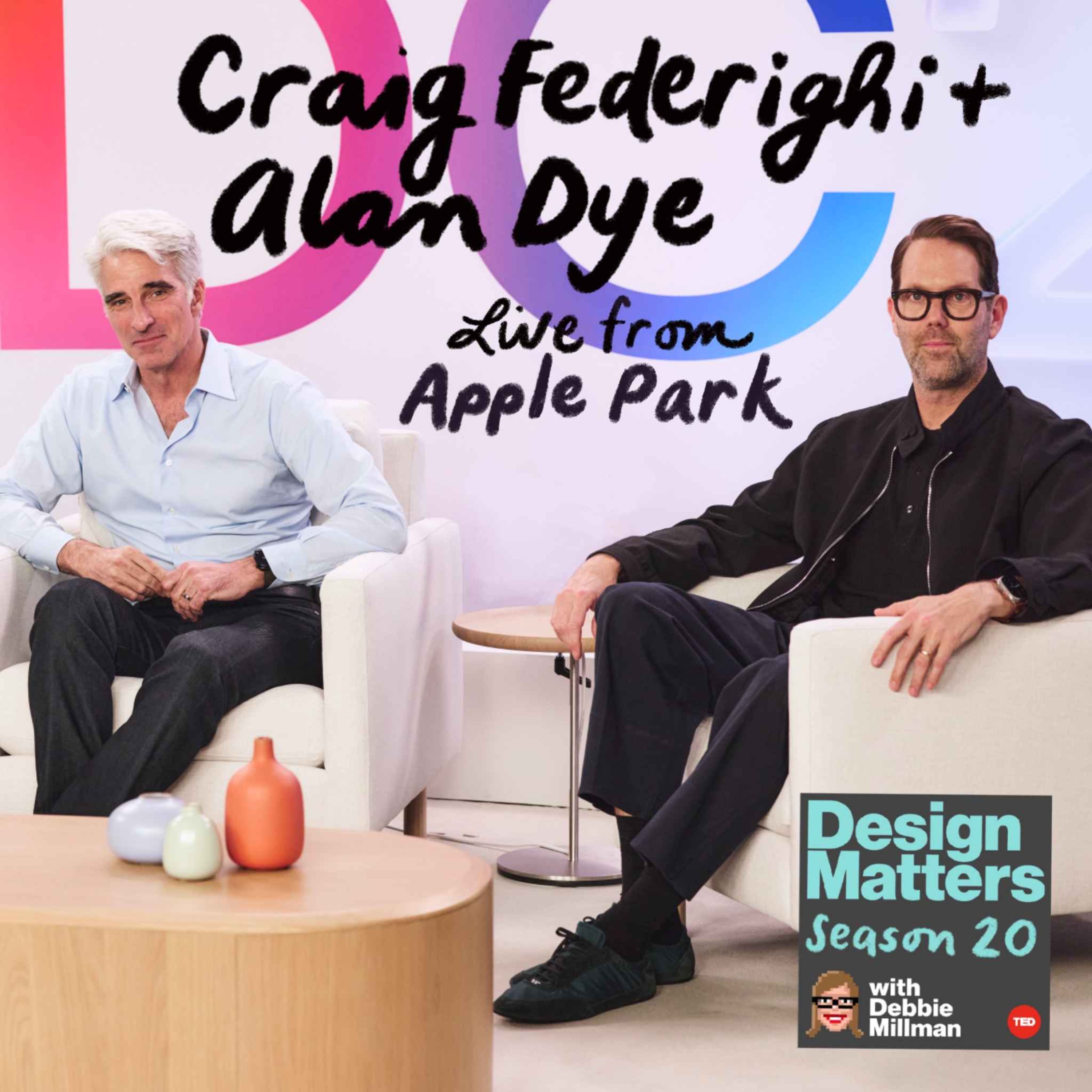
Today on Design Matters, I have the distinct pleasure of speaking with two of the most influential creative and technological leaders shaping how we experience the digital world. Craig Federichi is Apple's Senior Vice President of Social Media software engineering and the charismatic face of many of Apple's most groundbreaking innovations. He's been instrumental in the development of macOS, iOS, iPadOS, and Vision OS. With his trademark humor and clarity, Craig has become not only a steward of Apple software, but also a beloved presence at the company's signature product announcements, helping millions of users understand not just what's new, but why it matters. Joining us is Alan Dye, Apple's Vice President of Human Interface design. Alan leads the team responsible for the look, feel, and behavioral language of every Apple product, from typography to motion, from icons to interaction models. Under his leadership, Apple's interface design has become more intuitive, expressive, and cohesive across devices, balancing form and function with elegance and restraint. Together, Craig and Allen represent the rare combination between engineering and design at its highest level. Their partnership doesn't just shape how Apple products work, it shapes how they feel and behave. I recently had the opportunity to watch the most recent Worldwide Developers Conference keynote, and I'm thrilled to be able to talk with them both about the much anticipated launch of iOS 26. Craig Federici and Alan Dye welcome to this very special live episode of Design Matters at the audio Studio at Apple Headquarters in Cupertino, California.
- [05:44]
Craig Federighi
Well, thank you. It's wonderful to be here.
- [05:46]
Alan Dye
Thanks Debbie.
- [05:46]
Debbie Millman
Much longer than usual intro, but so much to be said and I want.
- [05:50]
Craig Federighi
To say, while I have to agree with everything you said about Alan, I. I can't let stand all those things you said about me. That was. Oh, that was a lot.
- [05:58]
Debbie Millman
Wait till. Wait, there's more. Oh, no. Well, regular listeners of Design Matters know that I've interviewed Alan several times over the last two decades.
- [06:08]
Alan Dye
Yeah.
- [06:09]
Debbie Millman
So today, before we talk about the launch of iOS 26, I want to start by delving into the origin story of Craig Federighi. Is that okay with both of you?
- [06:18]
Craig Federighi
I guess we don't have a choice.
- [06:19]
Debbie Millman
Yeah, I was going to say you're locked and loaded.
- [06:21]
Alan Dye
I've already done this a few times. So.
- [06:25]
Debbie Millman
Craig.
- [06:26]
Craig Federighi
Yes.
- [06:26]
Debbie Millman
I found an article written about you on theringer.com.
- [06:32]
Craig Federighi
Oh, dear.
- [06:32]
Debbie Millman
And it described you as follows. Who is Craig Federighi, you ask? Craig is a cold glass of kombucha after a tough yoga class. Craig is the high you get when you catch the perfect wave and just carve it. Craig is ceramic hors d' oeuvre bowls that just came out of the kiln, perfectly glazed. Craig is a long, cold shower after a weekend at Burning Man. Craig Federici is a bona fide Californian dreamboat. So, Craig, my first question is more.
- [07:12]
Craig Federighi
This is torture, by the way. I was not prepared for what's happening here.
- [07:17]
Debbie Millman
So my first question is really more of a request.
- [07:20]
Craig Federighi
Okay.
- [07:21]
Debbie Millman
Can you please tell me all about your beloved nickname, Hair Force One?
- [07:28]
Craig Federighi
Yeah, I guess I can. So it actually goes back to a WWDC, and I don't remember if it was 2012, 2011, something like this, where of all things, we were, we were introducing some feature and involved Game Center. And in Game center, you're supposed to have a handle for, for gaming. Right. And so they were setting up the, the demo accounts for the demo I was going to give on stage. And they said, oh, well, what, what should your name be? And I said, I don't know. And they, some marketing was kicking out all of these, these ideas.
- [08:02]
Debbie Millman
What were some of them?
- [08:03]
Craig Federighi
I don't even remember now. And, but they were, you could tell they weren't happy with what they were. And so at one point I said, it's okay if you want to say something about my hair. And like a second later they said they sent that back. It was like you knew they had it and they just weren't. Yeah, but I mean, so, so that was there. And it, it, it did catch on a little bit. It's never something I would call myself, but it, it appeared, you know, in the, in in the, in the sign on and it stuck. But from growing up, my brother, I had a little brother who was always trying to take me down a notch and he would make fun of my hair, like nonstop growing up. So it's quite a thing that it took shape on the stage at an Apple event one day later.
- [08:49]
Debbie Millman
And how does your little brother, what does he think about the nickname?
- [08:55]
Craig Federighi
He remains critical.
- [08:57]
Debbie Millman
So you were born and raised in San Leandro, California?
- [09:01]
Craig Federighi
Yeah, here in the Bay Area.
- [09:02]
Debbie Millman
Do you remember the first time you saw a computer?
- [09:05]
Craig Federighi
Oh, absolutely. Well, the, the first time I saw, you know, a computer that I could sit and type on. You know, you saw them on the Six Million Dollar man on television. Something that had big, you know, tapes that were, you know, moving back and forth and lights that were blinking, but was actually in the Lawrence Berkeley labs where, you know, you take. Kids would get to get to see things. You take a field trip there. And I saw a computer and of course was. Was fascinated by it. But the real moment for me is there was an after school class when I was in fifth grade, I think, I think it was 10 years old, and there was an Apple II. And I sat down with that thing and it was fireworks for me. It was an immediate, like, this is what I want to do with my life was the experience when I sat down with that computer. And immediately it was like, I need to save up, I need to find a way to buy a computer. And it, it became an obsession that really clearly has not yet ended.
- [10:03]
Debbie Millman
What role did creativity have in your life as you were growing up?
- [10:08]
Craig Federighi
I've always been drawn to music, but not especially good at it. But that doesn't stop me. You're a Rush fan, I believe, and that is true too. That is very true. I think for me, creative problem solving has always an inventive way to solve a problem. Sort of MacGyver things a lot. But also when I got into computers, what was so attractive to me is that you could build things and you could create sort of real things at almost the speed at which you could imagine them. You know, creating in the physical world seemed to me like I was too lazy for that. Or it took, you know, it took too long. And with a computer, if I had an idea, I could sit down and, and create it. And I was really motivated to do things for my family. My mom was. I pulled her into being like an unlikely early computer user because I was fascinated with them. And then I would build things for her use to do the things that, that she did.
- [11:04]
Debbie Millman
What kind of things were you building?
- [11:06]
Craig Federighi
Well, so she was, she was involved in League of Women Voters and doing a lot of work with documents and things. So I would create things to do like mail merge for or keep little databases of things. And then my, my dad had a small business and I created accounting software for him. So it was, it was all this, this sort of thing and it was, I was always hungry to find, you know, something more to build. I always wanted to learn. I mean, there's always this cycle, right, that you, you want to, you want to learn. And then when you learn something, you want to figure out how to use this thing, you learn to build something. And then as you start building something, you realize there's something more you need to learn to actually realize the vision that you have about what you're trying to build. And that virtuous cycle just, you know, never ends.
- [11:49]
Debbie Millman
At that point in your life, what did you think you wanted to do professionally?
- [11:53]
Craig Federighi
I wanted to do computers, whatever that, whatever that meant. Yeah, I mean, I was aware of, I lived down the East Bay, so I wasn't in Silicon Valley. And in that sense, like what was happening in the heart of the valley with Apple was seen far away to me. But I would read about Apple and about Steve Jobs and you know, the creation of the Mac was the second fireworks going off moment for me, which is seeing how this technology that I loved came together with the visual arts, with interaction design. Like that. Fusion was just incredibly eye opening to me. And from that moment on I was just, I want to be at Apple. I want to work, I want to meet the people who can do this kind of thing. I want to work with the people who do this kind of thing.
- [12:46]
Debbie Millman
You studied at UC Berkeley where you earned both your bachelor's and master's in computer science and your first job out of Berkeley was at next working for Steve Jobs.
- [12:57]
Craig Federighi
Well, technically, and I hate to say, I hate to have to correct you on this point because I wish, I wish it were true that it was next. But I did work at Oracle, believe it or not. And this was because I was not. You know, I meet kids these days that are so awesome about managing their careers and where they think they want to go. This is this, yes, this was not a great focus for me. As I was winding up college. I knew I wanted to spend a winter skiing and being at being a ski bum. And so I did not really tend to the career management sort of process. And Oracle was a very persistent recruiter and was actually willing to hire me even Though I told them I was going to quit in six months and so, so that's where I started. But after I completed that, that skiing adventure, I did, I did find my way, well to grad school and, and then to next, which you know, was. Yeah, and obviously an amazing stepping stone in my, my career is really, I mean Next, it was one of the rivers that flowed into Apple's products today. And getting to be part of that and work with those people was amazing.
- [14:05]
Debbie Millman
So given the history that you were having with your experiences, your early experiences with computers, it wasn't by accident that you ended up at next.
- [14:15]
Craig Federighi
Oh no, no, no. So I mentioned that when the Mac came out that I was obsessed with working for Apple. Well, midway through college at Berkeley, the Next Machine came out and Steve Jobs came to Berkeley and I saw Steve come in and demonstrate the Next computer. And I mean it was, it was the full Steve Jobs treatment to this, you know, little group of us in this auditorium at Berkeley. And from that moment I was like, actually I'm not working at Apple, I want to work at next. And it is being drawn to the people that do the work. Like you see something like the care that went into the Next machine, the technical innovations, the aesthetic innovations, the usability innovations. I mean it was just, my God, I, I have to, I have to meet these people, I have to work with these people. I have to learn how to do what, what they do. I want to be part of this. And so it was my obsession after that point to work for next. And I actually bought a NEXT computer which, you know, put me in very rare company if you ever heard. We, we didn't, you know, NEXT and sell a whole lot of those, but I got one on, on close. I hope you still, I do, I still have it. It's downstairs in my house. And I absolutely was dedicated to the idea of finding my way to next.
- [15:27]
Debbie Millman
Greg, I have two more questions before we start talking about yesterday's big reveal. What was it like working with Steve jobs as a 20 year old?
- [15:38]
Craig Federighi
Amazing. Intimidating. I mean when I first got into computers as a little kid, Steve was a hero, right? He was, you know, you don't have too many people in the technology world, at least back then, you know, pre Internet, that you would even get exposed to as, as a potential role model and that yet Steve was out there as at that time when I was young, you know, he was young, he was this 20 something person who was innovating and charting the future. And I was seeing him and going, wow. I mean and it made it tangible that like young people could change the world. And so it was, it was incredible to be in the presence of, of one of my heroes and, and ultimately to get to know him. I think one of the earliest moments I had working with him there is. We were, I was working on this team that was doing what, you know, compared to what we do today, sort of this obscure database oriented stuff. And Steve appeared in our hallway and wanted to see what we were working on. And we started talking about it and he was pitching an idea of how, how he wanted to present it. And I said, well, it's surprising I chose to speak up because I was, I was very young and new and whatever. But I said, well, you know, actually it doesn't, it doesn't quite work way, you know, the way you're talking about it does, it doesn't quite work that way. It's like how does it work? And I said well, it really works this way. And he said, well, you know, if that's the way it works, then that's the way we need to talk about it. Right. And so there was, there was a curiosity and deep integrity in, in how he wanted to represent the truth of what we were building. And I, I was very impressed with that at the time as a young person.
- [17:17]
Debbie Millman
Apple acquired Next in 1996. And so you got your dream of working. Exactly, but working with Steve. You left for Ariba in 1999 but returned to Apple a decade later. You're now senior vice president of software engineering. What does that mean?
- [17:37]
Craig Federighi
Actually it means my childhood dreams were completely exceeded beyond all reason. I think it means Apple, as you know, is functionally organized. So some companies will split them in pursuit of growth, will split themselves up into business units and say, well, this is the iPad division and they'll have their own, you know, marketing team and hardware team and design team and software teams. And then, oh, this is the iPhone division and this is. Apple has never been that way. Apple has said we are functional experts. We have experts in design, we have experts in software, we have experts in silicon and hardware and services. And we organize ourselves that way so that we can drive the greatest level of expertise in our disciplines and drive the greatest scent, the greatest degree of coherence and consistency in the work we do. Because you see these, these business unit cultures, they create a mishmash of uncoordinated products. And for Apple, our whole proposition is to create a unified set of products that you feel as a customer, they were, they were designed by one hand and they were architected by, by one set of engineers and so forth. So I have the amazing privilege of leading the software teams that take the amazing design work that comes out of Alan's team and collaborate with them on bringing it to life across the range of products that Apple builds and create. The platforms that third party developers who also play such a big role in every iPhone, iPad, Mac user's experience, give them the tools and the platform on which to build. So that's what it is. That's the job.
- [19:24]
Debbie Millman
As I mentioned, at the top of the show, I had the opportunity to watch the most recent WWDC keynote wherein you and Alan Dye talked about the upcoming launch of iOS 26. And you bring a certain showmanship to Apple's keynotes. Where does that theatrical side of you come from?
- [19:44]
Craig Federighi
Lord knows, it is the strangest, it is the most inexpensive. My own children say to me every year, they say, dad, it is so weird, given who you actually are, that they have you do these things. You know, I, I did not get into software engineering because of the, the, the fame potential, as you might imagine. And so it's been, it's been super, it's been super weird. But because I was a lover of music in high school, I was a dj, we had a high school radio station, which was pretty bizarre. And, you know, as long as I didn't have to, you know, actually small talk with people, but could play music and talk on the radio, I thought it was a blast. And so, I mean, maybe some part of that ended up translating to describing products to people on a stage, I'm not sure. But at some point someone threw me up there for some small thing and said, you seem to like to talk. And you know, so it has gone.
- [20:44]
Debbie Millman
The last iOS update was iOS 18, but the last significant design update was in 2007. You both just introduced a massive redesign across every Apple platform and product. What led to this new vision?
- [21:02]
Craig Federighi
I'm going to let Alan do some talking now.
- [21:05]
Debbie Millman
Hello again, Alan.
- [21:06]
Alan Dye
First of all, Debbie, I'm sitting over here very happy that I avoided that conversation and that line of questioning, because I know last time I spoke with you, I feel like you had a few gems up your sleeve that I wasn't quite ready for.
- [21:18]
Craig Federighi
But I heard you were known as one of the bad boys of design back then.
- [21:21]
Alan Dye
Yes, yes. That's the first and only time I.
- [21:24]
Debbie Millman
Was ever, always and forever, Alan Dyer.
- [21:26]
Alan Dye
Yeah, yeah, It's a funny thing, you know, we had a pretty significant redesign with iOS7 and that's where Craig and I really started our deep collaboration, and since then, of course, of course, the work that we've made together has evolved. There's no question it's very different. Last year's update looked very different from iOS7. But what we did this year was really quite significant, I think, something we couldn't have pulled off until now. We can talk a little bit more about that later. But from a purely experiential standpoint, I think a lot of things have happened over the past few years. We've moved to devices that have much more rounded corners. We did a lot of work on Vision Pro, where we became quite obsessive about glass. How do we represent digital artifacts in the real world? And glass was such a fitting material for that. So we really understood glass as a digital material, and we started to think about how that might translate to our other products. And glass is such an apt metaphor and such a great material because it really allows for you to kind of bring content, the user's content, to the forefront. We talk a lot about how do we get out of the way and allow for the user's content, whether that's video, photo or an application. How do we get out of the way and allow that to really shine through? And glass is something that can do that for us. We talked a lot yesterday about how we've advanced some of our hardware technologies to a point now where we can do some pretty powerful things in the software in real time. And so I think this all added up to us, exploring this new digital material that we ended up calling liquid Glass, that really becomes, in a lot of ways, the foundation for this redesign, and we think the foundation for the next chapter in all of our experiences.
- [23:12]
Craig Federighi
What's so exciting about our industry is that the underlying materials you have to work with, the underlying technology continues to evolve and open up new opportunities. And we've had this evolution of the power of our silicon, of the resolution of our screens, of their brightness, the fact we can do high dynamic range, bring out specular highlights, and then the screens, as Alan says, they've gotten rounder, they've gotten larger. All of this keeps shifting, really, the foundations around which a previous design was optimized for. Well, now you have a new set of capabilities and a new set really, of the environment that the user is going to be operating in. And enough had shifted over that time that really the right design for users to be using in 2026 was not the same design that made sense for the devices of 20. And we got to step back and reconsider that with all that we had learned over so many years, and for the first time ever, bring it broadly across all of them. Because the other thing that has happened since 2013 is that many of our customers, certainly our best customers, often use many of our devices. They might have. Probably have a phone, they might have an Apple Watch, they might have a Mac, an iPad, an Apple TV. They might use our product in their car with CarPlay. So to bring our best Apple experience in a coherent way across all of them, that sort of wasn't on the docket in 2013, but today, I think it's so much part of your Apple experience to have a consistent interface across all of them. And this year we got the treat to be able to pursue it.
- [24:59]
Debbie Millman
The new Liquid Glass aesthetic blends translucency, depth, motion. I'm really curious about how the design team arrived at this specific language and what types of emotional responses you were hoping and are hoping to evoke in your users.
- [25:21]
Alan Dye
It's always hard to understand where projects like this really begin. You know, I think one of the wonderful things about our design team, as Craig mentioned, is, like, we have one central design team that designs across all of our products, right? And so we're constantly iterating, we're constantly exploring across all of them and learning, right? So Vision Pro, we were focused on glass. I mean, you can think about the watch, how much came out of the watch and extended to our other programs like widgets and complications, things like that. And so it's harder to imagine, like, where the beginning was. But oftentimes what happens is we'll all get together and we'll see something that feels really exciting. And I do recall there being a moment where we were in the conference room and we looked at something and it was kind of the early days of what we now call Liquid Glass. And I think we all said, all right, we've got to go after that. And I think we're good enough at what we do to understand that. To take that germ of an idea and apply it to our operating systems is going to introduce a whole lot of complications and problems and some hurdles that we'd have to jump over and a ton of invention. But I think that's a very Apple thing to say. Not sure how we're going to get there, but that feels like something we've got to go off and do. There is that sense of, you know, design is really in everyone's. Yeah, you know, soul. Like, everyone wants to go off and make something wonderful.
- [26:45]
Craig Federighi
It is such an unusual Characteristic of Apple that for many, in many technology companies, and I've worked for a few others, and certainly work with people who've worked at a lot of others, often design's role is how do we take the constraints of this technology and whatever this technology makes easiest and try to get it into some reasonably palatable form that lets this product get out of the building. At Apple, our focus, and you know, Steve drove this to a huge degree, but it's been a cultural imprint at this point that getting to the right design is everything, and engineering is part of this. With the expectation that if we can find the product we want, if we can find the design, the experience that we want, at that point we will move mountains to make it happen. We will find a way technologically. We won't say, hey, here's. Here's the technology we have. What can you do with this? We will say, what's the experience that we want for these customers? And at that point, the experience we must deliver. And then every engineer at Apple knows and every design partner we work with knows we need to find the way to now make this real. And as Alan said, the. The moment we got our first glance at the liquid glass ui, we, we knew the make. Making it practical was going to be a huge challenge. Making it work across the diversity of places in the interface. You know, you take this material and you say, now it's going to work everywhere. It's going to work in the music app, it's going to work in a camera, it's going to work when you're sliding photos over, it's going to work in a news app, it's going to. And all of the different kinds of content, it's going to interact with all the dynamics, because one thing to have a nice still where everything's set just so, and another to have something that is durable enough to perform in all of these cases. And that is the incredible. You know, when we saw it, we both said, let's go after that. And oh, boy, this is going to be a journey to get it to something that's going to work.
- [28:55]
Alan Dye
Right?
- [28:55]
Craig Federighi
But there's that dedication to. That's why we're here.
- [28:59]
Alan Dye
And Debbie, I think you asked what we intended for the user, and I think one of the things that really got us excited was we've always been interested in taking these complex and capable technologies and making them accessible, but I think we've also been interested in making. Bringing a little joy to technology, Right?
- [29:14]
Craig Federighi
Yeah.
- [29:15]
Alan Dye
And so one of the things that we really started to focus on is how can we bring more of that delight into our software experiences? And that I think you see it and you'll really feel it when you actually use, in this case, iOS 26, that there's these little moments, whether it's just tapping a button or sliding a slider or swiping to unlock, where, you know, it just feels delightful. And I think that's another kind of hallmark of Apple, right? We not only want to describe the way that the product is used, but also make it fun also to feel.
- [29:51]
Debbie Millman
Really cool while you're doing it, which is one of my favorite things about engaging with your products. I feel like the halo just waves over me. I want to talk more about liquid glass and the new operating system, but I was really intrigued by what you just said about you come upon an idea and then you know that you need to pursue it. How many ideas do you have to come up with in order to get into that zone where, you know, this is what has to happen next?
- [30:24]
Craig Federighi
I don't know if we've counted, but there. There are. There are a lot of great. And I mean, it's. I sympathize especially with some of Alan's designers, because there are so many really good ideas that in the end, aren't the right idea for the product or the right idea, the product at that time. And in order to even make that determination, the amount of effort that has to go into crafting it, putting it forward in its best light, you know, only to realize, like, okay, now that we see it, that one. That one isn't working.
- [31:05]
Debbie Millman
Oh, that must be so hard, right?
- [31:07]
Craig Federighi
I mean, you know, they'll spend months, right, putting something together, and sometimes it's not right, but so often it actually isn't a dead end. It's something that we loop back on later. We realize, like, oh, and. And I think it also gives people the perspective that if you come forward with the design this time and this idea didn't quite hit well, it. It comes. It comes around.
- [31:30]
Debbie Millman
I'm really excited to tell you about a podcast that I am loving. It is from one of my favorite places on Earth, the Metropolitan Museum of Art. The show is titled 5000 Years of One Material at a Time. Hosted by Camille Dungey. Each episode examines a material of art. Clay, stone, trash, and even intangible things like space. You'll gain a deep understanding of what these materials make us feel and reveal about our history and our humanity. You'll also get a sense of the meaningfulness of these materials in art and how to see them in a whole new way. To listen to Immaterial, just search for Immaterial in your favorite podcast app. That's immaterial. 5,000 years of art, one material at a time. I love this show and I think you will too.
- [32:32]
N/A
This summer, Instacart is bringing back your favorites from 1999 with prices from 1999. That means 90s prices on juice pouches that ought to be respected, 90s prices on box Mac and cheese and 90s prices on ham, cheese and cracker lunches. Enjoy all those throwbacks and more at throwback prices only through Instacart. $4.72 maximum discount per $10 of eligible items. Limit 3 offers per order. Expire September 5th while supplies last discount based on CPI comparison.
- [33:06]
Alan Dye
Ready to order?
- [33:07]
Craig Federighi
Yes, we're earning unlimited 3% cash back on dining and entertainment with a Capital One Saver card. So let's just get one of everything. Everything. Fire everything. The Capital One Saver card is at table 27 and there are earning unlimited 3% cash back.
- [33:21]
Debbie Millman
Yes Chef.
- [33:22]
Craig Federighi
This is so nice. Had a feeling you'd want 3% cash back on dessert. Ooh, tiramisu. Earn unlimited 3% cash back on dining and entertainment with the Capital One Saver Card. Capital One what's in your wallet?
- [33:34]
Alan Dye
Terms apply.
- [33:34]
N/A
See capital1.com for details.
- [33:37]
Trust isn't just earned, it's demanded. Whether you're a startup founder navigating your first audit or a seasoned security professional scaling your GRC program, proving your commitment to security has never been more critical or more complex. That's where Vanta comes in. Businesses use Vanta to establish trust by automating compliance needs across over 35 frameworks like SoC2 and ISO 27001, centralized security workflows, complete questionnaires up to five times faster, and proactively manage vendor risk. Vanta not only saves you time, it can also save you money. A new IDC white paper found that Vanta customers achieve $535,000 per year in benefits, and the PLAT platform pays for itself in just three months. Join over 9,000 global companies like Atlassian, Quora and Factory who use Vanta to manage risk and prove security in real time. For a limited time, get $1,000 off vanta@vanta.com tedaudio that's V A N T A dot com tedaudio for $1,000 off.
- [34:40]
Debbie Millman
Alan, you just used the word delight and delightful, and it was a word I heard as well during the keynote several times. And it's a Surprising word in some ways, for Apple, the words that I would have more associated before the announcement were sexy, sleek, cool, sensual. There was a very immersive way of engaging with the product that, while I also think could be delightful, it wouldn't have been a word that I would have come to quite in the way I do now, having also seen the demos, because there is a real almost innocence to the way you can play with a lot more of the products now or a lot more of the ways in which you engage with the products. And it's different, but it also isn't so different that it feels alien to an Apple experience.
- [35:39]
Alan Dye
That's right.
- [35:40]
Debbie Millman
So I'm wondering if you can talk a little bit about that continuum. One of the challenges in any kind of redesign, whether it be brand or product or experience, is how do I keep the inherent integrity of what people love so much about this thing, but also redesign it in a way that feels surprising or delightful.
- [36:02]
Alan Dye
Right. I mean, a couple of things. First of all, I think we were very deliberate with that word, delightful, because one of the challenges we sometimes have is we have these wonderful keynotes or these presentations, and we're showing it all in video format in 2D. And like with Vision Pro is a great example where you really had to be in it to understand it, what a profound experience it is. And I think with this redesign as well, you sort of have to use it to understand what, you know, the full sense of it. You know, you use some other words that I hope are apt to describe it. You know, elegant, and I don't know if I would have said sensual, but that's.
- [36:37]
Debbie Millman
Oh, that's a Brian Collins word, actually. He talked about this sort of sensuality of swiping.
- [36:42]
Alan Dye
Oh, I'm going to stay away from that one. We love Brian. I think that people's opinions of it and their feelings around it are just going to change when they start to use it, just like yours did. So we talk a lot about change. Right. And we take it very seriously. We've got, I think, billions, 2.4 billion people out there using our products. Right. And. And from a design perspective, if we wanted to do something that was different, well, I promise you, we can knock that out of the park. We're pretty good at that, would be kind of easy. But our bar for change is so high because we know we have a responsibility to all those users, and change can be disruptive. You wake up one morning, get basically a new product with an update. And so one of our goals here was we said we want this to be very familiar to users. Right. And so we only make a change where we think it's really critical and necessary and a really good thing. So we're going after better now. At the same time, we wanted this to feel very fresh and new and have the user have that feeling of like, my gosh, it's almost like I woke up to a whole new product, but I know how to use it. And I think that's the. I mean, gosh, what a design challenge that's been for all of us, you know, to kind of pull that off.
- [37:59]
Craig Federighi
That responsibility that Alan talked about is, Is so huge and has grown so much as, as our products have become so much more widely used by such a diverse audience of every age and, you know, every point on the globe. You could imagine it becoming immobilizing, you know, that how could I make a change when so many people have become used to this this way? And someone is going to wake up in the morning and it's a lot of risk, and yet this is core to who we are. We have to move the products forward. And this is part of what our users, in some level, what attracted them to Apple in the first place. We can't forget that they want to see us delight them with new designs, but we have to do it in the right way. And our designs then have to operate on multiple levels. Where on the one hand it is familiar, you still know how to use it, and yet as, as you interact with it, you're pleasantly surprised by, by something extra. And that. Yet it was intuitive. And so surprise and delight is. I mean, there's a good kind of surprise and a bad kind of surprise, but the, the surprise and delight is something we, we reach for, but we're very conscious about what kind of change is going to be surprising and delightful and what kind of change is going to have someone feeling frustrated, confused. And so this is, this is something that we, we certainly put a lot of, a lot of thought into. But, you know, when I, I feel like when people see our current design on their first look, they're like, oh, well, you know, did it change that much? Like, I, that feels very comfortable to me. I understand it. And then they start to use it and then hopefully it's, it's.
- [39:46]
Debbie Millman
Ooh, yeah.
- [39:47]
Craig Federighi
Ah, this is nice.
- [39:48]
Alan Dye
Yeah, yeah.
- [39:48]
Craig Federighi
You know, and that, that's what we are going.
- [39:50]
Alan Dye
Suddenly makes the old one feel very old. Yeah, that's still good parameter.
- [39:54]
Craig Federighi
Still good. Vintage.
- [39:55]
Alan Dye
Yes, vintage.
- [39:56]
Debbie Millman
Well, one of the challenges in creating any design update or creating Something new with design is the notion that the only people that really, really look forward to design changes are designers. Like the public doesn't go to a shelf and think, oh, my goodness, would you look at that, My orange juice has been redesigned again. Oh, joy. People don't like change, but they also need change. So there's also this psychological conundrum in what we're used to, and then what will excite us. How do you manage the inevitable criticism that comes with every update, with every launch, with every redesign? And I'm really not talking about anything specifically Apple. It could be any logo for any company. How do you manage that?
- [40:50]
Alan Dye
I'll say. I find myself talking to the team a lot, and one of the things I generally say to them is like, what a privilege. There's a lot of people out there that really, really care about the work that we make, and we're lucky enough to have people who care deeply enough to send us notes, whether it's positive or negative. And I mean, honestly, it's the cost of being important in some ways, right? And it's the cost of having people care about the work that you make. And, and to Craig's point earlier, you know, we keep advancing the technology. We have new capabilities that come online, if you will, and we want to, you know, bring those to our products. That does mean change, right? But we like to think of it as, like, this amazing privilege in a way, that we get to be the sort of people that make work that put it out in the world that people really talk about. You know, there's lots of folks in the world, lots of designers who you pour, you know, a lot of energy into making work that goes out in the world that doesn't have billions of people caring as deeply as they do about it.
- [41:51]
Craig Federighi
You know, when, when iPhone introduced completely fluid animations where, you know, never, never a pixel shall errantly, you know, flow. And then you'll have customers send you a note with a, a video of, of a moment that you can't, you're, you're, you're, you're playing it back in slow mo, trying to spot the issue there. They're describing, you know, with, you know, the forensic camera work to try to understand, like, what do. But to them, they've internalized our values, internalized what we've been trying to achieve so much with the product and then hold us to it and look for us to exceed ourselves. And as Alan says, that's a privilege.
- [42:29]
Debbie Millman
I want to talk about some of the specific elements that I got to see over the last 24 hours, there's some real standout experiences. Live Translation, I think, is a game changer. I want to ask you about that. Workout Buddy is something very close to my heart. In the last two years since I've been working on my physical fitness, visual intelligence and messages photos on the lock screen, there's so many different things. Let's talk about life translation first, because I think it's really got the most global potential for better understanding each other, literally and figuratively.
- [43:09]
Craig Federighi
We're more connected than ever to people far away, around the world. In some cases, you have children here who have grandparents who don't speak the same language as their grandchildren, and yet they want to be connected. Right. We are distributed and yet connected in ways greater than ever before. And technologies like Live translation can close that gap. And this is one of these cases where, as Apple sees the potential for AI, that it's best when it's integrated right into the places where you need it. If you are messaging and you get a message from someone in a language that you do not understand or read, and yet the system can just right there translate it for you like magic, translate your reply as you type it, if you can have that tool available to you when you make a phone call or to make a reservation for a trip in a foreign land or get on a FaceTime call with that grandparent, you're empowered.
- [44:12]
Debbie Millman
Yeah. I mean, for people that haven't seen the demo, I want to explain that what you end up being able to do is talk in your native tongue to someone that doesn't understand what you're saying in their native tongue, and the phone translates in real time so that you perfectly can understand each other. Did I get that right?
- [44:34]
Craig Federighi
You did. Sounds pretty good.
- [44:36]
Debbie Millman
It's amazing. It's amazing. It doesn't even seem possible that that could be done so quickly in real time with such accuracy. But I tried it today and it does. It actually does.
- [44:51]
Craig Federighi
How?
- [44:51]
Debbie Millman
How? That's my question. How?
- [44:55]
Craig Federighi
It's the I mentioned earlier. How it is such a treat to be part of an industry where the underlying materials with which you work are becoming so much more capable every. Every year, every month, our Silicon team does amazing work, taking that little, you know, square centimeter that we give them and creating incredible power to do literally trillions of operations per second. And if you. I mean, it's made boggles the mind. Trillions of operations per second that can run these advanced deep learning models that can understand speech, can synthesize speech, can translate between languages, you know, with the work of our modeling teams, it's, it is magic. And yet it's so great to work with, you know, all the disciplines across the stack of people with mastery and these things that make the magic real.
- [45:59]
Debbie Millman
So much of what we've come to expect from the iPhone goes well beyond an actual phone. But in this new launch you actually make two really significant improvements to the way that we engage with phoning, speaking on the telephone, call screening and hold assist. So I'm wondering if you can also tempt our listeners with what they're about to be able to do or prevent.
- [46:31]
Alan Dye
Others doing, you know, not speaking on the phone.
- [46:35]
Debbie Millman
Yeah. So if you can share, share a little bit and describe what call screening and hold assist are. Even though it might seem self explanatory, it's really beyond. So if you can, if you can share.
- [46:47]
Craig Federighi
Sure. Well, and I'll say this is, you know, one of the huge treats of working at Apple. We are customers of our products. Right. These are very much as much a part of our lives, I guess, maybe even more so than, than everyone else and part of our family's lives. And so as we get together and have our experience with getting spam phone calls, getting, you know, having, having a device that is with you all the time and available to you all the time is a superpower. But it also means you are reachable.
- [47:17]
Debbie Millman
Yeah.
- [47:17]
Craig Federighi
By sometimes people you do not want to talk to all the time. And, and that is not a treat. And so this is something we all felt very personally about and we realized that what, what we want is. Some people say, look, if it's someone I know, it's fine. They could let the call through. If it's someone I don't know, I don't want my phone to, to ring and interrupt what, what I'm, I'm doing. I'd like them to have to explain what they want. And then I can just look at my phone and say, no thank you and, and be, be done with it, not, not be interrupted. And so with call screening, you know, your phone will do just that. It'll answer the call, it'll say, you know, Alan is busy right now, but can you let me know what you'd like to talk to them about and I'll put it through and they'll say what they want to say and then Alan's phone will just say, well, this is the, maybe it's saying that this is the plumber and I'm going to be late now. I wanted to know that.
- [48:12]
Alan Dye
Right.
- [48:13]
Craig Federighi
Or maybe they're saying, I got. I have something to sell you. And, boy, could this. And, you know, Alan just turns his phone over, right? And so being having the technology be more considerate of your attention and not interrupting you, I mean, these are ways that we feel like we can really impact people's lives in ways big and small. And then hold assist. I mean, my gosh, if you get put on hold and then you're like, oh, my God, I'm chained to wherever the. The phone listening to this darn music. I can't.
- [48:40]
Alan Dye
Yeah, yeah.
- [48:41]
Craig Federighi
And we just said, can we flip the tables on this now? You wait for me. I'm gonna.
- [48:45]
Alan Dye
Yeah.
- [48:45]
Craig Federighi
You know, it recognizes the great. Our favorite part is that it actually recognizes hold music. So, you know, because you always have this problem with these great features is how do people know they exist? How would they even know to turn it on?
- [48:56]
Alan Dye
Right?
- [48:56]
Craig Federighi
But in this case, as soon as your phone hears the hold music come on, it pops up and it says, hey, would you like, you know, me to take over for this? You say, yeah, sure. Which point's like, great, go use your phone. I'll let you know when a human comes back on the line and is ready to talk to you. In the meanwhile, you can put your phone back in your pocket, go take a run, or whatever, and then your phone will ring, and it'll tell the person on the other side, you know, Alan is gonna be with you in just a sec. And then Alan picks up his phone and he can keep talking.
- [49:22]
Debbie Millman
The actual technology is spectacular and wonderful, but I love the psychology of being able to turn the tables as much. Thank you. A big thank you, Alan. I can't have a design conversation with you and not talk about typography. It's foundational to Apple's interface design. Talk about how, if at all, the system font has evolved with this release.
- [49:48]
Alan Dye
Oh, my gosh. Well, I mean, we're constantly evolving what we call San Francisco. In the family of San Francisco typefaces, we put a huge emphasis on internationalization. So we've been drawing typefaces in different scripts for quite a while, and we continue to do that. We made some small tweaks to the system font. Sort of what I would call sort of sanded off the sharp corners. I don't think anyone will notice this, but they'll feel it, and that really helps. That certainly helps with the glassiness of the time, for example, on the lock screen, and you saw how the time sort of programmatically will grow and make space for notifications and will not cover up the subject of your photo. There's some really cool stuff in terms of how we're playing with imagery plus typography. The one thing I do want to mention also is we have. It's not really a typeface, so bear with me. But we have this. It acts a lot like a typeface. We have this symbol library we call SF Symbols, and it's part of our family of San Francisco typefaces. And. And I bring it up because literally there's 20,000 symbols that we handcraft for developers. They're used just like typography, which is really cool because if you update it, it automatically gets updated. They're weight matched to all of our system fonts and things like that. And this year we introduced some really cool things where they draw on or draw off or animate in. And an example of that might be if I tap a button that has a check mark in it. Previously you would have just had a check mark show up instantly, and now the check mark draws on in this nice little way. And I promise you, very few people are going to send us emails of appreciation over that, but I think a lot of people will feel it. Yeah, right. And those are the things we really love, right?
- [51:38]
Debbie Millman
Absolutely. With the check mark. Because, you know, now, of course, I'm going to be obsessing until I can see this. Was it a function of the liquid glass or was that just an additional.
- [51:49]
Alan Dye
Well, it's just an additional thing we've been working on for quite a while.
- [51:53]
Craig Federighi
I got to say, as a developer, I'm personally so appreciative of the way Alan's team with the work on SF symbols took this tough task for any developer, which is, how do I develop a good set of icons to express the operations in my application? Most software developers don't have those skills, and even if they did, they're going to end up deviating in some gratuitous and distracting way from the language of the. Of the system. And so Alan's team had this vision of, we're going to give you the widest array of symbols to express the operations of your app. And now as a developer, they're all just there. Couldn't be easier to use them and use them in any setting at any size, and then to then take something as simple as this, essentially vector artwork that behaves like a font and bring it to life with animations. It's just stretched the bounds of what I could have imagined for the symbol library. And it really empowers our developers to Build apps that are beautiful and consistent, that are Apple quality with, with these symbols. You know, one thing you didn't mention though, on the fonts is, you know, international. We've, we've recently expanded to this large number of Indic languages in India. And of course there are these fonts for those languages that are quite different than a typical Roman typefaces. And Alan's team did all, all of this work because they're often mixed though, together with English language text. And to have that both be. Have the character of the native script and yet have the modernity and harmony with San Francisco for English text, I think is no small design challenge and an amazing piece of work that you guys did recently.
- [53:44]
Alan Dye
Thank you.
- [53:45]
Debbie Millman
One of the things that has been really fascinating to see as I've been able to observe the demos, is how some of the consistency around the behavior that you have with the devices has become more consistent across different products. So whereas before on an iPad, for example, you only could have one screen, one window open, I'm very excited to tell people that that is changing. That to me is as somebody that does all of my artwork, all of my interviewing on an iPad, the idea that I could potentially be multitasking is just mind blowing. But in any case, I'm wondering how you manage consistency across the platforms in the design and engineering processes. The watch, the OS, the iPadOS, the watch OS, the Mac OS. How do you troubleshoot? Will this work on this? Will this work on that?
- [54:50]
Alan Dye
I mean, a couple of things I think. I wish I had a great answer in terms of like, programmatically how we might do all these things. A lot of it is we're just all working together across the board and we'll notice something over here, we'll apply it over there. And, and that's one of the jobs we play, which is to say, hey, where there can be consistency, there ought to be. If we're going to break consistency, we better have a really good reason for it. Right. And so, you know, I think there's literally, it's through doing the work that we get to some of this kind of consistent language. And then there's a, you know, there's a small number of us that are bouncing between these different programs and we're trying to keep the communication alive to make sure that we are being really consistent in terms of the design language.
- [55:33]
Debbie Millman
Yeah, I mean, just the notes alone in all of the notes on the watch, notes on the iPad, notes on the Mac, they're all going to have a consistent way of behaving and now.
- [55:42]
Alan Dye
One great thing about that, just to mention is, like, we try to have one design team looking after that whole application, regardless of the platform. Right. And so that's interesting, too, because you need to have designers who are flexible enough to understand all those different platforms as well. Right, right.
- [55:58]
Craig Federighi
Well, and one thing you do that's, I think so smart is you. You have, you know, a unified space. All the designers are together, and all the work across all the platforms is up on the walls. So even if you're a designer who's focused on iPad, you are walking past work constantly under development. That's for the Mac. That's for the Watch. That's for Vision Pro.
- [56:22]
Alan Dye
That's right.
- [56:23]
Craig Federighi
You can't help. Help but being ambiently aware, almost like in harmonic resonance with this other work that's all around you, and then also realizing, like, oh, there is a connection there I should be making. And so the level of, of awareness within the studio and, and, and ultimately the desire for everyone to harmonize and bring this work together, I think is, Is part of bringing. Having the team together and having a space, constantly having the work on display.
- [56:50]
Alan Dye
Yeah, it's a strange thing printing up all this digital work on paper, but it works, actually really works, because it connects everyone to it and really inspires folks, too.
- [56:59]
Debbie Millman
So I have two last questions. They're more personal. When you think about your individual legacies, what do you hope to leave, not just in the industry, but in how people live?
- [57:13]
Craig Federighi
Oh, if I just produce some, Some good kids.
- [57:17]
Alan Dye
Yeah, yeah, that'll.
- [57:19]
Craig Federighi
That'll cover it. I mean, it's been an incredible privilege to be part of this thing that's so much bigger than me or any one of us at Apple and, And see it carry on. So that is. That is amazing. But. But it's way bigger than me. I don't, I don't think too much about a personal legacy other than, you know, having some kids that are good people.
- [57:41]
Alan Dye
Yeah, I mean, I think I'm probably right there as well. I mean, definitely right there with the kids. But, yeah, I think we, I mean, and I think we're just like, sort of caretakers. I mean, Apple's bigger than us. It's gonna, you know, it's gonna be around for a long time. I hope we're growing the next version of me and so we can pass it on to them in the future and continue doing the work with the same sort of set of values that we have.
- [58:06]
Craig Federighi
Yeah.
- [58:07]
Debbie Millman
Well, that leads me to my last question then. Ten years out how do you hope people will describe Apple's role in their lives?
- [58:16]
Craig Federighi
Oh, empowering. Delightful. And I think they feel that now. And I think the future of the ways that we can empower people's learning and their creativity and their ability to connect are just growing and growing. And the way we can make technology fade into the background, in many cases, just be something that's as simple as that piece of paper and, and yet enabling so much more. This is always our goal. And it's been, you know, I think we can all see that progress toward, toward that moment, and I think it's. We're getting there.
- [58:59]
Alan Dye
Yeah.
- [59:01]
Debbie Millman
I often say that it's not really the devices that people are addicted to when people talk about that. It's really the feelings that we get through the devices that we want so deeply to have. And, you know, I know it sounds a little bit maybe corny, but I do feel that Apple products do help create those feelings of connections in a more beautiful way.
- [59:30]
Craig Federighi
I think that's why people have an emotional connection to our products. I think you've hit on it.
- [59:34]
Alan Dye
Yeah, for sure.
- [59:35]
Debbie Millman
Craig Federici, Al and I thank you so much for making so much work that matters. Thank you for allowing me a little peek under the hood to see what you're doing and what you're about to launch. And thank you for joining me today on Design Matters.
- [59:48]
Alan Dye
Such a privilege.
- [59:49]
Craig Federighi
Yeah, thank you. This is great.
- [59:50]
Alan Dye
Thanks, Ted.
- [59:51]
Debbie Millman
You can read lots of lots more about all of the amazing new Apple launches on apple.com this is the 20th year we've been podcasting Design Matters and I'd like to thank you for listening. And remember, we can talk about making a difference. We could make a difference. Or we can do both. I'm Debbie Millman and I look forward to talking with you again soon.
- [60:12]
N/A
Design Matters is produced for the TED Audio Collective by Curtis Fox Productions. The interviews are usually recorded at the Masters in Branding program at the School of Visual Arts in New York City, the first and longest running branding program in the world. The editor in chief of Design Matters Media is Emily Wylett.
- [60:34]
Debbie Millman
Right on time.
- [60:36]
Alan Dye
Oh, that road just hit zero.
- [60:37]
Craig Federighi
Oh, my God.
- [60:41]
Debbie Millman
He's very worried about Craig's schedule.
- [60:45]
Craig Federighi
That's incredible.
- [60:49]
N/A
Now at Verizon, we have some big news for your peace of mind for all our customers, existing and new. We're locking in low prices for three years guaranteed on myplan and my home. That's future you peace of mind and everyone can save on a brand new phone on myplan. When you trade in any phone from one of our top brands. That's new phone piece of mind because at Verizon, whether you're already a customer customer or you're just joining us, we got you. Visit Verizon today. Price guarantee applies to then current base monthly rate. Additional terms and conditions apply for all offers.
- [61:19]
If you love to travel, Capital One has a rewards credit card that's perfect for you. With the Capital One Venture X card, you earn unlimited double miles on everything you buy. Plus you get premium benefits at a collection of luxury hotels when you book on Capital One Travel. And with Venture X you get access to over 1,1000 airport lounges worldwide. Open up a world of travel possibilities with a Capital One Venture X card. What's in your wallet?
- [61:45]
Alan Dye
Terms apply. Lounge access is subject to change. See capital1.com for details.
- [61:49]
N/A
Here's a wake up call Right now, your liver is filtering everything from fast food to fancy drinks. But there's a game changer that 3.5 million people are talking about. It's called Liver MD. 80% of LiverMD users saw significant improvements in their liver test results, plus better energy digestion and less bloating. Backed by clinical research and trusted by health professionals, Physician Formulated Liver MD takes liver care to the next level with seven clinically studied ingredients at their clinically effective dosages. For real powerful results, from happy hours to heavy meals and everyday environmental toxins, your liver's keeping score. Time to flip the script with LiverMD. Feel the difference in 90 days or it's free. Visit onemd.org and use code TEDTalks to save 15% on your first order.
- [62:40]
Hey, this is Josie Santee from the Every Girl Podcast, and this episode is brought to you by Nordstrom. Summer's here, and Nordstrom has everything you need for your best dressed season ever. From beach days and weddings to weekend getaways in your everyday wardrobe. Discover stylish options under $100 from tons of your favorite brands like Mango Skims, Princess Polly and madewell. It's easy too, with free shipping and free returns in store, order pickup and more. Shop today in stores online@nordstrom.com or download the Nordstrom app.