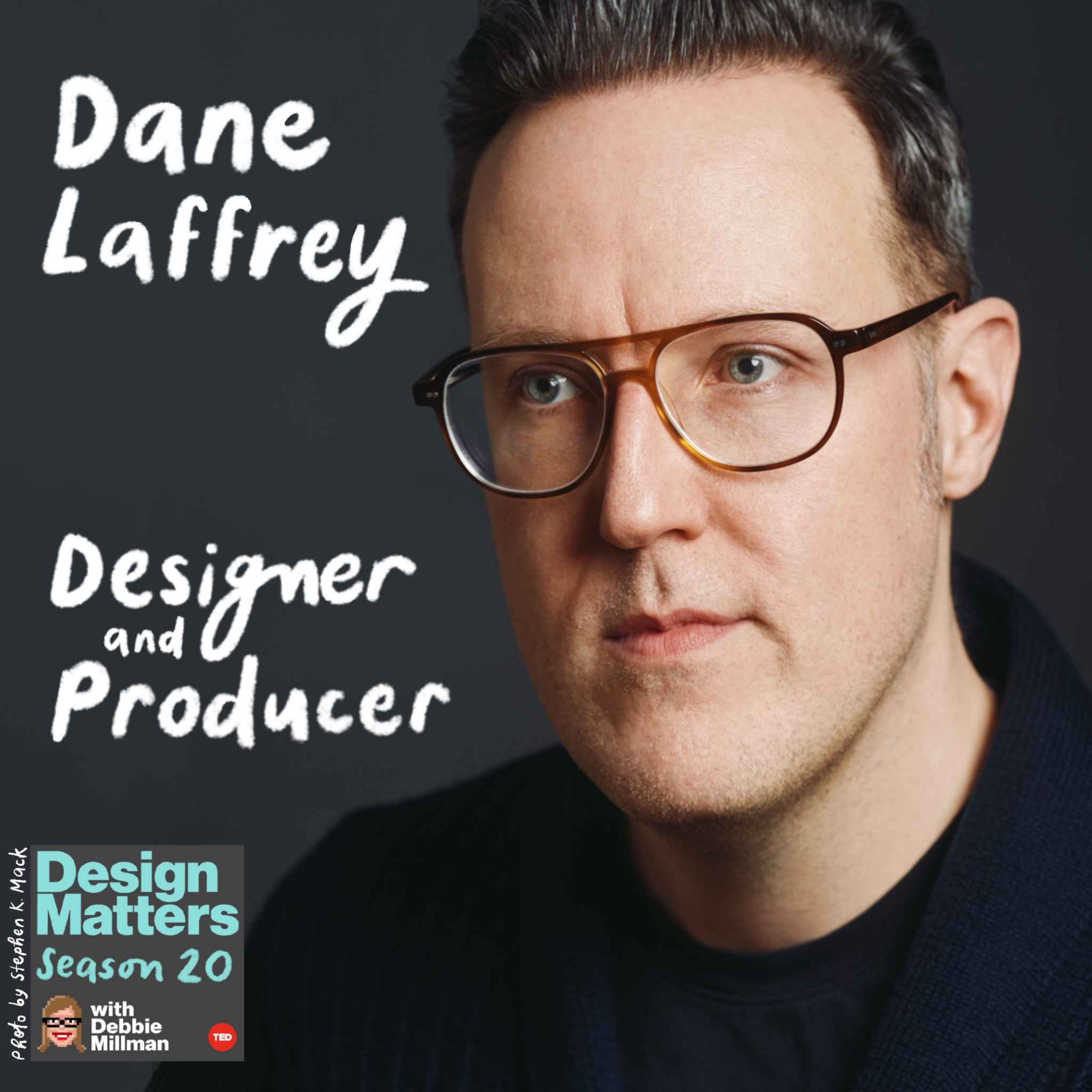
Loading summary
Transcript87 lines
- [00:01]
Elise Hu
Hi TED Podcast listeners. It's Elise Hu here from TED Talks Daily. Thanks for making our podcast part of your routine. We really appreciate it and we want to make your favorite TED podcasts even better. We put together a quick survey and we'd love to hear from you. It only takes a few minutes, but it helps us shape our shows and get to know you, our listeners, way better. Head to the episode description to find the link. Thank you again for listening and for taking the time to help our shows.
- [00:31]
Dane Laffrey
The work that I'm the proudest of had an immensely simple, scaled back muscularity about it.
- [00:41]
Debbie Millman
From the TED Audio Collective. This is Design Matters with Debbie Millman. On Design Matters, Debbie talks with some of the most creative people in the world about what they do, how they got to be who they are, and what they're thinking about and working on. On this episode, set designer Dane Laffrey talks about his career and designed for the musical maybe happy ending.
- [01:04]
Dane Laffrey
Every minute and 17 seconds the set is moving.
- [01:11]
James
It's James and Fouhad from Shits and Geeks Podcast and we're here to talk about Boost Mobile, the newest 5G network in the country. With compelling deals for new lines, Boost Mobile makes it easy to switch Today, Boost Mobile's new network delivers customers the speed and service they'd expect from from the Big three, plus groundbreaking benefits you'd only get from a true challenger in the industry. These include letting people try the network risk free for 30 days and offering a $25 per month unlimited plan that's guaranteed to never go up in price. They have blazing fast 5G and plans for all the latest devices. Visit your nearest Boost Mobile store and find us online@boost mobile.com this is Paige.
- [01:51]
Paige Desorva
Desorva from Giggly Squad. Opill is a game changer for sexual reproductive health through the first over the counter daily birth control pill available in the U.S. finally, the days of needing a prescription to get birth control are over. Opill is FDA approved, no prescription needed, full prescription strength, estrogen free and available online and at most major retailers. So when there's no prescription, no appointment, there's no hassle, no more waiting at the doctor's office to get a prescription. Opill will be easily accessed over the counter, in store or online and will be ready for when you need it. Opel is available online and at most major retailers. Use code giggly for 25% off your first month of opill@opel.com Race the Rudders.
- [02:39]
Dane Laffrey
Race the sails. Race the sails. Captain, an unidentified ship is approaching. Over.
- [02:45]
Fouhad
Roger Wait, is that an enterprise sales solution?
- [02:49]
Dane Laffrey
Reach sales professionals, not professional sailors. With LinkedIn ads, you can target the right people by industry, job title and more. We'll even give you a $100 credit on next campaign. Get started today at LinkedIn.com results, terms and conditions apply.
- [03:07]
Fouhad
Behind every successful HR strategy is a story worth hearing.
- [03:10]
Dimitri Boylan
Season two of the Talent Transformation Podcast is here.
- [03:14]
Dane Laffrey
Join Dimitri Boylan as he sits down with HR leaders from Deloitte, Emirates, Siemens.
- [03:19]
Dimitri Boylan
And more to explore how they're tackling.
- [03:21]
Dane Laffrey
Challenges and making a real impact.
- [03:24]
Fouhad
Subscribe now so you never miss an episode.
- [03:27]
Dimitri Boylan
The Talent Transformation Podcast Redefining Talent One Conversation at a Time maybe Happy Ending is a musical about two different but lifelike robots who fall in love. The show premiered in South Korea in 2016, and in late 2024 it opened on Broadway in New York City, where it has been nominated for 10 Tony Aw, including Best Scenic Design of a musical by Dane Laffrey. The innovative set fluidly morphs around the two robots as they embark on a journey in Seoul. Set in the near future, the set design is anything but set. It is a tour de force and one of the most extraordinary stages I've ever witnessed. Dane Laffery has been designing sets on Broadway and around the world for two decades, and his work includes the sets for Parade, Charles Dickens, A Christmas Carol, Spring Awakening, and so much more. Dane Laffrey, welcome to Design Matters.
- [04:38]
Dane Laffrey
Thanks so much, Debbie. I'm thrilled to be here.
- [04:41]
Dimitri Boylan
Dane, I read that since you were a kid you've had a strange affinity for World War II movies from the 1960s. Wondering why that particular genre?
- [04:55]
Dane Laffrey
That's an extraordinary question. You know, I think there is something I found immensely transporting about those films. They're not, with some exceptions, they're not great cinema. I admit to having slightly, like, peculiar taste in some areas like this, but yeah, there's something about those films that I think as I've come back to them later in life, which I'm semi embarrassed to admit I do, you know, there's an amazing, like, artifice around it. You know, a lot of those films were like, you know, shot on the back lot and it's clear at the end of a film that was, you know, like about the Battle of the Bulge, that they're definitely shooting in Southern California for some tank battle at the end, that it's sort of like there's something interesting about that, the artifice and nostalgia and how those things relate to each other. But mostly it's just because I, you know, you know, I Don't know. Something about those movies that I've always liked.
- [05:54]
Dimitri Boylan
You were born in Michigan, but have stated that you grew up around the Midwest. Where in the Midwest and why so elusive?
- [06:03]
Dane Laffrey
Well, my father, he's still alive, but when he worked, he worked. He was a sort of university administrator, had like a kind of weird professional wanderlust, I guess. And so he never wanted to or did stay in a job for more than a few years. And so as a result the family was kind of moved around and it tended to be the Midwest. So as you say, I was born in Michigan and there was a stint in Washington D.C. which is not the Midwest. And then there was Wisconsin and then there was also a stint in Western Canada and Edmonton, which is where I think I saw like my first theatrical experience with that place or like seeing theater in a way that really struck me. And then there was Indiana for a while and then I ended up going to boarding school back in Michigan, which was a, you know, Indiana didn't work out so well for me. So I was saved a little bit.
- [06:55]
Dimitri Boylan
Now you've described yourself as a bad student.
- [07:00]
Dane Laffrey
Really I was, I was pretty bad. I think there was an inflection point sort of in the middle of high school. I was like, became very involved in the sort of local community theater. And my recollection is that that was what, where my attention was going. And I think I just was like, well, this is what I should be doing. And the other stuff didn't feel so important. But yeah, there was a moment where I, like, I could have had a really different path, I think, if I hadn't been taken out of this kind of like middling public school in a small town in Indiana and sent to this really extraordinary arts boarding school where suddenly I only got A's there and I was doing academic classes and I was doing things that were, you know, that, I think. So I was being properly challenged, I think is one thing. Right. But also I, I, oh, I understand what I'm doing here. And I'm surrounded by people who seem to have the same sense of purpose that I have, which is not the sort of like standard sense of purpose of a 15 or 16 year old, I suppose.
- [08:03]
Dimitri Boylan
Once you became interested in the theater, were you first considering acting or were you always drawn to design?
- [08:13]
Dane Laffrey
No. Well, I think, you know, most theater kids, which I would consider myself, start with acting because that's the thing you can do. I, and it's, you know, and I think that began for me in like junior high school and I think at that time, I thought, well, that's quite good. Maybe that'll be good for me. And then I think in high school, I sort of lost interest in it. And certainly then when I, like, made the, you know, momentous leap to the community theater that, you know, I think. I don't think I was getting the roles, you know, I think I thought, no, I suppose I did do a little acting there, and I think maybe that was also exciting. But there, I think I wanted to be there so much, and I wanted to be in the building, and it felt energizing and interesting and. And, you know, it was largely run by, like, younger adults, like, people who had fairly recently graduated college, I suppose. And I think I was more comfortable with people of that age. And so I was. I think I was just happy to do anything they would let me do. And the first thing they. Somehow there seemed to be some, like, gap where, like, nobody wanted to deal with the sound design at the. You know, and so I was, well, I'll do that. I put my hand up as well. I'll deal with the sound design. I don't know anything about it. And I think it was really abysmal. I'm. I'm certain. But I. But I was just desperate to be on. I liked to be present for the performances, and I liked the idea of being out at night, and all of that felt, like, very thrilling and exciting. So it pretty quickly morphed. But it wasn't until again, this, like, you know, when I moved on into this second half of high school that that felt more focused or that I really found my way towards what I do now.
- [09:50]
Dimitri Boylan
During your senior year at boarding school, your roommate was an acting student named Michael Arden, who has gone on to become a lifelong friend and collaborator. Do you remember your first impression of him? Did you have any sense at all that this was going to be the significant relationship that it's been?
- [10:12]
Dane Laffrey
No, I don't think so immediately. I think we were immediately close and friendly and I think connected with each other in that way. He actually appeared at Interlaken in the middle of, I think, my junior year. So he kind of came a little bit later. But it was a very, like. It was a very small place and a smaller still theater department inside of a high school that only had, like, 400 kids at the time or something. All kind of, like, locked away in the woods in northern Michigan. Yeah, I wish I could remember the details of there's no, like, spark. But we did decide that we wanted to be roommates. That wasn't just a random assignment. We said, you know, at the end of our junior year, oh, well, we will be roommates next year. And I think as we sort of like, existed in our tiny little cinder block room together for a year, and especially in a year in which we were, you know, applying for college and trying to figure out what we were going to do and dreaming a lot about a potential future that I think there were lots of, like, dreams and schemes and thoughts and I don't remember specifically too, what too many of them were, but we definitely were like, very connected at that time. But then, you know, afterwards we like, went our separate ways, as many people who, you know, go after high school and into college do.
- [11:33]
Dimitri Boylan
After Interlaken, you decided to study in Australia at the National Institute of Dramatic Art. What drew you there and what was that experience? Experience like?
- [11:44]
Dane Laffrey
It was amazing. But first I did something that really didn't succeed, which is that I just applied for schools in the States and because I was at Interlochen and they, you know, they had really, you know, amazing kind of college counseling and a very deep knowledge about all of the kind of training programs. Although admittedly I was somewhat anomalous as a designer in that space there. That was so I, you know, I think I would potentially was the only person who had that major when I graduated, you know, so they had the knowledge that they had. But I was a little bit on my own and I. And I sort of looked at what the better programs were and I tried to pick one to, you know, for a sort of BFA program. I think it was pretty clear that I wanted to train, like, I wanted to be trained in my craft. You know, like, Michael got into Juilliard, and that's what, you know. And I think what I actually wanted was to also get into Juilliard, but Juilliard doesn't train designers. And so I was kind of looking for a version of that. And I do recall being pretty like, unclear about what to do. And a number of schools were pretty enthusiastic about taking me because again, I, at this point, I'm a sort of like 17 year old who had a. Who could. I don't think I could do very many things, but I was, I had a strong and clear sense of exactly what I wanted to do. And I was probably like a little bit ahead of the curve as far as like some of the kind of, of skill set stuff. And so they were all excited and fawning around and I, and I didn't have, again, I didn't have a Especially clear sense of what I should do. So I just picked one. I think they maybe were the one that offered me the most scholarship or it seemed like the facilities were the nicest, but it ended up being at the Cincinnati Conservatory of Music in Cincinnati, Ohio. And I was the only one from the department to go there. I didn't have any friends there. And I went and I lasted about a week. I like, moved to Cincinnati and it just, it was immediately clear that this wasn't going to work. And I, and I felt as though I had been thrust back in time and I was suddenly back in this kind of like gen ed public high school thing that I really didn't mesh well with me and that I didn't understand. And about a week went by and the person who had, I think it was the head of the department, of the design department maybe, and he'd been the person who had been kind of trying to get me to go there. I, I think I had a class with him. And after the class he, he said, you want to go to lunch? And I said, sure. And he said, this isn't going to work for you, is it? I remember this very distinctly. And I said, no, I don't think it is. And he said, I don't think it is either. You know, I want to tell you this because I think you get, you know, most of your tuition money back if you withdraw after, you know, before the whatever, two weeks or three weeks or whatever it was. And so I did. And my parents supported that decision, I think somewhat grudgingly. But at this point they knew me well enough to know that I was just going to kind of do whatever I needed to do and they were behind that. And so then I started to look abroad because I felt like I'd exhausted my options in the States. And that's when I found nida, which is the National Institute of Dramatic Art. It looked to be exactly what I wanted it to be. So I told my parents this crazy idea and my father, who was, I said he was a university administrator, he was a study abroad advisor. So he was keen on this idea and had some connections at the affiliated university. And so I flew down there with this sort of preposterous model box. It was like a scale model in a steamer trunk that we bought at Target of Cabaret. And I went in for this interview and got the thing out and I glued it back together because it's definitely broke on the flight or whatever. And my now person who I consider my mentor, Peter Cook, just ripped it to shreds he absolutely eviscerated me and the work. And I was. I mean, I was horrified because my parents had, like, flown me to Australia to, like, do this thing. And I thought, oh, my God, well, this is a catastrophe and I have no options. And I really felt like, oh, this is going to be terrible. And then he called the next day. He said, oh, I'd love you to join the program. And I thought, oh, he was right. The work was bad. I just never heard that before. And it was kind of a revelation and so important. And it is, you know, sort of the very beginning of a pedagogy that I found immensely valuable, actually. But it was startling. And so it proved to be all of the things I wanted it to be. I think it was essential, I think, in this training model for him to teach us how to edit ourselves and how to not be precious about the work and how to actually recognize what a good idea is and to develop, like, taste, which is so hard. I think you do have to sort of be exposed to things and talk about them critically and have a dialectic. And it was so amazing for all of that, as well as all of the sort of, you know, just the nitty gritty. It was really. And what it actually boils down to is that it was a master's program. Like, it just. That's. It was structured exactly like an mfa, but it happened to be a bachelor's degree, and that was the best possible thing. That's actually what I was looking for. I was ready to just, like, get on with it.
- [17:32]
Dimitri Boylan
You said this about Peter Cook's training. His training was rigorous, relentless, punishing and exhausting. And as such, he produced designers who are rigorous and relentless and never stop pushing for excellence and originality. And you go on to state that 20 years after graduating, you still hear his voice in the back of your head daily. What is he saying to you?
- [17:58]
Dane Laffrey
It's kind of the devil on your shoulder a little bit. But it's always about looking critically at things. That's what we're supposed to do. Any designer, I think, really needs to sit back and not spend so much time appreciating the work. You've got to sit down and go, what is this? And constantly reevaluate. And that's what it's all about. I think it's that skill and knowing when to hang on to something and. And trust that the idea just hasn't worked itself out yet, but it's a good idea. And that could be in a physical manifestation or. Or an intellectual manifestation or whatever, or when something's like, not that voice, just move on. You know, I think that's a really important thing to be able to bring into collaborations because there's so, you know, the work that we do is, is not. It's the opposite of, you know, the artist in the Garret. Right. It's like a fully collaborative. There's a lot of like, groupthink involved. And I think that's a really important thing to bring to bear as you're navigating those, you know, sort of interpersonal artistic relationships.
- [19:03]
Dimitri Boylan
You've said that designers don't really get a big break, and I found that to be true in lots of different design disciplines. But there was, Was there ever something that felt like a real turning point for you professionally?
- [19:18]
Dane Laffrey
There is, but I think it's, it's much more recent and I feel like it has come with the industry recognizing Michael and I as a kind of artistic unit. And we now also share a producing company, so we're also a kind of a producing unit. But. And that has actually helped people to kind of frame that for themselves because it's a slightly unusual relationship. To me that has felt like the big shift where I'm in more conversations and about work earlier and more globally. And that has really felt like it because I, I see, I think my path now and going forward as, as one that is not about being a gun for hire and is actually about building on a, a strong foundation of, of a single collaboration that is continuing to yield work that I'm the most interested in, in a way that, and that I'm the most interested in. And it actually is, is something that brings me back to the earliest parts of my career where after graduating from nida, which was like a three year program, you know, I just, I felt that I needed to stay in Australia for a little bit because I said I only knew people there. I didn't. It was, it was something that I kind of acknowledged as a sacrifice when I went down there in the first place is like, well, I'm not going to have, I'm not going to make any connections. And I think they talk a lot about it, but, you know, you've, you talk a lot about that when you're talking about going to colle about, you know, making connections with people. And I was like, well, I'm going to make connections, but I'm going to make connections with a bunch of Australian people. And, and, and if I ever have to go back, I don't know what I'm going to do. And I did realize, I think pretty early on there that I did want to go back, that the industry there is a little smaller than. Than I felt could. Could really sustain as many designers as were coming into the industry or. And, you know, that I. And I had, you know, a much bigger pond to swim in, and I had the ability to be there. So I thought, well, I will go back to the States. I will go to New York, but I'm going to need to, like, do some work before I return. You know, like, I need to build up a portfolio. I need to do some projects so I can show people something. Otherwise, I think I'm, you know, I'd be a little stuck. And so I. I stayed for a couple of years to just do some work, and I ended up really only working with one person. And. And it was an amazing time. And it's just a really. A brilliant director called Anthony Skuse, who's still a very close friend of mine. And we did, you know, three, four, five projects in close succession. One of the. We met. He. He directed a. I think, a show that I designed in my final year there. And then we subsequently just kept working together. And it really was an analogous collaboration to what I have with Michael. And. And it was this, let's say, the second most valuable to me artistically. And so I've realized that, oh, that's actually what I thrive on. That's what drives me. I don't do so well in situations where it's constantly new collaborators. I really only want to be doing this one thing. And so that's a long way of answering that question. But I think that has felt like the turning point, which also just coincides with more time in the industry and knowing more people. I mean, the Broadway community is a. Is small, but, you know, it's. But it's not tiny. And, you know, and gradually, just with more time in it, you sort of really feel like you get to know the world of it a little bit better, and vice versa.
- [22:55]
Dimitri Boylan
You initially thought your Broadway debut was going to be the Sam Shepard play Fool for Love at the Friedman, but Deaf West's Spring Awakening opened a couple of weeks earlier. So you had two shows on Broadway at the same time, right out of the gate. In Spring Awakening, your design, how to accommodate two languages at once, spoken English and American Sign Language. How did that inform and affect your design choices?
- [23:24]
Dane Laffrey
We wanted to make a space that could hold a lot of complex visual information as it concerned communication. And as such, I think the space wanted to be able to like recede. And so it had a kind of of cold industrial quality. I think we wanted to. The stuff that is exclusively in American Sign Language is also subtitled for the hearing audience or the audience who doesn't speak asl. And so we needed architectural opportunities dotted around to do that that wouldn't get buried. So yeah, I think that design as it concerned the dual languages was just a lot about kind of visual restraint and keeping it like simple enough and that it had the right energy and it didn't feel like spare and wand, but that it sort of had a quiet about it.
- [24:17]
Dimitri Boylan
In 2018 you designed the set for the Tony Award winning play Once on this island and the set transformed circle in the square into a post hurricane Haitian landscape. And you went on a research trip to Port au Prince which you said change the direction of what you wanted to do. And I was wondering if you can talk about I'm really excited to tell you about a podcast that I am loving. It is from one of my favorite places on earth, the Metropolitan Museum of Art. The show is titled 5000 Years of One Material at a Time hosted by Camille Dungey. Each episode examines a material of art, clay, stone, trash and even intangible things like space. You'll gain a deep understanding of what these materials make us feel and reveal about our history and our humanity. You'll also get a sense of the meaningfulness of these materials in art and how to see them in a whole new way. To listen to immaterial, just search for immaterial in your favorite podcast app. That's immaterial. 5,000 years of art. One material at a time. I love this show and I think you will too.
- [25:43]
Curtis Fox
At Memorial Care Saddleback Medical center, future.
- [25:46]
Dane Laffrey
Mothers are enjoying the journey of childbirth in private suites under the watchful eye of physicians, midwives, nurses and a level three nicu just in case. Saddleback Medical Center Caring is our calling.
- [25:58]
Emily Wyland
Now at Verizon we have some big news for your peace of mind. For all our customers, existing and new, we're locking in low prices for three years guaranteed. On MyPlan and my home that's future you peace of mind and everyone can save on a brand new phone on MyPlan when you trade in any phone from one of our top brands, that's new phone peace of mind. Because at Verizon, whether you're already a customer or you're just joining us, we got you Visit Verizon today. Price guarantee applies to then current base monthly rate. Additional terms and conditions apply for all offers.
- [26:28]
Paige Desorva
Hey It's Paige from Giggly Squad. Real talk. If there's one store that I absolutely love walking around, it's Sephora. It's my total guilty pleasure. They have amazing brands that other people don't have, and I find something great every time I walk in and there's literally one down the street from me, so I do that a lot. It's so fun to shop in the store and online, and the products are just too good. No regrets ever. For example, one of my favorite beauty brands is makeup by Mario, who just launched his new lip gloss that I absolutely love. So the next time you're in the market for great beauty, shop all the hottest products and brands only at Sephora.
- [27:08]
Dimitri Boylan
In what way that happened.
- [27:10]
Dane Laffrey
This is a project with Michael Arden, and we had been talking about it for some time, and I think, you know, once on this island is. Is specifically set on Haiti and, and it's alluded to in the story and it's a little bit more like allegorical in the text, but we wanted to be really specific about it because that's a real place and it's incredibly interesting and it unlocks the characters who are based in the voodoo religion. What that tiny nation has gone through is complex and challenging and ripe. And we felt like, oh, well, if we're gonna tell this story, we just have to be honest about where it's taking place. So that was a start. And so, you know, we came in with a bunch of research that was, you know, a lot about hurricane devastation and earthquake devastation and felt like, well, you know, this is a. About this community and their, this is their landscape and their. This is where they are and this is how we're going to tell the story. And, you know, there was a big idea about it being reorchestrated for non traditional instruments. Was a. Was a. Was a big, like, seed of this, of the visual language. And we worked with this group called bank on a Can that kind of makes instruments out of trash, basically. And we thought, well, this is really where it's at. But so we had gone pretty far in the process. And I believe by the time we went to Haiti, we knew we were. We had a theater and we knew we were doing it in circle in the square, and we were pretty far along in the process. And we went down there and we felt that we had to go. We thought this was like, we can't. We got to see this place. And that was a time very fortunately in Haiti, where it was reasonably safe to go there, which is, you know, I Think not the case anymore, which would not be possible. So we were able to go and it was incredible because it looked like all the things and it looks extraordinary. I mean, you know, it looks.
- [29:09]
Dimitri Boylan
Port au Prince is amazing.
- [29:11]
Dane Laffrey
It looks absolutely extraordinary. And this kind of like city that's like half destroyed colonial ruins and some entirely intact colonial buildings in a sort of like well heeled subset of the social strata, like who literally like live up on a mountain. And it's quite separate from the other stuff. But what was, what really struck us about it visually is that it is, it was constantly being reconstructed, that in the most beautiful, inventive, creative ways. Colorful and lush and kind of improvised a bit, but always moving forward. And that was the part we were missing. We were kind of like stuck in the devastation. And what we were missing was the idea that like, no, no, no, the storm has happened, the earthquake has happened. And then we immediately start rebuilding the space. And so it really like the container held, the idea held, but all of the detail changed. It felt like, oh, we're not in a ruin, we' a ruin that something is being done to very actively. So like it had that, that quality to it and it was so invaluable. But I mean, also just some of the things we were able to experience there were completely wild.
- [30:35]
Dimitri Boylan
My in laws are from Haiti and my wife is first generation American. So Haiti is a big part of our lives. We saw the show when it first came out. We actually sat in the front row and the play was set in the round. So we literally felt as if we were in the play. I mean, we were in the play.
- [30:56]
Dane Laffrey
You definitely were.
- [30:57]
Dimitri Boylan
Yeah, yeah. I mean, sand on our shoes and so incredibly immersive. But I really appreciated what you said about the devastation along with something else. And I do think that that's a lot of hope for what can still be, because it is really one of the most beautiful places on the planet. How were you thinking about the sort of round space and the sight lines and the sort of immersive experience that the audience was having while the play was actually running?
- [31:30]
Dane Laffrey
We imagined it from the very beginning for that theater. You know, Circle in the Square is the only Broadway theater that is not a conventional proscenium or mostly a conventional proscenium. And you know, it's a theater that can function in the round and it's very, very intimate and it is perfect for a sort of like experiential, immersive approach. Cause, you know, everybody kind of walks in the same doors and you the whole Space is laid out before you, and then you have to sort of maneuver through it to get to your seat. And there's very little separation between what is the stage and the audience. And we try to collapse that even further. It was always baked into the idea that everybody would sit in this circle to hear this story and the opportunities for just putting it around everyone. And especially with the tactileness, as you say, of like, having your feet in the sand is a meaningful idea, I think. So. These events, flooding, earthquake, whatever, felt like they were happening to the theater, not being placed inside the theater. So, you know, we made it look like one of these bombs had flooded and was being held back with sandbags. But then you had that humidity in the air of the water, and it just, you know, you kind of were getting it in every direction. You know, there was a lot of wind. We used to, like, give you that feeling. And all of those things are uniquely possible in that space because you just are there and you're part of it.
- [32:53]
Dimitri Boylan
I want to talk to you about one more production that you worked on before we talk about maybe happy ending. And I'm not going to be able to even remotely do justice to how many questions I actually have about this particular production, but I'm going to at least try to get one or two in, just to make sure people know that you worked on this one as well, which is the revival of the play Parade. It's a harrowing play about the lynching of Leo Frank, a Jewish American man, in 1915. Interesting in that you used actual historical photographs and projections, and we see how that evolves to your most recent work. The scale of the stage had a very intimate feel to it. I'm wondering if you can talk a little bit about how you approach scale in that particular design.
- [33:52]
Dane Laffrey
Part of it is that Parade was born out of significant limitation in that it began its life as part of the Encores series. Encores is a. Is a. They are. Let's call them semi staged or staged, kind of like semi productions of musicals. This was not that. This was Everybody with. Nobody was holding a script. Everybody was, you know, doing the thing. But. But they're done on a really, really small budget in an incredibly short amount of time. And so part of the vocabulary of Parade was. Was simply born out of necessary economy of scale. And it felt like our greatest strength visually was actually the people. Not just because there's so many of them and that they populate something and create a visual landscape, but because this is a. The show has dealing so Much with the idea of mob mentality or the idea of a jury, your peers making decisions on about you. You know, there's so many sort of like pieces of connective tissue that felt really valuable there. And to just sort of have them all present most of the time and therefore, like further compressing quite a small space and forcing most of the action up onto this further elevated platform always felt like energetically right for the piece. But. But again, also, you know, it's. Michael is such a stages thing so beautifully and. And collaborated with choreographers that we work with a lot, Lauren Yolengo, Grant and Cree Grant. And you know, they just made. They. They just conjured that whole world out of nothing. And I thought it was really magnificent. And, And I will say I, you know, not every director would know what to do with that space. In fact, I would venture that most directors would not. It was exposed, it was spare. That's really, really challenging to deal with.
- [35:47]
Dimitri Boylan
You've spoken about the idea that simplicity rather than scale or cost can be the most powerful tool in design. And I'm wondering if you can talk a little bit more about that.
- [35:59]
Dane Laffrey
Well, I think it can. I mean, you know, ultimately the theatrical contract with an audience sets you up for success in this way. They are there to receive a story. They understand it is not actually happening and that their imagination is an incredibly powerful tool. So long as, you know, the work is presented confidently and it provides opportunity to unlock the imagination, to seed imagery, to provide a framework that allows you to fill in the gaps. And I think it is. It can be incredibly powerful and essentialized. But it's challenging. You know, it's hard. And it cuts a little bit against the kind of like American obsession with naturalism in theatrical space. And it's something that you have to work out a little bit, but it can be really, really. I mean, some of my work that I'm the proudest of had an immensely simple, scaled back muscularity about it.
- [37:08]
Dimitri Boylan
Let's talk about your brand new play, maybe Happy Ending. And for our listeners, I want to share that. I'm going to be biased with some of my questions, I think, because honestly, this is one of the best plays I've ever seen in my life. And I have been going to Broadway since I was 13 years. And you all know that I'm now in my 60s. That's a lot of plays. So let's talk about the play. Dane.
- [37:39]
Dane Laffrey
Let's do it.
- [37:39]
Dimitri Boylan
The show is about two retired helper robots called helperbots. They're named Oliver and Claire. But the set is not really sci fi oriented. In fact, it feels what I'm gonna be calling a bit post mid century modern nostalgic with a very of the moment vis gestalt. Don't know if that's in any way what you intended, but that's the sense that I got. Can you talk a little bit about how you approach designing this very unusual, very innovative set?
- [38:20]
Dane Laffrey
There's a few things and you've hit on a bunch of the important parts. It's a story that we need a way into because it's something we don't immediately know. Right. It is an imagined near future. I think the circumstances involving sentient AI beings navigating the world is increasingly close to us and something that feels increasingly believable. But nonetheless, there was a gap to bridge. So I think we knew that in presenting this world we wanted to lean away from the need to like, mythologize a kind of like sci fi universe and instead really focus closely on the characters and their lives and as such present them inside spaces. And their two sort of apartments are a really important part of the story, mostly in that they're not supposed to leave them. They've basically been like, placed there until such a time as they can't turn on anymore. Those places felt like something we could hold on to. That war didn't feel like they had the sort of like burnished quality of a sci fi architecture that instead they felt, you know, a little having fallen into disrepair, you know, that it had a kind of like, roughness about it that I think is really relatable. Conjuring that aspect of the world is an important thing. The other thing that for those who see it, will know that it moves a lot and at a tremendous pace. And that's baked into the writing. And I think when I read it, I was like, oh my. To really do this justice. And because it is so much about two beings deciding to like, boldly leave the space that they're not supposed to leave and go on an adventure. And it felt like we had to really take the audience with them. That this is about an experience opening up and expanding and really taking these beings beyond what they thought was possible. And so we wanted to try and give the audience a similar experience. So we needed to build a machine that would do that, that would really be able to convey this idea and convey these wonderful helper bots on an amazing journey and take the audience with them. And so I believe really strongly that in theater design, where you are frequently needing to present Multiple places in one evening that all of those places have the same kind of visual value that they are. There's not. Well, these are the main sets and then these are these other little sets that are a bit of a throwaway. And you know, and there's a sort of like, you know, there's a tradition in musical theater of the kind of like well made scenes that are written to be done in one in front of a curtain so that the set can be changed behind it. Then you go back to the big set. I sort of like reject that idea in contemporary theater making. I think that if you're going to, to do 75 locations, those 75 locations have to have a sort of equal value. So we needed a, a set of tools that would allow us to do that, which is a huge ask. It's an enormous problem. So another important aspect of it that is also, again, just like written in is the idea that we go inside these people's minds. We, we are, we are let into their memory bank to see really critical pieces of information is how we learn about them. It's information that they share with each other. And you know, that is something that we knew we had to do. There are entire characters that only exist in this format. So a video element, an element that was going to be digital on some level, felt like it was, it was going to be a part of this world and that we would need to address that and find a way to, to completely integrate it into the rest of the design so that it felt indistinguishable from the physical elements. And that's something we worked really, really hard to do. So those were the sort of like ingredients sitting in the pot before we even put the pot on the stove that we knew we sort of had to address, come to terms with maybe.
- [43:02]
Dimitri Boylan
Happy Ending has perhaps the most technological visual beauty I've seen in a Broadway show. But it's a real counterpoint to the deep humanity embedded in this story about robots and the design in many ways seems to erase the boundaries between technology and humanity. There are dream sequences, time sequences, erasure sequences, atmospheric sequences that are just breathtaking. Where did these ideas come from and how were you able to bring them to life?
- [43:45]
Dane Laffrey
Well, first, thank you. That's an incredibly lovely assessment of this work. Again, I think basically everything you described is asked for in the story and I love the way that you're talking about the sort of tension between the coolness of, of the technological world, the sort of, the, the literal and figurative kind of neon edge on it. All mixed with the most sort of surprisingly human story, which I think is the sort of like, it's the magic of the show is that you. You come in thinking you're gonna see a story about robots and you're. You were really holding the mirror up instead. And I think that's the. Exactly, exactly. And so that tension I love, and it feels really important. And I think it's important that these helper bots feel it. You know, they lack agency in the world, and it's something that they learn to have and they make decisions for themselves, which is not something that they are, quote, programmed to do. And so them navigating a world that really likes, like, moves around them, you know, that is an idea that I think is. Is like woven through the design in an, in an important way. And you know, some of the other, like, like again, being inside their memories was something that we just, we. We had to do. And it was so wonderful because it allowed us to create a visual vocabulary in the video. And I'm, you know, know with this immensely talented George Reeve, who is the video designer on the show, and my co. Tony nominee is that we use those memories, those flashbacks to show the audience how the helper bots see the world and the way that they process things and the way that they kind of myopically focus on the human being in front of them and that the background is not a thing that they process. And so when we use video, if you look closely at it, it's treated in exactly the same way. It's not a photorealistic backdrop. It's not in the place of scenery. It is a deliberately digital thing that is precisely the same way that they process the world. And now we're giving the audience that opportunity. That was really a gift here because it's one of the hardest things to do as video becomes more and more a part of really of scenic design, actually, because now we're what even five years ago, certainly ten years ago, was. Was really more like about projection. It was about projecting things on surfaces. Now the surfaces are all led and it's all. So it's, it's. It is physically manifested in the space. And so it really, it becomes scenic design. And, and. And I've taken a much greater interest in it recently because it's becoming impossible to parse the two things. And I think the point is you shouldn't like, if you're gonna do it, you've gotta make it all one thing. And it can be really hard to. To add digital ingredients to physical Space. And I think we were just. The opportunity of the relationship between technology as an idea in this show was just incredibly helpful in that way.
- [47:15]
Dimitri Boylan
Yeah, I remember, I think it was about 20 years ago, seeing Closer on Broadway. And that had a lot of technological innovation embedded in it. But it was really about two characters communicating on two screens. And that felt so Mind blow. But the interesting thing about maybe happy ending, and I don't know if this was intentional, but you not only get into the sort of minds and hearts of these robots in a very tangible way. So you go into their internal dialogue, their internal lives, but then there are scenes that take you out into the world so much bigger. The fireflies sequence, which just makes you feel like you're sitting above planet Earth. I'm sure you did that intentionally, but I just had to bring that up because it was one of the things that I found so remarkable about the sets.
- [48:08]
Dane Laffrey
Oh, well, yeah. No, I mean, I think a big part of what we're doing is about edge and boundary. You know, that we. Everything up until a point is framed by irises, basically, which are kind of a. Like a.
- [48:25]
Dimitri Boylan
Tell us what that is, because that's a big part. I mean, I know I. I've read about them, but I think it's really important for. For my listeners to know what these irises are.
- [48:33]
Dane Laffrey
Totally. So, you know, an iris is this kind of an old fashioned theatrical idea, but it is basically, you know, two planes moving horizontally towards the center and one plane moving vertically from out of sight to the floor. And it. And you know, it. It creates a. An expanding and contracting frame frame. And we use them a bunch. We have three of them and they do a lot of heavy lifting. I mean they're a really important part of the machine I was discussing that is about conveyance. But they're also really about edge and boundary and scale in that we really begin the show in this incredibly tight close up on a plant, this living thing. It's also how the show ends and.
- [49:16]
Dimitri Boylan
Then it expands practically another character in.
- [49:18]
Dane Laffrey
The show, indeed, he's become famous at this point. So, you know, we start there and we expand a little bit more and we expand a little bit more and it introduces a vocabulary that has this like sort of cellular vocabulary, almost like a graphic novel. It also some sort of like there's filmic reference point. I mean, you know, they can create parallax in. When moving with the other, you know, several other planes of things that are also moving. And it's, It's. They're quite amazing things. And they're. Again, it's a sort of like. It's a nostalgic theatrical idea that is made modern feeling by the fact that they're lined with these kind of, like, neon edges that also expand and contract kind of inch by inch as they go. Which is some great tech that's. That's gotten better even since the first time we did it. But they put everything in this frame. But the frame gets bigger, and the frame gets bigger. And then when they leave their homes, it gets bigger still and it keeps going. And then there's this amazing moment where it doesn't exist anymore. And you're in a field of fireflies that has no edge, it has no boundary. And it is the sort of, like, turning point of the show. It's a big, like, apotheosis moment. And it's very emotional.
- [50:36]
Dimitri Boylan
I think I was weeping.
- [50:38]
Dane Laffrey
It's beautiful. It's beautiful and weeping. It's largely conjured by, again, not unlike Parade, by the power of a volume of bodies in space. Not to give too much away, but something that has been completely denied to the audience and then something that has been taken away. A boundary that's taken away. I think there's some alchemy there that's pretty powerful. Yeah.
- [51:02]
Dimitri Boylan
You stated that. One of the things that not only sets this production apart and is a feature in much of the work that you do with Michael Arden is your shared willingness to push dramatic sequences to the limit, demanding the kind of precision and timing that leaves no margin for error. And I've witnessed that now. And you go on to say that it makes your shows very nerve wracking for you to watch. How do you manage that kind of stress?
- [51:33]
Dane Laffrey
Not well, is the answer. I mean, I don't. I really don't like to sit during them. Like, I prefer to stand for whatever reason. Like, I'm not. I can't do anything if something goes wrong. There's something.
- [51:46]
Dimitri Boylan
Does anything ever go wrong?
- [51:47]
Dane Laffrey
Almost never. Does it ever. Almost never. Almost never. Oh, good, good, good. I never want that idea to be misconstrued, that we are, like, flippant about safety, because we are not. That's not what we're talking about.
- [51:59]
Dimitri Boylan
Oh, no, not at all.
- [52:00]
Dane Laffrey
Nor is it, you know, about something that's unsustainable because, you know, the most important thing about making theater, especially in the commercial space, is about its repeatability in every way. And so what it is, though, is about, like, taking things that. Just building things that are intricate and challenging, and if they fail, it's hard to recover from. It's hard to get to the next thing and when you're moving. And I think our count in maybe happy Ending is something like 75 distinct scenic moves. And the show is a hundred minutes long. So, you know, every minute and 17 seconds the set is moving. And so creating situations where the wheels could fall off the bus is a little nerve wracking. But also I think it's essential because I want to believe, and I think it's true that there are moments, maybe many moments in maybe happy Ending that the audience cannot understand spatially. They really just cannot parse what's going on. And I love that and I'm really interested in that. I think it's exciting theatrically. It's certainly exciting theatrically for me, but I don't think it's like the, that wonky. I, I, I think an audience can feel the thrill of something that is like, I don't know what just happened, but here we are. And here we are again. And here we are again. And I think there's something about that again, all going back to this core of an idea that we really wanted to take the audience on something that felt profoundly like a journey. You know, an amazing, amazing, like eye openening journey, just like the characters do. And so it felt necessary to do that. But we also, like, yeah, as I say, it is a bit of a feature of Michael and my work. You mentioned earlier, Charles Dickens, A Christmas Carol, which we did on Broadway a couple of years ago and is also a film. And that in many ways shares some DNA with maybe happy ending in terms of how it moves. The difference being that that show is done almost in complete darkness. It's largely lit by candles or like these tiny surgical little shafts of light. And so, you know, this space is just morphing around this person in a way that the audience can't see. It's a little more perceptible in maybe happy ending. But there's similar ideas about just like many, many, we call them axes of automation, of things moving in planes or rotating or flying or irising or whatever, all happening at once in a very, very carefully honed relationship to one another. And then with actors in the middle of it and lighting and video, and then you get these sequences that are, you know, can be pretty extraordina. Yeah, I watch that show and I know that my heart rate goes up. I can feel it. It's this what happens to me. It's often in theater, it's actually, even if the show's not that complex or Something, there's a heightened thing, if it's my thing. And also when. Sometimes when it's other people's things, sometimes I just kind of physiologically react.
- [55:05]
Dimitri Boylan
But also, you're in the moment. Anything could happen.
- [55:09]
Dane Laffrey
That's right. And I would. That's particularly like, I know all of the things that are coming next, and I just feel like, oh, God, I really have to buckle for it. But. But it's. It's fun, you know, it's okay.
- [55:21]
Dimitri Boylan
Dan, I have one last question for you. I read that you're working on upcoming productions of the Lost Boys on Broadway and Hercules in London, and you said that you also want to expand into other mediums, including film and opera and installation. Any of those genres on the horizon.
- [55:42]
Dane Laffrey
I'll break that down. I think the expansion that I'm really interested in at the moment is actually around producing. I find it to be somewhat anomalous in the American theater as compared to the American film industry or the American television industry, where the creatives do not have producing stake inherently. That's baked in for TV writers. It's baked in for actors, people who created TV shows. It's baked in for a lot of actors. It's not happening in the theater in a real way. It happens a little bit more in the uk.
- [56:16]
Dimitri Boylan
You co produced Parade, right?
- [56:18]
Dane Laffrey
Yep, we did. And as well as maybe Happy Ending, we also co produced Sunset Boulevard this year and the Roommate. And that's feeling very interesting to me because I think there's a siloing that can happen between the creative side and the producing side that I find. And I think that Michael finds he is my producing partner as well as my creative partner, we both find that a little bit. Little counterproductive. And we find that when we are able to have more holistic conversation around every aspect of what's happening, from the creative side to the business side and the inevitable and profound intersection of those things in the commercial theater. We get a better result and something more sustainable and more interesting is made and people understand it a little bit better. And so I'm very, very interested in that.
- [57:11]
Dimitri Boylan
Dane Laffrey, thank you so much for making so much work that matters. And thank you for joining me today on Design Matters.
- [57:18]
Dane Laffrey
Thank you. It was an immense pleasure.
- [57:20]
Dimitri Boylan
To learn more about Dane's work, you can go to his website@danelaffrey.com to see more of Dane's work, go to the Broadway show maybe Happy Ending. This is the 20th year we've been podcasting Design Matters, and I'd like to thank you for listening. And remember, remember, we can talk about making a difference. We can make a difference or we can do both. I'm Debbie Melman and I look forward to talking with you again soon.
- [57:45]
Debbie Millman
Design Matters is produced for the TED Audio Collective by Curtis Fox Productions. The interviews are usually recorded at the Masters in Branding program at the School of Visual Arts in New York City, the first and longest running branding program in the world. The editor and chief of Design Matters Media is Emily Wyland.
- [58:09]
Emily Wyland
Now at Verizon, we have some big news for your peace of mind. For all our customers, existing and new, we're locking in low prices for three years guaranteed on MyPlan and MyHome. That's future, you peace of mind and everyone can save on a brand new phone on MyPlan. When you trade in any phone from one of our top brands, that's new phone peace of mind. Because at Verizon, whether you're already a customer or you're just joining us, we got you. Visit Verizon today. Price guarantee applies to then current base monthly rate. Additional terms and conditions apply for all offers.
- [58:39]
Curtis Fox
I want my dog to live a long happy life. Maybe even hit 19. So I feed them Ollie. Ollie's fresh and nutritious human grade meals are made to support their health and happiness with protein packed recipes dogs go crazy for like beef with sweet potatoes, turkey with blueberries or lamb with cranberries berries. Honestly, you might start thinking dang, my dog eats better than I do. And that's probably true when it comes to ollie. Head to ollie.com healthypup and use code Healthy Pup to get 60 off your first box of meals. Plus they offer a clean bowl guarantee on the first box. So if you're not completely satisfied, you'll get your money back. That's O L-L-I-E.com HealthyPup and enter code Healthy Pup to get 60 off your first box. Feed your forever friend with Ollie.
- [59:24]
Fouhad
If you work as a manufacturing facilities engineer, installing a new piece of equipment can be as complex as the machinery itself. From prep work to alignment and testing, it's your team's job to put it all together. That's why it's good to have Grainger on your side. With industrial grade products and next day delivery, Grainger helps ensure you have everything you need close at hand through every step of the installation. Call 1-800-granger click grainger.com or just stop by Grainger for the ones who get it done.
- [59:55]
Laura Kim
Imagine a toilet so striking it inspired a couture Dress. That's right. Kohler's Veil Smart Toilet in Honed Black actually inspired fashion designer Laura Kim to create a stunning black chiffon dress that debuted on the Runway at New York Fashion Week. The Veil Smart Toilet, with its curved design, deep, rich textural color, touchscreen controls, and customizable cleansing features, can transform your routine into something extraordinary. That's the power of design. Design changes everything. Vale Smart Toilet in Honed Black only from Kohler Discover the Vail Smart Toilet and go behind the scenes of Kohler's partnership with creative director Laura Kim at kohler.
- [60:35]
Dane Laffrey
Com.