Loading summary
Transcript83 lines
- [00:01]
Debbie Millman
TED Audio Collective.
- [00:08]
Progressive Insurance Ad
This episode is brought to you by Progressive Insurance. Fiscally responsible financial Geniuses, Monetary magicians. These are the things people say about drivers who switch their car insurance to Progressive and save hundreds. Visit progressive.com to see if you can save Progressive Casualty Insurance Company and affiliates. Potential savings will vary. Not available in all states or situations.
- [00:32]
Debbie Millman
Spark Something Uncommon this Holiday with just the right gift from Uncommon Goods. The busy holiday season is upon us and Uncommon Goods makes it less stressful with incredible hand picked gifts for everyone on your list. All in one spot. Gifts that spark joy, wonder, delight and that it's exactly what I wanted feeling. Some of my favorite items that I've discovered on their site include a grilled personal pizza maker, some fabulous garden accessories, and my favorite, a pair of wine glasses personalized with a Maya Angelou quote. When you shop at Uncommon Goods, you're supporting artists and small independent businesses. And with every purchase you make at Uncommon Goods, they give back $1 to a nonprofit partner of your choice. To get 15% off your next gift, go to UncommonGoods.com DesignMatters that's UncommonGoods.com DesignMatterS for 15% off. Don't miss out on this limited time offer Uncommon Goods we're all out of the ordinary.
- [01:47]
Ken Burns
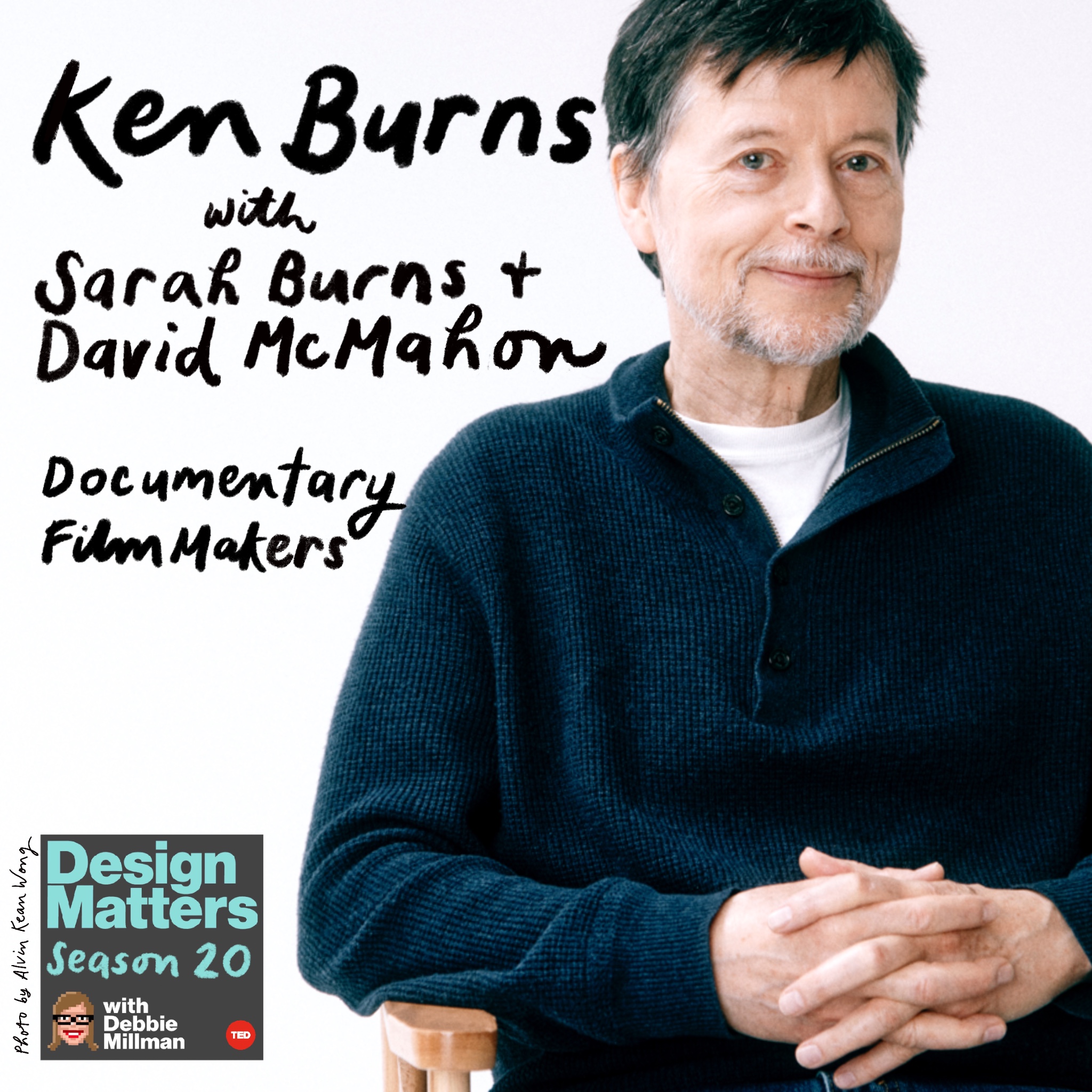
The machines don't have to work. It's just like I I want to fly. I think human beings want to fly. Someday they'll fly. Here are some ideas of how they might fly. And guess what? We do fly. From the TED Audio Collective, this is Design Matters with Debbie Millman. On Design Matters, Debbie talks with designers and other creative people about what they do, how they got to be who they are, and what they're thinking about and working on. On this episode, Ken Burns talks about his new film on Leonardo da Vinc. He's the bee's knees. There's nobody like him. This conversation was recorded shortly before the election.
- [02:30]
Debbie Millman
Leonardo da Vinci is probably the most famous painter who ever lived. He was also a great architect, a great military engineer, he was a great cartographer, a great scientist, inventor, botanist, anatomist. He's probably the person most of us think when we try to think of an example of a genius. He's been the subject of fascination since the 15th century. Ken Burns latest film is about Leonardo and it's the first time he's taken on a non American subject. His career started with a documentary about the Brooklyn Bridge and he and his collaborators have since chronicled the Civil war, World War II, the Vietnam War, Thomas Jefferson, the Roosevelts, Prohibition, the history of Baseball, jazz and country music, and so much more. His brand of visual storytelling has brought more history into the culture than perhaps any American alive. In this episode, I'm going to talk to Ken Burns about his career, and then I'm going to bring in his collaborators Sarah burns and David McMahon, who wrote and co directed Leonardo Da Vinci. The two part four hour film will air on PBS November 18th and 19th. Ken Burns, welcome to Design Matters.
- [03:54]
Ken Burns
Thank you, Debbie. It's great to be with you, Ken.
- [03:57]
Debbie Millman
I understand you collect American quilts.
- [04:01]
Ken Burns
I do. They're everywhere. I've got dozens and dozens. I'm sure I now have over 100. And they're wonderful because the work that I do professionally is about finding the answers to the questions. And the quilts are almost uniformly mysterious. We may know they come from Lancaster County, Pennsylvania, 1870. They may even be signed Hannah, but we don't know whether Hannah is 16 or 26 or 66. Happy, sad, made it with other people, made it alone. And so they remain these kind of artistic mysteries. And because most of history excludes more than 50% of the population, it's really good to have kind of around you, father of four daughters, that feminine energy and reminding us, as Abigail Adams said, remember the ladies, you husbands have messed things up, and if you don't watch out, we're going to take over.
- [04:59]
Debbie Millman
Hmm, I love that. What made you decide to start collecting quilts? What was the first inspiration?
- [05:06]
Ken Burns
You know, for the. For the longest time, I would have even refused to say that I was collecting quilts. I had always been drawn to kind of vernacular country furniture. I was drawn to the Shaker furniture and for decades couldn't afford a single one and finally was able to collect some Shaker pieces. But I was drawn because they hit me in my heart. And so somebody says, oh, you've got the star of Bethlehem or you've got a postage stamp. And I go, yeah, I guess, but I just love them. And they became sort of friends. In fact, there was a traveling exhibition of them that went to Nebraska and Illinois, other places. And I missed them, you know, I didn't get to see them for two and a half years. And when they came back, I spread them out on this long table, folded up, and I refused to put them away because I would just circle the table. Nobody could eat there. You know, it was just a place where we could remember the friends that had been missing for a while. So the collecting thing, I do collect quilts, but I don't feel a collector per se. I don't need to collect, like Noah, one or two of everything. I need to just be drawn. And I. I'll tell you, I drew the line about five years ago. I said, okay, you know, I'm nearly 70. I'm not going to collect anymore. And I went to my girls, I said, you guys, let's talk about the five or six that each of you can have. And then we'll give the way to the International Quilt Museum in Nebraska. And then I have someone who works with me who is sabotaging all of that. He'll say, you know, I know you're not collecting, but somebody sent this one. Or, here's a picture of. And I've, you know, like an addict on the street corner. I'm going have them ship it. Let's take a look. You know, and more often than not, I reject it. But I still. Yesterday, Chris, my employee Chris, he sent me pictures of two quilts, and I just went, okay, let's send them. He said, I thought you would. So there's a little bit of an addictive quality of this, but I love them. They're just so great. And I wish I could pick up this desktop and move all around just this barn, because There are about 25 hanging and there are about 60 or 70 in a glass cabinet. And just, you know, bring them out and show you my friends.
- [07:20]
Debbie Millman
Oh, I would love to see them. Maybe another time. Ken, you were born in Brooklyn, New York, as was I. Your mom was a biotechnician and worked at Kings County Hospital, and your dad was an academic and a cultural anthropologist. But he was also an amateur photographer. And I read that the first memory you have of him was building a dark room in the basement of your house. And you described it as the spectacular alchemy that takes place when a little boy is privileged to go into a dark room with a funny light on and watch an image come up from the developer and just appear before your eyes.
- [08:05]
Ken Burns
It's just magic. And I'm two and a half, three. I can remember snaking between the stud wall of this Masonite closet he was building in our basement of a track house in Newark, Delaware, and then just being sort of held in the crook of left arm while his right arm sort of stroked the paper and just funny smells. I won't even say amateur. He never sold. I mean, he wrote an article for National Geographic of our first year of my life was spent in the highest village in France. And I'm sure they paid him for the photographs, which he took to go along, but it was much more than that. There was a kind of visual commitment. He loved movies. Everything that I am comes from him. And for the longest time, I just assumed I'd be an anthropologist, you know.
- [08:53]
Debbie Millman
Well, you are in a lot of ways.
- [08:54]
Ken Burns
And in lots of ways I am. Yeah.
- [08:56]
Debbie Millman
Your dad gave you a Brownie camera in the late 1950s when you were about 8 years old. And I read a wonderful story about the experience that you had of first looking in the viewfinder. And I'm wondering if you can share that with our listeners.
- [09:11]
Ken Burns
I'm still embarrassed. It still makes my cheeks sort of burn a little bit. But I knew the difference, that we had black and white film. But I was looking through my viewfinder, and of course, everything was color. And I asked my dad if the pictures would be color, and he said, son, you know, we have black and white film. There is color film that we can get. And I was just so humiliated. He was thrilled at the question. And even in retrospect, as embarrassed as I was, I realized that I was just dealing with these very fundamental things about life and seeing and understanding the exterior world and knowing that there were perhaps burning, but certainly a lot of questions in the interior world.
- [09:56]
Debbie Millman
I'm sorry to bring up a story that you're embarrassed about. I was actually really charmed by it because I think it reflects some of what is so magical about photography and the sort of taking and making an image that potentially could last forever.
- [10:14]
Ken Burns
Yeah. Oh, it's great. It's so great. And it's a close representation. It doesn't have the abstraction of painting and drawing and things like that. It's really. You trust it to be true, you know, and so there it is. So there it must have been.
- [10:30]
Debbie Millman
Inasmuch as your visual interests were born in your father's evocation and his professional life, it seems that you were also really impacted and influenced by your mother. And you were told when you were 6 years old that she had cancer and that she was going to die in six months. She didn't pass until you were 12 years old and almost 12, 11.
- [10:56]
Ken Burns
Yeah.
- [10:57]
Debbie Millman
While you were certainly impacted by all of those extra years together, you said that you lived in a shadow of impending doom. How did you manage through that?
- [11:11]
Ken Burns
Well, I'll tell you. They sat us down when I was six or seven to say that she was going to die in six months. But we knew. We knew that there was something terribly wrong from when I was 2 or 3 that she was already sick with breast cancer and metastasized. And so we didn't know any of those words or the facts of it. But we knew the scars of it, we knew the pain of it, the dynamics of the family. There's a sort of Damocles hanging over everything. And so while she was incredibly heroic and said, I'm going to see you to junior high school, you know, which was like, to me, like way distance. And that was seventh grade. And she just, you know, I was April of 6th grade just before my 12th birthday. And it's the most important event. I mean, there's not a day that I don't think about it. It's influenced all that I do. In fact, my late father in law, who's a psychologist said that I wake the dead. I make Jackie Robinson and Abraham Lincoln and others come alive. And who do you think you're really trying to wake up? When I realized that I hadn't, at age 40, sort of dealt with the death, we did. My father had some sort of mental illness and was unable to sort of fulfill his obligations. It was never an urn of ashes. There was a funeral and then nothing in a kind of repressed no place where she was until about that time when my brother and I tracked her down to a pauper's grave. Yeah, I read that 26 other cremains. And from that moment on I began to own the day that she died instead of sort of avoiding it, seeing it up ahead and seeing it receding but never being present. And I have to tell you that 59 and a half years without a mother is way too long. Way, way too long.
- [12:59]
Debbie Millman
When asked about whether you'd ever make a film about your mother, you say that here's the secret. I've made the same film over and over. All of my films are about my mother.
- [13:09]
Ken Burns
Yeah, she's there, she's just there. I just think there are a couple of things about me that you really have to know about the history. Or maybe three. You know, my dad's interests in photography and anthropology and film are super important. Her courage in the face of her illness and her death and her absence are the single most important thing. And then I went to Hampshire College in 71 and I don't recognize the person who went in there and the person who came out in 75. And so all those three things, if any one of those were missing from our conversation, we wouldn't be having this conversation.
- [13:45]
Debbie Millman
You've said that your first films were foolish and stupid. Dramatic little shorts that were ridiculous. And you're sure if they ever turn up, they would be an embarrassment to see.
- [13:56]
Ken Burns
They will never turn up because they were never finished. Nothing was ever done. There was only one film that we made in college secretly called the Something of Harry Lott, that had just. It was a Zen like film. It could only be shown at one place at one time, because the character in it, who in this inane thing, ends up running towards the place where everybody's watching it. And then the guy actually comes in and everybody's head exploded and smoke was coming out and it was a wonderful. Only could be shown once. And that I have. But you look at it, it's crazy, but. Oh, you know, I'm really glad that I learned at Hampshire College that I actually didn't want to be a feature filmmaker, which I thought I would when I decided at 12 I'd be a filmmaker. I saw my dad cry at a movie and I just went, I get it. I'd never seen him cry before. And clearly this provided him some emotional safe haven. And so I said, I will be a filmmaker. And that meant John Ford or Alfred Hitchcock, Howard Hawks. But I went to Hampshire and all the teachers there were social documentaries, still photographers who also did film. And so all of a sudden you were immersed in a different world in which you realized that the stuff that is true, what is and what was, is equally as dramatic as anything the human imagination makes up. And so by 18, I'm a documentary filmmaker. By 22, I just accidentally made a film about history as my senior. Well, Hampshire doesn't have that. But my final Division 3 project for old Stourbridge Village, it's all live except for the last picture, is a pan across a painting. If you'd sort of said kind of a la George Bailey, that' you know, what you're gonna be doing for 49 and a half years later, I would say, you're out of your mind. But that's what I've been doing. I've been panning paintings and photographs ever since.
- [15:52]
Debbie Millman
The Ken Burns effect. I just learned about that term, that panning and zooming. Your first film, your first documentary film, the Brooklyn Bridge, you got an Oscar nomination for your first ever film. Did you worry at that moment that that was sort of setting you up for potential failure? Where are you gonna go from here?
- [16:12]
Ken Burns
Of course, you know, people say, what's the difference between now and then? I said, I don't worry as much. I don't have as much anxiety, but the emphasis is as much about the whole process. So I shot a lot of it. And then my future wife and I Came up to New Hampshire to the house that we're living in now that I'm living in, she passed away. And we in this little cabin that had to be heated up with a wood stove and take three hours to get up to a place where you could worry winter coats and sit down. We just sort of figured out how to edit it and then sent it out in the world. And we had this response and so everybody, we'd moved here from New York because I needed to get a real job. And I was so terrified that I'd take the footage and put it on a shelf and wake up 45 years old and not have done the thing I wanted to do. So we moved up here and lived on nothing. Chopped wood, you know, heated the house with wood. And then when it got nominated for an Academy Award, it was like, whoa. And then of course it was what have you done for me lately? Which is the age old question that continues to haunt. But the best decision, everybody said, oh, you're moving back to the city, you're going to move to la? I said, no, I'm staying here. And so it's now over 45 years that I've been living in the same house, sleeping in the same bedroom and making films the same way. And so the Ken Burns effect, which is something my later friend Steve Jobs sort of did, and that's how he introduced to me, was just a kind of superficial way of panning and dissolving and adding music to stuff. It's really our attempt to take that old feature filmmaker that I wanted to be and take each photograph and treat it like it was the master shot that had a long shot, a medium shot, a close shot, a tilt, a pan, a reveal, a zoom out, an insert of details. And not just look at the photograph with an energetic and exploring camera eye, but to listen to it, you know, treat it as a frozen moment of something that had had a past and would have a future. So are the cannon firing is bat cracking as the crowd cheering? You ask those questions of yourself as you're filming it. And then later in the editing room, you get to try to will them alive to wake the dead. Which is not just the idea of bringing back my mother, some sort of resurrection of her and by extension other people, the biographies that form the kind of building block of our stuff, but also moments, places, things. And so all of that has been part of the process and all in service to a story. That's the most important thing. I'm just a storyteller. That's what I'm interested in. I happened to choose American history. It was a good mix. I was early enough that I found what I was supposed to be doing. But that's like choosing oil over watercolors or choosing still lifes instead of landscapes. Just what I do. And it was up until Leonardo, All American history.
- [19:14]
Debbie Millman
Right after the Brooklyn Bridge, you moved into this home. Now, I know that at the time you were convinced that you would have to take a vow of anonymity and poverty to do what you wanted to do. And I'm assuming that you didn't care about that, right?
- [19:34]
Ken Burns
No, no, no. This was the conscious choice. I mean, when we moved up in the summer of. To this house, we had just fully expected. And in fact, for the next two years, we made less than $2,500 a year. I mean, literally in the middle of February at 4am when you heard the oil burner go on, I would get up and feed the wood stoves because it was terrifying to consider how we would ever pay for somebody to come and refill up the oil tank. And there was a wonderful kind of optimism there that Amy and I had. And we were sort of inventing a wheel. Like, how did you make. You know, people would say, oh, a film about a bridge. 10 minutes, stops. I go, I don't know how I'm going to keep it to an hour.
- [20:20]
Debbie Millman
Yeah.
- [20:20]
Ken Burns
If I were making the Brooklyn Bridge film today, it would be like five episodes, right? Because I now know how to open up those moments. But it was so exhilarating and so thrilling. And I'd worked as a crew member, just a lowly PA on a film that was being shot in Amherst, Massachusetts. I'd gone, that's where Hampshire College is. But an Amherst College professor's wife was making a film about Emily Dickinson, and Julie Harris was starring in it. We all became friends. She was a lovely woman. And she said. And I told her that I had this dream, and she didn't laugh. Everybody else laughed. This child is trying to sell me the Brooklyn Bridge. No. And I would get turned down thousands of times for funding for that. But she said, let me know if I can help. And then at some point, I just called and I said, could you read the voice of Emily Roebling off camera? She said, I'd be happy to. And we went to a recording session. And then she said, who's reading? Washington? Roebling. And I said, it's funny, we can't find anybody. And she goes, what about Paul Roebling? A guy that had called me, the great grandson of Washington Roebling and said that he was an actor and it was kind of like, oh, sure. And she said, you don't know who he is. I acted across him in the Lark on Broadway in 1957. And so I called up Paul and I apologized. He said, I wondered when he'd call back. And then he was a principal voice for us for the next many years until he passed away prematurely.
- [21:44]
Debbie Millman
In the last 40 years you've made 37 documentaries and you have at least three in production now. And you've talked about how the novelist and poet Robert Pen Warren once told you careerism is death and it terrified you. Do you still feel that way? And if so, how would you describe your practice?
- [22:05]
Ken Burns
Well, I just say my professional life. That's all I say. I mean, he said, careerism is death. And he had these sort of snapping turtle goggle eyes and, you know, I was very, very close to him. And whatever he said was like, God, I mean, I've been so fortunate in every film. Lewis Mumford and Brooklyn Bridge, the Shaker Eldresses and the Shakers and Red War and Huey Long, Shelby Afoot in the Civil War. I mean, every time has had a great mentor. And he said, careerism is death. And he'd said it before and I just took it to that. We sometimes sacrifice what we really want to do. What Emerson said in self reliance, whatever, inly rejoices for what's expected to us, not just the parent. I want you to be a doctor or a lawyer or whatever it is, but just that thing in us like, oh, I got to make money or I have to do this. And so I've never used the word career unless consciously in a meta way as we're doing it now. I always say my professional life, and that's how I understand it, that means that separates from my love of my child.
- [23:04]
Debbie Millman
The very first interview you conducted was in January of 1972 for a film called Bondsville. You were at Hampshire College. That means you've been conducting interviews for over 50 years, still a student. Well, that's what you've said. Why do you feel that way?
- [23:22]
Ken Burns
You know, you kind of go in with what you think you want to get. And that is in the way of hearing what they want to say. At the same time, what they want to say may not be what you need to get right. And so all of a sudden this humility comes in again, this sort of sense of insignificance that you have to say. I always say that if the interview doesn't Work out. Even if they're horrible, it's my fault.
- [23:50]
Debbie Millman
Absolutely.
- [23:50]
Ken Burns
And that if it's great, it's completely their responsibility. And we're so lucky to have put ourselves in that place. And so you may go in. A couple films have gone in without a. Anything written down. I made a film on Huey Long and I just say, you know, we've been traveling all around Louisiana and people either love him or hate him. And then we just go from there. I would just go from there. It was wonderful, wonderful. And the film still survives. I mean, you should watch it now because it's terrifyingly echoing and rhyming. Mark Twain might say in every single sentence with what's going on today? And yet I started then being more prepared and asking questions. But I realized that sometime that imperative to get through your list didn't allow me to hear that somebody that maybe that question seven had an A, B, C, D, E, F, G. You know, so that's why I feel like I'm always perpetually reminding myself to listen, learning how to listen and hearing the question or the next question that's really behind the way they're responding. And I mean, I'm in the process. One of the films that we're working on is a huge biography, multi part biography of Barack Obama. And he sat very kindly and patiently for so far, eight two hour interviews. And we've got, he would say one to go, I would say two to go. But we'll figure that out. He'll win, but it's just magnificent. And I have to learn to just sit on my hands and listen. Interviewing him is like going to a John Coltrane concert. I don't mean a record, I mean a concert. When he starts to play and you go, okay, whoa, can I skip up with him? Can I follow this thing? Yes, I can. I'm following it, I'm following. Oh my God, is he too far away? How's he going to come back? You know? And then at the end he's back and you just went, my God. And the only time, two times in my professional life have I stopped the camera mid roll. Once when he answered a question and 10 minute long answer. Never be able to use the whole thing. But I just said, Mr. President, that's the finest answer I've ever heard from anyone, let alone a politician. And the other one was when I asked Rachel Robinson, Jackie Robinson's widow, what it was like in the days after he had passed away. And she said I had a framed picture of him, a photograph of him stealing home And I took it from room to room to room and we were all just. And I finally realized I could not ask the next question because the tears were staining my paper and me. And so I just said, cut. And we discomposed ourselves and started again only two times. And in those 52 years of almost 53 years of asking people questions on camera, which is terrifying because back then the expense was, I cannot begin to tell you what, In January of 72, what it meant to shoot a roll of 16 millimeter film, 11 minutes and 40 seconds, a 400 foot roll in a sound silent camera. And that cost, cost an equal amount to develop it and another amount to create a work print of it. You've hired a cinematographer, you've hired that. We're students, so we didn't have that expense. But you had the sound equipment and the tape and you haven't gotten anywhere. You're nowhere near beginning to cut it. You just, you know, that's your baseline. So. Oh my goodness. The money going through the meter, on the taxi, the world's most expensive taxi cab, and you can hear it. And I've learned, and now that everything's digital, I've lost that touch. But I would stop and I turn back to Buddy Squires with my. My partner in cinematography for more than 50 years and just say, we close to the end. And he'll look back and go, 15ft, meaning we're at the end. He said, how did you know? I just had that length of a 400 foot roll sort of built in on my hard drive. And all of a sudden I was going, I'm not going to ask the next question yet because we're going to run out of film.
- [27:44]
Debbie Millman
Are you ever faced with an interviewee that is reluctant to talk or is anxious about what they're saying, or cold? How do you, if so, how do you deal with that?
- [27:56]
Ken Burns
All of those things, all my fault again. All my fault. So I'll name one name because he's no longer living and because it resolved itself spectacularly. But we were shooting the Huey Long film in Louisiana and I talked to somebody who was in on all of the graft and corruption and he said, please come, I'm going to tell you everything. And then I asked my first question and he goes, well, how can any of us really judge? You know? And we just, I tried again and he just had decided that it was sort of, you know, Michael Corleone at the Senate hearings, no comment. You know what I mean? It was just. He was gone. And so we Actually invented a thing where we said en francais, meaning we're gonna run any film the next time we just keep en francaise, meaning we just keep going. I could talk him so that we didn't feel we wouldn't dishonor him by, you know, suddenly pulling up stakes after two min. So we just kept going, but we weren't recording anything. So there have been things like that. In one case in our film on World War II called the war, I was interviewing Paul Fussell, who was a writer and a teacher at Princeton, celebrated and retired in his 80s. And I think he went in there with a kind of self consciousness that he'd be the next Shelby Foote. And it made him nervous. His mouth was dry, he couldn't really do anything. And it was just awkward and I couldn't figure out what it was. And finally he was talking at the end of reel three, which was already Come on, come on, come on. And we were thinking of going en francais for four. And I just said to him after we were changing the reel, I said, paul, you just said the kids who came to replace. I said, how old were they? And he goes, they were just 18. Maybe some had lied, they were 17. I said, but Paul, how old were you? Because he was referring to them as if they were like whippersnappers. And he said, Oh, I was 19. This is a time when the average lifespan of a first lieutenant, second lieutenant on the line in common was about 17 days. Either you were killed, severely wounded, or you went crazy. And he spent six months on the line, didn't take a shower, didn't change his clothes, didn't brush his teeth. He was good at his job. And so I started the fourth thing and I said, paul, you saw bad stuff. And all of a sudden the 19 year old came, the cheeks started to twitch and the eyes started blinking and he then for the next couple of reels just gave us unbelievable. We could only use it sparingly. It was so God awful what human beings do to each other. And you have to realize when he did finally get wounded fairly seriously, he was put at the head of the line because he was so good at what he did, which is killing other people, that they wanted to fix him up so he'd be ready for the invasion of Japan, which was going to kill a million Americans and he didn't have to go. And when he heard about the bomb, he just walked out of the hospital tent and just sobbed like a baby. And he brought all of that back. I mean, it's gold just Horrible things, Debbie, that are so chilling. And his contribution was so central to understanding because we tend to glorify war as soon as we get far away from it. In particularly World War II, which was the good war. No war is good. And it's the worst war ever. Right. 60 million people died. It's good to have somebody who can tell you what it's like to come across two dead children that are in uniform, German uniforms, because they don't have anybody left. So they're sending 14, 15 year old, 12 year old boys in no helmets. It's just horrific. But what a great gift, Ken.
- [31:32]
Debbie Millman
So much of your work has centered on racial justice, civil rights, and as I mentioned before we started the formal interview, I am preparing for our talk today. I been rewatching a number of your films and was binge watching jazz over the last couple of days. And though it's almost 25 years old, it's still very current in terms of what we face as a species, in how we treat each other, how we take advantage of each other, how we appropriate. How do you balance what you learn about humanity and what we're really capable of with what you hope we could be on our best days?
- [32:27]
Ken Burns
Yeah, well, you know, it's said we like to say that humankind is made in God's image. And there's almost nothing that we do that would suggest that that's true. And then you find moments, sometimes even in war, where that's true. And that's what keeps hope alive. You know, look, we are born. We know exactly when we were born, July 4, 1776. We know where in Philadelphia. And we know what the second sentence of the Declaration of Independence, and it starts, we hold these truths to be self evident. He had wanted to be sacred and undeniable, but his editor, Benjamin Franklin, said self evident, which is a lawyer's dodge. You know nothing about what he's about to say is self evident. Nothing in human history up to this point would suggest that. What's coming up is that all men are created equal. Okay, I'm a third of the way through the sentence. Let me stop. The man who wrote that owned hundreds of human beings.
- [33:22]
Debbie Millman
Thomas Jefferson.
- [33:23]
Ken Burns
Thomas Jefferson. So our story, particularly the American story, but as you suggested, the human story is one of others, right? To my mind, Debbie, I've made films for 50 years about the US but I've also made films about us, all of that intimacy. What I've learned, if I've learned anything, is that there's no them. That's what every dictator every authoritarian wants to do. They cannot promote themselves without making a them. And the successful part of our story, the part that is inclusive, is a priori about us, all of us in all of our diversity. And so how could you not make films about American history for 50 years without, you know, if you want to do it superficially, I suppose, you know, down in Florida, you know, let's not talk about slavery. And they may have actually, DeSantis said, had some good job skills that they learned because you don't want to upset people, but everybody's upset all the time. By the video games that you play, by the movies that you watch, by the coaches that yell at you, by the preachers that threaten eternal damnation by scolding to the parent. I mean, the world out there is real. And the idea that you want to sanitize history is crazy. So I can count on the fingers of one hand and still have a couple fingers left to snap those fingers. The films that don't deal with race, and it's not because you go looking for it, but because it's always there. I'm just finishing up a big series on the history of the American Revolution. Now we will accept the violence of World War II and the Civil War and Vietnam, Korea, first World War, but we have protected our revolution. It's just guys in Philadelphia thinking great thoughts. And that's true. It's really true. But it is a complex civil war where our civil war was not a civil war. It's a sectional war, one part of the country against the other.
- [35:17]
Debbie Millman
And there was nothing civil about it.
- [35:19]
Ken Burns
And nothing civil about it. I mean, our revolution is the civil war that we need to understand.
- [35:25]
Progressive Insurance Ad
Support for the show comes from Lumen. Still curious about what is Lumen? Well, it is the world's first handheld metabolic coach. You know how growing up, people might have said, like, oh, you must have a fast metabolism. You must have a slow metabolism. It's really not about fast or slow. It's about efficiency. Lumen helps you measure your metabolism through your breath. It's paired with an app that lets you know if you're burning fat or carbs and then gives you tailored guidance to help improve your nutrition and workouts and sleep and even managing stress. I love to check in on how my metabolism is functioning on my lumen in the mornings, but you can do it any time of the day. All you have to do is breathe into your lumen and you'll know what's going on with your metabolism. Then Lumen will give you a personalized nutrition plan for that day based on your measurements, and it will adjust its recommendations to keep your metabolism healthy through hormonal shifts. So if you want to stay on track with your health this holiday season, go to Lumen Me Design to get 15% off your lumen. That's L U M E N me Design for 15% off your purchase. Lumen makes a great gift too. Thank you Lumen, for sponsoring this episode. Support for this podcast comes from Odoo. Imagine relying on a dozen different software programs to run your business, none of which are connected, and each one more expensive and more complicated than the last. It can be pretty stressful. Now imagine Odoo. Odoo has all the programs you'll ever need, and they're all connected on one platform. Doesn't Odoo sound amazing? Let Odoo harmonize your business with simple, efficient software that can handle everything for a fraction of the price. Sign up today@odoo.com that's o d o.
- [37:16]
Debbie Millman
O.Com I'd like to talk with you now about your most recent Leonardo, which explores the life and work of the 15th century polymath Leonardo da Vinci. We are joined now by Sarah burns and David McMahon, your co directors and writers of the film. Welcome, Sarah. Welcome Dave.
- [37:41]
David McMahon
Thank you. Thanks for having us.
- [37:43]
Sarah Burns
Hi Debbie. Thank you so much.
- [37:44]
Debbie Millman
Absolutely. Ken, the first question is actually for you. I mentioned in the introduction that Leonardo is the first film you've made about a non American person or subject. Why Leonardo? And did this require a different approach in any way?
- [38:01]
Ken Burns
There are three people that are responsible for it. The first is Walter Isaacson and the other two are listening in right now. Sarah and Dave, Walter Isaacson. I was making a film on Benjamin Franklin and Walter was a biographer of Franklin and we had interviewed him and he's been an old friend for years and years. And we were out to dinner and he had also written a biography of Leonardo and so he was sort of pushing a kind of two for, you know, that I would do this. Here's the great scientist of the 18th century and the great artist of politics and of writing. And then Leonardo of his time is the greatest scientist and the greatest artist. And I said, walter, you know, I don't do non American stuff. And he pushed the whole dinner. I was finally kind of exasperated and I left and was talking to Sarah and Dave and expressed my exasperation and they said, oh, let's do Leonardo, you know. And then of course I yeah, why was there this barrier there? So it's all their fault Walter and then Sarah and Dave, mostly Sarah and Dave, for, like, overcoming that. And I called Walter back the next day, and I said, okay, we're in. And he's one of many interviews in the film. And it was exhilarating, but it also required this old dog to be taught a few new tricks.
- [39:14]
Debbie Millman
The three of you have collaborated for years now on a number of films, including the Central Park Five, which is based on a book that Sarah wrote, Jackie Robinson and Muhammad Muhammad Ali. What is it like for you three as family to work together?
- [39:31]
David McMahon
Yeah, you know, it works quite well. We've been doing it for 15 years now, altogether. You know, we started with the Central Park Five. And I think that felt not quite like an experiment, but it was the first time all of us working together. Dave and I sat down at the beginning to write a treatment for the film. Literally, the two of us in front of a computer with the blank screen to write this thing together. And sort of like, if I can. If we can survive this, maybe. Maybe that part could work. And we literally sit next to each other most of the time, all day long. And the three of us as a team is actually really great. We get in the editing room, and I think having multiple voices, and that includes our editors, who are really important creative partners also, and the rest of our team. But getting in the room together to wrestle with this material that we've written and gathered and researched, and to figure out how to tell the story. It's the great thing about what we do is how collaborative it is and how we each have our own ideas about things. But everyone listens to each other and everyone trusts each other, and it ends up being this really wonderful process. And there are those times when we don't agree about stuff, and usually it means someone is outnumbered. And you go, okay, if everybody else really feels strongly about this, I can accept that we're going to cut this out or leave this in or whatever. And it's really fun.
- [40:53]
Debbie Millman
How were you able to convince Ken to do the film on Leonardo?
- [40:58]
Sarah Burns
Oh, it didn't take much. I mean, as he explained, there was a phone call, and we weren't hesitant at all. I think that we didn't really know much about Leonardo, and so there was a process of learning. But we read Walter's book, and right away it presented some challenges that we thought would be a great opportunity. Wrestling with a subject from so long ago that lacks the archival materials that we have relied on. And our collaborations together meant that we could try and come up with a new way to See, Leonardo, we could come up with a new visual language. We maybe wouldn't want to use period music. And so perhaps we could do an original score wall to wall. And so I think we right away saw the challenges as ones that we would want to take on.
- [41:41]
Debbie Millman
Da Vinci is considered one of, if not the greatest painter to have ever lived. But I actually learned from your film that he actually painted less than 20 paintings and less than 10 were actually completed paintings. What makes those paintings so special?
- [42:03]
David McMahon
I think there's something about Leonardo's process and his curiosity and his interest in the world and the way that he pours all of that into the paintings that sets them apart even from his extraordinarily talented contemporaries in the Italian Renaissance. And there are many of them who are doing amazing work. You know, he's not alone here, but his interest in nature and the world and the human form and on the outside and the inside, I think is the thing that brings his paintings this additional level of humanity, of sort of personality, of life. I mean, he brings these people to life not just in the physical sense of making them feel three dimensional and sort of existing in space, but of actually making them feel alive, giving them emotions and thoughts and inner feelings. And that comes from his interest in studying, literally the inner workings of the human body. He dissected cadavers, he did anatomy drawings. He wanted to know what the muscles of the face were that are acting when someone smiles, but also thinking about human emotions and how those can be depicted through facial expressions, through physical motion, the way that hands, gestures. He would go and draw people in the piazzas in Florence to try to think about how people, what they look like when they're talking or laughing or arguing. And so that obsession with that, I think, elevates his work to another level.
- [43:36]
Debbie Millman
One of Leonardo's most famous paintings is the Mona Lisa, who in real life was the wife of a wealthy silk merchant. And Ken, you've talked about how many jokes are made about Mona Lisa's smile, but when you see this film, you won't ever joke about it again. Why is that?
- [43:55]
Ken Burns
I hope not, Debbie. I hope not. And it's so funny I said this the other day that people always say, what do you want people to take away from the film? And we've worked on it. Once it's done, it's your film. You know what I mean? You'll take what you want to take from it. But in this one, I want you to want to be more like him because he is just as Sir Candice Clarke. Said the most curious man ever. He just wants to know, as Sarah was describing, more and evermore. And then this idea that Sarah was also saying about how you could take something that is on a two dimensional poplar panel and make it not just three dimensional in appearance, that is a person, but to give them their spirit and their life and their anatomy. So the rapturous responses by people to the Mona Lisa was that you could see the blood in her veins moving, you could see her pulse in her neck. That's what he did. And that the smile contains all of the things that animate a human life and make the mystery of life so compelling. And the fact that he could do this not with a photograph, not with a piece of film, but with this painting. And it's a commission, you know, that he never delivered, right? He just worked on it and carried it with him and dabbled on it. And it's the most famous painting on earth. And therefore there's layers, there's patinas of inattention and inaction. Everybody, their Mona Lisa story is how many people were blocking their view of the Mona Lisa, how small it was. And then so our response to something that big and that powerful is to forget why it's big and powerful, to make up stories about it, draw mustaches on them and sort of make jokes about the smile. What is she smiling about? But if she's smiling, speaking to the highest aspirations of humankind or just this mystery of life. And the questions that he was always asking, who am I? Where did I come from? What am I supposed to do? Where do I go? How does the earth work? How does everything work? Then she represents the epitome of the human project, period. And the Renaissance. Renaissance is a rebirth, literally what it means that is emerging from the dark and middle ages and trying to recenter human beings in a world that has basically told them that they are insignificant cogs in this other kind of religious dynamic. And he liberates this in a way. And Lisa Ginconda is, you know, his great gift to us. The husband didn't get it. At least she had five children by 24 when it was painted. They don't have it, nor do the grandchildren or who knows where they are, but we have it. She is his great gift to us about what the human project is about, period, Full stop.
- [46:59]
Debbie Millman
Sarah and Dave, I know you spent over a year in Italy doing research and without any real photographs or newsreels or any of the things that we've come to see as part of the Ken Burns effect, how I mean, this is the man that lived in the 15th and 16th centuries. How did you find, aside from the 20 or so paintings, enough visuals for the film?
- [47:24]
David McMahon
It was definitely a challenge. But it is, as Dave was saying before, one of the really exciting challenges of this film. This opportunity to figure out new ways of telling the story. And I think we really took our lead from Leonardo himself, who was such a lateral thinker, who looked at all of these different things in nature, in the world, and was interested in all these different disciplines. Not just painting, of course, but science, anatomy, engineering. He designed machines. He studied birds in flight. I mean, he had a kind of endless number of interests, and he was thinking about them all at the same time. These were not separate pursuits for him. It was all part of one grand exploration of the world. And so what we wanted to do was think about ways to get inside his head and to see what he was seeing and think about what he was thinking about. And so that liberated us from feeling like we had to be in his time and only in, you know, period paintings from the Renaissance, either his or contemporaries or something, to see that. That we could be in nature in Italy. And we did a lot of filming of Italian landscapes, of the places that he might have visited and things he would have observed. We used a lot of nature photography, you know, the animals that he observed, birds and dragonflies and these patterns that he was looking for in nature. We could use all of that, and we used a lot of footage from the 20th century, things that are related to what he was studying. And so as you see these ideas, these things he's imagining, he has extraordinary creativity and imagination, imagination. He thinks he's imagining human flight machines. He never achieves that, but it is ultimately achieved. And so we can see that too. Or we can see an Archimedes screw that some French farmers are using in the early 20th century. That is similar to a drawing that Leonardo did, that is similar to a drawing that Archimedes did. And so it all ties together. And so we see all of those things, and we often see them side by side. We split the screen. We see two things, four things, nine things at a time, sometimes to help show Leonardo's lateral thinking.
- [49:35]
Debbie Millman
I love the direction of the visuals. There's the documentary really marks a significant change in your collective filmmaking style. The split screens, as well as the video and sound from different periods. Talk about how you developed this new visual language.
- [49:54]
Sarah Burns
Well, right from the beginning, we felt like, as Sarah was saying, that we wanted to make this an experience for our audience where it felt like they were inside his head. And so we actually, early on in a shot, we sort of plunge in through the eye, and we want to sort of stay there from the beginning. But we did early on begin to experiment with splitting the screen and playing with 20th century footage, as Sarah said, and things that we shot and things we observed. But it had to work. I mean, we're using the same research team that we worked with on our colleagues on the last project, and they're looking in the same spaces. We're working with the same cinematographer. We're going up and down the Italian peninsula looking for the kind of beauty that Leonardo observed, timeless beauty, landscapes that he would have studied. And we want to share all of this, put people in time and inside Leonardo's head. But it has to have a rhythm, it has to have a pace that has to work. And so we did play. And so, in ways, it is a departure, because we're not accustomed to splitting the screen, but we're drawing from similar resources. We're still getting up before the sunrise, and we're ending up in the spot where we're going to see a beautiful sunset, in a spot that maybe Leonardo would have observed one. And so we can choose to slow it down and watch the sun come up, or we can bombard you with a whole different set of images that Leonardo would have received and help our audience try to make sense of them in a way that he would have. But it's all in the service of getting the Leonardo story right and sharing it with our audience. And we're still. We're going in chronological order, but where we took liberties, we played around a little bit until we all believed that it served the story well.
- [51:31]
Ken Burns
And so therefore, it's both a departure and not. I mean, it's storytelling is. And then. And then. And then, particularly with biography. And so it is very much of the kinds of films that we have made together and I've made with other colleagues. But at the same time, in order to get into that space, to go into that eye, as David said, is going to require the liberation from the tyrannies of old forms. And that's always a good thing.
- [52:00]
Debbie Millman
How does it feel to experiment when you've made so many films and have had so much success in doing something in a certain way?
- [52:08]
Ken Burns
It's funny. It's really hugely different and experimental, having to explode the screen and I would say the soundtrack as well. And there's animation in this film that is particularly effective that sometimes is just memor and sometimes is just Understanding his unbelievable view of both of the cosmos at a kind of microscopic level, and he doesn't have a microscope and at a macroscopic level, and he doesn't have a telescope. So it's just. It's Leonardo. You just have to climb on and just take the ride of your life. It's spectacularly exhilarating and it's so aspirational that you'll do anything to make it work. And what's so great about working is that you always want to serve the film, not your vision of it. It's our vision.
- [52:58]
Debbie Millman
You really do use music in a new way in this film. David, you chose the composer Caroline Shaw to score the film. Can you talk about why you chose Caroline and what that was about?
- [53:10]
Sarah Burns
Yeah, well, I'll back it up just a little bit. You know, in our previous project, a biography of Muhammad Ali, we used something like 160 needle drops from the period between 1940 and his death in 2016. And the music really puts, I think, the audience in a particular time. We can move through Muhammad's life with this popular music. Popular music from this period didn't feel right. So early on, we began talking about what kind of sound might work well here. And we wanted something that seemed timeless. And we settled on the idea of strings and percussion together. And Caroline Shaw was suggested to us. And this is very early on, I went to see a ballet that was set to her music. It was amazing. And what was also present on that day was a Room Full of Teeth. A vocal group, or as they would say, a vocal band. And their sound was extraordinary. It just filled the whole theater. And we began to think about maybe it could be strings, percussion and vocals. Even though we worried a little bit would the vocalizations. This wouldn't be lyrics, it would just be vocalizations. Would it compete with our dialogue tracks? Anyway, we reached out to Caroline. She said, yes, we're so grateful for that. And she created a completely original score using music that she had written for all three of these groups, the Taka Quartet. So percussion and Room Full of Teeth. It was immediately clear that the vocalizations, that the Room Full of Teeth contribution was only going to elevate Leonardo and get us closer to him. There's so much joy in her music. And I think that's what connects most for. For me with Leonardo is he was a man who, you know, he's not a diarist. He doesn't leave behind a lot of what he's thinking and feeling about his days or his times or the people in his Life. But if you look between the lines, you can sense a guy who's prideful about his work, and you can see a guy who finds great ecstasy in his job and what he's doing. And her music. See, to point to that, the vocals.
- [55:14]
Debbie Millman
Do feel very instrumental in a really beautiful sort of ecstatic way. And they do add a lot to the film. You begin the film with a quote by historian Paola Galuzzi, who states, nature is God, Nature is perfection, Nature is proportion, Nature is the end which obtains every effect with the shortest and direct way that is possible. The best a scientist or a painter can do is imitate nature. What made you decide to start the film with this declaration?
- [55:55]
David McMahon
Well, that moment, I think he's really paraphrasing what he thinks Leonardo's view of the world is. It's a few minutes into the film, but he, I think, really sums up Leonardo's idea about his role in the world, right? That his goal as a painter is to try to reproduce nature, to recreate nature through his work, through his art. Because he is, you know, he grows up surrounded by nature. He's born in this small town of Vinci, outside of Florence. And because he's born out of wedlock, he does not have the same access to education that he might otherwise have had. And so he does not. He's not classically trained in an academic way, so he's largely self taught. But he spends his childhood, as a result, it's probably the best thing that ever happened to him. He spends his childhood, as a result, exploring in nature, and that becomes his guide and teacher, the most important one. And so for him, him that is at the center of anything. And he eventually, I mean, he. He does read all of the ancients and he studies his contemporaries and he, I mean, in his 40s, he tries to teach himself Latin because that was something he'd never been taught before. But nature is the ultimate teacher for him. And so all of it kind of flows from that.
- [57:25]
Debbie Millman
Another thing that I learned from your film is that Leonardo did not categorize his work. He's a scientist and a painter. When he's paint, he's a scientist. When he's doing science, he's a painter. He didn't see the distinctions between them. And there's a quote in the film that I loved. Painting is not of the hand, but of the mind. I love it for so many different reasons. But one thing that I've been thinking quite a lot about is that when somebody is as talented as Leonardo was so innate Talented, capable, a master of so many things. You can say painting is not of the hand but of the mind. But for those of us that are still aspiring to become better painters or better anything, it's up the hand as well. So I'm just wondering how you thought about his sort of genius and how that was incorporated into the sort of striving he had still in his life.
- [58:31]
Sarah Burns
Yeah, well, there's a leap that takes place in Leonardo's time, and it's not just Leonardo, it's some of the other painters as well, where they kind of become superstars. The artists, I think, up to that point had worked in these Bottegas, and these are spaces, as I said before, where they're learning anatomy, they're learning physiology, they're learning nature, they're learning math, but they're still being commissioned to produce works of art for wealthy merchants or for the church. And Leonardo and some of his other peers take this to another level, and you can tell, in part because he left some works behind, that he didn't finish. Where you can see that rather than doing this in the style that had been done forever, which was to create a cartoon or an outline of this painting, he's instead going to work out on the panel what he wants the thing to be. And so if he doesn't complete a work, let's say, like the Adoration of the Magic, you can see that he was having a philosophical argument with himself about what to do with this work on the panel itself, and no one had done that before. And so that is a point where you start thinking less about these artisanal things that these artists are doing and more about an intellectual process. And if you take the notebooks and the paintings, you begin to see that Leonardo is not just seeking to be remembered or thought of as a painter, he's seeking to be thought of as an intellectual. And in these notebooks that he leaves behind, their treatises, and he's unpacking a subject, he's learning all he can about it, and then he's organizing it in these treatises for publication. Now, none of it gets published in his lifetime, but whether it's a study of water or geology or preparations for a painting, he wants artists to know his thinking behind what he was doing. He wants scientists to understand what he learned about geology. And so at this time, as there's explosion of talented art artists, there are some real superstars who are now, as Adam Gopnik says in the film, these are princes of the mind. They're no longer just Making crafts. They're doing intellectual work on the panel. And so big transformation there. But it also makes him again of his time. It's just that his combination of curiosity and imagination allows him to take this further than the other superstars of his day.
- [60:53]
Debbie Millman
One of the interesting things that I was thinking about as I was watching the film, I've seen it now several times, and so many intellectual pioneers of our history have been criticized, ostracized for thinking differently, especially in the realm of science, where people have been seen as heretics or witches. Why was Leonardo sort of outside of that treatment? He seemed very much to be admired, celebrated as opposed to excommunicated.
- [61:31]
Ken Burns
Well, it's a pretty interesting thing, part of what Dave is saying, and I think we haven't talked enough about the notebooks, thousands and thousands and thousands of pages and exquisite drawings and observations which are written in a mirror script. He's a lefty, he's writing backwards so as not to smudge. And he's left us all of this stuff, but it's not published in his lifetime. And so unlike, say, a Galileo who's going to get in trouble with a church, which we know already knew that Galileo was right, what you have is this charismatic figure that is incredibly wonderful to be around, who has a kind of joie de vivre, who's a musician who stages pageants, who is obviously got these handful of paintings that are great. And sure, the Last Supper's out of sight in a monastery's dining room. And yes, this wasn't finished, but everybody understands that when he does something from his very first painting, you know, the Annunciation, you know, on his own solo thing, he's the bee's knees. There's nobody like him. And so there's this sense of a reputation that develops that I think also insulates him. And the biggest thing is that all of these scientific observations aren't going to be published until he's gone. He's insulated from the dynamics of politics. Remember, he's involved in Machiavelli. He knows, knows he's got a competition with Michelangelo. Raphael's the young squirt that's coming. I mean, this is all the dynamics between Florence and Milan and Venice and Rome, and it's all going on. And yet he's got a kind of plausible deniability because of this lack of output and the fact that all of the great stuff. I mean, look, he's got experiments on a heart, on how the heart works and how the heart valves particularly work and how blood flows through Those valves and does things in the heart that aren't going to be confirmed for 475 years until we have MRIs in the 1970s. And there's no cardiac surgery back then. So it's not like somebody could say, oh, Leonardo's doing. Even if it was published, Leonardo is doing some interesting work there in Florence or Milan or Rome. It's that he's doing it for this kind of sense. It's at one of them. Another scholar says it's about prophecy. It's aspiration. He doesn't have to. The machines don't have to work. It's just like, I want to fly. I think human beings want to fly. Someday they'll fly. Here are some ideas of how they might fly. And guess what? We do fly, you know, and we do lots of other things. And so, you know, just imagining to come back and thinking you went on the moon. Tell me how you did that. I want to know everything. What, you know, he understood about gravity and he did lots of experiments with it, but he'd want to know, how'd you figure, you know, and what did you do this? And how did you get back? And, you know, parachute. Really? I invented a parachute, kind of. So I think that he kind of misses the negative political stuff. He's involved in it. He's courting dictators and saying, I can draw you military stuff, and does. And he got the first overhead map, which has purely strategic military purposes, even though it's the first bird's eye map with no drones, no balloons, no nothing. He imagines it this village of Imola. I mean, it's just. It's incredible. And I think that how incredible he was just, in some ways, is a kind of insulation from that.
- [65:01]
Debbie Millman
I loved to learn that building the machines often seemed beside the point. For Leonardo, it was the ideas of the machines and that he visualized them. Leonardo's notebooks are also works of art. They're not just notebooks. They're not just journals. They are, in many ways, blueprints for living. I've been reading them and studying them for decades. And there's never a time when I open up the notebooks where I'm not learning something or realizing something in a new way. Can you talk a little bit about how you were able to bring to life not only his art, but his scientific explorations and drawings? Because I think that's such a beautiful part of the film.
- [65:54]
David McMahon
Yeah, it's central to understanding Leonardo. And I think from the very beginning, we went in with this idea that we wanted to go so far beyond what it is that we think we know about Leonardo. He's the author of a couple of the most famous works of art of all time, but that's not the whole picture. And we tend to look at him as this wizard with a long beard that we see in the paintings. And from the beginning, we wanted to figure out how. How to reach past that and get to know him in a different way. And that's through the notebooks. That is where we get this access to Leonardo's extraordinary mind. And so it was always going to be central. We were going to tell the stories of the paintings, many of them. But the notebooks is where we get to really know him. And so that is where he puts all of these ideas, what we've been talking about, the science, the questions, the constant questions about Ed, everything. And all of these incredible drawings, as you've said. I mean, they're beautiful to look at those pages. Mathematical geometry problems that he's trying to figure out. Grocery lists and everything in between, how babies are born. Yeah, it's really extraordinary. And so it was, I think, clear to us from the very beginning that a huge part of telling his story was gonna be around all of these other things. We maybe know him best as an artist, but he would not, I think, define himself that narrowly. And so we were going to spend a lot of time also trying to understand what else he was doing, these scientific experiments. It's part of why we were, of course, going to interview for the film, the art historians and biographers, the experts on Leonardo, who've dedicated decades, in many cases, to studying his work, his art and his other work, his notebooks, his. Well, but we also wanted to hear from people who were coming at Leonardo from lots of different angles and perspectives. So we have Guillermo del Toro, who we found as an interview subject, because we saw his notebooks, and they look a lot like Leonardo's, except he's drawing fantastical creatures and monsters and then filling in with writing all around it in this way that looks a lot like some of Leonardo's notebooks. And so we thought maybe he's inspired here and has something to say about Leonardo. And he absolutely did. We talked to an engineer who has looked at Leonardo's studies of gravity and studies of bird flight. We talked to a heart surgeon who's fascinated by Leonardo's anatomical drawings and studies of the heart. We talked to a theater director and playwright who's done work about Leonardo's notebooks. We wanted to hear from lots of different people from a painter. Kerry, James, Martin, who all could bring some other perspective to our understanding of Leonardo.
- [68:51]
Debbie Millman
Ken, you said this about Leonardo. He's a human being and he's closer to what our purpose here on life is, which is unanswerable. And I think he asked that question more firmly and more resolutely than anybody else I've ever come across. The people I've come in contact with who seem to be really pushing the boundaries of the big questions. Who am I? Where did I come from? What is my purpose in life? Where am I going? So my last question is, what is the biggest thing that you learned about our humanity and our mind from making this film about Leonardo?
- [69:34]
Ken Burns
There is a joyful byproduct of the sometimes painful pursuit of all of those questions, that when you come in contact with somebody who is engaging so many aspects of their senses that are so alive that the world is vivified to them in ways that we sometimes let that sunset go by, even the dramatic one. And he's as passionately interested in the beautiful sunset, but also the ant crawling on a log. And so you have a sense of your own possibility that we are imperfect machines, ourselves, bound by very earthly desires and passions and flaws and imperfections. And yet there are places and opportunities in our lives and the choices that we make and the way we see in our relationships with other people that offer what Leonardo seems to be constantly beckoning to, which is to know more. To know more. And the fact that what comes out of that which is incredible friction and conflict and difficulty, is so joyful and so powerful, it just as I said before, you know, you just want to be more like Leonardo.
- [71:04]
Debbie Millman
Ken Burns, Sarah Burns, David McMahon, thank you so much for making this beautiful film and for making so much work that matters all these years.
- [71:16]
Ken Burns
Thank you. Thank you so much. Your questions are just have been great.
- [71:20]
Debbie Millman
Oh, thank you. Leonardo, Directed by Ken Burns, Sarah burns and David McMahon, will air on November 18th and 19th on PBS. To read more about their extraordinary body of work, you can go to kenburns.com this is the 19th year we've been podcasting Design Matters, and I'd like to thank you for listening. And remember, we can talk about making a difference. We could make a difference. Or we can do both. I'm Debbie Millman and I look forward to talking with you again soon.
- [71:53]
Ken Burns
Design Matters is produced for the TED Audio Collective by Curtis Fox Productions. The interviews are usually recorded at the Master Masters in Branding program at the School of Visual Arts in New York City. The first and longest running branding program in the world. The editor in chief of Design Matters Media is Emily Wilent.