Loading summary
Transcript126 lines
- [00:01]
Debbie Millman
TED Audio Collective.
- [00:08]
Progressive Insurance Announcer
This episode is brought to you by Progressive Insurance. Do you ever find yourself playing the budgeting game? Well, with the name your price tool from Progressive, you can find options that fit your budget and potentially lower your bills. Try it@progressive.com Progressive Casualty Insurance Company and affiliates Price and coverage match limited by state law not available in all states.
- [00:28]
Toyota Announcer
Dear Toyota, I need a word with you about your Crown family. Suddenly I love traffic. Rush hour is my happy place. In the comfort of my crown, I feel on top of the world. This is strange though, right?
- [00:38]
Debbie Millman
The captivating Toyota Crown family Toyota. Let's go places.
- [00:43]
Nicholas Heller
I'll tell you why his hot dogs are the best. And it's very simple. He grills them. They're not dirty water dogs. Dirty water dogs are no good. They take all the flavor out of the hot dog. You gotta grill them. Nothing better than that.
- [01:00]
Debbie Millman
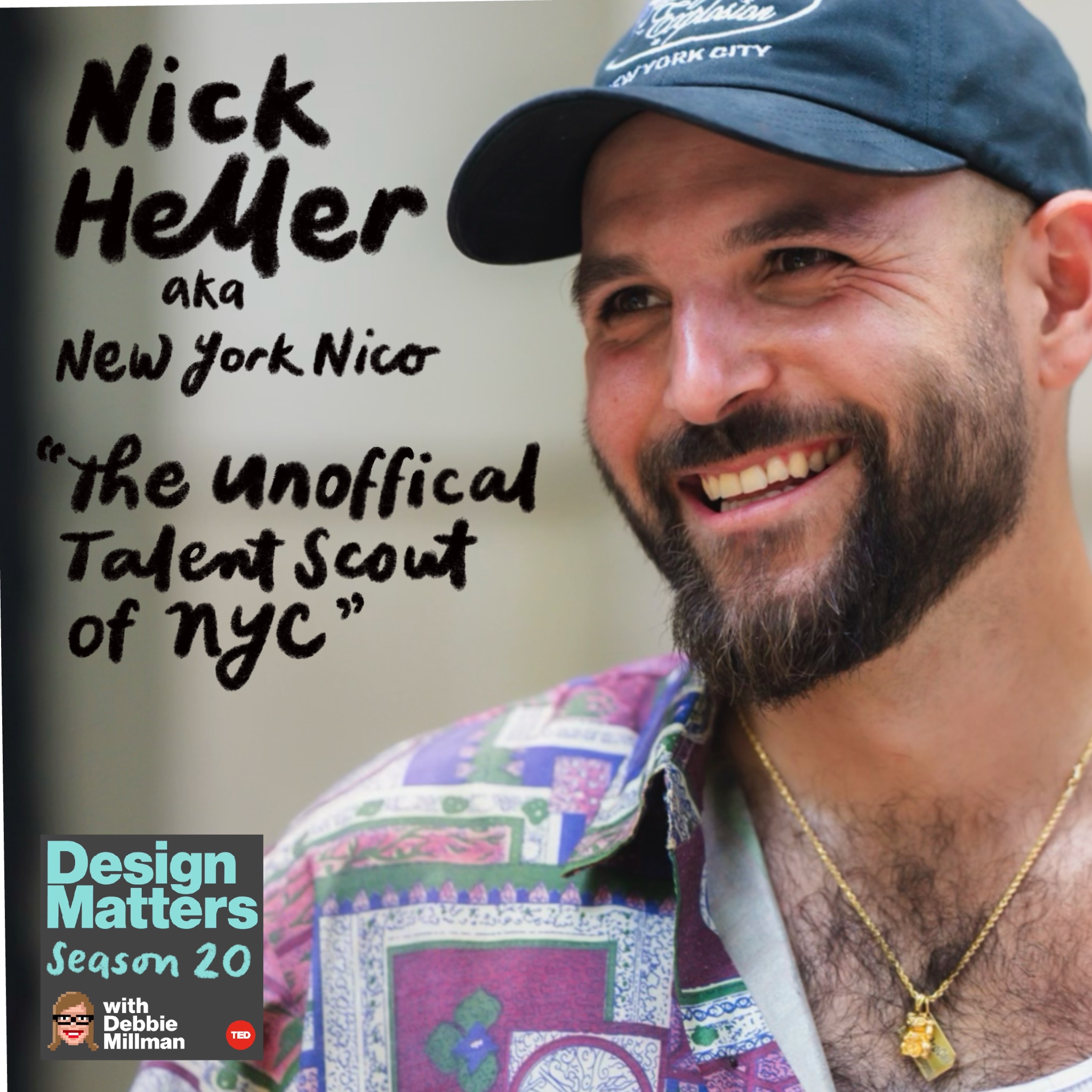
From the TED Audio Collective, this is Design Matters with Debbie Millman. On Design Matters, Debbie talks with designers and other creative people about what they do, how they got to be who they are, and what they're thinking about and working on. On this episode, Nicholas Heller talks about New York City and New York City characters.
- [01:21]
Nicholas Heller
He's a big dude, but he knows kung fu like he can put his leg over his head.
- [01:29]
Debbie Millman
On social media, he is New York Nico. And his short videos, photos and stories celebrate the enduring wonder and wackiness of life in New York. He's been called the unofficial talent scout to the city and if, like millions of others, you've seen his work, you'll know why. It's full of New Yorkers of all stripes doing their thing, working, singing, singing while working, riding a bike with a trash can balanced on their head. You know, normal everyday stuff. In the early days of COVID he was one of the local heroes when his Instagram channel brought much needed attention and money to storefront businesses trying to survive in the era of social distancing. He even won a presidential medal for for his work. I interviewed Nick Heller on Design Matters last year and we talked all about his life and his career. But this was before his work led to the publication of a brand new book. It's called New York Nico's Guide to New York City. It's just been published and today he's here to dish all about it. New York Nico, AKA Nicholas Heller. Welcome to Design Matters.
- [02:48]
Nicholas Heller
Thank you. Honored to be here, Nick.
- [02:50]
Debbie Millman
Let's remind people of a few important facts. One, you are a native New Yorker, as am I. And you're also considered the unofficial talent scout of New York City to millions of people in and out of New York. Remind us how you first got that title.
- [03:10]
Nicholas Heller
I think I just called myself the unofficial talent scout of New York once maybe on a post or something, and it kind of just stuck. And then the New York Times used that title in an article. So I've been giving them the credit because I think it sounds better coming from them than it does self designated from myself. Yeah, being the self proclaimed unofficial talent scout isn't as cool as New York Times calling me the unofficial talent scout.
- [03:40]
Debbie Millman
Well, you first became interested in film. I believe it was the eighth grade and you took your first in high school. You left New York City to go to college and then went to Hollywood to pursue your career there. And I know while you were living in Los Angeles, you failed your driver's test three times, which makes for quite a lot of difficulties in terms of getting around Los Angeles. How did you get around when you were there?
- [04:10]
Nicholas Heller
I biked everywhere.
- [04:12]
Debbie Millman
Did you?
- [04:13]
Nicholas Heller
Yeah, I biked everywhere. I was in the best shape of my life.
- [04:17]
Debbie Millman
And so was failing the driving test the primary reason you decided to come back to New York?
- [04:24]
Nicholas Heller
I mean, it was one of many reasons. I just wasn't booking any work while I was out there. I went out there because I thought I was going to make it as a hot shot music video director and just failed miserably. So that was the main reason why I moved back. But I also just, you know, I'm glad at the end of the day, I'm glad I experienced it. I feel like none of this would have happened if I hadn't experienced Los Angeles and living somewhere else for an extended period of time. But yeah, just not for me.
- [04:57]
Debbie Millman
You said something. I believe it might be in your book. I have it in my research. I'm not sure if I read it in your book or if I read it in one of the other interviews that you've done, but you said this. What I discovered was the whole thing about how the grass is always greener on the other side. But I don't know much about grass. I grew up around Union Square and I love that you shared that. And I think it's such a wonderful way of considering confronting what we think we need to do versus what we end up doing for lots and lots of different reasons. But it seems that in order to find out that the grass isn't greener on the other side, you have to walk over to that side too.
- [05:44]
Nicholas Heller
Yeah, you gotta experience it in order to know that what you have right in Front of you is. It's the best.
- [05:52]
Uncommon Goods Announcer
Yeah.
- [05:52]
Debbie Millman
There's no place like home, right?
- [05:54]
Nicholas Heller
Yeah. Anytime people tell me that they're tired of New York, I say, all right, well, you know, go somewhere else for a little bit and you'll be back. Yeah, or you won't. But when you're born and raised in New York, it's like you're used to a certain type of energy and movement. I just wasn't getting that.
- [06:14]
Debbie Millman
I think anybody that does live in New York for any amount of time, at any point in their lives ends up with some of New York in their DNA. And that never goes away.
- [06:25]
Nicholas Heller
No, never.
- [06:25]
Debbie Millman
I think people that leave the city will always have that. I haven't met many people that have lived in New York and then left New York that aren't proud of that DNA in their system.
- [06:37]
Nicholas Heller
Oh, yeah. I love going to other cities and meeting New Yorkers and just, you know, it hasn't left them. And they miss. They miss the hell out of it. I remember I was in Miami recently, which I consider to be the Sixth Borough. I know that's controversial, but there's so many New Yorkers out there. And I was like taking an Uber to the airport and I just had the best conversation with this native New Yorker. He was so happy to just talk about New York and all the places that he misses. But yeah, it's always a blast going outside in New York and finding New Yorkers.
- [07:13]
Debbie Millman
When you first came back to New York, you were coming back to find yourself again. And in one of your lowest moments on that journey at that time was a visit to Union Square, a place that was very familiar to you. And you saw a street character out of the corner of your eye who you'd seen all throughout high school. What happened next changed the trajectory of your life and ultimately led to not only your career, but to your writing this book. And I'm wondering if you can share some of that history with our listeners.
- [07:48]
Nicholas Heller
Yeah. After failing at being a Hollywood director, I came back to New York and was living with my parents in Union Square and trying to contemplate what I was going to do next. So I was just sitting in the park thinking, and I noticed this New York City street character who I'd seen all throughout high school. He was a. Or he is a 6 foot 7 white guy with dreadlocks who carries around a 10 pound sign that says, the 6 foot 7 Jew will freestyle rap and heal you too. Prior to this moment, I was a pretty introverted and shy person, but I used this low point in my life as an opportunity to just break out of my comfort zone and talk to this stranger. And we ended up walking around the city together, having a great conversation. And by the end of that, I asked if I could make a documentary on him. And he obliged. And I made this five minute film about this New York City character that everyone has seen before, but maybe didn't know the full story of. And it made me realize that I could do this for a plethora of amazing New York City characters. And that's what I did. And then that turned into my Instagram.
- [09:05]
Debbie Millman
What made you decide that the artists that you were filming, whether it be the 6 foot 7 inch performer or any of the other subsequent films that you made, what gave you the sense that these artists would be as compelling to other people as they were to you?
- [09:26]
Nicholas Heller
Well, at first I didn't know that they would be interesting to other people. I just saw them as, you know, in my head they were celebrities. Like Ted, the 6 foot 7 Jew was as famous as the Kardashians in my mind, because everyone knew who this guy was, but no one knew his story. So I figured that putting their story out there and kind of spotlighting them in that way, people would be intrigued. And unfortunately, these videos that I made didn't really get the viewership that I was hoping for. I just put them out on YouTube. This was like in 2013, when web series was kind of becoming a thing. And it was a little discouraging because in my eyes, these were incredible stories that everyone should know about, but it didn't reflect that in the views. So it was also around the time that Instagram was really pushing video. So I started, rather than doing these fully fleshed out, five minute slice of life films, I was like, well, why don't I just film the same people on my phone, not edit anything and just put it up in real time. And then that's what people started gravitating towards. It took a minute, but people started gradually getting more and more interested.
- [10:43]
Debbie Millman
Do you consider yourself to still be introverted and shy?
- [10:49]
Nicholas Heller
I am. You know, doing the press for this book has been not so fun for me because I do not like being in front of the camera. I don't love having to talk about my work, although I do love talking to you. But yeah, no, I'm still introverted. I'm not as introverted as I once was. I'm not shy anymore. I guess I was kind of shy prior to 2013, but now I can really talk to Anybody. But no, I like being sort of a behind the camera guy. You don't need to know anything about me. It's about the people and the places and the things that I'm documenting.
- [11:33]
Debbie Millman
You've gone on to direct big time commercial campaigns for the New York Times, Nike, Major League Baseball, Calvin Klein, Timberland and many, many others. You seem to be particularly interested in these small businesses that really make up the fabric of New York City life. What is it about these folks that interests you the most?
- [12:01]
Nicholas Heller
Well, about a year before the pandemic, I started this hashtag called mom and Pop Drop. You know, I started gaining this following on Instagram and I wanted to sort of give back to the people and the businesses of New York. So I figured by doing this hashtag, I would give free ad space to small businesses that were interested. So they would film sort of like a selfie video talking about their business and I would just post it on my page. And that was just, you know, a way to give back. People seemed to enjoy it, but it didn't really like move the needle by any stretch of the imagination. And it wasn't until the pandemic that mom and Pop Drop really started to have an impact. And it all started with one of my favorite people in New York, Henry Y, the owner of Army Navy Bag on 177 E. Houston St. This was in April or May, like late April, early May. A friend of mine reached out and told me that Henry was really struggling. There was no nobody coming in. You know, he owed months of rent and another customer had set up a GoFundMe for him. I think they were looking for like $50,000. And my friend asked if I could share the GoFundMe. And I was like, well, why don't I come in and talk to him? I'll do an interview, post a video on my page. And I was very familiar with Henry. Although we weren't on like a first name basis, I would just go in every now and then. But when I met him to interview him, I just like became sort of enamored by this guy. And after posting the video, we raised like $50,000 in a day, I think. And that made me realize how special Instagram can be and how you can use social media for good. People just like really wanted to support this guy. And it wasn't just New Yorkers, it was people from all over the world that just wanted this guy to succeed. And that made me realize that I could continue this with other businesses. So that's what I did. You Know, the next one was Punjabi Delhi. And then after that there was this Banh Mi shop. And, you know, it just went on and on and on and was able to, you know, help raise a lot of money for these businesses that needed it. Through that, I became very close with a lot of these businesses and the owners. To this day, you know, some of my best friends are small business owners like Jamal from Village Revival Records and, you know, Henry and Ali from Casa magazine. Anytime I'm in a bad mood and I need a smile, I'll go to one of these places because they just have the best energy and they're fun to be around.
- [14:50]
Debbie Millman
What made you decide to gather so many of these stories, sort of the best of New York, Nico, and write a book?
- [14:59]
Nicholas Heller
Well, one of the most frequently asked questions I get on DM is, hey, I'm going to be in town. Can you give me some recommendations? Obviously, I'm not going to answer all of these messages from strangers, but what I can do is make a book that has all these answers. And this book is like, people have been asking me, like, what sets this book apart from other New York City guidebooks? And I could give you a bunch of reasons, but the main reason is that it's my guidebook. It's like my favorite places in New York. It's not anyone else's favorite places in New York. Although in the book, you'll see I have a lot of my friends who take me to some of their spots, which have become my favorite spots. But, you know, I'm. I don't focus on fine dining. There's like no fine dining establishments. I'm not focusing on bars because I'm not really a drinker. These are just like mom and pop shops that have been around for 20, 30, 40, 200 years. Some of the businesses are much younger, but I feel like they're going to be like the next generation of classic old school mom and pops, if that makes sense. A good chunk of them are in Greenwich Village because that's where I was born. I was born around Greenwich Village. I went to school around Greenwich Village. So a lot of the places that I've been going to for a long time are there and fortunately are still around. But then throughout my work, I've been able to explore farther outside of that particular area. And I've found amazing places in the Bronx and Queens and Staten island and deep Brooklyn. So, yeah, so it's just like my recommendations, like, if you follow me and you like the stuff that I post, then here are my Suggestions for you.
- [16:45]
Debbie Millman
I loved reading this book for so many reasons. Selfishly, I am, as I mentioned, a native New Yorker. I also have, I think, the noted distinction of having lived in all of the boroughs except the Bronx.
- [16:59]
Nicholas Heller
Oh, wow.
- [17:00]
Debbie Millman
And having, you know, lived in the city now for six decades, I was familiar with some places, some of the older places, when I moved to Manhattan in 1983, they were places that I began to frequent. But then it was also really, really wonderful to learn about places that I had never been to and had never heard about. So the book is called New York Nico's Guide to New York City. And you feature 100 business establish. How on earth were you able to get this list down to 100?
- [17:32]
Nicholas Heller
I visited like 130 something spots and I wanted to include all of them, but my publisher said you have a page count that you have to meet, so you're going to have to whittle this down a bit. So, yeah, I mean, it was hard. I hope that there's a part two because between when I turned in the manuscript and Now, I discovered 10 to 15 more spots that I now love and frequent. And that's the beauty of New York is like you keep discovering new spots. I feel like any other city, not any other city, but many other cities you go to. There's like a handful of spots that everyone knows about and those are like everybody's favorites. And there's no discovering new places but New York. It's like you find out about it, a new spot every day.
- [18:22]
Debbie Millman
You write in the book about how New York has been counted out many times before. You recall the Daily News headline in the 1970s, Ford to City, drop dead. The gritty 1980s, 9, 11. And you share how New York has weathered everything. But the COVID 19 pandemic was something else. And New York City shut down. You write about how the streets were empty and the tourists were gone. As someone that was living through it so closely, was there ever a time where you worried that New York City might not recover?
- [18:57]
Nicholas Heller
Yeah, absolutely. I mean, around the time that I started helping these businesses, I was terrified that I would have to be doing this forever. It seemed like there was no light at the end of the tunnel. I imagine most people thought that way because it's hard to be there and think that things could go back to normal.
- [19:20]
Debbie Millman
Yeah. When I first came back, I went to Los Angeles to be with my then fiance. We ended up eloping rather than having a big wedding, primarily because of COVID But when I came back to Manhattan and first walked around, I cried. Yeah, I cried walking the streets because of how many storefronts were now empty.
- [19:43]
Nicholas Heller
Yeah, it's crazy that it really wasn't that long ago, but it feels like a lifetime ago. Yes, but things have gotten better. I'm not being hit up every day by someone whose beloved business is closing, which is nice. I mean, it obviously still happens, but New York is back and it's alive and. But yeah, no, I definitely did have that fear.
- [20:10]
Uncommon Goods Announcer
Spark Something Uncommon this Holiday with just the right gift from Uncommon Goods the busy holiday season is upon us, and Uncommon Goods makes it less stressful with incredible hand picked gifts for everyone on your list. All in one spot. Gifts that spark joy, wonder, delight. And that it's exactly what I wanted feeling. Some of my favorite items that I've discovered on their site included include a grilled personal pizza maker, some fabulous garden accessories, and my favorite, a pair of wine glasses personalized with a Maya Angelou quote. When you shop at Uncommon Goods, you're supporting artists and small independent businesses. And with every purchase you make at Uncommon Goods, they give back $1 to a nonprofit partner of your choice. To get 15% off your next gift, go to UncommonGoods.com DesignMatters that's UncommonGoods.com Design Matters for 15% off. Don't miss out on this limited time offer. Uncommon Goods we're all out of the ordinary.
- [21:25]
Progressive Insurance Announcer
Support for this podcast comes from Odoo. Imagine relying on a dozen different software programs to run your business, none of which are connected, and each one more expensive and more complicated than the last. It can be pretty stressful. Now imagine Odoo. Odoo has all the programs you'll ever need, and they're all connected on one platform. Doesn't Odoo sound amazing? Let Odoo harmonize your business with simple, efficient software that can handle everything for a fraction of the price. Sign up today@odoo.com that's o d o.
- [22:00]
Debbie Millman
O.Com the book is titled New York Nico's Guide to New York City. But you emphatically state that the book is not just a guidebook. How would you describe it?
- [22:11]
Nicholas Heller
Well, to me it's. I want to. I'm trying to figure out how to say this without it sounding arrogant, but.
- [22:19]
Debbie Millman
I want it to be like you're among friends.
- [22:21]
Nicholas Heller
No, I want it to be an artifact. Like I want it to be, you know, something that you'll find On a bookshelf 20 years from now, and you'll open it up and be teleported Back to this time in New York history. You know, I'm hoping that all of the places in the book are still around. But since I started the book a little over two years ago, I would say 8 to 10 of the spots have closed. It's what happens in New York. So I'm hoping that this book, you know, cements these incredible businesses into New York history so that they're never forgotten. And like I said, 20 years from now, you can look at this book and be like, wow, there was a shop in New York that was devoted entirely to chess. You know, there's a shop in New York that. That was entirely devoted to rubber stamps. I pray that these places are still open 20 years from now and that whoever's reading it is discovering this place and then goes to it. But for those that don't make it, I want them to be immortalized. And, you know, I'm hoping that this book does that.
- [23:32]
Debbie Millman
You start the book with a store called Abracadabra, which is at 19 West 21st street in Manhattan. And this is a store that was originally opened by Paul Bloom in 1981. This store was bought by Robert Pinzon and his brother Joe in 2007 and then handed down to Robert's daughter Janine and her husband, Brian Clark. You've been a customer since you were a little kid. Tell us about the store and what you found so interesting about it as a young adult.
- [24:04]
Nicholas Heller
Well, who doesn't love a Halloween store that's open year round? Yeah, I don't know my earliest memory, but I grew up a couple blocks away from Abracadabra. You step foot in there and there's an energy. They have everything you could dream of. And they also have a magician on staff, so there's always somebody there teaching you magic tricks, if that's what you're interested in. But yeah, I know. I just feel like with like all the spirit Halloweens that pop up, it's like I always encourage people to go to, you know, these family owned spots. You have Abracadabra, you have some others, but yeah, there's an aura around Abracadabra for sure.
- [24:47]
Debbie Millman
In the army and Navy bags description, you state that anybody who has gone into a New York City mom and pop shop knows that it can take some time for the owners to warm up to you.
- [24:59]
Nicholas Heller
Yes.
- [25:00]
Debbie Millman
Why is that?
- [25:04]
Nicholas Heller
I mean, it depends. Henry is an exception to that because Henry's just warm to anybody who walks in. He's just the sweetest guy ever. But then there's people like Big Mike at Astor Place, who I didn't speak to for 20 years because I got this very intimidating vibe from him, you know? Cause he has that New York hustler attitude where he just, like, wants to get his work done. And anyone who's, like, getting in his way of getting his work done, maybe he'll give you a little bit of attitude. So Mike is kind of a good example of that. Like, maybe at first you'll think he's rude or a little grumpy, but once you get to his core, he's the sweetest guy ever. And actually, what made him open up to me was when I saw him in the storage area of Astor Place with his shirt off painting a van Gogh inspired Biggie painting. I thought that that was the strangest thing I've ever seen. Like, what is the manager of Astor Place doing? Painting of van Gogh inspired Biggie. So I started talking to him about it, and apparently he had just started painting. He's been wanting to do it his whole life, but never had the opportunity to. So he decided, like, a week prior to me seeing him that he was gonna do it on his lunch break. We became friends from that. And then I actually ended up making a film on him called Big Mike takes lunch. But, yeah, now he's a very close friend of mine.
- [26:30]
Debbie Millman
In the entry. In the entry for Casa magazine's 22 8th Avenue, you state that every place included in this has some character who makes their neighborhood a little bit more special. In the case of the Casa magazine proprietors, whenever you stop in, you feel their love for the community. Is that a requirement for a mom and pop shop?
- [26:55]
Nicholas Heller
I don't think it's a requirement, but for a mom and pop shop that wants to make it into my guidebook, yes. I mean, that's what I love about mom and pop shops, is the owners are usually there all the time. They've probably been there for a very long period of time, and they're a part of the community, and everyone in the community knows them. And hopefully everyone in the community loves them. Casa magazine in particular is on one of my favorite blocks in New York City. A couple doors down is Le Bonbonier, which is like my favorite greasy spoon diner. And then the M12 bus stops between the two of those places. And Louis Lopez, my favorite bus driver in New York City, is always driving that M12, and he kind of like, bridges the two spots together. And it always feels like a sitcom whenever I'm there. Something's always happening.
- [27:54]
Debbie Millman
Tell me about Luis Lopez and what makes him, your favorite bus driver and how you even came to that determination.
- [28:02]
Nicholas Heller
I love city workers. They always have the best stories. And I love people that work for the mta. And when I met Louis and found out he was literally had his bus parked outside and was just taking a little break, I immediately just like got this vibe from him that he was, he was a cool guy. And then he started showing me his kung fu moves. He's a big dude, but he knows kung fu. Like he can put his leg over his head. He's just great.
- [28:31]
Debbie Millman
Nick, I can't tell you the joy, the sort of utter joy and the out loud squeal I made when I saw that you included La Bonne Bonniere, as you described it, a greasy spoon. I moved to New York, to Manhattan in 1983 and lived at Hudson and Perry. And my first job was at 111 8th Avenue. And so I walked from Hudson and Perry, very short walk to 111 8th Avenue and passed La Bon Bonniere every single day. And while you described it as a greasy spoon, to me somehow feels like the most elegant diner in the world. The typography on the sign, the atmosphere inside, I didn't even realize that some estimates range that La Bonne Bonniere has possibly anywhere from 85 to 95 years old. There's something about that environment that I feel is quintessentially New York.
- [29:40]
Nicholas Heller
Also, what's quintessentially New York about it is it's a French restaurant. Technically French. La Bon Bonaire is French. I'm sure it was originally owned by by a French guy, but now it is owned by a Greek guy and a Peruvian woman. And all the waiters and cooks are from Mexico. Talk about quintessential New York.
- [30:05]
Debbie Millman
I was also happy to see Cozy's. Also back in 1983, I was working. When I was working at 111 8th Avenue, there was a woman and I've written about her. Her name was Penelope. And she seemed to me to be the most glamorous sort competitive colleague that I had. And I remember her saying to her boyfriend that they were going to go to Cozy's for dinner. And I had no idea what cozies were. I couldn't find them in the phone book and never knew what she was talking about. This was obviously way before the Internet. And then one day was walking around in the West Village or really the Village, and saw a Cozy soup and Burger at 739 Broadway. And I learned from your book that in 20, in 2015, Crain's New York Business published an article reporting that about 400. Only 400 places in the city had either the word diner or coffee in their name. And that was about 1,000 less than a decade earlier. What do you think happened? Why is there so many fewer?
- [31:18]
Nicholas Heller
Well, first and foremost, it's a shame because diners are the best. The best place to meet people, a friend that you want to get lunch with, someone you're working on a project with. It's just the best because you can sit there for hours and generally they don't mind. But yeah, diners are slowly dying, according to John, the owner of Cozy Superger, and I believe him. I mean, you see fewer and fewer diners and. And I think it's just hard to keep up with, you know, fast food and everything else.
- [31:56]
Debbie Millman
I mean, margins are so tight in the food industry and restaurant business to begin with.
- [32:01]
Nicholas Heller
It used to be so cheap to go to a diner and it's just not. They're like, comparable to fine dining restaurants, and that's not what diners were meant to be. I'm hoping that it turns around and we see more and more diners. I've actually invested in a few newer diners that have been opening up because I want to see them stick around for as long as I'm around.
- [32:30]
Debbie Millman
I want to read a paragraph from the book and then reveal to our audience the mom and pop shop that you're referring to. You write this. There's one truth that resonates throughout all five boroughs. It's that New York City is a place filled with so many wonders that it's easy to miss one or a hundred whenever you walk out the door. It could be a gargoyle on the roof of an old brick building you've passed a thousand times and never noticed. Or a statue obscured by trees and brush in one of the city's many parks. There are always things to miss, which means there are endless chances for discovery. Few places sum up that idea, as well as the odd 125 square foot structure along 7th Avenue south that countless people walk or bike past every single day. Nick, tell us what this store is.
- [33:25]
Nicholas Heller
That's Greenwich Locksmiths.
- [33:29]
Debbie Millman
You wrote this about a locksmith store. Tell us more about Greenwich Locksmith.
- [33:35]
Nicholas Heller
And that's what I love about this book, because it's like I have a barber shop in here. I have a locksmith. You know, it's. To me, it's. It's more about the places and the vibe that they give off and the owners and not so Much about. Like, this is where you gotta go to eat. This is where you have to go to buy something. You know, Greenwich Locksmith is such a cool place.
- [33:58]
Debbie Millman
And it's tiny, 120 square feet.
- [34:03]
Nicholas Heller
Yeah. And you can. Sure, you can get your keys copied there, but you can also, you know, have a chat with Phil and Phil Jr. You know, who have been there forever. And on top of that, they can customize your keys, which I'm not sure many other places can do this, but they. They can make not just an engraving, but they can, like, put stuff on the key. So, like, they do this thing where they put subway tokens on the top of your keys. And they've done that for me. And it's super cool. It's the smallest freestanding building in New York City at 125 square feet. And they've been doing their business out of there for decades. It's just such a cool, cool place.
- [34:45]
Debbie Millman
Nick, how do you find these places? Yes, most people walk by most of or many of these environments, these stores, these shops, and don't see them. How do you see them?
- [34:57]
Nicholas Heller
I mean, I went to school around there, so I've known about Greenwich Locksmiths forever, but it wasn't until I think it was actually fairly recently that I. That I went there for the first time and met Phil and Phil Jr. And the reason why I went there, I think they. They had just reached out to me and they were like, hey, you gotta come by and check out our place. And they were super nice, and they were actually the last addition to the book. I had already turned in the manuscript. And then I met these guys, and I was like, wait, hold the presses. We gotta include Greenwich Locksmiths in the book.
- [35:32]
Debbie Millman
You.
- [35:33]
Nicholas Heller
But, yeah, in general. I mean, again, a lot of these places, I kind of grew up either going to or passing by. And then a lot of the places I was introduced to, many of which I was introduced to over the pandemic, and that just came out of customers or the business owners themselves just reaching out to me to be like, hey, if you're around, can you come check us out?
- [35:58]
Debbie Millman
So, yeah, I do want to ask you about some of the boroughs you write about. Brooklyn. There was a time when you'd tell someone in Manhattan you were going to Brooklyn, and they'd look at you as if you were about to visit another continent. I know that. And whenever I tell people I was born in Brooklyn, I always say I was born in Brooklyn before Brooklyn was Brooklyn.
- [36:19]
Nicholas Heller
Sure.
- [36:20]
Debbie Millman
How and why did that change? Do you Have a sense of when Brooklyn became this sort of crown jewel in the five jewels of the boroughs of New York City.
- [36:30]
Nicholas Heller
It's a great question because I'm, you know, I'm only 35 and I remember when I was in high school, I never really went to Brooklyn. I kind of just stayed in Manhattan. And it wasn't until I graduated from college that I was like, you know what, I want to move to Brooklyn. It seems like that's the spot. So I moved to Sunset park. This was like 2013, I think. And I loved Brooklyn from the minute I started hanging out there every day. But I don't know, I couldn't tell you, like when it started to become hipper. Such a hip place, you know, such a sought after place.
- [37:08]
Debbie Millman
It's so interesting how trends begin. I know that a lot of people, people that lived in Brooklyn and Queens, Manhattanites, called those people pejoratively, bridge and tunnel people, right?
- [37:21]
Nicholas Heller
Oh, wow.
- [37:22]
Debbie Millman
Which is just terrible. But I think that initially people moved to Brooklyn because they got priced out of Manhattan and then ended up usurping the allure of Manhattan in a lot of ways. And I always knew that Brooklyn was bigger than Manhattan, so to speak, in terms of population. I learned from your book that Brooklyn has 2 million 73674 residents. Manhattan, just to compare, has an estimated 1 million 694 to 50. You can take all the people who live in St. Lucia, Granada, Micronesia, Tona, Greenland and Monaco, and they still would make up only about a quarter of Brooklyn's population. And I love that. I love that Brooklyn was its own City until 1898. I learned this from your book. It's not just a guide to New York, best places to go. It's also in many ways a book about New York's magnificent history. But if somebody were to suggest that Brooklyn break off and become its own state, it might have seemed far fetched. But it certainly got the numbers, as you put it.
- [38:26]
Nicholas Heller
Yep, yep.
- [38:27]
Debbie Millman
You say this about Queens. People don't realize how important Queens is. So my question to you, Nick, is why is that and how important is it?
- [38:35]
Nicholas Heller
I mean, Queens is, you know, the birthplace of so many people who have shifted culture. You have for apparel, you have Ronnie Feig, you have Teddy Santis from Amelian Dor, you have Angelo Bach from Awake. These are like three of like the biggest streetwear brands. I don't even know if you would call them a streetwear brand anymore, but they came from Queens in terms of hip hop. You have Nas, you have Prodigy. You know, you have LL Cool J. You have run dmc. Definitely a lot of culture shifters from Queens.
- [39:10]
Debbie Millman
You can hear Spanish, Urdu, Greek, Tagalog, Yiddish, Nepali, and nearly another 300 more spoken along Roosevelt Avenue alone. You start out the section about the Bronx with this declaration. Everything you thought you knew about the Bronx was probably wrong. Like what?
- [39:30]
Nicholas Heller
Yeah, I mean, I feel like, especially if you don't live in New York City, when you think of the Bronx, you. You have a flawed perception of it. There is so much going on in the Bronx. You have. I'm. I'm not saying it, but people say the real Little Italy is in the Bronx. On Arthur Avenue. You have New York Botanical Garden. You have City island, which is one of my favorite, favorite places in the city, obviously. You have Yankee Stadium. You have Riverdale. You have Pelham Bay park, which is an incredible park that I was just in a couple weeks ago.
- [40:09]
Debbie Millman
One of the things that I learned from. From your book was that a quarter of the Bronx is open space with some of the nicest public parks in New York City. You know, I think people do have this perception that it's just buildings and apartment complexes, and it's a quarter of it is open space.
- [40:27]
Nicholas Heller
They have some of the best green spaces in New York. I would highly recommend people check out the Bartow Pell Mansion, which I just discovered the other day. I mean, you'd be shocked to go there and, like, the fact that you're in New York is insane because it's pretty much empty, and it's just full of, like, beautiful greenery and fountains and statues, and you don't feel like you're in the city, but you're in the Bronx.
- [40:54]
Debbie Millman
Is it true that on Staten island you can get one of the best clam pizzas in the world?
- [41:00]
Nicholas Heller
Yeah. Lee's Tavern. It's a tavern. And you would never expect it to have insanely good pizza, but alas, some of the best clam pizza you'll ever eat.
- [41:12]
Debbie Millman
I spent 3rd, 4th, and 5th grade living on Staten Island. Did not expect to go back, but now I'm making a pilgrimage to have the best clam pizza in the world, because I love clams and I am a pizza fanatic.
- [41:30]
Nicholas Heller
There you go.
- [41:31]
Debbie Millman
What do you think is the absolute best pizza in all of New York?
- [41:35]
Nicholas Heller
I can't answer that question. It depends what mood you're in. You know, there's so many different types of pizza.
- [41:41]
Debbie Millman
I think I might go with John's.
- [41:43]
Nicholas Heller
John's, okay. Yeah.
- [41:46]
Debbie Millman
Disapproval with your.
- [41:47]
Nicholas Heller
No, no, no, no. That's good. It's good. I just. I just don't think that there's a. There's an. A good answer to that. Because there's so many different types of pizza, it really depends what kind of mood you're in. You know, one of my favorite pizza places, it's in the book, it's called Cuts and Slices. Their main location is in Bed Stuy. It's actually a black owned pizzeria, which is not super common. He takes his Caribbean roots and applies it to his pizza making. So he has like oxtail pizza and like curry shrimp pizza. And it sounds crazy, but it's so good. But again, it kind of depends what kind of mood you're in. Like, if you want a little something extra on your pizza, then, yeah, you go to cuts and slices. But if you want like a traditional slice, then you can go to, you know, Linda street or Mama's 2 or Louie's or, you know, Louie and Ernie's in the Bronx.
- [42:40]
Debbie Millman
Have you tried the pizza place on 7th Avenue and 23rd Street? The pizza slices are $1.50 apiece. It's one of the best slices in all of New York.
- [42:50]
Nicholas Heller
Yeah. I can't tell if you're being sarcastic.
- [42:52]
Debbie Millman
I'm not. I'm not being sarcastic. It is.
- [42:55]
Nicholas Heller
I don't know if I Trust Pizza under $2.
- [42:58]
Debbie Millman
Yeah. And then I have to ask you about one other food type that's one of my favorites. Any sense of where you could get the very best hot dog in New York?
- [43:08]
Nicholas Heller
That I can tell you.
- [43:09]
Debbie Millman
Okay.
- [43:10]
Nicholas Heller
You gotta go to the Hot Dog King outside the Met Museum.
- [43:13]
Debbie Millman
Yeah.
- [43:14]
Nicholas Heller
I'll tell you why. His hot dogs are the best. And it's very simple. He grills them. They're not dirty water dogs. Dirty water dogs are no good. They take all the flavor out of the hot dog.
- [43:24]
Debbie Millman
Indeed.
- [43:25]
Nicholas Heller
You gotta grill them. Nothing better than that.
- [43:28]
Debbie Millman
I have a couple more questions for you, Nick. Talk about the design and the illustrations in the book. The book is highly illustrated. Who did you work with and what was that process like?
- [43:38]
Nicholas Heller
I worked with Chris Wilson, who I've been working with him for like eight years now, kind of on and off. And originally I was just going to use him for the COVID I knew I wanted a really special cover. I wanted this to stick out. You know, there's a ton of New York guidebooks. I wanted something that will catch people's eye. And my idea was to do sort of like my version of Where's Waldo and to create this sort of fictitious neighborhood in New York that has all my favorite places and favorite people. And it started as that. And then after he did it, I was like, you know, let's get you to do a little bit more than just the COVID So he did the maps and spot illustrations and I just love his style.
- [44:26]
Debbie Millman
Yeah, the book has a real and a wonderful energy to it. You mentioned writing a second edition of the book with another hundred or so places. But you've also said that your ambition is to make feature films about New York with your characters. And I couldn't help but wonder if this book could become sort of episodic TV show about each of these places.
- [44:51]
Nicholas Heller
Yeah, I hadn't thought about that, but I guess it could. I guess we have to see how it does.
- [44:57]
Debbie Millman
It really felt like it had.
- [44:59]
Nicholas Heller
Maybe I'll get a movie deal.
- [45:00]
Debbie Millman
Right? It would be such a wonderful to feature either by borough or by neighborhood or by genre. I mean, it would be. I mean, there aren't too many. There's only one locksmith and only one rubber stamp store. But still there's so many ways you could organize the various mom and pop shops. You know, my dad was a pharmacist and always had a mom and pop shop pharmacy for his whole career. And so it was a joy to see and re experience life from that side of the cash register. I used to work for him when I was in college and made all the little signs in his store. I think it's a celebration of anybody that was or started or created their own mom and pop shop or for anyone that wants to frequent one. I have one last question for you, Nick. You said at the beginning of New York, Nico's Guide to New York City, that you never realized how lucky you were to be born and raised in New York until after you left. Think you'll ever leave again?
- [46:05]
Nicholas Heller
No. No, I don't. I mean, I hardly ever leave now and whenever I do, I miss it immediately and can't wait to get home. So I can't imagine ever living anywhere else.
- [46:20]
Debbie Millman
Nick, thank you so much for writing.
- [46:22]
Uncommon Goods Announcer
This wonderful love letter to New York City.
- [46:25]
Debbie Millman
Thank you so much for making so much work that matters. And. And thank you for joining me today on Design Matters.
- [46:31]
Nicholas Heller
Thank you so much, Debbie. It's a pleasure.
- [46:33]
Debbie Millman
Nick Heller's book is titled New York Nico's Guide to New York City. To read more about Nick Heller, go to his wonderful, vibrant, Instagram feed, New yorkniko N I C O I'd like to thank you for listening. And remember, we can talk about making a difference. We can make a difference or we can do both. I'm Debbie Melman, and I look forward to talking with you again soon.
- [46:56]
Design Matters is produced for the TED Audio Collective by Curtis Fox Productions. The interviews are usually recorded at the Masters in Branding program at the School of Visual Arts in New York City, the first and longest running branding program in the world. The editor in chief of Design Matters Media is Emily Wilent.