Loading summary
Transcript148 lines
- [00:01]
A
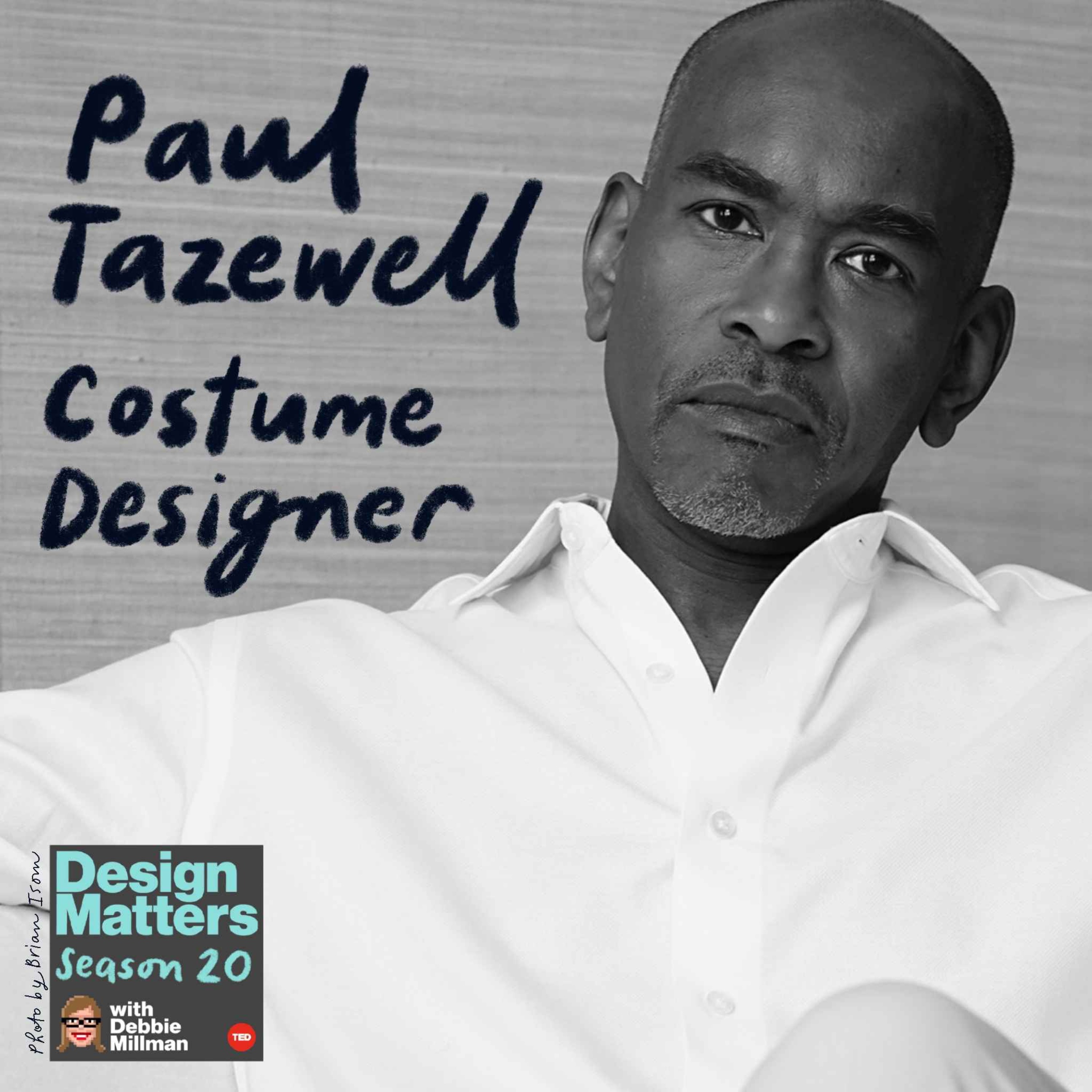
Contemporary design is often more challenging because everyone involved and also seeing it knows clothing because it's what we wear every day. From the TED Audio Collective, this is Design Matters with Debbie Millman. On Design Matters, Debbie talks with some of the most creative people in the world about what they do, how they got to be who they are, and what they're thinking about and working on. On this episode, Paul Tazwell talks about costume design look, my lens into my design for Wicked is seeing Elphaba as a person of color.
- [00:52]
B
At Schwab, how you invest is your choice, not theirs. That's why when it comes to managing your wealth, Schwab gives you more choices. You can invest and trade on your own plus get advice and more comprehensive wealth solutions to help meet your unique needs. With award winning service, low costs and transparent advice, you can manage your wealth your way at Schwab. Visit schwab.com to learn more.
- [01:15]
A
To get people excited about Boost Mobile's new nationwide 5G network, we're offering unlimited talk, text and data for $25 a month forever. Even if you have a baby.
- [01:24]
B
Even if your baby has a baby, even if you grow old and wrinkly.
- [01:27]
A
And you start repeating yourself, Even if.
- [01:28]
B
You start repeating your.
- [01:29]
A
Even if you're on your deathbed and you need to make one last call or text right? Or text the long lost son you abandoned at birth, you'll still get unlimited.
- [01:36]
B
Talk, text and Data for just $25 a month.
- [01:38]
A
With Boost Mobile Forever, after 30 gigabytes, customers may experience slower speeds. Customers will pay $25 a month as long as they remain active on the Boost Unlimited plan.
- [01:45]
B
Forever. I'm Jen. And I'm Jess and we're the hosts of the beauty podcast Fat Mascara. We fell in love with the brand Violette FR after we had its founder, French makeup artist Violette Seurat, on our show. I need a minimalist but effective skincare routine, so I love Violette fr's Boom Boom Milk. It's a multipurpose rebalancing that protects your skin's natural microbiome and improves overall skin health. The main ingredient, fermented birch SAP, is a miracle worker.
- [02:08]
A
Use it alone or as your first step.
- [02:10]
B
You can also sandwich it between your active topicals. A French secret for less reactive skin. Visit violafr.com to discover Boomba Milk, a French skincare essential that will bring your skin to its healthiest state. When you think of skyrocketing brands like Aloe, Allbirds or Skims, it's easy to credit their success to Great products, sleek branding, and brilliant marketing. But here's the overlooked secret. The real magic lies in the engine behind the scenes, the business powering their business. For millions of brands, that engine is Shopify, making selling seamless for them and shopping effortless for us. Upgrade your business and get the same checkout Alo Yoga uses. Sign up for your $1 per month trial period at shopify.com retail. All lowercase. Go to shopify.com retail to upgrade your selling today. Shopify.com retail Wicked west side Story, Hamilton. These stories have lots of iconic, memorable characters. And those characters, well, they all need iconic and memorable costumes. Costumes that align with their character, that are in harmony with the set design, but that also captured the viewer's imagination. Paul Tazewell has designed the costumes for Ariana Grande's Glinda, Cynthia Erivo's Elphaba, Rachel Zeller's Maria, Daveed Diggs, Jefferson Lin Manuel Miranda's Hamilton, and many, many, many more. For three decades, Paul has been designing costumes for theater, film, television, opera, and ballet. He's won an Emmy, a Tony, and he's just been nominated for an Academy Award for his groundbreaking work on Wicked. Paul is here to talk about his career and how he goes about costuming some of the most memorable characters of our time. Paul Tazewell, welcome to Design Matters. Hi.
- [04:12]
A
It's so good to be here. Debbie.
- [04:14]
B
Paul, congratulations on your Academy Award nomination for designing the costumes of the film Wicked. Now, I understand the very first you designed and created the costumes for was the Wiz, way back when you were in high school. That's right. And I believe you also had a part in the production. Who did you play?
- [04:38]
A
I played the title character. I played the Wiz.
- [04:41]
B
Oh, wow.
- [04:42]
A
Not Dorothy. I did, but I played the Wiz. I played the Wiz. I wanted to be a. A performer. Once I was stung or bitten by the bug of theater, I really wanted to be a performer. And costume design was a side gig. I happened to be in a program where they put a lot of money into a public school to integrate. And so whenever Wicked became available, the head of that program decided that we should do that. And I think that was very smart of him because it was a largely black school.
- [05:22]
B
Now, I believe that your mother helped make the white suit and the cape with the green lining and that your dad helped spray paint Glinda's gold cape for that production.
- [05:34]
A
All of that true. All that true. I have memories of asking my dad to spray an ombre of rainbow colors on the Glinda cape. On gold lame. And he did his very best. He was a research chemist for Firestone.
- [05:50]
B
Yes.
- [05:51]
A
That was not his profession. He wasn't creative in that way. But the fact that he took that on was really beautiful.
- [05:59]
B
You grew up in Akron, Ohio. You're one of four boys.
- [06:02]
A
That's right.
- [06:03]
B
What order do you follow?
- [06:04]
A
I'm number three.
- [06:05]
B
Ah, yes.
- [06:06]
A
Yeah. So my two older brothers were about a year apart, and then there's a three year break and I was born. And then my younger brother is four years younger than me.
- [06:16]
B
Now, you mentioned your dad was a research chemist for Firestone tire and Rubber. And your mom, Barbara, was a French and English teacher.
- [06:24]
A
That's right.
- [06:25]
B
But also a painter, a puppet maker, a performer, and a seamstress.
- [06:29]
A
That's right, all of those. And her mother was a painter, and her dad was a professor at Akron University.
- [06:37]
B
My mom was also a seamstress and a painter. And when I was living on Long island through junior high school and high school, she would put ads in the Penny Saver to advertise her business. She worked in the basement in a little room that she carved out for herself. And what really entranced me about it was she did something that I guess now, in doing my research for today's show, quite a lot of costume designers do, which is, you know, you draw the person and the outfit, and then you cut out little samples of the fabric and then attach that to the drawing. And she did that. And there were drawings all over her little space that she had with her Bernina sewing machine, which I remember.
- [07:24]
A
Oh, my God.
- [07:25]
B
And she taught me how to draw as well from doing that, because I wanted to draw the models that she did of hers. So I loved seeing everything that you did. It took me way back in a very sort of wistful, bittersweet way.
- [07:38]
A
Oh, that's wonderful. So many different parts of what you just said ring true for me. Paper dolls and dressing of paper dolls and color forms. I don't know if you remember color.
- [07:49]
B
Forms and paper dolls. Oh, my God. The Betsy McCall paper dials and McCall's magazine. I still have mine, Paul.
- [07:56]
A
So, I mean, you know, all of those things, I think were additive to create what I do now. It just happened that I. I diverted into performance for a little bit, and then I, you know, I came back.
- [08:10]
B
Now, your mother taught you how to sew, is that correct?
- [08:12]
A
That's right. I was probably in the fourth grade maybe, and I was making dashikis, the first thing. So it was a very simple T shaped garment, and it was fashionable at the time, so, you know, it all made sense.
- [08:25]
B
I was in seventh grade when she first taught me how to sew, and I started making my own clothes. Probably the most memorable was. Was a pair of red corduroy, bright red corduroy overalls. Form fitting. Nice that I appliqued a butterfly on the front panel of the overalls. And I really wish that I had a picture of them to show you because it was probably my best moment as a seamstress in training, you and your brothers studied quite a lot of music. You studied the Suzuki violin. You also studied piano and sang in the church choir. It really seems like your childhood was. You were really surrounded by culture and arts.
- [09:11]
A
And that is very true. I mean, you know, we were in Akron, albeit, and, you know, and even so, like, my. My grandmother would teach piano. She played the piano, and she also taught piano. She went to Oberlin to study music. So that element of culture, you know, of the arts was always a part of her life. I mean, it then bled into our time at church and being an acolyte and singing in the choir there. But my oldest brother, Joe, he pretty much led our experience with Suzuki violin, and he was excellent for his age. Then each of us needed to follow suit.
- [09:54]
B
I read that when you were nine years old, you saw a production of Oklahoma, and that was when you decided that you wanted to become an actor and a dancer. What was it about that show in particular? Did you see it as a play or did you see the movie?
- [10:07]
A
No, it was a high school production. So it was at the same high school that I ended up going to. I was in grade school. I might have been in the fifth grade or sixth grade. I was familiar with live performance, but there was something about seeing that story as a musical being presented with the kind of excitement that was coming off the stage. And it was infectious. And I really wanted to. You know, I decided at that moment that I wanted to be a part of that energy. I mean, there was something that was really magical that was coming from the stage. And I held to that until I was able to actually do it. I think my first plays were probably in junior high, you know, and those were just very simply presented plays. But then it was the production of west side Story, which was produced by the. It was a summer musical program again at my high school, but it was pulling many students from all over the greater Akron area to do a production of west side Story. And in that production, I played Officer Krupke.
- [11:13]
B
Wow.
- [11:14]
A
And that was probably my first full on Performance. And that was great. It was a lot of fun and life changing because again, it was creating a community of artists coming together for this single goal of creating art and what's turned into creating something beautiful for me. So that's been a consistent part of my professional experience. Yeah.
- [11:43]
B
And is it true for a very brief period of time, you thought you wanted to be a psychologist?
- [11:50]
A
You dug very deep? Well, I mean, yes. Yeah. You know, when you go through this process of, you know, as a kid, a doctor or a lawyer or a fireman or. I actually had a child psychologist. You know, growing up, it was a group kind of group therapy situation. And I had loved that time. It was, you know, for me, it was kind of playtime. And, you know, so I think that it made me very self aware in a good way. But I then also realized that as a profession, you know, I could choose to be a psychologist or a psychiatrist. It served me that interest as I investigate characters and that, you know, wanting to understand personalities, people, why we make certain decisions, you know, and how that informs what we choose to dress ourselves in. You know, I think that it is all part of how I have made sense of what I do.
- [12:58]
B
You started college at Pride Institute in Brooklyn, majoring in fashion design and intended to continue taking dance and acting classes. And I understand that it was your parents that insisted that you study fashion so you would have something to fall back on if auditioning didn't work out. And it's the first time I've ever heard of parents insisting that a backup safety job would be a job in fashion.
- [13:28]
A
Well.
- [13:31]
B
I mean, they must have had a lot of faith in your talent.
- [13:34]
A
I think that that was okayed by my mom. I think my dad, who was a very pragmatic man, wanted to make sure that his children took care of themselves and could take care of a family and making choices according to that. So really, theater and the arts for my father wasn't. I mean, that wasn't an option, really. You know, and I think that my mother probably talked him into this as an idea because indeed, you could get a degree in fashion design. It allowed for me. I mean, my intention was to get to New York come hell or high water. I mean, I realized that, you know, when I think that my class took two trips to New York while I was in high school, and I knew that I wanted to be in New York, you know, I wanted to mature, you know, as an artist in New York. And that was where I could actually start to do theater. So it put me in the Right place to start to take lessons, voice lessons, and audition and eventually join a cast, you know, on Broadway. That was my hope. But indeed it was, you know, at least having some degree that I could excel in. Why not have it be fashion? Because it was something that I really enjoyed, and I think that my mother knew that I would excel in a profession that I really enjoyed.
- [14:57]
B
You transferred to North Carolina School of the Arts after one year at Pratt. Why did you make that move?
- [15:05]
A
Well, coming from Akron, Ohio, that was a huge culture shift to enter into New York and Brooklyn in 1981. 82. Right.
- [15:18]
B
It was before Brooklyn was really Brooklyn.
- [15:19]
A
Yeah. I mean, that neighborhood. I live in the same neighborhood that I was going to school in now. And it was completely different situation, you know. But that aside, I was living in a roach infested apartment because that was the housing for Pratt Institute students. Huge high rise, full of students that were under the age of 21. So that was a little traumatizing. And then I just wanted to get back to really what my passion and love is. There was this program that offered costume design, or major in costume design, as well as a major in dance, as well as a major in acting, music of all sorts. And it was close to family. It's close to Greensboro, where a lot of my family lives. So there are a lot of pluses for shifting. What I didn't know is that I would not be able to double major, which is what my hope was, that I would double major in costume design and in dance or acting. You know, one of those. That second year there, I needed to make a decision about what am I going to do and what are my next steps with my life, really. And I made the decision to really set down performance and really embracing what seemed to be working at that moment, which was costume design. One of the things that led into that decision was also being aware that the roles that I had the potential to be offered at that time were not necessarily roles that I saw myself in, meaning I was not necessarily going to be cast as a leading man in a musical, or those would be few and far between because I'm a black man, you know, and those roles were not offered up very easily. So I thought that given all of the, you know, everything that was being communicated to me, that my longevity as a costume designer would be much greater. And really, here I am. I mean, I went on then to NYU for graduate school. So I continued on for another three years after I graduated from North Carolina School of the Arts. And there I met Tazwell Thompson, who is a director of opera. And, you know, we share a name.
- [17:40]
B
I know I was like, I had to double check and triple check.
- [17:45]
A
Like, is this correct? It's, you know, so no nepotism. It was just that, you know, as it was. But he introduced me to Arena Stage in Washington, D.C. it was the year after I graduated. I had done my graduate production with Tazewell as the director. That next year there was a production called Stand Up Tragedy. They were producing it at the Arena Stage. And so I was asked to come in and design that production. That started a relationship, a work relationship, a collaborative relationship with the Arena Stage. And the year after, I was asked to return as the head of the costume department, you know, to be in residence there. And it provided the opportunity to really hone my skills as a costume designer, to continue to mature as a costume designer as well, and to be able to express, I mean, to create in a. Prof. On a professional level. But it was outside of the gaze of New York. At the same time, I was also starting to get invited to other regional theaters around, because at that time, the theaters, again, were, through grants, were getting money to produce work about people of color, you know, and, you know, so there. There was much more that was being done to tell stories about black people and other people of color. So that allowed for introductions to these other theater companies. And in a beautiful way, I was able to show them what I could do, both to tell the story of people of color and then also to show them that my vision was much larger. Well, it was inclusive of other things as well.
- [19:29]
B
You were at the Arena Stage in Washington for eight years. You became the resident costume designer. You got 13 Helen Hayes Award nominations while you were there, as well as winning some. You met George Wolf in 1996. He was then the artistic director of the Public Theater. He saw your work, found your name, and invited you to work with him. How did he find you? What did he see of yours that intrigued him? Do you know?
- [20:02]
A
I am going to assume that he came down to the Arena Stage or he had a representative.
- [20:07]
B
Maybe it was a 13 nomination.
- [20:10]
A
Well, maybe it could be. It could be. The first play that he asked me to design was. It was called Blade to the Heat. And it was set in the 50s or very early 60s, I can't remember. And it involved a Jackie Wilson like character and then also a Cuban. There were boxers, I believe it was kind of. It was a boxing story. Then soon after, he asked me to design Bring it to Noise, Bring it to Funk, which was my First Broadway.
- [20:44]
B
Show, first Broadway show, first Tony nomination.
- [20:47]
A
That's right.
- [20:47]
B
You were 30 years old, is that right? Yeah, I think so. According to my math, it seemed like I got you. I was like, wow, that is incredible how. I mean, bring into noise, Bringing Defunct, created by Savion Glover. I saw that back in the day, 1996, I think. Revolutionized theater.
- [21:13]
A
Yeah. In a huge way. And, you know, I look back on my career and I think about those opportunities. I mean, that's, you know, those pinnacle moments that have really informed how I design. Just to work with George was. Is, you know, is amazing. I mean, he's. He's brilliant. And, you know, he's brilliant as a writer and he's brilliant as a director. And, you know, to be asked to keep up with him and his pace and his brain may be better and smarter. And I continue to work with George, you know, I carry with. You know, and in my process, I carry him into it because I'm asking myself questions in the same way.
- [21:57]
B
You've also had a really long relationship with the Public Theater. Hamilton was the play after in the Heights. In the Heights was created, the beginning of which was at Wesleyan, but then Hamilton was started at the Public Theater.
- [22:14]
A
Right, right.
- [22:15]
B
When did you get involved with Lynne and Tommy? I know you've worked with Tommy quite a lot.
- [22:19]
A
Yes. I mean, in the Heights was the first production I did with that group of creatives, with Tommy, with Lynn, with Alex Lacamore, you know, and with Andy Blankenmueller. And, you know, there's Tazewell. There was George Seawolf, there was Tommy Kail, Lin Manuel Miranda, Alex, Andy. Those were hugely formative collaborative relationships. With Tommy, with Lynn, that space became a very safe space to be able to create. That's when I do my best work. I know that. That's when I do my best work. But I think that, you know, in, you know, if I think. I don't have to think very hard, but if I think about what I was after from the west side Story when I played Officer Krupke, and that feeling, it's trying to, you know, searching to recreate that feeling in every experience that I get, and searching for collaborative relationships where that can be engendered, where, you know, where. Where there's space to offer up in, in a way that doesn't feel, you know, there's no judgment, just open and sane. That is what I will always search for, because I now know myself and I know that that needs to be part of the experience. But I think that it was Probably I wanted to say that it was my husband, he was my partner at the time, found out that this production was happening, I don't know, probably online. You know, he found out that there was a production called in the Heights. It focused on community, Latin community, and also other people on the street streets of New York. It was in line with much of the work that I had been asked to do up to that point. So I, as a designer, I was probably the best person to do that. And so he encouraged me to go after that star. And I'm so glad that I did. I mean, I put my agent on, you know, tracking down how do we get a meeting with Tommy and see if. And he might have been doing the same thing from his end as well. But however it happened, we ended up in the same space. We hit it off. There was a connection. From then on, there's been a connection. Tommy's one of my favorite directors. It is one of my favorite experiences having that lead there because there were a number of productions that were between in the Heights and Hamilton all that time. We were becoming more familiar with each other. And we did a production of the Wiz for Encores.
- [25:06]
B
That's where you win your Emmy award.
- [25:09]
A
Yeah, well, I won my Emmy award for the Wiz Live. So there was more of a. It was kind of a workshop level production that was done for Encores at City Center.
- [25:21]
B
So you've actually worked on a version of the wizard of Oz three times before Wicked. So when you were in school and then in Wicket center and television.
- [25:33]
A
Yeah.
- [25:33]
B
Wow.
- [25:34]
A
Yeah. So I've been with those characters for a long time. And then the brilliant Lin Manuel Miranda created Hamilton. And that was when life really shifted. I mean, until then, it was the struggle of being a freelance designer. Somewhere in there, I lost a little bit of hope. And I went to teach at Carnegie Mellon for three years, you know, and I had things that were on Broadway, like the Color Purple and Caroline or Change. Those shows closed. And, you know, I was just trying to figure out, where do I fit in again? And why did you lose hope? It was just a huge struggle to be a freelance designer and to also not feel like, you know, to feel like I was not being offered those projects that I really wanted to do. I wasn't being offered projects where I felt like I could really expand. And I think that I was just at a place where I wanted to have life open up and to have new experiences, to have new ways of creating. But it was that same year that I took on the professorship At Carnegie Mellon, I was offered George Wolf directed Lackawanna Blues for hbo. And so then it was a film and of course I was gonna do that. And so I was trying to juggle two full time jobs at the the same time and trying to shoot a film as well as teach and be present for the students. It was, you know, after that second year, I made the decision that I was going to leave and go back to freelancing because, you know, I really wanted to be doing what it was that I was teaching, trying to teach somebody else. And I also knew when I was present, the students did so much better and they deserved somebody that could be present. And so I, I made the decision to move on and just kept at it.
- [27:32]
B
Your costumes for Hamilton were also nominated for a Tony Award. I don't know if you happened to see Saturday Night Live this past weekend. Lin Manuel Miranda made a special cameo performance in his Hamilton costume.
- [27:48]
A
That's right.
- [27:48]
B
Which, you know, is so iconic now.
- [27:51]
A
Yeah.
- [27:51]
B
You don't even need to know. Like, you just see it and it becomes telegraphic that this is the costume from this play. That's so rare. When I was thinking about it, it just happened to coincide with preparing for today's show. And I thought, my goodness, we don't even need to know that he's Hamilton to know that this is the costume from Hamilton.
- [28:14]
A
Well, it's Lynn's brilliance and I mean, I'm just so grateful to be able to have created those iconic. I mean, the, you know, that costume that Lynn wears, the three sisters and their colors together, you know, when you see those three colors together, you know exactly what that reference is.
- [28:37]
B
Yeah.
- [28:38]
A
And to realize that that came out of me, it's mind blowing. It's. It's crazy. It's crazy. And I'm so glad that I was part of it. I mean, that was a beautiful group of people to collaborate with. Tommy and Lynn and Alex. But also the cast.
- [28:56]
B
Oh, yeah.
- [28:56]
A
And setting those characters on that cast and how they are forever will be those characters for me at least. And how the colors that I chose were defined by who was playing the role and that then defines who that character is from now on. And also, you know, hairstyle and, you know, there are all these qualities that we created together on that cast and, you know, just, you know, how we then look at the rest of the cast after them, you know, it was just really beautiful. Yeah.
- [29:34]
B
You worked with Steven Spielberg on the movie west side Story. Another one from your history, your personal history. And that was a very modern Had a very modern look. You also worked recently on the beautiful musical Suffs, also another show that came out of the Public Theater created by Shana Taub. Is there a different process that you have for period pieces than for pieces that are primarily set in more modern times?
- [30:10]
A
Well, I would say that my focus is always representing the character as honestly as possible, you know, so I'm, you know, I'm after how do we access who this character is as it's being played by the actor? And if it is period, I can lean on period research, you know, because that, you know, it's like, okay, well this is what it was. I still have to make character choices around, you know, how to use the period research and you know, just what the qualities might be of fabric choice. But, you know, I love historic work. I love period work because of the research element when I'm working on, which is, you know, this film that I'm working on with Steven Spielberg right now is contemporary. So, you know, it's a different kind of finding the character contemporary. Design is often more challenging because everyone involved and also seeing it knows clothing and everyone, you know, because it's contemporary, because it's what we wear every day. And so you, you end up with more input on what would be right for a character, whether it's from the actor or it's from the director or from someone outside of our, you know, the creative group. So that becomes challenging to manage. Also when you're making choices about personality, my relationship to a piece of clothing is gonna be different from your relationship to a piece of. So how you read that as an emotional statement is always going to be different. Whether it's historic or it's contemporary. All that I can hold to is how I viscerally feel about whatever that decision is. And then I rely on that and I expect that at least, you know, 50% of the rest of the audiences will feel the same, will have the same kind of response. But hopefully it's has enough insight that it actually hits a mark.
- [32:17]
B
To make switching to the new Boost Mobile risk free. We're offering a 30 day money back guarantee.
- [32:22]
A
So why wouldn't you switch from Verizon or T Mobile? Because you have nothing to lose. Boost Mobile is offering a 30 day money back guarantee. No, I asked why wouldn't you switch from Verizon or T Mobile? Wouldn't. Because you love wasting money as a.
- [32:35]
B
Way to punish yourself because your mother.
- [32:37]
A
Never showed you enough love as a child. Whoa, easy there.
- [32:40]
B
Yeah.
- [32:40]
A
Applies to online activations, requires port in and autopay customers activating in stores may be charged non refundable activation fees.
- [32:47]
B
Thumbtack presents the ins and outs of caring for your home out indecision, overthinking, second guessing every choice you make in plans and guides that make it easy to get home projects done out beige on beige on beige in knowing what to do, when to do it and who to hire. Start caring for your home with confidence. Download thumbtack today. Save on feel good favorites with great everyday prices at Whole Foods Market. Look for the yellow low price signs throughout the store on quality proteins like responsibly farmed Atlantic salmon. Prioritize well being for less with 365 by Whole Foods Market supplements and delicious smoothie ingredients like organic whole strawberries and almond milk. Don't sacrifice quality Shop great daily prices at Whole Foods Market, in store and.
- [33:41]
A
Online this episode is brought to you by Progressive Insurance. Do you ever think about switching insurance companies to see if you could save some cash? Progressive makes it easy to see if you could save when you bundle your home and auto policies. Try it@progressive.com Progressive Casualty Insurance Company and affiliates. Potential savings will vary. Not available in all states.
- [34:04]
B
Paul let's talk about Wicked.
- [34:06]
A
Yeah, absolutely.
- [34:09]
B
I read that you stated that you remember sitting in front of the television watching the wizard of Oz when you were four years old, and it left an imprint on how you see color, how you look at design overall and what you find magical. So can you talk a little bit about what that experience was like and how that all happened?
- [34:29]
A
Well, just to, you know, you think about that moment when it goes from black and white kind of sepia tone. It's, you know, so it's a very curated black and white into Technicolor. I mean, what other moment in filmmaking can you say has that kind of magic where you seamlessly are led from trauma and reality into a space of magic and anything can happen and beauty and love and brilliance and, you know, all of those, you know any of those words that are descriptive of what Oz is and feels like? Yeah, that as well as being full of, you know, you've got a fairy princess in Glinda and, you know, a huge tulle dress that's sparkly, which is like Cinderella, which is my favorite Disney film. And. And then you've got, you know, a witch that melts and she explodes into red smoke and, you know, and ruby slippers that sparkle. You know, there are so many different iconic clothing images alone that are in my bank of visual inspiration.
- [35:45]
B
In the original 1939 film Glinda the Good Wish wore an iconic pink gown that was designed by Adrienne Aldolf Greenberg, who just went by Adrienne. I love that. But Glinda's gown, beginning in the Broadway production, designed by Susan Hilferty, is blue. Can you talk about the difference?
- [36:05]
A
Yeah, I mean, I think that there was early on, I had a conversation with Mark Platt, who is the producer, the lead producer of Wicked, the film, and he's also the producer of the Broadway show. So he has. You know, it's been his baby for years and years and years, I believe, because of the difference of studio. It was MGM who held the rights to the wizard of Oz and Universal that was gonna be doing the film and then a different entity that was doing the Broadway show. So for Susan, she wasn't given access to that color for that design.
- [36:45]
B
Isn't that incredible that it was a copyright?
- [36:48]
A
Yeah, yeah, yeah.
- [36:49]
B
How are you able to go back to what I've read now is Billy Burke P, as it's been called in Ozzien mythology, to be able to have Ariana Grande wear a pink gown again?
- [37:02]
A
Well, I was using it as an icon, as a cultural icon that many people access, you know, know, and access. And. And I have it in. In my creative being as well. So, you know, I thought that it was important and useful to tap into that color because I could then use it to define the rest of her color story. And it just felt appropriate, you know, design appropriate, to be able to use it in that way and consistent to say something about her character, you know, and to. And to say something about artifice. All that is lovely and beautiful and bubbly. You know, it was reflective of all of those qualities. And it was also the same color as what Billy Burke wore in the wizard of Oz. So I held onto that. And then for what is the equivalent of the Billy Burke dress, that. That moment when she rides in. In the bubble, she's in a very same color, very different silhouette. And the way that we arrived at that silhouette is much different than what that dress is. But it is a glinda icon for 2025. You know, that's beautiful to create that. I mean, that's. You know, it serves the. The film overall, and she wears it so very well. Ariana Grande.
- [38:27]
B
Yeah. I've seen so many people trying to recreate the dress in different memes, but the gown includes over 20,000 beads.
- [38:34]
A
That's right.
- [38:35]
B
It took 225 hours to make. Is it true that you created and constructed more than 1,000 costumes? For the film.
- [38:44]
A
Oh, yeah. I'm surprised that it's not. I mean, it feels like there were many more, but that was it. I mean, we. And we were working on both films. Wicked Part 1 and Wicked Part 2 are two different films, and they were filmed at the same time. And in a given week, we might be shooting. Two days of the week would be all Wicked one, and then we would shift over into Wicked two. It wasn't shot in sequence. It was, you know, we were dropping in and using sets that needed to stay up only for a limited amount of time. And then when we shot that set out, then they could shift it to something else. So that was the practical reason that we were doing that we were faced with doing that way. But it also. It meant that we had to figure out the design of the whole story and, you know, both films all at the same time, which was very useful because you could then see, you know, I could lay out the design and actually see what the arc was gonna be all the way to the very end and make sure that the choices that I make at the beginning of the film need to somehow relate to what's happening at the end of the film. And it all needs to make sense in the way that John wants for it to make sense, you know, so that made for a really, you know, beautiful and creative process in telling the story. And to design something that was quite, so epic was really, really quite wonderful.
- [40:16]
B
You've worked with Cynthia Erivo now on several projects on Harriet, on Wicked. Did getting to know her while working together on Harriet impact your collaboration on Wicked?
- [40:26]
A
Absolutely. Cynthia, you know, she happens to be one. One of my favorite actresses, but just one of my favorite people. And having worked with her on Harriet, I just, you know, I gained so much respect for her because she does everything. I mean, she is an amazing athlete. She doesn't complain about the, you know, the physical nature of it. I mean, she does what she needs to do and is very, you know, adamant about taking on things that, you know, it's like producers are a little on the edge of her, you know, taking on. But she wanted to do as many of her stunts as possible. She wanted to do all of her own flying. She wanted, you know, she. And she wanted to be singing while she was. Or she was. She was singing all of those numbers where she is flying. She is singing as well. And daily, you know, just the stamina she really exhibits. So I, you know, I would give her the world to make her feel good and taken care of. And that was established. With that relationship, working on Harriet, you know, Harriet, it was a tricky time for me because that was the same. My husband passed away right before I was going out of town. We filmed in Virginia. And so, you know, I was going through that grieving process and using the creative process to help me with that grieving. You know, it gave me a place to escape into that. It helped me to heal because of what I was doing daily and the kind of focus that I needed to have daily, which was really powerful. And I learned a lot from that. I learned a lot of what I need in going through something hard like that. But, you know, speaking of Cynthia, she was always present and connected to that, acknowledged that in me. And that kind of warmth allowed for me to go through that process and be more present. Because I also felt seen and heard.
- [42:30]
B
Talk about dressing her nails.
- [42:34]
A
Well, I didn't get an opportunity to design them. I would give my input, but she and the nail designer really came up with what the sequence of looks would be for her nails. Her nails are very important to her. I mean, you see her on the red carpet with decorated nails. Well, before Wicked, she wanted to pull that into how she was telling the story. Story of Elphaba and then figuring out how, you know, how do we use. Because there are certain things that we like. Earrings, for instance. I didn't want to use earrings at Shiz because I felt like it would pull us out of the world of Oz for that moment. You know, she was perfectly fine with that. You know, but it was interesting how you really being able to unpack how we see people and different elements, different accessories and what feels very contemporary and what is. Okay. I mean, when you look at. There's a silhouette of the Wicked Witch of the west with her hands, you see this silhouette and you see these pointed fingernails. So just in that it allows for you to expand on that and make that be one of the identifying things about Elphaba.
- [43:50]
B
Yeah. I mean, when in the wizard of Oz, when the Witch of the west is trying to get the shoes, and then it's sort of the electrical shocks and it. It burns her nails.
- [44:01]
A
Exactly. Poof.
- [44:02]
B
That is burned into my brain. You talked about earrings. I know that the rings that Cynthia Eriva was wearing were very specifically designed, and I learned so much in researching this. So I understand that traditional Western tailoring is built on the symmetry of the golden rectangle in geometry. Did not know that. But your costumes for Wicked were influenced by the Fibonacci spiral, which favors asymmetry. Talk about that. Very specific Decision.
- [44:36]
A
The way that I start all projects is I will have multiple conversations with the director to better understand what their point of view is about a story or about a world. So I did have those conversations with John early on. I might have come up with some images, I believe that I did, that I showed to John in the hiring process. I mean, when I was being interviewed and I offered up a glimpse into how I saw the potential of this world and how I might realize it. But then adding to that, you know, after I was brought on board and I was, you know, thinking about other imagery, I was very much drawn to decor and other, you know, pieces of art. Kaleidoscopic images that included some kind of spiral. And then looking at the Art Nouveau period, which is the same period that Frank Baum was writing the original wizard of Oz, those were happening simultaneously. So I wanted to investigate, okay, so what is within this world of Art Nouveau, and that is taking nature and manipulating it into a design. With Art Nouveau, that was what is in operation. And with that, you see a lot of, of spirals and a lot of asymmetry. And so with design, I'm always searching for what are those common things that will help to define what this world is. For both Nathan Crowley, the production designer, and myself, we need to create rules for a made up world. And it was informed by, indeed by the book by Gregory Maguire of Wicked. It was informed by the wizard of oz film from 1939, and it was informed by the Broadway show. How do you collect all of that as imagery and then make use of it in a way that helps you to create a new world and a world that is actually. We have to explode it because we're gonna see so much more of what Oz is, whether it's Munchkinland or it's Emerald City or it's Shiz. So we really needed to figure out, okay, what is visually in operation. And the spiral ended up a large part of that sensibility and what seemed both whimsical and could hold all the magic that was gonna happen within the film. So I latched onto the Fibonacci spiral as a creative element or, you know, a formula that would govern this world of Oz. And it's, you know, you see it in the shiz uniforms where there's asymmetry. You see it in all of Elphaba's clothes are asymmetrical. There's the organic element that is added onto that for Elphaba, which is. It's more reflective of those things that are mysterious and hidden in nature, like mushrooms, like fungus, like the underside of a trunk in a forest, like dried leaves. And knowing that black was going to. To be very highly used for her costume, you know, I wanted to make it more interesting because when. When you're filming black, it can very easily just go to just kind of a block because it soaks up so much light. But, you know, with the brilliance of Alice Brooks, she figured out, with the cine cinematographer, she figured out a way to light all those different textures that I was creating. But then also when I would add color underneath, there was an iridescence that you got from her clothing as well. Alongside of that, adjacent to that was that we also wanted to be very aware of Elphaba's skin and her skin tone showing through her clothes as well. So there was a lot of sheer fabric that was used on Elphaba as well. So, you know, it was all of those elements together. We were talking about spirals, and I went into something else. Sorry.
- [48:47]
B
No, no, it's great. Cause even her glasses, even Elphaba's glasses have a spiral to them. Her pinky rings, which I read was sort of the center from which the rest of the Fibonacci spiral originates.
- [49:00]
A
Right, exactly.
- [49:01]
B
I want to talk a little bit about the sort of soul of Elphaba, a little bit. And you projected her so beautifully through clothes. I didn't realize that Elphaba wears black not because she is evil, but because she's in mourning, and that's the color that she wears. But when I was reading about the original book and the backstory of Elphaba, who was actually named in Wicked, not in the book. And Elphaba is the initials of the original writer, L. Frank Baum. His initials are lfb, and that became Elphaba.
- [49:42]
A
That's right.
- [49:42]
B
But one of the things that I can't stop thinking about is how Elphaba is portrayed. And I know that Gregory Maguire began contemplating the nature of evil when he was living in London and working on the book. And he stated this. If everyone was always calling you a bad name, how much of that would you internalize? How much of that would you say? All right, go ahead. I'll be everything that you call me, because I have no capacity to change your minds anyway, so why bother? By those standards, should I live? You know, we learned so much about Elphaba over the course of the play and the movie. Do you think that she really was evil in any way?
- [50:26]
A
No, no. Look, my lens into Elphaba, into my design for Wicked, is seeing Elphaba as a person of color, that is my key, my emotional key into understanding what this world is, what both their stories are. Both Elphaba and Glinda, as a person of color, she. There are many assumptions are made, and she's completely misunderstood, and even her reserve is misunderstood. And to walk this earth as a black man, I understand that challenge. And to be vilified for the color of her skin, her green skin is true and huge, and it makes for a very timely story, more so than ever now. Yeah. And timely because you have the opportunity to see this beautiful relationship come together of two people that don't like each other, and because of they're forced to live in the same space, they understand each other, grow to understand each other, and then grow to love each other. That's a beautiful story and necessary for everyone to learn, but definitely necessary for young people to learn.
- [51:53]
B
There's a moment when Elvaba and Glinda are going into the Emerald City, and it almost seems as if their silhouettes are similar in that moment. Was that intentional?
- [52:06]
A
Absolutely. Absolutely. I mean, it was. I was. Thank you for pointing that out. I mean, I. You meet these two women that very clearly have different modes of operation as they navigate their world. You know, I spoke of Glinda, who becomes Glinda.
- [52:25]
B
Glynda. Yeah.
- [52:26]
A
And her world of artifice and beauty and how she's seen is very, you know, without question, is nice, very polite, beautiful, desirable. She's of an affluent family. You know, there's just all of those things that make life very easy for her publicly. And for Elphaba, it's just the opposite, because of her difference and because she doesn't play by anybody else's rules as well, you know, which is admirable, but it is threatening to the rest of the community. So you just continue to follow that forward and figure out, okay, so how can this. How can this evolve to a place where Elphaba softens within her own style? It was partly because of Cynthia playing this role and her love of clothing. I knew that Elphaba had to. She's got a very definite style. It's all intentional and it's all very beautiful. It just happens to be within the color palette that she gravitates to. You know, their balance needed to always stay the same, but from a different point of view. So that to the end, the only important thing is their friendship. You know, when Galinda's invited to hop on the train with Elphaba and they ride to Emerald City, this very scary place Together, we see them in the same way, and then their relationship shifts and changes, you know, very quickly at that very end and moment.
- [54:05]
B
We have about 11 months to wait for part two. So upset about that. Any surprises in the costumes that await us?
- [54:19]
A
All I can say is that there is lots to look forward to.
- [54:26]
B
You said that in such a way that I was expected to hear, and there's gonna be this. Paul, I have one last question for you. You stated this. Keep your eyes and heart open. Understand the power of storytelling and how clothes help tell stories. For anyone looking to discover how they can best harmonize what they wear with who they are. What would you tell them?
- [54:56]
A
Every day that you wake up and you're going through what your day might entail and you check in on your emotional state, make it intentional, what you choose to pull out of your closet. It's all going to inform how you're seen. You know, I always say, you know, we're making judgments daily.
- [55:22]
B
Oh, yeah.
- [55:23]
A
Minute by minute, those people that are walking towards us down the street, anyone who enters into a room, you're making choices about who they are, what their emotional state is, what their personality is. Before you actually meet them, before you have a conversation, you know, you're making a judgment on who that person is. And it's defined by their clothing. It might be their hair as well or the glasses that they wear, but clothing is a large element of what you're taking in and making a judgment about. And then that person may, you know, prove you wrong or they are right in line with what they're wearing. But, you know, know that, you know, how you dress yourself is very intentional and speaks to where you are in your heart and how you want to represent yourself.
- [56:12]
B
Paul Tazewell, thank you. Thank you. Thank you for making so much. Beautiful work. That Matters. Thank you for joining me today on Design Matters.
- [56:21]
A
Thank you so much. This is a wonderful conversation.
- [56:24]
B
Thank you. Paul Tazewell's latest work can be seen in the movie Wicked and on Broadway in Death Becomes her and MJ the Musical. You can read lots more about him@paultazewell design.com and I'd like to thank you for listening. And remember, we can talk about making a difference. We can make a difference or we can do both. I'm Debbie Melvin and I look forward to talking to you again soon.
- [56:54]
A
Design Matters is produced for the TED Audio Collective by Curtis Fox Productions. The interviews are usually recorded at the Masters in Branding program at the School.
- [57:03]
B
Of Visual Arts in New York City.
- [57:04]
A
The first and longest running branding program in the world. The Editor in Chief of Design Matters.
- [57:10]
B
Media is Emily Weiland. To make switching to the new Boost.
- [57:26]
A
Mobile risk free, we're offering a 30.
- [57:28]
B
Day money back guarantee.
- [57:30]
A
So why wouldn't you switch from Verizon or T Mobile? Because you have nothing to lose. Boost Mobile is offering a 30 day money back guarantee. No, I asked why wouldn't you switch from Verizon or T Mobile? Oh, wouldn't because you love wasting money.
- [57:43]
B
As a way to punish yourself because your mother never showed you enough love as a child.
- [57:47]
A
Whoa, easy there. Yeah. Applies to online activations, requires poured in and auto pay. Customers activating in stores may be charged non refundable activation fees.
- [57:55]
B
Worried about what ingredients are hiding in your groceries? Let us take the guesswork out. We're Thrive Market the online grocery store with the highest quality standards in the industry. We restrict 1,000 plus ingredients so you can trust that you'll only find the best high quality organic and sustainable brands all free of the junk. With savings up to 30% off and fast carbon neutral shipping, you get top trusted groceries at your door and you can stop worrying about what your kids get their hands on. Start shopping@thrivemarket.com podcast for 30% off your first order and a free gift.
- [58:26]
A
This episode is brought to you by Progressive Insurance. Do you ever think about switching insurance companies to see if you could save some cash? Progressive makes it easy to see if you could save when you bundle your home and auto policies. Try try it@progressive.com Progressive Casualty Insurance Company and affiliates. Potential savings will vary. Not available in all states.
- [58:45]
B
There's one thing that will forever change the way you sleep and it's the softest 100% organic cotton sheets from Bol and Branch. You'll fall asleep faster wrapped in the most luxurious comfort. You'll never sleep hot again with sheets that feel breathable to sleep in. You'll experience the purest softness on night one and feel your sheets get even softer with every wash. Discover the difference with 15% off your first set of sheets@bolandbranch.com with code buttery exclusions apply. See site for details.