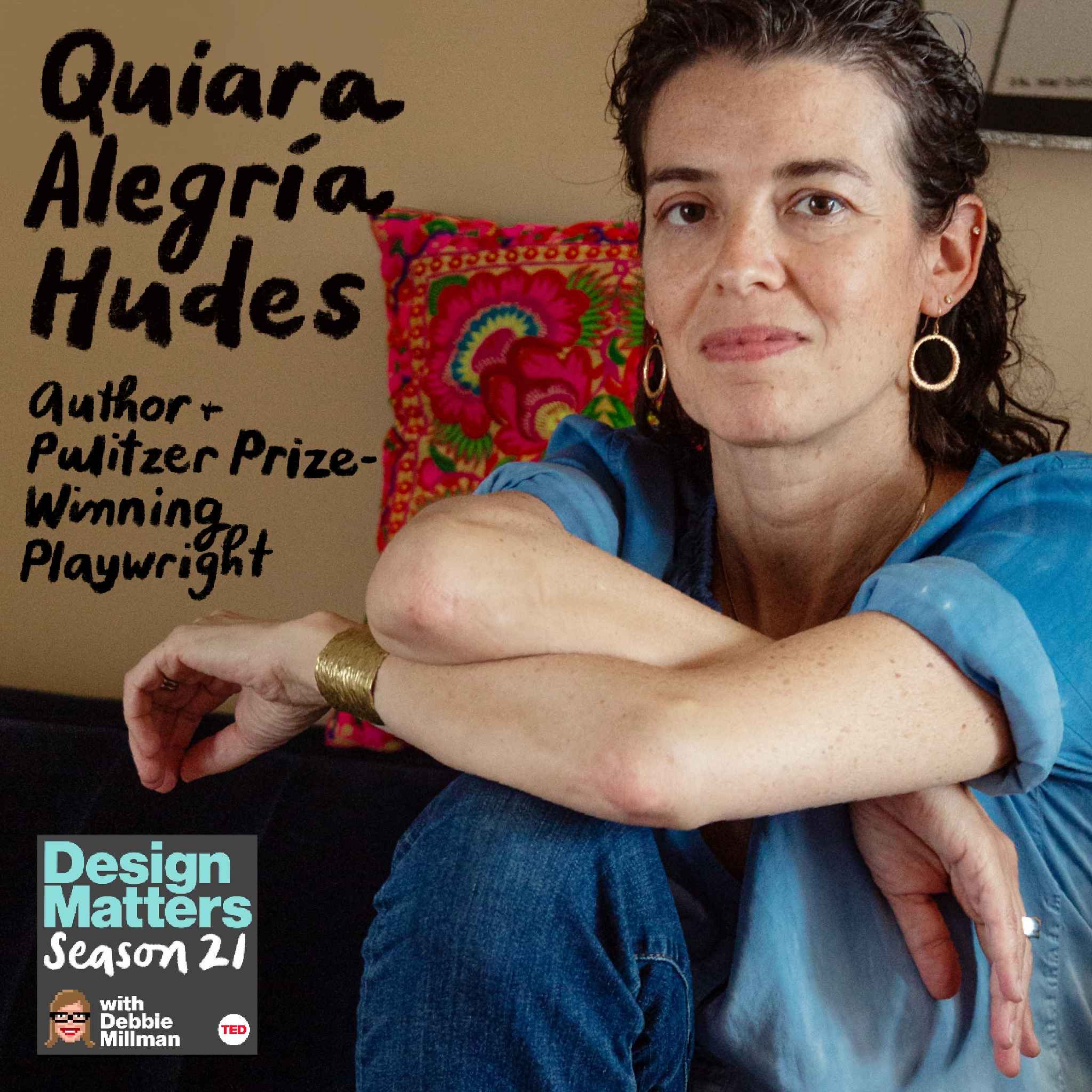
Loading summary
Transcript96 lines
- [00:01]
Chiara Alegria Hud
I know if you stare directly into the sun, you go blind. Like if we look directly at our mothers, will we go blind? Or can we see them? Can we see them just once?
- [00:12]
Debbie Millman
From the TED Audio Collective, this is Design Matters with Debbie Millman. On Design Matters, Debbie talks with some of the most creative people in the world about what they do, how they got to be who they are, and what they're thinking about and working on. On this episode, a conversation with Chiara Alegria Hud about her first novel and the lessons she learned from writing it.
- [00:36]
Chiara Alegria Hud
I'm 48 years old. Who am I living this life for?
- [00:42]
Fin AI Advertiser
AI is transforming customer service. It's real and it works. And with fin, we've built the number one AI agent for customer service. We're seeing lots of cases where it's solving up to 90% of real queries for real businesses. This includes the real world complex stuff like issuing a refund or canceling an order. And we also see it when FIN goes up against competitors. It's top of all the performance benchmarks, top of the G2 leaderboard, and if you're not happy, we'll refund you up to a million dollars, which I think says it all. Check it out for yourself at Fin AI.
- [01:12]
Debbie Millman
Here's how to stay alive longer so you can enjoy Boost Mobile's Unlimited plan with a price that never goes up. Do not mistake a wasp nest for a pinata. Stay alive and switch now at boost mobile. After 30 gigs, customers may experience lower speeds. Customers will pay 25amonth as long as they remain active on the Boost Mobile Unlimited plan.
- [01:28]
Paylocity Advertiser
When everything is moving all at once, your workforce, your tech stack, your business. You don't need more tools. You one solution. That's why Paylocity built a single platform to connect hr, finance and IT with AI driven insights and automated workflows that simplify the complex and power. What's next? Because when everything comes together in one place, growth comes easy experience. One place for all your HCM needs. Start now at paylocity.com 1.
- [02:01]
Debbie Millman (Interviewer)
Kiera Alegria Hudis is a Pulitzer Prize winning playwright, composer and novelist whose work has reshaped contemporary American theater. She's the co creator of in the Heights, the groundbreaking musical that helped redefine whose stories belong at the center of the American stage. Her play Water by the Spoonful earned the Pulitzer Prize for Drama and her writing across theater, music, memoir and now fiction has consistently explored identity, family, belonging to and the complicated inheritance of culture and care. We first spoke on design matters when Chiara released her memoir, My Broken Language, a book that traced her coming of age at the intersection of language, lineage and spiritual worlds. Our interview took a deep dive into Chiara's life and career. In our interview today, we will be talking about her extraordinary new novel, the White Hotel, a riveting story about rage and restraint, motherhood and freedom, desire and time, and how becoming oneself can come at devastating cost. Chiara, welcome back to Design Matters.
- [03:15]
Chiara Alegria Hud
Thank you so much. I'm excited to talk a second time with you.
- [03:19]
Debbie Millman (Interviewer)
Me too. Chiara, you've described writing and reading in recent years as something that saved your life. How so?
- [03:28]
Chiara Alegria Hud
Yes, I had a hard time in the last handful of years, became had to stop writing for a while and became a full time caretaker for a loved one who was not well. And so that was profoundly stressful. Just took a lot of time, was also kind of depressing. And I lost my spark a little bit during this period. Reading is what tethered me to the fact that I still had an inner life. I felt so deadened, I felt like a zombie because my entire being was revolving around caring for someone else. And yet when I read, and I'll never forget the books I read during this period, I still existed. I was still in there somewhere. And so I understood in a new and very literal way how people have said, you know, books saved me. That happened to me.
- [04:26]
Debbie Millman (Interviewer)
What books were you reading?
- [04:28]
Chiara Alegria Hud
So this is a very beloved bibliography. I read the Door by Magda Jabo. It really rocked my soul. You know, all the books that I'm about to list have something in common, that they're about women who are pariahs. Women who are outcasts in their communities or in their own lives and families and spheres. Sula by Toni Morrison. First time I had read it, you know, Sula literally screws her best friend's husband and doesn't find the fault in it. Cause there's pleasure there. And she still considers the friendship ballad. I mean, these things that, you know, just bent my mind. Reread Beloved. Of course. Sethi does the ultimate terrible thing, which I won't mention for those who haven't read it. But the reread was important for me. So here I am grappling with these terrible outcast women and just clinging to their humanity for dear life and feeling that the personhood, the groundedness, the specificity they can find in their experiments in their own agency are deeply hopeful for me. Another one I have to mention is Jamaica Kincaid, Autobiography of My Mother. Here was a character, Joella, who was Hated by many people, but she loved herself unconditionally in the presence of that hate surrounding her. I had never read a female character who loved herself unconditionally. So these are the women who held me and said, you have a self at this time in my life.
- [06:05]
Debbie Millman (Interviewer)
You've spent your career thus far moving between forms. Music, theater, film, memoir, and now the novel. What drove you to fiction?
- [06:16]
Chiara Alegria Hud
The story I was telling asked for it. So the White Hot, for those who have read it, the first two central scenes. One is a dysfunctional family dinner table, right? This is a mainstay, a staple of the American theater. So at this point, it was still a play in my mind, and I wrote it out as a play scene. And there's also a scene, an early scene in a principal's office where she's arguing with the principal. Again, I wrote this for the stage. Then the next few scenes, she gets on a Greyhound bus going who knows where. She's never left Philadelphia before. And so she's seeing. She's 26 years old. She's lived a very small life. Her name is April, April Soto. And she's just quietly looking out the window of this Greyhound bus. And that quiet was essential. And that doesn't work on stage. So I said, what do I do now? And then when she gets off that bus, she wanders into the woods for the first time in her life. She's never been in the wilderness before. She starts to get blisters. Blisters aren't going to read on stage. Who cares about blisters from the back row of a theater, you can't even see them. So when this book started getting. When the story started getting quieter and quieter and slowing down, things started happening that just. They're not good for dramatizing. And I said, I want this to whisper in the reader's ear. I started to realize this book needed to whisper, the story needed to whisper. And so I pivoted to an experiment in my first with a novel.
- [07:53]
Debbie Millman (Interviewer)
You've described the White Hot as the most honest thing you've written. And that fiction allowed you to be darker, more honest and freer than writing from life. How did you allow yourself that freedom?
- [08:07]
Chiara Alegria Hud
Part of it was this reading that I mentioned earlier. After reading Sula, after reading the Door, there was another book called the Forbidden Notebook by Alba de Cespedes. After reading about Shuela in Autobiography of My Mother, I said, you know, there's really no going back from reading. That shook me that much. I can't be so polite anymore. I can't ask for permission anymore. I'm either gonna go deeper and deeper and get more real, peel back the layers of my own curiosity, of my own inner journey. Even though the story, the plot is fictional, the personal excavation, the layers of a contradicting heart. As a woman, as a mother, as a daughter, as an intellectual, as a student, I had to really be true to that reading list. I had to kind of grab that baton and run with it. And so that's why it got realer, I think, than I've been in the past.
- [09:10]
Debbie Millman (Interviewer)
The White Hot is about a mother who leaves her daughter in pursuit of enlightenment and self discovery. And you said that in some ways, you got the initial seed of this story when you were in high school. Really?
- [09:26]
Chiara Alegria Hud
Really. It's funny how stories, it's just that little piece of sand in your oyster, you know, and, and, and you don't know. It just irks you. It's just an irritant in your life. And then it might be years, in this case decades past, that you start to look at it and you start to see a truth form around that irritant in this case. I read Siddhartha, the Hermann Hesse novel, when I was in high school, and I loved it. And that is something I stole for the novel. Our lead character also does read that in high school and has strong feelings about it. I loved the book. It's a fictional telling of the Buddha story I love. I was moved and inspired as a teenager by someone abandoning all they know, their. Their worldly circle, to go find the meaning of life. It resonates with an adolescent. And so by the same kind of breath, in the same breath, I was pissed. I was pissed, and I was like this freaking prince, man. Like, I wanted my mom to stop doing the dishes, walk at our house, and go find the meaning of her life. I wanted my abuela to stop raising all the babies in the family, walk out the door, go on her spiritual pilgrimage. But they didn't have the luxury of abandoning their domestic responsibilities. Siddhartha did. And so I was kind of. It was aspirational, but also, to me, a tale about gendered discovery. And so I just. Decades later, I'm like my female protagonist, my anti hero. She's walking out the door. She's taken her journey.
- [11:12]
Debbie Millman (Interviewer)
Twelve years ago, you were asked to write a stage musical to Alanis Morissette's blockbuster album, Jagged Little Pill. What was the play that you wrote about at that time?
- [11:28]
Chiara Alegria Hud
Yeah. So, you know, it's funny, not every musical comes to fruition. And that One didn't. But I spent about a year listening nonstop to that incredible album. One of the things that I really loved about it, being an adult and not a teenager anymore, when I had first heard it, was just her easy access to just 10 out of 10 volume emotions. Whether it's playfulness, whether it's curiosity, whether it's horniness, whether it's fury, whether it's bitterness. It's like she turns on the tap and the water just flows. And as an adult, I didn't have that same connection to my emotions. But I remember when I did as a teenager and I started to kind of walk down memory lane with that very emotional self. And so I wanted to write a play about a young woman with big emotions who has a spiritual journey. Because one of the things I love about Alanis's music is that here she is, she's pissed. She comes and she confronts her ex, but then she's also talking about, you know, I want to find God. I'm going to take a stroll through the park. I'm going to find God. I loved those conflicting emotions kind of just right up next to each other. And so, yeah, I started developing this in my head and then it kind of outgrew that project. And so I took that story with me and it became the white hot.
- [12:51]
Debbie Millman (Interviewer)
When the director of the play joined the development team, she wanted to go in a different direction. Your story went with you, as you just said, and you kept developing the character. April Soto. Was April Soto the character that would have been in the play?
- [13:08]
Chiara Alegria Hud
Yes.
- [13:09]
Debbie Millman (Interviewer)
You had that name.
- [13:11]
Chiara Alegria Hud
Yeah.
- [13:12]
Debbie Millman (Interviewer)
So you said that your ideas lived in little snippets that you threw into a box. It's very visual. I'm imagining you doing that 10 years later. You thought you were ready to take it all out of the box. What gave you that sense in that moment?
- [13:28]
Chiara Alegria Hud
I think it was being kind of an older, wiser woman who had asked for permission long enough. You know, I was a couple decades into my life, professional playwriting career. Something happened where year after year I was auditioning my plays and I started to see a pattern. And all of these plays, I guess maybe with the exception of one or two, but pretty much every play I've written includes a young Latina character. So seeing hundreds of real talent, like come through the door, just powerhouse actor after powerhouse actor, year after year. And there was one common thread, and it really started to weigh me down. And this common thread was a sense of asking permission before taking up space. This kind of doe eyed, am I okay to Be here. Am I offending anyone? You know? And I was like, what is this common thread? A sense that their role was to make us, as the people auditioning them, comfortable. And then working in the rehearsal room with a lot of these young actors, a sense of that their responsibility is to make us comfortable, to put us at ease. And really, that was irking me because I saw that tendency in myself too. And I remember talking to one actor and saying, can we do this scene? This character is really happy in the scene, but they don't have to smile to show us that they're happy. They can just feel happy. They don't need to indicate that they're happy. And so we kept trying to break down our facial muscles. We were doing it together in the mirror. Can we actually feel happy? Rather than having to show someone else we're happy so they know we're okay? And so it's this kind of, like, gendered repetition of performing pleasant femininity and pleasant femaleness that I think I outgrew. And I said, you know, I want to write a character who just doesn't care. She doesn't care. She's not asking for permission. She doesn't care about likability. She doesn't care about making people comfortable. I'm ready for that in my life. Can I dip my toe in the water through this fictional character, through April Soto? So I pulled out that box, I started looking through my notes. I said, yeah, not only is she gonna be an anti hero and do an unthinkable thing like leave her daughter, but she's gonna do it in a pretty in your face way. I'm gonna give that to the reader. You know, I'm not gonna. You know, it's not a. Hear me out. I'm innocent. I'm so sorry. It's a, Nope. I did it. And it really hurt me, and it really hurt you. And I'm gonna talk about that. Let's just talk about it.
- [16:12]
Debbie Millman (Interviewer)
One of the things that I heard recently, it was actually in the movie the Girl with the Dragon Tattoo, where towards the end of the movie, the actual serial killer says that the fear of offending is stronger than the fear of pain. And I was thinking about that as I was preparing my questions and planning our interview for today. Thinking about how so many people live their lives constantly aware of how what they're doing is affecting others rather than themselves and the need to make other people comfortable because we don't want to offend somebody, and that whatever pain that might bring to ourselves is just Accepted and just part of the process of living. Where does April's courage to step into herself come from?
- [17:18]
Chiara Alegria Hud
I think it starts with this sense of not having a self. We learn early on she is just very well versed in the art of self disappearance, in the art of numbing, in the art of turning the volume off on her life, on her heart, in her mind, right? She puts on headphones and she listens to nature sounds, a nature soundscape. She blasts it so that she can't hear anything else. She has this mantra she tells herself, dead inside, dead inside, dead inside. So that she kind of numbs herself to her environment. And she works. Her job is tallying receipts at a local construction company. And even just the way she approaches the. Like she's tallying the receipts on an adding machine or in the computer. And even just the way she approaches that data entry, it's soothing to her. She can kind of get into a state of nothingness, of non existence while doing that. And yet, by the same token, she freaks out. She has panic attacks. She has severe anger issues. She got into a lot of trouble in high school because she got into fights in school. And so there's just moments when that numbing, it just doesn't work. And this rage comes through. This is what is referred to as the white hot. And that's what happens. It's not that she gains the courage to question those things. It's that it becomes so severe. If you've ever had a panic attack, if you've ever gotten violent with someone, if you've ever, you know, felt suicidal, these are experiences that are so urgent and primal. It's like you're running from a burning building. You know, you're not making decisions, you're not being strategic. You're actually saving yourself, it feels like. And so that's what initiates it. So she's at the dinner table, and it's just that that sense of, I'm going to die, I'm going to die. Run. Get out of here, get out of here. I'm going to die.
- [19:13]
Debbie Millman (Interviewer)
Over the course of my life, I've experienced several, many white hots of my own. And I've experienced it sort of as fury taking over my whole body, you know? Now I know through lots and lots and lots of therapy that a lot of it is cortisol and that sort of response to try to stay alive and defend yourself. Was this fury or this rage something that you recognized in your own life or in the women you grew up around?
- [19:45]
Chiara Alegria Hud
Not for me personally. I Think I have more experience with the part of April that disassociates and kind of numbs. So my part of my healthy writing practice, part of my everyday practice is just to, like, when I'm feeling okay, do a little practice of getting into my body. Don't. Don't disassociate. Like, be present physically, emotionally, heart, space, spirit. In terms of that rage, that violence. Yeah, I've seen that. You know, first of all, I come from a family of fighters. I'm like, the quiet one in the corner. Like, I went to Quaker meeting. Everyone's like, who are you? I was always impressed by their ability. Just get it out, get it out. And it scared me. But I think it is actually part of a balanced emotional life if we can kind of keep it reined in and, you know, not too destructive.
- [20:37]
Debbie Millman (Interviewer)
Well, it's interesting because you describe the White Hot as a story about rage, but also about enlightenment. Did you always believe that those two forces could coexist?
- [20:49]
Chiara Alegria Hud
I didn't really know. Part of the question for me was, could I even understand anger? Like, I was. As I had mentioned earlier, I'd come through a pretty challenging time in my life, and I was. I was very numb. Totally lost my appetite. Like, couldn't eat. Couldn't even, like, have my morning coffee. I mean, you know, it's bad if I'm not having my morning coffee. Like, even that I lost my taste for that. And I wanted to come back to life. And I thought, you know, is there part of me that can fight? Is there part of me that can scream? And so I said, well, let me. Let me try on April Soto. Let me see if I can do it through her. And what I found as I wrote it and as I tried her on for sighs, was that there's a source energy to her, that her rage, that her anger is tapped into. It's just over tapped into that channel. But that source energy is also the part of her that can experience divine joy. It's the part of her that, towards the end, feels this profound, shocking oneness with her environment. She's walking by the Schuylkill river in Philadelphia, and she's overcome with this sense that she is a part of everything. It's the first time in her life, maybe she's felt like she belongs to the world. She is of a peace with the world, and the white hot is actually part of that too, you know, So I think the White hot, in some ways becomes the kind of source energy behind that rage. It's not the rage itself.
- [22:23]
Debbie Millman (Interviewer)
The walking along the river reminded me a little bit of Sid Arthur's journey along the river as well. But I thought it was really interesting that you chose to have April write an essay about Sid Arthur titled. I think it was why Sid Arthur Sucks or. Yes, talk about that a little bit.
- [22:44]
Chiara Alegria Hud
Okay. So she isn't much like me. It's not very biographical, but I did. One of the things I do have in common with April Soto is sometimes in my high school, in my schooling journey in Philadelphia, I would get in trouble for being too smart. Sounds egotistical. So I don't mean to say it that way, but, like, I would just call a spade a spade and I'd get sent to the principal's office. I spent a lot of time in the principal's office, and so does April Soto. She gets sent there because she fights in the schoolyard. I didn't have that problem. But she also gets sent there because she's too smart and they don't know what to do with her. And so this book report that I include in the book early on is kind of exhibit A in this. You know, she's saying, screw this guy like he's a baby daddy, just doing whatever he pleases. You know, like, good on him that he found God. Like I'd find God, too, if I could have all that time to walk through and sit by the river. So she loves the book. Something in the book engages her. It broadens her horizons, but it feels at the same time, it's almost taunting her how out of reach that potential kind of narrative is in her life.
- [23:58]
Debbie Millman (Interviewer)
She is a complicated woman. She's. April Soto has had to live her life in service to her daughter, to her elders, and in many ways to the emotional equilibrium of their shared household. For women living together, and ultimately she can't. And we know from the first page of the book that she has left her daughter. The first two pages of the book are some of the most riveting I've read in a very long time. I'm wondering if you can share those first two pages of the book with our listeners today.
- [24:35]
Chiara Alegria Hud
Thank you so much for saying that. I would be happy to. Noelle received the envelope eight years after her mother's disappearance. She got home from school and found it propped on the counter, oversized and leaning against the microwave door, clearly placed there by her dad or stepmother. To catch her eye, she ran a finger over the uppercase letters. Noel Soto. It wasn't the handwriting that dinged memory's bell so much as the pen's feral indentations. No sender was named above the return address, but Noel recognized those grooves like a gut recognizes a fist. The same ones she'd glimpsed on emergency contact forms, blue cards brought into school in September's, on grocery lists carried to the corner store. Why did her mom press so hard for the littlest of nothings? Grooves that attacked the paper, letters like jackhammers. One corner was ripped and a binder clip peeked through. She folded the torn flap and saw a return address in Pittsburgh, six hours away. Did that mean her mom had been close all this time? Or far? Pittsburgh. Pittsburgh. The devil laughed in her ear. Pittsburgh on the back. A note to my daughter. An explanation. Do not open until your 18th birthday. And so, with rumbling heart and saliva, pasting tongue to teeth, Fury's alchemy gave her a mouthful of metal. Noel plunged a finger into the manila corner and ripped open the fabric of her world. Seven weeks left till graduation, till the long awaited diploma. But no adulthood began now with these loosely stacked pages and whatever explanation they might offer, or claim to offer or fail to offer, Noel devoured her mother's words in three hours, standing by the microwave before meeting her dad, stepmother, and brothers at the Italian restaurant where her birthday tiramisu would arrive with a glittering lit sparkler plunged into its core.
- [26:45]
Debbie Millman (Interviewer)
That last line just kills me. I just. I can see it. The candle and the tiramisu and the sort of cream on top and the dent of the candle. It's so visual. Thank you for sharing that. The next chapter begins April's letter. And you mentioned earlier that your letter form allowed April's voice to feel whispered directly into the reader's ear. What did that level of intimacy make possible that a third person narrator couldn't?
- [27:19]
Chiara Alegria Hud
You know, I think for one thing, accountability. Part of April Soto writing this letter to her daughter is taking accountability for her action. She says early on, you don't have to forgive me. In fact, it would be unfair of me to even ask that of you. But please hear me. I think I have a story that you might benefit from as a young woman who's about to, you know, head out into the world. Lessons on womanhood, lessons on making decisions that will come with the cost. I don't know that a third person narration would have that same sense of accountability of I am owning this by saying it, by being real and plain about what I did. And the other thing is, I think a kind of low hum beneath the whole narrative is the tremendous amount of shame that April has grown up with. You know, she mentions later in the book about a violent episode she witnessed as a young child. And I think a survivalist sense is born at that moment. I'm gonna survive. I'm gonna survive. But there's also a sense of shame. I couldn't help. I couldn't help. And she's grown with this shame. And this shame has spiraled into other avenues. She talks very frankly about her sexual experiences and shame surrounding those. She's telling her daughter, you know, I left you. I didn't get a chance to give you the birds and bees. So I'm gonna tell you quite plainly about some mistakes I made in the sexual arena. And I just don't know that this sense of shame would feel so palpable again with a third person narrator. I think claiming and naming that shame is a very healing and painful and yet powerful act that April undertakes in that first person letter writing.
- [29:14]
Debbie Millman (Interviewer)
Yeah, I agree. I was thinking about it and felt that the third person narration, I think would provide a sense of judgment.
- [29:26]
Chiara Alegria Hud
I think that sense of judgment is really, in some ways the reader is the third person narration. And I'm really kind of sculpting this letter with a sense. It is up to the reader to decide what they think about this. I don't want to play that hand. I don't want to nudge too far in one direction. Obviously I believe April Solto's got a valuable narrative or I wouldn't have shared it. But I'm not letting her off the hook or calling her terrible with a judgment. I'm letting the reader do that and maybe do it through Noelle's eyes or maybe through their own eyes. I think one of the fun things I experienced as I developed this book is sometimes I felt so much that I was Noelle the daughter, the 18 year old girl. Sometimes I felt I was so much April, the young mother, I could kind of put on both shoes. At different times in the narrative, April.
- [30:15]
Debbie Millman (Interviewer)
Recognizes that Noelle has inherited some of her white hotel. And April says this about her own. I'm going to quote from the book. An electric pulse pinged the right side of my neck, the telltale sign. I tried to mantra it away. Dead inside, Dead inside. Dead in fucking side. But the syllables laughed with a maniac's howl. And then pop. A white hot blanket shrouded my body. A white hot veil blurred my vision in a milky sheen. And then later on, April states, my anger was not just a wrecking ball, but my dance partner and confidant, the only companion I had. And then April Says this about Noel. There it is. And mine alone to grasp Noel's own white guilt. Was April afraid of her daughter's rage?
- [31:14]
Chiara Alegria Hud
Yes, absolutely. One of the reasons why at the beginning of the book, April's going, I gotta get outta here. I gotta get out of here, is she might have realized I've come too far. This armor that has protected me, this white heat, this fighting sense, it has come to define me. I don't have a self outside of this. And as our armor often does, that armor's there for a good reason. She's trying to protect herself, but she can't quite take off that armor and put it next to her. It's just. It started to grow into her skin, you know? And what happens early on is her daughter starts getting in fights, too. She gets sent to the principal's office. Her daughter starts getting in trouble for being too smart, also gets sent to the principal's office. But that's not what makes April run. What makes April run is after the principal's office, they're at home. And her daughter's having. Is being sassy, is being rude, is being attitudinal, isn't really owning up to the fact that she got in trouble and she throws a plate on the ground. And Abuela, the grandmother who they live with, gets the broom and starts to clean it up. And it's seeing the broom, that's what makes April totally freak out and lose it. And I think the reason is, it's not that, oh, my daughter's gonna inherit my violence, my fighting. It's not, oh, my gosh, my daughter's too smart for her own good. It's, oh, my daughter's gonna inherit that broom. She could see it. Once that broom comes out, she's like, that's my daughter's future. What do I do? What do I do? I don't know. I gotta run. I gotta get out of here. And I think that part of April deciding years later to write this letter to her daughter is saying, like, you don't have to inherit that broom. You might choose to. That might be your truth, but it's not your. It's not a foregone conclusion on your path.
- [33:16]
Debbie Millman (Interviewer)
April states this about her mother and grandmother. There is a legacy of departure and seeking Noelle, that is your inheritance too. Despite all the domestic play acting, you are born of journey. Women know this. Remember this. When you step toward places you're not meant to go, what is it about April and Noel that is different from their elders?
- [33:42]
Chiara Alegria Hud
So this is something I saw in my own family, too, and in the community in North Philly, in the Puerto Rican community in Philadelphia, where the generation above me, my mom, my grandmother, they all came. My mom came from Puerto Rico when she was 12. They left everything they knew behind. I mean, I can't fathom the amount of imagination it takes to do that, to say, we're going to go somewhere else and we're going to live a new life in a new way. So they take this big journey, they get to Philadelphia, and then here they are in the fourth most segregated city in the nation. And the Puerto Rican community is so. It's as if invisible walls surround it. I'm talking about the time I grew up. Perhaps it has changed, but life becomes very small. It becomes almost enclosed into a block. The block becomes the ecosystem after this tremendous journey. And I think the danger of that is that the next generation can therefore go, oh, life is meant to be small. And can really lose touch with the reality of the tremendous adventure that was taken, the tremendous imagination that was harnessed by the generation above them. And so April realizes that when she's on that Greyhound bus, she's like, wait a second. The generation above me has taken a much bigger adventure than this. I've never. This is the first time I'm leaving Philly. What the heck? You know, she has to kind of learn that it's not obvious to her.
- [35:15]
Mint Mobile Advertiser
This episode is brought to you by Mint Mobile. I've spent my life studying what we design, but also what designs us, the systems we build and then inhabit. Without question, wireless pricing is one of those systems we should question. We pay large bills for years, accepting it as inevitable. But there's a better option. With Mint Mobile ready to stop paying more than you have to, new customers can make the switch today and for a limited time, get unlimited premium wireless for just $15 per month. Switch now@mintmobile.com design that's mintmobile.com design. Upfront payment of $45 for three months, $90 for six months or $180 for 12 months. Plan required. $15 a month. Equivalent taxes and fees. Extra initial plan term only greater than 50gb. May slow when network is busy. Capable device required. Availability, speed and coverage varies. See mintmobile.com.
- [36:22]
Wise Advertiser
This podcast is brought to you by Wise, the app for international people using money around the Globe. With the WISE account, you can send, spend and receive in over 40 currencies with no markups and no hidden fees. Whether you're sending pounds across the pond, spending rials in Rio, or getting paid in dollars for your side gig. You'll get the mid market exchange rate on every transaction. Plus most transfers arrive in less than 20 seconds. Join 15 million customers internationally. Be smart, get wise. Download the Wise app today or visit wise.com Ts and Cs apply BetterHelp Online.
- [36:57]
BetterHelp Advertiser
Therapy bought this 30 second ad to remind you right now, wherever you are, to unclench your jaw, relax your shoulders, take a deep breath in and out. Feels better, right? That's 15 seconds of self care. Imagine what you could do with more. Visit betterhelp.com randompodcast for 10% off your first month of therapy. No pressure, just help. But for now just, just relax.
- [37:37]
Sarah Gibson Tuttle
Hi. Who here loves when their nails are perfectly done?
- [37:41]
Chiara Alegria Hud
Me.
- [37:42]
Sarah Gibson Tuttle
I'm Sarah Gibson Tuttle and I started Olive in June because let's be real, we all deserve to have gorgeous nails. But who wants to spend a fortune or half their day at the salon? And that's why I created the Mani system. So you can have that salon perfect manicure right at home. And guess what? The best part? Each mani only costs $2. Yup, you heard me. $2.
- [38:04]
Chiara Alegria Hud
No more.
- [38:04]
Sarah Gibson Tuttle
30, 40, $50. Salon trips that eat up your day. Now you can paint your nails whenever you want, wherever you want. And trust me, you're going to be obsessed with your nails and everyone is going to ask you where did you get your nails done? And here's a little something extra. Head over to oliveandjune.com and get 20% off your first mani system with code perfectmani20@oliveandjune.com perfectmanny20 that's code perfectmanny20 for 20% off at oliveandjeune.com perfectmanny20. You're all set for a nail glow up. Let's get those nails looking fabulous, shall we?
- [38:40]
Debbie Millman (Interviewer)
The entirety of April's letter. Her story unfolds over just 10 days, yet it contains the entirety of April's sort of self reckoning. Why 10 days?
- [38:54]
Chiara Alegria Hud
Gosh, that's a good question. I mean part of it was. So I'm taking some cues from Siddhartha from the book. It's not an adaptation of it, but it's definitely in conversation with it. So I knew she was gonn kind of learn a big lesson by the river as we mentioned, that's the Schuylkill river in Philadelphia. I knew she was gonna kind of. There's a whole part of Siddhartha where he becomes an ascetic and he walks into the woods and he relinquishes all worldly Possessions. And so I knew I was gonna have something like that in the woods. And so then, of course, I have to research. Okay, how long can she really survive in the woods without food? She has to find fresh water. I kind of addressed that. And so 10 days is a little bit tethered to that reality. In Siddhartha, he finds a wealthy courtesan who teaches him the art of love. I wanted April just for my own pleasure in writing the book. I wanted her to have some real pleasure. I wanted to write her some real pleasure. But what I didn't anticipate was how short lived that pleasure would be because of what happens with her and the man she meets. Kamal. He asks her to do something that is really intense, and she agrees, but there's kind of no going back from that. So that keeps it a little bit short. It's not like they were gonna fall in love and be together for months. And it actually happens over just a short series of days. So those are some of the reasons why it stays in the 10 day realm. But I think once she's ripped off that band aid, once she's left just getting to a place where she's not in the emergency that is her daily life anymore, she just really starts to see things much, much more clearly now. And she remembers, oh, my gosh, my daughter has another parent. Where the heck has he been? What is going on? Why am I the martyr in this situation? Where's the accountability here? So she's also putting these pieces together, too, with more urgency and immediacy than she would have been able to have at home.
- [40:41]
Debbie Millman (Interviewer)
One of my favorite lines in the book is in response to someone telling Noelle that she had potential. And April states, wake up, Noelle. Someone says, you got potential means you ain't shit at present. What does April think of her daughter?
- [40:56]
Chiara Alegria Hud
I think April is intimidated by her daughter because her daughter is A, emotionally intelligent and B, honest as heck. And that sense of she can see. She can see our armor and our domestic pantomiming in a way that I'm not even willing to see. And when I say our. Just to note that April and Noelle live in a house with two other women in their family. So there's four generations of Soto women all in one household. There's no men around, and they all have their own particular ways to kind of disassociate or avoid conflict. They just have really no skills in conflict resolution. So they all go about it in a different way. And so I think the love and respect she has for her daughter Tips into. She's scared that her daughter's smarts are going to be. She's scared that her daughter's emotional acuity is going to be blunted. And then I think my favorite part of how she feels about her daughter is just utter, all encompassing tenderness. So when I knew that April's gonna leave her, this is where this story is going. And you know, you heard the beginning of it. We know from the beginning she's left. I said there has to be a laying on of hands. There has to be a moment of like really sacred tenderness. And so I knew there's gonna be a bath scene, there's gonna be a bath scene and she's gonna wash her daughter, she's gonna braid her daughter's hair, she's going to take soap to her daughter's skin. We learned that there was a traumatic birth story that Noel wasn't really born in the healthiest of ways. We don't really learn all the details, we just kind of hear about the aftermath of it. But in some ways, I was thinking when I wrote this, mother bathing her 10 year old daughter, this is the healthy birth that the two of them never got to experience. This is her having a natural birth that they never got the first time around. And so it kind of closes that circle and so that tenderness of a mother's waters, I think that's really important in how April feels about her daughter.
- [43:12]
Debbie Millman (Interviewer)
The notion of April being aware of. Of her daughter's potential felt to me like the underlining, foundation of the whole story. That this is a story of two potentials. Really?
- [43:30]
Chiara Alegria Hud
Yes, yes.
- [43:32]
Debbie Millman (Interviewer)
I read that when you shared the book with your daughter and your husband, they had different perspectives about the story and how they felt about April. For me, that line, that understanding of the various pathways that Noelle has that could be provided in that moment is what I think defines for me, defines April.
- [44:02]
Chiara Alegria Hud
I mean, speaking as a parent, myself to two children, to two teenagers, one of the. The most overwhelming and amazing experiences of it is they can do things I can't do. And they can see the world in ways I've never been able to see the world. And it's amazing and it's humbling. There's a memory that April discusses in the book of the first time she gave her daughter crayons, and she puts crayons in Noel's hand. And we know from the beginning of the book Noelle's a young artist. She loves to draw. Actually, the first scene is a school art presentation. And she's really talented and she's done a pretty impressive drawing. And so April remembers the first time she put crayons in her daughter's hand. And one hand wasn't enough, so she put crayons in the other hand. And Noelle starts coloring with both hands. And she's telling her mom, look, look, look. And it overwhelms April so much because it's like she already knows. I don't have the skill of looking like you do. You've got this skill, like, show me, like, can I live up to your skill? Do I merit your skill as your parent? You know? Yeah. That sense of they can do stuff I can't do. Am I gonna mess it up? Am I gonna. Am I gonna thwart them? I hope not.
- [45:24]
Debbie Millman (Interviewer)
Well, April says at that point, I was full of unvoiced bad thoughts then. And though your presentation contained pride, tenderness, even, you had diagrammed me in the act of being my unbearable self and gotten in an A. Killed me.
- [45:42]
Chiara Alegria Hud
You know, it's. Oh, just hearing that, it's like there's an alternate universe where they both grow up healthy and they're these smart women and they really kind of can get off on each other's intellect and they can really grapple with each other, but that's not the life they got. They got dealt a hand that is a little too hard for them to do that. But maybe, maybe one day, we don't know where their story ends. You know, we get one ending, we don't get the ending.
- [46:10]
Debbie Millman (Interviewer)
Yeah, I want to talk to you about that in a bit. Over the course of Alice's 10 day journey, she takes her first walk in the woods. She takes refuge from a storm in a cave. She sees her first shooting star. She hears jazz for the first time, which is just a spectacular, spectacular scene. She throws her shoes away and continues walking barefoot. She has a glorious orgasm. Music plays a really powerful role in your book, and Charles Mingus in particular becomes a kind of companion. You've spoken about structuring the novel almost like a Mingus album, and have stated chaos held inside of discipline. How conscious were you of rhythm and tempo as you were writing? How did Mingus influence the journey of this story?
- [47:00]
Chiara Alegria Hud
Yeah, it's put it on every day, like, get, get into that place. That is not intellectual. Even though the story I'm writing is intellectual, certainly the compositions Mingus is creating are intellectual. And yet breaking out of the small confines of that intellectual act into a looser, expressive act. So I'm listening to it every day as I'm looking at my pinboard that's got all my notes on it. And I'm trying to kind of create order out of chaos, which is my notes, my thoughts, my ideas. But you don't want too much order, because then it's an essay. Then it's just a logical thing. So it's finding that right balance between chaos and cohesion. And Mingus was great for that. Mingus gave me clues every day. I would listen, and then I would just kind of intuitively work from that energy that I heard. And sometimes I would listen to a slow song, and sometimes I would listen to a fast song, depending on where I was at in the novel. But I've always really loved working intuitively from musical structures to take my cues for narrative structures. Musicians are really good at this, figuring out where it's time to slow down, where it's time to speed up, where it's time to keep it soft, where it's time to let it explode. It's not just the poets that are good at this. The musicians give us a lot of clues.
- [48:19]
Debbie Millman (Interviewer)
You just used the word time quite a bit. And I want to talk to you about time because time feels like an actual character. In the White Hot, you stated this about the notion of time. In theater. The playwright's basic unit is time. You'll have two hours of the audience's time. You are forcing an audience to experience the play at the same rate, together on the page. The reader can step away, pause, reread. Did writing the White Hot impact how you think about time and storytelling?
- [48:53]
Chiara Alegria Hud
You know, that's an interesting question. I have said at the beginning of the book that Noelle reads the letter in three hours. So, you know, she's reading out a cliff. She's a speed reader. Maybe she's jumping ahead to the end. Maybe she's wondering, where is this going? But I didn't have a notion that the reader of the book would do it in one sitting. I've heard from readers that they've read it in one sitting. I've heard from readers they've read it in two sittings. And I've heard from others that, you know, it's, oh, I had to put it down for a few weeks and then, you know, do my life and then get back to it. I think rather than having a sense of time, as I wrote the White Hot, it was really relinquishing that sense of control for the first time. You know, I'm very aware of it when I'm writing for the stage. But for the book, I thought, you know, I can Be super intense here, because if it's too much for the reader, they can just put it down, you know, and they can go chop vegetables for their salad for dinner that night. So it did let me, in some ways, get a little more intense than I would allow myself to on stage. It can be a little unrelenting. I knew I wanted the book to start like you were getting shot out of a cannon. Just super, super intense. You know, that big rolling ball in Indiana Jones that he has to, like, duck under. I was like, that's what I want the emotional experience at the beginning of this book to be now. If I was doing it on stage, I'd allow that for maybe, maybe 10, 12 minutes max. Then it's like, give the audience a joke, let them breathe, let them exhale. But I actually was like, I think I can push it a little longer on the page. And really, it's almost, I think, like 40 pages before I let them breathe. And that's okay because they can choose to breathe if they want.
- [50:33]
Debbie Millman (Interviewer)
There's a pivotal moment in the book when April pleads for time. Not love, not absolution, but time. And she states, I want a decade. And you said that when you wrote it, you ugly cried. What provoked that particular emotion?
- [50:50]
Chiara Alegria Hud
Something still overtakes me now, hearing that, and maybe there is some part of me that relates to April there. It's not literally what she says. It's that she's saying, for the first time in this book and maybe in her life, something she actually wants. Why should that be so hard? Why should it be a milestone to simply say, here's something I want out of my life. And yet it feels like it's a brand new muscle for her not just to say it, but to admit it to herself in order that it might be said. That's where she starts to have a self, I think, where she starts to let that self open the door on that self and let it. Give it some air, let it breathe. And so that's everything. I mean, that's the whole book. There. There's something I want out of my life, and I'm saying it out loud.
- [51:47]
Debbie Millman (Interviewer)
In the novel, April encounters a librarian who introduces her to a lineage of quote, unquote, bad mothers and tells her about the mother who murders her own child in Toni Morrison's Beloved, as you mentioned, Medea, killing her own children, and even references Joni Mitchell giving up her baby for adoption. Why was it important for April to discover that she wasn't the only, again, in quotes, bad mother in the world.
- [52:16]
Chiara Alegria Hud
I think shame makes us feel that we're completely alone, whereas, in fact, she is part of a lineage. Another part of that list that the librarian gives her is women who had abortions who said, I'm not up for this now. I'm not up for motherhood now. So I think to feel that for April to go, oh, I'm not inventing the wheel with this. This has been hard for other women. And they told the world about it. Not, oh, it was hard for other women, and they kept it to themselves, but they spread the news about that challenge. So she says about that that she's almost in. Feels that she's inducted into a secret society, that she's like, I'm part of something. And what I'm part of is the fact that this is hard. I didn't write it there. It's more implicit. But it also helps her see her mother and her grandmother as part of a lineage, too, which is they. It was hard for them, too. So I think that sense sometimes. Sometimes our checkboxes can feel a little small. I think in the publishing industry, like the demographics of how our work is marketed. Certainly in theater, I felt this way, too. It's like, oh, it's a Latino play, or it's a Philadelphia play. And so I just wanted to kind of spin that demographic a little bit, to be like, what about this ancient as human history demographic of parenthood? That's something that she's part of, too, and maybe has never quite been able to articulate.
- [53:54]
Debbie Millman (Interviewer)
As I was reading the book and as I was researching and reading the various interviews that. Some really wonderful interviews that you had about the book, do you think that April left Noelle, or do you think that April abandons her? Because I don't. I think there's a difference.
- [54:15]
Chiara Alegria Hud
I see things also from Noelle's point of view. And, you know, if you've had your heart broken, if you've been left by a parent, part of you will always feel abandoned. That's not the whole truth of the story, but that will always be a part of that experience. I think that April left her daughter. I think that April modeled for her daughter a different sort of womanhood than her daughter would have ever seen otherwise. And I think that is to her daughter's benefit. I also think April chose her daughter, and April stayed with her daughter. She did that for the first 10 years of her life. She's not writing the book about that, but she did that. She chose her at a time when the father did not. So all of those things to me are true. It may be about, you know, how big each piece of the pie is there, but I've rarely felt that there's like. Like one word or one emotion that kind of fully encapsulates a situation like that.
- [55:23]
Debbie Millman (Interviewer)
Do you think that April is a bad mother?
- [55:25]
Chiara Alegria Hud
No, I don't. To a much, much lesser degree. I think about this with my own childhood. And when I had my first child, you know, the truth is, after about five weeks, after about six weeks, I don't remember. Maybe it was more like two or three months. But pretty early on, I was like, okay, I'm ready to write again. I'm ready to work again. And there was a little hippie daycare in the basement of our building that we lived in in the Upper west side, a little family daycare. And so I. I put my daughter there, and it was really hard for me. I felt terrible. I felt guilty. I was crying. I called up my mom. I said, I feel so terrible, but I want to write again. I wanna do my thing. And my mom was like, what are you talking about? Like, you were with babysitters and daycares and at your wetless house, like, your whole childhood. I was working. Does that traumatize you? Like, I was like, oh, no. And so just her putting that little spin on it was clarifying for me. And really how I reflect on her mothering is that she modeled for me what it is to live a life as a woman. I think April has done that for Noelle to a much more extreme version. But I think there's something really powerful and beautiful in that. And she has also taken ownership of that act, too. As difficult as that act is, there is an ethical reckoning that the mother is doing also. And I don't know. I mean, look, you know, dad sees it through to the end. He's the one who gets her the 18th birthday cake and the tiramisu and.
- [56:53]
Debbie Millman (Interviewer)
Gives her the letter.
- [56:55]
Chiara Alegria Hud
And gives her the letter. You know, has he ever looked her in the eye and said, I abandoned you for your first 10 years? Has he ever done that ethical act? I don't know. We don't get his side of the story. So I think April is more than a good mother. I think she's a powerful mother. And I think Noel will become a powerful person because of the kind of mother she had.
- [57:20]
Debbie Millman (Interviewer)
I want to share another couple of lines from the book. April writes this to Noel about her leaving. Leaving you was a kind of death. And in its wake, the world's beauty was almost unbearable. And she goes on to state, we are stuck with the project of becoming ourselves, a task we ignore to our great peril. Do not absolve me. Do not forgive me. Only hear me consider my story. Up till age 10, you saw matriarchs following the doctrine of duty. But now, through my betrayal, you've seen an alternate way. Whichever path you choose, at least you know it's not the only option. Freedom is a brutal assignment with many punishments. Conformity's punishments can be even harsher, though they're often less visible.
- [58:10]
Chiara Alegria Hud
Yeah, a little bit in. That is my nod to Frankenstein, which is another book I read during this kind of hard time in my life that led to me writing, actually sitting down and writing the White Hot. And in Frankenstein, which I think is absolutely about motherhood, the creature says, the creation says, you know, yeah, don't absolve me, just hear me out. He's less interested in the verdict and more advocating for the act of bearing witness as its own bestowing of humanity as a humanizing act. And so I, you know, that's my little nod and thank you and I love you. To Frankenstein.
- [58:52]
Debbie Millman (Interviewer)
April is never redeemed. We don't know exactly what happens next. We get a glimpse, but we don't really know the future. Your book refuses to resolve the question of is it okay that she did this? And when you were writing, did you want the reader to, or simply to understand her?
- [59:19]
Chiara Alegria Hud
So this is this ending that really refuses to make a verdict on April. It's because I started to. A question started to coalesce for me as I got to the end of the book, which is, will I, Kiara, ever be able to look at my own mom and see her not as my mom, as the woman she is? That's it. Not what I need from her, not what I want from her, not what I got from her, not what I didn't get from her. Would I ever be able to just behold her, who she is? And if I could, how would we grow in different ways together? So this started becoming a question for me. Can any of us do that? Can we see our parents, and specifically our mothers, outside of our need as individual agents in this world? And how would that inform our relationship with them if we could do that? I became kind of obsessed with this question. And I don't think that, to me, it's a question without an answer. But I became so curious about, like, I think I probably can't, but to strive to feels noble and worthy to me. So this is what happens to me at the end of the book, this telling of, can Noel ever see April as the woman who wrote that letter? Or will she always, always be stuck and shackled to that? It's the mommy who wrote that letter. Will she ever be free of that narrative? And I think she wants to. I think she really, really wants to be free of that narrative.
- [61:05]
Debbie Millman (Interviewer)
The ending of the novel hinges on a single haunting image. Noel having to look through her own reflection in a window to see an inside, another life. How did that image guide the ending?
- [61:19]
Chiara Alegria Hud
I had to rewrite the ending a number of times. I was kind of getting close. I was kind of, like, circling around it, but it wasn't locking in. But that image was part of every draft. I said, there's this window. She's looking through it. And the way the lighting is and the way the window's dirty, she sees her own face reflected in it. She has to look through her face and past it. So that really guided the ending. I didn't know why. I didn't know why she was doing that. And I knew I finally had the right ending when I was like, oh, that makes sense. Now I know why she's looking through her own face. There's a line on the final page where she says, actually, this is a third person narrator. That a mother is a life sentence. After all, the sense of a mother being a life sentence. And even though it's third person, it really is told from Noel's point of view. And so, yes, that sense of looking through our own face, will we always see our mothers through our own face? I know if you stare directly into the sun, you go blind. Like, if we look directly at our mothers, will we go blind or can we see them? Can we see them just once?
- [62:31]
Debbie Millman (Interviewer)
I don't know the answer to that question, and I wish I did. You have described the white hot as escaping in order to live. Did it change how you think about freedom in your own life?
- [62:45]
Chiara Alegria Hud
Yes. Me reckoning with, again, this youthful, annoying, burdensome desire to be liked, to be helpful, to accommodate and care for the people around me. That serves a purpose. And some of those things I want to hang on to. But I thought, you know, I want to do that to myself first now for a little while. Like, that's where I'm at. I'm 48 years old. Who am I living this life for? Me getting real and honest with what I want, what I can do, what I can't do, that I think could only be to the benefit of my loved ones. I just think this sense of freedom as Being just super real, super real with myself about what am I doing here, what am I doing here and why? That's where I am right now. That's my current moment in the journey.
- [63:45]
Debbie Millman (Interviewer)
Kiara, the last thing I wanna talk to you about is what you might be writing next. In a recent interview you stated that you never took a fiction workshop or a fict. So as you were working on the White Hot, you didn't know what the rules were. And there was something really wondrous about being in that naive place of creation. Now that you know more about the rules, is it impacting how you approach your next project or your next book?
- [64:11]
Chiara Alegria Hud
Well, I'm trying to avoid learning the rules for as long as possible. So the next novel has to be very different. So I'm leaning a little bit more into a humorous tone, into a light touch. My protagonist is a 60 year old woman, 60 year old lunch lady. So yeah, I'm avoiding. I know the rules a little bit now about how to write a book like the White Hot, but I don't know how to write a book that's different from the White Hot. So this is how I'm keeping myself on my toes. The thing that is very fun about working in the book form is I feel like my 17 year old self with all her emotions and all her kind of sacred curiosity and all her horniness and all her like rage against the machine. I feel like she's sitting right beside me because she's the girl who fell in love with books, you know, she's the girl who read Allen Ginsberg, America and putting my queer shoulder to the wheel. She's the girl who read Bitch magazine front to back. She's the girl who read I am an Invisible man, you know, and was really shaped by those bold testimonials about what it is to be in this nation, to be a person in this nation. And so I feel that I know so much more now, having a lot of life experience, but I'm holding hands with this young and emotionally available version of myself too. And so I'm taking that into the next book. I want to continue on that journey.
- [65:42]
Debbie Millman (Interviewer)
Kiera Alegria Pudis, thank you so much for making so much work that matters. Thank you for writing this remarkable book and thank you for joining me today on Design Matters.
- [65:53]
Chiara Alegria Hud
Debbie, it was a real pleasure.
- [65:55]
Debbie Millman (Interviewer)
Kiera's book is titled the White Hot. You could read more about chiara@chiara.com this is the 21st year we've been podcasting Design Matters and I'd like to thank you for listening. And remember, we can talk about making a difference.
- [66:10]
Mint Mobile Advertiser
We can make a difference or we can do both.
- [66:12]
Debbie Millman (Interviewer)
I'm Debbie Melman and I look forward to talking with you again soon.
- [66:17]
Debbie Millman
Design Matters is produced for the TED Audio Collective by Curtis Fox Productions. The interviews are usually recorded at the Masters in Branding program at the School of Visual Arts in New York City, the first and longest running branding program in the world. The editor in chief of Design Matters Media is Emily Weiland.
- [66:40]
Chiara Alegria Hud
Boost Mobile is now sending experts nationwide to deliver and set up customers new phones. Wait, we're going on tour? We're delivering and setting up customers phones. It's not a tour, not with that attitude. Introducing store to door switch and get a new device with expert setup and delivery Delivery available for select devices purchased@boostmobile.com dreaming of getting the all new iPhone 17 Pro designed to be the most powerful iPhone ever? Then stay in bed and let a Boost Mobile expert deliver and set it up for you. Oh actually they will have to get up and open the door. Oh right. Delivery available for select devices purchased@boost mobile.com.
- [67:10]
Paylocity Advertiser
Terms apply when everything is moving all at once. Your workforce, your tech stack, your business. You don't need more tools. You need one solution. That's why Paylocity built a single platform to connect hr, finance and IT with AI driven insights and automated workflows that simplify the complex and power what's next. Because when everything comes together in one place, growth comes easy experience. One place for all your HCM needs. Start now at paylocity.com 1 shipping, billing, admin, payroll, marketing.
- [67:43]
Chiara Alegria Hud
You're managing all the things, so why waste time sending important documents the old fashioned way? Mail and ship when you want how you want with stamps.com print postage on demand 247 and schedule pickups from your office or home. Save up to 90% with automated rate shopping. That's why over 1 million small businesses trust stamps.com go to stamps.com and use code podcast to try stamps.com risk free for 60 days.
- [68:10]
BetterHelp Advertiser
The old adage goes it isn't what you say, it's how you say it. Because to truly make an impact, you need to set an example. You need to take the lead. You need to adapt to whatever comes your way. And when you're that driven, you drive an equally determined vehicle. The Range Rover Sport. Blending power, poise and performance, it was designed to make an impact with a dynamic drive, refined comfort and innovations like cabin air purification and active noise cancellation. The Range Rover Sport is built to be as uncompromising as you. Explore Range Rover Sport@range Rover.com US Sport.