Loading summary
Transcript120 lines
- [00:01]
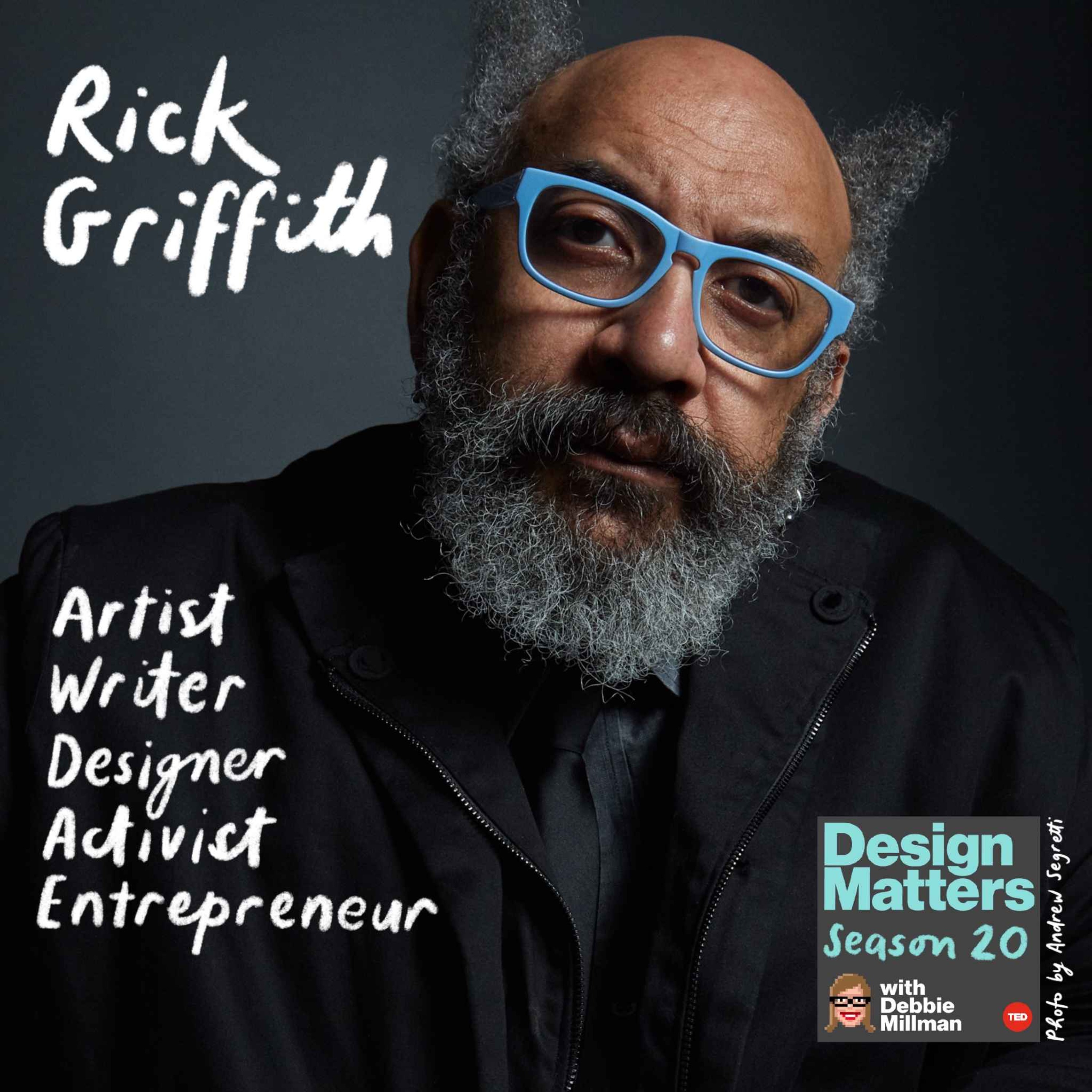
Rick Griffith
The moment I started to express ambition, I experienced more racism. Anyone feel like that? Or sexism? Anyone else? Right the minute you want something, that's when the walls start to show up.
- [00:14]
Debbie Millman
From the TED Audio Collective, this is Design Matters with Debbie Millman. On Design Matters, Debbie talks with designers and other creative people about what they do, how they got to be who they are, and what they're thinking about and working on. On this episode, Rick Griffith talks about the relationship between his design practice and his activism.
- [00:37]
Rick Griffith
We're just not evolving fast enough to care a lot about each other. It hurts me.
- [00:49]
Ryan Reynolds
Ryan Reynolds here for Mint Mobile. You know, one of the perks about having four kids that you know about is actually getting a direct line to the big man up north. And this year he wants you to know the best gift that you can give someone is the gift of Mint Mobile's Unlimited Wireless for 15amonth. Now you don't even need to wrap it. Give it a try@mintmobile.com Switch $45 upfront.
- [01:11]
Mint Mobile Ad
Payment required equivalent to $15 per month New customers on first three month plan only taxes and fees, extra speed slower above 40 gigabytes on unlimited. See mintmobile.com for details.
- [01:19]
Milk Ad
You know, as a busy mom, there are a few ways you can build strong muscles. You could get a gym membership, which you'll never use. Buy all sorts of expensive equipment for your garage that you'll forget you have. Pay for a personal trainer that you'll never have time to meet with and buy a fitness watch. Makes you sad every time you look at it. Or you could go for an easy run and try some milk, which helps build strong muscles. Visit gonna need milk.com for more info. And please don't make yourself sad.
- [01:54]
Progressive Ad
This episode is brought to you by Progressive Insurance. Fiscally responsible financial geniuses, Monetary magicians. These are the things people say about drivers who switch their car insurance to Progressive and save hundreds. Visit progressive.com to see if you can save Progressive Casualty Insurance Company and affiliates. Potential savings will vary, not available in all states or situations. Proving trust is more important than ever, especially when it comes to your security program. VANTA helps centralize program requirements and automate evidence collection for frameworks like SoC2, ISO 27001, HIPAA and more. So you save time and money and build customer trust. And with Vanta, you get continuous visibility into the state of your controls. Join more than 8,000 global companies like Atlassian Flow Health and Quora who trust Vanta to manage risk and prove security in real time. Now that's a new way to GRC learn more@vanta.com tedaudio that's vanta.com tedaudio.
- [02:59]
Debbie Millman
Rick Griffith is a graphic designer who specializes in letterpress printmaking. In 2020, he was Print magazine's first artist in residence and his work is in the permanent collections of several American museums. Griffith lives in Denver where he co owns and operates matter, which is simultaneously a design studio, a typography laboratory, and a bookstore. He spoke with Debbie at the Howe Design Live conference in Denver back in September.
- [03:28]
Rick Griffith
Riff Griffith, welcome to the How Design Stage.
- [03:32]
Hi.
- [03:33]
So this is my first question. I want to take you back to a moment in time. You're eight years old. You discover screwdrivers and their ability to unlock and reveal what happens next.
- [03:53]
So my brother and I are 360 days apart. I am the second born child. My brother was raised in South America in my father's homeland called British Guyana. And I was raised as an only child in London. And I can put on the accent if it sounds mad to me, but I found a screwdriver, I found a cassette deck and I took it completely apart and to the point where I could just see all the bits moving and I could accidentally zap myself with a little bit of electricity and everything. I mean, it was really, really just one of the greatest early experiences and memories of my young life. So yeah, I took apart the tape deck. That was really my kind of weird recording memory device in my young analog childhood.
- [04:41]
Yes, you mentioned that you were born in London. You were born and raised in southeast London where your parents instilled a real love of reading and literature. You were introduced to Chaucer, the Bible, the Quran, the Torah and more. And they also insisted, if I'm correct here, that you read the complete works of Shakespeare and Bronte before you were 12.
- [05:11]
Shakespeare, Bronte, Dickens, and Chaucer.
- [05:13]
Okay, so why?
- [05:17]
My parents immigrated to the United Kingdom from the British colonies and they had a sense that education was transformative and that they wanted to educate their children. They weren't 100% sure that I was going to get everything that I needed. So they bought a fireplace that had these tissue paper editions of all of those authors. So it was like a one piece fireplace with books in it. That's pretty much what it. And it was a gas fireplace with glowing logs and pretend heat. So it was one of those. And whenever I said I was bored, they said, go read that book or go read that book.
- [06:01]
So you were bored a lot.
- [06:03]
Well, I didn't have my brother and I was a young kid who was fairly sheltered. And my parents believed that any downtime was going to be spent studying for entrance exams so that I could go to a private school, because they couldn't afford to send me to a private school, so I had to study for a scholarship.
- [06:23]
Now, you also included Dickens in this list?
- [06:26]
Yes, very much so.
- [06:27]
And you've also described your childhood as a bit like a Dickensian novel. Which one?
- [06:34]
Even my adulthood.
- [06:35]
Oh, really?
- [06:36]
Even my adulthood. Like, I still have this resonance with the life and times of Nicholas Nickleby or. And most recently, I don't know if anyone's seen it, but if you haven't, I highly recommend it. There is a Dev Patel version of David Copperfield, which is a very play like adaptation of the book. It's really beautiful, it's multicultural. And that is actually like my. That is my anchor. The thing is, is that over time, if you live long enough, you take off to the city for your fortune, you escape tyranny, you. If you live long enough, sometimes you outlive your spouse. All sorts of things happen. And having this anchor in literature, particularly in Dickens, this Victorian novelist, it really felt like I could put myself safely into a Dickensian plot and I would come out the other side with a tiny bit of triumph. That's my hope.
- [07:49]
I sort of felt that way through my experience reading Jane Eyre as a young teenager. My family, for a very brief moment in time, did some family therapy. And we weren't all together in the family therapy. We'd go one at a time. And so when my mother was in there or my brother was in there, I would be in the waiting room and I discover Jane Eyre. And I remember there's this at the very end of Jane Eyre where she's talking to Mr. Rochester over the ocean. And I felt like if I could do that, I could bring my world out into a bigger place that maybe I could be saved to. It's interesting how books give you that sense of hope.
- [08:38]
Yeah, it's your imagination does a lot. And if you have literature stories in your mind and sort of moving around your psyche and your heart, what happens is you feel safe inside of those stories, as if you're not alone. And I really feel like that was one of the things that was like, well, things are pretty shitty, like objectively bad right now. But there are so many amazing plots that take a twist for the positive and some benefactor shows up and you're like, you know. And so in the client world, even as a designer, like every now and then I would bump into an amazing client that would last like 20 years. And those clients are not just clients, they're benefactors, they're trusted collaborators. And that kind of stuff gives you hope. And also employees that would stick around for five years.
- [09:46]
Well, that makes sense to me because I can only imagine that you'd be a good employer. What are the tenants of a 20 year relationship with a client that you might be able to share some best practices for the people in the audience that would also like to have a 20 year relationship with a client?
- [10:10]
I couldn't tell you if it's entirely possible given the kind of atmosphere that we're in right now, which has a certain reliable quotient of acrimony and greed and, you know, things like this that kind of get in the way. But being able to carry a deep conversation in the area of expertise that your client has should be a thing of great joy. Like every client that came to me when I was a young person that said, oh, we want you to work for the Chamber Music association of America, I was like, great. I became a method designer. I started listening to chamber music. I had an opinion about chamber music, I had an opinion about 20th century composers. And all of these things developed quite naturally because I enjoyed these relationships so much. And they would throw tickets at me to Carnegie hall or to other venues, symphony space, or some tiny little, you know, 30 seat theater downtown and say, tell me what you think you know, tell me, tell me what's up with that. So the 20 year long relationships look like you caring enough about them to know what they're into and what they're like working with. And then them trusting you to continue to grow with them over time. And neither person resists the value of each other. And that's just the beauty of those things. And they, and they can last longer. 20 years is, is something. But my, my partner, Deborah Johnson, you know, she also brought to the practice clients who were with her for 20 years as well. So it's not an uncommon thing, but.
- [12:03]
Oh, I think it's an uncommon thing.
- [12:05]
Oh, you do? I do. So that's the kind of people we are. Yeah, I guess is what's going on. Like we really, we really love being method designers, if you like.
- [12:14]
Your family moved to D.C. when you were still quite a young chap.
- [12:19]
Yeah, teenager.
- [12:20]
Yeah. And at that point you began to develop a number of different passions. You got involved in the graphic design scene while working at a local record store. You were really drawn to punk rock. Talk a little bit about that. Formative period and what you were imagining your life was going to be at that point.
- [12:46]
Oh my goodness. So for context, you know, it's like London in the 70s, Washington D.C. in the 80s, New York in the 90s, and Colorado since the mid-90s. And if anybody here knows what was going on in 1984 in Washington D.C. it blew my mind. I mean, I still resonate with the punk DIY ethos of the 80s. My family imploded. That helped a lot. My family completely imploded. I had no, like, as it often does, I had no actual family in the 80s. My parents went through a terrible breakup. I went through a terrible experience with my father and. And I found myself leaning into communities of punk rockers in the Fairfax county suburban D.C. area, which includes Dave Grohl and other punk rockers of the time. And we had the best time ever being in community, being in difficult questions and being in the center of it all, being against Reagan, being traumatized by the AIDS epidemic, being know, sort of really being in the center of America at a time when various types of neoconservative perspectives were being formed that we would be experiencing right now, you know, like in its full, in its fullest state, if you ask me. So, so it was a great place to get articulate about the struggle, about the truth of what was going on.
- [14:30]
It's so interesting that you just chose the word articulate, because I was thinking every now and then when I do my research before an interview, I'll find something out that really surprises me about that person. And with you, it was that you dropped out of high school. And you are one of the most articulate, erudite designers in the world as far as I'm concerned. So to learn that you dropped out of high school to go to queer New York, Punk queer New York and the East Village to get your first big job in design, which was at Kinko's, was a real surprise.
- [15:11]
Let's not get carried away. Kinko's is not a big job in design, but I was a graveyard shift worker at Kinko's of Georgetown University. I was also a bike messenger and a part time DJ I worked at just ever so briefly. I worked as a DJ at the original 9:30 Club at 9:30 F Street. And when I left Washington D.C. i went to queer, beautiful, queer New York. And I somehow in the transcript from kinkos of Washington D.C. and Georgetown University, I went to Columbia University's Kinkos. And somewhere in the transcript I became the graveyard shift manager, which meant that I was earning a full like $10 more an hour for the first time in my life. And that would mean that for the second time in my life I could afford to go to therapy, which was amazing. Yeah, I know. The giggle. The therapy giggle. You got it. It is a real thing. I trust therapy. I believe in therapy. And I've been in therapy many times. And this is why I'm here, is because I have. Yes, I dropped out of high school. I took a couple of college courses. I matriculated it at Cooper Union and at the New School, Parsons at the time and one at CU Boulder here in printmaking. But mostly I'm self taught because I have incredible curiosity about the world that we have inherited or the world that we're creating or the things that help us thrive in a creative atmosphere. Which means that everything that my creative collaborators are interested in, I automatically want to become interested in too.
- [16:59]
You've said that your biggest skill in design is not design, but your ability to interrogate.
- [17:09]
Yeah, that sounds a little like I can be the person who canceled fun. So it sounds, it sounds a little bit like that's what I just did was canceled Fun Interrogate is true. But there's also this, this notion of like, I have a great sense of when to develop a question, and that's what's brought me forward as an intellectual or as a person that's not afraid of reading and studying and getting involved in my own education. And that is that I just, I trust that. What college is for? I sent both my daughters to great colleges. What college is for is for framing the questions. And if you take responsibility for your education, you find the answers in a number of different directed ways. I knew my own questions and still do. I have a burning question today that I'm trying to get answered.
- [18:07]
What is that question?
- [18:09]
The question is this because of the post caste movement of Sikhism from Hinduism. How many creation mythologies live in Hinduism that makes the caste movement in Southeast Asia so prevalent outside of the religious framework of Hinduism? And how does it continue to create oppression inside of a Muslim minority country or in a Sikh minority country and so on, so forth. Like, I really want to know more about creation mythology. And to that end, whenever I teach, I try and tell my students, if you're interested in being in creative work, you should have at least one or two or three if you can find them creative mythologies to draw from. You don't have to just use the one that you were raised with. You could find out more about various religions and their concept of how magic happens, how creation happens.
- [19:13]
How does this fuel your practice? How does this fuel your design work?
- [19:19]
So quite recently, we swore off collaborative projects that were largely concerned with capitalism.
- [19:29]
What else is there?
- [19:31]
I said largely concerned with, you know, like, we have to talk about.
- [19:35]
We're in. But yes.
- [19:36]
Yeah, exactly. It's. It's baked in the cake. I don't know how many other ways to just kind of in some way surrender to the presence of capital. I mean, we have a bookstore right outside the doors, you know, like, come on. So I think it's quite real. But when we swore off a number of different relationships and different types of projects, I started to treat the bookstore like it was my biggest client.
- [20:01]
Yes.
- [20:01]
And that is now part of what I'm continuing to integrate. The bookstore absolutely cares about graphic design, and it cares about design, and it cares about art, and it cares about creative thinking. And we carry the Rick Rubin book. And, you know, I mean, we. We carry Debbie's books. We carry, you know, lots and lots of creative people who we trust and enjoy. We carry their products, but we also carry the products of black feminist queer intellectuals who are writing about their circumstance and what they believe is going to pull the communities that are black and queer and women or black and queer and Asian, or just Asian, pull them out of a negative circumstance or pull them into more unity with other groups of people so that we could survive this together. Because our sort of general philosophy is that we need to share strategies to either cope or flee.
- [21:08]
Progressive Ad
Support for this show comes from lumen. Still curious about what is Lumen? Well, it is the world's first handheld metabolic coach. You know how growing up people might have said, like, oh, you must have a fast metabolism. You must have a slow metabolism. It's really not about fast or slow. It's about efficiency. Lumen helps you measure your metabolism through your breath. It's paired with an app that lets you know if you're burning fat or carbs and then gives you tailored guidance to help improve your nutrition and workouts and sleep and even managing stress. I love to check in on how my metabolism is functioning on my lumen in the mornings, but you can do it any time of the day. All you have to do is breathe into your lumen, and you'll know what's going on with your metabolism. Then lumen will give you a personalized nutrition plan for that day based on your measurements, and it will adjust its recommendations to keep your metabolism healthy through hormonal shifts. So if you want to stay on track with your health this holiday season. Go to Lumen Me Design to get 15% off your lumen. That's L U M E N me Design for 15% off your purchase. Lumen makes a great gift too. Thank you Lumen for sponsoring this episode. Proving trust is more important than ever, especially when it comes to your security program. Vanta helps centralize program requirements and automate evidence collection for frameworks like SoC2, ISO 27001, HIPAA and more. So you save time and money and build customer trust. And with Vanta, you get continuous visibility into the state of your controls. Join more than 8,000 global companies like Atlassian Flow Health and Quora who trust Vanta to manage risk and prove security in real time. Now that's a new way to GRC. Learn more at vanta.com tedaudio that's vanta.com tedaudio.
- [23:06]
Rick Griffith
Only boost mobile Boost Mobile will give you a free year of service. Free year when you buy a new 5G phone new 5G phone enough, but.
- [23:13]
Boost Mobile Ad
I'm your hype man. When you purchase an eligible device, you get $25 off every month for 12 months with credits totaling one year of free service. Tax is extra for the device and service plan online only.
- [23:21]
Ryan Reynolds
Ryan Reynolds here from Mint Mobile with the price of just about everything going up during inflation, we thought we'd bring our prices down. So to help us, we brought in a reverse auctioneer, which is apparently a.
- [23:32]
Rick Griffith
Thing Mint Mobile Unlimited Premium Wireless 2020-2020-1515 just 15 bucks a month.
- [23:41]
Sold.
- [23:41]
Ryan Reynolds
Give it a try@mintmobile.com Switch $45 upfront.
- [23:46]
Mint Mobile Ad
Payment equivalent to $15 per month. New customers on first three month plan only taxes and fees Extra Speed slower above 40GB Details.
- [23:54]
Rick Griffith
Well, it's interesting that you bring up the word strategy as well because it feels having spent a couple of hours in your store on Sunday, it, it feels very much. It feels very intentional. Every single decision about how you and Deborah, who's your partner in life as well as your partner in business, have created this environment. I read a very funny anecdote about somebody that had come into the store asking about the latest Agatha Christie book.
- [24:29]
Yeah, I'm afraid we don't carry that. It's like top of shelf for Barnes and Noble or the Tattered Cover. Whichever words you'd like to use to describe our largest bookstore chain in in Denver, it's top of shelf for them. They'll be happy to get it for you. The thing that we carry that is mysterious and magical and strange might be Paul's autobiography, you know, Paul Sayre. Yeah, Paul Sayers, you know, like we carry or Rick Rubin's book on creativity. There's magic, and there's really interesting language inside of that for us to grow from as a community. And so we just lean into that slightly more rare object, and we basically want to be known for that slightly more rare object, or for any of the super, super uber nerds out there. It would be like we have Vision in Motion on a shelf in the reading room, which is the sort of posthumously published book from Laszlo Moholy Nagy from the Bauhaus, whose wife Sybil, wrote and compiled this book after his death, became the kind of unofficial curriculum for the founding of IIT in the Illinois Institute of Technology. You know, like, we have those design documents that if we go back far enough into these documents, we find absolutely magical concepts, steps of how we could perform our function, with our skills, with our attitudes about design, and do it in a way that is, like, big and interesting and challenging. And that's kind of where we. That's where we want to play.
- [26:24]
Yeah. I actually think, having. Having spent a good amount of time there, that there is a sort of palpable energy of magic there. Now, it's not just your bookstore and it's not just your practice that is all situated there. It is also your letterpress printing environment. That is incredible. So you're active. You said that your activism really showed up when you got your first printing press in 1997. Now I've taken a full tour of your entire space, and you have many printing presses now and have been printing for many decades. Talk about the evolution of that. What first drew you to letterpress printing? How did that fuel your activism? How has it extended your activism?
- [27:14]
Okay, I'm going to go really fast. Okay, guys, stay with me. When I was young, oh, so much younger than today. I mean, when I was younger, I wanted to be the best graphic designer in the world. Anyone share that? Yeah, it's a dumb idea to try and be that, especially if you're studying it and you're like, that's really, really good. That's really, really good. That person's really, you know, especially if you want to identify other people's talents. It's kind of a greedy. It's a greedy concept. So eventually I was like, I don't want to be the best graphic designer in the world. Catch this. I changed my mind and I said, I just want to be in the best conversations about design that I can find. So thank you for this anytime. But I did want to specialize, and I specialized on type. When I specialized on type, I kind of hit a wall. And I was like 26 years old, and I was just jamming hard. I hit a wall, and I was like, I know as much as I can know about type. This is a digital era. I was in Fontographer 1.0. I was in all this hardware, software stuff. And then I realized that I was accidentally in a conversation with these guys who were letterpress printers who were 20 years older than me, if not more, and what they were doing was, like, stuff I had no idea about, and it was all type. So instead of going forward into digital type, which wasn't going very far very fast, I went backwards into analog type. And I realized that with a couple of really great mentors and gifts from really super generous people in our community. Tom Parson is one of them, and Jason Wetkin is one of them. And also this guy, Brian Allen was the first person to stick their hand out and say, it looks like you might be interested in this. So I studied letterpress printing with these guys, and they taught me and continue to teach me. John Finch is the latest guy, and he's 81. They continue to teach me about type through the analog letterpress community and the analog letterpress tools. So I'm constantly learning. Now I'm like, simultaneously learning how to run a typecasting machine, a slug typecasting machine in my garage, and I'm also in a python class with the letterpress archive.
- [29:36]
Like, that's range.
- [29:38]
That's range. And I'm so excited to still specialize or still have a specialty in type. But the activism is what comes with an awareness of your circumstance. Which means that I experienced in my young life less racism because I had less ambition. The moment I started to express ambition, I experienced more racism. Anyone feel like that? Or sexism. Anyone else? Right the minute you want something, that's when the walls start to show up. So that awareness and that activism that held, you know, the circumstance of people of color and the circumstance of women and queer people, and anyone that was being, you know, in. In any way kind of had a prejudicial experience like that became very interesting and important for me because what else would you use a printing press to do except for say, that's fucked up. That's objectively fucked up. So, because everything else was being printed. So then I was like, that's cool, I'll do that. And so I started using that. But I also decided that what I wanted to do was learn how to be a better writer, which is a very big struggle.
- [30:46]
Why? Why is that such a struggle?
- [30:48]
Probably confidence issues, you know, like I. I say probably. Exactly. Confidence issues. The. And confidence, anxiety, all those things. Depression, you know, all the stuff that, like, no one should feel alone with. Just so you know, no one should feel alone with that. That gets in the way of being confident about your writing. Especially when you're reading things that are really well written. You're like, that's really good. I can write two sentences that could meet that. But an entire article is pretty stressful. So the activism comes alongside my awareness and the printing comes alongside my deep desire to know more about type in analog and digital forms. And as a designer, I stopped caring as much about like sort of digital kerning pairs, which I cared a lot about at one point. And I moved into caring about, like, acquiring wood type and figuring out how to make posters on the fly and how to make printing an extension of my writing practice, which is. I mean, I have my bag off stage, but I wanted to like, give the front row a bunch of stuff like that I printed yesterday because, well.
- [31:57]
It'S really hard with this kind of stuff.
- [31:58]
I know, it's like a gigantic gap. I would like have to fling it and then someone would get a paper cut and then I'd be inflicting harm, you know, so afterwards I will stand.
- [32:07]
Or maybe by the bookshop, I'll be.
- [32:08]
The by the bookshop for a minute and I only have like 20 of them. Be honest. Be. Care a lot about what we're doing and then you can have one. Right. It's a challenge, right? I say be honest and care a lot about us and you can have one. I have like 30, so.
- [32:23]
Well, everybody here is going to care a lot. And we all have different degrees of honesty.
- [32:28]
Yeah.
- [32:28]
And I assume that's true. No, but I'm assuming in this sort of like minded community that everybody's sort of trying to bring their best self to a place like this. And in many ways, I think designers, because we have so much empathy, have to have some sense of optimism for what's possible. Otherwise, why would we want to be creating things in the future? For the future?
- [32:53]
Yeah, I mean, there's that.
- [32:57]
You don't believe me. We're on stage. But I can see in Rick's head, because we're friends, that he's like, no, no, I don't agree, Debbie.
- [33:04]
I just, I mean, I have to be kind of honest.
- [33:07]
Please.
- [33:08]
It was hard and I think that Young people, especially if I hear them tell their stories, I feel like some young people are experiencing the same, if not a worse experience than what I experienced just trying to enter into the field of design. And so my heart breaks every time someone's, like, suffering in that way. It just. It harms us all to be gatekeeping opportunities from people who have deep love of the magic that can be graphic design and a deep expression of creativity and joy. You know, it breaks my heart that people aren't having the best possible experience. And so, yes, as a group, we should be pretty good. But someone's still drinking water out of a plastic bottle today. And that plastic bottle shows up in Africa. It doesn't show up in Orange County. And if it did show up in Orange county, it would be banned from our grocery stores. We're not doing enough to, like, really think about other people's circumstance. We're not doing enough to think about the world that we're creating. And if we're not doing enough and we're harming other people's children, other people's children could even just be the person next to you's children. We're just not evolving fast enough to care a lot about each other and about our relative geographies. It hurts me.
- [34:47]
I agree with you, Rick. And I do think that we have to think about the continuity of every single one of our actions. However, I teach. I teach both graduate and undergraduate students.
- [35:00]
For sure.
- [35:01]
I've been doing it for a very long time.
- [35:04]
Right.
- [35:05]
I don't know how young people can take care of others or take care of the future.
- [35:12]
Right.
- [35:13]
When they're having trouble taking care of themselves.
- [35:15]
100% agree. It's something that people have inherited. Absolutely. Yeah.
- [35:20]
And I see a palpable, alarming. Using that word, alarming difference in the students that I taught 15 years ago and the students that I'm teaching now.
- [35:32]
Yeah, I agree.
- [35:33]
And that's the biggest. You know, in some ways, the reason I still teach is because I feel like it keeps me young. It keeps me current. I get to hear what young people are thinking about and what they're. They're. They're struggling with.
- [35:46]
Keeps us sharp.
- [35:47]
Yeah. But there's a different level of struggle than there was. There's a level of struggle in connection. There's a level of construction and being able to get the kind of jobs with the kind of pay that they need.
- [35:59]
Right.
- [35:59]
And so I can't blame young people for not caring enough about the earth. I blame my generation, which you're a bit younger than I am, so it might include you, but I'm actually blaming my generation for not setting up structures that would better support them.
- [36:19]
With a handful of notable exceptions. I'm also blaming your generation.
- [36:25]
Bring it on.
- [36:27]
It's exactly, and this is a gesture towards what we call power. It's really a gesture to what we call power. Those who are hanging on to the power is basically who we're kind of blaming. But here's the one thing I'm so cautious to do is to alienate people in the present for stuff that we are just inheriting. I want to be really careful because the compassion that I believe in also extends to people who didn't have the choices that we have now and they didn't have the sort of well developed psyches and sensitivities that we have now and access that we have now and emotional framing that we have now. Like, imagine the conversations of parents about sex three generations ago. And imagine the necessary conversations about sex, reproductive rights, about ob GYN objectives. I mean, all of those things have changed so much. This is just a dad who, you know, like who's proudest, whose proudest moment was taking his youngest daughter to the her first adult OBGYN appointment and arguing with the doctor for her contraceptive objectives. You know, and, and that's true.
- [37:58]
I would have loved to have been a fly in that room.
- [38:00]
Right. Like, I trust and I love my children, therefore I'm gonna treat them like they're trustworthy and I'm gonna advocate for them wherever they are. Right.
- [38:10]
So Rick. Yes, let's clap for that. It's an important one. So as we're in this sort of, and I see it in many ways as a Venn diagram of everything from the past and everything from the future. And we're in this little zone, my feeling is my generation has to get the hell out of the way of the upcoming generations. Because there's no student that I have while they might be suffering, there's no student that I have that's like, yeah, we need more plastic or yeah, we need more, you know, we need more laws around women's bodies. No, they don't. They're the most activist, open minded generation in history. So how do we, how do we allow for that? Let's get out of their way.
- [38:57]
It's, it's not sit down and it's not get out of their way. It's hold hands and use their, and use the power that you have in the generation that you belong to to listen and to answer to their Queries about the world that they've already inherited. And tell them that you will try and do better with the time that you have left on the planet.
- [39:21]
We are unfortunate. Yeah. He's so wonderful. I love this man. We're out of time. When I was in your studio on Sunday, you were showing me some of your recent letterpress printing posters. You showed me what seemed to me like a bit of a manifesto. And I read a little piece of it that I asked if you would share on stage today as a way to close our episode. And so I'm wondering if. If you can do that. This is a. A piece that. Because I know Rick struggles over every word he has written so beautifully that I really wanted him to share that with you.
- [40:04]
News flash. I edited it about 15. No, half an hour ago. So it's. I printed it in order to stop editing it. And then when I looked at it this, this morning, I was like, a little bit more. There is only one struggle. It is the struggle not to be colonized, lied to, not to have treaties broken, land stolen, and to survive a genocide. It is the struggle not to be manipulated by marketing and the study of human psychology. It is the struggle to avoid physical injury. The struggle not to have your body legislated. The struggle not to have your voting rights in jeopardy. The struggle to live free of the pollution that the powerful have put in your community. The struggle to name yourself and claim yourself. The struggle to be a woman everywhere. The struggle to be black anywhere. The struggle not to be characterized by the worst of the people who look like you. The struggle to survive grief, anxiety and depression. The struggle to die without a knee on your neck or a spike in your vein. The struggle to farm this scorched earth. The struggle not have your body or your labor exploited. The struggle to be educated and have your children educated. The struggle to belong. The struggle to know the history of your circumstance. There is only one struggle.
- [41:38]
Rick Griffith. Ricky Ding. Thank you so much for making so much work that matters in so many ways. And thank you for having this conversation today with me on the How Design Live stage about design maps.
- [41:58]
Thank you. Listen to this lady's closer. What's your closer? Listen. Listen closely. I know you might have heard it a hundred times in the podcast, but.
- [42:07]
We can talk about making a difference. We can make a difference, or we can do both.
- [42:12]
There you go.
- [42:12]
I'm Debbie Millman and I look forward to talking to you again soon.
- [42:18]
Debbie Millman
Design Matters is produced for the TED Audio Collective by Curtis Fox Productions. The interviews are usually recorded at the Masters in Branding program at the School of Visual Arts in New York City, the first and longest running branding program in the world. The editor in chief of Design Matters Media is Emily Wyman.
- [42:42]
Boost Mobile Ad
To get people excited about Boost Mobile's new nationwide 5G network, we're offering unlimited talk, text and data for $25 a month.
- [42:50]
Rick Griffith
Forever.
- [42:50]
Boost Mobile Ad
Even if you have a baby.
- [42:51]
Mint Mobile Ad
Even if your baby has a baby.
- [42:52]
Boost Mobile Ad
Even if you grow old and wrinkly and you start repeating yourself.
- [42:55]
Mint Mobile Ad
Even if you start repeating yourself, even.
- [42:57]
Boost Mobile Ad
If you're on your deathbed and you need to make one last call or text, right? Or text the long lost son you abandoned at birth, you'll still get unlimited.
- [43:03]
Rick Griffith
Talk, text and Data for just $25 a month. With Boost Mobile forever after 30 gigabytes, customers may experience slower speeds.
- [43:09]
Boost Mobile Ad
Customers will pay $25 a month as.
- [43:11]
Rick Griffith
Long as they remain active on the.
- [43:12]
Boost Mobile Ad
Boost Unlimited plan forever.
- [43:13]
Milk Ad
You know, as a busy mom, there are a few ways you can build strong muscles. You could get a gym membership, which you'll never use, buy all sorts of expensive equipment for your garage that you'll forget you have, pay for a personal trainer that you'll never have time to meet with, and buy a fitness that only makes you sad every time you look at it. Or you could go for an easy run and try some milk, which helps build strong muscles. Visit gonna need milk.com for more info. And please don't make yourself sad.
- [43:43]
Warby Parker Ad
Every idea starts with a problem. Warby Parker's was simple. Glasses are too expensive, so they set out to change that. By designing glasses in house and selling directly to customers, they're able to offer prescription eyewear that's expertly crafted and unexpectedly affordable. Warby Parker glasses are made from premium materials like impact resistant polycarbonate and custom acetate, and they start at just $95, including prescription lenses. Get glasses made from the good stuff. Stop by a Warby Parker store near you.
- [44:14]
US Cellular Ad
Gifting is hard, but here's a hint. Give the gift of connection from US Cellular. Not sure what that means. Well, here's a slightly more specific hint. You can choose four free phones and get four lines for $90 a month from US Cellular. Your family wants new phones? How do we know? Well, they told us. The good news is that compared to wrapping presents, you're great at getting hints. So take the hint and get them four free phones in four lines for $90 a month. US Cellular Buil.