Loading summary
Transcript229 lines
- [00:01]
Debbie Millman
One of your bosses was chasing you around the sofa.
- [00:04]
Ruth Ann Harnish
Literally chased me around the sofa to try and tackle me to the sofa. It's a cliche because it was so true.
- [00:16]
Narrator/Producer
From the Chad Audio Collective, this is Design Matters with Debbie Millman. On Design Matters, Debbie talks with some of the most creative people in the world about what they do, how they got to be who they are, and what they're thinking about and working on. On this episode, a conversation with philanthropist Ruth Ann Harnish about breaking through barriers as a broadcast journalist, I don't let me down.
- [00:43]
Ruth Ann Harnish
I can count on me.
- [00:52]
Instacart/AT&T/Peloton Ad Voice
Instacart helps you get what you need fast. Like when the watch party at your place finally makes it out of the group chat, suddenly you need snacks, drinks and all the things nobody planned for. With Instacart, you can get groceries and party essentials delivered. Just download the app, place your order and it shows up in as fast as 30 minutes. That way hosting feels easy and looks like you had a plan all along. Get the Instacart app today and get game day deals.
- [01:18]
Wise/ServiceNow/Adam Grant Ad Voice
This podcast is brought to you by Wise, the app for international people using money around the globe. With the Wise account, you can send, spend and receive in over 40 currencies and with no markups and no hidden fees. Whether you're sending pounds across the pond, spending rials in Rio, or getting paid in dollars for your side gig, you'll get the mid market exchange rate on every transaction, plus most transfers arrive in less than 20 seconds. Join 15 million customers internationally. Be Smart, Get Wise Download the Wise app today or visit wise.com Ts&C's app.
- [01:55]
Gilt Tax Sponsor Voice
This episode is sponsored by Gilt, your partner in taxes. If you're a business owner, you probably know that tax season shouldn't be just a once a year scramble. Yet for so many of us, that's exactly what it feels like. A flurry of forms, emails and missed opportunities. Gilt is a modern tax planning and strategy solution for you and your business that takes a smarter approach, pairing real CPAs with AI to help you align your tax strategy tax to how your business grows. With gelt, your dedicated CPA team reviews your strategy every quarter so you can optimize things like entity elections, retirement contributions and hidden credits or deductions before it's too late. It's proactive, transparent and built for growing businesses, from creative studios and design agencies to consultants and independent practitioners. Make taxes part of the business plan and schedule a call@joingt.com today to learn how your taxes can become a lever for growth.
- [03:00]
Narrator/Producer
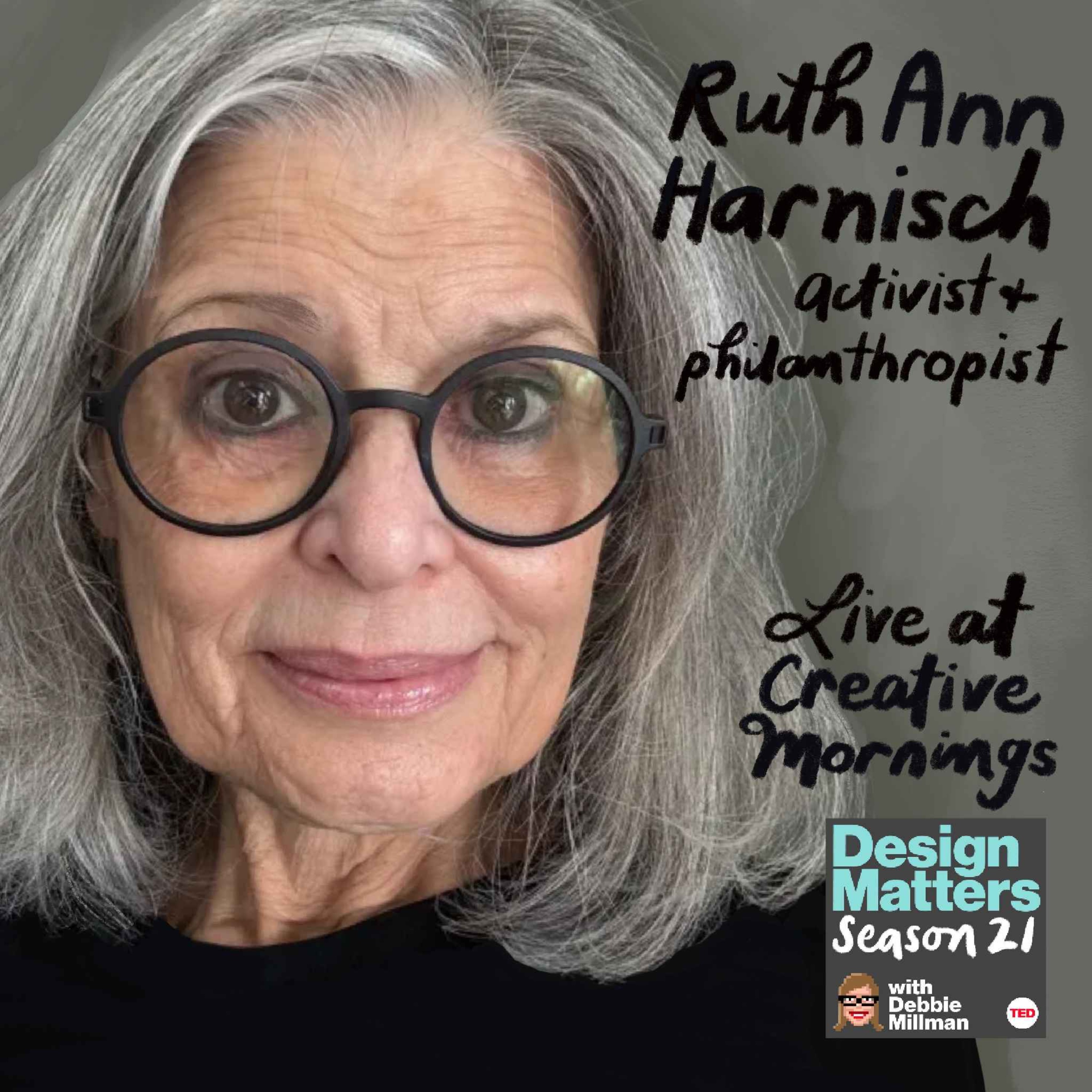
Ruthanne Harnish is an investor, philanthropist, social activist and media producer with a long history in journalism and broadcast tv. The interview was presented by Creative Mornings in l', Alliance, New York, and it took place in New York City in front of a live audience on December 5, 2025.
- [03:19]
Debbie Millman
Welcome Ruthanne Hornish.
- [03:22]
Ruth Ann Harnish
What a delight to be here.
- [03:25]
Debbie Millman
Ruthanne, I'd like to begin by going back to your beginnings in Buffalo. Is it true that when you were 15 years old, you worked as a DJ at the local radio station under the name Karen Kelly?
- [03:45]
Ruth Ann Harnish
Karen with an I K A R I N. Karen Kelly.
- [03:49]
Gilt Tax Sponsor Voice
Karen Kelly.
- [03:49]
Ruth Ann Harnish
And I have long said that if anybody can find a photograph of me riding in a parade with WYSL's Karen Kelly welcomes the Blue Max. I was in a parade and photographed that way, but I have never been able to get a hold of the. I'll pay a reward.
- [04:11]
Debbie Millman
Okay, well, the gauntlet has been thrown. You know how much I love research.
- [04:17]
Ruth Ann Harnish
I will look for find evidence of Karen Kelly.
- [04:20]
Debbie Millman
Well, I did in writing, but not quite in photography. So as I said, the gauntlet has been thrown. Now why the name Karen Kelly?
- [04:32]
Ruth Ann Harnish
It wasn't Ruthie Geistorfer. And eventually I was part of a teen DJ group. The old broadcaster Gordon McLendon wanted free help, so he let teenagers spin the records on his fm. He had a popular AM station in Buffalo. And so we worked as disc jockeys for free, enjoying playing the hits for the boys and girls with the names we chose for ourselves. And I chose that one because ethnically it was popular in Buffalo. There were a lot of Irish people and it felt original and fun to me at that time.
- [05:18]
Debbie Millman
Have you ever used it again?
- [05:19]
Ruth Ann Harnish
Never.
- [05:22]
Debbie Millman
Now, your job as a DJ wasn't actually your first job in media. I believe the first job you applied for was at the Buffalo Courier Express. And they wouldn't hire you as a paper girl, so instead you were hired as the youngest girl in the newspaper office. What were you hired to do?
- [05:45]
Ruth Ann Harnish
We were hired to bill the Root boys that we could not be. We would send them their bills every week, how many papers they sold, how much money they owed and had to make the numbers work every week. So that's what I did. And women were not allowed to smoke on the main floor because there were ceiling to floor windows and the public should never see a woman smoking. So our ladies room was extremely crowded and hard to breathe in.
- [06:19]
Debbie Millman
It sounds like my junior high school bathroom.
- [06:23]
Ruth Ann Harnish
Yeah, in more ways than one.
- [06:27]
Debbie Millman
So you became the youngest of a crew of girls. Girls. Most of whom were adult women.
- [06:34]
Ruth Ann Harnish
Yes.
- [06:34]
Debbie Millman
Who did the accounting for the paper boys instead of becoming a paper girl.
- [06:40]
Ruth Ann Harnish
They didn't have them.
- [06:41]
Debbie Millman
Right. And then when your shift was over, that's when you jumped on the Niagara Frontier Transit bus and went to the Statler Hilton Hotel. And that is where you became Karen Kelly.
- [06:59]
Ruth Ann Harnish
Yes, it is.
- [07:00]
Debbie Millman
Teen DJ on WYSL FM 103.3.
- [07:06]
Ruth Ann Harnish
Where life begins at 103.
- [07:12]
Debbie Millman
Ah, the voice.
- [07:12]
Ruth Ann Harnish
The voice.
- [07:14]
Debbie Millman
You were 15 years old.
- [07:17]
Ruth Ann Harnish
Yeah.
- [07:17]
Debbie Millman
That's incredible. To have two jobs in media at 15. Now, in addition to all of that, you described yourself as a stubborn, angry girl who grew up in a world that was clearly not fair.
- [07:37]
Ruth Ann Harnish
I knew that the minute I saw my younger brother allowed to do things I was not allowed to do, go places I was not allowed to go, dress ways I was not allowed to dress, say things I was not allowed to say. It just looked totally unfair from jump.
- [07:57]
Debbie Millman
Yeah, I remember. So I'm a child of the 60s. I was born in 1961, and when I was about five or so, my brother was turning three and we were having a birthday party for him, and I wanted to wear pants. I wanted to wear pants to his birthday party. And my mother was horrified and would not let me wear pants. And I was despondent. I went outside to play, and somehow, I guess I was very emotional. I tripped on the sidewalk and fell on my face. My grandfather, who was watching me from the window in our house in Howard Beach, Queens, saw that I fell, ran down, came to get me, and to comfort me, they let me wear pants.
- [08:56]
Ruth Ann Harnish
I guess you showed them.
- [09:03]
Debbie Millman
One of the most powerful stories from your early life that I discovered is about Buffalo, New York, Public School 72. Assistant Principal Dorothy Wolf, who chose you to join a group of children who studied French, memorized poems, and performed in musicals. You were also given elocution lessons, as she believed you all stood a better chance of success outside if you could speak beautifully.
- [09:36]
Ruth Ann Harnish
Yes.
- [09:36]
Debbie Millman
How pronounced was your accent?
- [09:39]
Ruth Ann Harnish
Well, if you grew up in Buffalo, it sounds like the ut you get in the car and you go places. And among our speech exercises, I had to laugh to see the calf run down the path and take a bath in a minute and a half. Which became I had to laugh to see the calf run down the path and take a bath in a minute and a half.
- [10:05]
Debbie Millman
Wow. That deserves a round of applause. You've gone on to say this about that experience with Mrs. Wolf. Every bit of success I have can be traced to my ability to use my voice. As an instrument capable of almost any accent, including none to speak loudly enough to be heard without a mic. In rooms where no microphone is available. To speak in front of other people in small and large settings without as much fear as most people have. Ruthanne, how was Mrs. Wolf able to teach you all that?
- [10:45]
Ruth Ann Harnish
She was mean.
- [10:47]
Debbie Millman
That was not what I was expecting.
- [10:51]
Ruth Ann Harnish
She was incredibly strict. Her standards were incredibly high, and you were going to meet them.
- [10:58]
Debbie Millman
Now, I suspect that you like that.
- [11:01]
Ruth Ann Harnish
No, you would be wrong. I like it when it's easy and nice and kind and pleasant. That's what I like.
- [11:12]
Debbie Millman
I had a teacher named Mrs. Langhauser who was strict, and I was glad that she was strict because she held us to standards that I didn't know if I would be able to maintain otherwise. And I suspect that you didn't need that.
- [11:28]
Ruth Ann Harnish
I had a tough enough go at home. My parents had very strict standards as well. So I was terrified not to be a straight A student, terrified not to be getting extra credit. I got grounded once because I got a 94 in Latin, and I had to work the entire marking period. I think it's six weeks to raise that grade. And when it came up to a 98, they said, see, we knew you could do better. So that was my academic career. I could not wait to drop out of school, which I did.
- [12:13]
Debbie Millman
I know, and I am a proud college dropout. I couldn't find where you went to college.
- [12:18]
Ruth Ann Harnish
Syracuse University.
- [12:19]
Debbie Millman
Oh, okay.
- [12:22]
Ruth Ann Harnish
Where, you know, I should have been able to manage her in broadcasting.
- [12:26]
Debbie Millman
Right.
- [12:26]
Ruth Ann Harnish
But you couldn't major in broadcasting till your junior year, and I didn't stick around that long.
- [12:32]
Debbie Millman
Well, you didn't need that.
- [12:33]
Ruth Ann Harnish
I had more experience live on the radio than the guy who was teaching me radio 101.
- [12:38]
Debbie Millman
Right. Speaking of radios, I read that after you got your first little portable transistor radio, which I also had, by the way, it became so magical to you that. But you hid it under your pillow at night to listen for as long as you could. And my favorite quote of yours from this story is, I fell in love with the idea of voices and pictures flying through the air.
- [13:09]
Ruth Ann Harnish
Yeah, it's magic.
- [13:11]
Debbie Millman
It was magic.
- [13:12]
Ruth Ann Harnish
And I grew up during great radio times. WKBW was a powerhouse up and down the Eastern seaboard, and you could hear it all the country. And it pioneered a lot of music styles and disc jockeying and paola and all those things. That was radio at the time.
- [13:38]
Debbie Millman
You also read your local newspapers and, quote, could find out the most amazing things that happened all over the world, unquote. And at that point in society, as well as being told what to wear and what not to smoke and so forth, girls were expected to become wives and. But you wanted to do something with the magic of pictures and words or something printed and delivered to somebody's house. Were you conflicted at all about the direction your life could take? Did you feel like you were being rebellious or needed permission to do what you really wanted to do?
- [14:16]
Ruth Ann Harnish
Nobody was giving women permission to do what they wanted to do. And I was often the first through the barrier, whatever it was. And it says, whoever goes through first gets hurt the most.
- [14:30]
Debbie Millman
Yeah.
- [14:30]
Ruth Ann Harnish
And makes it easier for everybody who comes after. So I hope I made it easier for some of the people who came after. But it hurt the most to go through the first.
- [14:41]
Debbie Millman
How supportive were your parents at this point in your life?
- [14:45]
Ruth Ann Harnish
Not.
- [14:47]
Debbie Millman
I want, if you can, to share with the audience how your talent and ambition moved you into a place where you could apply for a job working as a high school correspondent. I believe you left a sleepover party to race to the interview and aced it.
- [15:12]
Ruth Ann Harnish
What happened was I lied to my mother about what I was doing that night. I was at my friend's sister's apartment with my friend, and the sister had given us permission to raid the liquor cabinet.
- [15:30]
Debbie Millman
I read that it was adult drinks.
- [15:33]
Ruth Ann Harnish
I think I was 15. And we were definitely drunk. And my mother called saying, they called from the radio station, they want to interview you right now. And I said, well, give them the number. And I aced my interview on the phone drunk. And I always felt that qualified me for a career in broadcasting.
- [16:08]
Debbie Millman
Now, you then became a teen correspondent and recorded the news of the day at South Park High School.
- [16:17]
Ruth Ann Harnish
That's the truth. A real high school. Park High School.
- [16:21]
Debbie Millman
Now, what kinds of stories did you cover?
- [16:24]
Ruth Ann Harnish
Oh, whatever the clubs were doing. You know, just like here, you tell what the clubs are doing, whatever pep rally or whatever football or baseball or whatever game was going on.
- [16:36]
Debbie Millman
You also got your first radio call in show at that point.
- [16:41]
Ruth Ann Harnish
Mm.
- [16:42]
Debbie Millman
So talk about that. Tell us about the kinds of people that were calling in and the kinds of questions you were being asked and the kinds of answers you were offering.
- [16:50]
Ruth Ann Harnish
I have zero recollection of 1965.
- [16:55]
Debbie Millman
That's the year I fell on the street.
- [16:57]
Ruth Ann Harnish
The aforementioned drunk.
- [17:00]
Debbie Millman
Well, you went to Syracuse. You changed your mind, you left. And your next few jobs were as secretaries. You had a couple of jobs back to back, but at WSB TV in Atlanta, you became a volunteer producer of television programming in Addition to your secretarial work. But they didn't want to pay you to do that work. You wanted to do it. And you volunteered and they let you. Let you.
- [17:32]
Ruth Ann Harnish
They allowed me to work for free, producing a program.
- [17:36]
Debbie Millman
And so what kind of programming were you doing at that point?
- [17:38]
Ruth Ann Harnish
It was a quiz show for young people.
- [17:41]
Debbie Millman
And you then moved to Nashville, Tennessee?
- [17:43]
Ruth Ann Harnish
I did.
- [17:44]
Debbie Millman
Where you auditioned and got hired for the first time as an on air consumer reporter, producing your own show?
- [17:54]
Ruth Ann Harnish
Yes.
- [17:55]
Debbie Millman
You were 23?
- [17:56]
Ruth Ann Harnish
Yes.
- [17:57]
Debbie Millman
And I believe that affirmative action had something to do with your ability to do this at that time.
- [18:04]
Ruth Ann Harnish
Yeah. They had to hire somebody to represent the female portion of the population. And it was only going to be one. Of course, you only need one. It would have been better if I was black, but they already had their black man. So Bill Perkins was already there holding down the we have to hire a black person spot. And then I was hired to hold down the we have a woman spot.
- [18:33]
Debbie Millman
How were you treated at that time by your colleagues?
- [18:36]
Ruth Ann Harnish
Dismissively. Mary Tyler Moore show was on at the time. And Betty White played a character called Sue Ann Nivens, the Happy Homemaker. And they called me sueann Nivens, the Happy homemaker.
- [18:49]
Debbie Millman
Hmm.
- [18:49]
Ruth Ann Harnish
Too bad. You know, Ruth Ann Leach, which was what my name was at the time. Ruth Ann Leach, Dollars and Cents. Sueann Nivens, the Happy homemaker.
- [18:58]
Debbie Millman
But what I find interesting about that specific show was how pivotal the idea of thinking about and talking about money was to you even then. And I want to talk about that in a little bit, But I was really struck when I saw that the show was called Dollars and Cents with the s with the line through it.
- [19:22]
Ruth Ann Harnish
Yes.
- [19:23]
Debbie Millman
That. That was something that you were thinking about even then.
- [19:27]
Ruth Ann Harnish
Well, it was the girl department of news. You manage the home, you save the money, you clip the coupons, you find a way to inflate your tires so that your tire tread doesn't wear down faster. All the things.
- [19:43]
Debbie Millman
But you were teaching people.
- [19:45]
Ruth Ann Harnish
Yes.
- [19:45]
Debbie Millman
And that has become really important over the course of your life. And I thought that that sort of defining moment there was really significant in terms of providing this foundation and this introduction to how you were seeing the world.
- [20:04]
Ruth Ann Harnish
I'd have done anything. If they had assigned me to do another beat, I'd have done it. And I did. I did the medical beat, I did the health beat, I did the movie review beat. I had so many different beats through the years. So it's whatever they tell you to do. That's the assignment. That's what I did. I didn't get to choose.
- [20:24]
Debbie Millman
You became the token female reporter. And the reporter after you was, I think, what was referred to at that time as two birds with one stone. So it was a woman of color.
- [20:40]
Ruth Ann Harnish
She was misfire prevention.
- [20:42]
Debbie Millman
Yeah. And who was that?
- [20:44]
Ruth Ann Harnish
Her name was messed up on her birth certificate. Do you know the biblical story of Ruth and her sister Orpah? O R P A H and Oprah is how it came out. So that's who showed up in our newsroom is fire prevention from. I believe it was WVOD radio where she had a little gig and there she was.
- [21:12]
Debbie Millman
So she was your cubicle maid.
- [21:15]
Ruth Ann Harnish
I believe she was behind me in the cubicle. Okay. We had back to back cubicles.
- [21:22]
Debbie Millman
Your first on air camera job paid so little that you qualified for food stamps.
- [21:29]
Ruth Ann Harnish
True.
- [21:30]
Debbie Millman
When you told this to your boss, he gave you a raise that put you $1, $1 over the threshold for public assistance. And I was wondering, when I read that, did that actually make it tougher for you actually forfeiting the food stamps for the one extra dollar?
- [21:51]
Ruth Ann Harnish
Well, I wouldn't have applied for them. That would not have been something I would have done. But I just wanted him to know this is the level I'm being paid. And he wanted me to know. No, you're not.
- [22:05]
Debbie Millman
How generous of him. I had just asked you, I talked to you about your frustration at growing up in a world when you were little where there was so much inequity and unfairness. Did you have a sense of how unfair it was that you were entitled to so little?
- [22:30]
Ruth Ann Harnish
Yeah, I think we all did. There is a play on Broadway right now called Liberation that I'm not going to see.
- [22:38]
Debbie Millman
You're not?
- [22:39]
Ruth Ann Harnish
No. Because everything I read about it is. That was my trauma years. Why would I want to go and remember how awful it was to be a woman at that time trying not to get grabbed. I mean, me too. Came from somewhere and it was then.
- [22:53]
Debbie Millman
Yeah.
- [22:54]
Ruth Ann Harnish
You were a piece of meat at the office. Truly.
- [22:57]
Debbie Millman
Yeah, right.
- [22:58]
Ruth Ann Harnish
You did not.
- [22:59]
Debbie Millman
I read that you were. That one of when you were like 15 or 16, that one of your bosses was chasing you around the sofa.
- [23:05]
Ruth Ann Harnish
Literally chased me around the sofa to try and tackle me to the sofa. It's a cliche because it was so true.
- [23:15]
Debbie Millman
Yeah. At that point in your career you had three full time jobs and slept about three hours a night. What was driving you at that time?
- [23:30]
Ruth Ann Harnish
The insecurity of the kind of work that I did every two minutes. It seemed the owners were selling to somebody new. And slashing all the jobs and just stripping it for parts, so to speak. And it felt like that in every place I worked. Newspapers were going out of business and radio stations were consolidating and changing formats and there was absolutely no security in the work I was doing. So when somebody offered me a new job, I just didn't quit the other one. I just kept adding jobs and it was okay with them because it was always cross promotion. I've got the anchor woman hosting my radio show. I got the radio host writing the newspaper column.
- [24:20]
Debbie Millman
So you're on air reporting for WTVF TV in Nashville resulted in your first Emmy nomination. Over the course of your 15 years with the station, you went on to become the first female anchor on WTVF tv. You hosted two radio shows. That's a lot of glass ceilings. Ruth Ann Harnish yeah, it was. Brava.
- [24:52]
Gilt Tax Sponsor Voice
This episode is sponsored by Gilt, your partner in taxes. If you're a business owner, you probably know that tax season shouldn't be just a once a year scramble. Yet for so many of us, that's exactly what it feels like. A flurry of forms, emails and missed opportunities. Gilt is a modern tax planning and strategy solution for you and your business that takes a smarter approach, pairing real CPAs with AI to help you align your tax strategy and to how your business grows. With Gilt, your dedicated CPA team reviews your strategy every quarter so you can optimize things like entity elections, retirement contributions and hidden credits or deductions before it's too late. It's proactive, transparent and built for growing businesses. From creative studios and design agencies to consultants and independent practitioners, make taxes part of the business plan and schedule a call@joingt.com today to learn how your taxes can become a lever for growth.
- [25:57]
Instacart/AT&T/Peloton Ad Voice
Not every sale happens at the register before AT&T business Wireless. Checking out customers on our mobile POS systems took too long. Basically a staring contest where everyone loses. It's crazy what people will say during an awkward silence. Now transactions are done before the silence takes hold. That means I can focus on the task at hand and make an extra sale or two. Sometimes I do miss the bonding time.
- [26:21]
Wise/ServiceNow/Adam Grant Ad Voice
Sometimes AT&T business Wireless connecting changes everything.
- [26:28]
Debbie Millman
Celebrate your special someone at Whole Foods Market with the ingredient standards they deserve. Get baked treats with no bleached or bromated flour and no FD&C synthetic dyes like Red no. 3. Find yellow sales signs and make the night sizzle with savings on caviar, New York strip steak and more. Don't Forget to find the perfect bouquet and those romantic chocolate dipped strawberries. Taste the love all month at Whole Foods Market.
- [26:55]
Capital One Bank Ad Voice
With no fees or minimums on checking accounts, it's no wonder the Capital One bank guy is so passionate about banking with Capital One. If he were here, he wouldn't just tell you about no fees or minimums. He'd also talk about how most Capital One cafes are open seven days a week to assist with your banking needs. Yep, even on weekends it's pretty much all he talks about. In a good way. What's in your wallet? Terms apply. See capitalone.com bank capital1NA member FDIC.
- [27:28]
Debbie Millman
After 17 years at the Nashville Banner, 1998, the newspaper ceased publication. And you said this about that experience? The day I learned I was disemployed. Good word. I had planned to go to an at home dinner with other members of the Women's Forum gathering that included talking and networking. And you go on to say that when it was your turn to introduce yourself, you confessed that as of that day you were nobody and that you had no idea what was next. That moment really did change your life. Can you share with the audience what happened next?
- [28:14]
Ruth Ann Harnish
One of the other people at the dinner, whose name is Ruth Cowan, said, well, now of course you will become a philanthropist.
- [28:25]
Debbie Millman
What gave her the sense that that was your destiny?
- [28:29]
Ruth Ann Harnish
Because that was what seemed obvious to her, that I had married someone of means, that he had made it possible for me to have money to spare and that now my job would be being a steward of that money and becoming an activist philanthropist.
- [28:51]
Debbie Millman
You said at the time, I believe, yes, now I must become a philanthropist.
- [28:57]
Ruth Ann Harnish
Well, that seemed logical.
- [28:59]
Debbie Millman
That's all it took.
- [29:00]
Ruth Ann Harnish
Yes.
- [29:01]
Debbie Millman
What motivated you to do that? What gave you the sense that, yes, this is it.
- [29:07]
Ruth Ann Harnish
When it resonates, it resonates. When it's true, it's true. It doesn't take me forever to recognize when something is true for me.
- [29:16]
Debbie Millman
The Harnish foundation was founded in 1998. You've said your resources are intentionally invested in people and organizations working to break barriers that keep people from living with equality, freedom, dignity and opportunity.
- [29:36]
Ruth Ann Harnish
Yeah.
- [29:38]
Debbie Millman
Just. That's all, like, no biggie.
- [29:45]
Ruth Ann Harnish
Isn't that what anybody would do if they. I mean, really. I like to think that if anybody locked up on this kind of opportunity, that that's what they'd want to do too.
- [29:55]
Debbie Millman
Ruth Ann Harnish, there's about 15 people I can just list off the top of my head that have quite a lot of means and do not do that. I think that wasn't it Joyce Carol Oates that just pointed that out about somebody that is maybe the richest person in the world. When you first started, your grant making budget was tiny and you wrote all the checks by hand.
- [30:22]
Ruth Ann Harnish
I want to return to the people with the big money. There aren't.
- [30:26]
Debbie Millman
Oh, yeah, absolutely.
- [30:27]
Ruth Ann Harnish
Somebody said you can tell what God thinks of money by who he gave it to.
- [30:33]
Debbie Millman
Oh, wow, there's a T shirt.
- [30:37]
Ruth Ann Harnish
And you know, it's just another form of energy to be exchanged.
- [30:42]
Debbie Millman
Yeah.
- [30:43]
Ruth Ann Harnish
More money or less money makes you more or less of who you are at core. You don't become a different person. You become more of who you are when you have abundance.
- [31:00]
Debbie Millman
I want to return to that in a moment and I usually in an interview, don't pause on a topic that I want to explore. If my guest brings it up, I usually like to go with the flow, but I think it's really important to share some of what you've done before we go into the psychology and the anthropology of money. So your first grants went to nonprofits addressing social justice issues in Tennessee. In the years since, you've been named by Inside Philanthropy as one of the most powerful women in philanthropy. You're a founding funder of the TED Fellows program, the center for Sustainable Journalism, the Institute of Coaching at Harvard Medical School's McLean Hospital. You founded programs including awesome Without Borders, Funny Girls. You've supported the Sundance Women Filmmakers Initiative Fellows. You've gone on to produce over films and theatrical productions. You have helped create a sense of abundance within creative mornings. You've been nominated for an Oscar, an Emmy, a Tony, a Grammy. Congratulations, Ruthanne Harnish.
- [32:33]
Ruth Ann Harnish
It's really fun to be doing new things. Things at 75.
- [32:39]
Debbie Millman
Yes, you do.
- [32:41]
Ruth Ann Harnish
I am retiring. I have announced I'm retiring. And what that means is I'm not spending seven days a week, ten hours a day in front of a computer looking at random asks and proposals. I am narrowing my focus and I will be doing more of what I've done here at Creative Mornings. Give a more significant gift for a more significant result. I've been really proud to do a lot of little gifts. The donor activist Tracy Gary says there are four kinds of gifts. The first one is the social fun where you take a table at a big party and your friends and you go out and dress up and you have a big time. And incidentally, there's a charity involved. The second is the honored obligation. Your dad had a heart attack. You're going to raise money for the heart association. Your kids, school is having a PTA fight. You're going to do do that because it's an obligation that you will honor. The third one is actually trying to solve some problems, coming up with solutions and funding the solutions. And the fourth one is the one that Tracy says, if you can do it, this is what you should do. Go upstream and find what are the sources of the suffering that you are alleviating and hit it farther upstream to prevent the problems from happening in the first place. I follow Tracy's advice to give as much as possible for systemic change. The fourth category of giving. So that's what I'm aiming at at this stage of my life. When I did the awesome Without Borders, that was $1,000 a week. We gave over 600 of those giving grants at $1,000 a week. Then that's a lot of magic. $1,000 can change somebody's perspective on the world, and they did. And all that's still online for people to see. I'm proud of that accomplishment in little bits. And now I'm moving to the bigger gifts.
- [34:53]
Debbie Millman
What's wonderful to look at on the Harnish foundation website is the history. There's a timeline so you can see the impact that the foundation and you have had on hundreds, maybe thousands of people.
- [35:09]
Ruth Ann Harnish
And here I shout out Jenny Raymond, who is the executive director of the Harnish foundation, who runs the Funny Girls program, which after 10 years, has just announced an affiliation with Second City.
- [35:24]
Debbie Millman
Oh, that's so exciting.
- [35:26]
Ruth Ann Harnish
It is very exciting. We teach leadership skills to young girls and people who identify as gender.
- [35:37]
Debbie Millman
As female.
- [35:38]
Ruth Ann Harnish
Yes. Or non. Binary.
- [35:42]
Debbie Millman
Yeah, absolutely.
- [35:43]
Ruth Ann Harnish
And they learn leadership skills through improv training and learn to think on their feet and to hear what other people are saying. And the responsive leadership skills that can take them far before young girls lose their confidence. Because there's an age at which the confidence of a young girl falls off, and we aim to equip them with skills to retain themselves. So that's Jenny Raymond, who has accomplished all of that, and she's been with.
- [36:20]
Debbie Millman
You for two decades, right?
- [36:22]
Ruth Ann Harnish
Longer. It's a partnership of the heart and of the head and truly of the spirit. I. I love her. She has made me possible.
- [36:35]
Debbie Millman
Well, I think you've done that for each other. Now, I want to talk about money. Over the course of your life, you've been so broke you had to roll pennies to buy something to eat. You've said that you were so financially frightened most of your life, the ability you now have to not lie awake and fearful about money is probably the biggest life altering thing that has ever happened to you. As someone who has very similar fears, how were you able to arrive at this point after being so scared and insecure for so long?
- [37:18]
Ruth Ann Harnish
You know, the dog chasing the car. What happens if you catch the car? Well, I caught the car. And only having abundance did I realize there is no security, there is no safe place. There is no day when it's all wrapped up and you're fine. There is just, how am I right now? How are things right now? Is my cork floating? Can it float a little higher? Is there anything I can do to elevate my thinking in this moment? Because somebody could fly a plane into your building because somebody could declare tariffs. No tariffs. Tariffs, no tariffs. And you don't know where the money is coming from or going. I corresponded with somebody who said, I have a shipment arriving from France today and I don't know if I'll be able to afford to accept it. There's no security, there's no safety, there's just who are you in here? What have you got to sustain yourself in here?
- [38:37]
Debbie Millman
How were you able to cultivate that mentality that sends of self reliance and security?
- [38:45]
Ruth Ann Harnish
By making a decision, by making a regret free decision to change and sticking with that. That's keeping my promise to myself, my integrity to keep my own promises. And believe me, when I tell me something, I don't let me down. I can count on me. And if I have to renegotiate my agreement with myself, I will do so with integrity. I'm not rigid, but that's unassailable.
- [39:23]
Debbie Millman
Once you were freed of your fear, you learned that money and our attitudes toward it, as you said, are made.
- [39:33]
Ruth Ann Harnish
Up because money's made up.
- [39:36]
Debbie Millman
So talk a little bit about that. I found that really, really fascinating as I was doing my research. This notion of it being just a construct.
- [39:45]
Ruth Ann Harnish
Well, it is. And I used to tell people this all the time, that we made up the idea of money. And if you believe in the money system as we have made it up, you will have feelings and ideas that are attached to those definitions. But if you recognize that through time, where we store value and how we exchange value, it's always been made up. It used to be a big rock. They would roll a rock from one place to another and then just a certificate or a stone that says you have a piece of this rock. It became easier to explain when money got made up right in front of everybody's face and they called it crypto. They made it up right in front of you. Out of nothing here is a thing now that has value because we say so. It's crypto. That's all money is. It's been made up by the people who needed a way to exchange value.
- [40:57]
Debbie Millman
Yeah. At one point, salt was used as.
- [40:59]
Ruth Ann Harnish
Currency, which is how we got the word salary, because you were paid in salt.
- [41:06]
Debbie Millman
And I believe I might be wrong about this, but I believe that the word check actually comes from the word rock in some language evolution.
- [41:17]
Ruth Ann Harnish
We made it up.
- [41:18]
Debbie Millman
You started out in life struggling.
- [41:20]
Ruth Ann Harnish
Can I say something else, please?
- [41:23]
Debbie Millman
Whatever you want. Ruth Ann Harnish.
- [41:27]
Ruth Ann Harnish
Can we disclose we are in business?
- [41:29]
Gilt Tax Sponsor Voice
Yes.
- [41:30]
Debbie Millman
We just started.
- [41:31]
Ruth Ann Harnish
Yes, we just engaged in a business transaction in which I promised a certain amount of money to your business enterprise. And the minute I said yes, what happened to you?
- [41:49]
Debbie Millman
A sense of relief, a sense of excitement, trepidation, wanting to make sure that I'm worthy.
- [41:58]
Ruth Ann Harnish
But nothing happened.
- [42:00]
Debbie Millman
Nothing happened.
- [42:01]
Ruth Ann Harnish
No money changed hands.
- [42:02]
Debbie Millman
Nope.
- [42:02]
Ruth Ann Harnish
Nothing. But yet you had. You created a story around it.
- [42:08]
Debbie Millman
Yes.
- [42:08]
Ruth Ann Harnish
You had emotions about it. You felt things about that money being real, even even though all I did was say, yes, I will.
- [42:17]
Debbie Millman
Yes. Yes, absolutely.
- [42:19]
Ruth Ann Harnish
See, the power of just the belief system, just believing it's possible, opens up your imagination to create all kinds of new possibilities.
- [42:32]
Debbie Millman
But there's a difference, I think, in the ways that we construct our ideas about money, in that your investment is a belief in me, which also changes how I think about myself and what I'm capable of, because I also have experienced so many similar fears over the course of my life about financial insecurity. I remember being in my 20s, feeling like. I mean, when I graduated college, I was so broke, I had to think about every month what I was going to spend, whatever money I was making on rent, my student loan, food. And I remember thinking at the time, and this is gonna sound a little silly, maybe to people, but it was the early 80s. I remember thinking, oh, if I only had $1,000 in the bank, I would feel so safe. I would feel so secure. And then when I scrimped and saved over the years and I had $1,000 in the bank, I was like, well, maybe if it was 2000, I would feel better. And then when I scrimped and saved and had. And then I got a really good project, I got a freelance project that paid me a good amount of money. And I thought, this is it. I am now set. And I wasn't, because then I felt like I needed more. And I've spent my whole life, I am now in my 60s, feeling like anything could happen and I could end up homeless, face down in the street. And I know that that is unlikely at this point, but.
- [44:27]
Ruth Ann Harnish
But what if it did? Where is your wealth?
- [44:30]
Debbie Millman
With my family and my chosen family and my wife.
- [44:35]
Ruth Ann Harnish
You will never be without a place to sleep.
- [44:38]
Debbie Millman
That's what my therapist said practically.
- [44:43]
Ruth Ann Harnish
You will never be without because you are surrounded by the life you have built. And strangers would come to your assistance if you said, I need assistance because that's the world you've built for yourself. It's true. You cannot sink in this life. You, Debbie Milken, cannot sink in it from jump and because we need not to be. And if I knew how to fix it, I would have fixed it. So I put it out there so that collectively we can begin thinking about how we teach all people. I don't even like to be in the feminist space anymore. I'm in the egalitarian space. I want all people, however they identify, to live lives of abundance and dignity. And I think that's possible in this life. And so that's what I'm striving for. And I look to others to help find those solutions. And, you know, that's part of this Creative Mornings investment. When I put money into this place, it's because this is the best possible investment in the future I want you.
- [46:13]
Debbie Millman
Could offer our audience if they feel ruled or trapped or confined or insecure about money.
- [46:25]
Ruth Ann Harnish
Just recognize if you're scared by the concept of money, you're buying into a story that is not necessarily true for you. See if you can come up with a better version of that story for yourself. I believe you can do it.
- [46:43]
Debbie Millman
Ruthanne Harnish, thank you so much for making so much work that matters and helping other people make work that matters. And thank you for joining me today on this very, very special live episode of Design Matters for Creative Mornings.
- [47:00]
Ruth Ann Harnish
I would like to ask one little favor, and that is if we show up having had an audience in Mali today, in Africa, where there is not a Creative Mornings chapter in that country, it is because yesterday I, I met a Uber driver whose name is Suleiman who told me about the richest person who ever lived. And that person lived in mali in the 1300s. And I discovered a whole new world.
- [47:45]
Debbie Millman
Tell us a little bit more about this.
- [47:47]
Ruth Ann Harnish
Well, this person who I'm going to get the name right.
- [47:53]
Debbie Millman
I love that you bought your bag with you on stage.
- [47:57]
Ruth Ann Harnish
Well, yeah, it's got all my stuff in it.
- [48:00]
Debbie Millman
Aretha Franklin. Aretha Franklin used to do that. You're the only other person I know that does that. I think it's the coolest thing ever. I think I'm gonna start doing that.
- [48:10]
Ruth Ann Harnish
Mansa Masa Musa. Mansa Musa. This is a person who lived and who had so much wealth of every kind of asset that could be gained at the time, from precious metals to the silks and the spices and the slaves and the gold, gold, gold, gold, gold that this person had. They were without question the richest person in history right up till modern times. And I never heard of that until yesterday. And this driver said he was going to tell everyone in Mali to listen to this live stream today.
- [48:55]
Debbie Millman
Oh, hello everyone in Mali.
- [48:58]
Ruth Ann Harnish
And so if Molly is listening. Hello Molly.
- [49:04]
Debbie Millman
Let's all say it together. 1, 2, 3. Hello Molly. Ruthann Harness, thank you so much for joining us. Thank you everyone. And remember, we can talk about making a difference. We could make a difference.
- [49:26]
Gilt Tax Sponsor Voice
Or we can do both.
- [49:27]
Debbie Millman
I'm Debbie Milliman and I'd like to thank you for joining me today.
- [49:32]
Gilt Tax Sponsor Voice
This very special live episode of Design Matters at Creative Mornings with Ruthanne Harnish.
- [49:43]
Narrator/Producer
Design Matters is produced for the TED Audio Collective by Curtis Fox Productions. The interviews are usually recorded at the Masters in Branding program at the School of Visual Arts in New York City, the first and longest running branding program in the world. The editor in chief of Design Matters Media is Emily Weiland.
- [50:04]
Gilt Tax Sponsor Voice
This episode is sponsored by Gilt, your partner in taxes. If you're a business owner, you probably know that tax season shouldn't be just a once a year scramble. Yet for so many of us, that's exactly what it feels like. A flurry of forms, emails and missed opportunities. Gilt is a modern tax planning and strategy solution for you and your business that takes a smarter approach, pairing real CPAs with AI to help you align your tax strategy to how your business grows. With Gelt, your dedicated CPA team reviews your strategy every quarter so you can optimize things like entity elections, retirement contributions and hidden credits or deductions before it's too late. It's proactive, transparent and built for growing businesses, from creative studios and design agencies to consultants and independent practitioners. Make taxes part of the business plan and schedule a call@joingt.com today to learn how your taxes can become a lever for growth.
- [51:10]
Capital One Bank Ad Voice
With no fees or minimums on checking accounts, it's no wonder the Capital One bank guy is so passionate about banking. With Capital One. If he were here, he wouldn't just tell you about no fees or minimums. He'd also talk about about how most Capital One cafes are open seven days a week to assist with your banking needs. Yep, even on weekends, it's pretty much all he talks about in a good way. What's in your wallet? Terms apply see capitalone.com bank capital1na member FDIC.
- [51:40]
Instacart/AT&T/Peloton Ad Voice
This episode is brought to you by Peloton. The new Cross Training Series balances your workouts with more than 15 workout types for endless movements on and off your equipment. Stay motivated with weekly personalized plans that guide you from beginner to expert and push you past your goals with routines tailored to you. Get the new Cross Training Series?
- [52:00]
Wise/ServiceNow/Adam Grant Ad Voice
Terms apply hey, it's Adam Grant from Ted's podcast Work Life, and this episode is brought to you by ServiceNow AI is only as powerful as the platform it's built into. That's why it's no surprise that more than 85% of the Fortune 500 companies use the ServiceNow AI platform. While other platforms duct tape tools together, ServiceNow seamlessly unifies people, data, workflows, and AI connecting every corner of your business. And with AI agents working together autonomously, anyone in any department can focus on the work that matters Most. Learn how ServiceNow puts AI to work.
- [52:37]
Instacart/AT&T/Peloton Ad Voice
For people@servicenow.com Flowers die in three days matching underwear from Meundies that's a gift that lasts. Meundies creates matching prints for couples and friends. Same adorable designs in different cuts for each of you, all made from their signature ultra modal fabric that feels impossibly soft. With 30 million pairs sold and 90,000 five star reviews, MeUndies matching prints are the perfect gift. Valentine's Day is February 14th, so don't wait. Get exclusive deals up to 50% off at Meundies.com acast code acast that's Meundies.com acast Code acast.