Loading summary
Transcript128 lines
- [00:01]
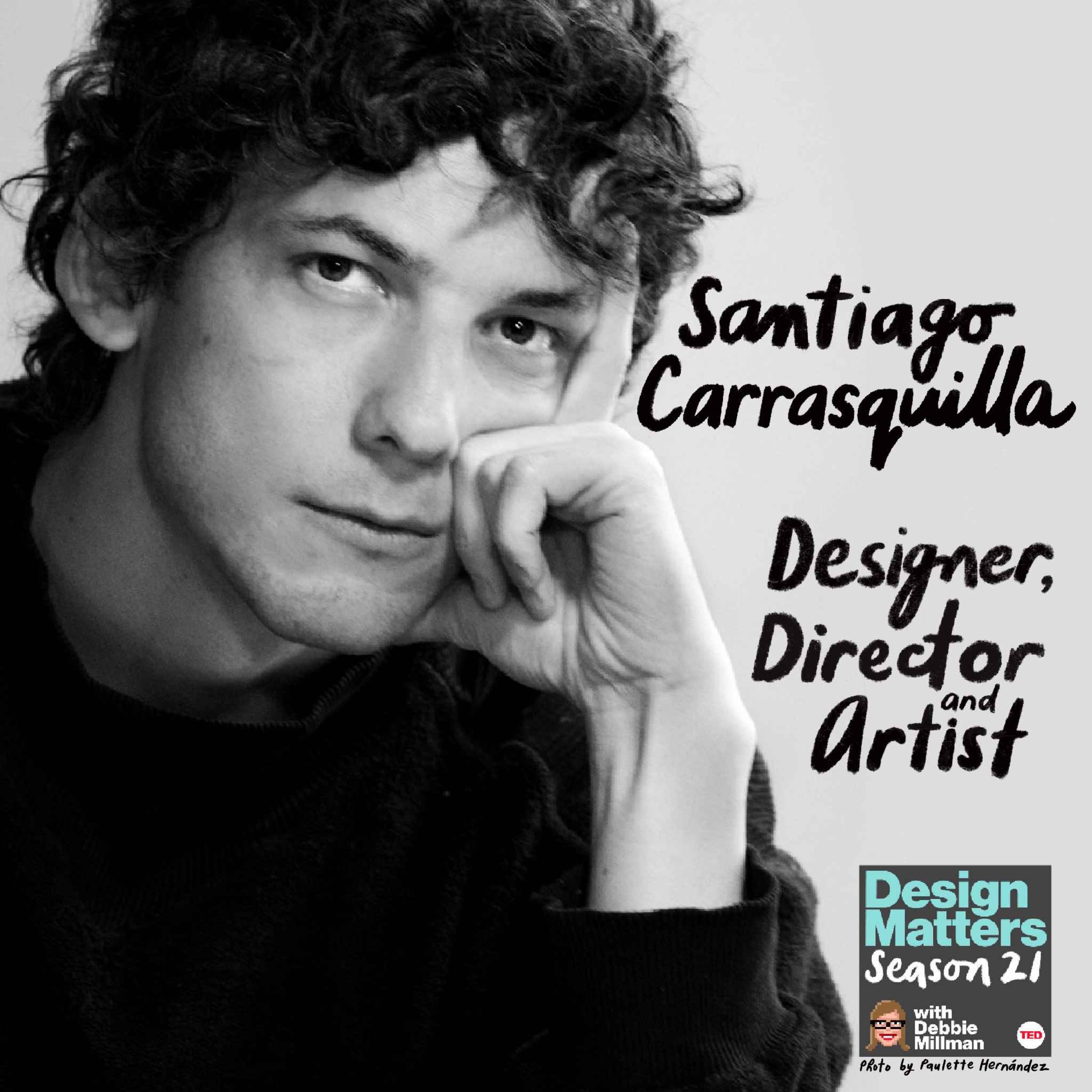
Santiago Carrasquilla
I'm often amazed, even just with myself, how much energy seems to be inside of me ready to devote to working.
- [00:17]
Narrator
From the TED Audio Collective, this is Design Matters with Debbie Millman. On Design Matters, Debbie talks with some of the most creative people in the world about what they do, how they got to be, who they are and what they're thinking about and where. On this episode, a conversation with designer and director Santiago Carrasquilla about his career and about the virtuous circle he finds himself in.
- [00:42]
Santiago Carrasquilla
The more I create, the more I love doing it. The more things I make, the more things I want to make.
- [00:52]
Spectrum Business Advertiser
You have the vision for your business. You have the plan and you just got handed a huge opportunity. But is your business connectivity reliable enough to make a move? Spectrum Business delivers fast, reliable Internet, phone, TV and mobile services, so you're always connected when it matters most. Get connectivity packages built for your business with savings that keep your budget in check. And with fast, reliable Internet and 100% US based customer support, you'll stay connected and ready to bring your vision to life. Learn more@spectrum.com business restrictions apply. Services not available in all areas we're lost.
- [01:30]
Verizon Advertiser
It feels like we're going round in circles.
- [01:33]
I'm gonna ask that man for directions H there.
- [01:36]
We're trying to get to the state fairgrounds.
- [01:38]
T Mobile Advertiser
Well, you're going to take a left at the old oak tree at this here road.
- [01:43]
Santiago Carrasquilla
Nah, I'm just kidding. Let me get my phone out.
- [01:45]
Verizon Advertiser
How is there signal out here?
- [01:47]
T Mobile Advertiser
T Mobile and US Cellular are coming together so the network out here is huge.
- [01:51]
Santiago Carrasquilla
We get the same great signal as
- [01:53]
T Mobile Advertiser
the city, saving a boatload with benefits. And there's a five year price guarantee too. Okay, here's the turn.
- [01:59]
Verizon Advertiser
Actually, can you pull up the way
- [02:01]
to a T Mobile store?
- [02:03]
T Mobile Advertiser
America's best network just got bigger. Switch to T Mobile today and get built in benefits the other guys leave out. Plus our five year price guarantee. And now T Mobile is available at U S Cellular stores in Hermiston Best Mobile Network Based on analysis by Ooklo Speed test intelligence data second half of 2025 bigger network the combination of T Mobile's and US Cellular's network footprints will enhance the T Mobile network's coverage price guarantee on talk, text and data exclusions like taxes and fees. Apply CT mobile.com for details.
- [02:27]
Wise Advertiser
This podcast is brought to you by Wise, the app for international people using money around the globe. With the Wise account, you can send, spend and receive in over 40 currencies with no markups and no hidden fees Whether you're sending pounds across the pond, spending rials in Rio, or getting paid in dollars for your side gig, you'll get the mid market exchange rate on every transaction. Plus most transfers arrive in less than 20 seconds. Join 15 million customers internationally. Be smart, get wise. Download the Wise app today or visit wise.com Ts and Cs apply.
- [03:04]
Debbie Millman
Santiago Carrasquilla is a director, designer and the founder of Art Camp, a multidisciplinary creative studio that has spent a decade making work nobody has ever seen before. Born in Colombia and shaped by migrations across multiple continents before landing in New York, Santiago brings an outsider's wonderful and an insider's precision to everything he touches. His studio blends hand drawn illustration with 3D animation, live action and emerging technology to create work that is at its core about human emotion. Beneath the acclaimed commercial work and the award winning films lies something rare, an unshakable belief in the power of optimism and craft. Santiago Carrasquilla, welcome to Design Matters.
- [03:54]
Santiago Carrasquilla
Thank you, thank you, thank you.
- [03:55]
Debbie Millman
David Santi, is it true that you worked with 15 people over 15 days to glue 35,000 cigarette papers to a wall for a mural?
- [04:08]
Santiago Carrasquilla
That is true. In Chicago, we're producing a mural for Stefan.
- [04:13]
Debbie Millman
Stefan Zagmeister, yes. What was the creative idea behind the 15 people over 15 days gluing 35,000. How do you find 35,000 cigarette papers?
- [04:26]
Santiago Carrasquilla
It was a whole production challenge to find all of the papers on time. But the way that piece came to be was Stefan would usually come with a simple sketch for a certain idea that he had. And in many cases I think he's been interested in playing with scale. So I think he must have seen something of a, like a single cigarette paper glued on a piece of paper and framed. And I think he immediately foresaw a multiples version of that for this mural that we created in Chicago. It was like 70ft long and 14ft high.
- [05:05]
Debbie Millman
It would have to be.
- [05:06]
Santiago Carrasquilla
It was really a giant wall. And at the time, Stefan was, I think, really starting to become interested in the idea of beauty, shifting away from the focus that he had had on happiness. And the mural said a sentence that is kind of a strange thing, I think. Still sounds a little weird in English to me, but sounds very Stefan. And its uselessness is gorgeous. You know, beauty and the idea of beauty for the sake of beauty outside of the context of function, which obviously in graphic design. And there's always this very strong connection between form and function. And I think he was sort of like rupturing away from that. But he came to me with a simple sketch and he said, you know, we got six weeks till we're opening the show in Chicago at the Chicago Cultural center, and I need you to help me produce this mural. So from designing the typography itself, the letters themselves, to figuring out how we were going to actually make the piece. And the type part was really fun, actually, because it was basically like creating a pixel typeface. 35,000. So, as I said, it was just like an enormous.
- [06:22]
Debbie Millman
It's just this sort of unfathomable number to me.
- [06:25]
Santiago Carrasquilla
Yeah. An enormous grid. It was an unfathomable experience.
- [06:29]
Debbie Millman
Where do you order 35,000 cigarette papers? Like, you can't order that on Amazon.
- [06:34]
Santiago Carrasquilla
Yeah, And I think that was pre Amazon. I'm not. I'm trying to remember where we managed to get that many. But of course, we had to source it from many different places. Nobody had the quantity that we were looking for. But, yeah, that was a really special, difficult experience. And I think it actually very closely connected to a lot of how my life unfolded afterwards.
- [06:57]
Debbie Millman
Well, I'll. I'll have a lot of questions about that particular part in your life. But I wanted to start with something that I could barely believe was true to start the show.
- [07:08]
Santiago Carrasquilla
One funny note. Just the end of that story. I'll skip the whole thing. But when we finished after 14 days and everyone was like, basically on the floor, everybody's back was just. It was supposed to, according to my calculations, only take four days, and it took 14 days. And it was only by luck that I had flown to Chicago with much more time. Like, the whole thing was, like, crazy. But when Stefan finally arrived at the end for the opening, he looked at this enormous mural that we had been working on, and he said, oh, it's as exactly as I imagined it.
- [07:45]
Debbie Millman
Well, that's good. You know, he could have been very Miranda Priestley esque and been like florals. How. How original.
- [07:53]
Santiago Carrasquilla
Yeah, I just thought it was a funny. A funny thing for him to say after all this work we had done. But it had fans, and the fans would blow on the pieces of paper that we had glued, and it made beautiful sound because 35,000 pieces of cigarette paper just like blowing in the wind. It feels like yesterday, but it was a long time ago.
- [08:14]
Debbie Millman
You were born in Bucaramanga. Is that how you pronounce it exactly? Oh, good, good. I practiced in Colombia. And then your life became a series of migrations. You moved to Bogota, you moved to Switzerland, Los Angeles and New York. That's A lot of worlds before you were 20. When you look back at that young person moving through all those places, what do you think he was carrying with him?
- [08:40]
Santiago Carrasquilla
I was born in Mucaramanga, yes. But I've never actually even been there, in a sense. I left. I went back to Cobota when I was a year and a half. So the first big migration from Colombia to Switzerland was an incredible contrast. I left Colombia, I think, during a really violent time of the country. So my childhood was beautiful, but felt very restricted by safety. It was. It was a very dangerous place. So it really. You couldn't really play in the streets by yourself. And it was. Yeah, it was a dangerous time in the country. So I think my first travel to Europe, I took with me, I think, a lot of love for my family. I was obviously, like. I left just with my mother, so my father stayed behind and my whole rest of my family. So there was a certain nostalgia always about having left Colombia, the home, my home land, Colombia. Quite. Quite a patriotic place, interestingly, like, Colombians love Colombia. And I was very much patriotic Colombian kid. And then when I went to la, I think I took with me the feeling of having sort of like, totally transformed to be able to live in Switzerland and learned French and just kind of like my. My entire. I had become someone else entirely. And right as I had become that other person, my mom was like, we gotta go again. It was my second big move, and I feel like I took with me that ability to transform quickly, as quickly as possible and learn another language. That's. I moved to Los Angeles when I was 12 and started learning English, which I had just finished learning French. So. So then on my third big change, big move when I moved to New York, then I. I took with me something entirely different, which was like a dream. Ultimately, I think that I moved to New York with a big dream to. I didn't even know ultimately exactly what the dream was, but it was to become some sort of a visual artist that got paid to do that. And I even considered moving to San Francisco, but in the end, I moved to New York because it just felt like the bigger dream. It just felt like here was the place to. To come and study at the School of Visual Arts, where we're sitting right now. So. Yeah. And I was also in love, which also made a big.
- [11:03]
Debbie Millman
Yeah, I'm actually going to get to that.
- [11:04]
Santiago Carrasquilla
Yeah. Yeah.
- [11:05]
Debbie Millman
That's an interesting story.
- [11:07]
Santiago Carrasquilla
Yeah. Yeah. Maybe even more of a reason, but,
- [11:10]
Debbie Millman
yeah, your first memory of being creative is very specific. You've Talked about this in other interviews. It's very tender. You were a little boy, I believe, about seven in Bogota, asking his mother to take him to the art store inside a mall called Centro Chia to buy a canvas and paints.
- [11:29]
Santiago Carrasquilla
Yes.
- [11:30]
Debbie Millman
Very, very specific goal in mind for a very specific painting you wanted to make and give to a very specific person. And I'm wondering if you can share that story.
- [11:40]
Santiago Carrasquilla
Yeah, I painted a beach and it was an oil painting. I'm pretty sure I had no idea how to use oil paints, but it was a very small canvas and I wanted to gift it to Carlos Arturo Ramirez, is his name. A great artist who was one of my closest friend's fathers, Matteo's dad. And I think he was definitely the first real artist I had ever met. And yeah, I remember going, doing this whole. Asking my mom to take me to the mall to buy this canvas and these paints, which. And I painted this scene and I really wanted to give it to him because I just was such an admirer of his, of his art, but primarily of his vibe. I was like. It was the first time I'd ever met someone that was an artist that also seemed to have a house and a family and like, it was just kind of a. Yeah, he made a really big impression on me when I was a kid, but not so much the art, but more the way the art spilled into his life. And like whenever I would go sleep over there, you know, he would tell incredible stories to us before we would fall asleep and he would help us invent crazy games or he would build special ropes so that we could swing from the trees. But it all had this very joyful energy that I just had never seen before because I think I grew up more around people who were in the corporate world and also great people. But.
- [13:05]
Debbie Millman
Yeah, you described him. I love this description I found of you talking about what he was like. You said he was a heroic, masculine, Picasso like figure who told epic stories and arrived at the breakfast table at 6:30am covered in charcoal after having been up all night drawing a mural.
- [13:27]
Santiago Carrasquilla
Yeah, that's another very vivid memory I have of him. And these additional words that I said in some other place really bring it back. Right. He was a very masculine, Picasso like character. Yeah. I have that vivid memory of him arriving at breakfast full of just completely covered in charcoal and telling us how excited he was and that he could. He could just not stop working until the sun rose and. Happens to me all the time now.
- [13:54]
Debbie Millman
It's a good feeling. You can't stop.
- [13:57]
Santiago Carrasquilla
Yeah.
- [13:58]
Debbie Millman
But you said that by the time you were 12, you stopped drawing and turned to music instead. Guitar, drums. You were listening to bands like Radiohead and Soda Stereo. What happened to make that switch?
- [14:12]
Santiago Carrasquilla
I must have just been more emotionally captivated by music. I kept drawing less so, but I definitely kept drawing throughout my teenage years. But there was something so visceral about playing music. One of my best friends and my uncle, same person, taught me to play guitar. He was a musician. He was also another person that I really looked up to and he would take me to. Yeah. So I. I just really became captivated by the act of playing music. And I just could sit there playing the same chords over and over again. And the vibrations of the strings, I think somehow they enchanted me more than drawing did, even though I kept doing it. And then later, drums. When I started playing drums, I felt like, wow. I almost felt like I was born for that.
- [15:05]
Debbie Millman
At that point. Did you think you might want to be a professional musician?
- [15:08]
Santiago Carrasquilla
Yeah, all the way up until I was like 16ish. I was like, maybe I should be a drummer. And I took a lot of drumming lessons in LA and had some pretty serious conversations with, along the way with my teachers about whether they thought or not I should pursue being a drummer. I can't exactly point my finger to why it is that I didn't end up doing it. I think it just naturally just didn't make the choice. And I didn't end up pursuing it, maybe because I was scared of the life of being a musician. I also, I think, understood that there are some real geniuses that, like, play drums at 7 years old. Like, they've been playing for 30 years. So I think I must have also recognized that, like, even though I love drumming and I think I was talented at it, I don't think that I was gonna be the next big great drummer.
- [16:08]
Debbie Millman
At 17, you met Kenny Scharf, and you've described it as the moment that changed the way you saw the world. Now when you visited him at his house, you saw works by Warhol and Haring, Basquiat, Ed Ruscha, and you said what struck you was the inseparability of his life and his art. And there was no distinction between the two. And it's so interesting now that you were talking about your Pablo Picasso esque friend's father. There is a connection there, this inseparability of life and art. What did you see in how he was moving through his own home that lodged itself in you so distinctly?
- [16:51]
Santiago Carrasquilla
I met Kenny because I was dating Malia his daughter. So obviously there was the.
- [16:57]
Debbie Millman
Oh, so she's the woman who you came to New York for?
- [17:01]
Santiago Carrasquilla
Yeah, yeah, yeah.
- [17:01]
Debbie Millman
Ah, see, that I couldn't find online.
- [17:03]
Santiago Carrasquilla
Yeah, yeah. So there was obviously that connection there of being in love with Malia and then meeting her family and her father happened to be Kenny. Wow. Where to start? I mean, first of all, it was just like an incredible purely art education. Like, I was in somebody's home with all these incredible pieces hanging, none of whom I knew. I didn't even know who Kenny was. But, you know, on the wall there was all the work from his friends and his friends. I slowly learned. And Malia very much would teach me this sort of. Yeah. Oh, so that's. That's Keith Haring. I knew. I just didn't know who that was. Or Basquiat.
- [17:43]
Debbie Millman
What a way to learn.
- [17:45]
Santiago Carrasquilla
Yeah, exactly. So, you know, being 17 in this beautiful house with a beautiful garden full of art and being in love and smoking weed and just, like, looking at Ed Ruscha next to her describing heaven, it was like you would see a Basquiat next to a Warhol next to a Cindy Sherman. And in the space between each one of those, there was like some line of paint of a squiggle or something that Kenny had literally just painted on the wall. So there was this sort of literal interventions of his hand in every single corner of the house. There was the art itself, which I think most of it, he had just sort of traded with his friends when they were in New York in the 80s. And then there was him. Very different energy than Carlos, but still very much this, like, incredible optimism and focus on enjoying the life that he was living and being funny, but also being silly and being creative. Creative even. Just in the way he would relate to his daughters. Right. They would just be silly and dance and. And. And. And. Yeah, I just didn't. I hadn't really. I mean, I grew up with incredible people, but I hadn't really experienced someone quite like him. And he was very kind and very generous and. Yeah, the combination of all those things was crazy. Actually, when I finally ended up moving to New York, Kenny asked me to please bring a painting in my carry on from LA to New York. And it was literally an Andy Warhol.
- [19:38]
Debbie Millman
Wow. We trusted you.
- [19:40]
Santiago Carrasquilla
It was literally an Andy Warhol painting wrapped in buffalo wrap and a tote bag, as one does this Andy Warhol hamburger painting.
- [19:53]
Debbie Millman
Who did you have to deliver to?
- [19:55]
Santiago Carrasquilla
To Malia. They were going to do something with the painting here. I forget exactly what they were doing with the painting. But he was just like, please bring this to New York. It's an Andy Warhol painting. Don't lose it.
- [20:06]
Debbie Millman
Oops. Now, you described yourself at that age as too scared to actually pursue art. And I find that incredulous because that fear feels so. It's an anathema coming from someone whose work is now so bold and experimental. What were you so afraid of at that time?
- [20:33]
Santiago Carrasquilla
Well, I really don't think that I grew up in an environment where it was very. Encouraged is the wrong word. Because my mother always encouraged me to do everything I wanted to do. But I didn't really grow up with someone close to me that I felt had made a successful, quote, unquote, successful life being an artist until I was 17. So, like. Or 17 and a half when I met Kenny. So that was like, the first. And that was kind of like, I mean, you know, he is one in a million type of human. Right. Just to take a step back. But, like, I. I've always wanted, I think since I was a kid, to be two things. I've always wanted to be an artist. And I think I also always wanted to be a business person, a businessman. Like, I think that that was maybe what I saw in my family. And so I do recall somehow asking Kenny before I moved here, because I moved to New York to study advertising at the School of Visual Arts. Because that was kind of. My intuition at the time was like, well, I think advertising is likely, like, the thing that I could do that has creativity, but also it has business, and I could make some money. I don't come from money. Even though my bio sounds like I could be, like, the child of a rich expat. I am the child of a incredibly hardworking woman that basically, my mom raised me mostly by herself. It sounds very crazy, right? Colombia to Switzerland to la. But I have been so fortunate to have enough, but not necessarily in excess. So making a living was always something that was at the top of my mind. So I think a combination of all those things made me choose something that I felt was tangent to creativity and making a living with creativity, but maybe not so far all the way into, like, the way Kenny makes his living, which is like, just being a fine artist.
- [22:36]
Debbie Millman
You decided to move to New York, in large part to be with Malia. Yeah. And I think the COVID story that you've talked about telling yourself, and perhaps your family, was that you were moving to New York to study advertising. And I actually think there's something wonderfully human about what you told them, given what the real reason was how do you think about the role that desire, not just romantic desire, but longing in all its forms, plays in where a life ends up?
- [23:08]
Santiago Carrasquilla
I've recently started living in Mexico City. The goal is to be half in New York, half in Mexico City. And I'm in large part in Mexico City because I'm very in love with Paulette, my girlfriend. And I love Mexico City. Had Paulette been in a much less interesting city, I probably still would have figured out a way to move to that less interesting city just because I love her so much. But, yeah, I think that obviously, the combination of such an incredibly vibrant location with being in love, I mean, there's nothing stronger than that. It's not a coincidence that I moved to New York to be with someone I loved and that now I'm living in Mexico City to also be with someone I love.
- [23:57]
Debbie Millman
When you first got to New York, you were studying advertising, but then fairly quickly moved to design and animation. What was the inspiration to make that switch?
- [24:08]
Santiago Carrasquilla
So, luckily, at the School of Visual Arts, the advertising department, the motion graphics department, and the design department are very closely connected. To study advertising, you had to study graphic design, and not necessarily vice versa. So it was like, I got here, I started taking Advertising 101, or whatever you call it, as well as communication design and typography. I think I was just, like, much more interested in studying. Yeah, my. My heart was much more open or much more leaping towards studying design. And, of course, I think it has a lot to do with the teachers and the people that I met. And maybe to your earlier question as to, like, what was I afraid of to go in the more artistic. Maybe that was another way that I foresaw. Like, okay, well, it seems as though the design path could be even closer to the possibility of an art practice than an advertising path.
- [25:09]
Debbie Millman
When you were at school, Stefan Sagmeister became your design hero, and you were determined, very determined to go and work with him when you graduated. Can you talk about the way you first got his attention?
- [25:24]
Santiago Carrasquilla
I left school with a rather experimental portfolio to sort of connect it back to the. In the end, I studied design. And in the end, I think I ended up leaving with a pretty experimental version of a design student. And most people were not really biting. Like, most. Well, as I was looking for a job, most people did not seem to think that I would fit into their space, into their studio. Good vibes. People were kind to me, and I think the work connected. But it was just experimental enough that it was hard for people to know how I could fit into the parameters of a commercial space. Frustrated, sort of generally by the lack of response even that I would receive. It occurred to me that I had to figure out a new method for putting my work in front of people because I felt that the work was strong. But it was that bridge between, like, how do I actually get someone to look at this? And I decided to make these handwritten animations that would say basically what an email would say, but just handwritten. So. Hey, Stefan, I'm a huge admirer of your work. I just graduated the School of Visual Arts. I'm looking for something to do if you have a chance to look at my portfolio, like, I'm leaving you a link behind. Thank you so much. Right. The same exact thing you would just kind of write in an email that the likelihood someone responds to that, it's pretty close to zero. Especially someone as busy as Stefan. So I wrote it, I made these little GIF animations that had to be, you know, three to five megabytes maximum, so that it would ensure that the email was not too heavy and you could see it, blah, blah, blah. And I started sending these animations out and the hit rate, let's say, went from like 0% to 100%. Like, literally every single person that I ever sent one of these to would respond extremely excitedly. And I remember the night, it was like late at night that I made the one for Stefan with the butterflies in my stomach and the fear of like, fuck, I don't know if this is terrible, I don't know if this is lame, I don't know what this is. And it's late and I'm just gonna send it and see what happens. And you responded. Well, Jessica responded. I think he forwarded it to her. And Jessica wrote to me and said, hey, you have great work.
- [27:50]
Debbie Millman
Jessica Walsh was working for him at the time.
- [27:52]
Santiago Carrasquilla
They had just become Zeigmeister and Walsh. And that was my first step into that world of that studio.
- [28:01]
Paylocity Advertiser
When everything is moving all at once, your workforce, your tech stack, your business, you don't need more tools, need one solution. That's why Paylocity built a single platform to connect hr, finance and IT with AI driven insights and automated workflows that simplify the complex and power, what's next? Because when everything comes together in one place, growth comes easy experience. One place for all your HCM needs. Start now@paylocity.com 1.
- [28:31]
Spectrum Business Advertiser
You have the vision for your business. You have the plan, and you just got handed a huge opportunity. But is your Business Connectivity reliable enough to make a move Spectrum Business delivers fast, reliable Internet, phone, TV and mobile services so you're always connected when it matters most. Get connectivity packages built for your business with savings that keep your budget in check and with fast, reliable Internet and 100% US based customer support, you'll stay connected and ready to bring your vision to life. Learn more@spectrum.com business restrictions apply. Services not available in all areas this
- [29:07]
Wise Advertiser
podcast is brought to you by Wise, the app for international people using money around the globe. With the Wise account, you can send, spend and receive in over 40 currencies with no markups and no hidden fees. Whether you're sending pounds across the pond, spending reals in Rio or getting paid in dollars for your side gig, you'll get the mid market exchange rate on every transaction plus most transfers arrive in less than 20 seconds. Join 15 million customers internationally. Be smart, Get Wise. Download the Wyze app today or visit wise.com Ts and Cs apply think Verizon is expensive?
- [29:42]
Verizon Advertiser
Think again. Anyone can bring their AT and T or T mobile bill to a Verizon store today and we'll give you a better deal. So bring us your bill, walk in, running pogo sticking teleport if you can, ride on the back of a rollerblading yak or flying on the wings of a majestic falcon. Any way you can bring your AT and T or T mobile bill to a Verizon store today and we'll give you a better deal on the best network based on RootMetric's best overall mobile network performance. US second half 2025 all rights reserved. Must provide a very recent postpaid consumer mobile bill in the name of the person redeeming the deal. Additional terms, conditions and restrictions apply.
- [30:13]
Debbie Millman
Talk about one of your favorite projects working for Sagmeister and Walsh. You were hired, obviously, and you worked with them for about three years and worked on some of their most notable projects. You were also in some of their most notable promotions. I believe at least one you were maybe partially clad, which was hard for me to look at because I know you. So talk about the atmosphere of working in a place that was so experimental and so well respected.
- [30:45]
Santiago Carrasquilla
First of all, it was like this incredible dream coming true for me, like I really had fallen in love with his work as a student. But working there was incredible for a lot of reasons. One big one is that the group of people that was working there during those three years that I was there was so inspiring. Like the creatives, the human beings that arrived there Every single one of them. I was, like, amazed by how talented and incredible they were. And the studio was small enough that it really forced us all to work with each other. Many of my very good friends still are people that came out of that group of those three years. So I think that that was a very exciting thing. Obviously, the fact that I was working for Stefan, who and Jessica, who were, you know, in many ways heroes, had this incredible feeling of, like, wow, I. I'm doing exactly the. The best version that I ever dreamed of. Like, you know, this is just incredible. I very quickly and luckily also fell more and more into working on all their experimental projects. So the 50% or more of the studio was doing client work, but they were putting a huge amount of effort and talent and finances also behind doing their experimental non commercial work, exhibition work, going back to the cigarette paper mural that we did in Chicago that was part of an exhibition. And so I got to work very closely with both Jessica and Stefan on their own personal projects. And they were both doing a lot of video, which was just perfect for me because I started filming things using the camera, and I started editing and putting music to the edit, and I would have to produce the shoots. So there was the logistical side of it, but then there was also the design aspect of it, but then there was the shooting and the editing and the execution. And that, I would say, was the first time I had, like, a really clear aha moment of, like, audio. Visual is my favorite work. Combining music and sound and rhythm and time with visuals is ecstasy for me. Basically. It's just, like, my favorite. So I got to do a lot of that. One particular project that comes to mind that was really, really fun. We made this film with balloons. Jessica and Stefan would come and be like, all right, we want to do a film with balloons. We want to shoot it in slow motion, and we want this sentence to somehow be part of what we tell in this film. And then it would just be like an open 3, 4 months where all I had to do every single day is just experiment with every. Every possible thing you could imagine doing with balloons. So filling them with water or filling them with paint, or filling them with paint and freezing them outside and the balloon, they would become ice, or shooting them with a BB gun or with a. With an arrow or with a. Just every possible thing you can imagine. And it was just like, I would just go to the studio, buy a bunch of stuff, shoot every single test, and work with Jessica and Stefan to, from all the experiments, decide this one, this one, this One, this one, this one in particular was if I don't ask, I won't get. Was the sentence that was being spelled out in the sequence.
- [34:21]
Debbie Millman
Good mantra to sort of embed in your psyche too totally.
- [34:26]
Santiago Carrasquilla
Often when I'm like faced with the choice or with the necessity to ask for something, so often the fearful instinct is not to because you're afraid of being rejected or because you're right. I'm like, fuck. I made a film that says like, if I don't ask, I won't get.
- [34:45]
Debbie Millman
Yeah, I think it takes a really, really, really, really long time before you start getting things before you ask. And I don't think that that happens until you're well into middle or old age. And it didn't really start happening to me till well into my 50s. And I still mostly have to ask when I for things. You decided to create your own studio about three years after you started working for Stefan and Jessica. You went off and you started a firm called Art Camp. Your tagline is emotion points to form. The points to is actually represented by an arrow. So it's really emotion, arrow, form. But I'm assuming that stands for points to, right? Or goes to. Sure. That arrow is doing a lot of work. Walk me through what that actually means in practice. How does emotion point to or become form?
- [35:40]
Santiago Carrasquilla
I think for me, the first place where I find that emotion has a lot to do with the work. It's literally working with my team sounds a little basic, but I think through work and through creating is the main way that I connect with people in the world. And that's a double edged sword. And sometimes. But there's nothing that is more meaningful but also pleasurable to me than to have this real emotional connection with the people that I work with. And that that emotional energy is at the core of the creation itself. And that ultimately, hopefully in the end it's love. It's really what it is. It's like, you know, I. I can point to any project that I've done and I like look at the list of the people that I was working on it with. And I think pretty much always, I feel like there was real love that was exchanged between us. It's like a gift in a sense, right? It's like you put your minds and hearts together to create something that didn't yet exist. And you create in the end this visual symbol for this life that you lived. And I think that's maybe the most basic way in which I think emotion leads to form. Like literally human beings getting together with A dream with a vision, with a, with a desire to do something creative as good as you can possibly make it for the sake of just that that energy is the best energy to tap into. And in the end you end up with form. You end up with literally something that you can point to that is tangible. And in a sense emotion is not quite as tangible on that level. I think is important for me to answer the question. And then of course there's the literal feelings that you are trying to conjure up as you're creating something to give the audience a certain experience which you think is somewhat similar to your experience. So like if a certain edit that you're working on, like has a crescendo like effect and you very carefully time everything so it reaches it climax and then it stops. That experience of my own heart and eyes and brain interacting with that piece of work to give me that feeling is hopefully what is then possibly translated into the audience. And maybe that audience get to experience some version of that thing that you were trying to do. So literally in that same way transforming emotions, my emotions with the piece and crafting it with the thing that it ends up becoming the form.
- [38:37]
Debbie Millman
You created a music video for Mitsky titled Pearl in which you created over 3,000 hand illustrated frames and combined 3D animation with more traditional mediums like charcoal, pastel ink and colored pencils. And it's since become one of the most celebrated music videos of its era. But the concept came from a very simple image. A small figure falling off the edge of the earth. How do you know when a single image is strong enough to carry an entire film?
- [39:10]
Santiago Carrasquilla
I don't think you know, you just hope, you just. Yeah, you never really know what people are going to like or how they're going to respond to it. I think you can know how you are going to feel and respond to it. And to some degree it's quite a mystery, I think for me what is going to resonate and why. And, and you know, every time you put something out new that there's always people who have their own opinion and their own experience. And some people think, well this is. I like this about it, didn't like this about it. So like in some way I think you ultimately cannot really know other than by trusting how you feel towards the piece. I think I've always sort of been obsessed with the feeling or the idea of falling. Just imagine the feeling of falling, falling, falling. It really kind of gives you a certain feeling in your stomach. I remember as a child at my grandparents house in Caracas, looking out the balcony and sort of pretending with myself that I would jump. Not in a suicidal way, but just kind of in like the thrill experimenting with my own brain into, like, if I just jumped, like, what would that feeling be like? And just by imagining it, I could kind of give myself that feeling without actually having to jump. But then that particular video, of course, even though the intuition for. And the song, I mean, Mitsky is incredible, and that song is just like such an incredible song. I mean, I think, like, it all starts there. I don't think that this music video would have been as celebrated as it has been if it wasn't. Because this song is just like such a emotional powerhouse of a song. But also we collaborated with Danae and with Saad and with Saad Musaji. We created something that, yeah, it's still, I think, to this day, really. People talk about it, people write to me about it, and it was one of those things that just. It all kind of came together and it makes something that I think people feel. People watch the thing and it gives them a lot of feelings.
- [41:24]
Debbie Millman
I also get that feeling from the collaboration that you did with Thom York, the lead singer and one of the masterminds behind the band Radiohead, on his video for his song Anima. How did that commission begin?
- [41:40]
Santiago Carrasquilla
The song was last I heard.
- [41:42]
Debbie Millman
Oh, not Anima.
- [41:44]
Santiago Carrasquilla
It was in the album. It was in the album Anima, but the song was, last I heard, dot, dot, dot. He was circling the drain, Which is just like, what a title. That video came about very much through the Mitsky video. The creative director, Scott Wright at Excel Records, saw the Mitsky video and reached out to us because he was working on this project with Tom York and felt like the aesthetic, this sort of like hand drawn aesthetic, but you don't quite know. Is it hand drawn? Is it 3D? Is it film? What is this? I think that aesthetic really made him curious to try and work on something with Tom York for this. We went about it in an ultimately totally different way. And the mood of the two videos is entirely different. Tom York video being a much darker one. Circling the drain, Circling the drain. But just to tell you a little bit about the process itself, we didn't have to pitch, we didn't. They just gave us the project. We worked with Saad Musaji again on this project. Saad makes images that really stick in your imagination. I think he has an incredible talent for making images that just look emotional. I think his ability to. To light scenes, but also to place everything so perfectly and so Beautifully. And so we had one call with Tom where he explained to us where he was at in the time that he wrote that song. It's like a one hour call. And he was like, look, I was in this place, I was living in London. I was feeling these ways about living in the city. And I was feeling claustrophobic. And that's what the song is about. They showed us the artwork that they had been working on for Anima, which was mostly done by Stanley Dunwood, long term collaborator. Exactly. So we are that Stanley was part of that initial conversation. And Stanley's artwork was all charcoal drawings, black and white. And there was one. There was a lot of birds. And then there was this one drawing in particular that they gave us of an astronaut behind like a forest. And there was something about that image of the astronaut plus everything that they talked to us about that basically those were the seeds. We were like, well, it's got to be black and white because these seeds that we've been handed and they did not tell us to do this. Basically, Tom York talked for 30 minutes, said, this is how I was feeling. Take it or leave it. Do whatever you want. It was pretty nice.
- [44:39]
Debbie Millman
Brief.
- [44:40]
Santiago Carrasquilla
Yeah.
- [44:41]
Debbie Millman
But also terrifying, I think. Do whatever you want. Okay.
- [44:44]
Santiago Carrasquilla
Yeah. He was.
- [44:45]
Debbie Millman
What I want is what you want.
- [44:47]
Santiago Carrasquilla
Exactly. And so we made this film about an astronaut who's in a city that seems to be suppressing him. He's surrounded by a bunch of faceless people. Everybody looks the same. It's very cold, it's very scary. And he basically has a panic attack and enters an altered state. And the video basically climaxes in this altered state. And he, in the end, walks out of a tiny door into the brightness of a good future.
- [45:18]
Debbie Millman
What was it like to make something for someone whose work had already made something of you?
- [45:24]
Santiago Carrasquilla
I've had a very specific memory of being on an airplane, writing in my diary. It's like my favorite place to write in a diary. Listening to Radiohead. Radiohead. I think it was weird fishes crying from what it was. I mean, everybody who cars on airplanes. But I was crying to weird fishes on this airplane, writing in my journal, saying this feeling that this music is giving me. If I could ever one day give this to somebody else, that is the dream, like, right? That is the ultimate goal, that if. If I could ever make anything that makes anybody feel the way this is making me feel. So in some sense, I had always. Of course, Radiohead was my favorite band and I had always dreamed of making something for Radiohead. It was definitely in the initial dream diaries of when the studio was started was like, you know, one day, let's make a video for Radiohead. In the end, it was not a video for Radiohead and we made a video for Tom York. Yeah, it was. It was amazing. It was also really hard because the song was really dark and we didn't have any money. And I think we were already in the time when, like, music videos, there isn't real budgets to make them. But of course, the ambition is the biggest possible ambition you can imagine. It was a dream project, but it was also. It came with a lot of difficulties because we had to figure out a way to finance part of it ourselves. And we had to. Yeah, we basically went all in and we bet the house on this video pretty much because of the art and because of the possibility of making something with our heroes.
- [47:08]
Debbie Millman
I recently read an interview with Tracey Emin, a really wonderful interview, about her painting practice. And she talked about how she works to music and was listening to Weird Fishes over and over and over and over again. Like, often when she gets into a painting, she'll just listen to one song, and that was the song. And there is something, I think about that song that just brings out the heart in people. You also worked for U2. You created a stop motion animation video for their single youe're the Best Thing About Me. A lot of people asked you how much of it was done in CGI. None of it was done in CGI. And I know you spent 17 hours on your feet puppeteering the book with string. So my question isn't really about your work with U2. It is about what is it about the sort of performative aspect of the work that you do. 35,000 cigarette wrappers, 17 hours on your feet, 3,000 images in a video. Talk about the stamina that you bring to your work. And what is it about that effort that you find so intriguing?
- [48:28]
Santiago Carrasquilla
I'm often amazed, even just with myself, how much energy seems to be inside of me, ready to devote to working.
- [48:43]
Debbie Millman
Yeah, you love working.
- [48:44]
Santiago Carrasquilla
I love it. The more I create, the more I love doing it. The more things I make, the more things I want to make. And my energy for creating only seems to be going up. It doesn't decrease, which is surprising to me, but it's also really exciting. If, in fact it keeps going, then, wow, I'm just getting started. Like, really, I'm just getting started purely just because I love it. I just love doing it. There's really almost nothing I would rather be doing than working. And Working is too simplistic a term than just creating. There's just really nothing I like doing more than that. It doesn't matter if it's Christmas or New Year's or Sunday or Monday or. It really doesn't at all. Is. I wake up almost every day with a really strong impulse and desire to get to work. I just love it. So in some weird sense, I would say that like my whole life is almost like a performance for creating. It's weird to say it sometimes because it sounds so single, focused or it almost sounds like. Almost sounds sad sometimes. Like really everything is geared towards that. But it kind of. It's the truth.
- [50:08]
Debbie Millman
I mean, it's making things I don't.
- [50:10]
Santiago Carrasquilla
Yeah.
- [50:11]
Debbie Millman
Making things about work so much as it is about, as you said, creating,
- [50:15]
Santiago Carrasquilla
creating and creating things that I find compelling and good still, maybe because I just don't have enough experience and have a lot to learn is hard. It doesn't necessarily come easy. It requires effort.
- [50:34]
Debbie Millman
There's so many really beautiful commercial projects that I could talk to you about your work with Telfar, your work with Nike Air Jordans, but I think your film with Luis Benz is one of your most original. You described the concept for the film as asking a self taught sign painter to paint 50 signs using words that carried personal meaning to him. His own words, not ice cream or soda. And that inversion, asking a commercial sign painter to make something purely for himself is a kind of creative generosity. What prompted that approach?
- [51:11]
Santiago Carrasquilla
I'm trying to recall exactly how that came to be, but I think my memory, my memory that comes to me is like being in a taxi in Buenos Aires with Danae, who's then my girlfriend, knowing that we were going to go make this film and being like, wow, what do we, what do we do? What would make sense to do? And in. In that conversation, somehow it occurred to, I think some in the com. I don't know, both of us, that it would make sense to have him write words that nobody ever asked him to write. Just the simple opposite. Like do instead of write sandwiches, just like write whatever words have meaning to you. And that immediately seemed like a much more interesting approach because I had been collecting his work for years prior to making the film. But I had always just told him, write whatever you want. And I sometimes would get a little disappointed by the choices because I would just be like, oh, I already have the sandwiches. One. I bought like over the years, 50 signs from him before we made those 50 signs for the film. And it was fascinating that he had this old Dictionary, Spanish dictionary, in his house. And he didn't even really. Actually didn't seem to us like he had fetched in his heart for the words that meant the most to him. He just kind of opened a dictionary, and all the words that he was attracted to are the ones he selected. And most of the words in that series are very peculiar. For example, I mean, at least maybe peculiar to me. Like, for example, one of them is nagual, which is a sort of magician, very particular words. And he wrote the definition of all of them in the back of the signs that we had him make.
- [53:07]
Debbie Millman
Louise Benz seems to have had a very big influence on you over the years. What would you say is the most important thing he taught you both about craft and how to live?
- [53:21]
Santiago Carrasquilla
The title of the film, short film that we created, is La Felicidad se con cigue con cosas muy simples, which is Happiness is Achieved with Very Simple Things. We decided to call it that much later, of course, we made the film, and then in the process of editing it, we were like, what do we call the film? And when we thought about what were some of the most profound things he talked about in the film, the documentary, we decided that that should be the name of the film. And I love that. That's such a great name for a film. Happiness is Achieved with Very Simple Things. It's such a statement, particularly for me, such a statement from a person that. Yeah. From someone who's had a really hard life. You know, in this film, he basically talks about having lost two of his kids and having had to leave his house when he was nine years old because there was no food to be had. And Luis has definitely had a very difficult life, and yet he doesn't really present himself in that light. He, in fact, presents himself from a very different light. Like, I've had such. One of the other incredible things he says in the film is like, I've had such good times that I don't envy anybody, but I've also such. I've had such bad times that I do not wish upon anybody like he. He has really lived the range of the. The human life. But his conclusion to me, in his demeanor and the way he treated us and the way he treated the people around him was that of someone that was uplifting. Yeah. No teeth. I don't know, like a. A tough. He's had a tough life, for sure. But he chooses to see the. The. The silver lining, or he chooses to. And maybe he's some sort of a Buddha or something. I Don't know, like, maybe there's just like depending on how you were.
- [55:14]
Debbie Millman
There's a little Yoda esque quality to him, I think.
- [55:17]
Santiago Carrasquilla
Yeah. And a good reminder, you know, it's like, I love her. Yeah. Like, I made a film with Stefan that it says if I don't ask, I won't get. And it comes to save me when I'm doubting whether I should ask or not. And then having made a film that's called Happiness Achieved with Very simple things, it's like this amazing reminder to myself when I'm going through a difficult time or something like that. Like separately from that more philosophical thing that I love about Luis and his joy. Completely, utterly in love. Still, 52 years into painting letters on metal boards. Completely in love with. He was always. He would just tell us like, oh, I gotta pick the right color combination. I want to do this as well as, like, I want this to be the best sign I've ever painted for you guys. And like, it's important to me that I do it really with precision and perfect and da, da, da. Just like this. Love for creating.
- [56:19]
Debbie Millman
I have one last question for you. Santiago Art Camp is now a decade old. Congratulations.
- [56:25]
Santiago Carrasquilla
Thank you.
- [56:26]
Debbie Millman
You describe it as an agile global team working across time zones and cultures frame by frame. Hand drawn meets AI meets live action meets 3D. What do you want the next 10 years to feel like?
- [56:41]
Santiago Carrasquilla
I would love for them to be really surprising in the way that these first 10 years have been surprising. But that's almost goes without saying because life is inevitably surprising. But I mean more specifically that I want to make even bigger dreams come true. I'm not quite ready to make a feature length film, but I think in 10 years I could work my way towards that slowly. Ten years ago, I hadn't made a six minute film. Now I have. So there's a certain knowing now that I'm older, if I continue to be in good health, knowing what is possible in a decade, once you've already kind of lived a decade of like being a professional or. I mean, obviously I've been working longer than that, but yeah, just having more perspective now, it really makes me excited to be like, wow, in the next 10 years, things that are even beyond what I can dream of seem possible because I've already. That's already happened to me. I've already sort of like experienced having landed much further than the furthest dream I had set for myself. So I am really looking forward to that same sort of perspective. And I would say the other thing which leads me to your first one of your first questions about emotion into form. I hope that I'm still just working with people that I really love, people that I really love as them as human beings, but people who really inspire me and people who, who astonish me. And I would say that everybody that I work with at Art Camp astonishes me. Like I, I'm like I am your fan. I am their fan. Every single person who works at Art Camp blows me away in their own intelligence and in their own way of seeing the world and in their own capabilities. And the last thing I'll say about that is, or about about this question is I really look forward to doing a lot more commercial work. So even bigger commercial projects, bigger in every sense, bigger reach, bigger, bigger budgets, bigger complexities while simultaneously developing more and more personal self initiated projects. That is really something that I want to focus on in the next 10 years.
- [59:02]
Debbie Millman
Santiago Carrasquilla, thank you for making so much work that matters. So much beautiful work that matters. And thank you for joining me today on Design Matters.
- [59:14]
Santiago Carrasquilla
Thank you Debbie.
- [59:16]
Debbie Millman
To learn more about Santiago and his work and see his films and videos and design work and his self generated projects, you can go to made@artcamp.com this is the 21st year we've been podcasting Design Matters and I'd like to thank you for listening. And remember, we can talk about making a difference. We can make a difference or we can do both. I'm Debbie Melman and I look forward to talking with you again soon.
- [59:44]
Narrator
Design Matters is produced for the TED Audio Collective by Curtis Fox Productions. The interviews are usually recorded at the Masters in Branding program at the School of Visual Arts in New York City, the first and longest running branding program in the world. The editor in chief of Design Matters Media is Emily Weiland.
- [60:08]
Paylocity Advertiser
When everything is moving all at once, your workforce, your tech stack, your business, you don't need more tools. You need one solution. That's why Paylocity built a single platform to connect hr, finance and IT with AI driven insights and automated workflows that simplify the complex and power. What's next? Because when everything comes together in one place, growth comes easy experience. One place for all your HCM needs. Start now at paylocity.com 1 hey, it's
- [60:38]
CoverGirl Advertiser
Paige from Giggly Squad. You already know once I'm in my jammies, I I'm in my final form. And lately my last step before fully clocking out is the covergirl Jammy Lip sleeping mask I just twist apply with the Mess free applicator and let the dreamy lavender scent literally tuck me in. By morning, my lips feel smooth, revitalized and baby soft while I'm doing absolutely nothing iconic behavior. So shop covergirl Jammy Lip Sleeping Mask at your nearest retailer now only from easy, breezy, beautiful CoverGirl
- [61:13]
Santiago Carrasquilla
acast powers the world's best podcasts. Here's a show that we recommend.
- [61:22]
Verizon Advertiser
What if you laughed all through your commute? Or if you heard the funniest story while at the gym?
- [61:27]
CoverGirl Advertiser
Well, now you can.
- [61:28]
Verizon Advertiser
I'm Jameela Jamil and guests on my new podcast Wrong Turns share their most mortifying and hilarious disaster stories. I'm talking people like Mae Martin, Bob the Drag Queen, Katherine Ryan, Jake Johnson, Margaret Cho, Simon Pegg Penn Badgley, and so many more. So listen wherever you get your podcast Wrong Turns where dignity goes to die
- [61:52]
Santiago Carrasquilla
ACAST helps creators launch, grow and monetize their podcasts everywhere.
- [61:57]
Verizon Advertiser
Acast.com this episode is brought to you by Choiceology, an original podcast from Charles Schwab hosted by Katie Milkman, an award winning behavioral scientist and author of best selling book how to Change. Choiceology is a show about the psychology and economics behind our decisions. Hear true stories from Nobel laureates, authors, athletes and everyday people about why we do the things we do. Listen to choiceology@schwab.com podcast or wherever you listen.
- [62:29]
Think Verizon is expensive? Think again. Anyone can bring their AT and T or T mobile bill to a Verizon store today and we'll give you a better deal. So bring us your bill. Walk in, run in, pogo sticking, teleport. If you can ride on the back of a rollerblading yak or flying on the wings of a majestic falcon. Any way, you can bring your AT&T or T mobile bill to a Verizon store today and we'll give you a better deal on the best Network based on RouteMetric's best overall mobile network performance US 2nd/2025 all rights reserved. Must provide a very recent postpaid consumer mobile bill in the name of the person redeeming the deal. Additional terms, conditions and restrictions apply.