Loading summary
Transcript173 lines
- [00:01]
Suzanne Vega
It took a long time to learn how to perform. It took another 10 years until I would say I got better at it. And in fact that's a lifelong quest for me. How do you embody the feeling and perform it in front of an audience?
- [00:19]
Debbie Millman
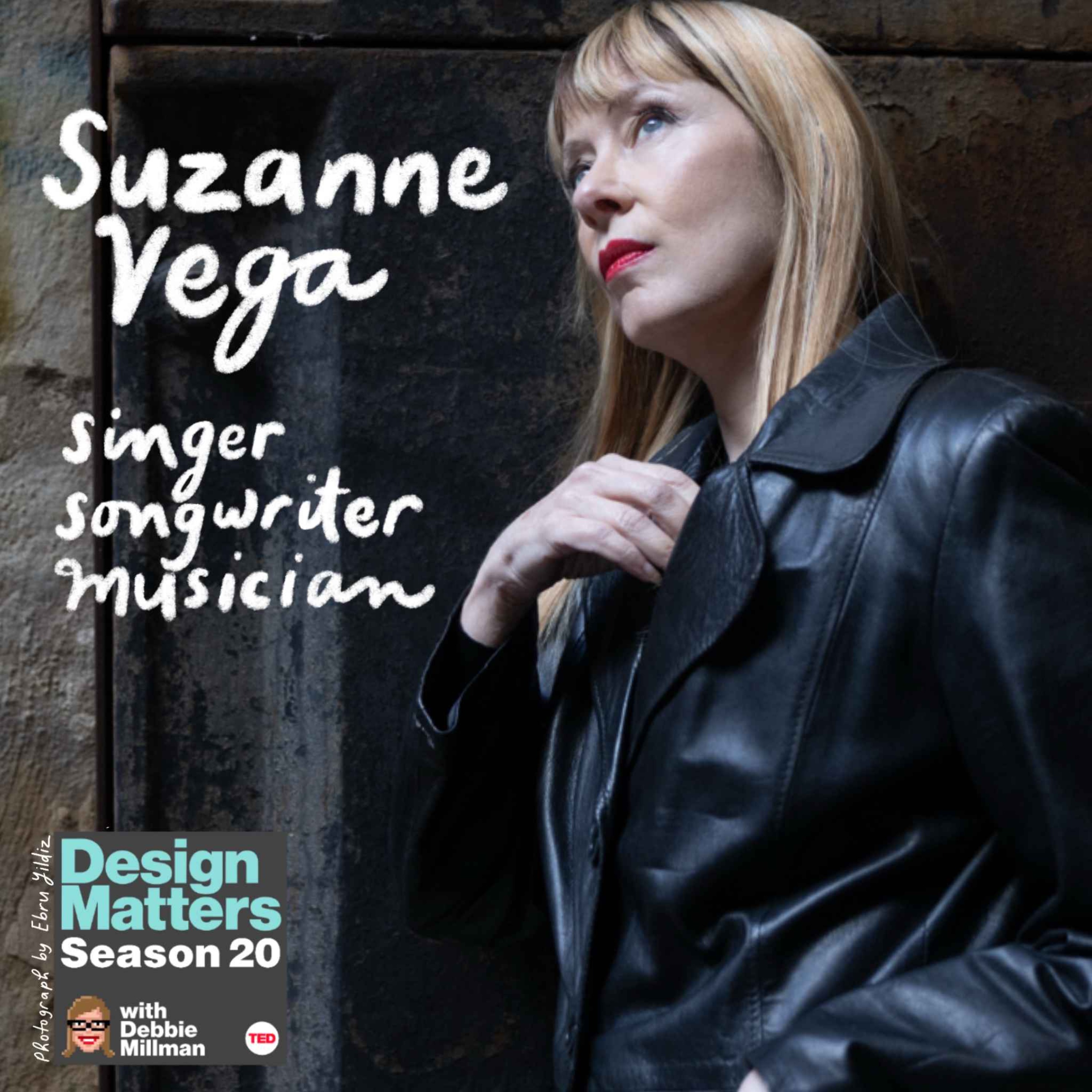
From the TED Audio Collective, this is Design Matters with Debbie Millman. On Design Matters, Debbie talks with some of the most creative people in the world about what they do, how they got to be who they are and what they're thinking about and working on. On this episode, Suzanne Vega talks about her latest album and opens up about the doubts she had early in her career.
- [00:42]
Suzanne Vega
Finally I started to feel like I am a musician. It's in my family.
- [00:55]
Capital One Sponsor
This episode is brought to you by Capital One Capital One's tech team isn't just talking about multi agentic AI. They already deployed one. It's called Chat Concierge and it's simplifying car shopping using self reflection and layered reasoning with live API checks. It doesn't just help buyers find a car they love, it helps schedule a test drive, get pre approved for financing and estimate trade in value. Advanced, intuitive and deployed. That's how they stack. That's technology at Capital One.
- [01:29]
AT&T Sponsor
And now a next level moment from AT&T business. Say you've sent out a gigantic shipment of pillows and they need to be there in time for International Sleep day. You've got AT and T5G so you're fully confident, but the vendor isn't responding and International Sleep Day is tomorrow. Luckily, AT&T 5G lets you deal with any issues with ease so the pillows will get delivered and everyone can sleep soundly. Especially you. ATT 5G requires a compatible plan and device coverage not available everywhere. Learn more@att.com 5G Network.
- [01:59]
Tide Sponsor
Did you know Tide has been upgraded to provide an even better clean in cold water? Tide is specifically designed to fight any stain you throw at it. Even in cold butter. Yep. Chocolate ice cream? Sure thing. Barbecue sauce. Tide's got you covered. You don't need to use warm water. Additionally, Tide pods let you confidently fight tough stains with new coldzyme technology. Just remember, if it's gotta be clean, it's gotta be tied.
- [02:31]
Quince Sponsor
This episode is sponsored by Quince. I've been quietly transforming my home with Quince's collection, and as we transition into fall, there's something so satisfying about creating a space that feels both elevated and cozy. Quince has everything you need to upgrade your home for the season. Think 100% European linen bedding, organic towels, handcrafted furniture and premium woven rugs. By partnering directly with ethical factories and top artisans, they cut out the middlemen to deliver premium quality at half the cost of other high end brands. I recently added their ceramic frying pan to my kitchen. It heats beautifully and makes even simple weeknight dinners feel special. And their handcrafted wooden bowls have become my go to for everything from morning cereal to hosting dinner parties. The craftsmanship is stunning and they bring such warmth to my table. Refresh your space for fall with elevated home essentials from quince. Go to quince.com designmatters for free shipping on your order and 365 day returns. That's Q-U-I-N-C-E.com designmatters to get free shipping and 365 day returns. Quince.com designmatters.
- [03:58]
Interviewer (Debbie Millman)
For over four decades, Suzanne Vega has been one of the most distinctive and quietly revolutionary voices in music. From her songs Luca, which gave voice to the unspoken, to Tom's Diner, which became a cultural touchstone, and even the BL blueprint for the MP3, her music has blended the intimate with the universal. A poet of observation and empathy, Suzanne Vega has continually reinvented her sound while staying true to her storytelling roots. With her new album Flying With Angels, she once again captures the struggles and resilience of our times. Suzanne Vega, welcome to Design Matters.
- [04:40]
Suzanne Vega
Thank you.
- [04:41]
Interviewer (Debbie Millman)
Suzanne, I read that you've been mistaken for Cynthia Nixon, Beth Orton, Isabella Rossellini, and Molly Ringwald. What do you make of that range of doppelgangers?
- [04:54]
Suzanne Vega
I don't know. I guess I remind people of something or someone. I think I'm a little bit of a shapeshifter, actually. I think it's amusing.
- [05:06]
Interviewer (Debbie Millman)
Do you enjoy that sort of chameleon quality?
- [05:09]
Suzanne Vega
Well, I've come to live with it. It took me a while to realize that was even happening. You know, when I was in my 20s and I started to do photo shoots, I realized that every photo looked different and I looked like a different woman in each photo. That is something I've never quite been able to figure out or to control is the whole issue of image. So I don't. I don't bother with it anymore so much. You know, I work on certain things, but most people know me by my name and my voice.
- [05:44]
Interviewer (Debbie Millman)
You were born in Santa Monica but moved to Spanish Harlem when you were two. There you live with your parents, your mom and stepfather, and in a multicultural household, how did that shape your sense of identity as a child?
- [05:59]
Suzanne Vega
It confirmed the idea that I was a changeling, that I Was mutable. That identity was mutable because I grew up close to my Puerto Rican relatives, to my grandmother, my aunt, my uncle, and spoke Spanish, had been to Puerto Rico. And then later on I realized, well, my stepfather told me that I had a different father.
- [06:28]
Interviewer (Debbie Millman)
And you were nine when that happened, I believe.
- [06:30]
Suzanne Vega
Yeah, I was nine. And so I thought I had my identity sort of down, you know, Even though I was constantly getting feedback from kids in the neighborhood and other people who would see our family would sort of look at me and go, okay, where did she come from? Because in a sense, I was the red haired stepchild, you know, literally that kind of stood out in our family. So I learned then that identity was something that could change, that could change overnight. And that ultimately I learned not to identify with cultural things like am I Puerto Rican, am I white? That became something that could fall away, you know. So I learned to define myself from the inside using other signifiers. Since I'm a changeling, I feel that I don't need to mark myself in that way. I just. I find a way to be myself without joining any particular group.
- [07:30]
Interviewer (Debbie Millman)
You've said that you've always felt more of an observer than a participant. And do you trace that to your childhood in a household that was both nurturing and volatile?
- [07:43]
Suzanne Vega
So, yeah, I'm sure some of it was, but some of it, I think, was also my. My nature. Over the years, I've come to wonder and probably believe that I probably am somewhat neurodivergent sometimes. If you're. If you're neurodivergent, you have a delay in emotional processing. So I think I have that. And so therefore, there are times where maybe something's going on in the household and I have to respond. So because I'm not fully emotionally invested in the moment, that sort of comes later. It can be two days later, it can be a month later, it can be a year later. There's a sense of sort of delay where I process things. No matter what household I grew up in, I think I would still have a bit in that.
- [08:30]
Interviewer (Debbie Millman)
It's interesting. I wonder if that slight detachment, initial detachment, is what has fueled some of your ways of communicating in other ways, Whether it be performance or singing or acting or any of the other. Certainly writing other things that you do well.
- [08:51]
Suzanne Vega
You know, it's interesting that you bring up acting because sometimes people are like, why would you write a one woman show and perform it for an hour and 45 minutes? Like, are you expecting to get other roles? Or like, are you expecting to like, Join the realm of great actresses. And I'm like, no, no, none of that. I'm not trying to be the next Meryl Streep. This is more. It was more like an, an exercise for myself where I could practice feeling things in the moment and doing it over and over again so that I could practice. Here's where I feel sad, here's where I feel happy. Here's where I feel the, the sadness of someone's death or, you know, I. I could. It was for myself almost as a. As an exercise how to connect myself with my feelings. So that's why I enjoy acting so much. And I've also enjoyed dancing for similar thing, different way of inhabiting your feelings, your body. So I do those things because I love to do them. And it makes me better at feeling my feelings in the moment. Yeah, yeah.
- [10:03]
Interviewer (Debbie Millman)
You picked up a guitar at 11 years old and wrote your first songs when you were 14. And I believe that the first song you wrote was titled Brother Mine.
- [10:13]
Suzanne Vega
Yeah.
- [10:13]
Interviewer (Debbie Millman)
What inspired that particular song and what did you think of the song back then, after you wrote it?
- [10:20]
Suzanne Vega
There were a couple of things that had inspired that song. I mean, it was based on my brother Matthew, who used to get into fights a lot. And so it was a song to reassure him that I still loved him even though he got into fights. What had inspired me was the fact that my father, my stepfather Ed, had also written a song to Matthew, sort of based loosely on my blue eyed son. Where have you been, my blue eyed son? So he took a bit of that form and wrote a song for Matthew, which I featured in, had my own little verse, so that was exciting. And I thought I too would write a song about Matthew. And I also loved the Judy Collins version of a song called Liverpool Lullaby, which I'd never heard a song like that. It was so beautiful and so real. The verse says, oh, you are a mucky kid, dirty as a dustbin lid. When he finds out the things you did, you'll get a belt from your dad. So I thought I'd never heard a song that was so blunt and the way Judy Collins did it was just shimmeringly beautiful and sad. So that was my template. I thought, I want to write a song about my brother. And I liked it. I mean, it took me three years to write a song I thought was good enough to keep because I had tried for three years. I thought it was never going to happen from the years from 11 to 14. I mean, that was almost a quarter of my life spent trying to write songs. So I thought I was actually really bad at it, but then I wrote that one, and I thought, oh, that's not bad. Let me try another one. And then I wrote the Silver lady, and then I thought, oh, I might. I might be pretty good at this.
- [12:08]
Interviewer (Debbie Millman)
I have spent two decades now talking to artists of every ilk, and I always feel compelled to ask musicians and songwriters how they go about writing a song. Where does that come from? It's one of those. It's one of the artistic forms I feel is so mysterious and magical. As somebody that's done a lot of writing, as somebody that's done a lot of illustrating, I understand where both the motivation and the muse comes from. But with songwriting, it's a mystery. And I'm wondering if you can talk a little bit about how a song comes to you.
- [12:52]
Suzanne Vega
Well, what you said is exactly right. It's a mystery. It comes to you, and you sort of have to set up the right atmosphere. You have to sort of invite it in without being too obvious. You know, you have to seduce the song. You have to make it comfortable so it can come to you and then present itself to you. If you're too obvious about it, it just goes somewhere else. So it took a while to realize that. That said, I think I've written a song at this point in my life, in every way that there is to write a song. So if it's not coming to you and you've made it soft and comfy and given it special lighting and its favorite treats and everything, you know, and it's still not coming, then it's time. The thesaurus and the rhyming dictionary, and you just sit down and work on it like it's a crossword puzzle and just nail the thing. Sometimes it has to be that way, but there is a sense of calling something forth, prayer almost, in a really good song. And the best ones are when it starts to happen by itself. The language starts to rhyme, and you get these rhythms, and the melody shapes itself. Those are really wonderful moments.
- [14:08]
Interviewer (Debbie Millman)
A couple of years after you wrote Brother Mine, the bass player Richard Davis heard the song and told you that structurally and formally, it was really good. And you've since included it on your 2012 album, Close Up, Volume 4, Songs of Family. How do you view that song now? Do you see it in a different light, knowing that you wrote it when you were 14? It is a good song.
- [14:32]
Suzanne Vega
Thank you. I think it's an anomaly for me, A. Because it's a country song, you know, and it really does have a sort of dang dun dun dun dun dun dun dun dun dun dun. You know, major key, very country, which was. I was exploring that genre when I was about 14. I had been looking at not just country, but real folk. Woody Guthrie, Cisco Houston, songs about traveling on the train, this kind of thing. So it's an anomaly because of that. But I like it. I like it because of that, and I like it because it has a kind of earnestness and it's kind of funny. And I think that in the end, Richard Davis was correct. It does have a good form. And there are some things about the songwriting that is somewhat sophisticated. Someone pointed out that I draw this picture of my brother very clearly for an audience, which I would have had to have thought about that because I already knew. So I didn't have to do that, but I did, you know, So I made it clear to an audience what I saw in my brother and what he was like so that they could understand it. And I thought, oh, that's well spotted.
- [15:43]
Interviewer (Debbie Millman)
That's really well spotted. And it's given me a better understanding of why it's so much harder for me to interview people I know well, because it's much harder for me to paint a picture for. I just. It just occurred to me, I've always wondered, why is it so much harder?
- [15:59]
Suzanne Vega
Yeah.
- [15:59]
Interviewer (Debbie Millman)
I understand your first performance as a singer was actually with Pete Seeger at Carnegie Hall.
- [16:05]
Suzanne Vega
Yes. Oh, what a thrill that was. Yeah. He came to my school looking for children to sit at his feet. He was doing a benefit for a couple of progressive schools in New York City. And I was determined to get him to notice me. And I stood very close to him and sang as loudly as I could, which would. I don't know how loud that was, but I sang, like, you know, in his face, practically. And he chose me and he chose everybody else on the stoop also. So we all were there at his feet, and I loved it. I just remember the vast space of Carnegie hall and the applause and Pete Seeger, who we knew, he knew his music growing up. So it was a splendid moment. And I think I resolved. That was probably one of the moments I resolved to not let go of that stage.
- [17:00]
Interviewer (Debbie Millman)
By the time you were 16, you had written around 50 songs. Yet at that point, your heart was set on being a dancer, and that's what you studied at LaGuardia High School for the Performing Arts. Why did you choose dance over music at that time?
- [17:18]
Suzanne Vega
Well, actually, I'll share a secret with you. When the music department teachers found out that I Wrote songs because I was always dragging the guitar around and playing. At lunchtime. I played a few of my songs for Mr. Trevor, who was the head of the music department, and he said, why don't you have a double major come on over to the music department. I lasted about a month. I was not suited to learning music theory. All my buddies were in the music department, and all the boys I liked were in the music department. So I would have loved to have stayed there. But I just sort of crept quietly back to the dance department once I realized I could not learn the things they were trying to teach me. That became apparent very quickly. And I think in the course of my life, I've tried six or seven times to learn music theory. And the last time I tried it, I was 27 years old. I'd already sold 4 million albums. And I thought, you know, I'm just going to farm this out to other people, because there's no point in my trying to. To learn it formally at this point.
- [18:24]
Interviewer (Debbie Millman)
I read that for most of your life, you didn't consider yourself a real musician because you never were able to read music.
- [18:30]
Suzanne Vega
Yeah.
- [18:31]
Interviewer (Debbie Millman)
Is that still how you feel? Is it possible? Because now it's like 10 million albums or something like that.
- [18:40]
Suzanne Vega
My vision of that changed when I met my birth father. I met my birth father at the age of 28, after I'd had this big success. And he told me, he sent me all these photographs of his mother and father who he had not known. And it turns out my grandmother was a drummer and spent a lot of her time on tour. And my grandfather was a trumpet player, and they had four children, and they gave up my father for adoption, so he never knew them, and I didn't know my dad. So suddenly I realized that this was a family. And many of them played music and did not. Could not play technically. They learned by ear like I did. Some of the other cousins that I've met are gifted both ways. They can play and they can read, but not me and not my dad. So I thought, oh, this makes sense. Finally, I started to feel like I am a musician. It's in my family. I come from a family of musicians. But, you know, there's some kind of dyslexia there where you feel it but can't read it.
- [19:51]
Interviewer (Debbie Millman)
So at this point, you are 16 or so, you don't know about your musical inheritance, and you're considering becoming a dancer. But I read that you got pushed out of the dance department because your teachers told you that you thought too much to Be a really good dancer. And I'd never heard that before. What does that mean to be too much of a thinker to be a dancer?
- [20:18]
Suzanne Vega
Well, that goes back to the neurodivergent delay in processing feelings because. And it wasn't that I was pushed out of the dance department. It's that when I graduated, I asked my teachers, where should I go, where should I apply? Because I wanted to stay in New York, because I wasn't sure if I should be a dancer or a songwriter. And so they suggested to me that I. Two places. One was NYU Dance department, which I applied there. And the other one was Barnard College. So I thought, well, if I'll apply for both. And I got into both. So there I had to make my choice. Am I going to be a dancer or am I going to go to Barnard College, be a scholar? I wasn't sure about the songwriting thing because I think they may have said I didn't have the temperament for a performer. So I was feeling doubtful. But it's because a great performer really can embody the emotion in the moment. And you shouldn't see the counting that goes on the 1, 2, 3, 4, 5, 6, 7. You know, that's not interesting to look at for an audience member. So it took a long time to learn how to perform. For me, it took another 10 years until I would say I got better at it. And in fact, that's a lifelong quest for me. How do you embody the feeling and perform it in front of an audience?
- [21:43]
Interviewer (Debbie Millman)
When you went to college, you majored in English literature and you studied writers like Emily and Charlotte Bronte, Charles Dickens, James Joyce, Carson McCullers. What motivated that decision? I mean, I also read how when you were very young, you saw a stage with an empty spotlight and remembered being attracted to that space. And so as somebody that was pulled towards performance, whether it be songwriting or dancing or anything that was sort of motivating your body to move through music or with music, it was really surprising to me to read that you were considering becoming a scholar.
- [22:27]
Suzanne Vega
Yeah, I decided to go to Barnard. And everybody had always told me how smart I was and I loved to read. So that was sort of a no brainer. So for the first year or two, I worked in the library. I had scholarships, work study and loans, but I had to find a place to work on campus. So after a while, I think I got in trouble in the library for sitting and reading the books instead of putting them back on the shelves. And that was becoming a problem. So I went to look For a work study job. And I saw that there was an opening in the theater, and I was sort of afraid of the theater because that represented everything I seem to be bad at. But I thought, well, they need someone to run their costume department, and I love costumes. So I thought maybe, you know, I just went for the interview because why not? They said, could I sew? And I said I knew how to do hems and I could sew buttons. And they said, great, you're hired. So I got into this world of the theater, and that's what I minored in theater in college. So even though I major with English literature, I got very caught up in the theater world there and started by doing the tech work of the wardrobe and then slowly started to put my big toe into the waters of actual performing and figuring out, how do you do this?
- [23:52]
Interviewer (Debbie Millman)
If you can talk about how your drama teacher, Shirley Kaplan, helped you break out of your shell, I loved that story. I think my listeners would love it too.
- [24:02]
Suzanne Vega
Well, you know, I'd heard about Shirley Kaplan, and she had this special class called the Musical Ensemble Theater. And she was supposed to be really good at bringing people out of themselves, bringing people out of their shells. And I remember thinking, no way. She's not getting me out of my shell. And she told me later, years later, that she felt the same way when she saw me. She said, there's no way I'm getting in there. But she still accepted me for her class. And I found to my surprise that she did. She managed to get through all of these neurodivergent ways of being and thinking by throwing things at me while I was singing. Not hard things, but like a ball or like an apple. Or she'd make me run around the room while singing something, which, you know, that feels so weird when you first do it. You feel like an idiot. And so you start to laugh because. And then the class laughs with you, and then you. Then you feel sort of free. So she did that kind of thing or she'd get me out of my head, as she put it. One day I sang I think it's Going to rain today by Randy Newman and she made me get dressed. She made me, like, put on a scarf. So I was singing it into a mirror. And it was wonderful because it really did make you drop all of your self consciousness. And you had to respond. If she threw something at you, you had to catch it and then throw it back. So you had to interact. And it did wonders for my confidence.
- [25:36]
Interviewer (Debbie Millman)
Is that what helped fuel your confidence? To go out and start performing in some of the New York City cabarets and become part of the Greenwich Village Songwriters Exchange.
- [25:47]
Suzanne Vega
Eventually I did, but at first, all I had the courage to do was audition for the Fernald Folk Festival. Fernald was one of the dorms on campus in Columbia. I tried there, and I sang three or four songs, and everybody talked about it all year. So then I sang the year following. And then I started to get a little following of people who liked my songs. But I also performed in Shirley Kaplan's cabaret. She had a little performing group that she would take us around and we would perform different places and do our songs. And that was also a great source of. Of confidence for me. And I started to make my way down to the Village and eventually made my way to Folk City.
- [26:32]
Interviewer (Debbie Millman)
By the time you were 20, you had a lot of songs. You developed a style you did feel was your own. What made you decide at that point you were ready to go out and maybe become a professional musician.
- [26:47]
Suzanne Vega
First of all, I never really stopped. I mean, there was that first year when I was at Barnard, where I had started going down to the Village, when I. I had heard that you start by going to the Bitter End, and you work your way up to Folk City, and then maybe if you were really good, you could play the Bottom Line. So I took it very literally. So I was like, first. First, I'm gonna play at the Bitter End. So I went there for two years on Monday nights, performed for the guy who was always eat his dinner. He always said the same thing.
- [27:20]
Interviewer (Debbie Millman)
What did he say?
- [27:21]
Suzanne Vega
He said, you're too quiet. You don't have any stage presence. Your songs are pretty good. They're almost like poetry, you know? He would say this with a look that implied that this was nonsense. But he's like, if you can write that stuff, you can write real songs. So he kept telling me I needed more experience. And finally it occurred to me to stop going there and go somewhere else. So I think I was 16, 17, 18 when I was going to the Bitter End and getting rejected. I still have never played the Bitter End.
- [27:55]
Interviewer (Debbie Millman)
I read that it's hard for me to believe Bitter End. What are you thinking?
- [28:00]
Suzanne Vega
Yeah. But then I had a year of that, of the musical ensemble theater class. And then by the time I was 20, I think that's when I went to Folk City for the first time. And I managed to bring 30 people down as part of my audience on a Sunday afternoon for Folk City. And they were impressed by that, so they booked me.
- [28:21]
Interviewer (Debbie Millman)
You were rejected by Every major record label, including A and M, twice before they eventually signed you. I believe that in one of the rejection letters they sent you, it stated, suzanne Vega has no sense of melody.
- [28:40]
Suzanne Vega
Yep.
- [28:41]
Interviewer (Debbie Millman)
What?
- [28:43]
Suzanne Vega
Well, we had started that demo tape with cracking because I felt this was a signature song. I felt it was very modern. I felt that it was very rock and roll. It was sort of related tangentially to this hip hop stuff that was coming up and also felt like Lou Reed to me. So I felt like this was gonna really show everybody how cool I was and how different I was than all the other folk singers. So. And then we got this rejection letter. You know, I was like, okay. But in the end, I still feel that it was the right way to present the songs. And, of course, if you listen to other songs, Tom's Diner, that's a melody that sticks in everyone's head. So I eventually made peace with the guy who wrote that letter. He was my A and R guy at A and M for years.
- [29:34]
Interviewer (Debbie Millman)
If you were rejected twice and then finally accepted, that means you were trying three times.
- [29:41]
Suzanne Vega
Yeah. We kept submitting demo tapes, and we were on the verge of signing a, what's called a development deal. They were going to give us a small amount of money so that we could develop a demo tape that they might like. And I think it was Nancy Jeffries who was piloting that project, and she brought Lenny Kay onto the scene to see whether that would sort of change things up a little bit. And just as all of that was going on, I got a really good review in the New York Times, and that brought David Geffen in. So then there became a bidding war, and then I signed an actual deal with Anna.
- [30:18]
Interviewer (Debbie Millman)
What did that rejection at that time, did it give you a different perspective on people not accepting you and then accepting you?
- [30:28]
Suzanne Vega
You know, I never took the rejections personally. And since I'd already been rejected for two years, by the bitter end, I mean, it was just like, that's the game. They say no, you say yes. If the door is closed, go around. You know, if you're standing there pounding on the door and it doesn't open, go to a different one. So I never thought, oh, everybody hates me. I was like, no. I had a lot of confidence in myself and in my vision. And if one person said to me, your lyrics really touched me, or your lyrics really mean a lot to me, that would be enough to keep me going to write another song every few weeks. I thought, if they don't like the music, it's because of the neurodivergent thing. You know, they maybe they don't understand what the point of view is here, what the perspective is. But again, I didn't take it personally. And Ron and Steve Adabo were great to work with. Ron Fearstein and Steve Adabo. They were a great team to work with. Steve taught me in a sense how to sing by throwing me back into the studio and continuing to sing. He could be very critical and I would complain a lot, but eventually I learned my craft through working with them.
- [31:45]
Quince Sponsor
This episode is sponsored by Quince I've been quietly transforming my home with Quince's collection and as we transition into fall, there's something so satisfying about creating a space that feels both elevated and cozy. Quince has everything you need to upgrade your home for the season. Think 100% European linen bedding, organic towels, handcrafted furniture and premium woven rugs. By partnering directly with ethical factories and top artisans, they cut out the middlemen to deliver premium quality at half the cost of other high end brands. I recently added their ceramic frying pan to my kitchen. It heats beautifully and makes even simple weeknight dinners feel special. And their handcrafted wooden bowls have become my go to for everything from morning cereal to hosting dinner parties. The craftsmanship is stunning and they bring such warmth to my table. Refresh your space for fall with elevated home essentials from quince. Go to quince.com designmatters for free shipping on your order and 365 day returns. That's Q-U-I-N-C-E.com designmatters to get free shipping and 365 day returns. Quince.com designmatters.
- [33:13]
Verizon Sponsor
Popsicles, sprinklers, a cool breeze. Talk about refreshing. You know what else is refreshing this summer? A brand new phone with Verizon.
- [33:22]
Suzanne Vega
Yep.
- [33:22]
Verizon Sponsor
Get a new phone on any plan with select phone, trade in in MyPlan and lock down a low price for three years on any plan with MyPlan. This is a deal for everyone whether you're a new or existing customer. Swing by Verizon today for our best phone deals. 3 year price guarantee applies to then current base monthly rate only. Additional terms and conditions apply for all offers.
- [33:43]
Comcast Business Sponsor
Comcast Business High five Hotline I signed my business up for the five year.
- [33:47]
Suzanne Vega
Price lock guarantee and I can't stop high fiving people.
- [33:51]
Comcast Business Sponsor
That's perfect. Perfectly natural when you sign up for gig speed, Internet and advanced security. Locked in at a great rate for five years.
- [33:57]
Suzanne Vega
Really that's great news.
- [33:58]
Comcast Business Sponsor
High five everybody. The Comcast business 5 year price lock guarantee is back, but only for a limited time. Sign up today.
- [34:05]
Boland Branch Sponsor
High five ends 92125 for new customers with qualifying bundle. Current customer eligibility varies by service and area. Guaranteed rate applies to monthly service charge.
- [34:11]
Suzanne Vega
Excluding taxes and fees. Other restrictions apply.
- [34:13]
Boland Branch Sponsor
Imagine a world of extraordinary comfort where Bowland Branch Bedding wraps you in the softest. Embrace the coziest experience made from the world's finest 100% organic cotton, all so you can sleep better. Start building your fall sanctuary with Boland Branch's iconic signature sheets made with a buttery, breathable weave that gets softer with every wash. Enjoy 15% off your first set of sheets with free shipping and returns at B O L L& Branch.com with code BUTTERY. See site for details and exclusions.
- [34:49]
Interviewer (Debbie Millman)
Let's talk about your first album. I have to share that Back in the summer of 1985 when it first came out, I first saw posters of the album cover that were wheat pasted all over Manhattan, and I was working in a really seedy neighborhood in Hell's Kitchen. I was working as a receptionist for a nutritionist and was trying to figure out what my whole life was gonna be that summer. And I saw the poster and I was mesmerized. And I bought the album based on the poster and it was all I listened to for the rest of the year. I could recite that entire album word for word. Still, 40 years later, I have the original vinyl. I bought it again on CD. Now I have it all on the MP3s, along with Joni Mitchell's Blue and Ricky Lee Jones first album. These are like formative albums to my life. My younger self is thanking you right now for making it because it did help me through a lot of really hard times.
- [35:53]
Suzanne Vega
That's so great. Thank you.
- [35:55]
Interviewer (Debbie Millman)
Now, is it true that you sang Undertow, one of the songs on that album, at your sister's wedding?
- [36:01]
Suzanne Vega
She asked me to. Yeah, I thought, sure. You know, she liked it. I liked it.
- [36:06]
Interviewer (Debbie Millman)
The first two lines of the song, I believe right now, if I could, I would swallow you whole. I would leave only bones and teeth. I would see what was underneath. And that's not anything that's written in front of me. That's how well I know it. Yeah, I didn't think the song had any lascivious undertones at the time. But what did anybody else at the wedding wonder?
- [36:26]
Suzanne Vega
Well, I don't know if anyone else at the wedding wondered, but my brother thought it was weird and he told me so because he had assumed that it was a song about oral sex because of course, he was a young man and that was very much on his mind. But I thought of it as more of a spiritual sort of taking in and kind of stripping someone clean. And interestingly, I was dating the man then, who is now my husband. So I had written it for Paul and I remember singing it for him and he said, that's one of your most beautiful songs. And he said, but I would be free, but I would also be dead. And that was his comment and we never talked about it again. So I was like, okay. So, yeah, it was a song that could be interpreted many ways, but I think the opening line prevented it from being a single. At one point we were playing with the idea of sending it to radio and I think it was rejected for that might be conceived, considered lascivious. Which now is like, you know, it wouldn't even.
- [37:32]
Interviewer (Debbie Millman)
Exactly.
- [37:32]
Suzanne Vega
Yeah, exactly. It wouldn't even. You wouldn't.
- [37:35]
Interviewer (Debbie Millman)
And it's. Interestingly, it's so melodic. I mean, it's so crazy to me to think that somebody would have said that you weren't melodic. But songs like Freeze Tag and Cracking A Marlena on the Wall, Small Blue Thing, one of my all time favorites, they were so sophisticated for someone so young and really did immediately establish you as a singer songwriter who actually created stories in her songs. When did you begin to feel that you had a distinctive voice of your own rather than echoing your influences? I know you felt like you had established your style earlier, but to have a distinctive voice so young is really rare.
- [38:17]
Suzanne Vega
I realize that now, but back then I didn't feel young, you know, as I said, it took me three years to write my first song, from 11 to 14. So I felt like I'd been working constantly and slowly for all these years. I had made a decision that I wanted to get a record deal. I made that decision when I was 16 and it took me eight years to get that record deal. So there were times where I thought, this is going so slowly, this is never going to happen. But by the time I. I did get the record deal and it came out, there was this huge acceptance and my life changed pretty radically almost overnight. But it's because I'd been working so hard all those years before. I felt that the first songs were strong. When I wrote Gypsy, I remember thinking that that was a good song. I worried that it was corny, you know, and sentimental. And I rewrote the whole thing to be less corny and sentimental. And a friend of mine said, I think it was Fine. The first way you did it.
- [39:22]
Interviewer (Debbie Millman)
Yeah. I love that song. I was wondering when you said that if the current version is the original.
- [39:29]
Suzanne Vega
It's the original. Yeah. It's the original version. I have another version somewhere, which I should probably put as a B side somewhere. So I remember thinking that that was good. That was sort of influenced a bit by Leonard Cohen, but maybe by somebody else, like maybe John Prine or. Because I listened to those writers also. But when I saw Lou Reed, then. Normally I hated rock and roll. I thought it was a bunch of posers standing around in costumes, doing stupid stuff, posing. So I wasn't really into it. But someone took me to see Lou Reed, and I hated the first half of the show. I thought, why? He's doing that stupid posing thing. Shouting at the audience, lighting cigarettes and throwing them at the audience, bashing his equipment, singing things I thought were offensive. I can't remember what heroin, probably, which I didn't think was cool. I'd come from East Harlem, which had a heroin epidemic, and I was like, this is gross. So then. But the second half of the show was all this music. He sang a song called Caroline says, Part two. And I just was so taken with that song. And I thought because I heard the lyrics, I heard them clearly, I realized he was writing in a female voice, even though he was male. Obviously, it was like a bit of fiction. And that I suddenly had this awakening, and I became obsessed with Lou Reed. And I felt that's when I started to write Cracking and some of the other songs that had more edge. And definitely that moment influenced when I wrote Luca.
- [41:10]
Interviewer (Debbie Millman)
I was gonna ask. Yeah. For listeners that might not be aware of the song Caroline says is a song about a woman being abused. Physically abused.
- [41:20]
Suzanne Vega
Yeah.
- [41:20]
Interviewer (Debbie Millman)
So let's talk about Luca. Your second album, Solitude Standing, was massively successful. It featured two global hits, Luca and Tom Steiner, both of which are still songs that have stood the test of time. But they've also been massively reproduced by others, particularly Tom Steiner, which I think has been covered about 30 times and sampled. Last I read was 155 times. 155 samples.
- [41:51]
Suzanne Vega
I think the doorman looked it up from where I'm living now, and he says it's up to 187interpolations. Because, you know, maybe there's been a month or two maybe since you looked it up.
- [42:06]
Interviewer (Debbie Millman)
I've been working on the prep for a while, so. Yeah.
- [42:08]
Suzanne Vega
Yeah.
- [42:09]
Interviewer (Debbie Millman)
But Luca was an unlikely pop hit. It's actually a devastating song from the perspective of a young boy. And I read that you wrote it before your first album came out, before you even had a record deal. What made you decide to release it on your second album?
- [42:28]
Suzanne Vega
I had a vision of what I wanted the first album to be like, and the first album is that album. I wanted the songs to be modern. That's why I started with cracking, and that's why we have Neighborhood Girls. But I also included the Queen and the Soldier because it felt folky to me, so I could still retain that folk root. So I felt that Luca was not. I was not ready to sing that song in public. My manager picked that song out when he first heard it. He said, I think that song could be a hit. And I was like, what?
- [43:03]
Interviewer (Debbie Millman)
A song about child abuse?
- [43:04]
Suzanne Vega
A song about child abuse? Because no one seemed to like it. You know, it was the song that people didn't understand, and if they did, then they looked sad and they looked embarrassed, and it was a song nobody asked for. Once in a while, I'd get a comment like, oh, that's a very interesting song. You've really given that child a voice. But most people were like, oh, my God, please stop. And this was in the era of punk and new wave, so the subject matter was supposed to be as edgy as possible. That's partly why I wrote it. But I almost felt like I'd almost gone too far. So to have my manager say, this is a song about an issue. And they took the two years in between the first album and the second album to work on that production, and it took that long to get it just right. So it would go to radio and fit right in. And that's what happened. They worked on the drum track. They worked on the rhythm track. They worked on the. We had the keyboard part by Anton Sanko that had that great opening line. His keyboard part went dun, dun, dun, dun. Then my guitar came in. So all of this came together to make the sound that would fit in with radio.
- [44:15]
Interviewer (Debbie Millman)
You took the name Luca from a boy that lived in your building. But many years after the song came out, you stated, I am Luca.
- [44:25]
Suzanne Vega
Yes, many years. Yeah. Yeah.
- [44:27]
Interviewer (Debbie Millman)
What was that like for you to share that?
- [44:30]
Suzanne Vega
You know, no matter how many years go by, I still feel a sense of. I don't know how to describe it, really. A bit of fear, a bit of exposure. There's a reason I've made it almost like a puppet, you know, this was a. Luca was sort of my puppet. I used to make puppet shows for my brothers and sisters when I was. To entertain them and. And I like to use the third person, which I did in the songs often. It made me feel safe. I don't normally like confessional songwriting, but when I said that, I thought, well, I. What prompted it really was the feeling over time and over decades, that. Because in the beginning I used to say, it doesn't matter if it happened to me. It only matters that it happened. It only matters that it's true. If people would say, is this a true song? I'd say, oh, yes, because it is. And I knew it was true because I got so much feedback from all these people all around the world, all ages, male, female, didn't matter. So that's. To me, especially in the beginning, I felt that was the important thing was that as a true song, doesn't matter if it happened to me. But then over time, I felt that I. I felt. Even though I never lied, I started to feel that it was a burden, that I wasn't being truthful. And so I started to feel that when people asked directly, as they started to do over time, that it was important to just say it simply.
- [46:14]
Interviewer (Debbie Millman)
After Solitude Standing, you began to move away from your acoustic roots to more electronic, industrial sounds with albums like 99 Degrees Fahrenheit. And at the time, the song Blood Makes Noise felt so radically different from your previous music. And I can imagine that given the global success of your first two albums, your record company must have been like, okay, just keep doing that. But immediately you pivoted and started to evolve. Did that feel liberating or terrifying?
- [46:50]
Suzanne Vega
It was very liberating. I loved it. And it was my working with Mitchell Froome that kind of made that all come to life. I felt like I'd been drawing with pastels and doing sort of pencil drawings and suddenly was allowed to play with the big fat crayons. You know, I was, this is awesome. You know, it was way more than I had imagined. And Mitchell set up an atmosphere where we both felt very free to have ideas, throw them out, do whatever we wanted, amuse ourselves, amuse each other. If I said, oh, I hate that, or what are you thinking? You know, he would just toss that idea out and bring in another idea. So it was a very fertile, wild sort of time, and it felt very liberating.
- [47:35]
Interviewer (Debbie Millman)
You've had a long fascination with the writer Carson McCullors that has spanned decades. It inspired your play Carson McCullors talks about love and the album Lover Songs from An Evening with Carson McCullors. And I understand you've been intrigued by McCullors ever since. College. When you read her short story, Sucker, when actually, that was when you were a teenager, I went and read it to get a sense of what that inspiration was and. Oh, my God. Is that a brutal story? I mean, it's a brutal story.
- [48:09]
Suzanne Vega
Yeah, it's a brutal story.
- [48:11]
Interviewer (Debbie Millman)
It's also written from the first person in another voice.
- [48:13]
Suzanne Vega
In another voice?
- [48:15]
Interviewer (Debbie Millman)
Yeah.
- [48:15]
Suzanne Vega
Yeah. She writes it from a boy's perspective.
- [48:18]
Interviewer (Debbie Millman)
A young boy.
- [48:19]
Suzanne Vega
Yeah. And the language is really tough. And just the title itself, Sucker. You know, I remember thinking, wow, who is this guy? And I read it in the 70s. So it sort of fit in with this sort of tough mood that New York was in, that we were all in 1972, 73. So I was shocked to find out this was a song that was written in the 1950s by a girl, by a young woman. I thought, wow. And so I wanted to get closer to this and find out, like, who did this. And then I sort of became her as a game, you know, as. Because Shirley had said, come in dressed as a character. Come in dressed as a person in the arts who lived, but who's no longer alive, and be ready to field questions as though you're on tv. And so I chose her, and that was big fun. So it's something I return to over and over again.
- [49:20]
Interviewer (Debbie Millman)
Do you see your theatrical performance work as a continuation of your songwriting voice? You mentioned before that it's still very much about perspective and voice, and I'm wondering if that includes your songwriting voice, maybe.
- [49:40]
Suzanne Vega
I think that I'm always working on my performance. You know, I've trained in so many different techniques. I mean, I haven't always mastered them. In fact, I don't think I've mastered any. But I. I still train myself in them because I want to be a better performer, because I want to earn that spotlight. So that's why I've studied dance and I've tried to study music, and I've studied singing, and I've studied theater. So this playing, playing with the play has been a way of exploring, first of all, what's it like to inhabit someone else's body language, preoccupations, you know, their life view and get their feelings across. And how do you do that? Well. And how do you express the range of their feelings in the moment? That's what it always comes down to. How do you do this in the moment? So it lives in the moment. So in a sense, I've used her life and her character and her work as a way of expressing and exploring the world. Of feelings and emotions. And I. I feel that it's sort of has helped me in a way to connect with my own emotions.
- [50:52]
Interviewer (Debbie Millman)
Do you think that McCullough's sense of dual nature mirrors some of your own?
- [50:58]
Suzanne Vega
Yeah, because as we discussed before, I feel like a kind of changeling. And that means that sometimes I inhabit a male voice or I inhabit a female voice, or even the way I look physically, most of the time I have red hair, but sometimes it's blonde, or sometimes it's darker. You. I'm short, long, whatever, so there's a sense of mutability that is also kind of edgy. Mostly, I fell in love with her. Her character, her paradoxes. You know, she could be so empathetic in her work and so mean to her husband.
- [51:32]
Interviewer (Debbie Millman)
Catty and catty.
- [51:34]
Suzanne Vega
Catty and bitchy and mean. Kind of love that. Yeah. And needy. And, you know, she could be wildly independent and really intelligent and just standing up for other people's rights and put this needy neediness and needing the love and needing warmth and affection to the point where she would drive people away because there was this kind of grotesque thing that would come out with her, which was. I think that's exciting for a woman to be able to be grotesque in public. And that's what she could be. I mean, it was startling to think that she was so famous in 1940, way ahead of her time.
- [52:14]
Interviewer (Debbie Millman)
Suzanne, before we talk about your most recent album, Flying With Angels, I want to ask you about some themes that I've heard in your music over the decades. And one is the concept of cold. These are just a few of the lines that appear in your songs over the decades. In small blue thing you say I am cold against your skin and it makes me wonder, you say to that cold blue feeling flame that you are under in straight lines you say there's a sound across the alley of cold metal touching skin in solitude standing, you say by her long cool stare and her silence in golden, you say you are shining like the sun upon a cold gray sea in zephyr and I, you state in spring the tide in Riverside will wash away the cold and frozen, you say in 99 degrees Fahrenheit you say Something cool against the skin is what you could be in cracking soon it will hit the deep freeze in freeze tag tickling and trembling A freeze tag in the dark. And in your new album in which you state, and I feel the air become bone cold. So talk about the use of cold as a theme in your music.
- [53:34]
Suzanne Vega
Well, as you said that my Hair is standing up on end with goosebumps. Suddenly get a shiver listening to all of that cold imagery. I was like, oh, I need a sweater. Yeah, there's this. It's one of the polarities of life, is the cold, hot spectrum. And I run. I run on the colder side of things to the point where my manager teases me about it and says I have ice in my veins. Which is. I think he's overdoing it, but, you know, it must come off that way. I mean, to be cool is. Is kind of sinister. It can be cool in the way we use the vernacular, but it's also kind of bad. You know, it's kind of evil. It's lifeless. It has its own allure because of this. And the world of heat was something I didn't really identify with. Say, my brother Tim, for example, hot blooded, sweating all the time. You know, very connected to his emotions. And we really were a good team because we ran that gamut. He embodied, like, just heat and passion, and I'm sort of on that other end of that spectrum by nature. I don't know why the New York.
- [54:51]
Interviewer (Debbie Millman)
Times described you as clinically a clinically poetic observer, and that felt like it was picking up on the coldness. I don't know. I was struck by the use of cold on your first album, cracking and freeze tag. But I've always felt your work to be more intimate than cold.
- [55:17]
Suzanne Vega
Yeah. I mean, because there's all these other elements. My voice is very intimate. Some of the recordings sound like I'm whispering into your ear. So there's a warmth there. There's a kind of.
- [55:30]
Interviewer (Debbie Millman)
Exactly.
- [55:31]
Suzanne Vega
Yeah. There's a warmth and a. An informality to elements of the way I perform. But, you know, I still like to have. I'm more formal than not. Like, my daughter points out that I, of myself and my husband, like, he's informal. I'm more formal. I prefer a bit of form. So we're not all over the place. Doesn't mean I'm always that way, but, yeah, that's how I run.
- [56:00]
Interviewer (Debbie Millman)
Your most recent album, Flying With Angels, has been considered one of your finest, and it really is extraordinary. It has both some of the classic Suzanne Vega gems, but also the innovative. Take you to new places, places, spaces. You stated that the album lives in an atmosphere of struggle, and clearly we are living in a time of deep despair, dismay and struggle. What struggle did you most want to illuminate, given how many there seem to be right now?
- [56:41]
Suzanne Vega
The first one I was thinking of, of course, was the COVID years. Because that's where I feel the genesis of this album came from. Like, 2020, because really, in 2019, I was thinking, ah, let's start working on a new album. And then we turned and faced 2020 and ran into this wall called Covid. I'd never experienced anything like that in my lifetime, where we all had to stay home for two years. And here in New York, it was this very frightening, sterile atmosphere. Everybody left. I stayed with my husband. And then, you know, you'd hear the ambulances go by, and we were all trying to read as much news as we possibly could. So a lot of the songs, Rats comes from that moment. Mariupol comes from that moment in 2022 when Russia invaded Ukraine. Some of the imagery from which we're living in a state of permanent emergency comes from COVID but also comes from the aftermath of COVID because we had a bad situation in our house where my husband's bout with COVID led to much worse situation. And of course, then there's been the two elections of Trump, where Trump got in, and then he got in again. All of this, I think, infiltrates the atmosphere of Flying With Angels. There are personal issues on the album. There are political issues on the album, there's social issues on the album, and then there's little bits of humor and.
- [58:18]
Interviewer (Debbie Millman)
And beauty.
- [58:19]
Suzanne Vega
And beauty, I would hope. Yeah. And then also of a song like Love Thief. It sounds groovy and it sounds kind of sexual. But on the other hand, it also has. There's a little element of politics because it's about the ideology of love as opposed to the ideology of hatred, and that's embedded in that little song, which you can kind of find if you probe.
- [58:43]
Interviewer (Debbie Millman)
Yeah. I actually felt like if anybody was going to cover that song, it could be Adele.
- [58:48]
Suzanne Vega
I would love that. I would love that. Yeah.
- [58:51]
Interviewer (Debbie Millman)
It is a real ballady sort of R B feel to it. Another of my favorites is Chambermaid, which is a real surprise. And talk about sort of storytelling through different voices. Chambermaid includes the melody of one of my favorite Dylan songs, I Want yout. And in that song, he sings, while I return to the Queen of Spades and talk with my chambermaid she knows that I'm not afraid to look at her she is good to me and there's nothing she doesn't see she knows where I'd like to be but it doesn't matter the first stanza of your song is, I'm the great man's chambermaid I've seen where his hallowed head Is laid. I revere the places he has stayed and clean crumbs from his typewriter. He is good to me. There's nothing he doesn't see and he knows where I'd like to be but it doesn't matter.
- [59:45]
Suzanne Vega
Yeah.
- [59:46]
Interviewer (Debbie Millman)
What inspired this duality?
- [59:49]
Suzanne Vega
Oh, there's a lot of theft going on here. I've always wondered about that chambermaid and about his relationship with her. Like, what is that? Like, is it sexual? Or. I mean, they're just talking or like, what is there? Does she clean his room all the time? Like, what's her point of view? I'm always curious to know the other point of view. So I had been doing a lot of housekeeping, which is not my favorite thing, and struggling with my own songs, really running into some writer's block with a couple of them. And I woke up one morning with this song, I Want yout in my head and thinking I'm Bob Dylan's chambermaid. And I thought, that's an interesting rabbit hole to go down. So I. I got out of bed and I came into this office here and I thought about that for a minute. I. I got a little bit of butter on my computer because it was, you know, I made some toast with butter and I thought, oh, butter on the computer. How can I used that on a song? And suddenly I had a sense memory of crumbs on the typewriter. Because my dad was a writer and he would let me use his electric. And one year I was baking a lot and I must have gotten crumbs on the typewriter. And he made me come and clean it. So that popped up and the whole song seemed to write itself in about an hour and a half.
- [61:07]
Interviewer (Debbie Millman)
What was it like to write inside another artist's universe?
- [61:14]
Suzanne Vega
I love it. And it's so exciting to be there in Bob Dylan's universe. Which sometimes, just to amuse myself, I will play his songs. I have a little Bob Dylan songbook. I like to sing his songs because then you inhabit them. Like I've done cover versions of It's All Right, Ma, I'm Only Bleeding. And it's an eight minute song and it careens everywhere. And he's so relaxed in his language and he uses phrases. And some of them are off the cuff or they're near rhymes or they're maybe not grammatically correct or whatever. And it's so opposite the way I work, where I'm polishing every phrase and everything has to be just right. He's so off the cuff that it's a thrill to sing a song like that because you feel like you're careening around these roads of his mind, that you know you're safe because you've heard the song, but when you sing it, you're at the wheel of that car and you're just careening and it's a thrill.
- [62:17]
Interviewer (Debbie Millman)
Did you need to get Dylan's permission to use the melody in your song?
- [62:22]
Suzanne Vega
I did.
- [62:22]
Interviewer (Debbie Millman)
Now, you toured with him in Norway in 2012.
- [62:27]
Suzanne Vega
Yeah.
- [62:28]
Interviewer (Debbie Millman)
So you knew him. You have, like, inside track.
- [62:32]
Suzanne Vega
Yeah, and my manager knows his manager. And so I was thrilled to get the approval. He doesn't own his publishing anymore, so we had to also go to the publishers and they approved it with certain caveats. And so it all worked out.
- [62:48]
Interviewer (Debbie Millman)
You wrote a song titled Lucinda, which is for Lucinda Williams, and you write that you love her because she's blunt and humble. It's an interesting duality also.
- [62:58]
Suzanne Vega
Well, I think it's very her. She has a kind of swagger about her, but she is also blunt and humble. She also struggles with that feeling of like, do I deserve this? Should I go to the Grammys? I don't have anything to wear. You know, those struggles that you. You feel when you grow up, working class, female itinerant, all of that comes out in her music. So she's all these contradictions, which I like.
- [63:28]
Interviewer (Debbie Millman)
You end the album with a song titled Galway, which feels very much one of the Suzanne Vega melodic gems. Talk about that song and that placement of that song.
- [63:44]
Suzanne Vega
Yeah, I had fun with the placement of that song because the way we originally structured everything was we started with all the folky stuff and then ended with all the really edgy stuff ending with rats. And we had Witch back there, too. And that was too easy because that way people could have their easy listening side and then they could avoid all the difficult stuff later. So I changed it all up and I had the first three songs be about current events, and I put which third because I wanted people to understand that this was not going to be just an easy listening experience. So then I thought, oh, let's end with Galway, because it's so funny and it's kind of nostalgic and it. It's kind of a relief after the Noise of Rats.
- [64:30]
Interviewer (Debbie Millman)
Well, I loved it because it felt like it came really full circle into bringing your entire catalog together.
- [64:37]
Suzanne Vega
Yeah. And it brings a smile, you know, and people love the melody. And I wrote the chorus really quickly thinking, oh, I'll go back and fix those lyrics. But then I. When I went back, I was like, oh, it works. It's a look back, but it's also a look forward. It's a look back on something that happened. But Galway is sort of this mystic place that seems to recede into the horizon and is still there waiting for me, for us. So it's the past and the future.
- [65:06]
Interviewer (Debbie Millman)
Yeah. It felt like you were writing for a real person, so I can't help but wonder if he'll recognize himself in the song.
- [65:13]
Suzanne Vega
Well, we'll find out. Sometimes it takes a while for the people to realize. The guy who I wrote Caramel for, I mean, took him years before he realized that he was that guy. So, I don't know. We'll have to catch up, and I'll have to let you know in about a year or two to see.
- [65:31]
Interviewer (Debbie Millman)
Okay.
- [65:31]
Comcast Business Sponsor
Yeah.
- [65:31]
Interviewer (Debbie Millman)
I know that Luca used to brag that you used his name in the song.
- [65:36]
Suzanne Vega
Yeah, he had some kind of ownership.
- [65:38]
Interviewer (Debbie Millman)
Your daughter Ruby Froome sings on the album with you. What was that like?
- [65:44]
Suzanne Vega
Well, I love hearing her sing. She's a terrific singer, and she went to the High School of Performing Arts and was a vocal major. I love it when she sings with me because she's told me many times that she's internalized my phrasing so she can match my phrasing perfectly. She really does it there, especially on Allie and she. That choral sound you hear in the back, all of that is Ruby. There's a low.
- [66:13]
Interviewer (Debbie Millman)
Oh, wow.
- [66:13]
Suzanne Vega
Yeah. There's a lower male voice. That's Jerry. But the five or six harmony lines that you hear in the back, that sound celestial. She's doing all of that, and she did it herself and came in, and she and Jerry worked on it, and she can just knock that stuff out, which I'm always amazed with. And she also does the vocals, the background vocals on Mariupol, the low voices, and the high ones. So I love singing with her. I wish we could do it more often.
- [66:41]
Interviewer (Debbie Millman)
Suzanne Vega, thank you for making so much work that matters. And thank you you for joining me today on Design Matters.
- [66:49]
Suzanne Vega
Thank you so much.
- [66:51]
Interviewer (Debbie Millman)
Suzanne Vega's latest album is titled Flying With Angels. She is currently on tour. You can read all about that on her wonderful website, Suzanne Vega dot com. This is the 20th year we've been podcasting Design Matters, and I'd like to thank you for listening. And remember, we can talk about making a difference. We can make a difference, or we can do better. I'm Debbie Melman, and I look forward to talking with you again soon.
- [67:18]
Debbie Millman
Design Matters is produced by the TED Audio Collective by Curtis Fox Productions. The interviews are usually recorded at the Masters in Branding program at the School of Visual Arts in New York City, the first and longest running branding program in the world. The Editor in chief of Design Matters Media is Emily Weiland.
- [67:42]
Verizon Sponsor
Popsicles, sprinklers, a cool breeze. Talk about refreshing. You know what else is refreshing this summer? A brand new phone with Verizon.
- [67:50]
Suzanne Vega
Yep.
- [67:50]
Verizon Sponsor
Get a new phone on any plan with select phone. Trade in and MyPlan and lock down a low price for three years on any plan with MyPlan. This is a deal for everyone whether you're a new or existing customer. Swing by Verizon's today for our best phone deals. 3 year price guarantee applies to then current based monthly rate only. Additional terms and conditions apply for all offers.
- [68:12]
Boland Branch Sponsor
Imagine a world of extraordinary comfort where bowl and branch bedding wraps you in the softest. Embrace the coziest experience made from the world's finest 100% organic cotton, all so you can sleep better. Start building your fall sanctuary with Bolin Branches iconic Signature Shape sheets made with a buttery, breathable weave that gets softer with every wash. Enjoy 15 off your first set of sheets with free shipping and returns at B O l l and branch.com with code buttery C site for details and exclusions.
- [68:45]
Suzanne Vega
Ready to order? Yes.
- [68:47]
Boland Branch Sponsor
We're earning unlimited 3% cash back on.
- [68:49]
Suzanne Vega
Dining and entertainment with a Capital One Saver Card. So let's just get one of everything. Everything.
- [68:54]
Comcast Business Sponsor
Fire everything. The Capital One Saver card is at table 27 and they're earning unlimited 3% cash back.
- [69:00]
Suzanne Vega
Yes Chef. This is so nice.
- [69:03]
Comcast Business Sponsor
Had a feeling you'd want 3% cash back on dessert.
- [69:05]
Suzanne Vega
Ooh, tiramisu.
- [69:07]
Comcast Business Sponsor
Earn unlimited 3% cash back on dining and entertainment with the Capital One Saver Card. Capital One what's in your wallet?
- [69:13]
Suzanne Vega
Terms apply. See capitalone.com for details.
- [69:16]
Boland Branch Sponsor
Balance of nature's fiber and spice Supplement is a one of a kind blend with four fibers and 12 aromatic spices made with psyllium husk, flaxseed, whole apple, monk fruit and 12 incredible spices. Fiber and Spice is the perfect addition to keep you on the right track every day. Go to balanceofnature.com and get 50% off your first fiber and spice supplement as a new preferred customer by using discount code on the.