Loading summary
Transcript149 lines
- [00:01]
Ken Goldberg
Ken and I spent like a good year thinking, like, what are all the big questions of humanity now?
- [00:07]
Debbie Millman
I still haven't seen a really good joke from AI yet. I'm waiting for that from the TED Audio Collective. This is Design Matters with Debbie Millman. On Design Matters, Debbie talks with some of the most creative people in the world about what they do, how they got to be who they are, and what they're thinking about and working on. On this episode, Tiffany Schlane and Ken Goldberg talk about their artistic collaborations. I always joke that Tiffany had never met a piece of rusted metal that she didn't like.
- [00:42]
Ken Goldberg
I love salvage things.
- [00:52]
Debbie Millman
Folks were back in the bottom of the six. Lorenzo's on the mound. His slider's been Wait, is that a cat on the field?
- [00:59]
Ken Goldberg
That tabby's really moving.
- [01:01]
Debbie Millman
He's past second base and Coach Bakerfield's making a grab and oh, he missed.
- [01:07]
Ken Goldberg
Incredible. Someone give that cat a contract.
- [01:11]
Debbie Millman
But folks, even this incredible cat can't sign up for Lemonade Pet Insurance. But you can cover your pet now@lemonade.com incredible.
- [01:21]
Tiffany Schlane
To everyone else, this is a desk.
- [01:23]
Debbie Millman
But to you, this is opportunity. Switch to Boost Mobile and get the Coach Prime Moto G5G for 29.99 at boostmobile.com the Boost Mobile network, together with our roaming partners, covers 99% of the US population. Moto G5G for $29.99 when you switch with a new Unlimited plus or Unlimited Premium plan activation online only.
- [01:44]
Ken Goldberg
Taxes extra.
- [01:45]
Debbie Millman
All prices, fees, features, functionality and offers are subject to change without notice. Visit boostmobile.com for details.
- [01:51]
Ken Goldberg
Dear old work platform, it's not you, it's us.
- [01:54]
Debbie Millman
Actually, it is you.
- [01:56]
Ken Goldberg
Endless onboarding, constant IT bottlenecks.
- [01:59]
Debbie Millman
We've had enough. We need a platform that just gets us.
- [02:02]
Ken Goldberg
And to be honest, we've met. They're called Monday.com and it was love at first onboarding. Their beautiful dashboards, their customizable workflows got.
- [02:12]
Debbie Millman
Us floating on a digital cloud. 9 so no hard feelings, but we're moving on.
- [02:17]
Ken Goldberg
Monday.com the first work platform you'll love to use. Getting engaged can be stressful. Getting the right ring won't be@bluenile.com the jewelers@bluenile.com have sparkled down to a science with beautiful Lab grown diamonds worthy of your most brilliant moments. Their Lab grown diamonds are independently graded and guaranteed identical to natural diamonds and.
- [02:40]
Debbie Millman
Ready to ship to your door.
- [02:42]
Ken Goldberg
Get $50 off your purchase of $500.
- [02:44]
Debbie Millman
Or more with code.
- [02:45]
Ken Goldberg
Listen@bluenile.com that's bluenile.com code listen for $50 off.
- [02:55]
Tiffany Schlane
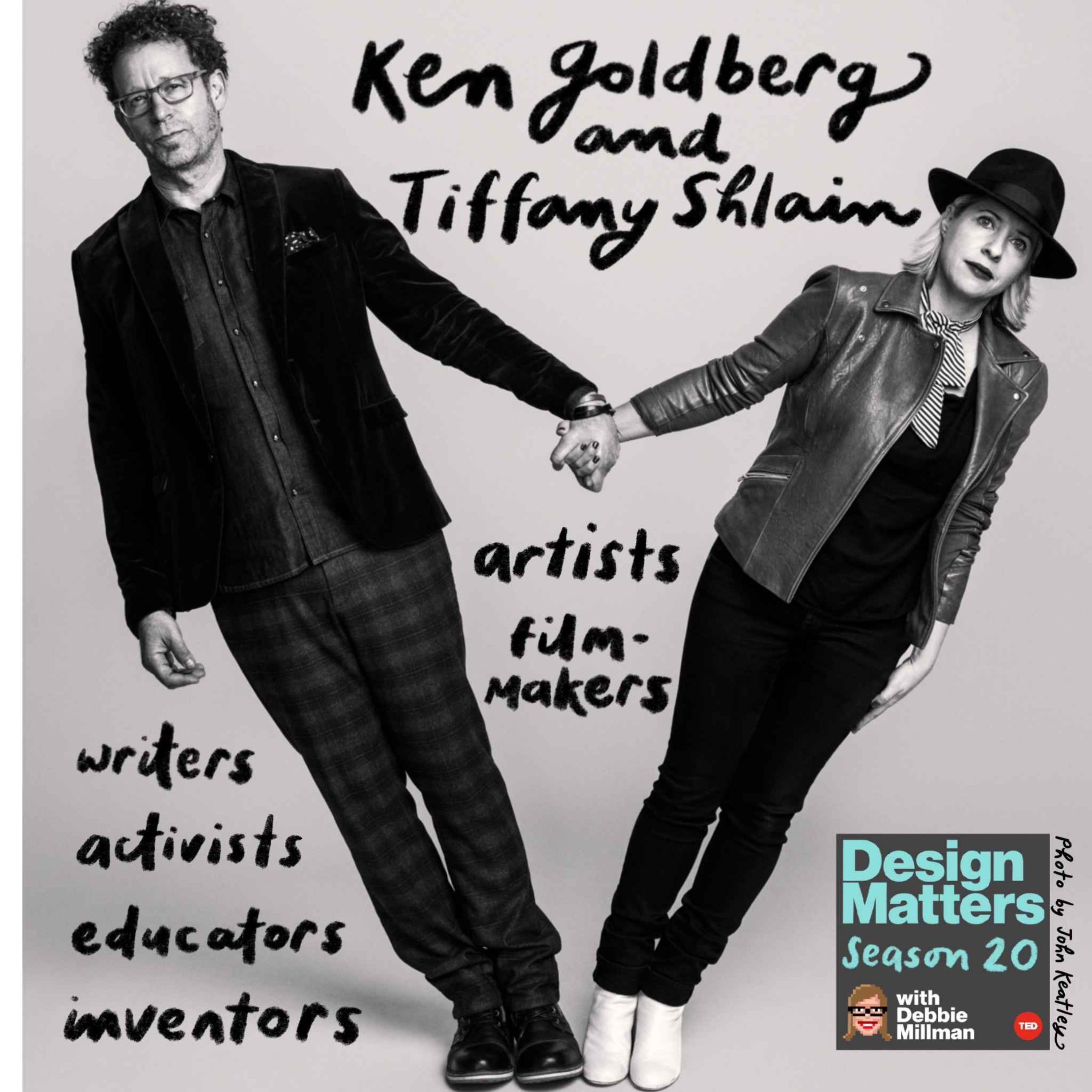
Tiffany Schlane is an artist, a multi award winning documentary filmmaker, the founder of the Webby Awards, and the co founder of the International Academy of the Digital Sciences. She's also the author of several books, including 246 giving up screens one day a week to Get More Time, Creativity and Connection, which we talked about on this podcast when the book first came out. Ken Goldberg is the William S. Floyd Chair of Engineering and Distinguished professor of Robotics at UC Berkeley, President of the Robot Learning foundation, and author whose books include Beyond Webcams, An Introduction to Online Robotics. He is also an artist whose work has been exhibited at the Whitney Biennial and the Venice Biennial. Tiffany Schlane and Ken Goldberg are partners, partners in life and collaborators in several films and art installations. Their latest project together is currently on display at the Skirball Cultural center in Los Angeles. It's a magnificent installation titled Ancient Wisdom for a Future Ecology, Trees, Time, and Technology. Ken Goldberg and Tiffany Schlane, welcome to Design Matters.
- [04:15]
Debbie Millman
Thank you so much.
- [04:16]
Ken Goldberg
I'm so happy to be here.
- [04:18]
Tiffany Schlane
Listeners of the show know that I've interviewed Tiffany a few times, but I've never interviewed her husband. And so I do want to talk to him about his really fascinating career. And then we're going to talk about their exhibit together. Ken, you have, at least by my latest count, 13 patents, several more under review. Your grandfather, Manus Glickman, had 10 patents to his name. Has your family always had this legacy of invention and innovation?
- [04:52]
Debbie Millman
Thanks for, thanks for finding that. Yes. My grandfather, there's a lot of sense that we are very similar, many people say. And he was an immigrant from Poland and he was an electrical engineer. And he developed all these patents in the 50s around hermetic seals, which was a way of sealing circuits and that were very popular with the military and other applications for aerospace. So I've always admired him. I didn't get to know him very well because he lived in California. He actually lived in Pasadena and then later in Beverly Hills. And so I always admired him because he had a gold Rolls Royce, but he was, he was very creative. And my grandfather on the other side was also an entrepreneur and he started companies around various creative ideas. He was very interesting. And my father is an entrepreneur as well. So I think there is an element of that kind of trying to do things a little differently that's in my DNA.
- [05:55]
Tiffany Schlane
And is it true that you were born in Nigeria?
- [05:59]
Debbie Millman
True. My father and mother were both part of the civil rights Movement in the. In Philadelphia in the 60s and early 60s. And so they wanted to do something constructive. And so they wrote letters to different places and got a response from Nigeria, and they went there and taught in a school in a pretty remote area for two years.
- [06:20]
Tiffany Schlane
And you then moved to Bethlehem, Pennsylvania. And from what I understand, though, you considered becoming an artist. As you were growing up through high school, your parents wanted you to do something with a bit more security, and you ended up going to the University of Pennsylvania and majored in electrical engineering. You got your BS in economics. @ that point, what did you think you wanted to do professionally? Because 30 years ago, or some range of that, Because I know that Rio and I are both around the same age, so maybe 40 years ago, people weren't thinking, you know, I want to be specialist in artificial intelligence when I grow up. I want to be able to create robots when I grow up. Well, maybe you could, because, you know, we both watch the Jetsons.
- [07:06]
Debbie Millman
Exactly, exactly. We are actually a month apart, like less than a month apart.
- [07:10]
Tiffany Schlane
20 days, I believe.
- [07:11]
Debbie Millman
Exactly. But yes, exactly, because we were both in that era when it was rockets and NASA. And there was this whole idea, a mythology around rockets and robots that were. And jetpacks actually was one of those things. And I think that I was very much a kid of the 60s. My dad was an engineer, so we built go karts and rockets and things. And we actually did a robot that we developed. It was just a crane, basically, but it was controlled by a computer and it was very primitive. It never really worked. But we spent a lot of time in the basement working on this. But it was a way of. I got exposure to robots and also AI because. Because he taught me binary numbers when I was a little kid. And so then I was interested in those ideas since from an early age.
- [08:06]
Tiffany Schlane
Now, I believe it was when you were studying abroad and took a class on artificial intelligence that you really began to become interested in robotics. And what was the state of artificial intelligence at that time? This was the 80s, early 80s, right.
- [08:23]
Debbie Millman
Some people were talking about it, there were classes on it. But my junior year abroad was in Scotland and in Edinburgh, they actually had a department of AI. So they had a number of faculty there and they taught a class that I took. And I was fascinated by the different questions that people were asking. Mostly it was in pretty academic research kind of level, but I got that exposure. And when I came back to Penn, I was just walking in the hallway and I stumbled onto a robotics lab.
- [08:51]
Tiffany Schlane
That was, as one does.
- [08:53]
Debbie Millman
I just got Lucky. In fact, actually, I will tell you. It said esp, and it was called the. I thought, oh, my gosh, I gotta check this out. But it turned out to be called the Experimental Sensory Processing Lab at Penn, but it was doing robots, not esp. So we actually later changed the name. And I said, let's modify this to the General Robotics and Sensory Processing Lab, and that became the Grasp Lab, which it still is today.
- [09:21]
Tiffany Schlane
You went on to get your Ph.D. where you developed. And so I have to make sure I get this right. If I don't, please correct me. You developed the first algorith for, quote, feeding polygonal parts, and you proved that the algorithm could be used to orient any part up to rotational symmetry, unquote perfect.
- [09:42]
Debbie Millman
Perfect.
- [09:44]
Ken Goldberg
I am very impressed.
- [09:46]
Tiffany Schlane
Tell me what that means.
- [09:47]
Debbie Millman
Okay. All right. So by feeding parts, we mean orienting parts. And the idea was that if you, up till then, you would have to use a camera and you would look at the object and try and reorient it. But there was always uncertainty. That's one of the fundamental issues in robotics. And so I started exploring this approach where it was just using pure, blind motions without any sensing at all. And that I found that if you could squeeze the part with this very abstract parallel jaw gripper in the plane in a sequence of motions, you could always guarantee that the part would end up in a unique final orientation. And it's a counterintuitive result. And it worked for lots of examples, but the hard part was trying to prove that for all polygons. And I spent two years working on that problem. And then my advisor was like, you can graduate when you finish that. So I just struggled with this math problem for many years. And then I remember, and I was talking to Tiffany about this recently was this aha moment when I suddenly saw the answer. And it was a step function. And I had been sitting by the stairs for all this time, and this step function turned out to be the critical ingredient for being able to prove it.
- [11:04]
Tiffany Schlane
Talk about that aha moment. I'm really intrigued by aha moments and how they manifest sort of through you. They almost aha moments feel almost mystical.
- [11:16]
Debbie Millman
Absolutely, Debbie. I so much remember that moment. I remember that the idea came, and I had to write out these equations to sort of formalize it. And as I was writing them out, there was these. Were these integrals, and they were starting to cancel out. And I was just kind of moving along, and all of a sudden they all canceled out. And it became that this integral equaled zero. And I remember this like it was a huge emotional and spiritual kind of moment because I had no idea that would happen. And it turned out that that confirmed that there was always in existence a step that would allow this process to continue. And that would work for any object, any polygon that you could conceive of. It was essentially, you're dealing with infinity in some way. And so it's very hard to prove things in general like that. So when that all came together, it definitely felt like some bolt out of something larger than myself. And I always remember it because I really haven't had an experience quite that intense since. I've had, aha. Moments in different ways, but that one in particular where it just mathematically clicked. I still think about this sometimes, that that is one of my reasons for being. Having a sense of something larger than. Than us. There's something out there that I really believe in.
- [12:36]
Tiffany Schlane
Was this the work that enabled you to get your first patent? I know that you patented a Comedically Yielding Gripper, which was a new robot gripper that complied passively to hold parts securely without sensing. And it sounds like that's what you were talking about just now.
- [12:54]
Debbie Millman
Exactly, exactly. That's right. That was the hardware part of it was a gripper. I figured out that I could put bearings on one of the sliding jaws and that would allow the friction to go away, to eliminate friction. So I called it the Kinematically Yielding Gripper, which is my initials, kyg. And I didn't even think of this, but my uncle. I went home for Thanksgiving and he said, you should file a patent for that. And so I did, and amazingly, it was granted. So that was very fun. Just actually get it into the patent system. I had known that my grandfather had patents at that point, but I hadn't had one of my own. I was super proud of that.
- [13:33]
Tiffany Schlane
I was thinking about how when you go to amusement parks, there's that amusement that you can participate in where you stand in front of a big sort of glass little room where there's a gripper and you can try to get stuffed animals from. From the pile. And I was thinking that never works. So, you know, they should have used your. But then again, I guess that would be a way to sort of lose all the stuffed animals immediately.
- [14:01]
Debbie Millman
Well, it's actually. I love that. That the crane thing you're talking about, where it drops the little claw. And actually I was at a roller skating rink with my. Our youngest daughter, Bluma, and it turned out that she had a knack for doing that, and she would. Would get Stuff. And I always think this is great because I am so interested in that problem, which is how do you pick things up? And I'm so glad you brought that up because that's a perfect example. And I should use that for when I'm explaining to people, because people say, well, what do you work on? And I usually reach over and there's a glass or something nearby. And I said, my whole career has been spent trying to pick this up. Like, that's what I do. And we still haven't figured it out.
- [14:40]
Tiffany Schlane
Well, I think Bloom is success at doing it has to be something related to her DNA. I'm just convinced now you. You also coined the term cloud robotics. So help us understand what that is. And how do you see that evolving over the next decade?
- [14:59]
Debbie Millman
Oh, great. Well, thanks for asking. I actually didn't coin the term. I was using the word Internet. Robots and networked robots, various things like that, because I had done an art project that had. In the early days of the Internet, we had connected a garden to the Internet.
- [15:15]
Tiffany Schlane
Telegarden.
- [15:16]
Debbie Millman
Telegarden. And in my mind, it was an art project. And it was also an engineering proof of concept. And so it was these two things coming together. We wanted to get this to work where anyone in the world could come in over their browser and tend a living garden. So it was a lot of engineering to get that to work. And also it had to be online for 24 hours a day. So it had little headlights that would come on so that it would work at night when people in Europe were operating at. But people could plant and water seeds. And so that idea of working over the Internet, I was very excited about that going back to 1994.
- [15:55]
Ken Goldberg
I wanted to jump in because you were also. What I love about that project is you were playing with the irony of what you kind of can't do online. Like, it was also a critique. At the same time as you were proving that this could be done, it was also showing what you can't replicate. And I know, Debbie, you're a big gardener now, and all the things you can't replicate with the Internet. So you were also kind of playing with that.
- [16:17]
Debbie Millman
Good. No, thanks for bringing that up, Tiffany. You're right. So there was an irony in my mind about doing this because I thought it's the last thing people want to do over the Internet is garden. Right?
- [16:26]
Tiffany Schlane
Oh, you'd be surprised.
- [16:28]
Debbie Millman
I was wrong. I was wrong. Exactly. People spend huge amounts of time. You know, we estimate 100,000 people came in and participated in this garden and it was fascinating because I was really interested in this intersection of technology and nature and the natural world. And so this was a way of exploring that. But it also, in the research realm, we believe it was the first robot on the Internet. So then it led to research and I got funded by the National Science foundation, developed these various versions of these systems that explored other kinds of activities. And then more recently, that has really picked up because the idea of networks being essential for robots is being increasingly recognized because now the robot doesn't have to carry all of its computing on board, it can use the Internet. And so, for example, right now everybody's talking about these humanoids, right? Which, by the way, I'm a bit skeptical about the claims that people are making. But I think that the beauty is that the robot is it can't carry that much weight and it can't carry that much battery power. So what it does is it transmits back to some base station or maybe even a data center somewhere. And that's where the heavy duty processing, the AI basically goes on. And then it sends back the commands for the robot. So that idea of cloud robotics is now being really embraced worldwide.
- [17:51]
Tiffany Schlane
I learned about a new paradox as I was doing my research to prepare for today's show. I believe it's Moravec's paradox. And I'm wondering if you can share what that is and how it relates to robots.
- [18:06]
Debbie Millman
Yes. So Moravec, Hans Moravec, is still alive. He is a roboticist who wrote a book about 35 years ago where he pointed out that what's easy for robots, like picking something heavy or manipulating heavy things, is very hard for humans. But what's easy for humans, like clearing a dinner table, is still amazingly hard for robots. And that's the paradox. You know, why is that? That there's this big disconnect and it's fascinating. And that's really. I've spent most of my career studying that.
- [18:44]
Tiffany Schlane
In an op ed you wrote for the Boston Globe, you stated that you've been a skeptic about AI for over 40 years and felt that AI could never be creative, couldn't come up with an interesting work of art, an interesting invention, or a funny joke. But after ChatGPT went online and you used it for a few hours, you wondered if you'd been wrong. So this is like a three part question. One, why were you a skeptic for 40 years? What happened when you went online and experimented with ChatGPT and how are you feeling about it now? Three part question.
- [19:22]
Debbie Millman
Okay, no, it's such a good question. Such a good question. Now I know why you're so. You're so amazing. All right, so why. I've been a skeptic, and I still am in general about AGI, you know, I feel that there's a lot of hype out there, but I think that in my sense, I had also been very involved with AI and seeing the claims and the sort of ebbs and flows about how AI has been treated over the years, and I felt that there were things that were being claimed that were exaggerated in so many regards. And then when ChatGPT came out, I remember very distinctly, like, I think many people being surprised by its ability to respond and to actually do something creative. Where for me, it was. I would give it two very different things and I would ask it to put them together and come up with a new idea. So I'd give it two papers that I'd written and say, well, how would you combine these into something new? And it was remarkably good at that. It is good at that. And that is creative. I mean, in my mind, when anybody connects two different things, you know, I put some together, I always find that creative and interesting. So, yes, I've recanted my. My claim that AI would never be creative. Now, I still haven't seen a really good joke from AI yet. I'm waiting for that, but I think that'll come. In fact, I'll make a prediction here. Debbie, with you in 19, 20, 25. I think this is a year we're going to see some kind of real breakthrough in AI creating something. What I mean by that is that I think we're somehow. It's going to happen, I think, as early as this year, but some breakthrough where, let's say, a real hard mathematical problem will be solved or a new important protein will be discovered, or maybe it's a truly hilarious joke. But I think we're going to get to something that's very, very significant and say that that was done with AI this year. I think we're ready for that.
- [21:25]
Tiffany Schlane
I've done a lot of experimenting with AI in the last year, both visually as well as with writing. I find that you can do more. Right now that feels more creative, maybe not original, but creative visually than verbally or with writing. I find that most writing feels very soulless because so many of my students now try to write papers with it or resumes or cover letters or anything.
- [21:57]
Ken Goldberg
You can feel it.
- [21:58]
Tiffany Schlane
You can tell. I can tell instantly. I mean, I've said this before. I'll say it again, because I think you'll enjoy it. Nobody under 50 uses the word hence or moreover in their writing, and that's a dead giveaway. And there are certain words that you just know there's more than that.
- [22:14]
Ken Goldberg
Debbie, I think you're right. There's something. It's almost ineffable. But it's like, you know, know when it has been written by.
- [22:21]
Tiffany Schlane
I mean, there's a soullessness to it, a soullessness that doesn't come through. And even if something that is written from the heart might not be either the most sort of grammatically correct or. Or ingeniously constructed, it still feels more like the person than something that's constructed in AI by a prompt from a person. But Ken, you've also written about how the scientists and artists you respect most are approaching the latest advances in AI with curiosity and not fear. And I thought that was really interesting because so many of the people that I know in the design community are actually really opposed to it. A lot of writers are opposed to it. I'm more on the curiosity side than the fear side. And I think that comes from age. Because, you know, I started working as a designer professionally in the 80s and literally started on a drafting table sitting next to a wax machine holding an X acto blade. And I remember, you know, late 80s, the very famous designers at that time were all lamenting the introduction of the computer and doing design work and felt that it was going to ruin the business and everybody was going to lose their jobs. And here we are 40 years later and I'm actually hearing almost verbatim the same arguments, just with different technology.
- [23:46]
Debbie Millman
Definitely. And I think that's a great point because the key is how you can start to use it. And I should have made it a little more clear when I was saying about my prediction. I think it's. The prediction won't be that AI will have done this entirely on its own, but it will have been in a partnership with a human that worked, understood and knew how to use it in the right way. And in terms of imagery, Photoshop was such a complex new fangled thing when it came out, but it didn't mean the end of design, it just enhanced design. And now with people learning how to really steer and prompt a system to come up with images and fine tune them, that is opening up incredibly interesting new doors and new potential. So I think that's right. And the idea is not to run away from it, but look at it as a new instrument almost. And how can you play it what can you do? How can it be used? And I don't think it's going to wipe out jobs in the same way. People are saying, I really don't. I mean, we can come back to robotics where, you know, anything. I really believe any manual labor is safe. You know, there's very. We're very far from being able to reproduce motor skills and what tradespeople can do. But I will also say that I'm fascinated by more recently. The breakthrough that happened two years ago with ChatGPT was based on a new model of attention. And can we talk about that for a second, please? Okay. So the technical result, there was a famous paper that was a big breakthrough called Attention Is all youl Need. And that is a little confusing as a title, but what it meant was if you basically train not just the system on a sequence of words, but you actually had the system learn which previous words to pay attention to, that turned out to be a big breakthrough. And that's called the Transformer network, and that's what enabled ChatGPT. And also, in some way, is very much a part of the new vision recognition systems. So that is really interesting and subtle. It's that what was critical was knowing what to pay attention to. And I think that's so true. I've been thinking about this in robotics, is that when we move around, our eyes are constantly moving, as you know, with our phobia. Right. So we're always paying attention to these fine little details. And if you watch those eye tracking videos, our eyes are moving in this kind of. It's very hard to figure out what's going on, but I think that there's a huge amount of nuance in that, and we haven't figured that out yet in the physical world. So when I go to reach for a pen or pick up a glass, there's things that I'm paying attention to both visually and tactile with my fingers that are very important, and they're constantly changing what I pay attention to. And it's very fast and very subtle and subconscious. And that idea of where is our attention being focused is extremely profound. And I think it's really the key to making progress.
- [26:49]
Tiffany Schlane
I have just two more questions that I want to ask you, and then I want to talk a little bit more about what you're doing creatively with your artwork. But what is one sort of ethical issue in AI and robotics that you think is the most critical for us to be paying attention to?
- [27:11]
Debbie Millman
There's so many issues that are. That are coming up I think that the idea of robots essentially running amok is maybe a little bit. I don't know if you could say it's an ethical issue. But I think that to my mind, most roboticists I know have no worry about this because robots are just not that sophisticated. You know, the idea that they're going to, you know, take over is a very deeply rooted fear that goes all the way back to the ancient Greeks. But it's sort of a miss, a distraction, I think, from what's really interesting. But there's a lot of people who are doomsayers. But people in the research field generally think of that as a kind of a very far fetched kind of concern.
- [27:58]
Tiffany Schlane
I think that the only real mainstream robot that's been introduced to culture are the little robot vacuum cleaners. And they don't always work well. And I think the only people they're scaring are cats and dogs, not people. The only things they're scaring are small furry animals.
- [28:19]
Debbie Millman
Right. Well, there's actually a new one that just came out this week from CES in Las Vegas and I was showing it to Tiffany last night. It's Roomba, basically, but it has a little door that opens on the top and this little arm comes out and then it can reach over and pick up a sock that you might have left on the floor and then it drives over and puts it into a laundry bin. And it's so fun to watch. You can find it online. It reminds me of the Addams Family. Remember the thing? Yeah. Yes. That would come out of the head. I always love that. And it looks like that.
- [28:53]
Ken Goldberg
Oh my God, it's terrifying. It's funny that you're saying that because Ken just did this amazing performance with this other roboticist who's also a dancer, and it has a nine foot arm. I mean, I'm thinking about you showing me that small arm, robotic arm. And then at the Exploratorium in San Francisco, he had this dancer was dancing with a nine foot robotic arm. And it's beautiful and kind of mesmerizing and haunting and loving and all these things you don't expect with robots, which I think is the brilliance of Ken's work is here. He's spending all this time at the lab in this very kind of technical way. And then to take that same kind of robot and have people reimagine what it could be in this other way.
- [29:38]
Tiffany Schlane
And I believe that performance was with Katie Kwan for a more dance homage to physical labor, which is this engagement between a dancer and a robot and I think it can be found on your website because I know I watched the highlights and it was really, really beautiful. Picture this, you're halfway through a DIY car fix tools scattered everywhere, and boom. You realise you're missing a part. It's okay because you know, whatever it is, it's on ebay. They've got everything. Brakes, headlights, cold air intakes, whatever you need. And it's guaranteed to fit. Which means no more crossing your fingers and hoping you ordered the right thing. All the parts you need at prices you'll love. Guaranteed to fit every time. Ebay. Things people love Save on Feel good favorites with great everyday prices at Whole Foods Market. Look for the yellow low price signs throughout the store on quality proteins like responsibly farmed Atlantic salmon. Prioritize well being for less with 365 by Whole Foods Market supplements and delicious smoothie ingredients like organic whole strawberries and almond milk. Don't sacrifice quality. Shop great daily prices at Whole Foods Market, in store and online.
- [30:59]
Debbie Millman
This episode is brought to you by Progressive Insurance. Do you ever think about switching insurance companies to see if you could save some cash? Progressive makes it easy to see if you could save when you bundle your home and auto policies. Try it@progressive.com Progressive Casualty Insurance Company and affiliates. Potential savings will vary. Not available in all states.
- [31:18]
Tiffany Schlane
Thumbtack presents the ins and outs of caring for your home out indecision, overthinking, second guessing every choice you make in plans and guides that make it easy to get home projects done out beige on beige on beige in knowing what to do, when to do it and who to hire. Start caring for your home with confidence. Download Thumbtack today. So I want to talk more about your art. You Ken, you've collaborated with various artists over the course of your career. With Gil Garcione on Are We There Yet? With Martin Wattenberg and Fernanda Villegas with Katie Quantum as I just mentioned, and with your partner in life, Tiffany Schlane, who is here with us as well. You work together on numerous documentaries including the Emmy nominated series the Future Starts Here and the documentary the Tribe. Your latest collaboration is part of the Getty's Art initiative Art and Science Collide and your exhibit is titled Ancient Wisdom for a Future Ecology, Trees, Time and Technology and it is currently on view at the Skirball Cultural center in Los Angeles. Congratulations. It is a tour de force. It is really, really beautiful in utterly unexpected and really grand ways. But before we talk specifically about the art, I do have one very important non art Related question I wanted to ask you. You met in 1997, you married in 1998. So was it like wild love at first sight? Tell us about your first meeting. Tell us about that aha moment.
- [33:07]
Debbie Millman
Oh, fun. Okay, that was an aha moment. You're right.
- [33:10]
Ken Goldberg
That was definitely an aha moment. The big aha moment.
- [33:13]
Debbie Millman
I'll start off in a. Just to set the stage, because I was teaching at USC in LA at the time, and I had been working with research as we were talking about, and also doing this art project. And several friends had given me the same book, which was called Art and Physics. It had just come out, and it was by Leonard Schlane. And I read that book, and I thought, wow, this is fascinating. This man has written. He's not an artist, he's not a physicist, but he's a surgeon. And he's writing about these topics in Such insight. And so I thought, I'd love to meet him someday. So that was in the early 90s, and then I moved to Berkeley, and the day I got tenure, or two days after, I was invited to a lecture by Leonard Schlane. And so I went to that lecture. Wait.
- [34:02]
Ken Goldberg
And I have to kind of jump in on my side because my father was this incredible speaker, and I had 10 of my best friends with me going to hear him speak at this art gallery on art and physics. And the way that my father tells this story is that this very handsome man comes up to him and says, Dr. Schlain, I'm a huge fan of your work. And had the copy of Art and Physics. You know, I'm a new professor at UC Berkeley, and my name is Ken Goldberg. And the way that my father tells it is he's like, loves my word. Czech professor. Smart Czech. Goldberg. Jewish Czech. And he's like, have you met my daughter Tiffany?
- [34:41]
Tiffany Schlane
That's the way you tell it.
- [34:43]
Ken Goldberg
And then. And we did. We did fall in love it right at first sight. Like, right at that moment, my father introduced us. Very, very shtetlike. We were set. I mean, he. I mean, there's another person who will also take credit, which he really should. David Peskovitz, who was in this moment as well. But at our wedding, my father said, I wrote Art and physics to bring you two together. It was so incredible, actually, to get an email from this wonderful curator, like, three years ago saying, you know, the Getty Pacific Standard Time theme is art and science collide. And I couldn't think of a better two people to do an exhibit around it. And it's so, like, the fact that the theme is art and science collide. And that was really us meeting was this art and physics colliding talk. So it's. It's. It's felt like a very auspicious part of our whole journey that we are, you know, have been doing this art show together. And it was a very immediate experience when we met that has. I'm so grateful.
- [35:45]
Debbie Millman
Yeah, we knew. I knew. I knew she was the one. I think your dad said it was like Velcro.
- [35:50]
Ken Goldberg
Cause we were just like that night. And you can imagine our first date was with my dad and 10 of my best friends. We went out for drinks after the book talk. And the way my dad describes it is like you two were like an inch away from each other's face the whole night.
- [36:05]
Tiffany Schlane
Oh, that's such a wonderful. I love romance. I love romantic stories. Well, I believe this current collaboration, this current collaborative body of work came out of the initial artwork that Tiffany has been exploring in the last few years. In 2022, Tiffany, you exhibited a solo art show titled Human Nature, which also included your feminist history dendrochronology piece, a feminist tree ring. So for our listeners, can you describe what dendrochronology is and how that evolved into your piece Dendrofeminology?
- [36:45]
Ken Goldberg
Yeah. So basically, when you look at a tree ring slice, every ring equals a year. So years of drought, the rings are really close together, and if there's been a lot of rain, they're further apart. So what else have trees witnessed? And you know, the feminist history tree ring was. Is imagining a completely different narrative than what you normally see in a national park. And then that just started my whole journey of imagining all the different narratives. I have one on the evolution of perspective and technology. And I did my own self portrait. And I was on this journey working with a lot of tree rings and light boxes and photography. So it's been this really exciting journey for me. And I was working on it, and we got this email from this wonderful curator, Salma Holo. And Ken, at the time, do you want to say what you. It was just kind of auspicious that you were working on something related to trees at the time. Different. But do you want to mention what?
- [37:40]
Debbie Millman
Sure. I was doing a project with Google and MIT researchers on trying to develop new data science techniques for classifying trees from images from above. And it was because there's this challenge of urban landscapes and trying to do tree census and see how trees are changing over time in cities. And it's very costly because it usually gets done by hand and people walk around street to street with these clipboards. But we wanted to see if we could do it. And it's actually from the air, but it turns out to be very tricky because the resolution of the images are not necessarily good enough. So we were developing these new techniques and so it was a nice match for what Tiffany was doing. And I was obviously watching how her work was evolving. And we got this call from Selma Holo, who was this wonderful, amazing woman, inspiring legendary curator out of la. And I had worked with her years before at usc and she had put together a.
- [38:45]
Ken Goldberg
She had followed both of our work. Yeah, yeah.
- [38:47]
Debbie Millman
And she had been in touch with us. So she came to our wedding in fact. Right. I think she was there. Yeah. And she basically had this idea in her head that we would work together and do this for the Getty and put it together with the Skirball Museum, which also has a strong Jewish background. So all these ingredients were really. It felt like they just meshed really naturally.
- [39:10]
Ken Goldberg
It felt. Yeah. Because when and when she came to us to do this proposal for an exhibit, and I should say that we, you know, we have done stuff before, we've co written movies and we've done specific art installations. But this was by far the most complex opportunity which we were excited about because it could. We could co write the tree rings that I had been working on and we've co written scripts. So that felt very natural. We have a lot of AI components. There's 10 artworks on the show. They all touch upon AI in some ways. And then there's just a couple very specific. We did a. Just like the feminist history training, we did a Dendro Judeology, a Jewish history timeline. And then we have the Tree of Knowledge, which is a gigantic.
- [39:54]
Tiffany Schlane
I want to talk to you about that one in a lot more detail. But in Ancient Wisdom for a future ecology, the show that we're talking about at the Squirrel Ball, you reimagine both old and new ways of understanding trees through several lenses. Time, technology, culture, politics. And you do this through tree ring sculptures. And the timelines address the histories, as you mentioned, of knowledge itself. California trees, science, Judaism. How did you go about determining the narrative arc of the topics in each of the sculptures?
- [40:37]
Ken Goldberg
Yeah, I mean, it was interesting because sometimes we had an idea and then we would find a tree that would be a great canvas for that idea. And sometimes we found a tree and it completely changed our idea. And you know, I mean, Ken and I love talking to each other and it was like Such a fun subject to kind of mull over and think about on our walks and talks and on our Shabbat mornings when we're like without screens and just like, like wide ranging conversations or a drive. So it was really, I would say sometimes the actual material would speak to us. And really in one particular piece, which is one of our favorite pieces in the show, which is the giant redwood salvage wood that's like seven feet and it's all about the history of mathematical equations. That originally was going to be a different subject, but that's my favorite, by the way. Thank you. Well, so the edges on it were actually, when we went to the. We go to different salvage wood places and this, we wanted a really big tree, but when it came, when we saw it, it actually had these sharp edges on it. And at first we were disappointed because normally all the tree rings, you see their natural edge, like oh my gosh. But then we kind of had an aha moment that, you know, Ken can speak about too, where it realized it actually looked quite, quite mathematical in some way. And it kind of made us change the subject on that tree ring.
- [42:05]
Tiffany Schlane
And I love the way you sort of work, work with it as opposed to around it.
- [42:09]
Ken Goldberg
Yeah. And that was a really exciting one.
- [42:12]
Tiffany Schlane
I learned so much about the science of tree ring dating in my research and read that it was discovered by A.E. douglas in the early 1900s. How beyond the year of drought or a lot of rain, how can trees help us visualize time?
- [42:30]
Ken Goldberg
Oh my gosh. I, Well, I, you know, I do a newsletter, Breakfast at Tiffany's. I just sent one out today where I was. I think what's exciting to me, and I did an image in it which I wish I could show your listeners.
- [42:41]
Tiffany Schlane
But everybody should sign up for Tiffany's newsletter.
- [42:45]
Ken Goldberg
Well, but it's because I am. I suddenly thinking about the tree rings made me think of this ever expanding tree of humanity. And we're only on for 80 rings. And if you look at those redwoods, if we're lucky, if we're lucky, if we're lucky, we're only on for 80. And those, some of those trees, I mean the oldest tree in the world is over 5,000 years old, but some of the old growth redwoods are several thousand years. And it puts things into perspective of like we're just in this moment and you don't know what's going to happen. You're not going to be here that long. You better live the life you want to live. And it always puts things into perspective for me. So in my show in New York at Nancy Hoffman Gallery, I did one where you never saw the edge, if we're speaking of edges. And it just felt like it was forever going. And it says, you are here, you will be here, went a little further and then you will not be here. And then there's a whole bunch of tree rings ahead of you. Like, I think it's very humbling and I think it's good. Especially in these times we're living right now is to just not forget that this is a very long story we're a part of. We are in a hard moment now and we have to keep pushing for what we want to have happen. But there is, we are. I love that about nature, where it's.
- [43:56]
Debbie Millman
Well, they're silent witnesses in some way to what is occurring in the world. And so they've become very interesting ways of tracking time individually. And so, you know, sometimes in neighborhoods, if you're lucky to live in the same house over time, you would see a tree and watch it grow. So one of the parts of the exhibit that we're very excited about is this idea that you can create your own tribute to a tree that you see in your own environment. And we like this idea that it can be very personal, that there's a memory and then there's something. Maybe it's in a periphery because you walk past it all the time, but you kind of know it's there. But if you take a moment to look at it, really study it, it becomes really interesting to see its changes over time.
- [44:46]
Tiffany Schlane
Yeah, it's really interesting to go through those renditions, so to speak, or those individual pieces of art on the website because they're so heartfelt, it's the only way they can come up to describe them well.
- [45:01]
Ken Goldberg
And that we should say, I mean, that's an example of. I mentioned there's a lot of AI in the show. That's an example of direct use of AI where Ken and his students ingested all this LA history. And so you can, once you go see the exhibit, it's open until March 2, you can leave with a tape measure and go and your favorite tree in front of your house or apartment, wherever, and give us a couple reflections and the measurement of it. And then we will give back to this beautiful, idealized version visually as well as a hundred word tribute. And they're really wonderful. That's an example, like Ken, you were saying, of a collaboration of a human and AI to make something really beautiful.
- [45:43]
Debbie Millman
And to the point you raised earlier, Debbie, is that we spent all summer, really, or even longer, on trying to figure out the right prompt to give to, in this case, GPT, so that it would generate images that were interesting. Because if you don't do that, you just say, give me a tree image. It'll give you a very cartoony image. And we wanted to really push it, to be thoughtful and to. So we give it prompts like we talk about the F stop and things like that, which trigger it to start to think more photorealistically.
- [46:14]
Tiffany Schlane
Yeah. They have soul.
- [46:17]
Debbie Millman
Thank you.
- [46:18]
Tiffany Schlane
Some practical questions. You've talked about all of the trees that you used being of salvaged wood. How did you get the pieces of the trees that you used? How do you find something like that?
- [46:31]
Ken Goldberg
Well, a lot of time at salvaged lumberyards, and now I have all sorts of new friends that, like when trees fall or in storms or sometimes in fires, that they will get the trees. And actually, I ordered one. There's one that we fell in love with that's kind of a. It's called. The artwork is called if We Lose Ourselves. And Ken and I looked at it as, like, a history of all the ways we recorded ideas in history. And it goes from oral tradition all the way to Chatgpt and to the Golden Record. And just, like, all the different ways we've tried to transmit ideas. And this wood is this incredible wood I saw online, and I ordered it from Portland, and it came, and it was just as gorgeous as I was hoping it would. As a filmmaker, I'm, you know, I do collage, a lot of, like, finding archival. And it's like you're finding an archival piece of wood that you're reinterpreting. And it's very exciting to find wood.
- [47:28]
Debbie Millman
I always joke that Tiffany never met a piece of rusted metal that she didn't like.
- [47:32]
Ken Goldberg
I love salvage things. I love vintage salvage and, like, reinterpreting.
- [47:38]
Tiffany Schlane
Yeah.
- [47:38]
Ken Goldberg
In images and artwork and with the ultimate combinatorial creativity.
- [47:45]
Debbie Millman
Well, we should say. You mentioned the Tree of Knowledge, and I would say that was really important because that anchored the whole project. And we started there. We said we wanted something that would. The Tree of Knowledge was so interesting, from its biblical roots to its whole connection to Western culture in general. And I always loved the idea that it was this forbidden fruit and required Adam and Eve to basically subvert the rules, to break the rules. And then it opened up the whole world of knowledge. There's all kinds of fascination about that. And so we wanted something that would resonate on that level. And we spent Some time. And then Tiffany found this gigantic piece of the stump. Eucalyptus of eucalyptus.
- [48:28]
Ken Goldberg
And it was normally, I mean, just to give you a sense, like, all the other tree rings I had been doing in my art were slices, and they would kind of hang on the museum or gallery wall as a slice, as a sculpture. And we saw this piece and it was like, oh, my gosh, we need the whole piece. And we even. I mean, we had a budget, we scrapped a whole section of the show so we could have that piece. It was felt so powerful as an object and all the different parts you walk in, it's like, gnarled. And to me, that's like ideas kind of fighting with each other before they become the elegance of a question of the tree of knowledge. And. And. And we spent. And actually, all the other timelines are kind of timelines reimagining what the tree has seen and playing with time. But this one, we decided to do questions. So Ken and I spent like a good year thinking, like, what are all the big questions of humanity?
- [49:24]
Tiffany Schlane
Which was such a 160 questions. And. And you organize them into six categories. Mind, humanities, society, sciences, beliefs and philosophy. Some of the questions include, why do I exist? Can we create fire? And as they fan outward, the questions evolve to prescient questions of our time, you know, including maybe not that those aren't, but how will we live in a changing climate? I have a couple of really silly practical questions, Tiffany. The artwork features text and symbols and numbers that you burn into. You literally burn into the salvage tree slices. And you mentioned it before, I believe it's called pyrography. Pyrography, which literally means writing with fire. How did you discover this art form and how long did it take you to master? I mean, I'm somebody that's really paying attention to typography, and this is pretty sophisticated for somebody that. That's only been doing this for a couple of years.
- [50:28]
Ken Goldberg
Yes. Okay. So on the feminist history tree ring, I had a pyrographer like a train, you know, somebody that had done it like a calligrapher, but with fire and a pen. And I did the dots. I did what I could. I was so nervous of messing up on this piece of wood. And then as I was getting more and more into it, I'm like, I want to learn this. I am going to learn this, like the 10,000 hours. And I worked with this amazing chirographer, Akansha. And by the end for this show, there were some shootings where I did absolutely everything. And then some abstract expressions, the mathematical one the really fine equations she did. But I was determined. I'm like, this is what I am loving creating. I am gonna learn how to do this. But it's very intense. I mean, it takes a long time. I love it. It's very meditative. I can't think of anything else. Like, there can be no music playing. The phone is off. I am for hours focusing. I used to think like my father when he was in surgery. He would tell me, he's like so focused. But then your mind does get into a wonderful state also.
- [51:33]
Debbie Millman
Yeah. And also smells good.
- [51:35]
Tiffany Schlane
The smell doesn't seem very forgiving. I mean, what happens if you make a mistake?
- [51:41]
Ken Goldberg
You know, here's the thing. First of all, I have made a mistake on a piece. And the feminist history training was like headed to the National Mall and we had a print of it that was gonna be in the DeYoung muse and a reporter wrote a story about it. And I said, I'm like, oh, they misspelled. I'm not even going to tell you what they misspell. They spelled misspelled someone. And I.
- [52:02]
Debbie Millman
You should. You should say it. I think it's okay.
- [52:06]
Ken Goldberg
Okay, okay. So I thought, oh, the article's great, but they misspelled Gloria Steinem's name.
- [52:12]
Tiffany Schlane
Oh my God.
- [52:13]
Ken Goldberg
And then it was one of those talk about an aha moment in reverse. I'm reading the article and then I walk in my studio and I'm looking at the sculpture that's just about to be shipped to the friggin National Mall to be on display. And sure enough, it was on. It was a mistake was on the touring. And I was like, oh my God, I'm human. I'm not a robot. No, that's. That's how I talked myself.
- [52:36]
Debbie Millman
Okay, so wait, I actually part of this. Because then Tiffany was like, oh my God, I have to arrange. We don't have time. I have to arrange someone to come in and sand that off. And we have to redo this and this whole elaborate thing. And I said, no, just leave it. It's actually part of the piece. You know, it's so just like in coin collecting, how special those coins that are like misprinted are. I always love that. And I was like, that's great.
- [52:59]
Ken Goldberg
And so Ken did say that in my gallerist, Nancy Hoffman, who's amazing. I was gonna go to the De Young and get that. I just gotten it framed, break the glass, reprint it, redo it. And she was like, tiffany, do not. No one's gonna notice. And she Confirmed what Ken said. It makes it more valuable and interesting and human. You're human. But I did fix the one that went to the National Mall. I could. Not as I could.
- [53:26]
Tiffany Schlane
But anyways, I'm sure Gloria will appreciate it, but I don't think she.
- [53:30]
Ken Goldberg
It's all corrected on the. On the sculpture, but.
- [53:33]
Debbie Millman
But just. I also want to mention how the time. The process of designing this, you know, since you're a designer extraordinaire. You know, one of the things is that they. When we were thinking about the space, we spent a lot of time with the designer down there and they. And the gallerist, the. The whole.
- [53:49]
Ken Goldberg
And both curators, Selma and Fiki, and. Yeah, definitely.
- [53:53]
Debbie Millman
Yeah. And so what was processed was what. What would fit in that space. And I'm so glad you actually got to be there. We. I really appreciate. Because it is. We had to really adapt and. And, you know, we don't want it to be too full, but also make it full enough. And then even the trees. There was one story I quickly want to mention is that for the abstract expression, the one we were talking about with it's all mathematical equations that when we were. We had to fit so many. And by the way, there was a huge debate about which to go in and which not to. And the mathematicians all disagree about what should be on the. What are the most important equations, as you can imagine. And so when we were putting it all together, we were laying it out and. And we found that because you had so much material there that the lines were intersecting and sort of creating a traffic jam at the center. And we were trying to figure out. It didn't look right. And we were trying to figure out ways to do it. And at one point I thought, wait, what if we arranged the points in like, a question mark? And then we were trying that. And then I thought, wait a second, that looks like something I've seen before. And then another aha moment was, that's the golden spiral and that Fibonacci. And we were like, oh, because it's all about math and history of math, that. That solved this problem.
- [55:13]
Ken Goldberg
And that happened at, like, midnight. And we were working with this wonderful designer, Nicole Anzatti, really struggling with how to fit it all. And the reason why there was a real. When there was a real deadline with the show. And it was like midnight when there was that aha moment. And I should say we've talked so much about aha moments that. That those listeners in la, there's going to be a big festival of the Trees at the exhibition. A whole day of events at the Skirball. And the one panel that we're going to be taking part of is called Aha Moments in Art and Science. Because there's so many beautiful similarities of Aha Moments in Art and Science where something you figured out changes the framework of how you see everything or how you do something. And that whole. You were saying mystical you mentioned earlier, it's like almost like a holy mystical moment when you have an Aha moment. So we're gonna try to. And you know, the theme for the Getty show is Art and Science Collide, and there's that similar Aha Moment. So that's gonna be one of the panels on February 2 for Festival of the Trees.
- [56:13]
Tiffany Schlane
Absolutely wonderful. Another kind of nerdy, practical question. Some of the text goes all the way out to the edges of the tree ring and some don't. Was that intentional? Was it done to sort of leave room for the future or talk about the sort of layout of the typography?
- [56:36]
Ken Goldberg
Yeah, and all of the tree rings. We definitely want you to think about the future. I mean, we're taking great liberties, and I've taken great liberties with these treeing sculptures. They're not literal. Like, we're going back millions of years, and some of them are thousands of years, and some of these trees are, at most are 400 years. But I think, again, this idea that trees are such an interesting way to think about time and to kind of contextualize where we are in this moment. So on each of the subjects, it's like, let's go into the deep past, let's go into the present, and let's imagine what will the future. We have a whole tree reading on the history of California only told through trees. So any fact on there is directly related to a tree fact in California. And there's a big space on, like, what is going to happen in the future. And we, I think, Ken and I, both, in both of our work throughout our careers, asking questions is such a theme of imagining what something will be. And I think that that's what that space on each of the tree rings, except for the Tree of Knowledge, we wanted those questions on the edge to be like, they're on the edge of knowing. You know, it's like that kind of grasping. And on the side of the Tree of Knowledge, I love the way the shape of it, whereas one side is very gnarled. The. The face of it looks like a brain or like a hand asking a question. I don't know. It just it feels so evocative to what the subject is.
- [58:00]
Tiffany Schlane
One of my favorite and the most surprising piece in the show is a video homage to Ed Ruscha's Every Building on the Sunset Strip. And you created this image using images of trees, or you created. I'm sorry, you created this film using images of trees along four major Los Angeles thoroughfares from Google Maps and Google Earth. You then feed this into an AI to create a film that you've titled Speculation, Like Nature, Abhors a Vacuum. Talk about the title. That is such a great title.
- [58:39]
Ken Goldberg
Oh, I'm so glad that title is.
- [58:40]
Debbie Millman
Such a. Yeah, I'm so glad you asked that. So I'll just back up a little bit, because this is where the connection with the project with Google and MIT came together. Because one of the things that was frustrating me was that the way that we had been listing the data portraying the images of the city data was just painfully ugly visually. It was just using the wrong set of colors, and it was just very hard to look at. And this is actually a problem with a lot of my engineering colleagues and myself. They're just not tuned to the visual nuance of really good design. And by the way, when it's done well in science, it really makes a difference, and it really helps science advance when it can be done right. But in this case, I said, we're dealing with these beautiful subject of trees, and they're so beautiful inherently, but why are we portraying them with this, like, very crude and clunky kind of graphics? So I wanted to try and push that, and that was actually very much a motivation when we started working on this with was could we take this opportunity to take that same data and make it into something lush and kind of engaging? And so that was the idea that we would do the same sort of timeline, but then take these trees and animate them so they would move ever so slightly and have this, like, visceral richness to them. So the trees. We were looking at streets already, and we were looking at these trees, and then we started realizing that there was a huge disparity between the different streets and neighborhoods and this shade inequity, which is a huge issue. And especially in a city like la, where you have so much sun and you have these. Some neighborhoods are incredibly lush and like Hollywood, and then you have South Central, where there's, you know, it's very rare to find trees. And so we wanted to juxtapose those. But at the same time as we started thinking about that, we also remembered Ed Ruscha and we had seen that actually In New York, MoMA had a big exhibition on Ed Ruscha and retrospective. And so his streets of la, where the video pans down the street of la. So then it all again clicked, and we started thinking, okay, that we can do that same pace of moving along the street, but now from the top, and use those streets and the variations between them to sort of suggest, in a subtle way, these disparities.
- [61:13]
Ken Goldberg
And going back to the title, I think actually the title of this piece is a great illustration of how we work together, because we love titles, we love words, and both of us, like, have a lot of fun thinking of titles and in our writing and various things. And this one we could not figure out the title for. And it was, like, getting very close. And we, you know, one of us is upstairs, one of us is downstairs. But what about that title? And you. We're like, it's a constant one conversation that's happening over a year. And then it was, like, weeks before we really had a deadline. There was wall text that had to be made for the museum. And I remember going, ken, nature abhors a vacuum. I've always loved that idea. And then Ken was like, yes, but then he built on it. And then. Tell Debbie what, Like, from that.
- [62:05]
Debbie Millman
Well, it was, you know, nature affords a vacuum is such a great phrase. And you use that in science a lot. Comes back from Aristotle when I looked it up, because I was trying to think of where did that actually come from, that Baruch Spinoza comes up. And Baruch Spinoza has a variation where he says, speculation, like, nature abhors a vacuum. And he's making a comment about science and technology and culture, really, because he's saying, you know, if there's any vacuum, somebody's gonna start speculating about it. Right? And it's such a genius twist on that.
- [62:40]
Ken Goldberg
But we were so delighted, like. But that, like, wrestling, trying to figure it out, and then, like, having this wonderful exchange. And then it got to this place. We were so excited by the title.
- [62:52]
Debbie Millman
And I think also. And it was interesting because Tiffany started with the idea of the vacuum and the different tree disparities, the shade disparities that there was in a vacuum, and some is filled and some isn't. But then when we saw it connect to Spinoza because he's this legendary Jewish philosopher, and we were in a Jewish environment, that. Then again, that was another aha moment.
- [63:14]
Tiffany Schlane
Yeah, it's really wonderful and ingenious and on lots of different levels. So my last question for you how are you feeling about the future? Are you feeling optimistic? Are you feeling cautious? Tell us how you're experiencing what might be coming.
- [63:32]
Debbie Millman
Well, I can say I'm very optimistic. I really do feel this. I've always been somewhat of an optimist, incurable optimist, but I know that there's so many difficult things happening in the world and suffering, and so I don't want to minimize that in any way. But I also feel really positive about where we are and that there's a enormous amount of potential for change that is going to open up new possibilities. Technology, I see, is the entire field is changing in really interesting ways. I don't think it's going to be as nearly as fast as people think, but it's evolving. I see students being smarter than ever and using these tools in new ways, and I really feel very, very excited and hopeful about where we are.
- [64:25]
Tiffany Schlane
Tiffany Schlane Ken Goldberg, thank you so much for making so much work that matters. And thank you for joining me today on Design Matters.
- [64:34]
Ken Goldberg
Oh, thank you, Debbie. Always so much.
- [64:37]
Debbie Millman
Debbie, such a pleasure.
- [64:38]
Tiffany Schlane
Thank you Tiffany and Ken's interactive multi sensory installation Ancient Wisdom for a Future Ecology, Trees, Time and Technology is on display at the Skirball Cultural center in Los Angeles. You can also see more of their work atLet it ripple.org I'd like to thank you for listening. And remember, we can talk about making a difference. We can make a difference or we can do both. I'm Debbie Melman and I look forward to talking with you again soon.
- [65:11]
Debbie Millman
As of January 16, the Skirball Cultural center is closed due to the fires in la, so please check their website before planning a visit. Design Matters is produced for the TED Audio Collective by Curtis Fox Productions. The interviews are usually recorded at the Masters and Branding Program at the School of Visual Arts in New York City, the first and longest running branding program in the world. The Editor in Chief of Design Matters Media is Emily Weiland.
- [65:47]
Tiffany Schlane
Over the past 75 years, more than 10,000 chemicals have entered our food supply, but the EU allows just 300 additives. At Thrive Market, we prioritize quality, banning over 1,000 ingredients found in conventional grocery stores. Our Healthy Swap Scanner helps you find better versions of your pantry essentials without the junk dyes or fillers, and everything is delivered right to your doorstep. So shop at a grocery store that actually cares about your health. @thrivemarket.com get started for 30% off your first order and a free $60 gift.
- [66:17]
Debbie Millman
This podcast is brought to you by Wise, the app for Doing things in other currencies. Sending or spending money abroad Hidden fees may be taking a cut. That's why you should use wise. Get the currency you need where you need it for less. Tap to pay in pesos in Cancun, easily move pounds to London. From paying overseas bills to sending money to family back home, you have up to 40 currencies in the palm of your hand. Wise always gives you the real exchange rate like the one you usually see on Google, which means you'll spend less on fees and more of your money gets where you need it to be. Join millions of customers managing their money with Wise. Download the Wise app today or visit wise.com Terms and Conditions apply. Hey, it's Marc Maron from WTF here to let you know that this podcast is brought to you by Progressive Insurance. And I'm sure the reason you're listening to this podcast right now is because you chose it well. Choose Progressives Name your price tool and you could find insurance options that fit your budget so you can pick the best one for your situation. Who doesn't like choice? Try it@progressive.com and now some legal info. Progressive Casualty Insurance Company and affiliates price and coverage match limited by state law. Not available in all states. I'm Jen. And I'm Jess and we're the hosts of the beauty podcast Fat Mascara.
- [67:32]
Ken Goldberg
We fell in love with the brand Violette Fr after we had its founder, French makeup artist Violette Seurat, on our show.
- [67:38]
Debbie Millman
I need a minimalist but effective skincare routine, so I love Violette Fr's Boom Boom Milk. It's a multi purpose rebalancing spray that protects your skin's natural microbiome and improves overall skin health. The main ingredient, fermented birch SAP, is a miracle worker. Use it alone or as your first step. You can also sandwich it between your active topicals. A French secret for less reactive skin.
- [67:57]
Ken Goldberg
Visit violafr.com to discover boomba Milk, a French skincare essential that will bring your skin to its healthiest state.