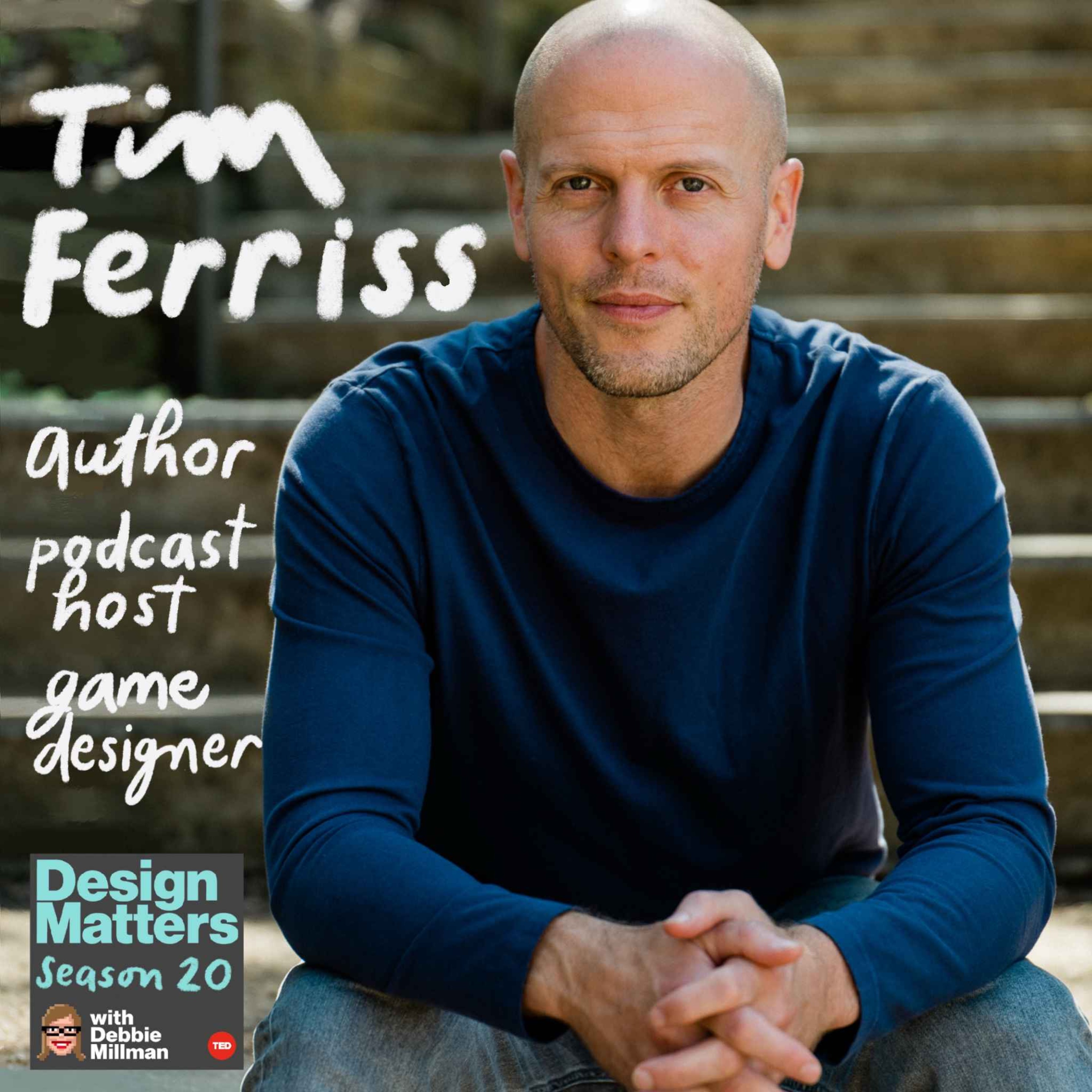
Loading summary
Transcript211 lines
- [00:01]
Tim Ferriss
Ambition used to be the hallmark of an enviable life and a righteous path. I don't relate to it that way anymore. I think ambition is a jet fuel. Not everyone needs to be on a jet, but if you're going to be on a jet, you better make sure it's pointed in the right direction.
- [00:19]
Debbie Millman
From the TED Audio Collective, this is Design Matters with Debbie Milma. On Design Matters, Debbie talks with some of the most creative people in the world about what they do, how they got to be who they they are, and what they're thinking about and working on. On this episode, Tim Ferriss talks about the pleasures and challenges of creating the game.
- [00:42]
Tim Ferriss
Making a game is like choosing a sport at the Olympics. Like curling is not exactly the same as high hurdles.
- [00:54]
James and Fuhad
It's James and Fuhad from Shits and Geeks podcast and we're here to talk about Boost Mobile offering reliable nationwide coverage backed by a 30 day mobile money back guarantee. Love your service or get your money back. No questions asked bruv. You know how it goes. Obviously I'm on one provider, you're on another provider. Sometimes I have good signal, you have bad signal, you have bad signal, I have good signal and I get stressed and I think shall I change? Is it worth changing? Is it going to make it better? I don't know. I've been with my provider for a long time. Same. It's anxiety inducing and I don't want the hassle. Well guys and girls, here's the twist. Boost Mobile gives you the same nationwide coverage and network speeds you that you're already used to for way less money. That's right, Boost Mobile gives you unlimited plans starting at just $25 a month. No price hikes, no contracts, no multi line faf. Just solid coverage and proper value. And if you're sitting there thinking, bruv, this sounds too good to be true, don't worry, you've got a 30 day money back guarantee. Try it risk free and if you don't love it, you get your service fees back. There are plenty of benefits when you switch to Boost Mobile. Together with their roaming partners, boost mobile covers 99% of the US population. 5G speeds not available in all areas. So whether you're scrolling streaming or just lost in a group chat, you're covered. Bottom line, Boost Mobile gives you the freedom to save money without sacrificing coverage. And no one's locking you into anything. Visit your nearest Boost Mobile store or find them online@boostmobile.com that's boostmobile.com Reliable service, proper coverage and no stress.
- [02:21]
Wise
This podcast is brought to you by Wise, the app for international people using money around the globe. With Wise, you can send, spend and receive up to 40 currencies with only a few simple taps and save up to 55% compared to major banks. Plus, wise won't add hidden fees to your transfer. Whether you're buying souvenirs with pesos in Puerto Vallarta or sending euros to a loved one in Paris, you know you're getting a fair exchange rate with no extra markups. Be Smart join the 15 million customers who choose Wise. Download the Wise app today or visit wise.com, or learn more by visiting wise.com US Compare Ts and Cs apply hi.
- [02:57]
Kim Holderness and Penn Holderness
This is Kim and Penn Holderness from the Laugh Lines podcast. Boost Mobile offers the same nationwide coverage, network, speed and service consumers are used to, but at more affordable prices. Why pay more if you don't have to?
- [03:10]
Boost Mobile
Boost Mobile offering reliable nationwide coverage backed by a 30 day money back guarantee. Love your service or get your money back, no questions asked.
- [03:18]
Kim Holderness and Penn Holderness
While other carriers blow millions on super bowl ads, we put that money to work for you. Deliver reliable 99% nationwide coverage at affordable prices.
- [03:28]
Boost Mobile
Start saving on wireless today with Boost Mobile's Unlimited plans. Starting at just $25 a month, the.
- [03:34]
Kim Holderness and Penn Holderness
Boost Mobile network, together with their roaming partners, cover 99% of the US population. 5G speeds not available in all areas.
- [03:43]
Boost Mobile
Visit your nearest Boost Mobile store. Find us online@boost mobile.com Customers who cancel.
- [03:48]
Kim Holderness and Penn Holderness
Within 30 days of activation will have Boost service fees refunded, activation fees if applicable, and phone payments will not be refund.
- [03:58]
Quince
Ready to elevate your everyday Quince has the luxe staples insiders swear by. Minus the markup from 100% European linen styles and 14 karat gold jewelry to gorgeous leather bags and elevated home finds, Quint has it all. And by partnering directly with top artisans and ethical factories, Quint delivers premium quality at half the cost of similar brands. Discover everyday luxury without the markup at quint. Go to quince.com styleupgrades for free shipping and 365 day returns. Quince.com styleupgrade.
- [04:36]
Tim Ferriss
Tim Ferriss is many things. Five times New York Times best selling author, a podcaster with over a billion downloads, an angel investor, an experimenter, a teacher and a risk taker. But above all, he's an architect of questions. This is the fourth time I'm interviewing Tim, and today we get to talk about something brand new that he's been quietly designing a card game called Coyote but before we shuffle the proverbial deck, I want to dig into the evolving mind behind it. The mind that's been asking better questions of the world and of himself for nearly two decades. Tim Ferriss, welcome back to Design Matters.
- [05:24]
Thank you for having me. It's so nice to see you.
- [05:26]
Oh, it's such a joy to have.
- [05:27]
Quince
You in this little studio.
- [05:29]
Tim Ferriss
So I want to talk a little bit about questions. Do you remember the very first time you were asked a question that really made you stop and reconsider everything?
- [05:44]
Ooh, I would say the first that comes to mind. And I don't remember the exact phrasing, but it was when I was in probably freshman year of high school. I could think of other examples, but this is the one that pops to mind. And my math teacher at the time asked something along the lines of, have you ever thought about getting out of here and going somewhere else, meaning going to a different school? And that possibility, that question had never entered my consciousness really at all. And at that point in time, there were very few things I can control. And there are a lot of things in my life out of control outside of my direct influence. But the one thing that I felt I could control was academics, right? Working really hard in school. So I did achievement and I did well. Yes, the curse of the achiever. Definitely some payoffs, but there are some trade offs. And at that time, I felt very good because I was, relatively speaking, a big fish in a little pond, although I wasn't aware of that. And this teacher then suggested that I had the option. Right. There was actually an item on the menu known as other school, and that led to all sorts of exploration. Going to the public library back in the day when you needed to research schools by pulling these giant tomes off of a shelf that were revised every year or two and ultimately led me to getting some scholarships and so on and going to a boarding school, and that changed everything. You know, six months after getting there, I ended up being an exchange student to Japan, going from Long island to Tokyo, Japan, and everything changed.
- [07:31]
Oh, that changed everything.
- [07:32]
So without that initial prompting from actually two teachers, but the math teacher is the one who comes to mind. Great guy. Also hilarious. He was very, very, very tall, and he had this older convertible Corvette that he would drive around, and he was so gigantic that it looked like half of his body was sticking out of the top of the car. This image is also burned into my mind, and I owe that man a debt of gratitude. Without that, I think I would have unknowingly just followed this script that had been set out in front of me.
- [08:09]
We've talked a lot over the years about performance reinvention, achievement optimization. You've been evolving quite a lot in the last couple of years and I'm wondering what has become less interesting to you over time.
- [08:27]
What a good question. You know, that's a better question than I sometimes try to edge into that territory with a handful of other questions. And that's a much better question. So I'm going to borrow that, if you don't mind.
- [08:39]
Never done it all, do whatever you want with it.
- [08:41]
I would say that, and one could, before I even say it rightfully, push back on this answer, saying that it's easier for me to say now than it might have been a few decades ago or even a decade ago. But I would say the no pain, no gain school of achievement has become much less interesting in the sense that one of the risks of self improvement is you find someone to model, whether that's something they write about or a person you have a parasocial relationship with, meaning you've read their book or you see them online. You don't get to see the whole person. So you might see someone on Shark Tank who is a billionaire or fill in the blank and in an attempt to copy that person, you take on, say, their business behaviors without seeing the possible side effects of those practices and behaviors and beliefs and so on. And for me, I suppose I have come to think, number one, if you were to ask 100 people, what is Alexander the Great's full name? I mean, I couldn't even tell you. And this is one of the greatest conquerors the world has ever known. And you could go through history and pick out these incredibly, by humankind scale standards, important men and women who have all been forgotten. Like the Ozymandias poem.
- [10:24]
I don't know many people that know Rembrandt's full name.
- [10:27]
Yeah, exactly. So to that extent then burning the candle at both ends in an attempt to leave a legacy I think is the most hilarious, foolish thing imaginable. Like we're just always, we're all going to be forgotten, at least on a full name basis, very, very quickly. But you, you can have an impact through starting with the small, trying to affect individual people or a small group of people. This is just, I suppose, a meandering way of saying that productivity or being effective with your goals is still important on some level. But eking out the bleeding of the stone for optimal fill in the blank I think is less and less interesting.
- [11:16]
Why do you think people drive themselves in the way that they do to construct a life that is comprised of that mentality?
- [11:27]
I think it's a very smart coping mechanism for a world that seems out of control and for a life that doesn't seem to have any clear mooring in certainty. Right, so you take away. Just went to the bathroom here, maybe 15ft from where we're sitting, and there's this amazing cartoon on the wall of the ten Commandments being held up by a dog to this audience of dogs. And it's like, heal, sit, lie, sic em, you know, fetch. And when you take away that type of certainty, this is how you build a good life. This is what makes you a good. Fill in the blank Christian, Muslim, whatever it might be. And this is what happens in the afterlife when you remove that. I think humans being, as far as we know, uniquely enabled, disabled by our knowledge of our own mortality, you need something to keep your mind from staring into the abyss for too long, I think.
- [12:35]
I agree.
- [12:35]
And maybe that ends up being veganism, maybe that ends up being CrossFit, maybe that ends up being workaholism, which is also very socially reinforced, particularly in the U.S. i think less so when you stray outside of the Protestant work ethic history. When you get to like Spain or something, it's like, okay, it's a different situation by and large. I think. I think that's it. I think it's coping with, for some people, the, the dizziness of freedom. It's like, okay, we used to have our village, have our hundred people. These were the options. What you did is A, B and C. You got married at this age, you went through rite of passage at this age. You had 3.5 kids or whatever it was, and you worked the farm and then the kids inherited the farm and that's it game, you know. But in a world of infinite options, even if that's just a perception, you have the created illusion that you're constantly losing if you are not striving to grasp at more and more of them. That's my perception at least. And also watching my audience over the years, it's like I've never seen such, such a combination of like fear, anxiety, apathy, nihilism, and. And it's really not uniform. There are outliers who don't fit that bill. But man, is it prevalent. And I don't think that's due to individual fault. I think society has just become, and life has become much harder to compartmentalize or conceptualize in a way that allows humans to kind of grasp things and operate day to day without worrying all the time.
- [14:24]
I wasn't planning on talking to you about this, but the conversation is leading me to consider that it might be an interesting thing to chat about. I don't know if you know Amy Griffin.
- [14:37]
I do. Yeah, I do know Amy.
- [14:39]
So Amy is the CEO of G6 Ventures. She also just recently wrote a book called the Tell. And I don't know if you know how much you influenced her writing that book.
- [14:55]
I don't think I have. Don't have the full picture. She sent me some very kind texts, and we've spent a little time together, and I have not read the book, but I've heard it's fantastic. Was a little worried about maybe triggering stuff in my own past, revisiting it. Yeah, there's a time for that, but there's also a time when I don't want to do that.
- [15:15]
Yeah. Oh, I hear you. But when I interviewed her, she told me that when we had one of our last conversations about our own lives, that it triggered something in her that ultimately inspired her to write her book about her memoir, about her experiences growing up and some of the violence that she encountered. And it made me think about the way in which we identify young people that might need direction or help. And the way that your teacher suggested, you know, have you considered a bigger world out there? And it made me realize. And the reason this. This came into my head is because in thinking about overachievement, you know, something you and I have in common, something that Amy has in common as well. I wonder if teachers, educators, guidance counselors, principals, you know, they're all taught what signs to look for in kids that might be having trouble at home or in their families. And it's usually the kid that's withdrawn or not getting good grades. I'm wondering if ever anybody's considered looking at the really intense high overachievers that seem to need to make up for something else. And I'm wondering if that's a.
- [16:45]
Or control something.
- [16:47]
Yes, yes, that's better. Absolutely. Control. And also to feel good about themselves and feel like they have some purpose in the world. And it just makes me think about the ways in which we're all conditioned to view certain external stimuli. And what if we rethought how much more we actually might be able to support other people?
- [17:10]
Oh, yeah, for sure. I mean, I'm not the first person to say this, but, you know, everyone's fighting a battle you know nothing about.
- [17:17]
Right.
- [17:18]
And certain types of compulsive behavior just happen to be more socially rewarded than others.
- [17:25]
Yeah. I mean, I've been behaving this way since I was in junior high school. What's considered middle school now? Exactly the same. Exactly. And not only that. After, you know, many decades of therapy, I realized that something that I thought I wasn't doing anymore, I realized I still do every day.
- [17:44]
And I will say that for my younger self, let's just say on Long island, definitely focusing to an extreme extent on schoolwork and things like that, I don't think that would have been the right time for me to try to sort of go to the cellar of my soul with someone's intervention to look at things because I wouldn't have had a safety net. I wouldn't have had a support structure. So at that time, I mean, I'm very grateful that I did have the compulsion to work.
- [18:21]
Yeah, same.
- [18:22]
And it served me for a long time. But there is a point when sometimes you outlive the tools that serve you for a long time and the behaviors.
- [18:32]
Yeah. What do you know about being public that you didn't during your four hour work week era?
- [18:40]
Oh, boy. Well, I would say number one is, is being public facing and recognizable, especially facially recognizable, has a lot of downsides from a privacy perspective, sometimes from a safety perspective, you don't need that to be quote unquote successful. If we look at it from the point of financial stability, and I wrote this piece, this was a while ago, but the 11 reasons not to become famous, something like that, people can look it up.
- [19:17]
That's what I was referring to. I figured you'd mention it.
- [19:19]
Yeah. Because many people experience a pretty good percentage of their lives on their phones. Looking at social media, understandably, what they see rewarded on those platforms often is some degree of fame chasing with various types of videos and behaviors and this, that and the other thing, which isn't to diminish all of it. Right. There are some amazing educators on YouTube and on Instagram and so on. There are also a lot of people who are falling prey, being seduced by the vanity metrics of followers or this or that or fill in the blank. Right. And that doesn't invalidate a short term career path for some of these people to build a huge following, get sponsors, do this and that and the other thing. But I would say that's pretty close to professional sports in the sense that you have a few winners make most of the money, and then maybe the next 10% do really well, and then the bottom 80% make next to nothing. But they will still chase the vanity metrics, which can apply to startups as well. They're these seductive metrics to get you pulled away from the things that actually matter. So I haven't had. And it's going to make me sound like an old bastard, but it's not an old thing. I know young people who've done this too. I haven't had any social apps on my phone in two or three years.
- [20:49]
Wow.
- [20:50]
Because they are too well engineered. I mean, the teams that are working on these are going to beat your psychology. That is their job. And collective jobs. You are the product. Right. If you're not being charged for the product, you are the product. What's the expression in Alcoholics Anonymous? If you don't want to slip, don't go where it's slippery. So I just don't have the apps on my phone. They're too compelling. And the personalized algorithms and so on are so good. Now it's very easy to become lost and to become sort of this, like, mimetic desire mirror where you start to get trained to want certain things or to be perceived a certain way by virtue of the things that get put in front of you. So I still go on social media. I can access it through my laptop, but there's enough friction that I can't sit on the toilet and get lost for 60 minutes on my phone. Right. Yes.
- [21:48]
I know people that do that. Did you go through withdrawal when you took it all off?
- [21:55]
Short answer is no. Like no. No physical withdrawal. Very short. Psychological. I wouldn't call it withdrawal, but observation of my Pavlovian conditioning. Right. You end up standing in a line for five minutes. What's your conditioned response to pull your phone out of your pocket and scroll through X. Whatever. I say X. Not the platform. I mean X. Any social media app. Pick your bo, Take your poison and you begin to realize how many dozens of times a day you've been filling gaps or displacing more important work by getting lost in various things. I'm sure people have had this experience because I've had this experience and, you know, the personal tends to be pretty universal. Especially I would like to consider myself pretty focused. Like I can. And this is out of the box in the same way that LeBron James is built to jump and be tall. I can focus for long periods of time on one thing to an abnormal degree. Like I can do that. And on YouTube I get immediately hijacked. I'll go to YouTube to find something specific, but my Feed is so good. Meaning for me personally, I'll get, I'll be like, okay, I'll watch a short before I get to the thing I was about to look for. And then game is lost. I completely forget. And 20 minutes later I'm like, what? Why am I even here? What was I looking for? So they're very, very, very well design. They're just going to get better. So for me, the experience of noticing how many times a day I went to this digital pacifier was shocking. Once there was no way to access it.
- [23:37]
Right.
- [23:38]
Wow.
- [23:39]
I like the term digital pacifier. That's good.
- [23:42]
Yeah. So I ended up, I just call friends more now, which is a much, I think, for a lot of people, not saying for everybody, but healthier way to go about things.
- [23:53]
Did you find yourself when you were on something like Instagram, comparing yourself to others? Was there any, like. One of the things that I've said a lot is nobody comes away from Instagram after a half hour feeling good about themselves.
- [24:09]
Yeah, it's generally not. I mean, unless the accounts you follow are all people, like getting into skiing accidents and like crying because they ate ice cream late at night. I don't know where you find those channels. But also, if you had an account dedicated to those channels, I would have a whole different set of questions for you.
- [24:27]
True.
- [24:27]
But I would say I must. I mean, I must because I do follow channels or profiles that are aspirational. Like I'm following, for instance. I mean, this is not interesting to most people probably, but like the Chinese Olympic weightlifting team and various athletes, for instance, judo. I used to compete in judo. I love judo, but I can't do that stuff anymore. So on one hand I love watching it, on the other hand, like, it pains me and I come away like, really? My low back hurts. Nah, now you can pull on that thread. And I think, unfortunately that type of comparison is a muscle that gets stronger with use. Yeah, that's another reason why I took that stuff off my phone. I'm just like, hey, look, the goal is better, not perfect. And I know how to do that already. I don't need the Internet to tell me how to apply progressive resistance or whatever the approach might be. Let me just get those habits in place, talk to my friends via phone or video, call as much as possible, and meditate once or twice a day to train myself. I mean, there are a million different ways to do it. I use an app called the Way with Henry Shucman. Use that once or twice a day so you get comfortable sitting with some empty space, and lo and behold, after a week or two, you're fine. So there is, though, that. Let's call it detox period.
- [25:54]
Yeah, it's like giving up sugar. Crave it for a whole bunch of days.
- [25:58]
Yeah, about two weeks.
- [26:00]
Tim, one of the many things that I've admired about you is your curiosity. Not just in what you do, but how you do it. You've optimized routines, reversed engineered habits, deconstructed mastery, but now you've done something entirely different. So I want to talk to you about your new card game called Coyote. The first question I have for you about it is, is the name an homage to Joni Mitchell's great song about Sam Shepard, Coyote?
- [26:34]
It is not, but I need to look up this song because this is now the second time that it's come up, really.
- [26:39]
The first line of the song is, no regrets, Coyote. And I was like, I could see Tim thinking that was a message.
- [26:46]
I need to find it. Maybe this song is meant for me. Coyote has a lot of symbolism, not just for me, but around the North American continent. I mean, Coyote is in some respects, uniquely American. Right. It is a. Okay for the people in South America. Yes, North American. But I would say fundamentally, if you look at creator myths and if you look at folklore from different first nations and indigenous groups in North America, there are a couple of trickster entities that come up over and over again, right? You have Coyote, you have Iktomi. Spider, you have Raven. Comes up quite a bit. There's a great book called Trickster Makes this World by Lewis Hyde. It is a dense read. I'm going to warn people in advance. The Hermes stuff is really long, so I hope you have some patience for Greek stories. But the Trickster is not necessarily automatically bad, right? So the trickster is sort of the tester of assumptions. Also gets his or herself often a he, into trouble. Right?
- [28:05]
So like a Loki character.
- [28:07]
Like a Loki character, also in some cases, like a Prometheus. So stealing fire from the gods, giving it to humans. And they often get themselves into all sorts of trouble, but they also do a lot of good. But coyotes are boundary walkers, as described by Lewis Hyde. So they. They sort of walk between different worlds. And I feel that way quite a bit in the work that I do, but just also in my curiosity, I end up kind of weaving through, meandering in like a slalom, kind of across the boundary from one world, into the next, into the next, into the next, and introducing people, making these connections, trying to copy and paste or transplant things from one field to the next. So I, I find that element of the coyote folklore really appealing. It's also just a fun character. And coyotes are amazing. There's a, there's a book. I am going to butcher it, but I think it's just American Coyote by Dan Flores. And it's the story of the evolution of humans and coyotes in parallel. We share a lot in common. The extents to which the US government has gone to which they did very effectively, of course, first, gray wolves eliminate. But coyotes, they couldn't do it. Like, they put out millions of bait, traps of poison, tons of collateral damage, all sorts of stuff.
- [29:34]
Why? Why do they want to eliminate coyotes?
- [29:37]
Well, they were successful at eliminating wolves and then to keep the department alive and fed, meaning lots of employ employees employed, they needed a new public enemy number one. So they decided to create the coyote as public enemy number one. And it's a wild story. It's very sad on a lot of levels, but coyotes are incredibly adaptable. They can hunt as single animal, in pairs, in packs. Wolves are much more constrained as an apex predator. They didn't have anyone really to worry about above them. Whereas coyotes had to be wary because they had wolves and other creatures that could kill them. For that reason, they're much harder to kill with traps and poison. They can survive almost anywhere. I mean, we're sitting in New York City. Like there are coyotes in New York City, right? There are coyotes in Central Park. They are just very, very crafty, clever creatures. And I mean, the reason for using coyote for the game is, you know, I wanted something that would be short and iconic. There were a lot of debates around this name. This is a game that is going to be sold internationally as of like July 21st or so. There were certain distributors and so on who said, hey, coyote don't exist here, so nobody's going to know what this is. And so I had. And whenever I end up in a situation like that, I'm like, okay, I'm open to that, but we should always stress test these types of convictions. And so I sent texts to friends of mine in all a bunch of European countries and then in Australia. And I'm a like, hey, do you do what percentage of your friends know what a coyote is? And almost all of them were like, hey dummy, we've seen Looney Tunes, like all of us. Oh, of course. And I was like, okay, that's what I thought.
- [31:28]
Oh, good.
- [31:29]
There you go. Yeah. So that's the tie in with the coyote. The more you learn about this animal, the more interesting they are like as a predator that has been able to bob and weave and not just get through mass annihilation by humans, but actually circumvent and thrive. It's wild.
- [31:56]
Kim Holderness and Penn Holderness
Hi, this is Kim and Pen Holderness from the Laugh Lines Podcast. Boost Mobile offers the same nationwide coverage, network, speed and service consumers are used to, but at more affordable prices. Why pay more if you don't have to?
- [32:09]
Boost Mobile
Boost Mobile offering reliable nationwide coverage backed by a 30 day money back guaranteed. Love your service or get your money back, no questions asked.
- [32:17]
Kim Holderness and Penn Holderness
While other carriers blow millions on super bowl ads, we put that money to work for you, delivering reliable 99 nationwide coverage at affordable prices.
- [32:27]
Boost Mobile
Start saving on wireless today with Boost Mobile's Unlimited plans. Starting at just 25amonth, the Boost Mobile.
- [32:34]
Kim Holderness and Penn Holderness
Network, together with their Roaming partners cover 99% of the US population. 5G speeds not available in all areas.
- [32:41]
Boost Mobile
Visit your nearest Boost Mobile store. Find us online@boostmobile.com Customers who cancel within.
- [32:47]
Kim Holderness and Penn Holderness
30 days of activation will have Boost service fees refunded, activation fees if applicable, and phone payments will not be refunded.
- [32:56]
Wise
This podcast is brought to you by Wise, the app for international people using money around the globe. With Wise, you can send, spend and receive up to 40 currencies with only a few simple taps and save up to 55% compared to major banks. Plus, wise won't add hidden fees to your transfer. Whether you're buying souvenirs with pesos and Puerto Vallarta or sending Euros to a loved one in Paris, you know you're getting a fair exchange rate with no extra markups. Be Smart. Join the 15 million customers who choose Wise. Download the Wise app today or visit wise.com learn more by visiting wise.com us compare Ts and Cs apply.
- [33:32]
Quince
Who says luxury has to come with a steep price tag? Quint's brings you hotel quality sheets and linens without the markup. From breathable bamboo bedding to spa worthy bath towels, Quince makes every corner of your home look and feel luxur. And by partnering directly with top artisans and ethical factories, Quint delivers premium quality at half the cost of similar brands. Upgrade your home for less at quints. Go to quint.com homeupgrade for free shipping and 365 day returns. Quints.com homeupgrade you buy a pair of socks, that's two socks. You buy a pair of Bomba socks, that's four socks because one purchased is one donated. Socks are the number one most requested clothing item in home homeless shelters. So when you Buy a pair of super comfortable Bombas socks. You're also donating a pair. Bombas customers have powered over 150 million donations. So Bombas would like to thank you 150 million times, but we only have like 30 seconds. Go to bombas.com and use code audio for 20% off your first purchase. That's B O M b-s.com and use code audio at checkout.
- [34:39]
Tim Ferriss
The game emerged from, I believe, two years of collaboration with former Xbox game designer Elon Lee, who is now the co creator and CEO of Exploding Kittens, a company with a mission to inspire people to connect, laugh and play fun games in the physical world. Now, I believe you met Elon after you interviewed him for your podcast. I'm wondering, did you always have aspirations to create a game or did the inclination take shape after the podcast interview?
- [35:10]
The inclination was there beforehand.
- [35:13]
So tell us when that started speeding up.
- [35:15]
I very often will dip my toe in the water with the podcast or maybe a blog post. Maybe it's a late night post on social media through my laptop to just see, like, what do people think about this? How do I feel about this when I see how people engage with this? Which is not to say I'm letting the audience dictate what I do. I think it's very important to say that I don't for fear of audience capture, meaning your audience turning you into basically some caricature of things that they want, which you will like. You become the mask you wear. That's dangerous. But if there are three or four things I'm really excited about, and let's just say I'm more or less equally interested in all four, then I'll start dipping my toe in the water, maybe seeing how a small audience or a large audience respond to it. Or taking a test drive, right? Maybe I have a weekend sprint. I go on a long hike with a game designer and I'm like, you know, hypothetically, if someone.
- [36:26]
Asking for a.
- [36:27]
Friend, asking for a friend wanted to create a game, like, what's step one? And I grew up very, very small. I was born premature. And I know you know some of this already, but was really the skinny, wimpy kid who would stay in for recess so he wouldn't get his ass kicked. Like, you know, I had this book, the World of Fishes. I still remember this hardcover. And that was my. That was one of my escapes so I wouldn't get bullied. Another one was Dungeons and Dragons. So I played D and D with a couple of other fellow nerds and this game just blew my mind. Like the fact that Cary Gygax, the TSR team and so on could sit down and build something like this was just. It was unbelievable to me. It's so sophisticated and comprehensive and I still have all of my modules and everything. To this day, they're actually sitting, sitting at home. That game meant so much to me. It taught me teamwork, it gave me an escape from pain. It allowed me as a relatively socially inept nerd, to like, nerd bond with other nerds. Right. Which is a start. And by the way, like, resolve conflict. Also, yeah, some pretty wild things can happen in D and D, especially if your dungeon master is a prick.
- [37:52]
I feel like there's some history bubbling up here.
- [37:54]
Well, yeah, I mean, dungeon masters have a lot of power. I'll just. This is one of my friends. He was a great dungeon master, but if he was in a bad mood and he was pissy, he could be spiteful and do terrible things to other characters. So that was such a formative experience that I've always been into games. But there was a point probably when I transferred to that school, talk about trade offs with the Curse of the Achiever, as I was like, okay, time for me to do adult stuff and be serious. Time for me to be serious. I can't do this kid stuff anymore. And that was it. That was the end of stuff like D and D. And, you know, I played video games and stuff too when I was younger. Thankfully that was like Spy Hunter and not World of Warcraft. Because I could have gone, you know, 60 hours a week with World of Warcraft, which I probably would have done in any case. I would intermittently, every few years picking up casual games because I'd be like, you know what? I take stuff too seriously. Sometimes I take myself too seriously. I definitely take my work too seriously. So I would notice that I'd be like, okay, I am really stressed out. And in the grand global scheme of things like, this is ridiculous. Let me play some games. And I would always enjoy the games, but I never quite found the game that stuck.
- [39:15]
What were you trying? What kind of things I was trying?
- [39:17]
Basically any game that you. There were a few mistakes I made in the beginning. The first was not really accepting my constraints. What I mean by that is there are some amazing, say, board games out there that take an hour and a half to learn. You have to play three or five times to start to get the hang and then you can begin to enjoy it. And I was as I am in a lot of Things very ambitious. I'd be like, of course I'm going to do that. And lo and behold, never happened, Right? Because the setting is, I have dinner. I've had two glasses of wine. Not always, but like two glasses of wine with a bunch of friends. It's 9pm Maybe we have an hour and a half. There's no way I'm going to subject them to sitting down and dealing with instructions and a hobbled, unfun attempt at a game. There's no way. And then there were other more casual games. I mean, some examples, like, contemporary examples would be, I think it's One Night Werewolf and Monopoly. Go. I believe is. Is another good example that are really fast, easy to play. All right, So I started exploring more of the casual gaming side. And then it wasn't until, funny enough, one of your students who we just interacted with before we begin recording, was talking about, what, exploding kittens and Poetry for Neanderthals. And I found the game Poetry for Neanderthals. And I was like, oh, my God, this is it. Like, this is the kind of game I want. And my friends wanted to play again and again and again and again. And that got me thinking about not just playing games, but I was like, you know, I've been doing the podcast a long time, been doing the writing a long time. And every four or five years, I. Let's just say roughly, I try a hard left turn somewhere. I try a new thing. And I was like, you know, I've always wanted to make a game. Who made this game? Exploding Kittens. Okay, what does that mean? Who runs exploding Kittens? And that's how I found Elan Lee. Looked at his background. I was like, okay, this guy's done everything. He's done video games, super big video games, Halo, et cetera. He's done interactive alternate reality or augmented reality games in the physical world. He creates the craziest spectrum of games. He can't stop also. And I say that as a compliment because his day job is running a big company that makes games. And when he's not doing that, he's thinking about how to make other games, like, just for fun. So I reached out and I was like, well, what's a good, you know, a good pretext for having a long conversation as a podcast. So let's try that. And then we really hit it off and became kind of thick as thieves quickly, which is, I'd say, pretty unusual for me as an adult. I'm fairly guarded. But we became close friends, and I was like, okay, this momentum feels good. How can I force myself to have some degree of like, accountability? What is it? Okay, it's the next conversation and Alon had mentioned, he's like, yeah, like kind of in passing, if you ever, yeah. If you ever thought about making a game, like, yeah, that's definitely this chat. And I was like, you know what, I think I should have that chat. And that's how it all kicked off. That was I guess about two years ago. But games for me are like the vitamin you know, you should take but that you forget to take a lot and then you take it for like a month and you're like, wow, I feel better. And then you take a trip, you get busy, you forget about it, and then you have a little more anxiety, a little more this, a little more that. And then when you start taking it again, you feel better. And I was like, okay, let me try to make this more of a constant. And I think that's also become more and more important. And it's, it's not limited to gaming, I mean, but getting off of screens, just getting off of the Internet writ large and technology for a whole lot of reasons. I mean, eye health, mental health, physical health, and games are an easy way to do that.
- [43:32]
Elon suggested that if you had an idea, let him know how hard or easy or neither is it for you to ask for something. When you were thinking, oh, I really want to make this happen, were you comfortable to say to Elon, I have a game idea, let's do this?
- [43:49]
Oh man, I wish that's how it started. It took us forever to figure it out. But in the spirit of your question, I would say I am very comfortable asking for small things in a way that is very unattached to, To A. Yes, if that makes sense. Right. So in the case of Elon, it was, hey, remember that thing you said? If that offer still stands, would you be open to hopping on the phone and just talking about what that might look like? Because I have a pretty big audience. I love games. I would want to be super, super. Like, I'm very excited by the prospect. But would you be open to like a 15 minute chat? Okay, cool. You start there. And I wasn't withholding in the sense that I was like hiding my cards and not showing my agenda. But it's. I want to make sure. I also test this belief that I want to make a game. There are a lot of things where you ask someone, they're like, yeah, if I had known A, B or C, I never would have done this.
- [44:55]
Well, what was the hardest part to get right?
- [44:58]
The hardest part to get right was. I'll tell you what's not hard. What's not hard is producing a mediocre fill in the blank, right? So producing a mediocre game, like a game that people will be like, yeah, it's kind of fun. That is challenging, but it's not super hard. That's true with a lot of things, right? I mean, I'm sure it's true in design, I'm sure it's definitely true in books. What's also not hard is if I were willing to, which I've never been, just to put my name on something and have someone else do all the work, that's pretty easy to get going. But what I knew is it's like, okay, I have to love this game and this is going to be the one and only game with my name on it. So I better be excited to talk about this a lot. And it's going to reward me or haunt me for a while. So I really need to be incredibly confident. And with that type of bar, what was hard was arriving at the concept and then figuring out game mechanics. So like name, theme, artwork, design. I mean, I was involved in all of that. The copy on the box, like the design of the box, like so many different aspects of this, but the lifeblood of it is. And look, guys, if any professional game designers who've done dozens of games are listening. I am a beginner, I'm a low blue belt in game design, but you got to figure out the mechanics. And there are many different ways to approach games. But for a casual game like this, and I should say also the ethos of exploding kittens, which I like a lot, is that they don't make entertaining games, they make games that make the players entertaining. And if you sit with that for a second, it's a really profound and important focusing maxim, right? We do not make entertaining games. We make games that make the players entertaining to one another. And with that also as a non negotiable criteria, I was like, okay, how are we going to do this? And Alana and I are both very busy. We got a lot going on and we did a bunch of jam sessions, like two or three day jam sessions in New York City, on Long island, in Utah and God, like all over la, all the place, and then finally did one in Canada and I was like, okay, we're not figuring this out, right? We tried a million different games, looked at some that were early prototypes. We looked at, well, like Maybe there's the possibility of doing a variant where there's, like, the Tim Rules of Poetry for Neanderthals, right? And then there's, like, do it from scratch, which is the hardest option, in a sense. And I really want to do it from scratch because I'm like, I want to be involved in every step. So we decided that, all right, this particular sprint in Canada is going to be the make it or break it. Like, we've kind of been trying it, but, like, let's do it 100% out of 100% for this period. And if we can't figure it out, let's just call it, like, we're not actually that serious about making a game or we can't figure it out. So. And it was on that particular trip, and he brought in one of his game mechanic experts named Ken, who's a wizard, and we just went for long walks, drinking lots of coffee. And it was on one of those long walks, it was very hot. I remember I was getting sunburned. And we started expanding. Not what board games do I like or have I liked, but, like, what games in general. And I was like, well, you know, it's gonna sound stupid, but I think Rock Paper Scissors is pretty amazing game. If you get into a rhythm and you have the right group of what if you could do that as a group but make it more interesting. That's how it started. And you can imagine, because you've played the game, it's like, okay. It's like, it's pretty.
- [49:03]
Yeah, I could see.
- [49:04]
Like, it rhymes with that correlation. Yeah, like it rhymes with that. Okay, all right. And then I would say that was the hardest part was. And this is true of so many things. It's like making the decision on a direction. For me, that's so often the hardest part. It's like making the decision. And then once you're committed, you're like, all right, I'm walking through this. This particular door. Then instead of considering everything and anything, you get this very productive set of blinders. It's like, okay, like, we walk through this door, and here are our positive constraints now, right? It's going to be a deck of cards. All right, do we want a bunch of other stuff? Okay, well, you have to think about not just the playing, but playing in multiple languages if you're going to do it internationally. Cost of goods, all that stuff matters, too. So it's like, okay, how do you. I mean, it's so for my brain, I was just, like, getting a candy store to play with all this stuff. But once you step through that door with like, okay, here is the fundamental concept and here are a few constraints, then, oh, man, then it's fast. It's kind of like, I should write a book. And then you're like, okay, I should write a book. No longer than 150 pages about this very specific subject. Okay, now I can start.
- [50:19]
And that's interesting. I was going to ask you, how did you approach. Did you approach creating Coyote in the way that you might write a book or produce a show or.
- [50:28]
I approached it in some respects very similarly. The big difference, I would say, is that the possibility scape for games was much more confusing to me.
- [50:40]
Why?
- [50:41]
Because there's so many different types of games. So did I want it to be some competitive type of collectible card game game right along the lines of magic the gathering, where people are building Dex? Did I want it to be something? Because I tried this early on, before I met Elan. I was like, okay, I'm going to make a D and D like game, which is so complicated. It's not impossible, but it's very, very, very, very involved. I was also, at that time, started listening to a podcast called how to Think Like a Game Designer by Justin Garry, which is great. And so I would just. Anytime I went for a walk, anytime I was in the bathtub, anytime I was washing the dishes, I would listen to this. And you realize that making a game is like choosing a sport of the Olympics. Like curling is not exactly the same as high hurdles. Not that one's better or worse. And like biathlon. Yeah, biathlon is very different from long jump on skis or pick the example. They're so fundamentally different. Different. And the people who sell them are different. Like the shops, the people who buy them are different. It's all different. So figuring out where to focus within that giant menu of options was very hard for me. Whereas within books, it's like, look, maybe I could write a great magic surrealism novel. But boy, oh, boy, that's going to be a risk. It's probably going to be prescriptive nonfiction. After I do a bunch of experiments on myself, meeting experts. That's kind of what I do. So I start with a pretty good idea of the set menu. But with the game, it was really quite challenging, I would say. The similarity is that I'm looking at, like, what am I good at? What do I have access to? Sort of like Robert Rodriguez, the filmmaker, when he made his first film, El Mariachi, for, like, I don't know what it was $6,000 or something. He basically figured out what he had access to. He's like, all right, my friend has a old school bus. This guy has a tortoise, this guy has a pit bull. He's like, all right, now I'm going to write the script including all of these things that I have access to, and then it's going to look like it cost a lot more.
- [52:54]
Right. It's like one of those food shows where you get five strange Iron Chef.
- [52:58]
Yeah, exactly. So I think for me, I did also think about that with this game. And most importantly, the question was, what is going to give me energy? Time is important. Yes. Tension is also important because that kind of dictates the value of your time in a sense. But you need energy. And as one gets older, you realize, man, oh man, that battery is critically important. So who I might work with, the type of game I might make, what might be entailed in making that and then promoting it, all of those things had to be something that would not be overly draining, but ideally recharging in some way. And I will tell you, boy, this is true with so many things. But when you get from overly simplistic to complicated to then on the other side, kind of hopefully some type of elegant simplicity, when you have gone through that process yourself, you look at things very differently afterwards. So if I go to the toy aisle in a store now and I see these games that have been successful for years and they're really easy to learn, hard to master, people like to play them a lot. It's like, omg, do I. I have much more appreciation for how much work goes into that. It's a tremendous amount of work.
- [54:17]
Yeah. One of my favorite card table games is Milborn. I don't know if you know that game. Oh, you would love it. It's a car race game.
- [54:26]
Okay.
- [54:26]
And that's just my little gift to you today.
- [54:30]
I'll write it down.
- [54:31]
Was there ever a moment in the process where you thought this just might not work?
- [54:36]
Oh, yeah, there were many points where I was just like, I don't know. It's like until the game clicks, it doesn't click to state the obvious. And what is nice about. I'll just give an example of another reason why I want to do a game that's. I mean, it's like I can hold the game basically in my palm, right. It's a deck of cards with a small box around it. When we came back from that over caffeinated walk in Canada, we went back to Alon's kitchen table and had blank index cards with markers, colored markers of different types, and just started mocking up cards. And so within let's call it 20 minutes, we had a V1 deck of cards and then we tried it. We're like, oh, like this is kind of interesting. This definitely didn't work at all. It's too slow in this way. Okay, well, like let's make another 30 cards and then you try it again and then you try it again and then you try it again. You're just using hundreds of these blank cards to iterate, but you can do it really quickly over the span of hours. So I would say there was the question of game mechanics. What does it mean to win? Right. How does one. What does done mean? How do you complete the game? How do you design a game so that it takes 10 minutes and not 40 minutes? How many cards should you have in the deck? These are all surprisingly big questions. Then there are other points where it's like, all right, right, you're developing the game. Are you ever going to land on a name? That was one where I was like, oh man, like if and even if I land on a name I like, am I going to be able to convince everybody else to be interested and commit to that name? There are definitely a bunch of kind of disagree and commit moments where it's like, okay, I know we disagree on this, but we got to keep moving, so can we do X? But I would say that, that the greatest amount of doubt was when there was not yet a concept that had a kernel of something that worked. So it was everything leading up to. I mean, it's gotta be at least nine months of doing these sprints and just coming up with nothing that felt good. And I was like, okay, wow.
- [56:48]
So that you just kept pushing and had faith that you'd get there or.
- [56:53]
I think there was faith, but I mean, this is going to make me sound terrible. I'm like, really? I'm thinking how to word craft this, but I don't think faith is my strong suit. I don't think like, oh yeah, everything's going to be totally peachy keen in the end. Don't worry about it is my default. Like, I mean, I run pretty hyper vigilant and just effectively. I'm like, prepare for the worst, hope for the best, but mostly prepare for the worst and then have a safety net.
- [57:24]
We share that.
- [57:24]
Yeah, put on your eight point harness. But when I had that podcast with Elan and I was like, oh, wow, this guy's really Cool. This is somebody I could really be friends with. I tend to choose projects these days based on. Number one is developing new skills, learning a lot. Number two is developing or deepening relationships, both of which should transcend any given project. For instance, if I were to write another book much along the same lines of a prior book, maybe not going to learn a lot. I mean, the subject matter will be different. So sure. Am I going to develop new relationships? Maybe. But I have the podcast for that also. Whereas in the game world it's like, okay, I'm going to learn an entirely new skill set. I'm going to learn about human interaction. I'm going to learn about big retailers. I'm gonna like big, big retail, right? Like Walmart and Target and Amazon and so so on. Well beyond the scope of book retail. And Alon is awesome. His team is fantastic. I mean, I could go through a long list of names. I won't do that right now. But his whole team has just been awesome to deal with. And I'm like, okay, these are good people. We were able to craft a deal that felt good and made sense. That's also non trivial. That's a very important deal. Anything, right? Like make sure, you know, sort of, you know, when to hold them, when to fold them, when to walk away, when to run, right? So like the making sure you have, for me at least, graceful exit options for ideally all sides is, is really important, right? Which is where I think maybe my hypervigilance is helpful, or it can sometimes not be helpful, but in that case, I do think it's helpful. So all of that mess, and I went into this and I was like, even if these sprints where we're trying to figure out a game do not result in a game, I'm spending time with Alan Lee, who I consider genius and is just such a great human being. I'm having fun with these games. It's giving me an opportunity to invite people over to play games with me and they get to experience what it's like to play test stuff. So I don't regret a minute of any of those sessions, even if they ended in no game. But yes, there was definitely a point. Hence the all right, we're going to do this final sprint and it's go or no go, where I was like, I don't think we're going to do it. Like, maybe this is a Tim problem. I feel like I'm usually good at coming up with lots and lots of ideas, but it's not happening right now. And then on that walk it didn't.
- [60:06]
I just. Quite coincidentally, I've been reading a lot of Daniel Kunneman lately. And so I've been going into deep, deep wormholes of game theory and so forth, but not game theory about games. I think a lot of people think that game theory is about literal Scrabble, wordle, et cetera, but it's really about psychology and choice making and decisions and so forth. And so it was very serendipitous that I started to talk to you about this. On the surface, Coyote is a card game. But like most things you create, there's something deeper humming underneath. This isn't just a game about rhythm or memory. It's a symphony in a lot of ways, because there's a lot of things happening at once. There's rhythm, there's speaking, there's psychology, there's presence, there's permission. There's a lot of things happening at the same time. This is a game where you are fully immersed. You can't look at your phone, you can't text somebody, you can't have a snack. You're just immersed in the game. And depending on how many people you're playing, you're all in this together and you have to pay attention to each other. It's a very focused game. So I want to dig into the psychology a little bit about how you approached making this in this way. The game seems designed to push people. And maybe it was just me because I have a sort of very fixed comfort zone, but the game seems to design to push people just out of their comfort zones. Would you agree with that?
- [61:57]
It is. And what is fun about that is that the players are in charge of how hard they make the game.
- [62:04]
Right. You have a cooperative version, and then you have competitive version, and you have a competitive version.
- [62:08]
And the players themselves can pull the levers on how easy or hard they want the game to be. And let me, if it's okay with you, I'll just. Let me just paint a picture for folks.
- [62:17]
Yeah, please, Absolutely.
- [62:18]
What the hell is this game? So I can explain it really quick, quickly. Coyote is a game that involves putting out a sequence of cards in front of you like you would see in a poker game. And let's say you're playing with three or four players, okay. In the case of three players, you turn over six of these cards and you'd put out these action cards first. And the action cards have an action you need to perform, a physical action and a thing you need to say. So an easy one might be ballet and you do a little fingertips on the top of the head, like you're doing a pirouette. Okay.
- [62:52]
Or a mustache.
- [62:53]
Yeah, or a mustache. And you put your finger under your nose. Exactly. And there are lots of other goofy ones that tend to get a laugh, like making a fart noise and having to lean to the side. I mean, there's tons of stuff. And there are a bunch that we had had to remove because I have a quirky sense of humor, and the big retailers didn't always agree with my sense of humor. So a bunch had.
- [63:15]
Not safe for work.
- [63:16]
Yeah, there was some not safe for work that got e yanked. So I'll probably make those available at some point. But the point is, let's just say you have ballet mustache, and then a couple of other things. In the simplest example of the game, you all hit the table with your hands, like, boom, boom. So if you think of the wee will, we will rock you like, boom, boom, boom, boom. So you go boom, boom, ballet, and you make the movement. That'd be one player. And then it goes to the next player, and it's boom, boom, boom. Right, Mustache. Boom, boom, Whatever it is. Boom, boom, whatever it is. Okay, you finished the four cards. Congratulations. Now each person takes out a new card, or they. They take, like, three cards from the deck, and they choose one to play. In addition to the action cards, which are the types of, like, a physical movement plus a thing you have to say at the same time, you have coyote cards, which mix things up. So you could. You could. And the. The cards are all colored differently. Green, purple, whatever. So you might have a card that you play, and it says, players must whisper every green. So instead of saying it in your normal voice, it's boom, boom, boom, boom, mustache. Right. And so on and so forth. Or.
- [64:29]
And then there's somewhere a card will come up, and it'll say, just tap once when it's a green card.
- [64:35]
Yeah.
- [64:36]
And that really.
- [64:37]
Oh, that messes people up.
- [64:38]
That messed me up because I was so kind of paying attention rhythmically. And then it's also before and after changing.
- [64:44]
Yeah, that's a very hard card. So they're also noted for difficulty. That's definitely three out of three hard. And so in the cooperative version, you're trying to get a certain number of cards on the table, and then you win as a team. In the competitive version, you can also sabotage people with attack cards. And the reason that's important is that in early play testing. All right, well, let me. Let me share a story from my life I have a family member. I'm not going to mention who they are. They're very good at chess. They love playing chess because they like beating people at chess. And I'm decent at chess. I'm not great, but I was playing with them and about, I don't know, four moves in, I was like, oh, I'm screwed. I'm dead. And so I said to him, or four or five moves, I was like, oh, oh, yeah, I'm totally dead in X number of moves. And so I said to him, I was like, yeah, I'm done. And he's like, no, no, no, we have to finish. I'm like, I don't want to euthanize myself slowly. It's like, I see that you're going to win, and that's. That's the risk of a game that is sort of complete information for everybody. Whereas if you're playing, like backgammon, there's an element of chance where even someone inexperienced might end up doing really well. And with very early versions of Coyote, what I noticed there was one guy who played with one of my employees who was playtesting in early deck, and this guy was a computer programmer, mathematician, and he just killed everybody. Everybody. Right. Like, nobody could beat him. Like, he was just so good at this game. It stopped being fun because he won every single time. I was like, okay, well, how do you work around that? Well, you could have cards that when everybody sees, like, oh, John's gonna smoke us. Okay, well, we need to gang up on John. So now we can. Now we can play these attack cards where it's like, okay, now Jon has to do everything. He has to say everything with his lips curled over his teeth.
- [66:35]
Ah. So it has a little bit of survivor in there.
- [66:38]
Yeah, exactly. And what that allows is somebody who might not be as good naturally at the game to compete with someone who is very, very, very naturally good.
- [66:51]
So the competitive still has some of the collaborative aspect of it.
- [66:57]
It does. Part of what makes it fun is, yeah, you can have these temporary alliances, but ultimately there's only one winner in the competitive. It's the last person standing. You each get three lives, and that's it. And if you mess up, if you say the wrong thing, if you don't whisper when you're supposed to whisper, if you tap twice instead of once or whatever the rules are, and the game starts very, very, very easy, and then it abruptly gets quite difficult.
- [67:24]
Yeah, it does.
- [67:26]
Yeah. But you mentioned cons, and I don't know if I've ever mentioned this. To you, I, to make ends meet when I was an undergrad, volunteered as a test subject in a bunch of his studies. Now, by association, that sounds awesome, right? I mean, this is a super genius Nobel Prize laureate. Amazing. In practice, what that meant is I was sitting in front of one of those really old computer terminals. Like, black screen, green font type thing. Yeah. I would sit there for hours, and it would basically have instructions along the lines of, if you see a blue square in the upper right hand corner, hit the space bar. If you see this, hit the up arrow and just sit there and stare at a screen for hours on end. But these were various types of attentional studies.
- [68:11]
Did you learn anything about yourself in it?
- [68:13]
I learned that it wasn't worth $6 an hour to me to do that. So I found other jobs.
- [68:18]
Did you ever work with him directly?
- [68:20]
No. No, I didn't. He was the wizard of behind the curtain in the tower. I mean, I've heard only wonderful things about him. I mean, he's since passed, but what a brilliant man.
- [68:33]
What do you think the sabotage aspect of the game reveals about our relationship to control or to rhythm or to failure?
- [68:47]
Well, I mean, I think that. Let me say a few things. So the first is that part of what I find really fun about a game like Coyote is particularly Coyote, because you're dealing with what is at least one piece of it, what is called interference effect. What is that in neuroscience. So you might have. So people may have seen something like the Stroop test, for instance, which is one of the things I'm very, very, very good at. And then for, like, digit recall, I'm terrible, which might surprise people. And by digit recall, I mean like 4 and 5. Number of strengths. Not very. The Stroop test is where you have to. I'm going to get this probably a little bit off, but it's something like this where you have to indicate the color of the phrase that pops up on the screen. But you might have red in red color, in which case that's easy, Right? Right. But then you might have red come up in blue font, and so on and so forth. So the Stroop is presenting you with interference. Difference between the stated color in the text and the color of the text. And there's more to it. But being able to very quickly hone in on the element that matters while ignoring this completely opposite direction to your brain is interference or contending with interference. And there are many different ways you can look at this. There's. I think there's something called the Wisconsin Sorting card sorting test. So we were chatting about this a little bit earlier, but it's like part of my hope is that this can actually be used as a cognitive training tool, which is not proven at all, but talking to some scientists about maybe doing a study. The reason I mention all of that is that people fail in different ways. So for instance, I remember doing play testing with six or seven people. It works with three people. But the more the merrier, for sure. Ends up being very fast also. And you have more players, but some people cannot. Not, for instance, if there's a card that modifies and says, okay, now instead of going, boom, boom card, boom, boom card, now it's boom, boom, boom card, boom, boom, boom, card. You have to do it three times. There's some people who just cannot do that, like the replacing two beats with one or three. They cannot do it. And then there are other folks, and I happen to be one of these players where if there's a coyote card that. That makes every player play a certain card. So what that means is for me and for most people, as they're watching the game go around the table, you can keep track of who. Whose turn it is. But if you play a coyote card over, let's say, ballet, then everybody goes boom, boom. And everyone does the ballet sign and says ballet. It basically resets in. Oftentimes, you're not gonna know whose turn it is. And that's when you make a mistake.
- [71:46]
Yeah, these are. You're just explaining every single thing that I did. First of all, I loved playing it. Roxanne was. My wife, was particularly good at it, as you can well expect, she has that focus. Then I was playing with my niece and her girlfriend, and they were also good at it. I was not good at it, but. But I had a lot of fun. But I do have to tell you that even if you're not playing the competitive set or the competitive way, it still gets competitive.
- [72:19]
Yeah, it still gets competitive.
- [72:21]
I learned cooperatively, but then I got really competitive. But then the more competitive I got, the worse I was doing. And so I was the first one out, even though we kept playing, like, technically, I was the first one out. Cause you get three outs, you're out. But my family let me keep playing and ultimately ended up with, I think, four or five outs.
- [72:38]
Yeah, house rules are the way to go. I would say the most entertaining people to watch lose are the people who are really good at it when they get sabotaged.
- [72:46]
Ah, yeah, I get it.
- [72:48]
Because they are expecting to win, and then they Don't. So that's pretty entertaining. I would say that that's the case with everything though.
- [72:56]
I mean that's what I like about this whole conversation and about this whole idea of game theory is that this is a microchasm of how we engage in the world.
- [73:05]
Oh sure. Or how do adults respond when kids beat them them handily. Right. Because this is also designed. It says age 10 and up. I don't think anyone's going to get upset for me saying this, but it's like you can modify the rules and we encourage like I encourage house rules. Like modify like you are in charge of how hard or easy it is. And like I got a, my, my son's daughter wanted to send me a, like a, a video with her feedback about the game and she's four. Right. They had to modify it. It was more of a like a like Simon says kind of thing. But you can find certainly like 8 year olds who will smoke most adults. And so seeing how adults who think they're really composed and even killed respond like if they lose once, they're like ha ha ha, good job. Like if they get smoked three times.
- [73:56]
In a row that says something about who you are. So were you thinking about cognitive overload in a deliberate way? I mean you said you were talking to cognitive scientists. Are you measuring that? Is there a limit?
- [74:11]
Yeah, haven't done all too much in terms of measurement yet. Because I want to. I'll say a few things. The first is forward looking. So forward looking the study design would determine how to measure. Right. Like what are we actually measuring? Because I suppose we might use a term broadly like attention but there are actually many fine slice types of attention and I need someone who's far more sophisticated than I to help figure out exactly what we're going to measure. And it could have null effect. Right. Maybe it doesn't do anything. It certainly helps you sleep. I will tell you that if you have an active mind and you play this couple of games, you are going to be wiped out. Great for sleep. So I can say that. But I would say as it relates to the origin story, I do think that as we become more and more dependent on digital tools, naturally we have abilities that atrophy. Example given Google Maps. Right. And I would like to preserve and cultivate and train my mind in the same way that I train my body. Body. But there most of the tools that are sold for that purpose are pseudoscience at best. This I, I don't know if it does anything in terms of adaptation, but I do know that it is very, very, like, cognitively challenging. I did like the idea of developing something that seemed to hit. For instance, there's a Coyote card, this trickster card that you put above one of the cards and the card gets flipped face down. So now you have to remember what that card was. So I wanted to incorporate as many different types of sort of cognitive training that as a layperson. Look, I did some neuroscience as an undergrad, but I'm not a neuroscientist. I wanted to incorporate as much as possible so that hopefully. And who knows, this is still tbd, but while people are having fun, there's this kind of Trojan horse of all also brain health. Like, who knows, right? I mean, but I have neurodegenerative disease on both sides of my family. I take that stuff really seriously. And just to give people a little Scooby Snack, I would say there's a protein called Clotho that's naturally produced K L O T H O discovered by a Japanese researcher. It is produced by the body. You can increase production through exercise. So do not skip the physical exercise for brain health specifically. But in addition to that, I'll like, well, if I can make something that feels like I just did a little bit of cross training for the brain, like, fantastic. Tbd. If it actually does anything.
- [76:56]
If someone plays coyote really well, what do you think that says about them? Is it about memory, presence, mischief?
- [77:05]
Whether it's coyote or anything else? On some level, this is cliched, but I do think if you're really trying to pay attention and you can overread things, but how people do anything is. Can tell you a lot about a person, right? I often think that. About driving.
- [77:19]
Oh, yes.
- [77:20]
Like, if you watch somebody driving, like anger management, you can learn a lot. Yeah, right. And if you talk to them about finances, I think you can learn a lot about someone's psychology just by how they. What their beliefs are and how they think about money. What's they're afraid of, what are their stories that they tell themselves about it. So in a game like this, I mean, there are going to be some people who just want to make. They're kind of of the. I mean, they're sort of the arc coyote of the group. And they just want to make it as hard as possible. They're like, lf, go, let's do this. You know, and they just like to stir the pot. So I would imagine that says something about that personality type. Then I would say there are some folks who seem very good at multitasking like visual input and physical behavior. So I would imagine, for instance, that musicians, some musicians would be quite good at this.
- [78:10]
Oh yeah, drummers for sure.
- [78:12]
Yeah. I would imagine they would be quite good at doing this.
- [78:15]
Bass players.
- [78:16]
Yeah. What's going to mess them up is going to be the verbal part.
- [78:21]
Yeah, it's true. I mean anybody can have like a lead gene in terms of their senses that combines a whole bunch of them.
- [78:29]
And the other piece of this that I have not seen done before, I'm sure that somebody else has done it, but I couldn't find an example is the deck. And I felt really strongly about this. The deck comes with 10 blank cards. Cards, because I want everybody to design their own cards as they play.
- [78:47]
I can't wait to see what people.
- [78:49]
Make to become a game designer. It's within the framework of the game. It's surprisingly easy. Like if you play five games, you're ready to make your own cards. You can create stuff that is as not suitable for work as you like. Because this is your home deck. You can kind of do with it whatever you want. And people come up with some hilarious stuff. Just doing play testing and seeing what people have thrown in there. So it's been a real journey. And part of my hope in doing this because it's so out of left field is just to offer to people that that type of left turn is available to more people than you might think.
- [79:31]
Yeah.
- [79:31]
And there are always going to be trade offs, always going to be costs, but there are always costs with everything. Including inaction, including continuing on your current journey.
- [79:39]
Including regret.
- [79:40]
Yeah, including regret. Maybe it's just a story I tell myself, but my feeling is if you choose based on the learning potential, the density of learning and the relationships that will transcend any given project, it's very hard to lose over time. It is very hard to lose and it's just more fun.
- [80:03]
Designing a game seems like a joyful act, but also an incredibly intentional one. And I know that intention is something that runs through everything that you do. I'm curious, what does a game like Coyote say about where you are now creatively and personally?
- [80:23]
I would say for sure. It says that I am in a place where I want to double down and really invest on social connection versus isolation. For sure, books are pretty, or at least for me, a very solitary experience. And they are. I've had enough of that, I think for a while. You know, few, few decades of mostly.
- [80:45]
Working by myself, going to write another book. And then I, I put, I hit.
- [80:48]
Pause on it for right now. I mean, I have an 800 page draft and I'm just like, oh, God, 800 page draft. That's so much rewriting and reworking. So I hit pause. I got a lot of raw material, but it's like, I know how to do the solitary thing. Thing. I'm not. I can do it and I'm good at it, but that doesn't mean I should do it. And my tendency when I am feeling stressed is to isolate, suffer in silence, figure it out. I think that stratagem has outlived its usefulness for me. So the game, whether I like it or not, to offset my condition and impulse to isolate, I have to work with people to make a good game, to play any game, unless you're playing solitaire or something, you're playing with other people. I also spend too much time sitting in front of a computer. So creatively, it's like I want to find outlets that allow me to hopefully do something other than peck at a keyboard, do things that are very visual, crack my knuckles and get out some procreate or some pens and actually do some sketching. Right. Which. Which was a really fun part of. Of this game as well. And where I am creatively, I would say, is also taking more risks that are outside of the categories that I might be comfortable with, which I have some history of doing in the sense that I went from the book stuff to angel investing and then to podcasting. But if you look at those, each one of those shifts in some way was informed by like an ultra meltdown, like just a burnout situation. And so I found myself in the, I suppose, very luckily fortunate position, but very confusing position for me, unpracticed position of saying to myself, I want a new chapter. Chapter. I'm not burned out, so I'm not forced to do it. It's not pushing me in a certain direction in the way that podcasting was kind of served to me on a silver platter. Because when I launched the Four Hour Chef, which was just. Just about killed me when I launched it, I did a lot of podcasts in 2012, and I was like, oh, this is fun. Maybe I should try this. And that's how that started. But when I was considering all the different options, games being one of them, I didn't have that feeling of kind of the burnout gun against the head. So it was harder. It was harder. It didn't feel like a necessity. So it was actually psychologically much harder for me to do it because the podcast is doing well. Like the other things are doing well. It's not like I hit some big stumbling block.
- [83:37]
But you have changed the way in which you do certain things. You just talked about pulling back on doing the book, at least for now.
- [83:46]
Yeah, yeah.
- [83:46]
You took a little bit of a sabbatic from the podcast. You came back with a new set of criteria about how you were going to be doing the podcast. Yeah.
- [83:55]
New rules for the podcast for sure.
- [83:57]
And now you have a whole new chapter.
- [84:01]
That's true. That is true. So, yeah, I suppose I should. I never really. I'm not very good at, like, patting myself on the back, as you know. But if I hadn't done the new rules. Right. If I hadn't taken the sabbatical, if I hadn't made the new rules for the podcast, which were intended just to make the podcast as fun as possible for me, economic consequences be damned. Because a lot of those rules did hurt in terms of I'm not chasing the crazy over moment thumbnails with clickbaity headlines.
- [84:32]
And the podcast are more heartfelt, more sincere.
- [84:36]
Yeah, very heartfelt.
- [84:37]
Not that they weren't before, but they just feel more soulful.
- [84:40]
I feel very good about it. And what did it do? The new roles gave me energy, energy that I could then apply where to this game. The new rules for the podcast enabled me to be more creative with guest selection and creativity. Again, I'm not coming up with this quote, but creativity, it's like courage. The more you use it, the more you have. I feel like the little sabbatical I had after the 10th anniversary of the podcast and the the new rules gave me a reservoir for energy upon which this game depended. I don't think it would have happened otherwise.
- [85:20]
And also, you might not even be aware of this, but it does inspire other people to rethink how they're doing things. This is my 20th year. And because you did that with your sabbatical, I've been thinking about a way for me to keep doing the show, but doing it in a way that also gives me. Me a little bit of time to rethink.
- [85:40]
Yeah.
- [85:41]
So watch this space. I have two last questions for you. Yeah, second to last. What does ambition mean to you now?
- [85:51]
You know, I'll say as a preface to buy myself time. I mean, ambition used to be the hallmark of an enviable life and a righteous path. I don't relate to it that way anymore. I think ambition is a Jeff fuel. Not everyone needs to be on a jet, but if you're going to be on a Jet. You better make sure it's pointed in.
- [86:07]
The right direction and that you have a parachute.
- [86:10]
Yeah, yeah, exactly, exactly. Make sure you have some means, an option, ideally of a graceful exit if you're going to decide to go after. But at the same time, if it's like, look, the game, you know, Coyote right now it was exclusive at Walmart. Walmart. By the time this comes out, it's going to be everywhere. Target Amazon International has 180 million-plus social video views of gameplay alone, which is nuts. So it's doing incredibly well. And I do want. I'm competitive and I like the excitement of this happening. After two years of kind of being in the cave. Right. And doing the playtesting and working with the exploding kittens team. I suppose you could say I'm ambitious about this game, but it's also a very focused ambition. That is not a personality trait. It's more like I mentioned that fuel that I am adding to this particular project and there is in a sense an expiration date. What I mean by that is I commit to go all guns blazing for X period of time and that's it. And if it's going to hit escape velocity, it will and if it doesn't, it doesn't. But I think open ended ambition that is not very focused can be incredibly corrosive. So I would say that's probably how I relate to it. It's tricky. Ambition's a tricky thing.
- [87:42]
It is slippery slope.
- [87:44]
Yeah. It's like making a deal with a genie or something. Right. It's like you really got to mind your P's and Q's.
- [87:51]
So my last question is one that I am actually borrowing from Roxanne. It's a signature question she asks at the end of every interview. And I really thought, you know what, this is such a wonderful question for me to ask him. I think he's going to love the question and I think I'm going to love hearing his answer. And so the question is, what do you love most about what you do?
- [88:14]
Oh, that is a good question. Being inspired and learning from people who are passionate about what they do. Or honestly it's broader than that. Like passionate about life. Right. I just, just having the chance to interact with people, this is not a very scientific term, but who have a high degree of stoke about something, anything. Cynicism and nihilism are not always in love. Enlightened.
- [88:41]
Yeah.
- [88:42]
You know, I imagine like a French woman with a cigarette who's like life is, you know, and, and I just swinging around and I just, I feel like the Internet is mostly turned into that there's a place for letting off steam and there are a lot of problems in the world. But while being cognizant of that and certainly being aware of what you can affect and what you can affect. Right. Cue serenity prayer. I think that you. I'll personalize it. I really benefit from focusing on the sources of light. I really, really need it as much as I need water, as much as I need sleep. Like, I need those sources of light. Because, I mean, we've talked about this. But like I can, I can default to dark. Like, I tend to think, like human nature is pretty dark and especially right now. Yeah, I mean, just. Yeah. Read any history too. It's like, look, it's. This whole human business is pretty rough. So when you find somebody who works at cultivating that light in themselves and shares it with other people, like Alon Lee is a great example, man. Value that for me. Value that. Spend time around that. Learn from it. So I would say that's what I love most about what I do.
- [90:06]
Tim Ferriss, thank you so much for bringing both rigor and mischief into the world and for making so much work that matters. And once again, thank you for joining me today on Design Matters.
- [90:19]
Oh, I love it, Debbie. Thank you so much.
- [90:22]
You can find Tim Ferriss's brand new game coyote@explodingkittens.com and wherever games are sold. And of course, the Tim Ferriss show remains one of the most thoughtful, wide ranging, enlightening podcasts out there. You can find that wherever you love your podcasts. This is the 20th year we've been podcasting Design Matters and I'd like to thank you for listening. And remember, we can talk about making a difference. We can make a difference or we can do both. I'm Debbie Millman and I look forward to talking with you again soon.
- [90:57]
Debbie Millman
Design Matters is produced by the TED Audio Collective by Curtis Fox Productions. The interviews are usually recorded at the Masters in Branding program at the School of Visual Arts in New York City, the first and longest running branding program in the world. The editor in chief of Design Matters Media is Emily Weiland.
- [91:22]
Kim Holderness and Penn Holderness
Hi, this is Kim and Penholderness from the Laugh Lines podcast. Boost Mobile offers the same nationwide coverage, network, speed and service consumers are used to, but at more affordable prices. Why pay more if you don't have to?
- [91:35]
Boost Mobile
Boost Mobile, offering reliable nationwide coverage backed by a 30 day money back guarantee. Love your service or get your money back, no questions asked.
- [91:43]
Kim Holderness and Penn Holderness
While other carriers blow millions on super bowl ads, we put that money to work for you, delivering reliable 99 nationwide coverage at affordable prices.
- [91:53]
Boost Mobile
Start saving on wireless today with Boost Mobile's Unlimited plan. Starting at just $25, the Boost Mobile.
- [91:59]
Kim Holderness and Penn Holderness
Network, together with their roaming partners, cover 99% of the US population. 5G speeds not available in all areas.
- [92:07]
Boost Mobile
Visit your nearest Boost Mobile store. Find us online@boost mobile.com Customers who cancel.
- [92:12]
Kim Holderness and Penn Holderness
Within 30 days of activation will have Boost service fees refunded, activation fees if applicable, and phone payments will not be refunded.
- [92:23]
Quince
Prime Delivery is fast.
- [92:24]
Tim Ferriss
How fast are we talking?
- [92:27]
Quince
We're talking puzzle toys and lick pad delivered so fast you can get this puppy under control fast. We're talking chew toys at your door without really waiting. Fast pads, cooling mat and pet hammer fast and fast. And there's training T R E A T s faster than you can say sit fast. And now we can all relax and order these matching hoodies to get cozy and cute. Fast fast. Free delivery.
- [92:48]
Tim Ferriss
It's on Prime.
- [92:53]
Banking with Capital One helps you keep more money in your wallet with no fees or minimums on checking accounts and no overdraft fees. Just ask the Capital One bank guy. It's pretty much all he talks about in a good way. He'd also tell you that this podcast is his favorite podcast too. Ah, really? Thanks Capital One Bank Guy. What's in your wallet? Terms apply. See capital1.com Bank Capital One NA Member.
- [93:17]
Quince
FDIC there's nothing better than treating yourself. Except maybe treating yourself to high end top quality pieces at half the cost cost. That's what Quince is all about. From European linen apparel starting at just $30 to handbags crafted from the finest Italian leather, Quince can elevate an everyday outfit at a fraction of the price by working directly with top artisans and cutting out the middlemen. Quint gives you luxury pieces without the markup. Go to quint.comstyle for everyday affordable luxuries with free shipping and 365 day return.