← Diabetes Connections | Type 1 Diabetes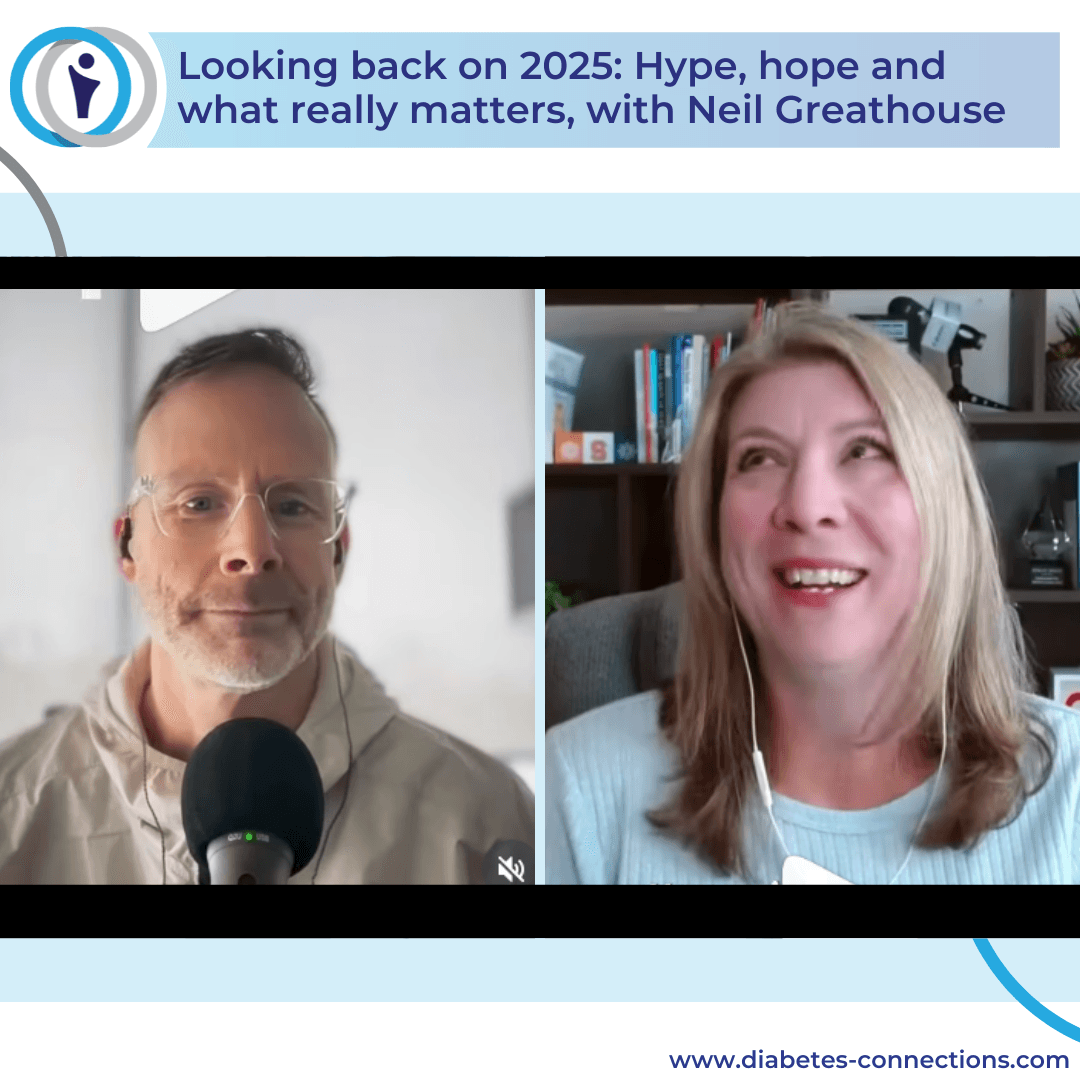
Diabetes Connections | Type 1 Diabetes
Looking back on 2025: Hype, hope and what really matters, with Neil Greathouse
00:56:27
Loading summary
Transcript258 lines
- [00:00]
A
Foreign. This week on Diabetes Connections, we're talking about the top stories of 2025, the hype that didn't happen, some trends for 2026, what community can accomplish, and what LeBron James has to do with all of this. We also get personal because I'm being interviewed by the wonderful Neil Greathouse, host of your best T1D year, and so much more. This podcast is not intended as medical advice. If you have those kinds of questions, please contact your healthcare provider. Welcome to another episode of Diabetes Connections, the last episode of 2025. You know we aim to educate and inspire about diabetes with a focus on people who use insulin. I am your host, Stacey Sims, and I am cheating a little bit here. I'm going to tell you more about how and why in just a minute, but a couple of reminders as we head into 2026. First, the podcast schedule is changing. We're still going to be releasing episodes every Tuesday, but it's going to alternate from an interview episode to an in the news episode. So next week on the 6th, we're going to stick with these long format interview episodes, but the 13th will be in the news, the 20th will be the interviews, and so on from there. Of course, I'm already planning a couple of bonus episodes and we'll pop in when we need to. But just for logistics, four episodes a month is where we need to be, not six or seven. A reminder about the community commercials. I will link that up in the show notes. Please send me your commercials. We want you to promote whatever it is you are doing for the diabetes community. We've had an amazing response to this. If you're confused, just get in touch. You can hit me up stacyiabetes-connections.com post in the Facebook group. But this is super simple. Grab your phone, send me a voice memo. Keep it to about 30 seconds. It does not have to be studio quality. It does have to be legit though. More information on the blog post in the show notes. And finally, My last reminder, 2026 is going to have a ton of events in it from Diabetes Connections. We've got our 4 moms night out events and you can use the promo code podcast to save on all of them right now. D.C. and Nashville coming up quick. February and March. Detroit is September, Seattle is October. Do not miss out. These are so much fun and we are expanding Club 1921. Club 1921 is our event for the entire diabetes community. Caregivers, adults with type 1 friends who want to learn more, Grandparents, healthcare providers. It looks like we're going to be doing something like 12 of these this year. We, Lord, help me. Stay tuned. Check out the events tab at Diabetes Connections, and we'll let you know where we're going as soon as all the details are in. Okay, today you'll hear my conversation with Neil Greathouse. And this is a bit of a cheat, as I said, because this is me on Neil's podcast. Neil is the host of youf Best T1D year. He lives with type 1. He is amazing on social media. He. You hear him, he'll talk about my voice. But, man, I. I wish I had his social media chops. He's been on this show several times. I'm gonna link up his episodes because if you're not familiar, he's just a wonderful storyteller and he has great, real advice. I love his podcast and I wish I'd stolen what he does here at the very end with the fastest five minutes. You're gonna hear me get super hyped for that, like the radio personality I used to be. And once you hear it, you will know why I'm coming back after to say more. So stay tuned at the very end of this episode. And one more quick bit of housekeeping. I am skipping Neil's introduction to me on his show because you know who I am. You know the deal. So here's my conversation, led by Neil.
- [03:52]
B
I've joked around with you about this since day one, but your voice is the most professional voice in this type 1 diabetes space. And I'm. I'm jealous. Is that okay to be weirdly jealous of your. You just, even your laugh is like. It's just so good. You're so good, Stacy. Wow.
- [04:11]
A
Well, there's no place to go from here but down.
- [04:13]
B
We're going crash and burn this thing.
- [04:15]
A
Thank you so much. You know, it's funny. I mean, I did work in broadcasting for a long time. I'm one of those weird people who knew what they wanted to do in middle school. I always wanted to be in broadcasting. So I was working on my voice from probably the age of 13. Oh, gosh. But if we get excited, the New York's gonna come out, so it's okay.
- [04:33]
B
It's there. It's all right. It's okay. You've kind of had this front row seat to a lot of type 1 diabetes change. Let's just not over the years, but even just this year, if you had to pick, if you had to pick, like a favorite moment or a story from 2025, something that moved you or made you laugh or just stuck with you in this space, what would it be?
- [04:57]
A
My absolute favorite story of this year was Chrissy Teigen's Instagram, where she said, let's give LeBron James type 1 diabetes. This was amazing to me.
- [05:09]
B
Oh, my gosh.
- [05:10]
A
My son loves LeBron James. It's kind of a warehouse because my husband, they go back and forth about who's the greatest, who's not the. I don't know. I don't even know that part.
- [05:18]
B
Okay.
- [05:19]
A
But I thought it took. It was a fantastic way to take all the discourse around Barbie, which I'm sure we'll talk about. The big moment around Barbie, the. The incredible publicity it got some not so great. You know, the comments were really up and down, but this was basically a mom trying to take something that was part of the zeitgeist and personalize it for her kid. And so on one hand, she got 3 million views educating about type one in this funny way. But also, to me, it was like, gosh, type 1 diabetes is different for every family. How we look at it, how we try to relate it to our kids. When my son was diagnosed, we were given Elmo juice boxes like, oh, Elmo has diabetes.
- [05:59]
B
Oh, my gosh.
- [06:00]
A
It was one of those moments where it wasn't a big tech story, it wasn't a breakthrough, but to me, favorite moment, hands down to 20, 25.
- [06:08]
B
That's so funny. I wonder if she even knew that it was gonna do that, you know, like, you don't know. You just throw it out there. And who knows?
- [06:14]
A
She had a lot of trouble doing it. If you watch the video, she was frustrated trying to cut those things, the accessories off and put them on the dollar game. I think she thought it was gonna be really easy and cute. Mom project.
- [06:26]
B
Yeah. You're up the night before doing your K science fair project. Yeah, you have. They're like two different worlds. The evolution of Stacy Sims has been really fascinating to watch because you have your podcast, but then Mom's Night Out. I remember talking to you before you even started it about what it was going to be. You're nervous about it, and now it's this thing that I think has momentum, it has energy toward it, and, you know, you could explain what Mom's Night out is if you want. I'm a little jealous that I'm not a mom, if I'm being totally honest with you. Because on from the outside looking in, I see the events. I see people posting about it. I see moms that are literally. This was One of the biggest eye openening moments of them realizing that they're not alone. When you think about Mom's Night out this year, is there a moment that, like, captures the best of what this community can do?
- [07:18]
A
Yeah. And I, I would like to say quickly, Mom's Night out is an event for moms of kids with diabetes and women with Type one. And I say at almost every event that I wish there was something like this for every cohort within the diabetes community, because it's wonderful for us all to come together as one. The type 1 diabetes community, even the greater diabetes community, there's a lot of value in being together. But when you break it down to men with type one, older people with type one, new moms with type one, different groups within dads, you know, I'd love to do something for dads. We just, you know, we can't do everything. So if you're listening, start it.
- [07:56]
B
Yeah.
- [07:57]
A
And I think that, you know, Covid really changed the way we got together in person. It changed the way a lot of the bigger organizations that we relied on to bring us together conducted their events. And I saw space and I saw, you know, having gone, like yourself to a bajillion of these events over the years, I wanted what I wanted. I thought these are the best parts of these events. So we're going to make it fun, educational, lots of technology, lots of peer support, very careful about who speaks. You're not learning from a mom who was diagnosed yesterday and bless your heart, decide to go on Instagram, right, and give advice. You know, I mean, we gotta be careful. But for me, one of the best things we've done at Mom's Night out is without going into too much detail, we do an ending event that. To wrap it up, that makes. Or an ending breakout session, I guess you'd call it. But everybody's there and we kind of wrap up. What did you learn? How are you feeling? What are you thinking? And then we ask all the moms to write themselves a letter. We.
- [08:57]
B
You're. You are pulling every heartstring.
- [08:59]
A
Yeah, it's emotional, but it's. What do you want to remember? Because what happens is. And it happens to all of us. We go to these events, we are pumped, we are excited, we are connected, we are feeling brave, we are feeling good. We are saying, oh, my gosh, that mistake is something I can laugh at and learn from. Then, three. Three days later, you're up in the middle of the night. You're, you know, Neil, as an adult, you're, you Know you've got a compression low or your pump fell out or, you know, who knows? Or as a mom and her dad, you know, you've got the headlamp and you're in your kid's room and you're feeling very, very alone. So rather than going back to square one, we send you that letter a couple of weeks later. And I put a little note in it. We do some other stuff. I don't want to give all my secrets away, but then you can kind of learn. What we also ask is if you don't mind us. And I say us because my husband helps me with these events. So if you don't mind us reading the let letters, leave them unsealed. We're not going to share them publicly without your permission, but leave it unsealed. If you don't seal it up, no problem. We don't need to look at it. And the vast majority of people leave them open after every event. We drive home or we fly home. We read the letters and we cry. We just cry, though. It's amazing. It's amazing. So they're funny, they're heartfelt. They are incredible.
- [10:07]
B
First of all, that's brilliant because you are right, we forget our past wins with type one so quickly.
- [10:16]
A
Yeah.
- [10:17]
B
Because we can only focus on the immediate present and to be reminded of these wins, these moments, these, you know, these galvanizing type of what. We learned so much in that moment, but in the heat of battle, we forget it and feel like a failure and we feel isolated. And that is just, that's. It's brilliant. You're. You're behind the scenes. You and I talked a couple of weeks ago just about the behind the scenes of what it takes to pull these off. What are some of your favorite behind the scenes stuff? These events are not easy to pull off.
- [10:49]
A
All right. I got to tell you, I. You were one of the people I talked to in 2022. I talked to. We started this event in January of 2023 as a one off. I thought I would do one of these.
- [10:58]
B
Yeah.
- [10:59]
A
So I talked to a bunch of people about, like, what do you think and could I do this? And how would you and what would you like? And, you know, I talked to a lot of industry people who frankly, sponsor the event and what did they need and what did they want? But once we did one event, we heard from people, I mean, frankly, all over the country, you know how this community is. You know, I've been blogging. I've been doing this since 2007. So we're connected to a lot of people. Come to my town. I want a mom. Stand out in my city. And my husband had just retired and he said, I bet we could do it. I was like, all right. I don't know anything about event planning, so I will tell you the funniest thing about. There's so much. But what I like to laugh about is we take the show on the road. So AV equipment is incredibly expensive. If you rent it from a hotel.
- [11:39]
B
Oh, my gosh.
- [11:40]
A
So we invested and we have all of it with us. You're an AV guy, so you know.
- [11:44]
B
Yes. Yeah.
- [11:45]
A
I'm going to send you a photo when we're done with this. You can share it if you want. When we went to Phoenix, because we also took golf clubs, but we take an enormous amount of luggage and it's just the two of us. So getting through the airport is hysterical. There's no porters anymore, remember?
- [12:03]
B
No, no.
- [12:04]
A
You can barely even find a cart to wheel stuff on. So we usually are. We're staging things. We're like. It's like Keystone Cops. We bring everything with us. We set everything up, we break everything down in 2026. I'll say this now as you. As you listen, if you're in any of our cities, I'm going to be looking for volunteers because this is too much.
- [12:22]
B
It's so much.
- [12:23]
A
It's so fun, though. It's amazing. And we do lots of little things. We put our own stuff into the swag bags. I always wanted more in my swag bag than. I mean, there's some great diabetes coupons and things like that. So whenever we get to a town, we go shopping. We put our own little spin. Local spin. We do. It's so funny to talk about Neil, because I don't get a chance to talk about Mom's night out that much, except for the people who've been there. But we've started doing this after dark part of it, which is Friday night. Everybody was going to the hotel bar when we finished.
- [12:55]
B
Yeah, they're going anyways.
- [12:56]
A
So we're like, we're going to do it ourselves. We're going to keep you here. So we. Part of our purchasing is we purchase alcohol and non alcoholic beverages, but not to serve because the hotel or the venue does that.
- [13:08]
B
Yeah.
- [13:09]
A
These are for games, so I don't want to go. I mean, you have to come to the event. We do a lot of pictures where it's just. Show us your Dexcom, you know, follow.
- [13:17]
B
Yeah.
- [13:18]
A
And the numbers are all over the place. And, you know, when I post the pictures, I try to black out the numbers. Not because they're good or bad, there's no such thing, but because people online are a little merciless. But in the moment, it's all over. Always says, I didn't realize. Like, I thought I was the only one. I thought I was failing my child. And yeah, you know, you're not. You're not.
- [13:36]
B
No, you're not. The statement that I say a lot is you're not doing a bad job, you're doing a difficult job. And there's a, there's a difference. It is not easy. You're not doing bad. This is ridiculously hard. So it's a lot. Yeah. Show us your numbers. And those numbers don't have any feelings associated with them. It's just a number. Like, it's just. It is what it is. It's not good or bad.
- [13:57]
A
It's just so hard, though. We say that all the time, right?
- [14:00]
B
And it's so, so, so we say that we judge. We judge ourselves and other people. It's just too difficult. You're like, that's not good. Just like. Well, I mean, yeah, but how they got here, you know, I think, I.
- [14:10]
A
Am not a scientist, but I think comparing numbers has got to be some kind of evolutionary trait.
- [14:16]
B
Yeah.
- [14:17]
A
We can measure it as human beings, we want to compare it. And there's got to be a reason for that way back, right? Because it's what we do. It doesn't matter with diabetes or not. We just, we compare, compare, compare. And because as you were inundated with numbers for diabetes, you really have to steel yourself and continuously talk to yourself and say, I'm not comparing. Or if I am comparing, I'm going to be nice to myself. It's a never ending battle.
- [14:42]
B
Okay, so the reason why I really wanted you on here is because I want to talk about what has happened in 2025. And I can't think of someone better than you who have this long standing history in the community, but you have interviewed more people than I will ever, ever have a chance at. You have learned things. You've been behind the scenes. You've had on camera interviews and off camera. There's so much that you know. So I'm curious for you, is, is there like this breakthrough or an innovation in the T1D world this year? This surprise you? Maybe you didn't see it coming, but you're like, wow, I dig that. I really like where this is headed.
- [15:27]
A
I think there are three kind of headlines from this year for Type one, one is, and I think it will ultimately prove to be the most important when we look back is. And very generally, I'll say, you know, we're kind of used to type one technology being used for Type two. We're used to seeing, oh, this insulin pump is going to be approved or Dexcom or Libre, you know, which it is, Type one technology. I think this is the first time we're really see medication that's already approved for type 2 really being studied for type 1, GLP1s Ozempic Kidney medications. There was a study just last month about metformin, which has been around forever. People take metformin when they're misdiagnosed, right? You're diagnosed with type 2 and you take metformin, it doesn't work. Then you're diagnosed correctly with type one. That really stood out to me. We're following that one more, but I think they're just really beginning. It was one of the top stories out of ADA last year. In 2024, we're starting to really get these studies in about GLP1 medication and type 1. And we all know people who are taking these medications off label or perhaps for obesity, if they have type one. So I think we're going to see, looking back that 2025, these pivotal trials, and I'm using that word not really in the scientific sense because I'm not exactly sure where they are along the way and that's a very technical term. But these studies, these important studies I think are going to really bear fruit soon because if we can get FDA approval for a drug like Tirzepatide, right, Semaglutide for type one, you can get insurance to cover it because we know it works. We all know people taking it and it works great. So. But we need better guidelines and dosing because of the insulin use. So I think that's really, really interesting. The other thing that I thought was interesting this year and it didn't get a lot of attention because it's not super breakthrough yet, but stem cells, crispr, the technology that we're seeing with islet cell transplantation and encapsulation, it is still going on. You know, we started off the year with an extremely promising study that, you know, 10 people were cured. Unfortunately, that study was then shut down because there was some danger. So it got a little muted. But there are three or four studies and companies that are still doing this that are still really continuing to move forward. I watch those closely. I'm very excited you're not asking for the editorial page.
- [17:44]
B
No, I do. I want it. Yeah, I need it.
- [17:46]
A
I don't think it's coming anytime soon. And I think if it does come, it'll be extraordinarily expensive.
- [17:50]
B
Yeah.
- [17:51]
A
But I think it'll be an incredible step toward ultimately, it may not be in this form. You know what I mean? Like, I feel like, I mean, my layperson opinion is watch this space because man, when they crack that code, it's going to be prohibitively expensive and rare to begin with. But you know, this is going to sound crazy, but remember in the 70s when they started talking about heart transplants?
- [18:13]
B
Yeah. Oh yeah, yeah.
- [18:14]
A
I have a friend who had a heart transplant. How do I know somebody who had a heart?
- [18:18]
B
How is that possible?
- [18:18]
A
Right. So it's, it's one of these things that I think will definitely bear fruit for a bigger population.
- [18:24]
B
I hear people ask me all the time. They'll send me posts, they'll be like, oh my gosh, did you see this? 16 people were. They don't have. And they go, is this real? I'm like, first of all, I don't know. I can't tell if that's real because it's not here and we don't have enough information on it. Second of all, if that is the cure, that won't be the cure. That's just the next step toward the cure, as best I can tell. And it won't be in that form factor. It's probably got to change five or six different times for any of us to be able to even afford it to begin with. But it is the right step. Yeah, I agree. Okay, what's number three?
- [18:57]
A
The one that I think really will affect most of us in the short term is this trend of longer lasting technology. And it kind of snuck up on us, didn't it, this year. It was interesting because it was not one of these things where like people remember, people were like waiting for Omnipod 5, like forever it felt like. And then it came and it was very exciting. This one was kind of like, oh, Medtronic has a longer sensor that's coming out. Oh, Tandem just got approved and will commercially launch in 2026. And Dexcom is 15 day and. Or 15 and a half.
- [19:27]
B
Yeah, yeah, 15 and a half. Right.
- [19:29]
A
You know, libre, 15 day. And I think that's just the beginning of the longer lasting technology. And I. The sound you made when I said that though, because I know you have some reservation.
- [19:40]
B
So Stacy, you and I talked, maybe it was two plus Almost three weeks ago, I can't remember now. I was in the middle of editing another video and I just looked down and my CGM had failed again. And I thought, dog gone it. This, this keeps happening. And I just randomly posted a video. Just thought, whatever, why not? I said, listen, if you're a manufacturer, look, super appreciate that you're working on longer lasting. But I think what we want overall, if you had to focus on works really, really well or lasts longer, I would prefer works really really well and is reliable as opposed to longer lasting. That's just my take. Nobody nominated me as a spokesperson. Take it for whatever it is. Stacy, I did not expect. And the last thing I wanted to do is like post some hateful whatever. It's not that I was just like, please let's make it work better and then we could go to longer lasting. I just didn't realize that that community is so polarized on this. That shocked me.
- [20:43]
A
Yeah, I think, I mean and I should have disclosed much earlier, but every company we talk about is a sponsor of mom's night out. I mean, I know you get it, but as you listen. They don't tell me what to say. You know, I'm not concerned about not making friends, but I think it's really important to just.
- [20:58]
B
It's super important.
- [20:59]
A
I do get paid by most of these companies and certainly Dexcom.
- [21:03]
B
You're 100% right. And listen, that's not. I don't even say that for like one company. I just say in general, overall, all the. There's not a single diabetes tech company out there that is not working on longer lasting.
- [21:16]
A
Oh, sure.
- [21:17]
B
Right.
- [21:17]
A
You know what I mean? Like I'm thrilled by that.
- [21:19]
B
I love it.
- [21:20]
A
I don't wear anything. Right. I mean, let's be clear. I don't have type 1 diabetes. My son does and he doesn't have a lot of problems, thank God. That I know. But he's funny. He doesn't tell me anything anymore. So I don't know what I think is, is really. Is really tough is when. And this is how I think. And I'm sure you do too, because I don't wear it. My first thought is, well, what about my insurance? Because I still pay for it.
- [21:45]
B
Yep.
- [21:46]
A
So if they're going to say you get two dexcoms every month, my insurance is like, oh good.
- [21:51]
B
Yeah, they love it.
- [21:53]
A
Many Right. So what happens if you really have an issue? Now Dexcom has been fantastic for us of replacing sensors when need be. And I know they are for a lot of People. But I also know that there have been times when people have been told you have hit a limit or you haven't done it right or et cetera, and so on. And I think, I don't know my gut, again, layperson, I don't have any inside information on this. My gut is telling me all of this is going to over the counter. So you're gonna be able to go and buy your CGM. Now, that might just be for type 2 and not dosing insulin. Cause there's already, I'm pretty sure there's a Libre. And I wanna say it's lingo that you can get at Walgreens soon, if not now, they have some kind of agreement.
- [22:33]
B
Okay.
- [22:33]
A
So my dad has type two, he's used Stello, he's used Libre. Like, we've tried all different things with him. And he said to me the other day, like, why can't I just go to the drugstore? I said, I think you can pretty soon.
- [22:43]
B
Yeah. Getting close.
- [22:44]
A
So I think that that will be a bit of a game changer. However, doesn't really help when you have a prescription and you're looking for insurance coverage. So that's really my biggest concern. Because if it works great for 12 days and you can easily get a replacement.
- [23:01]
B
Yeah, that's.
- [23:01]
A
It's not a lot better.
- [23:03]
B
Right.
- [23:03]
A
But it would be great if it worked really well for 15. I'm with you.
- [23:06]
B
Yeah. So when we were in. We were at Deepak in Washington and we were, we were basically talking to congresspeople and senators on the Hill for an entire day. And one of the things that we were educated on and trained on is how to talk about. There's, There's a new. It's not a bill, but it's a movement, a strong movement for all Medicaid and Medicare patients to go to a rental model only for your insulin pumps. And so what's interesting about that is from a financial standpoint, it makes perfect sense. You're like, gosh, this would save so much money. And I get that what you're saying about some of the, the CGM stuff like this makes. From an insurance standpoint, you only have two of them instead of three or four. Like that makes perfect sense. Let's do that. But then when you realize, oh, so if, if my pump breaks, I have to mail it back to you and you're going to send me another one and it might not even be the same pump that I currently use. That is a game changer and not sustainable. And. But you have to educate people on this is what that actually means. And everybody's take on is different because they don't have the same insurance, they don't use the same devices, they don't have the same access. I'm not opposed to some of this stuff, but I, I think you're going to have people that just scream and rant and rave about like the, all the, the bad stuff, but then there are, there are bonuses to this. There is a good side to it. If it was 15 and it lasted for 12.
- [24:38]
A
Yeah. How cool would that be?
- [24:39]
B
Okay. That's great. Two more days. What we currently have.
- [24:43]
A
It's fine to scream and yell about it. Neil, we need to tell people what's going on. We're a small population and that's why when I mentioned the greater diabetes community, I mean, type two folks who are using this stuff, we need all hands on deck, man.
- [24:55]
B
Yep. Yep. So on the flip side of this, we've talked about some of the positive things that are out there. What, what we see every year. You even joked around about it, like people wanted this device and it finally came out. What is like the hype machine that keeps going like this new thing is coming out. What did you think was going to be a big game changer in 25, but just ended up like under delivering or wasn't worth some of the hype?
- [25:18]
A
I'm. Well, it's, it's kind of a continuation of what we were just talking about. I mean, and it's a personal bias. I cannot wait for the tandem seven day steady set.
- [25:27]
B
Yeah.
- [25:27]
A
To come out because it was approved a while ago and they are probably, from what I'm. Well, they said on the podcast they are not going to launch it. Most likely until they launch the tubeless Moby. They're going to put them out together. Oh, so. And I get it, you know, you have limited. I don't get it. I don't know exactly what they're talking about. About. Maybe it's a marketing thing, maybe it's an FDA thing. I don't know. But my son has been using a tubed pump forever. And since. Forever, sight changes have been the bane of our existence. And they were scary and horrible when he was little. They were a nagging pain in the butt when he was a teenager. And now. I don't know if I've told you this line, Neil, but he loves to say this. You know, mom, any infusion set is five days if you just believe. Any infusion set is seven days if you just believe. No it's not.
- [26:16]
B
Hope is not a strategy, but I get it.
- [26:18]
A
Okay, here we go.
- [26:19]
B
Oh, it's so funny.
- [26:20]
A
I was really hoping when it was approved that it would come out because I have had friends in the clinical trials who really loved it, and I think that that would make a big help for him. So that's my bias of something that didn't materialize this year.
- [26:32]
B
Okay. Yeah. It just didn't hit.
- [26:33]
A
I don't know. It's really interesting to look at what is out there now. I mean, we talked several years ago. We were all talking about interoperability. Right. That's getting a little bit better, for sure.
- [26:45]
B
Yeah.
- [26:46]
A
With this device, talking to that device. But I would also say that I think that the closed loops, the hybrid closed loops that are out commercially, I keep expecting them to be more robust. I do keep expecting them to be more closed. Benny was invited to be in a clinical trial 20, 21, for what they called Rocket AP.
- [27:06]
B
Oh, I remember this.
- [27:07]
A
Right. So this is. It's still there. It's still coming out. It's Control iq.
- [27:10]
B
Okay.
- [27:11]
A
Plus. Plus. Plus, you know, it's got. It's basically. And I will look this up and confirm, but if I'm remembering correctly in the study, and they did the study, he wasn't a part of it because it was Covid and it was a mess. But in the study, the kids on regular control IQ who did not bolus for meals were in range something like 50% of the time.
- [27:30]
B
Okay.
- [27:31]
A
The people on. And it was teenagers who were on Rocket AP who didn't bolus for meals were in range 80% of the time.
- [27:37]
B
Oh, my gosh.
- [27:39]
A
Can you imagine? Like, amazing. So waiting for those, really. Now, to be fair, I can tell you how they do this sometimes. The meals, they're eating the same thing every day. They're not eating like a typical teenage. This is not like 27 slices of pizza.
- [27:53]
B
Yeah.
- [27:54]
A
This is a very controlled environment.
- [27:56]
B
Funyuns. Yeah. No, I get it. Right. That's not on the menu.
- [28:00]
A
So, yeah, that's one thing that I think is coming. And certainly the DIY folks have done a great job of cracking that code.
- [28:05]
B
Yeah. They're not waiting and they're pushing it. Like, they're definitely pushing.
- [28:10]
A
Yeah.
- [28:10]
B
Okay. All right. That's cool. One of the things that I think you have this advantage of is your perspective of doing diabetes connections for 10 years plus. Right. You're on the plus side of it.
- [28:22]
A
Right? Plus side.
- [28:23]
B
We're in year 11, so how have some of your, like, favorite stories and, and moments. How has that shaped the way you view and understand how this community has evolved? Like, just. And you could rant, you could go off here for a little bit if you want, but 10 years, 11 years in this space, you've seen a lot of things, you've seen a lot of change. And I believe firmly that we forget how far we've come. We just, I hate to say take for granted, but it could be that we've come so far in the last five years. I would say in the last five, we've come farther than we have in the last 10. That's my. That's my take on it. So what do you think?
- [29:05]
A
I think that's really interesting. I mean, when you think back to what was going on when I launched diabetes connections in 2015, it was. Well, let me actually, let me put it in perspective this way. I just read a study and. Oh, gosh, let me. I think I have it pulled up. Neil. Let me just take a quick peek because I want to get these numbers right. There was a 15 year study. Sorry, I get very excited.
- [29:25]
B
I love it.
- [29:25]
A
Okay. A new study led by researchers I'm reading at the Johns Hopkins Bloomberg School of Public Health. So they track 200,000 people with type one from 2009 to 2023. This was crazy to me. All right, so pump use among patients went from 16% to 50% among kids, from 11% to 29% among adults in kids under 18. CGM use went from 4% to 82%.
- [29:55]
B
Oh, my gosh.
- [29:57]
A
So that you think about that now, unfortunately, when you continue to deep dive into the study A1Cs.
- [30:04]
B
Yeah. Isn't that crazy?
- [30:05]
A
Only something like 30% of people are still A1C under 7. But 80% of CGM adoption for kids. And that was the conversation at the time. Now, when you think about 2015, what else was going on? And I get so excited. So this was. We mentioned the we are not waiting folks and CGM and the cloud Facebook group and Night Scout. I wouldn't call it the peak of their time because I think they're still engaging and developing and pushing the limits. But I think 2015 to 2016 was a time when we saw them push so hard that they changed commercialization.
- [30:40]
B
Okay.
- [30:40]
A
That's when it really became wider adoption. So you didn't have to have a friend who knew how to solder a thing and change a USB and give you a case that was 3D printed. You know, you could have Dexcom follow, you know, things like that.
- [30:55]
B
Yeah.
- [30:55]
A
Beyond Type 1 launched in 2015, the Diabetes Project. I'm trying to think other things. It was. It was a very interesting time, and it was a time where we were thinking, like, what could we do and what would change? But it didn't. Like, it kind of limped along for a little while. I mean, Bigfoot was a big deal.
- [31:13]
B
Yeah.
- [31:13]
A
That never really materialized in the form.
- [31:15]
B
Right.
- [31:16]
A
We all kind of thought, okay, we're going to have all these closed loops, all these commercial systems and, you know, little by little, in. I mean, Medtronic had the six. Oh my gosh, 670. They had the 670 pancreas in 2017, which seems like a bajillion years ago. And I think it came out in 2018. But it wasn't until really after Covid that we saw a wider adoption of aid systems. Control IQ came out in January of 2020. You know, we were lucky enough to get it before COVID Yeah.
- [31:46]
B
Because he had basal IQ before that.
- [31:49]
A
Yes. Which was great. But it took a while. Right. It's little incremental steps. I mean, I think that, you know, when I look at my. My son, my personal bias, which is really when I. When you hear the early days of the podcast, all you hear me say is like, is he going to be okay as a teenage? Like, give me all your secrets. I was so concerned about him being a teenager.
- [32:06]
B
Yeah.
- [32:06]
A
But it went from getting a CGM at age 9, which was just, you know, well, even go. Let's go back further. So he was MDI when he was diagnosed at 23 months old, which was new. Lantus had just been approved for kids. So our pediatrician, our endo, was really excited. He was like, you don't have to do the exchanges and NPH and all that. You can go right into this new thing called MDI. Then he got a pump, the Animus 2020. Then at age nine, he got a CGM.
- [32:33]
B
Okay.
- [32:33]
A
Then he got basal IQ. And then I think he was 15 when he got control IQ, which was amazing. And we've talked about this on the show too. Last year he started on a GLP1. So these incremental things have made. I mean, it's never easy. Neil. Diabetes is the worst and sucks, but I mean, he is doing less work for better outcomes. And that is the dream. Right? That was the dream for me.
- [32:58]
B
That's well said.
- [33:00]
A
That's what I look back on. But I mean, I think also just to keep talking about the difference between 2015 for good or for bad, social media has changed a lot of the community. That's a whole show we could do.
- [33:12]
B
It really is. Yep.
- [33:13]
A
Yeah, but it really has changed. I mean, I was one of the bloggers back in the day, and that was a lot of fun, but very different. And, you know, then Instagram, TikTok, it's. It's really changed. And I think it's. I mean, I'm always for more people, more podcasters. I mean, podcasting is the best.
- [33:31]
B
It is the best, isn't.
- [33:34]
A
Is the best. But you got to be careful. So.
- [33:36]
B
Yeah.
- [33:37]
A
Long answer.
- [33:38]
B
No, I love it. And the reason why I ask you and why I think so many people trust you is because it's easy to come and go, it's easy to beat, you know, to blow in and make a big splash and leave and. And not have that staying power. This is Rob Howe, and I talk about this constantly. It takes so much effort over time to do what you've done. You don't know this. You might blush when I say this, but when I talk to people about you, the word that I hear continually is that you're a connector. And I know that that's like. You're like, is that ironic because of diabetes connections? But you are that for so many people. They. They learn to get educated. But then you're. You're not hoarding all of this stuff for you behind some weird paywall type thing. Like, you're really good at connecting the dots. That's why I wanted to ask you this question, because I think so many of us don't realize the last 10 years, we see the things that frustrate us or we see the things that we didn't like, or we see the whatever. But you're right, it does simply come down to better control and a little less effort to get there. There are so many misconceptions about diabetes and even how it impacts the family. That's actually like, look, my last thought here for you, as you have spent more time with families with parents, being a parent for yourself, like, what is a misconception out there that you wish would change for people who have a kiddo that is living with type one or maybe there's something in 2025 that's like, it's a myth. You're like, oh, my gosh, we need to bust this. Like, what? What is that?
- [35:15]
A
Oh, boy. I know what I want to say, but we'll see how it comes out.
- [35:19]
B
Okay.
- [35:19]
A
What I have said, really, since the beginning, is you don't have to be perfect with this. You can't be perfect with type one. And I do think they're. And I'm a little bit more outspoken than I used to be. It happens as you get older and you look yay. But I think there's a lot of pressure, especially on moms, but even on adults with Type one. I mean, you get this, too. And dads, there's a lot of pressure to be perfect with type one, and you just cannot. And perfect means different things to different people. If you go into any mom's group, you know, you will see you must do low carb. No, you must do, you know, high fat. No, you must do. I'm the only person who can ever care for him. No babysitters, no. You must keep him homeschooled or you must enroll him in 27 sports. You know, you don't. It's like this whole you must do, and there's no right answer, because we all parent differently. Right. We all do things differently. You know, you got to put insulin in them. You got to check their blood sugar. That's what you gotta do.
- [36:21]
B
That's the only must.
- [36:22]
A
Yeah. But there's a lot of pressure to do it in a certain way. That looks good on Instagram. That is, I don't know, is very tough. Dr. Steven Ponder, who, you know, I think came to the forefront from a lot of people may have known from his book sugar Surfing and things like that, lives with type 1, has lived with it for more than 50 years, is a P Zendo. He said to me that. And they did a study on this to actually quantify it. He said he can always tell if a family is going to be successful with type 1 diabetes. And his version of success is happy, healthy kid moves, grows up and moves out. Right. It's not like a five.
- [36:56]
B
Yeah, right, Right. Yeah.
- [36:59]
A
He said he can always tell because it's all about how the parents interact. Are the parents feeling supported? Are they supporting the child? Not yelling at them? Not ashamed, not embarrassed asking questions? And they quantified it in this study, and they found that. Again, I can send you these links, but they found that the more supported a mother feels from her community and her own family, the better the health outcomes in the kid with Type one. And that really is what it's all about. Because more and more studies also show that while we want everybody to be under 7. Right. That's the standard. Once you get under 6.5, doesn't really make much of a difference, which I think is an incredibly illuminating point for a lot of these moms yeah. Listen to influencers and other people, podcasters, who are telling them you must get to a 5.2. Here's how I did it by my class, do my thing, eat my food. You know, I don't know, you know, click your heels, wiggle your ears, but it's, it's just really, really hard. And you also want to raise a kid who talks to you, who loves you, who has a good relationship with food. The hardest thing, how much disordered eating is there in type 1? So as moms especially, we are all freaking out about all of these things, and I was freaking out about them with my daughter, who doesn't have type one, Right. You gotta worry about, like, body image and, you know, bullies and, you know, just being a girl in the world.
- [38:18]
B
And that's hard enough.
- [38:20]
A
So being a parent can be really crazy, as, you know. And then when you throw type 1 in it, you can't give up. You can't say, well, I'm just not gonna do that. But you also, you have to find ways to be okay with the imperfection.
- [38:40]
B
True or false? Fast answers, clear thinking. Let's test those mess. Okay, true or false? Stacey? This typically makes people a little bit weirdly nervous because you feel like you're back in junior high all the, you know, and you're like, oh, true or false? Let's just run through a few of these and tell me what your thoughts are. So true or false. The T1D industry is finally learning from the advocacy community. And I say T1D industry. I'm talking about, like, manufacturers are learning from the ones that are out there advocating.
- [39:13]
A
What a crazy question. I don't, I mean, my instinct is to say false. I know I'm supposed to be, like, optimistic and say true. I think they're doing a good job in other ways. But the advocacy community, what is the number one thing we want? Lower prices, right? Better coverage.
- [39:28]
B
Okay, that's, that's why I ask you this question. Like, I wrote this and I'm like, is that too harsh? No, it's not too harsh because I knew you were going to answer it. I would say it's false as well. After having just done some advocacy, you realize I don't know that that put a dent in anything, but I can at least know and put my head on the pillow at night that I like, we did something, what did it?
- [39:47]
A
I also don't think they're. They're mustache twirling evil people. A crazy system that is extraordinarily limiting. And they've listened on some things, like better adhesives and that kind of stuff, but no, I mean, that's an uphill battle that I don't think.
- [39:59]
B
Yeah, I think it's too much noise and the signal doesn't get through to them. And I. Yeah, I agree. Evil mustache twirling, evil empire. Oh, gosh. I'm gonna have a hard time separating that out when I think about them. Okay, all right. True or false? You have cried during a podcast interview and you had to edit it out. False.
- [40:20]
A
I cried and left it in.
- [40:22]
B
Good for you.
- [40:23]
A
I'm trying to. It's happened more than once. I can't even. I can't even.
- [40:26]
B
Oh, my gosh. Okay. Good for you.
- [40:29]
A
100.
- [40:30]
B
All right. I love that.
- [40:31]
A
I'm sorry. I don't remember. I said you've done 50 episodes.
- [40:35]
B
You've done so much. Yeah.
- [40:38]
A
Okay. I leave it.
- [40:39]
B
It's okay. Good for you. Good for you. True or false? CGM technology has changed family dynamics more than insulin pumps have.
- [40:49]
A
Oh, I think that's got to be true, right?
- [40:52]
B
That's my thought.
- [40:53]
A
Yeah. You need to have conversations. We talk about this all the time on. You know, I wrote a couple books about parenting, and every year, beginning of the school year, have a conversation with your kid, because your kid is changing every single year. What do you want to do this year? At what limit am I going to call you? At what number? At what time? Is it 15 minutes when you're low? Is it half an hour when you're high? Is it never? Because now you're in high school and it's mortifying, and it's better to leave you alone, have those conversations. And if you cannot stop following your child and calling them 24. Seven, you need to have a talk with somebody. So, yeah, I mean, that's really quick. And it's nothing wrong. It's just because I think if I'd had a dex come from day one with Benny, I would feel very differently about it because we didn't get it for seven years. Right. So, you know, I'm not saying that as a judgment. I'm saying that that's the way the world is. That's what we have for technology. Use it as a tool. Do not let yourself become a slave to that tool. That tool works for you.
- [41:45]
B
Hard stop. Hard stop. Ladies and gentlemen, welcome to the diabetes confession booth. 60 seconds to drop some facts. No judgment. Only family in here. Stacy, let's imagine that this is a soundproof confession booth, right? No one is ever going to hear this except for you and for me. And if you want, I'll mute so I can't even hear you. If you want. But what. What is one thing that you would confess about your journey, your podcast, you know, Benny's story, any of that that maybe you haven't told or maybe you have and people need to hear? What's something in 60 seconds in the booth that you. You really just want to get off your chest?
- [42:34]
A
I still feel like we didn't do it good enough. I. I really do. I. I still feel. And I have. I mean, you said it's the confession booth. I have talked about the. This with my husband. And he said, and I think he's right. We had just. We had. We had just seen the marvel, you know, the multiverse of madness. So you were talking about if you had multiverses to do this again and again, you. You would never get it right because there's just no such thing when it comes to raising children. And that was very comforting to me. But deep down, bs. I feel like I didn't do it right and that. Benny, we could have done a better job. We could have had better numbers. We could have had. I don't know. I just feel like I could have done it. My. You know, my sibling, the. Excuse me, his sibling. Right. I could have been better with her because she. We've been through it with her. She's fantastic. We're in a great place. But, you know, it stinks to be the sibling of somebody with type 1. You get no attention. You know, what's going on. Like, it just. And so I don't think I will ever really, really, really shake that. And I. We always want that balance of how much independence and how much, you know, time and range. Because we gave that kid so much independence. He went to a regular sleepaway camp, not a diabetes camp. After a while, you know, I have, you know, again, crazy stories, but I still feel like, oh, you know, if I had just maybe given him more protein at breakfast and followed his Dexcom better and made him have an A1C of 6 his whole childhood. And I'm not joking. I'm really this obsession in my darkest moments, but I think you have to acknowledge it. And going back to what I told you earlier, you cannot be perfect. So I try to let it go. But that's my confession is that even with all my, you know, highfalutin talking and gotta go get em, it's hard.
- [44:28]
B
It sounds like you raised Benny in a world where type 1 isn't the main character it doesn't have main character energy. It's just somebody in the story, and that's probably the healthiest thing that you ever could have done. But you're in the majority, Stacy. I think so. What is like 86 of all of our regrets are things that we didn't do. And it's very few of the regrets we have are the things that we did was like, I didn't do enough. I didn't do this. I didn't do that. When my son graduated, I was like, oh, I've failed as a father. My wife's like, what are you talking about? I was like, no, I didn't teach him this. I didn't teach him that. There's no way we're going to get all of that right. You do the best that you can. It sounds like you did a fantastic job. I'm sorry I listened in your confession booth. I'm sorry. I just realized now that I heard every word you said. I'm so sorry. Yeah. Yeah. Everybody else. All right. Thank you. The fastest five minutes of your life starts now. Quick questions, sharper answers, bragging rights pending. Just you versus every other guest. No pressure.
- [45:35]
A
I love this. This is my favorite segment of your show. This is so good.
- [45:38]
B
I'm really excited.
- [45:39]
A
But don't forget, okay? I'm gonna be. I'm gonna brag, and I'm gonna probably not be the best, but I just set this up. Do not forget I hosted a morning show for 13 years. So don't slow me down, Neil.
- [45:53]
B
I won't. I'm not gonna slow you down at all. Okay?
- [45:55]
A
I'm gonna.
- [45:56]
B
We're gonna go through now. I have 40 questions prepped for you. No one's gotten even close to that. Okay, no one's gotten close. I think the record right now, actually, by the time this airs, Naomi Garlic, CEO of. Of Glucose Gummy. She's right. Now she's in the lead. I think she's got 28. Okay, maybe it's 29.
- [46:15]
A
So going down. Naomi, I like you, but you're ready. Okay.
- [46:19]
B
All right, I have the timer ready to go here.
- [46:21]
A
15.
- [46:21]
B
Question number one. Coffee or tea?
- [46:25]
A
Coffee in the morning. Tea after 2:00pm My goodness.
- [46:28]
B
All right, question two. Best advice you've ever gotten about type one diabetes.
- [46:35]
A
Ah. From my dear friend, Maura McCarthy. You are raising a child, not a number.
- [46:40]
B
Oh, my gosh. All right, Book that. That's really good. Hard. Stop. All right, question number three. Podcast guest who has shocked you the most?
- [46:51]
A
Oh, this is gonna slow me down. Podcast guest that has shocked you the most. All right, I'm gonna give a lame answer, but it's the first thing that popped into my mind.
- [46:58]
B
All right.
- [46:59]
A
I've never had Nick Jonas actually on the show, but I was part of a Nick Jonas interview thing where you could ask him questions about.
- [47:06]
B
Oh, yeah, yeah, yeah.
- [47:07]
A
And it shocked me because it was so disappointing because take actual questions.
- [47:14]
B
That's so funny. Okay.
- [47:15]
A
I had to, like, vet them. And, you know, I wanted to be like, yes, platform. Can you speak out about affordability? And I couldn't.
- [47:20]
B
No, I can't. Yeah. Okay. Come on, Nick. You could do. We got this. All right, question number four. What is your favorite guilty pleasure show on streaming?
- [47:30]
A
The baking show. What is that? The British bakery?
- [47:32]
B
Great British. Yeah, 100. I'm all in on that. Question number five. Okay, no, go ahead. I don't want to slow you down.
- [47:38]
A
Because I love the book, but Game of Thrones, I watched it with my eyes closed.
- [47:42]
B
Question number five, last thing. That made you belly laugh.
- [47:47]
A
I think that made me belly laugh. Oh, my God. Oh, my God. This is terrible. Okay, Neil, this is not funny at all. We are finally watching the show Chernobyl.
- [47:57]
B
Oh, my gosh.
- [47:58]
A
Okay, this is not funny at all. We're watching Chernobyl, which is the 2019 documentary, not docu series. It's not a documentary.
- [48:04]
B
Yeah, yeah.
- [48:04]
A
This is a terrible answer. There is a scene in the third episode where all the miners, these brave, amazing guys, they're so hot, they take off all their clothes and the head miner is coming up and he's having, like, a com. It's very funny. It's a funny moment. And full frontal male nudity. And the guy.
- [48:19]
B
Oh, my.
- [48:20]
A
It's like. That made me laugh.
- [48:21]
B
Yeah, that'll get you belly laugh. Chernobyl. Not funny. That scene, funny. Okay, number six, most overused podcast phrase.
- [48:33]
A
How about. How about. That's a great question.
- [48:36]
B
You're right. Okay, number seven, do you Google or Wikipedia your guests before you interview them?
- [48:42]
A
I Google. I research a lot.
- [48:45]
B
Because you're a pro. Number eight, what is a hidden talent that nobody knows about?
- [48:50]
A
I will beat you at Game of Thrones, hands down. Okay, I read all the books in 2011, and then I. When I got sick, I read them again, and I'm big time nerd.
- [49:01]
B
Okay, if you had one superpower, what would it be?
- [49:06]
A
One superpower, what would it be? You know, I heard you ask somebody else this, and I was like, what would I do? Okay, I would be Kitty Pryde from the X Men Shadow Cat. So she could go through walls and she has, like, a whole force field thing, and she probably could do more than that. That's who I want to be.
- [49:20]
B
That's so specific. I love it. Number 10, what's a childhood nickname you had?
- [49:25]
A
I didn't have a nickname.
- [49:26]
B
Oh, man. All right. That's all right. That's okay. Number 11, what is your most embarrassing moment during a recording or on air?
- [49:34]
A
Oh, 100. Recording. I would just not record. You're just. You're. And you're not recording anything. And you have.
- [49:41]
B
You had one job to hit record.
- [49:44]
A
Two to three times.
- [49:46]
B
I'm gonna check right now. Yeah, we are recording. Number 12, what is your least favorite diabetes myth?
- [49:52]
A
Is. Oh, is it under control now? Right. Is that a myth? When people are like, oh, how's Benny doing? Is he all set? Like. Yep.
- [49:59]
B
He set? Yeah, he's good. He's got it. He doesn't need to worry about anymore. Yes. All right. This 13 will be easy. What's a book you definitely recommend?
- [50:06]
A
Oh, well, I'm not going to say Game of Thrones. You should all read is the Expanse series. That's a great sci fi.
- [50:12]
B
Oh, my gosh. It's the nerdiest book ever. Yes. It's the best. It's the best. Okay, number. Number 14. Interview that you want to do with someone, but you haven't.
- [50:21]
A
Oh, there's a couple, but Sonia Sotomayor.
- [50:26]
B
Oh, my gosh. All right, number 15. Number 15. Android or iPhone?
- [50:31]
A
IPhone.
- [50:31]
B
30 seconds. Song. That always puts you in a good mood.
- [50:35]
A
Don't rain in my parade.
- [50:37]
B
Okay, number 17. The food that you wish was free for everybody living with type one pizza.
- [50:42]
A
It.
- [50:43]
B
Oh, my gosh. Yeah, that's the right answer. There actually is a right answer for that. Number 18. What is your favorite family tradition? 15 seconds.
- [50:49]
A
Favorite family tradition? We do a pizza night right before Thanksgiving where my husband makes all the pizzas.
- [50:54]
B
I love that. Number 19 podcast hack that you swear by.
- [50:59]
A
Record everything. Run a. I've got one going right now. I record everything.
- [51:04]
B
Good. Now number 20. Last one five seconds. What is one word you'd use to describe 20? 25?
- [51:09]
A
Transitional.
- [51:10]
B
Ooh, okay, I like that.
- [51:12]
A
Not there yet.
- [51:13]
B
No, we're definitely not there yet. If your kids are asking if we are the. The answer is no, we're not there yet.
- [51:18]
A
I didn't see. I held myself up.
- [51:20]
B
That's all right. That's good. Okay. You're. You're. You're 20. You're 20.
- [51:24]
A
But it's hard because you want to you want to talk.
- [51:26]
B
You want to expand on it. Yep. You want to expand on it. You are. I think you're very competitive, too, because you're like, I want to do good, but I also want to explain these.
- [51:36]
A
I think about my. At all.
- [51:38]
B
All right, Stacy, I'm gonna. I'm gonna give you the microphone here, because honestly, the microphone belongs to you. What is the message or the lesson that you hope people remember as they head into 20, 26, wrap up 25, and then where can people find you? Your podcast, Mom's Night out. All of that.
- [51:58]
A
Yeah. The message I would have is one I've had for a long time, and that is Diabetes connections. Is called that. Because I have always been passionate about connections. I really think that in person, local connection can make an enormous difference in your mental health and your diabetes management, whether you're a caregiver or a person with type one. I run a local Facebook group where we for years and years met monthly. I would do a dinner one month and a lunch one month, and I didn't do anything special. I would say, we're meeting at this restaurant. I would pick it a date and a place that worked for me, and sometimes two people would show up, and sometimes 20 people would show up. I don't do it anymore because I don't need it as much anymore. Oh, wow. And the message I would have is, do that. Find your local people. And I know it's really, really hard. Yeah, it is hard. It's hard to be the person, you know, carrying the sign, come meet me. Right. It's very hard to put yourself out there, even if you are a confident, competitive person like me. But the reward you will get from it is unlike anything you will get from a quick dopamine hit on social media. You will find people that will bring you insulin, that will meet you at a gas station with pump site that will. If your mom is coming to stay with the kids, they will say, hey, I'll be your backup if grandma doesn't want to change a pump site. I'll help you when you need a babysitter. I'll tell you what, schools will help you out. You know, you need those local connections. And I think as adults with type 1, you need it too. Let's go to a bar. You know, if you're a dad group, I know it's hard. They don't want to talk to each other. But, like, go have a whiskey tasting. Go to a sports place thing, I don't know. But the message I would say is put In a little bit of work to do some local stuff and find in person connections because the rewards are just incredible.
- [53:47]
B
Yeah, very well said. Where can people find you? Where do they subscribe and follow and all of it?
- [53:53]
A
All right. Stacy Sims is my handle on some places and Diabetes Connections is my handle in some places. So the best place is to go to diabetes-connections.com youm'll find all the podcast stuff. You will find all the mom's night out stuff and all the book stuff. That's all there. I gotta tell you, Neil, I'm not the best at social media anymore. I mean, I got into radio so I didn't have to brush my hair, you know. Now here we are, we gotta do all this stuff. I got a ring light. I gotta, like, look decent. So, I mean, I do it, but I'd much rather podcast all day long. But yes, that's where you.
- [54:23]
B
So I'm so glad that you do it. You, Stacy, I trust you like we, the people, we trust you because you've been such a steady voice. But it's not just steadiness alone. You're so honest and open and transparent about where you're at that is disarming and immediately draws us in to say what else? And you've done such a good job over the years. On behalf of all of us, wrapping up 2025, looking into 2026, thank you for the energy and the effort that you put into this because this is a lot of work and I'm super thankful that you're out there leading the way.
- [55:04]
A
All right, we gotta amend the crying, Neil. Thank you. That means a lot.
- [55:09]
B
I really appreciate it. Yeah, you're the best.
- [55:17]
A
This was so much fun. What a great hour. Just talking to a friend and I hope you got something out of that. But oh, my gosh, I was sure I was gonna beat that fastest five minutes record easily. How arrogant did I sound? And I need you to know that I texted Neil a couple of times after the show. To just being mad at myself for stopping and talking and thinking instead of just barreling through it. But it was a lot harder than I thought. So much fun. Congrats, Neal, on a terrific podcast on always sharing amazing content and being so real with your Type 1 experience. You help so many people. Thank you to my editor, John Buchenis from Audio Editing Solutions. Thank you so much for listening. Have a wonderful start to 2026. Have a happy and a healthy new year. I'm gonna see you in just a couple of days back here. Until then, be kind to yourself. Diabetes Connections is a production of Stacy Sims Media. All rights reserved.
- [56:18]
B
All wrongs avenged.