← Diabetes Connections | Type 1 Diabetes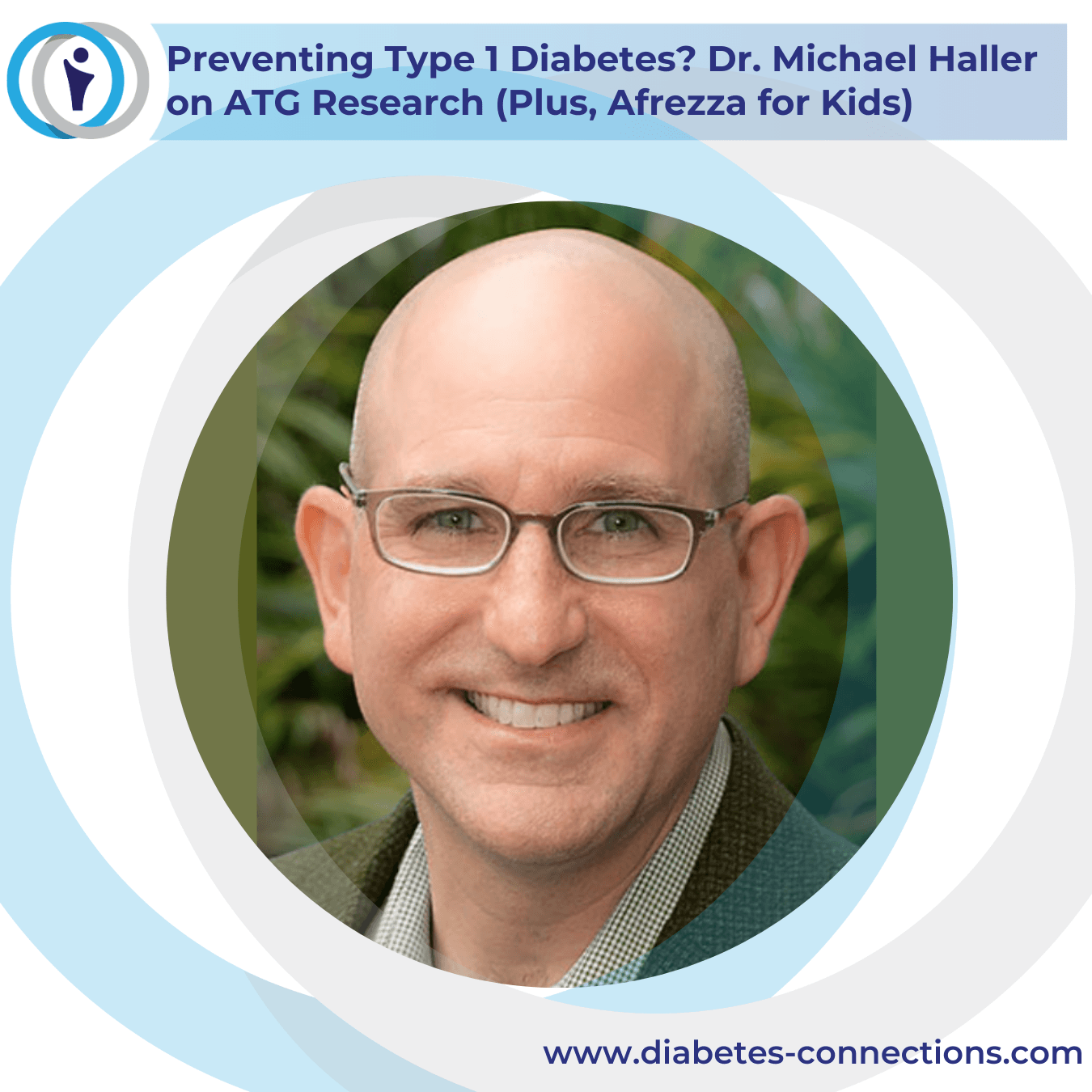
Diabetes Connections | Type 1 Diabetes
Preventing Type 1 Diabetes? Dr. Michael Haller on ATG Research (Plus, Afrezza for Kids)
00:41:53
Loading summary
Transcript38 lines
- [00:05]
A
This week on Diabetes Connections, a research update on two of the topics you've been telling me you want to hear more about. First, research into preventing type one with a therapy that has not been in the headlines. And second, inhaled insulin for kids. We're talking to Dr. Michael Haller. He is a pediatric endocrinologist who has been at the forefront of these studies. We're going to be talking about something called atg, which looks very promising and very low dose trials, and about the latest studies around Afrezza inhaled insulin for Pediatrics, which is in front of the FDA right now. This podcast is not intended as medical advice. If you have those kinds of questions, please contact your healthcare provider. Welcome to another week of Diabetes Connections. I'm your host, Stacey Sims. You know, we aim to educate and inspire about diabetes with a focus on people who use insulin. I hope you had a great Thanksgiving. My family came to town. It was a quick visit from everybody. But I have hosted Thanksgiving since I've had a job in broadcasting and I love having the holiday. I'm really lucky because my husband Slade is the cook in the family. So when we make our lists for shopping and executing the menu and everything, he's the one making all the lists and he's the one going to the grocery store. I'm usually the one saying what can I clean? What do you need me to move around? Can I set the table? So I know I have it really good but it was great to have everybody here and we are still really busy. I need to tell you that we have just opened registration for Mom's Night Out Detroit. I don't think we've ever opened registration for an event this far in advance. We now have registration open for the first three events of 2006. That's the Washington D.C. suburbs in February. We're going to be in Nashville in March and we will be in Detroit in the suburbs in September, September 18th and 19th. We'll also be in Seattle in October. We are working on opening registration there. It's venue dependent so stay tuned. I'm gonna keep our Black Friday sale open. I'm only gonna tell you about it here, not on social. If you are looking to register for any of those events, use the promo code Friday. I'll keep it up through the end of the week. I also had a Black Friday special that I'm keeping up through the end of the year for the world's worst diabetes mom books. If you're not familiar, these are part memoir, part advice, part funny story. They are both award winning I still feel a little funny about saying that the world's worst diabetes mom won Best New Nonfiction in a national book contest in Book Fest, so that was really exciting. They both are Mom's Choice Awards winners and they're both on sale. Head on over to diabetes-connections.com and use the promo code Holiday. And if you'd like to send these as gifts, get that to me as soon as you possibly can. And there's a place in the order form where you can write some notes. Tell me who you want to personalize it to, anything you want me to say, and we'll get those back to you. I cannot personalize Amazon copies, but the book is for sale there as well. Audiobook version is on Audible and I narrated them myself, which was a lot of fun. Okay. My guest this week is Dr. Michael Haller. He is a professor in chief of Pediatric endocrinology at the University of Florida. His grandfather lived with type 1, and Dr. Haller has been involved in type 1 research since the early 1990s. I have talked to him before. We last spoke to him in 2019 about Trial Net, but we last talked about him in 2021. I had interviewed a teenager who has had gone through one of the trials that eventually led to Tzield being approved. And Dr. Haller was his doctor that guided him through that. So it was a really fun interview. And I'll link that up in the show notes. You can hear both of them. That 2019 interview with Dr. Haller is fun because he's talking about the beginnings of ATG at that time. And ATG is very different from Tzield, as you will hear. I will let him explain that, but I think it's very exciting as we talk more and more about screening and we learn more and more about the stages of type 1 to have other options and see what works best. I mean, we may not know that for many years, but I think it's really good to know about what is going on behind the scenes. And a lot of you have asked me about Afrezza. It is in front of the FDA right now for the pediatric population. Could be approved next year for kids. We'll see what the FDA does. As you know, if you are a longtime listener, when something is in front of the fda, we have to be very careful about, you know, how we talk about it, especially with the company that makes it. But certainly we are well within the limits talking to Dr. Haller here. One more quick thing before we get to the interview. At the very end, you're going to hear me talk about. Hey, here in 2026. I'm new with my guests. This interview was originally scheduled for late January. You'll also hear that I thought it was going to be like a 20 minute interview. That was not the case. I just really liked it so much I didn't want to wait. Maybe that's the news person in me from my previous, you know, life as a reporter. But I really wanted to get this out asap, so I left that in. Yes, I know it's not 2026 yet. Okay, here's my conversation with Dr. Michael Haller.
- [05:09]
B
Dr. Michael Haller, welcome back to Diabetes Connections. Always great to talk to you. Thanks for coming back on.
- [05:14]
C
Thanks for having me again.
- [05:15]
B
Yeah, it has been a while, but let's talk a little bit first. What are you up to these days? Give me the latest.
- [05:21]
C
Yeah, sure. I'm a professor in chief of pediatric endocrinology at the University of Florida. I'm happily still seeing lots of patients doing lots of clinical trials work and advocacy as well, leading our trialnet clinical center. And it's an exciting time in the type 1 space. We've got lots of trials in the prevention space and the new onset space and the established space and we've got inhaled insulin to talk about in the pediatric space. New pumps and CGMs coming. So an exciting time for the field.
- [05:50]
B
Yeah, there's a lot going on. I want to start out by reading something, an article that I found on trialnet.org I just want to read the first part of the first two paragraphs here. It says, Amber Vandenhoovel received low dose ATG in 2015 as a participant in a trial net clinical study. Five years later, she still had beta cell function. Today at age 26, Amber is encouraging people at high risk for Type 1 to consider participating in a Trial NET prevention study using the same therapy. And then it goes on to say to help ensure Amber got proper medical care, her mom sought out the area's best endocrinologists and fortunately she found Michael Haller, chief of endocrinology and pediatrics at uf. I have so many questions here. First of all, kudos to you. That's fantastic. What is atg? What happened here and is it working so well? For real?
- [06:45]
C
Yeah. So antithymocyte, globulin or ATG or thymoglobulin, those are all the same thing. Unfortunately, it's a bit of a letters and word soup is a biologic drug that's been around for more than 40 years and is a mainstay of transplant medication most commonly used in treating folks who are having kidney transplants to both ensure the transplant goes well initially and to treat transplant rejection. And so it's a, it's a potent immunomodulating and immunosuppressing drug at a transplant dose. But our team and others have long been enamored with the notion of using lower doses of ATG to try and see if we could find a Goldilocks zone where the drug was still immunomodulating but not quite immunosuppressing, so that we could hopefully apply that in the type 1 space for folks who, you know, were recently diagnosed but still had significant beta cell reserve. In an effort to preserve the remaining beta cell function, we did a pilot study initially in the early 2000s where we gave low dose antithymocyte globulin, about a fifth of the transplant dose in combination with a second drug called granulocyte colony stimulating factor or GCSF compared to placebo. So patients got both active drugs or placebo. In a very small study, we found that it was highly significant in terms of its ability to preserve remaining beta cell function and reduced A1C. And that led to TrialNet committing to doing a larger multi center, well powered study that Amber participated in, in which patients got either low dose ATG or a combination of ATG and GCSF or placebo. So there were three arms and in that trial we again saw that low dose ATG actually by itself without the second drug provided a highly significant preservation of C peptide out to two years after a simple two day infusion of this drug and reduce hemoglobin A1C compared to placebo all the way out to two years, you know, which to date is one of just a couple of drugs that's been able to achieve that same goal, both A1C reduction and C peptide preservation, certainly at that duration after a single course of therapy. So based on that observation, you know, trialnet sought to see if we could move it earlier in the disease space. So moving from new onset or stage three patients to to trying to treat patients with stage two type one diabetes, those folks who have multiple antibodies and dysglycemia but who don't yet need insulin to see if we could actually delay their clinical onset of disease. And so that's the space that we're in now and working towards getting a new trial of low dose ATG in stage 2 patients up and running hopefully early in the next year.
- [09:44]
B
A lot there I Just want to clarify. I think most of my listeners are really familiar with the new staging, at least new to us, probably not as new to you in the research world of type 1 diabetes. So this drug in the past had been given to people who presented with type one. They're at the familiar path that most of us had been on acute onset, but that stage two is where they're tested. It's what we're hearing about a lot when people are saying get screened. Right. It hasn't really shown the signs. Just to clarify.
- [10:12]
C
Yeah. So screening nowadays is designed to identify folks even earlier at stage one of type one diabetes. So that's when people have multiple two or more autoantibodies that's been confirmed. And that confirmation part is important in folks who have two or more antibodies confirmed on a second sample. We know, unfortunately, that 99.9% of those patients are going to progress to classic type 1 diabetes, where they need to use insulin in their lifetime. But there's a lot of variability in how quickly that progresses, driven by a number of factors. But that is now the disease is there. Um, it's just in a preclinical state. And then people generally progress to stage two, which we can identify through monitoring studies of, you know, their response to oral glucose tolerance testing or hemoglobin A1C testing, or now even continuous glucose monitoring testing. That tells us they're losing the battle. Unfortunately. Their blood sugars are starting to act a little wonky. They. They don't need insulin yet, but we know that that's coming soon. And once you're in stage two, the timeline to stage three or needing insulin is much narrower. And it's such that the risk benefit calculation of potentially taking an immune therapy to push the disease off starts to make a lot more sense. If we had effective therapies that were low risk, we'd start treating people at stage one. And we even sometimes use the term stage zero to describe people who are at high genetic risk but don't yet even have antibodies. But obviously, if you're in that sort of setting, you wouldn't be willing to take, you know, a drug that has some risk associated with it. So. So everything in medicine is this balance. And we feel that our test case is using drugs generally in new onsets or stage three patients. Once we've got proof of concept there, moving back to stage two and hopefully even earlier in the disease as the drugs get better and safer.
- [12:05]
B
ATG and gcsf, separate treatments now. And are you testing both still? Is that what I Heard we are.
- [12:13]
C
No longer testing both because in the large trial net study where we had three arms, where we gave one arm, both drugs, one arm ATG alone and one arm placebo, we actually found that the ATG alone arm did the best. And so again, it's a good example of if a second agent is not improving the outcome and has cost and risk, then why would we expose patients to it? So we actually dropped the GCSF from our subsequent studies. And in fact, you know, our European colleagues took that observation yet another step forward and just recently published a study called Meld ATG, which Meld stands for the Minimally Effective Low Dose ATG. And they again studied the 2 1/2 milligram per kilogram dose that we found to be highly effective. And importantly, they, they found now for the third time that they confirmed our observation that that dose really does work in preserving C and lowering a 1C. So it's a very robust finding now. But they also extended the observation by finding that even a half a milligram per kilogram, which is the day one loading dose, provided a significant preservation of C peptide in their population. So that's, you know, the first small arm of a study to show that even a lower dose might be effective than our, what we've called low dose. We call that ultra low dose now. But what I think is really important is that it, it gives us now this very clear window called therapeutic window for this drug. So we know that, you know, more than two and a half is not particularly helpful, less than a half a milligram per kilogram is not particularly helpful, but somewhere between half a milligram and two and a half per kilogram is. And now we need to figure out which doses work best for which patients and which situations. And so we're moving into this era of hopefully personalized immunotherapy where we can tailor the drugs we're going to select and maybe even the doses to give patients the best chance at a good outcome.
- [14:06]
B
It may not be fair. And you tell me to even bring up Tzield into this conversation. I think that's the medication people have become more and more familiar with over the last couple of years. Does ATG work in the same way? I'd love an answer here from your perspective, the scientific perspective, and also from the patient perspective, because the first thing that stood out to me is it's a much shorter. Sounds like infusion time.
- [14:29]
C
Yeah, it is. I think that's the core question, actually, that we're all dealing with right now. Which is a great problem to have in that, you know, we finally have a therapy that's gotten across the, you know, the FDA goal line to be approved in topplizumab. And so toplizumab is a monoclonal antibody to a marker on T cells called CD3. It was developed in a lab going back to the early 90s and it took a nearly decade long study that was completed by TrialNet to generate the data to show that it could delay progression from stage two to stage three by initially two years observation and looks like with extended follow up, almost 3 years for average patients. That was a clinically significant enough outcome that the FDA granted the drug a license. And so now patients can receive that drug clinically. The interesting clinical trials challenge that creates is that, you know, patients who are identified as stage two no longer have to be in a clinical trial to access a drug that might benefit them. And so when we initially started the low dose ATG stage 2 study, we had designed it as a placebo controlled trial. Patients would either get active low dose ATG or they'd get placebo. But we learned very quickly that patients and families were not very excited about the notion of a placebo controlled trial where when there was an FDA approved drug out there, interestingly, even though a number of patients and families decided not to go forward with getting toplizumab because it is extremely expensive and has significant logistical challenges associated with it, it sort of created this inertia where patients and families wanted to keep their options open such that they could get toplizumab if they felt they really needed it and they might be interested in a clinical trial, but they didn't want to be a trial that might get them placebo. So there has not yet been a true head to head of the two drugs, but that is actually how the trial has now been redesigned. So we actually shelved the Original Low Dose ATG Stage 2 study and now redesigned it as a what we call a comparative effectiveness study where everybody will get active drug. Patients will either get low dose ATG or teplizumab in this new stage 2 study that we're opening through trialnet and it will enroll younger children that are currently eligible on the toplizumab FDA label. Currently the label is only for those eight and up. Oh, we'll be enrolling down to age four in the new trialnet study. And so the hope is, you know, we'll be offering something to patients and families that they're eager to participate in. They're going to get an active therapy one way or another, both of which have excellent data in both stage three and at least some preliminary data in stage two by way of ATG and certainly the strong stage two trialnet topizumab data. So I think that's going to be a winning approach to our trials moving forward and hopefully that's a space that the field will continue to be on in the future. You know, we're, I think we're all hopeful that toplizumab may get approved by the FDA in stage three patients in the very near future. They, they were one of the nine drugs that were given this FDA commissioner's special voucher program for an ultra rapid review. And so the FDA basically has to give the company an answer on a label within, I believe it's 60 days. So we'll, we'll have an answer to that relatively soon. And we may very well run into the same issue being that, you know, new onset patients faced with the opportunity to receive a clinically approved drug, you know, may very well not want to participate in studies where they could get placebo. And so we may have to shift many of our new onset trial designs to be comparative analyses as well. But there are challenges with duplizumab, as you mentioned. A, it is an extremely expensive drug. You know, it's $194,000 for pricing, which means it's cost prohibitive without insurance coverage for almost every family. And although we've been successful in getting it approved for many of those who qualify on label, it is cumbersome to get it pushed through because of that cost. It's also a daily infusion for 14 consecutive days, which is just a huge logistical challenge for many patients and families, working families, kids in school, young adults living their lives who really have to put everything on pause for two weeks to do the therapy. In contrast to low dose atg, which is, is a two day outpatient IV infusion. So antg, at least the rabbit ATG that we're currently using is a log fold cheaper than, than toplizumab. So from a, you know, disparities point of view or logistics point of view, low dose atg, certainly that has some significant advantages. But we have to, you know, first do the studies to see if it works as well as topplizumab. And if that's the case, then I suspect that we're going to find that there are certain patients for whom ATG is a better choice both biologically and logistically and financially, and others for whom toplizumab makes more sense, but that's a good thing. You know, our space is going to absolutely need more than one, what we would call induction agent, these more potent immunomodulators like that. And hopefully we'll then be able to choose our induction agent and then choose a number of different, what we call maintenance drugs that will continue the benefits, you know, with a less intensive perhaps oral or weekly sub Q injection of some immunotherapeutic that will keep beta cells happy for much longer.
- [19:49]
B
All right, I want to talk about that in the future, but just to go back, you're starting a clinical trial down to four years old. I know the next question people are going to have is how do they get into that? What's the best way to get into.
- [20:01]
C
Thanks for asking. Yeah, so, so you have to be screened in trialnet. My, my big PSA for today is if you have a family member with type 1 diabetes, you yourself are living with type 1 diabetes and have other family members, please get them screened. One in 20 first degree relatives or young second degree relatives of somebody living with type 1 is also unfortunately going to have type 1 diabetes. And the only way to know that before they present, you know, symptomatically or in DKA is to be screened. TrialNet offers the highest quality antibody screening available for free. It is still a research study so patients do have to complete consent forms. But we have ways to get screened via kits we can send to your home that are capillary collection. You can go to a quest diagnostics and we can send a kit there where they can be the phlebotomist for us or you can come to, you know, clinical trial net clinical centers. So there are multiple ways to get screened and for folks who you know, aren't interested in a research opportunity for screening, they still should be getting screened clinically. And pediatricians and endocrinologists should be offering antibody screening to the relatives of folks with type one. That's no longer a research question. You know, we've answered that question now through 15 to 20 years of doing antibody screening and it is a clinical recommendation that unfortunately still isn't getting done. Broad, vast number of folks out there who have relatives with type one. So yeah, I would, I would certainly strongly encourage people to do that. The good news is 19 out of 20 times antibodies are negative and people actually get a little bit of a sense of relief. Unfortunately, one out of 20 of those is positive. But once somebody is identified as positive and we confirm that, we then offer monitoring visits to Determine if they're stage one or stage two. And as soon as somebody is stage two with monitoring done in trialnet, you know, they would become eligible for this new teplizumab versus low dose ATG prevention trial.
- [22:00]
B
You've been doing this a long time. You've seen this go from a research question to, as you said, a clinical question. Just get screened. Your doctor shouldn't have any problem with that. You mentioned possibilities for the future. And I don't want to get too pie in the sky, right? This took a long time, but do you think that this prevention, I mean, teplizumab, you know, it's not permanent. Nobody's making any claims that it is. Same thing with atg. Do you think we will get to a point where it is an infusion, inpatient or outpatient or whatever, or some kind of treatment where you're diagnosed in stage one or two and then you never progress?
- [22:34]
C
Yeah, I mean, that's, that's our hope and dream, right? That's why we come to work to do this every day. I hope to find better, more effective therapies that can truly prevent the disease from occurring at all. And obviously an ounce of prevention is worth a pound of cure. And we, the old adage is true. And you know, the more we screen, the more we can identify folks, the more we can get people to participate in the research process, the faster we'll develop the knowledge base and the drugs that can do exactly that. And every other autoimmune disease on the planet is treated with chronic immune therapy. It's a bit naive to assume that we can give a drug once and walk away in a disease as complicated and as intense as type 1 diabetes and provide, you know, long lasting prevention. So all the trials we've done to date have sort of been proof of concept of can we, you know, even interdict the disease at all to change its natural history? But again, we've now shown we can do that, which now affords us the opportunity to ask the next question is, well, can we do better and can we make it not just a 2 to 3 year delay, but a 5 year delay, a 10 year delay, a 20 year delay, a forever delay. And to achieve that goal, I think we're going to need repeat courses of drugs and maintenance therapy. So that's where I think this notion of induction and maintenance is where the field is headed. And that is when you look at the world of rheumatology or allergy or even cancer immunology, most of those diseases are managed in that same way. So hopefully we can convert the type 1 space to the treating it like the immune media disease that it is. You know, if you sort of think about the history of type one, you know, a little more than a hundred years ago, this was a fatal diagnosis. Then Banting, Vest, Calipan, McLeod, it helped discover and develop insulin and we converted it to a chronic disease. And really now, and just in the last 10 years, we've started to have therapies that actually attack the core cause of the disease, the immune mediated issues. So I think we're just at the sort of the end of the beginning of immunotherapies and hopefully the next hundred years will see us convert the disease from something we treat with insulin and, you know, glucose monitoring to something we identify before anybody ever needs insulin, and then can kick the can down the road indefinitely by way of safe and effective therapies. We, we have a long way to go to reach that goal. But, but that's, that's what I'm hopeful we'll get to eventually.
- [24:54]
B
That's great. All right, I want to move on to the inhale information. I said it was going to be an hour, but obviously I could talk to you all day long.
- [25:00]
C
Yeah. One other exciting thing I did want to mention is there is a newer version of ATG that we're also going to be testing soon. So ATG is a biologic. It's made by immunizing rabbits with human thymus cells. That's where your T cells come from. Those are the cells that make up your immune system that unfortunately ultimately attack your beta cells. And so when we infuse people with rabbit atg, they're getting rabbit serum. And it's an incredibly effective drug, but it has some nasty side effects called serum sickness that have been the biggest deterrent to using that drug, frankly. A new version of ATG that's a fully human ATG has been developed. So it sounds somewhat science fictiony, but it's real. A company called SAB Bio, which for full disclosure, you know, I do consulting for, they have a humanized cow. So they took a cow and were able to cross in the genes that make human antibodies to it. And so you can now immunize these cows with the same thymocytes we used to immunize the rabbits with. And the cows see those thymocytes as being foreign and they make antibodies to them. But when they make antibodies, those antibodies are fully human. And so now we have a product that is the same, hopefully in terms of its efficacy as rabbit atg, but entirely eliminates that serum sickness side effect. And that gives us the potential for giving the drug multiple times with repeated courses. And so I think it may afford itself to be an even better option than the current rabbit ATG. There'll be trials with that therapy starting in stage three, new onset patients also, hopefully before the end of 2025 or early 2026.
- [26:33]
B
I reported on that for our in the News episodes with the cow. I remember that story. I didn't realize the implication. That's great. Thanks for bringing that up. It does sound like science fiction. That's amazing. All right. You are very busy. I do want to talk about something else that you have been involved in that is currently in front of the FDA and that is inhaled insulin for the pediatric group for, you know, Afrezza for kids. I know we have to be careful when something is in front of the fda. So if I, if, you know, you tell me what you can say, but tell me a little bit about how they did. Because my son is over the age of 18. We have used Afrezza. He doesn't use it all the time, but it, man, it acts really fast. What did you find in this?
- [27:14]
C
So, obviously, we are always looking for better, faster insulins. You know, as we've gotten better, better at measuring glucose, we all appreciate just how hard it is to cover glycemic excursions from carbohydrates. And even though our injected insulins that we call rapid, or even some people call some of them ultra rapid, they're really just not fast enough. And so it needs a bit of a paradigm shift to find other ways to give insulin. And one of those ways is through the lung vasculature by inhaling the insulin. And there was an inhaled insulin on the market, you know, over 20 years ago that was safe and effective, but was, interestingly, a commercial failure. People just didn't want to use it somewhat because the inhalation device was a bit cumbersome and clunky.
- [28:00]
B
It was giant. It looked like a big bomb. Dr. Haller.
- [28:02]
C
You know, yes, I wasn't going to use those terms, but yes, it looked like, for those who know, it looked exactly like a bomb. A better version of that has since been developed. It's called Tecmosphere insulin. So this is a biomaterial that binds to regular human insulin, the exact same human insulin that, you know, would be produced by a beta cell with no amino acid changes or other things attached to it, all of which are used to get insulin from the subcutaneous space into blood vessels faster. So this is just this technosphere bound to human insulin in what becomes a dry powder. And you can inhale it through what looks like a small pipe. And because of the ph change that it sees when it hits the lung walls, the tecmosphere dissociates from the insulin. The insulin is absorbed immediately through the lung blood vessels because there's so many of them. And the insulin is circulated within minutes. And so it provides a previously unable to be achieved rapid, we call it pharmacokinetic and pharmacodynamic profile where the insulin is peaking, truly peaking within five to 10 minutes and is entirely gone within 45 minutes, unlike any rapid acting insulin that you can give through an injection or a pump. Yeah, it has tremendous theoretical advantages. And so it's been approved now in adults for over a decade. This, this technosphere insulin. I've always thought that there would be a larger market for it in the pediatric world. And so I was fortunate to be part of the team that led Inhale 1, which was our pediatric inhaled insulin study, which was a non inferiority study designed to test inhaled insulin as your rapid acting insulin versus injected insulin in folks using multiple daily injections. And that paper is now published in Diabetes Care just as of last week. And what we found was that to no surprise, inhaled insulin was not inferior to injected insulin. When you compare it across the groups, it certainly wasn't better than injected insulin across the board. But this is where I think individual choice and options and tools really matter. So we saw that some patients did far better on inhaled insulin, some actually did worse. But this is where the art of medicine comes to play. And you know, the more tools we have to offer to patients and families, the more, you know, they can advocate for themselves and they can have some agency in deciding how they're going to manage it. And so I see there being a huge number of sort of test cases for where people are going to use inhaled insulin in the pediatric space. We already have many patients who do use it off label in peds as their only rapid insulin for all meals and snacks and corrections. I'd say I have a larger number of patients who use it as an adjunct. So they use it for particularly challenging meals, you know, pizza or Chinese food or challenging highs, or they use it when they have a pump failure and they have a really stubborn hod they want to get down quickly. We have a number of patients now who are even using it on top of their automated insulin delivery systems. I think that's a really exciting space because as good as the aid algorithms have gotten, the rate limiting issue is the speed of the insulin. And if you can give a meal announcement effectively by giving, you know, a puff of inhaled insulin and let the algorithm clean up the mess afterwards, I've been very impressed with how well that works. Now we have to get to a space where the algorithm can actually know that you've given inhaled insulin. Most of the commercially available insulin algorithms don't do that yet, but I think that's all coming. So there's going to be hopefully an approval of the drug. It's been submitted. There was no safety signal at all in the pediatric study. Non inferiority was effectively established. So hopefully we'll get approved sometime in the middle of 2026. And in the meantime, there are going to be additional studies popping up around the use of inhaled insulin with automated insulin delivery systems. And I'm also excited about a study that's going to be in pediatrics, specifically where we're going to offer inhaled insulin right at diagnosis. Imagine you're a new onset family. You don't have any sort of preconceived notion about how insulin is given. And I can tell you your child has to take just one injection a day. The rest is going to be inhaled. As you're, you know, drinking from the fire hose of learning about diabetes and have a child who might be needle phobic, just all of those things to me suggest that that might be a space where inhaled insulin really could have a nice niche for getting people through that transition period. And then if ultimately people, you know, end up switching to multiple daily injections or pump, you know, I still think many of those who experience how rapidly inhaled insulin works right from the get go will keep it in their tool chest and use it as just another part of the way they manage their diabetes to help them live their best lives.
- [32:38]
B
So you've already mentioned, and to be clear, and I think most people do know, but again, to be clear, you have to take a dose of long acting insulin with inhaled insulin. You know, that once a day shot, as you mentioned during your trial for pediatrics. Was that a standard? Were the kids on what they would have been on anyway? I mean, I know basal rate is kind of hard to talk about in general, but I'd love a little bit more information about that part of the study.
- [33:02]
C
Yeah, we, we tried to titrate patients basal long acting insulin, so they were waking up with, you know, fasting blood sugars in target range 80 to 120. We had a blinded CGM evaluation team. So they were, they were looking at patients, CGM tracings without knowing if they were on inhaled insulin or all injected insulin, and, you know, making recommendations based on, on obviously just the glucose values in an effort to try to make sure that the two groups were being compared equally. But patients were allowed and encouraged to adjust their basal insulin to achieve hopefully that same glycemic target in the morning between the two groups. But this was a study of adolescence, and to nobody's surprise, you know, adolescents who are weren't already at glycemic goal of an A1C, less than 7% found it challenging to achieve that goal. We still have tons of work to do in optimizing glycemic control for our teens with type 1 diabetes. You know, even in a study, we certainly weren't seeing the majority of folks reach A1C targets, but we did see a number of folks get there with inhaled insulin. And I think that just helps us demonstrate that for the right patient in the right setting, it's going to be a really nice option for them to use.
- [34:12]
B
I do get this question a lot, especially with pediatrics. And the question is, are their lungs going to be okay? Are there other things to think about with inhaled insulin?
- [34:21]
C
That's probably the most common safety concern people always bring up anytime you think of inhaling something, especially something that you can see it's a dry white powder that you inhale. The answer is there's absolutely no concerning safety signal in the pediatric studies to date and really none in the adult studies either. If somebody has a primary lung disease, they're not a good candidate for using aphraza. So if somebody, you know, has chronic recurrent asthma and is taking, you know, a daily inhaled steroid or requiring albuterol on a regular basis, or is, you know, heaven forbid, a smoker, this is not the right insulin for them. But other than that, there really wasn't any concern. About 20% of patients who inhale Fraser, report a cough when they start using it. But over time, people get used to the tickle of the back of the throat from the inhalation. People learn that angling the inhaler a certain way or taking a sip of water before and after often mitigates that. And then in terms of actual objective measures of pulmonary function, what we saw was that in the inhale one study, the difference in, we call it forced expiratory volume in one second, which is a fancy pulmonary function test measure, there was no significant difference between those who were on injected insulin and those who were on the inhaled insulin both at the primary 26 week endpoint of the randomized control study and as well as at the 56 week extension study. In fact, if anything, the pulmonary function was actually slightly lower in the folks who were randomized to the multiple daily injection than it was in the inhaled insulin. So I think with the available data we have on hand, there really isn't any concerning pulmonary function signal at all. And I think it's something that patients can use with confidence that it is the fastest insulin we have available to date and really can help patients achieve better control, especially in specific situations, you know, around hard meals or sports or activity or correcting, you know, right before bed. It has all these particular areas where I really think it's a, it's a superior insulin to anything we can give injected.
- [36:28]
B
It's funny, when we started this interview I said, oh, this won't be very long. Like, don't worry, I'll get you out of here on time. It's going to be easy. But man, you have such passion for this. There's so much great information. I'm so, so glad that you were able to spend so much time with me. But I gotta ask you before I let you go, I mean, and I know patients that you've worked with, so you are the real deal. You are very passionate about this. You still take so much time with all of your patients. Are you still really excited to get out of bed and do this every morning?
- [36:54]
C
Yeah, I am. My grandfather had type 1 diabetes. Even though I'm now bald and getting old myself, I'm not so old that I don't remember. I do remember, you know, when I was a kid and we didn't have glucose meters and you know, there were two insulins. And to think of how far the field has come, you know, in the last 40 years and you know, my involvement in medicine in the last 25 years, I'm really excited to see where we can get to before I'm done with my academic career. You know, hopefully improving the lives of kids and adults living with Type one, hopefully meaningfully preventing disease and hopefully one day reversing it. I wish I could say we were going to achieve that goal tomorrow. That's not going to happen. And I won't, you know, put a timeline on it because I think that's just unfair to people and unrealistic. But man, the pace, the acceleration that we're seeing does make me excited for the future. I think we will eventually get there and hopefully, you know, as more and more people see the value in participating in research and helping us answer some of these important scientific questions. We'll just continue to, you know, accelerate the pace of discovery and provide, you know, new therapeutics for people that really do change their lives. So, yeah, I'm excited to do this every day.
- [38:07]
B
Oh, so your grandfather lived with type 1. Has your family been screened, if that's not too personal to ask?
- [38:13]
C
No, we. Yeah, absolutely. Yeah. I had my kids. My daughter was old enough to participate in the Teddy screening and she was gene negative and then fortunately, antibody negative and trialnet screening. My son was just a little too young to be in the end of Teddy screening, but he subsequently has been screened in trialnet and they both participated actually in a study looking at the ENABLE antibody assay recently as controls. And unfortunately, we're negative in that as well. So our family, at least for this generation, seems to have skipped that risk and hopefully will stay that way.
- [38:46]
B
Yeah. So something new I'm doing for 2026. I'm asking my guests, what diabetes organization has made the biggest difference to you personally? Not so much. You know, I mean, I think there's a lot that we would donate to or perhaps we see as making a big impact. But, you know, in your life, I don't know if it's a fair question to ask you because you work so closely in it, but I'd love to know what you think.
- [39:06]
C
Yeah, I won't pick just one because that would be unfair because something made a huge impact in me. But I will, I will give you a few. And why. So the first would be Breakthrough T1D, formally JDRF. They gave me my first research grant that was transformative. I mean, that kept me in research. I probably would have been a clinician educator if it hadn't been for them giving me the opportunity to do research. And then I really got the bug. The next would be trialnet. That has been the thing that has given me the most excitement and passion for the space. I've been able to see my mentors do what, you know, I said, that's what I want to do when I grow up kind of stuff. So that's been exciting. And that's, you know, now I'm honored to be able to lead our trialnet Center. And so that's. That's had a huge influence on me. And then the Helmsley Trust, I would say next, they've been a huge funder of many of our high risk, high reward kind of projects, have just done so much for the field that other folks weren't able or willing to fund, and having that partnership with them has been tremendous. And then lastly, of course, the ada, who helps us to put together guidelines to hopefully turn things from research questions into clinical care. So I'd be remiss not to mention all those things. And then lastly, even the ispad, International Society for Pediatric and Adolescent Diabetes has allowed us to go beyond just the confines of the US and really affect care and policy throughout the whole world.
- [40:29]
B
Fantastic. I love it. We'll link all of those up in the show notes. Dr. Michael Haller, thank you so much for joining me for giving us such a thorough explanation of what's going on in these research studies. I really appreciate your time and I can't wait to talk to you again soon to see what's going on. Thank you.
- [40:44]
C
Absolutely. Thanks for having me again, Stacy.
- [40:51]
A
More information about those studies separately. Certainly in the show notes you can find out more about Dr. Haller and I will also link up the organizations that he listed there at the end. I'm doing this, like I said, in 2026. I think it's going to be a lot of fun because while there are a couple of really big diabetes organizations that you may be familiar with, I have been so excited to learn about the many, many other smaller groups doing important work, making meaningful change, and I want to highlight them here. So I'm going to try to continue that throughout 2026 and let me know what you think. Thanks to my editor, John Buchenis from Audio Editing Solutions. Thank you so much for listening. I'm Stacey Sims. I'll see you back here soon. Until then, be kind to yourself. Diabetes Connections is a production of Stacey Sims Media.
- [41:43]
C
All Rights Reserved.
- [41:44]
A
All wrongs avenged.