← Diabetes Connections | Type 1 Diabetes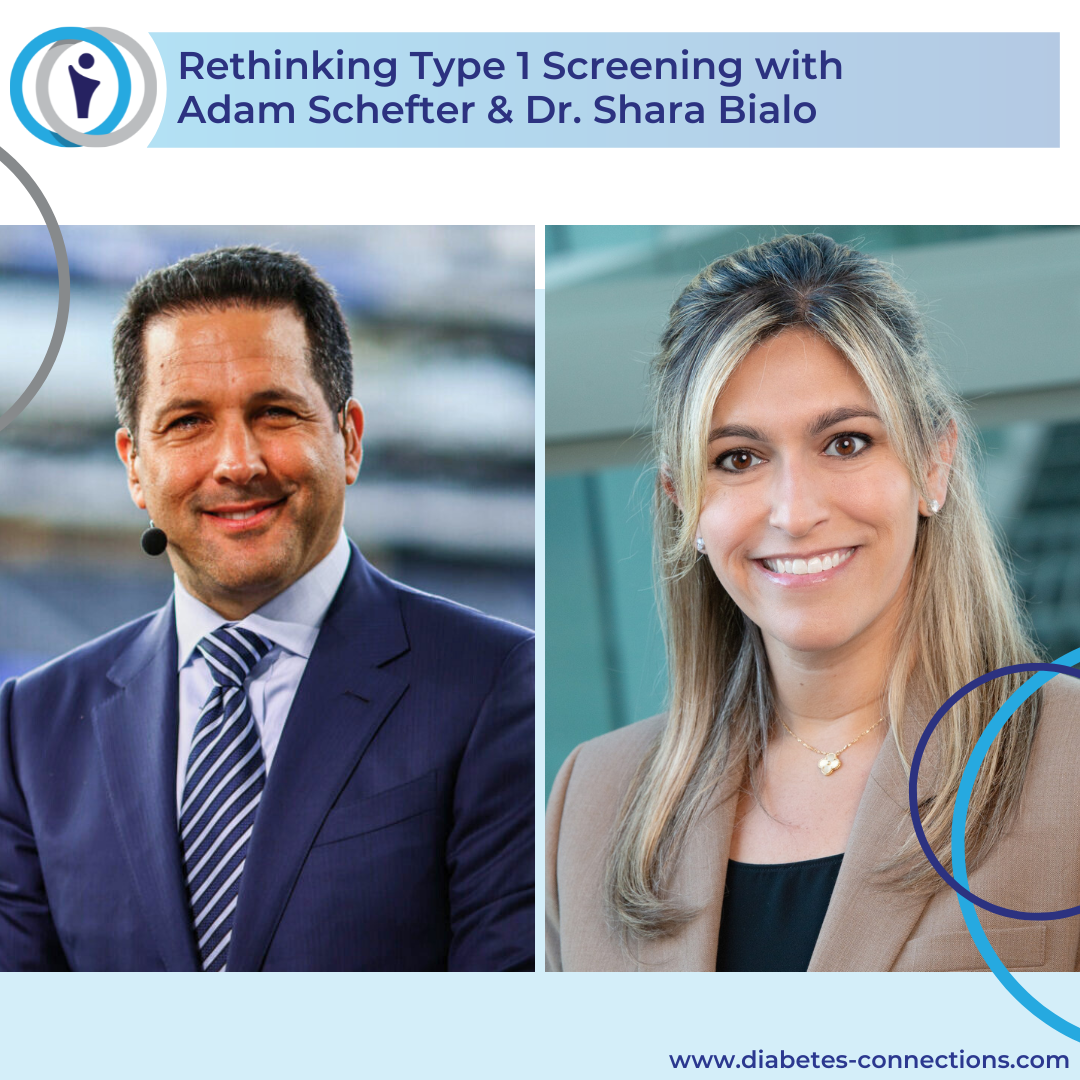
Diabetes Connections | Type 1 Diabetes
Rethinking Type 1 Screening with Adam Schefter & Dr. Shara Bialo
00:33:12
Loading summary
Transcript53 lines
- [00:00]
A
Hey, everybody. It is official. Diabetes Connections presents Mom's Night out is heading to four new cities in 2026, and the early Bird Special is on for our first two events. Registration is open for the Washington, D.C. suburbs in February, Nashville, Tennessee in March. There's no promo code needed, just select the Early Bird Special rate at registration. Whether you're a mom of a child with diabetes or a woman living with Type one, this is your night to connect and recharge and laugh with people who truly get it. We're gonna be in Detroit in September and Seattle in October. Head over to diabetes-connections.com, click on the Mom's Night out tab to learn more and register today, This week on Diabetes Connections. With a lot of family time coming up this week, for many of us in the US It's a great time to talk about screening for Type one. While this might seem to be a real downer of a Thanksgiving conversation, screening is now considered standard of care for people with a family history of T1D. And my guests want to get the word out about that. And they both walked this walk. Adam Schefter is ESPN Senior NFL Insider. His wife lives with Type 1, and Dr. Shara Biallo is a pediatric endo who lives with Type one. They've had their families screened. We're going to talk about the whole process, including the emotions, the expectations, and I snuck a few other questions in there, like marriage Dynamics with Type 1 CGM, sharing with your spouse. This podcast is not intended as medical advice. If you have those kinds of questions, please contact your healthcare provider. Welcome to another week of Diabetes Connections. I'm your host, Stacey Sims. Always so glad to have you here today. You know, we aim to educate and inspire about diabetes with a focus on people who use insulin. We are heading toward the end of Diabetes Awareness Month. There have been a lot of great activities in person events, great stuff online, clever campaigns. Whatever you did, big or small, I hope that you have taken care of yourself this month. It can get a little busy out there and, you know, the rest of the year is just gonna be a blur. It's always funny because when November ends, Diabetes Awareness Month, that's when our diabetes awareness really picked up. Because my son was diagnosed the first weekend of December, way back in 2006. It was actually at Thanksgiving that we really noticed that something was wrong. There had been some signs before that. I've told this story many times, but Thanksgiving was really the key to getting his diagnosis. And I just wanna mention real quick, and I'll Link this up in the show notes. I've done a bunch of episodes on Thanksgiving. It's a really tough holiday if you are newer or newly diagnosed, whether as an adult or if you have a child. Because as I've lear, a lot of adults with type 1 are just asked the most nonsense questions over and over again or, you know, all their relatives want to bring sugar free cake or pie or whatever. It's a lot. And as a parent of a newly diagnosed child, you're facing a lot of firsts perhaps. And of course, this is a holiday all about food. So I'm going to link up some episodes we've done in the past, including one of my favorites, Ask the D moms, where Maura McCarthy and I she's the author of many wonderful blogs and books, including Raising Teens with Diabetes. Maura and I answer your questions all about Thanksgiving and Christmas and the other December holidays because look, all there is is food right from here to the end of the year. When when my son was diagnosed though, back in 2006, screening at least to me seemed like kind of a far out research project. You know, people were doing it and you might see a booth at your JDRF summit or now breakthrough T1D, maybe at diabetes camp, but there just didn't seem to be anything that could be done. It just kind of went into this. Now, I know, you know, very important research bucket, but I think over the last couple of years we've learned the importance of screening because now more can be done. And I know I've talked a lot about screening this year, but I think the timing of this episode might be interesting, as I said in the open, because you're gonna be with your family. We're gonna talk about it at my Thanksgiving. There's gonna be information in the show notes if you want to move ahead with screening. It is easier than ever and it is a standard of care now. I mean, you should really be able to ask your pediatrician or your general practitioner about screening. And again, I will link up that information in the show notes. My guests this week are Dr. Shara Biallo and Adam Schefter. Dr. Biallo is a pediatric endocrinologist who also lives with type 1. She was diagnosed as a kid and she's now working with Sanofi to advocate for earlier screening, stronger guidelines and better mental health support. Adam Schefter is a senior NFL Insider at ESPN. He has worked at ESPN since 2009. He is non stop. He, you know, he works for ESPN Radio all of espn. He's got his own podcast. He's been on the show before. We talked to him. It's been a long time. I want to say like 2017. His wife, Sheri has type 1 diabetes and he has worked with Sanofi to help spread the word about screening for a while now. Sanofi is the maker of Tzield. This is the first of its kind, type 1 diabetes drug that delays the progression. It is available to patients age 8 and up who are in stage 2 of type 1 diabetes. Just a heads up, we're not talking about Tzield here. This is an interview about screening. I'm going to do more interviews about Tzield in the new year, but I will link up the ones we have done in the past. There's a lot of information out there. Full disclosure. Sanofi is a sponsor of our Mom's Night out events and they also sponsored a Club 1921 dinner we did here in Charlotte this fall. A question came up at that dinner that I want to talk to you about. I'm going to do this after the interview, but it was a really good and difficult question about what this kind of stuff means to people already living with type 1 diabetes. All right, my conversation with Dr. Shara Biallo and with Adam Schefter right after this. Diabetes doesn't always have to interrupt your day. Dexcom G7, a continuous glucose monitoring system, sends your glucose numbers to your phone or receiver. Know where you are and where you're headed without finger sticks and without interruptions. Dexcom G7 is the most accurate CGM and it's covered by Medicare. Learn more go to diabetes-connections.com and click on the Dexcom logo. Finger sticks required if symptoms or expectations do not match readings. See User guide for instructions. Data on file must meet coverage criteria. For full prescribing information on risks and benefits, visit dexcom.com Adam Schefter, Dr. Shara Bian, welcome to Diabetes Connections. Thanks for jumping on and doing this. It's great to talk to you both.
- [06:41]
B
Thank you for having us.
- [06:42]
C
Great to see you, Stacey.
- [06:43]
A
You got it. All right. Lots to talk about here. Dr. Biallo, let me start with you and just kind of give us the lay of the land right now on screening. I know there's been a lot of information for the Type 1 community in the last couple of years. What should we be thinking about right now?
- [06:57]
C
Yeah, so that's a fantastic question. It's actually a landscape that's evolving sort of day by day. I Think for a long time the attention has been on people who live with type 1 or autoimmune disease and have relatives. Right. That could potentially be impacted and would benefit from screening. That messaging has been out in the world and proposed by the American Diabetes association, by the International Society of Pediatric and Adolescent Diabetes. They've all sort of put forth this idea that if you are impacted by type 1 in the family or autoimmune disease, you should consider screening for type 1 diabetes by measuring diabetes autoantibodies. But the more and more involvement there is by breakthrough T1D and by experts in the field, the more the messaging is sort of morphing and evolving into. We should start to plant the seeds for general population screening, because we know that 85 to 90% of people who pop up with T1D each year don't have that family history that would have provided that flag for them to get screened otherwise.
- [07:53]
A
Yeah, I'm one of those families, even though my son was diagnosed almost 19 years ago now. But, yeah, no, you know, no family history. And Adam, you know, your wife lives with type 1. Can you talk about this? You know, the message that you got about screening and what this means to you?
- [08:08]
B
Yeah. Well, again, it's American Diabetes Month, and so it's to me, an important time to educate people about the importance of screening for early detection for type 1 diabetes. As you mentioned, my wife Shari, she's type 1. I know what it's like for her to manage the disease on a day to day basis. I always think of type ones as warriors, and they are, because what they fight through on a day to day basis is incredible. And it's why I partnered with Sanofi to raise awareness around the importance of screening for type 1 diabetes. As my wife knows, an unexpected T1 diagnosis can have serious impacts. And we know that you can't prevent type 1, but you can prepare for it. And screening gives you the time you need to prepare for it. And so that's why, again, I partner with them to come out and preach the importance of making a plan. Visiting your Doctor, going to screen4type1.com to learn more about T1D. Just think it's a very important issue for everybody.
- [09:02]
A
Was her diagnosis, I don't want to say sudden because, you know, every type 1 diagnosis really is acute, but did she have a family history as. As Shara alluded to? You know, so many people do not.
- [09:12]
B
My wife was diagnosed with gestational diabetes when she was pregnant for the first time. And then after she lost her husband on 9 11. A year later, she was diagnosed with type 1 diabetes. Wow.
- [09:25]
A
It can be such a shock as we both seem to share that, you know, no real family history. Certainly in my family, I think about my son being so tiny. He was 23 months old. With the research that we're seeing now, I feel like screening has, you know, we've talked about it on the show, probably more than the general public has. But when you look back at the research for screening, where do we stand on that? I mean, gosh, I was Screened more than 10 years ago by Trial Net. I guess the question there is how much progress has been made.
- [09:55]
C
Well, it's thanks to programs like trialnet that have really taught us about how diabetes rolls out. Right. It feels acute and we all talk about it feeling acute, but it's not kind of flipping from off to on from one day to the next. It's actually this sort of asymptomatic, slow, insidious process under the surface that we are blind to because we don't feel it happening. But it progresses in actually four stages. The first two stages don't have any symptoms. Stage three is the type one as we know it. The drinking, the peeing, the weight loss, the need for insulin. Stage four is the people like us, like me and Adam's wife, who've been living it for the long haul. But there are two stages before all that, Stage one and stage two, which are defined by the presence of diabetes autoantibodies in the blood, two or more. And then stage one is when the blood sugars are stone cold normal, and stage two is when they are mildly abnormal but not high enough to be noticeable physically. Right. It's called dysglycemia, and that was known in research for decades, but it wasn't until, like 2015, I think it was, that it made it out into like a guideline format for physicians to follow and understand that there were stages. And thanks to large scale population studies like TrialNet, we understand which autoantibodies are the ones to measure and how they tend to roll out depending on age. And. And the fact that if you do have two or more, it pretty much means a virtually 100% chance of progressing to stage three or clinical type one, needing insulin over the course of a lifetime. And we didn't know all that without people in the community volunteering themselves and their blood samples to kind of contribute to science in that way. And to your point, Stacey, it is changing and a lot is evolving and we can't make progress in this Field without those continued efforts, without continued, you know, medical volunteerism, so to speak, to volunteer for these trials to understand how diabetes rolls out. Cause as much as we've learned, there's still. They continue to bring up even more questions that we have yet to answer. Autoimmunity is a tricky little beast to figure out, but getting closer than ever. But I think with every question we ask, it, like, pops up 10 more questions to answer.
- [11:59]
A
Yeah. And let me ask you both this question. I expect you'll have different answers because, Adam, I know you've spoken a lot about this at conferences and with the lay public, and I know, Sherry, you talk with a lot of patients. But one of the things that I get asked a lot about screening is what is the point for Type one families? Because we, quote, unquote, we'll know if one of our kids, you know, exhibits the symptoms or will know if our spouses are showing the classic signs of type 1. Adam, can you tackle that just a little bit, just conversationally? What you. The feedback you get when you speak, do people bring that up?
- [12:30]
B
Yeah. I don't care how close you are to it. I think you always want to be prepared for that. And I make my living with information. I want information. And to me, this is the same type of issue. Right. You. You want to be prepared. You want to be with your doctor, have him screen you. You want to talk to him about type 1, you may not even know it's happening. It may be in your family, and you don't want to be blindsided by this sort of issue. You don't want certain conditions to creep in. Again, we know some of the things that could happen. Dr. Biallo can better explain that. I'm aware of that. I'll leave the medical side to her. But again, from my standpoint, it's just getting information in advance. Even though you know what it's like, even though you know what it's about, there's no reason not to talk to your doctor to be screened for type one in advance.
- [13:16]
A
Yeah. And Dr. Biallo, can you add to that?
- [13:19]
C
Yeah, I love this question, actually, because I think a lot of us fall victim to this idea that because we're intimately familiar with Type one, that that gives us. I think we want it to give us an advantage. And so, like, we want to think of it as, like, a leg up and to be able to see the signs early enough to avoid serious harm to our loved ones. And the. The truth is. The truth is a little cruel. Right. Like, when we look at studies that look into the rates of decay, even in those that have a family history, they're still quite high, up to 20 to 30%. Why is that? I used to give my son, when he was little, the side eye if he grabbed an extra sip of, you know, his sippy cup or if his diaper overflowed. Right. I would. I felt like I was so on top of it. And I'm sure a lot of us feel that way. But it just goes to show how tricky type one can be and how much it can mimic other things. Right. Just high activity level. You know, your kid's really active, or say you're really active, and you. You think that you're drinking more because you're active. Or even like the littlest ones that don't communicate, they can't tell you how they're feeling, and they actually progress very, very quickly before we may even have the opportunity to notice a pattern of signs. And then, you know, on the other end, there's teenagers and young adults who aren't communicating, like, with their family. They're independent, They're. They're getting their own drinks. They're going to the bathroom in the middle of the night by themselves. No one may be the wiser, and they might not know enough themselves to know that it's problematic. So there's a lot of reasons why I think DKA sneaks up on us and why a new diagnosis sneaks up on us. And I agree with Adam that screening, it's just a meaningful opportunity to have more control and fewer surprises in life.
- [14:58]
A
The first question I got from listeners when I said I was talking to you all was, would you ask them to share about how or if they have screened their own families or themselves in Adam's case, And as much as you're comfortable sharing how that was?
- [15:12]
B
Well, I don't like needles, but, yes, we have screened and we've screened our children, and I would advocate everybody do that kind of thing. And again, it's hard for me to get past it. And I think that's why they came up with them. I was screen it like you mean it rather than one prick. What was the expression at one point? Maybe Dr. Biallo knows. I don't know. But we've done it. I'm all for it, and I highly recommend that others engage in it as well.
- [15:36]
A
Was it emotional? Was it scary?
- [15:39]
B
I think it was more purposeful than it was anything else. Like, you just want to make sure that you're doing the right thing for the sake of your Family. And so that, to me, is more what it was like.
- [15:50]
A
Yeah. I mean, Adam, you are a matter of fact guy. I know. And you got 400 things going on at any one moment. But I'm going to ask your daughter when your son. Right. And they're getting screened, you and your wife, that had to be.
- [16:01]
B
Yeah, yeah. No, you're nervous. And fortunately, so far, so good. And that's the encouraging thing. Uh, but, yeah, look, I watch what my wife goes through on a daily basis. Dr. Bayala goes through on a daily basis. Um, like I said, nothing but extreme respect for all those type one warriors out there. And that's what they are. They're warriors. And with all due respect to my. I wouldn't want my children to have to go through that if they didn't have to. But again, that's part of the reason.
- [16:31]
A
That we did screen and Dr. Biallo, did you screen your family?
- [16:34]
C
Yes. And I. It's funny because my husband, I think, has the same mentality as Adam. He's, like, very pragmatic about it. You know, this is a way of giving an advantage to our family. I was a. I was a mess, a mess of emotion. And I don't know if that's just like being female or a mom or the fact that I'm the one that has type 1 diabetes. And there was this added, like, guilt factor that if it was positive, that would somehow stem from me. And I had a hard time processing that. I think it was, like, the lead up to the decision to do it that was very difficult for me. And my husband was the steadfast one and helped me get over that hump of, like, it being the right thing and was very supportive. Interestingly, he did not get screened, although I probably should have made him do it, because it's not like Type one's limited to the pediatric age range, you know, and his own family, you know, has some autoimmunity floating around it. So maybe like a second chapter to come. But we. We got our kids tested and the process was pretty easy. Right. I bribed them, they got their blood drawn. We did a commercial lab to do it. But I also didn't anticipate the stress of awaiting the results. And at the time the results were coming in one at a time, which I found especially anxiety provoking. Since then, commercial labs have done a great job of kind of clumping the tests together in panels, which. So you don't hopefully have to experience that anymore. And thankfully, my children didn't have diabetes autoantibodies and then the second wave of sort of emotional processing or third or a hundredth throughout the whole thing was that I was surprised by how much a relief the negative result was and actually continues to be. And although the negative doesn't necessarily mean they'll never get type one, it really means that right now they're not at immediate risk, because we know that can evolve over time. And now that I did it once, I'm completely comfortable with the periodic retesting. Right. Especially as they progress through childhood and adolescence. And so we've set reminders to do that every couple of years. And I think that I'm much more comfortable with the idea that it's quick and it really has given us a lot of clarity. And that itself is a gift. So I'm all about doing it again.
- [18:33]
A
Can you share a little bit about the retesting? That went by quickly, but I think some folks may not be familiar with why you might have to do that. For kids especially.
- [18:40]
C
Yeah.
- [18:44]
A
Right, back to our conversation. But first, Diabetes Connections is brought to you by Omnipod.
- [18:53]
C
Did you hear the pod drop?
- [18:54]
A
Did you know all the sounds used to make that song come from a site change with the Omnipod 5 automated insulin delivery system? Pretty cool, huh? With Omnipod 5 pump, site changes are simple. The pod lasts up to three days, 72 hours. And to change it, you just fill up the pod with insulin, place it on your body, tap a few buttons in the Omnipod 5 app, and you're ready to go. There's no tubing to prime like with traditional insulin pumps, and it's virtually pain free, so you never have to see or handle the insertion needle. Want to try Omnipod 5 for yourself? Request a free Omnipod 5 starter kit today by visiting omnipod.com diabetesconnections Terms and conditions apply. Eligibility may vary.
- [19:43]
C
Yeah, so diabetes autoantibodies can actually surface quite early, like between nine months to two years of age. And the vast majority of individuals do sort of convert seroconvert, as we call it, around that time. But diabetes antibodies, once they surface, they're not always present, meaning they can sort of wax and wane. And that makes measurement a little bit finicky and sort of throws a curveball into it a little bit. And so we know that the more you screen, especially with someone at in a high risk family, the more likely it is to actually capture all cases. So the idea is that, you know, if you're screening at around age 2 to 4, like 4 to 6, 10 to 15 around that time. If you do all three of those, then you're catching about 80% of cases. There's nothing in science or medicine that's absolute. So there's always going to be people who tell stories of screening and getting negative and then the next year popping up with clinical type 1. You'll hear sort of those scary instances. But we can only do so much, right? And we can do, you know, we can, we can try to take steps that give us the best possible probabilities. But the idea is, is that the more screens you do over time, the more information it gives you about the possibility of those who may be converting a little bit later in life. So at least in, in childhood, a few measures, a few years apart are a good idea. If you're one of those families that's already impacted by Type one.
- [21:00]
A
You know, it's interesting to talk to people who are adults with Type one and spouses of an adult with Type one. Quite often I'm talking to caregivers or we're talking about technology companies. So this is not a screening question, but I would love for you to share, if you don't mind, like, what does type one look like in terms of the way you share information on a day to day or regular basis with your spouse? And Cheryl, let me start with you. Like, does your husband follow your cgm? Are you one of these folks who's like, absolutely not. Like, do you mind sharing a little bit of what it looks like?
- [21:31]
C
Yeah, I'm, I probably fall somewhere in the middle. So my husband actually does not follow my continuous glucose numbers in real time. And that's sort of intentional. It's something we've discussed. He's open to it. I just think I've found a rhythm where I primarily manage things myself. And then he steps in when I ask or if something just seems off and he feels like he needs to offer. So some families work best, right, with shared data, others don't. So there's not one right approach. I think it needs to be a family discussion. And I think what matters most is that the person living with type 1 feels supported and not necessarily surveilled. Although I'm sure if you pulled teens, they, they'd have a very different point of view. But that's sort of where I stand as an adult. Pretty independent, but I know it's really nice to know that I can ask for help and receive it whenever I feel like I need it.
- [22:13]
A
Adam, does your wife ask you to follow?
- [22:16]
B
Not only does she not ask me to follow. She would never want me to follow, never. That would be a violation of HIPAA laws in my mind. She does things the way she wants to do things. But like Dr. Biallo said, like I'm there today when I left the house, she was not feeling well, she was not doing great. And it happens often. And I've come to learn when she's not doing well and when I have to step in and when I can offer support and when I have to take over and do things that she would have done. There are any number of times where I'm home doing television and she's supposed to pick up my daughter because I've taken her in from school and she can't go and I got to run out and run back home and scrambling around like these are just the daily functions of life and it could happen any day at any time. But no, I'm not tracking her numbers and she would never allow me to track her numbers. She doesn't want that to happen because honestly, I'm very on top of things, times, dates, punctual, like, and my wife is more carefree and loose about that kind of stuff. So I would be like, oh, you're at 73 right now. You know, we need to get things in order here. And she would not like that. She never wants to be told what to do.
- [23:25]
A
I think conversations around CGM is the best way, right. To not feel like the person is surveilled, as you said, but that you've got their back.
- [23:34]
C
Yeah, there's a big difference.
- [23:36]
A
Yeah, I mean I have a 20 year old son who was diagnosed at 2. So we've gone through the field of surveillance and independence and now independence is the good one. Adam, it's funny that you mentioned like you're on top of things and you're very punctual and you've got all these things going on and doing TV at home. I did ask my listeners if they had anything non diabetes they wanted to ask and this is more of a compliment than a question, but I'll see if I can turn it into one. My friend Matt, who works in public relations, met you at some breakthrough T1D events and he's seen you speak and he says as a leader in information gathering on your beat, your phone seems like your lifeline and your meal ticket. How he balances that with his family is like nobody else I've encountered. So kudos to you. That is high praise from my friend Matt. But also, how do you do that? I mean, we were sitting at this interview, you were over here, you were over there. You got talking to people. They're in the room. You're running here. You're. How do you do it?
- [24:29]
B
The same way that everybody else does it. It's just that mine is more public a lot of times than other people. I don't know that what I'm doing is all that different other than, like I said, it's oftentimes on television or on social media. And I have learned over the years to multitask fairly well. And so I could be doing TV and tweeting and doing this podcast at the same time. You might not even realize that I tweeted three times during the course of this interview.
- [24:54]
A
I love it. I love it. You know, let me be fair and ask the same thing to you, Shara. You're seeing patients. You're living with type one. You got a family, you got a practice. You're working for Sanofi. How are you doing it?
- [25:04]
C
Oh, I guess just one hour at a time. That's all we can do, right? I think that's. That's probably a lesson learned from living with Type one is that, like, you control what you can control and what you can't. You control how you feel about it. Right. And you just take things one at a time and nothing. The other lesson I learned from diabetes is that perfection is a total myth. It's not attainable. And I think that we try our best. And as long as we're comfortable with the idea that nothing's going to be perfect, days get a little easier, I think.
- [25:33]
A
Adam, I did get a sports type question for you. I used to work in news talk radio, and the worst part for me was when we would talk about sports, because, I mean, I was just the worst. So I apologize in advance, but I did ask my listeners, and Justin said he wanted to know who is your MVP or most improved player or coach of the year if the season ended today?
- [25:54]
B
If it ended today, it would be the Colts running back Jonathan Taylor. Running back Jonathan Taylor. But the season doesn't end today. There's eight more weeks, I believe. And in each of the last 12 years, the MVP has gone to a quarterback. So it's usually a quarterback award, and in the end, a quarterback probably will prevail. But the Colts running back Jonathan Taylor's having a season for the ages right now, and he would be my MVP today with eight weeks to go.
- [26:17]
A
And my question for you about sports is. I mean, I do see you tweeting all over the place. I see you non stop. Is this all still fun for you?
- [26:25]
B
Look, I love my job. I make my living around football. I get to do a job that I never would have imagined I would be doing as a kid if you had said to me as a kid, here's what you'll be doing. You're going to be working for espn. You're going to be talking to people in each football organization. You're going to be watching and tracking these games, trades, hirings, fire. I would have been like, how much do I have to pay you to do that job? But fortunately, I don't have to pay anything, especially with some of the bills I have and I get paid to do it. So it works out pretty well. And I feel very blessed and fortunate to do the job that I have.
- [26:58]
A
I feel like, I mean, I went to school for broadcasting at Syracuse and I feel like everybody I've met who was lucky enough to work in sports says the same thing. I would pay to do this if 7 year old me knew that.
- [27:10]
B
It's very true. It's very true. It's beyond what I would have imagined.
- [27:14]
A
That's great. So I'll wrap it up just by this. You know, you all have been talking about screening for a while now. I know, Adam, we've mentioned you speak to a lot of groups, Cher, you've been on the show and you address communities as well. Do you feel like people are hearing the message? Do you feel like the news is spreading? I mean, I guess I'm ending with, are you hopeful for this? And Adam, let me start with you.
- [27:35]
B
You know, here's the deal. Whether I am dispensing information in football or in sports, or encouraging people to talk to their doctor, to be screened for type one and to visit the website, visit screen4, type1.com, whatever it is, I never know the effect it's having and I never know the people it's reaching. I just try to stay on point and deliver something that I feel matters, whether it's football information or whether it's screening and talking to your doctor about getting screened. So hopefully it is reaching a lot of people. I hope it is. I never fully know, but it's my job to encourage people to prepare in advance and to talk to their doctors about it.
- [28:14]
A
Cher, I'll, I'll give you the last word on it.
- [28:16]
C
I think so. I'm coming at it from two different perspectives. One is the patient base, the families impacted by this. And it's definitely a topic that's pinging around the circles. You know, and so I think the awareness is definitely growing. Whether or not that's translating into action, I think is something that we could all put a little effort into. You know, we can't control everything about Type 1, but we can control how we show up for each other. And so if it means going with a friend or encouraging a family member to do the right thing and screen, I think that's where we have opportunity. But as a clinician and attending these diabetes based conferences for the last decade, I am astounded and delighted by how many symposia and educational sessions are geared around early T1D and screening and identification. And it seems like the topic is truly taking off academically. We know it can take a while for that to kind of, you know, ripple out into the community, but it's happening and it's in large part due to advocates like you, Adam, and you, Stacey. And I'm really grateful, you know, for everyone's collective voices to push this forward.
- [29:16]
A
Very cool. Well, thank you so much for joining me. I appreciate you. I know how busy everybody is, so thanks for jumping on and I hope to talk to you again soon. Thanks so much.
- [29:24]
B
Thank you for having us, Stacy.
- [29:26]
C
Thanks, Stacey.
- [29:32]
A
More duration on everything we talked about. Head on over to diabetes-connections.com and click on this episode's homepage. And I said before the interview I was going to talk to you about a question we got at the Club 1921 dinner here in Charlotte that we did with Sanofi. Club 1921, if you're not familiar, is something new that we have just started. This is a community dinner. It's not a big conference. It is a one evening event focused on one specific aspect of living with type 1 diabetes. We did two here in Charlotte this fall. We have more on the schedule for next year and we'll be announcing more about where we're going, who we're working with in really just a couple of weeks now. So please stay tuned. But the question that came up was this was a. A dinner all about information about screening and about Tzield. And the question that came up was, that's great. What about people who are living with a condition right now? Where's our cure? And I gotta tell you, when that question was asked, the mood in the room really shifted. A couple people told me after they did not think it was a fair question because that wasn't what was being presented. But I got to tell you, I think it was a very fair question. A lot of people, especially people diagnosed years and years ago Were told cure in five years or this will not be an issue for you when you're older. And those people are older now. And I think this is a really good question. And the way that we talked about it is, look, there are other research arms and other studies going on right now to provide what a lot of people would call a functional cure. Stem cells transplantation, things like that. But I see this kind of delay or prevention as a huge step toward ultimately curing type 1 diabetes. Will it pan out that way? I don't know. I mean, I'm certainly a layperson when it comes to this kind of stuff. And maybe a cure will come from a completely different direction or maybe there will never be a cure. I mean, I doubt that. But, you know, certainly in the near term, delay or prevention is the best chance for Benny's future kids. Kids and adults being diagnosed right now. And I think we can kind of walk and chew gum at the same time and not take away from incredible research that's going on over here by comparing it to research that's going on over here. But I do think it's important to acknowledge that worry about being left behind, because I have it for Benny. I mean, there's no doubt he laughs when I talk to him about this. He's like, it'll be fine. Like, it would be great. It would be amazing for future people not to have to worry about it. I'm fine. But, you know, I don't see it that way. So I get it. I really do. And I thought that was an important question. And if you're feeling that way, I think you have every right to your feelings. But it certainly doesn't negate the incredible research and progress that's being made here. Let me know what you think. I would love to hear more. And if you've listened all the way through to here, we are going to have a pretty normal schedule for the rest of the year. I am not doing an in the news episode this week because it's Thanksgiving, but we'll be back on that next week. And I plan to have an episode every week for the rest of the year. Except probably Christmas week, but you never know. A lot of times there's some FDA approvals that come very late in the year, and we've been known to do a quick turnaround if something like that happens. Thanks to my editor, Jack John Buchenis from Audio Editing Solutions. Thank you so much for listening. I'm Stacey Sims. I'll see you back here soon. Until then, be kind to yourself. Diabetes Connections is a production of Stacey Sims Media. All rights reserved. All wrongs avenged.