← Diabetes Connections | Type 1 Diabetes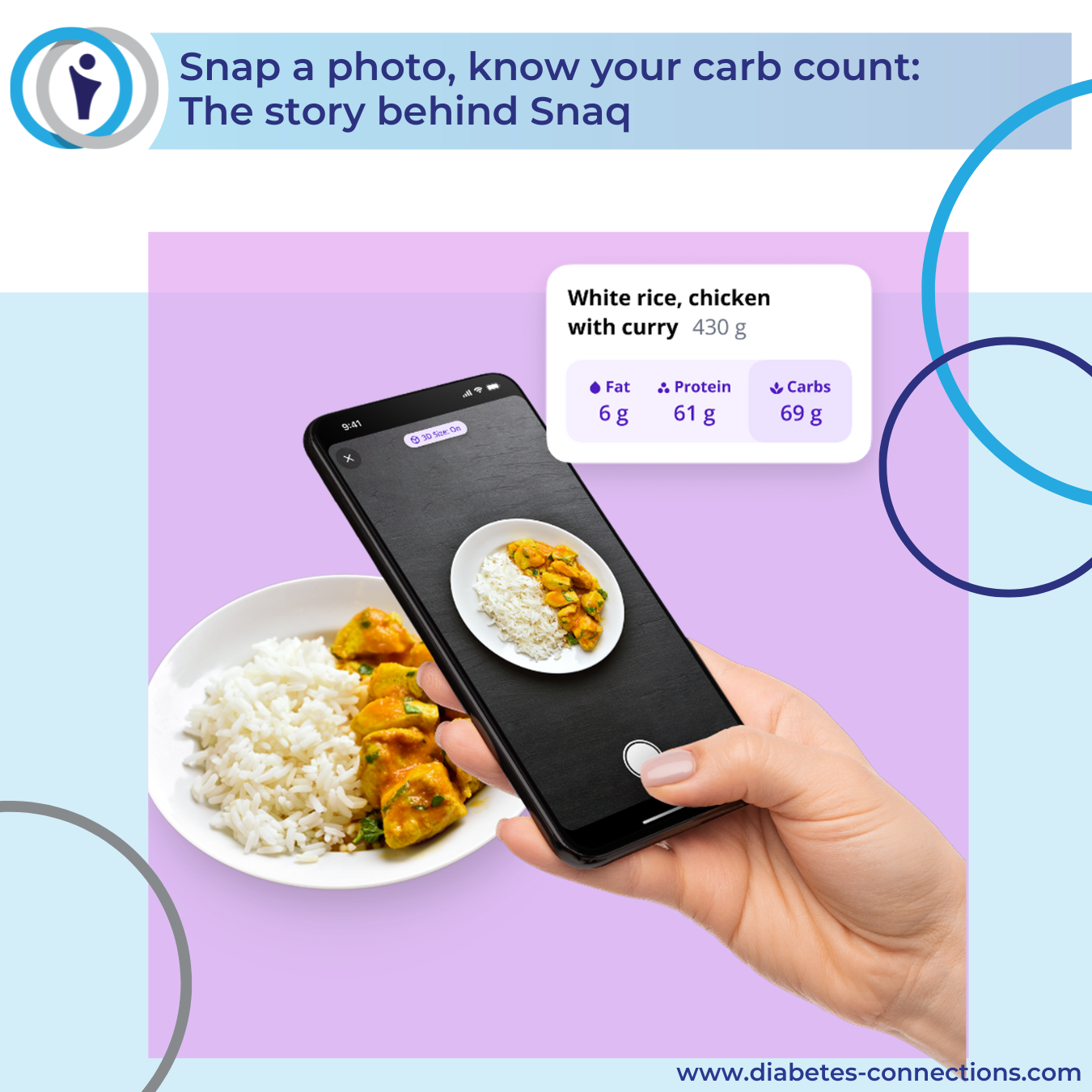
Diabetes Connections | Type 1 Diabetes
Snap a photo, know your carb count: The story behind Snaq with founder Aurelian Briner
00:32:25
Loading summary
Transcript58 lines
- [00:05]
A
This week on Diabetes Connections, taking a photo of your food and getting an accurate carb count seemed like a pipe dream just a few years ago, but this week's guest says it is here. Snack with a Q wants to help you get nutritional info and then see how that food actually affects blood glucose. Thanks to integrations with CGMs, Palm and activity trackers. SNAC founder Aurelian Bryner explains how his wife's type 1 diagnosis inspired the company. How it all works, including who owns the data and what's next. This podcast is not intended as medical advice. If you have those kinds of questions, please contact your healthcare provider. Welcome to another week of Diabetes Connections. I'm your host, Stacey Sims. You know we aim to educate and inspire about diabetes with a focus on people who use insulin. And welcome to November. Happy Diabetes Awareness Month. I always say this is a month for people not in the diabetes community. It's all about education and spreading the word and maybe getting some mainstream media attention so we can maybe educate and inspire elsewhere. But I do have something to announce very soon for the diabetes community and you do not have to travel anywhere to take part in it. Please stay tuned. I'm going to be announcing on social media and certainly by next week. We're going to make this easy and fun and it's a way you can participate in the show in 2026. All right, now if you do want to travel and be in person, we do have a Club 1921 community event next week here in Charlotte and we will be announcing more of those events in other cities soon. Really excited about how Club 1921 has taken off and I'm hoping to bring it to a city near you next year. Registration for Mom's Night out is opening for DC and in Nashville. We're going to be in the DC area, really? Silver Spring, Maryland. And that is February 20th and 21st, and we will be in Nashville March 6th and 7th. Registration may be open already. If it is, we do have a flash sale, so no promo code is needed. Head on over to diabetes-connections.com, click click on the Mom's Night out tab and you can see the other cities for next year and all the stuff we've got going on. And a huge thanks to everybody in Phoenix. That was such a fantastic event. I promise I'll get you the photos soon. Man, we are busy over here, but I'm so thrilled how that went. Special shout out to the Diabetes Network of Arizona. What a great community organization. If you're in that part of the country and you haven't heard of them, it's super easy to remember. DNA Diabetes Network of Arizona. Love what they're doing out there. Okay, so this week I'm talking about snack Diabetes Food and Glucose Tracker. The website says count carbs by snapping a picture and get insights on your glucose levels after meals. As you'll hear, founder Aurelian Bryner started the company when his wife was diagnosed with Type one. Now, like many of you, I remember back in the day before smartphones. I remember using the Calorie King book and thinking, somebody's gotta build a better mousetrap. Somebody's gonna be able to do this and take a picture of my food and tell me what the carb count is. And especially when smartphones came out and the camera was built in, you know, you knew it was coming. So how close are we really? You will hear us talk about some studies. There are some clinical studies about this. I'm gonna link those up. Just go to diabetes-connections.com or look in the show notes. You know the drill and I know some of you are already using snac, so I would love to know what you think. We will put this into the Facebook group Diabetes Connections. The group, you can certainly email me if you're not on Facebook. Stacyiabetes-connections.com, but I think it'd be really interesting to get some feedback from those of you who are using it. All right, my conversation with Orillian Bryner right after this. At one of our recent Mom's Night out events, the Omnipod team was on site asking moms about their experience with the OmniPod 5 automated insulin delivery system. It was so much fun and it was great to hear what the moms have to say. Here's what Angela, mom to Dominic, told us.
- [04:09]
B
My son is 10 years old and he uses an Omnipod 5. It's the only pump he has used since he was diagnosed. It's been a life changing piece of equipment for him to have and he's a competitive swimmer. He is able to keep it on in the pool and we don't have to worry about disconnecting. So we absolutely love Omnipod and it has really just made a big difference in his life.
- [04:28]
A
Want to try Omnipod 5 for yourself? Request a free Omnipod 5 starter kit today by visiting omnipod.com diabetesconnections Terms and conditions apply. Eligibility may vary. Aurelia and Briner, welcome to Diabetes Connections. Very interested to learn more about snack. Thanks for being here.
- [04:48]
C
Likewise. Thanks a lot for inviting us and happy to be here.
- [04:52]
A
Let's start by talking about the idea for this. You've been working on this for a very long time. It's been out for a while. What was the impetus for starting Snack?
- [05:03]
C
Yeah, the impetus for Snack was that my wife got diagnosed with type 1 diabetes now more than 10 years ago. And that's how I got into the whole topic of diabetes and also the importance of managing meals. Because being newly diagnosed and actually Even now like 10 years later, that matching meals is still one of the her main challenges. So, yeah, that's how we get into it initially.
- [05:28]
A
I recall when my son was diagnosed, being overwhelmed not just with managing the diabetes and the shots and the blood sugar checks, but like, you want me to analyze all this food? Did you have that experience?
- [05:37]
C
Yeah, well, I mean she, she asked me, you know, we were sitting there at the dinner table or at lunch or at the restaurant, basically. She was also asking me like, hmm, okay. I mean first it starts, does that food half like, like carbs in there or not like. And then the other thing is, okay, what's the weight? And now what should I do with that? So that's how, you know, I got really kind of firsthand or secondhand experience, so to say as well on the real world challenges of, of managing food and diabetes.
- [06:09]
A
I mean, I could take us through the whole story of how it started and what it was in the beginning. Let's skip to now, maybe go back and fill in some blanks. We what does Snack do?
- [06:17]
C
Snack helps people living with diabetes to better manage their meals. And the initial idea was all about carb counting and making that easier. Uh, so what Snack is best known for is the capability of taking pictures of meals and converting that into nutrient content. Uh, so predominantly carbs, but also fat, protein, calories. We nowadays provide the whole range of how you can capture meals. So taking a picture, that's actually still the most used, but you have very comprehensive food database. You can search for the items. We have a barcode scanner. You can log with voice, which is also very cool. You can scan the labels off of your food items and so on. So really like everything which is out there and has a reason to exist on how you make food tracking simpler. So that's the one part and then the other, like more diabetes specific aspect to it is that we connect that with like all like the diabetes devices. So you are able to connect your cgm, you're able to connect some of the insulin pumps or insulin pens to have all the like nutritional food data in context and additionally also like the variables. So the activity trackers which are out there as well. So basically bring a bit more, not just the data but actually the why did my blood sugar change or why a certain meal behave in, in that way. So bringing all together and trying to give, give some insights around that.
- [07:49]
A
So in other words you would use this if you connected everything. The idea would be trying to get a picture of how this food affected your blood sugar in the context of dosing and exercise.
- [08:00]
C
Yeah, in, in the context of basically all impacting variables. So uh, that also includes instant data but it also includes activity data because your postprandial glucose for the exact same meal might be very different depending on whether you exercise before or after that meal, for example. So really try to put those things together and provide insights around meals.
- [08:26]
A
Okay. Now my listeners know that my son is old enough now that I'm not involved in his day to day care. He, he comes on the podcast every once in a while. He does not want to look at lots and lots of data. So he's not the greatest example perhaps here. So I'm trying to figure out somebody who is more interested and I, I shouldn't throw my son under the bus like that. But people know Benny, but like somebody who is really interested to see how this all comes together. Can you take me through how a day would look, what would they do and what kind of information would they get out of it and then how would they use it?
- [08:57]
C
Sure. So typical main use or like the most used action within the snack app is actually logging the meal. That's where it all starts. And then all of the data is connected to it. So basically the people would take a picture of the meal. It does as much automation as possible as well as reasonable to then like analyze the different food components. So maybe when there is, I know some chicken, some rice and some vegetables, we'll try to identify that, make suggestions like look that data up in the, in the nutrition database. Depending on the phone we also estimate portion sizes. Then basically as an output of, of that analysis you're able to get the carbs, fat, protein, calories for, for that meal. You're always able to edit. I mean all these AI technologies obviously are not always right or perfect, but we've seen a clear trend that, I mean things get so much better. Like people are so much faster just in this year like logging a meal with Images is close to 3x faster than it was in January. So like actually that's how fast People are in reality so not just like some metric we came up, but it's, it's the actual real, real world data. And then besides capturing the meal after that, for example three hours, they see the glucose evolve for that meal, they see their post meal timing range, get some insights and maybe how they could next time change some certain ingredients of the meal which might have a different glucose pattern associated with it afterwards.
- [10:33]
A
This is a dicey question to ask you because you're with the company, but how accurate is the carb counting? And also how can we scientifically know? Because carb counting seems pretty inexact as a science anyway.
- [10:48]
C
Maybe I'm wrong. You're very much right. And actually we, we have been putting our heads together on that question quite a bit. We are actually the only commercially available solution which has peer reviewed the accuracy studies on our carb counting piece of the technology and actually two or three which are now like officially published. And I mean what have we done in, in those studies basically to, to validate the accuracy so far they were taken at hospitals because hospitals need to quite detailed know what's actually in the meals which they provide their patients in general, not just people with diabetes, but with all other conditions as well because there are lots of dietary restrictions occasionally and that we used as, as a benchmark. And obviously then you know, the, the hospital kitchen was preparing all these different meals. There are typically, I don't know, like 50 to 100 different meal components on every given day which they can assemble. And they did that like changed different portion sizes and so on. And then they basically compared it to snack and as well in one of the studies compared to the own estimates of people who have living with diabetes, with type 1 diabetes in that particular case. And that's how it was set up. So we were basically competing against nutritional values as well as a scientifically calibrated scale in regards to the weight with snag and, and the estimates of the patient. So that's how these studies are usually set up. I mean otherwise like real world benchmarking and all this kind of stuff is very biased and it's challenging. But in general to be very fair, like it also depends a lot on how you evaluate this accuracy. And then in the real world again it also depends quite a bit as well on the usage and the user itself, what real world accuracy people are able to achieve.
- [12:38]
A
Yeah, well, I really appreciate that answer, thank you. Do you use the user's data to help the system learn? Like when I use ChatGPT, right. It's using my information to learn what it does next time. Does your system work that way as.
- [12:52]
C
Well in that regard? The kind of this like, memory aspect on certain places? Yes. It doesn't directly help to optimize kind of, for example, the image. I mean, in some cases it does do that, but I mean, the. It's more on the personalization aspect than on the overall training of the algorithm. The models evolved a lot and it doesn't necessarily exactly work the same way as maybe in 2017 or 2018 when we got started, where the personalization is now much more crucial to the value of this individual user than the overall model training because the foundational models, so to say, are already at a very good level by default.
- [13:31]
A
This is a question I ask like dexcom or Libre, who have been a lot, but who owns the data? Who owns, when I, if I buy a subscription to Snack, who owns that data that I'm putting in?
- [13:42]
C
Yeah, we are different than actually probably most of the companies in this space, or at least not in the digital side. So yes, we have the capability to like improve the product based on that data, but we don't have the right to, to sell that data. And I mean, in our case we're very clear. I mean, we are not a free app. Right. And we're very clear that we don't show ads and then we don't sell the data because our incentives are directly aligned with the benefits from the user. Because simply if you don't like the product, you will not continue to use it or you will not buy it at the first place. And these are aligned with our commercial incentives. So yeah, we have a straightforward business model in that regard, which also doesn't incentivize us to do like funky things on the data piece. Yeah, to be clear, like, you know, in one or the other way, like software or products in general are rarely ever fully free. So, you know, even my Instagram, Maybe Instagram or WhatsApp or Facebook appear to be free, but it's not the case. And also obviously no Google or any of these other products. Yeah, they're monetized, but maybe not in obvious ways, whereas with us it's a bit clearer.
- [14:58]
A
Well, I think we've all learned, right? If it is free, then we are the product. Yeah, right, we are. We're the ones that they, they want our data. And I've learned over the years, Aurelian, just to ask that question. I think it's important, especially in healthcare. And you're, you know, you're in Europe, but you're you know, we're in the US and your product is, is for sale here. So there are some differences in terms of rules, but at the same time, especially in the diabetes community and, and you're part of that. You know, your, your wife has type one. We've kind of learned that overall, nothing is free, but it's always important to ask about health data. So, you know, it wasn't a criticism of it being a paid app. It was more of a question of like, well, what, what happens? So.
- [15:37]
C
No, yeah, I, I fully understand. And actually I would be more skeptical, maybe also as a user in general of any product when it's fully free, like, because there must be some incentives around it.
- [15:49]
A
All right, so when you, over the last 10 or plus years of developing snack, what food has given you the most problems? There's gotta be more problematic food in terms of accuracy than others. I can't even imagine where you would start with. When I think back to Benny.
- [16:05]
C
Right.
- [16:06]
A
Casseroles and homemade foods and restaurants and I mean, there's so much variety. Right back to our conversation. But first, Diabetes Connections is brought to you by Dexcom. Like most of you, we don't love worrying about insurance. I'm thrilled to tell you that Dexcom CGM is covered as a medical benefit for 98% of commercial insurance plan holders who have type 1 diabetes. And more and more plans cover CGM for people with type 2 who use insulin. We even have it as a pharmacy benefit so I can process it at the local pharmacy. They put it on auto refill for me, which makes it really easy. It's one less thing to think about. It's worth checking to see if that's available to you. And Dexcom will even help you do a benefits check to see what your insurance covers. It's easy. It's right on the website. Dexcom is the number one covered CGM brand. Learn more. Go to diabetes-connections.com and click on the Dexcom logo.
- [17:05]
C
Fun fact in that regard. I mean, what we also learned from the data, 80% of the foods, actually there are a couple of hundred food items which make up roughly 80% of the food logged. So even though there is a, a lot of diversity overall, there are a couple of main items which are not that many, but the remaining 20%, that's a very, very long tail, literally going into the hundreds, hundreds of thousands or millions of different food items that there's a huge diversity, particularly in the, in the US obviously with many ethnicities and backgrounds of different people. I mean, how our algorithms are set up, they're actually quite independent of the actual food type. So yeah, they, it's. That's why I said like the personalization aspects play a bigger role even with foods which the app hasn't seen a lot or hasn't been locked a lot. So as soon as you log it one or twice, we start personalized and optimize more towards that very particular cuisine it might be cooking.
- [18:09]
A
Did your wife have anything that she found difficult to log or, or to get the system to learn?
- [18:14]
C
It evolved over time, so we, we revamped a lot of our algorithms in the beginning of, of this year and with each of these like bigger changes, it, it changes as well. Like now like the granularity on where we are able to recognize things is much higher than in the past. But generally there's not like one type of food or type of cuisine, which is extremely more challenging. I would say though, it's the same as for whether it is for a dietitian or a person developing diabetes. As more mixed the stuff is, the more difficult it gets. No matter of the type of cuisine.
- [18:48]
A
What about depth? You know, I'm thinking of like a bowl of soup or a slice or a chunk of something and you take a picture and it kind of looks flat. How do you account for that?
- [18:58]
C
So that's what I was referring to initially that on some devices with the required cameras, we also estimate portion sizes and only on those cameras we are able to really do a volumetric, so a 3D picture and derive the, calculate the volume and through the density, the weight of it. In the others, I mean, we're doing the best we can, but we don't really actually estimate portion sizes that much, but they need to be eventually adjusted by the person using it. We do the best we can. Obviously, as with any technical system, you can only do as good computations when the proper input data is there. And that will depend currently at least on some cameras.
- [19:44]
A
I'm also curious what user input has changed because, you know, you don't know what you've got until you put it out in the world and then you find out that people like this or they don't like that anything stands out that you've adjusted because of the user input a lot.
- [19:58]
C
We are very, I'd say, open and very reactive to user feedback. Like over the course of these years there probably have been thousands of changes which we explicitly did because people asked for it. We also have within the app there is actually like the roadmap as well as A place to like request features which people then can upvote and download and so on. So we were transparent about that and we were also very open to feedback and like just since we introduced that produced. Yeah, implemented. Yes. So there's a lot of transparency in general on, on the user feedback as well as on what we're working on and like how people can get their stuff to be more noticed and get priority ultimately in the implementation of improving Snack.
- [20:43]
A
I should have probably asked this earlier but what did you do before your wife was diagnosed with Type one? What was the, the background for somebody to do something like this?
- [20:51]
C
Sure. So actually I come more from the business side with a bachelor Masters in Business. Then I got into software, was a software product manager in a B2B software company and then together with my co founder Nico is very much a technical background from ETH which is a very well known technical school here. Then we got together and basically started with Snack.
- [21:16]
A
Nice. And how's your wife doing these days?
- [21:18]
C
Well, the biggest happening of that year has been that we got our first baby basically in May. So yeah that was big part of our focus on in our private life this year. Obviously that also impacted a lot. I mean dismanagement particularly the last couple of months before and yeah now a bit less after she's enjoying a bit more freedom again disvention side.
- [21:47]
A
Well, congratulations.
- [21:48]
C
Oh no, everything went very well and I think she had the best ever bloodshed Sugars in her 10 years diabetes life so far in these nine or respectively like 12, 18 months even including the time before.
- [22:03]
A
I'll give you a chance to give Snack a plug here. I assume she used it during her pregnancy.
- [22:08]
C
Yeah, it was, it was heavily used and I mean the, the outcome were also noticeable but I mean you know, you know how it is how it is with mentioned diabetes you're not like always on a hundred percent there is life and you know you want to enjoy. But there was certainly that was obviously a time period where she and we together paid much more attention to it. But it's also amazing on what you can achieve with if you really have the willpower and the energy to, to put into it. It's unimaginable actually these levels. If I would have asked her probably before she would said nah, that's impossible. It's so hard and it's so restricting. But I mean yeah it was sometimes respecting but it also worked out.
- [22:53]
A
Yeah, I mean I have so many friends who've had type one pregnancies and they are amazing.
- [22:58]
C
They.
- [22:58]
A
I Mean, you know, it's so hard. It's so hard. So I know it's the first time you and I are talking about Snack. It's the first time many people are learning about it. But I have to ask like, what's coming next? What do you, where do you hope this goes? What do you want to add to it? What would you like to see?
- [23:14]
C
Yeah, so it's certainly in general a very exciting time to work on software and particularly also in the, in the healthcare area to work on software. Overall. Like we're close to 15 years now doing software and I mean the last 12 to 18 months has probably been the most exciting time ever in our careers to work on that. Just a couple of things because things are moving so much faster in general on how you can iterate and the things you can build build also particularly on the things you can build, like stuff which you think would have never been possible or extremely hard to develop suddenly become reachable within doing that within a couple of weeks or within a couple of months. So we've came much closer to, I would say kind of a dream experience we envisioned for Snack so that the recognition is like to a large extent very automated, that you can use voice, all these different modalities you can interact with, with the data integrations and so on. So we've come much closer to like the core experience we wanted to have at start. I mean there's still a lot of things we can do and optimize particularly also with for example supporting more devices on the portion estimation and so on. But that's an ongoing effort which will probably never will be done. There's always more to optimize on the course. But the bigger topic, a more recent topic which we see evolving is currently we allow people to, to track data and to get, get insights. Some recommendations. What we want to take it next is to be really a companion to help people achieve their goals around nutrition and around managing their diabetes in the context of nutrition and for being that companion. Like the goal aspect is crucial but also the technical implementation of how that companion will be to be assisted in to the person who have diabe. And that's what we're currently working on. So we, we're strong. We see huge opportunity in kind of like AI companions and in our case obviously in the context of nutrition, which have access to your data de anonymized and so on. Like all that is is taken care of, have basically the knowledge on nutrition and diabetes management in general. So they really like basically have the knowledge of A nutritionist or even an endocrinologist, endocrinologists in some cases. And thirdly, basically learn over time. Fourth, be available 24, 7 anytime at the fraction of a cost of the healthcare professional. And that I think unlocks a couple of things. On the one hand, side, it is really the companion which is there for you 24, seven which you might never ever receive in any healthcare system because it's way too expensive. And secondly, so there's the cost aspect to it and the availability aspect to it. But on the other hand, side, it's also the barrier to access such care will go down a lot because maybe they're just next to the affordability part, maybe it's just a lot of people who would are just off the brink of getting better care. But it's just too much effort to schedule it, too much effort to drive there. Like it's not that individualized, not that personalized. And like in a two weeks or monthly cycle people forget or lose motivation and so on. But if you really have your companion in your pocket and available 24,7 and its asset personalized to you and it remembers your, your habit and start building up on that, then we really see a lot of opportunity and we are super excited to be working on that and hopefully have something coming out on that later this year.
- [27:01]
A
That's great. So tell me a little bit more about the clinical studies. What were those looking at and what were the results?
- [27:08]
C
So as mentioned earlier, we did the couple of studies on the accuracy side, but we also did very recently was a published study that was actually a randomized controlled trial which was looking at people living with type 1 diabetes using the latest aid insulin delivery systems together with snac. And basically the, you know, the research question on that was whether SNAC on top of the aid is still able to improvement glycemic improvements. So that has been presented, yeah, I think at ESD and now it's like got, got fully published. So the result was that there's still 6, 6% time and range improvement to be gained even on the very latest systems. And I mean these algorithms evolved a lot. They're fantastic. But even on those very advanced systems we were able to deliver additional outcomes. And our hypothesis is, and this has not yet been fully studied in an rct, that in people using multiple data injections or pumps with less sophisticated algorithms that the improvements might be even bigger.
- [28:20]
A
That was definitely a question because when you're using an aid system you still have to generally bolus for meals, but they do fix a lot of mistakes they kind of make, at least in our case, inaccurate carb counting a little less important. So that's really interesting that it still bears out as these systems get more and more sophisticated.
- [28:39]
C
It was probably the most hardest study design you could do for a solution like ours because these people were already nearly, I think like nearly at 70% time in range baseline. And so like, okay, you know like usually in the industry you'll find most often like studies in like a cohort which is not doing very well and then like you have these publications on how great, whatever.
- [29:08]
A
Yeah, but that's easy. Yes, yes. No, we've seen, we've talked about that a lot. When you have if everybody in the group has A, an A1C of 12 and they go on an automated system, amazing. The results are much better. It's hard to start out with people who are already doing so much and show improvement. So I do think that's really interesting and we'll link up as much of those studies as we can. You know, people are interested to learn more. You can go check those out. Before I let you go. Where is snack available? I know it's in the U.S. is it in other countries?
- [29:38]
C
Yes, U.S. is our main country and main focus right now. So over 90% of our users, they're, they're coming from the U.S. we are available in other countries around the world as well. So these are English speaking and German speaking countries. So specifically this is the uk, Australia and New Zealand as well as Germany, Switzerland and Austria.
- [30:02]
A
Any plans to expand to other countries? Not yet, no.
- [30:06]
C
The main focus right now is on our core markets, predominantly asset, the US and we are currently more focused on building more value for the users in the existing market.
- [30:19]
A
I just know that's the first question I'm going to get from people who are not in those countries. So stay tuned.
- [30:23]
C
Yeah, unfortunately. But we're a small team, we have to prioritize and if we launch in additional countries, we also want to make sure that we provide the experience which keeps up to the promise. So that means that we support local foods, local languages that we have like partnerships and distribution and all these things in place before we decide to launch an additional country. So unfortunately, please be patient. You are welcome to reach out. We'll put you on a waiting list so we'll be the first to know once we launch. A near cut.
- [30:54]
A
That's fabulous. And again, I appreciate the honesty. Thanks for not making a promise and just saying we'll come soon. Well, thank you so much for joining me. It was great to learn more about this. I will stay tuned and we'll link up more information. But Aurelian, thanks for being here.
- [31:09]
C
Thank you Stacy. Great talk. Looking forward to stay in touch.
- [31:18]
A
More information about the snack, including those studies that we mentioned. Just head on over to diabetes-connections.com every episode has its own homepage over on the website, so if you cannot find what you're looking for on the podcast app where you're listening, head on over to the website. And if you are listening on a podcast app, do me a favor and follow the show or subscribe. It's the verbriage is a little different on different apps these days, but if you aren't already doing that, take a second. That really helps me out. It helps you out too, because the show is automatically downloaded every week. You don't have to think about it, it just shows up. And most of the apps have an easy way to share it. So if you like it, please send it to somebody else in the diabetes community. Thank you to my editor, John Buchenis from Audio Editing Solutions. Thank you so much for listening. I'm Stacey Sims. I'll see you back here soon. Until then, be kind to yourself. Diabetes Connections is a production of Stacey Sims Media.
- [32:15]
C
All rights reserved. All wrongs avenged.