← Diabetes Connections | Type 1 Diabetes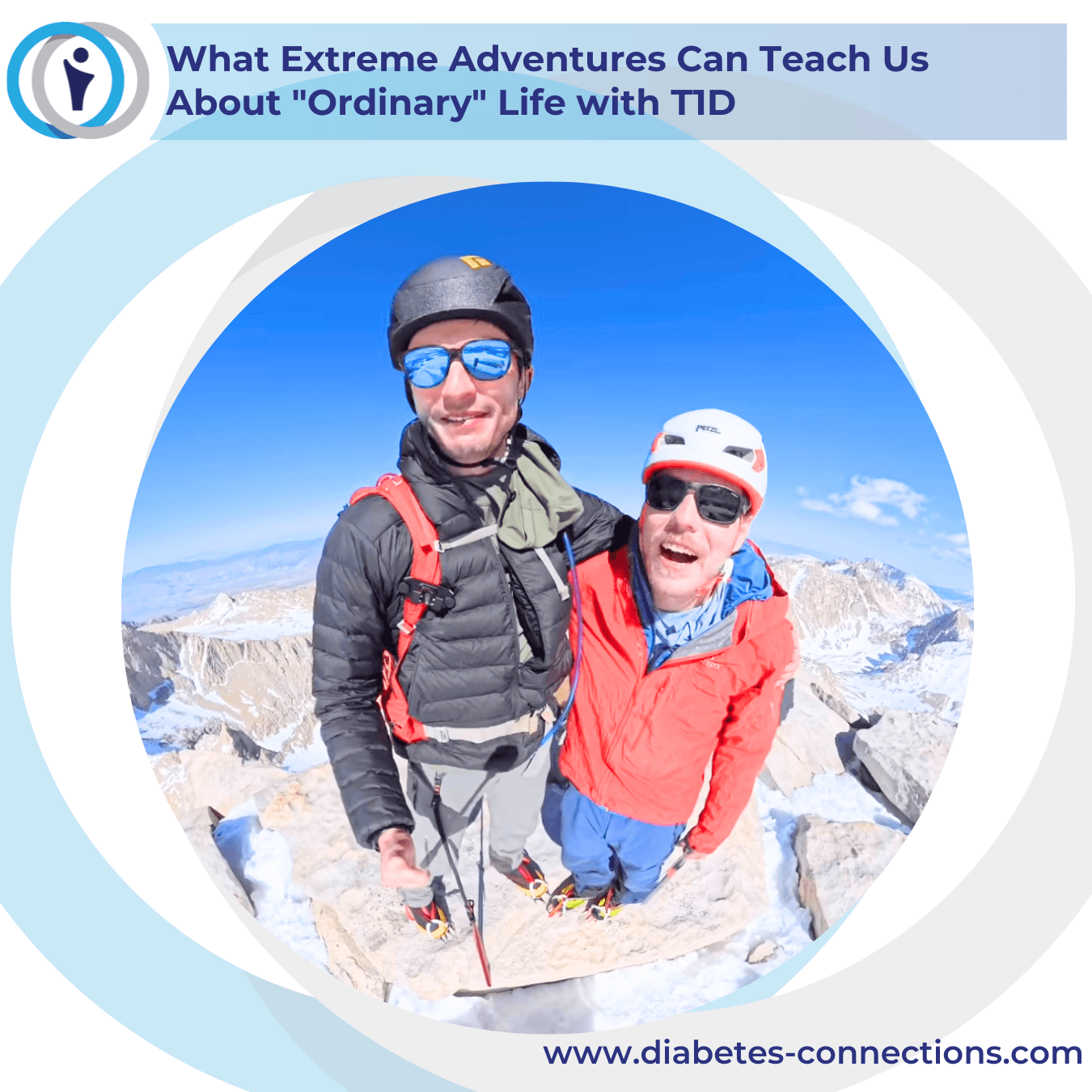
Diabetes Connections | Type 1 Diabetes
What Extreme Adventures Can Teach Us About "Ordinary" Life with T1D, with Patrick Mertes
00:42:18
What can those of us who will never climb the highest mountains, or take on extreme outdoor challenges – learn from those who do? Patrick Mertes and Michael Shelver have hiked and biked – and fallen – on incredible expeditions, while living with...
Loading summary
Transcript92 lines
- [00:01]
A
Support for this episode comes from Dexcom. When I think about our family's use of CGM and Dexcom, it's hard to remember how we did things before. Truly, how did we manage when Benny needed something like ten finger sticks a day when he was a toddler, we thought it was amazing to switch to Dexcom when it needed to be calibrated two times a day. Now Dexcom G6 eliminates finger sticks for calibration and diabetes treatment decisions. Benny's fingertips looked just awful when he was in elementary school. When they got wet, you could really see how pitted and scarred up they were from all those finger sticks. Now they're healthy and smooth, which I never thought would happen back then. He doesn't even remember, but to me it's everything. Learn more go to diabetes-connections.com and click on the Dexcom logo. This week on Diabetes Connections, great adventures with Type one and what those of us who will never climb the highest mountains or take on extreme outdoor challenges can learn from those who do. Patrick Mertis and Michael Shelver have hiked and biked and fallen on incredible expeditions while living with Type one. They'll share what they've learned, how those lessons apply to everyday life with Type one, what their families think, and what's next. Plus, Patrick talks about why Diabetes Camp really matters. This podcast is not intended as medical advice. If you have those kinds of questions, please contact your healthcare provider. Welcome to another week of Diabetes Connections. I'm your host, Stacey Sims. You know, we aim to educate and inspire about diabetes with a focus on people who use insulin. My son was diagnosed with Type one right before he turned two and that was a long time ago because this kid is turning 21 pretty soon. My husband lives with type 2 diabetes. I do not have diabetes, but I have a background in broadcasting and local TV and radio news and that's how you get the podcast. As you're listening, our last Mom's Night out event of the year is in the rearview mirror. Happened this past weekend and a huge thanks to everybody who came out to Phoenix. We've been really lucky in terms of the caliber of speakers that I have been able to arrange for all of these events. There are so many incredible stories to share in the diabetes community. Such great information, community level healthcare provider, young adults from camp. It's just been a blast this year to listen to everybody and I gotta say I have a big pet peeve when, you know, organizations hold these huge panels or they have a celebrity or you know, but they only do it once and they don't record it. And I understand that sometimes with celebrities there are know things in their contracts or it's gonna cost a ton more money. But I don't know about you, I just, I get a little left out right when I see an amazing speaker. But I can't travel halfway across the country to go see them for one night. So I try to record as much as I can. And this week I am bringing you a speaker from one of our previous events. I've known Patrick Mertis for a long time. We met him when Benny went to diabetes camp many years ago. He was on staff there. But then in 2019 he he set out with Michael Shelver for the 50 in 50 project. That was the start of many more adventures for these two and this past year they did low to high. Patrick is going to explain all of these challenges so I will not get ahead of him. Michael was actually at our Minnesota event in a different capacity which was really fabulous. So you'll hear him as well. We tried really hard to mic everybody for questions this time around, but a few people just didn't want to wait. So you are going to hear me pop in just a couple of times to let you know what the question was. Remember, it doesn't matter how loud you are in the room. If we're trying to record, you do need a microphone. Also, Patrick shows video clips throughout his presentation. We edited that out for the most part, but I did leave audio in of a few of those clips where it makes sense. So you will hear a lot of wind whipping in the background but the audio that I left in holds up and the parts where you hear it, it really does add to his presentation and he talks about it. It'll all make sense. I will link up whatever videos from his presentation are public in the show notes. And one more quick Mom's Night out note. Yes, we are looking ahead for 2026 and we are going to be opening registration very soon for our first two events of next year and that is Washington D.C. and in Nashville. And it looks like we are going to be moving up the date for the D.C. area. It might actually be in Bethesda much earlier than we originally planned. We had some issues there. So if you are in the Mid Atlantic region or near D.C. please go to diabetes-connections.com, click on the Events tab, the Moms Night out tab and sign up for those city specific email alerts. We're also going to be in the fall in Detroit and in Seattle. And when you sign up for Those city alerts. You're going to get everything first and all of the information. You know, flash sales, super specials, that kind of stuff. Okay, you're going to hear Patrick Mertis from Mom's Night Out, Minneapolis, right after this. Did you hear the pod drop? Did you know all the sounds used to make that song come from a site change with the Omnipod 5 automated insulin delivery system? Pretty cool, huh? With Omnipod 5 pump, site changes are simple. The pod lasts up to three days, 72 hours. And to change it, you just fill up the pod with insulin, place it on your body, tap a few buttons in the Omnipod 5 app, and you're ready to go. There's no tubing to prime like with traditional insulin pumps, and it's virtually pain free, so you never have to see or handle the insertion needle. Want to try Omnipod 5 for yourself? Request a free Omnipod 5 starter kit today. Buy by visiting omnipod.com diabetesconnections Terms and conditions apply. Eligibility may vary. Patrick Mertis, thank you so much for being here. And I can't wait for all of you to hear about 50 and 50 and so much more.
- [06:01]
B
Awesome. Thanks so much, Stacy. Hey, y'. All. As Stacey said, I'm Patrick Murtis. It's an honor to be here with you all today. And my journey to being here Today began nearly 28 years ago with a story I. I'm assuming all of us share. I was sitting in a pediatrician's office, immediately followed by a hospital admission, followed by a lot of tears, a lot of confusion, a lot of misplaced anger. Now, after 28 years, I gotta be honest, some of the memories are kind of fuzzy. But there's a couple things that are crystal clear. I remember my excitement for needles was on par with my excitement for eating peanut butter and mayonnaise sandwiches. I also remember in the hospital, they were trying to get an IV started in my hand, and it was like four or five times when we discovered that the person trying to start it was a student in training. Now, when my mom found this out, I'm surprised they didn't call the chaplain in to perform an exorcism on her, because the look on her face was that intense. A lot of misplaced anger. I also, after being in the hospital for a few days, we were discharged and I was referred to my first pediatric endocrinologist. And I remember at that very first appointment, he sits me down and he says, patrick, living with diabetes is going to be no different than from someone who has to wear glasses now. Someone who now wears glasses and contacts, I can assure you. And you all know that man was full of lies. So we were off to a bit of a rough start. And I'm not telling you all anything that you don't know. T1D is a 24. 7 condition. There's no escaping it. There's no days off, there's no vacations. But in a surprising twist, after 28 years of navigating the glucose roller coaster, I can heartfelt tell you all in all honesty that it has provided me with more blessings than it has burdens. It has introduced me to some of the most incredible friends, instilled in me a mindset of grit and resilience, emphasized the power of maintaining a positive attitude, empowered me to take control over my own Health at 37 years old. I'll tell you now, after 28 years of living with a chronic condition, I am more healthy than the majority of my friends that I'm close in age with and taught me valuable lessons in discipline and patience and self compassion. It's the teacher I never asked for. Undoubtedly, it has shaped me into the person that I am today. The dad, the friend, the father, and someone who does not let diabetes define me or stand in my way. And I want to share that with you all today from someone who's been living it for 28 years, that your child is going to live an extraordinary, beautiful, adventurous life with type 1 diabetes. So if I may, I'm going to show a quick video. So this is back in 2019, one of my best friends, his ugly mug is right over here. Also living with type 1 diabetes. We decided we wanted to do something that seemed impossible. We wanted to prove to the world that diabetes couldn't stop people from doing anything that they wanted to do. The idea? Climb the tallest mountain in every state, 50 mountains in just 50 days. To put that in perspective, less than 300 people have ever summited every mountain in each state. And the majority of people do that over the duration of their entire lifetime. And us two idiots said, let's do it in less than two months. So we trained, we planned, we got our gear together, our food together, a butt ton of diabetes supplies together, and we set off. So we began on Denali in Alaska. It's the tallest mountain in North America at 20,310ft, one of the world's seven summits. We faced whiteout conditions, freezing temperatures and exhausting days. But somehow we made it. Now, the problem with crying at 20,310ft, is the tears and the boogers immediately freeze to your face. Sorry for those that are still eating. From there, it was climbing Hawaii's tallest peak, Mauna Kea, a dormant volcano. Then we went across the lower 48 states, living in our sprinter van for the rest of the duration. Some state high points were grueling expeditions, climbing over huge crevasses. And then others were barely bumps on the map. So this is a parking lot in Florida, which is Florida's high point. But each one brought its own challenges. Has anyone been to the high point in Minnesota? Mount who knows what it is. Who's been to the high point? Eagle Mountain. That's it. Yeah. So I remember a quote that Michael shared. It's no surprise that the mosquito is Minnesota state bird. Those things were absolutely brutal. But one of the best parts is we invited the diabetes community to join us. Along the way, families, kids and adults living with Type one showed up, climbing alongside of us, of course, on the mountains that didn't involve technical climbing. Here's North Carolina, for example. This is Ethan in Wisconsin who's been climbing all 50 high points with his dad. He has a goal to climb all 50 before he goes off to college.
- [10:56]
A
Hey, type 1 diabetes. Kiss my booty. Because I'm climbed 10 peaks and I'm not even 6.
- [11:06]
B
Rhode Island, Connecticut, Michigan, Vermont, North Dakota, California, Colorado, all folks living with Type one. It wasn't all smooth as the previous video alluded to. In Montana, some things went wrong. A 26 mile approach and a midnight climb. We were forced to bivy on the summit of Granite Peak in Montana with absolutely no shelter. All right, we made it to Granite peak at about 1:30 last night. We were exhausted up here. We're very close to it and had probably the coldest night today. Yep, it was chilly. You look a lot happier tonight, Mike. Let me tell you that. On the descent, Michael and I both slipped on a snow and ice field. I stopped after about 25 yards. And Michael, always needing to be a one upper, slid about 100 yards before he landed on his back. Dangerous, badly injured, we had to call for search and rescue. And by chance, the chief paramedic that rescued us, guess what he was living with. I can't make this up. If anyone's curious, Michael can attest this is the most expensive way to get off of a mountain. That moment. Funny now, not funny. At the time, it was terrifying. But what amazed us afterwards was the outpouring of love and encouragement that we received from the diabetes community. The messages that we received were never Are you going to give up? It was, how are you going to finish? And that's when I realized this wasn't about Michael. This wasn't about myself. It was about something bigger. The strength, the resilience, and the hope that comes with living with type 1 diabetes. The same strength your kids are building every single day. Michael's okay, clearly. In the end, he recovered, rejoined me in Colorado, and We finished all 50 mountains in 49 days, 1 hour and 9 minutes. Ready? Climbing mountains taught me something that I already knew. Living life with diabetes, you don't have to solve everything all at once. If you're standing at the base of the mountain looking at the peak, it's very intimidating. But climbing mountains in life with diabetes is sometimes just putting one foot in front of the other. There are no days off, even when things are hard. You got to show up every single day. And most importantly, community matters. Thank you all so much for being here. You're doing so much for yourselves, and it's echoing out to help your kids. And here's the thing. Diabetes has been teaching me those lessons since I've been nine years old. It has taught me grit and resilience. It has taught me discipline and patience. It has shown me the power of positivity. It has taught me self compassion when things don't go as planned. It's a hard teacher. No one's denying that, but it's also the most transformative. Stacy alluded to that. I've worked with a lot of kids that are living with diabetes, and one of the coolest things is to see them grow up and take this message even further. There's a camper that I was working with in California who has now become a counselor herself. And she's also an outdoor guide that leads kids living with Type one up Mount Whitney. And she wrote a blog recently, and she just had the most profound. This girl is like 19 years old and wrote the most profound statement. She said, I don't get to do all of these amazing things in spite of diabetes. I get to do them because of diabetes. And I think that is the blessing that's built into this burden. Has anyone heard of Jay Shetty before? Yeah. He's got this really awesome story where he talks about the Biosphere 2 in Arizona. And essentially what scientists did is they built this real unique environment that had the perfect climate. It had no wind, no storms, perfect environment to grow trees. And the trees grew very rapidly, but before they reached maturity, all of the trees fell over and died. So scientists were trying to figure out what is going on here. And what they realized is that trees need wind. They need the resistance of wind. So they build something called stresswood, and that helps them dig their roots deeper. The winds force them to grow stronger and to grow to their full potential to withstand the storms. And I think the same is true with diabetes. The daily challenges your child faces, the highs, the lows, the shots, the sight changes, the emotional ups and downs, they are the wind. And although none of us would choose it for them, that wind is constantly building resilience, strength, and grit and will carry them through every challenge in life. Since 50 and 50, Michael and I have continued to do really stupid expeditions. This was in 2020. We did the Race along the Trace, which was a 444 mile, self supported bike packing expedition from Nashville, Tennessee to Natchez, Mississippi, that we completed in three and a half days. Last year, we did something called the Rim to Rim to Rim challenge, where basically you start on one side of the Grand Canyon, run all the way down to the canyon floor, run up the other side of the Grand Canyon, and then come all the way back. It's 44 miles, 11,400ft of elevation gain, and we completed it in 17 hours. Only puke like three or four times each. And then this year, this past April, we completed probably our craziest, arguably our craziest project yet, which we called Project Low to high, because we all know life with diabetes figuratively and literally is full of highs and lows. And for this challenge, we started at the lowest point in the United States, which is badwater basin. It's 282ft below sea level. We biked 135 miles through death Valley, obviously the hottest part of the United states. We gained 15,000ft of cumulative elevation gain until we reached the base of Mount Whitney, which is the tallest peak in the Lower 48. At the base of Mount Whitney, we ditched our bikes and climbed to the summit. And we did it all in 37 hours, y'.
- [16:51]
C
All.
- [16:51]
B
We have officially summited Mount Whitney, which means we have officially completed Project Lodehigh. It took us about 37 hours from start to finish. Mike, I get emotional when I wasn't crying.
- [17:19]
C
I would have 100% quit if it wasn't both of us there.
- [17:22]
B
Oh, man, I feel so blessed to have you as a friend and to have you in my life, man.
- [17:27]
C
Man, what an adventure.
- [17:30]
B
That's probably the hardest thing I've ever done.
- [17:32]
C
Yeah, harder than Denali. I'm gonna put that out there.
- [17:36]
B
Oh, y' all we are proven that if you live with diabetes, definitely not crying. Just make that clear. You finish it, right?
- [17:46]
C
If you're living with diabetes, you can do whatever you want. You know, whether it's something like this, whether it's an adventure out there or pushing yourself, you know, again, it's getting back to that positive mental attitude. Throughout this whole adventure, we had some very dark moments, but just kind of kept that attitude, kept bringing ourselves and supporting ourselves as well as each other, and. And that's why we're on top of Mount Whitney right now. So one heck of a trip. Felt like a lot longer than 37 hours, mentally and physically, but, man, what a crazy adventure. That was insane.
- [18:25]
B
All right, we love y'. All. Love you, brother.
- [18:28]
C
Oh, man.
- [18:30]
B
But here's what I want you to remember. Your child doesn't need to climb Denali to be brave. They don't need to run the Grand Canyon to be strong. Just living with type 1 diabetes and showing up every single day makes them resilient, makes them tough and powerful beyond what they realize. So while diabetes may feel like the teacher that none of us ever asked for, it's quietly shaping your kids into some of the strongest, most capable people you will ever know. And when someone, maybe a teacher or a coach or even a well meaning relative ever says something like, I don't know if they can do that. They have diabetes, I hope you and your child look them in the eye and say, watch me. This is what life looks like after 28 years of type 1 diabetes. Full of challenges, yes, but also full of joy, adventure, love. These three kids remind me every day while we push, while we climb, and we never give up. And just like them, every child living with Type one has the strength to rise, the courage to keep going, and the power to show the world that they can do anything that they want to do. Thanks, y'. All.
- [19:37]
A
Patrick, thank you so much. We are going to talk a little bit and we're going to give you the chance to ask Patrick some questions. I'm so glad you guys are okay. I know you're going to be okay. Michael, every time I see that video, I'm like, oh, my gosh. I would just wanna say a little piece about diabetes parenting, or parenting in general, really, when you were talking about the trees that die without the resistance, I think it's also really important for us, you know, as moms of kids with type one. And I know there are women with type one in the room as well, but we moms, we don't have diabetes. It's not the same at all. We have a different and unique experience. But I do think that when we encounter those problems with diabetes, when we let our kids start on those little bits of independence that, like, you have to do that and you have to encounter those problems, and you have to encounter those scary moments. And I know that you're remote monitoring tonight, and phones are ringing and things are beeping, and that's great. And maybe it's your first time away from your child for any significant period of time. Those little bits of wind resistance or wind problems give you that strength that you're gonna need when your child goes either to college or moves out or even just goes on their first sleepover. Those little steps are really important. So that's my two cents. How are you doing?
- [20:51]
D
Good.
- [20:51]
A
What's it like watching all that again? Does it come back the. I mean, I would have so many different emotions if I try to do some of those things.
- [20:58]
B
Michael has a quote that mountain climbers have the worst memories. Because when you're. When we're up there, it's like, I'm never doing this again. And then you give it, like, six weeks, and he's sending me a text message or some crazy idea. He wants to know.
- [21:10]
A
So if you have any questions, I mean, I think it'd be great. And Michael, if you do want to pop in. Absolutely. If you think it's relevant. Yeah, go right ahead. Wait, are you going to mic? Are you going to ask her?
- [21:19]
B
Oh, yes, I have. Where you basically do the elevation of Everest.
- [21:22]
A
This first question was whether they had heard of the Everest challenge, which doesn't mean you actually go climb Everest itself. It means you bike, hike, run, however you can get there. To the elevation equivalent to Mount Everest.
- [21:38]
B
One to add to the list. It wasn't on the list, but maybe it is now. Yeah. Who else has got ideas for us?
- [21:47]
A
Okay, I'm gonna ask.
- [21:48]
B
It's a good thing my wife's not here.
- [21:50]
A
Yeah. So I would say that most people with type 1 are never gonna do the adventures that you do.
- [21:58]
B
Sure.
- [21:58]
A
Not because they're limited, but because maybe they think differently.
- [22:02]
B
Sure.
- [22:02]
A
I'm saying that nicely. I'm curious what you think applies. Right. I mean, I want Benny to have a good, stable job and, you know, a nice life. I don't see him climbing Mount Everest or whatever. I don't know. I'm not limiting you. You do what you want.
- [22:19]
B
Yeah. It's a great question. And I'm a big proponent to hike. Your own hike. Right. You don't have to climb mountains and do crazy things. I think one of the things that is my hike, there's a Japanese tradition called the misogi, and it's this idea where you kind of intentionally put yourself into a challenging situation. So basically, when you're faced with the rest of life's troubles, it really seems kind of trivial in comparison. Truthfully, I think diabetes was my first musogi. You know, I think how that's relevant to people that don't want to do anything. I do think that there's value to intentionally putting yourself into challenging situations. It doesn't have to be denali just to kind of really help put everything else in perspective.
- [22:59]
A
What'd your mom think? Actually, let me back up on that. What was your first kind of adventure? I mean, obviously 50 and 50 was huge, but you've been. And I mean, I don't know if this is the right word, but you've been an outdoorsman and into adventure, I assume, since you were much younger.
- [23:14]
B
So my exposure. I'm a big proponent of diabetes camp, if that's not clear already. But that was kind of my first exposure into where I discovered that I truly love the outdoors. And it really kind of just blossomed from there. I also worked for Outward Bound for a while, so I worked with inner city youth that were actually court ordered to be there. So probably less fun than some of the challenges that we had done, but that really kind of solidified it to me. I think there's just something that's, like, really important for me to unplug from all the other chaos and stress. And I'll be totally transparent if you think our diabetes management on these expeditions is great. It is absolutely all over the map and wild. Another profound thing that this camper that I had alluded to in the speech said that having durations of time and happiness is what she calls it, and prioritizing those over time and range. I don't know. I feel like I'm verbally vomiting on this one. Stacey, bring me back in.
- [24:10]
A
Well, the question really then becomes, what did your mom think when you started diabetes camp? Is one thing. Then you start traipsing around in the mountains. Is she worried? Does she ask you questions?
- [24:20]
B
She's kind of crazy, too. Stacy, to be honest with you, my mom's a little crazy as well. I actually did the John Muir Trail with my mom when she was 68. So I previously lived in California for a short period of time. And right before I moved, the last thing we did was go on a 14 day, several hundred mile hike together, which, you know, if you all choose to do that, that is an option. I don't know if I recommend it at this point, but yeah, I mean, she's got a couple of screws list. I'm sure that there. As do I. As do I. I'm sure that there's concerns, but she's never really.
- [24:55]
A
Well, that's what I meant with diabetes. So I know that you were diagnosed at a time before the kind of follow technology that we have now. So it's kind of a different vibe, I would assume.
- [25:04]
B
Yeah. And truthfully, diabetes doesn't even come up in conversation with my parents at this point. And you're exactly right. Managing the condition at that point in time when I was a kid, looks very different than it does now. I remember my dialogue growing up was, did you prick your finger? And I would always say something like, yeah, 187. It was always a number that wouldn't really get me in trouble. Right. But was believable. Right. Yeah. It couldn't be perfect. So I do think that there's. There's a different parent child relationship with kind of the dawn of all the technologies that are available now.
- [25:38]
A
This is for either of you. Do you have kids with type 1 diabetes?
- [25:42]
B
I do not. So I have three kids. The oldest is, and this just came up at our table. The oldest is not yet five. And I kind of go back and forth on the idea of doing the trial net screening or the screening now. I think there's a lot of benefits to being empowered with that knowledge. But then I also think that, you know, you got to hike your own hike with it. I have not tested my kids and none of them are living with type one as of now.
- [26:04]
A
I'm going to have Michael answer too.
- [26:05]
C
I do not have kids yet. So my paychecks thank me for that.
- [26:12]
D
My question was, during your 50 and 50, your significant other, wife, spouse, whomever, how did they handle you going there knowing you're diabetic and you're going on a mountain and there's no communication? I mean, my daughter's 15 and I'm like, okay, I can't see where your blood sugars are. You know, I get anxious and I don't know, you know, the spouse side of things. But I just wondered how your spouse has handled that.
- [26:40]
B
You take that one, Mike.
- [26:41]
D
Not well.
- [26:45]
C
So my now wife, her name's Allison. So we had just. This was. We started dating about six months before I let her know that I was going to disappear for two months into the mountains. So there was a lot of repairing that occurred afterwards. But I will say that for us, we did have a satellite communicator, so you can buy them for a couple hundred dollars. And I recommend it for anyone that's going into the backcountry. That's the reason we were able to get helicoptered out of the mountains. Throughout the expedition when we had service, tried to communicate as much as we could. I would say that luckily for myself and Patrick as well, both of our wives don't really talk to us too much about diabetes because they just kind of know that we generally take care of ourselves. I think they're actually more concerned about the risk of going into the mountains. Right. We were younger back then, and we're older now and a little bit wiser and take less risks than we used to. Um, and I think that was the biggest concern. So for smaller mountains, things like that, not as much concern. But when we're going out in the mountains, it's always telling them where we're going, what the route is, so that, you know, if they're tracking us and they see us stopping for a long period of time to understand why we might be doing that. When we were climbing Mount Whitney a few months ago, after that bike ride, we had just biked 135 miles, which took 22 hours. Then we slept for four hours, and then we got up Mount Whitney. So halfway up, we took a nap because we were so exhausted. But on a GPS, it looks like we haven't moved for 45 minutes. So that can be really scary for someone that doesn't have that information. So for us, just pre communicating and letting them know this is the expectations, and then understanding the big thing is the mountain will always be there and we won't. So you can always go back. And a big rule that I have is your summit success rate should never be a hundred percent, because if it's 100%, you're taking too many risks to get to the top of a mountain. So when you're doing outdoor pursuits, it's always good to understand one having a partner that has the same risk tolerance, but also understanding that if they're boasting about how many summits they make every single time, to me that indicates that's a risky individual. Patrick is happy to turn around from the summit, and we've done it many times before. So communicating that to our wives and saying when we're in a situation where it feels too risky, we're going to turn around, they've Kind of trusted us to make the right decisions out there. And they do follow along and will send us GPS messages if anything is out of the norm. And we try to respond as quickly as we can.
- [29:19]
A
I'm trying to figure out the logistics of 50 mountains in 50 days. Now, was that 50 consecutive days?
- [29:27]
B
50 consecutive days, how were you able to do that?
- [29:31]
A
I think a lot of people are wondering that logistics wise, with flights or travel or getting there from one state to the next in 50 mountains. 50. I have no idea how you did that.
- [29:44]
B
And so I want to know. Yeah, so it took us about a year of planning. We actually downloaded a software for delivery driver companies that would actually tell you if it was faster to take a left hand turn versus a right turn. So we basically plugged in the GPS coordinates of all the jeep of all the trail heads. Now, with that being said too, like in the southeast and even kind of somewhat in the Northeast, some of these summits aren't a multi day expedition, right. Like Florida, for example. So a lot of times, especially in the south, we were able to tackle, you know, three, four, five in a day. So that certainly helped. And then we also had intermittent support drivers. So there was a bed built into the sprinter van. Then we also had a couch that was laid out. So a lot of times Michael and I could sleep while someone was driving us to the other summit. So logistically, we started in Denali and we started in Alaska and we started our time clock because it took us nine days to get to the summit of Denali. So we started the time clock right when we hit the summit and then we gave ourselves 49 days to basically hit the other 49. So from Denali we flew to Hawaii and then we knocked out kind of all the ones that would need flights, flew to Illinois, and then picked up the sprinter van, and then we just crushed as many as we could. We did it in 50 days, even with being out in the hospital with Michael. So we really, if had the accident not happened, we could have finished in a shorter duration of time. Thanks, Mike.
- [31:13]
A
This person wanted to know what Patrick thought was actually the most difficult part of the challenge.
- [31:19]
C
Um, yeah, I would say the probably the hardest part, logistically speaking, was just the driving. And you know, we're exhausted, we're, we're hiking. I would say when we were on the east coast, we were doing three or four summits and they're all, you know, could be three miles, could be eight miles, could be 12 miles. But I mean, we're really getting limited sleep and I would love to say we ate healthy, but, like, we lived off of gas station food and coffee through all of this because we were just trying to go as fast as we could. So logistically, the biggest help was having drivers. And we had some amazing. We had Patrick's dad out there who wore crocs and only crocs for multiple weeks. So we called him Crocman. And then we had another person living with diabetes, Kaler, that was really essential to helping us get this all done. But in terms of squeezing those extra hours out, we got off of Denali, got in, and then we drove direct. We paid a taxi driver a hefty fee to drive us as quickly as he could to the Anchorage airport. And we booked a flight, like walking into the airport to get to Hawaii. Showed up at Hawaii with people are getting off the plane and like flip flops and all that stuff. We're dragging skis and ice axes because we've just come from Alaska. So it was very interesting to squeeze it all together. But there was a lot of upfront planning and contingencies because we also had to worry about weather. You know, you can't climb certain mountains based on certain weather, so there was some flexibility. And when I fell down that mountain, it certainly changed the delivery route we were going. So.
- [32:47]
D
Yeah, I want to know how you guys met.
- [32:50]
B
Great question. We actually met at diabetes camp in California, so I was working as a program manager there. And Michael came up one summer to. Were you doing Mount Whitney, leading one of the mountain trips? And we really kind of hit it off right away. And we went on our time off. We went on a backpacking trip, just the two of us. And you just kind of know when someone gets it. You know, I think we're kind of cut from the same cloth and our brains work well together, where Michael's very detail oriented and logistical and I'm a little bit more crazy and can kind of come up with finding folks to help, you know, fundraise and sponsor the trip. So make a good team.
- [33:27]
A
Yeah. Question in the back.
- [33:29]
D
Hi. So I have a 17 year old daughter and she would never agree to come with me to this even if she were allowed.
- [33:39]
A
Right.
- [33:39]
D
But I so wish she was here, but she's kind of in this phase where, you know, I mean, nothing. Anyway, it's a challenge. It's a challenge. But she wants to do challenging things. And like, she just spent all of last summer in South Korea on her own.
- [33:56]
B
Awesome. That's awesome.
- [33:57]
D
Super awesome. But it was like, oh, she knows how to do it right. Because it's like, I don't want anyone to tell me I can't do anything because of diabetes. I want to go to South Korea for the summer.
- [34:07]
B
Right on.
- [34:08]
D
And it's like, great, because now I have to say yes, because I can't say no because of diabetes.
- [34:13]
B
Playing that card.
- [34:14]
A
I love it.
- [34:14]
C
I love it.
- [34:15]
D
So she knows, and she did great. In fact, this was the second summer she went to South Korea, and she's 17, and she did great. What I want to know is, because obviously you guys are super healthy, and that's encouraging to me, but how. When did you personally make the shift inside your own brain to desire to take that on? Because I perceive she's playing a little fast and loose. I'd be happy if, you know, am I making sense?
- [34:44]
A
No, it's a great question.
- [34:45]
B
Okay, let me offer some context that I was an absolute train wreck when I was 17 years old. So I probably took longer than most people, you know. And, you know, I know I said some inspiring words. It was a journey for me to get to this point, too. And everyone's going to be different. I think just offering from my personal perspective, it was probably the reality of coming out of college. College. I was just kind of, you know, I'm just going to be a normal college kid. Diabetes is going to be here in the background. And, you know, I'm very blessed and fortunate that I don't have any complications after 28 years. So that also some context of hope that it was a good day if I pricked my finger that day while I was in college. But it was a journey. And I would say I was probably once I kind of entered the workforce full time out of college, that I started really taking active ownership over my diabetes management.
- [35:34]
A
I'd like to add something to that. So I've had my podcast diabetes connections for 10 years. I've had something like 600 interviews during that time. And I've asked so many people who are adults with type 1 who were diagnosed as children, as. You can desperately hear me wanting answers for this one as he's growing up. It's funny if you listen, like, to follow the journey, like, what are the teen years? Like, what do I do when he's in college? But to a person, it's about age 26, and it's that frontal lobe thing. And it's amazing because I'll say to folks like. And they're like, well, I just realized, you know, I had all that crazy time in college. And then like, well, I Got married or I did this, or I moved. And it was this one job. I'm like, well, how old are you? And they're all like. I was like, 25, 26. It's amazing. Now, it doesn't mean, like, everybody does it at the same time, but just anecdotally it comes up over and over and over again. And it's really wild how consistent it's been just in the interviews that I have done. So. And almost everybody says, like, oh, my poor mom when I was a teenager. Oh, my poor mom. Oh, she knew what I did when I was in college. Oh, you know, it's really. It's been a very interesting education.
- [36:40]
B
I can imagine. I can imagine. Sure. And the landscape has changed so much too, where it adds to the anxiety when you all have access to the information. I never had the capabilities of sharing my glucose with my parents. It just wasn't a reality.
- [36:53]
C
I have a question.
- [36:54]
B
So, Patrick, thanks for being here. Room full of moms.
- [36:58]
C
So let's think back to Those days.
- [37:00]
B
When 187 was your magic number. Knowing what you know now and the support you had from your family, what would you say to your mom? I don't mean to be discouraging, but I think it took me until 26 to really even appreciate the middle of the night wake ups. Once I kind of started independently doing it and like, oh, yeah, this is something I need to do. It took that maturity to really. And I'm sorry, because I know a lot of you are probably might be far away from 26, but I do think that there is. There's a very real truth in that. All I could say is thank you. You know, I am so appreciative for what my mom did for me, but it took me. It was a journey for me to get there. But there is a light at the end of the tunnel. I promise.
- [37:44]
A
That's what they're supposed to do, though. You're supposed to be a kid and not realize how much you need your mom. That's how it goes. That's how it goes. That's a good question, Slade. All right, so we have a couple of minutes before we're going to. And tomorrow we're going to talk more about independence. So we're going to have an ask me anything panel. But I guess my question for both of you to kind of wrap it up. And the question you always get at the end of these interviews is, what's next? And you have little kids, you know, you're going to be.
- [38:10]
B
It's Funny, I was thinking about this because that's how my wife kind of leverages. She like, allows me to do these things.
- [38:15]
A
Take them with you.
- [38:16]
B
Well, there's an idea. I did take them backpacking.
- [38:18]
A
That's. You don't need to climb anything. You could just go five minutes in the wilderness with it.
- [38:22]
B
Parenthood is much harder than anything that we've ever done. So you all are the real adventure experts. We have talked about it. There's a couple things that we're stewing around. It's usually around kind of spring that we release it. There's one that might involve. We've got two states. Alaska is one and then Washington state is the other one. One might be a very remote expedition where someone drops you off and it's really just up to you to figure out your way out of there. And then the other one would be a combination of mountain climbing and some pretty rigorous trail running.
- [38:58]
A
So we squeezed in one last question here. She asked if Patrick and Michael had ever thought about taking a challenge and going international.
- [39:07]
B
Can we call my wife right now and we can ask that question?
- [39:12]
A
What I would really like to end on, though, is we haven't really talked about camp.
- [39:15]
B
Sure.
- [39:15]
A
And we had the diabetes camp, one of them here, earlier this evening. I know a lot of folks here have children who've been to diabetes camp. Let me just give you the floor for a minute because sometimes people are worried.
- [39:25]
C
Yeah.
- [39:25]
A
But what would you like people to know about diabetes camps? Sure.
- [39:28]
B
Well, if you don't have experience with diabetes camp, I was the kid too, where it's like, why would I want to go to a week long doctor's appointment? That sounds absolutely awful. And here I am 28 years later, and I'm still heavily involved in diabetes camp. It's just one of those things where it really, for me, it transformed the lens on how I viewed life with diabetes. It was the one place where I didn't have to explain it. Everyone just understood it. I didn't have to explain having to take 10 minutes out because I had a low blood sugar. It was just so commonplace. And it's gotten to the point now where, you know, when I do have the hard diabetes days, you know, I could talk to my wife about it, but she doesn't. She just doesn't get it. And I reach out to all these friends that I've made over the last 28 years from attending diabetes camp. If you haven't tried it, at least, I'm not saying your kid needs to love it, but at least Give it a shot if you haven't tried it yet, because it really could change your son or daughter's life.
- [40:21]
A
Patrick, thank you so much. Michael, thank you for chiming in as well. We really appreciate it.
- [40:26]
B
Thank you so much. Appreciate it. Thank you.
- [40:35]
A
More information on Project 50 and 50 and everything these adventurers are doing over at diabetes-connections.com just look for the episode. Every episode has its own homepage with more information. So as you are listening. If you're listening on a podcast app and you can't find the links, head on over to the homepage. It'll all be there. I had a few people asking me about Benny being on the panel at Mom's Night Out, Minneapolis, and I have some bad news. He was great, but technical difficulties. We only taped the first seven minutes of that panel. I don't know what happened. There's a chance that we might recover it. Sometimes wacky things happen. So I'm going to continue to look. And I'm really sorry about that because, you know, you know, I was really nervous about him talking. Cause he's so open and honest and a little kooky, I think sometimes. He did great. He was so. I was so proud of him. He did a great job. And I'm. I'm gonna see if I can talk him into coming to another Mom's Night out event. Maybe we'll record a separate episode or something to. To make up for that. I mean, all our panelists were just amazing. I don't know. It was. I had a lot of mixed emotions watching Benny talk, but I was really, really, really proud of him. I mean, the only other emotions I really have are know I always feel like it's. It's nothing against him. It's me, right? Feeling that I really am the worst. And is he gonna say stuff that shows what a bad mom I was? Okay. Thanks to my editor, John Buchanan, from Audio Editing Solutions. Thank you so much for listening. I'm Stacey Sims. I'll see you back here soon. Until then, be kind to yourself. Diabetes Connections is a production of of Stacy Sims Media. All rights reserved.
- [42:09]
B
All wrongs avenged.