Loading summary
Transcript101 lines
- [00:05]
Starbucks Worker
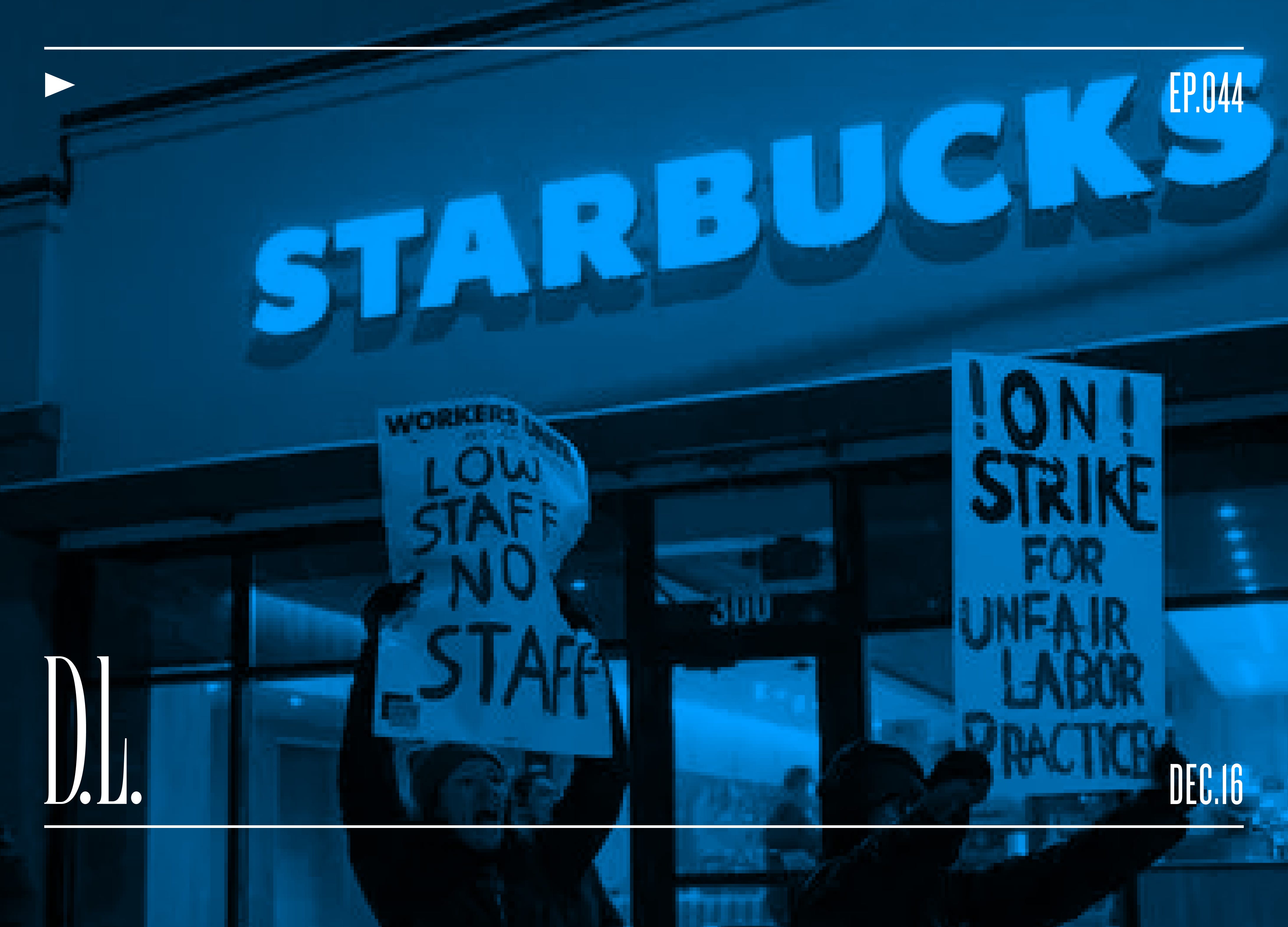
Starbucks workers are on an unfair labor practice strike because Starbucks has refused to come back and negotiate for our first contract. They have the full capacity to pay us right now for a multi year unit contract with one day worth of sales.
- [00:20]
Union Advocate
Hey Starbucks, you can't hide.
- [00:23]
Cara
We can see your greedy side.
- [00:26]
Union Advocate
These are not demands of greed. These are demands for decency. These are workers who are simply being asked to be treated with the respect that they deserve. They're being asked that their labor be repaid in a manner that allows them to build a dignified life.
- [00:42]
Starbucks Worker
What we're asking for is pretty simple and basic. We want enough hours to meet the benefits.
- [00:49]
Cara
Don't cross the bigger lunch.
- [00:53]
Union Advocate
95.8 million. That's the compensation package that Starbucks CEO Brian Niccol earned for four months of work last year.
- [01:01]
Starbucks Worker
Some of us have to choose whether or not we get groceries and ready vacation for the next month.
- [01:05]
Union Advocate
400. That is how many labor law violations the NLRB has found that Starbucks has committed.
- [01:12]
Starbucks Worker
We want enough staffing in our stores so we're not overworked.
- [01:15]
Caroline
Staffing pay protections like safety in the workplace, but also like sexual harassment.
- [01:22]
Cara
They call us partners.
- [01:23]
Caroline
Best lie, they just walk their fucking tie.
- [01:28]
Starbucks Worker
You guys do not give Starbucks any of your money.
- [01:32]
Caroline
No money to Brian Nichols believes he has had enough.
- [01:47]
Cara
A quick little A diabolical lies news brief, if you will. The rare and infrequent news brief.
- [01:54]
Caroline
Yeah, this is fun.
- [01:55]
Cara
Why don't you tell our friends about the mix up we had this morning over text.
- [01:59]
Caroline
Okay. Okay. So we are obviously on this conversation today to talk about Starbucks.
- [02:05]
Cara
We're recording this on December 12th.
- [02:07]
Caroline
For the rest on December 12th. And so you have been very involved in the Starbucks strike, in the work that they're doing in Denver. And so we talk about it a lot. And so you went to some sort of union thing this week and at the same time the Taylor Swift documentary dropped. And so I guess that there was like a.
- [02:25]
Cara
The event was a Denver DSA screening of a documentary about the strike.
- [02:32]
Caroline
Right.
- [02:33]
Cara
And today the Taylor Swift documentary came out. So Cara texted me this morning, 6:13am My time. I get a text.
- [02:42]
Caroline
I texted up saying, watching the doc and crying two minutes in. It's online and I have thoughts good and bad. Lol.
- [02:51]
Cara
And I go, because we've been talking about the Starbucks documentary. I think she's talking about the documentary about the star. And I was like, wait, I didn't realize it was like online. You found it like, oh God, what's the bad? Tell me the bad.
- [03:03]
Caroline
And I Was like, look, I'm not trying to be negative. There's a lot of good. But just enjoy it and we'll discuss later. And then we realized that I was talking about the Taylor Swift documentary and you were talking about Starbucks.
- [03:12]
Cara
I was like, wait, no, we're about to. I was like, what do you mean? I thought she was like, gonna come out to me as being like, anti good indeed. I was like, caroline, we thought we would do a quick hit about the ongoing Starbucks strike. And I think my hope here is that if you want something to just quickly, like, send to a friend or family member who wants to know what's going on, that this will serve that purpose. So we are having this conversation today because there is a pretty historic labor movement happening right now in the United States specific to Starbucks Workers United, which is the Starbucks union. So you may have seen workers striking at a local store, or you might not have. Maybe everything looks normal at your store, but you've heard about the strike and so you're kind of confused about what is going on. Maybe you want to support. The other night I went to a documentary screening of the documentary Partners, which actually a diabolical liar's friend made that documentary, which is really fun. So we are one degree of separation from the filmmaker. And after this documentary was about their unionizing effort and how they've pulled this off, I hosted a panel with five striking workers from Colorado stores. And so we are in a very pivotal moment for organized labor in the United States. This strike is very important, and I think it can have really far reaching impacts. And the reason that we wanted to talk about it is because it is a rare opportunity for you to withhold your money as a consumer to contribute to something that might be a pretty substantial shift in the direction that this economy and labor power is going in this country.
- [04:54]
Caroline
Yeah, I think that I really wanted to talk about this kind of like on the feed, because I know how much you have educated me on it. And I believe very strongly in not encouraging any sort of like, purity test with these types of conversations. I think boycotts can feel overwhelming. There are often many taking place at once. And there can often be like an element of shame applied, which often can be a strategy which sometimes is useful. But, like, people will sometimes shame others into feeling bad about not participating in something that they don't even understand. So I just want to be very clear here. If you go to Starbucks every day, it's not too late to consider joining this strike. If you are like sipping a peppermint mocha while you listen to this, I don't feel any desire to shame anyone over that. I think the goal of this is to be like, this is what's happening right now. This is why it's actually a very important strike taking place with major implications for workers all over the country. And so however much you can participate, whether it's just understanding and supporting the workers at your store who are striking, or whether it's abstaining yourself, or whether it's like passing this episode along to someone who doesn't understand, all of that is useful and this is just trying to contribute to the numbers and the support for a very important strike.
- [06:06]
Cara
Yeah, that's a really good way to put it. It's not about purity testing, it's about numbers. It's just a numbers game. And even if you are somebody that like, you live in a small town and like the only coffee you can buy in town is Starbucks and you get it every single day and you're like, I'm going to cut out half. Even that would be a big contribution. So I think that the reason that I get so excited about this particular movement and effort is that it is one of those rare opportunities in American capitalism where you actually can make a difference by not buying something. It's one of Those disproportionate, like 80, 20 rule, very little effort on your part is actually going to go a really long way because so many people have already done the extremely grueling work of organizing. So figured we would just kind of get into the basics today as well as like where they are right now, what this might look like, where you live and, and why it matters, why this one matters, and why we're talking about this. Okay, to start with, take us to church. Katie, I do want to start with just two quick facts. So as a personal finance educator, this is something that I pay a lot of attention to and care a lot about. And that is what is going to allow people to earn more money for the work that they are already doing. And what we know is that statistically unionized workers earn 13 and a half percent more than non unionized workers. That is significant. You also see in unionized workplaces that both the gender and racial wage gaps are smaller and that workers are more likely to have benefits like health care and pensions and paid family leave. These are not like little tweaks at the margins. These are substantial changes to the quality of your working life. So I think that there is a bit of a strain of anti union propaganda in the United States. Because there are, there are valid critiques of unions to be clear. Like there is bureaucracy in unions, there is corruption like just like every other organization. They're not a silver bullets. But there is a lot of anti union propaganda in the US that explicitly claims that like unions are just for people who like don't want to work hard and want to like coast off the effort of others. That could not be further from the truth. So much of what we take for granted today in our working conditions were the result of union pressure. So like the reason we have a 40 hour work week and a two day weekend unions, union pressure in the 1930s before that was not the case.
- [08:32]
Caroline
Wasn't it the famous thing 8, 8, 8, 8 hours for work, 8 hours for rest and 8 hours for you.
- [08:38]
Cara
So I think there's one other stat that Carol, I'm going to have you read just an abstract from a research paper that came out recently. That is I think the. If there were like one statistic that I would want Americans to know about the power of collective bargaining, it would be this.
- [08:57]
Caroline
Studies on labor union earnings premiums generally investigate their size through point in time estimates. Posits by contrast that point in time estimates of the union premium overlook the cumulative earnings advantages of long term persistent union membership. Using a sample of men from the panel study of income dynamics from 1969 to 2019. That's a nice long study. The authors investigate how lifetime union membership contributes to earnings advantages. They find first, that unionization throughout one's career is associated with a $1.3 million mean increase in lifetime earnings larger than the average gains completing college. Wow. Second, the lifetime earnings gains are channeled entirely through higher hourly wages and occur despite earlier than average retirement for persistently unionized men. Third, the union wage premium is not constant throughout a worker's career. Instead it increases with more years of union membership. The cumulative advantages of union membership for workers economic well being are far greater than point in time estimates suggest. So, so that's crazy. I just want to ask a question just to make sure we're all foundationally aligned. I think there are some people who don't understand why we're talking about unions in Starbucks. And so just to be clear, Starbucks employees are trying to form a union, correct?
- [10:16]
Cara
They have unionized. They're trying to fight for their first contract. Okay, so this is a kind of an interesting thing that I had to learn this this year. I did not know this. So I definitely don't want to position myself as like a labor activist or someone who's like, sure has been in this space for a long time. I have not. However, I the ROI here, and I'm like, this is something to pay attention to. This really matters. So to back up a step, you can form a union and you can have a union, but once you have that union, you then have to use that collective bargaining power to basically force the company to agree to a contract that outlines, these are the working conditions, these are the wages. The reason that they're on strike right now is because despite unionizing four years ago and adding hundreds of stores since then, the company will not agree to the contract that they are asking for. So we'll get into the details of all of that. So that study is important to me because even during a time when the college wage premium was higher than it is now, when you gained even more from getting a college degree because fewer people had them, the financial benefit of being in a union was more significant than a college degree over time. And so when we talk about these, like, 13 and a half percent wage difference stats, like, that is understating the lifetime value here of, like, union density. So all that to say, if you want higher wages, if you want better working conditions, pay attention to the labor movement. It is a critical component of that fight. So, okay, let's do, like, a little bit of strike background and, like, background on this particular union. So Starbucks Workers United started in Buffalo in 2021, Buffalo, New York. It started with someone called assault. So assault is somebody who gets hired at a company specifically with the intent to organize its workers. Like, you are going in because you want to unionize the company. And so the Starbucks employees are called partners.
- [12:16]
Caroline
So ironic that they're called partners and they're ignoring their effort to leverage their own value. And Starbucks is like, you're partners, but
- [12:25]
Cara
it's the pizza party model. You see in the documentary that pretty immediately the highest levels of executives at Starbucks are, like, crashing out over this. That should be another signal to people. It's like if you have a store, if you have a company where you have, like 10,000 locations in the United States and you have a dozen workers in three stores that are trying to unionize, and you immediately start dispatching chief executives to those stores to, like, sit in them and watch the employees. Employees, you can learn pretty quickly here. Like, they recognize how big of a deal this would be if this happened. So they start sending in these regional managers from all over the country. They send in some comms officer who, like, they have her, like, sweeping the floors and cleaning the bathrooms in the store, they have all the regional managers wearing the headsets that the partners will wear. Like, when you're. You're working drive thru, but you're also, like, working in the store. And you need to be able to, like, communicate and take orders and, like, talk to one another. They have the managers that they've flown in from all over the country listening to these conversations at all times to hear what they're saying during their shifts. So they're essentially spying, right? And just right away, all of this mounts to this, like, intense pressure campaign. They're trying all sorts of tactics. They're trying intimidation. They're trying hiring sprees. So, like, when you are trying to unionize, you have to vote, and you have to get enough people to vote yes on the union. So they're basically just getting in a bunch of people to work in the stores. That way, it dilutes the votes of the people who have already decided they want to organize. They start hosting these, like, listening sessions where they essentially plead with them not to unionize again.
- [14:08]
Caroline
Another Taylor Swift crossover moment.
- [14:11]
Cara
Oh, my God, you're right. Fuck. So the CEO of Starbucks has the workers to his penthouse.
- [14:18]
Caroline
He's like, I baked you guys cookies
- [14:20]
Cara
and plays them a 1989 vault track. So basically, like, they leak audio in this documentary from these listening sessions. And these corporate employees are like, we love you. Howard loves you. We, like, really love you. You know how much we love you. We can fix this. You don't need a union again. We're talking about, like, a dozen people at three locations in one city.
- [14:44]
Caroline
I just have to say, the first time I ever heard about a union, like, in any practical terms was in the episode of the Office where the warehouse guys try to unionize. And Dan comes in and she's like, we saw what happened in. In Buffalo, and no one wants things to happen the way they did in Buffalo. And she, like, corporate comes in and shuts down their unionizing. And then they look up and Jan. It's the tan all over Jan all over poster of her bikini that they printed. Anyways, go on.
- [15:09]
Cara
Okay, so the. The long story short.
- [15:12]
Caroline
Sorry, did I make you lose your dress?
- [15:14]
Cara
I kind of did. I started thinking about Janet in a bikini. Sorry. All right. But the long story short is like, David versus Goliath. The Buffalo stores prevailed. They unionized. And pretty quickly, people from other locations all over the country start reaching out to them, being like, how did you do this? Like, we want to do this too. And the effort starts spreading very organically. So Starbucks tactics Obviously intensify, because if they responded that way to three stores, you can imagine how they're going to respond to dozens and then hundreds of stores. They start outright, just closing stores, where they catch wind of organizing action, they really intensify the propaganda campaign. And then, all in all, if you like, look from when that all started in 2021, it was almost four years ago to the day that they unionized the first stores to now, Starbucks has broken the law 400 separate times, retaliating against workers.
- [16:09]
Caroline
When you say broken the law, what do you mean? Can you give examples?
- [16:12]
Cara
You have a legal right to unionize. And so if a company fires you or shuts down your store or retaliates against you for trying to unionize, that's illegal. But laws only matter if they're being enforced, right? And so they just keep getting away with it, basically. I mean, there's been some pushback, but, like, for all intents and purposes, it's like a slap on the wrist.
- [16:34]
Caroline
And the average Starbucks employee is not going to take the time to hire legal counsel to sue Starbucks over being, you know, they're just going to try to find another job.
- [16:43]
Cara
I think what you're hitting on here is that, like, this is why organizing that type of work is so difficult, because there is high turnover and it's low wages. So, like, these people don't have access to legal teams. In most cases. They oftentimes, if it gets too crazy or too hard or, like, if they are fired, like, they need money, so they're going to have to go work somewhere else. It's a really, really difficult environment to organize in. So as we've covered, you can unionize without getting a contract where the company is actually agreeing to your demands. So that is the phase that they are in now. And it's partially about wages, but from the partners that I've spoken with, it's far more about working conditions. It's about staffing issues. They have too few people working at a time. It's about scheduling. We kind of talked about this in our ama, where, like, companies can dangle really nice benefits in front of you, but you have to work a certain number of hours to get those benefits. And they can schedule you right up until you hit that limit and then essentially ensure that you're not getting those benefits, and you have no say over that.
- [17:50]
Caroline
I think part of why I'm so happy we're having this conversation is because I think that there is a perception in a lot of people's minds that Starbucks is an above average employer. Like, I think that there has been a lot of messaging around how you can go to college. They'll reimburse you for all these degrees. You can become a manager.
- [18:06]
Cara
Yeah. So I think one anecdote that I would like to tell comes from one of the partners at the. I think it was either the Garden of the Gods or the Lafayette store here in Colorado. There was a kid, I say kid because he was literally like 17 years old working at this location and he wanted to join the union. And the regional manager basically threatened him because he was only working there so he could get his college education paid for so he could get tuition. And the regional manager, in so many words, said, if you join, we're not going to do that. We will make it such that you do not get that tuition benefit if you try to join this union. So I don't know the specific hours threshold. Last I heard, I think it's 20 hours a week in order to qualify for any benefits, but it might be higher. But I know that this is kind of a standard tactic for companies that publicize their really good benefits is there are strings attached. Often those strings are hours. And you don't always have a say over how many hours that you get to work. And so your healthcare can be taken away if you drop below a certain number of hours. And so there's quite a bit of leverage that these companies can exert over the workers to control them.
- [19:18]
Caroline
I will say I have never experienced obviously this specific environment, but I worked at a number of media companies where all of my shifts were set up such that I could never have like full time employment. Next to it, it was like close to a full time job, but it was always just up to the exact amount that would be necessary for them to basically give us health insurance and benefits. And so you're always working right below that hourly. And I didn't even really understand that. I just felt constantly like, oh, well, I'm so happy to be writing. I'm so happy to be doing this. And it, in retrospect, it's so predatory because you really can't take other work in addition. And you often, these jobs are the stepping stone you need to get a college degree or to get into the media industry. It's like unbelievably predatory.
- [20:02]
Cara
I'm glad that you said that because I think that what you're highlighting is that these tactics are not specific to the service industry. Yeah, service workers are a humongous part of our economy, but like every corporation in some way or another will employ tactics like this in some area of their business. And white collar workers are not exempted from this shit either. So, like, anytime any corporation is getting away with shady stuff like that, it's the opposite of rising Tide lifts all boats. It drags everybody down. So essentially they've been fighting for this contract for years. And on November 13, right before the holiday season picked up, when they usually see this big influx of customers, there's a lot of strategy to labor organizing. So you want to be very effective. And like when you are planning to strike and how you're going about doing it, they began an open ended strike where workers are walking out of stores in waves and they're trying to intensify pressure over time and add more stores over time. So it's essentially like they're just like twisting the knife little by little, right, and trying to mount that pressure to get as much attention on it as possible and to make people kind of understand what is going on and to force the company back to the table to agree to their terms. So there are 10,000 Starbucks locations in the US give or take. Fewer than a thousand of those stores are unionized, and so far only a couple hundred are striking. So it is far more likely than not that you will not actually personally see a picket line in a location that you might visit. It'll probably look like business as usual. However, it is still very important that you do not go and tell your friends and family not to go either. To the extent that you can manage to avoid peppermint mocha lattes, which I know is hard. You know what, I get it.
- [21:49]
Caroline
Unless you want to go to the drive through and ask for a cup of hot water. And then when you get through the window, you go, unionize it. You give them a little salute, say, we got you, brother, brother and sister.
- [21:59]
Cara
I think it's important that they see this reflected in their sales numbers. And I, I understand that this is confusing. And I've had some people have asked me questions about this already to be like, I don't see a picket line at my store. Like, why isn't everybody, why isn't everybody striking? Like, what's going on? And again, I think it comes back to how hard it is to unionize in places like Starbucks, both because of this high turnover where you constantly have people coming in. This is really fucking hard. You have to, one by one, one at a time, have individual conversations with people and convince them that the risk is worth it.
- [22:35]
Caroline
And this is real risk.
- [22:37]
Cara
This is, this is real risk. And this is, that's the second part of that is that the risk is high. We know that Starbucks is straight up firing people and closing stores. So like the economic precariousness that people feel right now is a big reason why they don't do it. Or they might be scared to join a picket line or they might be like, I can't risk losing this job. This job is how I feed my family.
- [23:00]
Caroline
Right, right.
- [23:00]
Cara
It's a self fulfilling prophecy. You don't fight for better wages or conditions because you cannot risk losing what you have already.
- [23:08]
Caroline
So these hun, these few hundred stores are on strike and this strike is indefinite. Correct. It's going to go for as long as it takes. Okay, so this might extend past the holiday season. Number two, are there organizations or like funding endeavors to help people support those Starbucks workers who are not currently getting wages? And can we put those in the show notes?
- [23:25]
Cara
Yes, yes. So there's a general strike fund. Like if you go to the SBWU website and we'll put that in the show notes. There are also individual strike funds for stores. So like if your store is striking, you can donate to a specific strike fund as well.
- [23:39]
Caroline
Right. So these are two things that you can do. You can obviously not shop at Starbucks, not buy from Starbucks. And also if you want to go the extra mile, you can also support these strikers directly because they are basically unemployed right now. They are not receiving wages right now and they are risking losing their jobs to be fighting for these better working conditions.
- [23:58]
Cara
And if, for if you are yourself in a position where money is tight and you can't afford to do that, you can go be on the picket line with them.
- [24:07]
Caroline
Can we put some diabolical lies money towards it?
- [24:09]
Cara
Yeah, of course. I think we should do some of our Q4 redistribution to their strike fund. I think that would be awesome. But you can actually go to a picket line and literally march enchant with them. That goes a really long way both for morale and for optics to show that like, oh, our community members are striking with us. So you don't even have to give money if you've got an hour on a Saturday. Literally just show up, bring some water bottles and march with them. So why does this one matter? More broadly, I think backing up a step. A lot of the stuff that we complain about in our economy is obviously downstream of the way that it is structured. But labor share of GDP is a really big component of why life feels precarious. It's not only that. There are also like there is insecurity our employment schema in the United States, like you can be fired for any reason. They don't have to give you pensions, they don't like, have to give you health care. So we know that life is precarious. But labor share of GDP is a really big piece of this puzzle, which basically just means like the amount of income that is being generated in this country. A smaller and smaller share has been going to workers pretty steadily for about two decades. Workers used to get about 68% of GDP, give or take. That was around 2000. Now it's in the high 50s. So we've really lost a lot of ground and very little has been capable of disrupting this trend, partially because our political system is corrupt and you basically have like capital capture of our legislature. But the labor movement revival that we are experiencing now, that I think you started to see a lot post. Bernie 2016 is to me the absolute best example of how regular people can actually leverage just their sheer size, like the fact that we outnumber those in the highest positions of corporate and political power to force changes. So we can put simply, you withhold your work and withholding your work means you're withholding their ability to make more money. So it's like leverage and it's like, like simplest form.
- [26:17]
Caroline
And it would also be correct to say that a strike, like the Starbucks strike is important because you can potentially set legal precedent for other industries and other stores. Is there value in that as well or is it more of like a cultural momentum in terms of understanding the value of organized labor?
- [26:35]
Cara
I would say both.
- [26:37]
Caroline
Okay.
- [26:37]
Cara
I would say that it's, it is cultural because I think momentum really matters with mass movement moments, awareness really matters.
- [26:45]
Caroline
We got mom Donnie.
- [26:46]
Cara
Yeah, you got mom Donnie.
- [26:48]
Caroline
Gotta do this while Bernie Sanders is alive.
- [26:50]
Cara
Exactly. Momentum is key, but also there are real knock on wage benefits where if you have a major employer in the fast food industry that has unionized workers that has to pay higher wages, that puts pressure on every other employer to offer higher wages because they have to now compete, compete with Starbucks for employees. In my opinion, you will see higher wage knock on effects when they get this contract because Starbucks is competing for workers against other industries. It won't just be fast food. Like there are people that, you know, you might get a job as a home health aide or a barista, like you're going to see it show up in other industries. So that in itself is very important. And the other reason why I think this one matters, there are so few opportunities for a consumer boycott to actually do anything. But when you pair it with a labor boycott in solidarity with workers, you are magnifying their message to a stunning degree because it is sending a message to the company that not only are your workers going to withhold labor from you, but your customers are going to withhold their money from you. So when you pair these two things together, you find yourself in a situation where you really can exert pressure on a company by not shopping there for a short time, which is like a very unique and rare opportunity.
- [28:10]
Caroline
Do you know much about the target boycott? Would it be because the target boycott was purely consumer led? Right. It's not labor as well?
- [28:17]
Cara
I believe that's correct, yes. I, I didn't follow that one as closely.
- [28:20]
Caroline
I just want to create that distinction because again, I think that we see we. There is such a flood of information all the time around, like, which corporations are bad, and like, spoiler alert, none of them treat their employees very well. And how do you basically like divert your attention and your self control? And how do you do the thing that basically bucks your schedule, which is already hard, especially if you have kids or if you have a long work day, like, where do you make the decisions?
- [28:44]
Cara
Where do you put that effort?
- [28:45]
Caroline
Where do you put the effort? And so again, I think that you can think of this even as like a triangle where it's like at the top of the list. Don't go and go beyond that and support the strikers, whether that's striking with them, or like sending them $10, $20, $100 to their fundraisers. And then below that is if you go to Starbucks five times a week, week, go once a week. And when you go, don't get the grande, get the tall. When you think about like, all right, if I'm spending $50 at Starbucks each month, can I drop that to 25? Can I hold that to $10 for the next three months? And thinking about that, I think can often make something that feels very inconvenient suddenly extremely doable. Oh, my kid loves the cake pop. I'm just gonna get the cake pop, and I'm not gonna get myself the second coffee. And I'm gonna make a coffee at home. I want to make this extremely accessible to anyone. And to know that every little thing changes is contributing to what could be a major tipping point in labor power in America.
- [29:42]
Cara
I want to repeat what you said at the beginning. This isn't about purity, testing yourself and doing it all or nothing. If for some reason you're like, listen, my kid is going to crash out if they don't get the cake pop, just spend less there. Any little bit that you can contribute by withholding your cash from them is going to make a difference in this moment. In my mind, it's just like a really easy way to be a part of something that I hope will be a turning point in the 21st century. Because Starbucks has so many employees and is such a dominant force in the service sector that when they win this contract, it will push wages up and improve conditions for many more people than just Starbucks workers. So even if you are just behaving completely selfishly, I think I could still mount an argument that, like, it is still in your best interest for them to get this contract.
- [30:29]
Caroline
You'll get better drinks. There's a stat you've shared in front of me in the past that's always really staggering about how much more the Starbucks CEO makes.
- [30:37]
Cara
Makes. When the Starbucks CEO was hired, the new one, Brian Nickel, his compensation package was like, obviously some cash, but mostly stock. And it was worth I think $96 million in a single year that he like got this package. And the difference between like the median Starbucks partner and what he makes is something like 6,600 times more. So to my knowledge, at least in that year, it was the largest CEO worker pay gap in the country. That brings me to. I want to read you a post that I saw in the Starbucks Reddit where some customer had posted a picture of striking workers outside their store. And they were like, hey, I'm a Starbucks customer, I'm sympathetic to your cause, but like, why are you doing this? These workers just seem upset about executive compensation. Like, the signs were about the CEO pay, but like, I still got my coffee and like the mobile order worked as usual. Like, I'm kind of confused. A, if conditions are so bad, why don't you just go work somewhere else else? And B, if conditions are so bad, why isn't everyone striking? Like, why are people still working in there?
- [31:44]
Caroline
Right?
- [31:44]
Cara
I think we've covered, like, why not everyone is striking at the same time, or like, why that would be harder to do. But at the same time, I think it's also important. I want to read the top response who came that came from a striking worker. Part of what they said was people tell us constantly, if you want more pay, just quit. Well, if we quit quit, who is going to make your coffee? We are essential to people's daily lives. What if we all get fed up? No job, especially a billion dollar company, should be paying their adult employees less than $40,000 a year and that's barely getting by or not even getting by in some areas. If you think otherwise, you need to reevaluate. People constantly go, oh, but it's not a hard job. Trust me, this job is extremely hard. People would not survive 30 minutes at my store on a Saturday even if it was the easiest job in the world. You are still working. And human beings deserve a livable wage, not paycheck to paycheck. This company makes so much money and treats their employees like crap. They say they care about us, but they clearly do not. Unionizing a rabidly anti union company is hard. It is a full time job that you are doing for free for years. Yeah, a lot of these people are doing this because they care, because they care about their own working conditions, because they care about Starbucks, because they love their jobs, because they see it as a craft, because they love their customers and they want things to improve not just for them, but for the people who are hired after them. When I moderated the panel on Wednesday night, I asked one of the workers, Raven from Garden of the Gods, why are people sticking it out? Why are workers still taking up this fight despite everything you guys have been up against, against? And she was like, because I want the next person who is hired at my store to not have to go through the bullshit that we go through.
- [33:29]
Caroline
The people who organize union strikes are basically the real people that our politicians claim to be.
- [33:36]
Cara
That is exactly right.
- [33:37]
Caroline
Like these are people who genuinely care about their country, they care about their community, they care about their own job, they care about workers rights. And I don't want to say that labor rights are fundamentally American because they are not. And they existed far before the American project and they will exist, exist far after the American project. But if you want to talk about like get your chest puffed about what freedom is and what it means to fight for liberty and to like cross bipartisan lines and to come together with people regardless of how you feel about other things. That is what it looks like to form a union. It is finding a common shared denominator of we all deserve to be treated a certain way when we go to work. I mean, when you think about the Amazon workers, these are people who have been like dogged by police officers. Like, it is incredibly risky. It is incredibly dangerous to be trying to do this. And the people who are doing this, when you think about like, well, why don't you just quit? They kind of just did. What they just said is, we are not working until we get better jobs. And So I think that there is something incredibly binary about a strike, which is, well, oh, if you don't like it, why don't you go somewhere else? We just did. We just went to the street and said, we will not work there until we have better conditions. And in that way, I think it's. It's so illuminating and so clear. And the clarity of that is confusing for Americans because we don't ever see what it looks like for workers to demand better.
- [34:58]
Cara
We need to get your ass on a picket line. Amen. Can I get an amen? Damn, Caro.
- [35:06]
Caroline
Just trying to do my part.
- [35:07]
Cara
Yeah, I mean, I love that you highlighted the bipartisan part of this here too. Actually. Senator Josh Hawley, a Republican, is trying to introduce legislation that like, essentially means that when you get, if your company unionizes, like, you have to agree to a contract within a couple months. It's trying to, like, put more penalties and like, pressure in place so that companies can't just drag this on for years because what they're banking on is that they're going to get tired of it and they're going to quit. And like, from what I've seen, it's only ramping up. I want to show you a headline that came out this morning and I want to talk about it really quickly. And that's kind of how we'll wrap today. Will you read this?
- [35:45]
Caroline
This is from Forbes. The headline is, Starbucks strike drags into second month as deadlock deepens and global grows.
- [35:54]
Cara
As global support grows. That right there is in some ways just as important as their sales numbers getting hit right now, the reputational damage that they are going to sustain as the tide continues to turn. And you know that that executive communications team is watching this shit like hawks. They are tracking these headlines. They are sentiment monitoring. And when they see headlines that and Forbes, that global support is growing for the Starbucks workers in America. They are taking that to the board, they are taking that to the CEO, and they're saying, we are losing.
- [36:29]
Caroline
And that is why we're having this conversation, even though we touched on it on a recent ama, is because we want this to be a headline that exists in our feed. We want this to be a thing that people share. Like, you want to be changing not just consumer sentiment, but you want to be changing the online conversation and making these nervous. So if these people are still listening to this. Watch your. Watch your five.
- [36:50]
Cara
Watch your five. Caro is 30 minutes into one episode about labor organizing and she's already like, employing Teamsters tactics. She's like what if we brought a gun? What if we put a gun on the table?
- [37:01]
Caroline
Yeah. I'm only going to get involved if it can be like the Irishman.
- [37:06]
Cara
Okay, so in conclusion, right now, Starbucks executives are betting on one thing. They are betting that we are all a bunch of dumb consumers with no sense of solidarity, with no idea of our own class interests who cannot go somewhere else for our little treat for a month or two. And they are betting that they're going to outlast the strike, that we're not going to care, that we're going to be saying stuff like, oh, well, if you don't like it, go work somewhere else. And every single day, day that they are proven wrong, that pressure intensifies and we are one step closer to actual material change.
- [37:46]
Caroline
Don't go to Starbucks. Support. That's my addition. Don't go to Starbucks. And I know that you don't like to toot your own horn, but I just want to say you have been so much more involved on the ground than I have been, and I have learned so much from you. And so I just want to give you your feathers that you are really walking the walk with this conversation, and I really admire it. And. And I'm proud to know you.
- [38:08]
Cara
Oh, my God.
- [38:09]
Caroline
Because I think that that is something that's incredibly brave.
- [38:11]
Cara
Shut up right now.
- [38:12]
Caroline
Well, it's not just about you. I'm going to expand it a little bit. I also have a very good friend who is a therapist who was striking for Kaiser for a long time. I know how hard it is. I know what a grind it is. And I just have so much respect for anyone who contributes in any way, big or small, to the labor movement in America. Because we live in an incredibly hostile country for this labor movement. And this could make a big difference. So Mamdani nation, rise up. And that is spiritual. It is not geographical.
- [38:42]
Cara
Beautiful. Okay, that's it.
- [38:44]
Caroline
Okay, that's the end.