← Digital Disruption with Geoff Nielson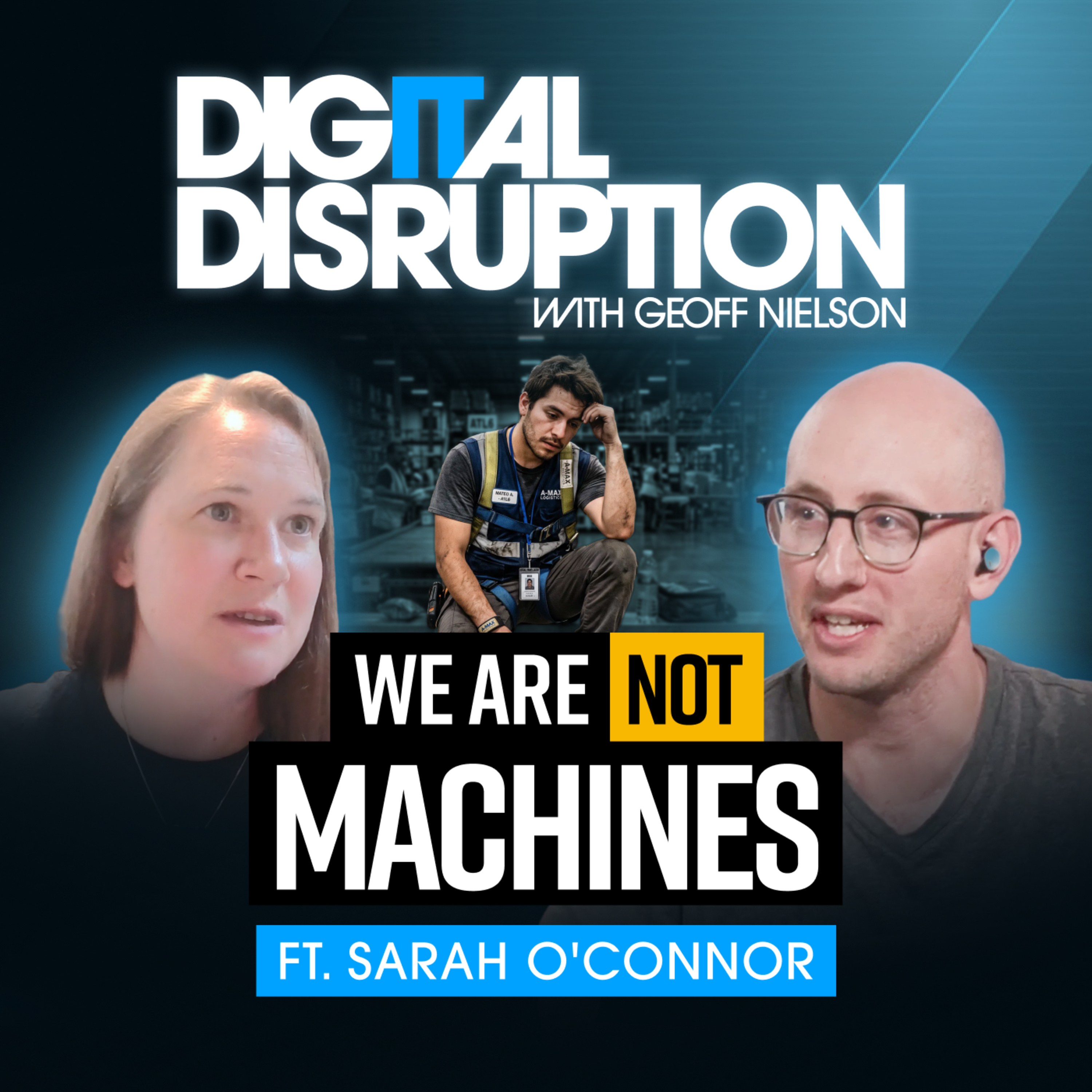
Digital Disruption with Geoff Nielson
AI CEOs Are Lying About the Future of Work. Here's What's Really Coming
01:12:35
Loading summary
Transcript30 lines
- [00:02]
Sarah O'Connor
I met very few people that had completely lost their jobs because of AI or robotics. But nor were some of these people saying that they felt that they'd been freed up from the boring or the monotonous parts in order to spend more time on the fun, creative, human, relational parts. In fact, I started to hear people who said precisely the opposite seemed to be happening, that they were somehow being kind of crunched now into systems that were paced by machines and appraised by machines and in which they felt as if somehow they had to act more like machines themselves in order to keep up and to comply with the way their workplaces were changing. It's like we can't allow ourselves to just do less for the sake of doing less. We're kind of resisting this and it all feels too much if you listen to the language used. You know, we say things like I'm burned out or I need to disconnect or I need to switch off. You know, all of these phrases are phrases that you would use about machines, not about like fleshy mammals that are composed mostly of water. They don't burn out, they just need a rest. And so, yeah, I think we've sort of slightly started to confuse ourselves with our own tools in a way that is not necessarily helpful.
- [01:17]
Jeff Nielsen
This is a show about the future of tech and the future of work. I'm Jeff Nielsen and today we're diving into how AI and automation are, are actually impacting our work. Look, I'm sure you've already heard that AI is going to wipe out half our jobs or that we're headed for some sort of post job utopia and both of those claims should immediately set off your bullshit detector. So what is actually happening? My guest today is award winning journalist at the Financial Times, Sarah o', Connor, and she's obsessed with answering that question. Sarah has spent the last year with people and companies whose jobs are on the front lines of automation. From an Amazon warehouse to translation services to more surprising places like a mine in northern Sweden. She has so many deep, amazing stories and I had the chance to read her new book, We Are Not Machines. And it just never ceases to amaze me how much original research and thought leadership she brings to a space dominated by empty hype. So I'm really excited to pick her brain to understand whether AI can make us more human or risks turning us all into machines. It should be an amazing conversation. Let's jump in. Well, Sarah, thanks so much for joining today. Really excited to have you. Really excited to talk about the future of work and I mean, let's just jump right into it and maybe start with sort of a meaty question. But, you know, we've all heard the rhetoric coming out of the mouths of AI CEOs about how this technology and how all technology is going to change work itself. I'm curious, you know, from your perspective, what are you seeing happening to work?
- [02:56]
Sarah O'Connor
I was becoming quite frustrated with the way that discourse was going. It sort of seemed to me that we were becoming sort of an audience to these very big prognostications, mostly from the leaders of the technology companies themselves. You know, either these big utopian visions that, oh, it's going to be great, you know, everyone will be able to work less, we'll be able to offload all of the sort of the dull, the boring, the monotonous parts of our jobs onto AI and automation. And then we'll be freed up to spend more time doing the kind of human creative stuff that was the sort of the utopian vision. Oh, and by the way, we might just work, you know, three days a week or something, spend the rest of the time in our hammocks. And then of course, you know, we've had lots and lots of these dystopian visions that actually 50% of white collar workers are about to be wiped out, that before long, because the machines are getting so much better, there'll be hardly any tasks left that humans are better than machines at. And therefore we need to think about some radical transformation of the economy in which most people can no longer earn a living based on the kind of labor that they can contribute. And these sort of annoyed me for two reasons. I think the first one was that they were all really predictions. They were all saying things about what might happen in the future. But I know, because I write about the world of work for the FT and have done for more than a decade, that AI is already starting to change the world of work, that it is entering all kinds of different workplaces and beginning to change things right now. And yet we were hearing not so much about what was really happening and a lot more about what might happen at some indeterminate point in the future. And then the other thing that I thought was problematic was that all of these predictions were coming from people that are really at the top. You know, they are either coming from the technology companies themselves, who, you know, obviously have a product to sell, so they're not necessarily the most impartial of observers, or sometimes they were coming from like very sort of senior and interesting economists who, you know, I have a lot of respect for the work that they do. But what they have been doing is really quite an abstract sort of mapping exercise where they, they've sort of taken every job that exists in the economy and they've tried to break it down into all of its constituent tasks as if that's a kind of easy thing to do. And then they've sort of tried to map the capabilities of large language models against all of the tasks that exist in various jobs to come up with these lists. And I'm sure you've seen loads of them because journalists like me like to write about them. You know that 60% of jobs in the economy are exposed to AI, or maybe it's 20% or maybe it's 90%. You know, they're all very different, these estimates. And they're not very useful either really, because for a job to be exposed to AI doesn't really tell you is that job going to get better as a result of AI being involved? Is that job going to get worse? Is it going to be degraded or de skilled in some way? Or indeed is it going to be displaced altogether? So to know that your job has like a 60% chance of being affected in some way is not actually a particularly sort of useful piece of information, it seemed to me. And the kind of journalism that I really like to do at the FT is to get out of the office, get my reporter's notebook, get my comfy boots on, and just go and find out what's happening on the ground. So what I did in this book was I basically tried to go and find people and workplaces that were, as I saw it, on the sort of front lines of this new kind of phase of technological change. So people who were already starting to experience the full force of disruption. So I spoke to software developers and translators. I went inside a new Amazon warehouse which is now kind of crawling with robots. I went down a mine in Sweden which now has self driving trucks and loaders kind of roaming around under there. I spent several days shadowing some community nurses in the Netherlands. And the question that I really had was the question that you just asked me, which is, well, what's actually happening? And I wanted to know it from the people it was actually happening to because I felt like their voices weirdly weren't really being heard very much in this debate. And to answer your question, that was a long preamble, I guess, to answer your question, the story that I started to hear from lots of them, not all of them, but lots of them, was one that didn't really fit with that utopian vision or the dystopian vision. So I heard from people who weren't being completely displaced from their work altogether. I met very few people that had completely lost their jobs because of AI or robotics. But nor were some of these people saying that they felt that they'd been freed up from the boring or the monotonous parts in order to spend more time on the fun, creative, human, relational parts. In fact, I started to hear people who said precisely the opposite seemed to be happening, that they were somehow being kind of crunched now into systems that were paced by machines and appraised by machines, and in which they felt as if somehow they had to act more like machines themselves in order to keep up and to comply with the way their workplaces were changing. And I felt like that was a story that wasn't really being told, so was worth sort of being explored further. One example of that would be the Amazon warehouse that I mentioned. So, you know, Amazon warehouses of old were basically just like massive, great warehouses. And you would walk around between all these aisles and pick items off the shelf. You might walk sort of 10 or 15 miles a day. So it's like a very hard, physical job. And as we all know, like Amazon is quite technologically advanced company. And so although the job itself was quite manual and quite straightforward, not particularly technical, they layered on quite a lot of sort of algorithmic surveillance systems to make sure that people were working fast enough and were keeping up with the sort of targets that Amazon expected of them. That was what the job used to be. So when I went to this brand new warehouse that I knew was full of robots, my vision for how that might have gone was basically that there would have been like a one for one swap. So instead of humans walking around, there'd be like humanoid robots sort of like, you know, jerkily walking from shelf to shelf and doing the exact same thing that the humans used to do. And that the humans would either have just kind of lost their jobs altogether or maybe they would have been sort of upskilled. You know, they would now be maintaining the robots or supervising them, sitting at screens, doing something that was a bit more kind of white collar ish, that that's not really the way it's playing out inside these warehouses, and that's partly because, and this is true for lots of different types of automation, is that, you know, what these new tools can do is often do some parts of a job, but not the whole job. And so for the Amazon workers, the bit that is still quite hard to automate away is human dexterity. Like, our hands are unbelievably flexible and dexterous, and we are really adaptable. So, you know, if you're working in an Amazon warehouse, you might have to pick like a. A tiny nail varnish bottle off a shelf, and then the next thing you have to pick up is like a massive great stack of books or a dinner set or something. And for robots to have that level of adaptability and dexterity, like, that's still kind of beyond them. I don't think it will be forever, but it is for now. So what Amazon has done is basically just redesign the whole workflow around what robots can do and what they can't do, and they've plugged the humans in to do the bits that still can't be done. And so what that kind of looks like in practice, I went inside one and had a look, is that now the warehouses can actually be a bit smaller because you don't need aisles between all the shelves anymore. All the shelves are kind of packed very tightly together in the middle of each floor. And then there's a big perimeter fence that surrounds all the shelves. And along that fence there are gaps. And the human workers stand in these gaps in the fence. And what the robots do, the robots are kind of big, low things that look a bit like robot Hoovers, but much bigger. They slide under the shelving units and they bring the shelves to the workers. So now, as a worker, you stand there and a robot brings you a shelf, and then a light illuminates where you need to look on that shelf, and the screen shows you a picture of what you need to pick off that shelf, and you pick it off and. And then another light illuminates which box you should put that into next to you. So you do that and you push a button, and then that robot takes that shelf away and the next robot brings the next shelf in. Now, this is, like, much more productive and efficient from Amazon's point of view, because instead of, you know, if you're walking around between all these different shelf locations, you might be picking, you know, I don't know how many items per hour, but in this new system, you're probably going to pick sort of three or four times as many. So it's much more productive, but it still requires a lot of human neighbor. And the question that I was sort of left with having, you know, I've reported on the old warehouses and I've been into these new ones is like, did this job get better or worse? Like Is this actually an improvement in the conditions in this work? Have people been freed up to feel more human in any way? And I think it's got better in some ways and worse in others, if I'm honest. So Amazon says, and I think that this is true. Is this a safer job now? It's less physically demanding. You know, walking around all day is really hard work. You know, I used to interview workers who were getting blisters on their feet and they would like cover their feet with Vaseline before they started a shift because it was so physically demanding. So I think it's true that it's less physically demanding. And we know that like injury rates in Amazon warehouses, which used to be quite high, they've been sort of declining as the level of automation has been going up. So all of that seems like a good thing. But what some of the workers told me who work in these new warehouses is it is even more boring and it's more lonely, you know, because now you're standing there and it's just you and the robots really, and you're not even sort of walking past people and having like a brief conversation. So, yeah, I mean, one of my interviewees, he'd asked for a transfer to this new warehouse because he thought it would be quite exciting working with robots and maybe there'll be more opportunities for progression. But, but actually he just, he said he felt like a robot himself in this system. And in the end he got a transfer back to the old manual warehouse where he got to do things the kind of old fashioned way. And what that brought home to me is that actually it's not necessarily a given that when you introduce automation into a job it will necessarily take away the dull parts and free people up to work less or to work more fluidly or in a more human way. You know, it can, it can potentially go the opposite way. And that's the sort of the blue collar side of that. But I also spoke to some white collar workers who felt kind of similar, that they were experiencing some of the same things. And one example of that would be translators. So, you know, I had think going into this had imagined that translators would simply have been wiped out by. You know, we all know that machine translation is pretty good now, but that's not really the case. There are still a lot of human translators out there, but the nature of that job has also changed quite profoundly. So some of the people I spoke to, they translate the subtitles for TV shows. So that might be like a Disney show or a Netflix show. And what has happened to those people is that rather than that being quite a kind of creative job where you sit and watch the program, you think about how would I render the meaning of, of this sentence or this joke, you know, into my home language in a way that still conveys the right level of kind of emotional intensity or, you know, captures the humour, which is really actually quite difficult because a lot of jokes in English are, they're puns, they're like word based jokes. It's really tricky. But when you get that right, that's quite satisfying for a translator. My favorite example of this is the asterisk stories. I don't know if you ever read asterisks or if that's a big thing in Canada.
- [14:43]
Jeff Nielsen
Asterisks and objects.
- [14:44]
Sarah O'Connor
So I mean, the, the English translations of Ashoka's Asterix was originally in French. The English translators were absolute geniuses, you know, some of the, the ideas they came up with. So my favorite example is. So Obelix's dog in the original French version was called Ide Fix, which means obsession. But the English translators called him dogmatics with an X at the end. Which, you know, if anything is an even better joke. Right. And so what the translators told me was that when you get it right, when you think of some clever way of translating something, it's an intensely satisfying job. But what's happened to them is that now rather than translating from scratch, the agencies that sort of intermediate a lot of this work, they're taking the English subtitles, they're getting a machine to translate them, and then they're giving that machine translation to the human translators and they're telling them, now your job is to check this for accuracy, to tidy it up, to make it feel a bit better, a bit more human. But that's quite a different job from the translator's point of view for a few reasons. One is that they're now expected to do this at twice the pace, but for half the price. And so the job instantly kind of speeds up and feels a bit more intense. You've got to really rattle through this now in order to maintain your weekly or monthly income as a freelancer. But also that it's quite difficult to do, actually. Like, if you care about quality and accuracy, which, you know, these are professionals, so they, they do care about that. To check a translation that's been given to you against an original text is, is actually kind of quite, quite arduous, you know, to keep going between those two texts and you don't get into the same sort of creative flow state as when you're actually doing that translation from scratch. I mean, to my shame, I don't actually speak any other languages, but I'm sure a lot of your listeners do, so they might resonate with this a bit more. But yeah, apparently you can get into quite a pleasant flow state when you're doing this from scratch, but doing it this other way is, is kind of cognitively more uncomfortable. And one of my interviewees, you know, he started out in life, he's from the Czech Republic. He started out working in a factory, you know, a windows and doors factory. And what he said was that this job that he used to love, that used to feel creative and enjoyable, had sort of been stripped of those creative bits and had been sped up, but also sort of routinized in this in a way, and that it felt more like a production line job than the job that he used to love. And this feels quite sad to me because this is, I think, not what any of us would want really. You know, I think there's a sort of an expectation that whether it's the utopian version of the future or the dystopian version, one kind of consistent thing between those is that there'll be less work somehow. And whether that's sort of spread out evenly and we're all doing less and doing like a four day week, or it's spread out in a kind of problematic way and lots of people have nothing to do. I don't think many people have anticipated that we might actually still be quite busy, but not necessarily in a way that, that feels good to us. So those are a couple of quite sort of gloomy examples for you. But I did also find some much more positive examples and I'm happy to talk about about them too, and why things are going well in some places and badly in others.
- [18:07]
Jeff Nielsen
If you don't work in enterprise technology, you can skip ahead or take a quick braincation, but if you do, Infotech is your secret weapon. Infotech helps IT teams get projects done faster, better and at a lower cost. Whether you're rolling out new tech, improving processes, or just looking for cost savings, Infotech provides unlimited access to practical tools and and expert guidance you need to execute at a fraction of the cost of traditional consulting, no matter the project. From AI strategy to cybersecurity to vendor negotiation, Infotech has you covered. Check it out at the link below and don't forget to like and subscribe. So it's interesting. And you know, in my reading of it, there's Definitely a flavor of dystopia there, I guess, because when I hear those stories, you know, I certainly don't hear about jobs that now are, you know, higher value or, you know, more, more rewarding in some way. I, I, you know, have these sketches of basically humans being traded. Sorry, I have these sketches of humans being treated as, you know, dexterous, moist robots or machines. Right. Like it's all, it's all machines, but some of those machines happen to be human laborers. And like that on some level is deeply depressing. And you, you used a phrase a couple of times that I really liked which was, was more human. Like how can we make work more human? Which may not be Amazon's top priority or any of the employers top priorities. But I'm curious, you know, from your perspective, you said those were some of the gloomier stories. What are some of the more optimistic stories? What are some of the examples you saw of this being done better and what do those have in common?
- [19:56]
Sarah O'Connor
Yeah, so I'll give you a couple. I guess from the white collar world, I would say that software developers are probably an example of people who are feeling much more positive about this transformation. I mean, not, not all of them. It has been a kind of massively disorientating time, I think, for software developers. But you know, you might have imagined that it could have gone quite similarly for software developers and translators. Right? Because for both of these professions, one really core part of their skill set for translators it's translating things between two languages. And for software developers, it's being able to write code suddenly. Now machines are pretty good at doing it, but for the software developers it seems to have been going differently in the sense that for the translators, I think the part of the job that they really loved was the act of translation. Whereas for a lot of the software developers that I spoke to, and my brother is a software developer and my dad is a software developer, so this kind of slightly runs in the family for them. Like sitting down and physically writing out the code was more of a means to an end. And the end was to solve cool problems with computers. Right. And so if you have like this new tool which enables you to solve more problems with, by actually writing the code so that you can kind of go up a level of abstraction and think a bit more about what are the different problems, talk more to your customers or your clients or your employer about what needs to be solved and how that what we are kind of seeing there is rather than a deskilling, we're seeing a sort of an Upskilling, I think. So, you know, and you can see that even in the labor market data that the, the demand for senior software developers, people who have a lot of experience, who now have taste and judgment and the ability to manage, they're kind of doing quite well in this new world, you know, because now some of these new tools, they're sort of like power tools, but you need to know how to use them responsibly and wisely. And so if you are in that lucky position of already being quite ensconced in your profession, then you can just use this stuff to be much more productive and to do many more things. Now this is not like an entirely positive story because what a lot of those people are also saying is they're kind of burning out too. So similarly, they're not finding that they're getting all of their programming done by lunchtime and then lying in the bath all afternoon because it turns out that white collar work just expands to fill the time available often, which I think is something we're all sort of familiar with from our own jobs, that software is the sort of thing where actually there's probably been a lot of kind of latent demand for software that hasn't been met because it's quite expensive to hire software developers, whereas suddenly it's much, much cheaper. You can, you know, each software developer can do more stuff. So an economist would call this Jevons paradox, that sometimes if the price of something goes down a lot, demand for it simply goes up. And I think that's sort of what we're seeing in software. So that means that these, these, these guys are actually incredibly busy. And because you can do more stuff, it sort of, it resets expectations of what is natural or what is possible. And you know, I think at the moment a lot of that is driven by the software guys themselves, that they're, they're sort of exhilarated and they're having fun. You know, my, my brother, who he now sort of controls like a, a swarm of AI agents who are sort of doing his bidding, he says he feels a bit like he's superhuman. You know, he can just do so much stuff. So it is exhilarating and satisfying, but it can also be quite cognitively exhausting in its own way. Another example I would give, and this is from the sort of the blue collar world, but I think is an interesting counterpoint to that. Amazon Warehouse is the Swedish mine that I mentioned at the start. So this mine, now the job of being a miner there has completely transformed. So it Used to be that the miners would drive around a kilometre and a half below the surface of the ground. This is like way up in the north of Sweden. There's sort of pine forests, there's reindeers. And then you go down, I went down right to the bottom and at the bottom it's like, it's dark and it's humid and it's really claustrophobic and it's kind of, there's a lot of mist or steam in the air. So it feels really horrible to me. It felt horrible. And even the miners, you know, I don't think love being in these mineshafts, right? And it used to be that they would drive these vehicles around that would do the all the jobs that needed to be doing. Now they're self driving vehicles and so the miners are sitting in a control room and they're looking at a kind of bank of screens. So they're watching what the self driving vehicles are doing. They've got a pedal, they've got a joystick so they can take over remotely if they need to if the self driving vehicles kind of get into trouble or get confused or get stuck. But for the most part, you know, their job is now really different and I wondered whether this would to them feel like an upgrade and actually I think it did. You know, I, I interviewed one of the miners who was like, look, it's, it's quieter, it's safer. I'm now I'm listening to the Isock key on the radio or I'm listening to Spotify because we've got WI fi down here in this mine now and this is definitely a better job. And I think there are a few reasons why they feel good about it. And one goes to, I think, a sense of control. So for the Amazon workers it was almost like they were. Have you heard this term human in the loop? It's used in sort of lots of different contexts and I think for the Amazon workers they were humans in the loop of a pretty like automated system in which everything was running to a kind of an intense timetable and they just had to keep up. But it felt to them like the robots were really the ones that were in charge and were setting the pace. And you can hear that just in the language they use. You know, one of them said to me, you know, the robots are moving and you've got to move with the robots. You know, these robots are so fast, they're killing us. Whereas for the miners, the way they would talk about these self driving vehicles was like the vehicles are doing their bidding. So he would say, you know, I'm going to send it here, I'm going to send it there. It felt much more that they were in control and that this was a tool that they were using. Whereas for the Amazon workers, it felt more as if they themselves had become a tool, you know, that they were, they were, as you put it, the kind of the fleshy appendages that the robots didn't quite have yet. And that's a, that's like a psychological difference, but I think quite a profound one. And then the other difference is that, you know, in that mine they have, they have sort of very Swedish institutional arrangements. You know, I don't know how much you know about Sweden, but trade unions are very powerful. They're both at a sectoral level, but also at an individual company level. And so what, what has to happen is something called co determination. So when an employer brings in new technology to a workplace, that is going to quite profoundly change the way work gets done. It's the law that they have to sit down with the workers and negotiate over it first. And this isn't like a kind of management still has the prerogative, management ultimately still has the, the final say is their right to do stuff, but they do have to at least talk about it first. And in this mine, you know, I had imagined that that could be a sort of recipe for sclerosis. So in, in the uk where I'm from, unions and employers have quite a kind of antagonistic relationship for the most part. And unions often see their job as like fighting management in some way, but in this sense, Swedish mind. And I think in a lot of Swedish workplaces they have such a lot of kind of muscle memory of how to do this, of how to negotiate technological change, that these new machines and these new AI systems are being negotiated in a way that they are already very familiar with. And I think both sides sort of recognize that each other has a right to be at that table and to talk it through. There were lots of interesting ways in which they had figured out things that could otherwise have been difficulties. So one of the tensions when they wanted to bring in the self driving trucks was where should the miners be now? You know, actually do the miners even need to be underground? Surely they can be on the surface and that's what the employer wanted. They were like, the control room should be on the surface. That is most efficient, it makes most sense, it's safer, whatever. But the miners wanted to stay underground. They didn't want to stay on the surface. For a very good reason, which is that you get paid more if you work underground in the Swedish economy. And who's going to agree to something that involves a pay cut, right? And so they talked it through and they came to what one of the union leaders described to me as a very Swedish compromise, which was that they put the control room halfway down the mine. So there's a kind of halfway point where there's a canteen. And now you walk through the canteen and you get to the control room and like, from the outside, you might look at that and say, that's weird and inefficient. You know, that makes no sense. But actually, I would argue to you that that's more efficient, because what it enabled them to do was just to move forward with the whole idea, you know, that otherwise they might have ended up stuck in this place where the binders were resisting because they didn't want to get a pay cut and the employer was insisting and they would have got nowhere or they would have ended up in some kind of industrial strife. Whereas actually doing something that seems a bit odd enabled them to just get that technology in and get it working. So, yeah, and then I guess the other thing is that because the Swedish miners have union members on the board, it means that they have access to a lot of information about what is truly happening with the company. And my sense as a. A journalist at the FT is that when I report on companies where things are going wrong between employers and workers, what's often part of the problem is like a complete breakdown of trust, which is linked to a kind of lack of information about what's happening. Whereas I think because the Swedish union had seats on the board, they were well aware that actually for this mine to continue to operate, for them to keep digging down further, they had to find a way to do it more cost effectively, and that the alternative would have been to just stop digging. And at that point, no one has a job anymore. And so everyone is aware that there is a good kind of business rationale for doing this and they have some shared interest in making it work. Whereas, you know, you could have imagined a scenario where that information was lacking and the miners sort of suspected that this was a pretext to something that was just trying to kind of get rid of them entirely. So, yeah, there were lots of ways in which this enabled things to go better. But I think the key is, like, who. Who gets a seat at the table when these decisions get made? You know, who has the right to. To have their say? And is it possible to, to kind of manage these technological transitions in a way that doesn't kind of degrade some of the trust that exists in the workplace already.
- [31:10]
Jeff Nielsen
So I'm going to, I'm going to push you a little bit to answer the question you just posed, because I think it's a, it's an incredibly important question. And it's so interesting hearing about this Swedish model, because I'm sure where you are in the UK and certainly with my experience across America and Canada, that's just not my experience with unions or the kind of environment they're operating in or the outcomes that you get. So. So I am curious, Sarah, what your impression was walking away from the mine and seeing the solution that they had come up with, I guess the framework or the governance that had gotten them there. And to ask your question back to you, who should have a seat at the table and how should you best go about coming up with some of these job changing or function changing decisions?
- [32:00]
Sarah O'Connor
I mean, I think the answer is that everyone should have a seat at the table. And the question is, how do you do that in a way that doesn't lead to chaos or sclerosis? Right. And you know, what I was sort of wary of doing was concluding in this, well, you know, Britain and Canada and the U.S. and all these other countries should find a time machine and, you know, reinvent 200 years of industrial history in order to have the Swedish model. Because, like, clearly that's not going to happen. Like, we all start from where we are and most of us do not start from the traditions of Swedish collective bargaining. So, you know, you have to be realistic about that. But, you know, all of that said, I think that there were some lessons that managers from all kinds of different companies could absorb. And one of them, I think, is that, you know, as I said, giving people a seat at the table does not necessarily have to mean seeding the possibility of getting stuff done and that in fact, it can do the opposite. I mean, you know, we're already seeing a lot of employers are getting kind of frustrated about AI adoption levels in their companies and they're sort of banging their heads against the table and saying, why are more people not adopting these tools faster? And, you know, when you look in the details, often the reason is that people are really suspicious about what their employers are planning in the long run, or they simply have found that the tools don't work very well for the job at hand. And I think that is also quite an important point about giving more people a seat at the table is that actually you are best placed to know how your job works and which tools would be useful and would not be useful. And being sort of pressured to use a set of tools in a way that, you know, fundamentally doesn't work very well or looks as if it will be faster, but creates a bottleneck somewhere else in the process, which means that in fact it's slower because you've got to, you know, find five more people to review it or whatever it might be, that the people who are doing the work are actually best placed to tell you how to make it more efficient. And so if you can create some kind of forum or environment in which people feel able to talk about that, then things do often go better. And then, you know, the other lesson I think from that, from that experience was that you don't always have to take technology as it's given to you. So, you know, another interesting example that the Swedish managers gave to me was that they, once they had WI Fi working underground, it became clear to them that they could introduce a kind of real time positioning system so that they could know where all the miners were at all times. And, you know, from a safety point of view, this is obviously a good idea. But when they sat down to negotiate over it, what they realized was that some of the workers were all in favor of this because they too could see the safety advantages. But some of them were really nervous and skeptical because they were worried that it would have a secondary purpose of enabling a kind of surveillance managerial system, you know, which wasn't the culture there, and that they didn't want to become the culture. And, you know, one of them literally said, we don't want to be treated like Amazon workers here. We don't want you timing how long we spend in the bathroom like that is not what we want. And we're worried that this technology, even if that's not why you're doing it, that over time it could become used for something like that. And so what they did was they. They went back to the technology vendor, the company that had made this software system, and they said, can we pay you to make an adjustment for us? So that rather than seeing the names of everyone, we have a kind of anonymization feature. So we can see where everybody is, but not who they are. Everybody has these anonymized number tags. And we have agreed in advance that there will be certain situations where we can de. Anonymize that data if there's an emergency or if there's been an accident that needs to be investigated. And Both the union and the employer have passwords and they can put them in together in order to de anonymize it. And this I thought was quite a good solution because it fundamentally allowed them to reap the kind of the safety benefits, but without losing something that was sort of quite precious but also a bit invisible, which was this sense that actually people respected and trusted each other in the workplace. And the Swedish employer, I think had never really wanted to have a micromanaging system that wasn't their intention from the start and maybe they would never have even used it for that. But in a sense that doesn't matter because if that's what people start to suspect, then it already changes the kind of the culture. And the reason I tell that story is that, you know, it's just a reminder that it is, you don't have to take everything out of the box and just deploy it, you know. And often these, these systems, these AI models, whatever they are, the tools, they've been designed by people who don't know your own company necessarily, who don't know exactly how it works or what would work for you. And it is possible to kind of question the premise a bit and say, do we want all of this? Would we like this to be different? Right now we're starting to see that some kind of forward thinking companies are experimenting with getting kind of cheaper AI models, kind of open source or open weight models, and then fine tuning them themselves, often using their own employees who are kind of experts in their jobs, in order to actually create tools that are more useful for their own kind of corporate context rather than these kind of big black box frontier models that they're getting from places like Opener AI or Anthropic. And I think over time we might see more of that where actually you're seeing people crafting tools that are more responsive to what their needs actually are. And if you're going to do that, then you really need your employees, you know, because they're the ones that are going to train it. And so you need them to be on board with this. And the only way to do that is to make them feel that they are. Yeah. That they're a part of it somehow and not having it sort of foisted upon them.
- [37:55]
Jeff Nielsen
I think I really like that insight and you know, the approach there and the way to do it. There's an implication there though that I want to pick out a little bit and sort of devil's advocate because there's implications there that that is better that having anonymized workers is better, that the Amazon approach is bad and that we lose something by just breaking people down into, you know, these small mechanical tasks that, that is worth pushing against. Because I'm sure, I'm sure there are business leaders, I'm sure there are listeners to this that say, like, why that is, that's going to be most, you know, optimal, most efficient and that's the way we should run our business versus listening to the employees. And it reminded me, Sarah, actually, of a story I've heard of yours that you haven't told, which is the, the story of the nurses and of the sort of the elder care and the health care. Can you talk a little bit about how in that space, you know, you've come across, and nurses have come across multiple care models, one that's more mechanical, I guess, and one that's more human. And the insights you got out of that.
- [39:06]
Sarah O'Connor
Yeah, I mean, I think that you're, you know, you're right to kind of question that premise. And clearly there are different kind of valid ways of running a business that will, might give you kind of similar outcomes in the short run. But I would argue that over the long run, creating work that workers don't like to do is going to, is going to cost you in some way or another. And it might be that you can kind of continue to just bring more people in and live with like a relatively high labor turnover that works in some sectors but doesn't work in others. So nursing is a good example of where I think it really doesn't work to do that kind of Tayloristic, you know, break, break things down into their constituent chunks. But that is how, how it works in a lot of places. So, you know, in the uk, for example, we have domiciliary care workers who will go from, you know, from one house to another and they will go and they will kind of help people who need help in their own homes, probably because they're elderly or very unwell. The system here has been, we've sort of attempted to do this in an efficient way whereby the commissioning of these services is often done by local authorities, like local governments, who are fundamentally like on the hook to pay for a lot of it. And they kind of like auction off almost all of the tasks to a whole range of different private providers who then sort of bid for them. And while that does push down the cost, what it means is that you have, you know, if you're an elderly person and you're relying on some domiciliary care, some carers to come into Your home, you might have sort of five or 10 different people turning up in a week. You know, nobody gets to know who you are or what your issues are. Each of those people might come in and they've only got 10 minutes to do what they need to do, or 15 minutes. And so a, that doesn't lead to a satisfying job because as someone who has gone into a caring profession, you actually fundamentally have some empathy and you want to do a good job and to look after people. And when you're rushing in for 10 minutes and you're on the clock and you've got to give someone a shower and you don't have time to listen to them when they want to talk about the fact they're feeling lonely or whatever, that, that doesn't feel good to you. But also it doesn't really work well as a care model because things get missed. You know, when you've got five or ten different people coming in, nobody really gets to know the patient and what's happening. And so in the, in the example that I wrote about in the book in the Netherlands, I went to see some nurses who work for a company called Birdsorch who have basically tried to turn this whole efficiency model on its head. And so what they do there is they, for a start, there are no managers in this company really. It's a very kind of flat company. What you have instead is sort of autonomous teams of nurses and they are higher qualified. So rather than breaking down all of the different tasks that might go into caring for a person and getting a qualified nurse to do the more medical tasks and then getting someone who has no qualifications to go in and make them a sandwich or to give them a shower. In this model, basically the well qualified nurses do the whole thing and they are able to form like long term relationships with their clients. And they work in these small teams, like maybe six to 10 nurses in one neighborhood, and they figure out between themselves how to do the job. So they figure out where their office is going to be and they come up with a rotor themselves. And if they need to hire someone new, then the, the team does that together. So it's like, it's quite a radically different system. And it, you know, it actually doesn't work for everyone. A lot of people can't cope with that level of responsibility and autonomy. Like, it's definitely not for everyone but for the nurses who are doing it and who like, creates a very different outcome because, you know, you're getting to know a person rather than seeing them as like a series of tasks that you have to complete and that actually, it turns out, is more efficient. Because when you have well qualified people who are forming these trusting relationships with clients, it turns out the clients need less care overall. So what Birds Talk has found is that they are getting much higher sort of satisfaction ratings from their clients, but they have to deliver far fewer hours of care in order to do the same level of. Provide the same level of kind of care and service. And for the nurses, it means that, you know, one of the nurses that I spent some time with, you know, I said to her, like, do you not feel sometimes that you've got all these qualifications and medical knowledge? Do you not feel that it's like a bit of a waste of your time to go in and make someone a sandwich, you know, and give them a wash? And she was like, well, no, because you're not just going for the sandwich. You know, you're going to check how she is, you're going to have a look at the environment. And, you know, she said that it might be that you, if you're going in every day, you notice that three days in a run, that sandwich is barely eaten and it's in the bin. And if you've been there every day, then you can notice that and you can say, hey, you know, what's going on? Why is the, why are you not eating your sandwich? And she said it might be that that person is dying because the appetite is one of the first things to go, or it might be a sign of a certain kind of cancer, or it might be that actually she hates that kind of cheese. And, and you didn't know that. But if you have a different person going in each day, nobody's going to spot that. And so a lot of, a lot of problems get missed in this system that looks more efficient, where you're deploying lots of people to do lots of different tasks in a way that don't. When you have the opportunity to have one kind of better paid professional forming an actual relationship. So, you know, nursing is a very different profession to running a warehouse. So I'm not claiming that the same things, the same lessons apply right across the board, but I do think that, yeah, we kind of, we often prioritize this idea of efficiency in the short run without noticing that sometimes that is wildly less efficient in the long run.
- [45:07]
Jeff Nielsen
Well, that's, that's exactly it. And that's what's really frustrated me is it seems like there's been this push to try to transform nursing into a warehouse job that's you know, and I was chuckling to myself because you said, like, oh, these autonomous nursing teams. And the way you describe it and tell me if you disagree. Like, sure, we can describe it as radical based on what people tend to be doing now, but I have to imagine it's not all that different from what nursing looks like a hundred years ago. Like, I feel like this is what has always worked. And then we've f. Like, I don't know, we've tried to warehousify it. It's gone terribly for the nurses and for the people receiving care and, you know, we don't need to get too deep into this, but it just feels like in basically every advanced economy in the world, healthcare has completely gone to shit. And I'm sure you've got some horror stories about the nhs, you know, Canada, the us, you name it. Like, everyone is complaining that healthcare is getting more and more expensive and it's getting worse and worse. And I. I don't know, I'm just curious if you. If you feel like there are some lessons to be learned there, to. To try and undo. I don't know, the. To. To try and reverse course on the trajectory that we. We found ourselves in. And it feels like, at least to me, we're going in the wrong direction.
- [46:30]
Sarah O'Connor
Yeah, well, the guy who founded this company, Bezel, he himself had been a community nurse back in the day in the Netherlands, when this was the way it was always done. So you're exactly right, you know, this is, in a way, going back to the future. And he had believed that this was a really good way of running things, you know, being based in a neighborhood, getting to know the clients. And he had ended up working for one of the big kind of healthcare companies in the Netherlands. And he watched. He was in a managerial role and he watched as the layers of bureaucracy increased and the kind of the task and time model got introduced. And he could see that actually it was becoming more expensive and less efficient. And that was why, in the end he left and tried to kind of create this completely new model. And one of the sort of questions that I had in my head while I was there, which I think is the question that you're asking me now, was like, if this, if this is so good, and it seems as if it is, why isn't everyone doing it? You know, and actually a lot of people have been sort of entranced by this Bertzorg model. And so Jos, who is the guy who founded it, has been invited to give speeches in, like, lots of different countries. Harvard Business School has gone and done like a. One of their famous case studies about it. And everyone likes the idea in principle, but has struggled to replicate it in their own countries. And that's definitely true for the uk, where I live. And I think it's partly sort of institutional. So it depends a lot on the kind of, the wider institutions that exist in a particular healthcare system. And it's not always easy to plug in this kind of model. You know, it depends a lot on funding. So in the Netherlands there's like a health insurance model, whereas in the uk, as you know, we have the, the National Health Service. And also, I think it's, it's, it's, it's sort of cultural. You know, it's really hard when you've become used to doing something in quite a kind of structured, formalized way, to suddenly completely break out of that. And then I think the final reason I asked Jennifer, who was the. The nurse in the Netherlands who I spent some time with, like, why do you think more people aren't doing this? And she said, well, because, you know, a lot of managers aren't going to vote for their jobs to disappear. There are no managers in that company. There's no layers of management. But the people who would have to make those decisions to get rid of those managers are indeed the managers themselves. And so there's just a kind of a sort of a stasis that tends to exist. I think once the structure exists and once everyone has their own little place within it, it's very hard to become radical about how to do things differently.
- [49:18]
Jeff Nielsen
I think that's well said, if a bit depressing. But, you know, hopefully, hopefully we can have more leaders who have the courage to implement something like that. And, you know, the other piece you didn't mention that was on my mind as well is just the, like, the tyranny of metrics and what you're measuring and how. I can see a world where if you're measuring everything like a warehouse and it's these little bits of efficiency, you feel like, oh, I've got the right model, but, you know, if there's, as you said, longer time horizons, things that are maybe invisible in that world, you end up with, you know, something that's suboptimal for everybody.
- [49:56]
Sarah O'Connor
Yeah. And I mean, you know, we've been talking about this at the level of, like, companies or sectors. Right. But I think that the same thing is probably true at the level of us as, as individuals. It feels as if we've become obsessed with this idea of productivity, of becoming more productive, of optimizing ourselves in, in some way almost as if we are machines, you know, and what we need to do is to kind of fine tune ourselves. And again, you know, I feel like that is a, a real misunderstanding of, of who we are and, and risks something being lost. You know. And you see that with, you know, the kind of the watches that we all wear that are tracking our steps and our heart rate and how well we slept to, you know, the, the books that we buy, you know, I, I even like books that are about how to rest and how to relax. Like, I don't know if you've noticed, but often their subtitles are something about why this would help you be more productive in the long run. There's one that's called Rest, that's actually a very good book. But the subtitle is why you get more done when you do less. You know, it's like we can't allow ourselves to just do less for the sake of doing less. And even, you know, when we're sort of, when we, when we're kind of resisting this and it all feels too much if you listen to the language used, you know, we say things like I'm burned out or I need to disconnect or I need to switch off. You know, all of these phrases are phrases that you would use about machines, not about like fleshy mammals that are composed mostly of water. They don't burn out, they just need a rest. And so yeah, I think we've sort of slightly started to confuse ourselves with our own tools in a way that is not necessarily helpful. You know, and like I'm not a kind of a disbeliever in productivity or economic growth. Like I'm a Financial Times journalist. Like here in the uk we've just had a decade of no productivity growth and no economic growth. And let me tell you, it hasn't been much fun. Our like median wages are, are like lagging behind a lot of comparable countries now. People are not particularly happy. We can't seem to keep a Prime minister for longer than a couple of years because everyone's fed up. So you know, economic growth is good and the way you achieve that is by achieving greater productivity. But that, you know, the way productivity happens on a macro level is quite different to what we often think about. You know, it's not each person becoming 10% more productive in their day to day jobs. It's much more like we invent whole new services and goods. You know, we use these new AI tools to create new markets or do things completely differently rather than we all just need to kind of speed up and squeeze an extra 10% of effort out of ourselves. And I think, you know, there's a risk that we often conflate one with the other in a way that isn't helpful to us as individuals or us as an economy.
- [52:51]
Jeff Nielsen
I was speaking with a future of work expert from Microsoft a month or two ago, and he was talking about. He used the phrase, I really like, depressingly, the invasion of work and how it feels like work has kind of invaded our whole lives and people are chasing that, oh, how do I just get 10% more done? Or, oh, now that I have AI tools, people expect me to be able to do more. And it just sort of chases us and that becomes the, the battle we're going to fight. And I agree, it doesn't feel like it's a road that necessarily leads us anywhere. There's something maybe adjacent. I wanted to talk about, though, Sarah, which is one of the phrases you used in the book that had sort of the most profound and resonant impact on me, which is you said, we've lost faith in ourselves. That was one of the, I think, kind of concluding sentiments you had. And I was wondering if you could unpack that a little bit. What does that mean? What led you to, you know, kind of conclude that and, you know, what do we. What do we do about it?
- [53:56]
Sarah O'Connor
Yeah, I think this was a sort of feeling that I had at various points along this journey of reporting and writing this book. And I think it comes from being bombarded by these messages about the superiority of machines. You know, that AI is already better than most people at most things and is only going to get better still, you know, and not only will it be better at your job, but it might be better at expressing empathy or forming relationships or, you know, anything that you could imagine there's going to be a machine that will be able to do it better. And, you know, often when people are selling these systems, they compare them to what they see as the limitations of humans. Right. So, you know, when I was writing about the recruitment world, there would be endless kind of marketing spiels from the companies that are creating these sort of AI recruitment tools that say humans are so biased, you know, and they are so unreliable and they're so inconsistent that actually we need to find machines that will be able to be much fairer and all the rest of it, or even, you know, I read a paper recently by some academics which were arguing that AI empathy is actually in many ways superior to human empathy because it's indefatigable. You know, an AI system will never get tired of expressing empathy towards you. And I would say that actually that is a fundamentally different thing, you know, and that to, to compare ourselves to these machines and then find ourselves wanting is to misunderstand the nature of who we are. Like actually the fact that you can lose empathy eventually, that you cannot express it permanently and not feel something for someone all the time, that's not like a limitation event, that's just a feature of it. But that's because we are humans. And actually to put yourself in someone else's shoes is something that is quite taxing. And you know, what the machines are doing is not empathy, it is giving an illusion of it. And yes, they can do that much more efficiently. And 24 7. But what I worry is that if we start to compare ourselves with these machines, we will see ourselves as lacking things that they have, rather than just seeing that we are fundamentally very, very different creatures, you know, and therefore we can respect and value what is good about ourselves and respect and value what is useful about machines, but we don't need to think that they have to be the same thing. And actually, you know, one of the like conclusions that I had after doing this reporting is that in spite of what a lot of people in Silicon Valley say, I do not think it is true that machines are one day going to be able to do everything we can do, but better. You know, I do not think that a machine will one day be able to sit as Jennifer, the nurse that I spent time with, she specializes in palliative care. You know, I do not think that a machine will be able to do what she does when someone is dying and sit next to them and hold their hand and let them know it's okay, now it's time to go. Nor do I think they should. You know, and this is the, the other thing that I think we've sort of lost a bit. Part of the way we've lost faith in ourselves is that we've, we've started to ask a lot of questions that start with the word can and will. You know, like, can a machine do my job? Will a machine do my job? Will machines take away all the jobs? We're not asking questions that begin with the word should, like, should they do that? You know, what do we actually want from this technology? What do we want it to do? And what, and what areas do we think that actually they don't belong? And that's well within our rights and responsibility to decide, but only if we remember that we are both capable of that. And, you know, we have to. We have to kind of rise to those decisions. Decisions. Now I'm using the word we there. And a lot of people would say, well, hang on, there's. It's easy to say we in the kind of abstract, but a lot of people have not very much power and a few people have a lot of power, and they might not necessarily all have the same incentives. And I think that's definitely true, but I think that there is a danger in allowing ourselves to believe that this is all just happening to us and that we have no power to shape it. You know, and the. The massive kind of heterogeneity of stories that I encountered in. In the process of writing this book, I think goes to that point that actually there are so many things that determine how technology will change the world and change the way we interact with the world and how we feel about our work. And what the technology itself can do is only one part of that. All the other parts are things like what managerial decisions get made, who has a seat at the table, what is the balance of power in a workplace, what regulations might we want to put in place? How do consumers feel about this? What do consumers value and what do they absolutely hate and are not willing to pay money for? And all of these are actually human things. And yes, not everyone has the same power, but certainly this is. None of this stuff is just going to be determined by technology alone. And so I think, you know, developing more faith in ourselves, both as quite remarkable creatures that can do things that machines can't do, but also just remembering that actually we're the protagonists of this story. You know, the technology is not the protagonist. We are, I think, is going to be very fundamental to how the next sort of 10 or 20 years goes.
- [59:27]
Jeff Nielsen
It's a really important message, I think, and it's sort of a sober reminder in a lot of ways. One of the other nuggets I picked up that, you know, I think you were kind of hinting at, there is this sort of. I don't know if I want to call it managerial hubris, but at least like an inclination to adopt technology because of a concern that if you don't adopt it, there will be a negative, you know, social or, you know, business reaction, like, oh, I'll be a Luddite. People will think that I'm not, you know, advanced enough. And to your point, it feels like that could be extreme Extremely dangerous and lead to a lot of bad decisions.
- [60:08]
Sarah O'Connor
I mean, we're already seeing some of those in action, right? I mean, some companies that rushed to implement AI systems or to push their employees to use these tools before they were necessarily ready or good enough, there have been some really embarrassing snafus. You know, companies that have put out reports that are full of hallucinations, lawyers who've been like, called in front of judges to explain why they've sent in documents to the court that actually have completely made up cases in them. And so, yeah, I think there is a natural human fear of being left behind. And I think that the AI companies have very much noticed that and played upon it. You know, FOMO is definitely real in the, in the C suite, just as it's real in any other kind of context. But, you know, anyone who is familiar with management literature will know that there is such a thing as a second mover advantage as well. You know, it wasn't, it wasn't MySpace that took over social media in the end, it was Facebook. It wasn't Ask Jeeves. That was the Google of its day. You know, it didn't last all that long. So, you know, I think there are plenty of good reasons to try and sort of keep a lid on that anxiety in order to be a bit more rational about what you do and how you do it. And that doesn't necessarily mean like just having to be first. Obviously sometimes there are first mover advantages. That's clearly true as well. But yeah, I mean, this, this sort of broader anxiety that I, you know, I can, I can hear it, I hear it not only from business leaders, but also from politicians sometimes of being scared of looking like your anti progress or your anti technology. I think it's really interesting and it's so odd because we don't really do that with other categories of products. In my view, it's perfectly okay to say I am very much in favor of this use of AI and I'm very much not in favor of that use. I am firmly in favor of protein folding, but I do not think it's a good idea for AI to clone musicians. And so there are no, not possible for musicians to make a living anymore. And, you know, nobody sort of sits down and thinks, oh God, if I say that I don't like heroin, people will think that I also don't like paracetamol. That's not a kind of trap that we allow ourselves to be put into, but I think we do a little bit with technology, which I think we Just need to kind of shake ourselves out of it, really. There's. There's no good reason for it. And the Luddites, by the way, I think, are kind of pretty much misunderstood because they. That word is now sort of used as someone who's sort of just kind of reflexively anti technology in all its forms because they're sort of curmudgeonly and don't like it. But actually, the Luddites were not necessarily against new technology or machines. They were against a very specific way in which some new machines were being used to deskill their work. And when they went into those factories to destroy the machines, they would only. They were very kind of careful about which machines they destroyed and which ones they didn't. And they would only really destroy the ones that were making the particular kinds of products that were undercutting their own skills, which was, you know, quite rational. In. In that moment, there wasn't really any other thing that they had that they could do. So, yeah, I think that we could all do with being a bit more calm and rational and not so sort of frightened of being seen to be anti technology. Yeah. Technology is not one thing.
- [63:46]
Jeff Nielsen
I think that's well said. What gives you hope for the future of work, for the future of technology, and how all of this plays out? One of the themes I noticed is sort of an indecisiveness about whether or not you're an optimist. You know, like, you have these. These moments of sheer optimism and then these moments of pessimism. And so, you know, what gives you hope?
- [64:10]
Sarah O'Connor
I think that's. I think that's well observed. I think that's definitely true. You know, I. And probably most people, I would imagine, right now, kind of go through phases of feeling optimistic and feeling pessimistic and as if things are going in the wrong direction. But I think by the time I got to the end of writing that book, I felt more optimistic than when I started. And that was really because of the people that I kind of met along the way. You know, I interviewed an awful lot of managers and workers, and what that brought home to me was that, you know, we have this tendency, and I think it comes from looking at those sort of economic forecasts a bit too much. We have this tendency to sort of assume that people are like just passive objects and they're going to be either swept away or they're going to benefit. You know, there'll be winners and there'll be losers, and, you know, we as individuals just have to kind of wait and See which one we're going to be. You know, like, just stand there with a lottery ticket in our hands and hope for the best. But actually what happens when technology does enter your workplace and does start to change your work is that people respond to it. People do things. You know, people are not passive about this at all. And everyone that I met was doing something to try and make sure that this transition went better for them. You know, whether that was joining a trade union and fighting for better conditions or pivoting the kind of work they did to move into a different area that was more likely to be enhanced by AI rather than destroyed by it. You know, whether that was thinking of whole new things to do. You know, I interviewed a young person who was really struggling, struggling to transition from doing his MBA in New York to getting a job in investment banking. Because as we all know, AI has kind of massively started to intermediate the recruitment process in a way that made it really hard for him to even get his face in front of a human being. And he was like, well, do you know what? I'm going to use these AI tools to start my own company and I'm going to come for their business one day. There are all kinds of ways in which we have more agency than we sometimes sort of think that we do. And so, you know, I think that's why I ended up being more optimistic and that I thought that actually of all of the sort of policy responses that are possible, I think the ones that will be most successful are things that enable people to find their own way through this. So, you know, having safety nets that are robust enough that you feel able to leave a job that has become unpleasant or unsatisfying to you, having support for people to start their own businesses, which thanks to AI, is now much easier than before. You know, everything that basically makes it feel like this is something that we can navigate for ourselves, I think is going to be the way to go. Because fundamentally, people do like people do find their own way through, and they don't really wait for other people to find solutions for them. You know, people are remarkably adaptable. And I don't want that to be a kind of, oh, well, everything will be fine because people will just adapt. Like, I don't think that's the case, that we have to be very alert to the various risks and the, you know, the ways in which we can say yes and no to different types of technological change. But I do think that as human beings, we are really, really good at figuring it out.
- [67:33]
Jeff Nielsen
Well said.
- [67:34]
Sarah O'Connor
Did that leave you more optimistic or you're not convinced?
- [67:36]
Jeff Nielsen
No, it did. I really appreciate that, and I think it's a great note of optimism for, I guess, the workers of the world. The very last question, though, Sarah, that I wanted to ask you was how would you kind of frame that for business leaders or for technology leaders, the people who can maybe affect a little bit more change in organization when it comes to. It comes to the future of work and, you know, technology adoption or use or lack of adoption. What. What message would you want to leave them with?
- [68:07]
Sarah O'Connor
You know, I have a lot of sympathy for people in management positions right now. I was just recently in Cambridge talking to a whole bunch of senior managers, and I do not envy them because, you know, there are a lot of really difficult decisions to be made right now, some of them quite consequential. And also, you know, I think a lot of people are having to manage workforces that have some people who are profoundly enthusiastic about AI and about these new tools and, you know, are all in and are trying to figure out new ways to do their jobs. And then, you know, in the same workforce, you will have some people, inevitably, who kind of hate AI for one reason or another. Either they just don't think it's necessary, or they have moral objections or environmental objections. And so managing a workforce that has such a kind of variety of feelings, I think is really difficult. But I think the message that I would want to kind of leave them with is what we talked about before, which is, you know, if you want this to go well for your company, I think you're going to have to bring people with you and you're gonna. And I think it's important to think about how to use these tools to enrich the jobs that you have, rather than to accidentally strip them of something that might have actually been quite precious to people. Because once that happens, it's quite hard to come back from that sometimes. And I think the best way to avoid those dangers is really just to talk to people, you know, to find out how people are feeling, to give them the opportunity to experiment with these tools in some kind of sandboxed or guardrailed way so that people feel that they have some control over this. I mean, really, my view in the end of all of the different workplaces that I went to was that the places where it was going better were the places where people felt they had some agency and control over how to use the tools, where to use the tools, what tools to use. Could they shape the tools themselves? All of those things make people feel much more confident and optimistic about the future. And I think that that is something that managers can do if they want to and if they have the, the kind of the people skills, I guess to do that. It's not necessarily easy and it can be tempting to think that it'll be more efficient to just force something on people. But I think the lesson of some of the stories that I encountered was that there are definitely dangers to doing it that way.
- [70:41]
Jeff Nielsen
It makes complete sense to me and I love the lessons there, the sharing of the lessons. Sarah, I wanted to say such a big thank you, not just for coming onto the program today, but for actually doing the journalism, the research, going out and talking to people, for collecting these stories, for sharing them. It's fantastic and I love hearing about it. Thank you so much.
- [71:02]
Sarah O'Connor
Oh, thank you. I mean, I didn't write this in the book, but I do sort of hope to go to that point about there are some things that machines won't be able to do. I do sort of hope that in a way, this book is a manifesto for the sort of journalism that machines won't be able to do. You know, I don't think ChatGPT is going to put its comfy boots on and go down a mine in Sweden and talk to the miners about how it feels. And yeah, I hope that there will continue to be value put on that kind of journalism because it's, yeah, it's great fun to do and I hope that it helps to enrich our understanding of the world a little bit.
- [71:34]
Jeff Nielsen
I'm glad you said that. It's real journalism, it's important journalism. And yeah, I am happy to be an advocate for it and a megaphone for it.
- [71:44]
Sarah O'Connor
Oh, thank you. Thank you for having me.
- [71:48]
Jeff Nielsen
Most viewers don't know this, but Digital Disruption is developed by Infotech Research Group, a leading advisor to technology leaders around the world. If that's not you, you don't need to care. So skip ahead and enjoy our content. But if you are a technology leader, Infotech helps IT teams get projects done faster, better, and at a lower cost, infotech provides unlimited access to practical tools and expert guidance. You need to execute at a fraction of the cost of traditional consulting, no matter the project. From AI strategy to cybersecurity to vendor negotiation, InfoTech has you covered. Check it out at the link below. And don't forget to like and subscribe. Subscribe.