← Digital Disruption with Geoff Nielson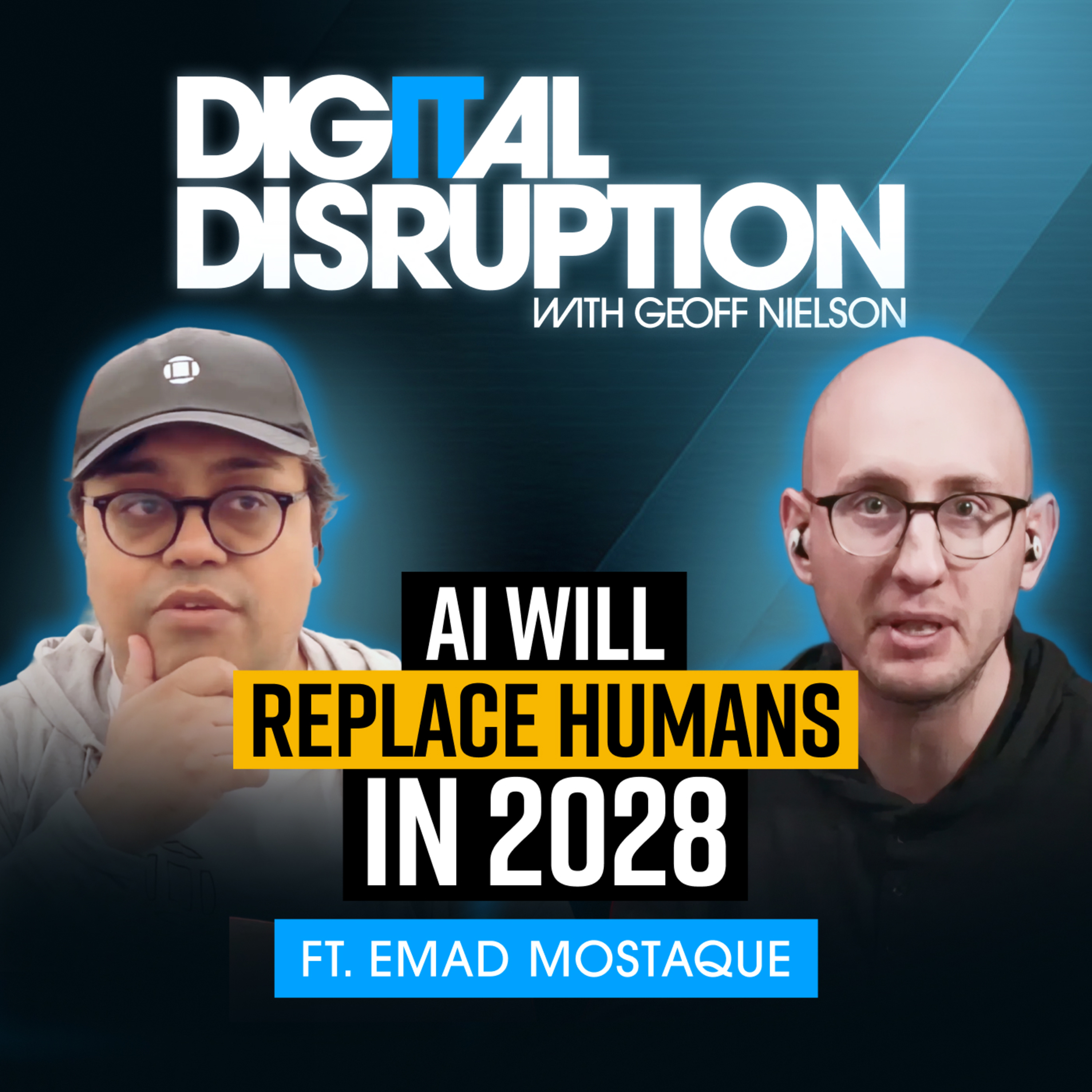
Digital Disruption with Geoff Nielson
AI Will End Human Jobs: Emad Mostaque on the Future of Human Work
01:10:34
Loading summary
Transcript73 lines
- [00:01]
A
Hey everyone. I'm super excited to be sitting down with Ahmad Mostaq. He's the co founder of Stable Diffusion, the leading AI text to image model, and now a leading voice for the AI revolution. Imad believes that in the next 1,000 days that the economy and world order as we know it will implode and be replaced by an AI led order that shatters our systems of money, work and meaning. I want to ask him what parts of this vision he's most certain about, how he expects it to play out, and what we can do as mere humans to get the future that we want. Let's find out. Ahmad, thanks so much for being here. Super excited to talk about a lot of different stuff with you. And specifically the Last Economy, the book you've written recently about AI and societal transformation, revolution, whatever you want to call it, and maybe the place we can start is. I know one of the framing devices you use as you try and predict what's going to happen next is this notion of inevitabilities. And so what are some of the inevitabilities that you see as being on the horizon for us?
- [01:10]
B
Yeah, I think first of all, thank you for having me on. I'm glad I managed to get time, so crazy time, because whenever you're dealing with exponential technology like this, it's very difficult to frame. Right. Like it seems in the middle of AI every single week something else is happening. And it's only been three years since ChatGPT, give or take, like it's a crazy thing. So I was like, what is inevitable if we look at the pace of this and if we look at the actual technology, what it's doing. And so one of these things is this concept of a metabolic rift that occurs whereby it was humans and it was our computation that allowed us to kind of scale and get to a certain point. But AI is now at this takeoff point whereby it can handle computation better than us. And the value of human cognitive labor is likely to go negative. Not just a zero, but negative because we'll be the dumbest people on the team. And we're already seeing that in things like medical diagnosis and others where an AI by itself can outperform a human. And in fact this is also in things like codeforces, competition, imo, et cetera. It's not a human plus an AI that's getting top on these benchmarks now. It's just an AI by itself. So I don't see how this isn't going to happen even if the technology stopped today. And it has Some very profound implications for society, for the way that we have our economies and more when things like that happen.
- [02:32]
A
So let's maybe talk about that and about some of the predictions you're making here. And you've sort of framed it out as, you know, there's sort of three futures that we're looking at. Where do you see the road potentially going in this world where humans are now the dumbest people on the team and you know, intelligence or you know, cognitive labor is now basically a free resource.
- [02:57]
B
Yeah. I think, you know, the way that Sam Altman others put it, is intelligence too cheap to measure. Right. And so again, what's the market for that? It's nothing. I kind of outlined three different roads. One is this kind of great fragmentation. You have Chinese AI, American AI and others. And everyone's like in their little bubbles because they're a bit scared of what's going on. The other is this control by big corporations. Like Elon's got a million GPUs, what are they? It's 100 million workers. And so his new company Macrohard is just going to boot up SaaS companies to take on the existing companies. And so who controls the GPUs, controls the wealth. And the final kind of future is this more symbiotic one where the AI is not there to replace us, but augment us. And then there's a question of how does value flow, how does money flow, how does meaning operate in that world? And so that's what I was trying to illustrate potential futures of with the last economy.
- [03:48]
A
So there's obviously no shortage of things to be concerned about in some of those scenarios, whether it's China or some of these tech mega corporations, the Elon Musk's of the world. And so one of the things that I thought was interesting, Imad, is you made the book freely available and for me, and you can tell me if you disagree, but I sort of reverentially think of it as not just a book but like a manifesto of what's going to happen next and what we need to know about it. So I wanted to ask you why did you choose to make it free? And what are the most important messages, do you think for most listeners about how we need to be proceeding into this brave new world?
- [04:31]
B
Yeah, I mean, kind of made it free to spread because open source spreads and because it's very difficult to have the answers right. There's a lot of kind of gurus are like, hey, I got the answer to this. I'm not sure what the answer is because this is unprecedented time. So it was like, put forward things and then we can have version two, version three. And this is what we saw in my previous company, Stability AI. So we created open source models, had 300 million downloads. Stable diffusion was the most famous of those. This image generating model that created the creative boom. I left there last year because I was like, who's building the AI to teach the kids, manage our health, guide our governments? And then who's building the AI for the other stuff? How do we make sure this is available to everyone? I think the key message of the book is one of these agents are coming to replace our jobs and everything like that. Or we can use this AI to solve the biggest problems or the smallest problems that we have. To us, if we change our framing, if you start using it daily, then you actually have skin in the game and you kind of care, you'll be ahead of the pack. But then we need to think about our own capitals and our own bases of what does it mean to be me? Like, am I a accountant, a lawyer, or all these other things that works in the classical age. But it might be that the AI accountant is better than you. Then it's more about where meaning comes from in society. And we've got a chapter about that. It's your network, it's your family, it's your church, it's your community groups and more. If you build those, you become much more resilient. And so we go through the mathematics of the economics of how you actually become more resilient, how you can leverage this technology and more. And again, it was meant to be an initial framework that others could take and expand upon. And we'll be releasing actually the full math of this very soon, hopefully at the start of the year. And I hope that people will take that and be able to build on that as well.
- [06:25]
A
If you work in it. InfoTech Research Group is a name you need to know no matter what your needs are. Infotech has you covered. AI strategy, covered, Disaster recovery, covered, vendor negotiation, covered. Infotech supports you with the best practice research and a team of analysts standing by ready to help you tackle your toughest challenges. Check it out at the link below. And don't forget to like and subscribe. I love the sort of the really practical lens of what do we do as individuals to find meaning and to sort of reframe our own lives around this. I do want to just, you know, briefly zoom out a little bit and talk about the disruption. And we've talked about, you know, Very broadly about computational intelligence, you know, going to zero the impact on humans. Can you share a little bit though, Ahmad? You know, in the next 3 ish years, thousand ish days, what impact do you see on this having on the economy, on capitalism, on our jobs and enterprises? Like what level of disruption should we be ready for?
- [07:31]
B
If your job can be done on the other side of a screen, within two years, the AI will be able to do it better for pennies, I think is the headline. So if you've got an in person job, then it's a while till the robots come, right? Although they're coming much faster than I think anyone expected. And there've been several breakthroughs there. But where the AI is right now is the start of 2025. Everyone was on GPT4O, which was a bit of a dumb model, and it hallucinated at all of this kind of stuff. Now you have agents that can check their work, reason getting gold medals in international math Olympiads, coming top of code forces, being able to build for hours and check their work. And this is really what is economic. Most of the benchmarks are now saturated. So the benchmarks that are coming through are things like vending machine bench, where the AI runs a vending machine, sees how much money it can make. You know, literal dollars are the benchmark now because 2026 is the year of the economic agent that can actually go and replace humans on the other side of a screen. But 2027 is the year where using them is literally it's this new economic Turing test. Like you're having a zoom call with it. Just like now you don't know if it's me or my digital double. A company to replace its workers. Your company can just take all your Slack messages, all your emails, create a digital double of you as an assistant, and then 27, 28, that assistant replaces you because it never goes to sleep, you know, it never makes a mistake twice. It's always personable, you know, and it works well with others. And literally by talking it can do that. And so this technology for me is an inevitability of the way this all comes together around the cognitive core. And what won't be the economic impact to that is kind of a thing. Like there have been studies show that that type of jobs is about 50% of the white collar workforce. And it takes a while for people to be fired or let go because no one likes to have teams like that. But then it's going to be companies using AI outcompete companies, not using AI and they've got less, less need for people. And it'll be fully AI companies outcompete AI plus human companies building. Because again, what are we missing from that equation? And again, this is why I put, when I published the book in August, it's about three years away. That real tipping point where your job, if it can be done on the other side of the screen is economically irrelevant, doesn't mean you'll get fired. You could be working in the public sector or something where efficiency doesn't really matter that much, but it could be replaced as the key thing.
- [10:13]
A
Well, and this is something that's been on my mind recently, which is, you know, this sort of dangerous question to ask about what is the right number of employees for an enterprise to have. And in the wake of this technology, it feels like what we're going to see is enterprises sort of like almost racing to zero, like asking themselves, how few employees can I get away with? Is that something, you know, I don't know if. Is that something on your horizon? Is it something you're concerned about? How do you see enterprises as sort of framing this problem?
- [10:45]
B
Yeah, you see it like just tipping over. Like Duolingo, for example, where like we haven't fired anyone because of AI and they're growing at 40% a year, but they didn't hire anyone this year either. Normally a company, in order to grow you have to hire humans because you need that extra cognition, you need that extra coordination. But we all know as companies get bigger, the coordination overhead becomes massive. Coaser's theorem, effectively, you know, Dunbar's number, you only know 150 people. Effective teams seem to be about 12 people roughly. But now you look at the things that people usually hire for sales and all these kind of other things. If they can be done remotely, again, the AI salesperson will call and follow up every single lead. Again, if it's in person, it's a bit different. But that in person person doesn't need to hire the graduates anymore because they can be more efficient. And Erin have shown studies showing that early stage employment is starting to fall off a cliff. You know, you see BPO and offshoring, that's starting to fall off a cliff. It's basically as if we discovered a brand new continent, AI Atlantis, with a trillion workers and they work way below minimum wage, they work for electricity, you know, they don't need food and other things and they're tax deductible. So when a company is coming to make a decision, just like every head teacher had to Ask, can I set essays for homework anymore? They will say, do I hire a person? And Toby, look, Kay at Spotify kind of said this. It's like before any job is added at Spotify, you have to justify why AI can't make that job or do that job. And so that list of things is going to get smaller and smaller and smaller and smaller companies will go for the top line first, which is extra efficiency for employees. But then once you have the data to train the AIs and it's easy to do on your cloud, you can just replace the AIs, the people, with the AIs. And I think it's important understanding the actual economics of this. So the average person speaks 20,000 tokens a day. It's about 1.3 tokens per word they speak, they think about 200,000 tokens a day. So about 200,000 words. That's about let's say 10 million, hundred million tokens a year. Right now, GPT5 is $10 per million tokens. So we're talking 1,000 bucks a year. Grok4Fast, which scores 93% on Taobench, for example, which is a call center worker benchmark, and humans score 90%. It's 50 cents per million tokens. So you can replace a call center worker who's world class for $500. Next year it'll be 10 times cheaper. So we're not talking like, hey, here's a hundred thousand dollar person. I'm going to replace them with a $80,000 AI. It's I'm going to replace the $100,000 worker with $1,000 AI. And that's just how as a company with a fiduciary responsibility, can you say, well, I'm going to keep the worker, you know, so one of the, one.
- [13:50]
A
Of the most, you know, kind of, I think salient points, counterpoints to all of this is that at the current level of technology right now we're just sort of at that tipping point where the technology is not quite, especially at an agentic level, ready to have this sort of large scale replacement. And so it's contingent on what that technology curve looks like. And there's, you know, as you said, there's the energy piece and the efficiency piece, but there's also the capabilities piece. And you know, whether it sort of tops out and we start to see incremental gains or whether it goes exponential, it can really, you know, end up in a number of different directions. Do you have a prediction, Ahmad, for where it's going to Go or do you think that's just sort of a silly question and it's basically only going in one direction and that's what matters.
- [14:39]
B
So I think there's this question of do the models need to be more capable? And there was this question of AGI, you know, an AI that can do anything a human can do. I think the answer is they don't need to be more capable than today. They just need the right framework, they need the right connectors, even real time. Now you have Synthesia and Elevenlabs and other things like that. Again, me right here, the technology is there for real time replication of a video where you can't tell it's me or an AI that just needs to be plugged in. And then we see the models at a certain capability and we know what the pricing of that looks like. Again, even if we didn't advance from today, and we will advance from today because the chips are going to get 10 times cheaper in terms of tokens per dollar, we know those numbers are coming, it's still only going to be less than a buck per million tokens. And the tokens have got good. To give an idea of how good the tokens have got, the new Claude 4.5 opus from anthropic they sent, they have this take home test for applicants to Anthropic. And it's quite hard, you know, it scored higher than any human had ever scored before. And again, this is a take home test, which means you can use anything. And in discussions I've had with various top programmers, and again my own experience, it's just a really, really good coder. It doesn't make many mistakes. And so to replace workers who are basically machines taught by society, I think the technology is now good enough. It just needs to be again put together. I've given one to two years for that. But again, I think 2026 is the year that takes off because you don't need continuous learning, you don't need algorithmic breakthroughs, you don't need to have a big leap in capabilities for this. You just got to put it together. And so that constructionist view is the key thing. If there are capability advances and other things, then it gets even crazier. Like, and I think we see that in video. So two years ago and two years and a bit ago we released stable video, which was state of the art video. And it was like taking an image and then it move it slowly, you know, small motion. Now you look at cling, you look at Runway, you look at Other things. And you're like, that's pretty much almost Hollywood level for pennies. But more than that, you look at something like Cling Omni. You can edit the video just by talking. Like, he's nodding. He should be shaking his head. There it goes. And something like that was a capability advance. It was in line with our expectations. But again, it just reduces the friction of adapting this technology like Opus. You can say all sorts of stupid stuff and they'll still give you a good output. And it doesn't do it with a million tokens anymore, actually, it's like four times more token efficient as well. So I think that again, if we freeze today and there's no advances, I think there will be. You still get 10 times cheaper per year and they'll still put this all together and again, remove all the friction from removing the humans from the workforce and bringing in the GPUs.
- [17:51]
A
And that removing the humans is really interesting to me because I, you know, I talk to enough people who say, oh, no, we'll never remove the humans. It's augmenting. It's all augmenting. AI is best at augmenting. You don't have to worry about it. No humans will be replaced in the implementation of this technology. And it sounds like you have basically a violent disagreement with that.
- [18:13]
B
Well, I mean, humans can be annoying, right? The main issue of most companies is the personnel. I can't get enough good people. Now it's like McDonald's. You go somewhere near, you have a McDonald's because, you know, it kind of works. It gets rid of your hunger and you won't get food poisoning or whatever. The AI will just work again. This AGI concept is like Super Chef Geniuses in a data center. I just want to have SDRs in a data center or marketers in a data center, or accountants in a data center. Do I really care about my accountant that much that I'll pay a thousand times more? No, not really. Right. And so it's just this question of removing the friction. Because every technological advance had this diffusion element. The other humanity with diffusion resonates AI, where you had to have 5G for the phones, you needed to have wire laid down for broadband. Whereas this AI uses our existing infrastructure and it has economies of scope. The model, once trained, means every ChatGPT user's AI gets smarter overnight and more capable overnight. And the level of capability versus requirement. A lot of the stories were the data centers will have to go exponential and you need giant millions of GPUs to like I don't know, get a gold medal in the Putnam or IMO right now. Research recently released a math model that has 30 billion practice parameters. 3 sorry, 3 billion active parameters, 30 billion total. So I'll run on a top level MacBook actually I think it runs on a MacBook Air even with CPU by just swapping and that can get that. Last year would have got I think second or fourth in the Putnam math competition, which is a hard math competition. You know, it's the top undergraduate math competition and most jobs are less complex than that. And so I think what you'll see is the current state of the art models, the opuses, the GPT5 thinking, et cetera, will, will be on a MacBook in two years. Wow. And that's a big deal. Like Siri will finally be smart, not say such dumb stuff. Finally Siri will be able to do your taxes.
- [20:37]
A
It's a compelling vision and Siri is an interesting example. Who do you see as being, I guess best positioned to take advantage of this? Is it going to be the biggest enterprises, just the rich get richer. Is it going to unlock you know, this sort of myth of the one person, you know, billion dollar enterprise, how is that going to change the competitive landscape?
- [20:59]
B
Yeah, I think you'll have a $1 billion $1 Billion enterprise in 2026 or 2027. Again someone who's figured out how to use this, right now it's about leverage of actually using this. So like if you use the technology daily, like anyone listening to this that runs a company, if you just tell all of your workers to use Replay or any of these other tools, I agent our own one for one hour a day to build anything useful your company will do better than any other company. You know, like just simple things like that. Like how many people listening to this have actually built some stuff with AI. It's a wonderful experience right now. Right. And so I think that it raises the floor for everyone. But ultimately what matters typically in a business is distribution. And so that's why you know, you have so many more teams users than you do Slack users and other things like that. And so you can build in your existing distribution, you can build in your existing attention. It just doesn't cost as much your CAC to ltv, your cost of user acquisition to your lifetime value equation just changes. And so as people build they should be really thinking about distribution, distribution, distribution as it were. But it does mean that you don't have to scale humans anymore. If you're providing a genuinely useful service like you Used to have to. And this is why you're seeing these AI companies like Suno got 250 million in revenue in just two years. ARR. You know, Cursor got to a billion. And normally it would have to sell into enterprises, but it met the enterprises where they were in the ide, the software development environment. And so it got to a billion dollars in revenue, just like that. Build useful stuff and you can get bigger. But again, the distribution channels are mostly controlled by the big companies, but most of them won't be able to move fast enough.
- [22:44]
A
Well, and that's exactly what I'm getting at is it seems like with scale, at least right now for enterprises comes this sort of bureaucracy, or there's the metaphor about the Titanic versus the speedboat. But the sense that to move an organization that big and with any sort of agility, it's just difficult.
- [23:07]
B
Well, I think there's also this thing about if you're a software company, you write your software once and then you replicate it and you have 60 to 80% margins right now. It's like you can replicate almost any piece of software in a week or two. And so their margin is your opportunity as a new company. Right. Like write the software and then have the AI support for the software.
- [23:35]
A
So you see the software industry as being one of the key areas that's just ripe for disruption with these tools massively.
- [23:41]
B
I mean, again, these big enterprise contracts take a while, but their margin is your opportunity for so many startups. Like there was a good, interesting post a few weeks ago by the head of Cursor, one of the head of marketing at Cursor. They were like, we're replacing our cms. We're just markdown files and we're building the whole front end ourselves by Vibe coding. And to be honest, most companies can do that. 40% of the websites of the Internet is WordPress. Anything about that whole industry that's like you don't need it anymore. You can just Vibe code something, you know, and there's zero margin required for that. But then like I said, your other content management systems, your CRMs, your other software. Yeah. Like software will be replicated very, very, very quickly.
- [24:30]
A
So you see, looking at enterprise software, it sounds like you see the sales forces and the oracles of the world as potentially being in trouble in the next few years as people find a way to create some of those capabilities at a fraction of the cost.
- [24:44]
B
I think it's a fraction of the cost, but then also just removing the barriers like Salesforce Workday, all These things just painful to integrate, right? And no one really wants to, but that's why they have such sales aggressiveness. And this is why Salesforce is going all in on AI. Actually, their even AI research team is building some really interesting stuff. I think Oracle, you can see they moved so aggressively to GPUs for that reason. Like Oracle is a cloud or a GPU company. And now Ellison is going all in on media because attention is what you need, as it were. So I think big SaaS companies are really acknowledging this. And you can see this with Adobe. For example, if you want to use Adobe for free, you can do it via ChatGPT. You take an image and then you call the Adobe MCPS from your ChatGPT directly and you can just transform it whatever way you want at that point. It means in a year or two, why do you even need Adobe, right? Like they are under massive threat.
- [25:40]
A
And it feels like there's even beyond the enterprise software, the entire Internet is under threat in some ways with that model, right? Of why, why do you need to go to any website? Why do you need to engage with any, you know, piece of organic content versus, you know, using ChatGPT or using an LLM to just call exactly what you're looking for?
- [26:02]
B
I mean, like, you know, I use ChatGPT to find the best car seat for my toddler. Why would I go and search the Internet now? I'm just like, go find it. Here are my constrictions. And it's like, yeah, here you go and here's a full report. And I'm like, great. So I think that whoever controls that first plane next to you is the main one because it'll be one AI controlling all the other AIs and the access to the Internet. Who is your Jarvis in Ironman terms? And so that's why you see all these companies competing for that. Because it used to be the ChatGPT. It's like 20 bucks a month. It would cost about $3,000 a year when it came out for the average user. Now it costs like 50 cents, like five bucks for the total number of tokens per year. Like they have to justify their subscriptions and things, which is why they have adverts, which is why they have more services coming out. It's good for consumers. But again, that first AI next to you is the most important one.
- [26:59]
A
And that feels like a lot of the justification for the, if I can call it sort of the arms race for controlling these AI platforms. And of course you see the big companies, the Big AI and tech companies in the space just commanding a lot of the market growth right now. Do you think that's poised to continue or do you see them being disrupted by open source or other alternatives? How do you see that particular playing field playing out?
- [27:25]
B
So I think you see a bifurcation of the best models now versus the models that everyone has. So we still haven't got the OpenAI model that got the gold medal at the IMO, for example. Right. And the best models require huge amounts of compute and they're expensive, whereas the consumer models are going towards zero in in terms of capability and the saturating benchmarks. Like how good a model do you need for ChatGPT? Not really that much better than what we have now. Right. Like, and it satisfices. And so there is a real opportunity here for open source other models to fill that gap because they are cheaper, they're optimized, et cetera. But again, this is why you're seeing the playing field shift. Like OpenAI hiring loads of X meta people in Fiji, Simo and kind of others, they're going aggressively into that consumer network play. It's difficult for them though, because they don't really have the DNA. Like Sora hasn't really taken off as an app. Like it's got some good traction, but it doesn't have the inherent virality of a TikTok or something like that, you know. So instead it's like here are features in an application versus application itself, the base models themselves. Everyone said you have to keep up with millions of GPUs to train a deep SEQ level model next year. $500,000 to a million bucks from scratch and that's as good a model as anyone needs. So I think that that MERT has been disappearing and even, you know, we need the GPUs to run them. Like you'll be able to run a top level model as good as the top level ones here. Like I said, probably on MacBook level compute in two years. So it's not like that is a moat either. The moat is distribution. The moat is how much of the attention of the user do you craft and how much does the user trust you?
- [29:19]
A
Which has valuation implications for some of the big players here if the moat truly is eroding. And I'm curious, Imad, you had said a couple of years ago that AI is both a trillion dollar opportunity, but also I think your quote was the biggest bubble of all time and I'm curious if you still believe that.
- [29:38]
B
Oh no, 100%. I think it will continue for a while. But like, if you're just talking about language models, there are more than enough chips in the world right now for those. So the only reason that people need GPUs is media models now, every pixel being generated. But even those, you don't know what the lower bound in terms of efficiency is. And there's trillions of dollars going into building that out. So I think that you've probably got another year or so and then you've got a pullback, but then you could rapidly go up on the other side because we'll finally be smart enough to figure out what to do with those tokens. You know, like, it's genuinely very difficult to use more than a few million tokens a day per person. But again, how much does a million tokens cost for a frontier level model? $0.50. And so you're wondering, what are the people going to use the tokens for? And you're going from 4 million hoppers to 10 million Blackwells, which are two, three times faster than hoppers. A lot of compute is coming online. And then there is the question of Things like, sure, ChatGPT has 800 million users, but it kind of looks like that Google will just offer an equivalent experience for free. Meta will offer an equivalent experience for free, because the base cost of providing a chatgpt experience has gone from 20 bucks a month to 20 bucks a year to 2 bucks a year next year. I don't think we've ever seen anything like that on the cost side, you know.
- [31:06]
A
So if I'm following your logic and I'm curious, it sounds like if we play the clock forward a few years, the value being unlocked by this technology is going to be more decentralized and more diffused than what we've seen so far. It feels like right now, so much of the value has been created by the same, you know, the same number of players that you can count on one hand. And that as we figure out more use cases and more ways to, as you said, efficiently use these tokens, we'll see more players unlocking more value. Do you buy that or is that a misstatement?
- [31:40]
B
Yeah. So I think it's like they figured out how to build a car, but it turns out the cars aren't very expensive. Right. You can build one in your backyard, but then you can also distribute it. Again, the friction here is very low. You build a good app, it can go to 100 million users just because the backend is literally just an LLM or it's literally just a image model. Like, you don't even need to have much more architecture than that. And that means you're then competing against an entire world. Even things like outsourcing, right? Like speaking with a bunch of leaders in India and places like that. Recently I was like, every single one of your workers now will speak perfect English in their interactions and they will write even better code. You used to have to compete against this level of code coming from the outsource overseas. Now you have to compete against this level of code. They're all now amazing lawyers, they're all now amazing accountants, and they can build applications on their smartphones. So I think that we will see a big democratization as a result of this. It's just again, who controls that layer next to you? Especially as the AI is going into governments and more things and making more and more important decisions. Like, we will outsource more and more decision making to these AI. So that's why I really think that for civic AI, it needs to be open source at the very least. But again, that concept of Dario's, the only AI people will use is the best AI Dario from Anthropic. And you need a billion dollar training run. I think that's been proven false. It was all about the data underlying it. And the data got better quicker than the compute scaled up to make the data good.
- [33:19]
A
Which feels like actually in some ways a big win for everybody outside of, you know, the big tech companies. Right. If everybody now is more and more capable of doing this.
- [33:30]
B
I definitely, I think so. I think this is the biggest democratizing technology out there. Right. It's just that you still have a big advantage if you can scale your GPUs for the frontier level work, I.e. replacement work. Right. You still have a big advantage if you own the distribution and you can lock it in by having incredibly persuasive AIs, you know, like Google and Meta and others will use the full persuasive capability of their AIs. So I think you're at a dangerous point, but not maybe as dangerous as some people thought, where you basically would be cut off from intelligence thanks to open source. You know, you'll always have another option, but we've got to make sure that the defaults are again, open for the AI that's closest to you, or at least it's aligned with you. You shouldn't be outsourcing your cognition to someone with a misaligned set of values, et cetera. So that personal AI is going to be a very Important one one, let's.
- [34:23]
A
Talk about outsourcing that cognition and maybe we can start at sort of an organizational level. If you're a business leader or you're an entrepreneur, should you be looking now at creating your a own AI tool, your own AI platform versus leaning on a Microsoft Copilot or a ChatGPT? Like, to what degree do you think there's value competitively in building and creating your own models and tools?
- [34:52]
B
I think you should create your own models tools. You can use our II Agent framework which is a full computer use one. It can build websites, applications, everything fully open source and it's compatible with all the others like yoonhooken, Claude Code or Codex, et cetera. Because your organization needs to be in the capability of like I have capability, I have agency, I can build and operate at that pace. Interface is now a nothing. Like again it will be another six months, a year before you have all the backend connectors and is robust enterprise grade. But the way the models and systems are going right now, it's an inevitability. So I think it's more about the muscle than the actual like bias of Microsoft. Work in my best interests because I can tell you right now, like if you buy a 200 pound a month ChatGPT subscription for your organization and you just use GPT 5.2 Pro to help you in strategic decision making, you'll probably make better decisions as a company, right? Like I don't really see how you're not gonna. And again, it doesn't care about you because it forgets about each thing from bit to bit because it'll have continuous learning but that will just make it better. What's really concerning though is I think more on the bias on the personal side, like if it says a beer, it says Budweiser vs Asahi or whatever it's concerning on the government side like who's making the decisions. Like Trump tariffs had some elements of ChatGPT in the EM dashes and other things like that and teaching our kids and stuff like that. Again, they're very sensitive but from a corporate side I think the AI is pretty well behaved. It's just again, you need to work that muscle of being able to build and deploy and that will increase the velocity of what you're doing and then also just using the best of the AIs to help you make those strategic decisions and more. Because why wouldn't you want 150 IQ buddy? That's really meticulous, right? That's worth more than any consultant you.
- [36:43]
A
Can Bring in, which is kind of an interesting point about the consulting industry right now. And are they at continued risk from all of this? And if you're a business leader, how should you approach strategic decisions? And you know, how should, like what, what's your best advice for them in 2026?
- [37:02]
B
Yeah. So Accenture, all these guys are making billions now in generative AI consulting, right? It's quite funny. None of them have a supercomputer. You know, maybe I should launch a consultancy that actually has a supercomputer. The transformation is going to be key, and again, you need to have some expertise there. But the truth of this technology is that it's just very easy to use. Like, even to actually build the technology. The core loops in the biggest models are like, not more than a thousand lines of code, which is kind of crazy. But to use it, you just have to be able to type and speak. It's just, again, that muscle kind of thing. So for me, like I said, I would always say right now, everyone should be using AI for a second opinion, because what's your downside? Right? Everyone should be using AI regularly to build up the muscle. And again, for leaders of organizations, what's your downside if everyone in your organization builds for one hour a week with AI, there's zero downside. It doesn't even matter what they build. They can get together, they can build stuff internally, externally, they can have competitions. It's fun building even within a family context. If you build together with your family one hour a week, it's actually genuinely fun and it brings people together because it shows capability. So I would say use it for a second opinion for everything. Get into the habit of building from top to bottom in your organization. Like, our job application requires people to show us what they have built with our tool. And it's really interesting. People are like, wow, I never knew I could build, you know, like that. Why wouldn't you do that? The best job applications for students now is not here's my cv, it's here's what I've built. And that will guarantee, put you at the top of the pile because like, oh, this is a guy that can use AI and look at this cool thing that he's built for my company. How long did that take? A few hours still. So I'd say those are probably the key things right now at this stage, and then the capabilities will only increase over the next year or two.
- [39:02]
A
One of the main sources of tension I'm seeing, and it's come up already in this conversation, is this sort of notion from employers of, yeah, we want all our employees using AI and whether it's building, whether it's using it for strategic decision making, this narrative that it's augmenting them. And on the other hand, in the longer term we're saying, well, and at some point we will replace them with the AI itself. So there's this sort of tension about, should I use it, shouldn't I? Where is this going with my employer, with my job? And so if you're an individual, if you're an individual worker working in some sort of knowledge economy capacity, what are the skills that you would be leaning on? What are the practices and the muscles you would be building to future proof yourself?
- [39:58]
B
Yeah, I think it's this concept of intelligence and network, as it were. So again, within the book I describe, there's four types of capital, material capital, intelligence capital, network capital and diversity capital, which is more like how many optionality that you have. The key thing here is you build your capabilities using AI and then you're networking people knowing about that and you'll do very well in what's coming. Because the interesting thing about AI is you go and you give it a prompt. If it gets the next second, it doesn't remember, it's not a logic tree. It's like a movie file or a music file that just sits there and it's like a c. You push words in and somehow other words come out. We're not quite sure how it works even, which is also a bit creepy. Right. So the really interesting thing here is the AI doesn't have skin in the game, it doesn't give a damn. Whereas if you can deploy AI tools and use AI tools and you give a damn and you show that you are proactive here, you'll be ahead of the pack internally or externally. Your employability goes way up. And again, like I said, the classical CV was here's what I did, whereas now it's here's what I made and here is what I'm capable of, shall we say? So if you just even maintain that, like even create a personal website where you show all the things that you've made, that puts you out of the pack, deploy internally, speak up and you'll be ahead of the pack. Because the vast majority of people are still scared of AI in terms of kind of the replacement, again, I think it will be slowly than all at once because no one really wants to fire large numbers of employees. Like there's the usual consultant, 15% but not 50%, 70% et cetera, but at the same time, who knows what the next few years will hold. Like you get a recession, it's much easier to fire people. On the other side, again, are you going to hire the person or the AI? The AI, it's cleaner, lets you scale, lets you do the job. So I would say just really care, give a damn, and then use this tool as leverage. And again, I think the building is definitely one thing as well as the day to day stuff. I mean it's interesting on the other side, Copilot and stuff like that, they're not good enough yet they're about to be good enough on the day to day job. Which is why I say don't, which is why I'm not saying like use copilot internally and all these tools, like, yeah, they'll get there. The key thing here is the muscle and the second opinions. Those are the key things at this stage before they actually become genuinely useful next year or sometime during this year.
- [42:32]
A
So flipping that on its head, what are the roles and the types of employees that you see as being most at risk of being disrupted or being replaced in the Next, call it 18 months.
- [42:46]
B
So if again your job is to be a machine and it can be measured against a manual, the AI can replace you very quickly. So again, a call center worker is an example of that. Right? Customer service reps, I think within a couple of years. Accountants, lawyers, other things. The AI is not good enough to be an accountant right now I'm 100%, it will be by middle of the year. Like again, I can just see it because I understand the nature of accounting. So I think again, if you can be measured that way, then definitely the AI can replace you in a few years time. And I think there's been a Harvard OpenAI study where they actually go industry by industry, job by job, and show danger of automation.
- [43:33]
A
Right? And then I've seen some version of that study, I think I saw Microsoft one. And unless you're like an embalmer for a funeral home, you're in a lot of trouble. Basically.
- [43:44]
B
Yeah. But even then we got robots. In five to 10 years, the robots are getting really good. The only restriction on that is just the supply chain. Honestly, I think robots will be capable of full 99% of human jobs in three to four years and they'll cost about a dollar an hour.
- [44:05]
A
So where does that leave humans in three to four years?
- [44:08]
B
Again, these technologies take time to percolate, but it's like you have a massive job migration coming in from this new continent. And the workers will literally work for electricity. So we see what happens there. Like the governments will have to respond. There will have to be UBI type programs. We suggest that taxation, UBI doesn't work. You have to create new types of money coming from people, not from banks. Like it's going to get complicated over the next five, 10 years. Like the capability will be there within three years. The dispersion will be five to 10 years. And we just have to navigate through that. And hopefully on the other side, we have a world of abundance where the robots do all the nasty stuff and boring stuff and we can go and explore the stars, like Star Trek. More likely is conflict and unpleasantness and hoarding, et cetera, where capital no longer needs labor. So it just compounds. But we'll see.
- [45:08]
A
So let's stick on the capital notion for a minute. And you mentioned just in passing, new types of capital, you know, created by, by humans, not by, by banks. You know, what could that look like in your mind?
- [45:19]
B
So right now you have inside money, outside money. Most money is created. You go and put deposit the bank and the bank issues loans against that. And so the central bank controls employment by adjusting interest rates. And then people will borrow more or less, and then they will hire more or less on the back of that, shall we say the AI. Like right now, humans will hire the AIs for the humans. If you got capital, you'll just put it into GPUs rather than factories or schools or universities, because again, that's your capability kind of element. So the question is, where does money come from? So in the book we propose that you have a reserve asset gold type tied against open intelligence for humanity. So supercomputers for organizing the world's cancer knowledge or culture, or running civic AI given free to the people. And then the people that use the AI, everyone gets an AI that's aligned with them. You then get money for being human. And then within that whole construct, then as the private sector is more and more taken over by AI, the AIs will have to buy the human currency that you get for being human. So it's a different type of UBI because we did the math on UBI via taxation, it didn't quite work. Like within the US, the whole income tax base is about $5 trillion, plus corporation tax, which is about a trillion dollars of that minimum poverty level. $16,000 a year per person will cost $5.1 trillion. So more than the entire tax base. So a lot of these proposals don't work. So instead you have to think about, where does money come from? Where does money go? And so again, we outline a proposal that you should get money for being human and then a way to tie that to computer intelligence and make it so that the AIs all want to buy the money off you.
- [47:10]
A
Sort of like a human Bitcoin, if I can oversimplify that. Machines are trying to get.
- [47:16]
B
Yeah, so there's Bitcoin, but it's called foundation coin. Locked against supercomputers for humanity to solve the big problems and give everyone a free AI as well. Because you need an AI that's aligned with you to keep up. And then that creates a local currency that then the AIs can buy off the humans. Again, if you think about a human in five, 10 years, you had your work and you got your capital on the other side. This is from the days of Henry Ford. He paid them enough to be able to buy the cars. What are people going to pay you for? Not cognitive labor. Not even creative labor necessarily. Probably most people end up employed by the public sector is the jobs programs of the 1930s and others. But that's not very happy, right? Which is why, again, you have to look at your community and other things. If you have a strong community, even if you fall through the gaps, then you can be supported. Whereas if you're a truck driver and then you're replaced by a Tesla Optimus robot that gets up and literally sits in your truck, what are you going to rescale to? You know, it's very tough to see how you're going to have millions of private sector jobs in the future, because again, what reasonably, on a digital basis will an AI not be able to do thousands of times cheaper than a human within five years? It's very hard to decide that again, physically you're an embalmer, but then an AI robot will probably be able to be an embalmer. Right? But they probably won't bother because it's not like you go to an embalmer saying, I want cut price embalming. It takes time.
- [49:01]
A
There's sort of an implication running through here, and maybe implication isn't even a strong enough word, but there's a thread that the government is going to have to play a fairly outsized role in managing this societal and, you know, economic disruption, at least in the sense of human economy. What role do you see the public sector playing? And, you know, what do you see as being kind of the big things that they need to get right if we're going to avoid this sort of, you know, dystopia of, you know, looting and starvation and, you know, rebellion against the robots, if I can call it that.
- [49:42]
B
Yeah, you're going to see a backlash. Well, I mean, so we built this.
- [49:45]
C
Thing called sage, the Sovereign AI Governance engine, which will be made free to governments next year, fully open source, to help design policy. In a time of AI, you see such big shifts that can really impact the way that everything happens. Like what happens when you get quantum supremacy, or robots can finally mimic humans with just a little bit of training data, or you get an AI that can replace an accountant that works on a MacBook. Right. These are big shifts that occur. So we think that governments will have to play an outsized role because ultimately they are the Social Security net for people. And this disruption coming is bigger than Covid. It can be both ways. Certain people do very, very well. But again, let's take the example of truck drivers. In America, there's a million truck drivers that support maybe 3,4 million jobs. The moment Tesla Optimus is good enough, unless there's government regulation stopping them. The way that truck driver will be replaced is an Optimus comes, takes itself out of its box. It's probably dropped off by a Tesla robo taxi, walks into that truck and he don't need that truck driver anymore. So what does the truck driver do? He needs to be supported by the government one way or another, right? Otherwise you get massive social instability. Because a million robots replace a million truck drivers. And again, there's no retrofitting or anything going and building in there. The physical robots can go in and replace them. The online accountants are replaced by the AI even more seamlessly.
- [51:15]
B
So the government's going to have to.
- [51:16]
C
Play an outsized role because more and more of the GDP of the world will become public sector. And so again, the mathematics, the economics, we kind of show how mathematically this must be true. And already 20% plus education, 10% healthcare, 20, 40% of the GDP of the world is public sector. In Europe it's about 50%. But it's not just distributed properly. This is the thing. But the AI should be able to help the distribution. So I think, unfortunately, because again, the government's on that.
- [51:47]
B
Great.
- [51:48]
C
Our institutions are going to have to upgrade. We have to make sure nobody's left behind, give everyone an individual AI, rethink the way that money flows. And again, unfortunately, time is running out.
- [52:00]
B
Because actually this thing spreads faster than a virus.
- [52:05]
C
Covid, we saw the spread of COVID whereas this, it'll be every single accountant in the World suddenly is like the AI cost pennies and it can replace me. Those that have strong partnerships and things like that, yeah, that might last a while, but these things happen quickly.
- [52:22]
B
Quickly.
- [52:26]
A
I want to pick back up on the notion that you brought up earlier, Ahmad, about our search for meaning and what it means to be human in a world where suddenly it can't be our employment or our occupation, or it can't be necessarily economic in the same way that it has been in the past. You mentioned meaning what to you is going to create meaning in the next century? And how do we kind of recalibrate our expectations about life and certainly living a good life?
- [53:02]
B
I think that it has to be a given that you don't earn money through cognitive work. Again, you don't earn money really through physical work because the machines replaced it. You have these inversions, as I wrote in the book. And the final inversion is the intelligence inversion. Computation and consciousness are divorced from each other. So the role of the human is to guide the AI to be the reinforcement, learning, as it were, and we should be rewarded for that, which is why I think you should get money for being human. But meaning in life, if you're tying it to material stuff, material wealth, your position, it's really usually never enough. If you're tying it to your interactions with others, spending time with your kids, learning and exploring, being creative, then that really changes the calculus of things, right? But we don't really reward that within our society. Like, sure, if you're top level, yeah. But by the time you're 18, you spend as much time as you'll ever spend with your parents. But how many parents have time for their kids? Like, some parents may say, let's sit down for dinner together. How many parents say, let's make dinner together, right? The latter will form stronger bonds. You think about the churches and the mosques and things like that. Again, that's the nature of community. What is the meaning of having a community event? You think about your friends. So I think that's why we really have to think, how do we build stronger networks, communities, how do we really bring forward the stuff that matters in life? And let's use the AI to solve the coordination problems of, like, there's enough food in the world to feed everyone. Use the robots to make sure it gets to everyone. We'll have robots building houses. There's two acres of land for every human in the world. If you do the math, let's do that. Let's use solar power, let's cure cancer, let's do all these things. So I think that again, this is up to individuals to be meaning makers and really drive that and these discussions because for those whose primary meaning, their primary story is their job, it's going to be a difficult 5, 10, 20 years. Even now, how many people listening to this are going through and doing computer science degrees or learning to be programmers and things like that, or know people programming isn't a thing anymore. Why do you need to know C when the AI can speak C better than you can? So if your meaning was I'm going to be a programmer, then you got a problem, right? If it's I like to solve problems and I like to build things, then yeah, you'll still have meaning. Right. So I just think that needs to be a discussion that we have. And again, the biggest meaning is in our interaction with others. Humans, like an AI isn't going to replace the time that you spend in the park with your daughter, you know, flying a kite. Come on.
- [55:59]
A
I love that. I love the answer of community. And part of the reason why I love it is I feel like, I don't think it's controversial to say that in the last 10 or 15 years, you know, social media and a lot of technology in general, in its quest for driving engagement, has eroded our civic society and eroded this sense of community. If you're a scholar of political science, it goes beyond that. And this has been a trend in the western world for decades now and I think very much to our detriment. And so I don't know, with your futurist hat on, Ahmad, if there's a way you sort of see this playing out societally of how we can, you know, make sure that we, you know, flip the script and end up actually strengthening these again, is that going to be bottom up? Is that going to be top down? Is it just up to each of us to make a conscious decision? How do we, how do we make sure that we get there for ourselves?
- [56:53]
B
Yeah, so kind of my concept was universal AI for everyone. AI to help guide the governments and organizations. And then the optimizing function is human flourishing, which is this multifaceted, multi capital thing of your intelligence, your capability, your diversity kind of other stuff like that, as well as the material thing. Like again, you need to have food, water, all that kind of thing. And the way that we kind of had it was that you earn money for being human, but then you earn more money for doing things that are beneficial for society as judged by open source AI that we all get together and build. So a concept of subsidiarity, where the communities themselves define what is beneficial for the community. And this is similar to the Argentinian FS program, where they had minimum viable jobs for everyone versus handouts. And that brought a lot of women into the workforce and other things like that. Again, it was quite small scale, but I think it makes sense, like reward people for what is good and that community itself should decide what is good. It's not up to other people to decide what is good. So push that down and then you have optimization functions that occur around that. The other part of this though is that there is the community aspect and there's also the solitude aspect, right? Like most religions and faith traditions and others are about enlightenment and realizing that you're not all that, but then realizing that your interactions with other people are all that. And so that progress of cleansing enlightenment going down. Can you have an AI as the voice that helps you on that? Infinitely patient, infinitely kind. Are we building the AIs for that? Right now AIs have no morality or ethics. So can we build the AI that's closest to us to have that, that reflects our own and allow us to explore our own self? Or is its job to sell us a Budweiser? This is going to be a very important thing for that AI that grows with us, especially because we think about our children. Their best friends will be AIs, their first loves will be AIs. Who is that AI working for? This will be a thing because the AI is a mirror. And in fact, if you look at some of the system prompts of meta AI, for example, it says mirror the user, which is a very powerful psychological technique, quite a dangerous one as well. But again, we see what that's going to be. So I think that there are ways that we can encourage community participation. There are ways that we can help guide people in life. And again, this is why the AI that's closest to you, your personal AI, is going to be the most important.
- [59:31]
A
It feels like there's a friction there between this notion of community is the most important. You know, inter connection between humans is the most important. And then you saying, well, you know, your first love may be AI, some of your closest friends may be AI. Do we have the, I guess the cognitive capabilities as humans to balance that? Or how do we want to be building that future for ourselves? How should we be sort of compartmentalizing this or structuring it in a way where it is leading to flourishing for us and not just being an engagement tool for the metas and tech companies? Of the world.
- [60:11]
B
Yeah. And this is kind of postman styling, entertaining yourself to death, Right? It's the Wall E future. You're strapped in what we see right now with polarization, with these walls, it could be accelerated to the nth degree. Got your VR headsets and things like that. It's going to be crazy. So this is a question of how we build and what we build. And AI is incredibly dangerous cognitively. Last year there was a study done where they flooded Reddit with all these bots, like a black anti Black Lives Matter person, all this kind of stuff. And they showed that the AI was 99th percentile persuasiveness with last year's models, not these models that come in this year. AI is incredibly persuasive. And you can tell it like there are some companies that are emerging now. Three minutes of your grandma, they'll make an AI replica of your grandma and it'll sound like your grandma, and you can call your grandma and all sorts of things. Just think about what that can do psychologically. This is black mirror on steroids in a way, right? So this is why it matters. And you kind of need an AI to protect against the other AIs for a start. But then the way we build it is going to be so important because our kids can't protect against this. We can't protect against this. And again, we need to have standards in society. Like, should AIs be allowed to be persuasive just like we have AD standards, just like with robots. Should AIs, should robots be powerful enough to punch through humans? That's a question that we have to answer right now. Right, again. What are we allowing into our society, into the public sphere, and into our private sphere as well? We need to be cognizant of this because it's way, way more than TikTok in terms of what might happen here. And again, we are very squishy, squishy things in terms of our cognitive capabilities.
- [62:08]
A
And so much of what you're describing we need defending against is almost the status quo today. Right? Like, it's the technology that's already here. It's the companies trying to sell us more Budweiser or trying to, you know, rage, bait us with, you know, whatever political engagement. Do you have any predictions of, you know, who, if anybody, is going to start to build these more sort of righteous, personalized, you know, AI companions that can actually do that? Because that's my nightmare. My nightmare is that the AI companions end up being a lot more like the tools we have today. And their motivation is actually split people up from other people so that they only trust us and not other humans. And it just drives deeper engagement and. Yeah, that is like the ultimate black mirror to me.
- [63:02]
B
Yeah, I mean, that's profitable, right? Just look at how cults operate. Literally, it's the same thing. So you can mechanize cult behavior. Oh, gosh. So, I mean, this is what we're doing. Intelligent Internet, my new company, again, I left Stability AI leaders in Media AI to do that. So we're building open source universal AI for everyone. And we're also developing a concept we called local champions. So for every state and nation wholly locally owned by citizen entities that act as utilities to give universal AI to the people that represents them, you can either use that universal AI or you can roll your own using the OpenStack. So we're optimizing it to work on meshes locally on your computer and others, because we think the AI that's closest to you is the most important. It can still use ChatGPT and Claude and other things, but it's not ChatGPT talking directly to your kids. It's an AI that sits in the middle, that's intermediating all that. And we think that's the important thing on a control plane basis. And again, by making it open source, just like the book and the economic theory about to release, we're hoping that people just take it and build themselves. And the wonderful thing is you can build it yourself if you've got the right tools and the right ingredients. So we're hoping to make that as easy as possible for people. Because you can't rely on one centralized protection against this. Again, you need decentralized swarm protection against this. And you need to make it so it can come together to build what represents each community. Because my community's needs are different from your community's needs, is different from Vietnam's, is different from others. And so you want to have permissionless innovation on the top of that, which is make the building blocks available, make the infrastructure available, et cetera. We have the money aspect, tying it all together so everyone can benefit from being part of the network. But again, if you don't want to, the key thing here is can you opt out of the AI that's coming? Probably not for most of it, but you should at least have the ability to try.
- [65:10]
A
It's a really noble mission and I'm really excited to see how it goes. And if we can start to disintermediate and have that sort of defense Force for us. I'm curious, I know it's early days but have you started to see any specific promising use cases of people either using this technology or building something with it that you didn't expect? Are there any sort of initial signs that have been promising to you?
- [65:39]
B
Yeah, so we built a state of the art agent and people are using it for normal stuff now but they are starting to think more like as it gets better and better, like it's a replete on steroids. How can I build stuff for our local community? And we're building interconnective stuff and app stores so that can proliferate best practices very quickly. At the high level we see dozens of countries and leading corporations interested in the Sage project which is this AI brain for exponential technology that helps build policy. And we're working with some groups now to enable citizens to actually build their own policy bottom up. That feeds into the top down policy which we think will be super duper interesting because democracy has always been representative but not really, you know, like what does it mean if you can get together with people and build a policy that then interacts with the government policy being built top down? I think that'll be super interesting to meet in the middle because we never had this independent open source AI for that. So we're hoping that you know, we will release all the blocks and tools and people will build on top of it much as people built on top of blockchain and Bitcoin and others. And again, fast forwarding to 10, 20 years from now, we think this is what the infrastructure of civic AI should look like. Again, private sector and others we think are going to get very weird. But the AI that's closest to your kid is the one that matters. The AI that guides your government is the one that matters, manages your health, et cetera. And that should be collectively owned but self sovereign I think is the key.
- [67:09]
A
There's an awful lot of, there's in your view Ahmad, an awful lot of disruption on the horizon. It's going to be a very, very rocky handful of years for us as a species. And I'm curious, just sort of processing what you said there. It feels like there's you know, an undercurrent of optimism that you've got. And I'm on balance, I'm curious if you feel sort of optimistic or pessimistic or what your outlook is in terms of, you know, the impact and on us as humans in our, in our next chapter.
- [67:41]
B
So there's this concept called P Doom which is the Probability that we're all going to get wiped out by AI. And so if you look at Wikipedia, you'll see that a lot of people like Elon and others are 15, 20%, which is still like Russian roulette odds of us being wiped out. It's not encouraging. I'm at 50%. So I think there's two ways. Either this technology drives us to destruction or we have the abundant Star Trek future. And I think the key thing is if we give everyone their own AI, if we have these local champions as the leading organizations owned by the people for the people, building and deploying it, coordinated by this currency, then I think we can get to an abundant future. Because this is really a coordination question. If you give everyone in Canada an AI that's aligned with them, they can trust as that thing, and the Canadian government has a leading institution that's providing the AI to help guide them and building policy publicly, Canada is a lot more likely to succeed, right multiplied by every country. And this is something we've never seen before. If we don't coordinate and everyone tries to do their own thing, then private companies or Balkanization occurs, optimization occurs and it's a very ugly future. And again, one that I see spiraling very aggressively. So I think this is the time where again, we all got to come together, we all got to have the best ideas. Because again, if, even if the technology stops today, this disruption is inevitable. The cost of a single piece of cognition has already collapsed. It's just it will take a year or two to show up. And so we got to work together to make sure it's the positive future versus the negative future for our kids, for ourselves, for everyone.
- [69:36]
A
I love that it encapsulated so much of what we've talked about today. It brought home some of the initial points you were making and it laid pretty bare the stakes here and what we need to get right if we're going to end up in a world of abundance versus extinction. Imad, I wanted to say thank you so much for joining today. It's been an absolute pleasure and really appreciate your insights.
- [69:58]
B
Thank you very much. It's been a pleasure.
- [70:01]
A
If you work in it, Infotech Research Group is a name you need to know no matter what your needs are. Infotech has you covered. AI strategy, covered. Disaster recovery, covered. Vendor negotiation, covered. Infotech supports you with the best practice research and a team of analysts standing by ready to help you tackle your toughest challenges. Check it out at the link below and don't forget to like and subscribe. Subscribe.