← Digital Disruption with Geoff Nielson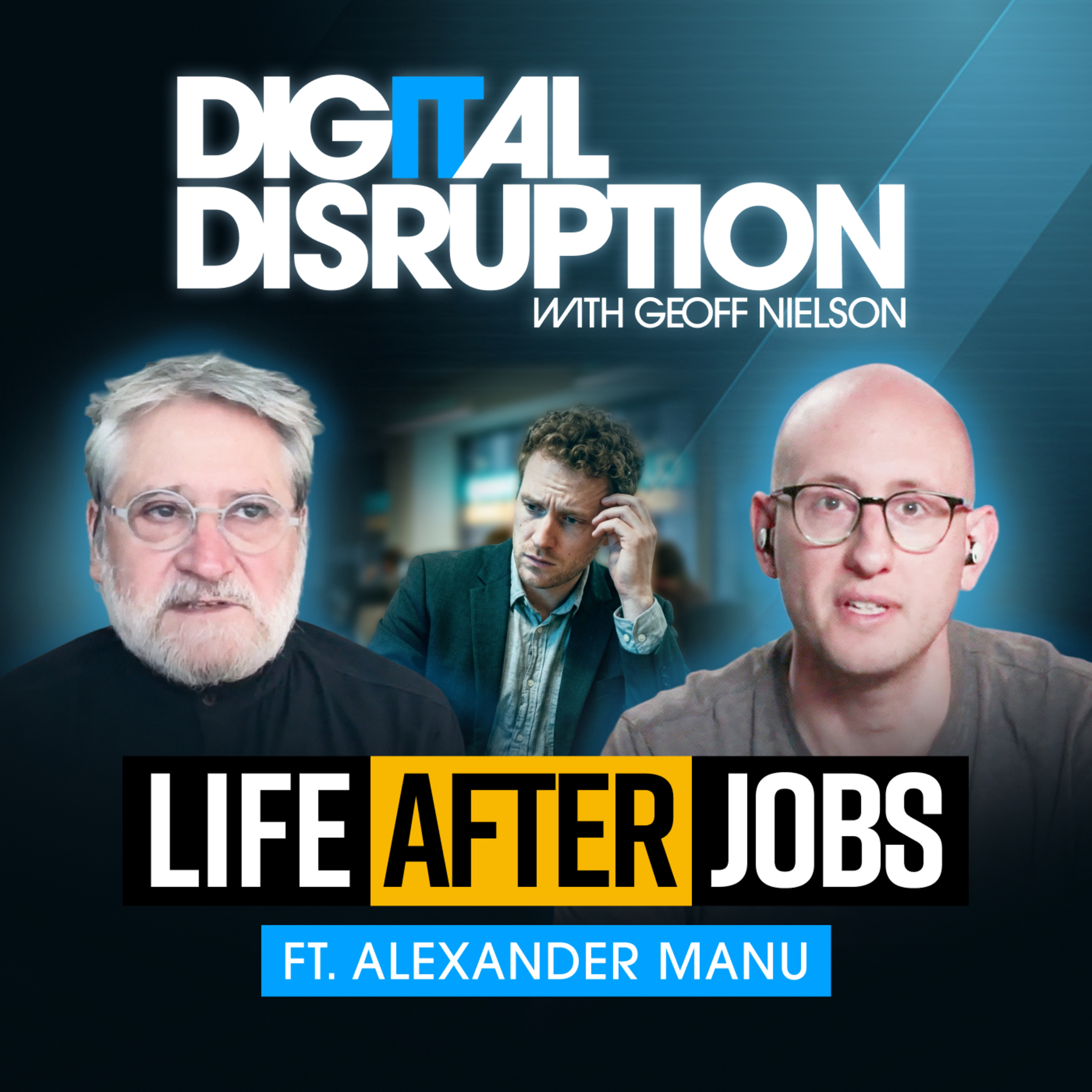
Digital Disruption with Geoff Nielson
Everything You Believe About Work is About to be Broken by AI | Alexander Manu
01:12:44
Loading summary
Transcript48 lines
- [00:02]
A
This entire fear is about loss of income because people have no imagination to look at life beyond money. We need to redesign everything from scratch because you are trying to adapt a completely revolutionary, transformative thing to an old infrastructure that just doesn't work.
- [00:18]
B
This is a show about the future of tech and the future of work. I'm Jeff Nielsen and today my guest is Alexander Manu. He's an innovation advisor, strategic strategic foresight practitioner, author and lecturer, obsessed with disruption and how technology is changing our lives and ourselves. Alexander is unusually optimistic about AI and sees it as a tool less for efficiency gains, but for helping us become truer versions of ourselves. He sees us as being at a historical bridge between technological eras. So I really want to know what he sees on the other side that I don't and what we need to do to get ready. Let's find out. Alexander, thanks so much for being here today. Really excited to have you. I wanted to start by just asking, when I hear you talk about AI, the word that comes to mind is fearlessness. You have seem to have a fearlessness about the technology that feels in some ways out of step with a lot of the media narrative right now. There's so much, you know, concern, there's so much backlash and I don't hear those emotions when you talk about it. And so I'm curious, you know, why is that? What's your outlook and what do you see from your perspective that is not being picked up?
- [01:33]
A
I think a lot of people react when they discuss AI react to something they don't really understand. And what they don't really understand is human nature. And human nature seeks, like every other animal, we seek something that we never talk about, which is the lowest energy state. Like we seek to balance activity with non activity. And for that purpose we build tools, we build elevators, we build cars, right? So when people discuss AI, they discuss it initially from a dystopian perspective because they don't understand the meaning of technology. They think technology has ideology. They think technology is a thing in itself. They never think of technologies as an extension of us, of the human will, the human will to exist, the human will to create, the human will to procreate, and so on, and to leave a sign that we existed. Because that's the whole thing about humanity, makes it different than other animals. So if you look at this artificial intelligence conversation right now, it's very easy to be dystopian. There is a story in dystopia, there is no story in utopia. There's no point in being positive about Something when you can be negative, because fear is a very dominant emotion. It's very easy to instill fear in people. So you think of, I'm going to lose employment. I'm going to be displaced as a professional. I'm going to be increasingly replaced by invisible automation, by machines. But nobody thinks about, okay, so at the end of all that replacement, what happens? Nobody thinks that maybe this is the purpose of humanity, to actually be work, to be taken over by machines and you to have the power or the opportunity to finally contemplate that you exist. And you may think, wow, what do you mean, contemplation? Well, yeah, contemplation is what your life is about. That's why you built museums. You know what you do in a museum? You do nothing. And that's the lowest energy state. You know what you do when you do nothing? You look at the Mona Lisa and you are in a conversation across time, time zones. You're in a different place. You are being human. You are not an engineer, you're not a doctor, you're not a lawyer. You're a human being in front of the Mona Lisa. And that is what people don't understand, that we created these layers, layers, layers of societal expertise after industrialization because we needed people to make machines, people to work for machines, people to manage the machines and the people, people to manage the systems in which all of these things existed. And guess what? Now we have AI taking over everything. So all these layers we created for the last 200 years are disappearing. And people don't like that because they don't think of why they became engineers in the first place. They became engineers because the layers existed. Once the layers become, I don't know, compressed or replaced by something, they will not exist. And that's very, very hard for people to understand because they identify themselves with their profession, and that is the mistake. They don't identify themselves with anything else but a professional thing. And then they have a hard time retiring. And then when they retire, they seek meaning some other way, and that is playing golf, traveling, and so on. So they re become this child that they started being initially. And this state of not doing nothing but of understanding life from the perspective of living it, not working at it. So that's my perspective.
- [05:26]
B
It's a really interesting perspective. And it's really interesting to me because it actually in some ways tells the same narrative that we've heard about. Yes, there will be this transformation. Yes, we will see AI and technology have this massive disruptive impact on automation. But you see that as Ultimately taking us to a happier place versus a sadder place or a place of worry. And so I'm curious, when you play the clock forward, what does that look like? And how do we. You said something really interesting there, which is that technology is here to work for us. And I hear this fear that it's almost. It's working instead of us or in a way that prevents us from having any sort of livelihood. So how do we cross that chasm? And how do you give people hope that they'll still be able to have a productive, fruitful, you know, life where they pursue, I guess, opportunity and, like, wealth in the broadest sense of the word.
- [06:32]
A
Okay, so let's start with some physical. Physical exercises. Okay? Try to screw a screw without a screwdriver. Just try it. Just see what happens to your finger. So then you realize that we create tools for very specific purposes, and we understand their place in our life because of the. We understand the purpose for which they were created. Artificial intelligence is different than that because it didn't come into our life as one of these purposeful technologies. Initially it did. Initially. You have to realize we had an enormous amount of AI which was invisible automation in word processors, in email, in web platforms, in Photoshop for 25 years. But it was stealth. We didn't know about it. So it wasn't replacing jobs. It was enhancing jobs people were doing. Hey, look, I can remove this thing from Photoshop. I can do this in Illustrator. So it enhanced our workflow, and we can do more things, nicer things and faster things. So now AI comes in, in this historical sequence of technologies which transforms civilizations, and this is nothing new. Lewis Mumford wrote a phenomenal book called Tools and Civilization, which tracks exactly the same history. We become the tools we use. We are the innovation, not the tool, the innovation. Innovation is not a process. Innovation is an outcome. Design is the process by which we design things and make things, and then the outcome is us. Now on the cell phone, well, guess what? That's innovation. My mobility is innovation, not the tool itself. The tool allows me to behave in a different way. So artificial intelligence shows up in this historical sequence of stuff, but it's a different order of abstraction because it doesn't automate physical labor. It starts to automate cognition. And that's a different level, right? Coordination, prediction, administration. Starts to look at all of these other things and starts to unify them invisibly. And now you wonder, so what role do I play? The human being? Well, now you can start creating things which artificial intelligence cannot create. Now you can start collaborating with a very powerful collaborator. That's how I use it in image generation. I don't treat it as a tool. I treat it as something that I can coordinate, I can collaborate with, I can give intent to, and I can give it an articulation, but I don't. And I am expecting a manifestation which is beyond what I could do myself. And once I see that manifestation in the form of generated images, I'm blown away and I realize the power of what just happened. So now imagine this future, right? So we have an ambient environmental situation where the AI is ambient, it's not identifiable. So guess what's going to happen? Bills are paid, lists are made, supply chains are taken care of, routes are changed, medical signals are monitored, and so forth. And now the task is no longer performed by you. Now. So again, what do I do? Well, do you think your life was meant? The meaning of your life is the tasks that you perform. That's when you feel alive. Don't you feel alive when you listen to music? Is music something that is physically draining on the body? No, music is something we do. And actually, all of us understand this idea that while we listen to music, we do nothing, right? Like, we do nothing physiologically, physically, right? But our brain does enormous amount of things. Our brain connects dots that we normally will not connect if we did not listen to music. And now you may think, well, what's that got to do with AI? Well, AI will allow you to do more of that. And then you say, okay, but what's going to happen to my money? But in the end, this is what this is about. Unfortunately, in the end, this entire fear is about loss of income. Why? Because people have no imagination to look at life beyond money or think of life as life. Okay, so here's the thing that I do with my students all the time. Imagine, just as a game, imagine a world in which tomorrow there is no money. Just imagine it. And then imagine what's going to happen. What do you think is going to happen? Do you think anything will change? Well, nothing will change because bread is made with flour and water and yeast, not money. And you may say, yeah, but the bread maker wants to get paid. No, he wants to get paid because he has other bills to pay. But if we remove this entire thing, you know who does this very well? Nature. Nature just does things, and nobody gets paid. And we are not able to understand that. We come from that place in which we had exchange mechanisms that did not involve money. And we have to be imaginative enough to come up With a society now with AI in which money will not exist. And then we have a different conversation right now, unfortunately, the conversation takes a layer of civilization which is now surpassed by a layer of technology. And they're trying to combine them. It's just not possible because you are trying to adapt a completely revolutionary, transformative thing to an old infrastructure and that just doesn't work.
- [12:09]
B
If you don't work in enterprise technology, IT, you can skip ahead or take a quick braincation, but if you do, infotech is your secret weapon. Infotech helps IT teams get projects done faster, better and at a lower cost. Whether you're rolling out new tech, improving processes, or just looking for cost savings, Infotech provides unlimited access to practical tools and expert guidance. You need to execute at a fraction of the cost of traditional consulting, no matter the project. From AI strategy to cybersecurity to vendor negotiation, Infotech has you covered. Check it out at the link below. And don't forget to like and subscribe. Let's dig into that a little bit more because I think, you know, to your point, there's the image of the utopia is really starting to take shape around what people could be. If we leave, you know, toil and work in sort of the, you know, continuation of the industrial revolution, sense of work continues. And if we can, if we can leave that behind, being able to move to something a lot better. I guess the question for me is what does that transition look like? Because I think that is where there's a lot of fear and how do we make sure we get that future that we want and architect that versus fall prey to some sort of manipulation by the owners of production, the owners of AI and the people who have all this capital and say, well, you know, why would I give this up? It's allowing me this privilege that I could lose.
- [13:49]
A
This is a historical bridge right now. So we have a bridge in which we need to take a transformational technology and instead of trying to adapt ourselves to it, which is the first mistake we try to, we make, we try to adapt. We need to redesign everything from scratch right now. To give you a very good example of how you can do things transformative in the deepest possible level without changing the infrastructure. I just returned from Copenhagen, which has the most amazing subway system. Most amazing because it's the deepest. It's 40 meters underground. You can't believe how deep that is. And why is there? Because they dug it without changing anything on the surface. They didn't have to disturb anything in the streets in Toronto. When we build the Subway. The street is blocked for 10 years because it's nine meters underground. So the thing is, we are trying right now to do an impossible things, which is to adopt a technology which is revolutionary and not designed for what we have to what we have. We did this with everything. We had gears on our mechanical devices, and then we had electricity. And then we created the electric motor. So then we put the electric motor on everything that had gears. It's very easy to understand what is the purpose of this thing. I have already this thing. I can make the egg beater now electric, and I can use my other hand to point to things so I can press one button. The egg gets. The white gets fluffy. But you know what the interesting part about taking that and adapting it to this? The egg doesn't know. In other words, you have not changed the ultimate outcome. In other words, the benefit is the same. I just do it, conserving my energy. So now we have AI coming in and we are trying to do the exact same thing with AI. We are treating it as an answer to a problem or a solution to a problem. Why? Because we are in this problem solution framework. The problem solution framework is very easy because you have a thing and we have a nail. We have a hammer. So the hammer hammers a nail. We got a solution. Everything is clear. AI comes as a question. And the question is, what do you want to become? What do you truly want to be? And this is where I get to the real fear. It's not that they are working less. It's a displacement of identity, because people, and I will say 99.9% of the people I ever met in my life in academia never read Abraham Maslow. And everybody uses the word. Maslow's hierarchy of needs, which doesn't exist because it's goals. He talked about goals. And everybody talks about self actualization as being the pinnacle, when actually it's not transcending. Self is the pinnacle. Self actualization is the worst thing you are doing because you are actually becoming exactly what society wants you to become. You are becoming a doctor, an engineer, a lawyer. You are actualizing the self, not you. The self is not you. The self is a construction. The self is a reaction of your organism and environment. That's Carl Rogers self theory. So we don't understand fundamentally what human purpose is about and what human a self is about, what the ego is about. And we think the whole thing is to satisfy this societal thing that calls us an engineer. That's the meaning of life. So when this thing is being displaced By a technology. Of course, we fear everything because we feel, what's my purpose? Where is my identity going? Right? So the fear is that you'll be forced to discover who you are outside that professional thing. And you are. No, you might not be pleased with the image you find because you might discover that you have busied yourself all your life to become the self. And you ignored the you, you ignored that humanity that needs to transcend the self eventually will transcend itself. So if I'm looking at purely from a Maslovian perspective, let's say, right, which theory Z in Maslow has this idea of transcending self. This is the ultimate goal. When you start to mean things for others, when you start to create for others, when you start to actually, no, you remove unnecessary labor because AI takes care of that. And now you have more time for creativity from learning, from unlearning and civic participation, all that kind of stuff. You don't even think about those as replacements for your job. But they are, and they are pleasurable activities. And there are things that you can do, and they're not utopian in any way, because you do them right now. And you will eventually do them when you retire, because you seek to do them, even when you retire, because you need an activity, right? And you need meaning. So this idea that fulfillment rests in self actualization is wrong. Once we understand that it's not the transcending that is the power, then you realize how I can help you do it.
- [19:07]
B
If I'm understanding correctly, it seems like for you, and the way we break through a lot of this negativity is really looking at AI as a tool for me. What is this for me? What does it unlock for me? How do I take advantage of it and how do I use it with an internal locus of control that I control. AI, this is my tool. It's not being imposed on me or work isn't being taken away from me by someone else.
- [19:37]
A
I can now using a tool, sure, I can now do joyful work. Yeah. So the profound possibility is not it will simply you become more productive in a joyful kind of way, but it will help you become less trapped by productivity as the measure of your existence. And that will give you more time to create, more time to actually dream about things that you never drank before. And that is not something people internalize as a benefit because they never experienced it in their life, right? They never experienced, hey, I can now do a lot more in my life because, you know, why can I do more? Because other things are being Taken over by a technology that you don't even have to touch. Right. So I can't say I'm positive. I think it's normal. I was never negative around any technology. I had this book launch, and I was mentioning where I come from in terms of emotional connection to technology. I designed in 1982 one of the first portable computers introduced in mellow park in 83 in California, the Pied Piper. I started one of my books with a story. I asked the guy selling the computer in the store, is there a market for this? And the guy said, absolutely not. And then I said, do you have a. Do you think there's a user base? Because, you know, you may not have a market, but you may have some users in a basement somewhere, the homebrew club. And the guy said, absolutely not. So then I'm thinking, okay, so what are we doing here? Like, why are we designing these machines? So then you realize we have designed platforms for which people designed behaviors. The reasons we started using these machines is. Is to change our behaviors. Software. So somebody needed to invent the reason we will need these machines. So then you realize, wow, that's happened in my life repeatedly about nine times. I transform my life because of a technology. We are the product, the extensions of all the technologies that happened in the last four years, right now in this conversation, because all the technologies are on my table, on your table, in between us, and so on. So you cannot be negative about technology when technology is everything that is around you right now. It's everything we created as a second nature. Even if we call it a chair, it's still a technology. It's a technology for even ideas are technologies, right? So all of this stuff is who we are. And our meaning is to keep creating these things to help us move, move further and further into our, you know, transcending moments. We seek to build all of this stuff just not to do it. And in the end, to contemplate. Look what I have done. Look at my journey so far. That's a very human thing.
- [22:34]
B
There's still a tension there that I want to get a little bit deeper in, which is, you know, you described it as there's the you that transcends the self and is really all about what is going to work for you. It's not the self that reflects other people's or other people's wants or desires or who you should be. It's truly connected to something deeper that you may not even know, you know, about. About yourself as a person. And technology, to me, could be Used for both. Right. It can be pushed on you by others who say, use this technique. You know, here is a personal computer to put on your desk at work with spreadsheets and you're going to have email and you're going to be more efficient.
- [23:18]
A
That's exactly what happened. It's exactly what happened.
- [23:20]
B
That's exactly. That's right. So how do we overcome that?
- [23:24]
A
Well, but this is what happened in our lives. All of a sudden every office had computers, whereas every office did not have computers prior to 1982. Like the PC. IBM PC was introduced in 1981. And all of a sudden by 84, it's on everybody's desk. And then we have noise canceling sound systems because that's very noisy. Then we have disk drives, then we have scanners, then we have storage media, then we have Business Depot, Staples. Now, which half of that was storage media? CD drives, CDs and so on and all initially floppy disks. So all of this stuff is imposed on you. And all of a sudden people that went to engineering school now have to create decks, PowerPoint decks. Like, what is a deck? The first actually program was called persuasion, not PowerPoint. So persuasion. So all of a sudden you have to make slides. It's an imperial. Like it's actually a demand from everybody above you that you need to know these things, even though you never studied them. But you know what? We adapted to all of it in a process called from gizmo to tool. So the first thing we do, we call them gizmos, because in the moment we call them a gizmo. It's something we play with. It's something non serious. It's something that, hey, my wife just called and she says, what are you doing? And I'm saying, I'm playing on my computer. You're using exactly this expression, I'm playing on my computer or I'm playing with my phone. So gizmos are introduced. They call themselves gizmos because it's a new thing. The early adopters call them the future. And then the more you play, the more you adapt it. And initially people say, whoa, what's the difference between the BlackBerry and the iPhone? The iPhone is a toy. It's not a serious thing. Well, that's exactly why it was the most successful product of all time. Because it is a toy. It was a toy. It allowed you to discover everything, right? So then you realize we adapt to these technologies. And one of the most powerful ideas in my mind that I discovered writing my last book was this idea that once we adopt a technology, we also embrace its future. Because from that moment, we are it. From that moment, we cannot go back, we cannot pretend we didn't use this tool or this technology. We cannot pretend this doesn't exist. So then we become completely co opted into that ecosystem and you cannot get out. And then slowly, and in my view, because of that, the earlier you embrace a technology, the more connected to it you will become, and more fluent you will become in your life, will be a much easier flow between these technologies and between the adoption of technologies, your redesign of the self. Don't forget, all of these technologies are architectures of selfhood. You are the one being transformed. The thing doesn't do anything without you. The thing doesn't exist without you. That's the most interesting part. People say, well, mid journey, mid journey doesn't do anything if I don't ask it to do something. Or chatgpt.
- [26:49]
B
So it's interesting though, right? Because we've got this history where it's connected to the self, it's an extension of the self, we suddenly become invested in it. You talk about the technology though, is in some ways co opting us into its ecosystem. So it feels like there's something mutual happening here.
- [27:06]
A
Yeah, because right now, these technologies, since machine learning, the technology learns a lot about yourself. So I'm convinced that you, your iPhone and my iPhone do not look at all like the same product when you open it, because we adapt it to ourselves. I'm convinced that your chatgpt behaves completely differently than mine because it learns from me who I am and it learns from you who you are. Whereas before very few technologies learned about you, very few technologists said, good morning, Alexander, what can I do now for you? Very few. But now we have Alexa, now we have other things. I can mention the thing on my desk, he's going to talk back to me if I say anything. But now we have all these assistants, right? And we use them without even blinking an eye. And we never understand how powerful this idea is. Of Alexa play Santana. You know what that means. I counted how many behavior moments need to happen from the desire to play Santana and the playing of Santana on a CD player. There are 18 behavior moments and they involve cognition, muscle memory, orientation, spatial orientation, fine motor skill, gross motor skill. Because you have to open the thing, take the CD out, close the thing, press the button, open. Like do you realize how many things you are consuming for no purpose whatsoever? In other words, none of these things have a benefit. Value analysis, which works in your favor. All of it consumes your life, all of this stuff. So now extend that 18 behavior sequence to your other life at work, in the market, making food, whatever. And you realize that we created tools that are wasting your neurons in a sequence of behaviors which in itself has no value. Because what you want, you want Alexa play Santana, you want Santana, you want. Not a sequence, you want the end result. Same thing with vacuuming your floor. You were vacuuming, not the vacuum cleaner. The verb vacuuming applies to the human. The vacuum cleaner sucks the dust and now it does it automatically. And I don't even have to be in the room. Well, isn't that extraordinary? Isn't that what we always wanted? Technology to take care of stuff? So I'm not sure exactly if this conversation, why this conversation doesn't take place at the level of. They should start actually in high school. They should train people how to embrace technology in the earliest possible moments of their life, when actually they are very susceptible to being early adopters, which most kids are. But then you have an attitude towards technology which is positive, and that becomes a normative thing in every school. And imagine a society that embraces technology. I believe there are countries that do that right now. I believe China has an attitude towards industrialization and building and so on. Completely different than we have in here.
- [30:20]
B
It's funny how much of it comes back to the change and having this behavioral change and this new technology be the part that is tough on people versus actually use it. You know, the actual experience of using it. And when you were talking about, you know, playing music, the image that came to mind is, you know, I have a 4 year old daughter and she says, play Taylor Swift out loud and there is music playing. And I, you know, as someone much older, I have my silly little record player that I like with my records and it plays it just so because it captures some sort of nostalgia. And I remember how things used to be and I like that now, of course, I still, you know, play music from my phone, but when I reflect on it, it's hard for me to believe she would ever want a record player because she doesn't have anything to attach it to mentally. She just knows it. Why would you make it hard?
- [31:13]
A
Right? And she will never understand why you put such a value on the record player. In other words, what makes you so connected to it and what does it mean so much to you? Because for her it has no value. The ultimate outcome is playing music. It happens that Alexa does it much better than Alexa and other devices, obviously. Sonos.
- [31:35]
B
Yeah, no, exactly. I Want to shift gears a little bit. And I want to talk about disruption itself, which has been a theme that we've been covering so far. And you've been talking and writing recently on the disruption continuum as kind of a framework for understanding disruption. Can you maybe walk me through what that means and how should we be thinking about disruption through that lens?
- [31:59]
A
So I wrote a couple of books about disruption in general, Disruptive business and future proofing and so on. And then I realized at one point that through client work, that you do this digital transformation seminars and workshops and so on, and you take companies from physical to digital, and once they are digital, they think it's over. Okay, I was disrupted. Now I'm ready. And then I realized that disruption is never ready. In other words, disruption is never finished. Why? Because one thing leads to another, another, another, another. So it's never finished conceptually, on a map. We have to finish the map somewhere. So if I do my mapping, which is the innovation is here or innovation object, and then it maximizes, it amplifies. So all of these things become maximization, and they stop at one point because of a physical impossibility of me showing everything. But it doesn't actually stop, it continues. So everything leads to everything else. Because once an innovation object exists, it prompts you to innovate around it. So you innovate around it. And now you have. Right now, the innovation object of the moment is agentic design. So now we are innovating agent like agents. We are trying to innovate agents because we can. So anytime we make a technology easy to understand, easy to adopt, and completely accessible to everybody, because now everybody has a computer. So there are moments in which that we call the end of the beginning. Like now we have Internet. Phenomenal. What do we do? We come up with web 2.0, which means blogging. Oh, phenomenal. Now we have blogging. What do we do? Well, let's come up with YouTube images, video and so forth. And all of this stuff innovates on itself. So then you realize if I start mapping human civilization from the most important innovation object according to many, the printing press, we are the descendants of the result, the extent of the printing press, which led to any number of things which I diagrammed in one of my books, in the book you mentioned. So then you realize that disruption never, never, never stops. Because disruption is the verb that happens when something disruptor exists. The disruptor is an inside or outside inside, meaning a technology which we innovate or an event. Covid. Covid is an outside in Digital transformation inside out. Like a transistor is a device. Right. So then we come up with a transistor and then we have to find the uses for the transistor. The first uses are the immediacy for which the transmitter was. The transistor was invented. And then we try to apply that transistor to every single thing we make. Same thing with digital stuff, same thing with LCDs, same thing with multiple touch screens and so forth. So then you realize each one of these things I'm mentioning is a disruption, creates a disruption. The disruption is behavior. Right. The disruptor is a technology. The disruption is behavior. So do we like our behavior being transformed? Yes, because it's always adding something to something else, which, which means you become a compound of all of these things. Now you can do more. And eventually you will have to unlearn some of the stuff that doesn't exist anymore. You had to unlearn to fax. You have a fax machine?
- [35:41]
B
I have never had a fax machine. I've used a fax machine. I've never owned a fax machine.
- [35:45]
A
Yeah, okay, so that's what. So you see what I mean? The fax was clearly an example of a bridge technology between a state and a new state email. So then you realize, wow, this happens every day with every technology, might be a bridge. So the question is to what? So that's what foresight practitioners do. They figure out when this thing is being maximized, what is the thing is being maximized into? Because if right now you can say Alexa plays on time, what else would you ask Alexa to do? Wouldn't it be normal to ask Alexa to do a lot of other things? Or a technology similar to Alexa? Yeah, because you start to get trained to the benefit of saying, alexa, do this, Alexa, what's the temperature? Or whatever. And then you start realizing, why can't this happen in other aspects of my life? Wouldn't that be wonderful? So then you start seeking these moments. So you become a disruptor as a human being because you are looking, you are seeking the other disruptors to create a disruption. So what people don't really see clearly is that disruption is a multi layered phenomenon. It's multi layered, multifaceted. And it's always cultural. Technologies don't exist outside cultures. So technologies completely transform societies, but it transforms the cultural fabric of society. What do I mean by that? What we do, what we create, how we create, what we look at, why we look at things. So people think that technology changes the. What they change. Sorry, the how? Yeah. Technology changes the how. How we shop, but also it changes the what. What we shop for. Because now we shop for completely different things than our shopping before. Why? I'm way. I'm data informed. I didn't even know this thing existed until I see them on Amazon. Certain things. Then if I see them and they make sense to my life, I want them. And then I realize, why would I go and buy coffee when I can subscribe to coffee? Why would I go buy certain things when I can subscribe to a lot of things? And then your life becomes much easier to manage because you realize what the point is. The point is not shopping. Shopping, it's. I compare it with prime for me is hunting without gathering. So I'm hunting without gathering. Like I'm hunting from home. That's a conceptual image, which is really cool, actually hunting from my balcony. There you go. That's when disruption activates other disruptors. Because once you change the mentality of people, they start seeking a different level of experience. So at that level of experience needs a new level of technology. So you move from VR to AR and so forth, and then you realize we need all of these things. And then we initially apply all the technologies to everything that we have. And then we start inventing native things for the technology. Like we first adapt games to the iPhone and we have pac man and Ms. Pacman. You probably don't even remember these games. And then we create Angry Birds, which is native to the phone. Or we create Fruit Ninja, that's a better example. Because Fruit Ninja took advantage of this multi touch screen on the phone. And that is exactly what needs to happen with AI right now. We do not have yet a native AI thing. Like, we have large language models, we have large action models. They are doable with AI, but they're not native. In other words, they are not things. They are replacing what we did before. We still have to come up with right now an AI native app. I don't know if that makes sense. Hopefully it makes sense.
- [39:46]
B
It does, it does. But I kind of get the impression when you talk about bridges that we're in a bridge period and we don't really know where we're bridging to. Or at least it seems like a lot of the people trying to innovate don't know where we're bridging to, that we're having these transformations, but we don't quite know what we're transforming into or what comes next. Is that fair or would you categorize that differently?
- [40:10]
A
No, it's not Fair. Because the people that create these things are never the people who should think about what they are being used for, because they are engineers or they are technologists. What I know and what you know from your own life, you know that at this moment, you might be the best version of yourself. I hope you are. I am the best version of myself right now, and I always transcend this version. And this is exactly my purpose in life, to transcend my latest achievement. And that's what transcenders do. Transcenders want. They forget about the last book and they move to the next book. And the thing is, I know that I have done everything that I become because of technology, because of my life at the edge of the soft edge of behavior and technology. In other words, I embrace it before it hardens and before everybody knows about it. It doesn't make any sense when I embrace it, but it starts to transform me. And that's how we become what we are. And you became a podcaster because of these technologies. So you are hopefully the best version of yourself as well. Do you feel that? No.
- [41:26]
B
Sure? Sure. Yeah. It's something I'm working on. So I'm curious, though, because when you say, Alexander, that this is what you're doing, I believe you. You've kind of internalized this posture toward technology that feels, you know, very healthy and very, you know, almost. Almost Zen. And I'm thinking more about organizations, about clients of yours that tell you, oh, we're doing a digital transformation. Oh, we're adopting AI. What are they doing it right in your view, or what are they getting wrong? What do they need to be considering as they're trying to manage disruption and innovation?
- [42:06]
A
Interesting. There are two types of organizations I'm running through my clients in the last four years. I can mention the domains, but I cannot mention the name of the client. But one was in high performance apparel. Let's put it this way, completely missed the opportunity of transforming because they didn't understand how this technology affects them in any way, except for inventory management and logistics support and so on. So they looked at the technology as an efficiency engine. And most people do this. Most people look at technology as efficiency, but not as effectiveness. So they are not looking at how can I make this taste better? They're looking at how can I rationalize the portion size so I make more money? How can I take three olives out of the olive can, or how do I cut this pizza? Or how do I cut the turkey? Actually, that's a real case with cutting of the turkey. So they look at it efficiency, but not effectiveness. Effectiveness is what the thing is made for, how good it is. So that company did not see it, they actually felt threatened by the conversation around it. Because if you don't see it applied to the end product you sell, but you see it applied to operations, then you don't find value. You find value because you save money on the operations side, but you don't find value in terms of marketing, announcing it, promoting it, allowing it to transform you, your deliverable. And that is a mistake because in that moment you are not front facing, you're not facing your market with a transformation, you are facing inwards with a transformation that may improve your bottom line but doesn't change anything for the consumer, which is a mistake. If I look at other institutions, another one was a transportation company. I can mention the means of transportation because it was obvious, again, threatened, didn't see how it could introduce anything, didn't see how they can use it in marketing, but in operations, yes. So they're looking for the replacement theory, they're looking for the easy, the lowest hanging fruit. Where can I save some money by introducing this thing? So they are looking at, it's a very, very poor use of the gigantic potential of this technology. I'm in conversation with ChatGPT every day and it's a real conversation because it understands my methodology, my formula for conditional futures and so on. And it creates variables based on what I give as an input, which are phenomenal but consistent with my thinking. And clearly without my insight, the thing will not exist. And I know that, and it knows that. So then we have another kind of client in education, for example, who is trying desperately to fit AI. So most companies want to fit the thing to what they have. They don't want to create something from it. So that's a big difference, right? It happens all the time. You want to fit innovation to business instead of fitting business to innovation. So those are very incompatible things. You create a Bluetooth and you want to introduce it to something, but you are not creating a Bluetooth business, which is where the business actually is. So the people that created Bluetooth, what was the purpose? Luggage tags, they did not think beyond luggage tags. And the headset did not even enter their mind because it was made for luggage. But once people understood the Bluetooth as a business innovation, they created businesses out of Bluetooth, Java headsets or Jabra, whatever the name was. So the thing is, same thing right now with AI institutions. So I have this issue with education. Right now they're trying to introduce AI in education, and clearly that will affect everything, will change the structure. So the result is a compromise. You are not using the best of this technology, and you are not using the best of what you have right now. Anytime you try to fit a new thing to an old infrastructure, you have a compromise. You take an air conditioning in a building that doesn't have air conditioning. You put these twin systems, they look horrible, they hang outside the window. It's worse than a compromise. But you have air conditioning. Compromised version of the future is not that bad. But let's think of what can we do that's original and amazing now, instead of installing a new thing into a system that cannot receive it because you have digital tools into analog bureaucracies, that's what digital transformation was exactly that. Introducing a digital tool in an analog mindset. So the mindset still performed the task in an analog way. Look at the example of the subway system in Copenhagen. What if we introduce everything underneath what exists so tick or above it? So take a look at the university. Instead of trying to compromise both the technology and your existing curriculum by combining them somehow, create something on top of it, which is only that, only AI. It teaches you everything about AI. Create a cognition mechanism here which discusses only AI. And don't interfere with anything else. Don't try. Well, of course, optimize whatever can be optimized at the existing level. Get rid of whatever is redundant at this level. And most things will be redundant, right? But introduce this at the top. Easy to do. You don't need to retool anybody. Hire new people and you have a completely new offering. But very few people think this way, because most people, when presented with an idea that changes anything, they're looking at, first of all, what happens to my job, Am I part of this project? And then they're looking at, do we have the stuff that's capable. You know, the comments typically you get are, this is aspirational. This feels like an aspirational idea. Well, guess what? Most great ideas are aspirational. And then you need people. And we simply do not have the faculty to deliver this. Well, we hire the faculty to deliver these programs, right? So anyway, so the lesson here is not technical, it's conceptual. So the whole thing is this. If the surface cannot be disrupted, which is the case of Copenhagen, then transformation requires a different layer of intelligence. And that's what people are not ready to accept, that there are other layers of intelligence. Boom, boom, boom, boom, boom. At which organizations and individuals need to operate, including in our own life. If I cannot do things daily with generative AI for my work, I'm going to do them as another layer of what I do. And that. What do you mean, another layer? See, like that complicates everybody's existence if you add it, if you explain it like that. But that's how it is. You either replace everything you do or you go on top of it,
- [49:44]
B
right? And that's the one that's the worst of both worlds.
- [49:47]
A
And so the worst of both worlds is to try to adapt it. My course now, the AI, and then you have to put disclaimers, what you can do, what you cannot do, don't do this, don't do that. But in other words, what you are doing, you are chaining the technology conceptually. Think of this. You are chaining a new technology to an old course outline by telling people where they can use this grandiose thing and where they cannot use it. In other words, tone it down, turn it off. Like, can you imagine something worse than that? Can you imagine if we did this, if we invented a cure for cancer and we say, no, no, no, no, we have a treatment here, we have treatments in here, established procedures, we have all sorts of layers. You have to go through this, this, this, this, and then we give you this, and this is the cure. So that's exactly what happened. We still have in art and design schools, people learning how to draw or drawing in design. I'm not saying about drawing in art. Drawing in art is a form of expression. In design is a form of communication, communicating a form. Not to yourself, to the client, not discovering the form accidentally. So now why would I need a sketch? Why do I need to do a render in marker? What is a marker? So if you look at this idea of parallel systems in schools, like imagine in a school, this top layer, which is parallel with all exists, and it's a layer of advising, tutoring, research, support, creative development. All the functions here being performed by the AI. No compromise, no rules, no nothing. There you go.
- [51:30]
B
So in this new world, there's an awful lot that AI can do that we used to do. And it sounds like the mindset we approach it with, the culture that we approach it with, are really important and in some ways, maybe more important than the technology itself. And so I guess looking at it that way, what do you see as some of the most important things for business leaders to learn about it, to unlearn, if they're going to actually take advantage of this?
- [51:58]
A
First thing? There's a lot of unlearning, obviously, but first, the Learning. The learning is where can we do this? Like I mentioned, we can go below as infrastructure, we can go above as interface, we can go around as a parallel service, which is very cool also. Or we can go within as an intelligence embedded into the process. That is the hardest one, because that's. You have to give up something else. So the first lesson they need to learn is that this is not an elective. This is not just like the Internet was not an elective, just like the digital transformation was not an elective. And the quicker you jump on this, the faster you will learn there is not an elective. And you will become way more capable as an individual to understand what needs to be done. So you need to reach a point of no return as a leader. So as a leader, and this is a leadership function, the transformation is a leadership function. So the leader must understand that this is a point of no return at one point and embrace it fully and lead into discovering what else can. So the question becomes, what else can we become? Right? So now let's look at this phenomenal question and that you can ask of any organization and leading to a discovery of where can I use AI? Let's go for the bank first. What else can a great bank be? So look at the phrasing of the question. Each one of them promotes a different conversation. What else? So what is a bank? Can a great bank? So what is a great bank? You have to define it. So the attributes that you define, the attributes that you can put either else are completely different than what a bank is. But you will say, a great bank is trusted, reputable, this is safe. And then what else can I bank? And you know, if you start asking a banker, what else can I bank? Do you think they understand you can bank DNA? Do you think the anesthetic can bank images, you can bank emotions, you can bank. You get it right? They will not think it like that because the limitation of the world limits their vision about what the bank is. So the first thing that needs to happen is an unraveling of the DNA of any organization. What is our DNA? What are we? What is a bank? What else can a bank be? What else can a great bank be? So what makes you great? What makes you a bank? What else can you be? So the what else is exactly the question AI came as. AI came as the question, what else can you be? Since we know we are becoming what the tools allow us to become, in other words, we are extensions, we have products, we are of our behaviors and behavior becomes identity. And this is if you don't accept the idea that behavior becomes identity, then you don't understand what technology did to your life. Right? So then, which means by definition, the contrasting condition, if you don't behave in a specific way, you don't have that identity. So the problem leaders need to surpass is mistrust. That's another. So they need to stop looking at dystopian scenarios. They need to stop looking at the idea that this technology is. Terminator 2 is coming for us, going to destroy us. We will not become the Matrix. Even some people think that we are in the Matrix right now. But they need to understand that you cannot attach this technology just as a decoration. This has to be your soul. That's what I meant, the DNA. So it's a very, very important time for organizations to re examine who they are. So to re examine that. So imagine I'm working with a. I have a formula that I use for my foresight work. It was inspired by. Are you familiar with the Drake formula? The Drake equation? For.
- [56:17]
B
The Drake equation for extraterrestrial life?
- [56:19]
A
Right. So I adapted that equation. I adapted the variables to foresight because that equation was not about. It was about. I call it a grammar of possibility. Like, the guy was trying to find a way to express what could be possible. So he looked at a multiplication formula in which you need to have each one of these variables to exist more than zero. Right? It has to be one at least. So it multiplies. So then you realize that, hey, that's a very phenomenal formula for any future, any future that I want depends on a number of variables. Now, the variables in banking are different than the variables in podcasting or the variables in education, but the formula is the same. I'm just changing the variables. But the conceptual idea is the same. This equals that times this times this, and error. Boom. Oh, so all of a sudden you have a diagnostic tool for the future of any organization because you say your condition, your future is conditioned on these things. Well, do you think most businesses look at that conditionality between things? Do you think most businesses look at. If this exists, then that happens. So that's a conditional tension. So essentially what I'm trying to teach leaders right now is understand your conditional tensions in these variables, which is a one paragraph, like it's not even a. It's not even a major thing to understand. Right. You are familiar with. Okay, so I'll give you. Oh, I can't mention the name. Okay, Another podcaster. Another podcaster that I did actually a conditionality for Another podcaster. And anyway, I was about to read to you the conditional attention, because that applies to you as well. Just to understand the idea. The idea is that leaders in organizations need to sit down with intellectuals, which is happening very, very rarely. They should stop watching TED talks because TED talks give you the impression you are thinking these thoughts, which in effect you are not. You are in the audience. And the fact that you get a 15 minute shot of adrenaline doesn't mean you are thinking anything. But it's time to start thinking about things. And the thinking about things starts having people having an intellectual conversation with factual basis, understanding self transcendence as the ultimate thing and understanding that humanity seeks something and that something is lowest energy state, while at the same time we are curious about like a cat seeing a laser beam, right? The cat is in the lowest energy state on the couch, but then you throw a laser beam and the cat is going to chase it. It was same thing as humans.
- [59:19]
B
I want to come back to something you said that I just want to like, really, you know, hone in on, which is you said this is not an elective. And it sounds like in your view, you're making a pretty strong stance that for. And let me feed it back to you to see if it's right. But basically, for every organization, for every person with AI, with these new technologies, this approach is not an elective. This is not, oh, if these conditions are met, I need to start thinking differently. This is fundamental to being successful in adopting new technologies and being able to take advantage of new paradigms.
- [60:00]
A
The worst thing people, organizations do right now, it's not that they're not ready for this, because I study also the level of readiness, I have a rubric that gives me points and so on, is they do not want to recognize where they stand. In other words, they are not even facing their own attitude towards it. What is the thing? The true promise of the AI is not speed. The true promise is redesign. This is where this is a phenomenal challenge, but also a phenomenal opportunity. This utopian future I was talking about depends on two transformations which are linked. The first one is to understand the historical purpose of tools which I mentioned at the beginning of this conversation, which have always been to conserve energy or conserve toil. Right?
- [60:54]
B
Why?
- [60:54]
A
Because I want to create the level in my mind for a higher form of human existence and a higher form of human experience. And I call that contemplation. I call that the contemplative interval. And you may think, whoa. The audience may think, I don't know how to contemplate. And I don't have any time to contemplate. But contemplation is just another word for doing nothing while you listen to music. Listening to music is contemplation. Reading a poem is contemplation of ideas. Going after swallowing a good red wine is also a contemplation of the quality of that thing. So we do this contemplative analysis all the time. We just call it something else. We call it a tasting menu or some other thing. So we have to understand also that the promise of this technology cannot be fulfilled if we force it into obsolete structures. And that's what's happening right now. That's why I'm saying redesign is the thing. What's happening right now is that we are forcing this thing into an obsolete structure, and we're expecting a phenomenally new result. No, if you ask midjourney to imagine a chair, he's going to imagine a chair, which means you're wasting the potential of the technology. If you ask midjourney, imagine a device that suspends the human body above ground in a relatively comfortable position while performing a task, then you get something extraordinary that you cannot possibly imagine yourself. So in that moment, you are using the technology to its advantage and to its full expanse. Right. So you need new social institutions, urban, educational. You need architectures capable of receiving this intelligence. So that's why I'm saying it is almost an environmental condition that needs to happen for this technology to flourish in its full capability, not to be just adapted as. As a tool. It's not a tool, it's a condition. So it's a way of being. It's. You know, it's like the rain. Yeah. The rain can be used as a tool because you can create climate conditions for the rain, which are good for agriculture. But so to conclude this idea, the future is not the future that I'm thinking about when I say this is utopian. It's not utopian. It's what happened to every technology when it fulfilled its maximization. So it's not a world where the human is made useless, but it is a world where usefulness was redefined. So we have to redefine, and we redefine many things where we are really, really good at redefining things, the meaning of things. So we redefined garbage as. Sorry, we redefine a green onion as garbage when we cut the green part, and then we throw it in the garbage, and then we come up with another thing, and we call it compost. But remember, this whole step Takes five seconds. You bought the onion, you paid money for it. It was food up to the moment. You cut a part of it. You cut a part of it which is edible, and you throw it in the garbage. But you don't throw it in your regular garbage. You throw it in the compost garbage. And that becomes redefined in two seconds. Garbage, compost. So we are very good at doing this redefining stuff. We look at the sun and we see, oh, that's a symbol of life. The sun doesn't know that. But we can define and redefine all of these things, right? So the question is not what work will humans still perform? That's what people are afraid of. The better question is what forms of human meaning become possible? What can become possible when compulsory effort to put food on the table is no longer the organizing principle of civilization? Because that's how we did it. The organizing principle of civilization was you need a job. And because you need a job, you need to create systems that allow you to reach that moment of learning, knowing until you know what your job might be. You go to school, you become this and that, and then you work all your life in that job. Well, that's not civilization. That's right now, a thousand years. It wasn't the same thing.
- [65:36]
B
I want to cover one more topic just out of personal interest here, and that's contemplation, which we've talked about a few times now. And again, there's a tension here for me, because I love the idea that, you know, going to a museum is contemplation or, you know, listening to music is contemplation. There's this competing idea or there's this concern, which maybe we just have in any generation, that with social media, with even, you know, you mentioned TED talks being 15 minute long and, and you said you're not thinking, you're just hearing somebody else's idea and believing it's yours, that some of the ways we consume media are not necessarily contemplative. They're almost like anti contemplative. Like they prevent you from thinking or they just give you.
- [66:20]
A
They absorb you. Yeah. They absorb you.
- [66:22]
B
Yes. So what do you make of that? Do you have a broader, you know, kind of viewpoint or paradigm for, you know, contemplation versus being absorbed by something else and kind of the good or the bad or how we approach that?
- [66:38]
A
Well, it's a question of how you define contemplation, also how you define meditation. And is riding a motorcycle a form of meditation? Technically, it is, because you are Focused on nothing. Like, in other words, you are focused on nothing and you are purely in that moment. I will argue that I'm addicted to bulldog videos, English bulldog videos. So I can watch English bulldog videos for an hour. Now, I don't think I'm. That addiction is a contemplative performance because I'm sucked into short videos of very funny moments. I'm not doing anything else. I'm completely relaxed. I probably laugh more than I laugh the rest of the day, so I don't see that as a bad thing. So I'm thinking of all these other moments in which I can allow myself not to be bothered by fears and stress and consequence. And if you start seeking these kind of moments, and I don't want to call them contemplative moments, but for lack of a better word, of explaining what their purpose is, their purpose is purely to understand who you are outside other constraints, like who you are removed from constraints which are that societal constraints clause, whatever. Who you are. And then who you are is this person that starts to see visions of the. Of themselves. And these visions of themselves, if they are on a background of music, are different than if they are on the background of a book you are reading. Because you are always projecting yourself into a situation, right? You're always part of something. You don't think you are part of social media when you consume it, but you are the consumer. So you are the thing for which the thing was being performed. Right? But so I don't see that as being different than contemplation because technically, and I don't see that in any way being outside of the realm of play. That's a form of play. You are not doing anything, you're not working. It's unproductive. It's purely play, right? So it has no time limit. So if you take a look at the rules of what makes play play, social media fits every box.
- [68:57]
B
So you're. I just want to confirm this because it's interesting and it's actually in some ways a very unusual take. But you are not making a value judgment about whether someone is at a museum or eating food they like or watching a short form video or reading a book. It's all a form of the same thing.
- [69:15]
A
It's a form of them performing only for themselves. It's a form of them being in touch with themselves, not doing anything for anybody else, not projecting an image. Of course you can be on social media as an influencer, but that's a different issue. I'm not discussing influencers. I'M not discussing people that watch influencers. That's not play anymore. That is a thing that has constraints and the constraint is the relationship. Influencer influence. That's the relationship. I'm not talking about that when I'm saying social media. Watching bulldogs perform tricks on a board is phenomenal. Did you ever watch these videos?
- [69:59]
B
No, I haven't. I have some English bulldogs in my life, but I can't say that I've gone down the. It's not a part of my identity, let's put it that way.
- [70:06]
A
Okay. They are really good at skateboarding, like really good, because they have a low center of gravity and they seem to enjoy it. At least the ones I'm following anyway. So I think. And this is not being part of a positive Men. No. I have all the reasons to distrust social media. I'm of the age that most people would say, how come you even are involved with technology? Well, it happens. I was an early adopter of everything, so I don't fear it. I don't see it as a negative. I think any time consumed outside obsessing about yourself, which is why I don't talk about the influencer part is a time of contemplation. It's a time in which life takes precedence over doing so. Being. Don't forget what these things are about. They're about being. Being is different than having and then work. So the human mind has these two halves to have and to be. Eric Fromm wrote a fantastic book about this. And then we keep working with a having part instead of working with a being part. So I want to be. I'm pointing to the side of the head that has the being part. I'm not positive for being positive. I can't find any negative that's. I'm rational enough to, you know, I don't believe in the fears of others. I believe only in my. In my own experience. And I'm doing every day, I'm performing every day with this technology. And I'm enchanted. That's the best way. Enchanted.
- [71:46]
B
Enchanted.
- [71:46]
A
Yeah.
- [71:47]
B
I love that, that word choice. Alexander, this has been really interesting. I appreciate your insight. We covered so much ground. Thank you so much for a fascinating conversation.
- [71:55]
A
Thank you.
- [71:58]
B
Most viewers don't know this, but Digital Disruption is developed by Infotech Research Group, a leading advisor to technology leaders around the world. If that's not you, you don't need to care. So skip ahead and enjoy our content. But if you are a technology leader, Infotech helps IT teams get projects done faster, better, and at a lower cost. Infotech provides unlimited access to practical tools and expert guidance you need to execute at a fraction of cost of traditional consulting, no matter the project. From AI strategy to cybersecurity to vendor negotiation, InfoTech has you covered. Check it out at the link below. And don't forget to like and subscribe.