← Digital Disruption with Geoff Nielson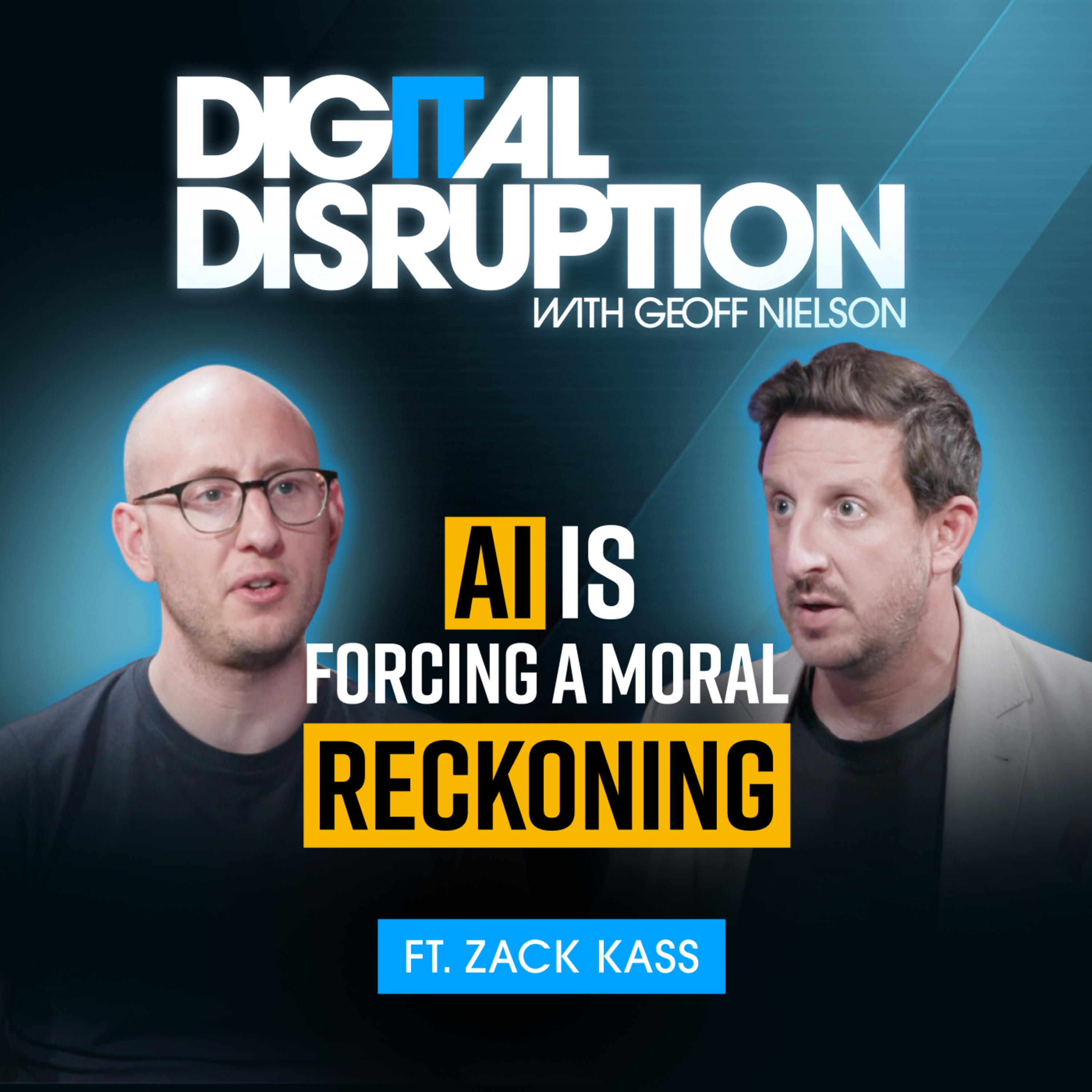
Digital Disruption with Geoff Nielson
Ex-OpenAI Lead Zack Kass: AI Judges, Abundance, and the Future of Society
00:35:27
Loading summary
Transcript82 lines
- [00:01]
Jeff
Hey, everyone. I'm super excited for the return of Zach Kass to the digital disruption podcast. He's a former leader at OpenAI and now a leading AI futurist and author. My first conversation with Zach was the most emotional and profound conversation I've ever had on the podcast and left me deeply moved with a series of unanswered questions about the future. He shared his techno optimistic view for how AI is going to transform our future for the better. And it left me wanting to probe more about why technological change is. Is so overwhelmingly a force for good, where we should be worried, and how we can all live more fruitful lives. Let's check it out.
- [00:39]
Zach Kass
Hey, everyone.
- [00:40]
Jeff
I'm here for a second time with Zach Kass, the former head of Go to market for OpenAI and an advisor, a futurist in his own right. Zach, thanks so much for being here.
- [00:49]
Zach Kass
Thanks for having me back. Jeff, good to see you again.
- [00:52]
Jeff
Amazing.
- [00:52]
Zach Kass
Good to see you this time in person.
- [00:53]
Jeff
Absolutely love it. You know, Zach, I wanted to ask you, you talk so much about this optimistic future of abundance. You know, you've got so many amazing stories about, you know, looking to the past as, you know, reasons to be optimistic about the future. You know, one of the things that feels, you know, different or at least on a different scale this time is just the speed of change, right? That's kind of become the, you know, the running theme of what's going on with GPT AI in general is like this, this just like, adoption curve and, you know, this technology curve that's never existed before. You know, how, if at all, do you think that impacts society and our readiness to adopt these changes and adapt to these changes? You know, if you compare it to, you know, the past and the rate in the past.
- [01:39]
Zach Kass
So what I would say is I think we've probably been in a parabolic curve for a little bit, right? Like you could. I think it's hard not to argue that things didn't start. It's hard to argue against the idea that things did not start changing very rapidly, circa electricity, in the way that like, generations stop being able to recognize their, you know, the next generation's life in pretty material ways that wasn't true for a long time prior to that. And I think what we're now realizing is that it's not slowing, right? So I think we'd sort of adjusted to this idea that things were changing and we could sort of like, you know, feel our way through the change. And now it's changing faster than we can probably really appreciate because we're in it, right? And obvious examples of this include like describing the effectiveness of AI today to someone 20 years ago, even in AI would have been very hard. No one would have believed it. And there are all sorts of reasons. I mean, maybe a couple people like Ray Kurzweil, but very few people could have actually believed that this was possible. So on a scientific frontier, what we're seeing is the expansion of frontier in every direction. And that's incredible because two things are true. It's begetting more scientific expansion. The more we know, the more we can discover. It also is actually inspiring people to look further than they've ever looked. So what's incredible about things like the Roger Bannister effect, Roger Bannister is the first man to run a four minute mile, or the Wright brothers effect is what it teaches us is these critical moments. So in the case of Roger Bannister, he runs a four minute mile. Prior to this first four minute mile on record prior to this, no human had done it and it was believed impossible. It was believed this limit of human physical capacity after this, within one year, 10 other men had done it. There's a scientific convergence and a physical convergence at play, which is that people get good at things around the same time. But also we are inspired when we see other people do things. So as we actually start to expand the frontier, more and more people are coming in to expand the frontier. And so you're seeing more people enter novel sciences than ever before. And Peter Thiel recently talked about this. He's like, when I was in college, the only thing anyone wanted to go into was computer science. And now everyone's going into all these other applied sciences material, particle, molecular and everything. We're just seeing the frontier expand everywhere in large part because of the improvements in computer science. Now the question you asked is, okay, fine, this is happening, but like what do we do about it? There are two answers to this. There's a, like, there's a short and simple one which is like we can't really stop the progress. And in fact a lot of the progress is like super important. And I think as humans we just need to acknowledge that like things are going to change at a rate that makes us very uncomfortable because we're not, we're neanderthalic in our biology. The other answer is actually more nuanced, which is that like humans are still at the wheel. Like we actually still control the planet and most of the things that happen on it. And it turns out that like societal thresholds not technological thresholds are going to dictate our future. And this I write about and talk about quite a bit, which is this idea that societal thresholds ask the question that is more important than what can a machine do? A technological threshold, what do we want a machine to do? And there are lots of examples of societal thresholds that have never moved, despite the fact that the technological threshold has moved a ton. Nuclear power is one. And so I think what we are, what we are arriving at is a world very quickly where what we want the technology to do collectively is far more important and interesting than what the technology is capable of. And so even though the frontier is moving in all these interesting directions, things like crispr, gene editing is still very, very sort of understudied because of the moral issues with it. We don't modify humans, we don't clone humans. We could. We don't. And so we have to remember that, like, the scientific frontier does not dictate the societal one. And there is a lot of work that we can do to actually start to explore what should we automate, what frontier should we expand and what shouldn't we.
- [05:36]
Jeff
So, you know, when I think about the interplay between the technological frontier and the societal frontier, and by the way, like, super interesting conversation, super interesting kind of model, you know, it sounds like you're saying the societal one dictates the, you know, technological one. Is it? Is it?
- [05:51]
Zach Kass
Well, no, not necessarily the societal one. In order for a societal frontier, a societal threshold to be met, the technological threshold must be met. Right. By definition, but the other does not. But a technological threshold does not necessitate a societal threshold, which is to say a technology can be capable of something. GMOs is a good example. CRISPR. And we could say, we don't want to do that. You can't use technology in this way.
- [06:12]
Jeff
Right. But as the technology advances, we as a society every time have to decide whether we say yes or no.
- [06:19]
Zach Kass
That's right.
- [06:20]
Jeff
It forces us to address increasingly difficult questions.
- [06:23]
Zach Kass
That's right.
- [06:23]
Jeff
In the space, you know. Do you think I was just picking up on one of the things you were saying about the rate of change and how it's kind of changing generationally and how, you know, now we're like, there's no going back.
- [06:34]
Unknown
Right.
- [06:34]
Jeff
We're just at this, you know, accelerated rate of change that's never going to, like, it's never going to slow down.
- [06:41]
Zach Kass
In our lifetime, barring a terrible. Yeah. Not even existential. I mean, there's. There are, there are events that Are. I mean, it's a funny idea, but, you know, people are like, what about. This is a hot take? We, like, what about nuclear war? I'm like, look, I don't think it would annihilate the human. Like, nuclear war would probably. It would be the last nuclear war we ever had. Sure. And then we'd be like, let's never do that again. That was terrible. Let's not do that again. It wouldn't eradicate the species. It would just set us way back.
- [07:05]
Unknown
Yeah.
- [07:06]
Zach Kass
With a new set of lessons learned. I don't say this with. With any degree of. You know, there's a lot of sobriety in my voice, but I do think we need to acknowledge that humans have. Have persisted through a lot of pretty terrible events.
- [07:17]
Unknown
Yeah.
- [07:17]
Jeff
Well, and let's maybe talk about that for a second. And this is, to be honest, a little bit fun for me to talk to the abundance guy about nuclear war, but, you know, one of the.
- [07:26]
Zach Kass
A nuclear weapon for every man, woman and child.
- [07:28]
Unknown
Yeah.
- [07:28]
Jeff
Yeah. I mean, how worried are you about this? Because one of the things. One of the things that I see almost as a fallacy, Zach, is that there's this view that, you know, oh, because we haven't struggled with this before or because mankind has always overcome challenges before, will always. Will we always be able to overcome them in the future. Right. Like, at some point does the technology, does the capability get so beyond our control that a mistake made by us can have consequences exponentially vaster than in the past?
- [08:01]
Zach Kass
So the answer is yes. Frankly, the answer is yes. I think that what we now need to recognize, and this is going to be. And I said this on stage, and I say this to anyone who will listen, the threat of the low resource bad actor has never been more terrifying.
- [08:12]
Unknown
Yeah.
- [08:13]
Zach Kass
And as much as, you know, like, we all sort of stared when Ukraine on June 1st carried out this, like, sort of unprecedented attack on Russian soil with these drones and, oh, you know, people celebrate as a victory for small countries who can now out fight. Sure. And by the way, fine. I mean, whatever. But also, you have to not recognize that what they just did is now possible by someone else, maybe a smaller nation state.
- [08:41]
Jeff
Maybe it's changed rules of warfare.
- [08:44]
Zach Kass
Maybe not a nation state, maybe just a medium resource bad actor. It's not about the drones. It's about the lesson that this warfare tells, which is that low resource actors are more equipped than ever before, because for most of human history, if you had more people, you won. That was the rule. And now it's not that ingenuity because of this, because of the new technological asymmetry is necessary. And so I say this because we have to start having really honest conversations about the actual threat. And the actual threat to society is 4% of the population are psychopaths and another 4 or 5% who operate outside the boundaries of incentive structures because they figured out how to make crime work and pay. And we have to acknowledge that this is the percentage of the population that we should be most scared of. And by the way, I think at the limit we make crispr psychopathy out of the gene pool. This is one of my crazy hot takes. But I do think that we are going to recognize that we are at greater risk to what one psychopath can do than ever before. And that psychopath is not necessarily a big nation state. It's just a jerk in a garage.
- [09:52]
Jeff
Well, and this to me is the. It's super interesting. It's the continuation of a trend that I can trace back at least to 9 11, right? Where it was the rules of how we understood warfare and how we understood threats to America were completely upended on 9 11, right? And it's only, you know, it's not getting worse in the 911 sense, but it's getting worse in terms of the impact that bad actors could potentially have. And so, you know, what I wanted to ask you is about containment and response. I guess, like, what do we do about this as nations, as organizations, as individuals?
- [10:25]
Zach Kass
There are quite simply two things that probably need to happen. The first is we need to acknowledge that AI is going to allow many people who want to do great things to do far more great things. I mean, God, the amount that this technology is already supporting with people with disabilities. For example, I recently invested in a company that's building an AI powered cane for the seeing impaired that actually doesn't require any training that helps guide the person with a small motor that you can speak to to say, this is where I want to go. I mean, and that can send warning signs to your loved ones if you fall, if you drop it. Like, this is amazing. And this sort of technology is now possible by small teams. So what we are seeing is the expansion of all human potential. And we need to acknowledge that as a very good thing. We also now need to acknowledge that our tolerance for low resource bad acting should come to a swift end. And I say this with a lot of sort of sobriety, but we have in the western world for a long time said freedom is so important and we need to be more tolerant. We need to Spend more time trying to help fix people who are broken because of the structure of society. And my point is those days are probably over because the amount of bad that a bad actor can do is so much greater than before. It's no longer just hitting or kicking someone. And we have to start acknowledging that as we supercharge weapons, just as we supercharge all these other incredibly good things, low resource bad actors have to be managed very well. And so I think policy that very, very clearly identifies targets and tries to eradicate the existence of low resource bad acting by making it so uninteresting on any economic basis is critical to solve for 5%. And then you have the psychopaths. And honestly I don't know what to do. Japan has solved this by saying if you exhibit signs of psychopathy, you get a warning. And then if you basically operate outside an anti social boundary, they put you in an institution, you're out. Now 200 of 100,000 people in Japan live institutionalized. Why does Japan work so well? Because they don't tolerate it. Singapore? Same. The United States, two people per 100,000. We have created a world with so much tolerance and then we wonder why no one wants to go to public parks anymore. Well, someone's like doing something insane. Everyone's like, let's leave, this is not a safe space. High trust societies are really critical when the technology is getting more and more powerful.
- [12:58]
Jeff
So it sounds like, and by the way, this is not the path I thought the conversation would go down, but it's interesting. So I'm just going to follow. Sounds like as technology advances, there's always in this societal sphere a trade off, as you kind of said, between freedom and security. Right. And we have that societal threshold of, you know, we continuously reevaluate where exactly we're comfortable with. But it sounds like, you know, in your mind we need to have sort of a generational conversation about did we get it right or does something more fundamental need to change given, you know, the ecosystem now of bad actors.
- [13:34]
Zach Kass
I think that's right. And in fairness, the commitment that Singapore and Japan have made to a high trust society is something that everyone now, it's easier for them and it's a homogenous society. It's easier to identify people who are operating in an antisocial way. But they basically said, listen, we have no tolerance for antisocial behavior.
- [13:51]
Unknown
Yeah.
- [13:51]
Zach Kass
And you know, I'm just such a staunch advocate for it because you see how comfortable people are living and thriving in high trust societies, how much more productive People are when they feel comfortable walking home at 10pm at night, when they feel comfortable letting their kids, you know, play in the street. Like the world just gets so much better in immeasurable ways.
- [14:16]
Unknown
Right.
- [14:17]
Zach Kass
When we, when we know that the people around us are operating inside the boundaries.
- [14:21]
Unknown
Right.
- [14:21]
Zach Kass
That we have all agreed on.
- [14:23]
Unknown
Right.
- [14:23]
Jeff
So, you know, one of the, you know, I'm going to ask you a tough question. So one of the, you know, I've had this conversation before and I've had, you know, some people who nod along and agree and some people who have like a really profound backlash to the sentiment. And the most profound backlash I hear is people who are concerned about the fallibility, I guess, of the people making these decisions. And if you're using technology based on this human fallibility and some of the biases, I'm thinking specifically about kind of racial biases or profile based biases, are we potentially creating, you know, you know, a hellscape based on specific demographics?
- [15:04]
Zach Kass
So let me say first, it's a reasonable question given how much, how strongly I believe this, I think I should be prepared to answer this. I'll say a couple of things. The first, I'm not actually in the, in first of all, I think the judiciary is fundamentally broken and at the, at every level, arguably, actually, except the Supreme Court, because I don't know even who knows these days, whatever, I don't want to make it political. Supreme Court didn't used to be political, now it's political. Can't say these things. But the judiciary is broken. It's been broken for a while. It doesn't have the capacity to hear trials on any reasonable basis. Trials take way too long. Small claims to criminal, it's all broken. White collar crimes especially, seem to drag out many, many, many, many years. Moreover, the judiciary is so incredibly inexplicable. We live in a world of incredible precedent. And still crime and punishment sentences operate in ways that no one can make sense of. And the reason for this is bias, human bias in particular. We live in a world where if a judge wants to make a sentence or wants to make a ruling, they can. And unless it goes to an appellate or, you know, further up court, that's it. And even at some point, someone stops hearing the case and says, no, that's it. And so theoretically, there are checks and balances. But in effect, for most criminal cases, you, you know, that's it, that's the verdict, that's the ruling. Now what's amazing is when people are like, what about bias in the machine? I say, well, yeah, okay, fine. You do appreciate that humans and machines likewise only work because we are biased. Like, we only work because we believe certain things. The problem with humans, the problem with the world we live in, for the most part, is that it is inexplicable. It's really hard for me to know why you believe something, just as it's actually hard for you to know why you believe something. There's too much genetically and in your life to actually process for you to make sense of all the things that you hold near and dear. Your values and principles are actually derived from a very complex neural net that you yourself can't make sense of. And even if you could make sense of it, you would never admit it to me. You would never admit to me, hey, you know, I actually don't really like you because you remind me of my high school best friend who betrayed me. Yeah, that might be happening. You know, that happens in our daily lives. We never say that to people. It would never. It would make for a terrible social standing. And so instead we just go about the world explaining, justifying all of our biases. Oh, no, this is why I believe this thing. And this is the world we live in now. Yeah, this is just. Why would you disagree? Look at the facts. Machines present this incredible opportunity for us to actually not remove bias, but explain bias. And this is the thing I keep coming back to, because if you get declined a loan at a bank, the problem isn't necessarily that you got declined the loan. The problem is often that you have no idea why and you cannot trust the system actually did so fairly. I'm not proposing that we are going to build a world where everyone likes the outcomes. I am proposing that if we start to automate more critical decision making, or at least augmenting critical decision making with machines, we will arrive at a much more explicable place where rulings actually carry with them incredible amounts of defense and where we can look at the machine and say, this is how the machine arrived at this decision. We don't have to like it. We can throw it out, but this is the explanation. Very few, very few bodies are capable of doing this. And the Supreme Court is really principally one of them, where their defense is so robust because they have dozens of people per every, you know, Supreme Court justice trying to explain why they believe what they believe. And even still, those people disagree. Why?
- [18:43]
Unknown
Right.
- [18:44]
Zach Kass
Cause they're biased. Cause they're biased because that's the way the world works. And that's actually not a terrible thing. And so my point is there's a lot of the world. Now, I'm not proposing we automate criminal courts, I'm not proposing that. But I am proposing that we start adding a ton more explainability into the process. And by the way, I do think we could automate small claims. I do think GPT 4.5 could do a much better job than most small claims judges and probably do it instantly. So I think that the answer in all this is actually that we want to move towards a more explicable world. What it doesn't solve for is false positives. What it doesn't solve for is people that are unfairly tried because evidence is just mounting in their favor. That is circumstantial or unlucky. And that's bad. I have no answer for it, except that's bad. And it's also a price that I would be willing to pay to live in a society where we get all of the bad actors out of society.
- [19:32]
Jeff
Right. And you try and optimize it out of the system of time through the explainability, of course.
- [19:36]
Zach Kass
And by the way, again, Singapore and Japan face this. And this is like, this is like one of the costs of the system.
- [19:42]
Unknown
Yeah, yeah.
- [19:43]
Jeff
So the explainability is big to you. And I think too about, you know, one of the fallacies of, you know, any of this kind of autonomous technology. I think, I think about autonomous vehicles where it's like, it, like it doesn't have to be perfect, it has to be better than human drivers.
- [19:57]
Unknown
Right.
- [19:58]
Jeff
And, you know, how do we make sure it's better than humans?
- [20:00]
Zach Kass
Well, this, I mean, again, this goes back to societal thresholds. And one of the reasons that societal thresholds do not progress is because humans have an exceptional tolerance for human failure and we have none for machine failure.
- [20:08]
Unknown
Right.
- [20:09]
Zach Kass
And you know, I think we talked about this last time, but no one wants to be, you know, people are. No one wants to be the person who gets convicted the wrong crime by jury of humans. And no one obviously wants to be that person. But even fewer people want to be the person that's wrongly convicted by a machine.
- [20:26]
Unknown
Right.
- [20:27]
Zach Kass
That is dystopian in people's minds in the way that a human jury is not because we're like, ah, they're human, they make a mistake. But machines need to be precise. And that's, you know, that's complicated.
- [20:36]
Unknown
Yeah.
- [20:37]
Jeff
I want to talk a little bit more broadly. You know, we've kind of fallen down this rabbit hole, which I'll take responsibility for, of falling into this sort of Fear trap around technology. And it feels like more and more in this attention based economy, there's an incentive for people to have these kind of fear based conversations. And so I mean, I'll be the first to own up to that and say oops. Like that wasn't my intent here, but we've kind of gone down that rabbit hole. But how do we, how do we come out of that? Like, given that, I think we all recognize it's bad for us, it's making us less happy. How do we break through that? And do we need, you know, technology or some sort of institution to help us or does that happen on an individual level?
- [21:19]
Zach Kass
So I don't have a good answer. I think there's a bunch that I can like, you know, ascribe to this. Like we live in a world of recency bias, attention bias, confirmation bias, but principally negativity bias. Because, and this is well documented, fight or flight was a really important chemical that told us to avoid the woolly mammoth and paranoid people survived. So we, we have the biology of, you know, Neanderthal with the technology of a, you know, a Star Trek. And you know, they're just everything looks like a threat now. I mean everything can feel like a threat. And for a lot of people, I think the opportunity in the world also presents this like almost debilitating paralysis. Just people are really, really anxious about all of the opportunities that are being presented to everyone around them. My answer to this is pretty simple. The body of evidence is mounting at this point that at least for a while now, we have been on a very positive upward trajectory. And you know, you can read Yuval Harari's Nexus, which basically says actually things might have been better and 10,000 than they were in 5,000 BC, you know, whatever. But what I always say to people is pick another time in history you'd rather be alive, right? You can't and you're just not. I think for most people you're not gonna.
- [22:37]
Unknown
Right?
- [22:38]
Zach Kass
And until someone gives me a date that isn't the day, isn't today, my answer to people is like, listen, I'm not saying that we are chemically wired. For all the stimulus that we are chemically wired to withstand screen addiction, that we are chemically wired to put our lives on the Internet for everyone to see that we are chemically wired to, you know, read about all the horrors that are going on around the world. And I acknowledge that for many people emotionally it has never probably been harder in human history. They are dealing with more emotional anxiety, depression, mental health, disorders than anyone in their lineage. And also we will overcome, like, we are going to figure that out. And I don't think the answer is going to be pharmacological. I do think the answer is going to be psychological, situational, and eventually behavioral. And I do think that, like, again, what people have to separate is that, like, the actual standard of living is so incredible relative to what it has ever been. And most of our anxiety is actually born from these mind ghosts, these ideas that things are going to get worse, when in fact, the evidence is to the contrary. And we have to acknowledge that we are not chemically wired for all of this world, but that physically and frankly, probably emotionally, we are in a better position than we've been in a long time, if not ever.
- [23:55]
Unknown
Yeah.
- [23:56]
Jeff
So, you know, when you look at what any individual can do to, you know, take back control from that, like, is this as simple as just making the conscious decision of, like, I'm going to turn off my screen, I'm going to create a layer of separation. I'm going to try and break that addiction cycle. Like, is it. You've mentioned parks a few times, which is kind of funny to me. And I, you know, there's something special about parks that nobody ever talks about, but is it literally just put down your phone, go to the park, you know, look at some trees in a pond. Like, how do you. How do you break free of this?
- [24:26]
Zach Kass
I. I have the luxury of living in Santa Barbara, the city I grew up in. And I moved home to Santa Barbara two years ago after OpenAI with the express intent of living near my parents and my sister and her husband and their two boys. The incredible thing about Santa Barbara is that it's one of these places where no matter how much money you have, you actually don't enjoy a much different experience than anyone else. Like, I went to high school with, you know, with kids, you know, with kids who lived in. On food stamps and in a home with eight other people. And we did the same thing on the weekends.
- [24:59]
Unknown
Yeah.
- [25:00]
Zach Kass
Because it's a. It's a physical world that everyone wants to take part in. And most of it doesn't cost any money. Going to the beach costs nothing. My wife and I every weekend go and play beach volleyball with our friends. It's a huge part of our lives. She's a former all American. She has four cousins in Santa Barbara. They're all former all Americans. The beach is our playground. I mean, and the more I travel the world, the more I realize the happiest people are not the Wealthiest by any stretch. They're the ones with, and this is proven, this is not hard to comp. Everyone knows this. They're the ones with attachment to community and also time outside. And when people, when I'm like, take back control, I'm like, listen, if you have what you need to survive and you have to be honest, like, I don't know. And if you feel like you're in a position to sort of thrive and explore the world, then do so and put yourself in a space where the physical environment around you inspires you to be in it. And that is not easy for everyone as it is for me. But it turns out that actually wealth is not a necessity to this. There are people all over the world who make so much less than anyone in the United States. Costa Rica is an amazing example, but honestly, so is most of South America who are living lives connected to the, to the environment that a lot of people just can't even imagine. And yeah, I do think it actually might be as simple as prioritizing time with your friends and family and physical community. I actually think at the end of the day that may be the meaning of life, quite frankly, that the more we change, the more we stay the same. And physical community continues to be the thing that the tribe appreciates the most. But I also think you have to start being honest about the narratives you're telling yourself. And I think for a lot of people, and I'm not a self help guru and I don't want to get too far into this, but I do think a lot of people are also like telling themselves some pretty scary narratives that they're also just perpetuating and feeding with the information that they, that they deliver to themselves. And I think everyone now has the opportunity and agency to start seeking the good news. And when I talk to people about like finding the life you want, it means actually spending time with people who are talking about a better future and reading ways in which the world is getting better. Because otherwise it's like, yeah, of course you're going to think the world's awful.
- [27:00]
Jeff
You know, along those lines, like to me, the antithesis of this, like, you know, finding happiness path is. And it's kind of funny because it's not directly linked, but it's kind of thematically linked to this world of abundance where we get obsessed with this like, you know, more is more approach, right? So as resources become more abundance, like become more abundant is enough ever enough or how do we get out of this?
- [27:28]
Zach Kass
My argument is really simple in this regard. I don't think any more money is going to make us happier for most of the developed world. But There are about 4 billion people on Earth, maybe a little less 2 billion people on Earth for whom a lot more money would make a big difference. We need to figure that out. There are a bunch of people on Earth who do not have access to the resources they need to thrive. Once we solve that, we're going to have to have a very serious conversation around what is enough. And I think we are fast approaching a point where we're going to realize that automation, infinite automation, does not lead to happiness. That there are plenty of things that we should not automate, there are plenty of things that we should reserve for ourselves. And what that line is, I don't know. But increasingly, like, increasingly I think everyone is acknowledging that the, like the emotional satiation of the population has everything to do with the narratives that we are telling ourselves. Like we are so susceptible to group think and at the point at which we achieve, you know, enough for everyone. I'm really curious what we're going to tell ourselves. I'm really curious how we're going to compare, like what are the next luxuries? And I think, frankly I think we will have to invent new luxuries all the time. But I, but I really do believe that like part of the AI renaissance in this revolution is actually going to be forcing humans to re explore what it really means to be human and what the purpose of life is. That in fact like we've filled our life to the brim with so many distractions in this post industrial world and now post digital world, you know, to what end?
- [29:03]
Jeff
Yeah, and you know, the, the narrative piece there. So by the way, I completely agree with you on that. As we think about these narratives and how they impact our happiness, our lives, one of the things we've seen through the rise of new media is a complete change in kind of form and structure, like almost a decentralization I guess of narratives. Right. It used to be, you know, it used to be there was no control. Then, you know, with the advent of broadcast and tv there's kind of this monolithic control know, now we have this age of kind of social media and you know, God knows what with AI, where there's all these narratives and you know, to me there's, if you want to be capitalistic or even nefarious about the information, the information you're feeding people, that capacity is there.
- [29:52]
Zach Kass
I agree.
- [29:54]
Jeff
Yeah, go ahead.
- [29:54]
Zach Kass
By the way, I'm not actually saying that there Are not. There are not changes that need. It would be optimal if the. If stealing people's. If we didn't have a negativity bias. Because frankly, if we had a positivity bias, then Facebook would only find value in feeding us all the good news, which there is a ton of, by the way. I mean, again, New York Times three weeks ago publishes an article, infant gets cured of a genetic disease with a custom genetic therapy. With a custom gene therapy. The number of people who know exactly what happened today. Like, there are so many bad things happening in the world that people are like so like zeroed in on. I talked to a bunch of people who should know about this and no one did. I was like, wait, did you not see this? People? Like, no, I had no. Like, we. It's so hard. It is so hard to be a bearer of good news in this world. It's really interesting.
- [30:51]
Unknown
Yeah.
- [30:51]
Zach Kass
And I, look, I get it, I get it. We once escaped woolly mammoths. But it's like those days are over and most people in the developed world go home every night to a roof over their head and without any physical immediate threat to their life in a way that their ancestors could not have imagined and have now filled their brains with new fears and anxieties related to often things that are not within their control. Which brings me to my final point. I'm increasingly of the mind that the most important things in our lives will happen at the most local levels that are, you know, federal government is so bogged down with sort of. It's just, it's so ineffective at this point. It's like laughably ineffective. And that's true for many, many federal governments and even states are now so big that they can't really do much. But what can happen at the local level is profound. And I'm increasingly inspired to tell people about all of the change that they can affect at the local level, all the lives that they can change in their community. Which is true. And again, it sounds self help guru, but like, especially with AI, the ability for local governments to improve policy modeling systems and services, automation, constituent connection is incredible. Like permitting offices are going to be automated fairly soon. Probably going to get back to building again. I mean, there's some really incredible things that are going to happen at local level. I also think for many people there's a lot more things to celebrate at the local level. It's very hard for someone to be like, oh, an infant was cured of a genetic disease. What does that mean for my kid? Well, eventually it could mean for someone in your lineage that they'll be cured of the same genetic disease. But at the local level, there's a ton to celebrate that people can deeply connect with. And especially in a world where kids are capable of more and more interesting things, learning instruments and exploring the world. I just challenge people to, like, go seek out good news where you can find it near you. And there's a lot of it.
- [32:52]
Unknown
Yeah.
- [32:52]
Jeff
You know, along the topics of what comes next in the future. I'm curious, you know, about your take on, you know, kind of generational issues. And you and I are, you know, call it roughly millennials and in the space. And I think I've probably some worldviews and experience things the same way. You know, there tends to be, at least in my world, a lot of kind of, you know, kids these days adages about, oh, you know, the Gen Z and the younger generation, they've lost ambition and they don't care. And, you know, every, you know, everything's wrong. You know, based on your experience, you've traveled a lot, you've talked to a lot of people. Are you seeing that, you know, what gives you, you know, optimism about the younger generation? Or is it mostly fear in your mind?
- [33:28]
Zach Kass
No, a lot gives me optimism. I think that, first of all, something incredible happened. Gen Z became severely addicted to the device, and it really warped their social capabilities. Gen Alpha observed them and said, actually, I don't like that. And we're already seeing, we're already seeing a regression of the mean. They're already using their devices less than the last generation, which is amazing because if you had looked at the United States in 1955, you would have safely assumed that we were all going to die of liver failure and lung cancer. And for a long time, people kept smoking and kept drinking. And then eventually we were like, oh, this probably isn't good for us. One generation later, they were like, whoa, this is way too much device time. Moreover, while I am concerned about their abilities as arrested development in social settings, they are clearly overachieving in all sorts of new arenas. Physical capacity, intellectual capacity, arts and sciences. We are seeing this incredible abundance of savants in Gen Z and Gen Alpha that we just have never seen before, because access to tools to learn capabilities is incredible. So while it's true we're seeing a rise in illiteracy and motor dysfunction, we're also seeing this, like, this expansion of savant behavior. And that's awesome. And I do think it's quite possible that we live in a world where in fact, yes, we have a bunch of people whose brains have turned to mush, because for at least a period of time, it can. But I also think we will live in a world where a bunch of people, especially the younger generation, are going to go explore the world in ways that you and I can't even imagine. And they're going to do incredible things and sort of like push the boundaries of all these different frontiers, you know? And I think it's going to be awesome.
- [35:08]
Unknown
Cool.
- [35:09]
Jeff
No, I love that. And I hope it's awesome, too. And, you know, thank you for sharing the good news. And. Yeah, a lot to digest and learn from.
- [35:16]
Zach Kass
Great to see you as always, Jeff. Thanks for having me.
- [35:18]
Jeff
Great seeing you, too. Thanks so much for your time.
- [35:20]
Zach Kass
Thanks.