← Digital Disruption with Geoff Nielson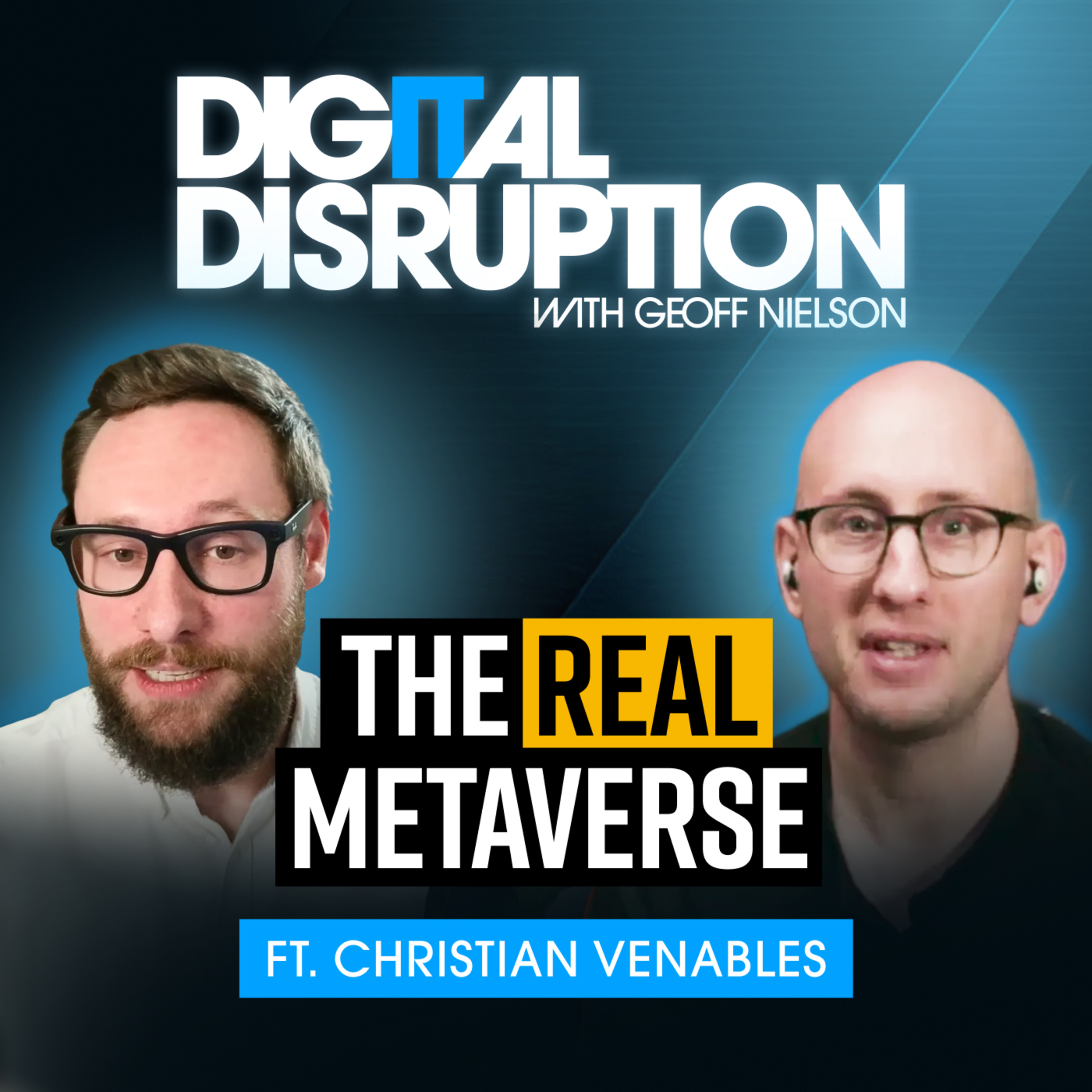
Digital Disruption with Geoff Nielson
What the Metaverse Is Becoming and Why It Finally Matters
01:02:40
Loading summary
Transcript37 lines
- [00:00]
A
Hey, everyone. I'm super excited to be sitting down with Christian Venables. He's the co founder of Radical Realities, a groundbreaking VR and AR group that's building immersive worlds for brands like Disney, Coachella, Meta, and Walmart. If you know me, then you already know I'm a big time skeptic of anything that smells like the Metaverse. And the recent news that Meta itself has taken an axe to its Metaverse division only reinforces that point.
- [00:26]
B
Point.
- [00:26]
A
But regardless of what's going on in Zuckerland, Christian is building some of the coolest virtual stuff I've seen and is at the forefront of a bunch of really interesting use cases. I want to ask him what he's seeing that I'm not. Are there real uses for this stuff that are more than gimmicks? And should this tech be back on our radar in 2026? Let's find out. Christian, thanks so much for being here. Super excited to have you just jumping right into it. I wanted to talk about xr. I wanted to talk about the Metaverse now. You know, the Metaverse in particular has had its brand take a beating in the last handful of years. And, you know, I'll be honest, I'm one of the people holding the club, I have to say. But I wanted to ask you, you know, what are some of the use cases or, you know, aspects of the technology that the average person might not know about that you're most excited about?
- [01:15]
B
It's a great question. And the phrase will definitely get rebranded sooner or later. It's. It's definitely a vision that a lot of people are heading towards, and it's definitely a future that we'll get to eventually. It'll just be called something differently. Absolutely. And for me, it's in two separate kind of parts. There's the 3D explorable world side of things, which is previously what it was really known for. And that was very exciting. We did some great partnerships there and built some great worlds for people to explore and learn and get together and do virtual conferencing. And it had its moment when we're all stuck inside. But for me, the actual future side of things, and what I want is it'll. It'll manifest and it'll come around again when we have the glasses that actually meet these kind of requirements and expectations that we have. So I can definitely, as a designer, imagine different pieces coming together and being able to walk around my real space and have these 3D spatial anchors in different locations. So gone away with the specific screens, but your computing is everywhere and you'll be able to go to a specific location and that's where specific documents will be. Or your calendar's on this wall. Or, you know, if you're learning or, you know, you're going through specific education or school, you can have physics on one wall, chemistry on another, and biology on another, and be able to spatially learn and understand and be able to go to that specific location and things like that in the home, you know, in your kitchen, you'll have kitchen based 3D anchors for certain things. So recipe books, et cetera, et cetera. So this, this vision, which we're definitely heading towards, of being able to get to that kind of future is, is what it definitely excites me the most and how I can be creative in that space and utilize those tools to either be as efficient as possible or just have as much fun as possible.
- [03:12]
A
So you mentioned, you know, it's a really compelling vision and you mentioned a few use cases there. And you also mentioned this notion of glasses, right. That when we're talking about, you know, what sounds like augmented reality, it comes down to, you know, the glasses that you're using. And you, you mentioned that they're continuing to get better. But you know, from your perspective, what's kind of the state of this hardware right now, you know, what's come out in the past year or so that has you exc. What should people know about in terms of where it's at and maybe on the other side, what's still to come, what's not quite possible yet with the current technology?
- [03:50]
B
Yeah, I think it's a really poignant topic. So I was very lucky enough to go to MediConnect this year and try their new display glasses because they have clearly demonstrated that particular leap. They have that full spectrum in my mind of the VR headset with the Quest 3 and the fully immersive side of things where you can create anything you need to or explore boundless worlds in games and then they completely control the other side. So the Ray Ban meta glasses are now with the added display. So it's really, really interesting having that compute on your face. So I've had these for the last two years and primarily because, and my daughter was being born and I wanted to capture my perspective of her growing up without her realizing that I'm actually. Oh look, a phone means camera, which means you have to smile. I wanted to capture these moments where I can just record or walk around and listen to podcasts and still have my Ears free, for example, when parenting and being a dad. So it's been really interesting having that technology there where I don't have to reach into my phone. And I really feel like the display glasses and this little milestone that we're at now, it's definitely gunning for things like replacing the Apple Watch, for example, where I obviously have one of those as well as a, as a, as a tech guy and being able to have all of my notifications on there has allowed me to streamline my life and unsubscribe from things that I don't need. And being able to access that and have it seamlessly connected to my space and my world means that I can do what I need to do and be connected, but I can also switch that off as and when I need to as well. So that's where I think we are now. And I think a year ago Orion was demonstrated as full ar spatially anchored glasses. And that's really, really interesting because we're eventually going to have a pair of glasses in the form factor like this that has all day battery life but also the compute power to be able to do exactly what the Quest 3 does now and that fully immersive environment. And I imagine they're going to be maybe even a slightly larger version. You know, imagine black Back to the Future 2 Dock sort of Chrome visor across the face or a simple ski goggle, very lightweight that you can actually wear all day and that then gives access, everyday access to most people for 3D. And that's what's really missing at the moment. And one thing I was disappointed at, but very happy about with the announcement of the Apple Vision Pro was the confirmation of the direction that they're heading in. That this technology that I've been playing with and investing in for a number of years, that it's actually been obviously recognized and heading in that area of development. But the downside for me was Most of the 90% of the experiences in there were flat 2D iPad screens in, in 3D space. I want more 3D. I want people to access that and play around with that because if you've been in a VR headset, you know what it's like. And that's the hardest thing when it's. You're trying to convince others of, of the possibilities. They put it on their face and they go, I get it, I understand now. But until they have, it is very difficult for people to understand how that fits.
- [07:07]
A
So, so that's one of the tricky parts I find is it's so experiential, right? Like you kind of have to put it on your face to experience it. And, you know, for the, you know, the meta glasses or some of the things you're describing, probably most of our audience hasn't had a chance to, to wear them yet. And, you know, I'm curious because these types of glasses, there's been waves of them for, you know, all the way back to at least, you know, Google Glass, probably, you know, close to 15 years ago. And so for people who haven't experienced it firsthand, you know, how would you describe it to them in terms of why this time is different or starting to be different if they're skeptical from the waves of the past?
- [07:47]
B
No, it's a really good point. Definitely diving into this a little, a little more. Being able to see what notifications come up as and when they do is really interesting. So for those that haven't either seen them, basically it's only in one eye that you have this display. And for you, when you're looking with both eyes open, it just appears in the, in the bottom corner for, for you, which is really nice, really easy. And my, one of my co founders and I were both doing the same glasses experience and we were like, what are the social impacts of this? When you're walking around and you're both reading notifications, but you're looking at each other face to face, what does that look like? And your gaze seems to go down to their left shoulder, so you can actually see when people are making eye contact with you or reading, you know, these notifications that are coming in. But having the use of things like Google Maps, for example, or similar mapping, where you have a little overview of where you need to go, little left and right arrows are really, really useful and really clear to be able to pull in those technologies as and when you need it. And it's a whole new approach for notifications. And no one wants this dystopian world of covering the entire space in ads and bright colors and flashing vine for your attention. You want a very nice, clean, streamlined approach that just gentle little nudge. This might be urgent, you know, so things like the first five words of a message is going to be the most important going forward if this is the main way that this is actually delivered to you. But overall, it was a really nice experience. The glasses don't feel any different to what I've got on now. They look a little slightly thicker in depth and also in some other areas, but they are a really nice pair of glasses. But I Think what really stole the show was the neural wristband. The glasses is just half of the, of the actual journey. The, the neural wristband. Basically it's just a wristband that really understands the gestures of your, of your hand. So you can do these essentially micro gestures or swiping your thumb along your finger to go left and right and then sort of tapping your finger and your index finger as a way of navigating this little menu that you have in the corner of your glasses. So it's really, really nice to be able to come in and start to very quickly and very seamlessly. Like the reaction speed was, was very, very quick. You'll be able to swipe through the menus, click. And what was really nice is when I was trying to take a photo, the little display shows a preview of what you're seeing because at the moment one of the cameras is slightly, slightly off centered for, for these glasses and you sometimes you can't quite line up exactly center but with the displays you can actually see where you are. And the nicest thing is if you just pinch and rotate your hand, it zooms in. And so you've really got this physical dial motif if you like, that is actually controlling how that works. And same with zooming in on photos, adjusting volume. Those really have some very nice impact. So and also being able to handwrite so you'll be using just your, just your hands or just holding a pencil gesture and scribbling on the table and it'll be able to write out a response to a message. So you'll be able to see people walking down the street responding and swiping and indicating to the glasses using those kinds of micro gestures and being able to machines being able to read us and understand us a bit more is really exciting on and being able to respond to that is really cool.
- [11:29]
A
If you work in it. InfoTech Research Group is a name you need to know no matter what your needs are. Infotech has you covered. AI strategy, covered. Disaster recovery, covered. Vendor negotiation, covered. Infotech supports you with the best practice, research and a team of analysts standing by ready to help you tackle your toughest challenges. Check it out at the link below and don't forget to like and subscribe. So you've mentioned now, Christian, a handful of ways that you're using it. Whether it's, you know, the camera or notifications, you know, writing maps. If you were to take these off tomorrow and or you know, you leave them behind, you know, at your house when you go out, what are the biggest things that you would miss and say, oh, like that the way I'm using this has changed my life for the better that if I don't have this, you know, I'm really missing it.
- [12:22]
B
Yes, it's. It's almost the thing with the latest technology and having it now and getting used to it and society, you know, relying on your phone, Google Maps and all of these things, it's as soon as you take it away, it's an instant shock to the system. Everybody knows, you know, you leave your phone at home, oh no, I can't continue. They've got emails on there, I've got messages, I've got my diary. There's just everything. So the more reliance that we have on the technology of those glasses going forward is going to be the same approach. You leave those at home or when commuting in London, for example, you leave your noise canceling headphones and you're on the tube. It's exactly the same approach. You become reliant on that particular technology. And yes, it feels like a house of cards. These things start to stack up and suddenly something goes down and we're all going back to handwriting by candlelight. Really interesting how reliant we are on these tools. And I have conversations with my wife regularly. She still has a paper diary, but also a full Google Calendar with everything and multiple things syncing. So she still has that, that two. Two sides of, of things. And I definitely see, and I've been thinking about this and speaking about this for a while now, but in general with, with how AI is being implemented, I imagine a rift that is actually starting and there's these, these clear two divisions. So on one side we have the artisanal hand sculpted vases, you know, you've got violin making, opera and improv theater. Very, very human things and very with, with mistakes, but relished. And actually that, that adds value to that versus the other side where everything is generated very quickly in real time, is personalized. It's, you know, a sort of a Netflix style thing. But I want to have my favorite actor in my favorite show that's no longer running and it's generating as you're watching it. So I can definitely see this, this massive rift between these two worlds and people just picking sides because that's what I know and love, that's what I want to do. I'm going to be an artist that paints with oils and that's fine. I'm going to continue to do that. But for me, I feel like I might not be the only one, but One of the individuals that is trying to bridge that gap. It's how can we use these technologies to try new things, discover new things, not necessarily replace, but to be able to augment and use these tools, to be able to do things that have never been done before. And that's definitely how I've had a. Taken that approach with my personal work and sculpture and designing.
- [15:02]
A
Well, I'm glad you brought that up because, you know, as you were talking, I, you know, was thinking about what you've been doing with Radical Realities and an artistic approach, I guess, but in a, if I can call it a virtual space or in a medium or a canvas that's, you know, historically never existed before. So are you working largely through these, you know, types of glasses and wearables and, you know, what, what, what are you bringing, you know, to this medium in that artistic space?
- [15:32]
B
So the culmination of how actually Radical Realities got together was that we were all using VR very powerfully, quite a lot. So via Instagram, we're sharing what we're doing and just putting our work out there and seeing that these were two other VR power users as well, and using a program called Gravity Sketch, which is entirely free, but you can get four people and four headsets from anywhere in the world can actually join together in Gravity Sketch in that shared 3D space. And you can sketch in there. You can create full 3D models. You can bring in high quality, like, engine blocks and model around them, but also use it as a markup tool and actually reviewing them. And so a number of large companies have been using this who have got teams across the world, and you can work on a car or a shoe and actually design together in that space. And there's no ambiguity of a static image or a render of what does that particular angle look like. You are walking around, you're picking it up, you're looking at it from different angles. So we had many, many hours in VR sharing each other. And there's a spatial audio as well. So you can, if they're to the left of you, you can hear them from the left. But we're learning from each other. We build a small community around it of other people who are also in that space and being able to do some amazing things in that. And also a collaboration with OpenAI to build like a city in two hours with AI generated images as inspiration. That was a good couple of years ago now, but it was, that was really the epicenter of it, of being able to work in that 3D space. And it's 3D first. And so we're still using those tools and those processes now for client work. So We've recently done two series on YouTube for a German toy company called Schleich. And they provided 3D models for the toys or scans of them and a script, some concept up, and that was it. So we produced the entire thing in Unreal Engine, but we did all the storyboarding in Gravity Sketch. So we are there with little 3D models of the characters. We've built out these environments, and we're moving around. Someone's controlling the camera, someone else is reading the script, and someone is doing the puppeteering. And so it was really a very seamless workflow. It allowed us to make a lot of decisions very, very quickly. We can iterate very quickly. There's no ambiguity or misunderstanding of certain things. And this is that kind of essence that we want to. We want everyone to work this way. You know, some projects, you know, we'll just send the client a headset with everything on, and there you go. And we will actually meet there because it's a lot easier to communicate and actually streamline these things. It's like a 3D mirror board where you've got actual added depth. And in terms of hand crafting and 3D modeling assets for all of our work that we do is I'm much quicker in Gravity Sketch manually because I have that depth aspect. And you're not constantly spinning the 3D model from front to side to top. You just, you know, you've got that muscle memory. And so as soon as that technology became available to use in that. In that context, so pre AI, that. That was, you know, the still handcrafted, but you're still using those. Those particular tools because those skills are transferable. Like studying sculpture at school and doing art before studying architecture. The skills are completely transferable. You know, you take a master sculptor into that kind of space and the things that they can create, it's. It's amazing.
- [19:12]
A
Can you. Can you paint me a little bit of a picture of, you know, I've never used Gravity Sketch. And, you know, we're talking about handcrafting, we're talking about sculptures. Can you just walk me through kind of the, I guess, the physical experience of using this? It sounds like there's a headset, like, what are you doing with your hands? Is it mouse and keyboard? Or like, what's the input? How are you. It sounds like a really cool experience. And I'm curious what it actually feels like to use this thing.
- [19:40]
B
Sure. So, yes, you Start with a headset, and you have a controller for each hand. And on the controllers you've got some triggers, and then you've also got grip buttons on the side. So as you're gripping with your, your hands, you can actually pick up certain objects and move them around. There's also a couple of other buttons on there as well that you can, and some joysticks. So you're in this vast 3D empty space, and it's always good to go in with a specific task and go in and you can just use the trigger. And as you move your hand through space, you can just start drawing a line. And that's how it just starts very simply. So it starts very gestural, very free flowing, very unconstrained. And that's very freeing because every single movement that you do is very vitruvian. Every movement and arm movements and subtle movement really gets embedded into what you, what you get to produce. And so those are the, that's just the basic understanding. But you can also move through that 3D space, so you can anchor it in your own room and then walk around. That's entirely fine so that you're looking at it. But you can also. In VR, scale is almost immaterial. You can hold both of the grip controllers and you can scale the scene up. And so it's nice and large in front of you. Sam working on a sculpture. If I want to get on some details, I can pull the controllers apart and that brings it larger. So I can get in there and do the little details. But if I do the reverse of that, it'll scale everything down again. So I can make it very small. I can put it on my desk. And so Gravity Sketch can be a white environment in sort of traditional VR, but if you've got a headset that has mixed reality capabilities, you can remove that background entirely and have the space that you're actually in, which is a whole new level of one to one scale. I'm going to build something that's. I'm going to build a chair, for example, that I'm going to 3D print. You can actually use a real chair as a reference for the right kind of heights and ergonomics and be able to sculpt around it, and that'll be one to one. So you can, if you sit on a real chair and you've sculpted around it, you can see what it looks like when you're sat in that virtual chair in your space. And it's such a freeing technology because you can also apply different materials to it whilst you're there. You can rotate different lighting conditions as well. So you have so much freedom just to be in this space and iterate as much as you need to and then also invite others and collaborate together. And that's a really key component of, of of the future. And where things are going is, is that collaboration aspect and keeping the human essence there altogether. And that's just the baseline of Gravity Sketch before AI implementation.
- [22:35]
A
Well, and I want to talk about AI implementation in just a minute, but just before we do. I mean, as you describe it, Christian, to me the picture I'm getting is it sounds like engineering, it sounds like engineers in some capacity are using the space and it's similar to what you'd do traditionally with, you know, CAD drawings or AutoCAD. But now suddenly in an immersive 3D space, are we, you know, with, with organizations you're working with or otherwise, are they starting to employ or, you know, contract engineers or professionals at this? And you know, what, what are some of the cases where they might want to do that?
- [23:16]
B
Yes, great question. So there are a couple of individuals in the community. One of them does. He's very into bikes and he has cab models of his bike sort of stripped down. And he actually completely modeled in 3D. Now he's a traditional clay sculptor for bodywork like you would for traditional automotive. And he's actually been able to use this exact technology to go in and model with millimeter, sub millimeter precision for all of the bodywork. And so it was, it's amazing to go in and watch him work and see what he's been working on and then actually to see the photos that he sends of the manufactured pieces on the bike as it's going around the track with all of the stickers on the right, the paintwork and actually out there to be used. So it really is a complete end to end process from idea that you get, you can put the headset on and it can actually be fabricated and implemented in the work in the real world. So yeah, it's a really transformative technology that I'm really surprised hasn't been utilized more. And it really does capture that human element and that actual skill and precise. Yeah, that's precise detailing and infusing that human touch.
- [24:41]
A
Well, I'm curious if you see a future where more and more engineers, whether it's a car company or any sort of manufacturing like this becomes a primary way, a primary form for them for collaboration. Like if it actually has an advantage over just, you know, Traditionally doing it with a computer or paper or what have you.
- [25:00]
B
I think, I think it does, I really do. The architectural industry can also benefit from it being in that space where you can have it as a digital model box, where instead of getting a very expensive model made of just one option, you can actually look around the digital version and then you can zoom down to one to one scale and actually look what it looks like being in that atrium and the clients there as well. And so I was in the construction industry for about 12 years doing similar things and actually working with the 3D models that engineers and architects are working with. And during the design phases, this is what architects were looking at. They want to be in that space and the client says, oh, can you push that wall back a little bit? And having it parametrically set up so that you can. The architect can go, yes, of course, and push that back and actually then get to see what that looks like and see different options in real time and then being able to see what it looks like rendered. So being able to pick different materials in hotel rooms, for example, and pick different hotel rooms and look at the actual view from that particular location. Some of the projects we did in London, it was, yeah, it was really, really interesting where you've got that not just 3D models, but the data rich 3D models. So we can actually look at the ductwork and peel back the ceiling and see what is the system in there. And the whole preemptive of all those pipes are actually intersecting with that ductwork. That's a problem. Let's fix that in the design phase to save money and time later on down the line. So it is a technology that's been around a while, but it's now getting so accessible that you just need the headset. Previously you needed a two grand PC and sensors in all four corners of the room. So the technology has been around for a while, but it's now just becoming a lot smaller, lighter and more accessible.
- [26:49]
A
And from a technology perspective, is the technology sufficiently advanced that this could be adopted at scale, or do you think it needs a little bit more revision and advancement from a UI perspective, from just a horsepower perspective, or is the adoption barrier just human? Is it just more people need to try this and see this?
- [27:11]
B
I think it's the latter. Initially we've got to a point now with cloud computing and streaming and things that we're now getting onto, things like Gaussian splatting, where you've got a representation of a 3D model, but it's very lightweight. But it's capturing an entire environment. Adding those over the top of design ready models allows you to check and validate the differences between those two. And when the technology becomes smaller and lighter, it's going to be a lot easier for people to try those things. Because unless you're a creative or a designer, you know those, these are the realms in which this technology can be very exciting. Whereas if most of your work is sort of spreadsheet or document driven at the moment, you're less inclined to be wanting to do that in 3D. Mouse and keyboard, fine. But for me, I feel the mouse and keyboard definitely has an expiry date with being able to talk to computers and being able to just come in and have that sort of commanding gestural movement to guide either AIs or the geometry in a very specific way to be able to, to get what you want. The computing there is fine. We're going to be able to stream stuff and stream a lot of the heavy lifting and the 3D models. And it is cloud rendering now, but it'll soon be cloud generated. So it'll be that mixture. And that world of being able to input a 3D model for AI generation is also giving that context that it so needs.
- [28:52]
A
So let's follow that thread for a little bit on the AI generation because it sounds like as you describe it, there's sort of a pre AI world here and set of capabilities and then post AI. So you mentioned city generation with OpenAI, but can you give me a little bit more flavor of what, you know, AI generated content looks like here and opens the door to in terms of capabilities?
- [29:18]
B
This is what I'm most excited about. And for the last year I've wanted to implement and see how we can fuse XR and AI together. And then what do those two fused, what industries and sectors can they help influence and improve? Because there's tons of tons of improvement to be had and then there's automation side of things as well. So being able to come in it all started with an experiment. So there was a tool that came out called crea, which is a web based image generation tool. But it started with real time web based real time generation. So you could move some shapes around on the left side of the screen which was the input, and then on the right you'd get the real time image generation. So as you move the circle around, that circle is then actually moving in that, that generation. So I was looking at this tool and I was going, right, I want this in VR. I want to be working on a sculpture. And I want Crea to see what I'm sculpting and I want it to feed me inspiration. Whilst I'm sculpting, I want to be in this environment. I want to see what human AI feedback loops would look like. What does that collaboration look like? What's that partnership look like? And so I did exactly that. I set up a, a virtual camera whilst I'm sculpting that goes into the input and I have a basically a floating chrome window in VR just off to the side for me to see occasionally and look over at what it's actually doing. And, and so it allowed me to iterate very, very quickly as I'm making changes. It's improving it and coming up with different suggestions as I'm changing different materials or even different lighting conditions. So just rotating the lighting or the background that is affecting the lighting give me some really crazy results that I was like, okay, this is it. This is a whole new direction. That's great. You're discarding most of it, but you're taking the bits that are there and we can just improve so much quicker. It's a really, was an efficiency guided approach on being able to do these kinds of things. And, you know, the mind, the mind wonders about how, you know, we can bring in multiple AI is trained on different tasks to help with different things. You know, if I'm designing a car in this exact environment, I could use a 3D selection box over the headlights and I'd say give me different, generate different options just within that zone and you assign one AI just to do exactly that. I want it to be a bit like a 1970s Camaro style that merge this with this and it's happening all in real time. And this is, this is the kind of future that I think we're very close to. I can see we're connecting these, these nodes of. That's my ideal design environment. I want to be orchestrating these in this sort of agentic workflow of being able to get to the final result quicker because it's just problem solving. A brief is just a series of parameters and constraints and you just have to keep shaving off the. No, no, no, no, no. And navigate through that part, that path to get to that end result. And I'm in the very privileged position where I know what I want and I can see these things and going through hundreds and hundreds and thousands of images of AI generated images. And I know what looks good and I know what I want to achieve. So I can Very quickly merge. Yes. Take the best of breed of this option 12 and 24 and then start the whole process again of merging those and having this hierarchy family tree system. So that's how I work with image generation. But I want that in 3D and being able to do that and, and then again going back to spatially having the options, you know, I've got option 12 on my left, 24 on my right. Let's, let's have a look and see and being able to go through that because anything that's designed in 3D has many, many aspects that can be, can be tweaked. So yeah, very exciting.
- [33:24]
A
It's a really exciting prospect. And certainly in relation to our conversation so far about engineering and architecting, you can see how it can rapidly, as you said, improve efficiencies or help you realize ideas or kind of unleash the creativity that you already started with. You mentioned starting to think about applications for different sectors. I'm curious know as you reflect on this, if there's any sort of most obvious sectors or applications that you think would be early adopters here.
- [34:01]
B
I think the one that would benefit most and this is becoming a recent father, my daughter's Neddy 2 thinking about the world in which she will grow up in and how she will learn. And I think this is, this is crucial. A lot of people in the AI space are going, well what am I teach my kids? But for me it's very specifically about how she will be able to learn and what's the best way to do this. And I feel merging of XR and AI in the education space is going to be absolutely crucial. And there's some very big players moving heavily in that direction. And I think that's right. I feel it's the area that needs most improvement. It's still desks and textbooks now and we have now let's replace those textbooks with a headset. Now imagine that headset. It's light, but it's also can be used collaboratively. Again, group work, the whole point of being in school is to socialize and work well with others and group work and understand together. So imagine a giant beating heart in 3D floating on the desk, but you're working with three others in your class and you can really understand, you can see how it's moving. You can live section it and it's all there in 3D and you can put your head inside and actually really understand you're going to learn and that that visceral learning experience is going to be so Much more sticky. You're just going to, it's going to be so much more, it's going to stick so much more than just a textbook. And so if children can learn, or all of us can learn so much quicker in this kind of environment, then yeah, we're just efficiency, we're going to be able to do that. And so there's that aspect, but you then supercharge that with AI tools. Imagine having an AI tutor alongside your real existing human tutor, but over a number of years. So after three, four years, that AI tutor is going to know exactly how you learn in the best way possible. It knows how you failed in the past, it knows where it can push you to get you that extra mile and it knows how you learn best. Whereas this is the hardest thing for teachers now is you as one teacher, you have a class of 30, there are certainly maybe six or seven learning styles and you can't mix up your teaching approach to be able to do that. And so having this. And again another conversations just going forward from, from that is if every child has their own AI that's linked to the school and a teacher has their own AI, you can save on marking because all of the AIs can talk and go upstream to the teacher's AI and actually then start to say, well, look, here we go. And you start to look at real time data across the school and the headmaster can very quickly pick up and pull up the information of who's the best performing student who needs a bit more help, how is it all going? And so, yes, being able to have those practical experiments like chemistry tests or things that are actually dangerous in the classroom, being able to do those at home in that environment is the safest way. But also we can do that now. We have the technology now, people are working on it now and this is the most important thing for me is being able to utilize the tools that we have and being able to really make the most of it so they can benefit in this little environment.
- [37:29]
A
It's a really exciting prospect and you can, you know, as you're talking through it, I'm imagining it and I've got young kids as well. And so it's exciting to imagine this kind of new frontier of learning and the excitement that comes with that. I love your kind of your bullishness and your excitement around the technology, whether it's XR or ar. I did want to talk a little bit about the flip side of that because with any new technology there's sort of risks and there's things we have to get right. And I'm curious from your perspective, Christian, what that looks like. What are some of the emerging areas of concern? What are the things that we as either users of this technology, end consumers of some of the pieces here, or even the technology companies creating it, need to be considerate of to make sure that the societal implications are all positive?
- [38:22]
B
Absolutely. This is the, the other side of the coin because there's AI hype in the positive sense and on also the negative sense as well. And there's, there's a lot of, of of concern in the space and a lot of it all has to be navigated correctly. Absolutely. We have to, has to be tested in controlled areas and before being released to, to the public. But the, the most implement like the largest implication for me I feel is the security side of things and I'm not a massive security expert, but the, the fact that you can clone your voice with three seconds of audio and there's this whole image generation side of things. Now we have Flux 2 and Nanobanana Pro out there. We're now getting this going over this threshold of it's very difficult to believe anything digital now. And there's so many people that have created incredible 3D works of art. They've spent hours slaving over and rendering traditionally and it goes out and people go, ah, it's just AI. A computer did that for you. We'll know this. 25 plus hours going into this particular thing. And it's really important for people and creatives to definitely label whether they've used AI or not as a thing because there's still a lot of people, and rightly so, very sensitive to traditional art and that should still be done a certain way. But I feel because people have had the wool pulled over their eyes and so some people are using AI in just maybe 20% of their creative process. And I've seen people recently posting and actually putting watermarks that say AI assisted on there. So there is a case of it's not fully AI generated. I didn't type in a magical prompt. And there we go. Copy, paste, off you go. It's actually a part, you know, part of the process. And you can use these tools in any part of, of a creative process. Absolutely. But the main thing is not to just take it verbatim. You can't just copy and paste and accept expect that to just fly because people can tell, people can really notice and they can, they can pick up on that very, very easily. And no one likes to be deceived in this particular way. So yes, being able to clearly label these things makes a, makes a huge difference. And this realism, it has a lot of problems because you can very quickly create a video impersonating someone else in trouble, send money to, etc. Etc. And we have to educate. And this is something I'm more passionate about now is being able to educate everyone on these kind of improvements and bring people up to speed with what's possible so that they know, you know, a safe word that is only between you. Or say phrase or what happened on my fifth birthday. When you're talking to someone on a call, if there's any kind of security concern is a great way to understand that you're actually speaking. And human verification is absolutely important because you can now real time deep fake webcam footage, you know, you can put anyone's face on yours in real time and match the lighting. So it's just educating absolutely everyone, parents, grandparents about this. Because now that we've achieved like complete ultra realism, I think for me is like a future prediction off of this is when the camera was invented, Impressionism as an actual artistic movement grew. It was because that, that level of realism, you know, of actually sitting there and creating a ultra realistic oil painting of a portrait was great, was no longer needed anymore. So artists created an entirely new avenue and entirely new movement based on this as, as their form of expression. And that's what I feel. There's parallels and I feel we're on that, that, that cusp of actually being able to shift over that. Now we have the photorealistic AI generated thing. And I think that's a really powerful thing to learn from that particular historical moment. Because what's going to come out next? What is the AI post AI equivalent of Impressionism that's going to. And that had a huge influence on society and how things were perceived. And yeah, it's really interesting. Again, very passionate but very exciting to see what that potential might be as we reach that side of things there.
- [43:00]
A
And in my mind it comes back to what we were talking about earlier with sort of the two paths of the artisanal willing to have a premium for anything handcrafted or created entirely by people versus the doors opened by AI generated or AI assisted. Now, Christian, for you, I mean, you're, you're an artist, but you're also, you know, a professional designer who, you know, creates content and you know, commissioned works by a series of different organizations. Are you finding the, the organizations that you work with and want you and your peers creating this content? Are they sensitive to what's created by AI or are they more focused just on, you know, the, the ultimate feel of it or, you know, experimenting? How does, how does AI come into your, I guess, professional process for content creation?
- [43:58]
B
It's a very valid point. Basically we are very upfront about asking it. So some, some clients, some briefs come in and they're like, absolutely no AI. Bold, underlined, like, okay, absolutely fine. And some, if that isn't asked or said so upfront, then we ask the question, are you adverse to us using AI here, here and here? And being very explicit about what it is we're going to use it for as part of the process and not an actual finished output and being able to understand that. And most of the time clients can't really tell what is AI output and what has been used. And it is all of these generative tools are just that, they are still just tools. It's going back to Photoshop when it first came out. With the right skill and artistry and time, you could learn how to doctor a photo however you want and post that online. It's just now accelerated accessibility and now anyone can use it very, very quickly. So yes, the clients, it's making it very clear. Some absolutely love the efficiency side of things. And there's one particular project that we worked on, it wasn't for a specific client, but we had a month to build this VR opera called Lucia VR. And so AI as a, as a tool, not from a creative perspective, but actually helped me to code 95% of this virtual reality experience. It was a very in person event. So we had eight seats, all facing inwards in a ring and every participant had a headset on. We also sort of first of its kind had a live opera singer moving through the space whilst they're looking at the experience on the headset. And so it was amazing to be able to see people's reactions. Some people didn't know that the opera sing was there until the end, but I knew what I wanted to show visually because the visuals, even though it was, it's a VR experience, was only really a third of, of this kind of production. And so we wanted to have a whole new angle on this traditional. It's called the mad scene and it's traditionally shown with the soprano, she's covered in a bloody dress, she's holding a knife, she's just murdered her betrothed. And yes, it's all very, very dramatic and we wanted to do a whole new perspective of her and the experience that she'd gone through. So if you'd gone through that experience, you'd be in exactly the same position. So she's singing in Italian what she's feeling in this mad scene. And we are actually producing visuals for that. Not literal. So she's talking about snaking. There isn't a giant snake there. But we had this nice little town scene and a fountain and actually the sound of her descending into madness. And this hallucination was done by a particular instrument called a glass harmonica. And it sounds like, you know, when you have a series of wine glasses with different water levels and they're doing this, it sounds just like that, but it's. The instrument is large bowls, glass bowls all sat within each when each other laid down horizontally and it spins and you play it like a piano. And so this, every time you heard that, that was her descending. And actually we used a lot of visual motifs of the glass bowls through the spirit space. And so, yeah, being able to create that experience in just a month for a large number of companies. We did a two day. Yeah, it was over two days, eight different sessions. And some were with the live opera singer, some weren't. And it was really interesting to get their input because a lot of people who came were from the opera space, a few from the tech space. And we're starting to merge those kinds of, again those kinds of industries where it can benefit from the technology and understanding how much movement is not enough movement. There's motion sickness there. And what opera goers felt like it was happening because for some you can bring that headset into schools and that might be the first actual experience of opera they'll have. And so with the recordings of the singer on the non live version was really, really powerful to. To understand how we can put the user in another position. So you're not a seat at the back of the. Of the opera house or in the back of the theater. You positioned right on the edge of the stage, so you feel like you're in that. That particular set. So, yeah, it was. I wouldn't have been able to have actually produced it as quickly as I did without using Claude to be able to code. But also we only managed to get it done because I knew exactly what I wanted the tool to produce. You break it down into steps, you know, and actually being able to write code, to procedurally generate certain things and actually do it all in runtime in the headset was. Was the real challenge. But yeah, just being able to have that tool, yes, saved us so much time. We would have needed at least 2 or 3 devs full time for double that amount of period to be able to produce something like that. So being able to use these tools as allowing us to create quicker is removing those, some of those barriers and being able to actually like prototype these things super, super quickly and make the, the key decisions sooner is an absolute superpower at the moment.
- [49:37]
A
It's, it's really cool and it's also, you know, I, I couldn't have told you going into this conversation. We were going to talk about, you know, Opera and virtual reality. But you know, I'm curious because we started talking more about, you know, engineering and architecture and operations. Now we're talking about entertainment or you know, somewhere at the nexus of entertainment and you know, education potentially if we're, you know, increasing exposure to Opera. The clients that you work with, what typically is, you know, the purpose that they're driving for? Are they looking for something that's purely entertainment, for something that's more education, for something that's actually more sort of operational for their business? You know what seem to be the most, the emerging trends for what people are looking to this technology to do for them?
- [50:25]
B
The. There's a couple of clients who just want to have, they just want creative content so that might be a full CGI video or they specifically want to do a style change on a particular personality or, and actually have them do things in different transitions that are just too expensive to do in real life. So AI now enables us to digitally capture that individual and be able to style transfer different and phase between different scenes, different settings and then also with complete consent from their side, actually replica clone their voice and actually be able to go on and extend the script so that they don't have to actually sit there and reel it all off. We can actually have a bit more flexibility with that. Being able to use that tool has been really useful to go down that route and then, yeah, less so on the helping businesses to use AI or automate workflows or anything like that. I think there's still a lot of businesses, especially here in the UK and especially in the north of the UK that can just benefit from some basic automations and basic implement implementations of AI. And I think, I think we're really just at the tip of the iceberg and I think a lot of people are exper. A lot of businesses and small, small to mediums that we deal with at the moment are really, they are experimenting with it and I don't think they're just quite ready to make that leap of faith. Of full implementation across the board. And I feel like the school scenario earlier, there's a number of systems being implemented in schools now that just don't talk to each other. And so we need one unified system to be able to handle that communication, which will streamline everything and make things, you know, remove the antiquated processes. But it's, it just takes a bit of bravery. And because a lot of people aren't talking about what works and what doesn't, a lot of people are keeping very closed doors. A lot of businesses are not really sharing so much about. I think people are quite embarrassed about whether they're using AI or not. For some people it feels like they're cheating or it's, you know, unethical or it's not the right tool to be using or how dare you. It's now it's. I think that will change once it takes a few to knock that first domino and actually say, well, we're doing it, this is a pilot project, this works, we're talking about it. I think that will really start to help businesses to, to make that leap, to have that confidence and to really make the most of, of what the, this technology and its potential can really unlock because there's so much that can be benefited.
- [53:23]
A
So in that spirit of experimentation and what works and what doesn't, I mean, this is such early days in this space and everybody's trying things out. I'm curious, Christian, when you think about people's expectations or understanding of anything around xr, if there's some sort of confirmed doesn't work like some things that you find people want or expect this technology to do, where you've said, you know what, we've tried this, that's actually not a great use case for xr and you have to sort of unteach them some of these expectations.
- [54:02]
B
Yeah, we've had a couple of clients come to us in the past and say we definitely want this. And actually just by asking a few simple questions to understand what it is they're actually trying to achieve, we can really then provide a better technology solution for that case. So a lot of people say, oh, I really want a VR experience. But actually they didn't want headsets on their users because they're too heavy or accessibility and they wanted a high shareability. So actually an AR effect would be the best case to be able to showcase what they wanted to do. And so understanding what, what it is that businesses want to achieve for that specific project or campaign and the wider context can really help identify because A lot of these, we work with a lot of agencies that are already running larger campaigns. So for some of the largest brands that we've worked with, there's always been a much wider context, a much wider rollout of specific marketing needs and KPIs that they want to hit and how these tools and technologies can bolt onto that existing thing. So AR has been for the last five, six years really, really powerful tool to be able to have something that loads up within seconds on your device. It's 3D, it's interactive and it's engaging. So great for user generated content and to actually communicate. I think that the trend that I've been seeing is brands and companies really want to communicate more with their audience. They want to open up that avenue of communication with them, have a bit more back and forth, you know, with more competitions and calling out individuals and making them feel, you know, part of this, part of these campaigns. And it really is, yeah, these technologies can enable. Absolutely. It's very difficult for VR. That's the, the number one thing at the moment is the devices are still too heavy, they still get, they still get warm. And you know, you have to really adjust them for the, each user. You know, you have to move the lenses closer or further apart for every person's IPD or interpupillary distance. So, and then there's comfort. And this is where, when we were doing Lucia, we had to, we spent a good 10 minutes making sure every one and every eight participants, they were all comfortable and that they could move their head around freely. Because if that headset moves or the vision goes blurry, that's it, the experience is blurry for the rest of it. And this is that the promise of glasses, where it's all sorted, you know, minor prescription and being able to put prescriptions in them mean that we've got that accessibility and being able to do all of these things and it just becomes completely seamless, that integration. Yeah.
- [56:57]
A
So for, for business leaders who are, let's say, XR curious, what would be your advice to them on, you know, the best way to dip a toe in. Where should they get started and how should they get started?
- [57:10]
B
Absolutely. If it's, if it's a creative business, we'll, we'll go with that, that section first because I feel that this, the, that's the easy win is being able to, if anyone is in the creative space and they want to either view, if they're dealing with 3D, full stop, it's a, it's an absolute no brainer being Able to bring those 3D elements into the headset and into that 3D space to just to look at them. At the very least to mark them up to share with others. And especially having overcoming the geographical differences is really, really very, very powerful. And that's the, the really quick and easy wins. Being able to just iterate, just design and communicate with each other. In that case you can still in that environment do 2D things. Absolutely. If you're doing, you know, sticky notes on a whiteboard kind of exercises or you know, just trying to plan things out, having all of that there is great. And gravity Sketch as a tool also has a web based window into that 3D space so they can still fly around without a headset. Or if someone has VR nausea, which is still a thing, sadly you can still go in and use a little laser pointer and add stick it notes into this 3D space as people are designing. So it really is just removing the friction and some of the bureaucracy of paperwork and back and forth and versioning when you can just do it all real time in these kind of sessions very quickly. If you're a non creative business, it's a hard sell. And we're not at the point where we can telepresence holograms in a really nice way yet. Meta's been working on codec avatars and eye tracking and face tracking to be able to get those things in. And then there's many others working on those kinds of things as well. But yeah, until they're in a lighter form factor and these dots are starting to come together. Yeah, it's, it's interesting. There's some other immersive experiences where you have screens, but you know, you might have gloves or controllers and still be able to control things happening in that 3D space. But we're missing this Tony Stark, you know, 3D hologram style. And until that comes, you know, that's, that's the race. What's going to get there first? Super lightweight glasses or that either way, the way we interact with 3D, being able to pick it up and immersive and being able to do those kinds of things is really key because things like VR training, you can jump in and you can do 30 hours of a simulation of a particular dangerous exercise, for example. And actually your mind can't tell the difference between these simulated things that you've done and actual memories. So when you're going in and doing the real thing, you, you feel like you've done this before and it becomes a lot more sort of muscle Memory orientated. So these kind VR and those kinds of things. So some clients of really been looking into that VR training side of things. So what can be supplemented with their existing training system that we can actually have a an option on the side to then do some simulated things and that can be done in sessions and group work and multiple people in that space and all of that can be custom built and even quicker now with these AI tools as well. So there's a whole enterprise section there for xr. Absolutely. My workflow now is moving more Into Iterating the 2D image side of things, then running that through image to 3D tool and then bringing those 3D elements in and then being able to sort of chop and change and really play around with those is. And that feeds in really well to just the production side of things. If, if a 3D model that you can generate so much quicker than doing it by hand means that if it gets you 80% or 60% of the way there, then that's a really great starting point because some people go into VR and XR into that blank space and just they get sort of decision paralysis on what do I do first and how do I start this and how do I approach this. So anyone going into XR should really go in with a specific goal in mind and specific task. Bring in reference images, reference 3D models, whether AI generated or not. And being able just to start that process is. Yeah, because a lot of people just see it and don't try it. And you have to try it to really understand.
- [61:56]
A
So Christian, I wanted to say a big thanks for joining today. This has been really interesting and insightful and I appreciate you sharing all your experience with us.
- [62:04]
B
My pleasure. Thank you for having me.
- [62:07]
A
If you work in it, Infotech Research Group is a name you need to know no matter what your needs are. Infotech has you covered. AI strategy, covered Disaster recovery, covered vendor negotiation, cover covered. Infotech supports you with the best practice research and a team of analysts standing by ready to help you tackle your toughest challenges. Check it out at the link below and don't forget to like and subscribe.