← Digital Disruption with Geoff Nielson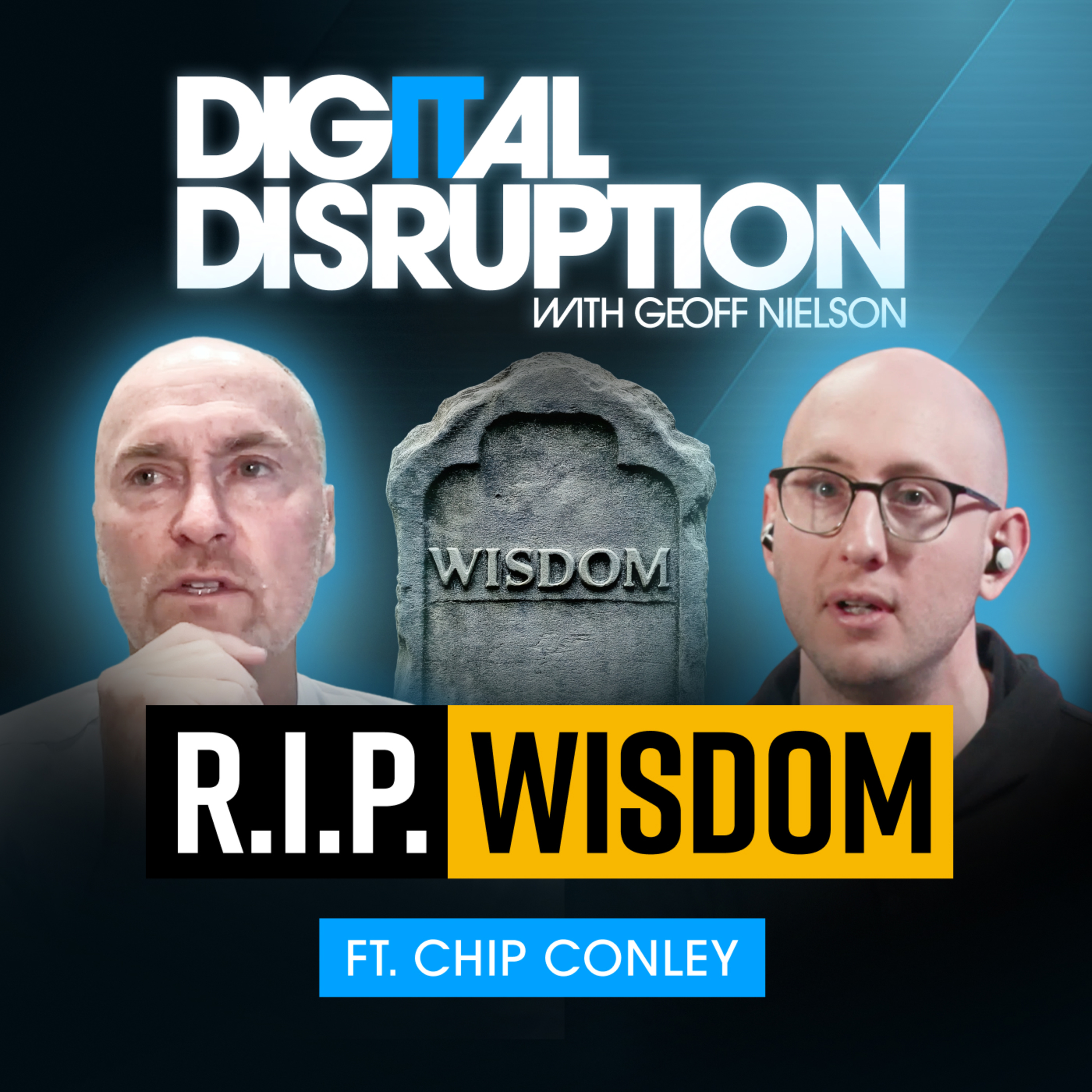
Digital Disruption with Geoff Nielson
The End of Wisdom: Chip Conley on AI and the Decline of Leadership
01:04:26
Loading summary
Transcript35 lines
- [00:00]
A
Hey, everyone. I'm super excited to be sitting down with Chip Conley. He's the former head of strategy for Airbnb, a seasoned CEO, veteran Ted speaker, and New York Times bestselling author, and now head of the Modern Elder Academy. What I love about Chip is that he's the rare leader who has not just walked the walk when it comes to building a successful business three times over, but that he's thoughtful enough to have collected wisdom along the way in a way that can be easily distilled and shared. I want to ask him how we can find meaning in the age of AI as more leaders turn to AI to guide them, Are humans becoming obsolete or more important than ever? Let's find out. Chip, really happy to have you on the show here today. I'm really excited. You know, it's funny, when initially, when I was interested in having you on the show, the Chip I knew was sort of the head of strategy for Airbnb, and I thought, oh, you know, that's interesting. But, you know, as I've learned more about you and followed you over the last few years, that's sort of, you know, one stop on the broader, you know, journey that is Chip and, you know, one. One component of, you know, the Chip Conley Doctrine. Maybe before we dive into things too much, you know, can you tell me a little bit about, you know, and I'm trying not to be too facetious with Chip Conley Doctrine, but, you know, what your overall message is these days? You know, what. What's the problem you're seeing out there, you know, in this age and what you're, you know, trying to get across to people?
- [01:28]
B
Well, I would say that. And we'll get into my history and how I got there, but I think in the era we live in, human wisdom has more value than ever before. But a lot of people see wisdom as something abstract that only Yoda or Dumbledore has access to, and they don't realize the practical application of wisdom and how in the era of AI and rampant commoditization of knowledge, wisdom becomes more and more scarce and valuable resource in a complicated world.
- [02:07]
A
Let's unpack that a little bit because there's some very deliberate word choices in there. Wisdom and knowledge, which you said is being commoditized. And one of the things that we hear about AI is that it's intelligent. Obviously, the I stands for intelligence, but it's unmetered intelligence. And now everybody has access to unlimited intelligence. And there's this idea and this trend now where why would I bother asking another human when I could just ask AI and it'll give me an answer at my fingertips. And so you very deliberately distinguished knowledge from wisdom. You know, what do you make of that? And what is the right case for using AI to learn more about your context or, you know, your job or your life versus what value do people still bring?
- [02:59]
B
AI is able to summarize all of the knowledge of the world and all of the points of view of the world in such a expeditious and expert way that there's a, there's a perspective that, you know, why would I need anything more than the wisdom of a crowd? And in some ways, AI is taking the wisdom of crowds and making it more practical. I think the challenge with that is there are sometimes when you want the crowd sourced knowledge that AI can bring you, but sometimes there's the uniqueness of a particular point of view that is exactly what you need to hear at this particular moment. And as Pablo Picasso said long ago, computers are useless. They only give you answers. And I think that my experience with AI has been. AI is remarkable at giving me answers. Not nearly as good at asking the right questions that I need to hear at this particular moment. I think it's getting better at that. And the more it gets to know me, the better it gets at asking the right questions. But at the end of the day, you know, knowledge. You know, as they say, knowledge is knowing that a tomato is a fruit and wisdom is knowing not to put it in a fruit salad. And, and I. And so for me, there's times when the context of what I am looking for requires human intuition. Someone being able to see my facial expressions and how I'm reacting to something. Someone who can actually give me some imagination and something may be outlandish in terms of a point of view that I might not get from AI the other thing is that AI has not suffered as far as I know. And so it's the storytelling sometimes of that wise person. And the wise person doesn't necessarily have to be older than you. Wise person could be younger than you. But it's that storytelling and, and it's the experience of hearing of someone else's experience that allows you to realize that wisdom is not taught, it's shared. And so I don't think AI could teach wisdom. I think another human being can share it and actually allow someone else to get wiser.
- [05:26]
A
There's, there's a lot of really interesting stuff wrapped up in there. And I'll come back to the Picasso quote, which I Love, by the way, about just giving you answers, because that feels like almost like a leadership trap of just, just give me the answer. I'm just looking for the answer, right versus no, to your point. Understanding the context or understanding the right question. And I don't mean to get too philosophical here, but there's, you know, I think a really interesting and important distinction around, you know, what is the role of the leader and what role can AI play in that? And so maybe I'll ask this somewhat abstract question, but is AI a useful leadership tool at all and what role does it play in the broader toolkit of a modern business leader?
- [06:20]
B
Well, first of all, I think learning how to ask great questions is a really important role for a leader. I, I'm a big fan of appreciative inquiry, which is a form of generative questions you can ask someone else. But also being able to ask the right questions of AI, you know, is a skill. Just because two people have AI or, you know, or let's say chat, doesn't mean that one person, they're both going to get the same knowledge, because so much of it comes down to the precision of the kind of questions you ask. So I do think that leadership in the era of AI is a combination of helping people understand how to access the greatest treasure within AI. So it's, we, we're doing that at, at the modern Eldritch Academy. MEA right now with our, our team is, is really teaching everybody how, how do you use the AI in a way that's going to maximize its effectiveness for you? But then how do you actually realize when AI is not going to solve something? And for example, marketing copy, you know, AI can do really passable marketing copy to market something, but it misses the sort of soulful fingerprint that has just the ingenuity baked into it. Based upon a conversation our marketing person had with two of our alumni this morning that just sort of like captured that. That conversation is not captured on AI. That, that conversation where, where two women were talking about why they loved mea, that was based upon a personal experience that someone on our marketing team had with those two women. And that date. That data point of what those women said does not exist in the world of AI because it doesn't exist on a computer. There's no data point for it because it happened in a verbal conversation that was not captured by AI or any technology. It was a conversation in the field. And that conversation could lead to the synapses firing and then a new ingenuity and a new line and so if you want efficiency, you know AI is going to be amazing. And for you, if you want soulfulness, you need to mix as a leader, the voice of the soul and fingerprints of people that are not captured in the context of the crowdsourcing opportunity that AI offers. So I think it's the individuality and maybe the quirkiness that can happen. Now, it doesn't, doesn't mean that AI can't write you an, a quirky blog post. And I do that. I have a daily blog. And I gotta tell you, ever since AI came along, my daily blog has become a lot easier to write. Partly because, you know, it's like daily blog of 500 words on average. 5, 600 words. Like, okay, that's, that's a, that's a, that's a, that's an accomplishment to do that every day. And so there's times when I'll just say, like, here's the, here are my inputs. Here's two articles that I have read that I like. Here's my point of view on it. Give me 500 words. And then I see it. And I was like, you know, there might be 10% of it that I would change and the 10% I'd change. And it's doing it in my voice. Let's be clear, the 10% I'd change is often the kind of thing that AI doesn't know. It's a new perspective I have that actually, you know, that I have based upon a dream I had last night, or literally talking about the dream I had last night and how that relates to this. So, but that's a beautiful opportunity to say like, this is where a marriage of human and AI can be very powerful. The problem is in the process of efficiency and bowing to the gods of efficiency. Many people would not do what I just said. They would just say like, ah, here's, here's the inputs. Give me the, give me the blog post. And then the blog post comes out, you know, a minute, you know, 20 seconds later, it's like, okay, perfect, let's throw that up. And that's when I think you get to this sort of the lowest common denominator as opposed to the highest common denominator. And the highest common denominator is when you actually give those fingerprints of the soulfulness in addition to the core of that blog post. To use the blog post example, if
- [11:00]
A
you work in it, Infotech Research Group is a name you need to know no matter what your needs are. Infotech has you covered. AI strategy, covered, disaster recovery, covered vendor negotiation Covered Infotech supports you with the best practice, research and a team of analysts standing by ready to help you tackle your toughest challenges. Check it out at the link below. And don't forget to like and subscribe that word soulfulness has come up a handful of times, Chip, and you've probably used it more than every other guest I've had on this show combined. It's not a word we talk about a lot here, but I want to talk about soulfulness for a minute because it's a very deliberate word choice and is obviously very evocative. Maybe to provide some context to it, though, let's back up for a second and talk about in your view, what is the role of a leader? Where can a leader add the most value? What should they be doing? And where does this notion of soulfulness
- [12:02]
B
come into the mix so you know a leader's job? One of my favorite questions to ask my direct reports at the three companies that I have helped to run, which would have been Joie de Vivre, which is a boutique hotel company that I started when I was 26 and ran for 24 years. I became the second largest in the US with 52 boutique hotels around California, and then seven and a half years as the modern elder to Airbnb, to the Airbnb founders as the head of global hospitality and strategy, but they mentored to the founders as well. And then as the founder and executive chair of the Modern Elder Academy, the question I love to ask is the following how can I support you to do the best work of your life here at, let's say, Airbnb? And the reason I love that question is because I think a leader's role is to both support in that servant leadership kind of way. Servant leadership means basically the more senior you are in an organization, the more you're there to serve the people who are less senior, you know, lower on the org chart. So service is is part of what a leader does. And, and how do I How can I support you? Is a great way to start the question because it's it's coming from the premise that as a leader, my job is to help you be successful. But the second part of that question is to do the best work of your life. How can I support you to do the best work of your life? I want you to stretch. I want to create the conditions for you to look back at this stage of your life and say I learned more, I did more, I accomplished more, and I feel incredibly complete about that era of my life and it wasn't just me. I was doing it with a group of people. And we did that. We did that together. So that. How can I support you to do the best work of your life at Airbnb? The broader premise behind this question, though, is the really important thing, which is it is suggesting that it is not my job as the leader to prop you up so you're successful. Your job is to have agency and to tell me with accountability what it is you need to do the best work of your life. You don't spring this question on someone and then expect them to answer immediately. You say, let's get together a week from now, and I'd love to have you come to the meeting with some thoughts about what do you need? And so I use this question to make the abstract of leadership practical, because practically speaking, a leader's job is to help the people who work with them to do the best work of their life and to support them to do that and to help them feel supported. But it all is also the leader's job to get people to stretch a little. Not just to do the best work of their life, but stretch from the point of view of getting clear on what resources they need to be successful. And while the conversation that can happen out of this question can be awkward at times, because a week later, your direct report comes in and says, here's the 22 things I need. And you as the boss, know that you know 18 of those 22 things. You cannot offer them, at least not yet. And there's only four that you can do. But that conversation's a valuable one because what it does is it, first of all, gets the. Gets your direct report to think like a leader, because a great leader is a resource allocator. A great leader is, you know, makes, you know, dozens of decisions every day about resource allocation. And. And so the resource allocation, putting that in the lap of your direct report puts them in a position where they have agency and they have the ability to say, like, I actually, this is. These are the things I need, I think, you know, and now I need to hear. Talk to my boss, who asked me this question to see what they think. But it's been a provocative question that I have found to lead to really interesting conversations. Because I think at the end of the day, a great leader is somebody who is both a librarian and a confidant. So the librarian means that you have the know how and know who to help a direct report in ways that allow them to ask you questions, and you answer the questions. But the, that's the librarian role, the confidant role is a confidant doesn't just have your secrets. A confidant is the one who gives you confidence. And in a confidant role, your role as the leader is to ask great questions and by asking great questions, helping guide somebody to find their roadmap to success. And it is those two roles as a leader, occasionally the librarian with the answers and occasionally the confidant with the questions, that actually allows a direct report to feel like wow, this person has my back. This person in the, in the habitat that this, that this leader has created, I'm supported but I'm also stretching and I am, have, I'm starting to think like a leader myself. So a great leader incubates great leaders.
- [17:36]
A
I want to, I, I want to press on that a little bit more ship in the context of again of soulfulness because there's, everything you said makes complete sense but to me there's a soulless potential reading of that definition. Where you can be a leader, you can be a resource allocator, you can try and do your best work, but where you view your own role as almost like a human automaton where you're like you're a stand in for just. I'm an operational execution based leader and I just know plug things in from A to B and it, it, it's, it, it's soulless, it's almost robotic. But that's not really what you're saying. I don't think you're saying that there is, that there's a soulfulness that a leader can bring to what they do. That's if I'm understanding you correctly, that's IRreplaceable. A by AI what does that look like and what does that add to the mix and to the organization?
- [18:29]
B
Well, there's an empathy, you know, so, so let's like go to the question of like what is a soul? So a soul is, you know, in my point of view and again I have, I have a unique point of view here. I believe the soul incarnates in us as we get as we're born and we, our job is to be the steward of the soul. Over the course of a lifetime we die, the physical body dies, that soul lives on and is going to be incarnated in somebody else. And part of our role in this lifetime is to evolve the soul and the consciousness of that soul and, and become, you know, wiser as a result. So that's the background. Having said that, when you meet somebody who is soulful. What you notice about them is often human qualities that are. Some are what Thacker Keltner, the UC Berkeley professor who started the Greater Good Science center, calls moral beauty. Moral beauty is the number one pathway for a person to feel awe in life. It's not nature. It's actually being exposed to someone with moral beauty. It's someone who is. Got grit and tenacity, got courage, got compassion, got equanimity, kindness. So someone who's soulful feels very human in the best sense of the word. But somebody who's soulful is also connected to something beyond themselves. A soul. A soul feels connected to other souls and to every. Everything in life. So when you meet a leader that's soulful, what you can feel is the heartbeat of that leader. But you can also feel the heart that this leader is connected to something much greater than themselves. And whether that is God, whether that's, you know, source or some belief around something spiritual, or whether it's just the ability for a soulful leader to be able to be intuitive. And, you know, intuition is not something, you know, someone who's soulless doesn't feel very intuitive. Someone who's soulful feels like they're connected to something almost indescribable that allows them to make better decisions and be able to be more intuitive about me, because my soulful leader sort of understands me and. And how I tick. So, you know, to me, someone who's soulful is the, you know, the best expression of human qualities, that moral beauty while being connected to something bigger than themselves. And, you know, you meet somebody like that and you sort of want to lean in and spend more time with them. So they're not. They're not robotic, they're not, you know, they're not ex. They're not purely focused on efficiency. Yeah, there's.
- [21:38]
A
There's a prevailing sentiment right now, I would say a somewhat cynical one, but I find myself thinking about it too, that soulfulness is in decline these days. That with, you know, with AI, with, you know, technology in general, social media, the just kind of rampant consumerism and people's attention spans and just how we're choosing to live our lives these days, that we're risking eroding soulfulness at a societal level. Do you believe that's. Go ahead.
- [22:12]
B
What I would say. I'm sorry to interrupt, Jeff. When something is scarce, it becomes more valuable. So if what you're saying is true, and I'm going to answer whether I think it's true in a moment, but if what you're saying is true for those of us who want to try to be more soulful, it may actually have more value. Just like in a world in which it feels like knowledge is rampant and wisdom is scarce, it's possible that wisdom becomes more valuable based upon the law of economics potentially. Now, again, if something is scarce and it's scarce because it's not valuable, that's a whole different thing. But whether it's soulfulness or wisdom, I do believe that there's deep value. And I think people see it. And you know, Justice, Justice Potter in on the Supreme Court in the United States long ago, talking about pornography, like, how do you define pornography? And he said, well, you know it when you see it. And I think that's true about soulfulness and wisdom too. You know, when you feel it, when you see it, when you're exposed to it. And so I, in my opinion, I think what is, there's a lot of things happening right now. And you know, as a Canadian, you know better than I do, you know, what impact that's having in the world in terms of a political world that is, you know, full of expediency, a political world, a political world that is in many ways survival of the fittest. And there's a bit of a rugged individualism and, you know, America first, Canada first, whatever, first. Like everybody's got to be first, but not everybody can be, can be first. And in that. So I think what's that, what that's created and especially because of our President, United States, without going down the rabbit hole of politics, there's a coarseness. There's a coarseness. And I think that coarseness that, you know, one truism about leadership is the, the more senior you are in an organization, the more emotionally contagious you are and the more character contagious you are. So you are a role model. And as a role model, what comes from that is you have a huge influence on how people are showing up in the world or in an organization. So I think the, it's not surprising given, you know, the, the nature of some of the leaders we have in the world. And I'm, by the way, a huge fan of, of Mark Carney. So I would just say, like, I, I really appreciate his leadership right now. I think that coarseness would be perceived as the opposite of soulfulness and expediency and selfish individualism is the opposite of communitarianism. And the idea of how are we in this together? So I, I, I would agree with you on some level that I think there's a, there's a, a pervasive top down leadership slash character and emotional perspective that is, is infecting the world. Having said that, I think what it does is it makes it the people who are showing up and saying things or exhibiting behavior that is soulful or human humanistic, that much more loved and cherished. So the pendulum is always swinging. We are at one era of the pendulum swing and I think we were going to see a pendulum swing back in the next few years. In my opinion that will lead to more of a prizing of people who have a humanistic, soulful perspective, a long term perspective. But I think, you know, it's easy to say right now that we are in an era in which that is not in power.
- [26:32]
A
Let's talk about that piece for a minute because you touched on something there in our little political detour about values in leadership right now. And it does feel, politically and frankly, I think in the corporate world as well, that there's this sense of this sort of win at all costs leadership that let's just do everything in our power to get ahead, to make as much money as possible to, you know, the word arms race or you know, the AI race. Yeah, yeah. The metaphor of war and winners and losers seems to be extremely popular right now. And the corollary to that is there's, you know, almost corollary.
- [27:18]
B
Wait, is that how. Is that how Canadians pronounce? Corollary?
- [27:22]
A
Corollary. I don't know.
- [27:24]
B
I don't know. I just loved it. I loved it. Okay, go back to you.
- [27:30]
A
We'll have to check that in post. What I was going to say though is that there's an implication, let's say to keep things simpler, that soulfulness or this more human quality is in some ways weakness. That in this world where might makes right and we have to get ahead at all costs, to be soulful is to be weak and it is to yield conditions of victory, let's say, to people who are going to be more brash and more abrasive. Now, I, I don't want to ask you a loaded question, but, you know, but it's difficult for me to believe that, that you agree with that. And so, so I'm curious what your response is to that line of, of reasoning and values.
- [28:16]
B
Well, you know, I'll use a, a war analogy, which is you can win the battle but lose the war. And I actually think that's what's going to happen. That's what's happening. And I think otherwise we are in for a lot of trouble because, you know, a dog eat dog world at some point means we're eating, we're eating dogs and we're eating each other and we're creating, you know, with the weapons of mass destruction that we have at our, at our fingertips and with, you know, AI, you know, relate with, with drones and, and some of the kinds of warfare and biological warfare and things that could happen without ethics. I mean, this is what's interesting to me right now is yes, the battle right now seems to be lost to those in the short term who are, you know, sort of trying to, to use rugged individualism as a means of getting what they want. Having said that, one of the things that's really interesting in talking to humanities professors and university people is in the last two years a real growth in curiosity in, in philosophy majors and ethics majors. And in some ways some of these, these kinds of forms of education that have really been, you know, neglected. And what we are seeing is that there's a discernment that people are looking for and they're looking to ask bigger and deeper questions. And you know, talking to some people I know in the AI world like they love philosophers. There's a recent interesting article about the ethicist who is at anthropic, I think it was, and she's, you know, it was, I think it was New York Times maybe, and she's young, she's 37 years old. But the idea that you need an ethicist for some of the questions that we are exposing ourselves to these days, you know, is, is to me, the bamboo shoots that I'm curious about, the bamboo shoots are saying like, yeah, if we are starting to maybe till the ground to make fertile soil for bigger ethical, philosophical, humanistic questions, I think, I think that's, that's encouraging. But I think we're like in, to use baseball as an analogy. And I know you have your Toronto Blue Jays. You're in Toronto, I'm in Toronto.
- [30:56]
A
That's right.
- [30:57]
B
So yes, you got your Blue Jays and you know, we're in the first inning of the baseball game of a nine inning game. And when it comes to some of these questions, the thing that's interesting is I think that this, back to my original premise, this is part of the reason I think wisdom is making a comeback. Wisdom was very popular 2000 years ago and the last 500 years in particular, the era of enlightenment and then not the knowledge, the idea of knowledge creation and the idea of ivory towers of knowledge and accumulating knowledge you know, I think we're. I think the interest in the kinds of questions that help us to discern how to live a good life and how to create a society that can have a good life are. These are the kinds of questions that I think are going to become more available to us or available to us in the right way. Say it. I think more. There'll be more curiosity around it. And you could say in some ways that there's a lot of literature and a lot of, oh, essays written 50, 100 years ago about the leisure class and what we have coming forward. The idea that in an era in which machines and know are going to give us more time and space in our life, there will be more space for leisure and asking bigger questions. Well, that has not really happened. Let's be clear. Like, the number of hours we're working compared to 50 years ago is more. We're working more hours. We have more of a disparity between rich and poor. We have a lot of things that are suggesting, like it wasn't this leisure class thing didn't happen. But I think with AI, I really think we may finally be there where the efficiency of AI will allow us to then have the opposite kind of questions, which are, you know, curiosity is not efficient. Curiosity opens up a can of worms. And I think the kinds of questions we'll ask, you know, with more leisure and space in our life will be the kinds of questions that a philosopher or an ethicist or a humanities major would ask. And therefore they're going to be in more demand. So we'll see. I mean, I, I'm. This is my conjecture about this, because I think the opposite of that, which is we just get more and more efficient and more and more selfish, is to me, a, you know, on the road to, you know, destruction.
- [33:36]
A
No, I'm inclined to agree with that. And certainly when we think about the future of work, it's not hard to imagine a path, and some studies have actually come out recently that support it, that as you gain the ability to be more efficient, rather than doing less work, you just end up doing more work. Your individual output just gets higher and higher and it's almost a race to the bottom. And so I'm curious, as we look out at these potentially diverging paths and this, you know, foundation of new technology here, in your view, I'll, I'll ask sort of the big, the big question, Chip, which is, you know, what. What is the future of work to you? And maybe, you know, on the opposite end, what is it not where can we go from here? And, you know, where would you like to see us not go?
- [34:24]
B
Well, I think the future of work, so, so Khalil Gibran, in the, in the book the prophet that he wrote, said, work is love made visible. But tell that to a factory worker on an assembly line. And I think that the way we have looked at work in the 20th century was sort of. It was toil, you know, in the 19th century, it was farming. And in some ways, you controlled your destiny to some degree. A farmer's an entrepreneur, and you choose what you're going to plant. But we moved into the 20th century with the assembly line culture and with, you know, manufacturing. And I will say that I think the, the, the reason that retirement as, as a concept became more and more appealing was because work became less and less appealing. And as we moved into the latter part of the 20th century and knowledge work, you know, a term that Peter Drucker coined in 1959, became more predominant, I think we went back to the Khalil, Khalil Gibran work is love made visible point of view, which is people really enjoying the work more and realizing that you could be doing this kind of work later in life. I mean, the problem with being a factory worker or, you know, carrying boxes for a living is your body's worn out by the time you get to your 50s. And yet when we know that, you know, when it comes to intelligence, you have fluid intelligence, which is fast and focused, and you have crystallized intelligence, which gets better as you get older, which is thinking synthetically, holistically, and connecting the dots. So there are knowledge workers who in their 50s, 60s, and 70s, may be actually coming into their own in certain kinds of thinking, this crystallized kind of thinking. And, and so therefore, I think that the future of work, you know, is not as bad as it's been in the, in the 1950. Meaning it's like people doing work that they love and, and doing work that they can do later in their life. If you read Arthur Brooks, who's on our faculty at mea, he's also at faculty at Harvard. If you read his book From Strength to Strength, he talks in the book. He talks about the modern elder academy in the book, but he talks in the book about the idea of what kind of professions are most suitable for people as they get older. And often they're teaching and philosophizing and they're crystallized intelligence, the idea of being able to use both sides of your brain, which is actually what you get better at as you get older is you're not so fixated to left, right versus right. You're the, you're the integration of the two. So I, I think the future of work will be synthesizing these bigger, deeper questions. Using AI as an amazing partner, you know, in with the efficiency. The, the again, in some ways the assembly line created an efficiency. Unfortunately, the worker on some of was a cog in the wheel. Will knowledge workers and those of us who want to use our brains be a cog in the wheel of what AI can do? Right now, I don't think so. In the future, I don't know. But right now I think we are partners with AI and AI can do things just like an assembly line can do that they can do it better than we can do it ourselves and certainly faster. But I think the future of work, you know, is going to potentially there's all kinds of professions, you know, leadership coaches, management coaches, life coaches. 50 years ago they, you know, there were, you went to a therapist for that kind of stuff, but you didn't go to a therapist because it was too expensive and it was like, you know, it didn't look good to, you know, your friends or your spouse. So, you know, there's like professions that are gonna, you know, they're gonna be lifestyle curators, they're gonna be people who are gonna help you to curate a life. They're gonna be the modern Elder Academy, mea a place that is dedicated to helping people to distill the wisdom they've learned along the way and figure out what's next in their life as a result of that. I just think there's gonna be a whole collection of new kinds of businesses and professions in the future of work that double down on that soulful humanity piece and, and really help people to make sense of their life experience such that it becomes wisdom. I define wisdom as metabolized experience, mindfully shared for the common good. And there's, you know, so I, I think helping people to realize how do you metabolize experience? How do you tap into the collective consciousness? You know, because there are 10 year olds who are wise not because they have a lot of life experience or are good at distilling their life experience, but because they can tap into something intuitively deeper than just their own experience. But mindfully shared is also a really important piece of that. How do you help people use their wisdom? Part of the reason I did well at Airbnb was because I had over a hundred mentees over seven and a half years and My, my job was not to like, sit them down at my feet and say, well, I'm a boomer and you're a millennial. Let me tell you how the world works, because I would have gotten an okay boomer in my face if I'd done that. So this idea of mindfully sharing it and how do we help people to get better at collaborating, which is a skill that I think is going to grow in, in an era of AI. Yeah. So, I mean, there's, there's, I, I'm sorry, I'm getting pretty abstract here, but I, I, I do, I deeply believe that the future of work is going to be a future based upon the humanities and psychology and philosophy and a bunch of, of disciplines within the academy that have generally been not as well regarded until just recently.
- [40:49]
A
And I think it's a great, you know, I love sort of the, the abstract of it. I think it's a great kind of philosophical framing. Let's, you know, maybe shift gears a little bit and try and bring it to like, the hyper practical by talking about, you know, individual, what can happen for the individual. And, you know, one of, one of the themes that's in the background there that I want to, you know, bring into the foreground is, is this sort of crisis of meaning that's happening. And you think about it a little bit more through the lens of middle age and that transition for folks as they move into their 40s and 50s. And so Chip, for folks who are, they're at that career stage now, at that life stage, they're being subject to some of these technological changes that may be impact their sense of meaning. What, what advice would you give them if they're in a job where they're saying, okay, you know, I'm concerned that, you know, I'm not maybe having the impact that I thought I would have, or I have been doing more toil than labors of love in my career. When you're in that zone, how much, you know, in your perspective, how much latitude do you have to change that at that point? Because I know that's also a concern for people. If, you know, oh, you know, I've got less road ahead of me than behind me at this age. What, what can I do and how can I regain that feeling of meaning?
- [42:19]
B
So Viktor Frankl's book, Man's Search for Meaning, is one of my favorite books, and I call it a leadership book, which, you know, most people wouldn't say that it's the story of a Jewish, an Austrian, Jewish psychologist who ends up in a concentration camp in World War II. And if I could distill that the, the wisdom of maybe the most famous book ever written on meaning down to an equation. And I ultimately wrote a book called Emotional Equations that was a New York Times bestseller that came out in 2012. The, the equation for man's search for meaning is despair equals suffering minus meaning. And what does that mean? So, so despair and meaning are inversely proportional. Suffering is sort of a constant in life. It not, it's a Buddhism point of view, which is, you know, the Buddhists say the first noble truth of Buddhism is that suffering is ever present. And so there's a sense that, you know, you were always attached to something and that attachment in our life can, can create suffering. So what does that mean then to spiritual suffering? Menace, meaning. It means that if you can increase your meaning, you'll reduce your despair. And what Frankl saw in a concentration camp was he saw that the people who actually lived were not necessarily the ones who were the most physically in good shape. They were frankly, the ones who actually had hope and meaning, who could see on the other side of this awful experience of being in a concentration camp that they were going to be a better grandmother or they were going to actually write a screenplay, or they were going to find the love of their life or they're going to be a better parent. So in, in Frankel's case, it was, he knew he wanted to write a book. Man's search for meaning. So, so woven into the idea of meaning is this sense of agency, a work, a word I used earlier, and the sense that there's something you're supposed to do with it. I, one of my favorite phrases is the purpose of your life is to discover your gift. I, I, I change that and say, the purpose of life is to discover your wisdom. The, the work of life is to develop it. And the meaning of life is to give your gift or your wisdom away. So meaning, often purpose can have very singular. It, it can be personal, but meaning to me has a communal, a social element to it. And so one of the things a person could do, and one of the things I've done since I was age 28, is to try to make sense of the wisdom I've learned along the way. So a practice I've done to make this practical is since age 28, every weekend. So for the last 37 years, I have sat down and for 20 to 30 minutes on a weekend, I've said, what were my biggest lessons of the week? What did I learn and often it was a painful lesson. And how will it serve me in the future? How will that lesson serve me so that I'm a better person or a wiser person as a result of that? So this is the metabolizing experience piece. Well, what I do with my leadership teams and again, that that's something someone could do. But like, now let's make it even more practical. Let's talk about how a leadership team could do this. I don't require my leadership teams to do their, you know, weekly wisdom journal. But what I do require is once a quarter, our leadership team at all three companies I've led, we sit down and we say, have each person say what was their biggest lesson of the quarter? So what did you learn? Like what happened? Like, what was the thing that happened? What'd you learn from it? How will it serve you in the future? Now the reason I love this is because it is a growth mindset. So you can have a fixed mindset and a growth mindset. So fixed mindset means that you're sort of trying to prove yourself and your job is to optimize what you, what you have. In a growth mindset, you're trying to improve yourself and you're not trying to succeed necessarily, you're trying to learn. And Satya Nadella, to his credit, and I'm, he's, I think, a great CEO at Microsoft. He realized that when he joined Microsoft as the CEO. He realized in 2014 that this was a, a know it all culture and he wanted it to be a learn it all culture. And so he instituted millions of dollars of growth mindset training that helped people to say, how are we learning? How are we in constant motion for learning here? And you know, to his credit, I mean, Microsoft has been one of the biggest winners on the stock market in the last dozen years and especially in AI. So what I would just say is this exercise where a leadership team comes together and once a quarter is vulnerable and candid enough, but also curious and learning enough to actually say each person on a six person team, let's say, says, here's what I learned, here's how it's going to serve me. And then the team at the end says, okay, what was our biggest team lesson of the quarter? And we arm wrestle over that. But the beauty of this is that I might learn some wisdom from the CFO who was talking about something he learned or she learned. And so to me, that is a meaningful exercise. It creates a wiser organization and allows you to share your wisdom that you've learned along the way, the hard way, because our painful life lessons are often the raw material for our future wisdom. And most importantly, it's creating an environment where people are constantly realizing that the work that they're doing is a noble experiment. It's not about failures. It's about learning from the experiments that you're doing. And. And that creates meaning. So meaning can come from a combination of realizing that you're getting better at something or something, something is improving, or there is hope and belief on the other side of this that you will be wiser as a result of it. You know, I. There was a woman who came to an. A Modern Elder Academy workshop recently, and she was distraught. She'd both gotten fired from her job. She's a knowledge worker, gotten fired from her job partly because of AI, in her belief, at least. And. And her husband had filed for divorce, like, within the same month. And so when it came to the divorce piece, I. I asked her, I said, like, okay, I know how hard it feels. And they had two kids. The kids are not living at home anymore. So for the first time in 30 years, she's living alone and she's struggling. But I said to her, you know, at some point, are you gonna maybe start dating again? And she said, yeah, I think I will. And then I asked her the question that really helped. I asked her, do you think you're going to wear a better pair of glasses to understand your next mate? Do you have life experience that has made you wiser based upon this marriage you were in? And she said, absolutely. I know I. Especially the filters of what I. I'm going to look for. I'm not going to get married a narcissist again. I'm not going to do this. I'm not going to do that. Like. And she just sort of said. And she realized as she was spouting all of this, she had learned something. There was some wisdom in that painful experience, and there's some meaning that can come from that. It means that she's going to be a lot more thoughtful and discerning about who her next mate may be. So meaning comes from the sense that we're learning something along the way and that we can share it with others. And I mean, this is, again, part of the reason why mea, I think, is a, you know, the start of a movement of midlife wisdom schools where people in the middle of their life at the. The low point of. Of the U curve of happiness, which is often around 45 to 50, people are asking bigger, deeper Questions that allow them to curate the second half of their life differently than the first half.
- [50:30]
A
I want to try to synthesize some of that and keep me honest here if I'm hitting it or missing it, but there seems to be a theme there around how can we make sure that we're actually looking forward to the future and how can we sort of package our experience in a way that allows us to do that and also feel a sense of, again, in your word, chip, agency over our future? Does that, does that resonate with you in terms of some of the themes there around Meaning?
- [50:56]
B
Yeah. No. To again, despair equals suffering minus meaning. Despair often comes from not having agency. Despair comes from not having hope. Despair comes from, you know, feeling like the suffering will never end. So, yeah, their agency's critical. The sense of learning is critical. And wisdom, the sense that there's some hope is critical as well. So, yes, I think all of those can help someone find a sense of meaning. But I think the other piece that may be missing in what you said is the ability to share, the ability to actually offer something and to feel that sense of making a difference out there. I do think that that is woven into the best that humans have to offer. So it's not just the selfishness of, like, I got what I needed and, you know, now I'm going to take care of my family, which is fine. I mean, you can be very selfish and then do all kinds of good things for your family and that, that's, that's good too. But when, when there's an element of, you know, there's a sort of generosity around meaning, to me, there's a generous generosity of spirit that to my mind is woven into what meaning is about. And, and that's when you feel this deep sense of a new kind of roi. Not the return on investment, but the ripple of impact. And it is in that feeling, the ripple of impact you feel what George Bailey felt in, In It's a Wonderful Life. Jimmy Stewart playing George Bailey, you know, he could, based upon what Clarence the Angel did in coming down in that famous movie, coming down and showing George what his little town, Bedford Falls, would have looked like if George had never lived. And he was able to see that the ripple of impact he had was profound. And people want that and need that. And it's part of the reason why children in our lives, our kids, both create short term unhappiness and long term meaning, because there's a deep sense that you have maybe, hopefully had some impact.
- [53:21]
A
It feels to me like one of the biggest barriers to getting there right now is, you know, this pervasiveness in. In many of our lives of, you know, what I'll call a diet of despair, where we're just being fed all this, you know, rage, bait, content, or, you know, the news and the political cycle and social media is just feeding us all this information designed to, you know, coax us into a state of outrage or feeling despair or feeling that the world is worse than ever. What gives you hope for the future? Like, what do you see as some of the opportunities or, you know, you know, the hopeful signs that things are actually getting better rather than worse?
- [54:05]
B
Well, you know, my experience is very much a function of the 3,000 people who go through our program every year and seeing the transformation of someone who came. You know, I always tell the story of the litigator. She came at age 60, and she'd been a litigator for 35 years, and she hated it. But she did it because her father wanted her to become an attorney. And at 60, she came to me a thinking, I want to work 10 more years, but I don't want to be a litigator anymore. Maybe I'll just be a litigation consultant. And she hurt her. She had not opened the aperture of her life, and she was very narrow in her thinking. And in so doing, she had some despair about, like, okay, being a litigation consultant has some upside. I don't have to be in court. I'm the consultant behind the scenes. And maybe that's less stressful. But the reality is, over the course of a week, what I saw from her was she was having dreams and memories of her grandmother, like, where was that coming from? And cooking pies with her grandmother and realizing that when she travels overseas, the first thing she does is look for the local bakery, because she loves to see what kind of baked goods they have in different parts of the world. And Croatia, it's very different than in Peru. By the end of the week, she realized that she had the hope of, I want to, like, have a hobby of becoming a pastry chef. And if I really like it, I think I might become a pastry chef entrepreneur, a baker, and create a bakery. And that's what she's done. So that's an n of one, you know, just one person. But with almost 10,000 people who've gone through our program now, I have seen the human spirit and the ability for people to evolve and transform in ways that, you know, our mainstream press and our social media feeds don't quite capture. Yes, you might get an Instagram picture of somebody happy on a beach here at MEA with a bunch of new friends. But what that's totally missing is the sense that that woman asked herself, ten years from now, what will I regret if I don't learn it or do it now? And it was that provocative question, ten years from now, what will I regret if I don't learn it or do it now? That had her dreaming and having had her, you know, thinking of things that she. That were not adjacent to being a litigator. So I guess where I come from is the small pebble in the pond. How am I? We have 56 regional chapters around the world with MEA. And how are those regional chapters making a difference in the communities in which they're located? How do we create a movement of people who feel like their best years are ahead of them? And they're saying that at age 50? And in so doing, I'm doing my part when it comes to the global perspective. You know, it's interesting. There's a. There's, you know, more and more trials going on around social media, like legal trials. And the. The premise of this is very interesting is we, you know, sometimes you don't know the effect of something. You know, you don't know the effect of smoking until lung cancer becomes prevalent. And, and maybe, you know, we're starting to learn some of the effects of some of our technology, and maybe that will lead to some adjustments in laws as, as well as in behaviors. You know, in many ways, you know, the laws around smoking, there are laws around, you know, you can't smoke in certain places, but generally, you know, people can go smoke in their car, they can do whatever they want, but, you know, but the cigarettes have a warning label, and, and over time, there's a little bit of a social stigma attached to, like, smoking. You realize that your smoking affects other people. There's secondhand smoke, and frankly, it makes other people smell bad. So are we sort of in the early stages of maybe a shift in terms of social media and technology that helps people to see that we don't have to, you know, be. Be the pawns of rage bait? I hope so. I hope so. But I don't know. All I know is what I. What I can do, and that's what I focus on.
- [58:48]
A
So with that in mind, what message would you give to people who are feeling despair right now? And maybe I'll break out into two parts. You know, business leaders are more people, more in the midlife bucket that are feeling despair, and then maybe young People as well. And I know that's where you spend a little bit less of your time. But young people who look at their future and say, oh, you know, I can never have the career or the wealth that, you know, the, the baby boomers did. What advice would you give to each of those groups?
- [59:19]
B
Well, for the young people, we, amazingly, we have. We had someone two weeks ago, 24 years old, who came to me a and 25% of the people who come to me a are millennials, so. And obviously a 24 year old is a Gen Z. But for the young people, I would just say, like, the world is changing faster than ever before. So in some ways you are at the advantage of that because you can see the how to surf the cultural zeitgeist and the technological zeitgeist better than I can. So, you know, there's real opportunity in that. And so I would just say double, double down on whatever it is that you're passionate about, whether that's the humanities, because as I've said in this episode, you know, I think humanities will make comeback, or whether that's understanding how to curate technology in such a way that we make it, you know, a great partner. I think there's a real, there's a lot of opportunity there. I think some of the, the existential issues of climate change, the existential issues of, you know, AI risks, yes, those things exist. But guess what? Back in the 50s and 60s, we had, we also had nuclear weapons that were really a dangerous place. We had a Cold war that, you know, and we had, you know, Cuba right off the shore of Florida with Russia having, you know, having missiles there. I mean, like, we've been through some shit before. And so I, I don't want to be a Pollyanna here, but I do want to say this is for the young people. You know, you didn't come through aids, you didn't come through the Vietnam War era where Canada got a lot, a lot of Americans because they crossed the border because they didn't want to go to the war. So there's like, there's, there's been turmoil before. So for others beyond that who are feeling that sense of despair, ask yourself, what's one thing you can do today to make a difference out there in somebody else? So the best thing we can do when it comes to despair is to feel like we have some ability to influence something. How do we influence something? How do we help someone else get out of despair? Sometimes the medicine we need is the medicine we're giving going out and Helping someone else and do. Doing something for someone else can be a great way to feel both a sense that you're giving, but also someone else receives it and you have value to them. You know, the issue as we get older is not about being youthful, it's about being useful. And so it's not about trying to, you know, use the Botox or whatever it is to make you, you look 10 years younger. Yes, you can do that, that's fine. But at the end of the day, as we get older, the sense of utility and usefulness becomes more and more important. And, and so when you're feeling despair, looking at how you can be useful is probably the most important thing you can do. You can do. Yes, you can do gratitude lists. And there's lots and lots of evidence that, you know, gratitude is a way to solve for despair. But, you know, thinking without acting is not enough. The acting piece is really important.
- [62:56]
A
I love that message and I think in some ways it's a perfect note to kind of end our conversation on. So with that chip, I wanted to say a big thank you for joining today. It's been a really interesting and really insightful conversation. I know it gave me a sense of inspiration as well, and hopefully some people listening to it felt that. So thanks again for joining.
- [63:15]
B
Well, definitely a different conversation than your normal conversation, Jeff, I would guess. Um, and I hope what wasn't too abstract, but, you know, I, I do think the idea of asking bigger and deeper questions is, is something that is perfectly suited for the, the, the time we live in.
- [63:33]
A
I, I completely agree. And you know, as someone who has a philosophy background himself in school and a bit of, you know, business ethics as well, I'm. I couldn't agree more. I love the comments about asking the right questions and not just, you know, these answer machines. So it certainly resonated with me.
- [63:50]
B
Thank you.
- [63:53]
A
If you work in it, Infotech Research Group is a name you need to know no matter what your needs are. Infotech has you covered. AI strategy, covered. Disaster recovery, covered. Vendor negotiation, covered. Infotech supports you with the best practice research and a team of analysts standing by ready to help you tackle your toughest challenges. Check it out at the link below. And don't forget to like and subscribe.