← Digital Disruption with Geoff Nielson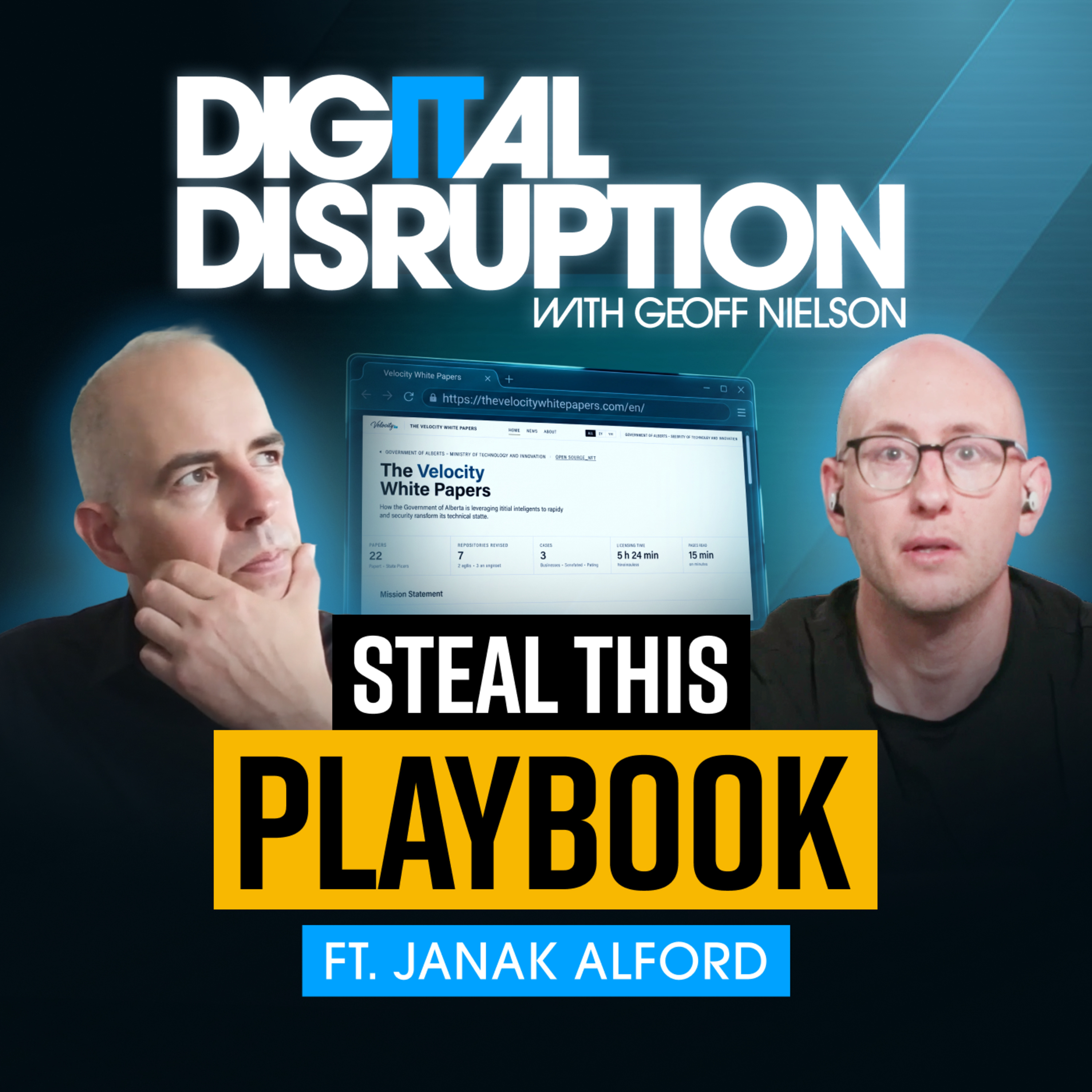
Loading summary
Transcript30 lines
- [00:02]
A
This technology was doing nothing for us 18 months ago. We're now saving $2 million a week. That's not nothing. Not only could AI increase the velocity of what we were doing, but it could increase the quality and the compliance and the safeguards and the standards. That was huge.
- [00:18]
B
This is a show about the future of tech and the future of work. I'm Jeff Nielsen and today we're diving into how governments are using AI to improve digital services. My guest today is Janek Alford, Deputy Minister of Technology and Innovation for the government of Alberta. Not only has Yannick figured out the recipe for using AI and agentic tools to transform government services at scale, but he's sharing the recipe and the ingredients. What I love about his story is that with so much hype around AI, he's figured out how to go around the big vendors and use homegrown tools to save millions of dollars a day. I want to ask him what the recipe is, how he overcame bureaucracy to get it done, and what we need to do if we want to get the same results. Let's find out. Yannick, thanks so much for joining today. Really excited to have you here. Maybe to kick things off. Can you tell me a little bit about the mission right now around technology and innovation with the government Alberta and I guess your mission there as well?
- [01:21]
A
Yeah, thanks for the opportunity. When we think about our role supporting the broad backbone of all government IT in Alberta, we take very seriously the work we do on a day to day basis. Government, like any organization today, is digital by nature. So we need the emails to work, we need the cybersecurity safeguards, we need people to be able to connect and do their work. Um, and, and that's table stakes for us. And in that there's a, there's a broad amount of systems and we, we put out, we have about 1400 systems. It's growing rapidly as well. Like the amount of, of new technologies we're coming online with is, is increasing all the time as government evolves. And, and that's, that's mission critical for us. If those systems don't work, Albertans can't get the services that they need. The public service can't effectively do their job and things break down really quickly. So maintaining that the integrity of that backbone is absolutely mission critical for us. But that's one piece of it. What we also have is a huge amount of demand and appetite for transformation. People want services faster, they want them to be easier. And governments are always trying to find more innovative services and solutions to put out and so we have a big demand as well. I speak about that a little bit, and I know we're going to talk about the Velocity papers today, but I speak a little bit about that. Whereas these, we have these two forces, which is, you know, the weight of the technical debt sort of holding us back in terms of being agile and nimble and needing to evolve that with this, with this large amount of demand. And so I'm really seeking opportunities to find solutions and approaches that bridge that gap between what we do today and what we might do tomorrow and accelerate and reduce the cost. And, you know, governments across Canada and around the world are facing deficits. I think every government in Canada is in a deficit scenario right now. And, you know, Alberta is no different. And so we have to get smarter. We have to do more with less. And that for us, that means finding newer innovative ways to deliver services at optimally, you know, a fraction of the cost. And we think that over the last about 18 months we've been able to engineer some meaningful ways of getting there. And we actually have a big number in mind. We want to reduce the cost and time of providing IT services and solutions by as much as 95%. And so that's a 20x improvement in performance. And we think that through some of the work we've been doing around artificial intelligence, we're on a really good path to do that. And we were excited to share some of that more recently publicly, and we plan to continue to share that as we evolve down that path. So those are some of the two big drivers. The other piece I can talk about if you're interested in is our ministry has a joint IT service delivery as well as an economic development mandate. And so we have, we oversee, our minister oversees two agencies as well, Alberta Innovates, Alberta Enterprise Corporation. And there's some really innovative and fun things happening in that space which we think are going to help to drive the flywheel of success in Alberta as well.
- [04:28]
B
Well, that sounds really interesting, especially the innovation side of it as you're describing. Everything you're doing over there though, what sort of caught my attention is the Alberta side of things is almost like incidental here in the sense that everything you described, you know, I've worked with enough, you know, public sector agencies with enough governments now I feel like I could rip and replace Alberta with, you know, almost any state, with almost any, you know, county or government agency, as you said, in Canada and the U.S. or across the world. And I think those challenges still resonate. So it's interesting. I'M curious from your perspective, the approach you're taking, and we'll talk in a minute about what that looks like, but how replicable is it, you know, across North America and the world?
- [05:14]
A
Well, the demand is absolutely there in every other government. So we are all faced with this scenario where over the last, say, 40 or 50 years, we've, we've had this explosion of digitization and we've accrued and accrued and accrued more and more systems and more and more networks and more and more databases and servers, servers and cloud. And we've ended up with sort of a, for lack of a better term, a medieval city of sprawl around the different, the different technologies we have. And government tends to, you know, like any large organization, it tends to become siloed. This is true in private sector. It's also true in government where different ministries have over time, gone off and done their own thing. And we try to bring it back together, but the problem is absolutely pervasive across Canada. There's not a municipality, province, or territory or government department I've spoken to as well that is not facing a very similar set of challenges. And so for us, we looked at what we're doing here as a bit of a reproducible blueprint. We needed to capture what we're doing to enable our staff to have consistency in our thinking and our approach. But we also wanted to share it because we think that everything we're doing is absolutely replicable by others, and we really hope that they do download, steal, replicate, emulate and feedback into the system what works and what doesn't in their own jurisdictions as well. Because I think we're all facing, I called them the four hydras, right? We're all facing technical debt, cybersecurity, reduced budget, increased demand. And so every organization in the world, I think, is, is in some way being burdened by that demand as well as being drawn into the future. And AI is just accelerating that and new technologies are just accelerating that. And so our approach is that we can be a thought leader, we can set that course and try to be on the leading edge of this technology, namely artificial intelligence, and then share back what works. Because there's a lot of things that don't work. And you only learn that through repetition. You only learn that through trial and error. And so I think, you know, some governments have taken approach of sort of a wait and see. We're taking the opposite approach, which is to say the least dangerous thing we can do with this new emerging technology is to engage with it. In good faith, carefully, but quickly, and to figure out how to really get the best out of it. That's our risk mitigation approach.
- [07:53]
B
If you don't work in enterprise technology. And you can skip ahead or take a quick braincation, but if you do, infotech is your secret weapon. Infotech helps IT teams get projects done faster, better and at a lower cost. Whether you're rolling out new tech, improving processes, or just looking for cost savings, Infotech provides unlimited access to practical tools and expert guidance you need to execute at a fraction of the cost of traditional consulting, no matter the project. From AI strategy to, to cybersecurity to vendor negotiation, Infotech has you covered. Check it out at the link below. And don't forget to like and subscribe. What you're describing in terms of what you're trying to do, I don't know if this is a word you would use to describe it, but in some ways, to me it's radical in the sense that we've had this history of sprawl, we've had all these challenges where as you said, it feels like we're heading in the wrong direction with the way we're managing enterprise technologies. And you're saying, okay, well we're going to do the opposite. We're going to have a 20x reduction in, you know, cost to deliver and at the same time we're going to find a way to deliver better, which, you know, if you can accomplish is something really, really, you know, amazing. So I want to talk about that for a minute. What, what, what's kind of the vision there? What's kind of that next, that next level of government that's technology enabled. Can you just kind of lay out what that looks like for Alberta and what you're building?
- [09:23]
A
Yeah, absolutely. So, you know, when we talk, you know, you use the term radical. I think, I think what we're doing is it's an incremental departure. I don't think it's radical at all. I think, you know, I speak about this since I got in the role a year and a half ago. We benchmark how long things were going to take us and, and at the rate that we were modernizing, our technical Legacy was around 130 years to life cycle. You know, you start with app number one, you go all the way through and you get back to app number one. The time was about 130 years and it was in the billions of dollars. And you know, that's, it's radical to think that that will work, that there's going to be any organization, whether government or private sector, which will say, yeah, yeah, go take 130 years and modernize that equipment and those applications. It's just untenable. So from our perspective, we needed that multiplier. It was a non negotiable and, and along that path, you know, there's, there's only so many levers you can pull to, to exercise the unlocking of new potential. Right. So government, you know, we typically have, we have typically two things. We've got money and we've got people. Right. So money is constrained. That's, that's a variable that's fixed and it's declining. So I don't have money, I do have people. And so one of the things that we're doing, which you know, again, maybe radical but I think very positive and very purposeful, we took a conscious decision to say, okay, we can't, we can't sit on the sidelines here. Let's educate and enable every single person that we have to understand what's possible today. And so we've done some really meaningful steps. We've kicked off our AI academy. By the end of July we will have had about 3,000 public servants trained formally through classroom style training, virtual classroom. We've had 17,000 people at this point take the courses online as well. And by the end of the year we think that we're going to at least triple those numbers both for enablement. We've rolled out, we have about 30,000 public servants. We've rolled out to a majority of them now AI enterprise licenses and we're really investing time and effort into our people to get them to be workforce ready. And we're looking for those force multiples and the biggest force multiplier we have and the kind of knowledge based work that we, we have right now is AI. And it's able, it's been, you know, it's not hype, it's not, it's not sales pitched. For someone to go and say that you can 10x the productivity of an individual using AI 10xing an entire government is harder because it's not always, it's not always, you know, one individual's contribution which causes things to go fast or not. But we believe that those gains are there more than 10x and we've measured it. So we've over the last, again, year and a half, just over a year actually we've produced more than a thousand different apps. We have, the vast majority of them have been prototypes and great, you let them go because the cost comes down so radically. So in the old way of looking at it, you might say, oh, you did a thousand apps and only 100 of them got to production. You have a 90% failure rate. And people share that back. To me, I say, yeah, but my cost input for that prototype was like $17. And so I don't really care. If that prototype didn't scale out, it would have taken longer to assemble everybody together and have a meeting. That's 10 hours of human time. 10 people having a one hour meeting. The prototype only takes two hours. And so why not have someone go off, build a prototype, come back and prove it? And that's changed the way that we work fundamentally from going from a sort of meeting culture to a builder culture. And so there are some things that are different, but ultimately our approach is invest in people, enable them and put humans first, show them the tools that work, find those, use cases that have the biggest force multiplier, roi, and then invest and enable teams to go off and deliver that. That's not radical. That's really what we've been doing through agile for the last, say 16, 17 years is what we've been doing through ITIL service delivery for the last 20, 30 years. It's just the next generation of that. And it sounds radical in that the improvements sound significant and they are. But the methodology, the governance, the security, the privacy protections, those are all table stakes. And this is an accelerate on top of that. And so I think the radical thing would be to sit on the sidelines at this point and expect either a technology to stop changing, right, for wait till the dust to settle. And AI is not, not for a while, if ever. And then to wait for someone to come and bail you out. Right. So is someone going to come along and produce some open source tool that just solves all of our problems? No, they're not. And is industry going to come and give us a, you know, a product that's going to solve all of our problems? No, they're not. And so the thing that we're doing is really just investing in ourselves and building that builder culture. And so what we see in the future for our organization is a lot of what we're doing but addressing, you know, eliminating and closing off that technical debt piece, I think that's, that is an important piece of it. And then getting service delivery just to be in the hands of, you know, putting services in the hands of Albertans, quickly driving down costs. People shouldn't have to wait eight months to get their social services application review. They should be able to do that in eight minutes. And you know, with the technologies this is really credible now, this is really possible. And so we feel a moral obligation, a fiduciary obligation as well as a moral service delivery obligation as public servants to put this, to really leverage the technology and see how far that we can go with it. I think we're going to see an explosion of people using bots, for example. I think you're going to see an explosion of people using things like Hermes or openfla or other things. They're just going to be part of your operating system. And we're trying to get government ready, you know, government 3.0, 4.0, whatever you want to call it. We're trying to get ready to say the consumer of the future for government services may not be a human, it may very well be an agentic system reaching out and connecting with us. Because you know, if I put myself in the shoes of a, you know, an Albertan such as myself, I'll, you know, it's not that I want to go to and fill out a form. I want the service and what I think the intermediary layer is going to be, that is a lot of agentic scale systems. And I'll just go to my phone and say, hey, why don't you file my business update and file my taxes and file my, you know, renew my business license and you know, put apply for a permit and, and it's not going to be me doing that as an individual filling up reams and reams of PDFs and pages and pages of forms. It's going to be an agent inter interacting in a trusted method with government. So we're getting ready for that. That's a, it's kind of a bit more radical departure. But we're already there, we're already, you know, we're already straining under the bot presence across our public services anyway. And so now we're actually re engineering and architecting our systems to anticipate that future state as well. So we're trying to be grounded in the future of really accelerating day to day service delivery while keeping one, you know, a very close eye on where technology is going so that, you know, by the time this gets normalized about how people interact with government, we become the most AI enabled government, the most AI ready government in North America. And we, that's just the way people can do business with us.
- [17:03]
B
One of the things that was impressive and exciting to me about this is that you're not just handing everybody keys to AI and Saying, see what happens, you know, where it's just, hey, everybody, use AI. The end, right? There's some sort of guiding principles around this. There's a vision about what I can ultimately unlock for the government and for the, you know, the citizens. Can you talk a little bit about that, about the vision behind how AI fits in your broader, I guess, technology system or portfolio? And maybe what you've seen so far that makes you most excited about this promise?
- [17:46]
A
Yeah, that's. It's really exciting for us to take a big step back and to look at, to ask the deep question, which is to say how I'm just going to talk about software, because it is one of the domains that AI is most profound. We have to go down to first principles, which is to say, how do you deliver software in general? Well, you have to. And then we look at what the state of the art is doing. So there's tons of tools to vibe code. You can use replit and you can use Lovable and you can use cursor and you can all these other things. And what's really easy is for people, if you just let them go wild, let them reach out and grab these tools, they can make something that looks pretty good in just a few minutes. Right? But any practitioner of that is going to know that that is not fit for purpose for a government or a business or even an individual. Right. These things have often shipped and they look super slick. And if you don't know deeper, if you don't know system architecture and you don't know cybersecurity, these things seem to be astounding and amazing and you can use them immediately. That is. That is really interesting. And when we looked at that capability of just giving people tools, and that's how we started, we just needed to see how people worked with it. So we pulled off about 5% of our workforce off the floor and said, you don't do anything else but AI from now on. You don't need to be a coder, you don't need to know math, you don't need to be technical. You just have to engage with the tools earnestly and with curiosity and dive in and show us what you find. And so we would do these daily standups and we broke them into sort of different thematic teams and said, go, go explore. Go spend. You know, I think we spent something, you know, trivial in, in. In the whole of the first five months, something like $10,000. So, you know, even the cost containment was. It was a fraction of, you know, people's time and what they came back with was here's patterns that work and here's patterns that don't work. And you know, people were vibe coding a lot of stuff. They're creating a lot of prototypes, creating a lot of ideas. And so we said, okay, if we could harness that speed, imagine if we could do it with quality. And so we took a big step back and we said, what are the, what are the first principles around privacy management, information management, data retention and disposition, access control, look and feel coding standards? Technical, you know, technical sprawl. Where are we spending money on licenses, where are we spending money on renewals? What are the open source products versus closed source products? So we took a big step back, we laid all that out on the table and we said, there's hundreds of decisions that an organization needs to make that if you can define it succinctly and in a comprehensive way, AI can actually run with that. And when we gathered all those standards and templates and skills and reference files and all those pieces together, we laid them all out and we packaged them them. What we saw is the speed of vibe coding, the speed of agentic creation, like the, the kind of, the amazing speed of AI harnessed with a quality that came across that was higher than human quality. Meaning that not only could they go faster, they were more compliant to standards than we were in our own human teams. And that's not a, that's not a slight against people, that's a reflection of the fact that it, when we add up all of those government policies and if we were to print it out, it'd be like a stack of paper this thick, right? That's, that's the, that's the non functional requirements before you write a line of code. And people are very focused on developing the user experience, the user interface, the backend system, the database, like all of those pieces and that in, you know, let's say that's a thousand pages. In that thousand pages, it's hard to remain harmonized to that as an individual because there's just such a mass amount of content. But when we compressed it and brought it into an AI space, we found that AI could not only produce things rapidly, but they could produce it to a, you know, 99% compliant from the first release versus where we were, which was only 40% compliant on the first release. So that was the big aha moment for us, which was to say that not only could AI increase the velocity of what we were doing, but it could increase the quality and the compliance and the safeguards and the standards, that was huge. And from then we've built the entire Velocity white papers and the concept of AI factory and the tools like Pronghorn and Nexus and even we have a tool itself called Velocity, which is a project management tool. We built all of that on the basis of the spec driven development. And now what we have and what we've shared publicly is a subset of that where we've packaged together. You know, I think we've got cybersecurity agents that we've, we've released open source through this, that scan 400 different critical vulnerabilities. We've internalized those. Now they're just part of our ecosystem. You don't even ship code without having an agent parsing and scanning and closing off things. And they always find stuff. And so no matter how diligent you are, there's always clever exploits and kill chains and other things that AI is coming up with. And it's made us better at delivering the product we were already delivering while giving us the opportunity for speed. And I think what's different about what we've done in Alberta is that we didn't trade off those two things. And you either have people who are vibe coding who are getting the speed but they're losing the quality, or you have people who are fixated on, you know, governance, standards, whatever, and they sort of have bogged down the AI to the point where they actually can't do anything. I think we found that a nice middle ground where we created content that was consumable by the AI and it resulted in the best of both worlds. Highly secure, systematic, cyber safe with the Velocity. And I think there is a sweet, that's a, there's a very sweet spot to be able to find. And now that we've found it, we're applying that towards, well, frankly a great many of the things that we do, whether it's software maintenance or the creation of new systems, or software remediation or creating APIs. We can use these same methodologies across the entire enterprise.
- [23:54]
B
So how, how did you do it? And I don't necessarily mean that from a technical perspective. What I mean is, you know, when I think about so many of the government agencies that I've worked with and so many, you know, public service organizations there, I mean, there's a couple of headwinds here. I guess there's typically, you know, if you're an optimist, I'll say a bureaucracy by design where you want existing processes and systems to be, you know, robust enough that people can't just go in and change them. But of course, the, you know, corollary to that is that it can mean that it's really difficult to change the status quo. And you know, if you're cynical, certainly in a lot of public service organizations there's a reputation for staff that don't necessarily have an innovative mindset and are, you know, very interested in, you know, and in some ways incented to maintain that status quo. So how do you, how did you introduce this mindset and this change into, you know, your organization and actually make it happen?
- [25:07]
A
So I'm going to disagree with you on one thing and it's a nuance. I don't think that's the individual. So a lot of people say, oh, you know, bureaucrats, public servants, they're not interested in being innovative. I, I couldn't, I couldn't disagree more. I think that when you get down to the, the, the granular scale of the person, you always find, at least, you know, the vast majority of the time, you always find very diligent, hardworking, serious people who have struggled sometimes their entire career against the sort of bureaucratic friction that you're describing. So yes, the bureaucratic friction is there, but it's not at the, it's not the module kind of the component of the person. My experience has shown that public servants are extremely diligent, they're extremely positive thinkers and they have been working in a system that may not have been amenable to that kind of innovation. And some people legitimately get burned out. It's hard to maintain, you know, for, for the decades of a public service career. It's hard to maintain optimism when, when it is hard to move things through the, the jello of government. But what I think we have, we, I, I can't disagree with you on the systemic nature of that. So yes, organizations at scale, and I'm not, I'm going to say I have a lot of friends in the private sector. It's the same. It's not just government, it's private sector as well. Organizations at scale suffer from this sort of bureaucratic process piece. Now the difference that I think that has made us successful is a couple of things. First of all, again, our mindset isn't to strip away and automate teams out of existence. Our mindset is a human centered investment. And that's been a commitment that I've made to our staff and technology and innovation from day one, which is to say that we're not here to, you know, download your brain and discard your body as it were, and you know, figure out how to do the job without you. What we want to figure out is how do I get your brains, your genius, and take away the things that are slowing you down. So that might mean re engineering your process. That might mean, you know, identifying the lower third of things that you just hate to do in your job. And, you know, the obvious one is do you copy and paste things or do you rekey things? Right. So there's teams across government who are just re keying things we receive. You know, one of the papers talked about this. There was a sort of a rural energy rebate for people who don't have access to natural gas. And people have to fill out a form literally on this paper, mail it in, and then it's. It's re keyed in back into a case tool. It's. That's 25 years old and then there's some sort of check getting cut or whatever. Now what we have to figure out is like, there's no reason to do that work and no one's coming to work every day to say, I want to rekey in manually, rekey in paper documents. And so there's a wealth of things that people do that are not rewarding, that we can absolutely use AI, but the people are innovative and the people are coming forward from every ministry. And some of the most innovative folks that we have are coming from outside IT and who are coming to innovate with us. And the other big thing is I think you need a signal from on top. And so I happen to have the good fortune, kind of like Slumdog Millionaire, if you know the movie where by good fortune and happenstance, he found himself in a variety of scenarios where he could answer a lot of questions. So by my own good fortune, I found myself in different teams and different opportunities. And I'm deeply technical. I understand this, this, this technology agentic orchestration solution architecture. I was, it was the, you know, the chief technology officer previously as chief AI officer. So I deeply understand these technologies and I can drive it very consistently through the organization. But I can also help unblock people. And I often joke that I'm, you know, I'm there to be chief snowplow officer to, for people, which is to just clear the road and get, get the snow and get the drifts out of their way. But you do need leaders in an organization who are not sitting on the sidelines. So if you, as a leader, and I've said this publicly, I said this a couple of months ago up in Ottawa if you're a leader who is just waiting for your staff to solve this and not really diving into it with curiosity, you're not going to be as effective as if you actively use the tools yourself. You have to dive in, you have to set the culture. And the other thing is I really gave, I really tried to set a culture of, of it's okay to fail. It's okay. This is a, this is a safe space to collaborate. Show me your ugly prototypes that didn't work, but explain what you were thinking is just as good as showing me the working prototype and better than if you don't explain how you got there. Right? So it's, there's a really good culture in Alberta right now where folks are showing each other. We've got these, these weekly drop in sessions where people do show and tell. I do design with Deputy every two weeks. You know, we sit around, we brainstorm ideas, we engineer, we bring agentic solutions and partially it's like, yeah, I love to help and I love to be sort of nerd, nerd out for an hour. But the cultural message I'm sending is this is something we're all deeply invested in and I think it's been effective. I think it's helped people understand that their creativity as an individual is valued. That if they find themselves hitting a bureaucratic thing, then that's my job to help. You know, mine, my ADMs and my executive directors. And I think it has to do with having the right coach, the right team in the right circumstances and some good luck. And so I think right now we're, you know, we're certainly finding ourselves with a tremendous amount of replicable success. We're, we've already given back $50 million to Treasury Board through the cost savings that we're finding through AI and we're sort of on track to double that. So I tell people, hey, you know, this technology was doing nothing for us 18 months ago. We're now saving $2 million a week, right? It's $400,000 a day that we're saving through this technology. That's not nothing. That's setting up the pathway to greater and greater success. And at the same time we're strengthening our ecosystem, we're getting more cyber safe, we're being more standards driven and we're producing services faster. And so being able to do that more with less, it's quite exciting. And just the last kind of thing, I try to remind people that if you can't do it in government, you can't do it anywhere. Which sounds backwards, right? But what other organization could you go to where you have a $1.2 billion budget, you've got, everyone gets paid every two weeks, you've got an unlimited set of tools and technologies at your fingertips and you have unlimited client demand. And so it's kind of the, it's the dream of any startup to find itself in that scenario. So why can't we have the same attitude as a startup? It's only mindset. We have no actual functional limitation and the constraints that we have are there for a reason. Security, privacy, integrity of our data and our systems. But those are constraints that we can work inside and we can be just as creative as anybody working outside. So a lot of it goes to mindset is my short answer to the question.
- [32:20]
B
It's super exciting. It's really amazing to see what you've been able to do. And I mean the $2 million a week is a particularly powerful number to me though. Yannick, the piece that has me the most excited is what you describe is the fact that this is a formula and it's something that's replicable. It's not just something that's kind of an Alberta only solution. It's something that, you know, governments the world around can use. So this is something that you, you know, we've alluded to it a couple of times already that you've tried to codify through these Velocity papers. So can you tell me, I guess first of all what you've kind of built there and then at a macro level, kind of walk me through what that approach looks like.
- [33:06]
A
Perfect. So I have the privilege of serving on what are called federal provincial territorial tables, FPT tables and there's dozens of these throughout government and it brings together various levels of governments across Canada across a number of different subject areas. So I support on cyber security, digital and AI and then also supply chain and artificial intelligence subtable. So I sit on three of these tables and I always talking to my colleagues in British Columbia, Saskatchewan, Manitoba, Ontario, Northwest Territories, across Canada we speak. We speak frequently, every month, multiple times a month. And what I was hearing and sharing was that we all had very similar challenges. We all had the, you know what I talked about the technical debt, the deficits and needed to invest in people. And as Minister Glubish and I traveled around and talked to different people. We found ourselves repeating the story and people would get really, really excited and they'd say what do we do next? And then, you know, there's only so much we can fit into a one hour meeting. And so what we decided to do was take it back and just take, tell the story. And we needed some space to do that. And so we decided to build a series of white papers that would explain in, in medium format. So not, not as detailed as we could go in each of these topics, but something that would, we thought would hold people's attention. So we came up with a series of, of white papers. And there's 21 live right now. We, we hope it grows, we hope it goes to 100. But, you know, over time, there's, when we initially launched, there's 21, and in aggregate, it's about five hours of reading time, five hours of listening time. And then we thought, how do we make this as accessible as possible? So first of all, no one reads anymore. Maybe they can listen. So it's all narrated. So every single white paper is completely narrated. And then we said, well, Canada is a bilingual country, so everything has to be in French. So it's all in French and it's narrated in French. And then we said, well, people need to use AI, so everything can be downloadable to AI. So you can, you can just take away the whole repository. You can feed it to your AI and be like, what are these people talking about? AI is going to tell you, you know, in a paragraph what we're talking about. So we needed it to be as, as accessible as possible. And then each paper is about 15 minutes long. So we start with the imperative. We start with, why does a government need to reconsider and reimagine its service delivery through AI? What is the driving force? And it's those, those four, those four threats, you know, deficits, tech debts, increased demand, and cybersecurity. Those are the four things that are going to drive any government forward into exploring AI. And then we said, okay, you know, that aside, we have a. I think we're facing a cyber winter. We know that AI models are getting more sophisticated and threat actors are using them. Over the last year, we've weathered multiple different cyber events that, you know, we've got a phenomenal cyber team in Alberta that. And so we've been able to rebuff and weather these things. But we've seen the patterns that the cybercriminals are using AI faster than we are in some instances. So there's a cybersecurity imperative, meaning that if you do nothing else, you have to strengthen the walls of your castle. And then we go through taking stock. So we do a deep dive into our code, and then we start the synthesis that's kind of the first four or five papers analyze the problem. They really admire the shape of the problem and the challenges government's facing. And then the next five, six papers they put together, okay, what do you do about it? How do you use the tools effectively? So we introduce some bold ideas. We introduced something called AI garage which is to take all of that legacy code, bring it in with AI, refurbish it, right? Like taking your car to the mechanic and they do a bit of work and they, you know, they change your oil and they put in your, you know, they change your brakes, whatever, they send you back out on the road. So AI, AI Garage there, AI factory, which is to say, okay, we could build net new apps and get them out just like the factory, highly consistent cyber secure compliant apps. And then we start to get into the more complex, the systemic level. How do we do a whole ministry at one time? So there's another piece of the paper on how do you take hundreds of apps and collapse them down into a reusable set of government owned open source modules. And then the third, which is a bit, or the fourth actually I should say, which is a bit of a moonshot, which is like what does the future of government look like when it's agents all the way down? Not only do we are using those inside, but it's the way that the public is interacting with us. And so we, we put ourselves imagining three, four, five years from now when you know, I don't shop anymore on online myself, I just send out my agent to shop and I don't file my taxes, I send out my agent to file my taxes. So you started to imagine what that would look like and created an architecture for that. And then we walk through different softwares, different tools, observability, we talk, we do have technical papers on templates. And then we get into the human side of things because we'd be remiss if we didn't focus back on the human about the investing. So we talk about our AI academy, we talk about building a strong builder culture and I'm really excited about this opportunity and I can speak a bit more about that, which is how do you have the capability of AI without undermining, without just chaos, without undermining like the controls and the integrity. So we call that builder culture. And then we get into some of our metrics and finally we land on simulations. And so one of the big thesis of the argument is that the entire problem of modernizing government is not a people problem, it's not a Money problem. It's not AI problem, it's an information problem. And so we have this nice paper on what we call the compression problem, which is how do you compact even, you know, how do you, how do you take five hours of white paper and compact it into the one page briefing? Note that a decision maker will read, well, how do you take 400 million lines of code and compact them into a specification that an agent can read? These are all data compression and expansion problems. So there's a great paper on that which really is a fundamental problem. And then we springboard right into simulation. So there's a couple of papers at the end which are actual simulations of the thesis brought into two dimensions, three dimensions, animation, voiceover. And so as a, as an alternate, you know, it's kind of a Marshall McLuhan approach of the medium is the message. Well, the message is I can't explain this to you in a briefing note, but I can show you a simulation which is really going to break down how we're going to do this work. And now the next step for us is to actually start to scale out that stuff. We legitimately want to be able to take 200 apps in a ministry, collapse it down to its composite 16,000 different, you know, components and then rebuild it in a new tech stack. And we want to be able to get that in so that we could do that in a week. And then we kick it off on a Monday, we let it run through the weekend, we come back Monday morning and I should be able to prove that we've got 99% compliant, all the business function and the logic and the user flows and the user interface completed and if we don't like it, it's gone. And we just refine the specification, enhance the architecture and we come back on a week later and the entire ministry is rebuilt. And that is achievable. This isn't pie in the sky, this is where the state of the agentic technology is today. If you can crack the information compression problem and the sort of the orchestration piece. And so that's a bit of a whistle stop tour through the 21 papers that we have today. And so there's a lot there frankly, and we have to stop somewhere. There's probably another, you know, like I've said, 80 papers that are itching to come out over the next year perhaps. And the other thing is, we don't have this all figured out ourselves. So Quebec is doing amazing things, Newfoundland is doing amazing things. Federal government, Scott Jones is doing amazing things, insured Services Canada. We all have pieces of the puzzle. And what I'd like to figure out to do is like, if we're proving things, I'd love others to come and collaborate with us. Infotech, I'm sure, has some, some stuff. I love to get pieces. My only requirement for a white paper that I tell the staff, because people are working on them right now, is that, first of all, it has to be something that you did, not something that you mean to do, because, you know, everyone wants to know what works, not what might work. And then second of all, it has to be with enough granularity that someone could reproduce it. So it almost needs to be like a patent application, which is a person with the ordinary skill in the art. Posita is the acronym. Has to be able to read your white paper and then say, I don't exactly have the code, but I think I could recreate this myself. So you give it to one of your lead developers or architects. And then finally, last, last thing, we're giving away all of our code for free. So as we solve something like taking reading 466 million lines of code or developing agents or creating templates that are actually working and you know, the AI, factory architecture and the orchestration, we're giving it all away. So it's all MIT open source. And so we hope people download it. And if you don't want to read the code, well, let your AI read the code and tell you what we did. So that's been our approach. That's the white papers in a nutshell.
- [42:25]
B
That's awesome. It's super cool and I love the way you framed it and kind of the journey it takes readers or listeners on. Just kind of picking up on that last piece there though, Yannick, you know, there's, especially in the agentic world, it's so easy to try these things out and they don't work, and that's okay. You throw them out and you try something else. One of the things that you mentioned is that you want to be sharing the things that do work. Are there any kind of agentic processes or apps, services that have gone through this ringer that came out the other end better that had you really excited that, you know, that, that you've been sharing or you want to, you know, talk about?
- [43:12]
A
Yeah, well, some of the, some of the things like we're, we're excited about the apps that are part of our, our, our factory process or our garage process. These are the apps that are allowing us to take a legacy piece of code, strip it down to its component parts, vet it, build a business case, build an architecture, and then basically rebuild it, right? So that is. That requires a reasonable amount of engineering at the single app level. And so we've called that our AI factory stack. And so we've put out things like the project Pronghorn, which is, you know, does the first part of it that allows you to pick your specifications off a shelf, right? So imagine you're going to go and build a car, right? Well, you need a whole warehouse of components and pieces. You need manuals, need specs and standards. That's what we do in Pronghorn. We can pick those off the shelf. There's robust sets of different standards and templates and things. We bring it into the project space, we develop the architecture. So there's a lot of, you know, there's a lot of design and thoughtful creative thinking that went into those tools. Then in the middle we've got the Agent orchestration layer. And so we're. We have something called Nexus, which is something we developed internally and it runs on Google Google Cloud platform. And it allows observable agents to go off and do deployments. So you can literally say, publish this app and it can go off and safely do the deployment into a sandbox. It containerizes it, it sets up your private endpoints, it gives you a database, it does all of your monitoring, does everything that you would do in an official deployment, but just with the words publish this app and the agent can do the rest. And then we've got project management observability. We have something called the Flexibility Velocity game engine, which is not really a game, it's more of a. It's more like a snakes and ladders, if you will, for Agentic tools. And so as they go forward and solve projects, they can be knocked back and lose points. And so it's kind of like agile on steroids, if you will. And so that's a tool we're giving away. So we're releasing a lot of those tools. There's more coming. We've got some design system tools that are just phenomenal. You can go on and just describe as an end user with no technical ability, the app that you want to get created is a wireframe. So think of it like a Figma or something like that. But instead of designing something, AI is building out your screens, connecting your buttons, doing your workflows. I think Google has something called Stitch, which is similar in principle. So that tool is coming out open source and we're going to ship a lot of Tools, we're really excited about this because they're taking off all of the time consuming the time suck of getting a project from an idea to a first prototype that used to take six weeks or six months or whatever. We can now collapse that to a working session. So these are meaningful accelerants along that path. We also have procurement tools. So in the internal workings of government, we've got a lot to share. But I'm also excited about the products that we're creating. One of the papers there, we had Sheldon and Chris and Michelle talk about a project that they were working on. And Chris shared a story around a product that he did in 25 years ago, which was still being used, which took him five months to code in Java. Well, for Kix, when he was in the academy, he decided to do that in five days. And so he was able to do a five month project in five days. And we also had another, another some more products that we were sharing that again, we had quoted about a million, $1.8 million, 1.9 million to do it. We not only sort of built the template, built the factory, built the app and got it out, we got it out for 100 grand. So we saved 1.7 million bucks. And not only that is the next time we produce the same kind of app, it'll probably cost us a fraction of that again because now we've got those processes repeatable. So we are pushing things into production. They don't look any different. They don't have a big, you know, a big tag on them says built with AI. But they're, they're code that has been vetted, built to a standard, cyber screened, and not to any lower standard, in fact a higher standard than what we were kind of sort of normally doing. And so we're pushing these things out and you know, we, every time we push another one out, we save a million to 2 to 3 million dollars.
- [47:34]
B
It's really fantastic and inspiring to see what's going on there. And again, especially that it's, that it's all being shared because, you know, as you kind of suggested, it's fairly easy to come up with cute little prototypes for this stuff that don't pass muster for getting into production and could never be deployed at scale for a government or any sort of organization. So the fact that you can cross that Rubicon and do that, that's really, really exciting to me. So if there are government leaders or technology leaders who are consuming the white papers and saying, wow, Janick and his team are doing some really cool stuff. I would love to do that in my organization, but we're not there. We're not in a place where we've started this journey. Where do you start? Is this a matter of just starting to download some of the tools, giving them to your technical team and starting with playing and exploring or how would you get this off the ground if you're not set up right now to do this kind of thing?
- [48:39]
A
So a couple of things I'd advise. I had a chance to meet with the government of New Brunswick senior, some of their senior team share what we're doing. And, and in fact I'm going to be cross crisscrossing Canada all year, meeting with different organizations to sort of answer that question. So we're doing it as, as openly and as, as actively. We're engaging as much and sharing as much as we can. I'll give you maybe two or three things to get started. First of all, you have to put your, you have to flip the switch on your mind that, that goes from skepticism to belief. And you don't have to believe the vendor. You can believe results. And what Alberta has been able to show through this is real results that is saving tens of millions of dollars in producing a higher quality product. So, so start with an open mindset that this is doable. Second of all, you have to pull some people off the floor and make it 100% their job. Everyone's treating AI at the side of the desk or they're giving it to their senior engineer and basically they're giving a technology which is arguably more complex and more sophisticated than anything we've ever had before. And they said, can you, Jeff, go sell that off the side of your desk if you don't mind. It doesn't work. Pull people off the floor, don't pull everyone off. But let's say again, we pulled 5% off. I think it was the right number and it helped us learn. And what we found is, and not everyone came out of that being AI wizards. A lot of people went back and said, you know what, I enjoyed the experience, but it wasn't for me, which is fine. Or a lot of people came back as I didn't quite get it. I needed more training, which was fine. And so, but you have to pull people off the floor and you have to make this their, their full time thing maybe for six months, maybe for 12 months. The other thing I would say is, is not everyone's going to get it from day one. And that's okay, right? We're not leaving Anyone behind, but roughly 5 to 10% of the people who get their hands on the more sophisticated tools. There's a light bulb moment and it seems to go on. And they can train other people. So you have to create this opportunity to bring people through, put them in that environment and use the opportunity as a little bit of, a little bit of a selection process, if you will, to say, okay, who's so good at this that they can go teach other people and recognize that that's going to pay dividends. Right. So let them do that. And then the other thing is, don't do one or two prototypes. We've done, like I said, a thousand to two thousand. We actually, by policy, don't track everything AI touched because it would be like tracking everything that, you know, word touched. Right. Like everything or anything that you use the Internet for. Right. It's everything. So we don't, we don't have a list of that. But I do know that it's far more than a thousand different prototypes we've created. And so I do recommend that you look under multiple different rocks for this. And then, you know, I really have to stress, if you're a deputy minister, if you're an adm, if you're a senior leader, a CEO, whatever, take the time to learn it yourself and use it every single day. If you don't do that, you're not going to be able to lead your people through this. It's like, had you never used a, you know, if you're a CIO and you've never used a computer before, right. And I use, I give people the example that had I taken this job and I showed up and I told my minister or the clerk of the public service that I'm sorry, I just don't use email, it would be, you know, I wouldn't have lasted till lunchtime. They would have said, what do you mean you don't use email? Right. The entire government runs on email. Well, you have to apply the same mindset to AI, Right. It's not, it's, it's not tenable that you have a leader in an organization who's not actively and curiously and continually engaging with this themselves in their own office, with their own administrative staff and their chief of staff. The entire organization needs to start to use this. And I guess the last thing I would say is, you know, the, you know, we talked a lot about app building, but habit changing is just as important. One of the most important habits that we've fostered is the simplest thing to do. We turn on the transcript. And it sounds silly, but a lot of people don't do it. They don't. They'll sit and have a meeting for an hour and they'll talk about this and that and they'll take some handwritten notes. I like taking handwritten notes. It feels good. It's, it's nice. But I'll miss 99% of the context. I'll miss 99% of the content. We, we have a really tight disposition schedule on our teams. It's gone after 48 hours, but just take the time to run the transcript and convert it into action items and then put those action items into, into motion. That alone changes having a work session where you're discussing work to a work session where you're doing work with AI in real time. And that, that's, that small habit alone will increase the flywheel of government significantly. And, and like we don't have, I don't have work sessions with my ADMs to talk about a thing that we need to do. I don't have meetings, I should say, I have work sessions where we sit down and everyone pools their information together and we use AI in real time to build the 90% artifact that we want and that we can agree to and then leave the meeting with the task done. That carves months of time where just doing the work as a collective group, we can get that work done in an hour, 30 minutes and never have to revisit and do that again. And so that's again, start thinking about the habit forming activities, about enabling your team and that will go a really long way. So maybe my last plug is you're not in this alone. Join us. This is a Team Canada effort and so we really want to see everyone succeed on this at the same time. So pick up what we're doing, pick up what Quebec's doing, and pick up what you know, the BC is doing and really start with that because there's no reason to reinvent the wheel as well.
- [54:34]
B
Yannick, what do you think right now is the biggest misconception around the public discourse around AI? There's so much hype, you know, there's so much, if I can call it bs, coming from vendors, specifically in the AI space. Anybody who's trying to make a buck off of AI, what myths do you want to dispel for your peers?
- [54:55]
A
AI really needs to be adopted in a T shaped strategy. And what I mean by that is you need to be able to look at common use of AI things like Copilot and Gemini and some of these things. NotebookLM is a great tool. People love it and that these are going to give your general staff an uplift where you can invest in Copilot. And we've proven it, and Quebec's proven it and they shared it with us that right off the get go you have a 10% productivity bump across your workforce, which is not nothing when you put dollars to dollars to cents, it's somewhere between a 5x to 10x ROI. Basically, for every dollar you spend on AI, you're, you're netting yourself 5 to $10 of time savings back. So it's, it's, it's incremental, it's not nothing and staff will enjoy it. But you're not going to get the productivity boost that I'm describing unless you start building your own tools. And for, and for that, that's, that's the vertical part of the te. So the vertical part is where you go deep on a subject. You drive AI deep within a specific function or team or process and you are in, in finding and netting those opportunities to get that 10x return, not 10%, 10x return coming out of that opportunity. Opportunity. And so that requires you to build those tools probably yourself. There's a ton of good open source out there, but the tool that's really going to work is some sort of bespoke, deeply, you know, deeply configured, deeply rooted in your, in your organization, team's knowledge, right? So gather that knowledge and build that rag engine that's gonna, that's gonna look up that information and to tie it back into the AI. Get those, you know, get those, you know, whether it's AWS Bedrock or Azure Foundry or Google Enterprise Azure Platform, like get those root systems set up and start building your own custom tools. If you're looking for the kind of multiplier effect that I'm describing because you're not going to get out of Copley and that might change, right? Like Copilot Cowork was amazing. It took Google Cowork and it took Microsoft Copilot and sort of, they, they made a mashup there. And it's a phenomenally powerful tool and there's some amazing stuff coming out of Google in the same sort of space and others, but they're just, they're just at that productivity uplift. They're not at solving deep problems. If you want to solve deep problems, you build your own tools. And so that's message number one to sort of separate the hype from the not hype. So people think again, Copilot's not your strategy. I think we've been saying that now for four years. Copilot is not your AI strategy. But that's not a slight against Copilot. It's a good product. It just isn't going to be that big bump you're looking for. The second thing is, I mean, transformers are. The LLMs are interesting. You, the, the one, the people who are getting the highest return on investment out of it are the subject matter experts in their own domain. And so let me describe what I'm talking about. In your domain, you can, you have the ability to vet what is truth and not truth because you have a deep, grounded, you know, sense. So let's say you're a developer, a senior software engineer. You are going to use a tool like Cloud Opus or Cloud Fable or something like that, or Grok 4.5, and you're going to both find that it's amazing, but it's also fraught with mistakes. And people look at the mistakes just being like, I can't use this. It makes mistakes. Okay, well, first of all, so do you. But second of all, you're in a dialogue with this tool and if it makes a mistake, you tell it. And if it makes repeated mistakes, it's your job to create the harness, to create the feedback, to prevent the mistakes. So the big thing I would say is it, as a subject matter expert, if it's making mistakes, it's your job to, to fix those mistakes, and you absolutely can. And if you create the markdown, the skill markdown file or the Constitution file or whatever you want to call it, like the Agent MD file, you can bridge those mistakes by recognizing them and applying your own judgment to it. You get the best of both worlds, so you get the speed of it and you get your human judgment applied. So just because the agent makes a mistake the first time you use it doesn't mean that the agent's not helpful. It may mean that you haven't done your job in coaching it. And so a lot of senior software engineers are looking at AI and they're like, ah, I made a mistake, right? I'm not going to use it. It made a mistake. Of course it made a mistake. You didn't tell it otherwise. And, and it's your job to set the context, so expect it to make mistakes. The, the challenge with that is when you use it outside of your domain. Well, you can't vet the mistakes. And so I would really encourage people to say that this is why AI is not an IT tool. And our, our ministry is called ti. So my slogan, I tell people that TI is not AI, right? Every ministry, you're the subject matter experts. You need to be using AI because only you can vet what it says about, you know, social spending. Only you can vet what it says about tax theory. Only you can vet what it says about the economics or whatever. Right? Whatever domain you're using it. And you're the only subject matter expert that, that can vet that. Now, what you can do is we can help each other here. Because if I am a senior software engineer and I'm able to create a constitution file that fixes the mistakes in my domain, and you are a procurement expert and you're able to create a constitution that fixes its mistakes in your domain, oh, wouldn't it be amazing if we pooled that knowledge? Which means if you need to do a bit of software and I need to do a bit of procurement, we can actually interchange that skill set. And so. So all that's to say is expect mistakes. But it is your job as an organization, just like if it was a junior employee, to help to bridge the mistakes and create strategies there. So AI doesn't make any fewer mistakes. In Alberta, it's the same model that everybody else is using. We're using Opus and Fable just like everybody else, and Gemini just like everybody else. What we are doing is we're recognizing its mistakes and we're bridging every single mistake that we come across. And then in its aggregate, we're getting a much higher return off of it. And I don't think vendors disclose that. They sort of let people, oh, go do you know, go make an agent. And then the agent sucks. Of course it sucks. Your first agent is going to suck all the time because you haven't set context, you haven't set the parameters, you haven't bridged its mistakes, you haven't gathered the information, you haven't coached what success looks like, you haven't given it templates, like all of those gaps. Like we call it the wedge of context, right? Like, if you don't give it the wedge of context, who am I? Where am I? What do I want? What does success look like? Let's give you feedback on the product and let's iterate there. You're going to fail and no vendor is going to tell you that. Unfortunately, we'll tell you that because we've got the scars on our, on our front and back to show it. But that's your job. Your job is to make AI not suck. And you can do it if you put the effort into doing it. And so those are some things I'd say to dispel people's perception around sort of commercialized AI versus custom builds versus, you know, agent working out of the box and you giving up or failing out of the box and you giving up on it or finding success.
- [62:19]
B
I really like those insights and if I can sort of bridge them, there's sort of an undertone of empowerment there that I think is really powerful, which is like, don't wait for the vendor to save you or give you the perfect tool. Don't wait for it to save you. Nothing's going to work the first time. It's in your hands. Try it. It's not going to be perfect. Get your hands dirty. And you should, in your domain, have everything you need to make this successful. Is that kind of a fair summation of your philosophy there?
- [62:50]
A
I think it's, I think it's a very good summary. The only nuance I would say is that there's a thousand ways to die in the jungle, right? So there's a thousand ways to mess up with AI. And so what we're trying to do in TI is we're trying to lay down the things you don't need to see. You don't need to see the agent gateway, you don't need to see the observability layer, you don't need to see how we manage cost and API keys and tokens. Like those are all things that if you just go and swipe your credit card and get an API key and you don't put a cost containment on your credit card. Yes, you can wake up and you spend a hundred thousand dollars or $100 million or whatever, right? Like those risks are there. It's job is to manage those risks for you. Right? So we have to figure out like what are the areas where you're all going to fall in the jungle and get eaten by a snake. Let's figure out how to deal with that without degrading the capability of the AI. And so we should make it more. You know, my team, what my team is doing under my AI Delivery enablement branch is they are looking at that as to say, okay, we should make it so easy that if Jeff and Janik have an idea over coffee, they just reach in, they activate an agent, they do something, they innovate on it and there's no friction. They don't have to put in a support ticket, they don't have to request a database, they don't have to do all these Other things, it's so seamless that they can spark an idea, they can go and pilot it, but at the same time we can then clean it up and dispose of that after the fact properly. And so our goal is to make AI safe and seamless. And so I think that is it's goal. But beyond that, I do think it needs to get the hell out of the way a little bit. Because if we try to funnel, like, if we try to make AI something that it has to deliver for you, we're going to have this massive bottleneck and frankly it's not going to work because people are just going to circumvent us. AI agents are often, you know, they're already a better coder than I am. They're already better, you know, maybe better business analysts, maybe a better deputy, who knows, right. They already have skills that people are just going to swipe a credit card and go to. We know that that's dangerous. It's, it's on track with vibe coding, right, which you could do it, it'll look great, but it may not be the thing that you want as an organization. Well, if that's, if that's the inevitability that everyone's just going to go and use AI anyway and sort of circumvent you, then we're not going to withhold that. What we're going to do is make sure that it's scalable and safe and secure and that they can go off and use that reliably and that we hold the plumbing again. Just like everyone wants their app to work, but no one wants to see how their network is segmented and how their database is backed up. They just want their app to work well. It's similar with AI, right? We need to make it seamless and secure and that's what we're focusing on now. So we hope that through this builder culture attitude that we do, you know, we're a centralized IT service delivery shop, but we also want every ministry out using AI. And so in order to do that, there's a lot of re engineering going on in the background to make that happen. Cost containment, things like that. We haven't given everyone in the world cloud code and the reason that is is because we don't want them. There's a whole ecosystem to make cloud code do what you want to do. It's a massively powerful tool and it's going to spin up applications all over the place that are going to be just completely cyber unsafe. But what we can do is we can Let you go into a sandbox in less than five seconds and do it securely. And so you get all of the impact of AI without any of the friction. That's the job of it in this space. And it is to enable, secure and to some degree, step back and let the subject matter experts just go off and be brilliant, go off and be amazing, creative and focus on what they need to do, which is innovate and, you know, and drive their business forward. And what we need to do is to maintain, make sure the castle is secure, the walls are secure and, you know, the no one's poisoning the well and so forth. And so those are. That's kind of the new role of IT in this space, right. If when every agent can code, great, everyone's got code. But. But now the role of it is to make sure it's safe and secure. And that's always been our role, but we're sort of have to, I think any cio, any centralized IT function, they have to reinvent that a little bit now. And you got to be not afraid of it. People are going to use AI whether you, whether you grant them the ability to or not. And there's just a way put them on the happy path that's safe and secure. Again, Scott Jones and Shared service kind of done, has done amazing work with can chat and some of the other sovereign compute stuff that they've been doing. It's, you know, we're very inspired by some of what they're doing. And just like what they've done with GC Translate, by the way, right. Everyone was putting all of their allegedly protected information into Google Translate to get it quickly into English or French. Right. Well, GC Translate comes on, it's a better product, it's safe, it's secure, it's in the government's own domain. And why would you ever use Google Translate again when you have a better product that's safe and secure, it's just seamless. Right. And so I think what they've done is inspiring to us. And then what we're doing with some of our agent orchestration and enablement, I think is equally replicable for others. So there's some blueprints and patterns there that people need to follow, but it really is that seamless and secure enablement is I think, the best path forward for AI. So it's not go out and be crazy. I think that there's a period of time to do that, but it's also, there's a way to do it. There's a way to do it. That works really well.
- [68:29]
B
It's, it's fantastic. And I really, I think you said it really well in terms of the new role of it. One last thing, Yannick, that we didn't really touch on, but feels like it's sort of a byproduct of this entire approach is a much more sovereign AI than you would get out of the box. Is that fair? And what's kind of your perspective on, on that lens?
- [68:56]
A
I think we're going to need another hour to talk through Sovereign.
- [68:59]
B
That may have to be a conversation for another time.
- [69:01]
A
Big conversation. So we're, we're trying to bridge the best of both worlds. We, we see companies that, that are hearing what Canada is saying and they're taking us seriously. There's some, we've got some great Canadian companies that are, and some of them are in Alberta as well that are scaling up Sovereign Compute, who can bring on AI workloads. Very supportive of that. Very supportive of what the feds are doing with the SKIP program, the Sovereign Compute Innovation Program, I think it's called Skip. We need a lot more of that in Canada. So no doubt that's important. I think that realistically, every organization is going to end up with a spectrum where you have your unclassified workloads or your protected A great go off and do that in your hyperscaler, Go to Bedrock, go to Foundry, go to gc, Cloud or Agent platform. Cool. That's what they're there for. They've been certified by cccs, they've been certified by every government across Canada to do those kind of workloads. And it's great. But as you go up the food chain on sensitivity, as you go into protected B information, as you go into health information, or if you go into defense information, or if you go into trade information, things get more, you know, things go, at least in the provincial level, we go protected A, B and C, which is, you know, increasing levels of potential harm. And the federal government, of course, has, you know, various levels of classification, secret, top secret, et cetera. What you end up with is you just end up with a diversified sourcing of AI. So we have our own compute cluster in Alberta. So if we want to do sensitive workloads, if we want to look at, you know, if we want to redirect a workload into our compute environment, we can easily direct that into our sovereign compute cluster. We can do protected C workloads in an air gapped environment. And what we're doing is we're making it so seamless that you could literally just flick a switch on a sensitivity like oh, I'm going to do some high sensitive work. You disconnect from the cloud model and you go straight into the sovereign compute cluster. And then we even have it now like we're piloting now with Mac, getting the M5s and the forthcoming like the new Mac minis that are going to come out and sort of those, you know, what people have done with the M4s running Sovereign models locally. And so now we're even pushing that into that space because we have a lot of people who could run a workload on just a Mac or a laptop or something like that. And so we're pushing things to the edge. It's really about just mapping out your information landscape and then finding the right avenue. And it's unrealistic to say it all has to be sovereign. There's just not enough compute in Canada to, to even serve government, much less private sector or our partners or regulated industries. So a lot of that can go to our hyperscaler partners in Canada and a lot of them are bringing on the inference and compute right into Canada as well. So you can do your entire endtoend data management safely and securely within Canada. So that's, you know, that's great that they've made that those investments and you just need a stratified all the way from edge to cluster to cloud. And then as you go into unclassified workloads, need to generate a Suno song or something, I don't know, go out and make some short video then cool, go use an unclass platform. And so it's a diversified strategy and we really just are making it again seamless. And so if, if you're in a tool, we have an Albert tool which is a lot like copilot that we've built. If you're in Albert and you just go from, oh, you change your sensitivity scale then and it routes you into the cluster then you're, you're in the right environment at the right time. And so we need to make those investments for sure. Like if I step back from, if I step out of the government automation or the government kind of side of things and we look generally speaking in Canada, if Canada doesn't make the investments in sovereign compute where we can have the, the, you know, the, the token cost if you will being spent and harvested in Canada then 30, 30 cents out of every dollar, say roughly of, of innovation that we build on, on AI is just going to flow out of the country and it's not going to come back. So we absolutely need the COMPUTE in Canada. I think there's a number of different ways to do it. I don't think it slows us down at this point, but it does make us selective. Like we're not, you know, we, we've been as much as I've been talking about modernizing systems and modernizing code and rebuilding government, we've done all that without touching personal data. There's no PII data, there's no health data, there's no individualized data in that we're touching the, the code of the systems in dev. What we're delivering is the, you know, the data is not being touched, accessible at all to AI. But that will change as we get more and more Sovereign Compute, more and more capability to scale that stuff out and we can do more in, in that, that health space. And we've seen folks in Alberta like Dr. Ross Mitchell, who's created this amazing AI scribe that helps, you know, helps thousands of more people see a doctor every year because they, that they're using AI now in a safe and secure way. So just really a ton of opportunity there. But yes, I'm bullish on Canada. I think we've got, especially in Alberta and some other places, I think we've got the makings of being one of the most robust primary AI economies, you know, with the data centers, but the secondary economy, the robotics, the automation, these, these opportunities that haven't been tapped, those are what spring up around Sovereign Compute. And that's what I'm really much more excited about.
- [74:40]
B
That's awesome. And it's, it's so exciting across the board. I mean, first of all, that it's not slowing us down and also where we can potentially go from here.
- [74:47]
A
We didn't have to do the Velocity papers, right? No one beat my door down and said, oh, Alberta, tell us what you did. The, the reason we did them is we want, we need partnerships. We need to collaborate both with other governments and the private sector. And so coming up in, in the, in the coming weeks and months, we're going to be doing more outreach engagement. So we hope that the, the Velocity white papers are getting people primed to participate with us. We hope that we're activating industry with our partners in the private sector who are coming up with these technologies and agentic orchestration and automation and things like that. And we hope that we're really starting to get the dialogue going. So that's the intent of what we're trying to do. We need to solve a few things in Canada, we need to look at productivity, we need to look at cybersecurity, we need to look at sovereignty, we need to look at the economics of it. And we need to build that robust secondary economy built on the intel, the integration, scalable intelligence ecosystem that we're producing. So these are all things that we want to be part of at the table for or convening the table for. And so just please continue to connect with us, please continue to share what's working. We have as much to learn as we have to share. And we hope that our contribution, yes, some technical papers and some code. Our contribution is the culture. So let's build the culture in Canada that's celebrating Canadian successes, just like you're helping us do today with this podcast. And let's keep that going because that's the real win. That's the real success story for Canada.
- [76:20]
B
I love that. Janik and I wanted to say such a big thank you for coming on the program today to share your insights. And not just share them on the program, but share them through the Velocity papers as well. I think it's such a wonderful way to give back and kind of raise the tide of everything that's going on in the space.
- [76:36]
A
Well, great, Jeff. It's been my pleasure, really support Infotech, but also in being just a consistent partner and voice in Canada. I've heard, you know, I've worked with Infotech from my previous role and I've heard nothing but a positive can do story around how you're engaging with technology. And so, you know, I deeply appreciate what Infotech is offering into that space as well and helping to to build the dialogue. So thank you as well.
- [77:07]
B
Most viewers don't know this, but Digital Disruption is developed by Infotech Research Group, a leading advisor to technology leaders around the world. If that's not you, you don't need to care. So skip ahead and enjoy our content. But if you are a technology leader, Infotech helps IT teams get projects done faster, better, and at a lower cost. Infotech provides unlimited access to practical tools and expert guidance you need to execute at a fraction of the cost of traditional consulting, no matter the project. From AI strategy to cybersecurity to vendor negotiation, InfoTech has you covered. Check it out at the link below. And don't forget to like and subscribe.