← Digital Disruption with Geoff Nielson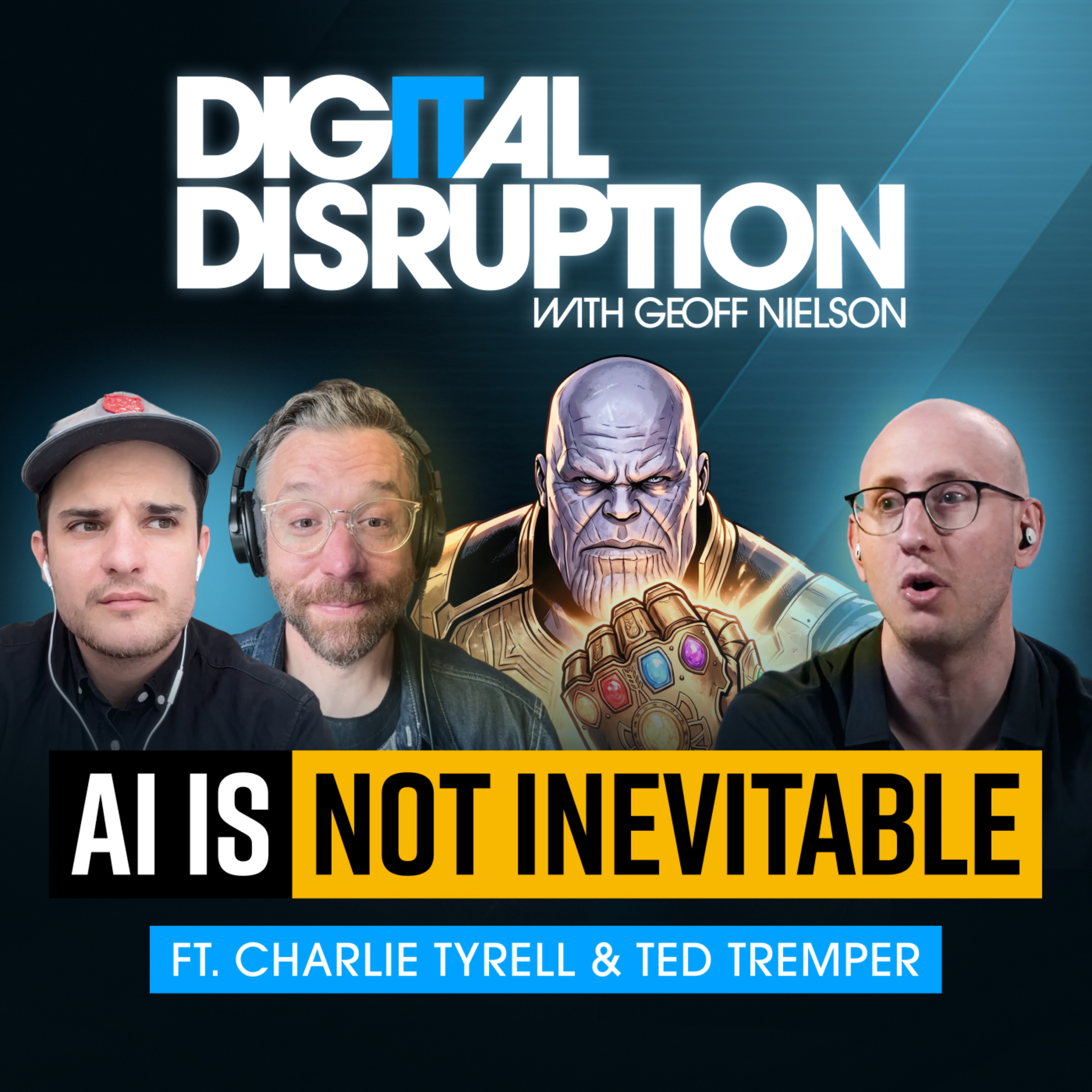
Digital Disruption with Geoff Nielson
The Most Insidious AI Narrative: We Can't Shape the Future
01:08:30
Loading summary
Transcript94 lines
- [00:02]
A
Where we have to be really careful with something like generative AI is the way that you would repurpose a sample within music is extraordinarily different from the way that a generative AI model recombines the totality of its training data to synthesize all of the stolen material in that to generate an output.
- [00:18]
B
I don't want to sound snobby, but I guess I'm going to sound snobby. Some of the stuff where it is being used feels a little low class. Hey, I'm taking these two major characters from two different IP and look at me make them clash together. That doesn't say anything. It's an illustration of an idea, but it isn't really telling me much of a story.
- [00:40]
A
Everybody has a right to the opinion of what they like to enjoy. Like, that's the entire purpose of art and breaking norms and making new things.
- [00:46]
B
We're skipping over the process and just going to result. Sorry for swearing, but what's the fucking point?
- [00:52]
C
This is a show about the future of tech and the future of work. I'm Jeff Nielsen, and today my guests are the producers of the new documentary, the AI Documentary, Charlie Tyrrell and Ted Tremper. Your fear of AI is the collapse of humanity.
- [01:06]
A
Well, not the collapse, the abrupt extermination.
- [01:10]
C
If we can be the most mature version of ourselves, there might be a way through this. I want to ask you to promise me that this is going to go well.
- [01:18]
A
That is impossible. This is the last mistake we'll ever get to make.
- [01:25]
C
These guys have spent the past three years investigating the questions of our time. How worried do we need to be about AI and what do we do about it? They've spoken with everyone from Sam Altman to Dario Amadei to AI skeptics to experts who think we're all going to die and have released the interviews in their new movie. Having explored AI from so many angles and so many experts, what I want to know is what they really believe and what they think is total bs. Let's find out. Charlie, Ted, thanks so much for being here today. Really excited to talk a little bit about the AI doc that you guys have put together. And congratulations on now being honorary, you know, AI storytellers. Maybe just to kick things off, you know, I'm curious. Why did you guys want to tell this story? What, you know, brought you into. Okay, we need to talk about AI right now. This is worth making a movie about.
- [02:21]
B
I mean, a lot of it starts back in kind of summer. Fall of 2023 is when this project first started, and that's when, you know, the conversations are really starting to enter kind of the more public spaces. And even if you're trying not to pay attention, they were getting louder and louder. And for me, I would say I was honestly probably trying to be a little bit dismissive of some of the hyperbole around AI and tech at that time, but along with my co director, Daniel Rower, where we. We both found out that we were having kids at the same time. So kind of that. That big dialogue that was happening with our future is maybe probably going to change significantly and drastically right now, was suddenly a different thing when you're considering, you know, the fact that you're going into parenthood and you're going to have a child to kind of bring into that future and that future beyond you. So that was definitely something I was thinking about. And then simultaneously, Daniel Kwan, one of the film's producers, reached out and said, I want to make an AI movie. I haven't made a documentary before. And he reached out to Daniel Rohr. For the record, Daniel Kwan can make a documentary, but he reached out to Daniel Roher. And Rohr and I were pals, and we all got folded in. Then a week later we're talking about making this movie, and then two and a half years later and it's done.
- [03:52]
A
Yeah, for my part, I've been friends with Daniel Kwan and Daniel Shinett for about 15 years. And we, Quan and I are in a video game thread, and there's a very silly phrase that I've coined that is accountability buddies. And it's really nice to have nerdy friends, because if you become interested in something, you can find an accountability buddy to learn more about those things. And when he became aware of what was going on with AI before anybody that I knew, he kind of reached out and said, I think you should be interested in this. And that sort of started a lot of conversations. And my background, oddly, is in comedy television, but mostly like nonfiction political satire stuff. And so when it came time, you know, when they assembled this, like, wonder team, they needed somebody to. To help kind of book people and get people to say yes. And so he asked me to jump on, and I was going to. I was supposed to start and go for five or six weeks, and then it became two and a half years. So
- [04:46]
C
it's funny how that happens now. You know, Charlie, you mentioned something around the, you know, sort of the framing here of you and Daniel, who, you know, is the director and in some ways star of the movie that it came out of a place of, you know, fatherhood, of having kids, and anxiety about AI, anxiety about the future, AI dread. And I'm curious if you can talk a little bit more about that. Like where were your heads at when you started this project and now given that you're on the other side of it, it's been released. You've done dozens of interviews with experts in this space. Where is your head at these days in 2026 around AI, anxiety and dread?
- [05:32]
B
I am a steadily and consistently anxious person. Despite my maybe kind of calm or flat demeanor. I just vibrate so much that I look still. But you know, it's still there. That dread is still there. And the funny thing is it's my kind of take and feelings towards AI and perspective of it in an odd way is very similar to how it was when this project first started. But the difference is I'm much more informed now. I have in some ways more validation to some of the fears and more kind of knowledge towards some of the things to understand kind of how it works, how it's working right now and, and what's needed to change it. Before it was just kind of a, kind of an instinct in a sense that, that, you know, motivated some of my feelings and now it's, it's more kind of information based while still not dismissing the feelings and instincts that I have towards it.
- [06:37]
C
So when you say more information based, can you again, with the advent of this insight and having talked to this many people, does it have a little bit more of a shape to it? Like what are the concerns that are lingering in your mind about what's creating the sense of dread and what are the scenarios that you're still concerned about?
- [06:58]
B
A lot of it is still just the ever growing wealth gap, to be honest. You know, this, this technology came in the package of helping and optimizing individuals. It was, it's been presented as this new tool that everyone can use. But however, that tool and that usage of that tool by hundreds, thousands, millions, billions of individuals is funneling towards, you know, corporate businesses. You know, it's, it's moving towards enabling, you know, people in power. And that power is defined by their wealth to become more powerful. When you get to that level of powerful, you influence governments and you influence, you know, many other things that make the world go around and make life sustainable and happy and peaceful for people on the planet. So that's the scary thing that, you know, that that power is concentrating through this technology.
- [08:03]
C
I'm curious, Ted, if you agree with that. If you have similar views on the concerns around, I guess, the concentration of wealth here or any other AI concerns or anxieties that Charlie didn't touch on?
- [08:17]
A
Yeah, I think my answer to your question would be that every day I find more reasons to be hopeful and every day I find more reasons to be concerned. And I think that that's the nature of technology and humanity's relationship to technology. And I think that's why it's so important to engage with the process of being involved in understanding how it's affecting your life and the lives of the people you care about. And in terms of. And this transcends. I think I share Charlie's concerns about wealth inequality, but it really does. It proliferates in our lives in the way that something like a technology like electricity does. Or Karen Howe, who's in the film, I think at one point said the. The idea of being anti AI is like being anti transportation. Like, it's such an enormous thing that the really critical part is becoming educated enough to understand that there are positive alternatives to the trajectory we're on. And the work that I've been doing now with the Creators Coalition on AI is really inspiring because, you know, Daniel Kwan at a certain point said, like, for every problem that you can imagine that AI is creating, there are really brilliant people who are trying to solve those problems. And meeting those people is, like, inspiring. But also the fact that nobody knows or not as many people know about these people as they do about the CEOs of the companies is very sad. And that sort of goes into the larger discussion that's present in the film of really the question is, you know, fundamentally not about AI itself. It's about how do we create a society that can coexist with stronger and stronger technologies, because we're only going to get stronger and stronger technology. And what that means to me is being personally involved in the process of getting it right as opposed to focusing on the solution of doing that. Because there is no solution. It's a relationship. So I think that, yeah, you're living a lot of. It feels sometimes like you're running on the top of a sand dune. Emotionally, psychologically, intellectually. And it's very easy to want to slip off and go to the other side, but when you do that, you need to get right back up on the top of there and keep running.
- [10:23]
C
If you don't work in enterprise technology, you can skip ahead or take a quick braincation, but if you do, infotech is your secret weapon. Infotech helps IT teams get projects done Faster, better, and at a lower cost. Whether you're rolling out new tech, improving processes, or just looking for cost savings, infotech provides unlimited access to practical tools and expert guidance. You need to execute at a fraction of the cost of traditional consulting, no matter the project. From AI strategy to cybersecurity to vendor negotiation, InfoTech has you covered. Check it out at the link below. And don't forget to like and subscribe. The involvement piece is really interesting. And, you know, I think in some ways, you know, a theme of a lot of the work and also I guess an antidote to this feeling, this sort of this nihilist feeling of, oh, I'm here and this is all happening and I can't control it at all. I guess just to put a little bit more color on that, have either of you guys seen any specific ways? I mean, Ted, you mentioned you've got this kind of organization you're working with, but, you know, concrete things that people can be doing to get more involved to help kind of shape this, to help use this, and I guess regain that sense of control that some people, you know, consuming this media digest around AI are finding themselves in.
- [11:47]
A
I think the most important part is education. Clarity creates agency. You know, I was speaking to an extinction risk expert and they pointed out that right now 90% of the conversation is going towards persuasion. It's people who seem to have all the information telling you exactly how this is going to roll out. And that feeds this notion that there's an inevitability to how it's going to roll out, which is. Which is categorically false. That's the most important thing to understand is that this is not inevitable. You could make the argument that technological development itself is inevitable, but you could then point to something like human cloning, like there's enormous incentives to create super soldiers in every country, or to create clones and create human organ farms. But we as a society decided not to do that. We've had that technology for 30 or 40 years at this point. And I think that when that comes to AI, when you are able to educate yourself enough in your domain to understand the impacts that it could have or the benefits that it could have, the next part is communicating with other people to make sure that you are sharing your feelings about this, what the norms you want to be in your workplace and your family and your school and your kids school, because then you are able to build a consensus about where you want society to be moving. So I think that's what I would say.
- [13:02]
C
Charlie, anything to add?
- [13:03]
B
There not much other than just the. I think it's one of our subjects who pointed out that the weird thing about AI is that seem to come for the arts first. So most of my kind of thinking and, you know, discussing with colleagues and friends as to, like, what to do, what to do to empower ourselves has. Has been in the art space. And some of that has just been the simple kind of taboo of using AI and AI generated imagery in your art and your work. And a lot of it has been just kind of seeing a lot of people, especially the people I know. I love to try out new technologies and new techniques and new tools, really kind of scrutinize and be critical about what the back end of the technology is and where it kind of its power and capabilities come from. And that might include energy usage, but it also might include, you know, you know, some of the dystopian kind of ted, where they called the. The thumbs up, thumbs down kind of people who, Who, Who. Who view the material and kind of gauge accuracy, but still a human engagement.
- [14:17]
A
Oh, reinforcement through learning. Reinforcement by human feedback. Reinforcement. Learning about human feedback.
- [14:21]
B
Yeah, yeah. Like which. Which is a lot of that's been taking place in the Global south and.
- [14:25]
A
Oh, yes, yes, yes. The training.
- [14:27]
B
Yeah, yeah. And. Yeah, yeah. The. The training of some of these models. Yeah. Has been, you know, things that can convince you to not use it in certain cases, to. To avoid the kind of leisure of it and the convenience of it because. And. And also the other side of it. Sorry, I'm kind of on a tangent here, Jeff. But it's. It's really reaffirm. Affirming what kind of creation is from a human level. Like, you know, oh, I have this thing that can do my work for me, but my work is me doing it. So it's kind of giving up some of those kind of more philosophical questions that we have to answer about, you know, who. Who's making what here.
- [15:13]
C
This. This is maybe a taboo question to ask, but did you guys find you were using AI at all as filmmakers as part of this? And if so, what was that experience like?
- [15:24]
A
The whole film is generative AI, which is really impressive. We had access to a model. I'm, of course joking.
- [15:32]
C
Yeah.
- [15:32]
A
I think. I mean, I can speak from my experience being the person who needed to talk to people to convince them to appear in the film. I was using every tool as much as possible and understanding how they work. But in terms of the actual film itself, there's no generative AI that's not labeled as generative. AI. But I'll let Charlie just speak to the. I mean, from day one, you guys did such an amazing job of making sure that it felt handmade, that it felt human made and tactile.
- [15:57]
B
Yeah, I mean, to Ted's point, like, we. We were definitely researching and interacting with some of the tools, you know, in. Sometimes in the simplest way, just to research story avenues for the film. You know, oh, Sora's come out. Do we want to maybe shine a light on the film or in the film on that technology and that capability and know. So we were familiarizing ourselves, but in terms of using it with the intention of this is going to end up on the screen. No, to Ted's point, any kind of AI generated imagery in the film is either labeled, most of it is just used as archival, or stuff from other news hits and whatnot. But, yeah, we decided to painstakingly do most of the visuals in stop motion. Ouch. But. But it also, like I said, what goes. Getting to earlier reaffirmed that kind of notion of human creativity. And, you know, now it feels like there's a different dog in the fight.
- [16:55]
A
Well, and I would add to that, Jeff, like, I really don't think that this should be a taboo question. Like, one of the things that will help us educate each other and establish the norms in our art forms is, oh, did you use this? Like, what tools did you use? Because, you know, AI in AI is such an enormous thing that when you. When you think back to Peter Jackson using machine learning and little sprites for the orcs and Lord of the Rings, like, there was an argument to be made that him doing that disenfranchised thousands of background workers that could have dressed up as orcs and could have been part of some massive helicopter shot. But I think that they probably wouldn't have been able to afford to do that. And similarly, we had, you know, 3,300 pages of transcripts that we used, like, transcription services to do. But for the rushes, we, you know, Adobe has an automatic transcription tool that helps you work very, very quickly. And the question of whether or not you want to use those tools, these are the conversations we need to be having. I think that it's also really important just to begin having longer conversations that clearly delineate generative AI from machine learning from an AI tool versus an AI service. That's a big one. I think, as far as filmmaking goes, really being clear about what the difference between a tool and a service is,
- [18:14]
C
it's interesting, and it is interesting to hear that you Made a deliberate choice to, as you said, Charlie painstakingly have a lot of human made elements in this. And I think I have to imagine we're in sort of a backlash phase right now. I feel with a lot of AI usage that it'll be interesting to see how it plays out. And, I mean, I don't know. For what it's worth, my perspective is that if as storytellers, you want to use generative AI tools in the service of telling that story to do cool things you wouldn't otherwise be able to do. Yeah. It feels weird to say, like, no, you should be dragged through the mud for making that choice. Now if you just type into a prompt like, what should my movie be? And you outsource the script and there's no thinking involved, sure, you know, we're talking about something different, but it's. I don't know. I mean, I'm sure you've had many of these conversations, you know, during the production of the movie and since it's come out. Do you have a feeling for kind of the industry's posture even today on some of this stuff?
- [19:19]
B
Not as a whole. Like, what I've seen from my own personal perspective has been. I don't want to sound snobby, but I guess I'm going to sound snobby. Is. Is some of the stuff where it is being used feels a little low class. Like it feels sometimes, you know, to use some of it for something like filmmaking and not. Not just the kind of assistive models where it's like, oh, yeah, we're going to give a bunch of background orcs where they're like, hey, I'm taking these two major characters from two different IP
- [19:56]
C
and look at me.
- [19:57]
B
Make them clash together. That doesn't. That doesn't say anything to me. That's like, that's it. It's an illustration of an idea, but it isn't really telling me much of a story because stories kind of. I personally like the stories that go other places and that, you know, there's. There's a reason why I use a lot of analog visuals in my films and whatnot, because I like. I like that collaboration. I could, you know, pick a picture of an actor and turn them into a 3D model and then give them a prompt to make them do something. And then there. Now I've created a piece of media, a film, a piece of video. But for me as a filmmaker, I like to find an actor and then give them the material and then see what they do with it. And See what happens in that collaboration, that the experience part of it is, is the, the making to me and then the, the result is what you get from that. So it's like we're skipping over the process and just going to result. And to me like it's. Sorry for swearing, but what's the point? Like, you know, so it's so, so it's asking these existential questions of, of, of myself where it's, you know, I, I think that audience appetite is going to dictate what we end up with for the most part if, if this like, you know, look at any kind of trade or craft outside of art, furniture making, you know, cooking, like most people get the quick and fast and cheap rather than the bespoke work with someone to do it again. It's just the world we live in, the affordability is difficult with many things. So I hope that filmmaking doesn't reserve, get reserved as something for, you know, hoity toity people who can afford the, the handmade film because it has been a people's medium for a long time. It's been, it's been the accessible form of entertainment for a lot of people for 100 years. And I hope it, I hope the human made filmmaking gets to remain that. So bummer.
- [22:25]
A
You go ahead, go ahead. J.
- [22:27]
C
Well, I was going to, I was going to say, and you know, Ted, I'm curious for your thoughts on it. There's, there's, you know, an implication there in a parallel that, you know, maybe as sort of a lowest common denominator tool, if I can call it that, that if you're an amateur filmmaker, it's a great shortcut. If you're in film school, it's a great shortcut. But if we're really talking about comparing top tier filmmaking to a great restaurant or any sort of state of the art experience, then cutting these corners is something that audiences will feel and they won't appreciate. And it's a place where it's worth putting in the work and putting in the effort to get something that really elevates the experience still, versus just trying to do it as cheaply as possible. I don't know, Ted, what do you make of that?
- [23:14]
A
I mean, I think it's really interesting because I've been looking back at the history of technology and the way that technology transforms art and I feel like exactly what you just said could have been said about transition from celluloid film to digital film. They'll never be able to get the film grain right. It'll never look right There's a thing I call just like the it will never be able to paradox where, you know, it's like when it comes to. Around like hip hop and sampling, well, they can't even play an instrument. That's not music. These are, these are things that are wonderful conversations to have as human beings. And everybody has a right to the opinion of what they like to enjoy. Like, that's the entire purpose of art and breaking norms and making new things. Where we have to be really careful with something like generative AI is that rather than, you know, the way that you would repurpose a sample within music is extraordinarily different from the way that a generative AI model recombines the totality of its training data to synthesize all of the stolen material in that to generate an output that to me is categorically different because there's no choice that you're really making in that regard. There's no intention to say whether or not it has value to a large audience or to any audience. That's not for me to say. But I do think that it's really important to avoid believing that it will never be able to do certain things. For three years I just watched as people say, it'll never be able to get the hands right, it'll never be able to produce sound, it'll never be able to show a text. These are things that are deadly mistakes to become sort of falsely assured that the position of the artist in society or the craftsperson, society will not be replaced. So removing that as a sort of mental position is really, really important. We need to act as though it will be able to. And so what that means is that we have to put policies in place where we are fighting for compensation to the people whose training data was put in there. We need to fight for transparency, for consent, all of these different things. Because there actually is a world in which you could have generative AI models that are ethical. I don't believe any exist right now, but. And moreover, when, as part of the work with the creators coalition, we'll have tech companies reach out to us and they'll say, great news, we've solved. We have a vegan model, an ethical AI image generation model. And I'll say, great, what does that mean to you? And they'll say, well, all of our, all of our images were, were, were licensed is from a licensed data set. And I'll say, great, what was your foundation model? And they'll say, what's a foundation model? And then you get to have the conversation I told my wife about this, that like, it really sometimes is like talking. You walk into a car dealership and all the salespeople are very nice because they don't know that all of the cars are stolen. They're. And when, when they learn that there is such a thing as a foundation model and that if you're able to interact with it currently and with any efficacy, that that was likely built on the totality of all of human knowledge that's been stolen and put into that, that model. That's when they get to the choice as to whether or not they want to, I would say, join what, what I would sort of largely call a pro human fight towards honoring the knowledge of the people that went into training that model. And that's how you get a positive feedback loop with these kinds of services and tools is you acknowledge what's gone on and you find ways to create consent compensation, transparency about what we're creating now. And that's totally possible, but very rarely talked about.
- [26:46]
C
I think you and I have talked to some of the same advocates for doing something like this. I think about Dr. Emily Bender, Dr. Timit Gabru, who have advocated for this for years. From your perspective, Ted, in light of your work in this area, what do you see as the most fruitful path forward? Because I think you're right, that foundation model question makes it really difficult. Like, if we're talking about the foundation of so much of this being stolen, like it, I'm gonna go down a slightly weird road. But if we're talking about, you know, building an ethical house on stolen land, like, how do you get past the stolen land problem? Right? Like, what meaningful things should we be pushing for from a policy perspective that help us, you know, do this in a fairer way?
- [27:39]
A
I think there's a lot of things. I'm so glad you brought up that metaphor because I think it's possibly the most appropriate metaphor that we have. I think that when one looks at mass injustices in the past, something like apartheid, you need a truth and reconciliation process in order to be able to get people on the same page about what has happened, in order to create a future where you avoid those kinds of things reoccurring. And I think that when it comes down to, you know, what a policy direction looks like and what people can do, number one, it's in specifically the creative industries, just never make a deal that forgives past theft. And it's ironic, I was speaking to, you know, there are people currently who are designing protocols where you would be able to back propagate to see what information is being called upon to generate an output when those things happen. And there's many people working on this. There's other researchers who've proven that, for example, like memorization, that the models have memorized things. And so it debunks, it systematically debunks all the different legs that the labs have to stand on. That work is really important. Supporting the people who are doing that work is incredibly important. Understanding that you. The vote with your dollars approach is possibly the most instrumental thing you can do with these specific labs, which we saw how that played out with anthropic refusing to cave to the demands of the Department of War. Sam Altman tweeting on Friday, good news. We've taken over those contracts and then a million and a half people unsubscribe from the paid tier of ChatGPT and then SAM has to reverse course, at least verbally. But then we also know that we should never trust any of these people because the game is too. The stakes are too high to just operate on trust. So it's sort of all of those things, all of this is all playing together in an ecosystem where we need to be highly skeptical. We need to verify an anecdote. I like to Deboraji, who's in the film, is a tremendous researcher, was part of essentially a campaign to shame Amazon and to stop using facial recognition or stop licensing their facial recognition software to law enforcement because it was so bad at identifying, accurately identifying people of color. And so there were a lot of false arrests. They, they successfully did that and that's fantastic. But then Amazon bought Ring and then Ring is able to license their. It's all. The cycle will always continue and the incentives in our society will always be such that. Well, until they're changed for these companies to try to find the most profitable way to use the technology that they've developed. And so it's up to all of us to be able to kind of push back and make sure that we're kind of keeping an eye out for all this stuff and supporting the people who are doing the work that we don't know how to do with our voices and with our dollars. I'm not sure if I fully answered your question, but it's basically. Yeah, I mean, it's. The thing I would like to add is that that work doesn't have to suck. It doesn't have to be drudgery. It's literally as simple as just having a friend that you trust or Having people like the people you've mentioned or other researchers who can help you understand the ways in which certain parts of the system are being exploited for gain by other people in that system. And I think it's really important to not just have one or two, you got to kind of keep your eyes scanning based off of what your priorities are.
- [31:00]
C
One of the topics of conversation that does come up in the film and a lot of conversations about AI is this notion, this concern that as we're in this kind of race, this arms race for AI, that cutting corners or doing things unethically is part of the pressure to succeed here. And so, yes, we can try and use data ethically, but I mean, I'll just give you my perspective on this, that it seems pretty obvious that these models perform better the more data that they get. And so to be a bit conspiratorial, I think they're using even more ill gotten data and proprietary stuff than even we've discovered yet. And so how do you, against that backdrop, how do we push back on that? How do we make sure that we get ahead and that we, I don't know, sort of acknowledge and maybe undo the harm of the nature of the race itself?
- [32:10]
A
I think that there's a number of things that give me hope in this regard. And when you talk about winning the race, we're really talking about the race between the labs to reach AGI and the race between the US and China to ostensibly reach AGI or to some kind of, to maximally implement gains that AI is yielding in their society. One of the biggest fulcrums that we have in the west, if you care about these kinds of issues, is the fact that in China they've already won their society's culture war as it pertains to AI. There was a recent New York Times reporting that, that pointed out, you know, by and large, people in Chinese society are very pro AI because they look at, they, they look at the ways that it can, I mean, they basically have, are seeing the ways that it's being deployed at all level of society and they're very in favor of it. They're pro technology. Part of the reason why the west is so skeptical of it is because of our first contact with AI, which is social media, and the ways that social media has caused enormous harm. And that being an example of the way that we lost by winning that race. And so in order for us to succeed, there are companies that proselytize this idea of creating a race to the top. It is society's job to clearly paint a picture of what that looks like. So that way we are creating the opportunity for those labs to win back the hearts and minds and society. Because if our general standpoint is AI, terrible AI, bad, hate AI there is no incentive for anyone to build an ethical AI and that race continues. So it's like that's sort of on a personal level, geopolitically, that's a whole other conversation. But I think just like on a very personal level, unless we are setting the norms and standards within our own lives and being very vocal about what those are and where we want AI to meet us, then we are not doing our job in clarifying where we want it to go. And if we don't do that, there is no reason for them to try to be ethical.
- [34:06]
C
I think that's well said. And I want to. I want to kind of pivot that into something I've been curious about, which is there's so many narratives now, there's so much hype. And even when you guys, and for me as well, doing our jobs as AI investigators, everybody has such a different message. And I always chuckle because the message that they have tends to align very closely to whatever product they're trying to sell or whatever service they're trying to sell. But I'm curious, having investigated and having researched and spoken with so many experts, are there any narratives you're seeing pushed right now that you're just not buying, that you can see are clearly being sold, that there's some sort of profit mandate or that you want to express that people should be more skeptical of? And maybe. Charlie, I'll start with you on this one.
- [35:00]
B
Yeah. I mean, I think to what Ted was saying earlier, just this narrative, this idea that it is an inevitability and that it is like predestination, like how we evolve from apes, we're going to go into digital beings or machines? I just have to disagree with that. I mean, we and Ted cited some earlier, like human cloning, but it's just what I would love to see, and this is kind of going to. Your last question is I would love to see us focus on a way how to make AI even if for now it's limited to certain countries or communities. Before we try and go wider with it, find a way how to make it more democratic, how to make, you know, what the capabilities and uses of this technology are to be kind of decided by more than just a few people, you know, because that will determine the want, that will determine the need. People in one part of the world might need to do one thing when people, another part, need to do another thing. And then the resources will balance out based on those needs, you know, because resources will have limitations on what, what it can do. So. Yeah, I don't think I answered your question, unfortunately, but, but I, it's just really that this thing is, is, is an inevitability and it's on a continued ascent and its capabilities and its, its possibilities. I do agree with Ted that you have to default and assume that we'll be able to do everything it says it can, but I, I think that, that Ascend is only ever going taper off at some point because there are finite capabilities in just in terms of resources on this planet that it's going to run into at some point.
- [36:54]
C
Well, and to your point there, it's, it sounds like, you know, part, part of what you're saying is that the idea that somehow this race is too fast and too important for any sort of governance or regulation, it kind of seems like BS to you.
- [37:09]
B
Totally disagree with that. And like right now, and going back to the democratization of, of its capabilities is. And resources. Resources can be bought right now, despite limitations. Certain places, it's something that can be paid for. So the wealthiest ones are getting there first because they're able to afford those resources and able to, you know, pay the fees, pay the fines to, to occupy them. And that kind of consumption can be confused with power. And that power isn't something that we have to accept. We can choose who we give power to collectively. It just takes a lot of organization to do so. So that, that, that's where, that's where my kind of fundamental beliefs as a human being go to. And there's just so much noise out there right now that it's hard to know where to direct that energy and where to direct that collaborative and collective decision making.
- [38:12]
C
Makes sense to me. Ted, where's the you know what to you hits your BS radar even as you hear know some of the, you know, most prolific and loudest voices speak on this.
- [38:23]
A
I think Charlie nailed it. The most insidious narrative is that this is inevitable. It's not inevitable that humanity gets to shape it. This has been the story of all technology. Is it an enormously asymmetrical battle with the greatest investment in the history of civilization being dumped towards one very specific thing? Absolutely. Does that mean that, you know, 10. It's the. There was one moment where we were talking to a. I can't disclose who this source was, but we were talking to someone. And this person had been, had, had been talking to a lawmaker. And they just said offhanded, like, how many people would need to call to, to like have this issue get in front of this lawmaker? And the staffer they were speaking to is like, you know, if like 10 people call, like, we have to, we have to write it down. We have to like deliver that to the congressperson. And this person was like 10. That's it, like 10. So the idea that like, if a couple hundred people actually cared about these things and made their voices heard, then that could actually move the needle. The challenge there is that there's two different sides of this coin. There's the this is inevitable myth that needs to be debunked on the side of the people who are pushing progress. And then there's also the this is the solution myth that needs to be pushed back on from the advocacy side because there is no single solution. Evaldo Harari points out in the film, this is a relationship. And the thing I've learned about relationships are if you look at them as a series of problems to be solved, you're going to be miserable and you're not going to have a great time. But if you understand what your values are and you set up certain boundaries and you're able to have conversations about that, you're able to then shape the, be able to be like in a flow and actually like be present and receive the benefits of what that collaboration is. So I think that rejecting both of those, understanding the relationship based nature of humanity's relationship to technology, that's where we can actually create a sustainable road forward in shaping it. So I guess that would be, that would be what I would say. Oh yeah, and the other thing, like it's. Yeah, the other thing I would add is like the education piece also comes into it because even like, no matter what, like, I've stayed up to date to a large degree on the issues that are arising. And every single time I hear about this intractable problem, I immediately think about the three people who have told me a way to solve that very specific problem and these different ideas. So it's like Daniel Kwan and one, you know, one of the producers of the film in our work at the Creators Coalition has pointed out that like, what this time demands of people who care about the future is radical imagination. So when it comes to the point that Charlie made about, I mean, the idea of companies being so big that they want to pay the fines instead of actually fix the problem that goes back decades if not centuries, figuring out what are the actual pain points for those corporations, like is the job of people in government. So, for example, with social media, why not, instead of finding them, impose a latency tax where their page loads, loads incrementally slower for every violation of our norms are because they lose a tremendous amount of revenue by the microsecond. And they also know that they lose users if their site goes slow. That's actually something that regulators could do. There are actually people who are currently talking to states attorneys general about how to actually codify that into law. These are all things where, if you. I mean, figuring out how to get a or AI right will be significantly easier than removing leaded gasoline from the world. But we did that. You know, like, it's these things where, like, you know, the fourth act of the film really highlights the times in the past where we as a society, I mean, the entire purpose of law is for us to determine as a populace what we want to happen and then to put mechanisms in place so that they are encouraged to happen. I'm not saying that they will, but between public pressure, between actually having regulation that moves at the speed of technology, the path is actually really clear to how to create that change, whether we'll do it or not. I have different amounts of confidence based off of the weather and the way the wind blows that day, but my belief that it is possible has never gone away.
- [42:45]
C
So maybe on that note, to take the more positive approach again, having learned everything that you learned and now being more embedded in this, you know, in this world, what. What do you see that gives you hope? You know, and I'll ask that question to both of you. You know, what makes you hopeful and what are some of the signs that we may be actually going in a better direction than you thought of, you know, two years ago?
- [43:10]
B
Goodness.
- [43:10]
A
Charlie, you want to start? You want me to go? You go. Yeah.
- [43:12]
B
I mean, again, not only is my baseline quite anxious, but it's quite cynical and negative also. But I guess what I will say is, you know, this. This was a space that, just like I said in all the hyperbole that was associated with it back in, you know, Summerfall 2023, it seems like we've been talking about. It seemed like an inevitability. It seemed like something that was just barreling through and there was no getting out of the way or stopping it. And I know that even some of our subjects in our film reinforce that belief. But what I am starting to see now in small ways, is that work is yielding results in terms of things like what CCI is doing and some of the other kind of coalitions and organizations and kind of right now it is more so in the space of discussions and thoughts and kind of, you know, conceptualizing the directions that we can take this and, and what we should prioritize. But you're starting to see and feel that organization that is moving towards a collective good. I do. Despite my cynicism and negativity and depressive disorder, I do believe in collective good. You know, I, I do think that human nature, while there are people who do lots of shitty things and seem to have a million and one reasons to do those shitty things that they believe in, that's not the majority of people. A lot of people are focused on trying to live a happy and peaceful life. And when you challenge that happiness and that peace, people have the capability to resist and redirect to maintain that happiness and peace. And I know I'm talking in big, lofty terms right now, but I am seeing that a lot of people are starting to focus, not just the most intelligent people in the world on either side of this technology in the labs are thinking about this general population is starting to think about this now too, and, and involve themselves and that's what's needed. And that is just so encouraging to see it happening, to see. Because I feel like going back to 2023 more people, including myself to some degree, were very willfully keeping their heads in the sand. And now there's a. More of an adoption of the acceptance that that's not going to work this time. This isn't something that you can just ignore and it's going to go away or going to pass. It needs, it needs our interaction.
- [46:05]
C
Well, and it feels like it's coming back to that sort of education piece and, you know, whether it's us as individuals understanding it better, whether it's just enough time elapsing that we have a better sense of how this is playing out and how it might play out versus, you know, when it's so new. It's just, you know, we don't know where it's gonna go. And I'm curious for you, Charlie. You know, as you said, you and Daniel were both going to be fathers when, when this started and now are on the other side of that. And so I'm curious, you know, you mentioned that, you know, you're a cynic and tend to have like a depressive view of these things. The combination of now, I guess, being on the other side of fatherhood, where You've got a kid being farther down the line with AI, more educated, did both of those things together sort of, you know, potentially enable you to view it in a less alarmist, less dreadful way.
- [47:01]
B
No, but in an informed no. Which is to say, and Jeff, I know that you're a father as well. One of your main things going into fatherhood, at least for me, was knowing that I'm going to have, especially I have a son, I'm a man. I grew up as a boy, you know, so I know some of the boyhood experiences that he's more than likely going to face, and I know how I was able to handle them and comprehend them. So you kind of have that leverage as a parent to know that there's going to be a shared experience here where I'm going to be able to step in and help, or step in and guide, or step in and go like, hey, this thing that you're really worrying about, like, it's actually not that big of a deal. Like, you can fail that. You can fail your fifth grade math test. It doesn't matter in the long run. You know, things like that. The kind of reassurances that are needed to navigate, you know, childhood and adolescence and young adulthood. But the thing is, with this technology and its adoption that, you know, is happening, the world that he's growing up in, in a lot of ways is going to be very different. You know, normally that there. That. That's been kind of the story from generation to generation is just that the world that, you know, your, your parents grew up and it's different from your world. But there's a. Historically, there's been a little bit more of a stretch, you know, like, some of the biggest ones in the last hundred years were like, I can remember hearing from elders and grandparents about knowing people who grew up without plumbing or knowing people who grew up without electricity. Those transitions took many, many decades. But the transitions that we're going through now with this adoption of technology is happening. You know, a lot of it's happened in my toddler's lifespan. So there is so much more that he. That the world is going to change into that I just won't have familiarity with. So he's going to be on his own for some of that stuff. And it sucks, and I'm not fully surrendering to it, but I'm. My job is to do my best to keep up and keep informed and also allow him to teach me things, because the way the world is, is not the way that world was when I Knew it. So I'm. I'm less of an authority on the world, probably, than his life will be. So, to answer your question, no, but. No, that way. And. And it's not all bad. It's just kind of an acceptance that's required to understand that rather than hold on to. And we've seen this from, from boomers to millennials. Like, there's a belief that, oh, if you just go out and work really hard, you'll make enough money to buy a house and buy a car and retire, and that world doesn't exist anymore. To the same degree, it was painful for my generation to accept that, but boomers kind of seem to collectively refuse to accept that. So I know that there are going to have to be things about his world that will cause friction with my beliefs and understand the world that I just have to accept. So, sorry, complete tangent there. But it's something I consider a lot. Yeah.
- [50:07]
C
And it feels like a very mature position and, you know, in some ways a very Zen position almost, because to the point you made, yeah. The world is going to change in unforeseeable ways that make it more difficult for you to provide guidance to the next generation. But to the same point you made, maybe that's just the same world we've been in all along, and now we just have the ability to introspect a little bit better and recognize that. And I don't know, maybe.
- [50:38]
B
Yeah, it's like, don't pretend that's not happening. And I'm going to have to take his word for it on certain things.
- [50:43]
C
Well, and maybe this is too optimistic of me, but maybe that recognition alone, you know, is worth something. Right. It positions us better as parents to be able to, you know, know our own limits and not just keep giving the same annoying, outdated guidance that we got from our parents.
- [51:01]
B
Exactly. One the best. This is kind of related, but it was a comedian's joke where he was talking about when you have kids and your parents come to step in and try and help. And he's like, imagine someone working at a company 35 years ago, coming to work at that same company again and kind of how obsolete they are in their. Their methods. Like, it's that kind of thing, but just a little bit faster. And, like, I'm going to start to feel old and in the way a lot sooner than a parent maybe normally would, probably when he's 10.
- [51:36]
C
No, I totally get it, Ted. We. Charlie and I took quite a journey there, and I loved every minute of it. But I'm. I'M curious from your perspective, you know, as you look forward, as you think about, you know, what you've learned, if it has changed your overall posture toward this, you know, toward AI and where it may go and, you know, what gives you hope?
- [51:56]
A
Oh, I mean, I think, you know, being a kid, I'm old enough to remember what pre social media was like, and I am young enough so that technology is like, by and large, had an enormously positive impact on my life. And so those two things, I think are in constant conflict. And what really investigating AI as a subject has taught me is that there are people who really do want this to go well and who are literally dedicating their life to making sure that it goes well, and that some of those people are doing things that will likely have a positive effect and that some of those people are doing things that actively are having negative effects. It's sort of the old writing piece of advice is you need to make sure that your villains believe that they are the heroes. Like, that's the most important part about writing a villain. And what I would say in this entire subject. It's really important, I think, to have confidence in your values and in the things that you think are really important in your life and to be looking at and investigating those things, whether or not you're a parent, whether or not you're a partner of someone. And it's also really important to have intellectual humility when it comes to the subject of technology writ large, because each, you know, whether you're talking about, you know, autonomous weaponry, whether you're talking about AI's deployment in healthcare, whether or not you're talking about algorithmic bias and institutional racism and how that's perpetuated by these systems. Each one of these subjects is a big enough thing so that if you approach it from a standpoint of you being sure that you're right, I find that that's a very difficult way to make progress. And so I think that the thing that gives me hope is people's rigor in their intention to do well. And I think that given the results that society is sort of seen from social media and the polarization and the. The fact that even just saying I don't know, or hey, you know what, I think you might be right are things that we almost never hear anymore. Those are the challenges that we have to face. But I think that, like, the thing that gives me hope is I feel like we're all just really tired of that bullshit. And I think that the, the voices that I hear and that I listen to are really ready to collaborate.
- [54:47]
C
So, Ted, I love that answer, and I think it makes a ton of sense to me. I'm curious on that note, as you talk about voices, influential voices around this space in your life, I mean, you guys have had the advent of speaking to so many people, of hearing so much commentary. And I know as filmmakers, you try and be as objective as possible, but I'm sure you have your own individual thoughts on, you know, who shared the most wisdom, who, you know, really informed your view and you wish you could spend more time with. For viewers listening to this who are, you know, trying to tune out some of the noise and figure out where the signal really is. You know, do you each have one or two people that you spoke with that you think, man, I really. I would have loved to spend more time with them. Or if people are just getting their feet wet in the space, you should really go and hunt out conversations with, with these people because they're really gonna, you know, change the way you think in a positive way.
- [55:41]
B
Karen Howe was the big one for me. She's just much more the good balance of being one of the most informed people, but also having it became kind of clear many of the subjects that they just were so rooted in within the tech bubble and within that world and maybe not knowing life outside of it. And Karen is just, just more well rounded as a human being. And her book is a good reco as well. So that's my boat.
- [56:17]
C
Yeah. And it sounds like it's because she brings that groundedness that a lot of these people don't necessarily have.
- [56:23]
B
Yeah. And you know, the way her interview was is just very similar to the way her book Empire of AI is, which is just, it's. It's not without hope and possibility of outcomes that do benefit human beings, rather than it being just a growing problem.
- [56:47]
A
Yeah, I had the same answer. Karen Howe, for me, is top of the list. Deborah Raji as well. The thing I really love and appreciate about Deborah is that not only is she an outstanding researcher, she's an outstanding advocate. And also just the amount of joy that she brings to her work is like, it's contagious. And I think that's a really important thing. Like, I think about emotions as being potential energy and action being kinetic energy. So regardless of, you know, where you're drawing that those. What emotions are driving you to. To be working in the work that you're doing. Like, it's just so clear from all the people that we interviewed is that, like I said, They're. They're engaged and they're motivated, but in terms of, like. Yeah, and obviously, I think that the center of the center for Humane Technology does outstanding work in this area. I mean, all of the. It's hard to just choose one. But if I had to recommend, you know, someone doing a deep dive with any of our subjects, I think Karen Howe would probably be top of the list.
- [57:53]
C
Awesome. I'm. I'm surprised and impressed that you guys came to a consensus on that. That's a huge feather in the cap of Karen, who's, you know, great, by the way.
- [58:02]
A
Or I would. I would also say. Or Caroline Lindy, who is. Is Daniel's wife. I think that she's an outstanding voice of reason. She puts up with a lot. I think she's.
- [58:10]
C
I am.
- [58:11]
A
She's the hero of the film.
- [58:13]
C
She kind of is. As someone who went into the film not knowing her, I really appreciated her. You can kind of feel her steady hand on the wheel in some ways and, like, steering. Steering the narrative.
- [58:24]
A
And actually, if I would. If I. If I could add, this person was behind these. These people were behind the camera, but all. All the producers are. Are exceptionally brilliant people, but really, as far as somebody who has their eye on. On sort of the. The philosophical side of humanity, humanity's relationship to technology, Daniel Kwan is really a very special person in that regard. And I would add Shane Boris there. Shane, you know, there were five producers on this film. There were two directors, there were two editors, there was a story producer, a co producer, an associate producer, all of whom were just trying to all get our arms wide enough to wrap around this subject. And. Is that a Sawzall, Charlie, what do you got there? Yeah, I mean, it's just. Everybody had such invaluable input, but it's also just, you know, Daniel Kwan's a special person. Like, he. He's. I'll just leave it at that. I think that if you have the opportunity to listen to the things that he says about anything, you ought to. But specifically about this subject is like, he has a deep, deep belief in our capacity to come together and to make this right. And he's also very good at actually backing that up with finding the people and the ways to do that.
- [59:39]
C
That's awesome. And I'm. I'm just chuckling, Charlie, because you're saying. Earlier, I was like, there's no way. We'll hear the construction. There's no way.
- [59:46]
A
It just.
- [59:46]
C
It just cuts through loud.
- [59:48]
B
I'm sorry, you shouldn't have told him
- [59:50]
A
to set up the chop saw directly behind you. Tell him to work downstairs.
- [59:53]
C
Yeah.
- [59:54]
A
Do you call it a chop saw in Canada? What do you call it reciprocating or what do you call a. I call it a zaggler. A zaggler. Okay, great.
- [60:02]
B
Is a Zeigler and a zaggler.
- [60:04]
A
Okay, fair enough.
- [60:07]
C
Awesome. So as we start to wrap things up here for anyone who's listening to this, whether you're a business leader, whether you're someone who's starting to get your hands on AI tools, start to use this technology and want to have some sort of, I guess, ability to do this responsibly, to do it in a way that's going to be productive. What are your recommendations for people to, you know, think about this and how they can be better and more effective in this space? And Charlie, maybe I'll start with you.
- [60:39]
B
I don't know if I can advocate for a particular tool because for me, before using anything, let's say if I'm just working on an individual level, oh, I want to, like, I'm, I'm writing an email to a colleague. I want to spruce it up, proofread it, find a way to clarify my thoughts and my, my goals of, of maybe what I'm asking them. I always really, you know, make the effort to ask like, okay, can I do this myself? And if the answer is yes, try doing that. Yeah, of course, sometimes you're under a time crunch and you need to just get your thing done. So whatever, maybe. But I really do try to ask if I'm replacing myself and my own critical thinking and cognition first and if that's necessary and that usually the answer is like, yeah, you can, so don't use it. So I don't know if I can advocate for a particular tool right now. Chappie GPT for a minute was really good at finding discount codes for online stores. And that doesn't seem to work anymore. So that would be the only one I would, you know, be able to go for. But it doesn't seem to work anymore.
- [62:04]
C
No, sorry, go ahead, Ted.
- [62:06]
A
No, no, no, you go ahead. I would love to answer this question, but I want to make sure that you, you ask a follow up there. Well.
- [62:12]
C
Well, yeah, I mean, I was just going to say it sounds like, Charlie, the, you know, the feedback there is to be extremely intentional with this stuff and not to just use this because you feel like you're supposed to use it, but make sure that there's actually some sort of value in mind versus
- [62:27]
B
yeah, if you overly convenient and allow yourself to be overly lazy, then you're not going to develop as a person. And sometimes that's your communication skills with other people and sometimes it's your, your craft, your work, your profession. You know, I really am actively working to resist this culture of over optimization and over productivity and get things, you know, done on this super fast timeline because it took me, you know, most of the years of my life to realize that I'm going to go at my own pace. And that doesn't mean my pace is wrong. You know, I think all of us on the production have adhd and I have a version of it too. I've joked that I have the Honda Civic version because I can still get things done, but it just, it is very non sensational and anyways, it's just really kind of knowing yourself and knowing your timeline and knowing what's a reasonable pace for yourself rather than trying to always keep up because yeah, you might end up poor and, and all that, but you'll be more balanced. And like I said, I spoke about anxiety a few times on this, but, but trying to keep pace with that just, it feeds anxiety and then that just makes you less stable as a person, less happy as a person. So I'd rather be happy and stable or at least pursue that.
- [64:05]
C
I really appreciate that perspective and I think it's very well said. Don't get caught in this sort of race to the bottom with using these tools that just ends up harming yourself. Ted, what do you want to add
- [64:18]
A
on the subject to that end? There's a really important problem to highlight, which I call the software as a service addiction model problem, which is essentially right now what a lot of companies are doing are they're replacing workers who, whose salaries they can control with AI agents whose costs they can't control. And this is a really, really important distinction to make. And this is where we get into the idea of like, what's the difference between a tool and a service? If I go to Home Depot and I buy a hammer and take it home, I can build anything I want with that. Home Depot can't come and take that hammer away from me. They can't retroactively increase the price of that hammer by 100x. What you're seeing with these companies is, is they are intentionally using efficiency and reduced costs as a way to insert their very addictive services to businesses in the exact same way that the big tech playbook has gone with, you know, taxis and Uber, that they convince everybody, oh, you know what, leave your job become part of the gig economy. Don't you want to be an independent contractor? We'll give you all these incentives. And also as a customer, you don't want to, you don't, you don't want to pay that union taxi driver or somebody with health benefits. Don't you want to go to the airport for $20? And then you fast forward, use debt as a way to be able to corner the market and addict people to that business model. And now it's $120 for me to get to the airport and the worker is getting paid less than he's ever been paid and the companies are making a higher profit margin. So specifically in any business, but really in the creative industries, what we're seeing is the potential for a complete hollowing out of the human beings that are capable of doing the work without these services. And when you've gotten to that point, that's an addiction. And so it's really important, if you're thinking about sustainability as a business person, just asking yourself the question, is efficiency important enough so that I'm willing to risk a company or risk my livelihood on a company that has shown no reason why I should trust it? And somewhat ironically, recently the CTO of Uber pointed out that the coders that they have at Uber are so reliant on cloud code that they've used their entire 2026 budget on tokens by the end of April. And so then they haven't even increased the cost. You know, like they recently moved, I think, the, the largely cloud code from the pro tier to the max tier. So it goes from $20 to $200. That's a 10x increase in cost. So be very, very careful about the ways that you are deploying these systems and these services into your business because you might end up in a world where you are working for these companies, not for yourself.
- [67:02]
C
I think that is very wise and very well said and I don't have anything intelligent to contribute to it. And I appreciate both of your very different answers. Charlie, Ted, I wanted to say such a big thank you to both of you for coming on the show today. It's been really interesting, really insightful, and I appreciate your insights. For anybody who hasn't seen it, the AI Doc is an excellent movie. It's an excellent way to learn more about AI in the space here. So check it out. And I'm not just chilling it. I have seen it and it is really good.
- [67:35]
A
I appreciate it.
- [67:35]
C
Thanks, gents.
- [67:36]
A
Thank you so much.
- [67:37]
B
We really appreciate it.
- [67:40]
C
Most viewers don't know this, but Digital Disruption is developed by Infotech Research Group, a leading advisor to technology leaders around the world. If that's not you, you don't need to care. So skip ahead and enjoy our content. But if you are a technology leader, Infotech helps IT teams get projects done faster, better, and at a lower cost. Infotech provides unlimited access to practical tools and expert guidance you need to execute at a fraction of the cost of traditional consulting, no matter the project. From AI strategy to cybersecurity to vendor negotiation, Infotech has you covered. Check it out at the link below. And don't forget to like and subscribe.