← Digital Disruption with Geoff Nielson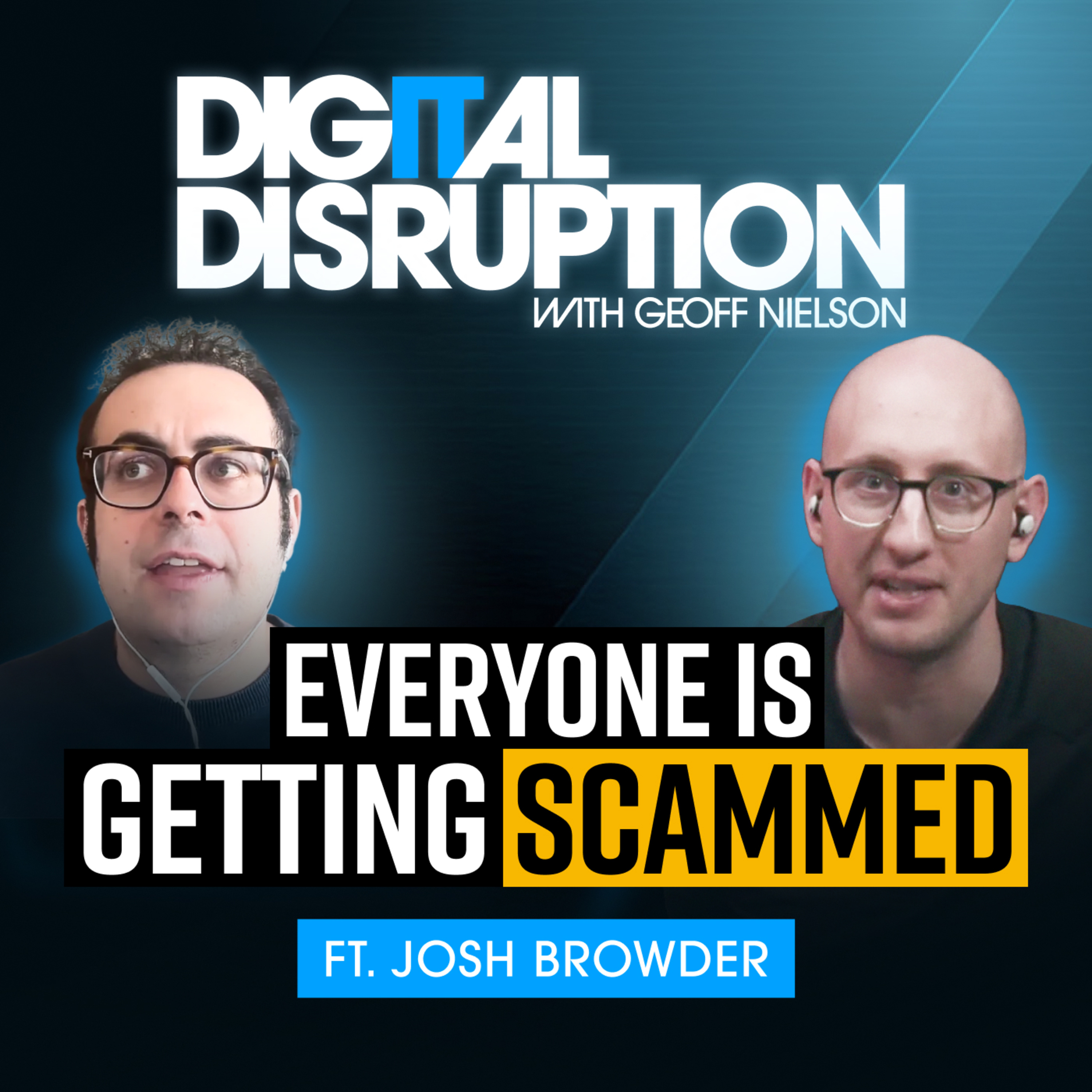
Digital Disruption with Geoff Nielson
The World's First AI Lawyer: Josh Browder on the Anti-Scam AI You Need to Know
00:55:47
Loading summary
Transcript73 lines
- [00:01]
A
Hey, everyone. I'm super excited to sit down with Josh Browder, founder of DoNotPay, the world's first AI lawyer. He's also an AI angel investor and has worked with some of Silicon Valley's leading venture capitalists. I'm not typically big on profiling individual companies, but what's interesting about Josh is that he uses AI to help people fight back against predatory and exploitative practices by big companies. Think cable bills, think parking tickets, think canceling subscriptions. I want to ask him about the most predatory behaviors. We need to be aware of how this landscape is evolving, but most of all, how to save money and get money back. Let's find out. Josh, super excited to be talking to you today about really all of the good things that I can do for people. And, you know, there's a lot of conversation right now. There's this narrative about, you know, big tech and all the ways that AI is sort of, you know, consolidating power or it's helping big business. You have a little bit of a different perspective about the potential of AI to help, you know, the long tail of folks, you know, the every man or every woman here. You know, maybe you can start by painting me a little bit of a picture of some of the challenges or pains that people are facing in their daily lives and the opportunity that this technology brings.
- [01:19]
B
Thank you so much for having me. I've been exposed to this world by accident. I've started my company 10 years ago. It's called Do Not Pay, and it helps consumers fight for their rights. I should mention, it's not only a company, it's a lifestyle about fighting against big companies and governments. And I started the company by accident because I got a large number of parking tickets. And I realized that the government and these large companies were really exploiting people. And it started with just templates, but now we're using a lot of true AI to help people fight back. So, for example, we have robots, they go into someone's utility bill account and they start negotiating someone's cable bill down. And what's interesting is the big companies are using AI and we're using AI. So sometimes it's an AI versus AI negotiation. And I think this is a great example of the broader trend of AI can be used to help people. And it can also be used, unfortunately, by these big companies to squeeze money out of people. And so we want to fight fire with fire and fight back.
- [02:24]
A
That was exactly the phrase that came to mind, the fight fire with fire, because it doesn't necessarily seem like a fair fight. And I certainly have been in a situation where you feel like, oh, you're being exploited in some way, or you just don't have the time or you end up paying for something just to make the problem go away. The this is such a broad landscape of like any sort of interaction it could be with, you know, either people and private businesses, with the government. You know, in your mind, Josh, you said you've been doing this for ten years or so. What are some of the most sort of compelling use cases for this that you really think there's an opportunity to push back on?
- [03:03]
B
So there's so many more broadly, there's so many areas of people's lives where the big companies know there's this, there's this problem in society of concentrated benefit and spread out harm. And what I mean by that is Comcast or any company like it can charge a million people $10. They make $10 million. But the people being charged $10 don't have the time or the resources to fight back. And that's a great job for AI because you don't have to pay AI, it doesn't have to sleep. It can work very cheaply and efficiently on behalf of consumers. And there's all sorts of rights and rules that people have that they didn't even, that they don't have the time and the energy or the knowledge to get back money for. So I'll give you one concrete example, which is perhaps my favorite do not pay feature, which is called roborevenge. And there's this amazing law in America. It's called the Telephone Consumer Protection act. And it allows consumers to get up to $1,500 whenever they get a spam call. And this is an amazing rule. And if everyone enforced this, I don't think there would be any spam calls. But no one has the resources to get that money. And one of the reasons people don't is that when you get one of these spam calls, as I'm sure you can attest, they give you fake names and fake numbers and they don't even say where they're calling from. And we've built an AI trap to fight these spam callers. And the way the trap works is it's a special do not pay credit card. It's not linked to the consumer in any way. And when they phone you up and try and sell you the cruise with the spam call, you can say, I'm very interested. Here's my do not pay or you don't Say here's my do not pay, here's my card number. And you give them this special card and through the payment network, it gets their business name, address, phone number, and then it generates a letter automatically and sends it off to the right place to get you that $1,500. So it's like a honey trap. And we have users. It's their, no exaggeration, their full time gig, just getting money from robocallers whenever they get a spam call. There's even one guy, he bought a new house roof for his house in New Jersey. He's made so much money. And I like AI is empowering people to almost be their own regulator and own vigilante, to fight back against all these problems.
- [05:27]
A
So I want to dive a little bit deeper into that because it's really easy for us to fall into the conversational trap of AI as just this sort of broad umbrella. And Josh, you mentioned a little bit earlier that this started with templates and it sort of evolved. So when you say AI and talk about what AI can do, you know, is this, you know, dynamic template generation through generative AI, is it sort of having agents? What's. What is it, is it passive? Is it active? What does this actually look like in practice for some of these situations?
- [05:58]
B
Yeah. So the very first use case, so I'll use the excuse, I came from the UK to study at Stanford and the Americans drive on the other side of the road. So I'll use that excuse. But really I was a terrible driver. And so I was getting all of these expensive parking tickets and I couldn't afford to pay them. They were like $300 each, very, very expensive. And so I became an accidental expert at how to get out of tickets. And the way I did that is I did a freedom of information request in various cities. And I looked for the top reasons why parking tickets were cancelled. And so my initial version of Do Not Pay, it would match you to one of those reasons with a template, put in all the details and then send it off to the right place. And I didn't expect anyone to use it. I literally just sent it to like 10 of my friends. And one of them wrote a blog post about her experience. And she's a very good writer, but usually her blog posts maybe get like 500 views. In this case, it went internationally viral. It went to the front page of Reddit and I went from 10 people using it to 50,000 people almost overnight. And the initial version of the site user, you choose a template and then it would send the letter. But all these 50,000 people using it, they didn't know which template to click. And they didn't know that there was like a college student behind this. They thought it was like some big company. And so they'd write into support with all these questions about which template to pick and other problems they would have. And I actually, even in 2016, 2017, a few years in, I decided I want to make it, wanted to make it a chatbot. And the reason for that was I can have an open ended input so people could put in their reason why they were unjustly treated by parking tickets. And then some of the other use cases we had at the time and then the software would match you on the back end. And so Do Not Pay was actually one of the first mass market consumer chat bots. And it seemed crazy at the time. People weren't really used to interacting with a chatbot. And now people use chatbots every day with ChatGPT. But it was very novel back then. So that was the kind of initial version and over time it's become much more sophisticated and AI has helped us solve a very key problem, which is that what happens when the government or the companies respond and you need to respond back and, and parking tickets is an asynchronous dispute. You submit it, it goes into a black box and then it comes back. But most of the really exciting things to get money for people are synchronous. Imagine you're chatting with a Comcast chatbot, or you're chatting with an airline chatbot to get a refund and things like that. And that's why where AI is incredibly useful, where you can respond instantly. So we've gone from helping people save $100 in parking tickets to thousand dollars disputes with airlines, and we're even doing tens of thousand dollar disputes with medical bills. And that's really helpful. And the big breakthrough that we've made in the past six months is about two or three years ago we started doing the synchronous disputes online. Now we're doing them a bit over the phone as well. So AI is finally getting convincing enough that we have phone robots phone up. And I've got all sorts of funny stories around that and helping people. And so Jeff Bezos has a great quote which is consumer expectations are constantly increasing and it's exciting. The technology is giving us all these opportunities to build these products. But at the same time, people are expecting a lot more from us than they did 10 years ago. Because now you could just ask chatgpt to write you a parking ticket appeal letter.
- [09:40]
A
If you work in it. InfoTech Research Group is a name you need to know no matter what your needs are. Infotech has you covered. AI strategy, covered. Disaster recovery, covered. Vendor negotiation, covered. Infotech supports you with the best practice research and a team of analysts standing by ready to help you tackle your toughest challenges. Check it out at the link below. And don't forget to like and subscribe. So what's the implication there then for what you're doing? I mean, it sounds like your, you know, what you've been doing has been like evolving pretty rapidly. You know, how does the chatgpt of it all, you know, fit into what you've been doing and how people are using your services?
- [10:23]
B
I think AI will lead to a much more efficient world. There are a lot of big companies that make huge revenue and profit just from dark patterns where they people know that they don't have the time to or energy to cancel or switch to a different plan. It's an open secret that if you phone up a company and say I'm thinking of canceling, they're going to give you a discount and they should just give you the discount to be nice to begin with because we're in a competitive market and they have competitors, but they know there's so much friction and bureaucracy that it takes time to switch. So the optimistic view is that AI will lead to a much more efficient world. And then there's also customer service costs. If you buy a plane ticket, about 10 to 20% of the cost of the plane ticket is actually going towards customer service. And so AI can even make things more efficient on the big companies end. And in fact, when so Do Not Pay was launching city by city, even with parking tickets. And npr, the radio station, asked the head of the Los Angeles Parking Ticket bureau what he thought about a service I do not Pay. And you would think that they would hate it because it would take revenue from the government and they do. But he did have a positive spin on it, which is people write such nonsense in their parking ticket appeal letters. At least when it comes from a service like Do Not Pay, it's efficient and streamlined. And so I think even the companies can benefit from an efficient world where they don't have to jack up the prices by 10 to 20% because they're paying for all this expensive customer service. Now whether all of that benefit flows to this consumer is probably unlikely, but at least some of it will.
- [12:02]
A
So with that in mind, I'm curious, you know, I Love the optimistic view that everything is more efficient and everybody has money in their pockets. Since you've been doing this, have you seen any response from some of these big organizations, like, is this enough of a risk to them that they're starting to revamp some of their, you know, their own processes so that, you know, they're either AI proof or they're making it more difficult to, you know, for people to use this either synchronously or asynchronously.
- [12:31]
B
So we take a very humble view to our product. We have over 250,000 subscribers, which is great for us as a very small team. And we've had a big impact in those people's lives. But it's a drop in the bucket to the grease and exploitation going out there. And the biggest statistic, I would say, is New York city alone make $1 billion a year just from tickets alone. And so we like to think that we give our customers almost an unfair advantage. And we take the view that not everyone is going to be a customer of Do Not Pay. And so those that use the AI tools and more broadly, there's still a lot of people who don't even know what GPT is, if you can believe it. And so especially our customer demographic. And so we, we would have to be like 100x bigger to have companies start changing their processes. But I will give you one concrete example where a company changed their process. We have a product, it's called the Free Trial Credit card, and it uses AI to help people manage their subscriptions and stop people from getting sucked into all these things. And one aspect of the product is there's a special credit card that you can use for any free trial. And it gets you through the free trial thing because it's not linked to the consumer. It's linked to do not pay. But when the subscription comes time to renew, it automatically cancels the free trial. And we were signing up so many people for so many. And that's the way it should be because most people, they give their credit card details and they forget and they don't get any value and it just renews every month. But we were signing up so many people for so many free trials that a lot of big companies started ending their free trial program. And actually, we were very humble, but we actually like to take some credit in actually Netflix ending their free trial program, because just before they did so, we were doing so many Netflix free trials. It was crazy.
- [14:32]
A
It's interesting, and that's sort of a multifaceted one, is that A good thing? Is that a bad thing? I mean, it's certainly good that, you know, consumers are not being exploited anymore. And I've encountered that plenty of times in my life where it's just, you know, I signed up for, like, a sports channel because I wanted to watch the. I wanted to watch the World Series this year. Toronto was in it and I didn't have it. And so I signed up for this package. And, you know, the next thing I know, I've forgotten and they, you know, they're billing me month after month and it's just, you know, I've forgotten to do that. So, I mean, it's interesting and it's compelling. And I wonder, you know, to what degree people are going to be reshaping these models.
- [15:13]
B
Yeah, and we definitely ruffle some feathers. We send a lot of data deletion requests. So there's all these privacy laws that allow people to stop data brokers from selling their data. And we sent so many to one data broker that they actually tried to, like, take legal action against us because they were getting so much do not pay. So it's like David versus Goliath. They're constantly being squeezed on all ends. But we're typically more motivated than the average big company executive or engineer. So being motivated takes you a long way, right?
- [15:49]
A
No, that's. That's awesome. It's a, it's a noble calling. I wanted to come back to, you know, one of the examples you talked about, which is medical bills, and just, just that these are one of the, you know, the bigger scope problems that you solve for people. Can you give me a little bit more flavor in terms of what that looks like? And I imagine that's mostly in the U.S. but how much wiggle room is there? What are some of the predatory tactics that you're seeing insurance companies or medical providers actually download onto their customers? And how do you support them? Saving money?
- [16:28]
B
Yeah. So there's this amazing new law, it's called the no Surprises act, and it allows you to. Allows consumers a broad range of rights to negotiate their medical bills. And first of all, a lot of these hospitals and providers are unfortunately run by private equity firms. And the second that anyone does any sort of pushback with the bill, most people who get a medical bill will tell you this. They'll knock off 30% just from the initial negotiation and just as like a negotiation tactic. And so I would advise all consumers through online service or just themselves to push back on any medical bill they receive. Because what we're seeing is a Lot of big companies will just reduce it almost immediately. In terms of some of the more shady tactics, there's something called upcoding. Upcoding is where the provider will say you had an, like a full kind of arm examination, but really they just look to your wrist, and then it's triple the price and things like that. And then the final thing I'll say is that the no Surprises act almost allows you to do comparison shopping between hospitals. And if one hospital is charging you three times the price for a procedure that the hospital down the street is charging you much less for, you can dispute that. And if the provider disagrees, you can actually go to an independent panel to keep disputing it. And the big companies, they don't have time for that. Once you know your rights and you push back, they typically are very amenable. And we like to joke internally, it's actually sometimes easier to get a big discount, tens of thousands of dollars on a medical bill than it is to get out of parking ticket, because these companies have so much margin, and they know that the slightest negotiation, they'll take some off. So that's very exciting. Well.
- [18:17]
A
Well, it is. And you know that. It's exactly where I wanted to go, Josh, which is, you know, for the average person, I mean, a parking, you know, a parking ticket could be, you know, 50 or 100 bucks in terms of money saved. Call it in 2026. What do you see as the biggest kind of opportunities for the average person or, you know, a few different scenarios for the biggest opportunities for people to actually save the most money from some of these practices?
- [18:46]
B
I think the next area we're looking into is property taxes. Everyone hates property taxes. And that's even bigger than medical bills in some instances because everyone gets it who owns a property every year and the way they do, some of these valuations are very kind of dubious, and it's a big money driver, and you just have to follow the money. And so kind of automating property tax disputes is probably our next biggest area of focus. I will say, though, there's all sorts of interesting technical challenges that we're dealing with as well for these more advanced use cases, and I'm happy to go into that. But, like, even handling these phone conversations is very interesting.
- [19:35]
A
I'd love to go into that either for the advanced use cases or just some of the technical challenges. I guess for me, what's interesting, Josh, is not just the technical challenges, but some of the technology that's out there and the way that you're able to overcome some of these challenges.
- [19:50]
B
Yeah. So with AI at Do Not Pay, there was really three waves. So the first wave was when GPT2 came out. And this was actually before ChatGPT by a few years. And this allowed technology to have a conversation in and pass the Turing test, in a sense, where you could connect for businesses. You could loop it into OpenAI and then you could build your own bots. And that was very helpful for us for jumping through these hoops that required a human like interaction, like chatting with the New York Times to cancel someone's subscription. But the problem with that was it didn't really reason very well. It was very dumb. You, if you remember early ChatGPT, you could still kind of tell it was a robot. And one example would be like, the big company would say, I'll give you $10 off. And then the robot powered by GPT2 would say, that's fine, I'll take it. And we wanted to do better for our customers. ChatGPT and GPT 3 and 3.5 and 4 came out. And that was a step change. So that was really the second wave. And all of a sudden these big companies were saying, I'll knock off $10 off your bill or more advanced use cases. And the GPT said, no, I reject that. I want to do $100 off or I'll cancel right now. And that's really what enabled these more complicated use cases, like medical bills. But there was like a modality problem where it was still over online chat. And it took about two seconds for all of the technologies to kind of loop in together. You have the kind of processing of what the company is saying and then you're processing the response. And it took about two seconds. And this was good enough for online chat, if you can imagine. Two seconds is a convincing amount of time for a consumer to be typing frantically. But it wasn't good enough for phone calls. And everything really changed about a year ago when GPT4O came out for two reasons. Firstly, the latency, like the speed it took for the AI to respond decreased by 80%. And then also the cost of the models decreased by 90%. So now it's like 90% cheaper to operate the same thing. And that allowed us to start doing these phone conversations. And we've had big successes with the phone, but we've also had interesting challenges. And I'll give you one example. About a few months ago, we were doing one of our first utility bill conversations over the phone. And we instruct our AI to never lie because we're established business with liability purposes. It has to be always truthful. And so the AI phoned up this cell phone company to negotiate someone's bill, and it said, hello, I'm the assistant to so. And so I'm calling to negotiate the cell phone bill. And it didn't say AI Assistant, but it said assistant. And the human agent on the other end said, okay, I understand you're the assistant, but what's your name? And this was a big challenge for the AI because it didn't have a name. And so it was very confusing, and it was relying on its instructions to never lie. And so I said, no, you. You don't understand. I'm the assistant. And this went back and forth like three times. The human agent said, no, I understand you're the assistant, but what's your name? And went back and forward, back and forward. And we were watching this in real time because it was one of our test cases. And the AI said, you can call me Alex. And it came up with this on its own. And so it wasn't technically a lie. It was just an interesting way of solving the problem. And so I think the reasoning models are getting very sophisticated at solving all of these constraints where you want to represent someone very efficiently, but also you want to be truthful and comply with all the laws. And so those are the type of problems we're seeing.
- [23:52]
A
Yeah, it's interesting from the perspective of what you're doing with Do Not Pay, but it's also just interesting to see what this technology is doing and some of the logic goes going in there as well. You mentioned that the next frontier for you is property taxes. And that's an interesting one because I. And I mean, it's a takeaway for me. I never thought about property taxes as something I could dispute, but now I'm like, huh, maybe I can dispute property taxes. But I'm curious, Josh, are there any other sort of wish list dispute items that you would love to be able to help customers with?
- [24:27]
B
Yeah, I tell my team, and by the way, the team is like the people who, like, Browse Reddit at 2am Looking to scale up their own hacks. We, as a broader product level, Do Not Pay is trying to go from proactive usage, so someone goes and has a parking ticket or an airline dispute or a utility dispute to kind of retroactive usage where you just wake up and do not pay. So I solve you. I saved you money. I noticed there was an outage while you were sleeping with the Internet, and I already got you a $20 compensation for that. And so even across our existing product base, this is kind of the year of just making do not pay more passive. Almost like an insurance policy about being ripped off so that consumers don't even have to go to us with these issues. It just has all your information and it kind of gets you these refunds in the background. We're trying to be like AAA against the establishment.
- [25:23]
A
The that's really interesting to me. And once you can crack that sort of passive nut where it's just like it's not an assistant that you necessarily have to prompt every time you want them to do something, but they're out doing that, that seems like a big, very exciting frontier when you think about that. Josh, Is that something that you think you'll be able to see in 2026, 2027, or is that like, you know, dream territory?
- [25:55]
B
Well, it's kind of like Tesla full self driving. It's. There's some aspects that are available today and some that come soon. One aspect that's available today that I recommend everyone does is there's a concept called unclaimed money. So if consumers move address, sometimes they're owed a refund because they overpaid their car payment or utility bill payment. And so you would think that the companies have to track you down to send you that money. But eventually they send you the checks and it goes to your old address and so it doesn't get opened. And so they send that money to the state governments. And so there's about $20 billion just waiting for consumers to be claimed in various databases that they're owed tax refunds is another one. And so we built a product that the consumer gives their name and date of birth and it constantly checks the these databases. And that exists today. And actually found me some money. I was owed $150 by Chase because when I was at Stanford I overpaid one of my car payments. And so that's just one example of creative ways. And it's really unfair that governments are just holding this huge amount of money. In fact, one in seven Americans have this unclaimed money and AI can go and find it today for people.
- [27:18]
A
That's awesome. And yeah, again, so much of it seems to be coming back to just putting money back in people's pockets, which is really tough to argue with and feels like sort of a no brainer. I'm curious about potential industry disruption you see coming from this use case, from AI in general. One of the areas that sort of abuts what you're doing here is just the legal industry and the use of lawyers. And so I wanted to maybe ask you when you think about the impact right now on let's start with legal and we can kind of branch out from there. A lot of these new tools and tactics that people are using here with AI, do you see it replacing traditional lawyers, traditional engagements with law firms? Is it just opening up a pocket of value that wasn't previously accessible to people? How do you see this space changing?
- [28:16]
B
So do not Pay. My thoughts on this have really shifted. When I started, I was like overly optimistic college student and I thought that AI would replace all lawyers. And I think maybe one day it will. I do believe in kind of these advanced AI systems and AGI for professional work. But in terms of what Do Not Pay is doing, it's really an underserved area. There's no lawyer who's going to get out of bed to help someone with a $20 Comcast refund and Do Not Pay. Ironically, we spend a huge amount of money on real lawyers for compliance to comply with all these state bar regulations and all these disclaimers that AI is not a lawyer and all this stuff. And that's really important for us. And I think we've reached a good balance now where we, we're just helping being a consumer advocate. The lawyers are unfortunately the people who write the rules. And so they will ironically be the last people to be replaced. Interestingly, I think software engineers will be the first to be replaced, even though they were the ones who created this AI wave in the first place. I joke with my friends that I left college at the absolute peak of the computer science industry. It was only that downhill from there. There are a lot of interesting companies in the space. There's like Harvey, which is helping lawyers become more efficient, and others. But really these are just tools for lawyers to save the lawyers money. And there hasn't been a kind of AI law firm because of all of this regulation, or at least one that's been widely mass market successful.
- [29:54]
A
So let's pivot then maybe to COMPSCI and software development, which you flagged as kind of an area ripe for disruption and is interesting given your background there. Can you tell me a little bit more about that perspective and how it's impacted you as someone who is doing some version of software development professionally with Do Not Pay.
- [30:20]
B
So at the beginning of the call I mentioned that Do Not Pay is a lifestyle and addition to being a company. And we really take the Do Not Pay approach even to our own internal Operations and AI has really helped us with that. We're only a team of 14 people and we're servicing this huge subscriber base and we try and be in a very efficient and profitable business. And we're actually one of the first VC backed companies to pay dividends and AI has allowed us to do that. And the way it works is it's like integrated throughout our customer support and product development kind of life cycles. So for example, someone emails customer support and they say I had this bug problem. And we actually have an AI that monitors all usage from all customers and can link it to the customer support ticket, figure out the issue and summarize it without us having to spend an hour figuring out what the actual bug is. Then we use like many companies, Claude code to actually get the solution much more quickly and probably replaces like three times the amount of engineers that one engineer can do. And so automating customer support and actually rope fixing of bugs has been incredibly helpful for us and it's allowed us to kind of stay on top of this huge customer base and like someone writes it to us and say, and says unfortunately I lost my parking ticket dispute or something like that. The AI has pre drafted a response and one click send the response and automate with the billing systems give them a refund. And so it's even making us a lot more efficient as a company and allowing us to be very lead.
- [32:02]
A
Right. So it's an efficiency play in your mind. It's helping developers do even more or helping the customers do even more versus like a wholesale replacement of the industry.
- [32:14]
B
Yeah. And everyone always asks me what do I think about the future of jobs and with AI. And I'm very, very optimistic about this because the job that I'm doing today didn't exist 10 years ago. Nothing that do not pay is built on even existed 10 years ago. Even our customer acquisition strategy. We get 95% plus of our customers from referrals from Google search and increasingly chatgpt even. And 20 years ago or 25 years ago that didn't even exist. And so AI is constantly creating new opportunities for people. And actually I'm an angel investor in some companies. I'm trying to pay forward my entrepreneurial journey. And there's one company I'm an angel investor in called micro one and they pay people to train AI models and there are people making $500 an hour teaching AI what to do. And there was a recent article that this industry alone is projected to be a $1 trillion industry over the next few years. A brand new industry of training AI. And the world is constantly changing and as humans our experience is unique and so this is not going to go away. A lot of people say, well once the AI is trained then that will be done. But, but the world is constantly changing so you're constantly going to be needing people to update the AI. So maybe that will be our job. And also doing a fake economy within video games, but that's a whole separate issue.
- [33:46]
A
So how does the training AI piece work, the getting paid for it? Because that, I mean if you told me that and I didn't know you or anything about you, like that sounds an awful lot like a scam to me of, you know, make $500 an hour from your home, you know, training AI. What, what does that look like?
- [34:02]
B
No, it's a big industry, there's multibillion dollar companies. The best one known one is a company called Scale which meta acquired at $28 billion valuation. And the training of AI models has really evolved over the past few years. So it started out with telling AI this is a traffic cone. And actually the self driving companies were the first customers of Trust Training AI because you had to tell the AI this is a traffic cone, this is a stop sign, things like that. Now it's getting much more sophisticated where if you're an English professor or a nuclear engineering professor or an expert at law even you need to reinforce and refine the AI model to make it better. And that's why Chat, GPT and Anthropic Claude are getting better. It's because they're hiring millions of people literally to train these AI models. And there's companies that provide infrastructure providers that provide to them. And so it is very much a growing industry and a lot of people are working in this field.
- [35:12]
A
Oh. And it sounds like, if I'm understanding correctly, that the price tag is a result of, of like you're paying for the expertise that specific people have. Right. Like it's not like you're going to quit your job flipping burgers to train AI and that anybody can do this. It's access to very specialized knowledge. Is that right or no?
- [35:31]
B
Yeah, well the most exciting thing about this is that the AI companies have so much money, like OpenAI, but I think it's now valued at close to 800 billion. They want to make their AI model good at everything. And so even if you're good at the piano, there are AI companies now paying you to record a video of you playing the piano. And actually the most important example I would say is folding laundry. That's the big one right now. You would think billions of humans have done it over the past centuries folding laundry, but there aren't actually that many high quality videos of people folding laundry. So AI companies, maybe not $500 an hour for the laundry example, but certainly $60 an hour. I know of a real example of AI company paying people $60 an hour to fold laundry, where the camera is very zoomed in so that AI robots can one day do our laundry. And I will say 2026 will be the year of robotics. So the previous years was about online intelligence, but now I think it's moving to the real world. Wow.
- [36:38]
A
So from your perspective, basically anybody who's looking for work or looking for or is potentially in a low skill role, you see there's value in at least exploring training AI as an income stream. Or is that too broad a statement?
- [36:55]
B
No. And there's thousands of jobs listed online where someone can sign up. And this is actually probably one of the biggest employers in some developing countries like the Philippines as well, where people are making triple the minimum wage training these AI models.
- [37:13]
A
That's interesting to me. And I mean, I guess it can't go on forever, but if I think about it in terms of its sort of logical extremes, I mean, it's interesting to me because it has an opportunity to really disrupt a lot of traditional industries, at least in the short term, if it's creating a flight from what people are doing now to basically this glut of capital in AI right now and just bringing all these people to do this lucrative low skill task.
- [37:45]
B
Yeah. And I think understanding how the AI models work is why I'm so optimistic. So the way ChatGPT is trained is just a statistical model that predicts what's the next thing to come. What's the next word to come? You know, if you ask it a question. And the way they've trained it is they've taken every book, every TV show, every online website that they have access to through copyright or that they legally have access to, I should say, and they feed it into this model. The problem is that humans, the AI, is almost a reflection on ourselves. And not all of human history is good, and not all of online content is good. And, and so the AI is like this monster that has to be contained and you have to say, oh, well, this is actually not correct history. This is actually a conspiracy theory. And that's why everyone has to go in and all these data training people have to go in and clean it up.
- [38:42]
A
Yeah, well, and that's a big job and it's a contentious one. Right. Like being able to answer what is true, what is good. I don't know. That's like, I don't know the best way to do that. I wish I did, but it feels like that's more contentious than ever these days.
- [39:00]
B
Yeah, well, some things are non controversial. Like just the right way to fold the laundry is good, but definitely on the content moderation side. And I wouldn't want to have that job of all of that stuff. Yeah.
- [39:14]
A
So I'm curious, Josh, coming back to Do Not Pay. So you. It's interesting to me because the spirit behind it is sort of very anti big business in a way, which is all well and good. It's interesting to me because I feel like you've been able to attract some really big individual and institutional investors to Do Not Pay. Whether it's the Andreessen Horowitzes of the world or Greylock or Peter Thiel, or executives from know places like Adobe or Coinbase. What do investors see in this? And do they see it in any way as sort of a threat to what they're doing or what attracts some of the bigger names or deeper, deeper pocketed folks to a tool like this?
- [40:04]
B
I think it's. I think venture capital is incredibly useful. When I was thinking of starting Do Not Pay, I was really, I'm just like an anti authority warrior. And so I was even considering it, making it a nonprofit. And I had a pivotal breakfast with Marc Andreessen, the founder of Andreessen Horowitz. And he really convinced me to make it a company. And the reason he convinced me is because the biggest organizations that we see are typically for profit companies because you can just have a bigger impact. I guess that's just how the system works. And I think venture capital plays a really important part of that system. And, and actually Andreessen Horowitz just came out fairly recently with their latest fund. And the motto of their latest fund is everyone in a fair society, everyone deserves a chance to build something big, regardless of their background. And that's really the opportunities that they give. With that said, though, I think it's really important to align the venture capital. Venture capital is a lot like AI. You have to kind of contain it and Do Not Pay. We've been very frugal and very responsible, and maybe it's because I'm from the uk, but we're not like one of these bubble companies. So we tried not to raise too much and that really helped us a lot. And so it's given us control of the company still and we don't have outsized expectations. And we can run it like working for our customers and building an efficient business. Because you see some companies, they raise hundreds of millions of dollars or even billions of dollars and then they shut down. And I've been doing this for 10 years and I tell every candidate who joins do not pay on the employee side. Like we're going to be around in 100 years. We really believe in sustainability. So you've got to not. It's a useful tool when used in moderation, just like with most things in life.
- [42:00]
A
Yeah, no, I love that mentality. It absolutely resonates with me. I'm curious, do you spend any time being kept up at night by either like a Google or an Apple or one of these kind of device providers and platform providers just saying, wow, this is such a good idea. We're going to try and make our own and bake it into our platform.
- [42:24]
B
So there are some things that DoNotPay does where it's more just pure assistant based. Like a few years ago we helped people automatically get appointments from the dmv. And I think that assistant based tasks will ultimately just be rolled into Alexa or Siri or any of the AI tools or perhaps even ChatGPT. So we constantly have to be on our A game to build unique products that aren't available elsewhere. On the other hand, we really about biting the hand that feeds a lot of these companies. In fact, Comcast is one of Google's biggest advertisers. So do I think that Google is going to build an antagonistic robot that helps people fight Comcast? Probably not. And actually when a lot of these companies build these products, it's integration based. So ChatGPT has an integration, it's called GPTs where companies like Do Not Pay or even Comcast of the World or United Airlines or others can build things on top of these platforms. And is Planet Fitness going to build an AI tool on top of ChatGPT to help members cancel their own subscriptions? Definitely not. And so I think that there's an antagonistic angle that we take that few people are going to do. And then the last thing I'll say is that the largest companies like Google are working on building robots to have in the household and self driving cars and the latest AI models. This is almost beneath them. And so that's why there's a unique role for a company like Do Not Pay.
- [44:04]
A
That makes sense. It's interesting and I love the sort of subversive, antagonistic view of it. I totally get it and I get the argument about why some bigger organizations may not be into that. I'm curious, do you have, from your 10 years doing this, do you have sort of one or a few favorite stories of people saving money of just like whether it was surprising or it was a large amount of money or just like something that was sort of eye opening in terms of you didn't expect it, but had just a really good feeling about how the tool was used?
- [44:41]
B
Yeah, we see some crazy stuff. There was one, one dispute where a consumer was trying to get their security deposit back and the consumer told the AI, my landlord logged into my tax refund site and said, you have so much money, you don't need the deposit back. This is a crazy story and there's a few problems with that. Firstly, there's all these rights that people have and if the landlord doesn't give you the deposit back, you can get three times the amount of money. But even beyond that, the landlord like logged in to the, with the, with the rental application. I guess he had like a lot of Social Security details and things like that. He logged in, which is like a huge, huge issue. And that kind of got escalated and actually the landlord got indicted by the Department of Justice. Wow. And so it's very interesting all the things we're seeing. We also have, unfortunately a lot of homeless people use our product because they get parking tickets in their car. And we get a lot of notes about that. But we also have incredibly, we have actually extremely wealthy people use our product. We're very big on user privacy, so I won't mention explicit names, but like literally billionaires who are using our product to save $20. And I think that speaks to the value that we offer. It's not even about the money for some people. It's about the justice, like the feeling, the emotional justice of being ripped off is like so bad that people will fight back and use it. And I actually have a broader thesis that the best companies tap into some core human emotion. So like Robin Hood would be greed or polymarket would be greed. The dating apps would be lust and do not Pay. It's really about justice and anger.
- [46:32]
A
Yeah, I completely buy into that. And it's funny because that, that actually aligns fairly well with some of the wealthier people I know and that quest for justice. But I think, I mean, it's a huge motivator, right. If you feel that you've been wronged in some way and the word that keeps Coming back to me for this behavior. It's predatory on the part of some of these organizations. Right. And they're taking advantage of the fact that people don't have the know the resources are in a lot of cases just, you know, strong enough will, I guess, to put the time and effort into this, that if you're changing the calculus for doing that, you know, I'm very hopeful. I want to be very hopeful that that'll change some of these business practices.
- [47:20]
B
Yeah. Even if it doesn't change, at least it will get people money back. It's amazing that in 2026, some gyms still make you send a signed letter to cancel your gym membership. And how has the government not stepped in to stop something like that? And actually a lot of our work is connecting AI to the Stone Ages. We literally have AI generate faxes sometimes because that's one way to cancel AppleCare, for example. And so I'm not so optimistic. I think Do Not Pay, unfortunately is like an ETF on the world's problems. And it seems like the problems are only increasing.
- [48:01]
A
Right. So I mean, if you. I'll ask you a broad question, I guess, but if you roll the clock forward a handful of years and suddenly it's, you know, 20, 30 or so, what does this space look like, the space you operate in, whether it's AI, basically the interaction between consumers and businesses. What's your, what's your guess, most realistic view? And what's your optimistic view?
- [48:27]
B
The average person doesn't have to stress at all about being exploited by the big companies and the government and everything just works in the background. Someone is wanting to get a refund or something and they just do one tap. I do think that the modality of technology will change and it's not going to be in a phone anymore. Soon it will be perhaps in an Airpod earpiece or perhaps in some sort of wearable. And they just tap and it gets sorted for them and it's constantly watching in the background.
- [49:02]
A
Yeah. So are you. We talked about this a bit before. Do you see us moving toward, you know, basically a passive full time AI assistant for people that everybody just has their own. Is that where we're going toward?
- [49:15]
B
Yeah. And there's a lot of rumors in Silicon Valley that OpenAI is actually building a pen. So maybe just as you're about to sign a contract, the AI is a talking pen, according to the public reports. I have no insider information. I'm just reading what the media is saying. So one could imagine a tool. I do not Pay. Just as you're about to sign that loan contract, the pen starts talking to you. Don't sign it.
- [49:42]
A
I love the story of that. I'm chuckling because I signed. I sign more contracts personally and professionally, that I would prefer, and almost all of them. I don't often pull out a pen. It's usually I'm using a PDF or what's the other one? The online one where you have to get everybody's signatures or what?
- [50:03]
B
DocuSign.
- [50:04]
A
DocuSign, that's the one.
- [50:06]
B
The joke is there's like 3,000 people that work at DocuSign. What do all the people do? That's the joke that everyone asks in Silicon Valley.
- [50:16]
A
Yeah, well, and Docusign, to me, there was a time where I was like, what's this? And then it very overnight is everywhere being used for everything. We just accept it as a standard. But, yeah, if you can build something into DocuSign saying, don't sign this, that'll be a very good day.
- [50:34]
B
Do not sign.
- [50:35]
A
Do not sign.
- [50:36]
B
Yeah.
- [50:37]
A
Do not pay. Do not sign. Yeah, I love that. I guess. Maybe. Last question then, Josh, for you is you've talked a little bit about things you expect to see in the next handful of years, whether it's AI pens or robotics or AI assistants. What's your boldest prediction for a technological breakthrough we'll see in the next handful of years?
- [51:02]
B
I think that if you combine everything we've been talking about, the unfortunate prediction is that human relationships start to increase with robots, real robots, and people will have physical AI girlfriends and it will be very common. I think, unfortunately, the loneliness epidemic is really increasing. And so I guess it could be a solution to that, but it doesn't seem like a very good solution.
- [51:29]
A
That's a really interesting one and one of the ones that I worry about as well. Even calling it a solution feels a little bit perverse.
- [51:38]
B
I retract that, actually. No. In case it's clipped.
- [51:46]
A
Because if you think about demography and if you think about the perpetuation of human life, it feels like that could start to be an existential risk to us, which is really scary when you say, you know what? I'm having more fun talking to in any capacity, socializing with having a romantic relationship with a machine than a person does not bode super well for the future of our species.
- [52:12]
B
Yeah. And I think a lot of people, they're relying on really important life decisions to ChatGPT. There's a phrase, it's called GPT psychosis, which is. And you can kind of tell because oftentimes they'll communicate. And it's really unfortunate. I think millions of people are like, they talk to ChatGPT every minute and rely on their advice. And I think it's good for information. But I would encourage everyone to take a step back.
- [52:39]
A
So I think that's good advice. And I'm curious within. Within the scope of what you're doing with the do not pay stuff. If we can kind of flip on. Flip it on its head. And is there anything that you've seen where you're. You would advise people, don't try to use. Do not pay your AI for this. This is outside the scope of what we can do. And you're going to do more harm than good if you try and use cases where it's just not right.
- [53:04]
B
Yeah. So much of the law is not about rules and systems, which AI is good at. It's about people and emotions. And so if you imagine divorce court where people are like shouting at each other, that's probably not a good use case of AI. I think criminal defense is. Is another one. And I've been in these circles for like 10 years, and a lot of people have floated all sorts of different ideas, But I think that the human side of the law can never be replaced, and maybe that's a good job for humans. One thing I will say, though, is in 10 or 20 years, people will be laughing that someone's sentence was up to some old man. I do think that in sentencing, AI will be increasingly used.
- [53:51]
A
As a tool by judges and by the judicial system.
- [53:55]
B
Yeah. And I think the constitution that someone will still have to sign off on it, but it will be largely AI driven because it is so unfair that someone's. If the judge. There's actually a study. If the judge had like a coffee that day, it reduces people's sentence.
- [54:11]
A
Right. And that's such an interesting one because with technology in general, I think we, and maybe rightly so, just hold technology to a much higher bar than we do with people. Because what I feel and what I've heard is that if you just tap someone on the shoulder on the street and say, hey, do you want to move to a world where AI can carry out sentencing for people based on their crimes, it sounds dystopian, but if it's used in conjunction with a person and it's eliminating more bias than it's creating, it's not difficult to believe with the right argumentation and the right implementation that it could actually be an order of magnitude better.
- [54:56]
B
Yeah. So it will be interesting to see.
- [55:00]
A
Awesome. Well, Josh, that wasn't necessarily the note I thought we'd be ending on, but it's a provocative one. I wanted to say a big thank you for joining today. This has been a really interesting and insightful conversation.
- [55:11]
B
Thank you for having me.
- [55:13]
A
If you work in it, Infotech Research Group is a name you need to know no matter what your needs are. Infotech has you covered AI strategy, covered disaster recovery, covered vendor negotiation, covered. Infotech supports you with the best practice research and a team of analysts standing by ready to help you tackle your toughest challenges. Check it out at the link below. And don't forget to like and subscribe. Subscribe.