Podcast
Doha Debates Podcast
Hosted by Doha Debates · EN
What happens when disagreement is labeled disinformation?
Can aging be cured—and should it be?
After Gaza, who decides what justice looks like?
The Doha Debates Podcast brings together global voices for Majlis-style debates on the ideas shaping our world.
This season continues with the same rigorous, truth-seeking conversations in a live, in-person setting—with new episodes every Tuesday.
26episodes
Episodes
Newest firstAll episodes
A new season of the Doha Debates Podcast 🎙️
Dec 3000:00:26Tap to summarizeStart the year 2026 with us as we discuss the questions shaping our world: What happens when disagreement is labeled disinformation? Can aging be cured — and should it be? After Gaza, who decides what justice looks like? The Doha Debates Podcast returns with a bold, reimagined season, featuring Majlis-style debates that challenge you to think differently. Each week, our moderators sit down with experts to explore these big issues through a wide range of perspectives. 🗓️ First episode premieres Tuesday, January 6 🎧 New episodes every Tuesday 🔔 Subscribe and join the conversation!
Transcribe →Global order: Which principles should shape our future?
Dec 17, 202401:29:00Tap to summarizeToday, the global order is facing challenges from shifting power and ongoing conflicts around the world. In this moment of rapid change, our latest town hall sought to examine the competing values and principles that underpin our societies—and uncover fundamental truths about which philosophical building blocks are most essential to building a better, more equitable and peaceful world.Expert guests Victor Gao, Hina Khar and Vali Nasr, together with an onstage audience of students and recent graduates, joined us to explore this urgent question: which principles should shape our future? This Doha Debates town hall was moderated by journalist Femi Oke and produced in partnership with Doha Forum. It was filmed in Doha, Qatar on December 6, 2024.
Transcribe →Narrative Power: Are Western narratives promoting global justice?
Jul 16, 202401:29:35Tap to summarizeFor the greater part of a century, conversations and narratives about global justice and free speech have been dominated by the West. From seminal works of history to newspapers of record to media networks to politics to public discourse, Western voices have often been louder than the rest. And while the West has long claimed to act in the name of democracy, equality and freedom, some wonder whether it always lives up to its own ideals. Can the world rely on Western media, politics and public rhetoric to promote global justice, or is it simply furthering its own interests?At the tenth Bradford Literature Festival, speakers Fatima Bhutto, Steve Clemons and Konstantin Kisin came together alongside an onstage audience of students and recent graduates for a lively town hall exploring how this narrative control plays out on the world stage.This Doha Debates town hall was moderated by journalist Remona Aly and produced in partnership with Bradford Literature Festival. It was filmed at University of Bradford in Bradford, England on July 6, 2024.
Transcribe →
Should everything be up for debate?
May 28, 202400:33:17Tap to summarizeAt Doha Debates, we believe that debate can help solve some of the world's most challenging problems. But are there limits to what free speech and debate can accomplish? Social media has allowed more people to connect and share their perspectives than ever before. That has led to an immense amount of learning and progress—but it's also led to an uptick in hate speech and misinformation, online and IRL. Today, anyone can have a platform—but should they? Is everything up for debate, or should some things be out of bounds?Jacob Mchangama, founder and executive director of The Future of Free Speech think tank, argues that free speech and open debate are the only ways to build and secure open and tolerant societies. He thinks we should all be able to speak our minds, and says that engaging with people and perspectives we disagree with can help sharpen our own opinions or help us learn something new. Author and journalist David Stubbs says that unlimited free speech tends to favor extreme voices and that certain ideas, like climate denial, don’t deserve a platform and are “just plain wrong.” Listen to Doha Debates Podcast as these experts discuss the limits of debate and the future of free speech.
Transcribe →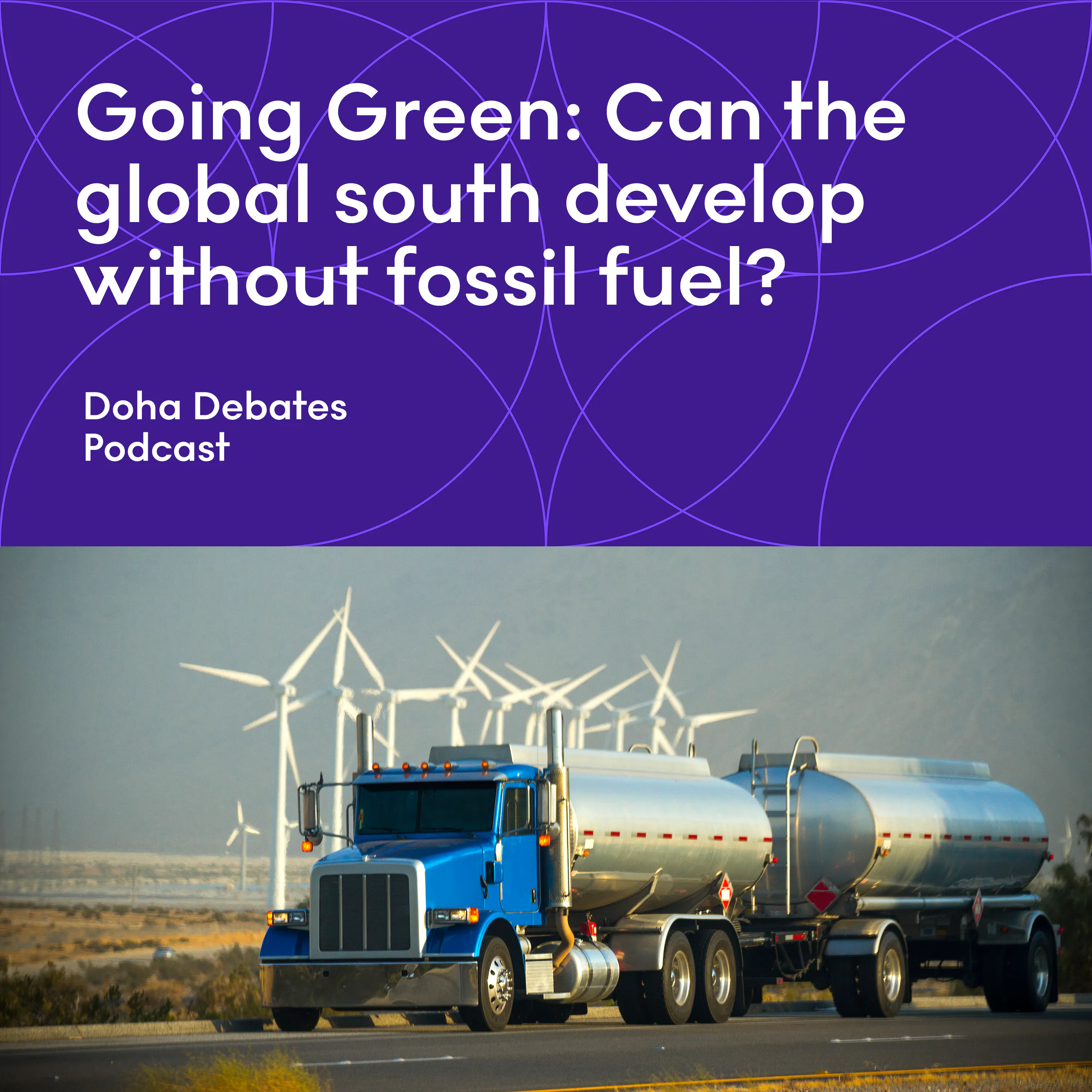
Going green: Can the global south develop without fossil fuel?
May 14, 202400:38:29Tap to summarizeClimate anxieties—and global temperatures—are on the rise. According to the United Nations, if the planet warms by 1.5 degrees Celsius, we’ll be facing irreversible climate damage. To stop that increase, we need to reach net zero emissions by 2050. Reaching such an ambitious goal means changing a lot of our behaviors, including cutting back on our use of fossil fuels. But should everyone, and every nation, be held to the same standard? Is it realistic to ask countries in the global south to shoulder equal responsibility for cutting carbon emissions?Dr. Rahul Tongia, Senior Fellow at the Centre for Social and Economic Progress (CSEP) in New Delhi and non-resident Senior Fellow at the Brookings Institution, concedes that while we must be more innovative and aggressive when it comes to the development of green technology, it’s unrealistic to cut out fossil fuels entirely. He adds that we need to decouple the idea of “access” from “clean,” and make sure there is electrical wiring in every home across the globe before we focus on going green. Zaki Mamdoo, South African environmental activist and coordinator of the StopEACOP (Stop East African Crude Oil Pipeline) campaign, says that it is entirely unnecessary to harm the environment in order to increase energy access. He says fossil fuels are actually anti-development, in that they not only pollute the air, land, water and livestock, but they destroy local economies, desecrate cultural sites and ruin labor systems and communities. He argues that all nations must refrain from new fossil-fuel use, leapfrog towards more renewable energy resources like wind and solar and embrace a just transition to a low-carbon economy. Listen to these experts discuss and dissect the best pathways to a greener world on this episode of Doha Debates Podcast.This special episode is inspired by Necessary Tomorrows, a podcast from Doha Debates and presented by Al Jazeera that combines fiction and fact to imagine better futures. To dig deeper into the core issues of environmentalism and the ethics of energy use and development, check out the episode “The Last Impala.” Listeners are thrust into a world in the near future where a climate refugee is on trial for murder—not for killing a human, but for killing an ecosystem. Doha Debates Podcast is a production of Doha Debates and FP Studios. This episode is hosted by Karen Given. Thoughts on this conversation? Let us know! Follow us everywhere @DohaDebates and join the post-episode discussion in our YouTube comments.
Transcribe →
Do race-based policies create a more equitable world?
Apr 30, 202400:39:08Tap to summarizeDozens of countries have implemented race-based policies, which factor race into hiring decisions or school admissions, in an effort to address historical traumas. Critics say that affirmative action and similar policies are counterproductive. Is it time to consider color-blind policies instead?Thandiwe Ntshinga, South African author and researcher, says it’s important to have policies that address the inequalities historically marginalized groups face in today’s world. She argues that the backlash to these policies is a result of white supremacy and a fear of losing power. Magatte Wade, Senegalese entrepreneur and prosperity activist, says that race-based policies tend to backfire and, in fact, produce more negative than positive outcomes. She argues that it’s more important to focus on the future rather than the past by prioritizing merit and economic prosperity. Listen to Doha Debates Podcast as they debate how parts of Africa are addressing race-based policies and the best way to combat racism. Doha Debates Podcast is a production of Doha Debates and FP Studios. This episode is hosted by Joshua Johnson. Thoughts on this conversation? Let us know! Follow us everywhere @DohaDebates and join the post-episode discussion in our YouTube comments.
Transcribe →