← Don't Listen To Us with Mandy Patinkin and Kathryn Grody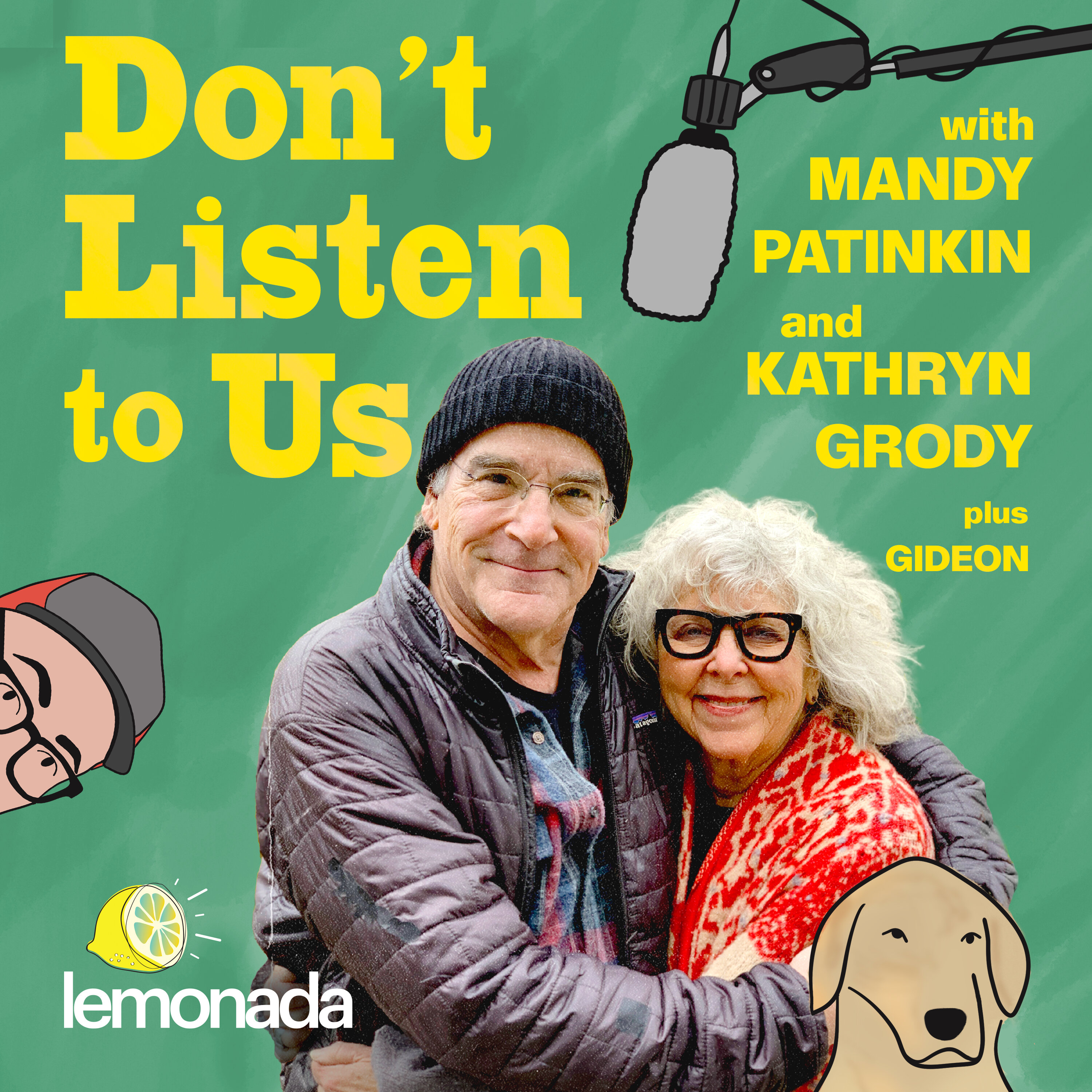
Don't Listen To Us with Mandy Patinkin and Kathryn Grody
A New Year Without Resolutions And With Lots of Songs
00:35:39
Loading summary
Transcript366 lines
- [00:00]
A
This episode of Don't Listen to Us is brought to you by Progressive Insurance. Fiscally responsible financial geniuses, monetary magicians. These are things people say about drivers who switch their car insurance to Progressive and save hundreds. Because Progressive offers discounts for paying in full, owning a home and more. Plus, you can count on their great customer service to help you when you need it. So your dollar goes a long way. Visit progressive.com to see if you could save on car insurance, Progressive Casualty Insurance Company and affiliates. Potential savings will vary. Not available in all states or situations. Lemonade. You're not really old until you're nine. In your 90s. I. I would say you can look that up.
- [01:06]
B
Anyway, so are you guys late youth right now?
- [01:08]
C
Well, I'm. I'm late middle.
- [01:10]
A
We're youth.
- [01:10]
C
I'm Dad's late youth. I'm late middle. I did feel that. I really believed that until, like, this year, I sort of went from ageless to.
- [01:21]
A
Are you old middle now?
- [01:23]
C
I'm ancient middle now, honey. I'm just ancient middle.
- [01:26]
B
You like the term elder?
- [01:28]
C
I do like the term.
- [01:28]
B
Do you like that term, dad?
- [01:30]
A
Elder? No.
- [01:31]
C
As opposed to senior, you like.
- [01:33]
B
What about oldie? What about fogy?
- [01:37]
A
What about crotchety old?
- [01:38]
B
Crotchety old.
- [01:42]
A
That's really kind of like the crotchety old.
- [01:45]
C
I think that's kind of perfect.
- [01:46]
D
That's good.
- [01:50]
B
Do you guys Remember New Year's? Y2K?
- [01:53]
C
Oh, yeah. I remember it very well. It was a very big deal.
- [01:56]
B
Do you remember why I was upset?
- [01:59]
A
Yeah.
- [01:59]
B
Why?
- [02:02]
A
Because you missed New Year's. You slept through it.
- [02:04]
B
Yeah. So I was in the. We're in Hawaii. You were performing somewhere. We had our friends there, had a family affair there.
- [02:12]
C
Yeah.
- [02:13]
B
And apparently I was taking a nap before midnight rolled around and apparently one of you woke me up and you said, come on, we gotta go to the thing.
- [02:21]
C
I did.
- [02:22]
B
And I have an interesting condition where I can fully communicate sentences if I'm being woken up from my sleep and have no memory of them. And apparently I said, just leave me alone. I want to sleep. And I woke up half past midnight in a hotel room at 14 years old, alone in Hawaii on the 2000. On the biggest 2000, the biggest one, when the world was going to end. And I was.
- [02:46]
C
Your friend. David was dressed all in black.
- [02:48]
A
You were devastated.
- [02:49]
B
I was devastated.
- [02:50]
C
David was all dressed in black and you were dressed all in white. You had coordinated your New Year's Eve outfits and you had this whole plan and you could not. You could not.
- [03:01]
E
You were.
- [03:01]
C
It was the most upset I'd ever seen you in your whole life.
- [03:04]
B
So you just left me there because you felt I'd asked you to?
- [03:07]
C
I had really tried to wake you up, Gideon. I really did. You were absolutely out of it. And then you said, just leave me. It's okay. And I said, you're gonna miss.
- [03:15]
A
You had never displayed this condition to us before. Your brother Isaac, certainly as he fell asleep on a plane. My piano player, Paul Ford, thought he died.
- [03:23]
B
Yeah, I know. I didn't think of myself as having this condition back then, but now I know that people have said they've had like entire back and forth conversations with me, waking me up out of a sleep, and I have no idea.
- [03:36]
C
Yeah, you had a friend that said, I'm having a heart attack, and you just went right back to sleep, Right?
- [03:40]
B
No, that's not what happened. The phone rang. I didn't hear it. Luckily, he rang again and I said, what's going on? He said, I'm having heart attack. And then I kept yelling to my partner while I was trying to get dressed. I kept yelling, call somebody.
- [03:58]
D
Call somebody.
- [04:00]
B
And I was so panicked. I wasn't telling her what to call anyone about.
- [04:03]
C
Oh, my God.
- [04:04]
B
She was saying, call. Call who for what? I was like, you have to call.
- [04:08]
D
Oh, my God.
- [04:10]
B
Anyway, that friend survived in very well. It's kind of an interesting honor when a friend has heart attack at your place. Really, it's a. You feel kind of.
- [04:18]
A
When I was choking to death, you were laughing.
- [04:21]
B
No, I wasn't laughing.
- [04:23]
A
You thought I was fucking around.
- [04:25]
B
I thought you were fucking around for a second. And then I. And then I shouted to the restaurant, does anyone know cpr? Which is actually not what you need. And a little. A little petite woman came up behind you. She Heimlich a salmon, came out of your mouth, landed on the table. She saved your life. At the moment the thing came out of your lap, the. A big guy pushed her, a doctor. And then started just heaving you up in the air while you couldn't tell him to come down. She was a doctor. The woman was a doctor. And he took the credit.
- [04:53]
A
That's not what she said. She said she was just a normal person and saw the Heimlich maneuver maneuver on tv.
- [05:00]
B
So moral of the story is, don't eat food.
- [05:04]
C
Yeah.
- [05:04]
B
And don't go to sleep on New Year's.
- [05:06]
C
Yeah.
- [05:07]
A
I was in the talk of the town from that in the New Yorker.
- [05:10]
B
Oh, yeah. That's how you get.
- [05:12]
A
I won't talk about anything that happened to me unless it's Been documented in a major periodical.
- [05:18]
B
Yeah, well, things to talk about. All right, I want to get to our first listener question today. This is from Jesse. And this is just an email. I'll read it to you guys.
- [05:30]
C
Oh, okay.
- [05:31]
B
Jesse writes, I've given up on New Year's resolutions. I know they're kind of dumb, but. But for years I kept doing the same one to read more books. I love reading, but it's hard with a full time job, two kids and aging parents who require some care. Who has the time? And I just end up feeling disappointed in myself. What's a resolution you've broken so many times that it's practically a tradition? And what do you do about the guilt from Jesse?
- [06:02]
A
I've never made a New Year's resolution. I can't take the pressure.
- [06:06]
B
Really? Even when you were younger?
- [06:07]
A
I can't remember any New Year's resolution I ever made.
- [06:10]
C
Oh. But you know, we used to sit around with you guys when you were little and we would ask everybody what. What you would hope for the year. You guys hated it. And I thought it was really important.
- [06:21]
A
I've seen it in movies, but I've never done it.
- [06:23]
C
No, we did it, honey. We did it at the movies.
- [06:24]
A
Remember me ever making New Year's resolution? Resolution? Every week that you're starting your diet on Monday.
- [06:31]
C
No, that's. You start your diet on Monday and you do it. And I thought what you thought about. I follow you and then when you break it, I break it with you.
- [06:38]
A
So I'm responsible for everything that goes into your mouth?
- [06:41]
C
Pretty much.
- [06:42]
A
No, you are the one who always says, come on, I'm starting on Monday.
- [06:46]
C
I do. I start everything on Monday. That's a sort of.
- [06:49]
A
I don't see it.
- [06:50]
C
Monday is.
- [06:51]
B
Monday's the New Year's of the week.
- [06:52]
C
That's right. Monday. I think I sort of agree with dad that New Year's resolutions are a certain kind of pressure and kind of bogus. Yeah. You know, I wonder if. Is it Jesse?
- [07:07]
B
Yeah.
- [07:08]
C
Do you ever try listening to books? Sometimes I find if I'm in a really busy mode or going from place to place, if I do an audio version of a book, it helps me focus on it, you know, And I usually do it if I'm driving or if I'm walking. So I can't be.
- [07:26]
B
There was a piece in the New York Times recently that in terms of reading comprehension and retention of what it is, that it's just as good listening to the book as reading, which is surprising to me.
- [07:39]
C
I'm actually having trouble reading these days and it's making me very nervous because I'm always worried about my mind.
- [07:43]
B
But you're not alone. It's the tech phenomena. I think it's reading.
- [07:47]
C
I think it is the troubling times. Everybody is really distracted and we have all these machines distracting us more. So it's really hard and I'm determined to practice.
- [07:58]
B
But if you, if you had a resolution to pick for the other person, what would it be?
- [08:05]
A
More licorice.
- [08:06]
B
That's what you'd wish for Mom.
- [08:08]
A
For mom to get me.
- [08:10]
B
Okay.
- [08:11]
D
That's a good resolution.
- [08:12]
C
If I had a resolution, I would wish. If I had a resolution for dad, I'd probably say, take a breath before you act, Jesse. I would.
- [08:25]
A
Jesse and Gideon have. Are responsible for our divorce.
- [08:29]
C
Yeah.
- [08:30]
A
Okay.
- [08:31]
C
See ya. It happened right here. It happened here on.
- [08:34]
B
Don't listen, Jesse. We'll meet up, we'll talk about it.
- [08:37]
C
Jesse, I'm glad you like me for it.
- [08:40]
B
We will.
- [08:40]
A
And Jesse, you should too. I don't know you, but you've triggered it.
- [08:54]
B
Look at what time it is. It's listener question two. Time.
- [08:57]
C
Okay.
- [08:57]
B
Okay, here's a voice note. We're gonna put our headphones in. Here's a voice note from Karen in Boston. It's a. It's not a question, but a message she's been trying to teach her family that might be relevant on this holiday.
- [09:15]
E
Okay. I'm trying to think which category my comment falls into. Triumph, perhaps, I don't know, an almost 60 year old mother of three, grandmom of two. And I'm trying to teach my 30 something year old children that forgiveness absolutely does not mean that I agree with what another person did. But rather as a gift I give myself, it is something that just releases a weight from my shoulders. And I say this because it's a family member that I had to forgive. And some of these millennials think that my sister and I are crazy for forgiving said family member. But he is our brother and we grew up with him. And you are nostalgic when you get to be 60. And although we do not agree with things he may have done, we have forgiven him so that we can go on and work on our relationship. So that's it. Have a fantastic day. And I'm pretty excited about this podcast.
- [10:27]
A
Thank you, Karen. I have a particular attitude toward forgiveness. I don't do it because I don't think it's necessary. I used to think it was the definition of Judaism, one of the pillars of Judaism. Both compassion, Rachmanos and forgiveness. And then one day, one of my teachers said to me, and it's most hard to forgive yourself. That's the hardest thing to do. And a therapist, teacher, friend of mine said to me once, what is this with forgiveness? What are you, a deity? You have to forgive yourself? Aren't you a human being? Don't human beings make mistakes? Aren't you allowed to make mistakes? Can't you just make your mistake and move on? Does everything need to be forgiven? Does everything need to be fixed? And that leads me to what I think is one of the cancers of human nature globally, is the idea of needing to fix things. You fix it, literally in the drug world with a fix in your arm. You fix it by eating to death. You run away and you fix it. You fuck your brains out to fix it. You divorce to fix it. Nation states kill each other to fix the things. Why can't you? Just as the Buddhists say, and I love this. Stay with the discomfort. Sit with the discomfort. Some things are uncomfortable. That little kid that falls down, you say to the baby, let me kiss it. Make it go away. Kiss. It's fine. Don't make it go away. It's uncomfortable. Let's learn to be uncomfortable with our differences and things that make us uncomfortable. It's okay. It's what human beings sometimes feel and do, and they don't need to be forgiven for everything.
- [12:07]
C
Okay? I think this is an example of how two things can maybe be true. Two different things can be true at once. I think you can feel that way, and it's valid, man. And you can also have a different understanding of forgiveness. I love the idea that you and your sister needed to forgive whatever transgressions your brother had committed for yourselves. It wasn't like absolving. You didn't say what he did was okay. What you needed to do was move on from whatever pain and hurt he caused.
- [12:41]
A
Is it through forgiveness or is it through accepting whatever he did?
- [12:44]
B
Well, that's an interesting question, that sometimes that line of, what is acceptance and what is forgiveness? Means things to different people. So it's interesting to hear what different conceptions of it are.
- [12:56]
A
I think everything I do is wrong. I think I'm always in trouble. I wouldn't have a minute to live any kind of life because I would be asking forgiveness 247 constantly.
- [13:09]
C
Okay? That's a global idea of how you feel about yourself.
- [13:14]
A
It's Mandy's rules.
- [13:15]
E
Okay?
- [13:15]
C
But if you screw up on a more minor way, you are capable of saying I'm sorry. And that implies.
- [13:22]
A
I say I'm sorry.
- [13:22]
C
I say I'm sorry.
- [13:23]
B
I'm curious.
- [13:25]
A
I don't say, I'm sorry, please forgive me.
- [13:27]
C
No, but it implies please.
- [13:30]
A
Well, forget it. If you ever hear me say I'm sorry again. I am not trying to imply that I need your forgiveness by now, after seven years, aren't you familiar with things that I do that are exhaustingly annoying and uncomfortable and you want to kill me for. And if I went through the whole list, we'd be doing nothing but forgiving.
- [13:49]
B
But let me ask you guys. I'm curious, Ma, what's your relationship to forgiveness? Not so much within yourself, but towards others. And how has that evolved over the years?
- [14:02]
C
I basically try. I think my. My nature is to try and understand people's behavior. That's kind of why I like acting. You know, I used to. To play different characters to understand them. So I try and understand where a person's coming from if they have ideas or behavior that is so foreign to me. There's a difference between behavior that is absolutely forgivable to me and understandable and behavior that there is no forgiveness for. I must say.
- [14:32]
B
And has that changed through your life where that line is as you. As you've grown?
- [14:38]
C
Yeah, I think as we've gotten more polarized and have more misinformation, I guess I'm aware.
- [14:45]
A
We as a couple or we as a nation?
- [14:46]
C
No, we as a nation. You know, that I feel. I feel. You know, dad had a thing at one point where he liked. He is much more open to talking to people of all different persuasions. And he finds it interesting. I would always say, well, I am open to talking about people that have different eyes, with some exceptions. I have no desire to talk to a white supremacist. None. Zero. I'm not gonna.
- [15:09]
B
What about flat earther?
- [15:11]
C
A flat Earther? I'd be kind of curious.
- [15:13]
B
I would love to have a flat earther on the show. I think that's one of the most insane things I've ever heard, and I'm.
- [15:18]
C
Dying to make that 5,000 of them.
- [15:20]
A
Well, if you look around, it all looks FL to me. If you're in Nebraska, we've got a.
- [15:23]
B
Flat earther right here. We know.
- [15:27]
C
I never knew that about him.
- [15:28]
B
Oh, God, Dad. That would be a great role for.
- [15:30]
A
Men in the movie, you know, for Boots. If Uncle Mike was here, I'd love it. Because, you know, really, if I do something that is warranting forgiveness.
- [15:39]
C
Yeah.
- [15:40]
A
And, you know, it doesn't make it go away? No, it doesn't make it go away. And what's I think more valuable is, you know, if I say I'm sorry, but I'm not asking for forgiveness, I just say I'm sorry. And then if I then try from this moment forward to do better, to not do the same thing, to just do better, but I can't take it away.
- [16:01]
C
No.
- [16:02]
A
If I shoot somebody by accident or on purpose, I can't ask for forgiveness and make it okay.
- [16:09]
C
No, that's absolutely true.
- [16:10]
A
Yes.
- [16:10]
B
And that's one of the great reasons not to shoot anybody.
- [16:13]
C
Yeah. Really. I want to address Karen because, Karen, I heard a little, I heard an attitude when you said they're millennials. And let me tell you something, I do sometimes find that particular generation rather doctrinaire and rigid in their rights and wrongs of things and not as open to nuance as some other generations. So I would say that you should say to your doubting children of that generation that feel so absolutely right about what you should do, that they should think about it a little bit. And I say you get to decide and your sister get to decide how you want to handle the past with your brother so that you can have a future. That's up to you to decide. We are complex friggin people. Do you know, And I think I have two friends in my whole long life that I no longer am in touch with, you know, and probably for things that I don't even remember what they did, you know, and. And I have a friend that I wish had forgiven me because I talked too much at lunch once and she never spoke to me again.
- [17:27]
A
I just, I just can't get off the thing. I understand these podcasts are recorded and made at different times and when they're going to be on the air, but the world is going pretty slow right now in terms of change. And I'm just saying what's going on right now doesn't need to be forgiven. It needs to be made better. It needs to be addressed and addressed and made better.
- [17:49]
D
We need to do better.
- [17:51]
A
Not forgive, not be obsessed with forgiveness. We need to do better for our fellow human beings globally. And my feeling is get rid of the need for your forgiveness and do better.
- [18:03]
B
Okay, I can totally appreciate that. And I think in your mind, I mean, in dad's mind, this is going to like a global pro television and.
- [18:14]
C
You'Re going to personally, but I'm speaking.
- [18:16]
A
To Karen at the same time.
- [18:18]
C
That's why I said two things can both be true in the beginning of this discussion. And I think, Karen, I hope your millennial children loosen up a bit and try and understand your perspective and not think that only their perspective is the Lord's truth.
- [18:46]
B
You guys are gonna love this next question. This is. This is a question from Susan, and it's about some. Some bad advice. And. Yeah, we asked. I want dad to read this one.
- [19:01]
A
I'm gonna sing it because I've been told on this podcast, which pisses me off, that I can't sing songs because of economic and unless they're public domain. Public domain. Which I don't have a list of. What's public domain? I know lots of songs. I like to communicate with songs. And so I'm told that I can't do that because of economic and rights problems and money and clearance everything. So I couldn't be more pissed off than that. And so from now on, when I get a question, I'm going to sing them.
- [19:28]
B
Okay, we'll see how that goes.
- [19:29]
A
Katherine and Mandy, quick. What? You want to say something?
- [19:32]
B
I was just going to say, this is after inviting folks to share with us the best or worst advice they've been given by other people.
- [19:40]
A
Okay, okay.
- [19:40]
B
And this is.
- [19:41]
A
Okay, just repeat what Gideon says.
- [19:43]
D
This is sharing with us the best.
- [19:45]
A
Or worst advice that they were given. On a quick entry for your podcast.
- [19:50]
D
On bad advice, she says, hi, Mandy. Hi, Katherine. My son, then about age 10, was attending a small private school at the time headed up by a rather pretentious, obnoxious, know it all administrator. You can probably tell he wasn't my favorite person. Whatever anyone said. Whatever anyone said. Whatever anyone said. This man knew better and was not shy about saying so. One day my son told this administrator that he was going bear hunting with his father. One day that administrator said, oh, let me give you some advice. If you are being chased by a bear, run downhill. Bears can't run downhill. No, no, no, no. I told my son to make sure he told that administrator that that was not true. When he did, the administrator double down and insisted it was on this upcoming bear hump. My son should try it. I forgot what the fuck the question was. I'll try reading that paragraph again. Oh, insert face palm from here. When my son told me this.
- [21:23]
A
What's a face palm?
- [21:24]
C
Like, oh, my God.
- [21:25]
D
Oh, my God.
- [21:26]
A
Oh, my God.
- [21:26]
D
Oh, my, my, my, my, my God. I had to take a trip to school to inform that the administrator that not only can bears run downhill, they can do so at great speed and would very likely overtake a human running downhill. From them.
- [21:46]
A
Ha ha.
- [21:47]
D
It is also never advised to run from a bear because it triggers the bear's prey drive. Yes sir. Prey drive. If you hear me, remember, watch that bears prey drive and they'll definitely D E F I N I T E L Y chase you. Susan.
- [22:15]
B
Well Susan, dad, can you tell us what that email is about?
- [22:21]
A
I wasn't paying attention.
- [22:24]
C
Yeah, really?
- [22:26]
D
Something about a bear.
- [22:27]
A
Something about some guy said what to do with the bear. I think it's about some administrator who's an asshole said something about don't run downhill and the bear and the administrator doesn't know anything.
- [22:38]
D
So.
- [22:39]
A
Listen to yourself, my son.
- [22:40]
C
No, what I really. Susan, I'm really grateful for this because we have bears where we live and they're not grizzlies, but I'm terrified, completely terrified of them and I've a couple times been very close to them. Grizzlies, huh?
- [22:54]
B
You think we have grizzly bears here?
- [22:55]
C
No, we don't have grizzly bears, but we have black bears. And they say.
- [22:59]
B
Oh, you said not grizzlies.
- [23:00]
C
Yeah, I said not grizzly bears. But when I go at night, are.
- [23:04]
A
You supposed to be less scared of a grizzly bear?
- [23:06]
C
Yeah, no, you're more scared of a grizzly bear because they will kill you. They will kill you.
- [23:11]
D
Do they run downhill when you're scared?
- [23:14]
C
But that is really amazing that that administrator said something about what he clearly doesn't know about. And I think your son has a great mom that you could confront the obnoxious person. I'm sure you took him out of that school. But I'm grateful that you reminded me to not run from any bears even if I'm on a horizontal flat road with them. Like I was recently like 20ft away from a frickin black bear at night by my mailbox and I literally had those old stories drop, you know, drop, curl up, you know, But I really did want.
- [23:46]
B
I don't think it's drop, curl up. I think it's get big and get loud.
- [23:49]
C
Get big and get loud with our black bears here.
- [23:52]
B
Yes, to scare them away. Drop and curl. If they run after you, they might claw you out.
- [23:56]
C
I will not run.
- [23:57]
B
Dad is reading the email right now.
- [23:58]
C
Yes, I will not run. See, your response is not what he said.
- [24:03]
B
Yeah, that's pretty bad advice.
- [24:05]
C
Yeah, I hope he got out of that school.
- [24:07]
B
I mean I've got, you know, I've got friends nearby who live with a large number of wild black bears. That's probably a story for another day. It's rather controversial in the community, but these bears started hanging out in their. In their property and they've gotten along very well with them so far. I go over there and have lunch or coffee and there's like two or three moms, a bunch of cubs that just.
- [24:32]
C
That so kills me, Gideon, that you go over there when those bears are around. I cannot.
- [24:37]
B
You don't know what they're like. You don't know what it's like to cuddle a big 600 pound.
- [24:41]
D
Remember this the tune that we cannot insist enough upon on to hear what's happening. That the dumb fucking administrator is the dumb obnoxious one. Don't listen to him. Don't listen to him, Tommy. Listen to your beautiful son, okay? And when you walk down that beautiful.
- [25:12]
B
Path, don't run away.
- [25:14]
D
Don't run away from the big black bear.
- [25:18]
C
Yikes.
- [25:19]
D
Just hold your son and then get on your knees and pray. Pray, pray, pray, pray. Oh, Jesus. And stop moving away. When you stop moving, then the bear knows that you're praying and you're not praying. You're the one praying for the prey not to be you. Boo ba da booba doo Boo ba da boo.
- [25:46]
B
Oh, yeah.
- [25:48]
D
Oh, yeah.
- [25:50]
B
We will be premiering our new family musical, Running from the bears called the Song of Questions. I mean, just for safety's sake, I think we can conclude.
- [26:02]
C
Don't run from bears.
- [26:02]
B
Don't run from bears. It is time for our Hang Time segment. This is where we get to play a little fun game at the end of the show. And today I have a fun thing. I'm going to try to improve our intergenerational communication.
- [26:22]
C
Oh, great.
- [26:23]
B
In 2026.
- [26:24]
C
Okay.
- [26:24]
B
I'm going to say a single slang word that Generation Z or generation. Generation Z before. It's like, I don't know, people in their 20s, younger.
- [26:34]
C
Okay.
- [26:35]
B
Okay. It's a slang word that the. The youth are using. And I want you to.
- [26:40]
A
You're a baby boomer, and I'm not.
- [26:42]
B
I want you to.
- [26:44]
C
You are a baby boomer.
- [26:45]
A
I don't think so.
- [26:45]
C
I think you are. I think you're the generation of the baby boomers, and I'm the first.
- [26:49]
B
What generation do you think you're in?
- [26:51]
A
Generation Tomorrow.
- [26:54]
B
That may be true.
- [26:56]
C
Yeah. Yeah. You're a baby boomer, man.
- [26:59]
A
I don't think so.
- [27:00]
B
Okay, so here's how this game is gonna work. I'm gonna say a word and then I want you guys to use it in a sentence and then tell me what you think it means. Okay?
- [27:08]
C
Okay.
- [27:08]
B
First Word is Riz. Use it in a sentence.
- [27:14]
C
I know what this means. I know what this means.
- [27:15]
D
Go for it.
- [27:16]
C
Don't think I've been trying to get I. I Riz. Boldly.
- [27:21]
B
Okay.
- [27:22]
A
I can't get my thing to Riz.
- [27:24]
B
Okay. And what do you think it means?
- [27:26]
A
I think it means erection.
- [27:29]
B
Okay.
- [27:30]
C
I think it means enthusiasm.
- [27:31]
A
That was Catherine who hit the table.
- [27:33]
C
I'm sorry. It's a shortening of something. That's not gratitude or Riz. It's enthusiasm or something.
- [27:42]
A
It's a Spanish word for rice.
- [27:43]
C
No.
- [27:44]
B
Okay. It is someone who is charming or trying to charm.
- [27:48]
C
Right.
- [27:48]
B
Short for charisma.
- [27:49]
C
Charisma. I read about this.
- [27:51]
B
The dad was close with erection.
- [27:53]
D
Okay.
- [27:53]
E
Yeah.
- [27:53]
B
Next. Drip. Use it in a sentence, both of you.
- [27:58]
C
You're such a drip.
- [28:00]
A
I hear dripping.
- [28:01]
C
Dripping is not drip.
- [28:03]
D
Excuse me.
- [28:04]
A
I don't see that.
- [28:05]
B
She's the Katherine Deduction to Mike of Mike. And what do you think it means?
- [28:11]
A
Elocution.
- [28:12]
B
What do you think it means?
- [28:13]
D
Dripping.
- [28:13]
B
No, drip.
- [28:15]
A
Drip. It's when you make a pee and.
- [28:17]
D
You have to chew.
- [28:18]
C
You're all this physiologic.
- [28:19]
A
Catherine.
- [28:21]
B
Dad has penis on the mind. It's okay. And you shake it.
- [28:25]
A
And you teach your grandson to shake it to get that last drip out.
- [28:29]
B
Okay.
- [28:29]
C
So you don't get your chonies. I think it's so drip. That's so drip.
- [28:33]
B
And what does it mean?
- [28:34]
C
Really being cool. It's so incredible.
- [28:36]
A
Well, that's nonsense. Definition, clearly.
- [28:39]
B
Okay, that was pretty good.
- [28:40]
A
I gave.
- [28:40]
C
What does it mean?
- [28:41]
A
I gave a technical definition.
- [28:42]
B
Yes, it was very great. It means stylish.
- [28:44]
C
Oh, that's so dry.
- [28:45]
B
Those pants are. Drip.
- [28:46]
C
Yeah.
- [28:48]
A
This is modern slang.
- [28:50]
C
Yes.
- [28:50]
A
Well, you know, I didn't.
- [28:51]
B
I didn't know he was following our show's title. Don't listen to us. No idea what we were talking about.
- [28:56]
A
Doing the research.
- [28:57]
D
Very literal guy.
- [28:58]
A
So none of these words that you're. Let's start over.
- [29:00]
B
Okay, here's the next word. Here's the next word.
- [29:02]
A
So it's slang.
- [29:04]
B
It's generation Z Alpha. Generation Young people use.
- [29:08]
A
Not what it really might be.
- [29:09]
B
No, no, this is slang. Where is.
- [29:11]
A
All right, I missed that part.
- [29:12]
C
Okay, okay, next word.
- [29:14]
B
Dulu. Use it in a sentence.
- [29:17]
A
Delulu.
- [29:18]
C
Delulu.
- [29:18]
A
Your mother is one Delulu.
- [29:22]
B
Okay.
- [29:24]
C
I wouldn't delulu it.
- [29:25]
B
Okay, great. And what do you think it means?
- [29:27]
A
Diluted.
- [29:27]
C
I think it means dulu. I think it.
- [29:31]
B
Dad thinks diluted.
- [29:32]
C
And you think it means. I think it's something positive. I think it's A. It's something really. I think it's something really unusual and beautiful.
- [29:42]
A
Delulu.
- [29:43]
B
Okay. It means delusional.
- [29:44]
C
Oh, Delulu. No, that's just a delusional delula.
- [29:48]
B
So you thought it meant mix something with water. And your sentence was, your mother is delusional.
- [29:53]
A
First they thought it was like a compliment. Like, isn't she a hot dulu? Yeah, that's what I said. What's the real use?
- [30:01]
B
Delusional.
- [30:02]
A
Delusional.
- [30:04]
C
Can you make me a list of these I want to use?
- [30:06]
A
Do you think I'm deluded?
- [30:07]
B
Okay, next word coming at you. Okay, next word is cap. Use it in a sentence.
- [30:13]
A
Cap, C, A, P. Yeah, Shut up.
- [30:17]
B
That's your sentence.
- [30:18]
A
That's what it means. Cap it.
- [30:19]
B
Okay. Cap it.
- [30:21]
A
Shut up. Shut up.
- [30:22]
B
Dad thinks it means shut up. What do you think?
- [30:23]
C
I wanna shut up. I want to cap it. Oh, there's a deer right there. God. Cap. Cap it.
- [30:35]
B
You're using the same sentence to him.
- [30:37]
C
I forgot.
- [30:38]
B
The creativity here is just astonishing.
- [30:41]
C
I've been listening to him. Oh, no. I want to cap it.
- [30:46]
B
That's the same sentence.
- [30:47]
C
No, but I want. But I mean something different.
- [30:50]
B
You got excited, you had a whole brand new idea for a sentence and then you said the exact same sentence.
- [30:56]
C
Your. Hey, hey. Cap yourself.
- [30:58]
B
Okay.
- [30:59]
A
Can you use. What does it.
- [30:59]
C
Cap yourself.
- [31:00]
A
Can you use it?
- [31:01]
B
Yes, because I know what it means.
- [31:02]
A
Use it in a proper sentence. Let's see if we can figure out what it means.
- [31:06]
C
Cap yourself.
- [31:07]
B
Okay. I would use in a sentence. I would say, I promise I'll be there to pick you up at 8am sharp. No, Captain. Huh?
- [31:22]
C
That's different. That way. No. No dissembling. No.
- [31:27]
A
No. Shit.
- [31:27]
C
No cap. No. No. But what would it derive from?
- [31:31]
B
A lie.
- [31:32]
C
A lie.
- [31:33]
B
So cap means lie. No, cap means no lie.
- [31:36]
C
Where did it come from? Capitulate.
- [31:40]
B
We'll find out next time. Okay, and this is the last one. Bonus round. This is my favorite one. De blovo.
- [31:47]
C
De blovo.
- [31:48]
B
Use it in a sentence. De blovo.
- [31:52]
C
I wouldn't de blovo. For sure.
- [31:54]
B
And dad, de blovo.
- [31:57]
A
I'm tired of Donald Trump de bloving me.
- [32:02]
B
And what do you think it means?
- [32:03]
A
Just. Just blowing smoke up my ass. 24. 7. De blowing me.
- [32:10]
B
Blowing you like that was it. Mima.
- [32:17]
C
Be false about something, okay?
- [32:19]
A
It is.
- [32:20]
B
I made it up. It doesn't mean anything.
- [32:22]
C
Oh, my God.
- [32:23]
A
De blovo.
- [32:26]
B
No one says de blovo.
- [32:29]
A
No, they're gonna. They're gonna start saying it yeah, well.
- [32:32]
B
That'S all the time we have, folks. This week. We want to hear from you. More questions, more de Blovo ing.
- [32:38]
C
Yeah, Come make up your own slang.
- [32:40]
B
That should be slang. Good advice.
- [32:42]
A
This was a shitty podcast. It took up a lot. It's 48 minutes long. Only we took up too much time singing a song.
- [32:49]
B
Mandy's already giving you a review of his own podcast. He's giving it.
- [32:54]
E
What was this?
- [32:54]
A
Susan's note about this jerk that I turned it into a hit. You know, pop hit. So are you self criticizing all the time?
- [33:04]
B
Okay, Mandy will work on not forgiving himself for that but doing better. If I was understanding the philosophy, I'm not forgiving myself. Please send an email to askmandyandcatherinemail.com or check out our socials for an easy way to send us a voice note. Thanks so much for tuning in and happy New Year. Happy New Year. And don't, don't, don't listen to us.
- [33:28]
C
Clearly.
- [33:45]
D
Don't listen, Don't listen to us. Don't listen to us. Don't listen. Don't do, don't, don't, don't, don't, don't, don't, don't, don't, don't, don't, don't, don't, don't, don't, don't, don't, don't, don't, don't, don't, don't listen to us. Don't listen. Don't listen to us. Don't listen. Don't listen to us. Don't, don't, don't us. Don't listen to us. Don't, don't listen to us. Don't, don't listen to us. You can, but don't listen to us. Don't listen to us.
- [35:17]
B
Don't listen to Us is a Lemonada Media original hosted by Mandy Patinkin, Kathryn Grody and Gideon Grody Patinkin. Created by Katrina Onstad, Debbie Pacheco and Gideon Grody Patinkin. Executive producers are Kathryn Grody, Gideon Grody Pudinkin, Mandy Podinkin, Katrina Onstadt, Debbie Pacheco, Jessica Cordova Kramer and Stephanie Whittles Wax. Our engineer is Ryan Derringer of Welterweight Sound. Video and audio production by Mark Whiteway of Bellows Media. If you haven't subscribed to Lemonada Media Premium yet, now's the perfect time. You can hear Don't Listen to Us completely ad free. Plus you'll unlock exclusive bonus content like behind the scenes conversations, questions so weird they didn't make it on air, Becky the Dog Shenanigans and more. Just tap the subscribe button on Apple podcasts, head to lemonadapremium.com to subscribe on any other app, or listen ad free on Amazon Music with your prime membership. That's lemonadapremium.
- [36:19]
A
Com.
- [36:20]
B
Don't miss out.