← Don't Listen To Us with Mandy Patinkin and Kathryn Grody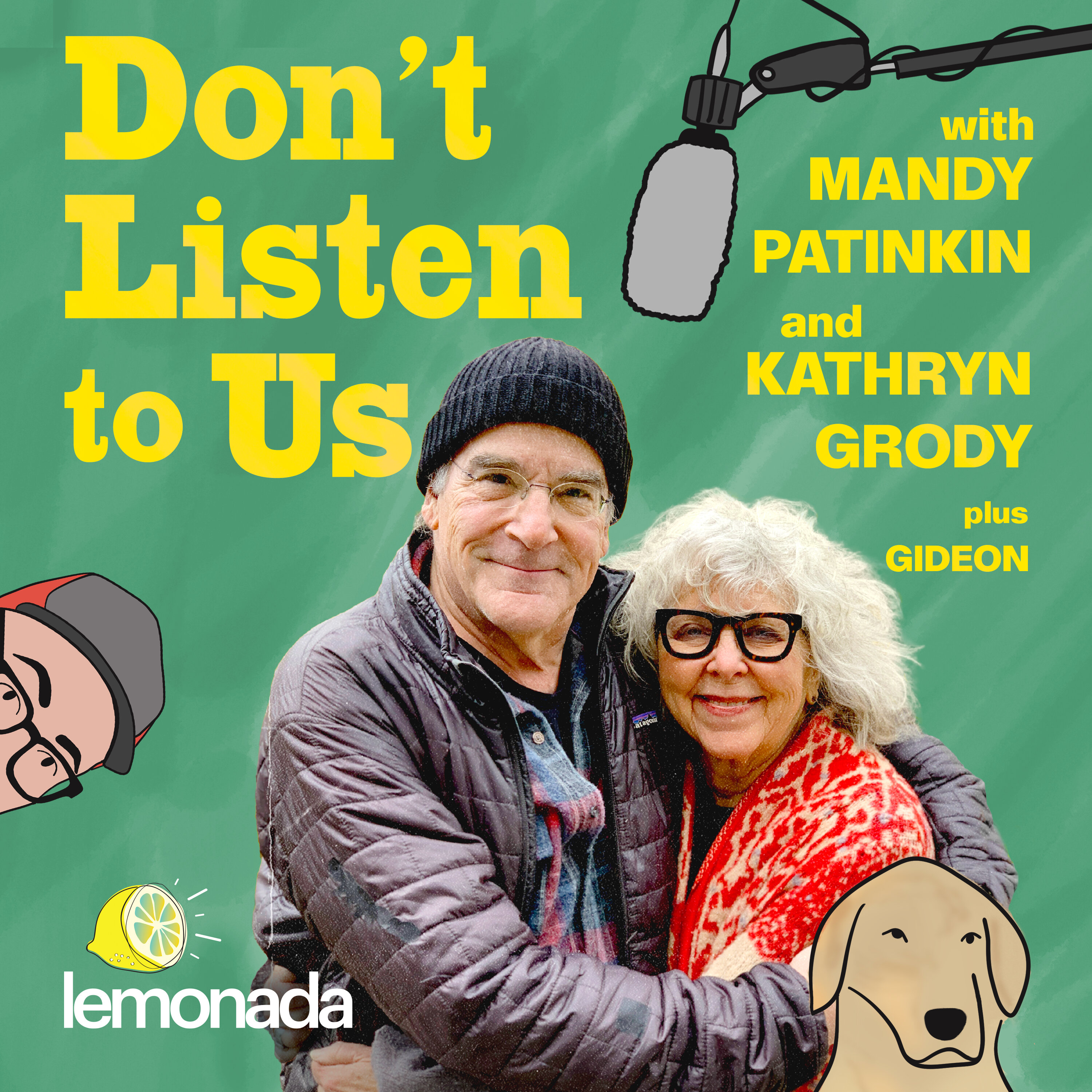
Don't Listen To Us with Mandy Patinkin and Kathryn Grody
Ideal Date Night, White Lies, And Befriending Your Fears with Mandy Patinkin and Kathryn Grody
00:41:07
Loading summary
Transcript367 lines
- [00:02]
A
Lemonade.
- [00:11]
B
What's Dad's ideal date night. Okay, so you both get the answer in your head.
- [00:17]
A
I know what it is.
- [00:19]
B
And now what's your answer? Mom.
- [00:22]
A
Go ahead, you can say it.
- [00:23]
C
Staying at home and go to bed early, not watching anything and just being quiet.
- [00:29]
A
Perfect.
- [00:32]
C
At the nose.
- [00:34]
A
That's the girl I married. That's perfect. Hi. Hi.
- [00:43]
C
Do we need to be closer to each other?
- [00:44]
B
No, you're. You're great. How are you feeling? Here we are.
- [00:50]
A
I'm hungry. This is my dining table. My dinner table.
- [00:53]
B
Weird, huh?
- [00:54]
C
That's weird. Somebody asked me what the podcast was about. I said, no idea.
- [01:00]
A
It's about nothing. It's about nothing. That's Seinfeld.
- [01:03]
B
That's Seinfeld.
- [01:04]
A
Seinfeld.
- [01:05]
B
So this is our version of Seinfeld.
- [01:08]
A
Seinfeld. Well, there's probably a lot.
- [01:09]
C
Elder Seinfeld.
- [01:11]
B
How are you guys?
- [01:12]
A
Speak for yourself.
- [01:13]
B
How are you doing this morning?
- [01:15]
C
Fine.
- [01:17]
A
I took a walk.
- [01:19]
C
Yeah, dad, when did you. You went to. You were sound asleep at 9 o'. Clock.
- [01:22]
B
This is. This is going to be a fun thing. The tapping of the table.
- [01:26]
A
More of it.
- [01:26]
B
Yeah. As much pounding and tapping at the table as possible for the microphone.
- [01:30]
A
That's what I do when I'm live.
- [01:32]
B
I know. So who are we? Let's introduce ourselves. I'm Gideon Grodipatinkin.
- [01:37]
A
I'm Gideon's father.
- [01:38]
C
I'm Katherine, Gideon's mother.
- [01:41]
A
Great.
- [01:43]
B
And this is our. This is our podcast number two, Don't Listen to Us. The second episode of Don't Listen to Us. Each week we'll hash out folks questions. Hopefully at the end of each episode, we all feel a little less alone.
- [02:00]
C
Alone.
- [02:01]
B
That's the idea. We'll see what happens. And where are we? We're in a new location. This is our dining table.
- [02:06]
C
This is in our house. This is who I used to be.
- [02:08]
B
You eat.
- [02:09]
C
I feel anybody that comes in here knows who I was 40 years ago versus who I am now. This is who I was 40 years ago.
- [02:17]
B
And who are you now?
- [02:18]
C
Somebody different than all this. But you know, what are the differences? It's. I. I live with less. A little less stuff and a little.
- [02:27]
A
A little more lipstick.
- [02:29]
C
Do I need lipstick?
- [02:30]
A
No, no, that's not.
- [02:31]
C
But I just said a little less funk.
- [02:33]
A
You didn't wear lipstick in the beginning.
- [02:35]
C
Oh, I think I always have.
- [02:37]
B
And do you guys think that you're good at giving advice?
- [02:41]
A
No. That's what makes you great.
- [02:45]
C
That.
- [02:46]
A
That's why I got a call and.
- [02:48]
B
That'S why you got.
- [02:49]
C
I mean, I get. Truthfully, I get very excited if somebody actually asked me for advice and I'm able to say something useful or helpful.
- [03:00]
B
But I feel like that happens more with you, with your younger friends.
- [03:03]
C
Well, I was just thinking of that. It does happen with my younger friends. I always love remembering your friend Josh, actually, years ago, I mean, probably 10 years ago, when he was saying, you know, what advice do you have for young things? And one of the things I remember really meaning is, don't be afraid to let people know what you want. Because I had way too much pride to let people know I wanted anything. And it just. And I told Josh, you know, what did he want?
- [03:31]
B
Well, that's private.
- [03:33]
A
Not private. What did he want more than anything? A portion of what?
- [03:37]
C
Ice cream? No, man.
- [03:39]
B
And what was a portion of Container.
- [03:42]
C
But that's. But the other thing, I set up stories. I also said, kid, which I really do think is great advice. And I. I learned it from not listening.
- [03:50]
B
Yeah.
- [03:51]
C
When I first came to New York and I was waiting tables and looking for acting work, and a big deal guy producer asked me if I wanted to go to Sardinia for three months to coach a young actor in a film.
- [04:04]
B
Yeah.
- [04:04]
C
And I was like, go to Sardinia for three months to coach an actor? No, Fred, I'm. I'm looking for work in New York City. Well, the movie was Black Stallion. The actor was Henry Thomas. All I did for those three months was just wait tables looking for work. Yeah. And so from that, I say, say yes to the unexpected. Say yes to what comes in front of you.
- [04:25]
A
Is that why you say yes?
- [04:26]
B
This podcast?
- [04:27]
C
Yes. I mean, just say yes to what falls in front of you if it wasn't part of your big, huge plan.
- [04:34]
B
Yeah.
- [04:34]
C
Because you never know. I. That's one of the few regrets I have, not saying yes to that job.
- [04:39]
B
That's actually one of the only consistent pieces of good advice I feel I give to people or friends is when they are in turmoil over making a decision and they're so worried about making the wrong decision. My advice tends to skew towards, make a decision, let it be the wrong decision. Then that experience will be a part of your life, and you'll learn from it. Paralysis, you know, option paralysis. It just gets people frozen.
- [05:10]
A
Well, I, like one of my teachers said to me, when in doubt, leave it out. I like that one.
- [05:16]
B
What does that mean?
- [05:17]
A
When in doubt? If I'm not sure if I should say this or that, then don't say it.
- [05:22]
B
That's great advice, especially for you.
- [05:28]
A
I should tattoo it on your forehead.
- [05:30]
B
Yeah. Don't tattoo it on your own forehead.
- [05:32]
A
I will be able to see it.
- [05:33]
B
Yeah.
- [05:33]
A
And he did tattoo it on family foreheads. Yeah.
- [05:40]
B
Guys, we're. We're coming to our first listener question. So our first question today is from Teddy.
- [05:48]
C
This isn't lying.
- [05:49]
B
We don't have to put our text on. This is something I'm going to read to you. Teddy wrote in, and the thing he wrote about is something we've talked about around the dinner table many times. So Teddy wrote. Hi, Mandy, Catherine and Gideon. Very excited about the show and looking forward to hearing what advice Becky has. Here's my question, and it's a doozy. When is it okay to tell a white lie? Is it better or worse if you tell a white lie to a family member or a stranger? Is a white lie even a lie? What do you think? From Teddy in Toronto.
- [06:27]
A
Wow. You want to go first? Because I have a big story about this.
- [06:30]
C
I'm a great believer in white lies, Teddy. Actually, I really am. I think they're very useful. If the alternative is devastating, if the truthful answer would cause harm and devastation and it's not essential to the relationship for that devastation to be dealt with, then I say a white lies. Completely acceptable.
- [06:54]
B
And do you feel it's been pretty easy for you to gauge when it's on that side of things versus the other side?
- [07:02]
C
I do. I don't tell that many white lies, but.
- [07:04]
B
Oh, my God, are you kidding me?
- [07:07]
C
I don't tell that many white lies. She's a compulsive liar. White, black, red, yellow, green. I just think there's no point in harming people unless it's the kind of conversation that you have to get down to to. To fix continuous discomfort. So then I think it's fine and fine if, you know, I mean, if it's somebody that you don't have a relationship with.
- [07:31]
A
Give me an example of something. You've told a white lie, either to Gideon or me.
- [07:36]
B
There's so many. I mean, I think I agree with you on what you're basically saying, but I also think that it's a slippery slope, and even in our own family, there ends up being this practice of don't tell. Like, everyone's kind of saying sometimes, like, don't tell this these two that, or this one that or these three that or this one that until this. Which ends up, I think, creating, like, an overprotective, you know, like, practice.
- [08:04]
C
Yeah.
- [08:05]
B
That people can't handle the truth until this moment or until that moment. What. What came up in your mind? Oh, man. I have.
- [08:11]
A
I have a total. One of the biggest memories of me and my dad.
- [08:14]
B
Yeah.
- [08:15]
A
Or my dad and me, as Grandma Ida would have said. And so what it was, I think I was around five or six years old. I don't know the exact date, but my mom had to have a hysterectomy. And so my dad took my sister Marcia and I. Wow.
- [08:31]
B
I never knew that.
- [08:31]
A
Yeah. So my dad took my sister Marcia and I. We were supposed to go to Carl's Hot Dogs on the south side of Chicago to have a hot dog, which were the best hot dogs. And my dad loved the tamales there. And the fries were greasy, but we loved the hot dogs. It was great. Chicago hot dog. One of the true, really original greats. And anyway, we ran out of time, whatever was going on that day and was, I think a Sunday. And we were on our way to Michael Reese Hospital to go visit my mother after her surgery. And we were two little kids. Marcia, if I was five, she was eight, she's three years older, and we're on our way. And dad says, and my father was incredibly soft spoken, very gentle man. And he said, listen, when we get to the hospital, Mom's going to ask if you had lunch and we're going to tell her a white lie.
- [09:22]
B
I said, this was the introduction of the concept.
- [09:24]
A
Yes. She literally used the word a white lie. And I went, a lie. And he said, a white lie? What's that? And he said, we're going to tell her that we had lunch. That's a lie. I know. But mom will worry if she thinks I didn't get you lunch yet, so. So she doesn't worry. We're going to tell her we had lunch.
- [09:49]
B
Yeah.
- [09:49]
A
And I could not understand how that was. That was in the same place as I was born November 30. My birthday came first. My sister was born December 19 and her birthday was after me. And she was older.
- [10:08]
B
Right.
- [10:09]
A
That was insane. It's even insane as I tell it now. And I'm 73. I know that it's a different context.
- [10:17]
B
I'm trying to figure out if I need to explain that.
- [10:19]
C
Yeah. Really?
- [10:19]
B
How that works?
- [10:20]
A
Yeah. Oh, no, I know how it works as a grown up. But those two things always were pretty darn confusing to me. But we told the white lie. And then we went to Carl's Hot Dogs after the visit to the house.
- [10:32]
B
Did you feel guilty about the white lie or you were just like, huh, new idea?
- [10:36]
A
No, I Didn't. I didn't feel guilty. I just thought, like, this is really, you know, this is real confusing.
- [10:41]
B
Right. And do you feel you employ the white lie as an adult? That it's been a useful.
- [10:47]
A
I agree with what mom just said. Never, oftentimes. I think people say they tell a truth because they did something they want to be absolved from. Forgiven. So they'll tell it to somebody who never needed to know a piece of information. Their lives would have been fine without that information. But they want to be forgiven. They want to clean their slate. They want to be absolved. And. And my. My advice is go off in the woods and absolve yourself. Right.
- [11:19]
B
Yeah.
- [11:20]
A
Don't bring other people that don't need to be involved with something you did or said or, you know, learn. Right. I'm not saying don't. Don't have a discussion with somebody, a trusted friend or advisor or therapist or whatever, or religious helper. You know, sure, talk to people. But don't talk to the person who might be hurt by the information you want to discuss. That isn't necessary. And we all make mistakes and go ahead and hurt people anyway. I'm right at the top of the list of people that do that.
- [11:59]
B
You think you're the number one person who's hurting people?
- [12:02]
A
I think I could be a competitor. I think if there's, you know, I got a title. You just.
- [12:08]
B
You just. You're not number one.
- [12:10]
A
I'm not an Olympic. I'm not an Olympic. Well, that's good news. From your mouth to God's ears. I'd love not to be successful.
- [12:18]
C
So I think Teddy. So the idea is it's an. It's a human option.
- [12:22]
B
Yeah.
- [12:22]
A
Oh, Teddy. Forgot about him. Oh, I shouldn't have said that.
- [12:26]
B
Thanks, Dad.
- [12:26]
A
I should have said a white lie. How is Teddy?
- [12:29]
C
Yeah.
- [12:29]
A
One of my favorites.
- [12:30]
B
No, you know, we're just starting our relationship with Teddy.
- [12:33]
A
Really?
- [12:33]
C
Yeah.
- [12:34]
A
You know, I had an Uncle Teddy. I. It wasn't my uncle. He was my cousin Alan's Uncle Teddy.
- [12:41]
B
Mom, do you think when you're doing this with your hands subtly that it's.
- [12:44]
A
We're on video. Why don't you just say, shut the fuck up?
- [12:49]
B
Oh, wait, I have.
- [12:50]
C
I have a system.
- [12:51]
B
You guys don't ever need to worry about moving each other along if it's time. Just because I'm keeping my eye on time and stuff. If it's time to sort of get to the end of an idea or something, I will put my water bottle on the table here. Okay. And that's how you know, this is great. But we need to get to the end of.
- [13:12]
A
So when you take the water bottle away, we can go back to the idea.
- [13:14]
B
Yeah, I can just go for it. I want to get to this.
- [13:19]
A
Thank you, Teddy. That was a good. That question reminded me of my dad. And anybody who reminds me of my dad is. Is a good person in my book. Love that. Okay, wait a minute. There's Becky. She wants to be in the.
- [13:36]
B
Okay, she can be in the ad. Do you have dog?
- [13:38]
A
These are great, great JLab. JLab. JLab headphones. Few people know this. They're. They're. They're the most unique earphones for dogs. And dogs have very sensitive ears. So this is the one you want to get if you have a dog.
- [13:53]
B
Which model did you get?
- [13:54]
A
Yeah, I got. Well, I got them all. My favorite one is this one. The Epic Open Sport. Epic Open Sport. Comes in this incredible little case, and it's fun. Here, Wait a minute. I can even show you this. I just had the thing because I was charging my stuff earlier. Look, you take a ubc. It's for the Cisco. Look at me with all my language here. UBC. Is that called.
- [14:16]
B
What's it called? That's just 100% wrong.
- [14:18]
A
USB C. USB C. USB USB C. And then it lights up. You see, when it's all lit up, then you have it. You have it. You open it up. You open it up. Has a nice little case.
- [14:32]
B
But, dad, tell me how the actual headphones feel in your actual ear holes. Playing actual ear sound.
- [14:39]
A
I put them in immediately and I love it. Takes me away from the noise in my head and puts the music in my being. Look for the blue box at retailers everywhere. Or you can shop jlab.com and use code don't listen for 15% off your order today. And always keep the JLab tune in your head. J L A BJ lab. That's the headphone just for me. And if they use that, I'll make them pay.
- [15:22]
C
This show is sponsored by MIDI Health. And let me tell you, I'm so thrilled to learn about MIDI Health. Because when I was in midlife and when I was going through perimenopause and menopause, they did not exist. I felt alone. Like every woman going through this was made to feel. And we were made to feel ashamed and embarrassed and to feel that our vibrancy in all areas was over. Do you know, today, 75% of women seeking care for menopause and perimenopause issues are Left entirely untreated. How's that possible? Midi Health is now here to provide individualized telehealth, which is covered by your insurance, by the way. And they will listen, take women seriously and encourage you to move on to this next act. Get through it less insane than I was, so I really encourage you to check them out. If you're ready to feel your best and write your own second act, visit joinmitty.com today. Book your personalized insurance covered virtual visitors. That's join midi.comm I d I the care women deserve. That's progress. Hallelujah.
- [16:53]
B
So this next one is going to be a voice note from Jackie. Let's have a listen.
- [17:00]
A
Hi, Mandy and Catherine. My question to you guys is you've been married a long time and you guys fight and disagree. I've been married now 40 years, and when we fight, it doesn't go away. There is a silent treatment. You go to bed angry. How do you get through the anger and make up? Do you have any advice for me? I appreciate your time and I absolutely love you guys. Thanks. Are we gonna be talking to her?
- [17:36]
B
No, no, that was just.
- [17:37]
A
Okay, so we can take these back out?
- [17:39]
B
Yeah.
- [17:40]
A
What's her name again?
- [17:41]
C
Jackie.
- [17:42]
B
Jackie.
- [17:42]
A
Jackie. Thank you, Jackie.
- [17:44]
C
Oh, gosh, Jackie. You know, that's a classic, really. You know, in long marriages, I always love the story. When we were. Have I told this before in this circumstance, kid.
- [17:55]
B
I mean, you haven't told anything on our podcast because.
- [17:57]
C
Yeah, so I know. Forgive me if I told this in some other version because it was very profound for me. When we were engaged to be married, we were in Los Angeles and Mandy was doing a vita, and we had an enormous fight. Like, just our biggest fight of our couple of years.
- [18:14]
A
I don't remember the fight at all.
- [18:16]
C
Okay? And I can't forget it. So there is one of the basic differences, mostly between men and women. And anyway, I called up a cousin where we were going to have an engagement party. And I said, we have to listen, we have to call people. And we're not getting. We're not engaged. We're not getting married. And she's like, well, her cousin Daryl. And Daryl was like, these are your friends, These are your. Who do I call? We'll split the list. And I'm crying and it's over as far as I'm concerned. Then I hear from the.
- [18:42]
B
How old were you?
- [18:43]
C
I was. I was 30, 31. And he was six years younger. And then I hear from the other room, honey, what. What are you gonna wear to what? To our party. Darryl, let me just call you right back, please. I just gotta call you back. And I went in the room and I said, what about that fight? And dad went, it was just a fight.
- [19:07]
B
He already couldn't remember what he was.
- [19:09]
C
He already couldn't. The thing is, he grew up in a family that fought loudly and that was sort of the dominant. A lot of the atmosphere. I grew up in a family that had council meetings and never raised their voices. So I was very inexperienced in that aspect of being human. Anger, conflict, you know, loudness. And so one thing, Jackie, I think, is a fight is just a fight. There are some fights that uncover things. If you cannot move on together, you have to sit down and say, okay, I can't live with this. How are we going to resolve it? But if it's stupid, which I think a lot of them are, if it has to do with the mood you're in or what kind of lousy day you had, if you felt safe enough with your partner just to unload, go to bed. We go to bed angry all the time. I don't believe in not going to bed angry. I don't know where that came from.
- [19:57]
B
Or, I mean, it be nice.
- [19:59]
C
It would be nice if you could not do that. And oftentimes we don't. But I, I, we let a lot of it go. After all this time, we just let a lot of it go, I think, and chalk it up. Sometimes we say, I'm sorry about the, the other night. Sorry about the warning. And sometimes we just move on.
- [20:19]
A
Yeah, we let more of it go now than we ever used to. I. A little correction here is my family did not fight. My mother fought, my sister fought, and I fought. My father never fought. My father was very quiet and calm and quiet. But mom never fought. In the beginning, she has learned to be so aggressive and fight for what she feels is appropriate or right or wants.
- [20:53]
B
Maybe it feels aggressive to you, but compared to docile.
- [20:57]
A
I'm comparing it to when we met previous times. Yeah. Many, many years before. And I'd say within the last eight to 10 years, she has gradually become quite a different person in this area. And I think it's made us healthier in more ways than one. I don't like the fighting. I don't like it when she's like that. I like the one person I met 47 years ago more than the person who's mean or gives me a face or an attitude, who is able to.
- [21:30]
B
Maybe be in touch with her anger.
- [21:32]
A
Yes. Like stand up Somebody else might be, yes. Oh, you're saying I'm in touch with my anger.
- [21:38]
B
I'm saying, when have you ever experienced something like that? I'm saying that I think something I've heard from mom over the years when you guys have been fighting, that she's had a hard time being able to just be angry when she feels justified, which you haven't had as hard a time. And I think it sounds like you've gotten better than that.
- [21:59]
A
I remember our dear friend and therapist, Mary Sams, who treated both of us both separately and together as a couple for a while. I'll never forget this. One day she said, mandy, be quiet. You listen to her. You need to learn to listen to her. But at that same moment, she says, I may have this wrong. Exactly how it came out. But she said, you don't understand that some people don't know how they feel. You know how you feel. Maybe you. Maybe every minute you think or you do know how you feel. And maybe there's someone who you're married to doesn't know how they feel. And there are people that don't know how they feel.
- [22:44]
B
And sometimes people who are so sensitive and people pleasing that they absorb the feelings of their partner and then are confused with how they feel in that moment.
- [22:55]
A
I mean, say that again, because that was pretty confusing.
- [22:57]
B
That some people who are people pleasing to their partners or their family or those around them.
- [23:03]
A
Caretakers.
- [23:03]
B
Caretakers. That when those around them are having big feelings, they have a hard time being in touch with their own feelings and what they need because they're absorbing those around them.
- [23:13]
A
Exactly.
- [23:14]
C
And they've also been.
- [23:15]
A
And I think that's it on the nose. Because I think her getting more in touch over the years, 47 years together, has made us a healthier couple. I really do. I don't enjoy it at the moment of anger, but I do think we're healthier. And so far, we always let it go. It's usually kind of like a little kitty coming in for a hug or a kiss or a hug, or just getting in bed and holding each other. And we seem so far. Or an ice cream, things like that. We seem so far to let it go. And that's taken a good 30 some years.
- [23:59]
C
Part of the reason is what I would do because I was so inexperienced, I would sometimes know my feelings, but I did not feel comfortable if they were angry. That was not okay.
- [24:10]
A
The bottle just came out.
- [24:12]
C
So anyway, I just. Okay.
- [24:15]
B
Is this supposed to be a sign?
- [24:17]
A
Can I show them what the bottle.
- [24:18]
B
Looks like this is a sign.
- [24:20]
A
It just went like that.
- [24:22]
C
Yeah. Yeah, that's right. That's.
- [24:23]
A
That's the cue for shout.
- [24:25]
C
I had one other story.
- [24:27]
B
It's supposed to be my secret.
- [24:28]
A
Why not let her share the other story?
- [24:30]
B
Okay.
- [24:31]
D
No.
- [24:31]
C
We were married for six months. Dad only wanted to get. You know. Okay, I just gonna tell this one. I'm not talking because it's weird. All that is true. And yet I had this one moment, you know, at the very beginning of our relationship, and I had blind rage. That's a real thing. I. I couldn't see anything. It was just white. And I actually hit him. I've never done that in my life. On his arm. And I went, I've had it. I've had it.
- [24:55]
A
That was my favorite moment of the marriage up to that point.
- [24:57]
C
And then I went into the bedroom, and I was so shocked with what I'd done. And a few minutes later, in comes this stick with a white paper towel attached to it. And dad looked so happy. It was the happiest I'd seen in the six months because she treated me.
- [25:12]
A
The way I deserved to be treated. Yeah.
- [25:14]
C
And he was like, surrender, you know, And I don't know why I didn't learn from that to keep that going.
- [25:19]
A
But she got it eventually. But I was an. And she was like, putting up with it.
- [25:25]
B
Wow. Well, it's wonderfully complicated, Jackie.
- [25:30]
C
The silent treatment. You go covert when you don't express your feelings. Just say, let's not be silent, but.
- [25:35]
A
Don'T tell everything, because remember the white lie discussion only from podcast two.
- [25:40]
C
Yeah.
- [25:42]
A
Foreign. This episode is sponsored by BetterHelp. Gideon, do you know about betterhelp.com I.
- [25:55]
B
Do know about BetterHelp. I have a lot of friends who use it. Recently, it was World Mental Health Day, and this year, BetterHelp is shining the spotlight on therapists, people who truly make the world a better place. I certainly feel that about my own therapist.
- [26:11]
A
I know we screw around a lot on our show, but I'm not screwing around with this. Therapy has absolutely saved my life. And. And I don't think Catherine and I would have made it through 47 years of being together. But we've learned that listening is actually a virtue and something that we might try on occasion.
- [26:36]
B
BetterHelp is the world's largest online therapy platform, and it works with an average rating of 4.9 out of 5. A live session based on over 1.7 million client reviews. And I know, dad, that you. You like the. The star system, you know, 4.9 out of 5.
- [26:54]
A
What's the star system?
- [26:56]
B
Oh, 4.9 stars. The ratings.
- [26:58]
A
Yeah, yeah, yeah. That's how I pick a restaurant. That's how I pick a therapist.
- [27:03]
B
That's right.
- [27:03]
A
That's right. And if they have liver and onions, don't throw that therapist away.
- [27:08]
B
You mean if your therapist feeds you liver and onions?
- [27:12]
A
If my therapist fed me liver and onions, I'd stay there 24, 7, 365. I'd be the happiest person ever to have gone to therapy.
- [27:21]
B
Well, if there's a therapist out there.
- [27:23]
A
Who provides such a service, you could probably find them@betterhelp.com this World Mental Health Day, we're celebrating the therapists who've helped millions of people take a step forward. If you're ready to find the right therapist for you, BetterHelp can help you start that journey. Today, our listeners get 10% off their first month@betterhelp.com Don'tListen. That's betterhelp.com Don'tListen.
- [27:54]
E
Well, hi everybody. It's Julia Louis Dreyfus from the Wiser Than Me podcast. And I'm not going to talk about food waste this time. I'm going to talk about food resources. All that uneaten food rotting in the landfill. It could be enriching our soil or feeding our chickens because it's still food. And the easiest and frankly, way coolest way to put all its nutrients to work is with the mill food recycler. It looks like an art house garbage can. You can just toss your scraps in it like a garbage can. But it is definitely not a garbage can. I mean, it's true, I'm pretty obsessed with this thing. I even invested in this thing. But I'm not alone. Any mill owner just might corner you at a party and rhapsodize about how it's completely odorless and it's fully automated and how you can keep filling it for weeks. But the clincher is that you can depend on it for years. Mill is a serious machine. Think about a dishwasher, not a toaster. It's built by hand in North America and it's engineered by the guy who did your iPhone. But you have to kind of live with mill to understand all the love. That's why they offer a risk free trial. Go to mill.com wiser for an exclusive offer.
- [29:27]
B
Mom, dad. This round we'll be joined by a live caller. But first, Kathryn, will you read her email for us?
- [29:33]
C
Dear Mandy and Catherine, first, thank you both for your Instagram account. It feels like a warm conversation with trusted friends. In my first life, I studied stage design at Carnegie Mellon and had the privilege of working for costume designer Ann Hold Ward in New York City, who we know.
- [29:51]
A
Hold Warden. Yeah, she did send in the park with the.
- [29:53]
C
Georgia costume Design was my dream, and honestly, I would have been great at it. Ann once told me to earn a master's in art history and come back to her. I did get that degree, but I didn't return. Anne also warned me that costume design is a hard way to make a living, and she was right. I'm someone who values health insurance, a consistent paycheck, and a bit of routine. Still, sometimes I wonder, what if I had stayed? So I wanted to ask you both, because you speak so truthfully about life and choice and joy and grief, how do we let go of that pang over the spark of talent not realized? How do you reconcile a present that is peaceful and good with the potential of a path not taken? And how do you explain to people the unique path you had without sounding like a total ass with admiration and warmth? Melissa. Oh, wow.
- [30:48]
B
So Melissa's looking for some advice about regret and paths not taken. Let's bring her in. Hi, Melissa.
- [30:56]
C
Hi.
- [30:57]
D
Hi, Mandy and Katherine and Gideon. Thank you so much for having me.
- [31:01]
C
Oh, Melissa, I loved your letter. I was really, really moved by your letter. You know, Mandy worked with Ann Huld Ward on Sunday in the park with George.
- [31:11]
B
Yes.
- [31:12]
D
I. I was researching her, and I saw Sunday in the park with George, and then I pulled up your Instagram account. That's how this came about.
- [31:23]
A
Melissa, thank you. I loved it. And. And I. How, may I ask? I know I'm not supposed to ask. You know, you can ask. How old are you?
- [31:32]
D
I'm 46.
- [31:33]
A
Oh, God. You're a baby. Okay, even better. Even better. Listen, Melissa, first of all, what I tell young people when I have the privilege to have a conversation with people, you know, anywhere I go, and. And I'm not a teacher. You put a nickel in me, and I'll never shut up until Gideon holds up the water bottle. But that's something you'll. You'll understand down the road. But anyway, what I say to them is, if you have a desire to do something, anything in this world, do it. Try to do it. And even if it looks impossible, try, because you will always regret not trying. But here's the good news. You said you thought about being costume designer, and for whatever reason, you didn't go in that direction. And I'm Sure. You've gone in other directions to do other things. For instance, could you just share with me what is the other main thing or several things that you did instead of being a costume designer? Before I get to my point?
- [32:32]
D
Oh, well, I wanted to be an educator, so I did my K through 12 art education degree, thinking I would work in museums. I've done a lot in museums, and now I run events for the University of Virginia, and we're sponsoring a wonderful art exhibition in the fall, for example. So I try to keep myself in the world of art. But the fact that you say 46 is young, I want to cry because I do not feel that. I feel so old. And, you know, you need to be 20 something to get your leg in, or you have to pick up and move your whole life to where the costume designers or the production is. And so I feel very settled where I am. And it also does feel a little oppressive. Like, I know the world is big, but it's very scary to put yourself out there.
- [33:22]
A
So let me just jump to my advice. Forgive me for giving any advice, because who am I? But nonetheless, that supposedly has something to do with the title of this crazy venture we're all doing. But my real true advice is, you're fucking 46 years old. You go out and you find somewhere before you drop dead, which is hopefully going to be at least 50 years from now, minimum, maybe more. And go find a community theater or some student that's doing a project for NYU or Columbia or a film school anywhere in the world, and put yourself out there and say that I would like to offer myself as an assistant designer or a designer and participate. I'll go shop for clothes for you. I'll sew them, I'll make them, I'll do this, I'll do that, and do it. Because you don't have to do it on Broadway or at the biggest motion picture in the world. You need to do it somewhere for yourself. And I was just speaking to a dear friend of ours, just so you know about Broadway, who's a major Broadway producer, who said to Katharine and me on the phone the other day, actually, I think Broadway is really dying. And I'm putting my money, time, effort, and focus on off Broadway and smaller productions, because I think that's where the heart of the heartbeat begins. And so that's my advice, and here's my lovely wife to tell you why I'm wrong.
- [34:48]
C
No, I don't think he's wrong. But I also think you can think about outside the box. Melissa first of all, I want to congratulate you for being in the arts. I don't think we've ever needed art more.
- [35:00]
D
Yes.
- [35:00]
C
Whether it's events in univers, Virginia's a pretty important place right now.
- [35:05]
A
Yeah.
- [35:05]
D
I'm a little terrified about what we have on programming for the fall, but I mean, we are saying it's performance as protest right now and making is so important. So I'm so happy to be able to support these artists.
- [35:18]
C
No, it's incredible. So you are in a creative field and you're encouraging people to be creative and you're using your creativity. And I don't think there's anything wrong with liking a consistent paycheck and a bit of a routine. Knowing who you are and what you need is great, you know, but it's also possible if you like designing clothing and costumes. One is Mandy's idea, a local theater and just introduce yourself. The other thing is you can design clothing and have a website. You can know people in your community and say, listen, I really want to express my creativity with clothing. And this is what I'm working on. Whether it's a cape or something easy for somebody to wear, or a local shop that has handmade clothes and interesting clothes, lots of people are finding their ways in terms of sharing creative ideas for clothing. And you can explore that.
- [36:15]
D
How do you guys keep your energy?
- [36:17]
B
Oh, we're drinking a lot of cocaine.
- [36:19]
A
A lot of drugs. A lot of drugs, Melissa. Lots of drugs.
- [36:23]
D
Because at the end of the day, you know, all this email and the talking and the things that you have to do to then do your passion. At the end of the day, it's like, how do you do that?
- [36:33]
A
What is. Just remind me, because I'm getting older. What is my passion at the end of the day, Melissa? Yeah.
- [36:38]
C
Taking care of your dog.
- [36:40]
B
Taking your dog for a walk. Mom and dad. Just for listeners who don't have theater experience, like, how important is the costume designer?
- [36:52]
C
Oh, my God. It's the only. I must admit to you, Melissa, it's the only diva aspect of myself. I had the privilege in the beginning at the Public Theater to work with Theoni Aldridge, who said to me, oh, tell me your. Do you like synthetic or do you like natural products? Do you like pastels or do you like vibrant? So if I meet some young person that doesn't even ask me what my character wears and said, this is what I picked out for you, she's in very friggin big trouble.
- [37:20]
D
No, it's a relationship.
- [37:22]
C
It's Relationships and they're very important, really. In the last 20 years, I basically been dressing myself from home with people. But it's extremely important, very intimate relationship where, you know, you explain to the customer your vision of the character and she helps you bring that to life. And I do think just investigate all the options. Melissa, you are not over in this area at all.
- [37:53]
B
Yeah, I think, I think there is a poison in the culture when we're only seeing operating like at the most ambitious or the highest level and we're missing out all these other creative opportunities around us.
- [38:04]
A
Yeah. Here, here, here, here. And I hope what's, you know, I love. My teacher said to me, when my teacher was my therapist, who's a friend, I love this man. And, and he said to me, you don't know what's going to happen in the next millisecond. You have no idea what the future holds.
- [38:20]
D
And I, well, that's what terrifies me a little bit, to be honest. I mean, I think the older we get of what we experience in life, it's like I'm almost afraid of what we don't know.
- [38:30]
A
So be a. Here's another thing from my teacher. I'm not so smart with these answers. Teacher was then stay with that fear, Stay with that terror. Walk around with it, breathe with it, eat with it, play with it and, and don't try to fix it. Your brain, if it needs to, will get rid of it and it'll get bored and tired with it. If it needs to, stay with that fear. It'll keep you from touching the fire on the stove. Like when you're a little kid. But don't feel you got to run away from all your terrors. Just live with them, stay with them, breathe with them. They are, they are the food of your life and they're not bad.
- [39:05]
C
Yeah. Enjoy what you do and find a way to find the people in the community to do it. Just think creatively outside the box.
- [39:14]
B
Melissa, thank you so much for calling in.
- [39:16]
A
Thank you.
- [39:17]
B
And just remember, don't listen to us.
- [39:20]
D
Yeah.
- [39:27]
B
So this is a fun and games part of the show we're going to.
- [39:32]
A
We should have some music, a little fun and games music. Yeah, we probably will put that in later.
- [39:36]
B
We'll take a little break from the intensity of the world. This week we're doing a little quiz thing. So it's called how well do you know each other? This is a very low rent version of the dating Game, if you remember that at all. So here's how you play I'm Going to ask.
- [39:54]
A
I hate this game.
- [39:55]
B
Right off the bat, I'm going to ask one of you a question about the other. And then you both think of the answer in your head. But be honest with what you've thought.
- [40:06]
C
Okay.
- [40:07]
B
Oh, dad, you can take your headphones out if you want.
- [40:09]
A
And don't. And don't speak.
- [40:11]
B
Don't say it until I say what do you have the answer? And then we'll see if the other person's guess is right about you. Okay? Okay. So, dad, what's Mom's favorite breakfast food in the morning? So get it in your head what you think your answer is. Dad. And mom, you get in your head what your answer is.
- [40:33]
C
About dad?
- [40:34]
B
No, about you.
- [40:35]
C
Okay.
- [40:36]
B
Okay, so no cheating.
- [40:38]
A
Does she have the same question as me?
- [40:40]
B
Yes. What's Mom's favorite breakfast food in the morning?
- [40:43]
A
And hers is what's Dad's?
- [40:44]
B
No, it's Mom's. Okay, shoot me.
- [40:53]
A
Here's the question for both of you.
- [40:55]
B
What's Mom's favorite breakfast food in the morning? Okay, you know when your answer is, dad, say your guess out loud.
- [41:04]
A
Nothing. She doesn't eat till 12.
- [41:06]
B
And, mom, what was your answer gonna be that you guessed? Don't change it.
- [41:12]
C
Well, it was gonna be like eggs and toast, but at noon.
- [41:17]
B
Okay, so it's lunch, kind of.
- [41:19]
A
Right.
- [41:19]
C
Crunch.
- [41:20]
A
Okay. Not a breakfast food.
- [41:21]
C
Yeah.
- [41:22]
B
Nice.
- [41:22]
C
That was disappointing that we got it sort of rife.
- [41:24]
A
No, we shared an element of it.
- [41:27]
C
Yeah.
- [41:27]
B
Yes.
- [41:29]
A
Is there a prize? Do we get a prize?
- [41:30]
B
Yes.
- [41:31]
A
What is the. More.
- [41:32]
B
Marriage. Okay.
- [41:35]
A
Mom.
- [41:35]
C
Yeah.
- [41:35]
B
Oh, this is for both of you. Can you name who my first kiss was?
- [41:40]
C
Yes.
- [41:40]
B
First name only.
- [41:41]
A
Vicky.
- [41:42]
C
Marianne. Marian. The one that you gave the little green charm bracelet, too.
- [41:48]
B
Well, dad is right.
- [41:49]
C
Oh, my God.
- [41:49]
B
And mom is wrong. And I've never even known anyone named Marianne, so.
- [41:53]
A
That.
- [41:54]
B
That was very good. That was very good, Mom. Can't believe she lost that one.
- [41:59]
A
I can't.
- [42:00]
B
Wait a minute. Okay, dad, remember when you gave a little. There's no getting out of being wrong about.
- [42:05]
A
You were wrong.
- [42:06]
C
I was wrong.
- [42:07]
A
Oh, my God.
- [42:08]
B
Okay, mom, when was the moment.
- [42:11]
A
Dad.
- [42:12]
B
It was Vicky.
- [42:12]
A
And when was. Oh, don't get out of it.
- [42:14]
B
No.
- [42:14]
C
Okay.
- [42:15]
B
You're just wrong. When was the moment dad knew he was in love with.
- [42:20]
A
With you? Yeah, I know.
- [42:21]
C
Well, he would say at our first rehearsal.
- [42:24]
A
No.
- [42:24]
B
What would you say that he would say? Oh, yeah, I guess I would say.
- [42:28]
C
He would say at our. At our first rehearsal.
- [42:31]
B
Uhhuh. For a play. You would?
- [42:33]
C
For a play.
- [42:34]
B
And, dad, what would you say?
- [42:35]
A
Well, I'd elaborate a little bit. We were doing a play by Michael. Well, called the Split. Oh.
- [42:39]
B
Not the whole elaboration.
- [42:40]
A
Okay. But we were sitting at a checkered red and white tablecloth, like Italian restaurant. And the game was. We improvised all these things that people say to each other, you know, that are interested. Like you'd say when you're courting or looking to see if you can have a first date. And we improvise this for 45 minutes. The Director left the room. And I realized in that, in the middle of it, that this is the person for me.
- [43:04]
B
You thought you were in love with that person.
- [43:06]
A
I. There was nothing I didn't love about that person. And it just escalated until it crumbled and then it escalated again and then it crumbled and then it escalated and then it just became normal.
- [43:19]
B
All right, let me tally up your guys.
- [43:20]
C
Okay. I didn't have that feeling. I just thought he was crazy and very talented.
- [43:25]
A
Well, he didn't ask.
- [43:26]
B
Well, that wasn't the question.
- [43:27]
C
I'm sorry. Okay.
- [43:27]
A
Okay.
- [43:28]
B
Your score is do something while. Okay. Catherine, 73. Mandy, 72. Very close. Okay. We'll see how you do next.
- [43:40]
A
I lost. He loves you more.
- [43:43]
C
Yeah.
- [43:44]
B
So we're at the end of the this episode too. Thanks guys so much, folks out there. We want to hear from you. More questions, stories, send us advice. We want weird, playful, fun stuff in the mix too.
- [43:59]
A
Good recipes.
- [44:00]
B
Yes. Did we say something you disagree with? Let us know how wrong we are. We'd love to hear that.
- [44:07]
A
Recipes that aren't hard to cook.
- [44:09]
B
Yes. Although you gotta learn how to cut an onion for this next next movie.
- [44:13]
A
I gotta get some work with you on that.
- [44:15]
B
Send an email to ask mandyandcatherinemail.com or check out our socials for an easy way to send us a voice message. Thank you so much for being here and tuning in. And let's be perfectly clear.
- [44:28]
A
Don't listen to us, Catherine or Mandy or Gideon. Yeah, don't listen to us.
- [44:34]
B
Would you like to do a sign off song? It's optional.
- [44:39]
A
Sure, sure, sure, sure.
- [44:40]
B
Okay, great.
- [44:41]
A
Every time I think about the things I think think about, I think about episode two. Every time I think about the things I like to think about, I think about what to do. And two.
- [44:59]
B
Don't Listen to Us is a Lemonada Media original hosted by Mandy Patinkin, Katherine Grody and Gideon Grody Patinkin. Created by Katrina Onstad, Debbie Pacheco and Gideon Grody Padinkin Executive producers are Kathryn Grody, Gideon Grody Pitinkin, Andy Patinkin, Katrina Onstadt, Debbie Pacheco, Jessica Cordova Kramer and Stephanie Whittles Wax. Our engineer is Ryan Derringer of Welterweight Sound. Video and audio production by Mark Whiteway of Bellows Media. Thanks to Lemonada's lead engineer, Ivan Kurayev. If you haven't subscribed to Lemonada Media Premium yet, now's the perfect time. You can hear don't listen to us completely ad free. Plus you'll unlock exclusive bonus content like behind the scenes conversations, questions so weird they didn't make it on air, Becky the Dog shenanigans, and more. Just tap the subscribe button on Apple podcasts. Head to lemonadapremium.com to subscribe on any other app or listen ad free on Amazon Music with your prime membership. That's lemonadapremium.com don't miss out. We want to be really clear. We are not doctors or licensed therapists, just people with a lot of opinions. If you're facing a serious issue, especially related to mental health or addiction, we strongly encourage you to speak with a qualified professional. You are not alone. You deserve real help, not just a podcast.
- [46:31]
A
Hey everybody. I just want to remind you that my beautiful wife's play that she wrote and performs a one woman show called the Unexpected Third. Then there's some more to the title that I can't remember.
- [46:42]
B
The rest is a radical, rollicking rumination on the optimism of staying alive, also.
- [46:47]
A
Known as the unexpected third. It's going to be in Malvern, Pennsylvania for quite a number of weeks from.
- [46:54]
B
September 17th to October 19th. And Malvern is just outside Philadelphia, right?
- [47:00]
A
So it's not far. It's like a subur. I'm telling you. I saw an early rendition of this play in a rehearsal studio with nothing but neon lights on the ceiling and it blew me away and everyone else in the room. I obviously am prejudice. I'm a fan of my wife. She's written many things, all wonderful, but this one, I swear to you, you will not be disappointed. It takes the cake. She it is her gift to us all. Come see it.
- [47:27]
B
Yeah, it's my favorite show.
- [47:29]
A
Yep.
- [47:30]
B
My mom is having to suffer through us.
- [47:32]
C
You know, it's very uncomfortable sitting and hearing this and I'm a nervous wreck. You'll never like it as much.
- [47:37]
A
Yes, that means it's gonna be good. She's a total actress in this way. Always worry.
- [47:43]
B
The Unexpected Third at the People's Light Theater in Malvern, Pennsylvania from September 17 to October 19.
- [47:51]
A
Starring Catherine Grody, the one and only.
- [47:55]
C
It's a wonderful place.