← Don't Listen To Us with Mandy Patinkin and Kathryn Grody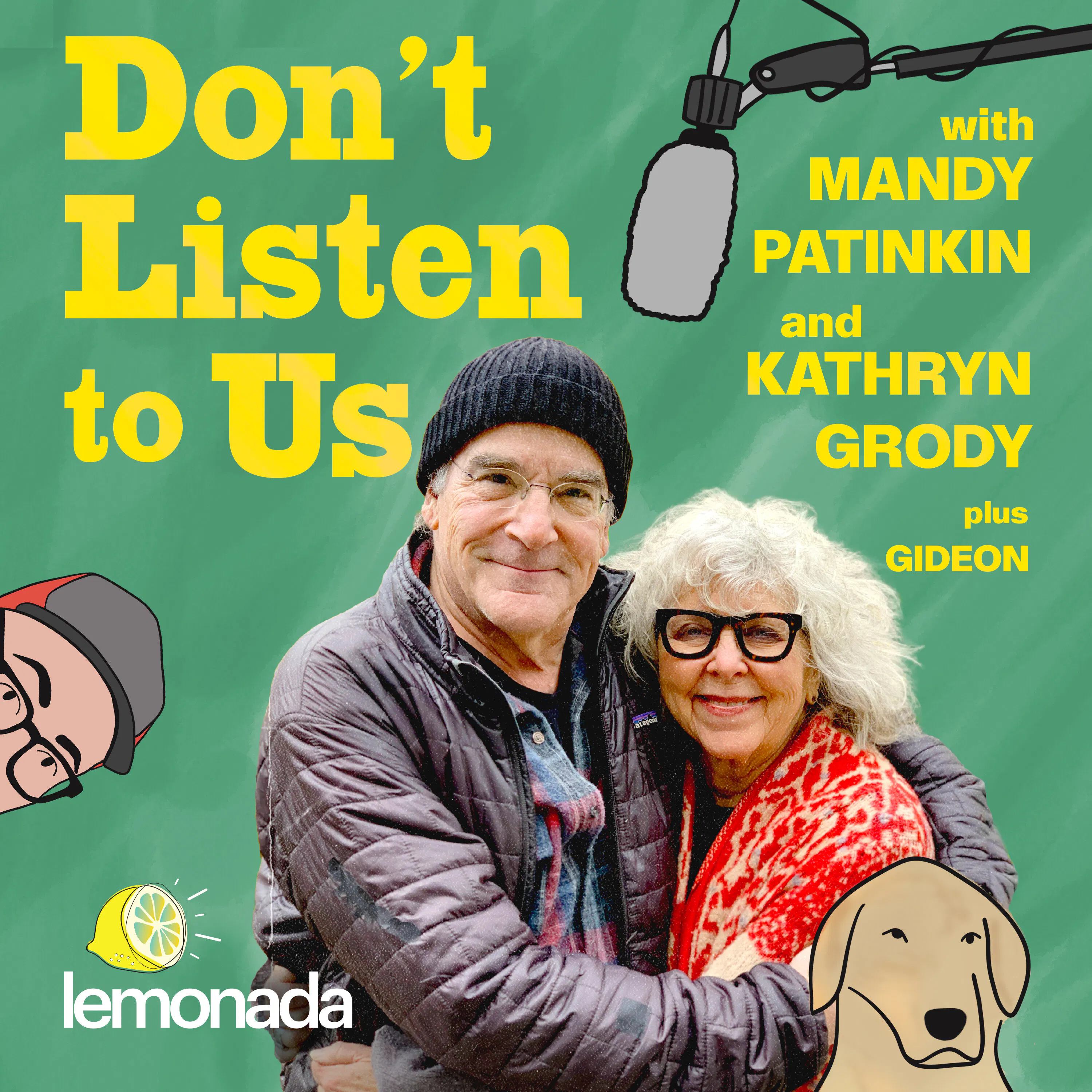
Don't Listen To Us with Mandy Patinkin and Kathryn Grody
Listener Favorite: Why Don’t I Feel Like the Age I Am?
00:51:48
Loading summary
Transcript318 lines
- [00:02]
A
Lemonada.
- [00:11]
B
You can hear every episode of Don't Listen to Us ad free with Lemonada Premium. Just tap that subscribe button on Apple Podcasts or head to lemonadapremium.com to subscribe on any other app. That's lemonadapremium.com.
- [00:27]
A
it's a beautiful day in the neighborhood. Oh, you can't do any redesome. No.
- [00:31]
C
But you can get up to, like, three seconds without being sued, so that was perfect.
- [00:39]
B
Yeah.
- [00:39]
A
All right. You can do three seconds. It's a beautiful day in the neighborhood.
- [00:46]
C
Yeah. That's how long you can sing a song without getting sued.
- [00:55]
A
You guys.
- [00:56]
C
You reading anything interesting, dad?
- [00:59]
A
Reading?
- [01:00]
C
Yeah. What was the last book that you liked that pops into your head?
- [01:06]
A
The Little Engine that Could. Wow.
- [01:09]
C
What's that about?
- [01:11]
A
Little Engine was trying to get up the hill, and it was saying, I think I can. I think I can, I think I can.
- [01:16]
C
Whoa.
- [01:17]
A
And then eventually, he couldn't regularly turn the page.
- [01:22]
C
There's the conflict.
- [01:23]
A
It's a page turner.
- [01:24]
C
That's the conflict.
- [01:25]
A
The hill was big. The hill was big. And then he got up. And the reason I love this book is it is the only book I remember my father loving and telling me about when I was a little kid. I can't remember him talking about any other book. He wasn't a big reader because after he had his accident where he essentially broke his neck and then had some trouble from it, he's, I think, reading disappeared. He had essentially a brain injury for a while. Had to learn how to walk and talk again and write with his other hand, etc. But that's a whole other story. But thank God he recovered and married my mother and had my sister and me and.
- [02:11]
C
Wait, so what else happened in this book? Did he get to the top of the hill?
- [02:15]
A
You know what? I can get the book and read it to you.
- [02:18]
B
Yes, he does. The Little Engine that Could gets to the top of the hill.
- [02:22]
A
Yeah, yeah, yeah. Oh, I thought I said that.
- [02:25]
C
Oh, he gets to the top.
- [02:26]
A
Yeah, yeah.
- [02:26]
C
Eventually he gets worried.
- [02:28]
A
No, it's a page turner. Where is he gonna get. Is he gonna get.
- [02:30]
C
Well, every book is a page turner. That's how books work.
- [02:33]
B
Yeah, I'm. I go to sleep with. I go to sleep with literally three New Yorkers now because I don't have time to read them as they come.
- [02:41]
A
Oh, let's talk about some of the New York cartoons you love talking about.
- [02:44]
B
I'm not done talking about.
- [02:45]
C
So there's the difference. Dad is reading the Little Engine that Could. You're reading three New Yorkers at the same time.
- [02:52]
B
I just finished Judith viewers latest book called with what's Left or It's Too Late to Reupholster the Furniture. I think we should because she's 94 years old and she's written so many. She wrote my favorite children's book. She also wrote a great book called Necessary Losses. She is really encouraging and I love it because she reminds me of how young I am comparatively.
- [03:15]
A
I think we've just learned that the title of this podcast should not just be don't listen to us, but it should have one of those parentheses underneath it. Don't listen to us or the Intellectual and the idiot.
- [03:29]
B
No. Oh, my God, that is so dumb. You know, dad, he's one of the smartest freaking people I know.
- [03:37]
C
Smartest idiot I know.
- [03:38]
B
You know?
- [03:38]
C
Yeah, he's looking for compliments. Actually, speaking of the name of the podcast, we should introduce it. Oh, yeah, it's welcome to Don't Listen to Us.
- [03:51]
A
Don't Listen to Us.
- [03:52]
C
Our Take it or leave it advice show. Yeah, multi generation. Who are we? Introduce yourself.
- [03:57]
B
I'm Katherine Grody, wife for 47 years of Mandy Patinkin. And you are my.
- [04:02]
C
That's your identity. Wife of Mandy Patinkin.
- [04:04]
B
No, I'm a person in her own right.
- [04:07]
C
Great. Hey, dad, who are you?
- [04:08]
A
I'm Mandy Grody and Gideon's daddy.
- [04:11]
C
Okay. And I am just a guy behind the microphone. I'm Gideon Grody Patinkin, son of these two people. Well, thanks for joining us. We want to get into first listener question today from Willie. It's a voice note. So mom, dad, if you can put your headphones on here. And we will listen to our note from Willie.
- [04:44]
B
Hi, I'm Willie Conway. I'm a survivor twice. Ovarian cancer, 2011 and breast cancer, 2023. I celebrate life every day. I enjoy your family so much. You remind me of my house growing up. Since my dad passed in December 2006 and my mom died in August 2009, my life changed. I live with my best friend now. She brings laughter and joy to my heart. Question. Why does the mind feel it does not match the age we are? I'm a kid at heart.
- [05:26]
A
That's the good fortune of being a human being. I think her name is Willie. Yeah, she has one of the great voices I've ever heard. She should be a reader for Winnie the Pooh. You remember that one, that actress, that English actress that read not Winnie, but I forgot the other character. Just the Greatest reader. And I thought it was her for a minute on the message.
- [05:52]
C
So what do you guys think? Why does the mind not match the age?
- [05:56]
A
Because, as a friend of mine once said, Willie, that you want to feel the way you do when you're 21, when you're 31, when you're 41, when you're 51, when you're 61, when you're 71, 81, 91, 101, 120. And so I think it's the greatest gift in the world that you feel like a kid.
- [06:20]
C
That's great.
- [06:21]
A
There are times I wish I felt like I was 18. And I'll say to Catherine, you know, I worry about myself sometimes because I just don't feel I have the hunger or the direction or the appetite for everything that drove me when I met you, when we just got started. Partly because some of it was dreams or, you know, whatever it was that I wanted to do. Make a family, have a career, this and that. And if that went all right, I guess I did it. So I don't need to go.
- [07:01]
B
It's been done.
- [07:02]
A
I don't need to go down that path again. I want to try other paths in the woods. But I just think it's great to feel, you know, I don't care if your knees or legs or hips or shoulders or neck or whatever aren't working. Is. I feel the most important thing is that you want. That you feel like you're young, that you feel like you're a kid. And I think we are kids till the moment we die. I think it's one of the greatest gifts you've been given as a human being.
- [07:35]
B
Well, it's a really strange thing, Willy, because the kid that you were is inside of you always. It's always there, and it's always a shock. If you are feeling very energized and very curious. When somebody will look at you and not immediately see that curiosity or that energy or that verve, you know, and just assume some cliche about your age. I think your attitude is the most important thing. Yep, you're lucky if you have health and mobility. But your attitude and your curiosity is what keeps you, your brain and your mind active and going forward. Whatever's happening with your body.
- [08:18]
C
I mean, what do you feel like a kid at heart?
- [08:21]
B
Mom, I don't even know what that means, to tell you the truth. A kid at heart. I don't feel like a kid right now, But I do feel that I'm not finished, that I'm not All done.
- [08:34]
C
That.
- [08:34]
B
This is not, you know, the end of who I'm going to be implying some years long now. Finished package. I feel very excited when something new happens or I meet new people or I have a new experience, and that makes me feel young.
- [08:50]
C
Willie also said she's living with her best friend, which I love.
- [08:54]
B
That really moved me.
- [08:55]
A
What.
- [08:56]
C
What best friend would you guys live with if you had to choose one?
- [09:00]
A
If I choose Mom.
- [09:03]
C
Well, that's cheating.
- [09:05]
B
I had a great, great friend of many, many years, and we always talked about how we'd live together when we were ancient.
- [09:15]
C
That's actually very sweet, dad. That's not cheating.
- [09:18]
B
Yeah.
- [09:18]
C
You're allowed.
- [09:19]
A
Yeah.
- [09:19]
C
Yeah.
- [09:20]
B
I mean, I. I love the idea. I heard about this recently with somebody else, too. I think that's a wonderful way of making. Making family according to what your needs are and your definition. It's not just blood kin or who you're married to, but an expanded idea who makes you feel good as family.
- [09:39]
A
I'd love. I'd live with my dog.
- [09:42]
C
Yeah.
- [09:42]
B
So I'm back.
- [09:46]
C
Something dad has talked about a lot is this idea of, like, you know, he wishes everyone would find a companion in life. And sometimes, you know, I've challenged you when that's skewing romantic to be like, not everybody wants a romantic partner. Not everybody wants to settle down. Some people aren't interested at all. But then you've shifted that to, like, well, I don't care. Then even just a friend, you know? And I do think as time goes on and we share different ways of living with each other in community, that hopefully we'll see more people who are living with their friends not because they couldn't find a partner or something else, but just because it's awesome and they love it.
- [10:28]
A
I care too much about my friends to do me to them. I would not do that. I would to my enemies. I'd go live with my enemies. That's what I would. If Bun left me, I would. God forbid, I would go live with my enemies.
- [10:44]
B
This word community is so interesting. You never heard people talk about community before?
- [10:49]
C
Yeah, it's in.
- [10:50]
B
It's hip, it's hot, it's totally in. There's intergenerational communities, intentional communities all across the country of, you know, older people that either lost partners or want to live with younger kids, where you have your own separate places and you share.
- [11:04]
C
But I think it's also something that everyone is talking about and wanting and is very in the zeitgeist. But it's one thing to have it as an idea and aspire towards it. And it's another thing with the complexity of being in it and being accountable to one.
- [11:21]
A
I don't like the idea. I don't want to be in a community.
- [11:24]
C
Well, you live in one.
- [11:28]
A
I try to avoid aspects of it.
- [11:31]
C
Yeah, well, that's part of being a community member. You feel sometimes that the word community
- [11:37]
A
makes you go, I avoid it like the plague. I'm not into it.
- [11:41]
C
Yeah.
- [11:42]
A
I mean, I do feel in commune with people who have moral, ethical ideas that are similar to mine. Care about humanity. In a way, I care about humanity. The world I want to see, you know, as others thank God, want to see the end to war and starvation and hatred, and thank God I'm not alone in that community and that there are millions and millions and it's growing every second, every day.
- [12:08]
C
So that feels more of like a global.
- [12:10]
A
Yeah, but that doesn't feel like a community. When I hear the word community, I'll tell you, you talk about age earlier. You know, there's a lot of talk about, well, let's move over. Well, maybe this because it's like an elder community or. No, a plan. What's the phrase?
- [12:24]
B
Intentional.
- [12:24]
A
Intentional community, meaning, you know, that you'll all take care of each other. Well, I certainly think that's a good thing. And I'm really glad that anybody who needs that has it, and I may need it at one point, but I don't want. I'm going to just be a little stupid and not plan for it.
- [12:44]
C
Yeah. Well, you also.
- [12:46]
A
Yeah.
- [12:46]
C
You also have the privilege of, like, having money to get the care that you need when you're older. Right. That can still keep you in your home and in your privacy if you need. You know, I think a lot of people who seek that later in life don't have access to that. But also. Tell me if I'm right here. Is part of your aversion to the word and the concept, the feeling of being stuck with people that you don't want to be around?
- [13:13]
A
Yep, yep, yep, yep.
- [13:16]
C
You know, and I think that's. I think that's what's cool about what Mom's saying. And kind of the idea of how broad that can be is that there's so many different versions of it and that in some places, how people are living together leaves plenty of space for people to be alone a lot or have their own room.
- [13:34]
A
Yeah, but it's still challenging if you're living, like, at a monastery or like Uncle Mike. You know, he lived In a monastery. And he had a lot of people. He had to get along with a lot of people, you know, and he.
- [13:44]
C
Yeah, you lived nearby.
- [13:45]
A
But, you know, I'd listen to uncle Mike talk about, you know, there were good aspects to it and very, very challenging ones.
- [13:51]
C
Uncle Mike was our uncle, brother in law, brother monk, who was zen Buddhist monk at Mount champra monastery in New York and was a very, very, very close person to us. So he might come up often. Often.
- [14:08]
A
Oh, you know what? All right, wait. One quick thing is mom said that who all in the family.
- [14:15]
C
Who?
- [14:16]
A
The. The producer. And he produced the princess bride. Norman learn Lear. What did he say to you about talking to people? I'm as old as the person I'm talking to.
- [14:25]
B
Oh, that was a great thing. I forgot about that. Norman Lear was asked, like, when he was 100, how old he felt. And he said, I feel as old as whoever I'm talking to.
- [14:35]
C
I love that. Thank you, Willie.
- [14:46]
D
Hey, it's julia Louis dreyfus from wiser than me, et cetera. Just popping in with a little reality check. Food waste shouldn't exist. There is no reason that our leftovers should end up in a landfill. But that's the final destination for about a third of the food we grow. Our ancestors would be confused. They use their food scraps as compost or as animal feed or in weird soups, all the stuff we did before garbage was invented. But composting is hard work. Living with a bucket of rotten food on your counter is gross. Most food goes in the trash because it's the easy. And these days, we'll take any easy we can get. But now there's something easier. Drop your scraps in a mill food recycler. It looks like a kitchen bin and an iPhone had a baby. It takes nearly anything, even meat and bones. It works automatically. You can keep filling it for weeks and it never smells. When you finally empty it, you've got these nutrient rich grounds. Use them in your garden, pour them in your green bin or. Or have mill get them to a small farm so the food you don't eat can help grow the food you do. Just like it should be. It's why I own a mill, why I invest in mill, and why I'm still obsessed with my mill. If you want to get obsessed too, go to mill.com wiser to get $75 off. That's mill.com wiser for $75 off.
- [16:22]
A
This episode of don't listen to us is brought to you by booking dot com. I'm looking out my window and spring is in the air. It's time to go travel. I've gotta say, if you're looking to grow your vacation rental business, this is the place to be. Booking.com is one of the most downloaded travel apps in the world, and for good reason. Since 2010, they've helped over 1.8 billion vacation rental guests find places to stay. That's billion with a B. But here's the thing. Most vacation rental hosts don't even realize they can list their properties on booking.com and if you're not on the platform, your rental is basically invisible to millions of Booking.com travelers worldwide. After all, they can't book what they can't see, right? But once you start listing on booking.com, your property gets seen by by a massive global audience of unique travelers. That means more visibility, more bookings, and more opportunity to accelerate the growth of your rental business. And it couldn't be easier. You can register your property in as little as 15 minutes, and nearly half of hosts get their first booking within a week. So if your vacation rental isn't listed on booking.com, it could be invisible to millions of travelers searching the platform. Don't miss out on consistent bookings and global reach. Head over to booking.com and start your listing today. Get seen, get booked on booking.com.
- [18:02]
C
Next. Listener question. We've got another great voice and a voice message from Maria. So if you guys want to put your headphones in, hear this one.
- [18:14]
E
Hi Mindy and Katrin. My name is Maria and I'm from Sydney, Australia. I love idea that you will have a new podcast simply because I laugh so much with your videos.
- [18:29]
B
They are very real. It's just a life how it is, not how people would imagine be for somebody famous like you are. I have a very simple question for
- [18:40]
E
your podcast and I'm very excited about that. How you still have so much fun with each other and how you manage
- [18:52]
B
to be not so serious about the
- [18:56]
E
life and all of us getting older.
- [19:01]
A
Very good question and I will let my wife go first because she's smarter
- [19:07]
B
than me, I think. You know, it's funny, we had a very brilliant, brilliant friend named Mark Harrington who got struck by melanoma at a way too early age. And when he was really, really on his last few days, he asked us to come to see us and he said he had something really important to say and we were ready for some very philosophical, maybe incomprehensible thing from this brilliant guy. And with all his Strength, Maria. He have fun. And it's been one of those punctuations for our lives. There's a lot of sorrow in our lives, in the world. And I think one of the things that rebuts it and an act of resistance is to find joy and fun anyway. You know, we are an animal that can have fun, and we make an effort to find it.
- [20:05]
C
I mean, what do you guys. What are you guys doing for fun days for fun other than.
- [20:10]
B
Well, we go for big, big long hikes.
- [20:12]
C
Playing with your grandchildren is probably the fun.
- [20:15]
B
Playing with the grandchildren is major fun. Also an energy sapper and a reminder that naps. I never thought I needed them ever, and I do need them after that. Fun is eating a lot. Maria. We have been. We have been eating a lot of ice cream and a lot of pastries. We're usually disciplined. Sometimes when the sorrows are overwhelming, we let each other eat them. We eat the sorrows right down in
- [20:45]
A
the form of oat milk ice cream with chocolate chips and oat milk. Cherries.
- [20:52]
B
Cherries, yeah.
- [20:53]
C
If you're gonna eat your sorrow, should you go for the real thing?
- [20:56]
A
No, because I try to stay away from the dairy.
- [20:58]
B
Yeah.
- [20:58]
A
And the oat milk. I'll give you a taste of that.
- [21:01]
C
That's like an actor. Real indulgence, really going for it. But the oat milk.
- [21:06]
A
No, I'm telling you, if I put the oat milk ice cream in front of you in the real, I bet you couldn't tell.
- [21:10]
B
I disagree. You could tell in a second.
- [21:11]
A
Okay, we should do the test one day, and we should do it on the podcast because nobody can. How often taste the ice cream. They'll have to be a believer.
- [21:18]
C
Dad, what do you feel that you guys are doing to what's fun?
- [21:23]
A
Well, mom said it in the beginning, like, I think, like day one when we met or something. She just said, you know, you make me laugh. And I remembered it, and I just always would try to make her laugh. And sometimes I can get a little hot. And we often, in the middle of the heat of some insane losing it discussion, we start laughing because we see how absurd we are. And we have a history of recovering from horror and troubles through laughter and just knowing that it takes X amount of time or X amount of ice cream or X amount of naps, and then we're happy again.
- [22:06]
B
I also think in terms of the question, Marie, about older, how do you deal with fun when we're older? I mean, my parents died when they were 53 and 55 years old. My Brother was always reminding me if I ever complained of any creaky anything or shocking anything or I didn't like the way my neck looked. And he'd say, gath, mom and dad lived till 53 and 56. Be grateful. And I think the gratitude for still being here and still being able to have fun and laugh and have new experiences is the way that you incorporate,
- [22:40]
C
you know, that's the other thing that's really. That's really hot in the Zeitgeist community. And gratitude, gratitude. I mean, we're always reminding each other to be grateful and everything. And that's. And that's lovely, but that's also something people didn't talk about all the time.
- [22:56]
A
I had a piece of good luck happen to me. I'm dyslexic, so I wasn't a good student. And it was when I was taking my older son once for, you know, his issues, and the expert learning person said some stuff to him. And I said, you know, I was trying to learn a script the other day, and I had all this time to learn it, and I had months before we were going to shoot and I couldn't learn it. And she said to me, similar to what she was saying to our son, this is like when he was a kid, high school or before. She said, are you learning it out loud?
- [23:27]
B
You said, you have no trouble learning songs.
- [23:29]
A
I know. And so I said, no. I said, but when I do songs, I learn them out loud. When I do Shakespeare, I learn it out loud. But because there's music to Shakespeare. But no, I wasn't Joy. She said, I think you have a brain that needs to learn out loud. So I immediately went home and learned out loud. And I had the script in two days. And I thought to myself, if somebody had diagnosed that in me when I was a little kid, I would have gone home and read my assignments out loud and not felt like a fucking idiot, you know, in class and that I was a dummy. But because of that, I ended up. My mom said, why don't you go over to the youth center on the south side of Chicago and join this? They're doing some plays over there. And I said, you don't know me at all. That's not for me. I go, I get in the play. A football player at fifth period lunch says, you should go. You know, we need some guys. I go, I get in the play. And I. And I. And I found my life. I found my life because you had to learn the words and you had time and freedom to go over and over and over them for hundreds of times, for weeks, and out loud. And then you rehearsed it out loud. And it just. It was, like, easy for me, and I loved it. And then it became something that I thought, I think I can do this. Because all the other guys were becoming mathematicians and lawyers and doctors, and I was, like, digging this. And. And I'd sing, you know, in the synagogue, and little old ladies would pinch my cheeks, saying I'm cute. Well, I got attention. I thought, this is good for me. But the glory of it is, I ended up in a profession that requires me to be an athlete until I choose to either give it up or die. Because if I'm going to perform or spend 12 hours in front of a camera or be on stage for two hours, I have to be in the best athletic condition I can be in. Now, sometimes I fail and have a little extra ice cream, oat milk. But. But. But it really. It really is a blessing for me. So what I'm trying to say. What was the lady's name who called?
- [25:25]
C
Maria.
- [25:25]
A
Maria. I can't remember anybody's name until I really go through something with them. So is. Is. Is that it would be great. I should write their name down. Then I could glance to it every time. That's what I'll do. I'm learning. I'm learning. Give me podcast. Learning freedom. And so what I'm trying to say is, do something that requires you to stay fit, whether it's learning a new recipe every day.
- [25:50]
C
To have fun.
- [25:51]
A
Yeah. Yes. Yes, to have fun. Because the minute you do something like walk, ride a bike, learn a song, memorize something, meet somebody new, it enhances your brain. The air going in and out wakes you up. There are times I. My. My dear piano player Paul Ford, he was. He would be more depressed than I was. I didn't think that was possible. And then we'd sit down every day and play and work for two hours. And he's working on the piano with his fingers. I'm singing. I got air going in and out of me. By the end of those two hours, we felt great.
- [26:25]
B
I just want to say something, Maria. Sydney, Australia, is one of my most favorite cities ever. I think it's so beautiful. I am sure you've enjoyed Bill's breakfast. And also, I just want to point out a little cliche that my husband says. It's just one of my pet peeves.
- [26:41]
C
You're sure that this woman in Sydney, Australia, a gigantic city of millions of people, has enjoyed a guy named Bill's Breakfast.
- [26:48]
B
It was a great restaurant. We have those pictures there and it's one of the best breakfast places in Sydney. And I just want to say, dad said a little old lady pinched my cheek. Has anyone ever heard the expression little old man crossing the street? I've heard. Really?
- [27:02]
A
Yeah.
- [27:03]
B
Okay. I haven't. I just want to remove both of those from the light. Maria, I hope you have fun.
- [27:09]
A
Don't, don't. Don't stay up at night waiting for.
- [27:10]
B
I hope you could find anything through the morass of what we just said to answer the question.
- [27:16]
C
Thank you, Maria. All right, Mom, Dad. This round will be joined by a live caller, Britt. But first we'll hear Britt's voice note.
- [27:40]
E
Hi, Mandy and Catherine. My name is Britt and I'm a professional chef. I turn 39 next month and have done everything from restaurants to consulting as well as working as a personal chef. Currently, I work at an upscale assisted living facility in Indiana. The hours in pay are decent, but it's still not the right fit for me. I married my wife Hannah last year as well as bought a house. I have a dream of opening a food truck and have a lot of plans in place to do so. I need more creativity, flexibility, and I really think it's time for me to get out on my own instead of being under an ever changing and semi demanding corporate job. I have full confidence that I will do well and be successful. But I'm terrified. I'm terrified of losing my job, letting people down, having to start over again, etc. I'm really hoping maybe you guys got something for me or at least just some words of encouragement. Thank you both and be well and safe.
- [28:36]
A
Thank you. Thank you, Britt.
- [28:37]
C
Thanks, Britt, for being here. She's here, Britt.
- [28:43]
A
Can she see us?
- [28:44]
C
Can she see us? No. Oh, she can. Look at that.
- [28:47]
A
How come we can't see her? Because maybe we can make that happen in the future.
- [28:51]
C
We can't.
- [28:52]
B
Okay, but I'm imagining you.
- [28:55]
C
We've got Britt's soul.
- [28:57]
B
We've got Britt.
- [28:58]
A
First of all, Britt, you look great.
- [29:01]
E
You're amazing. You guys look wonderful as well.
- [29:05]
A
Oh, thank you.
- [29:06]
B
Thank you, Britt. I just. First of all, as soon as I heard you say you are a professional chef, I just.
- [29:12]
A
I wanted to marry you.
- [29:13]
B
Yeah, I bow down to you. You're barking up the wrong tree. No, yeah, really, I will marry you.
- [29:22]
A
I'll make adjustments. Have a faith in me, Brit, for God's sake.
- [29:26]
E
You can be our house.
- [29:27]
B
Are welcome I can be their houseboy.
- [29:29]
A
I'd love to be your houseboy.
- [29:31]
B
Really?
- [29:31]
A
Are you?
- [29:31]
C
But, Katherine, you struggle with chef. Chefery.
- [29:35]
B
Oh, my God. I just. Other than brunch, Brit, I cannot do it. I just hate it. My fantasy would be able to afford you and Anna to live right there in a nice little property and just have fun.
- [29:51]
A
Anna's a friend of theirs. Her wife's name is Hannah.
- [29:55]
B
No. Is it Anna?
- [29:56]
E
It's Hannah.
- [29:57]
B
I'm. That's okay, Hannah. Sorry.
- [29:59]
C
Can you tell us a little bit more about this food truck dream and what. What we'd find in this food truck?
- [30:07]
E
Yeah, sure. Can I first. Can I first respond to Catherine?
- [30:11]
C
Absolutely.
- [30:11]
E
You said that you. You hate it. It's actually why I started cooking. My mother also hates to cook. She's happy with a bowl of cereal for breakfast or for dinner.
- [30:19]
B
Yeah.
- [30:20]
E
So I started cooking at 12. I just really enjoyed it, and it was a hobby of mine that turned into a profession, so.
- [30:27]
B
Well, I think both my sons are excellent cooks because in reaction to how much I hated it, Gideon asked you, Brit, what your idea of your food truck? What's your food truck dream? Can we hear that?
- [30:39]
E
Yes, ma'.
- [30:39]
B
Am.
- [30:39]
E
First, the biggest part is I. I just want to be outdoors. I. I want to be with my community. I want people to show up for what I'm presenting to them. That's. That's the biggest part is sort of just being more involved in my community, food truck wise. I plan on starting with breakfast. Nothing crazy, just done really well with locally sourced ingredients. I actually started calling Goshen. I'm in Goshen. Indiana is a big community of factories. So I actually started calling factories yesterday to see if they'd be interested, which was a huge boost of confidence because they were so excited
- [31:24]
A
for the factory to be interested in helping you. How?
- [31:28]
E
Just. Just allowing me. There's lots and lots of factories around here. It's like the RV capital of the world.
- [31:33]
A
You drive your food truck there.
- [31:35]
B
Yeah.
- [31:35]
E
Park it there for their staff.
- [31:36]
A
Yeah, got it. Got it.
- [31:38]
C
Nice.
- [31:38]
A
Great.
- [31:38]
C
Brit, in your note, you're talking about taking risks, making life changes.
- [31:44]
A
What.
- [31:45]
C
What do you feel you're most afraid of right now, today, as we're finding you in this idea?
- [31:54]
E
Well, I mean, with the state of the world, I mean, not to be too dramatic, but life feels horrifying right now and also, like, incredibly beautiful at the same time. My fear is taking a chance not only on myself, but as an independent worker kind of away from corporations. I'm terrified of losing that Steady paycheck. My insurance is tied to my employment, sort of all of those things. And also just buying a house last year to take out not a huge loan, but another sort of large loan just scares the bejesus out of me.
- [32:37]
A
Look, you gotta crunch the numbers and use your ingenuity and creativity.
- [32:41]
E
Yes, sir.
- [32:41]
A
To try to figure out how to insure yourself so you have healthcare. This country's got its head up its ass in terms of not giving healthcare to our citizens. And one day, hopefully, we will all fix that if we work together and never give up. So I keep the faith and keep the fire burning on that one. But I just wanted to share with you. We had a friend when our kids were little. And I'm talking preschool, you know, Bruce and everybody. And Bruce was working for the New York Times. He was a city reporter. New York City reporter for the New York Times. And new friends that we met through the kids. And he got canned for whatever reason, and he thought his life was over. And we were about 30 something. We were mid-30s. And I remember we went to this restaurant. I remember sitting there and I went, bruce, Bruce, what are you talking about? You need the actor's life. The actor's life is. Every job is over before you walk in for the first day. And I've always wished the actor's mentality for my corporate friends so that they wouldn't be afraid of the job ending, they'd be afraid of it continuing. Because the glory of an ending is then you go to a new job, new experience, new people. Yes. You have the pressure. If you're an actor, if you're one of the lucky actors who gets work, you need to keep going. You need to go serve a drink to somebody in something so you can keep your health insurance going one day and use every connection you have, all your creativity.
- [34:15]
C
Can I say one thing? I know, I know. But just so you know, also just for. Keep in mind when we're recording video.
- [34:23]
A
Yeah.
- [34:23]
B
Okay.
- [34:23]
C
If you're. You both will stop talking eventually and give the other person a chance.
- [34:29]
A
You don't listen to him at all.
- [34:31]
B
Do whatever you want.
- [34:32]
A
Okay? That's the name of the show. Don't listen to us. Don't listen to him. Do whatever the fuck you want.
- [34:39]
C
I'm just saying. You mentioned Bruce Frankel. Bruce Frankel went on to write.
- [34:42]
A
I just said Bruce, I didn't say Frankel.
- [34:44]
C
Okay, it's fine.
- [34:45]
A
Okay.
- [34:46]
C
Bruce Frankel went on to write a book called what Should I Do with the Rest of My Life? There you Go. And it featured people really over 60 years old who made radical different life choices.
- [34:59]
A
Bravo. I love that.
- [35:00]
C
All different kinds of resources and experiences, and exploring the support that they found, the courage that it took, how doing something new later in life changed brain chemistry, and that there's tons of people who are taking these leaps and risks, not just in their 20s and 30s, but in their 40s, 50s, 60s.
- [35:23]
A
Read Bruce Frankel's book Britt.
- [35:25]
B
I just heard that. Britt, I want to say three things. I know 39 is somehow this very significant number. I'm not sure why, because my writing life and my solo show life started when I was 43 years old. That's when I first wrote an answer that I felt needed speaking to. When somebody asked me when I had my second son, was I working now or just staying home, having fun? And I decided to answer that theatrically, which I did. So for me, my 40s and 50s were the beginnings of all sorts of new things. How supportive is your wife about your doing this idea? Does she think you should go ahead and do it, or is she also anxious about it?
- [36:13]
A
Both.
- [36:14]
E
Hannah is 12 years younger than I am, so she's in her middle, late 20s. And I think it's just. It's been hard for her to wrap her brain around because I think for our whole lives, we've been told that our option is to get a job, not really to create.
- [36:35]
B
Right. My big question to both of you is, is it more scary not to take the risk? Are you. If you don't take the risk now, I think it's incredibly amazing that you have the foresight to go to factories that surround where you live and just find out if they're interested or not. I mean, that strikes me as really having a lot of creativity and ingenuity. You already know they're enthusiastic.
- [37:04]
A
Catherine used to always say to me, let's just. Let's hold hands and jump off the cliff. And she always gave me that image. And we have done that many times.
- [37:13]
C
Well, in that metaphor, you die.
- [37:16]
B
No, in that metaphor, you'd make it to the other side. That's because our rabbi.
- [37:20]
C
Off a cliff to another cliff.
- [37:22]
B
You go over the canyon, you take a leap. It's called a leap of faith, Gideon.
- [37:26]
C
I know, but what are you. You're leaping on a cliff.
- [37:28]
B
You are leaping.
- [37:29]
A
No, you take a chance. You take a big chance and you jump off a cliff, and you see where you land. Here's the great news. I'm not listening to my son. Here's the great news. Brit, you don't know what's going to happen in the next millisecond of your life. Right now, while we're all talking, none of us do. You need to take a chance. When I have the privilege to talk to anybody in the world, you students of any age, I always say, if you have a dream, you know, people say, well, I want to do this, or I want to do this, or what should I do? Or I want a family, I want a career. I say, look, if you have a dream, whatever it is you want to be a scientist, a doctor, a politician, an actor, a writer, a cook. If you don't try it, you will never forgive yourself. What do you have to lose? You go try it. You may have to struggle with some medical insurance, but you also may hit the pot of gold. And you may find a way, like, I can pay for this insurance, easy. Because I'm doing what I love. And I so deeply believe when you do what you love and what you feel you are meant to do. A friend of mine said, that's your destiny. And what I think he meant was, your destiny is what you lean into, what you lean toward, where your imagination and your instinct and your actions take you. Uncle Mike, our favorite teacher and person in our family, who was a Zen Buddhist monk, had a phrase from the monastery that he gave us all that. It's a regular part of our life. Our actions are the ground we walk on. So if you have that instinct to take a different action in your life, take it. You're a baby right now. What's the worst that can happen? Dad.
- [39:11]
C
Dad. I think that's a beautiful, beautiful sentiment and a very powerful one. And I think Britt's concern is the worst that can happen is you can fuck up your life and make a terrible decision.
- [39:26]
A
Well, then you make a new decision.
- [39:27]
C
Yeah. And then you make a new decision. But I also think it's interesting because you've taken a lot of risks in your life for a while. I've seen you do that. I've seen you be very brave in a lot of different ways. But you've also done it being in a circumstance where financially, you had some security.
- [39:49]
A
That was an accident that went in my favor. I could have not had this monetary security.
- [39:54]
C
I'm saying even as you've had financial security, I've seen you take risks as a person with your voice and your art and all those things. But it is a different thing when
- [40:05]
B
you have no financial risk.
- [40:07]
C
Right? When you are taking that risk in this very fragile, crazy World.
- [40:13]
B
What you said about, we are living in the most challenging times, certainly, that I can remember. And I think comfort from wonderful food in the morning and from every person that comes to your truck and can say, hello, Britt, how are you? And you can say, hello, Janine, or, hello, Henry, and you develop that kind of warmth and comfort at the beginning of somebody's day can really make a huge difference. You know the starfish story, Britt? Do you know that one?
- [40:43]
E
I think so, but I would love. I would love for a reminder.
- [40:45]
B
Yeah, well, you know, all these starfish go up on the ocean, and a little boy starts throwing them all back in, and the father says, what are you doing? You can't possibly save all these starfish. What difference does it make? And he picks up one. He says, it makes a difference to this one.
- [41:01]
E
Yes.
- [41:01]
B
And I think community by community, relationship by relationship, feeding, feeding stomachs and mouths and souls and hearts right now with kindness and real nutrition couldn't be more needed and welcome.
- [41:17]
E
I think the biggest thing for me is expanding on that. I have an idea of. I. Sorry. I have an idea of, like, the food truck pulling up to our local food pantry once or twice a month because I've done well enough and give the food pantry a break. Here's breakfast for everybody.
- [41:36]
C
How good would that feel?
- [41:38]
E
I mean, incredible.
- [41:38]
B
That would be amazing. Yeah. Yeah, I think. I think it's wonderful. Brit, I'm. Let us know what you decide to do. I support you in anything you do, but I'm betting on you taking a chance.
- [41:51]
E
Yes, ma'.
- [41:52]
B
Am. And you can always go back to
- [41:53]
C
a corporate job and call us back sometime and let us know how it goes. Any which way.
- [41:59]
A
Please do it. I have to leave this conversation with one final thing that my teacher said to me. If you don't want to take a risk, don't bother getting up.
- [42:13]
B
Yeah.
- [42:14]
E
Yeah.
- [42:15]
B
You have your family support, your wife's support, our support. Go for it, Britt. Obviously, you're a brave person. Just take it wherever you want to go. Thank you guys so much.
- [42:24]
E
Be well and be safe.
- [42:25]
B
Thank you, Britt.
- [42:26]
A
You, too. Bye.
- [42:26]
C
Bye.
- [42:26]
E
Thank you.
- [42:31]
C
So this. I had an idea for a segment called Gideon's Secrets.
- [42:35]
B
Oh.
- [42:36]
C
Is where I tell you guys a thing that I don't think we know. I don't think you know about my childhood.
- [42:43]
B
Oh, geez. So I don't know if I can survive hearing this.
- [42:47]
C
Do you know. Do you know what me and. I think it was Tyler Paul did with the bottle of gin that we found in the freezer that you guys never drank from when we lit a bit of it on the floor.
- [43:00]
B
Oh, yes, I do. You lit a fire in the kitchen and it went really crazy.
- [43:05]
C
No, that's not quite what happened. We had a friend who liked to have a drink when he came over. So nobody in the family really drank. You're how old and drink as a kid? I was maybe like 9 or 10. And so you guys a 10 year
- [43:18]
A
old who loves a gin?
- [43:20]
C
No, if you let me get through a sentence of the story. So you guys never drank when I was growing up, but you had this friend who would come over every now and then, so you bought a big bottle of Blue Sapphire gin, or maybe the friend did, and you kept it in your freezer, and year after year it would only go down when this one friend came over to have a drink. And so after it had been in there for a while, me and my friend kind of had this notion that if you lit gin on fire, it might be a cool color. We heard that somewhere. So we lit a little bit of it on fire on the kitchen counter, and we turned the lights off and there's a beautiful purple flame. It smelled like juniper berries and whatnot. So then we took the whole half gallon of gin because we knew you guys wouldn't miss it because you forgot about it a long time ago. We went into the bathroom and we got into the bathtub.
- [44:17]
B
You got in with the gin?
- [44:19]
C
Just let me. We got into the bathtub and the floor was all tiled in the bathroom, and we poured the entire bottle of gin on the floor, thinking that, like, on the kitchen it would just be a very shallow flame. And we threw a match in the gin and the flames immediately went high up above us and we laid on each other's bodies in the bathtub crying as flames engulfed the entire bathroom.
- [44:47]
A
This is bullshit.
- [44:48]
B
No.
- [44:49]
C
And. And the tile went up the bathroom walls just about, like two or three feet, but the flames went like four feet. And we were crying in the bathtub, like, freaking out, holding each other, thinking that we were gonna burn to death. We were left alone at home having a playdate, and the walls turned black. But then the alcohol burned off and it went down pretty quick and it was really hot in there. And then we spent the entire rest of our playdate furiously scrubbing the walls to get the black soot off.
- [45:23]
B
No, it is not a lie.
- [45:24]
A
I totally believe it so that we
- [45:25]
C
wouldn't get in trouble and we threw the bottle out. And you guys never knew?
- [45:30]
B
Well, no, I believe it. Totally.
- [45:32]
C
You don't believe that I would have been that stupid or that I would have survived.
- [45:35]
A
I don't think that you could have hidden that kind of fire damage from us.
- [45:40]
C
From us.
- [45:40]
B
I don't think he could have.
- [45:41]
A
I don't think you could have.
- [45:42]
C
It was a very. The flame lasted very short time.
- [45:46]
B
Where the heck was I? Or there was nobody around. You were both by yourself in that apartment. You must have been older than nine. Getting.
- [45:54]
C
Is Becky still behind you guys?
- [45:56]
A
She's right on the floor. She wanted the cold.
- [45:58]
C
Florida. Nice. Nice.
- [45:59]
B
What is Tyler. How did Tyler Paul do? Is he a teacher or something?
- [46:03]
C
I don't know. I don't know what happened to him. But there were.
- [46:06]
A
There was running a burn unit in.
- [46:08]
C
There were a lot of things like that that happened that I thought I'd tell you about in my 20s and then forgot to do.
- [46:14]
A
You have.
- [46:16]
C
Well I. I don't know. I stabbed myself with a knife one time in my thigh and didn't want to tell you about the wound. And so I was a young kid and just putting all these bandages and I was afraid of getting in trouble even though I didn't get in trouble a lot. Do you guys have a thing that you did when you were a kid that you kept as a big secret from your parents because you were worried you'd get in trouble?
- [46:39]
A
Yeah. I have my famous story of every Wednesday. We went to Phil Schmidt's over the Indiana Skyway where my grandma Celia loved to eat and order perch with. I want the perch with no bones. And. And then we would go there and it was when you'd get light bulbs in in the grocery store and then you'd return the dead light bulbs in a brown paper bag. And I was in the back of the car so I was probably five or so. And I shoved my hand in the brown bag. You know what's in there? And I immediately broke all the light bulbs. And my arm was bleeding but I didn't know what. But I knew that they broke. So I just didn't say a word. And I kept quiet and waited until we got home. Which is about a 45 minute drive after the.
- [47:22]
C
Just bleeding.
- [47:23]
A
Well I didn't even know I was bleeding. But I did feel some wet and I thought maybe some water was in there. You know. What did I do? And I'm going to get in trouble. And then everybody gets out of the car in front of the house. And then I had to pull my arm out of the bag of all the broken light bulbs because they were going to be returned. It was like, you know, bottles, Coke bottles to return. And my mother saw that my arm was all covered in blood and I knew I was gonna get in trouble.
- [47:49]
B
And you did.
- [47:49]
A
And I did get in trouble.
- [47:51]
C
What was your consequence? You remember?
- [47:53]
A
Nothing. They just. I just remember being yelled at and not embraced for my curiosity and nurtured for my suffering.
- [48:03]
C
Yeah, that sucks. I just want to say, dad, I can't imagine me cutting up my hand when I was a little kid and you being anything but comforting and kind and supportive no matter what I did. I know, but that's progress.
- [48:20]
A
Yeah.
- [48:20]
C
Yeah. Some people. Some people continue the harm their parents have done and some people learn from it.
- [48:27]
A
I do remember that time you and your brother got in a fight with the glass pitcher and it severed your hand and you had to get serious surgery.
- [48:34]
C
You didn't yell at me or make.
- [48:36]
A
Then you became a band.
- [48:37]
B
Honey, I think that's a really big, beautiful point. And I really want to thank Gideon for mentioning that. That is friggin progress.
- [48:43]
A
What is that?
- [48:44]
B
You didn't get the kind of compassion and you got many things from your mom, but you didn't get the kindness and compassion when you were vulnerable. And you were able to not carry that forward and be loving and kind and wonderful to your children when they were in any kind of trouble, physical or emotional. And I think that's a great thing to really hear.
- [49:06]
A
I had a great balance between my mom and my dad. My mom gave me strength. She was very aggressive. She really got things done. She ran the house. My dad was incredibly gentle, sweet and kind. So the kindness comes in different packages. And I don't think my parents. Whatever finger you want to point, I don't think they were ever intentionally mean, angry or unkind.
- [49:30]
C
I think a lot of parents don't mean to do that because they have shitty tools and they weren't taught it and they didn't have good examples around them.
- [49:38]
A
Yeah. And it's the phrase that mom always says wherever she got it, which I love. Hurting people, hurt people, hurt people. And so you get hurt in unconscious ways and it shows up. I mean, there are times we all hear our parents voices coming out of our mouth. We see our hand and all of a sudden it looks like our father. You know, we just see it all.
- [50:01]
C
That reminds me of the end of the show song. The end of the show song. It's the end of the song. Thanks for tuning in, everybody. We want to. We want to hear from you more questions, stories, if you got any you know, DIY house problem fixes. You're trying to figure out weird things you stepped on in the grass. Really anything? We'd love to hear from you. Also, call us and, you know, tell us if you disagree with something you heard one of us say.
- [50:38]
A
No, don't tell me. I don't want to hear it.
- [50:41]
C
Send an email to askmandyandcatherinemail.com or check out our socials for an easy way to send us a voice note. Thanks so much for being here. Tuning in.
- [50:53]
A
Thank you. I hope the rest of your day goes better.
- [50:57]
C
Just remember, Don't Listen to Us.
- [51:00]
A
Yeah, don't, don't, don't, don't, don't.
- [51:11]
C
Don't Listen to Us is a Lemonada Media original hosted by Mandy Patinkin, Kathryn Grody and Gideon Grody Patinkin. Created by Katrina Onstad, Debbie Pacheco and Gideon Grody Patinkin. Executive producers are Catherine Grody, Gideon Grody Padinkin, Mandy Padinkin, Katrina Onstadt, Debbie Pacheco, Jessica Cordova Kramer and Stephanie Whittles Wax. Our engineer is Ryan Derringer of Welterweight Sound. Video and audio production by Mark Whiteway of Bellows Media. If you haven't subscribed to Lemonada Media Premium yet, now's the perfect time. You can hear Don't Listen to Us completely ad free. Plus you'll unlock exclusive exclusive bonus content like behind the scenes conversations, questions so weird they didn't make it on air, Becky the Dog shenanigans and more. Just tap the subscribe button on Apple Podcasts. Head to lemonade premium.com to subscribe on any other app or listen ad free on Amazon Music with your prime membership. That's lemonadapremium.com don't miss out.