← Don't Listen To Us with Mandy Patinkin and Kathryn Grody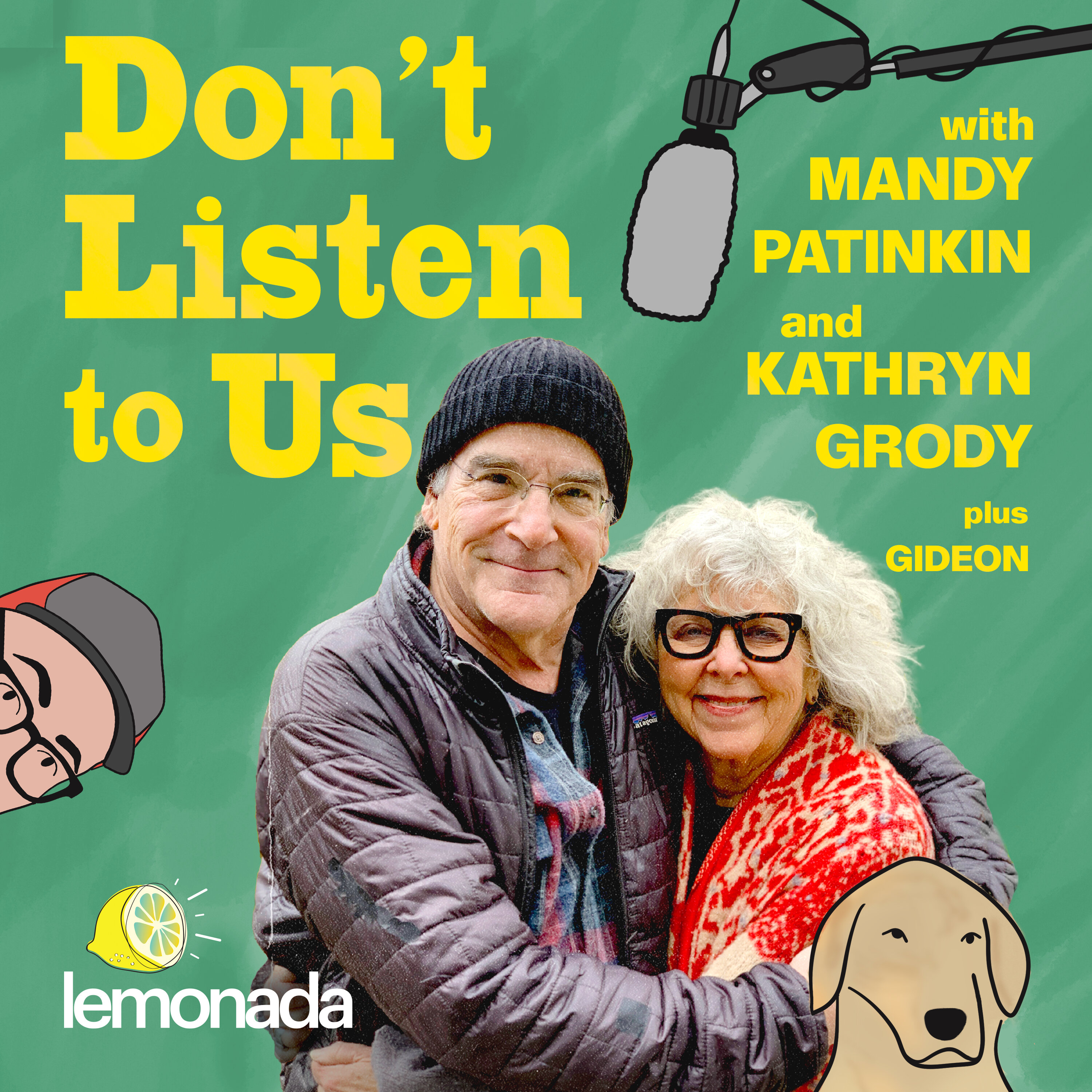
Don't Listen To Us with Mandy Patinkin and Kathryn Grody
Should Artists Use AI and Gene Kelly’s Best Advice
00:46:39
Loading summary
Transcript251 lines
- [00:02]
Mandy Patinkin
Lemonade.
- [00:11]
Gideon Grody Patinkin
How you guys feeling today?
- [00:14]
Katherine Grody
Very good. Because I was fed. I fed myself. My son did a Zoom car ride to get my organic turkey sandwich from Cherries the local.
- [00:27]
Gideon Grody Patinkin
Dad, how are you? No comment.
- [00:28]
Mandy Patinkin
I'll pass on that question.
- [00:29]
Gideon Grody Patinkin
Yeah, that's true. You pass on any question. It's a great thing about don't listen to us. Nobody's listening, so you don't have to say anything. Welcome to Don't Listen to Us. I'm Giddy Giddy. Go. Who are you?
- [00:50]
Mandy Patinkin
I'm Andy. Boo.
- [00:51]
Gideon Grody Patinkin
Andy. Boo.
- [00:52]
Katherine Grody
Catherine Tutu.
- [00:54]
Gideon Grody Patinkin
Kathryn Tutu.
- [00:56]
Mandy Patinkin
I don't know what.
- [00:57]
Gideon Grody Patinkin
What? You gotta just tell. It's a thing you have to do. You have to tell people who you.
- [01:01]
Katherine Grody
Are every single time.
- [01:02]
Gideon Grody Patinkin
Well, yeah. Cause somebody's just coming in on the. This is their first time hearing this nonsense. Becky laying down right there.
- [01:08]
Mandy Patinkin
Whatever part of her you see.
- [01:10]
Gideon Grody Patinkin
Dad, you asked me to go pick up a box from over by the driveway for you.
- [01:14]
Mandy Patinkin
Is that why you didn't pick it up? Cause you want to make a part of the podcast?
- [01:16]
Gideon Grody Patinkin
No, I was just thinking.
- [01:20]
Mandy Patinkin
Yeah, go.
- [01:21]
Gideon Grody Patinkin
How does it feel if your children, you ask them to do something and they say no? Do you feel like, what's wrong with them? I'm responsible.
- [01:31]
Mandy Patinkin
Nothing's wrong. No. It was an appropriate answer. And I'm taking a quarter off your allowance.
- [01:39]
Katherine Grody
I think, Dad. I know.
- [01:42]
Gideon Grody Patinkin
I only hear it, like, once.
- [01:43]
Mandy Patinkin
Let's hear one of your favorite jokes. What's your favorite joke? What's that favorite joke you kept saying the other day?
- [01:48]
Gideon Grody Patinkin
Oh, my favorite joke that I heard is two gentiles are walking down the street. One says to the other, so, how's business? And the other responds, great. That's a great. You know, it took me a second. It took me a second, too. But that's a good joke for all of you people out there who've never met a Jew. Just, you know, do some Googling to.
- [02:14]
Katherine Grody
Try to figure out why that is an answer by a non Jewish person.
- [02:20]
Gideon Grody Patinkin
Want to get into listener question one? A voice note from.
- [02:25]
Mandy Patinkin
About the oceans.
- [02:26]
Gideon Grody Patinkin
It might be about water. No. Next, we have a chewy interesting dilemma for you guys from Sarah. We're gonna put our headphones in here.
- [02:35]
Mandy Patinkin
Okay? Chewy makes me think of a really good chocolate chip cookie. Gooey, chewy, nice and warm. The ones you used to make.
- [02:43]
Gideon Grody Patinkin
I don't know if she mentions cookies.
- [02:44]
Mandy Patinkin
But she made a great chocolate chip cookie, and you haven't made one for quite some time. And I even like them frozen.
- [02:50]
Gideon Grody Patinkin
Trying not to eat those yeah.
- [02:53]
Mandy Patinkin
Do you have a cold?
- [02:54]
Gideon Grody Patinkin
I think I have some allergies.
- [02:56]
Mandy Patinkin
Are you gonna snorkel all through the.
- [02:57]
Gideon Grody Patinkin
I might.
- [02:58]
Mandy Patinkin
The talk. I might.
- [02:59]
Gideon Grody Patinkin
All right, let's have a listen to.
- [03:02]
Katherine Grody
Oh, man. Jesus. My least favorite.
- [03:06]
Mandy Patinkin
Maybe it was Gideon.
- [03:07]
Gideon Grody Patinkin
Maybe it wasn't just all kinds.
- [03:09]
Mandy Patinkin
It was a comedy snorkel. That was a comedy schnorf.
- [03:13]
Gideon Grody Patinkin
Some knuckle cracking for the radio. Is that a popular thing?
- [03:16]
Mandy Patinkin
People love it.
- [03:17]
Gideon Grody Patinkin
Okay, let's take a listen to Sarah's voice note. Hi, Mandy and Catherine. I have a question for you. I have a friend that recently accepted a new job, and although I'm super excited for them this new chapter in their lives, I am worried that this.
- [03:37]
Mandy Patinkin
Job isn't a great fit for them. And more so, I'm morally opposed to the work that.
- [03:44]
Gideon Grody Patinkin
That this company does. I strongly believe that the company is.
- [03:49]
Mandy Patinkin
Causing harm to others, and that's something.
- [03:53]
Gideon Grody Patinkin
That'S hard for me to look past. So, yeah, I'm wondering if you have any advice for me or anyone going through something similar. Thank you so much for your time.
- [04:06]
Mandy Patinkin
Wow. Wow. Sarah, you can't. Obviously you recorded this, so we can't have a conversation with you. It's really hard for me to talk about this without knowing what the job is, but I'll take a stab at it. Tell her to quit.
- [04:23]
Katherine Grody
No, I would feel totally differently. I feel absolutely differently. Sarah, it's great that you're friends with somebody that you care about and I hear your concern, but it's not you doing the job. I think it would be totally appropriate if this is a close friend for you to say, I wonder if you're really aware of the harm this job will cause. How do you feel about the harm the job causes? But if that friend is knowing, takes the job, knowing full well what the business does, she can either say, I'm sorry, I'm desperate for a job. I don't care what they do, or I disagree with you. And then. And it may be a wrench in your friendship, but I don't think you can say, I wouldn't take that job. I would quit that job. And I'm wondering if what you're thinking about, because it makes me so uncomfortable that somebody I care about and I know is a good person is going to take that job. I don't agree, but I don't think you can just say quit.
- [05:32]
Mandy Patinkin
I don't agree. I would do everything I could to counsel her, to counsel her friend for a job that. More that is morally offensive to Sarah and does harm to People to not accept that job.
- [05:47]
Gideon Grody Patinkin
I mean, I think I'm generally aligned with dad on this one, but it's hard to know without more specifics of what the harm is. You know, some people think that television just in general is harmful. Is harmful and like, rots people's brains and keeps them just, like, zoned out on tv. And that might be, you know, her sort of moral parameters. Or maybe she's feeling like this is a company that's inherently, like, racist or part of violence. And that's a very different thing. But it is tricky.
- [06:21]
Mandy Patinkin
I need to know what the company is and I need to know. I don't need to know the friend's name. I do need to know the company's name. I need to know what they do, and I need to know what she considers the harm that they would do to others. Yeah, what the.
- [06:34]
Katherine Grody
What they'll do without naming the company.
- [06:37]
Mandy Patinkin
If you get sued, if you're going to get sued by naming the company, then what's the level of harm that X Company does?
- [06:45]
Gideon Grody Patinkin
But I think you guys bring up an important part is it's like, where is your. Where are your values here? How flexible is your moral compass with being able to say, okay, it's doing some harm, but I need to make money. Everybody does some harm. Or do you have a line in the sand and it sounds like for you, dad, if you know a project or a company is doing harm.
- [07:10]
Mandy Patinkin
Harm to others.
- [07:11]
Gideon Grody Patinkin
Harm to others, don't do it.
- [07:13]
Mandy Patinkin
I couldn't ask for a clearer description.
- [07:16]
Katherine Grody
It's just. It is one of those things. I mean, I have a friend that does work for us, and I like her very much. And we couldn't be on different. More different political spectrums. You know, she supports an agenda that I think is causing harm. Do I? I don't think I fire her. I try to talk to her, but.
- [07:34]
Gideon Grody Patinkin
It'S not the work she's doing for you. No. It's not her job.
- [07:37]
Katherine Grody
No. It's just her.
- [07:38]
Gideon Grody Patinkin
It's her beliefs and the way she votes. I think one question I have though from this is like, what are those boundaries for you guys of what you feel you can tolerate from other people in your life that might not be aligned with your moral values? I mean. Cause you guys want to have friends that believe in different things.
- [08:00]
Katherine Grody
Theoretically, yeah.
- [08:01]
Gideon Grody Patinkin
You want to know people, I can ask, who believe differently than you, but you also don't want to be supporting things or people's beliefs or practices that commit harm to others. So how do you navigate that I can answer that.
- [08:13]
Mandy Patinkin
I would, very politely. If they brought it up or if I brought something up that let them illustrate clearly to me that we have polar opposite points of view on an issue, I would let them finish. I am not in the business of converting them over to my thinking. I'm not in the business of trying to get their vote because there are enough people that I can get to vote for what I want, voted for that aren't participating in the voting process. And I would let them finish, I'd be polite, and then I would move on as quickly as I could because I need to save my energy for those individuals in our society who are not participating in the voting process or in the work process or whatever they're not participating in and ignite them and get them to participate and believe that they have that at least the possibilities existing with them, that we will be morally and ethically aligned. And that's where I put my energy.
- [09:15]
Gideon Grody Patinkin
So I hear you're kind of saying, like, choosing your battles and not exhausting yourself or frustrating yourself with somebody who's so far from your set of values that you can't reach.
- [09:27]
Mandy Patinkin
I appreciate their clarity because lifetime is short, life isn't forever, and I need to move on, spend my energy wisely. So they're giving me tremendous clarity. This is who I am. This is how I feel. God bless you. Go and be well. Let me go where I need to go.
- [09:44]
Katherine Grody
You know, it's one of those things, kid. I don't order from a certain company because I don't like their values. Dad orders from that company because he likes the availability and the quickness of things. I wonder what that could be. Do I think my not ordering from that is gonna make a difference? No, it makes a difference to me. I like having alternative companies that do similar work but have decent practices in how they treat their workers. So I try to find that out.
- [10:16]
Mandy Patinkin
Right.
- [10:17]
Gideon Grody Patinkin
I mean, another thing that comes up in this conversation for me is a certain degree of hypocrisy that we are all interacting with as we try to navigate our moral compass. We can state what our values are. We can state what we're trying to do. And it's aspirational in a lot of way. And we are all a part of actively, like, creating harm even while we're trying to fix the rule of the world. We don't do all that we can, and that's okay. Like, this is not. I'm not criticizing us in a different way than other people. I'm saying we're like A ton of other families in this country that like to think we're doing what we can, and we are living beyond the things that we need.
- [10:57]
Mandy Patinkin
Here's what I disagree with. With the way you're saying it. We do what we can, as though that's a negative thing. I believe that what people are doing that they can do means a lot.
- [11:06]
Gideon Grody Patinkin
I agree.
- [11:07]
Mandy Patinkin
It makes a big difference if you can take less flights, if you have the kind of money to fly private jets and you don't, if you have, you know, all kinds of choices that you can make and you make more ethical, moral planet, caring choices.
- [11:21]
Gideon Grody Patinkin
I think that's all.
- [11:22]
Mandy Patinkin
And if that's all you can do. Thank you, is what I said.
- [11:26]
Gideon Grody Patinkin
I think that's all good.
- [11:27]
Mandy Patinkin
I don't want to make anybody feel bad about only doing what they can.
- [11:31]
Gideon Grody Patinkin
No, I don't either. I just. I'm just. I'm just my perspective. When I hear us say we do what we can, we're doing some of what we can, like a lot of other people. And I think. I think we tell ourselves, you know, what can I do? And we keep doing way more than we need to because it's a cultural lifestyle thing and our behavior is not in line with the emergency that we're seeing. That's something we're a part of and a lot of other people. This isn't like a huge part of.
- [12:02]
Katherine Grody
It not being part of the. But I was listening to actually a podcast about the end of our species. One of the worst things in terms of making things better or pulling us back from the brink is utter hopelessness.
- [12:16]
Mandy Patinkin
Well, what the fuck are you listening to a podcast about the end of our species? Is that helping you go to sleep without crying?
- [12:21]
Katherine Grody
I don't listen to. I don't listen to it at night. It's very interesting because the guy.
- [12:25]
Mandy Patinkin
I do not listen to those things.
- [12:26]
Gideon Grody Patinkin
Well, she can do whatever she wants.
- [12:28]
Mandy Patinkin
She does. But then she cries waking up and she cries going to sleep, and she doesn't sleep.
- [12:32]
Gideon Grody Patinkin
You cry and don't sleep.
- [12:34]
Mandy Patinkin
I don't listen to those podcasts. I cry for other reasons. We want to hear my reasons. Let's ask our listeners to vote on.
- [12:46]
Gideon Grody Patinkin
Best reasons for crying and not sleeping.
- [12:49]
Katherine Grody
He gives me. He's a teacher, and he can't give his students no hope. And so he offers hope in very original ways about how to keep our species going. And part of it is by being more connected to your natural world and not thinking this human species is such an exception. And I found that interesting. And hopeful.
- [13:10]
Gideon Grody Patinkin
That's great.
- [13:11]
Mandy Patinkin
I wasn't listening.
- [13:12]
Katherine Grody
I know, honey.
- [13:13]
Mandy Patinkin
Because I follow the title of this show. Don't Go Listen to us. Really?
- [13:18]
Patricia Kelly
That's great.
- [13:19]
Mandy Patinkin
Whenever I can. Yeah.
- [13:26]
Katherine Grody
This episode is sponsored by Better Help. I was born in California, and I never understood that if people had the option, why they wouldn't live in a place that had all four seasons. Because I found that magical. But I know as the days get shorter and it gets darker, some people feel a little shut in, a little lonely with that. And BetterHelp is encouraging everybody to reach out. Let the people that you're close with or haven't been in touch with for a while know you're there. You know, and in these challenging times, it really feels good to remember you have a community. Remember there are people that you feel close with. And if you need help outside of your community, it feels really, really good to reach out for a therapist. BetterHelp therapists work according to a strict code of conduct, and they are fully licensed in the US which was really important to me to find out before I agreed to associate with BetterHelp because I think licensing and skill and training is really important. This month, don't wait to reach out. Whether you're checking in on a friend or reaching out to a therapist yourself, BetterHelp makes it easier to take that first step. And our listeners get 10% off their first month at betterhelp.com don'tlisten. That's BetterHelp. H-E-L-P.com don'tlisten. Let's make the Fall a beautiful opportunity to connect and to heal what needs healing. This show is sponsored by MIDI Health. And let me tell you, I am so thrilled to learn about MIDI Health. Because when I was in midlife and when I was going through perimenopause and menopause, they did not exist. I felt alone. Like every woman going through this was made to feel, and we were made to feel ashamed and embarrassed and to feel that our vibrancy in all areas was over. Do you know today, 75% of women seeking care for menopause and perimenopause issues are left entirely untreated? How's that possible? Midi Health is now here to provide individualized telehealth, which is covered by your insurance, by the way. And they will listen, take women seriously, and encourage you to move on to this next act. Get through it. Less insane than I was. So I really encourage you to check them out if you're ready to feel your best and write your own second act visit join midi.com today book your personalized insurance covered virtual visit. That's join midi.comm I d I the care women deserve. That's progress. Hallelujah.
- [16:34]
Julia Louis-Dreyfus
Well hi everybody. Julia It's Julia Louis Dreyfus from the Wiser Than Me podcast. And I'm not gonna talk about food waste this time. I'm gonna talk about food resources. All that uneaten food rotting in the landfill. It could be enriching our soil or feeding our chickens because it's still food. And the easiest and frankly, way coolest way to put all its nutrients to work is with the mill Food Recy it looks like an art house garbage can. You can just toss your scraps in it like a garbage can. But it is definitely not a garbage can. I mean, it's true. I'm pretty obsessed with this thing. I even invested in this thing. But I'm not alone. Any mill owner just might corner you at a party and rhapsodize about how it's completely odorless and it's fully automated and how you can keep filling it with for weeks. But the clincher is that you can depend on it for years. Mill is a serious machine. Think about a dishwasher, not a toaster. It's built by hand in North America and it's engineered by the guy who did your iPhone. But you have to kind of live with mill to understand all the love. That's why they offer a risk free trial. Go to mill.com wiser for an exclusive offer.
- [18:08]
Gideon Grody Patinkin
Listener Question 2 is an email that Mom, I'd love you to read. This is an email from Chris.
- [18:18]
Katherine Grody
Hi Mandy and Catherine. Thanks for inviting us into this conversation space. It means a lot. Here's my dilemma. I've been writing lyrics and poems since the 70s, but I've never been able to play an instrument. Nervous breakdown Mental illness at age 16 so when I discovered AI music tools, I felt hopeful I could finally bring my lyrics to life. But now I find myself torn. I know you and many artists feel AI threatens creative integrity or jobs. I get that. But for someone like me, it's been a gateway, not a replacement. Question Is there room in the creative community for people using AI out of accessibility, not apathy? How do we balance innovation with respect for the craft? I don't want to be seen as cheating. I'm just trying to share my lyrics while I still have time. Thanks for listening, Chris. Thanks for writing that, Chris. It is a great question. I think it's a fair question. I do have a lot of negative bias and fear about AI in the creative space and in personal space. But I. I think what's really important is that people that use AI creatively, that you say that you've used it. I think it's important if you share your lyrics and your songs that you have. You know, like somebody will say the characters in this book are not based on real life. You know, it's a disclaimer or a reclaimer. And I. That it's fair to the artist not using those tools, that you are honest and transparent about it and tell them, you know, and just say, I have these lyrics I wanted to share, and because of personal things in my life, I needed to use AI tools. And then I think that's a valid way of being human while you're using that technology.
- [20:15]
Mandy Patinkin
I echo my wife, Katherine Grody. I would add a little bit more to it. If you're writing lyrics, poems, stories that you put to music in any way, shape, form whatsoever, and you know the story you want to tell, or you want to paint a picture or something like that that you do with your hands and your mind and your body, and you, for whatever reason, are not able to attain the skill to do that, to learn the instrument, to figure out how to paint whatever it is. And you feel like your brain just doesn't work that way and you can't do it, but you still have the story that you want to tell. Tell it, tell it any way you can, but only tell it after you've explored this possibility. Look for a musician that might be able to help you, that you could afford, or who wants to do it pro bono, or who wants to collaborate with you on telling a story. Look for a painter who might be able to paint the picture that you're thinking of, or design the building that you'd like to build or the house you want to live in for your friends or family or yourself before you turn to a computer and an AI app. If you've exhausted all possibilities to collaborate and be with another human being, which I think is the key to being alive, which I got a lot to learn from what I just said, because it's hard sometimes to be with other people, but it's important. That's what I think defines us as a species that we like to and need to be with other human beings and share ideas, thoughts, and most of all, creativity. There is no person on the planet that does not have the ability to create. Everyone can do it. It's just how you do it and who you do it with. And if you've checked everybody out in your neighborhood and the computer can help you do it, turn it on.
- [22:14]
Gideon Grody Patinkin
Have you guys. Have you guys felt AI in your own lives as creatives yet? Has it encroached in that space? Is it something you've been having to deal with as.
- [22:26]
Katherine Grody
No, it's just all the warnings. It's tons of warnings and tons of playwrights and tons of illustrators and artists freaking out about it. And I am trying to be open to the positive aspects of technology.
- [22:42]
Gideon Grody Patinkin
Yeah, this is a great one here.
- [22:45]
Katherine Grody
This is great. Chris has these issues and then he's found this tool that could help him really express himself. But I love Dad's suggestion before you hit the AI Chris, if there's a friend, if there's a teacher, if there's somebody in your neighborhood, if you could trade with them, it's great.
- [23:02]
Mandy Patinkin
Yeah, I got a go human before AI My piano player, Adam Bendavis, he is like an apple genius. He can do anything on that computer. And we use four score to clock all our music and transpose our music and all our lyrics. And that's what he uses during our concerts. And that is a version of AI we can change it into any number of keys we want instantaneously. He can do that himself with his hand and his pen and his paper. But that would take a lot of time that we'd rather spend practicing, learning new songs, arranging the songs we have, finessing them and preparing them for telling the stories and sharing them with our audiences. So we only have so much time. So we make that choice. Could we hire someone to do it? Yes, there are people. It's a lot fewer people around that do this because the technology, even before AI was there to do it on computers.
- [24:05]
Gideon Grody Patinkin
So let me ask you a question. Taking your own advice. When you guys came to this moment of using this program that had AI.
- [24:11]
Mandy Patinkin
We didn't have the budget for it.
- [24:12]
Gideon Grody Patinkin
Didn't have the budget for it.
- [24:14]
Mandy Patinkin
And that's a good reason, too. Okay. You're budgeted for what? Xyz. And you got to follow the budget or you go bankrupt and you're going to have to close your shop. So that's a good reason, too.
- [24:26]
Katherine Grody
I'm just having a stray thought. I am so sad that there are no record and music stores anymore. You used to go to Tower Records or what was the other name of them, and you'd look for sheet music and you'd talk to somebody and you'd meet somebody and somebody would tell you about A concert, there would be bins of music available that still exists.
- [24:45]
Gideon Grody Patinkin
Just less so.
- [24:46]
Katherine Grody
Less yet. I don't even know where music was.
- [24:48]
Mandy Patinkin
What was the name where all the sheet music was?
- [24:50]
Gideon Grody Patinkin
That's because you're never going to buy records or music.
- [24:53]
Katherine Grody
It's not part of life.
- [24:55]
Mandy Patinkin
Could our wonderful producers please look up the name of the music sheet store on Broadway and 49 and 40th or 50th street in Midtown? And it used to be the premier place. Now I can't remember it, but I hear you.
- [25:06]
Gideon Grody Patinkin
That's a big. That was a big.
- [25:07]
Katherine Grody
But that was. That was a big.
- [25:09]
Mandy Patinkin
Let me just put it in the AI and it'll give me the answer so I don't bother my producers.
- [25:14]
Katherine Grody
Yeah.
- [25:14]
Mandy Patinkin
I'll tell you an example that I thank God for. AI If I had a loved one who had a medical problem, and that problem could be cured by A.I. medical technology and science and A.I. oh, my God. Please, please, please do it. Are there scientists that could do it? Sure. How long would it take? As a great dear friend of mine said, we can figure it out, but it's a question of turning over one lily pad at a time. We know how the cell system works, but we have to do that. And it takes time. And if a supercomputer can do it in time to save my loved one, do it.
- [25:50]
Gideon Grody Patinkin
And I think that that very well might be a big one of the many motivations for creating this technology. Say you can cure cancer. Meanwhile, you might explode the entire world doing that.
- [26:05]
Mandy Patinkin
But you've cured cancer.
- [26:06]
Gideon Grody Patinkin
But you've cured cancer.
- [26:08]
Katherine Grody
Plant life that will remain. Or wielder animals.
- [26:11]
Mandy Patinkin
So no more cancer.
- [26:12]
Katherine Grody
The animals.
- [26:13]
Gideon Grody Patinkin
The place was called Colony Music.
- [26:14]
Mandy Patinkin
Colony Music.
- [26:16]
Katherine Grody
Yes, it was Colony Music. I love that. I love going in there. There was all these people that worked there, knew all music. And you would have conversations with strangers. It was a way of practicing being in community with each other with a level of stranger kindness that we've totally gotten.
- [26:34]
Mandy Patinkin
And what did you give me as a gift that's all over the walls in my room?
- [26:38]
Katherine Grody
Your sheet music.
- [26:39]
Mandy Patinkin
Covers from the songs. All the old songs. The old songs I used to. That I still sing, I found it there. But they're like artworks. And we framed them all and put them all.
- [26:50]
Katherine Grody
And every time, every time, I do not understand how the choice is made about what journalists read their articles or have voice actors read them. And if it's an automated voice, if I want to listen to something and I hear this is read by an automated voice, I smash My hand on it, as if that algorithm will know I'm pissed off because I don't want to hear an automated voice that sounds exactly alike and is not human.
- [27:13]
Mandy Patinkin
Now here's what I'm.
- [27:14]
Katherine Grody
It's a real difference.
- [27:15]
Mandy Patinkin
Here's what I'm hearing. If this conversation could be fed into AI, I would type in, could you make these two people sound a bit calmer, a more sane individual? Could you do it so that maybe more people could hang in for a.
- [27:36]
Gideon Grody Patinkin
Few seconds, making them smarter, better, smarter.
- [27:40]
Mandy Patinkin
Better, but a little less crazy, a little less intense? We've now been programmed for AI and we'll show you how that comes out. 5, 4, 3, 2, 1.
- [27:55]
Katherine Grody
I would like it to know. I'm very interested to know who makes the decision about having a human voice actor or, or the author read an article as opposed to choosing an automated voice. And what is the benefit of automated voice other than you kill the employment of voice actors and save $0.02 when you have billions to spend? Gideon, give me that idea.
- [28:17]
Mandy Patinkin
Gideon, that is such an interesting question. I find that I think if AI can answer certain life questions or problems, that you would want to engage in that as soon as possible. There are so many things we can learn.
- [28:39]
Gideon Grody Patinkin
That's way better. Okay, mom, dad. This round we will be joined by a live caller. We got a very intriguing email in our inbox from her. I'll read it to you before we bring her in. Email, read. Dear Mandy and Catherine, I've always had a feeling that my late husband, the dancer, director, choreographer Gene Kelly, might have been an influence in your lives. I wanted to ask you about this for years, but I didn't know how to contact you directly. Thank you so much with fondness and admiration, Patricia Kelly. And to those of you who might not know, the late great Gene Kelly revolutionized dance in movies. You know him from Singin in the Rain and Anchor's Way. We're so pleased to have Gene Kelly's widow, Patricia on the line. Hello, Patricia.
- [29:40]
Patricia Kelly
Hello. Thank you for having me.
- [29:42]
Gideon Grody Patinkin
Thanks for joining us.
- [29:44]
Katherine Grody
Wow.
- [29:44]
Mandy Patinkin
Hello, Patricia. What an honor to talk to you.
- [29:49]
Patricia Kelly
Well, as I said, I've been wanting to do it for about, I don't know how, maybe three decades.
- [29:56]
Mandy Patinkin
Wow.
- [29:57]
Katherine Grody
Isn't it great, Patricia with this. That's a good thing about technology is it lets us finalize 30 year old intentions, you know?
- [30:05]
Mandy Patinkin
Well, for you to have been lucky enough to had a partner who was one of the greatest contributors to humankind in terms of heart and soul through his feet, body, hands, face and being is just unbelievable that I'm even getting to talk to someone that close to Gene Kelly. And I had the privilege of sitting with your husband and meeting him for the movie, the Second Greatest Entertainment. What was it called? The Greatest show on Earth.
- [30:43]
Patricia Kelly
That's Entertainment.
- [30:44]
Mandy Patinkin
That's Entertainment 2. You remember? And he was working at Zoetrope Studios. I believe he had an office there. And I was a kid, I was about 25 or 30 years old, and. And I walked in and there he was, sitting behind the desk without his toupee. And I felt I was in the presence of God Almighty.
- [31:07]
Katherine Grody
And what did he say to you? How did. He gave you great advice?
- [31:10]
Mandy Patinkin
I'm trying to remember the.
- [31:12]
Katherine Grody
No, it was about failing. Wasn't Gene Kelly the one you've always.
- [31:16]
Mandy Patinkin
Oh, that's the one. He said it's Gene Kelly who said that. And I stopped quoting him, so I forgot that it was Gene. Gene gave me the greatest piece of advice that I. That I share with everyone. He said, let me tell you something, kid. This is how he said it. Let me tell you something, kid. We never learned anything from our successes. They pat us on the back and send us on our way. But our failures, we tore them upside down and inside out. And they taught us everything we know.
- [31:41]
Patricia Kelly
Yep, that sounds just like him.
- [31:44]
Mandy Patinkin
Yeah, that was word for word.
- [31:46]
Patricia Kelly
The kid part, too.
- [31:47]
Katherine Grody
The kid part, too.
- [31:49]
Gideon Grody Patinkin
Patricia, I'm so curious. Why did you want to ask my folks this question? What was that? How was that?
- [31:58]
Mandy Patinkin
I forgot the question.
- [32:01]
Gideon Grody Patinkin
Gene Kelly influenced your life, you know. What influences? I mean, I have heard my dad quote that so many times, but, yeah, curious. What made you want to ask these guys that question?
- [32:13]
Patricia Kelly
Well, I followed their careers and I just felt like there had to be some kind of influence, not only in the work, in the love of the American Songbook, but also in the humanity of the two of them. And I just felt like there had to be some crossover. And I was curious if they had met or if they. And I just. I don't know, you just have this instinct that they saw his movies and they appreciated him and they understood the breadth of his work.
- [32:47]
Katherine Grody
And I must say, Patricia, I love that we have those films and records of a human being's magical powers, that you can see what years of work and study and practice and failing did with that human person to climb up that wall and dance on that ceiling. And I just love being reminded of our species, human capacity, all by itself, without any machines. Those are his real feet, his real moves. I'm so grateful.
- [33:30]
Mandy Patinkin
Pardon me, Forgive me the first time because I'm interrupting, because I'll forget my thought. The first time I did my concerts, in 1989, I believe it was. I put in what I called the Pal Joey medley. And I called my dear friend Annie Reinking, rest her soul, if she could help me choreograph it and make me look like Gene Kelly, if at all possible. And I just remember Annie, at one point, was, I think, like seven or eight months pregnant with Christopher. And she took me in her arms in this rehearsal room, and she started taking me around the room. And she was teaching me how to be Gene Kelly. And when you're in the arms of Gene Kelly or Annie Reinking, you all of a sudden are Gene Kelly. And you're like the greatest dancer in the world. And no one can ever take that feeling away from you. It lives with you forever. And I'm the luckiest guy that I literally sat at his feet at his desk and got to meet him. I saw him one other time at some event we were with. There were too many people there, but the elevator door open, and there he was, close to the end of his life. And it might have been even you standing next to him in the elevator. And I just thought, oh, my God, I get to see him again. And I thank you for taking care of him for all of us.
- [34:59]
Patricia Kelly
Well, it's a privilege to be able to continue his legacy. I think he said that the purpose and the point of his work was to bring joy. And I think we could all use a lot more of that these days. And maybe that's our form of resistance that we continue. You continue with your shows and spreading the Great American Songbook. And I keep Gene out there for young people.
- [35:28]
Katherine Grody
It's fantastic.
- [35:31]
Gideon Grody Patinkin
Patricia, can I ask how you and Gene met?
- [35:33]
Mandy Patinkin
Yeah.
- [35:35]
Patricia Kelly
You won't believe it. I was a very nerdy Herman Melville scholar. Somebody said that's a little redundant. But I was a writer on a television special about the Smithsonian museum in Washington, D.C. and Gene was the host narrator. And as it turns out, I did not know who Gene Kelly was. I had always been in a library with my nose in a book. And all of the women on the set were trying to get a marriage proposal out of Jean. They figured they had a week to do it. So the director decided he would put me in the room with Gene to keep all of the other women away from him. And I was. I think Gene always looked at me like something had been tossed in his cage. He'd never seen anything quite like it. I Had long brown hair, thick, was wearing a man's lumberjacket and corduroy pants that were high water and thick wool socks and clogs and no makeup. And the first thing he said to me was, I bet you don't know who Montgolfier was. And I did know that Montgolfier had created the first hot air balloons in France. And then he said, I bet you don't know the opening lines to Yeats poem the Lake Isle of Innisfree. And I did know the opening lines. And he went through this list. And by the end of it, I'm thinking, like, who the hell does this guy think he is? I bet you don't know. And. But by the middle of the week, he was the true Renaissance man. He spoke French, he spoke Italian, Yiddish, he read Latin, he wrote poetry. He was an economics major. And he was drop dead gorgeous. I fell in love with his use of language. He loved words. And my pet study in graduate school was etymology and poetry, and those just happened to be Gene's pet studies as well. So we started playing word games and quoting poetry back and forth. And by the end of the week, I was completely enchanted. And he gave me a little piece of paper with his phone number on it. And I gave him a piece of paper with my phone number. And about six months later, he called me and asked me if I'd come out to California. He said he had some writing projects. And at the end of the weekend, after watching baseball and his telling me the connection between classical ballet and baseball, he asked me if I would stay and write his memoir with him. And I said yes, figuring I'd only stay a couple weeks. And we ended up getting married five years into that process. So I recorded him almost every day for over 10 years. And when you come to Los Angeles, I inherited his archives. And I would love for you to see the. See everything.
- [38:34]
Katherine Grody
Oh, my God, we do come to Los Angeles. I would love to meet you.
- [38:38]
Mandy Patinkin
Do you have a way to get.
- [38:40]
Katherine Grody
I would love to see that, Patricia. Was he pleased that you had no idea who he was?
- [38:47]
Patricia Kelly
I think that's why he married me, because I was the only woman and man who didn't fall over on the floor.
- [38:56]
Katherine Grody
Yeah.
- [38:57]
Patricia Kelly
I think the thing with Jean is that people love him up on the big screen, but they don't know the depth of the man. They don't know that he was such an intellectual. They don't know he created what you're looking at. And so I kind of like to subtly remind them. And they'll ask me if he was ever romantic, if he was a romantic person. And to me, that's a surprise, because he was really the epitome of romance for me. I mean, he'd wake me up in the middle of the night just to go out onto the balcony to see the full moon. And he was very upset that they walked on it.
- [39:37]
Katherine Grody
Because that sort of ruined that romance.
- [39:41]
Patricia Kelly
Exactly. It was a symbol of romance for him. And we would go to these Beverly Hills parties and Buzz Aldrin was always there, and Gene would be over in a corner saying, I hate that they walked on it.
- [39:56]
Katherine Grody
Patric, did you finish that memoir of him?
- [39:59]
Patricia Kelly
No. In fact, I'm sitting here at my desk in Los Angeles, and I wanted to take this opportunity. I was so happy that they chose my email. It wasn't really a question, didn't really fit what your podcast is, but I was so happy that the producers reached out. But I'm working. I hope to finish it by the end of this year. It's time to do it. And it's taken me, well, Jean, February of next year. Jean died 30 years ago, which is really hard to believe. It seems like maybe five years, maybe.
- [40:40]
Katherine Grody
That is such a strange thing with time. Patricia. You know, Mandy has this thing from Carousel that he loves. As long as someone remembers you, as.
- [40:50]
Mandy Patinkin
Long as there's one person on earth who remembers you, you're not.
- [40:55]
Katherine Grody
It isn't over.
- [40:56]
Patricia Kelly
Yeah.
- [40:57]
Katherine Grody
And I cannot, for me, I wasn't, you know, I would have said a few years ago, because I watch all the time, and I watch particularly when I need a dose of joy. Patricia. So I'm very anxious to read the memoir, and I'm so grateful for your sharing this extraordinary human with so many people and new generations that I can't wait to meet you and see the archive and read the book.
- [41:27]
Mandy Patinkin
I have to ask you something else, because Katherine and I are in the aging process. Happy to be here doing that. And I just wondered, did Gideon share. Gideon, did Jean share or teach you anything about growing older and aging and. And this chapter of Life as Changes Start to occur?
- [41:55]
Patricia Kelly
Very much so. That's a very good question. I think I've never been asked that, and I think, and I do talk about it in what I'm writing, because what I learned from Jean was how to end your life gracefully and with dignity. And he was faced with so many medical challenges, he had a stroke and lost the use of his left side. So for a man whose entire life had been around movement and control, he no longer had that. And yet. And I've heard, you know, I read that people write things. You've probably found this about your own lives, that there's very little that people write that's very accurate and the Internet is terrible. And. But I'll read things that. It was very sad. And I think I always say that Gene deserved. Deserves to be seen at the end of his life in the array of emotions that it covered, the gamut. I mean, it was. Sure, there was sadness, but there was also joy, there was tenderness, there was understanding, there was thoughtfulness. But he. He really taught me, and he taught me with his friends. Two of his friends died before Gene did. The great director Richard Brooks, who was one of Gene's closest friends, and also our literary agent, Irving Swifty Lazar, died. And I was able to watch Gene in the interactions with these two men as they were dying. And it really. In an interesting way, it was a way for me and a way for Gene to see how I would be with him at the end of his life. It was really kind of a training ground for me to learn to be comfortable with the end of life. And I think it gave Gene a lot of quietude as well, because he knew how he'd be cared for at the end. So it was a real bonding experience because the biggest difficulty we had was in confidentiality. That was the pre HIPAA laws. So the nurses were selling the stories out of the hospitals and the 911 call was always. We'd be followed to the emergency room and we'd be followed when we got home. And people were dressing up as priests and coming into the hospital rooms to try to take pictures. And. And so I think that despite all of it, we managed to have a beautiful death. He wanted to die at home and he wanted to die without pain. And I promised him both. And those were very difficult things to accomplish given his celebrity. But we pulled it off. It was. So, yeah, I can. I'm happy to discuss that in more detail because it's. I really. I set up a MASH unit essentially in our house because we had privacy and we had comfort there in the home. And it was better than being in a hospital.
- [45:11]
Katherine Grody
Absolutely. I think that's what anybody would wish for if they had those circumstances, to be with a person that loved them in the comfort of what was familiar. Thank you, Patricia, for sharing so much with us. I really look forward to continuing the.
- [45:29]
Gideon Grody Patinkin
Conversation at the archive.
- [45:30]
Katherine Grody
At the archive.
- [45:32]
Mandy Patinkin
Yeah, I was. Go ahead. What were you going to say?
- [45:33]
Patricia Kelly
Well, I was going to say I'LL cook you one of my famous toaster oven dinners. All the dancers from around the world come to my house, and I haven't installed an oven yet. I'll get around to that one.
- [45:48]
Mandy Patinkin
Take your time. Take your time. Toaster oven.
- [45:50]
Katherine Grody
We'll bring a toaster oven. We'll bring our own toaster oven.
- [45:53]
Mandy Patinkin
I gotta tell you, Patricia, I'm looking out a window onto the woods listening to you. My face is bent, aching from just smiling from the minute you started speaking and then just staring out into space listening to you, maybe more intently than I've ever remembered myself. Listening, seeing Gene dancing in the woods. And outside the window in the air that I've just been gazing at while I've just been listening to you come into our lives. I'm so grateful at this moment for this podcast thing that's just begun in our life that Katharine and I now will meet you and sit with you and that we now know you.
- [46:35]
Gideon Grody Patinkin
Can I come?
- [46:36]
Katherine Grody
Yes, you can come.
- [46:37]
Gideon Grody Patinkin
Yeah, yeah.
- [46:38]
Mandy Patinkin
And Gideon will come, and then we'll bring the whole family. There's only about 300 first cousins.
- [46:43]
Patricia Kelly
That's all right.
- [46:45]
Mandy Patinkin
They won't bother you.
- [46:46]
Patricia Kelly
I've cooked for 80 people. I had 80. The entire Australian ballet came for breakfast.
- [46:53]
Gideon Grody Patinkin
And that breakfast came all out of the toaster oven.
- [46:55]
Patricia Kelly
Toaster oven. I have a hot plate, Gideon. I do have a hot plate, too.
- [47:02]
Gideon Grody Patinkin
Wow.
- [47:02]
Patricia Kelly
So you can do magnificent things. I'll make you a deal. If I can come to one of your shows, I don't know what your schedule is, but I would love to hear the music, so.
- [47:14]
Mandy Patinkin
Oh, I'd love it.
- [47:15]
Gideon Grody Patinkin
You got it. I'll make sure you guys are in touch.
- [47:18]
Katherine Grody
Oh, thank you so much, Patricia. We will continue this conversation in an in person form or email or whatever, but I don't want to let it go. Have a gorgeous day. And thank you so much for wanting to have this conversation and asking that question.
- [47:36]
Mandy Patinkin
What a day this has been because of you. Thank you.
- [47:40]
Patricia Kelly
Thank you. That's a mutual feeling. So enjoy the rest. You will have noticed that both of your voices got very calm during our conversation.
- [47:49]
Katherine Grody
Yes, they did.
- [47:51]
Mandy Patinkin
That's a once in a lifetime experience.
- [47:55]
Gideon Grody Patinkin
It takes a Patricia.
- [47:56]
Katherine Grody
It takes a Patricia.
- [47:57]
Patricia Kelly
Yeah, thanks so much, Patricia. Enjoy the rest of your day.
- [48:01]
Katherine Grody
Bye.
- [48:02]
Gideon Grody Patinkin
Thank you. Bye.
- [48:04]
Mandy Patinkin
Thank you, Gideon. Thank you, Debbie and Katrina, for making that happen.
- [48:08]
Gideon Grody Patinkin
You know, a little interesting fact about Singing in the Rain is it's public domain.
- [48:15]
Katherine Grody
Are you kidding?
- [48:16]
Mandy Patinkin
Oh, wow. Really?
- [48:17]
Katherine Grody
Is it really?
- [48:18]
Gideon Grody Patinkin
Yeah.
- [48:18]
Mandy Patinkin
Oh, my God. I'm like literally flipping out.
- [48:21]
Gideon Grody Patinkin
Up flying singing. You know how it goes, Ma.
- [48:24]
Katherine Grody
I do. I'm singing in the rain Just singing in the rain.
- [48:30]
Mandy Patinkin
I'm happy again I walk down the lane with that happy refrain I'm laughing and singing in the rain.
- [48:54]
Gideon Grody Patinkin
That was great.
- [48:55]
Patricia Kelly
I mean, did you.
- [48:56]
Katherine Grody
Did you think that would go on like that?
- [48:59]
Mandy Patinkin
No.
- [48:59]
Gideon Grody Patinkin
No. But you never know.
- [49:00]
Patricia Kelly
It.
- [49:00]
Gideon Grody Patinkin
Don't listen to us.
- [49:01]
Katherine Grody
Yeah, don't listen to us. You never know.
- [49:03]
Gideon Grody Patinkin
This week.
- [49:04]
Katherine Grody
Oh my God.
- [49:05]
Gideon Grody Patinkin
Thank you for tuning in. Please send us your questions, stories, oddities, things about your dead husbands, wives, anything. Recipes, jokes.
- [49:18]
Katherine Grody
I don't get jokes. But that's okay.
- [49:20]
Gideon Grody Patinkin
Yeah, there's no more reason.
- [49:22]
Mandy Patinkin
Send us some jokes than mom explaining a joke.
- [49:25]
Gideon Grody Patinkin
To understand, you can send us an email@askmandyandkatherinemail.com or check out our socials for an easy way to send us a voice note. Thanks so much for being here. And let's be perfectly clear.
- [49:41]
Katherine Grody
Don't listen to us.
- [49:42]
Mandy Patinkin
Please don't, don't, don't, don't. Don't listen to whatever you want, but don't listen to us.
- [49:50]
Katherine Grody
Don't listen to us.
- [49:53]
Mandy Patinkin
Listen to us.
- [50:04]
Gideon Grody Patinkin
Don't listen to Us is a Lemonada Media original hosted by Mandy Patinkin, Katherine Grody and Gideon Grody Patinkin. Created by Katrina Onstadt, Debbie Pacheco and Gideon Grody Patinkin. Executive producers are Kathryn Grody, Gideon Grody Paninkin, Mandy Patinkin, Katrina Onstadt, Debbie Pacheco, Jessica Cordova Kramer and Stephanie Whittles Wax. Our engineer is Ryan Derringer of Welterweight Sound, video and audio production by Mark Whiteway of Bellows Media. If you haven't subscribed to Limonada Media Premium yet, now's the perfect time. You can hear Don't Listen to Us completely ad free. Plus you'll unlock exclusive bonus content like behind the scenes conversations, questions so weird they didn't make it on air, Becky the dog, shenanigans and more. Just tap the subscribe button on Apple podcasts, head to lemonadapremium.com to subscribe on any other app or listen ad free on Amazon Music with your prime membership. That's lemonadapremium.com don't miss out.