← Don't Listen To Us with Mandy Patinkin and Kathryn Grody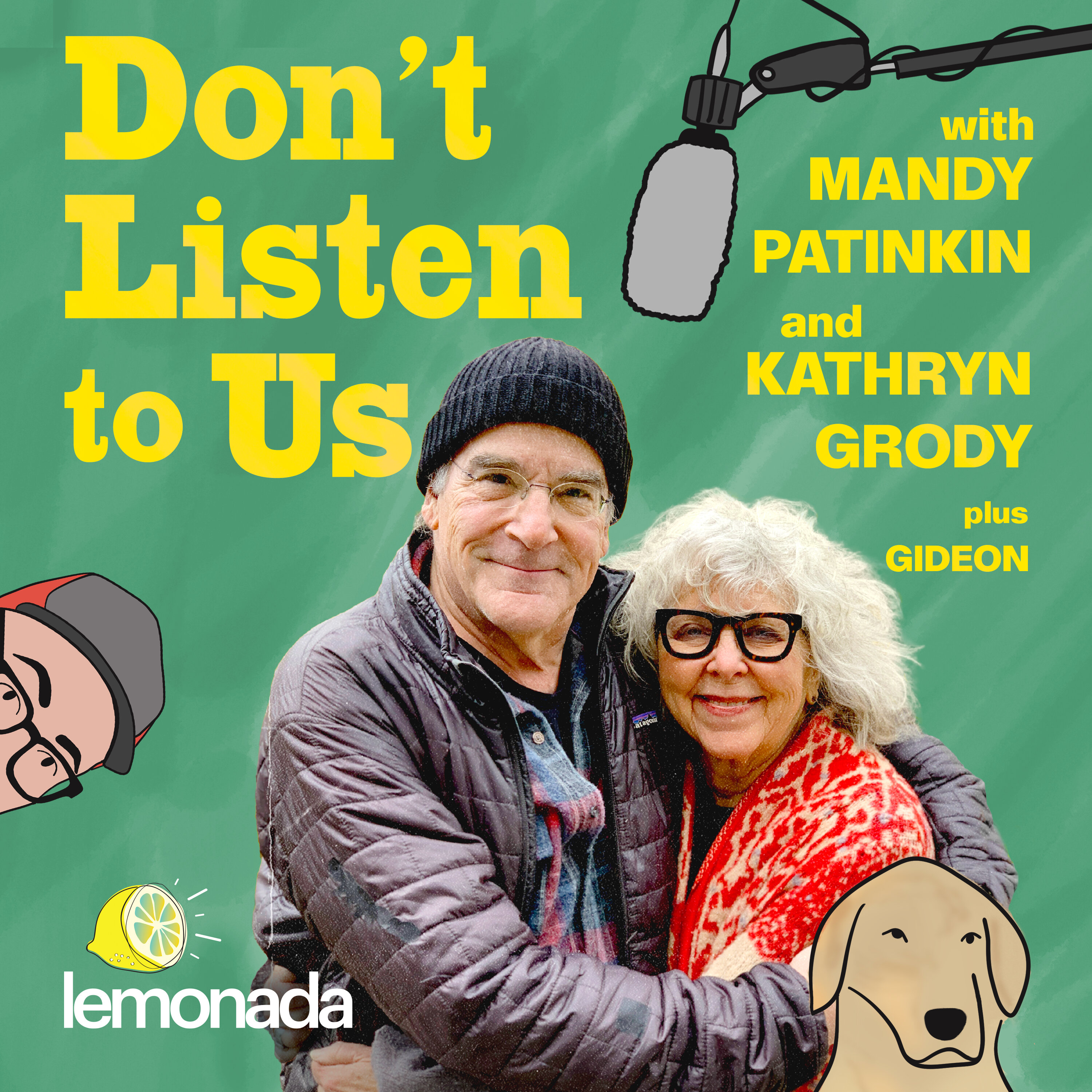
Don't Listen To Us with Mandy Patinkin and Kathryn Grody
We Can Do Hard Things (feat. Mandy & Kathryn)
01:11:45
Loading summary
Transcript258 lines
- [00:02]
Gideon
Lemonade.
- [00:07]
Mandy Patinkin
Hello dear listeners, it's Gideon, Mandy and Catherine and we are taking a little holiday break before we wander off for a rest. We wanted to share this wonderful, heartfelt, slightly chaotic conversation my mom and dad had with our friends over on We Can Do Hard Things, hosted by Glennon Doyle, Abby Wambach and Amanda Doyle. In it, my folks talk about how to make a marriage last without losing your mind.
- [00:37]
Catherine Grody
That's kind of funny.
- [00:38]
Mandy Patinkin
They lost their minds a long time ago. The holy importance of quiet and how we can hold tight to our humanity while insisting on a more humane world. If you want to hear more of We Can Do Hard Things, follow it wherever you get your podcasts. With more than half a billion plays since it launched as the number one show on Apple, it's a hilarious, raw, deeply comforting support system for braving the everyday. There's also a link in the show notes Happy holidays and we'll see you in 2026.
- [01:16]
Podcast Host (We Can Do Hard Things)
Mandy Patinkin is a Tony Award winning actor, singer and storyteller whose career spans four decades across stage, film and television. He's known, of course, for unforgettable roles in Evita, Sunday in the Park With George, the Princess Bride, Homeland and Criminal Minds. He has toured the world with his solo concerts and collaborations with icons like Patti LuPone and Nathan Gunn. Since 2020. Mandy and his wife, fellow performing artist Catherine Grody, have offered a delightfully unvarnished glimpse into 45 years of marriage, sparking live shows with their son Gideon and a new Lemonada Media podcast, Don't Listen to Us. Katherine Grody is an Obie Award winning actor and writer whose work spans theater, film and television. She won Obies for Top Girls and the Marriage of Betty and Boo and earned a Drama Desk nomination for her one woman play, A Mom's Life. She has long been active in advocacy with groups including the International Rescue Committee and Downtown Women for Change. The this fall she premieres her new one woman show, a radical, rollicking rumination on the optimism of staying alive. Exploring the transition into elderhood at 78 years young. These two what you are in store.
- [02:34]
Gideon
They're the best.
- [02:35]
Podcast Host (We Can Do Hard Things)
I mean this hour, these two. Obviously there's a reason they are two of the most beloved love bugs on the planet. But in this hour you get to feel it this like way that they have brought so much joy and commitment to their marriage, to their parenting and to their the planet. They talk about the arguments they have over and over again and what they really mean. They talk about what it actually means to love a dog or raise a child. And how they're similarly the same. The terror and beauty of watching time pass so fast and trying to hold tight to it. And then how their Judaism has compelled them to show up in this moment on this planet. Exactly how we needed them to. Just snuggle in and listen to these two and allow them to heal your heart.
- [03:39]
Gideon
They're marriage goals. Goals, goals.
- [03:42]
Amanda Doyle
But what is so cool about them is they've been separated twice in their lives. Like, so it's that it's just very credible. It feels. It feels like goals is like maybe that's attainable. It feels like they struggle and they're messy. And they were actually, in our conversation, kind of working some things out. You saw them be like, what I would like from you is, could you do that for me? It was very special to be a part of.
- [04:10]
Gideon
Yeah. They're, like, still actively fighting for their marriage, their connection and their love, which at their age, I'm just like, that's. It's goals.
- [04:20]
Catherine Grody
It's goals.
- [04:21]
Podcast Host (We Can Do Hard Things)
Exactly.
- [04:21]
Catherine Grody
Yeah.
- [04:22]
Podcast Host (We Can Do Hard Things)
There's something that one of them said, not in this interview, different time, where they said they have, over the years, survived and thrived through the brutalities of intimacy.
- [04:30]
Catherine Grody
Yes.
- [04:31]
Gideon
So good.
- [04:32]
Podcast Host (We Can Do Hard Things)
The brutal. It's brutal to be seen. Like, they see each other. And it's also so beautiful.
- [04:37]
Amanda Doyle
They said it's a daring thing to have weathered the brutalities of intimacy. It's a daring thing. It's an astonishing thing. They are daring and astonishing.
- [04:46]
Catherine Grody
I love them.
- [04:49]
Podcast Host (We Can Do Hard Things)
Enjoy.
- [04:56]
Catherine Grody
Hello.
- [04:58]
Gideon
Hello.
- [04:59]
Catherine Grody
Hi.
- [05:01]
Podcast Host (We Can Do Hard Things)
Well, hello. Catherine said you would be wearing your hiking shirt. Are you wearing.
- [05:06]
Catherine Grody
Honey, did you hear what? Yeah, I said you'd be wearing your hiking shirt. Was I right?
- [05:13]
Yep. And open for a nice little sexy look.
- [05:17]
Podcast Host (We Can Do Hard Things)
I'm already so delighted. I just can't handle this. You two can't understand how excited we've been to talk to you. You two. And the reason we're absolutely friggin delighted that you are launching a new podcast, and Catherine, we want to hear all about your play too, is because I know you're gonna say that this isn't right because you're always so humble about who you are, but you are exactly what the world needs right now. You are so human.
- [05:44]
Catherine Grody
I told you this world is fucked up. That's why. Can I just interrupt this for a second? How do I turn off the ding every time? I can't remember.
- [05:56]
I mean, nobody gets that. I don't get notifications, so don't text me. If it's urgent or timely, use the phone. The old fashioned vocal apparatus.
- [06:08]
Podcast Host (We Can Do Hard Things)
You know, the old fashioned vocal apparatus. That is what a phone is.
- [06:13]
Catherine Grody
You call these things in your ears, honey? What? What? What? Tell them what you call the things that are in your ears.
- [06:21]
I, you know, I didn't know that I was going to share my hearing accessories. Pink gold. I waited six weeks to get the pink gold ones because they were prettier than the white ones. You changed the name of them to Hearing accessories?
- [06:38]
Yeah, Hearing Accoutrements was the first one.
- [06:42]
Podcast Host (We Can Do Hard Things)
Accouter.
- [06:44]
Amanda Doyle
It's an upgrade when you put it like that.
- [06:47]
Podcast Host (We Can Do Hard Things)
Yes.
- [06:47]
Catherine Grody
Well, as I say in my show, instead of a humiliation.
- [06:52]
Are you doing a show, honey? What show are you doing? What show are you doing, hun?
- [06:58]
I don't know, just this little thing in Malvern, Pennsylvania, 20 minutes from Philly, near the Barnes Collection.
- [07:06]
Oh, I didn't know that. What's it called?
- [07:08]
It's called the Unexpected Third, A radical rollicking rumination on the optimism of staying alive.
- [07:16]
Who's in it?
- [07:18]
Me.
- [07:22]
Podcast Host (We Can Do Hard Things)
Can you tell us a little bit about it? Yeah, tell us a little bit about.
- [07:27]
Catherine Grody
Is Glennon. It's been a long time coming. I think I've been pissed off about deals with age certainly since 50, and that was quite a while ago, you know, and I just couldn't stand the way people were disappeared or assumed about. Do you know, there was a point where before my hair became this color, which I do thank my husband, Mandy Patinkin for encouraging me to do, because I was on my way to my nice vegetable hair dye person once, probably 15 years ago, and he was following me saying, you haven't seen it in the sun. You think it looks natural, you would hate it. And I'm saying, don't follow me. I'm not old enough to have white hair. Well, now I am. And I actually that's the one thing I like better, aesthetically speaking, is the color of his hair. So I've been pissed off about this topic for a long time and huh. Aging. Yes, honey, aging. And you know, all the things I do turn out to be things that I think people in the culture at large are experiencing, but nobody's really talking about it. Like mom's life came from, you know how you always see if a guy has a snuggly, you know, and he's wearing. It's a front page of New York Times Magazine. But women, we're just like, oh yeah, that's what they do do, you know. And it pissed me off so I wrote a Mom's Life, you know, and Then this show is just my. It's not a Hallmark card. This is some challenging period, and I thought I was going to be really exceptional and do it differently. And it was all just about your attitude and how you care for yourself. But shit happens, you know that it's not quite in your control and is stunning. And then you start losing people more often than you are used to, and it is just a sort of rumination on how you keep going and surprise yourself and don't stop. And that whole finished idea of being finished. I hate, hate the term seniors. It's like, been there, done that. I don't mind, Elder. It has some dignity. It has some gravitas.
- [09:54]
So that's part of my favorite thing, you know, I. I love. You know, look, let's just face it. We're. We're here to bang the drums. So people, go see this thing at the People's Light playhouse in Malvern, Pennsylvania. Preview starts September 17th till October 26th. Get your.
- [10:12]
Maybe 26. Yeah, well, the extension, honey, right now I'm supposed to go till October.
- [10:18]
No, no, no. October 26th is the extension, right?
- [10:21]
Well, we're hoping it's.
- [10:22]
Yes, it will. It will, it will. Don't think that way. It will.
- [10:25]
But also, we're supposed to be.
- [10:26]
Here's the big thing. Tell them, Catherine. What? When people came to see it in Rosendale, an early workshop, and people came to see it in other workshops, in fluorescent lit rooms, you know, where there was no set or anything. Tell them what young people had to say, because that knocked me out.
- [10:43]
Well, no, you know, this was really moving to me. I knew people of a certain age would respond to this, you know, over 50. But what blew my mind, I'll never forget. I've done. I've been working on this thing for three years, 10 workshops. I mean, really, it's like clawing your way. But this young woman named Raya came up in Rosendale, New York, upstate New York, and she was crying, and she said, Catherine, I'm 30 years old. My generation tells me, unless I have my place, my person, my profession, and my Botox account, by 35, my life is over. And your place says, that's bullshit. And I was so moved. And, you know, I don't. I don't have a litmus test of how you age. I'm just saying it's not a shameful thing. It's not an inhuman thing. I don't want to stop the process. I don't want to think of it.
- [11:37]
As a disease, you know, look, obviously, I'M prejudiced. This. She's written many pieces. She's performed them. I fell in love with her because she's an actress. That is just so truthful. But I promise you, if you drag your butt down there, I promise you, wife, 47 years or not, you will not be disappointed. It is beautiful. Becky. Be quiet.
- [12:04]
Podcast Host (We Can Do Hard Things)
Becky.
- [12:05]
Catherine Grody
We love Becky, Amanda.
- [12:09]
Podcast Host (We Can Do Hard Things)
What's that?
- [12:10]
Catherine Grody
I'm glad you love Becky.
- [12:12]
Amanda Doyle
I love Becky, honey.
- [12:14]
Catherine Grody
I do too. I love Becky.
- [12:15]
Come here, Becky.
- [12:16]
Come here to Becky, baby.
- [12:18]
Amanda Doyle
This idea that doesn't surprise me because they love you.
- [12:22]
Catherine Grody
Oh, Becky, baby, You're such a good baby. This is the nicest thing I've done for my husband other than our two sons.
- [12:31]
Podcast Host (We Can Do Hard Things)
Let him have a dog.
- [12:32]
Catherine Grody
I'm not a dog person, guys, but here we are.
- [12:36]
Amanda Doyle
But I feel like dog, not dog people are just people who haven't had dogs yet, right?
- [12:42]
Catherine Grody
Yeah, I think you're actually right, Amanda, because we got two black labs at the same time. And our 42 year old was 12 and he needed a dog. My husband needed a dog. I said, okay, to make everybody happy. And I started. You know, I remember this one time, it was late at night, of course, I started and ended my day in New York City with little bags of dog poop. And I was so pissed off. And I was just like, this is not what I imagined, you know? And then it was very late at night, it was raining, and a cab stopped and at the corner and I heard some young guy say, sir, please make sure this man gets home okay. And I looked up at the corner and it was our older son Isaac, helping an elderly person into a cab and saying, I hope make sure he gets home safe. And I remember thinking, okay, that's what I've been doing. That's what I've been doing. I've been raising decent, decent human men. You know?
- [13:48]
Podcast Host (We Can Do Hard Things)
You know, you two, it's so funny because we wanted to focus this talk about how to throughout life, even when things get tough, sustain and maintain a loving, beautiful marriage relationship. And how when things get tough, to maintain your relationships with your children as parents and then also with the world. Yeah. To your all's commitment to your Judaism and healing the world has been so inspiring. And I feel like in the first 10 minutes of this, we didn't ask any questions, but you already showed us how that happens. Your support for each other, the play, Mandy, the way that you just focused on Katherine's, and then Katherine, you just were like, I don't like dogs. But I let him have a dog. And Then the kid thing.
- [14:41]
Catherine Grody
And can I give a real helpful thing to folks that are listening of all ages? You know, it's interesting, this thing about getting older. I find it fascinating. And I talked to some of my getting older friends and I say, you know, there's no preparation for this. First of all, I believe that you should be. When you're 120, you should feel the same way you do when you're 19, 20, 21, 31, 41, 51. So all the way down the road, that's how you should feel. That's how all of us do feel every now and then, though some other parts of our body don't seem to agree with that particular sentiment. But, but you know, that to hell with them, we're moving on and we're getting new parts or we're finding ways around it. But there is a little thing. I woke up in the middle of the night for my, I don't know, third, fourth pee. And then I had these terrible leg cramps, which I started getting. As I started getting older and, and I thought this horrible. And I spoke to a nutritionist one day and I'm telling you this, I'm selling this product. I'm not selling it. You got to get this product. It's a magnesium supplement. I went down, boiled some hot water, put a teaspoon of it in hot water, and I put it in the hot cup. Then you put cold water so it's not too hot. And I drank it and I forgot, I started forgetting to take it. It is a miracle drink. Get it. It's. They sell it at all kinds of places. Everywhere you'd go, they got it. It's called Calm and, And you know, young people, you don't have that many cramps, but you should practice for when you get older.
- [16:16]
Amanda Doyle
That's really, I feel like a very concrete, helpful thing. I thought you were going to give some advice.
- [16:22]
Catherine Grody
This is better.
- [16:23]
I mean, it's just buy this, this shit works for me. And I don't know, I actually don't know if it calms you, but it certainly calms the leg cramps, makes them go away. And I, you know, and then therefore, you know, you sleep better and it's great. And if you take it, Catherine often, she's away doing the play, so she, she often brings me the cup before I fall asleep. And so, you know, I'm not there to get my glass of water or my cup of coffee. You know, that's how it goes.
- [16:54]
She goes to bed at 8 o' clock and I go to bed at 1 in the morning.
- [16:57]
So 8 o' clock is late for me. Honey, 8 o'. Clock.
- [17:00]
That's true. That's seven past seven when I'm working away from home.
- [17:04]
Podcast Host (We Can Do Hard Things)
So, Catherine, what do you do between 8:00 clock and 1:00am? This is a similar vibe to my parents. So I'm just wondering what. My dad goes to bed at like seven and then my mom goes to bed much later. What do you do during those?
- [17:16]
Catherine Grody
I. I talk to friends that live on the west coast or I try and get people in South Africa or in England or I go through my piles of newspapers and try to call them so my husband won't throw away what I want to keep. I keep explaining to him that newspaper and things like if you make collages or stuff, it's not going to be here. They're going to digitalize everything. Digitalize us. So I need to keep it.
- [17:47]
I go through those piles in your personal space.
- [17:51]
Podcast Host (We Can Do Hard Things)
Yes.
- [17:54]
Catherine Grody
Yeah.
- [17:55]
So otherwise it's a recyclable item.
- [17:58]
Yeah, that's right. I try and find things that he won't throw away. I still remember I had kept. There was a wonderful columnist named John Leonard for the New York Times that I adored in my 30s. I even ended up going to a public celebration of him. And I didn't know him at all. I just loved his work. And I kept all his columns for like 10 years in this striped bag and in a shared closet. And my husband threw those out.
- [18:29]
I don't think that's true.
- [18:30]
Catherine, honey, that is true. You threw out my John Leonard columns. I've forgiven you.
- [18:33]
No, no, no, no, no, Honey, I think you are making things up. I think things mixed up. I did not. I don't go in your closet and throw bags of stuff.
- [18:42]
It wasn't in my closet. I didn't even have a closet that. It was in our bedroom. And you threw it out from a corner.
- [18:47]
Well, so maybe it had been there for three or four or 15 years. Maybe it was a home for SP and all kinds of creatures.
- [18:57]
Yeah, well, see, here's an example. But we let it go. That is how we solve a lot.
- [19:03]
Clearly, honey, you haven't completely succeeded with that. You just brought it up on a national podcast.
- [19:09]
Podcast Host (We Can Do Hard Things)
What did I do?
- [19:11]
Catherine Grody
You just.
- [19:11]
Amanda Doyle
I'm not gonna let it go. I'm sort of mad about it.
- [19:14]
Catherine Grody
Thank you. That I just threw out something very precious to you.
- [19:18]
No, but you just said that it was collecting dust and it was in a shape.
- [19:21]
Catherine, you just said you let it Go. You didn't let it go.
- [19:24]
Oh, that's true.
- [19:25]
There you go.
- [19:27]
Amanda Doyle
I have a question because I'm wondering if this. Because I know the newspaper issue.
- [19:33]
Catherine Grody
Yeah.
- [19:34]
Amanda Doyle
Well, just called an issue. I don't know if it's a problem. It's just an issue is a recurring. It rises and we deal with it on an ongoing basis.
- [19:44]
Podcast Host (We Can Do Hard Things)
Yeah.
- [19:44]
Amanda Doyle
And from my understanding, another issue is. Used to be at least this, like, the anxiety over the passage of time. And I'm wondering, as you talk about, like, your play and getting older and even the need to hold on to the newspapers because they're going to be digitized. Like, is a lot of this about.
- [20:10]
Podcast Host (We Can Do Hard Things)
That?
- [20:12]
Catherine Grody
Well, as you can see in the background of my husband, we have all our vinyl collection. Yeah, right. Which I love. And we never play. One of those records.
- [20:26]
Comes on.
- [20:27]
And every now and then, I mean, our. Our house is like, could be a museum of the 80s, you know, we have our CD players, which we don't use. We have our cassettes, which nothing can get played on. We have our DVDs that I keep meaning to transfer. You know, it's just artifacts, including us.
- [20:50]
But.
- [20:51]
Podcast Host (We Can Do Hard Things)
But.
- [20:53]
Catherine Grody
You know, it's a really. It's a really. I find it very challenging to. To honor what is valuable to me. I'm very sentimental, so I don't throw out anything. And I. That is part of case.
- [21:11]
You bet your ass I am. You aren't kidding. She's missing a chip and she didn't know to get rid of me, so.
- [21:19]
I would never, ever, ever get rid of him. You know, it's always been so strange to me. You know, we only understand 5% of the universe. This is a true thing. Right. So I'm always curious about what that 95% is that we don't know anything about. And I'll never forget I was home from college in San Francisco, visiting home. I had two younger brothers watching tv. And I just passed them, you know, and came back because there was this commercial on. I don't usually watch commercials now or then, but I was just struck and there was some young guy pretending to be a like, 70s greaser, you know, at a soda shop. And I came back and I said, oh, who is that? Who's that kid? He's really good. And that kid turned out to be my future husband, Mandy Patinko. Oh, my gosh. And.
- [22:08]
And you can YouTube it. It's. It's Teen angel from the 7up commercials in 1969, or 70 or 68, something like that.
- [22:20]
And I. I was with. I. I knew one thing. I knew a few things. I was going to be in the theater. I was going to be a mom. I was never going to go out with an actor because one in the family is enough. And I. I wasn't totally wrong about that. But. But I was with.
- [22:37]
Yes, you were wrong. One in the family is not enough.
- [22:40]
Okay, I. I was at Mandy's first professional show in New York, Trelawney of the Wells. I was with my boyfriend of two years, who is this great political guy named Michael Yule. He started Safe Return Amnesty for vets in Canada. He discovered. He outed Agent Orange whistle on Agent Orange.
- [23:06]
I'm thinking, this is who she's with before me. What on earth does she see in me?
- [23:13]
He made me laugh. But I was sitting with Michael, and Mandy comes out in this show, and I say out loud, now he's my type. What am I doing with you? I didn't usually say something like that, Glenn. And I might think it. I said it, which was so odd because, you know, young actor, not me. No, no, no, no, no. But here we are, 47. 47.
- [23:37]
We're friends. We're friends with Michael Ewell.
- [23:40]
Podcast Host (We Can Do Hard Things)
Yeah.
- [23:41]
Catherine Grody
And I think most of her exes were at our wedding.
- [23:44]
Podcast Host (We Can Do Hard Things)
Oh, my gosh. How did. What happened next? So you were like that. That's my vibe, not you. And then how. What happened next? How did you guys make contact? What was the first dates like?
- [23:57]
Catherine Grody
We have the rule. If you want to tell it, you tell it. We don't tell the same story twice. So.
- [24:02]
Because he has his version, I have.
- [24:03]
Mine, and mine's always wrong, as far as she's concerned.
- [24:07]
Okay, I. You know, I thought I was hot stuff. I'd hit New York running, and I'd done several plays, and I was gonna go to Europe. And this playwright, Michael Weller, whose shows I had done, was doing a two week workshop at Ensemble Studio Theater and asked me to do it. And I said, no, no, no, I. I've worked so much, you know, I have to go see the Real world, some shit like that. I don't know if I can say that. Anyway. And then he said, it's only for two weeks. I really want you to do it. And I said, well, who's in it? And he said, Chip Syen, Elaine Bromka, Mandy Patinkin. Oh, that kid.
- [24:43]
Danny Stern. Danny Stern.
- [24:44]
Danny Stern.
- [24:45]
Podcast Host (We Can Do Hard Things)
Yep.
- [24:46]
Catherine Grody
And I agreed to do it. And. And I remember Michael coming out after one of the first rehearsals saying, so, what do you think? I said, oh, he's great. I love working with him. Oh, you mean for me personally? I said no way, Michael. He's a baby. He's an actor. He's all crazy. No, no. The next person I'm with is going to be the father of my children. And he's not in it. He's not it. So that shows you how wrong.
- [25:14]
So we're hoping soon we will meet the father of her children.
- [25:20]
Wow.
- [25:21]
All very excited to bring this person into our family fold. But so far it hasn't knocked on the door. But it could happen any day and we're all very open to it.
- [25:31]
Podcast Host (We Can Do Hard Things)
Well, I'm jealous of that person already. They get to join your family eventually.
- [25:35]
Amanda Doyle
What a Gideon, Isaac.
- [25:37]
Catherine Grody
They did a great job. Careful what you wish for.
- [25:41]
You know, we are highly edited, as Gideon will say. You know, highly edited for all those people that during the pandemic wanted us to adopt them. It was like, well, this is one vision of us. You know, we are just like other families that drive each other crazy.
- [25:58]
Podcast Host (We Can Do Hard Things)
And now it's time to thank the companies who allow you to listen to we can do hard things for free.
- [26:07]
Cancer Guard Sponsor
This episode of Wiser Than Me is brought to you by the Cancer Guard test from the makers of the cologuard test. Nearly 70% of cancers diagnosed have no routine screening, including some of the most aggressive, like pancreatic, ovarian, liver, esophageal, stomach and lung cancers. CancerGuard helps address this unmet need and complements existing recommended screening to expand the ability to help detect more cancers earlier. Cancer Guard is a simple blood test that helps screen for over 50 cancer types and subtypes even before symptoms appear. When treatment may be more effective, the Cancer Guard test helps you take proactive steps for your health with confidence and peace of mind. Talk to your doctor about Cancer Guard to see if the test is right for you or visit cancerguard.com for more information and to connect with a telehealth provider. You can also give the gift of peace of mind this holiday with a Cancer Guard gift card@cancerguard.com wiser this test is not recommended for individuals who have had cancer in the last three years or are pregnant and it is not a replacement for recommended screening. The Cancer Guard test may be HSAFSA eligible.
- [27:27]
Podcast Host (We Can Do Hard Things)
Besides the holding on to things and letting go of things which seem which seems to be perhaps a thing for you all, what would you say? We have been taught by many therapists that every couple really only has three or four arguments that get repeated ad nauseam. If you're lucky for 50 years like you, what are your repetitive issues.
- [27:52]
Amanda Doyle
Arguments.
- [27:53]
Catherine Grody
Or conflicts are much more prolific than three or four, don't you think?
- [27:57]
Podcast Host (We Can Do Hard Things)
Okay. Of course you are.
- [27:58]
Amanda Doyle
They're the creative type, so, you know.
- [28:01]
Podcast Host (We Can Do Hard Things)
Yeah.
- [28:01]
Gideon
But a lot of the fights, they.
- [28:03]
Catherine Grody
Revolve elves over again.
- [28:05]
Yeah.
- [28:05]
Gideon
And they usually. The root of the fight is. Is a very similar thing. Right. So it might be about moving the couch or it might be about whatever, but like really it's about hearing each other. Control, power, whatever it is. Yeah.
- [28:21]
Catherine Grody
You go first. What?
- [28:26]
I was going to say you go first. It's interesting. I'm trying to think. Well, I. I think one of the issues we always deal with, I will tell you, is my excessive speaking, you know, is that I'm very afraid of quiet.
- [28:47]
Podcast Host (We Can Do Hard Things)
Raising her hand. Yes.
- [28:49]
Catherine Grody
I gave my husband a birthday gift several years ago, and at the end of the day, I asked if he had noticed what it was and he said yes, he loved it because I basically was mute for most of the day.
- [29:05]
Gideon
That's literally Glennon's biggest dream.
- [29:11]
Catherine Grody
Okay, I've just given you the. The gift of really helpful, you know. And I survived it, Abby. I mean, you know, I had like, I like to share. I sort of like to turn my mind inside out. And it's not necessarily consecutive connections, it's just, oh, did you read this article? And, oh, I heard this. And, oh, do you know where we're supposed to go now? Or do you know who drove me nuts?
- [29:37]
Podcast Host (We Can Do Hard Things)
Or.
- [29:37]
Catherine Grody
And it's just sort of a rambling stream of consciousness thing that I enjoy sometimes to a greater degree than being sensitive to my companions desires of maybe wanting to say something or just being confident in the quiet, which he's much better at than me. Confident.
- [29:59]
Podcast Host (We Can Do Hard Things)
And how do you experience this, Mandy?
- [30:01]
Catherine Grody
Well, I'm thinking about my beautiful cousin who we love, my Israeli cousin, Eyel Zuckerberg, who was very, you know, worked hard, had different kinds of jobs. Then he went back to school to become a landscape architect. And I said to Al, toward the end of his studies, I said, what's the most interesting thing you learned in this course, you know, to learn this skill? He said, negative space. What you leave empty. And I love quiet. I have so much noise in my head all the time. Not literal noise. Noise that Mandy makes silently in his head. That's explosive. And I just. I wish for peace in my brain. I wish for quiet. There's a woman who. I don't remember her name. She's a doctor, a wonderful book called Quiet Susan.
- [31:01]
Podcast Host (We Can Do Hard Things)
Susan Cain. So Good.
- [31:02]
Catherine Grody
It's my favorite book and talked about people who are introverts. So you wouldn't think that, you know, people who are in show business or public lives, you know, would be introverts. Yet I am. And the people that she points out are. And in the 30s and 40s and 20s, all the ivy League schools, Harvard, Yale, Princeton, they had courses to be outgoing, to be extroverted, et cetera, that it was a bad thing if you didn't know this and you would fail in the course of life. And you can't get over the people that she talks about that were introverts and what they accomplished. And so I just wish for those who are quiet, those who are shy, for those who have trouble entering a conversation, that is one of your great gifts. Don't doubt yourself. I will say this, and it's not a criticism of my beloved, it's a concern that I'm sure she's not the only one that deals with this. She's always been a much more social person than I was. She would have breakfast with somebody, then lunch with somebody, then a tea in the afternoon, go see a matinee, go see a play in the evening. Very active life. All the kids stuff, all the time. I could not keep up with her. You know, no one can keep up with her. She's the ever ready, ever ready bunny of humanity. And I have noticed in the past, I don't know, eight to 10 years, but certainly the last five to seven, without a doubt since the pandemic, no question, a kind of hysteria about time. And I feel for her because I feel she's so afraid of losing anything and anyone and afraid of the clock and the sand finishing in the hourglass that she tries to pack in everything, every podcast, every newspaper article, every book, everything that everyone says. I remember one time I said to her, you know, I held up the New York Times, I said, look at this. Isn't this an interesting thing? I said, you know, it doesn't talk. It doesn't talk. It's just a paper. And I don't need someone to read it out loud to me, every word. And I wish if I had one wish for my beloved, it would be that she would not feel that the clock is moving that fast. Honey, you may be one of those people, like Auntie Ida used to say, you should live to be a hundred and swansic. 120. Like, what was Abraham's wife's name? Sarah. You know, because she was like 120 when she had Isaac, I believe her son's name and that you have plenty of time and that you don't have to feel that, you know, you got to pack it in. And there's one other thing that I'd like to mention because she won't listen to me unless I'm on. So you can't edit me. So this is this. I long for this.
- [34:34]
You got a couple of hours, guys.
- [34:38]
The other thing is, what else? If we're sitting around with folks and there's a pause, she can't handle quiet and so she has to fill it as opposed to. I would say to her, and she's getting a little better at this, she is trying, she is improving. But I need her to work harder at it because there isn't that much because the sands are going through the Argonauts and I want her to enjoy it and that it's so interesting. I think it's interesting that if you're sitting around a table with a bunch of people and you're the one talking and then it gets quiet. Why don't you just wait? And the person that hasn't said anything, maybe they'll talk and maybe they won't and maybe it'll be quiet until everyone leaves for some strange reason or maybe not, but you don't have to keep the talk going.
- [35:33]
Podcast Host (We Can Do Hard Things)
What do you think about that, Kathryn?
- [35:35]
Catherine Grody
Thank you.
- [35:40]
Podcast Host (We Can Do Hard Things)
Thank you.
- [35:41]
Catherine Grody
I'm so grateful to the three of you for this opportunity to hear that. I think he's really right and I have really been working hard. First of all, the slightly off thing is I love people. I love friggin people. They are my passion, my interest, my curiosity. I love all kinds of different people. And the pandemic was extremely difficult because it was the two of us and the trees, you know. And I don't even think we've begun to realize how that period has still impacted us and is in terms of how we deal with each other or if we're only comfortable on this space and not tactically, you know, involved. But I really do know that that is an anxiety of mine. If, if, if there's a big quiet and I. I perceive someone to be uncomfortable, I try to be uncomfortable, you know, without realizing I'm the one that's uncomfortable. So I think that is something I'm really working on. I really make sure I leave space for other people. My younger son's partner, when he first met her, she didn't say much when we were around and I was worried it was because of my excessive talking and I asked her about it she said, no, no, no, I don't feel that. And then explained what it was. So I am aware of it. But what I would say to my husband, who is much better with quiet, I also want to say there's nothing pejorative. I find when. When parents apologize for their kids saying, oh, they're shy, like there's something wrong with that, you know, or it's a quote that in the 20s, that Dale Carnegie book, we were a country of people with character. And he sold everybody on being a country of persa. Ality. So suddenly everybody was being taught to perform some. Some version of themselves that could get them somewhere else. Yeah, I think that's how like, we do. Yes, that's right, honey. That's right.
- [37:57]
Amanda Doyle
Well, you read the book.
- [37:59]
Catherine Grody
You read the book.
- [38:00]
I didn't read the book.
- [38:01]
Me neither.
- [38:02]
Amanda Doyle
So many friends and influenced so many people.
- [38:05]
Catherine Grody
But I want to just say that my husband is totally right about quiet. I'm really working on it. I'll probably work on it till I stop being just in this body, you know, But I am working on it. However, what I would like him to work on and acknowledge is. Is though he is great at enjoying just his. Thank you, honey. Take those notes. He forgets that he also sometimes enjoys being with people. And there have been many occasions where I've said, I'd like to have dinner with so and so you can go, I don't want to. And I will say, you know, they're really nice. They're very nice, or they're not in show business, or they're, you know, whatever. And I have to really push him. And then he's amazed that he had a really good time for a really nice time. So, I mean, this is a deal we can make on public with, you know.
- [39:02]
I'll do that for you.
- [39:03]
Okay. I mean, so we, you know, he can expand his ability to be a little more interactive with fellow humans, and I can work on not taking up so much space.
- [39:14]
I'll do one person a year.
- [39:16]
Podcast Host (We Can Do Hard Things)
Perfect. You guys, this is so helpful to me because, yes, we have the exact same, exact, exact same issue, and we are always talking about how to work on it. But I will tell you that, you know, I'm always saying, can we just be quiet? Can we just have a space? Because I'm always worried that a person who takes a little more time to speak needs some space to speak. And when you have kids, you think about that a lot. Like, you don't want the quietest person at the table to never get a Minute to speak. But I will tell you that recently my mom was visiting, and Abby was out of town, and we were in a room together, and she was just staring at me, and I was like, shit, where's Abby? Like, oh, this is the service she provides me. Like, she talks. No, I have to. It's a. It's a. It is also a labor of love that when she's not there, I notice what a service it is to keep the conversation going.
- [40:22]
Catherine Grody
I totally agree with you.
- [40:24]
Yeah.
- [40:24]
Podcast Host (We Can Do Hard Things)
Yeah, I know.
- [40:25]
Catherine Grody
It's a. It's a blessing and a curse at the same time.
- [40:29]
Gideon
Yes.
- [40:29]
Podcast Host (We Can Do Hard Things)
Yeah.
- [40:31]
Catherine Grody
But it really is a blessing. You get to listen, you get to rest. And, you know, Sondheim wrote this great lyric. Careful the things you say Children will listen Careful the things you do Children will see and learn Children may not obey but children will listen Children will look to you for which way to turn to learn what to be careful before you say listen to me And I really. We are all children till it's over.
- [40:58]
Podcast Host (We Can Do Hard Things)
And now it's time for our ads.
- [41:13]
Catherine Grody
Gift of. Of having a more talkative partner. I really mean this, honey. And is. That is you get to listen. And. And it comes out when I do interviews for whatever it is I have to, you know, be selling. Almost every word out of my mouth is something that came out of Catherine's mouth, that she taught me, or out of my children's mouths. And almost everything I am. I would say I'm the most unoriginal human being I've ever.
- [41:51]
I beg to disagree, but I want to say two things, because now I get to say something. I feel that the gift that Mandy gives when he is singing a song, acting a song, he has this new concert called Jukebox, which he's on tour for soon. And it just is an affirmation of the gift of being an alive human at any age. So he is doing that same thing, being up there being this force. Do you know? And I think that the work you guys do on your podcast and the work we're hoping to do on Don't Listen to Us is. You know, there's this expression that Isaac came home when he was working in Ecuador. It's better in Spanish, which I can't do, but it's. There's nothing so bad. Good can't come from it. And in some ways, the horror of the isolation and with all the horrors and this technology, which are so many, and the struggle to be in charge of it and not have it be in charge of us, but you came up with this way of communicating and connecting with people. And that's what we're trying to do with. Don't listen to us, is create a kind of community, a kind of messy embrace of the messy human, you know, authentic non AI community of people that are struggling to make sense of the world in a time where it seems to make utterly no sense. When it's frightening to ground each other, even if it's in this little rectangular thing. Talk. Have connections with each other across, you know, all ages and ideas. And, you know, you only meet people.
- [43:39]
In this forum or do you also meet people in the room sitting next to you?
- [43:45]
Podcast Host (We Can Do Hard Things)
Well, this is interesting that you ask. We just decided that we were going to meet people in the room and then I freaked out and changed it and went back to this. So there is some. I am a writer and so one of the things I'm most comfortable with is my ideas getting to people without my body being involved. Also Mandy, I have heard you say that, or Catherine, maybe you said it about Mandy, that you deeply love humanity, but only a few specific human beings. I love humanity so deeply. I have always said I will likely die for you, but I will not meet you for coffee. And I don't know what that's about, but I like the most comfortable right now. And also you guys, for me there's a. Like, I want to keep real life a little bit separate.
- [44:42]
Catherine Grody
Yeah.
- [44:42]
Podcast Host (We Can Do Hard Things)
Than work life. And for my body and spirit, I have to maintain. It's like capitalism is everywhere. So now if I'm sitting on a couch with my friend and having a comp and it's filmed, I'm like, where's the line here?
- [44:57]
Catherine Grody
You know what I mean? You know, I'm thinking while you're saying all this, it also does eliminate a favorite thing of mine, which is the back door, the escape. If you're sitting in the room and I go, well, we have to stop now. It's, you know what, Did I say something wrong? Did I help you and was I not interesting? You know what? And there's an uncomfortable moment and no. The answer is often like, no, I got another appointment. It's only for X amount of minutes and that's it. But when you're in the little boxes and machine, it's. It's already more. Less personal. Less. Not personal is the word. It's just. It's less of that. It's less trying to say it's. It's safer. It's safer.
- [45:41]
Gideon
Yes, Safer.
- [45:42]
Podcast Host (We Can Do Hard Things)
I think in my life I want more and more real that's why I love you guys so much. I want more and more real. I want more embodiment. I want but non monetized, non content like current culture.
- [45:58]
Catherine Grody
Clinton was, you know, hey, let's hear it from Mondami. That's just my point of view. And I so wish somebody would be able to say, I wish he would. I think I just tried to write in some form he probably won't get. You know, Franklin Delano Roosevelt came up with social friggin Security, right? What did I just do? I just did something and everybody got oh, I have there, okay, I just did something on the machine. Franklin Delano Roosevelt came up with Social Security. What American doesn't want that? And what did the forces of the right say? Oh, you're a socialist. That big boogie word. Anybody doesn't want their Social Security, let's take that. That word means many different things and it's practiced many different ways. And basically we need to be more generous in sharing our, our resources. Do you know? Yes, I don't think that should be a problem. And the fact that business, business interests are all up in arms should just hopefully get him another 10,000 decent, all kinds of people saying, hey, we can do this together, we can be better humans, we can make our cities better in a humane way, not in an insane authoritarian way. Don't get me going, guys. You can just edit this if you need. Are you kidding?
- [47:18]
Is exactly what we want. Honey, try to keep your hands off the computer.
- [47:22]
I know I touched something and everybody went like this, banging the table. I love it.
- [47:27]
Amanda Doyle
She's having an internal earthquake and we're here for it.
- [47:31]
Catherine Grody
My director, Timothy near, who was my idol in college, she was a couple years ahead of me and she's directed all three of these solo shows I've done and we're still working. Ten years ago we were working on a piece called Falling Apart together and she looked at me, she said, kath, do you realize we're almost 70 and we're still working like dogs for no money? And now she's 80 in doing the same thing and I'm almost there. But I was talking to her one day and she said, God, Kath, watch your hands. You almost poked my eye out. And I said, ooh, getting catchy in our old age, aren't we? And then a couple days later I called her up and I said, tim, I apologize. Apologize. I was talking and I almost poked my own eye out. That's a good idea, honey. If you had me sit on my hands at a Dinner table. I probably wouldn't be able to speak.
- [48:25]
Thank you. I'll write that one down.
- [48:27]
Okay.
- [48:29]
Podcast Host (We Can Do Hard Things)
Catherine, can you put into any words what this feeling is about holding on and time passing through? So we were having a conversation recently where I was had this week where I was obsessed with getting all of the children's names and things tattooed on my body and, like, messages from my parents tattooed on my. And we're like, what. Where is this coming from? And it was like, you know, the Virginia Woolf thing of just life stands still. Life stands still. Like, how do I make this. This impermanent thing somehow permanent for myself? And I feel that so much from you is. Can you just. So many of us feel it. How does it feel?
- [49:09]
Catherine Grody
Quote the line part. Don't not quote the line that you wrote for a mom's life.
- [49:14]
This is so amazing. Guys, he just.
- [49:17]
I love you.
- [49:18]
Telepathy. I. I was thinking of several things. One is, in that first planned mom's life, I say to my baby at one point, don't grow, don't change, don't lose your baby teeth. Just stay as you are, perfect and small and all stay this way, too. And neither of us will grow or change, because the way this is, is perfect. But living things do grow. We are not bonsai plants, do you know, And I think my brother was a Buddhist monk. And one of the things that I think is very true, all suffering comes from us grasping, holding on to that which is impermanent. And you can tattoo all your babies. I can keep all their little things they made when they were five, which they're just horrified by. But the truth is, we're all impermanent and we are future dust. And I think the way we can hang onto the love the most is by being in the moment and not being so afraid of what's over and not being afraid of what's going to happen. But be here now as fully as you can, you know, and live and breathe in this moment till it takes you to the next one. And that's. That's how we're fully, fully alive, you know, Real key. Says his poem, hold beauty and terror in one hand. Let everything happen to you. No feeling is final. So that's, you know, it's really hard to do.
- [51:03]
Amanda Doyle
Guys.
- [51:04]
Catherine Grody
I keep every freaking piece of. I picture my kids when I'm gone. Oh, my God, they're gonna have the worst fight of their lives. Because my older son is much better at letting go. He's just toss, share, let it go. Gideon's going to Want to go through every drawer and find every secret and find everything. I'll just ruin them So I have to do this before I'm gone so that doesn't come true, you know? Oh, God.
- [51:31]
I also just want to share. When she. When she says these things, it triggers in me. I loved Warren Beatty's movie Heaven Can Wait. Whenever he'd go into the next person that he'd embody, he'd fall into this well. So I said to Katharine, I want a wishing well. And she found one in the village from France. You know, the cement thing in the top and everything. And she bought it, and she had it shipped to our home. And it's a flower bed and everything, but it's beautiful. And I always told the boys when they were little, because I take walks everywhere, all the time, every day. And I would stop where there's water on a bridge. And I say my prayers and my meditation, my wishes for the world and all people who are vulnerable and need extra. Extra service from all of us. And I watch the water and I say the prayer and I watch the water take them out. And I've always said to the boys, look, if I'm ever not here for any reason, just go to the wishing well or go to the water, and I'll be there. I really mean it. Because my. You know, that. That higher power, in my view, and I was brought up as a conservative Jew in Chicago, blah, blah, blah, is Einstein's theory of relativity, that energy never dies. So if you want to connect with any entity that was made up of protons and neurons and energy, it may not look like the four or five. How many of us? Two, four, five? Five of us are, but. But we're there in some way. Sound. My sound man taught me. He said, sound never dies. Like light. Light is millions of years away. And then it hits our eyes. Sound is the same. So when they put out those things in that Jodie Foster movie and look at listening for sound. Sound is the same. It travels. And so listen. Take a walk. Most of all, try to listen and see if you can hear your own thoughts. That's the toughest one. But it never dies. I believe it. I need to believe it. I say every person's name every day in my prayers, on my walks, in my meditation, before I walk in front of an audience or a camera or a microphone. Because Oscar Hammerstein, and I've said this in everywhere I go. And it's. It's one of the best things I think I can offer anybody. He wrote in Carousel, of all things, a musical. This line. As long as there's one person on earth who remembers you, it isn't over. So I say their names. People who were acquaintances or, you know, you know, just people I connected to. Some seriously, Some just, you know, casual. But I bring them there and I put them right here so that when my moment comes, whenever, wherever I'm going, I won't be alone. And. And I. And I don't want to be alone when I'm on stage or in front of a camera or talking to my kid about something important. And I believe, I deeply believe, I'm not a woo woo person, but somebody would say, well, you ought to check yourself out again because you're sounding pretty woo woo. I don't give a fuck what I sound like. I'm taking. Telling you this is my comfort.
- [54:50]
And should. Why should embracing or being open to possibilities that haven't been proven materially, why should that be dismissed as woo woo? You know, it's just like, why should sharing resources be dismissed as, you know, that. I mean, you know, that whole mythology of the individual, the greatest thing that is.
- [55:12]
Say it again. What is it? What's the mythology? Say it again.
- [55:15]
The mythology of individuals being the most important thing here, as opposed to us working together. And that's what these podcasts do. And that's what. Don't listen to us, honey. We have to mention it a couple times because that's why we got invited to have this wonderful.
- [55:30]
You know, Shakespeare in Hamlet, there are more things on heaven and earth. Hamlet says it to. Who did? George?
- [55:39]
Horatio?
- [55:40]
Horatio. Hamlet says to Horatio, there are more things in heaven and earth, Horatio, than are dreamt of in your philosophy. Therefore, as a stranger, give it welcome.
- [55:54]
Podcast Host (We Can Do Hard Things)
And now it's time for our ads. Can you all tell us a little bit? The world in our home and everyone we know has been deeply moved by the way that your Judaism has led you to speak out against the genocide in Palestine. What are you. Can you talk to us about how your Judaism informs you the way that you're showing up in this moment?
- [56:36]
Catherine Grody
Go ahead.
- [56:37]
Well, you know, Mandy, as he said, was raised as a conservative Jew, and his mom was so happy he found a Jewish girl, but she didn't know I was a Southern California Jewish girl, which meant you celebrated Rosh Hashanah, Passover, Hanukkah, and practice social justice. And that was a very different notion than what Mandy grew up with. And my dad was a son of Russian Jewish immigrants. He landed on Normandy on D Day.
- [57:09]
Podcast Host (We Can Do Hard Things)
Wow.
- [57:09]
Catherine Grody
He deeply Deeply believed in a democracy being about civic responsibility and participation. He had a 30 year correspondence with Senator Alan Cranston. And my dad had no money. That was the really important thing. Letters, two page single type. About policy, no money. I recently found. And all my stuff. A little thing, a thank you Note from Eugene McCarthy for my dad giving him 100 bucks. That was a long time ago. A lot of money for my dad. So my. It's tikino lum. That means seal the world. Okay? And it means one person at the a time. You know the old starfish story with the kid cleaning up, throwing all the starfish and the dad saying, you can't possibly save all these starfish. What does it matter? Well, it matters to this one. You do what you can. You practice kindness. You stand up. This is what I was raised with as a kid. My dad was in that army for five years. Was in Germany, was in places. You still stand up for injustice wherever you see it. You practice common humanity. And it is excruciating to have to say that the word anti Semitism is being bandied about. It's a serious thing. I do not want anyone to practice othering anybody because of their religion or their beliefs or the way they look or what they practice. But don't use that as an excuse to commit heinous wars against humanity. And it's excruciating.
- [58:54]
It's.
- [58:55]
It's like watching a country commit suicide and go crazy and the entire world is wondering what has happened. Every time I hold a grandchild, I imagine being a mother in Gaza or Ukraine, you know, or a Uyghur in China. I mean, you know, it is very easy to say I can't deal with any of it, so I'm just going to upset myself. And I think we all need to have moments of the day where you focus on the joy and beauty acts of resistance. But examine our own lives. Examine if we're doing enough. Examine if we're using our voices, who we know in our neighborhoods. Expand our social interaction with the people that maybe are not in our circles, that live in our communities and just keep demonstrating, keep shouting. I mean, I was lucky enough to be in a generation. We stopped an unjust war. We did civil rights. We had the first Earth Day. We redefined what sex and marriage and family could be. Let's keep doing it.
- [60:03]
Podcast Host (We Can Do Hard Things)
Yes.
- [60:04]
Catherine Grody
Even though it is very, very profoundly sad and awful. But our species adapts sometimes too well. Maybe there's flowers growing in the burnt parts of la. I don't know what Else to say I'm talking to myself because I often just wake up weeping. And then I'll talk to man. He'll say, did you read the paper today? Or, you know, or I'll tell you some horrible news. And he'll say, please don't start my day with that.
- [60:32]
Podcast Host (We Can Do Hard Things)
Yeah, that sounds familiar. Yes.
- [60:35]
Catherine Grody
You need to start with, okay, we're alive, we're well. What can we do today to love each other, to love our circle and to see. See what we can make better. Just a little bit beautiful.
- [60:49]
Podcast Host (We Can Do Hard Things)
There's flower. There's flowers going in the. Growing in the burnt part of la. Should be the name of a poem.
- [60:56]
Catherine Grody
Well, really beautiful out there. I mean, I was very touched to read about that. You know, fire. People are seeing these and species of things they didn't even know were there originally. So we just have to not be afraid to speak up.
- [61:12]
Podcast Host (We Can Do Hard Things)
Amen.
- [61:13]
Gideon
And I just want to. I just want to say, Mandy and, and Catherine, you both have spoken up and everybody's seen that. The viral clip that went. That happened a couple weeks ago. Glennon. Her favorite movie of all time is the Princess Bride.
- [61:29]
Podcast Host (We Can Do Hard Things)
And so it's just me. Just a weird niche.
- [61:32]
Amanda Doyle
She's an oddity of hers.
- [61:34]
Gideon
Yeah. And we just want to say that you saying what you said was really important and profound, and we are just so grateful to you for speaking up on behalf of all humanity and. And the people in Gaza and Palestine.
- [61:53]
Catherine Grody
You know.
- [61:56]
I just wish for the horror and the. And the killing to stop. I can't bear it. I can't bear it. On both sides, you can make lists of the atrocities that have taken place over time. You know, from October 7th, every Jew needs me to say that 1200 people were killed on October 7th. 250 hostages were taken. Yes. That's not good. Yes, you need to return the hostages. And how many Palestinians have been killed over time, in what situations, in what circumstance? The bottom line is people on either side who are running these two entities, these countries, these caretakers of the humanity of these countries are not interested in creating a peaceful solution. They will not stop hating each other. They only want to annihilate each other. Both of them do. And when they say they don't have a partner in peace, they are covering up the fact that they don't have themselves as a partner in peace either. And until you're willing to sit down and create a possibility, Sunday in the park ended with my favorite words, so many possibilities. Until you're willing to create the possibility of people of unlike Minds, religions, customs, history, ownership of land that no one can own. Until you're willing to address that in a humanitarian manner to right the wrongs, just take it from. Not the wealth of history that you cannot correct, but from this moment forward, make it the best world possible for the unborn to come into. You can't ask yourselves to carry on with this burden on your souls from either side and your children. It's not livable.
- [64:06]
And there are so many groups that have been struggling to address this. From a school with 45 Arab kids and 45 Jewish kids going to school together. It's called the Oasis of Peace Nevishalom. There is the bereaved parents, both who have lost people. There's breaking the silence.
- [64:28]
I bring attention and fundraising to the Abraham now. I forgot the Orchard. The Orchard of Abraham, which when I was filming Homeland in Israel on two occasions. Beautiful organization of an Israeli woman and a Palestinian Arab man that started this school for preschoolers. And now it goes all the way through all the grades. You know, it's so beautiful. Palestinian and Israeli teachers, it's everything that you would wish. There are pockets where this takes place, but to annihilate the structures where people have, have a roof over their head, where they. Not to, not to allow food and medicine to come in to take care of the innocent. You know, when, when, when, when you, when you turn to violence and war and revenge, you have lost. If that is your answer to a problem, you have lost, which is full stop right there. Go back to the path, Take a walk, find a friend and a partner and come up with more humanitarian solutions. And don't tell me and scream in my ear about what was done to my people and what. And so what everybody says what was done to my people? What was done to my people. You know, everybody's. Everybody gets bad things done to them. It's the history of the world. Why are we living here right now? Where are the Native Americans?
- [66:00]
Okay, this is why the solution really is let women run the world for just 200 years. Because we absolutely have a better ability to compromise. We do not need excessive power and control. I'm not saying we're perfect. There certainly have been people. Thatcher wasn't, you know, my idol, but honest God, you know, really, really. We can help people come together because we're friggin genetic nurturers is my bias. We can communicate. And that's just one of my solutions.
- [66:46]
You know, get in a room with a group of Native Americans from any group that whatever they're doing, you will feel the pain in their DNA. You will breathe it in. It doesn't ever go away. You can't do this to humanity. And if you want to be somebody else, stop being naive, Mandy. That's what life is. That's what war is. Learn a little bit about history. It's conquerors and winners, and they take the land, and they take this and they take that, and then it's theirs. At what cost? At what cost? And if you can live with that and ignore it for eternity, go right ahead, but I can't.
- [67:33]
Guys, I am so moved by my husband because I'm a 60s person. He missed the 60s. He was doing milk commercials. I was, you know, in a state of shock. I mean, Vietnam. I took it personally because I went to college thinking we were the nicest country in the world and only did nice things, right? That pissed me off very personally. When I met Mandy and we were talking about things, he said, I'm not political. Right. I asked him if his parents were Republicans or Democrats or, you know, working families socialists, and he said, they're road Faizetians. And I said, oh, what's that? And it was the brotherhood and sisterhood of his temple. Okay, so not political. And right after that, we're on a bus, and he is, like, 25, and I'm an ancient 31. And he sees an older person running for the bus just as it pulls away, you know, probably 20 years younger than me, but perceived as an older person. And he said, driver, driver, there's somebody trying to get the bus. And then he pulled the cord to stop the bus, and I looked at him, and I went, that's political. Ah, that is political. And, you know, I want to make a plea.
- [68:56]
May I interrupt, hon?
- [68:57]
Yes, you may.
- [68:58]
I want to make a plea to your elder listeners. If the younger listeners are concerned about the greatest privilege that they have in a democracy, which is the privilege to use your voice. And in this climate, if you're afraid of that because you might lose your job or your sponsors or your health care or your neighborhood standing or your home or anything or your life, if you're afraid, I can understand that, and I'm empathetic toward it. And we're seeing and hearing horrible things every minute, every day. But you elders out there, you people who know that you're elders, take up the slack. Do it for those who are too frightened to speak for whatever reasons. Some of them have good reasons. You've had a long life, you elders. If you have enough to take care of the roof on your head and a stipend to get by till it's over. And I know some don't, but some do. And those who do are the ones I'm talking to. Use your voice. Use it twice, three times, thousands of times. For those who are not able to use their voice or too afraid. I have nothing to lose. I've been given everything more. I've been given more than I ever imagined. My wife and two children and two grandchildren, first and foremost. But if I. My life was over this second, I've had a glorious existence. And I want to pay it back by using my voice and asking my fellow citizens globally to please, use your speech. Speak your heart and your mind. Wherever you go, in your church, your school, your local dinners, to your kids at the table, use your speech. Don't remain silent. We need to hear you. The world is dependent on your voice.
- [71:16]
Well, you too.
- [71:18]
Podcast Host (We Can Do Hard Things)
Thank you for that. Thank you. We adore you. No matter what you try to tell us, we will listen to you.
- [71:27]
Gideon
Yeah.
- [71:28]
Podcast Host (We Can Do Hard Things)
You can't. You can't stop us.
- [71:31]
Catherine Grody
Well, we might have to. We might have to steal from this conversation for our sake. Anytime, please. Oh, my God.
- [71:43]
Podcast Host (We Can Do Hard Things)
Thank you for your love for each other, for your love for family, for your love for the planet, for your love for humanity. It comes through in every word that you say. We're so grateful that we are here with you on this planet at this time.
- [71:59]
Catherine Grody
Well, it's such an odd way to meet such lovely people. And maybe we could meet just this group in a small place and it wouldn't be frightening.
- [72:13]
Amanda Doyle
He's like, that's gonna take up two years worth.
- [72:16]
Catherine Grody
Three of them, honey. And he said one. Well, we.
- [72:21]
We didn't make that much progress, but.
- [72:23]
Podcast Host (We Can Do Hard Things)
It was, you know, let's keep trying, Catherine. Okay? Let's keep trying.
- [72:29]
Catherine Grody
I am.
- [72:32]
Thank you for being you guys.
- [72:35]
Gideon
Thank you so much. You both.
- [72:38]
Podcast Host (We Can Do Hard Things)
We Can Do Hard Things is an independent production podcast brought to you by Treat Media. Treat Media makes art for humans who want to stay human. And you can follow us. We can do hard things on Instagram and we can do hard things show on TikTok.