
Podcast
Double Loop Podcast
Hosted by Glenn Langenburg and Eric Ray · EN
Whether you're a practicing Latent Print Examiner or you're interested in forensics and true crime, the Double Loop Podcast is a weekly show featuring Glenn Langenburg and Eric Ray discussing latent print topics, current events in forensic science, the newest research articles, interesting guests, and analysis of notable cases from a forensic scientist perspective.
22episodes
Episodes
Newest firstAll episodes
Episode 294: Cindy Cale Interview and DNA Activity Level
Jul 1701:26:44Tap to summarizeIn this episode, the guys start off with Regional Quirkisms from the Land Down Undah. They then interview Cindy Cale, DNA expert from DNA Mavens, a consulting and training company in Houston, TX. Cindy will discuss 3 topics, all related to testimony of the activity level, with respect to DNA, as well as discuss validation issues in DNA. They first discuss a recent DNA testimony case report titled "DNA analyst's refusal to answer an activity level question did not violate the defendant's right to confrontation" from the Journal of Forensic Sciences (2026; 71:1063-1069) by Ted Hunt. The paper reviews a U.S. Court's reaction to a DNA Analyst who refused to offer any testimony regarding activity level and DNA. Then they discuss a Minnesota case in which Cindy testified for the defense, where the State lab was attempting to introduce a complex 5+ person mixture of DNA from firearms [MN v. Exavier Porter; 55-CR-22-7394]. Defense was ultimately successful in excluding the evidence from trial. Finally, they discuss a second Minnesota case, in which Cindy testified, where the State was attempting to introduce another complicated mixture from a firearm, and make inferences about activity level [MN v. Garry Bell; 62-CR-24-1146]. The evidence was suppressed in this case as well. The guys make parallels to the fingerprint community and why it's important that fingerprint experts pay attention to these issues popping up in DNA. Episode References: DNA Mavens: https://dnamavens.com/ Cindy's email: ccale@dnamavens.com Hunt TR. DNA analyst's refusal to answer an activity level question did not violate the defendant's right to confrontation. J Forensic Sci. 2026; 71: 1063–1069. https://doi.org/10.1111/1556-4029.70266 Minnesota v. Exavier Porter; 55-CR-22-7394 order: https://forensicresources.org/resources/state-v-porter-memorandum-and-order-mn-2025/ Minnesota v. Gerry Bell; 62-CR-24-1146, Ramsey County, St. Paul, MN Minnesota v. Alexander Taylor; 69DU-CR-19-2984, St. Louis County, Duluth, MN USA (EDNY) v. Tyler Scott Johnson; 1:23-cr-00013-NRM, Brooklyn, NY. Samie, Taroni, Champod (2020) Estimating the quantity of transferred DNA in primary and secondary transfers (Sci & Just 60:128-135). https://doi.org/10.1016/j.scijus.2019.09.008 Cale, C.M., et al. (2016) Could Secondary DNA Transfer Falsely Place Someone at the Scene of a Crime? J For Sci 2016; 61(1): 196-203 doi: 10.1111/1556-4029.12894.
Transcribe →
Episode 293_ASB Standards Part 2
Jul 300:44:45Tap to summarizeEric and Glenn finish this two-parter episode about ASB Standards and Best Practice Recommendations. Specifically, in Part 2, they cover ASB Standard 015 "Standard for Examining Friction Ridge Impressions" (2024) and ASB Best Practice Recommendation 166 "Best Practice Recommendation for Comparison and Evaluation of Friction Ridge Impressions" (2024). The guys discuss how to use the standards, their own experiences, some of the critical requirements and recommendations, etc. ASB Standard 015, First Edition 2024 Standard for Examining Friction Ridge Impressions https://www.aafs.org/sites/default/files/media/documents/015_Std_e1.pdf ASB Best Practice Recommendation 166, First Edition 2024 Best Practice Recommendation for Comparison and Evaluation of Friction Ridge Impressions https://www.aafs.org/sites/default/files/media/documents/166_BPR_e1.pdf
Transcribe →
Episode 292 - ASB Standards Part 1
Jun 801:12:50Tap to summarizeEric and Glenn start off this supersized two-parter topic with a Regional Quirkisms game of Canadian-isms. Then they move past the Great White North and talk about ASB Standards and Best Practice Recommendations. Specifically, they cover ASB Standard 015 "Standard for Examining Friction Ridge Impressions" (2024) and in Part 1, cover ASB Best Practice Recommendation 165 "Best Practice Recommendation for Analysis of Friction Ridge Impressions" (2024). The guys discuss how to use the standards, their own experiences, some of the critical requirements and recommendations, etc. ASB Standard 015, First Edition 2024 Standard for Examining Friction Ridge Impressions https://www.aafs.org/sites/default/files/media/documents/015_Std_e1.pdf ASB Best Practice Recommendation 165, First Edition 2024 https://www.aafs.org/sites/default/files/media/documents/165_BPR_e1.pdf
Transcribe →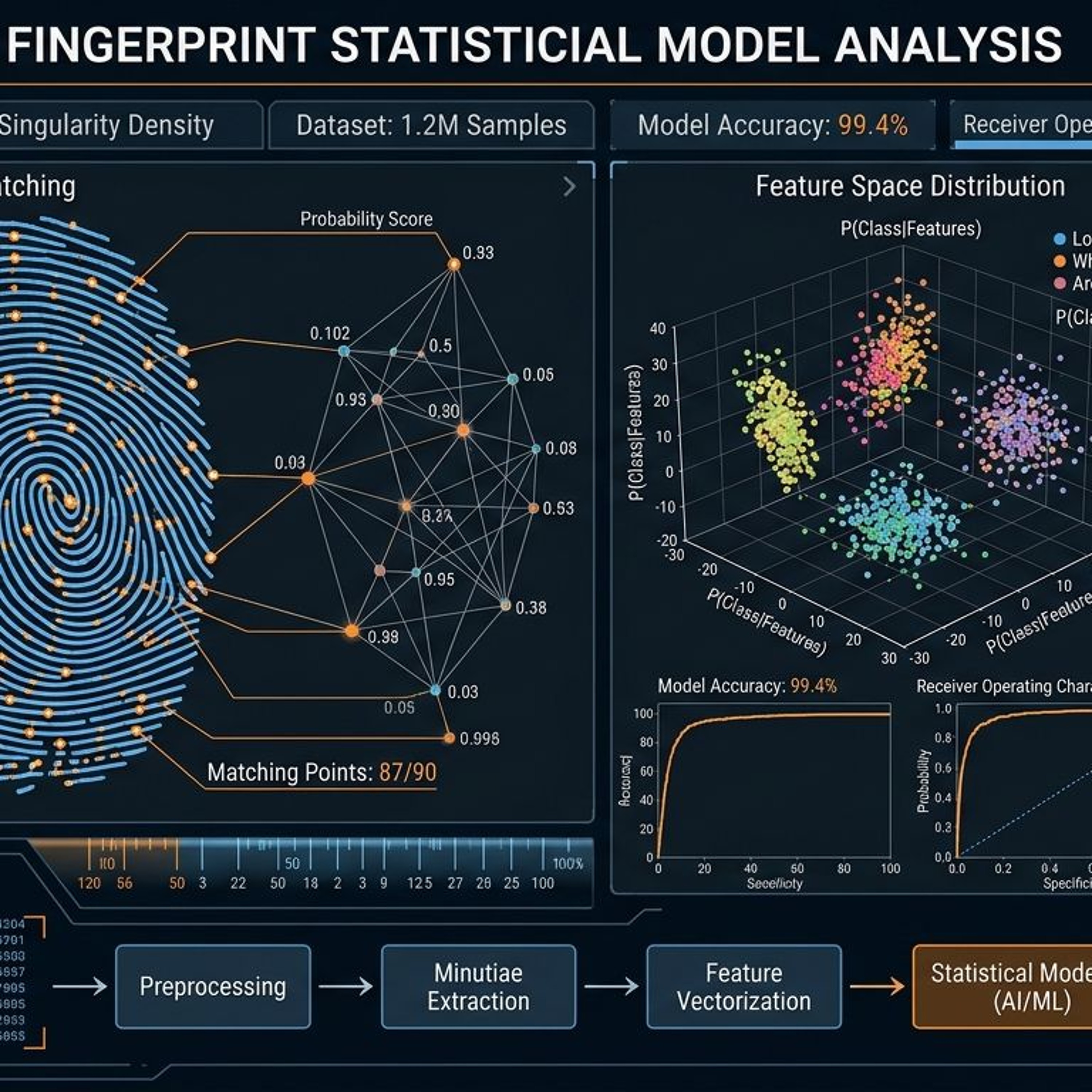
Episode 291 - Mundane Obstacles to Developing a Stats Model
May 401:26:21Tap to summarizeEric and Glenn start the episode with a listener email and then play a numbers themed game of Regional Quirkisms. For the topic of this episode, the guys discuss a 2025 paper from Simon Cole and Justin Sola titled "First impressions matter: Mundane obstacles to a forensic device for probabilistic reporting in fingerprint analysis". The article discusses practical and realistic obstacles and hurdles to developing a validated, accepted, and commercially-available statistical model for fingerprint evidence. The article takes the novel view that most sources cite either "practitioner disinterest" (or worse: practitioner rejection) or lack of push and influence from the Courts, Daubert challenges, or Authoritative bodies. However, once you remove those two obstacles and assume examiner 'buy-in' and Courts pushing for empirical data over subjective examiner expertise, what 'mundane' obstacles exist that most people don't realize or think about? The article discusses a number of surprising, non-trivial obstacles that have a huge influence on the state of statistical model development in the field today. Article: Cole, S.A.; Sola, J.L. First impressions matter: Mundane obstacles to a forensic device for probabilistic reporting in fingerprint analysis. Social Studies of Science (2025), 55(5): 683-710. https://doi.org/10.1177/03063127251333074
Transcribe →
Episode 290 - Review of a Bias Research Paper
Apr 601:18:43Tap to summarizeIn this episode, the guys start off with some Michigan Regional Quirkisms. They then review a 2024 paper titled "The effects of cognitive bias, examiner expertise, and stimulus material on forensic evidence analysis" by Michelle Pena, Stephanie Stoiloff, Maria Sparacino, and Nadja Schreiber Compo, from the Journal of Forensic Sciences (2024; 69:1740-1757). The research paper provided lay participants (students) and fingerprint expert participants with images of ground truth, matching and non-matching fingerprint pairs. The researchers controlled the exposure of the participant to contextual case information. Lay participants made a number of errors and seemed to be more impacted by case information compared to experts in these trials. Glenn and Eric discuss why that might be and discuss and compare other studies that might be relevant on this topic. Article: Pena MM, Stoiloff S, Sparacino M, Schreiber Compo N. The effects of cognitive bias, examiner expertise, and stimulus material on forensic evidence analysis. J Forensic Sci. 2024 Sep;69(5):1740-1757. doi: 10.1111/1556-4029.15565. Other Articles Discussed: Tangen, J. M., Thompson, M. B., & McCarthy, D. J. (2011). Identifying fingerprint expertise. Psychological Science, 22(8), 995–997. https://doi.org/10.1177/0956797611414729 Langenburg, G., Bochet, F., & Ford, S. (2014). A Report of Statistics from Latent Print Casework. Forensic Science Policy & Management: An International Journal, 5(1–2), 15–37. https://doi.org/10.1080/19409044.2014.929759
Transcribe →
Episode 289 - Angela Tonietto Interview - Palm Patterns
Feb 2201:04:33Tap to summarizeGlenn Langenburg and Eric Ray interview Angela Tonietto about her recent article on the frequency of patterns in palm prints. ("Patterning in the Distal Portions of the Palms as a Key to Palm Print Identification". 2025, 75-3, p.274.) The research analyzes the frequency of loops and deltas in the interdigital area and compares the results to past research. (Link mentioned in episode: https://demo.hugin.com/example/FingerprintEvidence)
Transcribe →
Episode 288 - Close Non-matches
Jan 2101:21:03Tap to summarizeHappy New Year 2026! The boys are back in town, with a new game: Regional Quirkisms. After discussing Minnesota quirkisms, the guys answer a listener question from Ireland: "What's the most number of corresponding minutiae that you have seen from two impressions from different sources?". This leads to a deep dive on close non-matches. The guys share their tips, tricks, and red flag warnings for dealing with close non-matches. They discuss a few examples and talk about the relevant research on this topic.
Transcribe →
Episode 287 - IAI 2025 Review
Dec 1301:29:22Tap to summarizeEric Ray and Glenn Langenburg talk about their week in Orlando at the 2025 IAI Educational Conference. Hear about Quality Metrics, limited examinations, and linking cases together, and hear from some of the conference attendees.
Transcribe →
Episode 286 - Forensic Science Ireland Interview
Sep 3001:42:52Tap to summarizeIn this episode Eric poses to Glenn a Mandela effect question concerning household cleaning products. After that, the guys celebrate the 4th of July holiday by welcoming their guests from Ireland. Four fingerprint examiners from Forensic Science Ireland (FSI), the national forensic lab in Ireland, join the podcast. The guests are Dr. Aoife Power, Dr. Craig Mullen, Mr. Columb Doherty, and Dr. Kim Connick. Glenn and the guests talk about their time at the recent European Academy of Forensic Science (EAFS) conference in Dublin in May 2025. The examiners from FSI discuss their research, posters, and presentations from EAFS. Eric is also curious about their new AFIS system and has lots of questions about their processes. The guests discuss forensic fingerprint practices in Ireland and especially working in their new national laboratory. Forensic Science Ireland: https://forensicscience.ie/ Dr. Kim Connick: kconnick@fsi.gov.ie
Transcribe →
Episode 285 - Michael Whyte Interview - Latent to Latent Comparisons
Aug 12, 202501:08:18Tap to summarizeIn this episode, the guys start with a product-based Mandela effect question. Then they welcome back long-time friend of the show and webmaster, Michael Whyte from the New South Wales police force in Australia. Michael has a question for Glenn and Eric, regarding latent-to-latent comparisons, using latent prints as 'proxy exemplars' when the exemplars are worse than the latent prints or incomplete, and various off-shoots of these questions. The guys discuss the theoretical basis and some of the legal issues that arise in both the U.S. and Australia.
Transcribe →