← DTC POD: How The Best Brands Are Built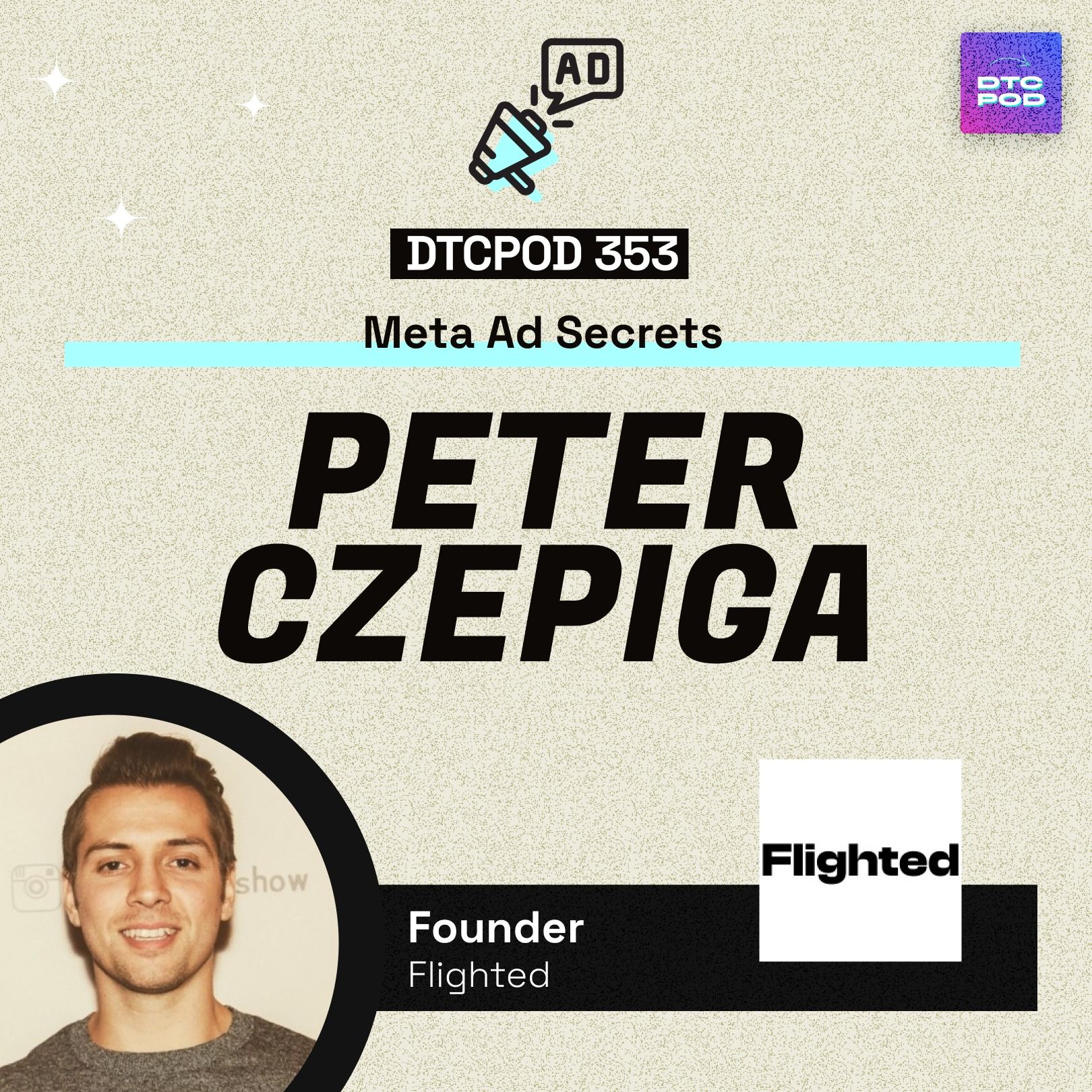
DTC POD: How The Best Brands Are Built
#353 - Meta Ad Secrets: How Top DTC Brands Spend $300K/Month Profitably
00:46:17
Peter Czepiga is the founder of Flighted, an agency that scales advertising for DTC brands. He also runs his own brand, Ando. In this episode, Peter shares his tactics for profitable Meta ad campaigns, including testing product-market fit, winning creative strategies, audience targeting, the impact of AI on ad production, and how DTC ad tactics apply to SaaS.
Loading summary
Transcript49 lines
- [00:00]
Host
Foreign.
- [00:06]
Co-Host
We'Re super excited to announce the launch of our slack community for D2C pod. This is a space exclusively for D2C founders and operators to connect, share ideas, ask questions and support each other. You'll be able to engage with the best minds and operators and consumer and currently we're on a wait list and it will open up the community Once we reach 150 members. So apply using the link in the description and we hope to see you on Slack. So before we kick off today's recording, I've got one more for you. Keeping up your momentum this year starts with the right selling tools and if you're looking to increase revenue, grow faster, build more pipeline and close more deals, check out the all new sales hub from HubSpot. You'll be able to manage your whole sales process plus my favorite part, the reporting. It's super intuitive, powerful and customizable. Plus the whole thing is powered by AI so your teams can spend less time on tedious time consuming stuff and more time on developing relationships. Also, no one likes a clunky platform that takes months to onboard onto, but getting set up on Sales Hub is really quick and easy. It's free to get started. The pricing will scale with your business and with more than 1300 integrations and add ons, you can tune it to your exact needs. Visit HubSpot.com sales to start selling with Sales Hub.
- [01:21]
Host
What is going on D2C pod today we are joined by Peter Sapiga who is the founder at Florida Flighted, which is a an agency that helps D2C brands and all sorts of brands actually for that matter scale up. He also runs his own brand called Ondo. Typically a lot of their brands that they've served are some of the most popular and largest brands in the D2C space. You know, oftentimes spending between 50 to 300k a month on ads as profitably as they've scaled up. But he's also taken brands from zero and launched several brands starting out. So you know Peter, maybe that's where we can start the conversation. Why don't you give us a little bit of a background about yourself and how you kind of got involved with the DTC world and then let's get right into growth stuff.
- [02:09]
Peter Sapiga
Cool. Yeah, so I started working in house for brands, mostly e commerce businesses, was at a company called Bespoke Post, which is a very large nine figure subscription e commerce business, and then moved to a much smaller premium baby brand called Healthy Baby where I was their director of growth, freelanced for E Com businesses the whole time. So eventually went onto my own. It started flighted in March of 2021 and since then, yeah, like you said, we've scaled north of 25 brands launching from scratch on meta to profitability and more recently have started to, as we've grown, work with larger businesses in the 50 to 150 to 200k in monthly budget range than even software companies. So we've had quite the journey.
- [02:56]
Host
Yeah, and I'm really excited about this because, you know, one of the things I love about D2C is because the space inherently is so competitive, a lot of times you've got the best marketers who are selling commoditized products. Maybe there is a little bit of innovation, but you know, when you translate some of those tactics over to SaaS where it seems like a lot of those tactics are maybe a little bit behind the ball, it's really exciting. I think one great example that we've seen recently that's really taken off is like in the, in the creator, in the social app space, like a lot of the concepts that were working in D2C where creators were, you know, creating a bunch of viral content, organic content that's we're seeing that playbook play out in the, you know, app sort of space right now, especially like TikTok accounts and how do you replicate and scale up content but again do that stuff in the ad space as well, whether you're on Google, Meta, etc. So yeah, there's going to be a bunch to talk about there and then, yeah, you guys also have experience working with some of the biggest brands. Like I can just see on your site, you know, having worked with brands like Harry's, Todd Snider, Momofuku, Bespoke post and a bunch more, it's, it's going to be really exciting. I'd love to unpack some of these strategies that really work. So why don't we start off for, you know, the people who are maybe launching a brand, what does it take to, you know, get your ad account set up and prove out concept of a product where like, what do you need to spend to like prove that you've got some semblance of product market fit? If you're a brand starting out, how much should you be spending and what do you need to do to get, you know, an ad account ripping?
- [04:33]
Peter Sapiga
Yeah, I think the first thing you need to do is make sure you have the diversity of content to ensure that you're giving meta the best possible chance. So a lot of brands test like 5 to 10 ads on Meta, they spend $300 and they think they don't have product market fit. You want to make sure you're at least giving the channel as big of a swing as the bigger competitors in your space before you rule it out entirely. So I always say think of yourself as a media company that happens to sell a product, not an E commerce brand. Once you have that in place and you have, I would say north of 25 unique assets at launch is like minimum necessary amount of creative to scale in 2024, unless you have a really amazing product moat. So if you have something really unique, I think that the brand zest is a great example. It's a delayed release caffeine pill that you take before you go to bed and then you wake up and you feel amazing. Like that's going to sell itself in many ways and have a much easier path to profitability through Meta ads. But if you're probiotic number eight on the scene right on Meta or like number probably 25 at this point, you're going to need a really large diversity of content to properly test the channel. Once you've basically done that shotgun approach, testing messaging, testing formats, making sure you really like, left it all out on the field, messaging wise, I always recommend marketers who are fairly, you know, beginner stage. Take all of your most promising creatives from that test round, throw them into a single Advantage plus campaign and just try to exit the learning phase. Meaning at leave meta says 50 conversions per ad set per week to exit the learning phase. But often you can do it at a lower volume if you're just not touching your campaigns as much. So if at that point, if you've tested that really wide variety of creative, at least 25 unique concepts and then you've consolidated your winning ads into a single ad set, kind of taking your hands off of it. I'd recommend using the Advantage plus shopping campaign format. If you're still not close to profitability at that point, it might make sense to pump the brakes, pause, look at what the issues are in your funnel. Is it a conversion rate issue? Is it a. Honestly, AOVA issue is a really common one. Did you price things correctly and. And make a decision there? But that's usually how we recommend brands come out of the gate.
- [07:02]
Host
So talk to me about. So you said 25 assets, right? So I'm a brand, I'm starting out, I want to get set up. I set up 25 different concepts or ads. How much, how much should I be spending to, you know, guarantee that those 25 are at least like getting the reps they need. How long should I be spending it for before I can really say I've got winners or I've got losers and you know, like, and how long for? Right.
- [07:28]
Peter Sapiga
Yeah, it's a good question. It's a question that every client asks us and I think a question that you don't really need to ask that early. So my reasoning for that is two. Let's say you spend $200 a day. That could potentially be thousands of impressions per day that meta is getting on each of these ad units. So even if it feels like a pretty low absolute dollar value, the amount of impressions that meta can get and serve across different cohorts and identify, like, which of these ads are going to have the highest estimated action rate is actually pretty significant. So I say if you really need a minimum budget, probably 150 a day. I don't even care if that's spent across 25 ad sets worth of creative. Of course that's really fragmented. Of course you're not going to get a high absolute dollar value spent on each of those. But as long as they're using campaign budget optimization and you know, you're not selling $12,000 like furniture products, it's just a normal e commerce product within the normal threshold that someone might buy in a single session on Facebook or Instagram. A week of running, you know, 50 plus ads at $150 a day is actually a really significant amount of data for meta. Even if you get no conversions, all you're looking for is that initial spend allocation that you get across all of those concepts. So we look at like spend allocation as the number one signal of quality ahead of anything else, even purchases that early on in the journey.
- [09:00]
Host
So, so basically, rule of thumb, you should be spending at least somewhere between 150 to 200 bucks a day on, you know, somewhere between around 20, 25 different assets. And that over the course of the week should give you some initial data to know what ads people like and what ads people don't really, you know, vibe with.
- [09:23]
Peter Sapiga
I think so. I think if I've learned anything from running meta ads, it's that meta is really amazing at identifying creative winners in a very short amount of time. And we almost never uncover what we call false negatives. So ads that are deprioritized in the auction and then we retest them and all of a sudden they become a big winner. Especially that early on you're going to scale from 0 to probably 5, 10k per day on like one or two creative concepts. And so that will make itself very clear very quickly once you've, you know, created that concept.
- [09:58]
Host
So yeah, so let's talk about that next phase. Right. So we've kind of, we rolled out our tests. You're saying Meta does a pretty good job of figuring out what creative works and what creative is flopping. Now that we know where, where we've got a little bit of signal, what are we doing are we're creating a different campaign and you know, how much money are we pumping into that? Now that like, let's say we assume that we like what we're seeing in terms of a initial like ROAS or aov, it supports this motion of growth and we want to continue to invest in it. What's the next, you know, what's the next step in terms of ratcheting up that budget?
- [10:36]
Peter Sapiga
Yeah. So for most advertisers, for your average E commerce founder, you're going to discover maybe three to five of those ads from your round one had any traction at all. Meaning we're given a significant amount of spend in the auction compared to the long Tail, maybe a few drove conversions. And for those brands, then the next thing I recommend is either leaving those ads on in that structure. So pause the things that aren't getting spend by Meta, pause what's getting deprioritized, or reduce the number of ad sets in your creative testing campaign, or if you're not even close to your CPA target or your profitability target, whatever that is, scale those into an audience testing campaign. These campaign types, many people say are like outdated, going by the wayside. But the fact is, if you're launching in a new ad account, Meta doesn't have the historical conversion data for things like Advantage plus to work for your brand yet. So you don't want to move too quickly to an Advantage plus campaign. I think that's another really common mistake early advertisers make. What we want to do is test a few different audience types. I always, always, always recommend really four buckets. Test broad, test the engaged shoppers cohort, which is an interest audience you can target, which is anyone on Meta that's clicked a shop now button in the days. So that's just people that are in market to buy something. So I think of that as broad with purchase intent. So we test broad, we test engaged shoppers, we test a interest stack. So usually a stack of similar brands to your own. I really like brand based interests versus like generic interests like you know, physical fitness and then the third or the fourth would be a stack of upper funnel custom audience lookalikes. So maybe a lookalike of anyone who's watched more than 50% of any of your video ads. Maybe a lookalike of people that have visited your site in the last 180 days. A lookalike of people that have engaged with your Facebook and Instagram ads. So I'll stack all of those lookalikes into audience number four. We test audiences all the time, hundreds a month and those four are probably the highest success ones that we can actually scale behind. Occasionally you get a brand that's round one. Creative is so strong that they can simply scale on their creative testing campaign structure, which is great. Like don't throw, you know, all your learnings out and launch a new campaign that's testing audiences if you're doing really well or off to a promising start with creative testing. But that's usually people that you know, they are like an agency founder as their day job or someone who really understands creative at a deep level.
- [13:24]
Host
Awesome. My next question is around. So you covered the audience stuff. I think that was something that I was definitely curious about. But talk to me a little bit about Advantage plus for people who are listening in and may not understand it, like what is it, how does it work? And you know, should you use it, should you not use it? Yeah, just talk to me about that.
- [13:45]
Peter Sapiga
Yeah, in terms of how it works, I don't think anyone knows how it works, but except for maybe like three high paid engineers at Meta headquarters somewhere. But in terms of what it is. So Advantage plus shopping campaigns are essentially Meta's like AI black box targeting campaign type. So if you're familiar with Google Ads, it's kind of similar to performance Max on Google. It's where you essentially give Meta a target country. You give Meta not even age range or gender. I think you can only select an age minimum. You give Meta a group of ads and you say go find me purchasers. And this is different than broad targeting in that it generally at scale tends to perform much better. So for mature advertisers, advertisers that are spending I'd say more than 10 or 20,000amonth profitably. Advantage plus campaigns are almost always the majority of our ad spend on that account. When you are at scale, Advantage plus campaigns typically outperform most other what we call manual non advantage plus campaigns. However, they are not as incremental as what we call manual campaigns. So campaigns are using things like broad targeting, interest targeting, lookalike targeting. They tend to shift a little bit towards retargeting or middle of Funnel as you scale on them. So you just have to be really careful with your exclusions when you're defining your existing customers in Advantage plus and also with making sure you're building top of Funnel through other manual campaign types, even if they're not, as, you know, efficient in the platform. So yeah, short answers. Advantage plus campaigns, otherwise known as ASC campaigns, really the black box targeting campaign type that's probably going to get your brand from like 10k to 100k in monthly ad spend, will be on the back of the Advantage plus campaign type.
- [15:43]
Host
So you would say basically you don't need to necessarily work with Advantage plus when you're just starting out, but once you've got some traction and you're looking to scale up, then it's, it's better to, to bring in as you scale. Is that right?
- [15:54]
Peter Sapiga
Exactly. It's usually when we switch a client from that audience testing campaign to Advantage plus, maybe after two or three weeks, once we've gotten at least 50 conversions, that we see stepwise improvements in return on ad spend or cpa.
- [16:09]
Host
Awesome. The other couple concepts that you mentioned that I'd love if you could just kind of flush out a little bit. One, you talked about exclusion list, right? For like current customers and also like ad frequency. You know, sometimes you're like running an ad and the same people are seeing the ad a million different times. So how do you, how do you guys think about, you know, setting up or having a strategy around those two things like who should, who or what should you be excluding? And you know, how should you be thinking about ad frequencies?
- [16:41]
Peter Sapiga
Yeah. So in terms of exclusions for Advantage plus campaigns, we define the existing customer as past 180 day purchasers. So we use the maximum duration of the pixel exclusion for purchasers and then we'll also add in the client's CRM list. So if they're using Klaviyo, we'll add a Klaviyo integration of all of their customers. I've started to hear, and we're seeing this, that Klaviyo actually has really bad match rates on Meta. So if the client can afford Shopify plus or has Shopify audiences, adding in a Shopify audience of their lifetime past purchasers can be an effective exclusion. Or even if you don't have that, just export a CSV list of all of your customers from Shopify and upload that as a manual list that you would update maybe quarterly. That's how we Use for existing customer exclusions. For our manual campaigns, we've actually started to even exclude 60 or 180 day website visitors just because incrementality becomes more and more of an issue as you start to scale up these campaign types. So that's what you use for exclusions. Can you remind me of your second question?
- [17:50]
Host
Frequency.
- [17:52]
Peter Sapiga
Right, frequency. So for frequency, we actually almost never look at ad level frequency because I think every major campaign in meta is almost its own ecosystem where certain ads are driving more top of funnel, like new customer impressions and other ads are what we call closers. So ads that are retargeting people that were brought into your funnel maybe from like a video ad. And so you're going to see much better in platform performance from the ads that have higher frequencies and from the ads that aren't as, you know, incremental in capturing new audiences, but they're just as important in the overall ecosystem of a prospecting campaign as maybe an ad that's getting more spend, has a less efficient return on ad spend, but has a much lower frequency. So what we actually track is account level frequency over time. And if we start to see that degrade, even campaign level frequency is okay as well because you're going to start to notice, for example, your advantage plus campaigns will usually have a higher frequency than your manual non advantage plus campaigns that are targeting like regular audiences. And so we look at those two numbers over time and once we start to see those declines, we'll start to do things like maybe launch a more upper funnel campaign or just shift budget allocation a little bit more into more incremental campaign type. So I think where you could get into too much confusion is trying to decide if you should pause an ad or not based on things like frequency is just not a really helpful metric for the value of that ad, I think.
- [19:30]
Host
Cool. The next thing I really want to talk about is, is creative, right? What's working? What formats? But also like as a brand, like you were saying, there's some ads that are great for top of funnel and then some ads that are like you're saying closers, that's like really driving the conversion. So as you like, how do. Why don't you just talk to me a little bit about a what, what is, what should a creative mix look like in terms of like concepts and formats as well, right? Like because you've got statics and you've got video and you've got ugc, there's so many different types of formats that you might book want to be running and then the other thing is, you know, how do you think about like platforms as well? Right? Because like sometimes they get pushed out to, you know, an Instagram story versus an Instagram in feed versus actual Facebook ad. So like how do you just think about the entire ecosystem of ads on the creative side and then like where they get placed?
- [20:30]
Peter Sapiga
Yeah. So we don't approach ad formats as scientifically as I think maybe other agencies. We are entirely focused on messaging. That's where we spend most of our time in terms of like understanding what, why things are resonating. What are the commonalities across top performing creative. I don't think it's a valuable insight to say like hey, carousel ads work really well for this business or like this comment overlay, this TikTok comment overlay video seemed to work really well. What I care more about is what is the messaging that caused the user to convert on that ad or that caused that ad to become a top performer. So we identify first the commonalities in messaging that work for the brand which again like a simple, I know brands that have scaled to a quarter of a million in monthly ad spend off of like two or three angles or just headlines that seem to resonate across formats. So once you've identified the copy, the actual either product features, like psychological triggers, the benefits that those features translate to that get users to convert on your ads, then the format part is easy. I think that's just like have fun with it and test a diversity every month. We don't think about it in terms of okay, we need to get 80% static, 20% video, or 80% video, 20% static. It's what are all the different formats that we want to test this month that we haven't tried? How do we plug that messaging into these formats? I think Meta is increasingly valuing creative diversity over really anything else in the ad platform. So whatever you haven't tested, test it. If your ad account is very static heavy, you should start spending more on video concepts using the same messaging that was working in your static ads. If a static ad works, throw that at the beginning of a three slide carousel ad unit and see how it does there. If your video hook is working really well, put that on five different static ad templates and see how the hook does as a, as a headline. So we're much more scientific around like messaging testing and cracking messaging first and from there we actually have an internal database of like 200 out of formats that we basically prioritize by efficacy. But honestly that vary a ton from brand to brand that we simply like rinse, wash, repeat, plug and play that messaging into. So I think in the same way that, you know, meta is a machine learning model at the end of the day. So in the same way that you would, if you wanted to teach an AI model how to be a chef, you wouldn't only feed it, you know, Italian food recipes, you give it Mexican food, Asian food, Indian food, whatever it might be. We think the same way about formats. Like, let's nail our messaging and then just feed Meta as diverse an array of formats as possible so we don't really double down on a certain format that's working, which I think makes us a little bit different than other agencies.
- [23:24]
Co-Host
We are really excited to announce that DTC Pod is officially part of the HubSpot Podcast Network. The HubSpot Podcast Network is the audio destination for business professionals and we're really excited about being part of the network because we're going to be able to.
- [23:38]
Host
Keep, keep growing the show, bringing you.
- [23:39]
Co-Host
Guys amazing guests and obviously helping you guys learn from the best founders, marketers and builders of the most successful consumer brands. So anyway, keep listening to DTC pod and more shows like us on the HubSpot podcast network@HubSpot.com podcastnetwork yeah, but I.
- [23:57]
Host
Like that because I think the concept and getting the concept and the messaging right is the, like, you can have the best format in the world, but if it doesn't, I think it's like a similar thing to organic content, right, where you can create a piece of organic content, it can go super viral. But like, maybe no one even buys it because like, it was just an entertaining piece of content that doesn't actually convey the message. Whereas you can have, you know, a conversion focused piece of content that maybe doesn't go super viral. It maybe only does like 10,000 views organically, but like, it'll get you a bunch of sales because your messaging was really good. So I do think there is a lot of value, like to what you're saying and first get the brand and the messaging right. So I'd love to know, do you have any tips on like, now you've seen a lot of like, what type of messaging is working is there? You know, and now that you have a pulse on this from multiple different brands, what type of messaging is working? Like, what do you look to do when, when you're onboarding and you're trying to suss out that like messaging market fit, you could call it?
- [24:58]
Peter Sapiga
Yeah, it's a good question. So we do two things really the first is simply translating the features to benefits. So it's a high, high protein collagen bar. Like we're not going to advertise 25 grams of protein. We're going to advertise. You know, I've never felt more confident looking in the mirror. If it's an acne brand, we're not going to advertise, you know, get prescription Accutane. We're going to advertise. Feel confident in your swimsuit this summer. Swimsuit seasons coming up. So the biggest one is that second order thinking, taking all their product features and then thinking about what are all of the like actual personal psychological triggers that those features translate to for my life or for the customer's life. And you can do some prompting with ChatGPT where it can be really helpful with that if you, you know, dump all of your products granular features into ChatGPT and just encourage it to go deeper with translating those features into specific psychological triggers or hooks that provoke an emotional reaction versus just like a feature which doesn't always, you know, sell that well unless you have a deep product moat like I mentioned. So a lot of those brands that have remarkable products can literally just describe their product and get to, you know, 50, 100k in monthly ad spend. So that's the first thing I think once you've exhausted translating features to benefits. What we call like ICP callouts is lane number two. So ideal customer profile in this case, if you're an E commerce brand, think about who are all of the different potential customer archetypes that are out there for your business and speak to them directly. So make creative for, you know, the busy mom of three who doesn't have time to make meals at the beginning of the day or make creative for the young professional whose email inbox is absolutely swamped every day. Whatever your product is, you know, think about who that person is on the other end and try to build out like five or ten of those avatars and we'll literally just test like five icp, call out iterations of, you know, five formats, five different creative concepts. And that's a really great starting point.
- [27:03]
Host
For creative as well.
- [27:04]
Peter Sapiga
So I don't think any of this is like reinventing the wheel. This is creative strategy, day one type stuff from what I understand. But not a lot of people take the time to think that way when they're making ads. I think there's a tendency if you don't make a lot of direct response, response ads to make copy that's like, you know, Something Don Draper would write in Mad Men. Like, overly clever. You know, they use things like alliteration or they hint at what their product does, but you really need to just hit people over the head with what your product does in a way that sticks in them like a knife in terms of how much it resonates emotionally.
- [27:38]
Host
I love that. No, those are really solid and actionable. Actionable frameworks. My next question was going to be, what does it take to pull this off? Because like you just said, for a brand, you need a lot of creative. You need to understand what the pain points are, the hooks, the benefits, and really be able to scale up and iterate on that creative. So for you guys on the agency side, or if you're operating a brand, like, you know, why don't we just talk about how you currently, like, work with clients? Like, do these brands have in house teams that are coming up with the creative? Are you guys doing the creative? Like, how do you. How do you marry those two together? Because you can be great at, you know, selecting your audiences. But like, you're saying if you don't have the right, you know, ad creative and you don't have the right infra in place to be able to iterate and churn out those, like, winning creatives, then, you know, having a great media buyer isn't going to deliver the same impact. So how do you guys think about when you're working with clients or you're trying to, like, really scale up? What is the operation side of creating great creative look like?
- [28:38]
Peter Sapiga
Yeah, this is everything. And this is where people's heads start to spin. And it can feel like, overwhelming, right, because you're just looking at a blank page and you have to magically come up with a hundred ads, which is terrifying if you don't do this for a living. So for us, I mean, we have like seven video editors and graphic designers in house making ads all day. I don't know if that would be helpful to describe our process for your average brand owner, but, I mean, I wrote this tweet thread a long time ago that was basically how to get to profitability on Meta for less than $4,000. And it goes through some really scrappy ways to source creative. But you really need three things to start. You need static ads. Guess what? There's banks online of, like, hundreds of really premium static ad templates that you can buy for, you know, $80. Not even. That's phase number one. Download all of those, repurpose them with your brand assets, and just go crazy writing copy. Make five to 10 iterations of each of these static ad templates that were pulled from some of the biggest e commerce advertisers out there. So that's the easy one that can get you to a hundred ads for virtually free with only your brain, your copywriting ability and this $80 number two, you need raw inputs. So what I mean by that is video content from creators, humans on camera, selling the product, that's a little bit more difficult. The sources for that are yourself. As the founder, you should absolutely be making unfortunately video edits of yourself. Everyone hates that. But the founder story ad concept continues to be a top performer for all of our clients who actually do it. You have your friends and family send the product out, say, hey, please just record like a 30 second video testimonial. You have UGC creators for fairly affordable prices across tons of different platforms. I think on the very lowest end of the price quality ladder is below for maybe $80 per creator. If you want to get a little bit more custom. I love brands meets creators dot com. That for me is my favorite one. You can form a direct relationship with the creators. You get their email. They are a much more diverse set of creators. The quality is higher and the prices are competitive. So that's another place you go or use product seeding for that purpose. So a lot of these brands do mass product seeding from day one. The goal being to actually drive growth. So you hope you send out a hundred packages, 25 people post, you know, Instagram stories, maybe five of those, generate meaningful sales for you, take all of that content and run those as ads, get the content rights for those videos. Um, once you have the raw inputs, then the third component you need is a video editor. So you need someone to, not only, you know, you, you should not only be running those videos as standalone pieces of content, but you need someone to cut those up into new iterations, to add text overlays, to, you know, test different starting points within those video concepts to improve the pacing, add background music. And so those are the three components.
- [31:38]
Host
Static ads.
- [31:39]
Peter Sapiga
You can make yourself net new what I call raw inputs, which you can get from the sources that I mentioned and then a video editor to actually like, continue to make use of those raw inputs, which is probably the hardest one to find. But I would recommend everyone goes on LinkedIn, post a job in any country in Eastern Europe, any Slavic country, for a video editor. You will find someone for an incredibly affordable price point who will churn out videos for your brand that are extremely high quality because they understand the US market. Alternatively, there's platforms out there like Constant Creative, which is a unlimited sort of design as a service platform. There's plenty of places on Twitter to find, you know, good video editors if you just reach out to people. So those are the three places I recommend people start.
- [32:30]
Host
Awesome. And this takes me to my next question, which seems to be all the, the talk these days of like AI creative, right? What are you seeing? I know there's platforms coming out like icon, where they purport to, you know, ingest a bunch of your media library and be able to churn out a whole bunch of different ad creatives. I've talked to a bunch of my friends who are actually using them and it doesn't seem, it seems like there's kind of a disconnect from like the brand operators and what they're saying at the moment versus you know, what the, the talk is on Twitter. Like it's the fastest growing platform of all time and I all this sort of stuff. So I'm curious to see what your take is on like the AI ad creative platforms. Is that something that, you know, you were bullish on in the the immediate term? Is it something that we're more bullish on in a more medium or longer term time horizon? How do you think about that in terms of creating winning ads?
- [33:28]
Peter Sapiga
Yeah, the ecom buyer is the most sophisticated buyer on meta. So I think for that reason the avatar, the AI generated voiceovers and AI, AI generated avatars have not done as well in E Com as they've done for you know, like large lead gen businesses. You know, if you run, if you sell like do lead gen for you know, high end law firms or for personal injury attorneys or energy companies those brands are making. Non brands that don't have physical products are finding a lot more success with AI generated creative right now. But the E Com buyer I think is still very sensitive to like what's real and what's fake. And we always, always see AI generated voiceover always, almost always underperforms that exact same voiceover done by a human. Like it just is a little bit less engaging. 90% of the time you can distinguish it. And so the performance isn't quite there yet. We're even further off with the AI generated avatars. Like that's even more obvious. I know we're probably three to six months away from that not being obvious. But as of right now, I think most brands who say they're doing that are more talk than walk in that respect where I think AI has A really strong role right now in E Comm is video scripting at scale and video editing at scale. So the most redeeming feature of Icon for me is its ability to find video clips that somewhat match the voiceovers you're inputting in the platform. And I have tested it and I have actually found winning ads for my brand from Icon. Like, I think that feature in itself is legit and more effective than maybe the AI avatars, of course. But the other thing, scripting is the one that I'm more excited about. So what we do is we use this tool called Gumloop and it's basically like Zapier but for more. Just AI geared and a little bit less, less buggy, like, easier to use. And it allows us to do things like, for example, scrape a competitor brand's Facebook ad library, convert those videos into text transcriptions, repurpose those scripts, replacing the content with our brand's name and features, and then upload those into Google Sheet. So AI is allowing us to have really effective workflows for creative scripting, which we can then give to human video editors and use actual footage of human UGC creators to make really quality ads. Of course, you could have that be AI end to end if we fed those scripts into, you know, an avatar or something. But maybe it's me. I just haven't been able to get those really to work as well. So I'm most bullish on AI for copywriting, scripting at scale and then being able to again just take. Synthesize a Drive folder with 300 influencer videos in it into actionable, like helpful clips that match the content in the video script.
- [36:36]
Host
Yeah, I think, I think that's a really good point. I think we're close. I don't think we're quite, quite there yet. I think even, you know, we're in the early stages of like AI generative video. And when you ask and you prompt directly for an AI generated video, it's like, like people are look kind of weird. The fingers. Like it doesn't quite have that right. Like you'll ask for like a bottle pouring something and you'll see like liquid pouring into the top of the bottle. Like it's just like it's a little, it's not quite there. I think there's, you know, you have AI generated video creative that might start with a nicely generated static. So you've got image to video that, that might create something that looks a little bit more natural because now you're adding, you know, movement to an image that, like, is better generated and the image generated models are a little bit better. So. But it'll just be interesting to see as all this sort of stuff comes together. I think there'll be a lot of really exciting things. But for now, I. I think you're spot on by saying that, like, the, the buyer, you know, they know when it. When it's a human. It's a little bit different for versus like a TikTok that just goes super viral because of, you know, who knows, maybe TikTok's algorithm just pushed a random, like, avatar, AI avatar video and it made it super viral. But, like, that's not to say that you're gonna actually see the same conversion from it when it comes to a user making a purchasing decision.
- [37:59]
Peter Sapiga
Yeah. And to your point, this space is moving so fast, there's also the risk of getting stuck on the wrong tool. So five months ago, Arc Ads was like the sexy UGC avatar sourcing platform. If I had built out all these workflows to pump creatives out using arc Ads and then icon came out, I'd be, you know, kind of upset. So the tools that are being used for this are also shifting every few months. And so you have to be careful how many eggs you put into which of these baskets too.
- [38:27]
Host
Cool. One of the last things I wanted to kind of ask you as we kind of transition out of like the ads and the creative and the strategy for D2C is like, how do these tactics apply to other businesses? Right? Like, say you're running a SaaS, or say you're, you know, running an info course or something else. Like, how do you apply these tactics that you're talking about? How do you see them translating what works and what doesn't work? And what are some of your favorite tactics?
- [38:56]
Peter Sapiga
Yeah. So for SaaS and legion businesses specifically, the biggest thing that works is just the content playbook. So that's been the biggest revelation to us, is we can take our same creative approach we use in E Com, make very similar ad types like ugc, same volume of static ads, many of the same templates, ad formats, similar video concepts. And when we run those for SaaS businesses, the performance is like tenfold because the space is so much less competitive. People are not used to seeing these formats for, you know, selling enterprise software tools yet. And then when you do get them to work, the margin profile of a software business compared to Ecom, like infinite margins at scale compared to, you know, some E Comm product with a 40% gross margin, like, it's just not even fair. The LTVs to, to allow meta to be profitable. So we have literally run almost the same format. I think 10, five years ago, the SaaS paid media approach was like build out some white paper that's interesting to your icp, run ads, getting them to go to that gated content page and download it, capture their email and then run like an email sequence or have a sales rep reach out. And I think that's no longer the case. Like the meta is becoming a effective enough platform to just run regular direct response ads. We're spending more than 700k a month across software clients right now and 90% of that spend has a direct response objective attached to it, a free trial or a demo. And so that's been really interesting for us. Even the audience targeting approach is very similar. The things that are different in SaaS that you have to be aware of is number one, the nuance with audience targeting related to email addresses. So if you download a list of leads from your CRM, you need to enrich those at the tool like Clay that will get you a personal email attached to that user so that the match rates are high enough on meta for those lookalikes to be effective. That's number one. And then the other thing is event optimization is a much bigger game in SaaS than it is in E Comm. An ecom, it's a no brainer to optimize for purchases until you're at like a quarter of a million a month in SaaS. Sometimes we're optimizing for leads, sometimes we're optimizing for qualified leads, sometimes we're optimizing for even lower funnel events. When the lead ultimately converts like three to five days later, we'll send that as an offline conversion event. So there's a balancing act between finding a high event that's going to give you a high signal volume, but that's also high quality in STAs. That is not something you have to worry about in E Comm. But once you unlock that formula, it's a lot easier to scale your business, I think.
- [41:52]
Host
Yeah, and I think that's one of the biggest, one of the biggest challenges for us as we've scaled up castmagic on the south side of things has been figuring out attribution and where the events are and getting the tracking right. And that's just not something that it's like easy in Shopify. You just hook up the product that you're selling and it's like, it's very clear, very. But you know, it's a totally different ballgame. We probably spent like a year just go like ripping our hair out over like trying to figure out attribution and then attribution breaking and going back and forth. But I think we finally got it figured out. But it's just, it's a totally different ball game. And I think that's one of the things that's really important to get right. To be able to successfully run an ad strategy, right, you need to have some visibility into, you know, what are the events, who are you optimizing for, you know, are they purchasing? And even another thing is like a lot of SaaS platforms, right? Like one, one thing that we ran into before was our product is primarily a, you know, a web app. But, you know, a lot of the conversions that'll happen on Meta are going to happen on mobile. So it's like, how do you also take that sort of stuff into account? So, you know, while I totally agree, I think there's a ton of upside in being able to run those strategies. There's just things that, you know, if you have a SaaS and you want to take those approaches and run those playbooks that you. That are just inherent to SaaS that you kind of have to work out and figure out and build the right experiences so that once you get the traffic, once you get the brand resonating the right way, you know, you're able to scale it up effectively. Peter, my last question is just going to be about now, how do you work, like on the agency level, right? Like you said, you've got a bunch of clients. Like, what do engagements look like working with you guys? How do you guys charge? How do you guys onboard? Who do you typically work with? Just walk me through all of that.
- [43:37]
Peter Sapiga
Yeah. So onboarding is an intake form where we get, you know, everything we need from you. Budget, KPI goals, brand assets, information on like messaging, what's worked, what hasn't worked. So once we get all of that intake data, we then get to work on production of assets and landing page. So we do three things for every brand to work with. Paid ads management, Meta, TikTok and Google. Obviously the big three there, creative production. So we're making north of, I'd say 400 ads per month at this point and landing page design because we really feel like it's necessary to take the entire funnel off of the plate of the brand to ensure that it's done in a way that's best in class is going to give them enough of a chance to scale with us. As possible. Especially in our earlier days when we were launching brands from scratch, we really needed to bring those capabilities in house. So we deliver all three of those things for each brand. We also do things like, you know, whitelisting funnels. So we own a blog called Tested and Trending where we run advertorial reviews and we found a lot of success scaling brands that way. But when yeah, that's our general kind of service scope. And then in terms of pricing it's usually a flat fee based on spend tier. So you know there's a lot of convo around like percentage of spend versus retainer and I think we're right in the middle where we're a flat fee within different spend bands that I feel like require like drastically different levels of effort. So that's kind of how we go about it.
- [45:07]
Host
Awesome Peter. This was a bunch of fun. Have learned a lot. Excited to see you guys continue to scale up more and more successful brands and as you know the the ad environment continues to evolve. We'll love to have you guys back back on and we can jam on more of the updates. So thanks for coming on. Why don't you shout out how to get in contact with you?
- [45:32]
Peter Sapiga
Yeah, just go to Flighted Co, that's F L I G H T E D Co and book some time with me. I'm also on Twitter at Peter Sapiga if you can successfully spell my last name, shoot me a dm. We'd love to connect as well.
- [45:48]
Host
Sweet. Thanks so much for coming on the pod.
- [45:50]
Peter Sapiga
Thanks for the time man. Appreciate it.
- [45:54]
Host
If you enjoyed the show, we'd love your support. A rating and review would go a long way as we continue to host the best builders in DTC and beyond. Follow and subscribe to the show and.
- [46:02]
Co-Host
Make sure to check out our show.
- [46:03]
Host
Notes where you can find our socials and weekly newsletter. Visit us on dtcpod.com to join our founder, community and access resources from every episode.
- [46:11]
Co-Host
We'll see you on the next pod.