← Ear Hustle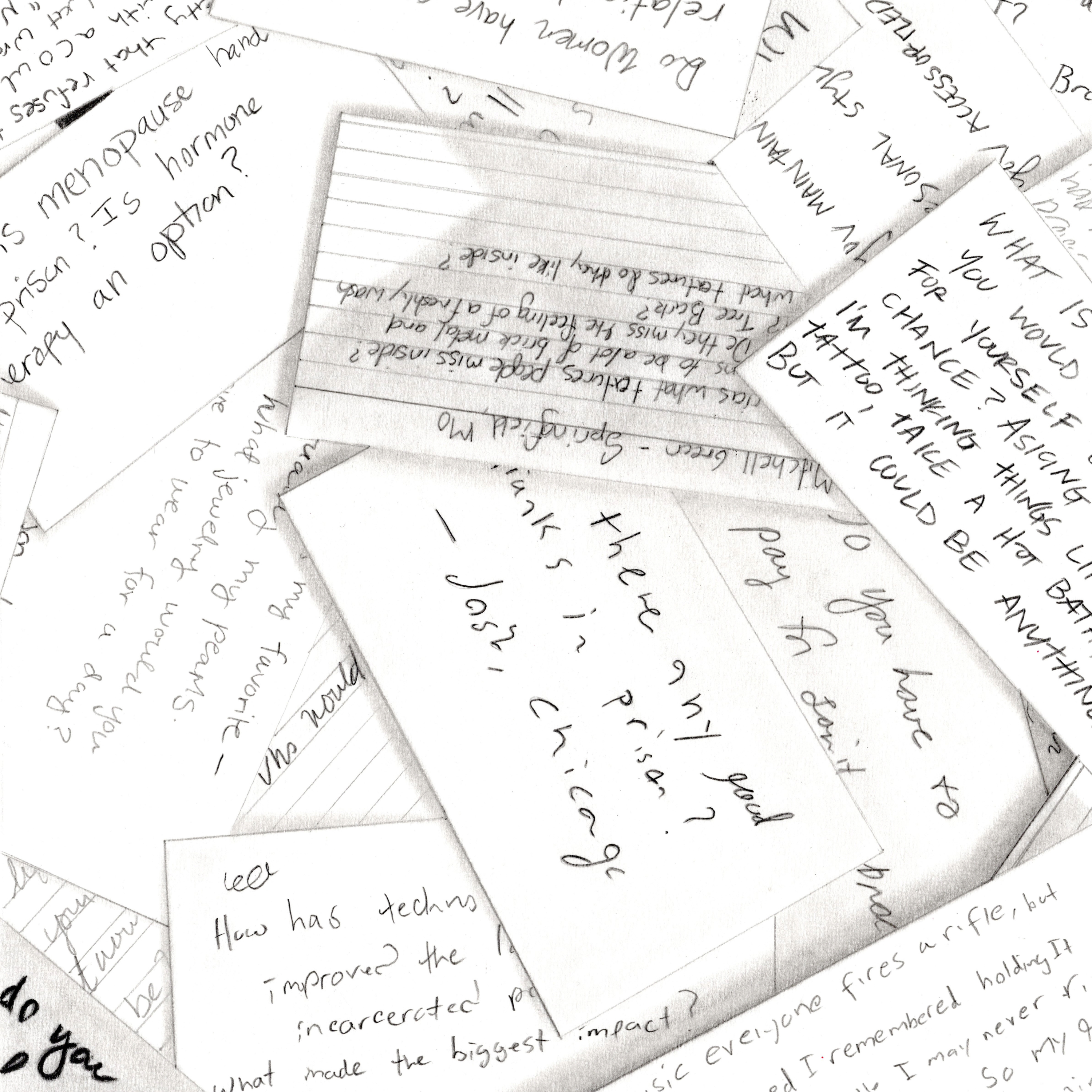
Ear Hustle
Catch a Kite: On Tour
00:33:23
Women incarcerated in Ohio and Oklahoma answer listener’s questions about life inside prison.
Loading summary
Transcript202 lines
- [00:01]
A
This episode of Ear Hustle is brought to you by Progressive Insurance.
- [00:05]
B
Do you ever think about switching insurance companies to see if you could save some cash?
- [00:09]
A
Progressive makes it easy to see if you can save when you bundle your home and auto policies. Try it@progressive.com Progressive Casualty Insurance Company and affiliates. Potential savings will vary. Not available in all states.
- [00:25]
B
Um, Earlonne, where are we right now?
- [00:28]
A
We are driving to Austin, Texas, our final stop on the Ear Hustle lobby tour. And we've had some long drives. And you know what?
- [00:35]
B
What?
- [00:36]
A
It's been a great time to catch up on some cool new podcasts.
- [00:39]
B
Exactly like Life Kit from npr.
- [00:42]
A
If you're looking to be more intentional or just need guidance on how to live better, Life Kit helps you make meaningful, sustainable change. For instance, we checked out an episode about quitting. And I know sometimes people think quitting is bad, it's weak or whatever, but our time is valuable and sometime you just gotta move on.
- [01:00]
B
Totally. And we also listened to another episode called Is yous Ph Becoming a Time Suck? And it was a really thoughtful conversation about we know why phones do that to people. I particularly liked it because, Earlonne, I'm a little bit judgy about how much people are on their phone, and I learned some new and interesting ways to think about why that happens. And yes, I'm looking at you.
- [01:23]
A
Why are you looking at me? I know you got phone love with Life Kit. Nigel, there's no judgment, just real advice from experts.
- [01:31]
B
Life Kit isn't just another podcast about self improvement. It's about understanding how to lead live a little better. Starting now.
- [01:38]
A
Listen now to the Life Kit podcast from NPR.
- [01:42]
B
Are we there yet?
- [01:43]
A
Nope. Says got another 22 minutes.
- [01:54]
B
Hi, I am Kirsta with Life Is Precious program. And this episode of Ear Hustle contains language and content that may not be appropriate for all listeners. Discretion is advised.
- [02:22]
A
Hey, Nige.
- [02:23]
B
Hey, E. What is in that little box you have over there?
- [02:29]
A
It's our box full of kites. And I'm gonna tell listeners about how this Catch a Kite episode is gonna work today.
- [02:35]
B
Please do Earlonne.
- [02:37]
A
So while we were just on our live tour in August through the south and Midwest, we asked people in the audience to give us questions that they would like to have answered about life in prison. And we collected them in this box here. Our little kite box.
- [02:50]
B
Exactly. It might not look like much. It's just a see through plastic box. But inside there are treasures.
- [02:56]
A
Mm. And it's cool seeing all those different handwritings.
- [03:00]
B
I can read most of them, which is A blessing.
- [03:03]
A
That's right, Dr. Poore.
- [03:05]
B
Normally, with our Ketchikite episodes, we would take these questions back to San Quentin or to the California Institution for Women and ask people to answer them.
- [03:13]
A
Right. But we figured since we got these questions on the road, we should also try to get them answered on the road. I'm Earlonne Woods.
- [03:21]
B
And I'm Nigel Poor. This is ear hustle from PRX's Radiotopia.
- [03:31]
A
One of the coolest things we got to do on our live show tour was Visit3Women's Prison.
- [03:36]
B
It was amazing. One in Ohio, just outside of Columbus, called the Ohio Reformatory for Women.
- [03:43]
A
The other two were in Oklahoma. The Dr. Eddie Warrior Correctional center near Tulsa, and the Mabel Bassett Correctional center not far from Oklahoma City.
- [03:53]
B
It was such an amazing experience. It was. You know, we've been in some women's prisons out in California, but this was first outside of California.
- [03:59]
A
Yes. And while we were there, we did a few things. We taught a workshop, we did some.
- [04:04]
B
Interviews, and we performed a live show that was monumental.
- [04:09]
A
First time ever in a prison.
- [04:11]
B
Yep.
- [04:12]
A
I mean, at San Quentin, you know, there's so many outside people coming in all the time.
- [04:17]
B
Yeah. I mean, the warriors come in there. And Earlonne. Last year, as you know, there was even a San Quentin film festival.
- [04:22]
A
Yes. And I could be wrong, but I didn't get the sense that there's that much outside programming coming into these women prisons in Ohio, in Oklahoma. So they ate it up.
- [04:33]
B
And it was cool having these Ketchikite questions to bring in. It just gave us so much to talk about. So let's get to it. Let's get to our Ketchikite episode.
- [04:43]
A
All right, now let me pull a card out of there. All right. It's from Dan in Nashville, and his question is, what's the most surprising off menu food you've enjoyed in prison?
- [04:58]
B
Oh, man, food. This is a classic Ear Hustle kite. So they call them meat marshmallows. You get sliced bologna or hot dogs and you stick them in the microwave until they literally blow up. Pizza wraps, empanadas, tater tots out of potato chips. It's almost like a KFC bowl. My friend, she makes them with, like, barbacoa meat. So I take vanilla cookies, crush it up, add butter or mayonnaise, and then she makes a little bowl out of the tortilla, and it forms exactly, exactly like a cheesecake. When you make a ramen noodle and you put in coffee in it, so you have to wet them, you have to separate Them. And if you fry them just right, they'll taste like a french fry. It tastes like a teriyaki. It's like a Chinese noodle. It's really good. You would be surprised. Sheesh.
- [05:53]
A
Nigel, in my over 27 years of prison, yes. I've heard of everything that you can put in a noodle. I never heard anybody putting coffee in a top ramen noodle.
- [06:09]
B
Are you sort of interested to try?
- [06:10]
A
I am very interested. I mean, you know, I've put stuff like peanut butter, mayonnaise, jelly, mustard inside a noodle.
- [06:20]
B
Jelly.
- [06:21]
A
Yeah, Just sweeten it up a little bit. Just a little hint of sweetness. You know what I'm saying? And it gives it a good twang. But coffee, I just can't even put that taste together in my head.
- [06:32]
B
I know. Well, what about the meat marshmallow?
- [06:36]
A
That's interesting too. The meat marshmallow is something. But that coffee and the ramen, we gonna have to do a video something with that?
- [06:44]
B
Yes. I think our interests have been piqued by both of those recipes. So, listeners, stay tuned.
- [06:48]
A
Listeners is over there. Like, what?
- [06:50]
B
Yeah, we're gonna make these and report back.
- [06:52]
A
Definitely. All right, hold on.
- [07:05]
B
This next question comes from Kelly in Durham, North Carolina, and she wants to know how menopause and perimenopause are managed in prison and whether or not women have access to hormone replacement therapy. I had, I kid you not, 10 hot flashes last night. It is when you light up with a hot flash, it's like lighting up from the inside out. You feel like your core has caught.
- [07:29]
A
On fire, so you just become like a little flame.
- [07:32]
B
It's not even a flame. It's like a swamp meets an explosion. I can't even begin to tell you. It's horrible. That was Michelle we just heard from. She's incarcerated at the Mabel Bassett Correctional center in Oklahoma. So a few things stood out from our visit there. One, it was really, really hot.
- [07:54]
A
Two, the place we performed had no air conditioning, so it made it hotter.
- [08:01]
B
And earlonne, right when you were about to go on stage, you got locked.
- [08:05]
A
In the bathroom, and it was the hottest.
- [08:09]
B
I bet it was in that tiny room.
- [08:11]
A
I did. I had to be rescued by an incarcerated woman with her ID card. She had the skills.
- [08:18]
B
Thank God she did, because I thought you might be in there all day.
- [08:22]
A
I was in there sweating.
- [08:26]
B
Well, that brings us back to hot flashes.
- [08:28]
A
Here's Michelle again.
- [08:30]
B
We're all women here, and so we look at each other. You can just tell, honestly, all you can do is you're Going to make it through it. It's going to be okay. Don't kill anyone today. You do have a unit where there's the elderly ladies. This is Cherie, also in Oklahoma. She told us she's in perimenopause. They real crotchety, but I know how to deal with them. They like the vets, so we respect them, regardless. They talk crazy to you or they having hot flashes, whatever the case may be, we respect them and we love them. We take care of them because they're our elders. The good thing is that we do have a doctor here that understands, so he provides the medication. It's like a hormone replacement. I make sure I take that every day. I never forget it.
- [09:19]
A
Here's Michelle, who told us about the meat marshmallows.
- [09:24]
B
The best way to deal with a hot flash, I've been told, is the prison smoothies. You get ice from our ice machines and crunch it up in a bag in the door frame and usually add a Kool Aid and some sugars and some creamer or milk and just. Yeah, you're either eating it immediately or you're first rolling it all the way across your shoulders and everything else and then eating it.
- [09:56]
A
I'm at the age right now where all my friends are going through this perimenopause and menopause, so I'm hearing it from a gang of different angles.
- [10:05]
B
And I hope you're very sympathetic.
- [10:07]
A
I'm very. I don't have nothing to say. You want to go to a cool.
- [10:10]
B
Room.
- [10:12]
A
Put some ice on your forehead?
- [10:14]
B
Well, now you can make one of these concoctions for them.
- [10:16]
A
You know what? I learned to get out the way because I don't understand it and they know I don't understand it. So I become the irritant in this situation.
- [10:25]
B
Yeah, it's a special time. Prison is a strange and lonely place.
- [10:38]
A
This next question comes from Jamie, who lives in New York City.
- [10:42]
B
How do you cry in prison? In the shower or to my pillow, facing the wall? You don't. You don't be vulnerable in prison. That's not really a thing.
- [10:51]
A
This was Erica. We met her at the Ohio Reformatory for Women.
- [10:55]
B
Even at a women's prison, you can't. I prefer not to. Why? Because it's a sign of weakness, and people prey on that in this place. And they advance on vulnerabilities. Yeah. How often do you cry? Like, never.
- [11:14]
A
Next up, here's Dusty, who's incarcerated in Oklahoma.
- [11:18]
B
I've only cried one time since I've been here. I had just Called my power of attorney on the wall phone and go up to my room afterwards, and I had. I cried for about 46 seconds, and it was done. I don't cry, really. I don't allow myself to cry, probably when I should, but suck it up, buttercup. You know, I mean, I would recommend going to the shower or something.
- [11:50]
A
And here's Geneva, also in Oklahoma, you.
- [11:53]
B
Cry in a shower. You cry in the bathroom in a stall. You turn your face to the wall if you should be so lucky to have a little half wall. But I had to say, you know, there's not a lot of crying. When was the last time you cried? I cried when my friend left. We had been friends for a long time. Her name's Michelle, and she just left in April. And I cried when Michelle left because. Because. Because prison. Prison is a strange and lonely place. And when you've been friends for a long time, you are happy that they are going and you celebrate. And then when they leave, you can cry because you love them and you're gonna miss them, and time is hard without them. So this is a question somebody asked, has your relationship to time changed since you've been in prison? And I'm asking because she's got a big clock tattooed on her arm about the hourglass, and she has a clock and an hourglass. E. How many Michelles are in this episode?
- [13:27]
A
I don't know. I lost count. This one is from the Ohio prison we visited.
- [13:33]
B
Sometimes I feel like maybe I'm in, like, a purgatory. Like, life just feels distorted, I guess. Like it's on pause. I got locked up at 22, and I'm 33 now, so I'll be 40 when I get out. I feel like there's not enough time. There's too much time. Like, I want it back, but also I can't wait to get to 40, you know? So it's like I'm always wishing on more time, less time, faster time. I don't want to race through life, you know, I want to pause and enjoy in the moment, but I'm always waiting for that out date. Before I came to prison, I had really bad anxiety about time. And here's Rebecca. We met her at the Dr. Eddie Warrior Correctional center in Oklahoma. So, like, I was one of those people that, like, if I was not 10 minutes early to wherever I was going, I was definitely late. And there are days where I don't even know what day it is anymore. I just know that I need to get up and go to work at 6:30 in the morning. And like, halfway through the day, I'm like, I don't even know what class I'm teaching at this point. Like, it's literally, are we plumbers or are we electricians? Because it's today, Wednesday or Tuesday, I'm not really sure. Is that. So is that a relief to not have to think about it? I think that in some ways it is, because it's taken that stress of the anxiety and, like, having to be perfect, having to be 100% what everybody's expecting at all times. And time has become more fluid. So I'm still accomplishing everything that I need to and still finding that I have more time now that I'm not worried about time. Father Time. Father Time.
- [15:28]
A
Father Time. Father Time. Nah, it just sound like we got a philosopher here.
- [15:33]
B
Totally. This is Brittany. We met her in Oklahoma. I knew about God and I had always went to church, but I didn't really meet Jesus until coming here. I felt like he set me here and set me down to ketchup like two tomatoes. What? Me and him. I never heard that expression. Say it again. Ketchup, like two tomatoes. Me and him. I went through a lot of culture shocks with this time thing. It made me angry, kind of mad. I was mad at first, a little bit, yeah. I was being told what time to do this, what time to do that, what time I could eat, sleep, that I got all this time on top of all the time that I got, you know, and then the time I wasted, the time I had, the car wreck, the time that led me here.
- [16:21]
A
And the time that I'm about to leave.
- [16:24]
B
It's a time, time, time. I was just like, wow. I even went astrological with it.
- [16:29]
A
I'm like, okay, I'm a Capricorn.
- [16:30]
B
I'm lined up with this time. Saturn is my ruler.
- [16:33]
A
I, like, I went and went and.
- [16:35]
B
Went until I opened the book, the Book of Life, the Bible. So now that you have that faith, does time slow down? Are you not so concerned about how time is going to go? I don't have no time to waste. I have to hurry up.
- [16:57]
A
In that spirit, let's keep it tight. Knives. Okay, we're going to take a short.
- [17:00]
B
Break and we'll be right back. There's a lot going on right now. Mounting economic inequality, threats to democracy, environmental disaster, the sour stench of chaos in the air. I'm Brooke Gladstone, host of WNYC's on the Media.
- [17:25]
A
Want to understand the reasons and the.
- [17:28]
B
Meanings of the narratives that led us here and maybe how to head them off at the pass that's on the media specialty. Take a listen wherever you get your podcasts.
- [17:41]
A
Nige. Mm. I can feel it. The cool weather is approaching.
- [17:44]
B
Oh, you are right. Fall is here and I am already craving warm, hearty meals. And I just heard that HelloFresh has doubled its menu.
- [17:52]
A
That's right. Right now you can choose from 100 options each week, including new seasonal dishes and recipes from around the world. And bigger portions.
- [18:01]
B
Bigger portions, yes. You know you got me with that one. So I am already browsing their healthy menu with so many high protein and veggie packed recipe options. Earlonne. You know how I will pick a sandwich and I'll eat it for like six months and not change it? Well, I just found the one for me. This sounds so good. Green Goddess chickpea salad sandwich. The picture looks great. The description is yum. I cannot wait.
- [18:24]
A
Whoa.
- [18:25]
B
You're blowing your mind, right?
- [18:26]
A
Yes. And HelloFresh is now offering three times more seafood on the menu at no extra cost. I'mma check out that miso maple glazed salmon. Ooh, that's right up my alley.
- [18:37]
B
That is so you. And here's something I need you to try because I had it. What's that? It was so good. Creamy asparagus and bacon pasta bake.
- [18:47]
A
Mmm.
- [18:47]
B
Yep.
- [18:48]
A
Healthy and bacon will do. And I've got two words for you.
- [18:53]
B
Yes.
- [18:53]
A
Steak salad. That meal was fire.
- [18:57]
B
The best way to cook just got better. Go to hellofresh.com earhustle10fm now to get 10 free meals and a free item for life. One per box with active subscription free meals applied as discount on first box. New subscribers only. Varies by planning.
- [19:15]
A
That's hellofresh.com earhustle10fm to get 10 free meals and a free item for life.
- [19:25]
B
This episode is sponsored by BetterHelp.
- [19:28]
A
Nige, who do you go to to talk about, you know, life problems? Do you have a group chat for that?
- [19:34]
B
Well, if you consider family, husband, friends, co workers, a group chat, then that's where I go. How about you?
- [19:41]
A
Yeah, I mean, you know, I have a few close friends that I trust, but talking with a therapist is also helpful since they're clinically trained and licensed.
- [19:48]
B
Did you know that BetterHelp has been helping people find the right therapist for over 10 years?
- [19:53]
A
Really?
- [19:53]
B
Yes. And they have a 4.9 rating out of almost 2 million client session reviews.
- [19:58]
A
Yeah, and BetterHelp is convenient too. You can join a session with a therapist at the click of a button, helping you fit therapy into your busy life.
- [20:06]
B
As the largest online therapy provider in the world, BetterHelp can provide access to mental health professionals with a diverse variety of Expertise.
- [20:15]
A
Find the one with better help. Our listeners get 10% off their first.
- [20:19]
B
Month at betterhelp.com earhustle that's betterhelp.com earhustlE we had a staff member that came in just the other day. Her shirt was that silk and it was that real slippery smooth. And I mean, everybody. Can I just touch your elbow? Can I just, can I just please.
- [20:56]
A
That's one of our Oklahoma Michelles again answering a question from Mitchell in Springfield, Missouri. He wanted to know what textures people miss in prison. This was a good question.
- [21:08]
B
I would say like real soap, just the soft pillow, velvet being immersed up to your neck in water. The ground on my feet. Walking on the grass, barefoot, wet sand and baby hair. Cuddling up with the puppy dog and petting the kittens. I miss corduroy. Just a cheap pair from Forever 21. Like Canvas is not comfortable. You know what I always imagine I would miss is the feeling of a warm bath. Just relaxing in a warm bath.
- [21:41]
A
Now that's a, that's a good one because prisons is just full of showers, right?
- [21:45]
B
There's no place you're going to get a bath.
- [21:49]
A
Here's how Geneva answers that question.
- [21:52]
B
What textures do you miss being in prison? I never could imagine that I would say this, but I would have to say skin. Skin, especially the skin of someone you love. Is there a particular skin? Yes, there is. You want to stop it there? His name is Roshan. Have you felt his skin before in a previous life?
- [22:42]
A
This last one about texture come from Dusty. We met her earlier talking about crying. What textures do you miss?
- [22:50]
B
Hmm. Carpet. I was in Afghanistan for a year and before I come home, I had my whole house re carpeted. It was a really dark brown, very plush, soft carpet. And I had this carpet pad underneath it. And I mean it was softer. I promise you it's softer than my mat I got right now. When I come home, I just laid in the floor and I can't wait to do that.
- [23:18]
A
Were you in the military? What's different from prison in the military?
- [23:23]
B
That's a great question because whenever I was in Afghanistan, I had a friend who was in prison and we would write back and forth and he'd be like, tell me about your day. What, what goes on over there? You know? And I'd describe my day and he'd say, your day sounds just like mine. Like lock down, can't leave on your own. Someone always Want to kill you.
- [23:48]
A
Nigel. I've talked to people in the military, and they say the same thing far as the language, the activities. Like, you have a commanding officer there, you have a correctional officer here. You know, you can go to the hole in either the military or prison, all kind of stuff.
- [24:05]
B
Okay, this is sort of a weird question, but when we were on the tour, we met your friend.
- [24:09]
A
Yes.
- [24:09]
B
Who had been in the military around the same time you were in prison.
- [24:12]
A
Yes.
- [24:13]
B
Who do you think had a. I.
- [24:15]
A
Think he had it way worse than me. And the crazy part is he was with us back in those days, so if he would have not left and went to another state, he would have been in jail with us. But, you know, he was in the first Gulf War, and that was just blew my mind, the stuff they seen and participated in.
- [24:32]
B
So, Earlonne, you're saying he experienced more trauma and disturbing things in the years he was in the military than you did in 27 years in prison?
- [24:42]
A
Definitely. And he and I fell out of touch for a long time while I was in prison. But when I got out, you know, we talked a couple of times and, you know, I don't know, it was almost like I can imagine him just staring out in the sky as he spoke to me.
- [24:58]
B
When you were talking about military stuff.
- [24:59]
A
Yeah. Yeah. But I can tell you this, though. When I seen him on tour, it was 1988 all over again. You know what I'm saying? Like, we fell right back into everything, you know, Only thing we was tripping off of was, like, the gray hairs and the little bellies.
- [25:18]
B
The little bellies, yep. Well, Bernard, I hope you hear this episode. It was great to meet you. Okay, back to the box. I'm going to pull out our next question. This one is from Miranda in Dayton, Ohio. When in prison, do you feel a sense of dignity every day?
- [25:47]
A
This is Jamie, who we met in Oklahoma.
- [25:50]
B
I'm a hairstylist, and I've done that for 14 years. I did it on the outside. I do it in here. And it is very rewarding to me to be able to have a line of people waiting outside for you at 7:30 in the morning when we don't even open up till 8:30. And to be able to give them a good haircut is just very rewarding for me. Okay, if you were gonna change my hair, what would you do? So I. You okay with me being completely honest? Okay. So do you see this layer right here? Just this very bottom layer? Oh, the bottom layer. Yeah. I would probably cut this off to about Right here. Oh, you'd shorten my hair? I would shorten your hair a little bit just because the shape of your face, I think it would make you look younger, but I would not change your natural highlights is what they're called, even though it's gray, because people are paying so much money for that right now. Okay. What makes you feel dignified when you're inside prison? I don't know that. I don't know. I don't really have an answer for that one. How does it feel to not have an answer for it? Makes me kind of wonder, like, how should I feel about that? You know? But, yeah, that was Felicia from Oklahoma.
- [27:19]
A
And again, here's Michelle, also from Oklahoma.
- [27:22]
B
Once again, what makes you feel dignified or a sense of dignity in prison? When staff members address me as Ms. King or Ma' am or. Ladies, can I have your attention, please? Just people recognizing that you are a human being. And yes, I might have inmate attached to my name. I might have this number that I have to have memorized and might as well have tattooed in my brain, but I'm still a person. What other names have you been addressed by that aren't dignified? When they make the joke that it's chow time, heifers, or they'll remark that it's, you know, we're sending you through the cattle chute again. You know, Earlonne, I've heard a lot of horrible things in prison, and I'm not gonna say I've gotten. What's the word? A newer. I've gotten, you know, cold to them because they still affect me. But this one really stunned me. It really hurt to hear her say that. Like, I could hear it in her voice, and I could imagine that humiliation. It was really awful to hear that. I don't have an answer for that one.
- [29:10]
A
We've got one last question, and it comes from Brad in Ohio. He wanted to know whether people have gained things in prison that they couldn't have received on the outside.
- [29:21]
B
Here's Vanessa, who we met in Oklahoma. I came from a background where I did a lot of drawing, and on the outside, there's always, you know, reference after reference. You can Google a picture and have a hundred images pop up in here. We get to rely on our imagination and our creativity that we actually have within us. And I never knew that I was this creative until I came to prison. Hmm. That was so interesting.
- [29:48]
A
Yeah, I can relate to that.
- [29:50]
B
Yeah.
- [29:51]
A
Yeah. Because, you know, I never paid attention that I could draw. Now, my mother's an artist, but I never paid attention that I could also draw. And, you know, a lot of people when they get to prison, you know, you got a lot of time on your hands to figure out what skill sets you have. I used to make a lot of cards for my nieces, nephews, sisters, mom. You know, I used to make cars, like, out here.
- [30:11]
B
I remember I used to get some nice cards made by you, you know, And I think.
- [30:17]
A
I think since I've been home, I've made a couple. You know, I made a couple. I think I made. I don't. I don't do it a lot, because you got to have time to do it, and in prison, you have a lot of time to really hone those skill sets, you know?
- [30:26]
B
Yeah. It's a very cool thing that people discover their creativity that way. The thing that really got me was we made up our own games. So, like bowling out of shampoo bottles and a roll of toilet paper, and you can get everybody on the pod involved in bingo. And it's pieces of paper that we have written down, and you have a colored pencil instead of a dauber. And you better not cheat, because I promise everyone will jump you, but. But it's a lot of fun. That was Michelle. Which Michelle exactly? I don't know. I don't know. Don't ask me. And this is Christine from Oklahoma talking about what she gained in prison. I have a really small core group of people that I can rely on to make sure that I'm safe and on the outside. I live out in the middle of the country, and there is a nobody around.
- [31:31]
A
Christina has an eye condition that's making her lose her sight, and Michelle is helping take care of her.
- [31:38]
B
Going through the trials that I do with my vision in here, I can't imagine what it would be on, like, the outside. I probably would have committed suicide by now.
- [31:52]
A
It's just that bad?
- [31:53]
B
Yeah.
- [31:55]
A
And seeing like, you can't see far.
- [31:58]
B
I can't see at all. No, No. I have moments that it's like somebody drops a curtain down, and I lose all vision in both eyes, just randomly. There's no rhyme or reason as to why or when.
- [32:12]
A
So is it just like the power went out? Yeah, just bam, lights out.
- [32:19]
B
What is something you've gained from prison that you never received outside of prison? Freedom.
- [32:28]
A
This is Erica from Ohio, who we heard from earlier, talking about how she never cries in prison.
- [32:34]
B
Earlonne. I remember her really well. When she walked in, she was very kind of, like, stoic. I mean, I don't know if she was Closed off. But she kind of gave that vibe. And I thought, oh, this is going to be an interesting challenge.
- [32:46]
A
Yeah. But this question got her talking.
- [32:50]
B
You experienced freedom in prison? Yeah. Can you explain that? Prior to incarceration, I was an addict. So drugs. I've been incarcerated since I was 22 years old. And so I don't. I learned who I was. Incarceration kind of built me. I started drinking when I was nine, started doing heavier drugs by the time I was 12. And then crack cocaine was my drug of choice by the time I was 17. I was raised in it. My mother was an alcoholic. Many men in and out of the home. So it was a normalcy. And so nobody taught me how to adult or gave me coping skills. I was born in a barn, raised by wolves. When this is a habit that you learn, this is how you cope with things. This is how you deal. You work a nine to five, you get high, you sell drugs. That's normal. Violence is normal. What changed in your life once you stopped using drugs? Or how did it change the way you saw yourself? I didn't see myself. I was a shadow. I didn't exist on drugs. Yeah, by any means necessary. I was a very cruel person. And what changed once you stopped them? How do you see yourself post drugs? Gum. Confident. I progress in work every day. It's a practice. I feel like every day I'm growing towards the best version of myself. Is that shadow still around? Shadows always stay. I mean, your shadow follows you everywhere you go. Right. I wish we had more time with Erica. I love when your first impression of somebody is really challenged.
- [34:41]
A
Erica also told us about her son who just turned 17.
- [34:46]
B
Well, I sang Happy Birthday to him in the visiting hall and embarrassed him. And he tried to hunker down in his chair like nobody could see him. I'm like, dude, you're big. Everybody can see you. Can we hear you sing Happy Birthday, Birthday? No, thank you. I'm not.
- [35:01]
A
That's a Nigel. That's a Nigel thing right there.
- [35:05]
B
I love to hear people sing or something. No, I was totally embarrassing. I can't sing enough. I can't hold a tune in a bucket. One bar of Happy Birthday. Come on. One bar of Happy Birthday. Happy birthday to you. You got one bar. You.
- [35:22]
A
You got one bar.
- [35:23]
B
You are a woman of your word. Earlonne. This catch a kite was a really interesting experience, don't you think?
- [35:33]
A
It's always fun. It is. You know, it shows that, you know, you have similar situations all around. You know, people in similar situations. That's all I can say.
- [35:44]
B
But you know what's so neat? I mean, looking at these questions right here, you know, I'm being reminded of, like, how immediately this experience was to get questions on the road, you know, have a good idea who actually gave us the questions and then go in within a week and get, you know, maybe even less than a week and get the questions answered. That was really cool.
- [36:01]
A
And some good answers.
- [36:02]
B
Yeah.
- [36:03]
A
Some challenging answers.
- [36:04]
B
Yeah. It felt like, I don't know, I don't know how this is going to sound, but it felt like a service to our listeners and it also felt like a service to the women that we spoke to again because it was just so immediate and personal.
- [36:16]
A
Well, you know, I mean, you know, our job is to get those voices out. And we went to a place that we would have never thought of going.
- [36:23]
B
Exactly.
- [36:24]
A
And got some voices out.
- [36:25]
B
Well, I think we should do this again, right?
- [36:28]
A
Definitely. I mean, we're gonna go back on tour, we're gonna get us some more questions.
- [36:32]
B
Yep.
- [36:32]
A
This will happen again and visit some more prisons that we don't usually go to and get some deep answers.
- [36:39]
B
Yep. Ear Hustle is produced by me, Nigel Poor, Earlonne Woods, Amy Standen, Bruce Wallace and Kat Shutnik.
- [36:54]
A
Shubnam Sigman is the managing producer.
- [36:56]
B
The producing team Inside San Quentin includes Darrell Siddiq Davis and Tom Wynn. The inside managing producer is Tony Tafoya. Thanks also to Aristeo San Pablo.
- [37:08]
A
Thanks to Ellen Jordan, Melissa and Lisa at Poetic justice, our team in Oklahoma, and to Kirsta Benedetti, Tara Nickell and Warden Maldonado for all their help in Ohio.
- [37:19]
B
Earlonne woods and Bruce Wallace sound designed the show with help from Darrell Sadiq Davis. Fernando Arruda and Harry Culhane are our engineers.
- [37:28]
A
Music for this episode comes from Antwan Williams, David Jassy, Darrell Sadiq Davis and me. For more information about this episode, check out the show notes on ear hustle's website, earhustlesq.com youm can find us on.
- [37:41]
B
Social media, Instagram, Facebook, YouTube, TikTok and.
- [37:45]
A
Blue sky at earhustlesq. And if you're not already, follow and review Ear Hustle on any of your favorite podcast apps including Apple podcasts, Spotify and iHeartRadio.
- [37:57]
B
Ear Hustle is a proud member of Radiotopia from PRX, a network of independent creator owned listener supported podcasts.
- [38:05]
A
Discover audio with vision at Radiotopia fm.
- [38:08]
B
I'm Nigel Poor.
- [38:09]
A
I'm Earlonne Woods. Thanks for listening.
- [38:21]
B
Could I have bangs? Yes, I would think I would do a side bang. I wouldn't do a full bang because you have a major cowlick right there in the front. How could you see that? It's my job. Radiotopia from prx.